

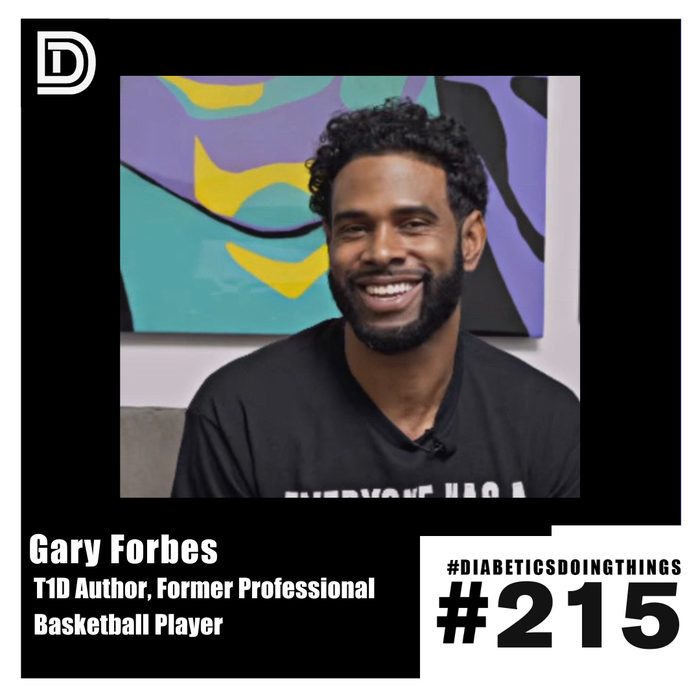
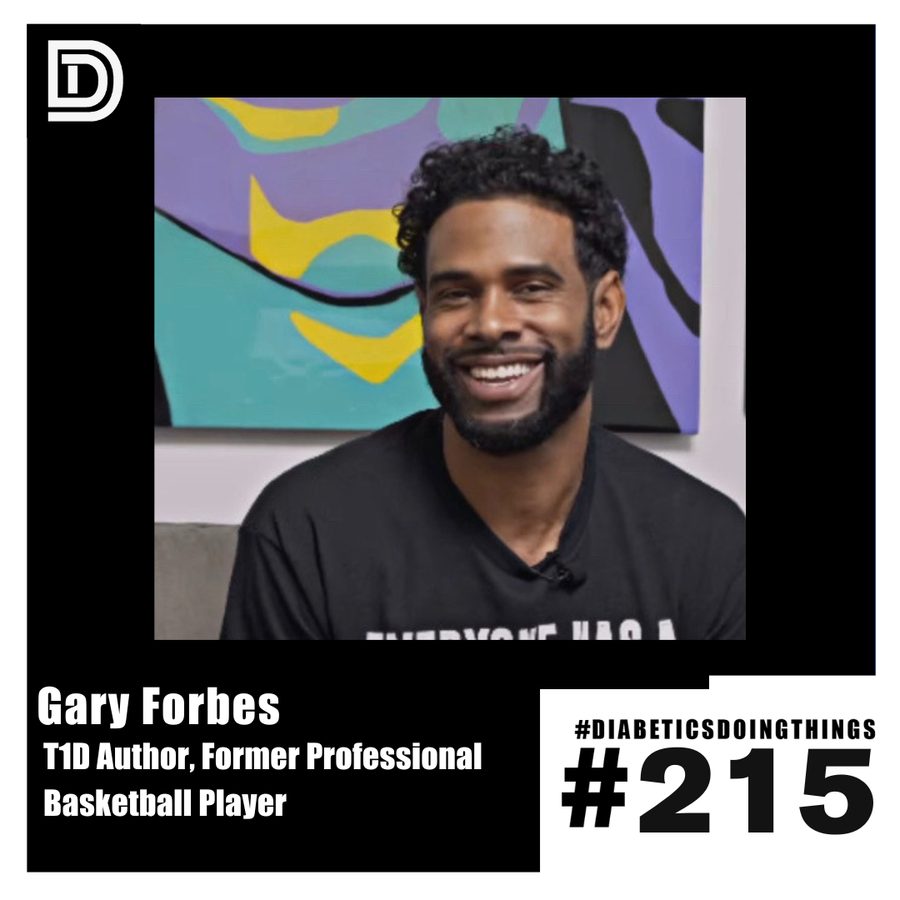
Gary Forbes, T1D Author, Former Pro Basketball Player

Episode summary
Gary Forbes played in the NBA with the Denver Nuggets and is still the most recent NBA player to have had type 1 diabetes. He tells Rob about leaving pro basketball and becoming an author, spending four years building Soul Survivors, a comic series about children living with chronic illnesses including diabetes, cerebral palsy, autism, leukemia, and lymphoma. Gary describes hiding his diabetes care in college bathrooms so he could feel like a normal student, his diagnosis at 19, and periods of diabetic comas and severe lows. He credits his father, an Olympic athlete who also lived with diabetes, for his mindset. Gary also talks about returning to basketball for one tournament with Team Defeat Diabetes.
Key takeaways
- Gary Forbes is the most recent NBA player to have played with type 1 diabetes.
- He spent four years writing Soul Survivors, a comic series about children living with chronic illnesses including diabetes, cerebral palsy, autism, leukemia, and lymphoma.
- Gary says he used to hide his diabetes care in college bathrooms because he didn't want to be treated differently.
- He says his father, an Olympic athlete with diabetes, shaped his mindset with sayings like mind over matter.
- Gary played for Team Defeat Diabetes in The Basketball Tournament and says he was the only player on the team with type 1 diabetes.
Show notes
This episode is sponsored by Gvoke HypoPen® (glucagon injection). Gvoke HypoPen® is an emergency glucagon for very low blood sugar in a convenient auto injector that is available in 2 pre-measured doses for adults and children.
Note from Rob:
I have partnered with Gvoke® before, and I’ve been working with Xeris Pharmaceuticals® since 2018 - I even interviewed their CEO back in March 2020. If you want to hear that interview with Xeris President & CEO, Paul Edick, from March 2020, check out episode 143 of Diabetics Doing Things.
I’m also really careful not to promote products that I don’t personally use and I have used
Gvoke HypoPen® for very low blood sugar before. I’ve told the story on this podcast before and I am convinced that if you are on insulin, you should have emergency glucagon around, just in case of a very low blood sugar, and I use Gvoke HypoPen®. Gvoke shouldn’t be used in patients with pheochromocytoma or insulinoma – visit gvokeglucagon.com/risk.
I also want to address that I will not promote pharmaceutical products without the opportunity to promote patient assistance programs because if my listeners can’t access glucagon, how can they use it to treat their very low blood sugar? So, if you visit the savings and support tab on GvokeGlucagon.com, you can get a $25 coupon for patients on commercial insurance plans, and there is a contact form to fill out for people not on commercial plans.
Now onto the show: Gary Forbes is back on the pod! In this episode, Gary and Rob talk about:
The transition from professional basketball player to author
Being the most recent player in the NBA with T1D
The Sole Survivors , a comic series about heroes with chronic illnesses
The superpower of words and attitude
His father, an Olympic athlete living with diabetes
Playing with Team Defeat Diabetes
For more details and important safety information, visit GvokeGlucagon.com.
Questions this episode answers
Who is Gary Forbes?
Gary Forbes is a former NBA player who played for the Denver Nuggets and lives with type 1 diabetes. He says he's still the most recent NBA player with T1D, and he now writes the comic series Soul Survivors.
What is Soul Survivors about?
Soul Survivors is a comic series Gary Forbes spent four years creating. It follows characters who are children living with chronic illnesses such as diabetes, cerebral palsy, autism, leukemia, and lymphoma, aiming to show kids a strong mindset despite those challenges.
Did Gary Forbes play basketball again after retiring?
Yes. He joined Team Defeat Diabetes for The Basketball Tournament and says he was the only player on the roster with type 1 diabetes.
Where can people find Soul Survivors?
Gary says the first volume was set to release on Amazon around the 2022 holidays, with later volumes sold at thesoulsurvivors.com.
Full transcript Searchable, with timestamps
Rob Howe: This episode is sponsored by Gvoke HypoPen, glucagon injection. Gvoke HypoPen is an emergency glucagon for very low blood sugar in a convenient auto-injector that is available in two pre-measured doses for adults and children. I've partnered with GVOC before and I've been working with Xeris Pharmaceuticals since 2018. I even interviewed their CEO back in March 2020. If you want to hear that interview with Xeris President and CEO Paul Edick from March 2020, check out episode 143 of Diabetics Doing Things. I'm also really careful not to promote products that I don't personally use, and I have used Gvoke HypoPen for very low blood sugars before. I've told this story on this podcast before, and I'm convinced that if you are on insulin, you should have emergency glucagon around just in case of a very low blood sugar, and I use Gvoke HypoPen. Gvoke shouldn't be used in patients with, and bear with me here, pheochromocytoma or insulinoma. Visit gvokeglucagon.com slash risk for more information. This announcement is especially important now because you may have heard that there are glucagon products being discontinued, such as Eli Lilly's glucagon emergency kit. So make sure that your prescriptions for glucagon are up to date by asking your doctor about GVOC hypopen glucagon injection. For more details and important safety information, visit gvokeglucagon.com. I also want to address that I will not promote pharmaceutical products without the opportunity to promote patient assistance programs, because if my listeners can't access glucagon, how can they use it to treat their very low blood sugar? So if you visit the Savings and Support tab on gvokeglucagon.com, you can get a $25 coupon for patients on commercial insurance plans, and there is a contact form to fill out for people not on commercial plans. We've linked gvokeglucagon.com and the savings and support resources in the show notes, as well as the important safety information. So thank you to Xeris Pharmaceuticals for your support of telling the amazing stories of people with diabetes all over the world at Diabetics Doing Things. Let's get to the episode. Welcome back to another episode of Diabetics Doing Things. We're telling the amazing stories of people with diabetes from all over the world and returning to the podcast. He's still the most recent person in the NBA to play in the NBA with type 1 diabetes, Mr. Gary Forbes. Welcome back to the show, man. Thanks. Thanks. Thanks for having me. Pleasure to be back. Well, man, you've been busy since, since you were last on the pod. I went back and looked, it was a, it was about this time of year. It was in 2018. We're going into 2019 and I was psyched bro. Cause like 10 years and it's been, you know, 15 years almost now since you were playing for the nuggets and I was in college in Colorado Springs playing basketball and seeing you in the NBA was It's like, man, there's somebody out there doing what I want to do with diabetes. And that just gave me so much, so much hope, man. So I'm always hyped to have you back. Then you were, you're about to go play overseas in Saigon, I believe was you're about to go over there. And, and now obviously like post, post pandemic, you know, a couple of years have gone by. What are you up to, man? How are things?
Gary Forbes: Well, now, uh, currently I'm an author. I know this is my my second act and my you know in my journey this life you know it was a it was a I guess it was a grind um you know getting to this stage I have this comic series Soul Survivors that is set to come out three weeks and you know it was just it was a new new challenge for me and you know it got me excited every day it was something that plays that same passion that i have basketball and finding my purpose
Rob Howe: and i'm we're i'm psyched to talk about soul survivors we're gonna talk about that a ton today because you even brought it up to me last time or like over the years we've been talking and keeping in touch about you know your journey and kind of transitioning from uh, athlete to author. And I'd love to know, even just like personally, like there's a lot of routines that go with like getting to that pro level. And like, you know, I, you, you were always like sharing your workouts and like all work is easy work. Did you apply that same all work is easy work to being an author? Because you got to get, get up every day and, you know, return to the page and keep, and keep writing, keep, you know, fine tuning and getting everything ready. How did Did you apply that mentality to writing as well?
Gary Forbes: Yeah, I did, man. When I first came up with the whole concept of Soul Survivors and started writing, I've always been a good writer. Even in college, I was great at writing essays and all these reports and things like that. So the skill was there, but writing a comic series for the world to see was a whole different aspect of it. I started four years ago with this in 2018. And I thought it was gonna be like, all right, I'll write the book, 10 chapters, and it's a book next month or something like that. But over time, just things getting better and sharpening and editing and things like that. And new concepts coming to mind, And I was able to grow to what it is now and seeing where it started four years ago to now. I put my 10,000 hours in. You have to put 10,000 hours to become a professional or something. Or year four, I kind of calculated how many hours I really spent in a day. And it added up to around 10,000 hours.
Rob Howe: and I've done it. It feels amazing. So you're seeing it now like four years of work and now three weeks away at time of recording. It's December 8th right now. We're going to publish this next week. So by the time the public is hearing this, like two weeks away from the release, how does it feel?
Gary Forbes: It's amazing, man. I've been around so much and I've talked to people year after year, from it being just an idea in my head to it being on paper, illustrated, and I have content and videos out and things like that, to seeing that growth from my mind, from my dream or my aspirations and finding a purpose to paper and all over the world. it's a good feel of accomplishment and just knowing that the same routine that I did with persevering and fighting to become a basketball player is the same skill set and the same routine I did with this.
Rob Howe: Man, I've been also reading, we were talking a little bit before we started recording, I've been reading a lot more the last couple of weeks, getting back in my routines and it's consistency. You know, everything is everything. Like how do you approach one thing is how you approach everything. And, you know, so yeah, whether it's sports or creative outlet or advocacy efforts or just personal goals, like showing up and keeping the work going is the only way to make it happen. Talk to me a little bit more about that though. Like that transition of like, did you, cause, cause you're not, are you officially retired? Are we calling it that? Or are we, are, you know, are we just saying, you know, you might show up to open run and like shut it down but uh like are we officially you know you're not you're not uh looking to join teams
Gary Forbes: anymore no no definitely not looking to join teams but i hope i hope every saturday right i hope every saturday so you know it's the new new life for me but you know i'm enjoying it it's something that i know i was put you know here to do yeah and you know it it actually really replaced that same love and joy and passion that I had in basketball.
Rob Howe: Right. So like you're now like, you got to wake up and you know, there's nobody cheering for you in the morning. Just like, just like it was when you're up running on the track or running bleachers in the morning for, for preparing to play basketball. So what was that like for you? Like, you know, now is it, is it just the same kind of approach just in a different way? Uh, how have you, you know, just, I don't know. You said that you've been a writer for a while and that you've always kind of been drawn to it. How does it make like the, how is it different how how is gary forbes today different than gary forbes the athlete
Gary Forbes: like four years ago or five years ago when i was thinking all right you know my career coming towards my errands you know i'm not getting obviously the same views anymore and you know getting older new new book of talent is coming in and you know i understand getting basketball um the business side of it and i was you know just thinking like all right what do I do next? And a lot of athletes do have that issue and what's the next act? I do love basketball, but something didn't drive me to become a coach or a trainer or something like that. And I knew I wanted to leave a legacy behind. I knew I wanted to make an impact and a joy, you know, inspiring and helping people. And I wanted to use, I guess, my disability, I guess, and, you know, show all the, you know, perseverance and the difficult times that I was able to overcome with the mindset that I have and just the joy and passion,
Rob Howe: just living life as long as life. I love that. And when you talk about like a legacy, I know watching your videos recently i see a lot of comments from other uh people living with diabetes and and their parents as well like hey my you know my son or my daughter looks up to you for what you've done like how how connected are you or like what is that like for you like in this stage to see not only like it's it's your your previous accomplishments but also your present uh and future like as a as an author and storyteller like seeing those come together and impact people
Gary Forbes: Man, like, I remember I've always talked to friends and, you know, they always, they always told me, you know, I have a story to tell. I've never been, you know, that outspoken of having that. It was just as, you know, at the time when I was becoming a professional basketball player, it wasn't something that's talked about. There wasn't a podcast out, you know, it was something that was like a secret. and it was like if you had this you know you're kind of like look look you know look down on and
Rob Howe: look lessen yeah let's let's call it what it is there's a lot of stigma around diabetes that affects people of all abilities and disabilities it really does right and you know it was something
Gary Forbes: that you know i i struggle with to you know to be open about you know especially in college you could go to run to the bathroom and you know either check my sugar or give myself injections because I didn't want anyone asking questions or feeling bad about what I have. I wanted to be a normal college student and being accepted just like everyone else with no questions about my health. Having diabetes, you kind of want to feel like you have it in control because it's your body. No one understands what you're going through and you get moody sometimes and things like that.
Rob Howe: Wait, I need to talk to you about this because I did the same. I do the same thing. I think like now as an older, like more mature guy, I can say like, oh, well, that's because you feel attacked, you know, and you know, when you're like, but I remember some of my worst diabetes moments were when I had to like come out of a practice or I felt like I felt like my team was doing something like a conditioning day or something without me. And like, you know, we're sitting around later and I know they're all like, come on, Rob, like you didn't even go through half the session. I was like, I feel bad. I wish I could tell you guys what this is about, but I also don't want to make it about me. It's tough, man. I think it's good to talk about this stuff. We are quick to celebrate, myself included, you doing it at the highest level, but it's also just so normalizing. It feels so good to hear you say, yeah, I had some bad days on that path.
Gary Forbes: Right, right. I did, I did, man. And I think those, those bad days, I guess it grown me and made me just more, just knowledgeable about things that, that people both do through life. or not, even though diabetes is something that's different from everybody. Like me and you might have the same exact meal at the same exact time. And our blood sugar levels would be different, you know, in an hour or so, which is crazy. It's sometimes then we could do the same thing tomorrow and our numbers would be different. That's my body. And, you know, it's something that, you know, with what I'm doing, you know, I can help so many people because I've been through everything. I've been in a diabetic coma. I've had so many low blood sugar episodes. I've been in the hospital various times. But as you know, having that energy or an emotion of feeling down about yourself can't hurt yourself as a diabetic. And I've had that. And I think that's what's that, I guess, nonchalant or hopeful attitude about life and just focusing on the positive, I think, is helping a lot.
Rob Howe: Just a reminder that this episode is brought to you by Gvoke HypoPen, glucagon injection. If you are a person on insulin or sulfonylureas, you should have glucagon. Gvoke HypoPen is a glucagon auto-injector for very low blood sugar that can be used in just two steps. whenever I have a very low blood sugar, I'm glad that I have GVOKE. Talk to your endo or visit gvokeglucagon.com today. Well, I think being able to, and I think you talked about your mindset earlier, being able to take the negative with the positive and not let either one get you too high or too low. I mean, well, it's hard and it's practice, right? So, and like, that's the difference to me. You know, people talk about, you said 10,000 hours to be a professional. I totally agree. But also like the difference between an amateur and a professional is like when you got no inspiration, when you have no energy, when you have no reason to show up, you show up anyway. And so, you know, when I see, you know, professional diabetics, like, you know, people are like, you know, this low blood sugar hurt, but it's not going to stop me. This high blood sugar sucks, but I'm going to continue to go and do what I can fight for what I want. So I promise there's a transition in here somewhere to these superheroes. So the soul survivors, this story, all these people are different. And it's not just people with diabetes. There's other chronic illnesses represented, and they are this unit. So tell us, what are we going to find here in the next couple of weeks?
Gary Forbes: well i always loved comics books growing up cv comic series x-men power rangers conan and all those things growing up so you know i wanted to do something that you know i love it and enjoy as well as use it as an inspiration and you know i know that there's millions of diabetics out there and I knew that my reach was you know is I have a platform to speak and I wanted to you know make it a very impacting story and having this it's unfortunately this pandemic of you know children with so many of these chronic illnesses cerebral palsy the autism, leukemia, lymphoma, and all these things that I'm introducing in a book. And there's so many great people that have done great things with these, despite having these health challenges. And I wanted to show children how to have that strong mindset, despite having these stigmas. And it's something that I'm excited about every day, especially seeing parents that are reaching out to me and thanking me for for doing this and and the way that i'm doing it and i'm feeling so excited about this and i know it's gonna be a
Rob Howe: very impact impactful story well you know you see with kids like you it's so interesting like i don't know where some somewhere in like adolescence or adulthood we start to like get afraid and like we to look at ourselves differently, but like kids are so quick to accept each other. And so, you know, when I look at like a diabetes camp and I haven't been back since the pandemic, but I'm hopeful to go and visit a couple of camps here in the future. But at a diabetes camp, there's, you know, 500 kids there and they all have diabetes. And so right off the bat, like there's no, everybody already knows what the other ones, you know, at least on a surface level going through. And you see them kind of help each other and influence each other. And it's all on this like platform of support and acceptance. So I'm so excited for people who aren't aware of some of these other, you know, chronic illnesses that, like you said, are affecting millions of young people in the world. Uh, I hope that the results that, you know, we're not going to be able to see, uh, one-to-one, but there will be someone somewhere living with one of these diseases. And I'll pick diabetes as an example, just for this podcast, but somebody has encountered your story and your comic book, and they are able to meet somebody later with diabetes. And immediately they can say, you know, Hey, I, I connected, I can connect with you. I know a little bit about you through this story and Hey, I'm not going to treat you differently. I am going to accept you as you are. And I think that like those little micro interactions can start big time, like make a huge difference. I used to talk about on the podcast a lot, the first 15 minutes of your diagnosis can set you up for success or failure for the next year, because it's just a long learning curve and you got to know it's like not your fault and like, you're not alone. But if you don't hear that right away, you know, it might be a really tough road. So I'm psyched for, you know, the roads that are going to get smoothed out and the good things that
Gary Forbes: are going to happen from this book um it's crazy he said the first 15 minutes of being diagnosed i remember it i was in the trainer's office and he rolled down the blind lines and you know i was kind of like all right what is this guy but tell me it's just like why you know why can't i see anybody anymore and you know he said you got type 1 diabetes and you know they're going to send me to the nurse to, you know, practice, you know, being able to take injections and needles. And I was just like, okay. You know, they told me I would have to take like a week off of practice just to get acclimated. And I'm thinking like, all right, this is, you know, why does this feel serious? But, you know, I'm in college. I'm 19 years old. I'm thinking about trying to become a pro basketball player. And it, you know, it just went in one ear and out the other. and I know other people don't have that same experience or maybe that same mindset, but I just thought about it like, all right, I have diabetes. I've seen my father with it and live with it. All right, let's go. What do I need to do? What steps do I need to take to not only be at the highest level playing basketball, but able to manage, you know, living with diabetes. And it's been an experience every year, you know, of either, you know, gotten better or sometimes, you know, things, you know, go the other way. And it's a learning curve. And with just, just with life, like it's almost like living, living two lives. Like, you know, you've got to grow up and learn the learning curve, being out in the real world, as well as every day living with diabetes. and it's something different every day, which is a believable kind of thing to live with.
Rob Howe: And, you know, sometimes it feels personal too. Like right when you're the most tired or like you're the most like at the end of your rope, like an alarm will go off or you'll feel a little blood sugar coming on or you'll just be like, all right, come on. Like this is just too, the timing is too perfect.
Gary Forbes: Right. It's crazy. And I think the biggest thing about social robbers that I feel is everyone knows someone with one of these health challenges. And that's the connection and removing the stigma from being able to see people with these things and being able to know about it and understand what they're going through. There's no judgment and, you know,
Rob Howe: everyone feels included in this life. When you look back and you think about like those moments, those highs and those lows, like today you shared a note that you wrote yourself and you talked about it on the last time that you were on the show and it's on that Marriott scratch pad. So, you know, for you, like you talked, we talked a lot about mindset. I think it's so clear, like the way that you're able to handle, you know, highs and lows of life and highs and lows of diabetes without judgment. How do you, you know, where does that come from? Is that like, you mentioned your, your father and i know he lives he lives with diabetes and was an olympian with diabetes before you know we had the tech that we have today a real real you know a pioneer and like where does that attitude come from where does that mindset come from i think it honestly comes
Gary Forbes: from him you know he always gave me these cliche sayings and mind over matter and it it truly resonates with me because they kind of make me build it i came out with this this quote saying doubt your doubt before you doubt your pain. And it kind of pays no dividends to doubt yourself if you haven't even tried. And I've always had that optimistic view on everything that I do. I always think I could do it. Even if we were playing the number one team in the country and our record was one in 16. I honestly believe that we can beat this team or honestly believe that, you know, every year I'm going to get better as a diabetic or, you know, just anything like, you know, writing this book, I've written it down four years ago that I'm going to be a New York Times bestseller for this comic series. And it's, you know, why not? You know, Rutherford has that saying, like, why not? So, you know, I feel the same way. Why not try to be, you know, the best that you can be? Sometimes you fail and every, you know, failure is a part of, you know, success. And, you know, I've always felt that.
Rob Howe: Well, and I think what it really comes down to is like, you know, you don't average close to 30 points a game in college without that mentality. You know what I mean? That's a shooter's mentality. That's a bucket getter. So, you know, the way I was talking to my wife about it the other day, because she was having a hard time with like a particular project and. And, you know, she didn't grow up playing like sports. And so this is kind of like the my my pitch for an advocacy for sports. And like you learn lessons, you learn how to win, you learn how to lose. You learn how to put that effort out. And you also learn that the best opportunity, like the best outcome is still possible. So, you know, when you're visualizing that and your words have power, you know, you used to do, you know, you go to a camp and somebody come in and like, imagine yourself shooting a basketball. It's like, well, did you make it or miss it in your mind? And it's like, in my mind, it was always going in. Like, I didn't understand why I would look at it. You know, the point is to put it in. So, yeah, I believe there's superpower in the words and attitudes. And that is why I love people when people play sports, because you learn, you learn how to fail, you learn how to suck, you learn how to be a beginner and work your way through it and apply yourself and learn how to love something, even when it's hard. And I think that's valuable, valuable lessons. And, you know, now I'm making it off my soapbox. So speaking of sports, your life as a diabetes athlete is not completely over because you played in the basketball tournament, which for those who are not real hoop heads, is a awesome tournament that started up about five, six years ago and had a million dollar prize. I think it's like a two million dollar prize now. And a lot of like college teams get their alumni together and now charities are getting involved in team defeat diabetes, put their first team together this year. and you were a signature member. I think you were the only member who lived with type 1, if I'm not mistaken.
Gary Forbes: Yes, that was true for sure. It was an honor for them to even call me. You know, I've been retired, I guess, for three years or so. And, you know, it's something I couldn't turn down because it was for, obviously, for a great cause. And I just felt connected to what they stood for, what I'm going through and the message that would show to any child living with or anybody living with diabetes that you can still do great things. And, you know, just representing them made me feel great. I was honored. And I can't wait to go again next year. I got to stay in shape. So I got to up my basketball workouts.
Rob Howe: Those Saturday workouts, I feel bad for those guys that are lacing them up next to you, just getting off their 9 to 5 for the weekend. And they got to pick up Gary Forbes in the pickup game. That's tough. Well, man, give us the plug. Where can we find, in a couple of weeks, what's our official release date, and where can we find Soul Survivors?
Gary Forbes: We're looking at three weeks from today. The first volume will be on Amazon for the Christmas holidays, and in January, we'll be selling them on our site, www.thesoulsurvivors.com. and after I think March you'll be releasing volume two there's seven volumes in the first book series so you know it's a great story it's a great series and I was so excited to just to show the world and show so many people you know the inspiration that these characters can give powers that they possess you know the daily struggles that they go through living with these health challenges and you know just overcoming them through you know through perseverance and you know just that that that sense of hope for like a better tomorrow because you know every day is a new challenge and you know every day you have to wake up with that same fighting attitude and and really go after it and I can't. So my favorite series, my favorite series is book two. So you guys are going to have to read along and get introduced to these characters. They're a great team. They're a great inspiration. I can't wait for everyone to meet them.
Rob Howe: Well, we are very excited for you, man, and very excited to see the Soul Survivors. So we will be sure to include the link in the show notes. But man, Gary Forbes, thanks so much for coming back on the pod, man. He's Gary Forbes on Instagram with the underscore afterwards. So give him a follow on there and support fellow type ones who are going out and doing their creative projects, man. I'm super hyped for you. Thanks for having me.
Gary Forbes: I appreciate you.
About Gary
Gary Forbes is a former professional basketball player who played in the NBA for the Denver Nuggets and overseas, and says he is the most recent NBA player to have type 1 diabetes. He is the creator of the comic series Soul Survivors.