

Living With Type 1 Diabetes as a Touring Acrobat with Leah Orleans, Tiny Girl Big Show

Episode summary
Leah Orleans performs as Tiny Girl Big Show, a touring circus act built around archery with her feet, fire juggling, and roughly 300 shows a year at Renaissance festivals. In her late twenties, mid-tour, she ended up in the ER with an A1C of 14 and no health insurance. A doctor later suggested she find a desk job instead. She didn't. Instead she started writing comedy about diabetes, performs a song called Diabuddies with a giant cardboard pancreas, and now gets hands raised from the crowd when she asks who's diabetic. She and Rob talk through the real cost of living with type 1 on the road, the logistics habits that keep her safe, and the Big Nonprofit Insulin Party in Brooklyn on October 23, raising money for Project Insulin.
Key takeaways
- Leah Orleans landed in the ER with an A1C of 14 in her late twenties, mid-tour, with no health insurance.
- A doctor told her to consider a desk job instead of performing; she kept touring and now does about 300 shows a year.
- Leah says living on the road taught her logistics habits, like always knowing exactly where her supplies are, that carried over and became life-saving with diabetes.
- She asks food vendors near her stages to keep an insulin pen in their fridge for her, and says they've never said no.
- The Big Nonprofit Insulin Party happens in Brooklyn on October 23, raising money for Project Insulin, a nonprofit working to sell insulin at cost.
Show notes
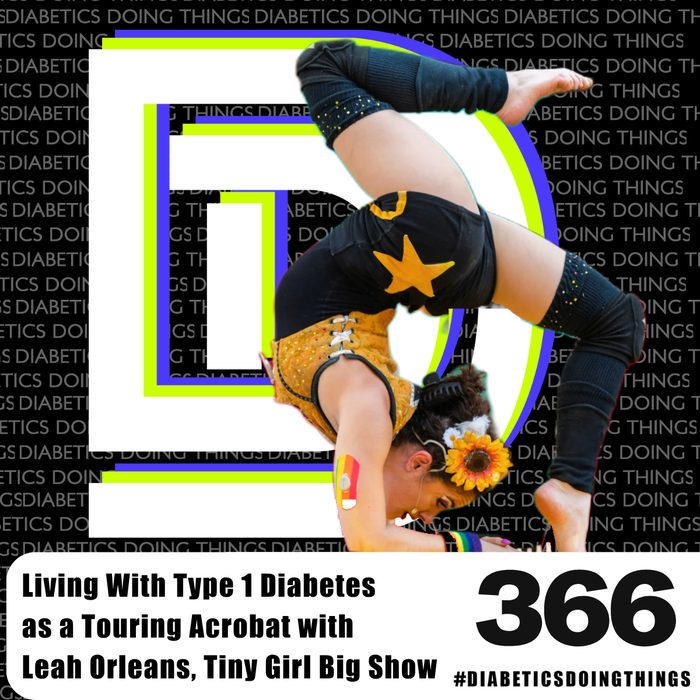
Leah Orleans shoots a bow and arrow with her toes, juggles fire, puts knives on her face, and performs around 300 shows a year as Tiny Girl Big Show. In her late twenties, in the middle of a tour, she landed in the ER with an A1C of 14. A few months later, a well-meaning doctor asked what other skills she had, and suggested she start looking for a desk job.
She didn't. Instead, she got loud about it. Leah started writing comedy about diabetes (it turns out it's a genuinely funny word), performed a song called "Diabuddies" using a giant cardboard pancreas, and now when she asks "Who's diabetic?" from the stage, hands go up all over the crowd. We talk about the $2,000-a-month reality of living with type 1, how the logistics skills of a touring performer turned out to be life-saving, and why she has convinced food vendors near her stages to keep an insulin pen in their fridge for her. (They've never said no.)
We also get into the Big Nonprofit Insulin Party happening in Brooklyn on Friday, October 23, benefiting Project Insulin, the nonprofit working to sell insulin at cost. And we land on a question I keep coming back to: what are you optimizing for? If you've ever been told to trade the life you want for the one that feels safe, this conversation is for you.
Chapters
00:00 Welcome and meet Tiny Girl Big Show
03:01 From touring acrobat to an A1C of 14
05:26 Following your passion versus healthcare security
06:13 Turning a $2,000 monthly bill into logistics
07:31 Diabetics are everywhere, even at Ren Faires
08:57 Why "diabetes" is a hilarious word
10:25 Diabuddies and a giant cardboard pancreas
11:22 Health content doesn't have to be sterile
13:13 The Big Nonprofit Insulin Party in Brooklyn
14:24 Why Project Insulin's mission hits home
17:02 The doctor who said find a desk job
20:10 Advice: pick the problems you want to solve
22:43 Systems, habits, and insulin in strangers' fridges
24:12 What are you optimizing for?
28:25 Where to find Leah and her diabetes content
Resources:
Tiny Girl Big Show Website & Schedule
The Big (Non-Profit) Insulin Party Tickets
Questions this episode answers
Who is Leah Orleans / Tiny Girl Big Show?
She's a touring circus performer who does about 300 shows a year, mostly at Renaissance festivals, where she shoots a bow and arrow with her toes, juggles fire, and puts knives on her face.
How was Leah Orleans diagnosed with type 1 diabetes?
In her late twenties, mid-tour, she landed in the ER with an A1C of 14 and no health insurance.
What is the Big Nonprofit Insulin Party?
It's a fundraiser presented by Tiny Girl Big Show on Friday, October 23 in Brooklyn, benefiting Project Insulin.
What is Project Insulin?
A nonprofit, founded by Eric, working to create insulin that gets sold at cost instead of at current market prices.
Full transcript Searchable, with timestamps
Rob Howe: Hello listeners, welcome back to another episode of Diabetics Doing Things. We're telling the amazing stories of people with type 1 diabetes from all over the world. And I'm very excited for today's guest. Her name is Leah Orleans. You may know her as Tiny Girl Big Show across social media, where she has over 1 million followers across all of her platforms. We talk a lot about her early days of diagnosis and how she lives a creative life. And when I say she lives a creative life, I'm talking a really creative life. She's living life on the road. She's doing 300 shows a year as part of Renaissance. festivals. She's living authentically. She's having fun. And she is also, as we learned, a little bit of a logistics expert because she's living on the road 24-7 with type 1 diabetes. And most importantly, we want to promote that she is putting on the big nonprofit insulin party, which is presented by Tiny Girl Big Show. And it is a fundraiser, a chaotic diabetic fundraiser show benefiting Project Insulin, which is advocating for an affordable future. So Project Insulin is working on creating a new insulin that is affordable and will be sold at cost, hopefully change what it means to live with diabetes here, or at least to access insulin here in the United States. So all of the proceeds from the show, Friday, October 23rd, the big nonprofit insulin party in Brooklyn, New York, presented by Tiny Girl Big Show. So give it up for Leah Orleans. Guys, who was MVP of the chat? tiny girl big show what's happening thanks for thanks for joining the show it's an honor and a pleasure it's fun i've been following your stuff for a while since i got diagnosed really and i'm really glad we were able to connect special yeah me as well you are i think we're gonna have a really great winding conversation today and we got some really cool stuff coming up that i want to make sure that we promote and there's also some opportunities for people who hear this podcast who are in the right area to be able to see you perform in a t1d community capacity very soon
Leah Orleans: i'm so excited it's the coolest merging of my wild and wacky career and my wild and wacky chronic illness both things at the same time i love your tape that you've got to show the tape to the thanks my girlfriend did this and it's ridiculous and she just we didn't have a proper SkinGrip shout out to SkinGrip for always keeping me attached but whenever she's around when i need to do a site change she just doodles all over it so there's like so cool an angry spooky upside down
Rob Howe: man here on my Dexcom and for those listening at home it's a collage of epic proportions of different SkinGrip tape this one has polka dots on it yeah this is gonna be great for the clips for this for social so yeah if you're if you're listening the podcast is also available on video on YouTube. So check it out there. So Leah, let's talk a little bit about, I love the perspective that you're taking what you're given and turning it into something beautiful and turning it into art. Let's connect that to your diagnosis story. You were diagnosed in your late 20s. Why don't
Leah Orleans: you walk us through what was going on at that time? For those of you who don't know, I am a touring acrobat. So I have a show that travels all across the country. I drive most of the time, but I also fly sometimes. I'm on the road for about eight months a year and I've been this way for 15 years. So my life is very mobile. I love it. It fits my personality and my lifestyle, and it supported me through so many things. I perform, and I emcee, and I host, and I speak, and I do a lot of on-mic entertainment. And then I also have kind of an internet personality that comes with that on socials. So I'm creating content all the time. And I was already doing all of this before diagnosis. This was just who I was as a person. In my late 20s, very healthy athlete i'm a professional athlete circus performer gymnast type kind of body and suddenly things stop working right i start to get weird vision my weird stuff is happening with my pee that the listener and i are not close enough to know about but it's weird although it's like is there
Rob Howe: is there anyone who would know more closely what you're talking about than the listener because you know that's true you know what you're right you've probably looked down and gone why is this
Leah Orleans: so foamy, right? Why is my pee bubbling? Why is it effervescent, right? That wasn't a good sign. I get my a bunch of blood work done and everything is fine except for my A1C. So here we are at 14. I wind up in the ER. I'm in the middle of a tour in between performing weekends. I shoot a bow and arrow with my toes. So I'm active, you know, like I'm doing crazy things. I'm like in the doctor's office. Like, can I go back to work this weekend? And they're like, yeah, I guess if you've been doing this up to this point. So fast forward a few months, I'm diagnosed as diabetic. I don't have health care. That is, you know, good. I wind up with a billion dollars of bills and I am faced with the very real reality is that we are all just corporal bodies. But I keep performing. I decide to be loud about what I do. So I'm a comedian as well and I'm talking a lot about myself and my world and my illnesses in my show. And before I know it, people are like, me too, me too, me too. And now I have this amazing group of fans that are diabetic and they show up and I say, who's diabetic? And hands go up and it's so cool. And we get to connect and share and share resources too, which is really cool. That's the past four years in a diabetic nutshell.
Rob Howe: So there's this tension, right? Like when you're a creative person and you're diagnosed with something like type 1 diabetes that's going to require health care for the rest of your life, there's this tension to be like, okay, well, how do I choose what to do next? Do I still continue to live my creative life? Do I follow my passions? Do I stay true to who I am? Or do I shut some of
Leah Orleans: that down for safety and security on the other side of it? I had doctors tell me that I couldn't do what I do, you know, left to right. And I had other diabetics tell me that I couldn't do what I do or people that knew someone who was diabetic. My aunt's cousin's cat is diabetic. You shouldn't be an acrobat, right? Like that story. My aunt's cousin's cat has a job and like they, you know, require healthy, they got to stay gainfully employed, you know? Oh, I am my aunt's cousin's cat's dependent, actually. They're the one that gets health insurance. That's good. Which is how I can make it through as an acrobat. I mean, I was forced to have to be completely blunt and transparent to make a lot more money really quickly. I had to, you know, I had, I suddenly had a $2,000 a month bill to live, right? What my gear costs, what my equipment costs, how I need to be able to get a lot of them in advance. There's a lot of weird stuff I have to do to make that work. It's a logistical nightmare. But lucky for me, I guess I like logistics. I really do like that. And I already live a life that requires a high prioritization of know where your stuff is at all times because you're moving anyway. So if I know where my microphone equipment is and my circus gear and my irreplaceable one of a kind unicycle is, right, then I also know where my
Rob Howe: cancel this so i got to kind of use that skill to save my life which is it's interesting how like those skills or personality traits that we have as people show up again for us when we need them you know like they're obviously in order to be a traveling performer you've got to know where your stuff is you got to have logistics like you're your own tour manager you're your own stage manager you know your own props master like all these things have to come into play and it's amazing how those skills are sort of applicable i do before we move on from your story though i want to touch base on this because you said once I started to live out my life with diabetes and make it known that I was diabetic other people started showing up like these are people who are already in the
Leah Orleans: stands are already in the the theaters who were then raising their hands we're everywhere we are we're infiltrated we're in that conference room we're in that gym yeah and I'm performing for large crowds too at renaissance fairs if your listeners don't go to renaissance fairs it's like a big outdoor festival where people can come dressed up in fantasy wear if they want it's kind of like somewhere between the Six Flags, a farmer's market, and like a haunted house where there's like a theme. But it's huge. And some Renaissance fairs that I work have 15,000 people a day. So there are these large spaces and I'm performing on these stages with big audiences. So I could be performing for three, four, five, 600 people. So the percentage of one of them being diabetic is very high. Pretty high. It's just so cool, especially because I wear my gear out. if it's warm enough outside, which it usually is. You can see my pump. You can see my Dexcoms on my arms. And people go, you know, they point. They're like, it's me too. And we do this. It's great.
Rob Howe: Is that something that you did intentionally? Like, obviously, I think you're focused on the show and you're doing what you need to do for your diabetes to give you the space to be you. Were you surprised at all when people saw your devices and came up and like said, hey, like me too, or brought their devices and showed you, after the show or connected with you in that way? Or did that come about organically?
Leah Orleans: It made me cry every time. And it still does all the time. But it's very moving because I'm kind of this larger-than-life character when I'm up there, too. I'm juggling fire. I'm putting knives on my face. I'm doing scary, dangerous things. And kind of silly comedy. And I akin my character to a Nickelodeon female villain who kind of has that, like, she could do anything. she likes to play with danger but you love her and she's not a bad guy she's just mischievous and that also now having a chronic illness too it does add to the character which is silly but beautiful but it's also because she's a few steps above me as a person as well so i know that a lot of my comedy writing style and my writing style of how i want my show to go is personal. I talk about my personal life all the way on stage anyway. So if I'm wearing a weird ass looking thing, why not do material about it? Also, diabetes is a hilarious word. Like, it sounds funny. There are certain words that sound funnier than other words, and they make for better jokes. Words with hard K sounds and E sounds are funnier. And diabetes diabetes is hilarious and it i started writing comedy about it and it got laughs and i was like great let's go like why not because it's always top of mind for us right like so yeah and like any way to just get a laugh sure and it's inspirational too i find i find myself inspired to write about it and my partners as well like we wrote a whole diabetes song called Diabuddies that Chloe wrote and put together about how diabetes works. And it's like a four minute long school of rock style, giant cardboard cutouts. We have like a big fake pancreas. And it's really, really funny. And we take you through how diabetes is and then it gets really, really dark. And it's one of my favorite routines. Yeah. Being able to do it's really special.
Rob Howe: But again, you're tapping into something that's true for you and pouring your heart into it, bringing your community into it with your team and your writers and your partners. And then welcoming your audience into that and treating it as an awareness moment where it is something scary. I think a lot of people can get stuck on that fear, but then also being able to laugh about it and kind of take that power away. But through the art of being silly and also being true to yourself.
Leah Orleans: Yeah, we learn it better. And I think so much health stuff is done through the lens of PowerPoints and minimalist logos and trade shows and stuffy boardrooms and sterile hospitals. And like, why does it have to be that way? It can be branded in bright colors and be fun. And I'm seeing more and more diabetes industry people slowly looking that way, too. The younger generation is interested in that. What Rachel's doing with Chronically Illness is huge. just creating a space for queer diabetics, which, yeah, that's like super niche. But you know how quickly those people feel good and listen to and at home and loyal to the brand and interested in what they have to offer because they feel like this is for them? Because diabetes is so misunderstood. And I know we know this. I've probably talked about it all the time.
Rob Howe: No, but I think we want to feel seen. We want to know that there's space for us. We want to feel loved. And also we want to feel authentic.
Leah Orleans: I think you're right.
Rob Howe: Like nobody ever got inspired by important safety information on the back of medication. You know, like nobody ever was like, this is my moment. Here I am.
Leah Orleans: Right.
Rob Howe: And so being able to flip that.
Leah Orleans: That's why the party is happening. Like that's why this event in Brooklyn is going to be so special because it is all about making it. Yes, of course, it's about diabetes and about raising money for Project Insulin. But it's all about fun first. My job gets to be fun first. Eric, the founder of Project Insulin, his job is to make sure that his foundation is achieving what they want to as a nonprofit and then also awareness and raising money for their cause. And I get to come in and say, let's make this special and fun and silly. And we're doing some things that, you know, they'd never let anyone do at a giant diabetes corporate conference. But Eric's like, let's go, let's have fun. You know, it's for a different crowd.
Rob Howe: So let's talk about the party, the big nonprofit insulin party. which is Friday, October 23rd. So this is going to go live October 14th. So there's a little bit of time. So all you New York, greater New York area, Brooklyn, show up.
Leah Orleans: Brooklyn, where you at? We want the baddies. We want the rock stars. We want the diabetes people and those who love them. We want the queer friend groups who have their token diabetes. Like that's who this is for.
Rob Howe: Well, and I think too, anybody who wants to have some fun around diabetes, right? Like to take something that's very serious and let's add a little levity. I think there's going to be really something important when other diabetic professionals, you know, healthcare professionals, people who are used to going to different healthcare fundraisers and events come to this event and see this too because their relevancy is also in the diabetic world.
Leah Orleans: And they're like, whoa, I know that it's going to be that type of reaction. I'm hoping to elicit that type of reaction where people go, wow, this is really fun. I feel inspired and elated and hopefully also, of course, that turns into them being philanthropic, donating money to the cause and walking away with much more understanding of what it costs to have this disease.
Rob Howe: Why does the Project Insulin cause and mission resonate so closely with you? Obviously, you're putting the power of your community, the power of your profession and your passion towards this incredible event that's been done for the first time, nothing else like it. What made you say, like, OK, Project Insulin is the cause that I want to anchor myself to and throw the support of my community behind?
Leah Orleans: I think that I had a really great understanding very quickly about the concept of rationing insulin and how scary it was to be someone who didn't and doesn't make enough money to support this illness easily or has a job that, you know, the cost, it's the cost of insulin is so ridiculous. stimulus and being able to support an organization whose sole purpose is to neutralize that cost and make it as low as possible and sell it at cost and go around the big guys. And I think there's a really special place in my heart for people who pave their own path. And when Eric came to me specifically, he said, I'm just going to go around. I'm not going to try to change what's happening. They're too big. I can't fight it. Instead, I'm going to go around and we're going to make our own drug path and our own trial system. And I don't want to use a word that isn't exactly the correct term that he's going in. But you hear what I'm saying?
Rob Howe: I think you nailed it. I want to support that. Yeah.
Leah Orleans: I met him at the Friends for Life conference and we had a mutual friend and they were like, hey, Eric from Project Insulin wants to meet you. And I was like, okay, well, I had seen Project Insulin a few years ago when they first announced and kind of laid out their pathway. and my thought initially I was a little bit afraid that like this awesome idea wasn't going to get the support that they needed because it's just such a huge uphill like you said that there's all these barriers systemically that prevent this type of innovation from happening so I asked Eric that like did you ever sit down and wonder why this hadn't been done and he said yeah absolutely we knew it was going to be a really uphill battle but here's where we are today and we're actually on track to continue forward. And so that's why it was so important to tell that story. And I think also just as a, you know, a leader of a nonprofit, his background allows him a really unique perspective. He obviously has a tie to type one diabetes through his partner. And like, that is, you know, something I think beyond just the mission just obviously helps, you know, motivate.
Rob Howe: And so, you know, for yourself as well, it's like this idea that this next generation of people diagnosed in the middle of their life or whatever point in their life they're diagnosed have an option that doesn't have to take them away from pursuing something that could be their livelihood
Leah Orleans: or their passion. I'm at the height of my career and I had a doctor tell me that I needed to go find a corporate job. He was like, what other skills do you have besides being an acrobat? He was like concerned for me. It was out of concern and it wasn't his fault. You know, he just didn't really understand. He's like, what other skills do you have? I was not going to be like, well, I'm an entertainment marketer. I have an entertainment marketing degree. I do all of my I am marketing for my shows and I do logistics and things like that. He's like, great, well, I think you're going to want to start looking into that. You know, and I was like, the fuck? Like, well, I don't, I'm doing 300 shows a year. Like, I am at the height of my career. I am not about to just throw that away. What? So I could sit at a desk for a nine to five, which I've never done and never want to do in my life. I'm not cut that way. And so I think Project Insulin, yeah, it's an uphill battle. But there's also an uphill need. There's an uphill climb for anyone who's been through that. And there's millions, millions of us. I think it would be great if the people that need the money are the ones that get the money. And unfortunately, anyone that's socially aware with what's going on in our country right now knows that that's not happening. So I have seen success happen when people can be generous to the point where it doesn't hurt them when they realize, okay, if I can give away $3,000 and I don't feel it, how generous can you be to the point where you don't feel it, really? and the people who do have surplus who do have more than enough when they figure out that that the amount that that good exponentially changes the people that it helps instead of sitting in their own accounts that's how we change the world and and like reaching out and lifting each other up and like you know hand in hand i think reaching across like and reaching below reaching above like i think all those things like are yes i have been a recipient of that time and time again and since going more public about my illness, I have had people who have surplus, whether that's surplus supplies or surplus needs or DME or insulin itself. And they show up and they say, here, I don't need this. You do. And then I go, holy shit, thank you. And it changes my life.
Rob Howe: Right. And that's why I can still tour. Let's talk about that because, you know, I think someone could look at you from afar. They could read your amazing page that you sent me of your content portfolio. They can look at your success. Like you said, you're doing 300 shows a year. You're at the top of your game. And you're also still receiving help and supplies from your community to get you through the day to day. Because I know that there's someone out there, they may not be an acrobat, they may not be a professional performer, but they might have dreams of something like that. And they may be getting advice that's well-meaning, like the one that your doctor gave, which was the wrong advice, but it came from a place of care, right? It's hard
Leah Orleans: to say hey well you're wrong for making that yeah yeah but also a lack of understanding like dude doesn't know and that's not his fault he's a doctor he's he's like he's a doctor he has never seen me in costume like i get it yeah he's never had someone shoot a bow and arrow with their feet around him probably and then it might change his life five minutes later yeah truthfully i hope it
Rob Howe: does so but but for the young person out there who is weighing those decisions who maybe has been told by their parents, by their doctor, by someone in their life that cares about them, that they should get a corporate job to be safe and stable. How does that land for you? Like, what would you tell them? If you could, if you could like tunnel your way into their ear,
Leah Orleans: be an earworm, what would you say? Yeah, I think all advice is personal too. You know, everybody has their own capacity of what they want and how much stability makes them feel safe. What kind of stability makes them feel safe? And what kind of consistency makes them feel safe? And if they know and feel safe and will have a better, I will feel more stress if I know that I'm going to get a check week to week, but I don't get to move and travel and entertain people. Then if I don't know if I'm going to get a check every week, but I get to move, travel and entertain people. It's all about the problems you want to solve. So when it comes to your diabetes or something that is a limiting factor in your world, whether that is a chronic illness or a disability, you have to figure out what are the problems you want to solve and what are the ones that you really don't. and how to organize your life around that. And it takes time and sacrifice. I know that's kind of a vague answer, but when I was first diagnosed, I had a friend too who was an amputee. He lost his leg in a motorcycle accident and he's a circus performer as well. And we got pretty close during that time when I was first diagnosed and first dealing with it. We spent a lot of time talking about this topic of like, what are the things that are totally fine for you to handle? And what are the things where you're like, no, I don't want to have to deal with that. And the way that he would get around his apartment and he like hooked up all of these bars to the ceiling with these ropes. So he essentially could monkey his way around his space if he needed to before he wanted to put his prosthetic on for the day. So like he could get out of bed and go get coffee and do the things he needs to do in his house based on kind of the system he created. And yeah, setting up that system took time and effort and money. And it was difficult. He had to hire help to, you know, install these beams and blah, blah, blah. It took, it was like an incredible amount of effort. But once it was done, then he had a system that worked for him. And I take that with what I do a lot. And I create the systems that work for me. I have a juice box, a Dexcom and an insulin pen in almost every show bag, every backstage. Like I'm very strict about where my items are in space. And those are the systems that work for me. Therefore, when my freaking Dexcom stops working in the middle of a show day,
Rob Howe: I'm fine and I can click another one on and get going so man a logistical problem hates to see you and your friend coming because you guys I'm so serious though and I think there's a lot of
Leah Orleans: people out there who don't understand that when you create habits and systems you can release so much tension from your life and I know that we're ADD and we forget things and we say we're going to and we procrastinate and that's okay and you give yourself grace but like that's the only way that I get through this. And I think a lot of the doctors were like, oh, well, you're not going to have one backstage. I'm like, well, then I'm going to find the closest place that sells food near me and say, hi, I'm diabetic. This is an insulin pen. Please keep this in your fridge so that I always know that I have one by my stage. And if I need it, I'll come get it and I will come pick it up when we close at the end of the festivals. They never said no, you know.
Rob Howe: I 100% love that. Like, because it does take some self-advocacy.
Leah Orleans: like you have to have the courage right but but as a performer like you're gonna do way scarier things during your performance than asking somebody to hold an insulin pen for you to hold an insulin pen and also like what what if they say no that you you have a life threatening on us people want to help you like it's okay and then i always know i have one there and like do i mess up sometimes of course all the time you know and do we do things like this and and
Rob Howe: make it work anyway yeah but yeah figuring out the problems you want to have you and i could probably do an entire another podcast episode on like habits and logistics i would which i would
Leah Orleans: love to but the question that i've been thinking about lately i've been in a position to give people advice or like on panels and stuff recently and my answer to a lot of things is always like the big question of your life as an adult is what am i optimizing for and like what what do i want it's just it's a it's a way that's like a sneaky way to ask like what do i really want and it's a scary answer so like how do you decide how did you decide like this is what i want and how do i build a system to solve for it so that i can be who i want to be can i show you what that just did either way yes i like put it on a post-it note but i feel like the context is necessary of why this i love it this is my system of life i think i i ask myself a similar question a lot which is what are my metrics of success like what am i measuring to see if i'm doing well Sometimes that's the amount of shows per year. Sometimes it's money. Sometimes it's joy. Sometimes it's community time, time with my partner, time with my family, time with my friends, time with my alone. Sometimes it's footage, content. I'll do a gig for the content, for the footage, for the proof of it and the media. I think, in general, the big answer is I like to try to turn the experience of giving a lot of people together in real life a spectrum of different feelings. Tension, release, humor, catharsis, emotional introspection, and suspense. sets those if i can hit those and turn the ability to take those to make a bunch of people feel those feelings into money i'm happy that's what i'm optimizing for right i want to create experiences where people feel a range of emotions and i want that action to be monetizable so it can be my
Rob Howe: living that sounds like a show that i would pay for i don't know i don't know about the listeners
Leah Orleans: but like yeah yeah these are things that i that i like to see these are things that i want people
Rob Howe: to feel in the 45 minutes. Yeah. And that's what you can come to expect, I imagine, from the big
Leah Orleans: nonprofit insulin party. Yes, that's the goal. We're going to knock them down. And for those
Rob Howe: who are wondering, I do have a link to the tickets in the show notes. So for those of you in New York, we're going to share out this interview also in the diabetes groups in the New York area. So be on the lookout for that show. I wish I could go. My wife and I are we're pregnant. Our baby is due in December. So we're having a baby shower that weekend. So I won't be able to be there, but.
Leah Orleans: That's great. That's a great reason. Nope. Fantastic reason.
Rob Howe: It is. And you know, it's like right now for me, we were talking about what am I optimizing for, you know, I'm about to have a new set of priorities for the first time in a long time.
Leah Orleans: Yes. You know, like.
Rob Howe: That's crazy. Number one on my call sheet is about to get an upgrade. It's not going to be like me or my wife anymore. It's going to be our baby. And so I'm now like examining, I don't know, what I'm just describing in detail is just like a person in their midlife you know i'm just getting older and there are things that are changing and i'm excited about that like what systems will i have to implement what how will my metrics change metrics for success change as you know we continue to move forward and i don't know like the full answer and i think that's also exciting about it is that like i'm just leaving it open to what's going to change what's going to happen and like the things that are going to bring me joy that i don't even know yet are around that corner that's
Leah Orleans: such a special time and it's such an irreversible change too you're not just like going through something that's going to happen for a few weeks or even like a job change where it'll happen for a little bit but like you're now going to be a dad forever full identity shift and your wife's going to be a mom forever and your partnership is going to become there's going to be a result
Rob Howe: a physical result of it that's crazy proof physical yeah it is yeah thank you i'm so excited So, Leah, I want to make sure that we stay connected on, like, this is not your only show. Like you said, you're doing hundreds of shows a year. For people who are interested, like, maybe they can't make the show on October 23rd in New York, but they're like, man, I am dying to get into that show and experience tension and emotional introspection. And also maybe at a Ren Festival. And a motorcycle. You can wear all fears. Feel something with a turkey leg in your hand. That's what we all want, I think, ultimately. It's really fun. Where can they find your schedule or where can they see you?
Leah Orleans: Tiny Girl Big Show is the name of the show and the name of the handle. And my tour schedule is always on my Instagram and my website. Tiny Girl Big Show dot com. Tiny Girl Big Show. Instagram. TikTok. YouTube. YouTube has significantly more diabetes content on it, too. I have like a whole diabetes playlist with a lot of longer form stuff where I take you through Dexcom changes and walk you through some of my top tips to things I wish I was told when I was
Rob Howe: diagnosed things like that talk to me about your diabetes content like because obviously like you're a you know a macro creator as they as they would say in marketing boardrooms you know like you you've got like a million followers across your channels like how have you found like the diabetes content as being open to that part of your life how does that differ from some of the other content that
Leah Orleans: you make i like it i like it because i get to share the things that i wish that i was told i think a lot of it stems from that some of it is instructional some of it is you watching me struggle through the very large realities of being on the road with this illness. I love the comments and the feedback from people who are diabetes caretakers. So they'll message and be like, oh, my son is diabetic and I showed him this or my partner's diabetic and I showed them this and watching your partner care for you. My partner right now has a Dexcom on her. She is not diabetic. We are doing a system of her experiencing what it's like to have that much insight and reading and comparing our numbers. And I love getting to create this type of content because then it, I just hope it helps people, really. It creates a snowball effect very quickly.
Rob Howe: Ooh, say more.
Leah Orleans: Where people go, wow, I got to see something that's not so sterile or, you know, formal. One of the videos I did was reacting to, I went to like the Boston Medical YouTube page and found a video of how to inject insulin. And my YouTube video is me reacting to that video. And it's very funny. It's very silly because it's just so sterile and so creepy. She like injects into this dummy, this rubber thing that's lying in a hospital bed. Obviously, I'm not going to feel like I could do anything if the model for what this illness looks like is a rubber dummy lying in a hospital bed. I want to change that narrative.
Rob Howe: I think you're doing it. So like you said, I think there's momentum. We only can exist in the timeline that we're on, but someone is going to see that. They're going to change something for themselves, which is going to empower somebody else.
Leah Orleans: and you know i think that's what community is all about right we give what we can to each other and share it and and be open and be willing to commit and show our hearts on stage in some ways on video
Rob Howe: in other ways even just in person-in-person interactions i am having big fomo that i'm not
Leah Orleans: going to be there on the 23rd so it's okay it's where are you based i'm in dallas so like i'm i'm
Rob Howe: a little bit far away anyway but i might be doing sounds like there might be a ren fair
Leah Orleans: there might be a texas show i don't work the renaissance fair near dallas there is a Ren Fair near there. I don't work at that one, but I might be trying to come through Dallas in the
Rob Howe: spring. So let's keep in touch. Well, I'm going to have to keep an eye out on tinygirlbigshow.com. Big heart as well, I would say. And thank you for sharing it with our listeners. This will not be the last time that you were on the podcast, but now that I know more about you as a logistics expert, I know that you have an important thing that you've got to get to. So I want to make sure
Leah Orleans: I do, but I really appreciate you respecting the time.
Rob Howe: Also, I want to talk about Notion with you because I love that you're a Notion.
Leah Orleans: I can't wait.
Rob Howe: The Notion pod?
Leah Orleans: There might be like three listeners, but we're going to dig in.
Rob Howe: Oh, no.
Leah Orleans: I'm in.
Rob Howe: I'm in.
Leah Orleans: I'm in.
Rob Howe: Cool.
Leah Orleans: Nice to meet you. Congratulations on the baby, and we'll talk soon.
About Leah
Leah Orleans performs as Tiny Girl Big Show, a touring circus act that does about 300 shows a year, mostly at Renaissance festivals, where she shoots a bow and arrow with her toes, juggles fire, and puts knives on her face. She was diagnosed with type 1 diabetes in her late twenties after landing in the ER mid-tour with an A1C of 14.