

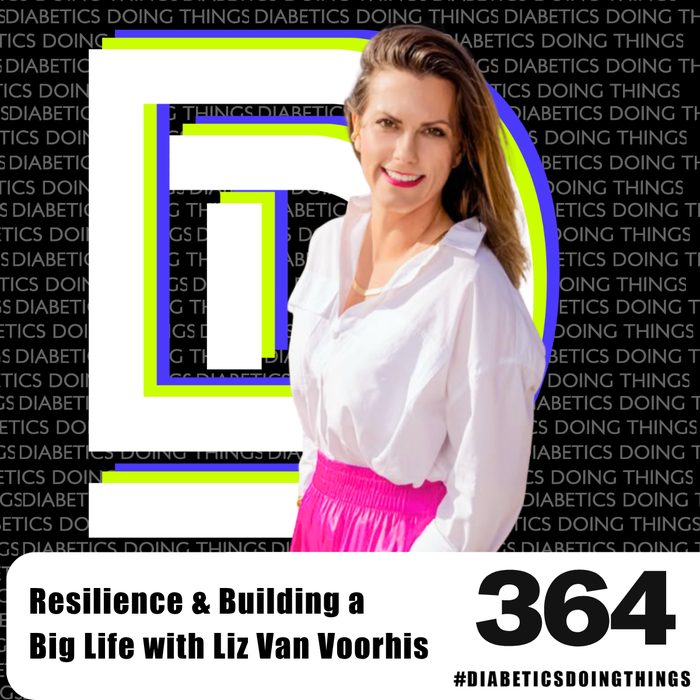
Resilience & Building a Big Life with Liz Van Voorhis
Episode summary
Liz Van Voorhis was diagnosed with type 1 diabetes at 15, arriving at the ER during spring break with a blood sugar of 1,200 and a weight of 78 pounds. She built a 15-year corporate career before her mother's death from brain cancer led her to quit and spend a year teaching 15 spin classes a week in New York, where her studio became a gathering place for other people with type 1. She later founded The Fit Collective, building wellness programs for brands including Equinox, Peloton, and Lululemon. She and Rob discuss the values exercise she still uses every New Year's Eve, organizing diabetes supplies for displaced families during the 2025 Los Angeles fires, a major financial setback, and why she waited years before switching to Omnipod.
Key takeaways
- Liz Van Voorhis was diagnosed with type 1 diabetes at 15 with a blood sugar of 1,200, after losing 20 pounds in three weeks.
- Liz says doing hard things strengthens a specific part of the brain, so resilience is a skill that improves with practice.
- During the 2025 LA fires, Liz helped organize more than 400 volunteers to deliver diabetes supplies to about 50 displaced families.
- Liz avoided switching to Omnipod for years out of vanity and says she regrets waiting, since it brought her blood sugar into range.
- Rob says diabetes does not get easier, but people get better at managing it over time.
Chapters
- Meet Liz and the Thailand retreat
- How the 2015 diabetes Instagram connected us
- Diagnosed at 15 with a 1,200 blood sugar
- From church-basement aerobics to corporate career
- Losing her mom and blowing up her life
- Teaching spin and finding her T1D community
- Alignment and the courage to walk away
- The values exercise that changed everything
- Organizing diabetes supplies during the LA fires
- It doesn't get easier, you get better
- Breakthroughs, a $1M loss, and a stolen car
- Meaning-making vs. "everything happens for a reason"
- Identity, basketball camps, and embracing who you are
- Tuning out the noise and never drinking
- Omnipod, Dexcom, and getting over vanity
Show notes
At 15, Liz Van Voorhis landed in the ER on spring break with a blood sugar of 1,200. She weighed 78 pounds. She had two questions for the doctor. First, when could she get back to cheer conditioning? Second, did this mean she couldn't finish her Halloween candy? It was April. That mix of grit and humor is Liz Van Voorhis.
Liz is an executive coach and founder of The Fit Collective. She has built wellness programs for brands like Equinox, Peloton, and Lululemon. She tells Rob about the 15-year corporate career she walked away from after losing her mom to brain cancer. She also talks about her "brain sabbatical" year teaching 15 spin classes a week, where her class quietly became a safe space for people with Type 1 all over New York. She explains the values exercise from 2004 that she still revisits every New Year's Eve (her birthday) to decide what gets her commitment.
They also go back to the January 2025 LA fires. Liz used her retail-operations background to help organize more than 400 volunteers and get diabetes supplies to around 50 displaced families, which earned her the self-appointed title "diabetes drug dealer of Southern California."
Along the way, Rob and Liz dig into several other topics:
Rob's thesis that diabetes doesn't get easier, but you get better at it
A million-dollar business loss
A prayer for financial abundance that was answered by a stolen car
Why "we are meaning-making beings" beats "everything happens for a reason"
Why Liz put off switching to Omnipod for years for purely vain reasons, and how much she regrets it
If you've ever wondered whether you can build a big, beautiful life with or without type 1, this one's for you.
Chapters:
00:00 Meet Liz and the Thailand retreat
01:38 How the 2015 diabetes Instagram connected us
03:13 Diagnosed at 15 with a 1,200 blood sugar
08:11 From church-basement aerobics to corporate career
11:41 Losing her mom and blowing up her life
13:00 Teaching spin and finding her T1D community
14:13 Alignment and the courage to walk away
15:45 The values exercise that changed everything
18:51 Organizing diabetes supplies during the LA fires
26:04 It doesn't get easier, you get better
30:09 Breakthroughs, a $1M loss, and a stolen car
35:19 Meaning-making vs. "everything happens for a reason"
36:44 Identity, basketball camps, and embracing who you are
38:42 Tuning out the noise and never drinking
43:29 Omnipod, Dexcom, and getting over vanity
Resources:
Questions this episode answers
What was Liz Van Voorhis's blood sugar when she was diagnosed with type 1 diabetes?
Liz says her blood sugar was 1,200 when she arrived at the ER at age 15, which doctors at the time said was the highest they had seen in a living person.
How did Liz Van Voorhis help during the 2025 Los Angeles fires?
She used her retail operations background to help organize more than 400 volunteers and deliver diabetes supplies to around 50 displaced families.
Why did Liz Van Voorhis wait years to switch to Omnipod?
She says she avoided switching for purely vain reasons, not wanting a device stuck to her body, and now regrets waiting because it changed her blood sugar control.
What is The Fit Collective?
The Fit Collective is Liz Van Voorhis's coaching and leadership development firm, based in New York City and LA, which builds corporate wellness programs for brands like Equinox, Peloton, and Lululemon.
Full transcript Searchable, with timestamps
Rob Howe: My guest today has lived with type 1 diabetes for more than 30 years. And she says that she's made health her top priority, not by choice, but by necessity and built her career on it. Liz Van Voorhis is an executive coach, leadership strategist, and corporate wellness expert. She spent more than 20 years at the point where high performance meets well-being. She's coached Fortune 100 leaders and built wellness programs for brands like Equinox, Peloton, SoulCycle, Lululemon, Intel, and Women's Health. Today, she runs The Fit Collective, a coaching and leadership development firm based in New York City and LA, and its motto is not transactional, transformational. She's also got something really big coming up. Her Find Your Fit retreat in Thailand runs December 3rd through the 11th. Her Find Your Fit retreat in Thailand runs 1126. Her Find Your Fit retreat in Thailand runs December 3rd through the 11th, with three nights in Bangkok and five on the island of Koh Lanta. If you are a person with type 1 diabetes who's wanted to travel or take a retreat, but didn't want to be the only person with diabetes, this is one for you. So just check out the Fit Collective. That's the-fit-collective.com slash events, and you can check that out. And please enjoy this interview with Liz Van Voorhis. I've been connected with her for a long time since starting this podcast. And this is our first conversation together. We dig into entrepreneurship, athleticism, diabetes, identity, and most importantly, resilience. Please enjoy this interview with Liz. Guys, who was MVP of the chat? Rob Powell! Rob Ricken Powell! What were you on? We need more of that. Liz Van Voorhis, welcome to the show. I wanted to give a little bit of background before we jump in. So 2015, I'm making my posts on Instagram.com, making my photo posts, single image photos that were, you know, at the time you put a hashtag on there and you get immediately opened up. opened up to whatever community is posting those hashtags. And during that time, I got connected to a lot of people and you were one of them. And I think we're going to talk a lot about this and fitness and in particular spin in your life and in your business. But you were somebody right away that I followed and got connected to because as a person with diabetes, who was a spin instructor doing crazy amounts of miles every day, all day, every week. And I just felt like, oh yeah, this is one of my people. And I remember getting connected with you and Libby Russell, now Ari Gemma and Lauren Bongiorno and others who have become my great friends in the community. So you're long overdue to be on this podcast. And thank you for coming. It's great to get to
Liz Van Voorhis: connect with you and to actually chat after all these years. Absolutely. I'm so excited and can't believe we haven't. I've met all the other homies, but we haven't met yet. So just shifts in the
Rob Howe: night. So but I'm sure we'll make it happen. We just got to manifest it. So exactly. I want to dig in and let's talk a little bit about your early days with diabetes. And then I'm really excited to kind of talk about all of the intersections like we've talked about between the community and being an athlete with diabetes and traveling. And I think, you know, resilience is something that's been coming up a lot on this podcast. And I'm really interested to hear your perspective on that and kind of how that shows up for you. But let's talk about your diabetes
Liz Van Voorhis: diagnosis. So I was 15, a sophomore in high school and getting ready to go on spring break. And I I had tried to convince my, I grew up outside of Atlanta, Georgia, which anybody knows my musical taste that totally tracks. I wanted to go to Panama City with my friends and my mom is way too smart and strict for that. So that didn't happen.
Rob Howe: Thank goodness.
Liz Van Voorhis: And instead I went to the exciting destination of Colonial Williamsburg, Virginia.
Rob Howe: Only slightly less well-known is the spring break destination from PCB.
Liz Van Voorhis: Exactly. Exactly. Leading up to it, I just wasn't feeling great. I had a babysitting empire when I was young. My businesses started early and I would be watching kids and I couldn't even get through like a 30 minute TV show without having to go to the bathroom. And I was already a very small girl, but I definitely had lost some weight and just had to be drinking all the time. I was so thirsty. And, you know, we drove to our vacations. And so we had this long trip from Georgia and I had to stop all the time just so I could go to the bathroom. And we got there. And I remember I had gone in a hot tub like at the hotel with my family. And I didn't know at the time, but my mom just started crying afterwards. She actually thought that I had eating disorder because I had lost like 20 pounds in three weeks and just hadn't even really realized it. And basically, I lost all my energy. I couldn't walk. I wanted to go. She wanted to go shopping and I wouldn't go with her. And she's like, something's wrong if she's not going to go shopping with me. And called our pediatrician and they said, take her immediately to the emergency room. And I had a blood sugar of 1,200, which at the time was the highest they'd seen on an alive person and, you know, was in very dire straits. I was 15. I weighed 78 pounds and ended up taking an hour-long ambulance from Williamsburg to Richmond, Virginia to stay at a children's hospital there for my spring break. It was spent there and learned how to, you know, inject oranges with insulin as we did back then. And yeah, so I was a sophomore in high school. And the two questions I asked the doctor, which give you a good insight into my personality. The first one was, when can I get back to conditioning? And so I'm ready to try out for varsity cheerleading because that was the goal that year. And the second one, and grant you that this was April. The second one was, does that mean I can't eat the rest of my Halloween candy? Because I'm the kind of gal that saves up and hoards and eats like one piece a week. And so I still had a bucket of Halloween candy in April. So that was my diagnosis.
Rob Howe: And it's so funny when like holidays come into the diagnoses, like spring break, like being around your family and, you know, your mom noticing you getting in and out of the hot tub. Like, it's amazing. You lose 20 pounds in three weeks or in my case, 20 pounds in two weeks.
Liz Van Voorhis: You don't really notice it because you're seeing yourself on a regular basis. Exactly. It's not as drastic. But when we're around our parents a little bit more, they pick up on those things.
Rob Howe: My mom picked up on mine really quickly as well.
Liz Van Voorhis: So grateful for those noticing parents for sure. Yes.
Rob Howe: And that they didn't send me off to Panama City Beach. The outcome could have been very different there. When you think about like 1,200 blood sugars of 1,200,
Liz Van Voorhis: Neil Greathouse was at Mom's Night Out Detroit this past week, and he shared his diagnosis story. He was at 1,800.
Rob Howe: He's the only person I've ever heard of that was higher than me. I told him that.
Liz Van Voorhis: That's extremely high, right?
Rob Howe: Yeah.
Liz Van Voorhis: How does that land for you now, knowing how you feel today at 250, 300, 400, etc.? I mean, I just can't even imagine, you know. You can't help but question, like, how long was my pancreas not working?
Rob Howe: Was it years? Was it months? None of us know or will ever know. And I had a really long honeymoon, you know, like a year afterwards. I hope that it was because it was more gradual. It wasn't as terrible, but I definitely did not feel well. I can't imagine that now.
Liz Van Voorhis: Yeah, I think sometimes to my inner control freak, I can't allow myself to be in present in the moment if my glucose is in range. And then I remember we were probably walking around three months with like average blood sugar in the 300s. And so back then you don't have that awareness. You don't have anything to compare it to. You're just tired or dehydrated. I remember feeling so like my coaches were going to love how much water I was drinking. I was like, I am so hydrated, coach. Like I don't pass a water fountain without chugging it. Like I'm doing really good.
Rob Howe: You thought that was a good thing. I remember I wanted the little cutie oranges. I would eat like 20 of them. And now I know it's because I wanted the hydration. But at the time, I was like, I'm just obsessed with cutie oranges.
Liz Van Voorhis: And I mean, honestly, who can blame you? They're delicious.
Rob Howe: I mean, they're delicious. So it seems like fitness and being an athlete has been part of your life and identity your whole life. And we can talk a little bit about identity and leaning into that as something I also, as I got older after my career as an athlete was over, I wanted to hide some of those parts of myself and have in recent years come back around to that and understand this is really just who I am, not just a job that I had or an identity that I had a while ago.
Liz Van Voorhis: It's your work. It's your practice. And when I first got connected to you, you were a spin instructor. Now you're a founder and a leader of wellness and fitness retreats through Fit Collective. Tell us a little bit about your journey there, your evolution as an athlete who was at once asking a doctor about whether you could go out for cheerleading and now is leading fitness retreats around the world. So much of my identity and story is interconnected. Like I said, I grew up outside of Atlanta. I took my first aerobics class at the age of eight in a church basement with my mom. She used to go every morning and I realized how much I loved it immediately. The movement, I'm a dancer, like it's in my blood and my bones. And I realized at that time that I could move in a certain way and, you know, just love the community that was created through these fitness experiences. And being around these ladies in their leotards was just a thing. And my mom, thankfully, was very healthy and had a good foundation of health and wellness, which, to be honest, was very rare in Georgia at the time. We were the only people eating avocado and falafel in the 80s. And so then in high school, my goal was to cheer. And competition cheerleading was a, you know, it's a big thing in the South. And I had moved school districts and thankfully was able to do that. And then when I went to college, I was taking step aerobics classes like every day and was like, I could have a much better playlist than these people. Again, grew up in Atlanta. I'm much more ludicrous than Britney Spears. And so it was all about the music for me. And I started teaching in college and kind of have never looked back. It was always my side gig. I went to Clemson University and then I actually did an internship in college with Gap. So I'd worked in a store in college and then did their college internship and then went to San Francisco and I worked at Gap Corporate. So you don't know my corporate life that existed before blew my life up, which I'll talk a little bit about. But so basically, I had this 15 year corporate experience in San Francisco, San Diego, and then after moving to New York. But I taught fitness the whole time at different gyms. I had a hip injury right before I moved to New York in 2010. And so I was sidelined for a bit, which was hard for my identity. So I understand that as an athlete, what that feels like when it's not just what you do, but it's who you are. And then you don't have it all of a sudden. And it's an outlet for me. And then I moved to New York. I worked at an experiential agency. And so I had these big leadership jobs. I was flying 100,000 miles all over the country and then popping home. And on a Saturday morning, teaching a kickboxing or a sports conditioning class. And then in 2011, I had hip surgery. And it basically was the start of experiencing six major health hardships in six years and the loss of my mom to brain cancer. And it was during that experience, after my mom died, she was 55, I was like, wait, am I allowed to curse?
Rob Howe: Yeah, yeah.
Liz Van Voorhis: I didn't ask that question up front. I was like, what the fuck am I doing with my life? and I am floating on this planet, not being tethered to something important, not knowing why I'm here. And I was like, I'm not spending another day on this planet, not knowing what that is. And so I basically spent a year trying to figure that out and did ultimately, but knew to leave my old life behind and chart a new path. And so at the time I actually started teaching spin. I had found spin when my mom was sick and post rehab from my hip surgery. And it was just really an amazing outlet for me. I'd love this one particular teacher and the style of music. And then he opened a studio and I started teaching there and sold out all my classes right away. And they wanted me to come on full time. And I'm like, I've got a mortgage and a corporate paycheck. And that's not like, you know, that was never the full time identity I was looking for. But I wasn't happy. I knew I wanted to take what I'd done before and move into the fitness and wellness industry. And I thought this is a great way to do it. I can get on the ground in New York and, you know, really learn the positioning and where I want to be before I take the next move. So I call it my brain sabbatical year. I taught 15 spin classes a week and at the time met Libby. Libby was one of my students. And then Lauren and Libby came in kind of like nervous. Someone's going to see my pump and my gummies. and realized that I was diabetic and like all of a sudden fell to ease. And then all of a sudden I had all of these type ones coming to my class. So I had a whole community in New York because they knew this was a space that I could feel safe. And if I have a low blood sugar in class and need to leave, they're not going to feel some kind of way. And in fact, I probably have another juice I could give them. And yeah, so that was really a pivot for me. And then it was basically during that time frame that I had the idea for my business. And Fit Collective originally was partnership marketing in the fitness and wellness space. So I brought wellness brands together to help them grow and collaborate based on my years of creating experiences for brands. And then COVID happened and everything changed. And my business ultimately ended up shifting into corporate wellness because I started to realize these are the audiences that need me. I've been in their shoes and their seats and I understand them. And so that's kind of how the journey evolved for me, both kind of career and fitness and then bringing it together.
Rob Howe: I'm going to try to do what good podcast hosts should be able to do, which is lever what you just said into like use diabetes as an example. But I want to focus on alignment and the courage it takes to uncouple yourself from the rat race is usually like probably negative connotation for life in corporate America. where you're actually doing what you think you're supposed to do. And you wake up one day and you realize like, oh, this isn't making me happy. I have all the things that they say you should have, and I don't feel fulfilled about it at all. And then obviously with loss in your family and that causing you to rethink things as well. But alignment from a diabetes perspective, just getting to be yourself, being in the right place. So you making that choice puts you in teaching 15 spin classes a week, which then causes you to collide and have intersections with other people with diabetes who are in these kind of right place, right time, having these thoughts about, am I safe in these classes? Like, can I actually do these things with diabetes or what will people think? And I think for women, especially, it can be extremely difficult to show up to a spin class or a yoga class or a fitness class wearing devices hanging off of your body or having to sit alongside a hot yoga room while you're chucking a juice box or eating gummy snacks. It feels othered and weird, but because you are in that situation, other people are attracted to you to have that safe space and to be in there. The courage and the nerve that it takes to make that jump, was this sort of at least starting to let you know that you were doing the right thing,
Liz Van Voorhis: that you were in the right place? In 2004, while I was working at Gap Corporate, And I literally just wrote about this in my newsletter that I sent out yesterday. I took a class, like a professional personal development class around values. And it was amazing. It was a three-day course. You had other people in your life fill out surveys and assessments about you. You filled out your own things. You had strangers interview you. And by the end of the experience, the goal was that you were able to articulate what your top values were. That was life-changing for me. and the foundation for where my life was going to evolve and now the work that I do. Because I all of a sudden had this coding that I not only could live my life by, but I knew this is how I want to show up in the world as a human. And then here's actually how I'm going to show up as a human and do they match. And my birthday is New Year's Eve. So it makes it a really easy time of year to evaluate your life, right? Your physical year, your calendar year are all the same. And every year I look at that list of values and they can change and evolve as life circumstances. You have family, things change and evolve. But for me, they've stayed the same. And my alignment in my life is what my purpose is, which I am on this planet to inspire others to become the best version of themselves. That is why I'm here. And my values are health, pleasure, friendship, creativity, and responsibility. And it makes it so easy for me to live in alignment in my life because if it doesn't bounce up against one of those, I ain't doing it. I'm not spending time or energy and I'm not feeling bad about not doing that, right? And it gave me permission in a way to say, this is how I want to show up in the world. And if you were to go out and talk to any of our mutual friends or people that know me, the top thing they would say about me is that I show up. And I do that because I know what's important to me that makes me feel good to be able to show up fully as a human that I want to be on this planet. And I do believe that, you know, my diabetes is only a small part of my story. And it's honestly one of the least interesting things about me, but it has prepared me for being the human I am. I was at an event this last week and events and creating experiences are still a big part of what I do. And I saw a client I hadn't seen in like 10 years. Her son was diagnosed with type 1 diabetes five years ago and she had reached out to me because she obviously knew that about me and we had chatted. And I was like, honestly, it's part of what has made me so great at creating these large scale, big experiences because the checklist. Living with diabetes, sure, you could live not prepared, but it's not going to be a great existence. Like we talked about the resiliency and the preparedness, like these criteria that helped me live well and thrive with diabetes are the things that have made me more in touch with myself and understanding myself and feeling in my body to be able to be in alignment and now help other people be in alignment.
Rob Howe: I think so much of what you do is also defined by what you don't do. So I love what you were saying. Defining those values helped you realize what things were not for you as well, which I think is a maybe overlooked or maybe just not as exciting topic of finding what your purpose is that nobody wants to talk about what I don't do because it feels wrong to say no, even though it is a complete sentence. And I'm talking to myself because I also have a hard time saying no to things. But I wanted to go back to what you said about showing up. And even though we've been mutuals on social media for a long time, we've never had this conversation. But I know that about you, even without you having to tell me, because I remember in 2025, the LA fires in the Palisades were causing real difficulty for the local community in LA and you and a small number of my other social media mutuals, including Laura from You're Just My Type, Dylan Leonard and others, really stepping up to get supplies to people on the ground and delivering and meeting at a storage unit and sourcing supplies and delivering them to people in need. And you were at the center of that boots on the ground. How do you think about that today, a year and a half, almost two years later, where a group of people really did just say, hey, we're going to help right now. There's suffering out there. How can we help? And stepped up and made a huge difference for a ton of people.
Liz Van Voorhis: You know, I like to live my life in a way that somebody asked me once professionally, they said, would you rather be liked or respected? And let's be honest, like I want to be both, But I would rather be respected. And when I look back on my life, I want to be proud of what I did and how I showed up. And so when I look back on that experience, I'm proud of it. But I'm also like, what choice did I have? You know, I was flying out to L.A. Let me back up. I lived in California for nine years. I was in San Francisco and then San Diego. I have a huge network of friends and community out there. and I've been living in New York since 2010. When I started my business in 2017, part of the goal and living this like aligned life was I'm gonna launch my business in New York and Los Angeles so I can spend time in both. I have opportunities to activate in both. There were a lot of benefits and I just wanted to be in both because I am in love with two people. They just happen to be cities. It's New York and LA. They give me different things. And so I had an already scheduled trip there. I was gonna be house and dog sitting for a friend and the night before the fire, I was supposed to have a birthday brunch because my birthday is New Year's Eve. This was January at a restaurant and a friend called and said, I don't think we're having brunch there. It just burnt down. It was one of the first restaurants. RIP Chalada in Malibu was my spot. And then, so I'm like looking at like, should I still be taking the flight? Should I still be going? Get on the plane the next morning. Don't know what I'm flying into, but I knew two things. One, I had a dog I had to go, you know, take care of. But two, there was a reason I was meant to be there. And, you know, we didn't have Wi-Fi on the plane, just, you know, it wasn't working. And so none of us knew what we were flying into. And I just knew, like, people are going to get diapers, they're going to get money, they're going to get soap-like. But I always joke that in a zombie apocalypse, I'm the first one to go. And, you know, people left their homes that day thinking like in my bag, I have one, maybe two Omnipod and I don't bring a Dexcom with me when I'm just going out for the day, right? Unless I need to change it. And they left for the day thinking they were going home. And then you and I both know exactly what's going to happen. They're going to not have supplies. They're going to go to the pharmacy. The pharmacy is going to say, you can get it in three weeks, which is exactly what happened. It took five days for an emergency order to change that process so people could actually override that. And I just knew, like, people are going to need their stuff. And so when I got there, you know, I was trying to figure out, what can I do? What can I do? I followed You're Just My Type. And on social, I never met Laura. I didn't know much about it except for they did these pop-up events and saw that she was trying to get people to talk in the comments and help each other. And my background is serious operations. I ran store operations for Gap Brand, 1,100 stores. I have some real chops with operational systems and process. I should have been an engineer. That's how my brain is set up. And so I just knew, put me in coach. I messaged her and I was like, I got you. I can help with this. She's like, good thing because I'm in London. I can't do anything. And it just really quickly. I knew how to get a team organized and volunteers going. And we had a space loaned to us. And hundreds of people across the country sent their supplies because they knew exactly what it would feel like to be in the situation of those affected. And we ended up, I think, 50 families in Los Angeles received supplies. I had over 400 volunteers. It was an incredible experience just to see how much people care. But I think part of it was we knew if it was us, like what that would feel like. And so this can feel like a helpless disease. There's not a lot that you can do. So when you have those moments where you can help, I think it's really important for me. I gained an incredible community. I was on a call with Joseph Emde who gave us the space in Culver City and his wife yesterday helping them with a business proposal. Both Dylan and Laura and I have texted this week. I have an incredible community that I hadn't had since I went to diabetes camp as a young teenager. So there's a lot that I'm proud of, of what happened. And no doubt this community would show up in that way. But I'm also grateful for all the connections that I have now. It's a great example of just having the opportunity to show up and
Rob Howe: maybe not knowing where your skills are going to be put to use, but saying yes. So we talked about saying no and like recognizing also when to say yes and what does come with those values. And There's so many things happening in the world sometimes that we can't do anything about. And I think it's really important to recognize when you can help and just showing up as you are. Like you said, 400 volunteers, people shipping things from all over the country because we just we knew we all knew the pharmacy can't help you. Your device manufacturers don't have an emergency system to be able to do this. And even if they did, the Postal Service wasn't delivering to some of these places or people didn't have addresses. So the whole infrastructure was totally down.
Liz Van Voorhis: Yeah. Or they couldn't because of liability reasons. And, you know, I was the one literally I'm like laying in bed at 10 o'clock at night texting like, oh, my gosh, you need a G7 and you're in North Hollywood. And oh, my gosh, I know Tim has one. Let me see if he can drive over there right now. Like it was that kind of urgency. Like I'm on my last pod. What do I do? And you're worried about your home and your livelihood and your things like you cannot worry about your life saving insulin delivery. you know, and I always joke, I have the mind of a criminal. I just use it for good. And I like to
Rob Howe: think of myself as the diabetes drug dealer of Southern California during that time. We're going to do what we have to do. Drug delivery logistics, you know, all through LA County, you headed down. This is a good transition. I've been talking a lot and things have been coming up a lot for me in my content creation and also on the podcast about resilience. And I'm going to tell you a little bit of my thesis or at least how I've condensed some of it down. And I want to get your thoughts on it because I think a lot of people when they're first diagnosed, they wonder, will I ever get better at this or will this ever get easier? And I kind of messed up my quote there, but will this ever get easier? My answer to that is no, it doesn't get easier, but you do get better at it, whether through skill acquisition or force of will, building resilience. We know now through research is a skill and you have to get used to doing hard things and you get better and you build momentum at that. How does that land for you as someone who, you know, physical fitness, doing hard things, showing up in those ways, and also living with diabetes and having other challenges and health complications in your life? Like, how does that land for you?
Liz Van Voorhis: My story is one of resilience. And my ability to get back up stronger every time is in direct proportion to how big and beautiful my life is. And, you know, it's interesting because a lot of the work that I do with companies is around wellness, right? And corporate wellness is maybe the term that you learn. But I learned kind of early on that that phrase may not land with everybody. Like you may have a perception of what wellness means and think it's not targeted towards you, you're not a participant, you know, it's not for you, but resilience as a human and as an organization, that then clicks for most people, right? And, you know, there have been recent better understanding of how the brain works. And there's actually a very specific part of your brain that when you do hard things, it gets better. It actually does get better at doing hard things, But they have to be hard and you have to not want to do them for your brain to actually get better at it. And I think I learned that early on, whether it was a combination of hard circumstances growing up or being diagnosed with diabetes as a teenager. It was just like every time that I maybe this isn't a great example because it may sound easy, but I changed schools between middle school and high school. And I had the bright idea going to high school where I didn't know a single person that I was going to run for freshman class president. And somehow I won. Right. And I think like the kids from the other school thought I came from the other school and somehow I just slipped by. But the confidence that you get from taking a leap like that. And I could have lost and would have learned a different lesson. But every time you get back up, you're prepared to take on an even bigger challenge or level. I had a conversation recently with a work client and they were kind of challenging the word resilience. And they were saying they didn't want a hard life. They didn't like want to have to think about experiencing hard things all the time. And I understand that and I empathize with that. But I haven't met one person who's not had hard things happen in their life. And so the way that I look at it is being equipped and prepared to be able to take on those things without them crumbling you is what's important to me. And, you know, kind of the message that I bring forward with how I've lived my life. I could be like, you know, some people thinking they have diabetes alone is enough to make them sad, right? Like type 1 diabetes. I had my hip taken apart and put back together. I had my gallbladder removed. I had a unilateral mastectomy and two surgeries for an 8-centimeter tumor removed. I had vocal cord surgery. I was diagnosed with Graves' disease. I just had a spinal cord injury and two holes in my spine. Like if you look at it that way, there's a lot to be sad or look at like, why is all this happening to me? But I have to look at it as all of these things are happening for me to create the human that I'm meant to be on this planet and have the impact that I'm intended to have.
Rob Howe: Well, I think some of it too, like speaking to your client's perception, like, of course, we all would love for things to work out. And I think a lot of us are really attached to that. I've been doing a lot of meditation and reading on attachment and because I'm a control freak. And I think something I'm becoming more, I had done this indirectly because I had come up with this thought rooting my diabetes diagnosis in gratitude to help me refocus. Like you said, this is happening for me. It's an opportunity for me, even though sometimes it doesn't feel that way. And my thought was just, if I had been born at any other time, I'd be dead. Because this is the only time in history where we've been able to live at all with type 1 diabetes, much less live well and have very full and large lives and get to choose what we want to do with it. And that doesn't mean it's easy. It doesn't mean it's not without complications, like literal diabetes complications and also just complications with life. I'm also a person, even though my birthday is not January 30 or December 31st, I love the end of the year. Like I take the inventory. I love putting it into the next, like that rhythm for me is very, it resonates and I like doing it. And now I kind of laugh at myself doing it. But this year I had really wrote down and thought there was going to be the year of the breakthrough. And that was what I was bringing forward. I had this idea of what breakthrough meant in my mind. And then the first week of the year in my business, we lost a million dollars in recurring revenue, but we weren't getting fired. It was just things happen. And I was just like, this is not the breakthrough that I wanted. And I think we just get so attached to this version of life that we're trying to get. And we submit ourselves to that. That's the whole lesson.
Liz Van Voorhis: Isn't it? It's the whole lesson. When I was, because I was living in LA from 2020 to 2023, that was my home base. And I had a commercial lease on this space that I'd opened as a production studio for the wellness industry. And I was doing that along with the partnerships business and some of the corporate wellness. you know, like all the things. It was a hard season financially. I was trying to get this new space up and running. And at the time I had started praying. I'm not a religious person. I am spiritual AF now, but I was like, why not pray to the universe, right? Say my intentions out loud, essentially what it is. I was like, it can't hurt in this circumstance. And so I started doing it. One of the reasons in my spiritual journey that I believe in a greater something and energetically is I've seen the evidence of it. Even though my brain is wired for science and evidence, I saw the evidence of what a gratitude practice, of what meditation, of what these things brought into my life. And so I'm praying for financial resources and abundance to come my way. And Rob, my car was stolen and I got a $21 check. So you also got to be, I'm joking because it's like you got to be real specific with what you asked for but it's also like i just i'm listening to signs the book signs okay is that where i was coming from or maybe it was i don't know i start every third sentence with i'm listening to this podcast or this audio book but basically something was said recently that just resonated with me that i can ask for what i want but what i should be asking for is let me be the vessel for what I'm intended to put out there. And that you can't ask for the like, what it is you want. You have to ask to be steered in the right direction, because what is waiting for you on the other side could be way bigger or different than what you could
Rob Howe: ever imagine. You and I are more similar than I think we've talked about thus far, because I'm kind of having a very similar path right now. I was raised in church. I think you mentioned that
Liz Van Voorhis: you were as well. No, no, no, no, no. Your mom was doing some sort of exercise in a church. Okay.
Rob Howe: So different. Yes, very different. Right now, I'm listening to a lot of like Ram Dass, like meditations and audio books and things like that. And I went on a diabetes sangha meditation retreat earlier this year. Highly recommend. So great. And one of the things that has come up recently is a Ram Dass meditation. And he's like, you know, we're all really quick to say, yeah, I submit myself to you, God, but only if your will is exactly the way that I want it. And that's something that really, really resonated with me. And then also that truth waits for eyes unclouded by longing is something that like, you know, I think for me, that breakthrough, what was behind the breakthrough word for me was, oh, I want this abundance. I want these things that I'm working on to pay off, to work out. And the real breakthrough, I think that I've learned and that I needed is that it's not the outcome, but it's like the person that you become along the way. And that's the real breakthrough. That's the whole point. It's literally the whole point. That's right. Like you said, be more specific. Yeah, hey, I need a financial breakthrough. Then your car gets stolen and you get a check. It's like, well, you get what you asked for in some ways. And I think that's really what I got as well. I didn't really want to lose that million dollars worth of business. But what it forced me and my business partner and all of our employees to do was to think differently and to get scrappy and to make sacrifices. On the other side of that, yeah, it was really hard and really uncomfortable. but we're all still here and we've gotten new experiences and learning as part of it and it all worked out and i think where i've landed is like this is the life where it all works out and
Liz Van Voorhis: whether it's the way that you want it or not but yeah but you know i used when i was younger i used to always think the phrase everything happens for a reason you know was true and now i that's that's not where i align you know because there are terrible things that happen in the world and it's hard to like see reason in things like that. But what I have come to believe after, you know, experiencing a lot of life, my best friend who fought cancer for five years passed away in October and I was her caretaker for two months. You can't find a reason in that, right? But what I have come to believe and learn is that we are meaning making beings. And the point is to learn the meaning from it. Right. And I don't look back on any failure of which there are so many and think like everything was preparing me to be the human I am today. And you had to lose that million dollars like it or not to to be creative or scrappy to figure out the next thing to close that door to open the next opportunity. And I feel like if we can look at life and we can't do it in the moment, it's hard in the moment when you're like, shit, how am I going to pay freaking payroll? Like you can't see the meaning, but with some time and distance and wisdom, everything was preparing
Rob Howe: us for who we are now. I couldn't agree more. And I think this, let's go back to the question of identity and like, you know, learning who you are and accepting also who you are. And for me and you as well, right? Physical activity and being athletic and being active and energetic are, that's who we are. That's our life. And when I was done playing basketball, I hid that part of myself because it felt like I was just, I don't know, using it as an identity and it didn't feel like it encompassed all of me. 10 years ago or so, I started to re-embrace that part of myself because it felt true. And when you close yourself off to something that's true, you really miss it And you lose that part of yourself in a way and kind of grieve it. And so coming back to it now, you know, from posting those single photos on Instagram with the diabetes hashtags 11 years ago to now, like we've I ran the numbers today. 360 kids have gone through a Diabetes Legends basketball clinic because if there's one thing I love in life, it's basketball camp. and you know those kids get to go through and get coached by other adults get get feedback to fail in front of their friends and realize that it's not final and learn the the skills to to be resilient and mental and physical tools for diabetes all of that came from identity and embracing who i truly am my core which is an athlete and those things in my life i was very fortunate i have two great parents today it would have been my dad's 80th birthday he has passed away. But my parents raised me. They were amazing. I didn't have a lot of true, real hardships, if not for sports. And that taught me how to be ready when I went to the hospital and they said that, hey, you're going to have to treat this disease for the rest of your life. And I said, okay, well, cool. What do I need to do to get back playing basketball? And just like you, my first thought was, well, how do I do this and do what I want? And I wouldn't have been that without the person that my parents helped me to be and also for my identity as an athlete. So for someone who's afraid to embrace who they truly are, afraid to make the jump, wants to be more purpose-driven, what would you say to that person?
Liz Van Voorhis: It's a layered and complicated answer because we are conditioned from the time we're young to think life is supposed to unfold in this sequence and series of events, right? I graduated college when I was 21. So I was young, you know, for a college graduate. And at the time, there was no health care available to kids. Once you graduated, like when you went from high school to college, you got your insurance was through like your college and then you had to get a full time job to have insurance. So I prepared my life for that. Right. I knew day one out of college I had to be working somewhere, even if it wasn't my dream job so that I could have insurance because preexisting condition clauses existed at the time. Right. I'm so happy for the journey I went on and what I learned from all of my experiences preparing me to then take on entrepreneurship later. But I did what I was told to do, to be a good girl that was perceived as successful. And, you know, now, like, I look at the opportunities that kids have. I don't know if I'd go to college. I would probably go abroad and go work somewhere and get some experience and travel the world young. And they're just different opportunities afforded to you. But I say that to say, just because someone's telling you to do something doesn't mean it's the right path. Just because your friends are taking on certain activities, like it doesn't mean that's right for you. We have to go back to when we were kids. Like, did you go to basketball camp when you were young? Yeah. And you probably loved it. Right. And, you know, I was making spin art and selling it on the street when I was seven years old because I've been an entrepreneur since I was a little girl. Right. And fitness since I was a little girl. Like we know what we love and what we're meant to do, but we let all this noise come in. So part of it is just the peeling back of what other people are telling you to do, what you think you're supposed to do and spending time on your relationship with yourself. You know, I don't drink. I've never had a sip of alcohol in my life. Just never unfolded for me. It was like never the right decision because I was diagnosed with diabetes and that would have been around the time. And then I went to college two years later and it was just too complicated. And like I'm the girl dancing on the bar no matter what. So I didn't like need that. And it's been such a gift in my life because I didn't have a numbing mechanism. I had to face every environment and social experience like 100% me. And I could either like crawl in a corner or I could figure out what made me feel comfortable. And I say that to say people understanding themselves so deeply is such a lost art these days. And we have to get quiet. We have to ask ourselves questions. We have to put ourselves in situations where we have fear, where we're lonely, where, you know, where we learn in those experiences. And the more we can do that, the more you'll hear the messages about how you're supposed to show up in the world and who you're supposed to be. But we let our screens and our friends and the TV and the booze and the whatever take away from us just being in quiet with ourselves.
Rob Howe: We do. And I think there's never been more distractions today. It's very hard to uncouple yourself from technology. There's a lot of judgment. There's a lot of othering or whatever the case may be. And I think there's so much fear and anxiety because of it. People aren't dancing on the bar because they're afraid of being seen. And I think they're anxious and depressed at levels that we've never seen before because there's just too much input and dopamine stimulation on their brain because of their phone, because we're not sitting with our thoughts quietly. We have infinite entertainment that'll outlast, you know, however many batteries we can put our phone through on a given day. But, you know, I think our happiness is on the other side of that screen time or avoiding, and like your client was saying, avoiding that hard thing that you need to do is causing that rift between who you want to believe you are and who you are and who you're showing up for yourself because you're just leaning into that convenience, which I think has become a real trap for many people, myself included. I've got hard things in my life that I've avoided because I didn't have to do them right away. And I could just kind of opt out of it. But I'm happier and I'm healthier when I face those things and I have the courage and do those hard things. So thank you for being an example for that today. And man, you brought some good words. I'm so glad we potted this. This was great.
Liz Van Voorhis: So it's amazing. Thank you.
Rob Howe: Like as we close, what's something, and I kind of asked you this beforehand, and we've talked a lot about the outside, like the metaphysical, I say in like spiritual side of things. But what's something in the last 10 years, maybe in the diabetes space that you've changed your mind about or that you thought in your life is showing you're showing up differently today than maybe you were 10 years ago?
Liz Van Voorhis: This one is a simple answer. I don't know if it's you intended. Diabetes has always been hard for me. You know, I am very sensitive. My body is sensitive to everything from like, you know, hormones, like just regular hormones in your body to I was on a call. I got a like stressful work call once and I watched on my Dexcom. my blood sugar go up 200 points just because I had like, you know, a bit of an adrenaline spike from a, from a, you know, not great news on a call. My doctors have said my entire life and I've been so lucky. I've had incredible doctors. Dr. Edelman was my doctor in San Diego and Dr. Jason Baker in New York. So both two type 1 diabetics that have treated me for like 20 years, best, best in the business. But you know, they say to me all the time, like diabetes wants a, the same schedule every day. And it would love if you don't eat. Like Dr. Edelman, Dr. Baker said that all the time. You just didn't eat like your blood sugars would be amazing, which I love to eat. So that's not going to happen. I love my boba. But I never thought it would get easier. I am an epitome of health. I make better decisions about my health than 99.9% of other humans. I've worked out, you know, four to six days a week for over 30 years. I eat mostly things that I know where the ingredients come from. I'm the happiest person you'll meet. Like I know how to manage my stress. And still it has been incredibly hard until Omnipod and Dexcom. And that has changed my diabetes life. And I mean, I had Dexcom. I was an early, early adopter of Dexcom. But I went back on MDI in 2017 because so I'd been on a pump for 17 years, right? And I was having issues with kinking. Like it kinked five times in one month. And I'm teaching spin at the time. I can't go from 100 to 430 minutes and teach a spin class. So I was like, I got to take a break from this. And I was on MDI for seven years. And then I finally went back on a pump and I chose Omnipod and I didn't do it for years because I was being vain. If I'm being real honest, like I did not want something stuck to me. And God, that was so stupid. It has changed my life. I wake up with a perfect blood sugar every day of my life. And I'm in range most of the time. And I just switched. I had a PDM. So I was using two devices and I just put it onto my phone and I'm in week three of that. And it sucks. Like, come on, Omnipod, get it together. The algorithm needs to be able to transfer. Like y'all need to figure that technology out. But so two sensors worth aren't great because it's still figuring you out and it just regulated three days ago and I'm back to normal. But I kept myself from being in good control because one, I didn't like trust that the technology had improved
Rob Howe: and being vain. So there's that. Yeah. It's like sometimes the freedom you want is on the other
Liz Van Voorhis: side of that uncomfortable decision. Right. And well, even, you know, when Laura and I met, she was doing MDI and I was giving her little plugs like, let's go, like, you're going to like it and i'm not speaking for her but she seems to be yeah i think she does for sure and i do as well like i if i could go back and tell my like 18 year old self in college like on mdi my first action every day was just to test my blood sugar to see what it was and like it was a crap shoot and now to know it's like that's not part of my life anymore because i know even if i have like difficulties overnight my pump's working behind the scenes and i'm waking up mostly in range almost every single day. And to know that in the past would have, I think, given me a lot of reassurance because it's a hard thing. It's a tough thing. And if there's any kind of way that we can opt into something that makes our lives a little easier, I'm all for it. My goal relative to anybody living with type 1 diabetes is you can have, frankly, to anybody, you can have the biggest, most beautiful life possible, right? And you should. It is your gift and honor on this world to live in your purpose and have a big and beautiful life. And diabetes shouldn't hold you back. And with people like us who have really fast moving lives with a lot of things, get rid of the real estate in the brain that is, you know, spending half your day thinking about it. That's what the technology upgrade did for me. That's actually what I've been, you know, I have a partnership with one of the pump manufacturers and I'm talking about like, what I want to focus on is almost not really the technology, but like the space that the technology gives me to be myself. And if I didn't have that, then I would be less of myself, which would mean that my life was less of what I wanted. And because of that, I'm able to focus on the things in my life that need attention and manage them better. And my diabetes comes along with me, but I have a partner, digital partner that's helping me out every step of the way because sometimes I'm wrong.
Rob Howe: Yeah. And doing things like this. It allows you to have this space to be able to do something like this that's making impact for so many people. Well, thank you. I'm glad that we finally made
Liz Van Voorhis: this happen. And hopefully it won't be too long as long between your next interview for sure. So
Rob Howe: we'll definitely have to have you back. Yes. And we'll have to find a way to be in person at the same time, do a little reunion with all the homies. Now we're talking. I think we got to get the 2016 Diabetes Community reunion. I just saw Jillian T1D Chick this weekend in Detroit. And so it was
Liz Van Voorhis: like, man, it was a flashback. So the spirit of 2017 is alive on Instagram. We can find it. And I think it was 2018 when I, this was when I was teaching spin, Lauren Bongiorno and I taught a, so I taught spin, she taught yoga and we did a fundraiser at the time for Beyond Type 1,
Rob Howe: but I would love to do something like that again. So maybe one of your listeners has access to a spin studio. We can pop up it and do a little, little reunion. Incredible. I hope it happens. Yes. Liz, thank you so much for your time and for being part of Diabetics Doing Things.
About Liz
Liz Van Voorhis is an executive coach and founder of The Fit Collective, a coaching and leadership development firm based in New York City and LA. She has built wellness programs for brands including Equinox, Peloton, and Lululemon, and has lived with type 1 diabetes since she was 15.