

Racing at 150 MPH with Type 1 Diabetes: Tyler Cooke's Life in the Fast Lane

Episode summary
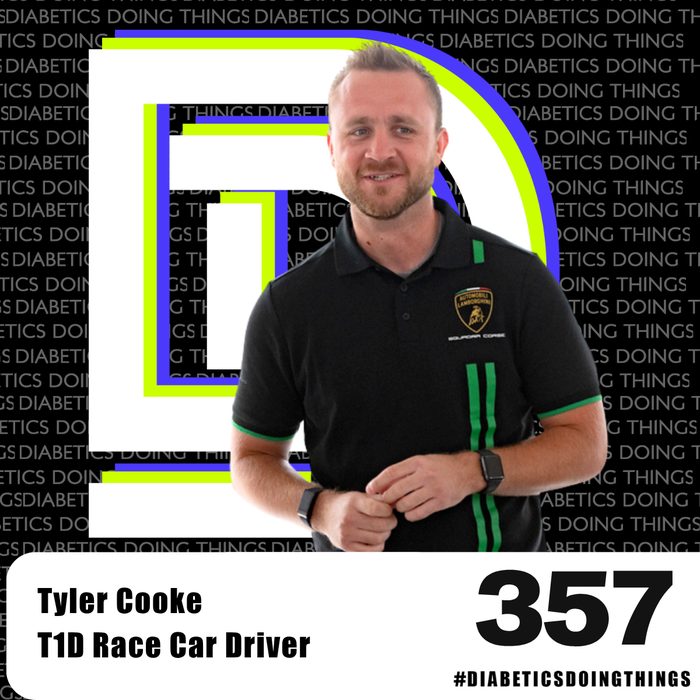
Tyler Cook is a professional GT3 racing driver who has competed in the 24 Hours of Spa, the 24 Hours of Nürburgring, IMSA, and GT World Challenge Europe. He was diagnosed with type 1 diabetes at 11, in 2006, after an ICU stay, and took a year off racing afterward. He talks about being bullied over his diet in middle school, hiding insulin injections on early dates, and later deciding to stop hiding his diabetes. The conversation covers how he manages blood sugar across a 24-hour race, including a Gatorade button wired into his cockpit for lows, why adrenaline pushes his glucose up instead of down, and how switching to Omnipod changed his race-day insulin routine. He also describes the heart-rate and neck training GT3 racing demands.
Key takeaways
- Tyler Cook was diagnosed with type 1 diabetes at 11, in 2006, after an ICU stay with four IVs, and took a year off racing to adjust.
- Tyler says adrenaline and cortisol push his blood sugar up during races instead of dropping it, sometimes to 220 even with proper insulin dosing.
- Tyler built a Gatorade button into his cockpit so he can treat a low blood sugar without taking his hands off the wheel.
- Tyler says Omnipod made bolusing and insulin timing during long endurance races much easier than his old routine.
- Tyler says GT3 drivers train their hearts and necks specifically, since cockpits can hit 130 degrees and brake pedal force can reach 1,200 pounds.
Chapters
- Climbing out of a race car at 2 a.m.
- Introducing Tyler Cook, GT3 driver with T1D
- Diagnosis at 11: ICU, four IVs, and Epcot chocolate mousse
- Go-karts at three, racing in the family DNA
- Racing pre-CGM: going off vibes and feeling lows
- Bullied for his diet in middle school
- Dating with diabetes and deciding to stop hiding it
- Going public: from fear of losing opportunities to advocacy
- A potential cure and why staying healthy now matters
- What GT3 racing actually is — and why you should go watch it
- The Gatorade button: CGM and cockpit glucose management
- 130-degree cockpits, adrenaline spikes, and pre-race hydration
- WHOOP strain scores: practice vs. race stint
- Training for the car: heart rate zones, neck day, 1,200-lb brakes
- What Tyler would tell 11-year-old himself: trust the process
Show notes
Tyler Cooke is a professional GT3 racing driver who has competed in some of the most grueling endurance races on the planet, the 24 Hours of Spa, the 24 Hours of Nürburgring, IMSA, and GT World Challenge Europe. He's also been living with type 1 diabetes since he was 11 years old. This episode gets into what it actually looks like to manage blood sugar in a fire suit, in a 130-degree cockpit, at 150 miles per hour, sometimes at 3 a.m.
Tyler takes us back to his diagnosis in 2006 — an ICU stay, four IVs, and a very specific grief over the chocolate mousse at Epcot's France pavilion. From there, he walks us through the journey from go-karts in his dad's garage to GT3 race cars with 650 horsepower. Along the way, there was bullying in middle school over his diet, sneaking to the bathroom to give injections on dates, and a decision somewhere along the line to stop hiding his diabetes and start owning it.
We get into the technical side, too: how OmniPod changed his race management strategy, why adrenaline sends his blood sugar climbing instead of crashing, what a 24-hour-race insulin plan actually looks like, and what it means to have a Gatorade button wired into your cockpit as an emergency low-blood-sugar protocol. Tyler also talks about the physical training side of racing — heart rate zone work, neck day (yes, neck day), and why a GT3 driver can be pressing 1,200 pounds of brake force per pedal.
The episode wraps with something that's been sitting with both Rob and Tyler: the idea of trusting the process. For Tyler, the lesson comes through racing — you can't skip steps from spec Miata to GT3. For people with T1D, it's the same. Wherever you are in your management journey, that's where you are — and it's going to get better if you just keep going.
Chapters:
00:00 Climbing out of a race car at 2 a.m.
00:51 Introducing Tyler Cooke, GT3 driver with T1D
01:52 Diagnosis at 11: ICU, four IVs, and Epcot chocolate mousse
04:16 Go-karts at three, racing in the family DNA
06:20 Racing pre-CGM: going off vibes and feeling lows
07:29 Bullied for his diet in middle school
09:53 Dating with diabetes and deciding to stop hiding it
12:29 Going public: from fear of losing opportunities to advocacy
13:35 A potential cure and why staying healthy now matters
17:19 What GT3 racing actually is — and why you should go watch it
23:02 The Gatorade button: CGM and cockpit glucose management
24:28 130-degree cockpits, adrenaline spikes, and pre-race hydration
25:39 WHOOP strain scores: practice vs. race stint
28:37 Training for the car: heart rate zones, neck day, 1,200-lb brakes
36:45 What Tyler would tell 11-year-old himself: trust the process
Resources:
Questions this episode answers
How does Tyler Cook manage his blood sugar during a 24-hour endurance race?
Tyler says he uses Omnipod for bolusing between stints, eats protein bars or shakes to avoid muscle fatigue, and keeps his pit crew watching his Dexcom Clarity app in case he goes low.
What is the Gatorade button in Tyler Cook's race car?
It's a custom button wired into his cockpit that delivers Gatorade or sugar so he can treat a low blood sugar during a race without stopping or letting go of the wheel.
Why does Tyler Cook's blood sugar go up instead of down while racing?
Tyler says adrenaline and cortisol from the intensity of racing push his glucose higher, sometimes to 220, even when he's eaten little and dosed insulin correctly.
How hot does it get inside a GT3 race car, and how does Tyler Cook handle it?
Tyler says cockpit temperatures can hit 130 degrees and he can lose five to seven pounds of water weight in a stint, so he hydrates heavily in the week leading up to a race.
Full transcript Searchable, with timestamps
Rob Howe: Imagine you just climbed out of a race car at 2am on one of the most demanding circuits in the world. You've been driving for two hours straight in 130 degree heat inside your car, your heart is pounding, your muscles are wrecked, and before you can even think about sleep, you gotta check your blood sugar and figure out your insulin strategy for the next stint. That's a normal Saturday night for my guest today. Tyler Cook is a professional GT driver who's raced at the 24 Hours of Spa, the 24 Hours of Nürburgring, and IMSA and GT World Challenge Europe. And he's doing all of it with type 1 diabetes since he was 11 years old. Tyler, you can find on Instagram at TylerCookRacing. And I'm really excited to share this interview with you today. So here's the episode. Guys, who was MVP of the chat? Rob Powell! Rob Boyd Powell! What were you on? We need more of that. Hey listeners, welcome back to Diabetics Doing Things. My guest today is Tyler Cook. Tyler is a professional GT3 racing driver who's competed in some of the biggest endurance races on the planet, and we're gonna talk about those, especially three in particular. He was also diagnosed with type 1 diabetes at age 11, way back in 2006, and he's been managing his glucose at 150 miles an hour plus in a fire suit at 3 a.m. for his entire racing career. Tyler, welcome to the show.
Tyler Cook: Yeah, thanks for having me. Super pumped to talk and have some fun with this.
Rob Howe: Yeah, so we have had some conversations with drivers over the years, and we've heard some stories of drivers that are more of a traditional, we'll call it a traditional style race that maybe we're more familiar with, whether it's IndyCar, whether it's NASCAR, etc. I really am excited to dig into the nitty gritty of managing type 1 diabetes while being behind the wheel of a car for an extended period of time in like a 24 hour Daytona type of race. But first, let's start kind of with your diabetes story. So, like, take us back to 2006. You're 11 years old. Like, what do you remember about that diagnosis?
Tyler Cook: Well, probably, like, a lot of diabetics. I remember every minute. So I remember we actually came up to North Carolina. We lived in Florida at the time. Came out of North Carolina, and I was losing a lot of weight, and it didn't look good. It didn't look healthy. And I was eating a lot. My dad said he's definitely not eating. He's pounding back food like it's going out of style. I remember getting back to Florida for middle school again after winter break and went to school. I remember sitting in my homeroom and I looked at my homeroom teacher and he looked at me. He's like, you don't look too good. I was like, oh, I don't feel good. And he's like, all right, maybe just go to the bathroom and see. And so I walked out, go to the bathroom, ended up puking all over a girl, lost that shot. But puked all over a girl. And I was like, I'm so sorry. I sprinted to the bathroom and I proceeded to puke about five more times. with the school, it was as soon as you throw up, you have to go home. So my dad picks me up and he had a pretty good idea of maybe what was going on because my dad, you know, did a lot of studying. So he takes me to the doctor and the doctor does a finger prick. And I remember me and my dad are sitting in a room. They pull my dad out of the room and they said, you got to get your son to ICU now. You know, if you don't take him now, he doesn't have much longer to live. You know, my body is going into shock. My dad's emotional, frantic, you know, and rusted me at Joe DiMaggio. they admit me um i remember getting four ivs putting into my body just to get my body back to normal actually one of them they forgot to take the band off so my sister walks in very emotional from high school knowing i was in icu and she's like why is his arm turning colors and they forgot to release the band um and i thought it was funny at the time i was like you know what it's just been a day um so i was in icu for two days and then they moved me to a normal room where I was in there for another five days. I still remember me and my dad would always walk outside. He would get some fresh air with all the IVs. I remember like walking out there and I saw a kid eating like chocolate mousse, like on the painting on the wall. And I started crying. And he's like, why are you crying? I was like, because I can't get the chocolate mousse at Epcot in France anymore. You know, I'm so disappointed in that. He's like, you just got a life altering disease and you're worried about the France chocolate mousse. I was like, yes. I was like, I love that. Like, I absolutely love that stuff. And, um, you know, so I went there, got to go home for a week and then took a year off racing. We had to figure out what normal was and how, you know, big, big change to the family and big change to everybody.
Rob Howe: And let's talk about that because you were, I mean, you're 11 years old at the time. So like taking a year off when you're 11 years old to someone who's not really plugged into the racing community may not seem like a big deal, but like racing is in your family and has been what you wanted to do since you were very little so like tell us a little bit about like how you
Tyler Cook: got started in racing uh so i actually got started in racing when i was three years old my dad built me a go-kart from scratch in our garage and i started that go-kart to this day i'm restoring it i want to bring it back to life and it's just a memory with him and so i started when i was three my grandfather had a late model team uh that uh dave rudeman uh borrowed his car Rusty Wallace drove his car for a race. Eric Amarola drove his car for a race. It was really cool. I got to maybe meet those guys. I was a little young to remember that, but, you know, it was definitely cool when my grandfather told me those stories. And so I would get out of school. My dad would get off work. He worked as a mechanic at Cadillac for a long time, and we'd go to the shop, and we'd help my grandfather with the car. I could do anything. I could just take the wheels off, make vroom-vroom noises in the seat, but I felt like I was just a part of it. Um, and then, so I went into go-kart racing when I was about nine years old, started a little bit the later part of it. A lot of kids start when they're six, seven years old. And, you know, it's just every year you're developing, just like you're developing in school. So every year does matter and every year does count. And taking that year off, you know, obviously it was a big deal, but it was something that was needed because it's, you know, it's life altering. It's a full different change of a life. The last thing you want is to rush back into something and you don't know why you're shaking in the go-kart. You know, it's because of a low, low sugar. And I actually had that happen once where I got into a crash and turned one and a kid like drove over me on the go-kart. And I remember he was sitting on top of me. So I like shoved him off. And for the rest of like the 18-lap race, I was shaking. And I thought I was just nervous. And, you know, I think I finished like fifth or something like that. I come back in the pits. I go back to our pit area and I check my blood sugar and I'm 42. And I was like, oh, wow, like I actually went low. And, you know, it was years after I got diagnosed. But, you know, it's always a learning thing. We're always learning our bodies.
Rob Howe: Well, I was going to say, too, like at that point, maybe, you know, 2008, 2009 time frame. So you've been diagnosed a couple of years. There's still not like a continuous glucose monitor or a system where you can have somebody in the pit or you can have something on your dash where you're monitoring your sugar. So you're just kind of going off vibes at that point.
Tyler Cook: Yeah. And you had to, yeah, I mean, I mean, a lot of diabetes know that you'd have to feel, oh, I'm tired. That must mean I'm high. Or I'm getting like jittery. You know, I would start talking a lot. Or like, my dad would have to go like, just please stop talking for a second. And I'm just like, when you're low, you start to talk a lot? Yeah, I was like freaking Bugs Bunny trying to run the marathon. I was going, and then my dad started to realize, like, you're going low. But, like, you know, here's a little bit of sugar. You know, I get a Reese's cup, you know, which is always great, you know, because me and my dad. Those medicinal Reese's is, like, top tier, you know. It's like, hey, sorry, I got to have this candy to save my life. It's better than Michelin star restaurants when you get a Reese's cup when you're a little low. It just hits right. That dopamine hit of, like, your brain's like, yes, we're safe now. Now eat this, enjoy this chocolate and peanut butter.
Rob Howe: I want to talk about before we move on more towards your professional career, you shared as an ambassador for Breakthrough T1D throughout your life, being open about being bullied about your diabetes as a kid or at school. Tell us a little bit about that. And I think that's something that a lot of people either can relate to or are afraid of, whether it's a person with diabetes or a caregiver. Tell us a little bit about that and kind of how it shapes your relationship with diabetes.
Tyler Cook: Well, you know, kids can be kids. when kids don't know something they can be a little on the harsher side of things so kids cannot figure out like i remember going to middle school and i always had to bring like tofu chicken that my mom made me and like green beans because my family wanted me on a pretty strict diet because at the time we knew that one fast 10 slow and if that didn't work i couldn't have that food you know before we didn't really learn about counting carbs so it was pretty much just that so it was like if he ran high that food's gone and so we got down to like certain foods i could eat with that and i'd bring it to school and you know all the kids look at me like what's this weirdo eating like we're having like school lunches or you know sandwiches stuff that i just couldn't have and at the time middle school kids are like experts at pointing out anything different and laughing about it yeah they really are and i mean they they're i mean they were my nutritionists as well because they were just telling me like what i was eating was so stupid and i was like i know thank you and you know if there was like a birthday party I would have to go like no I'm sorry I can't I can't have cake and then they would look at me weird and kind of sometimes make fun of me of like oh well you can't have cake and you know it did get to me I remember going back to my family a few times or my parents going like what is wrong with me like why can't I you know why can't I be like these kids and you know they they definitely sat me down a few times when I was younger like while I was crying I remember I went out trick-or-treating my dad really did not want me to go trick-or-treating and I went trick-or-treating and I got a bunch of candy and I was so excited and my dad's like, I have to take this. You can't have this, you know, because again, before we knew about counting carbs or anything. So he just thought that is the right thing for us to do. And so I remember him taking it and he bore like cried, you know, taking it because he just was, he could see my excitement. And, you know, then you're dealing with kids that don't understand that and they're going to go like, you know, it's cooler to make fun of somebody than it is to understand because you're at the age where you're developing nonstop. Yeah, your brain will not develop. No, it's definitely not a fault. Like I look back at now, you know, it was tough, but it made me a stronger person. And then I remember, you know, getting older, my 17, 18, 19, you know, start dating. I would both think I had a bathroom problem because I would constantly go to the bathroom and go do insulin for like what we were eating, what we were doing or anything. And I just realized, I was like, if this girl doesn't like me because I'm a diabetic, this is just never going to work. I can't hide this. So, I mean, I just started going on dates and I would just go, you know what? I have to do a shot. Like we're having cake right here. And they respected that more because I was more open and honest about it because like it was like, okay, like I understand what you're doing, like what you have to go through. But then back to the bullying part of it, you know, it's just kids being kids. And like, I never steer away from who you are because something that I love is I think type 1 diabetics are actually cooler people because we get to have little computers on us to feed us stuff. I mean, how many people get to say that? We get computers.
Rob Howe: Well, I think, too, like even just digging into that more. But every carb, you know how every meal has affected you for going on 21 years. Right. So I think a lot of people, it is a burden. Sure. and I think a lot of people will really resonate with the story of your dad like feeling really guilty when he had he took your candy away but he didn't have the knowledge to help you enjoy that at that time and you know I think that's one of the things where wherever you are in your in your diabetes journey that's that's where you are and and you will get better at it's like there's this idea of an infinite ladder so no matter where you are there's somebody ahead of you and there's somebody behind you that's why I'm I've been so fortunate to learn from other people in the community who tried things or like having somebody like yourself, because maybe somebody or a parent is out there listening and they want to get their kid into kart racing and they don't know where to start. And now they know that you've done this with type 1 diabetes and they have a dream of being a professional driver. These are all those things where I think I just think that having that example can really help someone and, you know, being willing to share it, especially that it wasn't always good. I think we have this idea where I see that photo behind you, like you're in Winner's Circle, checkered flag, there's confetti dropping all around you. Like we just assume it was always like that. And so to hear you say, I was going to the bathroom to give my injections. I had to make a decision to be open and upfront about my diabetes. So I guess like, how did you decide that you were going to kind of be more public and be an example, even after you experienced that bullying and that resistance or those negative interactions early on?
Tyler Cook: Well, for a bit, I was scared to talk about it. I did try to hide it. I thought I was going to lose opportunities. By being that, I thought, you know, I was going to lose people in my life, you know, because they would look at this weirdo that has to take injections. And it was mostly just in my head, you know. And so it was more or less, hey, I am a type 1 diabetic and there's nothing I'm going to be able to change about that. And hell, at this point, I think it's weird if I don't give myself insulin because I've actually thought about as we keep going down the road of developing a cure. I'm like, I don't know if that does ever come out. Like, you know, while I'm still alive, I'm like, I don't know how that would go if I don't have to do anything. It'd be weird. Like, it'd be very weird.
Rob Howe: You know, you're the second person I've talked to recently who brought up this idea where the cure comes out. He was saying that, like, he wants to make sure that he's in a position to be eligible to get it. So he's like, that's his motivation for taking care of himself today is that eventually, based on what we're seeing now with these clinical trials, where we're having tremendous success, getting people with diabetes off of insulin and in a sustainable way with fewer side effects, he wants to be able to be able to get that stuff. And so it's like now it's like counting carbs, taking insulin, exercise, whatever is like potentially framing that as a gateway to potentially a life down the road where that doesn't have to be part of your life.
Tyler Cook: Yeah. And I mean, it is so cool what we're doing and it's so cool to see the advancements we're having. And I'm completely in agreeance with that. Hey, I just want to stay healthy just in case it doesn't happen. You know, I want to just be a healthy person, live into my 90s, hopefully triple digits. But, you know, if it does happen, I agree with that. Being able where your body's not damaged that much. you know at the end of the day you see where everybody says be 120 be 130 or be even lower than that that's really hard it's a big challenge and it's almost like a medical practice because you're practicing to see i've had you know i eat iq bars in the morning and i've had sometimes as iq bars i give myself barely any insulin and they you know will drop me and then i'll have an iq bar and then it'll spike me but i've given myself a little bit more insulin and it's just you don't know why it's doing that you know everybody in the community knows when you get sick when you have surgery it is so hard to get that blood sugar out of the 200s you know two to three hundreds because your body is so focused on what got damaged instead of you know kind of focusing on the sugar and it's difficult but again it makes us cool we get to know like more things about how our body's doing that than the most most human humans can and i do love how Dexcom made the Stelo where a normal human can kind of track and see things like i would i would really love
Rob Howe: more people to be on that because you just don't know how your body's reacting well yeah and i think initially there's a lot of maybe resistance to that in the type 1 community because like you know for most people who have normal functioning pancreases and like no metabolic disease you're not going to see a whole lot from that but if we read the numbers there's like 100 million people in the united states living with pre-diabetes so what better way for them to discover that than to you know, over the counter without a prescription, you know, trial like like a Stella or a lingo where they can get that and see what's going on in their body or at least like rule out what's going on. Because, you know, some of those things they're having symptoms. They're like your dad. They're doing Google searches. They're talking to AI and they're like, hey, what's going on with my body? I do want to go back to what you've been saying about feeling cooler. You know, for me, you're a little younger than me. So guys my age, you know, in their late 30s, all of a sudden start to be like, oh, well, I should probably take care of better care of myself because I'm at risk for heart attack or I'm at risk for whatever. And so I'm like, yeah, dude, I've literally counted every single carb I've eaten for 21 years. I've literally got to get three labs done every year to track to see how I'm doing. And so it's interesting to be like it actually is an advantage for me in some ways, obviously, like not in all the day to day inconveniences and like the costs and the mental burden and all those things. but I know what's going on in my body. I don't have to go get caught up. I've been managing this for a long time. And, you know, I look at that as an advantage long-term.
Tyler Cook: Yeah. I mean, you think about how many people really don't even go to the doctor, you know, and we have to go to the doctor. And yeah, it does have the burden because, you know, sometimes you don't get the best news when you go to the doctor. A1C might be a little high. And I do love that Dexcom can keep that tracked. So you can kind of see, you know, before you even get to the doctor where your A1C is going to be. but it is cool that we always have to get labs done so we can see what the rest of our body like you said is doing so it just kind of keeps us healthier i mean everything has a side effect when it comes to life and i do think like we do have some side effects we do have some issues that we could potentially get down the road but there's so many advancements now to help us prevent those issues and you know there's nobody that's a perfect 100 healthy everybody has something that is a little problem. We just get the cool label on it, which makes us cooler.
Rob Howe: Well, if you're listening and you're like us, you're a dude in your 30s, go to the doctor. There's no like punishment. They don't judge you or grade you negatively. Okay, but let's shift gears a little bit because I want to talk about racing. And I know the audience wants to hear from a GT racer what it's like. And so I'd love for you to paint a picture. I think for better and worse i know the racing community didn't necessarily like it but the f1 movie we got to see the 24 hour daytona at the beginning of that movie gt3 racing um for those who are listening who don't know much about gt racing like what can you paint do to paint a picture of them for like their 24 hours of spa uh like the biggest gt3 race in the world like what's it like in that race
Tyler Cook: it's so cool um you know it's always been a dream of mine and it is so cool being 16 years old graduating high school half a year early and getting to go pursue my dream like me and the principal made a deal and I had to pass all these classes he's like once you pass those classes you're free and I did but GT racing a lot of people don't really know what it is because of F1 IndyCar NASCAR like you know those are all great big series you know like Max Verstappen raced GT3 car over the weekend at Nürburgring some of the most fun he's ever had Lance Stroll Aston Martin F1 driver race GT3 car in France a couple weeks ago because F1 had this downtime and a lot of those guys are actually kind of venturing into the GT3 platform so when you come over here it's a series called IMSA IMSA or SRO America and IMSA IMSA has these things called GTP hypercars so they're pretty much an F1 car with fenders all the way down to GT3 so it makes the racing really cool like 24 hours Daytona when you know hypercar is going by a GT3 car about 25 miles an hour faster and you know they're trying to mix up in their battle and they have gt cars like me that are in the middle but we're trying to mix up our own battle and it usually gets very entertaining a lot of contact happens but it's 24 hours of kind of like a family like all the fans become a family and it's really cool it's like a very interactive platform so in sports racing one single ticket gets you every single place in the paddock you know besides pit road You cannot go to pit road and Daytona can't go into the garages. We can get everywhere else with one single ticket. And GT3 cars look like your regular streetcars, but wider, cooler, kind of beefier, sometimes louder. But, you know, if you look at like a BMW M4, like what I've raced, a Lamborghini, it looks very similar to that streetcar. But then if you put it next to the streetcar, it's a lot wider. And then the inside of it, it's all carbon fiber. Our steering wheels have about, you know, 30 or 40 buttons on them. you know, to change different things. Might be 15 to 30. We'll do that. We'll be on the safer side. And then the center console has a bunch more buttons and it just allows us to make changes throughout the whole entire time. So a lot of people think we're just sitting in the car. Non-stop, you know, we have a little computer inside the car. We're flipping through pages. We're trying to update and see, update the team, what the car is doing. The car will most of the time have like a cell phone tower in it. So it's beaming a signal back to the team so the team can see live depends on the series some series don't allow that but it allows the team to see live what's going on with the car so if you're a mclaren fanatic and you love the 720 you can go see the big boy the race car race out there but the coolest thing about sports racing is all those people can drive their cars to the racetrack and there's corrals you got b&w crowd you got porsche crowd you got Lamborghini corral so you actually get to be a part of that family and they'll usually cater some food for you and all that but then it's the accessibility you know as a little kid you can walk right up to the race car and a lot of the guys in hypercar are either x f1 drivers f1 reserve drivers indy car drivers like when you actually look at the paddock it's cool and it's growing more and more you know and that's what i love to see but if you're a big car person you actually want to see pretty much what the street car looks like in racing form it's probably the best thing you can ever go do for an affordable price it's you know fairly affordable to go well and like you said you one ticket gets you wherever you want to go like you know if you're going to an F1 race, like it's going to be tiered based on how much you pay. And, you know, the top tier is going to be extremely, extremely expensive. So this is, this is just your basic entry level gets you wherever you want to go. And the racing is only just like one step below. Well, and I mean, the racing different totally as well. Well, and that's the thing, all of us in sports car is trying to make, you know, what sports car looks like the same level. And that's why I love that for stopping came and did the Nurburgring because he was like, man, this is wild. Like, this is super cool and then if you look at all the advancements you have in hypercar you have porsche so and the cool thing about sports car racing is a lot of the advancements that happen in the race car get passed down to the street cars in years afterwards and that's the only form of racing that that happens so like why does the bmw have that big front grill because the race car needed it so they had to create a street car that actually resembled the race car so that the race car could be what it needs to be and probably since i started in sports racing now the series has grown all around the world. All of them have grown a ton more and it just keeps growing and the competition keeps getting harder. You know, it is incredible to see where it has, like Daytona is getting a few hundred thousand fans per race now. When the Rolex 24 comes in, Sebring, and it's USA Today, I think it was USA Today, on IMSA's website, the 12 hours Sebring is ranked number two and the Petit Le Mans is ranked number four and the United States Grand Prix was ranked number eight and that's the fun race. I was just blown away when I saw that because I was like, man, the sports car racing is actually the only thing that was number one is the Indy 500. And that's a good old American race. So it's just, you know, it's really cool to see the sports car racing moving its way up there where the attendance is
Rob Howe: getting there. And starting and continuing to grow. I think, like you said, the participation of people like Verstappen and like, you know, getting interest throughout is really exciting. I want to talk a little bit about your, you mentioned more buttons on the dashboard, more buttons on the steering wheel. Do you have a Dexcom button? Do you have a CGM button? What does that look like how do you how has cgm changed your race management strategy like does your crew
Tyler Cook: have access to your numbers like what does that look like yeah i'll share uh with the crew my Dexcom, like the Clarity app for a lot of them to see it just in case like blood sugar goes low I have a Gatorade button that sits in the car and just it's a special button that allowed allowed me to get some gatorade in my system or some sort of sugar a lot of times we're doing like specialized drinks to keep the energy up you know and sometimes too much sugar can bring the energy down especially when you need as much as you can so it might be like a little bit of sugar mixed in with some caffeine just to kind of bring like that good dose in yeah a lot of times i'll try to get a special button in the car that because race herds somehow sometimes have some dead buttons that can be programmed into something and i'll try to get that i haven't got to race with the omnipod yet so i'm i'm looking forward to trying that you know and trying to see what what that can do along those lines like sometimes the temperatures in the cockpit can be really hot like 130 degrees like in the summertime and you might be wearing a suit right so like how does that affect your whether it's glucose or hydration or insulin absorption like how do you plan for those types of scenarios well you build up the week before you build up a lot of hydration because you can lose you know sometimes five seven pounds of water weight just just by running a stint so you try to build up the week before to make sure your body's just hydrated the cells are hydrated And then a lot of times because, you know, you're in the car, you're going through a lot of things, your blood sugar will actually run up sometimes. And there's sometimes I don't know why, but I'll be sitting at 220 and I've barely eaten anything and I've given myself the proper insulin. But it's almost like the adrenaline kicks in and everything starts kicking in. Your blood sugar just sits up here.
Rob Howe: Adrenaline, cortisol, you're sitting down, like the whole thing, right?
Tyler Cook: Yeah. And I mean, your heart's beating like crazy because, like, you know, I wear a whoop and you can get, you know, a motorsports tab in the whoop. Your heart's sitting up at 170. knee so you think they should technically be going down but it's i think because we're just geared up with so much adrenaline while we're doing it that the adrenaline just kind of keeps it
Rob Howe: you know a little bit above normal i'm glad you brought up the whoop because i saw it earlier what's your strain look like on let's say like a practice run or like you know you're a day out at the track versus a race like what's the difference or what's the delta for like a let's say like a
Tyler Cook: three-hour stint like what are you going to log on your whoop at that at that point uh for a three hour stint you'll typically probably get to about a 15 on strain um practice you'll do like a five before you know because you know a practice run you'll go out for a few laps you'll come back and do some adjustments go back out for a few laps because practice you're not necessarily just trying to make laps to learn the track you're just trying to make laps to get the car adapted and then you know we're dealing with yeah we're dealing with three to four drivers sometimes for endurance races or two drivers for the sprint so you got to get the other guy in there you got to get all the drivers to run through it and then we're also you know we try to change drivers in about 20 to 21 seconds you know so while tires are coming off fuel's going in drivers get changed so that's what kind of makes sports racing a little bit more fun is when you watch a pit stop it's not just tires and fuel it's you know a lot of things happening at one time and the whole crew
Rob Howe: has to be in sync so like for you let's let's just walk it through like a 24-hour race so you're like say you're at the Rolex Daytona, your stint might be like, you might have to wake up in the middle of the night and do a stint. How are you preparing your glucose during those types of
Tyler Cook: styles of race? Well, I'll tell you, the omnipods made it a lot easier. Just because it can just bolus a little bit. You don't have to worry about the slow acting, but I always had trouble with because, you know, that thing's lasting for 12 to 24 hours. And we started to do like a little bit of slow in the morning and a little bit of slow at night and so the the the problem is when the slow is engaging pretty hard then you have to start giving yourself some fast and you're trying to eat like a snack like typically i'll try to eat an iq bar or a protein shake just trying to get some protein in my system and you know just trying to keep the muscles you know from fatiguing too much and i give myself a little bit of fast insulin thinking okay it has it has you know 40 grams of carbs so let me just dial it to four and then the slow kicked in pretty hard too and next thing no, I'm plummeting and now I got to hit the Gatorade button. You know, that's always, and Omnipod's done a great job when it comes to making just everything so much easier. Everybody on the Omnipod could probably say the same thing. It's just so easy, you know, having to just do everything for you. Obviously you need a bolus when you have to, when you have to eat something, but you know, it's just made getting into a race car a lot easier than what it used to be.
Rob Howe: And I want to talk a little bit about this to those who are either driving a car, listening to the podcast or have never been in a competitive racing environment, I'll share. I got to ride in a couple of GT cars a few years ago during just like a fun run on a track. And I was shooting some photos and it was the most intense time I've ever had in the passenger seat of a car. Like it was the interior was all stripped down, obviously, like it was, you know, racing harness and helmet. And like I was being thrown around like crazy. And it wasn't Like it wasn't even like full racing conditions, right? So how like, how do you prepare yourself physically to log a, you know, a 15 to 18 on your whoop strain during a race? Like what kind of preparation do you have to do for that?
Tyler Cook: I used to go to a training facility here that specializes in driving. And we do many different things there. We were heart rate monitors. We try to keep the heart in 90% range for say 10 minutes. and then maybe like the next month it is keeping the heart between 80 to 90 for 10 minutes and it's also maybe doing a whole entire amrap with the heart between 80 and 90 because then they adapt your muscles to what your heart's doing so a lot of times that's what the training facility does is they try to get our muscles to adapt to what they think our heart rate's going to be in the race car so we do a lot of work with our hearts you know training our muscles to be in sync with the heart and because you felt it's a high g-load and you know we do special work on our necks we'll just have neck day where we're lifting weights with our neck we're never never stick i've always said that yeah exactly i mean leg day you can skip but um no neck day is really important leg day is also important because you know in a modern day gt3 car you're 1200 pounds and more on the brake pedal and if any consolation if you break really hard on a street car you're probably about 500 pounds So just think about that much more pressure that you have to put into a race car. So you have to make sure the body can work. And, you know, your heart's never going to sit down here while you're in a race. Your heart's always going to sit up there. So they don't really want us to work out down here. They try to get the heart going. Like, you know, before this call, I just got back from training. Just, you know, working out a few different things just to make sure that you're always ready to get back in that race car.
Rob Howe: Yeah, I mean, it's really interesting. I think like the correlations between endurance training for like ultra marathoners, for example, or for any other kind of like high intensity interval where you've got to be at a certain heart rate training and you're training your muscles to operate at this level and kind of optimizing it according to your heart rate zones. That's really fascinating. I think like, I don't know, I imagine your average person is probably not thinking that how dialed in drivers are to their muscles and their heart rate zones, like what's going on while they're behind the wheel.
Tyler Cook: Well, and I mean, you've touched on the G load, you know, it's a high G load. You're sitting in a full containment seat. You're pretty strapped in there. So your body's not able to move. You don't really get air conditioning. They do allow fans for air to blow in. but if it's a 100 degree race you're pretty much just getting 100 degree air blowing inside blowing in your face it's a sealed car you know so sometimes you get a little window that you can open up to try to get some hot air out of it but you know it's it's it's not abnormal for us to lose a lot of weight i remember a race i had in york i got out of the car my voice was shaking i i remember cross checker flag adrenaline was done adrenaline finally wore off i drove all the to second place and i remember like calling on the radio to the team i was like i i can't i can't hold the steering wheel i can't do anything and my my body just went numb and it was just because of the heat the sheer exhaustion you know my body's went into over exhaustion and you know somehow my blood sugar stayed at 120 the whole entire time it was great but like that was that
Rob Howe: was a miracle uh but yeah that the exhaustion level was high well i was gonna say like that adrenaline and that cortisol is like protecting you really from like and then you know when the when you pass the checkered flag you release that like adrenaline and cortisol and your body's like
Tyler Cook: no dude we need to go to sleep we're done well i remember like the team guys are coming over putting ice down my suit they were putting water bottles onto my neck and they dumped a whole jug of water like ice water on me just to cool my body down because they could actually feel how hot it was just because the you know it's uh the bmw is a turbo car so the turbos even run hotter than a naturally aspirated so the interior of that car was getting so hot that car had an ac that under brakes it would run an ac and with about 45 minutes ago the crew chief came on saying if you turn off the ac there's a chance we're going to win this because the ac was dialing like taking some power away from getting off the corner so i turned the ac off i was like i want to win this and drove to second did not have enough for the winner the leading car and yeah i felt it after after that checkered flag and then the trophies i shared it there is a solid glass trophy weighs a ton and they're you know we're all on the podium like hey you got to put it up and i was
Rob Howe: like i'm just it's gonna be down here i can't put it up i'm i'm exhausted man uh i love that story i think um do you have a favorite racing and diabetes story or like one that comes to mind or like a story that you always tell?
Tyler Cook: I do love that picture that you saw behind. That was actually the first win for the BMW in North America IMSA competition. All year, we were struggling, not really able to perform to a level that we thought. It was a new car. We were getting good podiums, but there's just nuances with the car that we were learning, the team was learning. And so we were always in the points battle. We were always doing well, but it wasn't you know where we actually wanted thought we were going to be and so that happened we actually were a whole straightaway ahead of the field and able to win it and I remember I was crying my team owner is crying my mom was crying I did the whole lap in tears and coming to the checkered flag it was just an emotional win because you just realize how much heart there is in it and you know you have guys working at the shop you have guys working at the track you have so much personnel to make that race car hit the racetrack. And that's what a lot of people also forget. I've also said this too, like there's so many more people behind the scenes and you see the driver, you go, oh man, I'm a big fan of Tyler Cook. I'm a big fan of Conor Daly. I'm a big fan of any driver, but you forget about the guys that are behind the scenes actually make that race car go on the racetrack. Yeah. So many people behind the scenes that make that car from production to data and testing and pit crew and all that. It's how many people work on your race team? I think per car, it's about 10, 15. So it's just, you know, you have specialized guys, you have specialized guys that are doing data, you got tire guys, you got shot guys, you got just, you know, guys that be dedicated to that part of the car because there's so many moving parts. You can't have one guy that's working on all of it because, you know, by the time he gets to the end thing, the team that has all the personnel are already done and they've already been on the racetrack a few times. It's kind of like a football team. It's like the quarterbacks who everybody sees and talks about, but everybody's special teams, offensive line, defensive line, that go into that. For fans or people who are interested, obviously we want to support you, but do you have a favorite driver or somebody if they have kids who want to dream of racing? Who's somebody they should watch? There's a couple. I always root for a fellow T1D, Conor Daly. I was running the Indy 500 this weekend. It's really cool when he takes a lead at the Indy 500. That place just goes crazy. They're screaming for him. He's a very genuine, nice person. a very good driver too you know he's raced everywhere he's raced all over the world and another guy um that i've gotten to know uh scott mclaughlin and he's an indy car driver as well just again a very genuine person he has uh i think he's called locked in on youtube it's his youtube thing and he's just you know he just shows you like kind of be yourself you know you can just be yourself people love you uh and if i could say maybe a third guy i know i'm probably wasn't plus a three but um the third guy would probably be Connor De Phillippi who's a really really good buddy of mine he just ran the nurburgring over the weekend he won the rolex 24 this year um you know worked really hard he was he was staying intense at the racetrack you know to make sure he got to race yeah he he worked himself to get into a bmw factory position and he's doing a great job and he's like a brother when you get to know him where he just is a very genuine sincere person And, you know, him and I will just talk about random stuff on the phone and, you know, catch up. And it's kind of nice, like, you know, when you have people like that around you.
Rob Howe: Definitely. Okay, I want to ask you one thing. We talked about the year off that you took when you were younger, after you were diagnosed, away from the thing that you love to do, the things you're still doing. If you can go back and tell, you know, 11-year-old Tyler, sitting at home, sidelined, newly diagnosed, like, what would you tell yourself?
Tyler Cook: Let the process happen. You know, give things time. it's really it's really easy to want to rush things right you always think that uh especially social media nowadays you see you know a 13 year old star on tv or you see like you know an influencer that's 17 16 years old or 30 years old and you think i have to be that person and maybe that's not the calling you were supposed to have you know trust me especially in the racing world it's easy to try to relate to other drivers especially if another driver wins in front of or something and it's really easy to beat yourself down but it's just trusting that the process is going to be good because most of the time it is going to be good and just always working at it never give up on yourself and never let anybody say that you can't do it because everybody has a chance to do something it's about what you want to make of it to make it happen you know and i mean look what you've done with your podcast like your podcast has grown to what it is today because you've worked so hard at it and now you have a really cool following and you're able to spread a really great message around and you know you would probably ask your 11 11 year old self too would i have a podcast that's this big when i'm this age and you know you could tell him that
Rob Howe: yeah i mean you you nailed it i think and thank you it's funny you know you don't think from a race car driver that the uh that the advice would be take it slow like like let the journey unfold like trust the process because yeah you're right comparison it's so easy to make yourself upset or make yourself think that you're supposed to be in a place that you're not yet it's really easy to think that way. But man, something I've been talking a lot about recently is just momentum. And I wrote this down and I've been revisiting it on a regular basis. Momentum is so much more important than ability or quality. I think we often can tell ourselves a story like I'm not good enough or I don't have what it takes or, you know, this person's better than me. But all you got to do is stack those days and like continue to work. The story you shared about your friend who's like sleeping in tents to make something happen and is now like winning a huge race and you know has a big responsibility if you just read that he won the race you wouldn't see that other stuff you know there's 10 years to make an overnight success and all the uh all of
Tyler Cook: the encouraging uh inspirational quotes yeah i mean you can rush the process right and then you can fail faster instead of you know like in racing right if if you didn't start in a spec miata which is a lot of times like a great car for people to start in you know it's a 1991 to 2004 mazda miata if you're looking at getting in racing great place to start next place is a specum x5 those are just two really good places to learn your race craft and learn a lot of things at a very lower price but say you went from spec miata gt3 well there's many steps in between that you should have taken and it's a completely different car you know one has 650 horsepower one has 110 and you know if you didn't trust that process to get yourself all the way through there by the time you got to the gt3 if you did the process you got to the gt3 you're successful you're winning if you just go from spectrum on to gd3 you're you're out within a race you know you're you're going back on the couch and you know you're you're regretting the decision you made can't cheat the grind man
Rob Howe: well tyler man thank you for your time and for all you do to advocate for people with diabetes on the track and off and i really appreciate this interview man and i can't wait to let it
Tyler Cook: to get it published thank you for having me
About Tyler
Tyler Cook is a professional GT3 racing driver who has competed in the 24 Hours of Spa, the 24 Hours of Nürburgring, IMSA, and GT World Challenge Europe. He has lived with type 1 diabetes since being diagnosed at age 11 in 2006 and serves as an ambassador for Breakthrough T1D.