

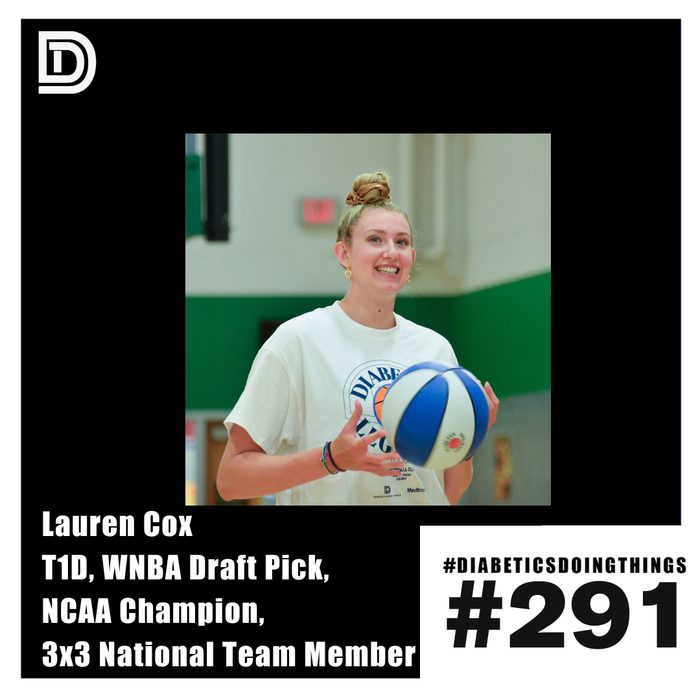
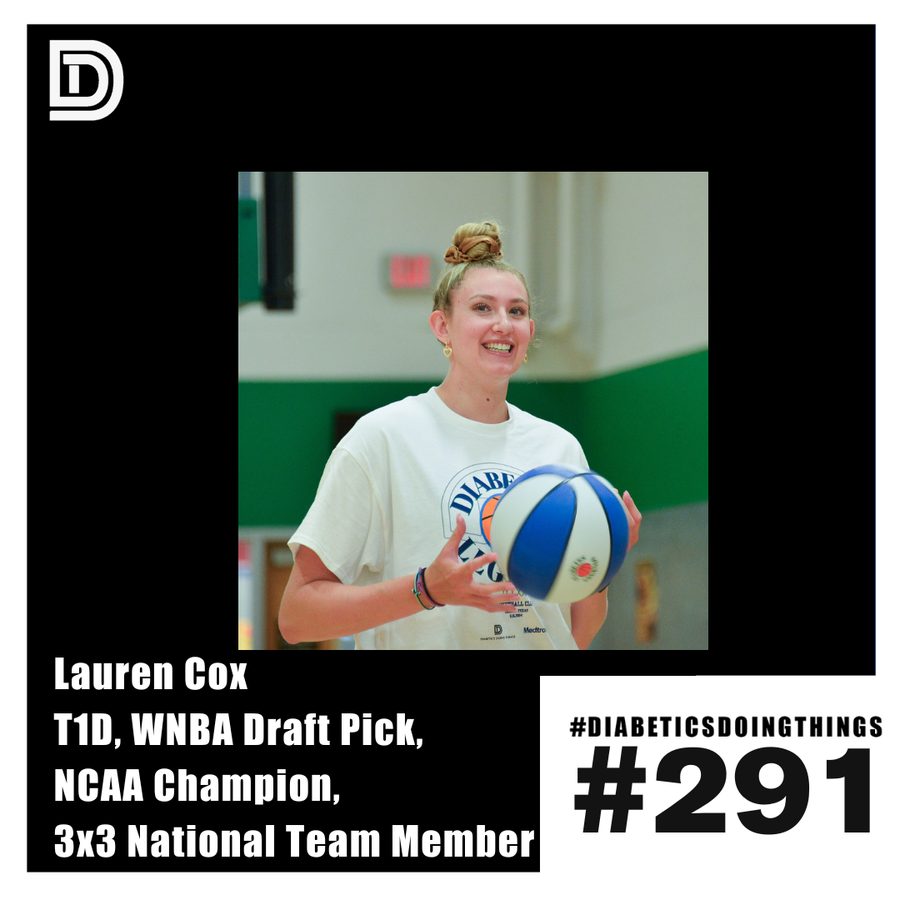
Lauren Cox T1D WNBA NCAA Champion

Episode summary
Lauren Cox is a former Baylor national champion and the third overall pick in the 2020 WNBA draft, diagnosed with type 1 diabetes at age seven. In this repost episode she talks with host Rob Howe about growing up in a family with two people living with type 1 diabetes, the pressure of being a top-ranked recruit, and how she manages blood sugar before, during, and after games. She describes starting games with low blood sugar on purpose because adrenaline sends her numbers up, going low during a championship celebration, and sitting out a college game because her number was too high to play safely. Her younger sister Whitney, also diagnosed with type 1, joins for a segment on growing up checking blood sugar together and playing against each other in college.
Key takeaways
- Lauren says she starts games with her blood sugar around 70 on purpose, because she knows adrenaline will push it up once the game begins.
- She had to get juice during the trophy celebration after winning Baylor's national championship because she went low while accepting it on stage.
- In college, a high blood sugar in the 300s to 400s kept her out of a game entirely, which she says people assumed was a coaching decision.
- Lauren says diabetes is trial and error, and what works for one person with diabetes won't necessarily work for another.
- Her sister Whitney, also living with type 1, says growing up watching Lauren check her blood sugar helped her adjust quickly after her own diagnosis.
Show notes
Repost! We’re sharing Lauren’s episode from 2023 because she is a member of the USA Basketball 3x3 National Team! If you haven’t watched 3x3 basketball in the Olympics, you should check it out here.
We also include Lauren’s live Q&A from the Diabetes Legends Basketball clinic in Dallas!
Lauren Cox is live in the studio with Rob and Eritrea! You can watch the entire episode on YouTube or you can listen here. This very cool in-person episode covers a wide swath of topics:
The reigning legacy of the whole Cox family
Lauren’s diagnosis story
Growing up with T1D
Being a #1 player and an inspirational figure at a young age
Athlete’s attunement to blood sugar
Advocating for yourself in the big leagues
The Spanish league and managing diabetes overseas
a cameo from Lauren’s sister, Whitney
And MORE
We want to hear from you. Send those questions, comments, queries, and general diabetes concerns to THE MAILBAG at mailbag@diabeticsdoingthings.com!
Questions this episode answers
Does Lauren Cox have type 1 diabetes?
Yes. Lauren Cox was diagnosed with type 1 diabetes in 2005 at age seven and has lived with it throughout her basketball career, including at Baylor and in the WNBA.
What blood sugar does Lauren Cox try to start games at?
She says she tries to start games around 70 because she knows adrenaline and excitement from the game will cause her blood sugar to rise.
Has Lauren Cox ever missed a game because of her blood sugar?
Yes. During her freshman year at Baylor, her CGM had expired and her blood sugar spiked into the high 300s to low 400s, and her coach and medical staff kept her out of the game.
Does Lauren Cox's sister also have type 1 diabetes?
Yes. Her younger sister Whitney Cox was also diagnosed with type 1 diabetes, and the sisters later played against each other in college, including in a type 1 diabetes awareness exhibition game between Baylor and Lubbock Christian University.
Full transcript Searchable, with timestamps
Rob Howe: Welcome back to another episode of Diabetics Doing Things. We are telling the amazing stories of people with diabetes from all over the world. And occasionally, luck turns in our favor and we get a little bit of the Dallas diabetes connection. Just some background, we had this production day on the calendar for like months now. And it just so happened that international basketball superstar and Dallas native Lauren Cox was able to swing by and do a very special interview today. So Lauren, thank you so much for being here.
Lauren Cox: Yeah, thanks for having me. Happy to be here.
Rob Howe: And we've done videos and we've done Medtronic content together back in the past, but you've never been here in the hot seat for a true Diabetics Doing Things interview. And I'm just happy that you're here in person. This is so cool.
Lauren Cox: Yeah, me too. Happy to be here.
Rob Howe: So if you're in the diabetes community, you know Lauren Cox. That's obvious. You were the number three pick in the WNBA draft a few years ago. You're a national champion at Baylor and you've lived with diabetes since 2005. but if you if you know the cox family you know that you you're not the only like you know everybody's got their own things like and your dad sends me his dunk videos on his birthday you know and your mom is amazing and we're starting to meet your whole family you're not the only person with diabetes i'm just going to list off some cox family we're going to brag about the cox family we've got two people with type 1 diabetes we got four division 1 athletes two national champions and one wnba draft pick so like how do you guys like what's it like being growing up in the Cox family. You guys are overachievers and amazing people.
Lauren Cox: We have been competitive since, I mean, we could all talk, walk, pick up a ball, whatever it was. We've been super competitive, whether it's a card game, board game, we're out in the front playing horse, whatever it is. Super competitive, but we're all super close. I mean, my sisters are some of my best friends. We are only a few years apart, so we're super close. And it's just always been fun growing up. I mean, three of us play basketball, one plays volleyball. So been around
Rob Howe: sports our whole life. It's very cool. And obviously, like you guys are not just playing sports, but having tremendous success, all of you, all four of you. We talked a little bit earlier, like off recording about your diagnosis, but like, what do you remember going back to 2005? Like, what do you remember about being diagnosed with diabetes? I just remember I was at my
Lauren Cox: sister's soccer practice and I was eating a pop tart and my parents just came and snatched it out of my hand. And I mean, I was seven years old at the time. I'm having fun outside. I'm carefree, not worried about anything, eating a pop tart, eating whatever I want. And all of a sudden we're going to the hospital and I'm getting poked with needles. They're drawing my blood. And I was scared at first. I didn't know what was going on. I had never heard of diabetes before. so they were trying to teach us everything we were getting a crash course and how to understand and manage type 1 diabetes so it was really scary for me well and I think like
Rob Howe: being that age too and we've talked about this a lot on the podcast and when you're diagnosed younger you don't really even remember kind of your life before that and and also like you have your whole life in front of you so you have to kind of like learn how to deal with diabetes and live your life and like do what you wanted to do? Like, what do you remember about like being young or like trying new things or like going to, you know, basketball camps or whatever the case were traveling or going to the beach or like going to birthday parties? Like, what do you remember early on about like kind of your mindset with diabetes? Yeah, I mean, all I know is life
Lauren Cox: with diabetes. I was seven years old, so I don't really remember much before I was diagnosed. So I when I was younger, I was kind of embarrassed. Like I didn't I've always been a shy kid. And And even now I'm pretty shy. But I didn't want people looking at me in restaurants when I was checking my blood sugar. I didn't want people asking me, oh, what are you doing? Or just looking at me. So even at a restaurant, I'd be checking my blood sugar and the waiter would come back and I'd like hide it under the table really quick. I just I didn't want people looking at me. I felt different. So that was a huge adjustment for me and not really something that changed until I got to college. so it was a huge adjustment just learning all these things I had to do learning how to check my blood sugar how to give myself a shot how to change my infusion set when I got on the pump all of these things that a normal kid shouldn't have to do and it makes you mature really quickly
Rob Howe: it does like we've talked about it before like it sort of forces you to grow up no matter what age you're diagnosed, like all of a sudden you now are in charge of keeping yourself alive in a way that you didn't really know before. I mean, there's a seriousness to it, right? Because you're so small and you're processing what's happening. And then I think when you're little, you think things have a beginning, a middle and an end, right? But this doesn't have an end. It's forever. So you have to kind of just put it on. And it's really weird to be a small adult scientist in a child's body. Yeah. And like that's the other thing is like you're doing complex math. You're like, you know, thinking ahead, like how many, how many supplies do I have to bring? Like, what do I need to go just to go out the door or walk around or go play with friends or whatever the case is? You mentioned that you're shy, which I know is true, but also experience. I wonder like the reason I remember this is because it was my first ever diabetes panel. So I think it was 2016. So you were probably, I guess, senior in high school. Okay. so you're a senior in high school and you're like going in, I think like going into your senior year, maybe or something. And like, you were the number one player in the country and you were on this panel. And I just remember, like I was thinking about it today, like over the years, like we've run into each other on other things. We've done the Medtronic videos together. And like, so from that, from that time, like before you're going to college, national champion, WNBA draft pick, like, you know, Spanish league champions recently minted, you know, FIBA three on three, like going through all of that, like, like, what would you tell 16, 17 year old Lauren on that panel? Like what, what would you go back and like, what would you tell yourself? Like, you know, seven years down the line, like, like what, and what, what would you tell yourself that day? I think that day I was just so nervous
Lauren Cox: because that was like the first time that I had actually like spoken in front of a bunch of kids and really just spoke up about my diabetes and talked about my experiences. So I was super nervous. I mean, I was 17, 18 years old and never done something like this before. So I think I would just tell myself just to relax. And like, I mean, these kids are here for a reason. They're here to hear me talk about my experiences, about playing basketball at a high level, about going to college next year. So just to relax and just be yourself and share your experiences.
Rob Howe: Well, I don't mean, I want to compliment you. Like if me at 17, I would not have done as well as you did. So you did an awesome job. And like, I want to talk about that too, like, cause not just with the diabetes, but like, as a kind of introverted, shy person, you had a lot of spotlights on you like pretty early. So like, you know, and I'm sure people were like coming at you, like you're the number one player. Like, you know, they're looking at you on the schedule and they're like, all right, cool. Like, this is, this is my chance to try to prove that I'm the real deal. Like what, what comes with, what pressure comes with being like the top player and, or, And when did you start seeing yourself as that type of player?
Lauren Cox: I definitely had a huge target on my back. Every game, I knew that I was going to get the other team's best defender. They were going to send double teams, triple teams at me. I knew that was going to happen every night. I have always been the type of player who doesn't really like to talk about myself and my accomplishments. It kind of makes me uncomfortable just talking about myself. And so I knew that going into every night I was going to get everyone's best shot. And that did bring a lot of pressure, not only on the basketball court, but also off the court, making sure I had good numbers so that I could perform well. Because as soon as I had a bad game, there were going to be people saying, oh, she's not all that. She shouldn't be the number one player, blah, blah, blah. So there were definitely pressures both on and off the court from everyone else and myself. I'm really hard on myself.
Rob Howe: Sure. And that's obvious, too. Like, you know, you're your worst critic, right? And you're in there. Like, was the diabetes ever part of that monologue? Like you said, every game is so important, especially when you're at the top spot. Everybody's trying to come up with a reason to tear you down or move you down. How did you approach the diabetes during that time?
Lauren Cox: I was just trying to make sure that I did the right thing before games making sure I was testing before games making sure I had a good number to start I know every game that blood sugar is going to go high and just because of adrenaline the excitement of the game how big the game is I know it's always going to go high so I actually try to start games in like the 70s I know like that's borderline like people are like oh that's that's way too low but for me I know it's going to go up as soon as we start the game so I try to start it as low as possible sometimes that doesn't happen
Rob Howe: and just got to live with it and play can you feel like and like obviously now you wear a CGM and so you can see your numbers like before CGMs could you feel kind of where you were throughout the game did you have that kind of like connectivity yeah I can definitely feel
Lauren Cox: especially when I'm high because I get tired easily I'm drinking a lot of water I mean you know the typical symptoms of a high blood sugar with lows it doesn't usually happen during games but during practices I usually go low and I can just feel myself like missing easy shots like I'll miss a layup or something like I don't know why I just missed that and it may be a few in a row I'm like, okay, something's up. Like this isn't normal for me. And I usually not.
Rob Howe: Yeah, for me too, it's like, you know, high blood sugar, you're tense, you're tight, you know, you're kind of like really forcing. And I feel like low blood sugar for me is the opposite where it's like way loose. And it's just like real loosey goosey and real relaxed. It's like, it's just funny. Like now being able to see it and like to have that confirmation of like, oh, here's where my numbers are and not having to take yourself out and like prick your finger. It's so interesting to hear the athlete's perspective because it's like me, a non-athlete missing every basket it's like I would not have noticed after four so it's so interesting it's such a well-oiled machine and it's obvious you take really great care of yourself because it's like I know immediately if I'm not performing the way I'm supposed to be so that's really interesting
Lauren Cox: as an athlete you have to learn to be able to read your body and read how you're feeling so diabetes kind of takes that a step further so I feel like I kind of have like a double understanding of how I feel, how my body feels, all that. A spider sense, if you will.
Rob Howe: I agree. And I think also like, you know, in athlete circles, people say like, listen to your body, like, you know, what's your body telling you? And I think there's so many other things that your body with diabetes can tell you that somebody else isn't tuned into. Have you ever like found yourself or like for other athletes with diabetes, like for me personally, it was challenging to have to have the confidence in a high stakes environment to say, hey, I need to take a step out or I need to get some Gatorade or I need to check my blood sugar. Do you have any like, you know, stories like that of you having to like kind of advocate for yourself on the fly?
Lauren Cox: Yeah, I think especially when you're younger, like in high school and stuff, and maybe you're running sprints or something and you have a low blood sugar and you're like, hey, I need to take a seat. And then all of your teammates are like, oh, she's just tired. She doesn't want to run these sprints. So she's using her diabetes as an excuse. I felt that all the time, even in college, sometimes. Like when I had to tell them I need 10 minutes, I need juice and I need 10 minutes. And whether they felt that way or not, I kind of told myself, oh, they think that I'm making an excuse to sit down, to rest. So I kind of had to get over that and just, I mean, say, I need a break and just not worry about what they think, what the coaches are thinking, because this is my health and I know how I'm feeling right now. And I need to take a few minutes to get my blood sugar back up, back down, whatever it is, and gather myself and get back in there.
Rob Howe: I'm glad to hear that you have that challenge too, because your teammates are your best friends too, especially in college or in high school. So you know they're not thinking that really, but also they're sprinting, so they're mad about everything. So you're in the middle of that like, oh, of course Rob's got to pull himself out on the hard conditioning days. And I did because like, you know, adrenaline, you're trying to run hard and then you're doing that for a long period of time and your blood sugar goes down. It's like, yeah, I just need 10 minutes in a juice box or a Gatorade. But in your in the back of your mind, just like the worst things imaginable are being said about you behind your back, you know, and that's like the last thing you want to do is let people down. So I'm glad you said that. I think I know there's people out there who at whatever level of competitive sports are playing, like feel like other people are looking at them and wondering if they're, you know, if their diabetes really is the reason they're getting out of that conditioning drill. I promise you, if you're listening, if you miss a conditioning drill, it does seem like a big deal at the time. But like as time goes on, you'll be fine. You'll be OK. We talked about this before, right? Like one of our last episodes, we talked about boarding a plane early and how some people will see a person with diabetes and not know they have diabetes because it's an invisible illness and be like, well, why are they boarding the plane early? They're just taking advantage that nobody checks the medical stuff, right? If you need to do something for your diabetes, you need to do something for your diabetes.
Lauren Cox: Don't let anybody step in your way. If you need to tell them, listen, I have diabetes. I need this. I need that. Don't be afraid to do that.
Rob Howe: absolutely and i think like it also gets easier the more you do it just like anything else like with repetition as you continue to advocate for yourself you get more confident doing it over and over lauren and i've been at this game for a while now i'd be like diabetes card i love it so you went to baylor uh national championship i don't know if you guys are familiar that's good that's like top you know that's great big school what was that experience like for you like you know going and you know being able to hang that banner and like be pretty close to home you also did some awesome like diabetes work like a big like event like special around raising awareness for jdrf like what was that like to win a championship so close to home it was amazing
Lauren Cox: when i first got to baylor coach mulkey was kind of the one who was like you need to use your platform and inspire people who also have diabetes who may be afraid to take that next step and follow their dreams. So when I got there, she was like, oh, let me see your CGM. Let me see your pump. What are you doing here? She would pull my teammates and be like, oh, watch Lauren do this. And like I said, I was super shy about it and I didn't want people watching me, but she was kind of the one that got me out of my shell and really got me talking about my diabetes. So we started doing the type 1 awareness night we had a game every season where we had usually just kids from the Waco area but we had some that traveled a few hours to come to the game and they all sat in the same section we had special shirts we I talked to them after the game signed autographs took pictures that kind of thing um and then my senior year was the game this is the good stuff this is the good This is what I want to know. This is great. This is the game where we played against Whitney, my younger sister who also has type 1 diabetes. So we made that. It was only an exhibition game, but we made that the type 1 awareness game. We had like the split shirts with Baylor and LCU on them. We had a bunch of family friends come down. It was a really cool experience just having them so close that they could come to that game. And it was really cool that my coaches were willing to work that out and call LCU and be like, hey, this would be really cool for them, their family, all of that. So I'm really thankful that they were able to make that happen.
Rob Howe: It was super cool. And also, that was the year you guys won the championship, right? That was the year after.
Lauren Cox: So we won my junior year.
Rob Howe: That's right. And I know you were injured in that final game. Yeah.
Lauren Cox: I got hurt. I actually had a low blood sugar when we were getting the trophy. So we were on the platform on the stage and I'm like in the back, like talking to my mom and my dad, like I need juice. I need something because I'm up here. Emotions are everywhere. I'm hurt. I'm glad we won. I'm on crutches and I'm sweating like crazy. So I'm like, OK, something's up. And I always sweat when I get a low blood sugar. So I'm trying to get juice. I'm trying to accept the trophy, celebrate. It was crazy.
Rob Howe: Diabetes has no boundaries. I was going to say, if you ever think you're out of the weeds with diabetes, you never are. It'll just right in these big moments just snatch you right back up.
Lauren Cox: You got a dub that's great, but I'm still low. I'm still here. Oh, yeah.
Rob Howe: You got a trophy? Cool. You're going to need a juice box. That's next up. So let's talk about being the first ever person with diabetes drafted into the WNBA, the number three overall pick which i mentioned in the show notes was also where adam morrison was drafted so so far in the draft world in the nba and wnba if you have type 1 you get you get drafted number three overall there we go so what was that like for you like hearing your name called like walking across the stage like here in the community and i guess you yeah because it was during covid right
Lauren Cox: so it was an interesting experience we were at home it was during covid 2020 right when covid happen. And our season got cut short. So I was home. I didn't even finish my classes. I didn't get to graduate. I mean, I obviously graduated, but didn't get to walk across the stage with the cap and gown and all that. So it was weird. We still dressed up and everything. We did our makeup, our hair. They sent a bunch of equipment to set up the camera, the microphone, all of that. So we made the most of it. Everyone was home, obviously, so it was nice just having all my sisters there, my parents, everybody. We had this really cool backdrop. We had the orange carpet, confetti, all the hats. So it was a different experience, but it was definitely memorable and something that I'll never forget. I kind of knew where I was going to go but still hearing my name and that actually becoming a reality like it was unbelievable I I didn't know what to say I was kind of speechless and being able to share it with my whole family it was really special that's super cool and also like
Rob Howe: pros and cons obviously like being in like a quarantine situation like you got to have it at home like with your family and like oh we've already talked about like how close all you guys are and like to be able to celebrate that together is really special. I was going nuts in my apartment during COVID. I was like, yes, like we got, we got one. People with diabetes, we got one.
Lauren Cox: Well, we also had all of our neighbors, they, they were outside, they were honking their horns, they were cheering. So it was a little delayed. So we knew inside before they knew outside on TV. So we had our little celebration and then all of a sudden you can hear everyone cheering and the horns honking and everything. So it was really cool. That's awesome. It's like years from now,
Rob Howe: we'll tell like our kids and grandkids like about quarantine and like COVID and how like strange that was but it's cool to have that like people in their cars honking their horns like in the neighborhood like really celebrating really great so since then you've played not only in the WNBA on three different teams but also overseas also on the FIBA three by three on three team you are like you know in every way international basketball superstar so what has that journey been like what have you learned like since becoming a professional and like how like how has that changed your approach not just like as an athlete but um just kind of dealing with some of the uncertainty and like picking up and going across the country and across you know the u.s like kind
Lauren Cox: of at a moment's notice like uh what's that been like you have to be very flexible as a professional athlete because there is a lot of uncertainty and i mean i was in spain for eight months so i knew my season started here. It's going to end here. So I knew that. But then coming home, I went to Connecticut. I spent some time there. I landed in Dallas, coming back from Spain on like a Wednesday, I think. I left again on Thursday to go to Connecticut and then did all of that there. I ended up coming back home. Now I think I'm home for the summer. I mean, that could change tomorrow. That could change today, tomorrow. So I kind of always just have to be on my toes and be ready for anything. I have done a lot of traveling and learned all of the travel tips, not just for a normal person, but also as a person with type 1 diabetes. Well, and you know, you mentioned that
Rob Howe: you were in Spain for eight months. So that means like having to think ahead eight months in advance supplies wise because obviously in Europe it's a different health care system and you're not there permanently so it's like you're establishing residents like there so what kind of hoops do you have to jump through like when you're prepping to go to a new team or even just to like a you know six eight weeks and like a three on three on three tournament or training camp yeah I usually
Lauren Cox: get in like our living room or something just like a big open space on the floor and I kind of just like set everything in rows and just like, okay, I'm going to be here for X amount of days. I need this many supplies for those days. And I also need extra supplies. So I kind of just lay everything out where I can see it all in one space and then pack it up in a duffel bag. I have to make sure I have enough insulin and make sure I have an ice pack, a cooler. I try to make a list of everything I need sometimes the math isn't always great sometimes the math ain't math yeah math ain't math but it's it can be a little stressful sometimes but that's why I like to see everything in front of me and it it makes it a little easier one big pile of diabetes stuff you just throw it
Rob Howe: from one side like Kobe you know just throw it it makes it yeah I my like I have like this bin of diabetes stuff like and depending on when you catch me it's like either really organized or just all in one pile and I'm just like fishing through like oh how many reservoirs I have left I guess
Lauren Cox: I better order some I rather not know I like to live on the edge that's what she was saying I make a big pass I can see everything it's like the day before I have to leave just throwing stuff in
Rob Howe: that area yeah I I also it's like so much of our lives are regimented like sometimes it's nice to just kind of go off vibes for a little while but maybe when you're not when you're gonna go play professional for sure obviously obviously so not just playing in Europe but you guys won a Spanish league title this year what was that like being able to see like eight months of work like kind
Lauren Cox: of come to a head and like in celebrating that way it was really cool for me because I kind of felt like I I hadn't won anything since college and we we won a lot in college I mean I won four big 12 championships and won a national championship so I I'm a competitor and I hadn't won anything since college. So I was kind of itching for this championship and we knew we had the team to do it. It was the first championship in Valencia basket history on the women's side. So it was super special for the team, the fans, the city of Valencia. Everyone was super excited. We won at our opponent's place, so we didn't get like a huge celebration. We had some great fans that traveled with us and made it really special for us and then we came back to Valencia I had a big celebration and everything and then I I had to leave within a couple days to get back to the states so we celebrated as long as we could and then I was out of there also like you had I know
Rob Howe: you're you're extremely humble but like you had like an awesome performance in like the championship round like and like and Valencia was like going crazy sharing like all of your stats and like your PR and stuff so like for you personally like talking about your journey like and we can kind of get into some of the stuff like not only you're not the only person from your draft class in that top three and five picks who's currently not on a WNBA roster so some of that is challenging because there's just not that many spots and there's new people coming in every year and also it's a fit aspect but for you to be on that stage in Spain Valencia has never won a championship and for you to perform to the best? Did you feel validated in your effort? How did that make you feel?
Lauren Cox: Yeah, my confidence was super high just throughout the season. I had played in Spain the season before for a different team. So that was my first season overseas. This was my second season. So I just kind of felt my confidence go up throughout the season, and I was feeling really good. I loved the city, loved the people. I had a great time there. So I just I felt really good and to see it all pay off in the end was
Rob Howe: really special. Let's talk a little bit about like diabetes in Spain or overseas like like you mentioned your second year overseas so you kind of like got the rhythm like how is it different
Lauren Cox: and how is it the same? I would say the biggest thing is just traveling and the time difference And then the food, the food is just so different. A lot of people say the food is healthier overseas. I definitely agree with that. Not as many processed foods as there are in the States. So it's definitely an adjustment. I always see that the first probably month, month and a half, my blood sugars aren't great just because I'm trying to adjust to not only the time, but the food, the schedule of being a professional athlete. And so it can be difficult just trying to manage those things to kind of figure it out. I always say that diabetes is a lot of trial and error and that's okay. You're not going to be perfect. You're going to have some highs and lows. You're not going to have a perfect blood sugar every single day. So you have to keep trying things and see what works for you.
Rob Howe: I think too, like Euro teams like practice, like we had like training camp is like training camp. Like, so like, how did, like, it's very different than here in the U S even in college. Like, uh, so what, like, how do, how do you approach like going into a new city, like new time zone, you're like getting off the plane the next day, you've got to be on the court, like doing some kind of work. And it's often like multiple times a day, like two days, three days. Like, how do you approach like different times in the year where you're like, okay, I know this is going to be a really physically demanding time, or you've got a really difficult travel schedule coming up. How do you kind of approach that?
Lauren Cox: I guess when I first got there, I knew we were going to have training camp. And it was actually different for this team because we had a lot of injuries to start the season. So our training camp wasn't as bad as I thought it was going to be. We had a lot of younger players that helped us out when we were down in numbers. So it wasn't as hard, but it was still my first month being there. I like I said, I had to adjust everything. So definitely had to, I guess, change my mindset and the way that I handled my diabetes not being so hard on myself because I knew my numbers were going to fluctuate and things weren't going to be perfect. So I knew I was going to have to take a step back and just, OK, things aren't going to be perfect. It's going to be OK. You're eventually going to level out and get back to normal.
Rob Howe: it's like everything is temporary basically right yeah yeah i mean it can be tough too because i think especially people who are like really type a about their diabetes and like really like that control like releasing some of that control and like relaxing can be really difficult speaking for myself as well like you know i'm not sure how you know everybody is but like you know i think giving yourself a little grace like and and not being so focused on the number and like, you know, like this will pass, like I will get used to this or this short, this is just for a training camp period and saying like, once I get through this. And the funny thing is like your teammates and peers who don't have diabetes are telling themselves the same thing, just not about their blood sugars. Right. Wait. So I wonder, so since I have another amazing athlete here, that's not you. I'm not even amazing. I'm just like pretty average. I'm just trying to be nice to you, man. But anyways, the point is, are you very type A with your diabetes? Are you like type A personality in general because you're an athlete or no? I wouldn't say that I am.
Lauren Cox: I want it to be in control, but I also know that it's not going to be perfect. I think going to a new place and even coming back to the States after being there for so long, I think the first couple weeks I'm a little type A and I'm like, okay, well, why isn't my insulin working. I know exactly what I ate. I know the carbs. I've eaten this hundreds of times. So why isn't my blood sugar in a good range? So I think I just have to remind myself like, okay, you're, you were living in another country across the world for eight months. So coming back here, you have to adjust again. Your body is going to need a little bit of time. So I think those, when I travel somewhere new, like those first couple of weeks, I'm a little uptight about it, but then I just got to remind myself like you said it's temporary
Rob Howe: yeah I like it I I wish I had had been that mature about my dad she's so chill I'd be freaking out yeah me a control freak okay let's talk a little bit like fun like euro fans like the like the Valencia fans especially seem pretty rowdy and like they go they ride hard for you
Lauren Cox: guys for sure they are crazy in the best way they are honestly some of the best fans that i've ever seen and they they're respectful too so they they don't hate the team that we're playing with they cheer for them when they run out on the court there are some teams that they don't like more than others but they're they're always respectful they're super friendly even if we can't understand each other i just smile gracias so they're super sweet i loved it there they were very welcoming and they're just great people in general funny what free health care will do to a country
Rob Howe: free health care and paella you know give people paella they'll be great man that's cool okay let's let's get tactical let's talk about this because over the years i'm sure your diabetes approach like during games has changed and like you know devices equipment cgms etc so i know you wear your medtronic pump and your cgm while you play so when did you start doing that and like how do you what's your kind of game day or even practice
Lauren Cox: day like regimen look like i think i've always worn my pump during games i i honestly can't remember the last time that i took it off i just find that it's it's easier just having it with me being able to I keep it in like the side of my sports bra just being able to pull it out even if I'm on the court I can pull it out real quick look at my number make sure it's okay so I think I've always done that practice days and game days are different because my number is like the complete opposite for both days so practice days for the most part I usually have good numbers but sometimes like if we have an early morning practice I usually go low A lot of the times if I eat breakfast and we have an early practice, I don't bowl this because I know it's going to go low. Game days are completely different. I try to eat two, three hours before the game, eat my bigger meal. And then I try to start, like I said, at like 70, just as low as I can because I know that it's going to go up. and as much as I try as much as I take insulin even at halftime I'll take some insulin it doesn't come down until probably two three hours after the game and then maybe I have a really bad low after the game so if we have an eight o'clock game I don't get home until 10 o'clock my blood sugar doesn't go down until midnight and it's just a long night I just feel like you're reading from
Rob Howe: my journal or something right now. Like, like even now, like these, the games I play now don't matter at all. And like, still the same thing happens, like adrenaline, insert double arrows up before the game starts 30, 45 minutes after the game's over, I see the double arrows down. It's like, you know, whatever insulin on board is. And yeah, I think I get a lot of questions. I'm sure you get a lot of questions on social media about parents who are trying to help their kids like prepare better or kids who are trying to navigate it. It's challenging. I think like when you're playing a sport, adrenaline is part of that. And I think also the more you love something or really care about it, you put more adrenaline into that. And so like, even like with fitness trackers and things, 15 minutes of basketball, I'm going to get a higher like strain score, like workout score from that. Then if I did, you know, lifted weights for an hour, because I'm like more engaged, I'm more excited. And I think that's just a part of it that But like the spikes and the crashes, people without diabetes are getting those too. They just don't know. And so I think like that's something that I try to tell parents and athletes is just to like relax. It is frustrating, but it's a little bit, it can be predictable. And like if you can put yourself in the best chance to succeed or be where you need to be so that you can play the way you want to play. That's all that really matters.
Lauren Cox: It's hard to answer those questions sometimes because every diabetic is different. And I try to tell people that. I go back to that trial and error. You have to find out what works best for yourself, your kid, whoever it is, because what works for me isn't going to work for you and vice versa. So you have to find out what is going to work for you and then stick with that. Totally agree. And I think like
Rob Howe: that's something where it can be really hard to be comfortable if your management looks a little bit different or if you are, you know, some people may have the exact opposite, like during games, they go low or in practices they run high. Like it's, it is that trial and error. And I think giving yourself the grace to, to fail and remember that it's not the, like, it's not final. You can, you can pick yourself back up. You shared the awesome behind the scenes story about you trying to hoist the trophy and also find a juice box. Like what other, you got any other interesting, like behind the scenes, diabetes, basketball stories or just, you know, things that you remember, things that stand out.
Lauren Cox: um I it was by I guess my freshman year we were playing in Tennessee and I my CGM had expired that morning so I was charging it trying to get it back in and during that time that I didn't have it on my blood sugar just shot up and it was in like the high 300s low 400s um and it just it wasn't coming back down. So we had a game that day. I think it was an afternoon game. So maybe like two, three o'clock. I had a bunch of family that was there. My dad's mom, my Mimi had come down from Missouri with some other family, some of her friends. And I didn't get to play in that game. I was and I was just I was so upset in the locker room for the game. I was like fighting with my coach going back and forth like I can play the doctor's like no she can't play the trainer no she can't play and I was just so upset and like and with high blood sugar you're super emotional so I was I was crying I didn't want to talk to anyone I wanted to hit something so that was that was one of my not so good stories but one of my behind the scenes and it sucks because people don't see that and they're like oh she's just not playing because the coach doesn't want to play her so that was hard to just and i mean i'm sure people weren't thinking this but in my head people are like oh she's not playing because she sucks and like i said people probably weren't thinking that but that's immediately where my mind went to i think it's
Rob Howe: important because you said like people don't see it and not just general like basketball fans don't see it. But also, we don't talk about it a lot in the diabetes world when there's articles or like, we're celebrating you for doing something that nobody with diabetes has ever done before. And we'll continue to do that forever. But sometimes I think we read that and think that everything's okay all the time. And so to hear you say that even in the journey to this national championship, to a top-ranked team in the country, top-ranked player in the country, you're still missing a game because of diabetes and that is i think we have to normalize that there is this like duality of yeah you can do whatever you want with with your diabetes but it doesn't mean it's always going to be pretty or easy and so i think it's super important to just share those moments of like even these people who are at the top of their craft and the pinnacle with diabetes like they're still dealing with the stuff that we all deal with which is when you take that sensor off you never don't know what your blood sugar is doing and you put that thing back
Lauren Cox: on you're like oh what what happened what happened in these two three hours that i didn't have it on
Rob Howe: yeah there's like small scale things that diabetes takes from you and i think this is maybe one of the small ones and then there's bigger so i think maybe and i don't know if this is right or not but it's like to define those feelings it's like a type of grief because it's like my whole family came for this i was so excited for it i've been prepping for this what my whole life like literally playing professional basketball and when i have to do it it just gets there's nothing i can do from diabetes taking it away from me. I think that's such an important thing to just not normalize, but also just acknowledge that that's a form of grief. And I think it's okay to hate
Lauren Cox: your diabetes. Like I have had days before where I just, I cried and like, like, why is this happening to me? Why me? And I think that's okay. Like you have to, you have to feel those things and it's a big part of your life and it can take a lot of things from you, but it can also do a lot of things for you. Like I never thought that I would be reaching so many people with what I'm doing and inspiring so many kids. So you have to take the good with the bad and know that it's okay to cry about it sometimes or get angry about it sometimes, but give yourself that time and then move on from it and take care of it, be responsible, all that stuff. I cartoonify my diabetes. I say
Rob Howe: that a lot. I'll be like, maybe it's not appropriate, but I'll be like, I'll fight that bitch in the streets where are you diabetes i got you ho so that helps sometimes when you are mad at your diabetes or it takes a day from you or a game like i'll fight you yeah sometimes i get dramatic i'm like my diabetes is my enemy and it's just like it's not sleeping it's it's never giving up and i can't let it win i gotta keep fighting it you know the same animal or the different beast you know yeah what are you talking about kobe bryant okay so i do want to bring i want to bring whitney on to do a little hot seat. But I just, I want to say just as somebody who's seen you grow over the years, how fortunate we are as people with diabetes to have you as a representative of us worldwide. I am inspired by you daily. And I just am cheering you on from afar. Also, your family is so cool. Like your parents, I ran into them at a JDRF event here in Dallas. And it's just so cool to get to be a little bit behind the scenes of somebody who's doing something so extraordinary so keep it up and thank you so much for coming on here today thank you i appreciate forever dallas forever that's right dallas texas you heard let's go all right let's bring whitney on we're gonna do a little hot seat because we got to get we got to get some fun sisters with diabetes also both national champions so like how often do we get to have do we have that okay what we got here okay okay yeah yeah you guys are wild whitney you were diagnosed basically at one of lauren's games so what was the text that you sent her like was like hey hey like i've i got something
Lauren Cox: to tell you i honestly don't remember i i don't know that it was i i don't think she texted me Did you know at your game that I was? No. I don't think I knew until the next morning. And my parents texted me and they were like, we've been in the hospital all night. And we actually had the day off. So I was able to go back home. It's only an hour, 45 minutes and be with her. But yeah, I think it was my parents that texted me.
Rob Howe: What was your response? What was going through your mind?
Lauren Cox: I was heartbroken, honestly, because I knew that she was going to have to go through the same stuff that I had gone through. I wouldn't wish it on my worst enemy. It's just not something that you want anyone to have to deal with. So to know that my baby sister was going to have to go through it now, like we can beat up on her all we want, but no one else can touch her. So it was hard. And I mean, I got home. I got home before she did. And then she got home from the hospital and we sat on the couch together and just cried. We were hugging and just crying together because we knew.
Rob Howe: Yeah. And like nobody knows also like you guys have this shared interest. Like you're both like you're about to go play college basketball, like you're playing high school basketball. Like what was it like for you having? I mean, it's kind of a huge life hack just to have a sister with diabetes. You know, what was that like for you guys' relationship?
Whitney Cox: We talked about it earlier. It definitely brought us closer. And I grew up around it too. When we were little, we would always want to check our blood sugar whenever Lauren was doing it, me and my other two sisters. And so kind of knew what to do. And that kind of helped the hospital stay be so short too. But definitely brought us closer and we know what each other's going through every single day.
Rob Howe: do you guys like are you guys workout partners do you guys work out together or is that is that is that a is that a touchy subject a little bit but we kind of do our own
Whitney Cox: thing yeah definitely different now since i'm done with basketball she's still playing now oh yeah you're just a regular just one of us just trying to stay in shape now i've been I've been messing with her about that lately.
Rob Howe: Yeah. Do you guys or do you guys like talk about like, do you count carbs together or do like.
Whitney Cox: We used to whenever I was first diagnosed. Yeah, I think there's a picture of us like testing our blood sugar at the same time. Yeah. Or we would go out to dinner and I'd be like, how many carbs do you count for this? I think more when she was first diagnosed because she just wasn't, she was new at it. She's gotten a lot better now. so yeah i mean we would be out at dinner and she'd be like okay i think it's this do you agree
Rob Howe: what do you think it is things like that wasn't like to get to like play like like that we talked about on the podcast we talked about the diabetes event at baylor like you know playing against your sister in like a real like a big game like you know that's pretty exciting probably like the like you know i i also know like guarantee games when you're like the division two school getting to go play like at a D1 and you're like, oh yeah, we're going to go get them. They're like taking us easy. It's going to be fine. What was that like getting to do that against your sister?
Whitney Cox: It was really special just having all my family there. It was my freshman year in college and we had one exhibition game before that and I didn't play. I was a freshman. But my coach kind of told me, he's like, yeah, I'm going to put you in this game. You're going to play against your sister. So it was my first college game too. there's tons of pictures of us there's one of me laughing at her and she's all serious well yeah i i played like 25 minutes maybe so i'm i'm tired on the tree throw line she just got in so she's like laughing and i'm like bent over trying to breathe uh we we played against each other in aau one time and i pantsed her during the game just like messing with her so it was a super small like ghetto tournament i don't know why we were playing in a trend but my phone i i wanted to do a tour again but i wasn't gonna embarrass her like
Rob Howe: not on the big diabetes yeah okay that's good big sisters looking out well that's cool well i don't know like what would you you know to somebody who will like from the outside looking in like sees you guys like you know being sisters together like playing basketball, like living your dreams, like sharing that, like, what would you encourage somebody who wants to, you know, try to live their dreams with diabetes? Like, what would you say?
Lauren Cox: I mean, just don't let it stop you. You can do anything you want to do. It's not going to hold you back. It's a burden at times, but it won't stop you from doing anything
Rob Howe: you want to do. Hard to agree. Even if, even if you're just trying to NARP, even if you're just like getting in if you're just entering the rest of the rest of the world and i think like that's something that we try to do on the podcast too is just like remember that when we're done you know sometimes careers end like they say athletes like die twice right like when you know and you know you you sort of like start to realize like oh like hey there's this whole other life out there for me to live i don't have to go to two practices a day and hit study hall and have a coach yelling at me so well thank you for this this was great i'm glad that you guys got to we got to have a little bit of like inside info with you guys. So so thank you. This was awesome.
Lauren Cox: Thank you.
About Lauren
Lauren Cox is a Dallas native who played basketball at Baylor, where she won a national championship, and was the third overall pick in the 2020 WNBA draft. She has since played professionally in Spain, winning a Spanish league title with Valencia Basket, and on the USA Basketball 3x3 National Team.