

Episode summary
Erik Douds has lived with type 1 diabetes for 11 years and runs the website DiaBadass.com. He is an adventure filmmaker and endurance athlete based in New York City whose grandfather was diagnosed with type 1 in 1940 and lived to 83. Erik biked the TransAmerica Trail coast to coast and down the West Coast with Annalisa Van den Bergh, and spent a year staying in the homes of type 1 diabetics across more than 20 states. He talks about using a DIY looping system called Loop, walking after meals to flatten blood sugar spikes, the gap between US and Canadian insulin access, and why he thinks CGMs, not pumps, should be the first device offered after diagnosis. He also discusses an upcoming Alaska film project funded by Pearl Izumi.
Key takeaways
- Erik Douds says walking after meals, a tip from Adam Brown's book Bright Spots and Landmines, reduced his post-meal blood sugar spikes.
- He uses a DIY looping system called Loop that automatically adjusts his basal rates from his smartphone.
- Erik says he believes CGMs, not pumps, should be the first device doctors recommend after a type 1 diagnosis.
- He biked the TransAmerica Trail across the US and down the West Coast with Annalisa Van den Bergh, and says their blood sugars swung wildly during those rides.
- Erik says traveling outside the tri-state area showed him how inconsistent US prescription access is compared to Canada's pharmacy system.
Show notes
Name: Erik Douds
Hometown: New York, NY
Date of Diagnosis: 10.01.2007
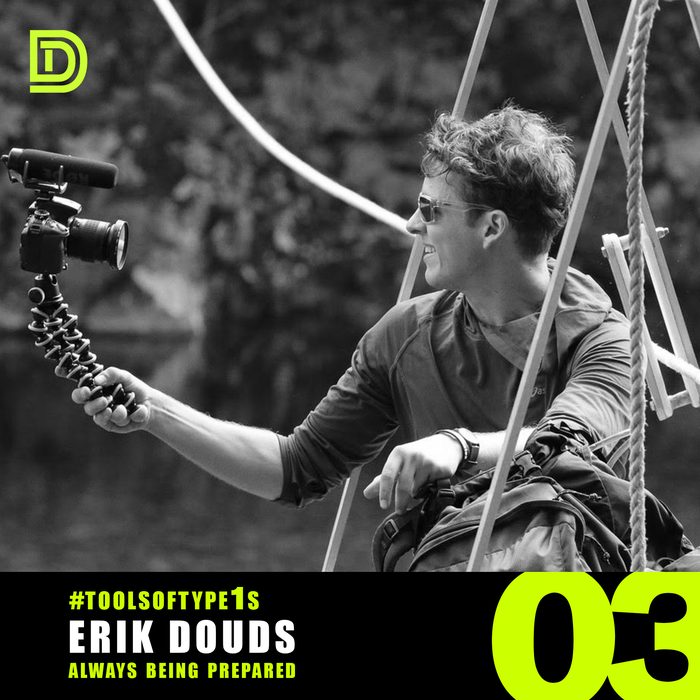
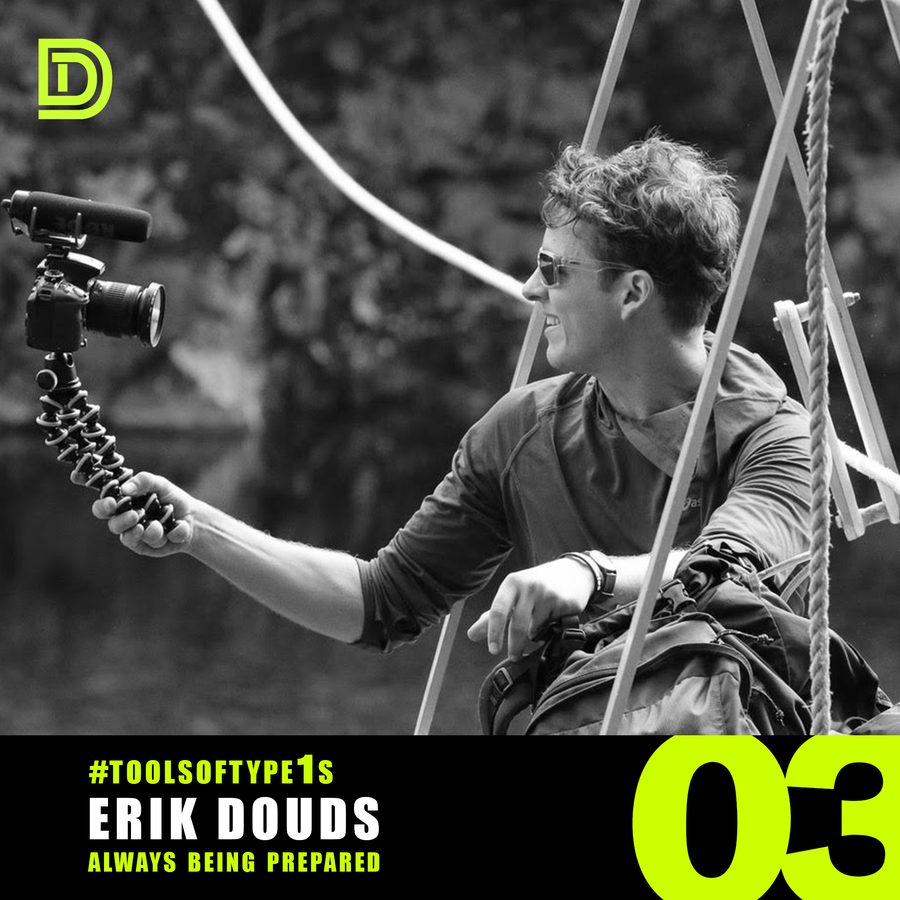
Tool: Always Being Prepared
Diabetes Devices/Treatment Methods: DIY Looping (medtronic paradigm revel 722 pump, Dexcom G5)
Questions this episode answers
What diabetes technology does Erik Douds use?
Erik uses a DIY looping system called Loop, which automatically adjusts his insulin basal rates from his smartphone.
Does Erik Douds think a CGM or an insulin pump should come first?
Erik says the continuous glucose monitor, not the pump, should be the first device recommended after a type 1 diagnosis, since the CGM is what changed how he understood living with the disease.
How did Erik Douds bike across the country with type 1 diabetes?
He rode the TransAmerica Trail from the East Coast to the West Coast and then down the entire West Coast with Annalisa Van den Bergh, admitting their blood sugars swung wildly during the long mileage days.
What is DiaBadass?
DiaBadass is Erik Douds's website and YouTube brand, where he shares films about living with type 1 diabetes alongside his adventure travels.
Full transcript Searchable, with timestamps
Rob Howe: Episode 3, Tools of Type 1s. That's hashtag tools of type 1s on Instagram. Where do I even start with this guy? Erik Douds. Diabadass. I didn't know Erik until 2018. We met early on at a dinner in Dallas. He came to Dallas. He was kind of on his Diabadass tour. I don't know if there's someone that... I didn't have any expectations really going into meeting him. I knew a little bit about what he was doing and traveling around. I just am very grateful that I met Eric when I did. He's a guy that just immediately, if you've met him, you know he's just a warm dude. He gets right in. He doesn't beat around the bush. He asks the tough questions. He's very present. I'm very glad to know him, and I can't wait until we continue to collaborate on all sorts of projects throughout. I actually think he's in Dallas this week. Erik Douds his tool is community hashtag tools of type ones on instagram enough from me listen to mr Erik Douds
Erik Douds: all right rob i'm glad i finally got around to this and that you consider me interesting enough to be on this podcast i have briefly looked at the questions but i will read them in full and answer them right after so um with that i'll take a sip of water and get into this my name is Erik Douds and i'm a new york city based adventure filmmaker and endurance athlete who's been living with type 1 for the past 11 years and i always enjoy throwing in the fact that my grandfather was diagnosed with the exact same disease in 1940 and lived until he was 83 i run the website dia badass but i'm also a youtuber and the past year i've gotten really into biking. So I did the Transamerica Trail from the East Coast to the West Coast and then biked down the entire West Coast with Annalisa Van den Bergh. And two to three things that I do besides these adventures is kind of make films about the type 1 diabetic experience. So sharing what it's like day to day living with this disease and kind of all the adventures. and then also have this cross-section of visiting over 20 states the last year and staying in the homes of type 1 diabetics for most of it, which gave me a new perspective on how this disease is managed.
Rob Howe: What is your tool of type 1s? And what's the one thing that a person living with T1D could learn from you or your experience?
Erik Douds: well overall i'd like to say that you can do anything and go anywhere with this disease and as i say that it comes from experience of telling my endocrinologist that i want to do something so crazy that they often can't give me any form of advice so this really began I think when I studied abroad for six months, which turned into nine months, and then backpacking right after that for a month in New Zealand. That's where I thought there was a threshold of knowledge where the medical community can only go so far because type ones themselves do so many things in a unique perspective in a very nuanced way. So one of my tools is always being prepared, but also always thinking about plan A, plan B, and then plan C. And that resiliency can get you through many situations.
Rob Howe: What is the simplest thing you've done that has helped you with the management of your type 1 diabetes? Where did you learn it or who showed it to you?
Erik Douds: I am always mentioning Adam Brown's book and online PDF, Bright Spots and Landmines. And the simplest trick that I have taken out of that resource is to go on a short walk after every meal. And that has truly reduced the post spike in blood sugars that you usually see from eating and also gives you a nice moment to catch up with yourself or someone else right after a meal.
Rob Howe: What failures or apparent failures with T1D have made you better at living the rest of your life or made you more well-rounded as a person?
Erik Douds: The thing that gets me most excited about this community is everyone that I have interacted with is an empathetic individual. and I will say that the failures that come from relying on any sort of healthcare system is that we have all been challenged in many different ways to get basic access to many things and that resiliency to keep fighting, to keep advocating for yourself, to look out for others I think makes us a very strong community. And it's something that at times I've dealt with alone. And now I am fully immersed in the community. And it has really made me a more resilient person and really helped with burnout.
Rob Howe: What unusual or absurd opinion or approach regarding your diabetes do you have?
Erik Douds: Oh man, I feel like most people... I'll give you a pause. Yeah, I feel like most people look at me as an absurd human being all around. I have taken on challenges that I am extraordinarily unprepared for, but still think through. one of my approaches i think is that if you want to push yourself you have to accept the increase in risk that comes along with it so many people ask how Annalisa and I managed our blood sugar biking 70 miles a day on a bike that weighed 80 to 100 pounds and the brutally honest answer is that our blood sugars swung wildly. However, we were living out our dreams in the current moment. There's obviously technology that helps improve those results. But I think when you push yourself to an extreme limit, you have to expect a certain amount of repercussions that comes with living with type 1 diabetes.
Rob Howe: What's your favorite thing? What gets you to smile or laugh almost every time?
Erik Douds: besides a few accounts like marie diaz whose nerds can fight i would say working with children with or without type 1 diabetes always brings a smile to my face i love seeing the way that kids dream without any limitations to their minds and that truly makes me smile
Rob Howe: in the last five years what new adjustment to your lifestyle has improved your life with
Erik Douds: diabetes the most. In the last five years, I have never been so involved in the diabetic community and that has opened up my mind in many ways to see relationships in terms of how parents and teenagers interact, how husbands and wives interact. That has opened me up to new solutions, but also new issues that I never thought about in my own life. But then also in terms of technology, I now use a do-it-yourself system called Loop, which makes automatic adjustments to my basal rates using my smartphone. And I now assume if everything is connected that I will wake up in range. and that has altered my life with this disease where diabetes for the first time ever is starting to enter the back of my mind rather than being on the forefront and that's what makes me so excited
Rob Howe: about it. What challenges related to T1D did you encounter or have to overcome while you were doing
Erik Douds: your thing. The biggest challenge I face on in terms of just like an everyday life of living with diabetes is that when you actually travel with this disease, and I only mean that in the broadest sense of when I leave the tri-state area, it really shocks me how poorly managed our prescription system is, getting access to medicine that, for instance, like many of us rely on getting three-month supplies of things sent to our home. Or many of us, because of insurance issues, have to get our supplies from a specific branded chain. And that kind of boggles my mind for Americans. The fact that I can travel across the U.S., be a citizen of the U.S., and have access issues, I think is one of the most solvable issues that isn't being addressed in our community. And why I say that is because visiting Canada, you're able to enter any pharmaceutical store and get many of your prescription drugs or what Americans assume to be prescription drugs without a prescription and at a very transparent price. I know things change province by province, but the way that they treat insulin access and the way Americans treat insulin access, I think isn't addressed with enough criticism in this country.
Rob Howe: What bad advice regarding diabetes do you see or hear
Erik Douds: that you'd like to address. I would like to put out something controversial. I believe the way that we push pumps as the first thing that should happen to people who are diagnosed should change to pushing the continuous glucose monitor. I believe that the CGM was the first thing that made me realize I have diabetes, where a pump is simply a convenient tool to replace needle and syringe. And so I think once you begin living a life with a CGM, and if you're like concerned about access and stuff like that, you know, I assume that if you have access to a pump, you most likely have access to a CGM. I think the CGM is the greatest tool to change your perception on living with this disease. And so I think that should be the
Rob Howe: number one priority. What priority are you focusing on in your own life currently? This can be diabetes related or not.
Erik Douds: I'm extraordinarily proud to announce that Annalisa and I have gotten funding from Pearl Izumi to produce the film series for Miles of Portraits Alaska and so that is my number one priority which is going to be a YouTube series about our trip to Alaska segmented into at least four parts biking from Denali going past Denali Mountain going across the Denali Highway which is considered one of the most beautiful highways in the world going down to Valdez which is little Switzerland and then exploring the Kenai Peninsula. And for me, this has been at least a year long journey, if not longer, to really get fully funded and sponsored from the outdoor industry to share my story of exploration and then share my story of living with this disease. And so I'm very excited for this opportunity and also to advocate outside of our very close-knit type 1 diabetic community to hopefully reach a larger audience.
Rob Howe: Who is someone that you look up to and what have they taught you? How do you apply that to your
Erik Douds: life? I mentioned how Amy McKinnon has changed my life and it's actually quite remarkable as As I reflect on it, a lot of the small seeds she planted in my mind, how they have truly taken form. To give a little bit of backstory, Amy McKinnon, she's a type 1 diabetic, but she was living in New York the same time I was in Manhattan. And the first thing she changed really was spending time with me running. And also at the time, I had tried the continuous glucose monitor, but hadn't enjoyed it. And so it's one of those things you try once and then write it off forever. And she really convinced me to get back on it. But she was also someone that just kind of, you know, she'll share her lessons and preach. But at the same time, she'll just show through example. And I remember she was doing marathons at the same time I thought running six miles was absolutely absurd. and she was the one that slowly encouraged me to run a marathon, which eventually I convinced my high school friend to do that with me. And I just find that those small encouragements can actually really change your life. And so she's also helped encourage me, change my diet, and just change my overall perception on a lot of things. And so I really respect that and really enjoy following her journey because I find that it somehow filters back into my own life.
Rob Howe: What are you most hopeful for? This can be diabetes related or not.
Erik Douds: I'll talk about a current thing that's happening that people don't really acknowledge, I think, in enough of a way. and that's the pride that people are getting from being a diabetic. I often think about my grandfather's journey with this exact same disease and he was warned almost every decade of his life that he was going to die. So if we put ourselves in his shoes it'd be like going to your general doctor and telling them, oh, I have diabetes, and them just looking at you as if they're astounded that you're still alive. It might be in comparison of having like a terminal form of cancer. And my grandmother shared some stories around that. And so when someone is diagnosed nowadays to hear how people are getting tested for antibodies so they are aware that they might be at a higher risk for diabetes so you can start experiencing an easier transition into the disease to hear that teenagers are now choosing to wear pumps so they have something to show off that they're diabetic. I think that's very exciting. I think it's very exciting that people are proud to live with the disease because it is such a hard grind to go about alone. And so that optimism and hope, I think, is one of our greatest gifts to deal with something that is as complex and demanding of a disease like type 1 diabetes.
Rob Howe: What advice would you give someone who has T1D and is trying to pursue a career in your line of work?
Erik Douds: So I would say currently my line of work is adventure filmmaking and soon to be educational resources. And the hardest part about getting started in this field of work is getting out of the door. There are many people you will meet who will have ideas that they never execute on. and so if I had advice for someone it would be to find someone else that has the passion that you're able to convince to fulfill one of your dreams in some capacity and just take the leap
Rob Howe: take the blind leap what's the one facet or trait that you think makes you uniquely you explain why
Erik Douds: I think if I had to put myself in someone else's shoes explaining who I am, I think it's hopefully my smile and joy that I try to bring into most situations. I will 100% be the person that says yes to any crazy idea and give it 100% of my energy. And that is in part how I've ended up biking across America, exploring British Columbia, doing all these crazy things, and most recently building a six foot tall, seven foot wide juice box wall in Central Park during the New York City Marathon in roughly 48 hours. I 100% get excited by ideas and love giving them my energy.
Rob Howe: Where do you get plugged into the T1D community the most?
Erik Douds: If people want to follow along on my journeys, check out Erik Douds on Instagram, That's Erik with a K and my last name is D-O-U-D-S. But more simply, check out DiaBadass.com, which will link you to everything. I would say I'm most excited to continue to put out YouTube series in a larger extent that focuses on travel, conferences, and everything relating to living life with Type 1. when I was first trying to find other type ones I feel like I had to make my own communities but that has definitely changed one way that I began is meetup.com which is just a website for people that want to get together in person and diabetes falls into that you'll also find a lot of photographers hikers and stuff like that but um that's surprisingly how I met my community here in New York. And then I would say just go on Instagram and put in the hashtag type 1 diabetes and you will find people. We also now have resources like the Beyond Type 1 app and you can find people locally. But I will say like once you start to inch your way into the community, you will find more and more people across the US or wherever you happen to be based that are always looking to connect. And then myself personally, I designed my website so people could reach out and offer me a place to stay. And so when I spent pretty much a year traveling, the way I was able to stay in the homes of so many type 1 diabetics is because I just put a form on my website saying, you know, basically host me for a night or a weekend. And that's how I ended up meeting so many people. And I find that our community is excited to connect and grow and offer a way to help in any way possible. And that really, really excites me and makes me happy because I definitely remember days where I dealt with this disease alone. and it is much easier when you have someone else's shoulders to lean on who often can have the solution to a problem that you might be struggling with for many years.
Rob Howe: Thank you for listening to the Tools of Type 1's podcast on diabetics doing things. I'm Rob Howe and every Tuesday and Thursday in 2019 we are posting the next Tools of Type 1 episode. So follow us on Instagram, hashtag tools of type ones, or just on diabetics doing things. We will post those regularly every Tuesday, every Thursday. My favorite type ones are answering the questions I want to know the answers to. And hopefully you'll learn a few things as well. If you like this episode, be sure to review us on iTunes. And if you didn't like it, go ahead and let me know that too. I want to know. All the feedback is good to me. Thanks again for your time. I value that more than anything you could possibly give me. Thanks so much. Bye-bye.
About Erik
Erik Douds is a New York City based adventure filmmaker, YouTuber, and endurance athlete who has lived with type 1 diabetes for 11 years. He runs DiaBadass.com and has biked across the US and down the West Coast with Annalisa Van den Bergh while filming the type 1 diabetic experience.