

Diabetics Doing Things Interview with Xeris CEO Paul Edick
Episode summary
Paul Edick is CEO and chairman of Xeris Pharmaceuticals, maker of Gvoke, a shelf-stable liquid glucagon delivered by prefilled syringe and, soon, an auto-injector. He describes over 40 years in pharmaceuticals at companies including Johnson & Johnson, Baxter, and Pharmacia, and how he took over Xeris in 2017 and grew it from twelve employees to about two hundred. He and Rob discuss why the older glucagon mix kits often fail in a real emergency, how Gvoke cut rescue time in testing from minutes to seconds, and what Xeris learned by talking directly with people in the diabetes community before launch. They also cover the company's COVID-19 response, including $0 copays for people with commercial insurance and free Gvoke delivery through PillPack.
Key takeaways
- Paul Edick says everyone on insulin should carry glucagon, not just people who have already had a severe low.
- He says the older glucagon mix kits are hard to use correctly in a real emergency, with error rates he puts at 70 to 90 percent.
- In Xeris testing, trained healthcare professionals took over two and a half minutes to administer the old mix kit, versus about 20 seconds for the Gvoke prefilled syringe.
- During the COVID-19 shutdown, Xeris set Gvoke copays to $0 for commercial insurance and partnered with PillPack for free home delivery.
- Edick says an auto-injector version, the HypoPen, was on track to launch in July 2020.
Show notes
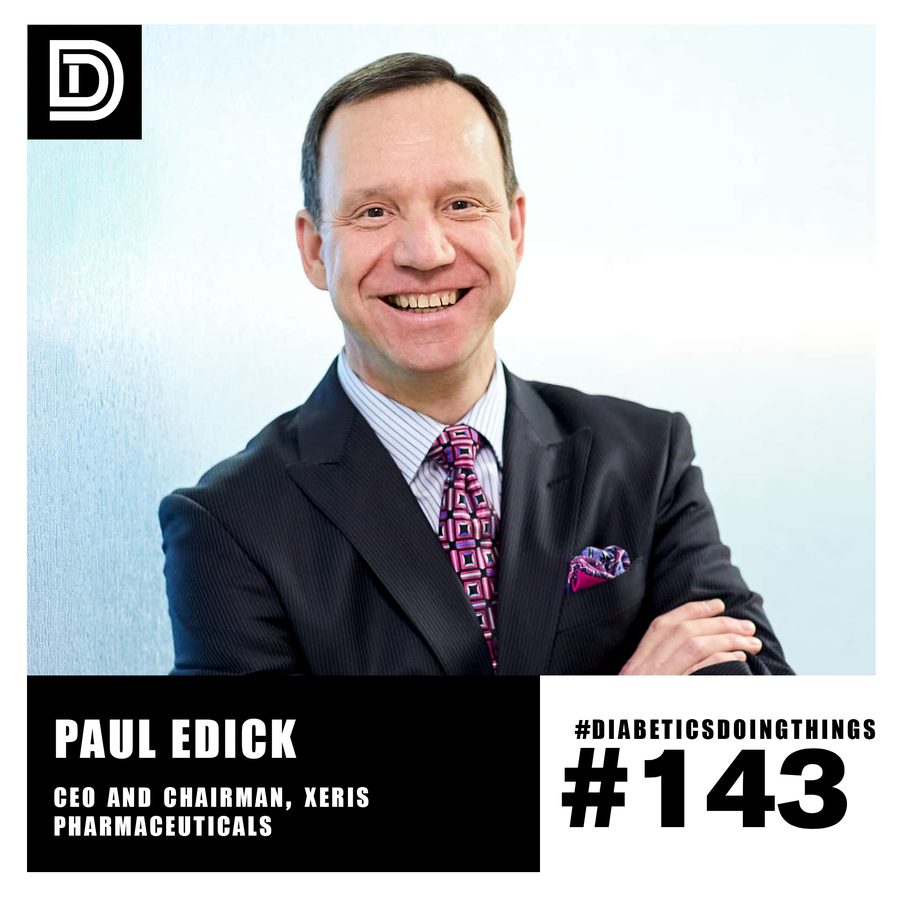
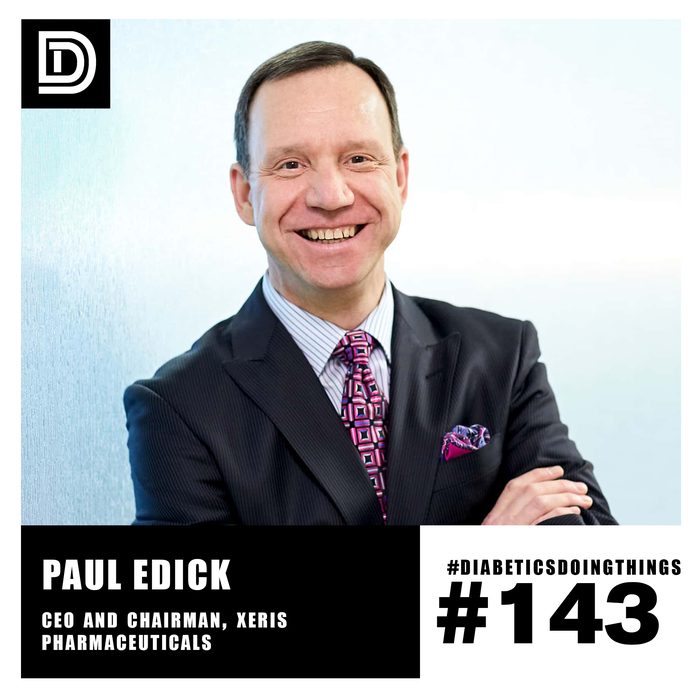
We’re living in unprecedented times, and with all the messaging in the news, sometimes you can miss important announcements that can make a difference in your life, so that’s what today’s episode is all about. Paul Edick, CEO and Chairman of Xeris Pharamaceuticals, makers of Gvoke pre filled syringe (liquid glucagon) joins the show to talk about the measures Xeris is taking to ensure people with Diabetes have access to glucagon during the COVID-19 lockdown.
Xeris has partnered with PillPack from Amazon to provide free delivery of Gvoke PFS. For those with commercial insurance, they have set the copay to $0, so for no money out of pocket, people with commercial insurance can get glucagon delivered to their home for free. Some restrictions apply, but be sure to check out this website for more information on the savings.
As you can imagine, setting a $0 copay is a big deal, so here is the press release from Xeris on the program.
Paul joins the pod to talk about the results Xeris has seen with their shelf-stable, liquid glucagon in Gvoke, and why he is working to get more glucagon in the hands of more people on insulin, to help prevent the nearly 250,000 hospitalizations each year in the United States for severe Hypoglycemia.
Paul and I also discuss how Xeris has leveraged the knowledge of influencers like Rob from the Diabetes community in terms of messaging, communication and the importance of access.
For more information, or to get started on your $0 copay Free Shipping order of glucagon, visit www.gvokeglucagon.com
Questions this episode answers
What is Gvoke and how is it different from older glucagon kits?
Gvoke is a shelf-stable liquid glucagon made by Xeris Pharmaceuticals, delivered through a prefilled syringe. Unlike older glucagon kits, which require mixing a powder and liquid before injecting, Gvoke is ready to use, which Paul Edick says makes it far easier to self-administer during a severe low.
How much does Gvoke cost and how do you get it delivered?
Paul Edick says Xeris set Gvoke's copay to $0 for people with commercial insurance, which covers roughly 70 to 75 percent of patients. Xeris also partners with PillPack, an Amazon company, which can contact a patient's doctor for a prescription and deliver Gvoke free, including overnight.
How fast does Gvoke work for a severe low blood sugar?
Edick cites Xeris clinical studies in which patients brought below 50 mg/dL returned above 70 mg/dL in an average of about 15 minutes, and patients as low as 28 mg/dL recovered in about 30 minutes.
Is Gvoke an auto-injector like an EpiPen?
At the time of this episode, Gvoke was available as a prefilled syringe. Edick says an auto-injector version, the HypoPen, was on track to launch in July 2020, which he compares to an EpiPen for people with diabetes.
Full transcript Searchable, with timestamps
Rob Howe: Hello, welcome back ladies and gentlemen. We have a very special episode for you today. In these times of social distancing and quarantine due to COVID-19, I'm looking to use this podcast as a way to deliver critical information to you in this time of uncertainty. Today's guest is Paul Edick, the CEO and chairman of Xeris Pharmaceuticals, makers of Gvoke PFS, a shelf-stable liquid glucagon, and an easy-to-use pre-filled syringe. Paul's joining us on the podcast to talk about Xeris' new program with PillPack from Amazon, offering free delivery of Gvoke during the COVID-19 pandemic. They're also offering a $0 copay for those with commercial insurance and are working to ensure those without insurance and Medicare or Medicaid pay the lowest over-the-counter price for Gvoke. Adjusted schedules, added stress, and isolation can all affect blood sugar levels, and at this time, it's more important than ever to have a solution nearby for severe hypoglycemia. This is not a sponsorship, just an effort to spread the word about a solution that could be exactly what you need in a scary hypoglycemic situation. For more information, visit gvokeglucagon.com, and in a few easy steps, you could be on your way to getting GVOKE delivered to your door. That's gvoke, G-V-O-K-E, glucagon, G-L-U-C-A-G-O-N.com. welcome back to another episode of diabetics doing things we're telling the amazing stories of people with diabetes from all across the world and we have a very special episode for you guys today during this time of social distancing for covid19 we're trying to provide as many resources for people with diabetes as possible to make sure their lives are a little bit easier during this time so i'd like to introduce you guys ceo and chairman of the board of Xeris Pharmaceuticals Mr. Paul Edick. Welcome to the show. Thanks. Glad to be here. Yeah, excited that you were able to carve some time out for us today. And you and I have known each other really over the last 18 months or so. So for people who are listening who may not be as familiar with Xeris, let's talk about Xeris the company and then also give a little bit of information on your background and just help people get to know you a little bit better. Sure. So I've been in the pharmaceutical
Paul Edick: business for over 40 years with companies like Johnson & Johnson and Baxter and the former Searle and then a company that was known as Pharmacia in various different jobs. At one point, I was running kind of international, part of the international business for Pharmacia. left the whole world of big pharma and joined up with a bunch of guys who were raising money and starting small companies. We started a company called MedPointe back in 2002, sold that business in 2007. I started another company called Durata in 2010 that got bought by Actavis, which is now Allergan in 2014. And I ostensibly retired. didn't stick. And the investors in this little company called Xeris called me and said, hey, we'd like you to take a look at this company. Xeris as a company has been, was in its infancy for a long time. It was started by a group of founders. The main founder is the scientific founder, Steven Prestrelski, who's still with us today. And it sort of evolved over the course of probably 10 or 15 years based on some chemistry work that he was doing. He's a chemist by training, PhD, and was doing research at a company called Powderject on different delivery mechanisms. And he came up with a way to take products that are not stable in solution and make them stable. And to put it simply, you take the water out and you replace the water with other liquids. And it's an amazing process because people have not been able to do it for years and decades. And Steve figured it out. So they started a company around that technology. And then there's another delivery technology. In 2016, they kind of stalled. It was a small company, 10 or 12 people in Austin, Texas. And the investors called me and said, hey, we've got this little company and kind of stalled and we need to really, we need to go about it a different way. I took a look at it. The science was fascinating. The intellectual property, the ability to protect our science was outstanding. And Steve was, he's a really cool scientific founder and we hit it off. So I agreed to take over the company and we brought in a new management team. and since January of 2017 we've gone from 12 people to now probably 200 people. We've got a product on the market, GVOG, and we have four or five other programs in the clinic. So a lot of time and effort and we've had to go out and raise close to $250 million over the course of that period in order to do all that. but it's been quite interesting. So that's me and Xeris.
Rob Howe: Yeah, thank you for that. And obviously, I think we're going to talk a lot about the science that you mentioned about making liquid shelf stable because you mentioned GVOKE, which is the product I believe was FDA approved last year in September, if I'm not mistaken, and has been on the market now for, I guess, since that time. So let's talk about GVOKE. on the surface level, it's shelf-stable glucagon. But I'd love to hear your perspective on the product itself, why it's important and how it works, maybe share some trial results and have a conversation to introduce people who may not be as familiar with this new glucagon product.
Paul Edick: Yeah. So the important thing, the starting point is why is glucagon important? Anybody who is on insulin, as we know, low blood sugar is a pretty common occurrence. And severe low blood sugar can happen to anyone. And people can go 10, 15, 20 years, maybe not have a severe low that requires rescue. But in type 1 and type 2, it's probably going to happen at some point to just about everybody. So our position is everybody who is on insulin should have glucagon. And then it gets to, okay, well, what glucagon? Historically, the only product that's been available is a kit that you have to mix it yourself. And for anybody who's ever had a severe low, that just doesn't work. People can't do it. Anywhere from 70% to 90% of the time, depending on how you look at the studies, people get it wrong. They don't use the diluent properly, et cetera. But the mix kits just don't work.
Rob Howe: And I remember, and people who were diagnosed as children or teens may remember, you know, extensive training going on in the children's hospital upon diagnosis of this very complex emergency procedure that you've basically got to do on your own or with someone else prior to the paramedics arriving.
Paul Edick: Yeah. And so the end result, almost consistently year over year, there's 25,000, 27,000 deaths from severe hypoglycemia every year. There's 250,000 or more emergency room visits every year. so the current product was not working so the ability to make a liquid stable version of glucagon that can be put into a pre-filled syringe and eventually an auto injector is is life-changing for a lot of people because now you can carry it around with you you can put it in your backpack you can put it in the in the nightstand you know when you can parents can have them at the school, it's totally different. And so now, and it works. One of the things that people worry about glucagon is, you know, if I use it, is my glucose going to go too high? The answer is no. The average increase was up to maybe 170 on average. You know, how fast does it work? You know, it depends on how low you go. You know, in our clinical studies, if people, you know, we induce hypoglycemia. That's part of the clinical study. And when people get below 50, we rescue them and they go back up above 70 within an average of about 15 minutes. People who went as low as 28 got back above 70 in about 30 minutes.
Rob Howe: So we're talking, even if you're experiencing a low that's, you know, in your, say, like lowest numbers you've experienced either recently or maybe in your life, within a matter of minutes, you're back at a safe range and feel like you're in control.
Paul Edick: Absolutely. Absolutely. And, and the, the, the cooler part about it is you can self-administer these new devices. So it's a pre-filled syringe. You pull the cap off and you inject period, done 20 seconds. Once we have the auto injector in July, you pull the cap off, you press it down five seconds, you're done. That's totally different than spending in our clinic. We did one clinical study, and if I'm off on a tangent, you want me to stop, I will. But we did one clinical study where we actually had healthcare professionals, either pharmacists, PharmDs, nurses, doctors, who were trained on how to use the old mix kit. We had them administer the rescue when patients were down below 50. And it took trained healthcare professionals over two and a half minutes to administer the old kit. In two and a half minutes, when you're at 45, you could be down to 25. But with a pre-filled syringe, they could do it in 20 seconds. It's quite fascinating.
Rob Howe: And it's really cool. I think I, obviously, I've been privileged to see the tests and comparisons of the products in action. And so I am part of the key holder collaborations that you guys have worked with, and we're going to talk a little bit more about those as we go on. But it's pretty remarkable to see virtually the same molecular product be administered so much quicker and easier. And the user experience, I think, is so much more intuitive and there's far fewer steps. So you mentioned this is, you know, it's a breakthrough new product, but effectively it's still molecularly the same. It's still glucagon.
Paul Edick: It's glucagon. It's glucagon in liquid stable form. The breakthrough is the ability, is the delivery. Because it's liquid, you can put it in a pre-filled syringe or an auto-injector. And the more important part of the breakthrough, I think, is the ability to self-administer. Because when we listen to the community, people with diabetes, and almost universally, People would say, I'd look at that kit and I'd wait and I'd eat and I'd do my 15-15 and I'd do it again and I'm looking at that kit and I just, and the doctor told me to wait until I pass out and have somebody else do it. It just makes no sense. When now you have something, you don't have to wait until you pass out. You don't have to sit there and have your anxiety level increase as your glucose is decreasing. you can pick when you want to rescue yourself. You know, people are worried about side effects, and yes, it causes nausea and, you know, maybe a little bit of vomiting. The alternative, you know, none of us want. Right.
Rob Howe: And I think it's interesting, too, the self-administering aspect. You mentioned that I think the number you shared was 250,000 hospitalizations every year, emergency room visits for hypoglycemia. And when you think of what Gvoke could mean to the community at large, is there a goal or a mission that you guys have to reduce those? Or what is your sort of guiding light as you guys go to work every day?
Paul Edick: Well, we would love to have anybody who's on insulin have glucagon handy and have Gvoke handy. I mean, that's our goal. I don't think you would ever eliminate ER visits because a lot of people have other underlying conditions that when you have a severe low and you have to rescue yourself if you've got other health issues you should still go see your doctor you know go to the emergency room etc but I think having something that you can self-administer dealing with your severe low sooner will probably, once enough people have Gvoke in their possession, should reduce the number of ambulance rides, should reduce the number of ER visits, and resultingly should, if enough people actually have Gvoke, reduce the number of fatalities. You look at the severe allergy market, with the advent of EpiPens, the number of ER visits and hospitalizations and deaths dramatically reduced. So one would expect a similar dynamic. At least that's what we're hoping.
Rob Howe: Yeah, and I think even the term EpiPen is sort of ubiquitous, and people understand it who don't have epilepsy or don't have any other sort of other allergic reaction, but they understand what that is. And I think for a layman term, and this may not be compliant, so if regulatory says it's not compliant, then I will scrub it. But it's effectively a glucagon EpiPen. Just quick, easy application, self-administer, use in time of emergency, take all the thinking and kind of planning out of it, and you're able to be actionable.
Paul Edick: Yeah, I mean, that's the analogy.
Rob Howe: Great. So you mentioned this, that you guys went into the diabetes community and you're looking for insights from people with diabetes from all sort of walks of life, all different age groups, caregivers, people who are like myself who are sort of influencers or have a platform in the community. how did you guys decide to go that route? And what do you think that you have gained from being a community member even before the product was available and sort of having those discussions that you mentioned about getting deep insights and stories from people with diabetes who interact with other people with diabetes on a regular basis and can kind of generalize some of those community fears and concerns around glucagon?
Paul Edick: Yeah. So the decision was easy. I mean, you know, if you want to, if you have a product that you believe can help people, at the end of the day, they need to believe it. And the only, the best way to understand what that interaction, that communication should look like and sound like is to listen to the people you want to talk to. it's as simple as that and so the decision was easy and and we went out and talked to you know through various means thousands of people you know but the most the most impactful group was when we did reach out to people like yourself 40 or 50 people who are online and connected and you know have a platform and you know talking to each other um and we we actually you know we said look you are you're in touch you're you are a member of the community you are in touch with people with diabetes we have this is what we have how do you want to hear about that how do we talk what should we sound like what should the engagement look like feel like etc etc. And that really shaped everything that we're doing. It changed a lot of what we thought as well. In just one example, we thought that, okay, this has got to be pretty scary. And people tell us it's scary. And, you know, so we need to talk about that scariness. And you and others said, Oh, no, no, no, no, no, don't do that. We get it already. You know, I was in, I launched a drug in asthma once upon a time. And people, people said, well, here's how you should talk about that drug. And I wasn't too sure. So, and it was an asthma product that was intended for pediatrics, especially. So I said, well, why don't we talk to kids? So we actually brought in children and we had them draw pictures with crayons and colored markers and all kinds of things of an asthma attack. I said, draw a picture. What is asthma to you? And the pictures that these kids drew, they were downright scary. And so we said, okay, well, then you have your inhaler and you have your medication and stuff. Draw a picture of what that looks like. and they were they shed they had sunshine and you know fields of flowers and they weren't scary anymore um the point being is don't talk about the scary the kids get it because they are scared um talk about what it feels like to take your inhaler the right way and the better drug and this and the other thing so i've this is just something that i believe is the right way to go
Rob Howe: about listening. So, well, and I think it makes a huge impact, right? Because I remember being in those discussions about, you know, Hey, we, we think that we know that this is scary and we think that we should highlight those. And I think it was as a clear 90 degree right turn from, you know, most people in the room that's like, Hey, we, we understand the fear. We get to live that, help me with a solution. Uh, and I think even now, um, kind of transitioning to the moment in time that we're currently living in where, you know, most people are under orders to be sheltered at home or socially distant and sort of quarantined. And there are dangers of hypoglycemia there as well. And, you know, potential for, you know, running out of snacks and having food and, you know, your normal, you know, general hypoglycemia incidents, not as readily available to treat. So there is an increased risk. And I think, you know, isolation, stress, anxiety, less access all play into that. So what are you guys doing to kind of help on that, you know, quell that fear and provide, you know, a solution for people during this time?
Paul Edick: Yeah. So, I mean, without question, it's well known that anxiety and stress can exacerbate low blood sugar, right? You can happen more frequently and it can happen more severely. And without having glucagon or a Gvoke, right? What's the alternative? You call an ambulance, you call 911, you go to the emergency room. Right now, you can't go to most emergency rooms. You can't get an ambulance because you show up in an emergency room and you don't have COVID-19, you don't have severe symptoms. Most metropolitan areas, they say go away. So now is more important than ever for people to have, have it in their hand or have it in their house. So what we've tried to do is, and the other two, how do people normally get it? They go to their doctor, and they have a doctor visit, and they get a prescription. They go to the pharmacy, and they pick it up. Well, when you're sheltering at home, you're not going to the doctor's office. A lot of the doctor's offices are closed. You know, people don't want to go into the pharmacy. I went to the pharmacy yesterday. I stayed in my car. So what we are trying to do is we're trying to interact with each element of that. So number one, we are trying to meet with physicians either online, by phone. We're doing seminars. We're doing 15 or 20 physician seminars on glucagon and especially Gvoke. And our goal is to get physicians to call patients who are on insulin, who may be at risk, sheltering at home, make sure they get glucagon. Second thing we're doing is making sure that with the pharmacies, a lot of the chain pharmacies, Walgreens, CVS, et cetera, They have their own overnight services, so they can overnight it to patients. And thirdly, we're reemphasizing our partnership with PillPack, which is an Amazon company. What they do is fascinating. A patient can go online and sign up and provide their – you can go online, you sign up, you provide your information, you provide your physician information, and PillPack will call your physician and get them to write a prescription for you. Then they will fill that prescription and get it to you overnight. There's not a lot of people taking advantage of that yet. It's extremely helpful. I don't think people realize that somebody will call your doctor for you. That's a new, you know, people think they have to call their doctor themselves. And then the third element is fourth element. is to talk to the community again to say hey guys you can get somebody to do your work for you just go online it takes five minutes and they'll call your doctor they'll check and if if they don't get a hold of your doctor they'll keep calling them they'll chase your doctor down they'll get you a prescription they'll get you a g-vote um not a lot of people yet but we're we're really trying to help people understand um you should have it because you're at higher risk you shouldn't go outside to try to get it yourself you can't go to the doctor's office
Rob Howe: here's a way to get it and i think it's so new and it's so revolutionary like that user experience of go on enter your information and then you know in a short period of time be able to get your prescriptions you know that's just such a different experience than i think people with diabetes and just people who filling prescriptions in general have experienced over the last few years that I think it just sort of seems counterintuitive. It almost seems too good to be true. And then, you know, now you, I think you guys have a really strong message right now that there's free home delivery available for, for Gvoke. Um, how, how did you guys, obviously that's a quick prioritization and people, uh, I think represents like a, an amazing innovation for people who really need things quickly and cost effectively. And access has always been, uh, you know, especially in the diabetes world has always been a priority to talk about. So, you know, how did you guys come to that decision and how, you know, for people who are wondering, all right, this product sounds great. I'd love to use PillPack, but you know, how much am I going to have to pay? And what if I have lost my insurance recently? What is you, how are you
Paul Edick: guys helping to solve that problem? So two ways, three ways. First, the, you know, the PillPack is the delivery is covered. So it's a free delivery. We will be announcing, I think, that we're changing our copay to a $0 copay. So if you want to get Gvoke, you pay nothing in your copay. And over 70% for commercial insurance. If you have commercial insurance, It doesn't work with Medicaid, Medicare, but if you have commercial insurance and you order Gvoke either from your pharmacy or from PillPack, it's paid, done, end of subject. So that's 70, 75% of the population have commercial insurance. You order a Gvoke from your pharmacy or from PillPack, your copay will be zero.
Rob Howe: Great. So I think, you know, accessibility in this time, obviously, we want to take advantage of, you know, especially like you said, 75% of the population with commercial insurance want to be able to take advantage of, you know, the incentives for getting Gvoke now so that you're prepared in your home or on your person in case of a severe hypoglycemic incident. I think the biggest thing, too, like you said, is right now, if you don't have acute symptoms of COVID-19 and you go to an emergency room, you're probably going to be turned away or not prioritized. So avoiding hospital visits at all costs right now is super important.
Paul Edick: Yeah. I mean, I will tell you in Arizona, you can't get tested unless you are demonstrating symptoms that are severe enough to require hospitalization. So, you know, believe me, I've tried to get tested. You can.
Rob Howe: So let's talk a little bit about the webinars with endocrinologists. You mentioned that earlier with physicians. So I believe you guys are doing 15 to 20 very soon. And really just making endocrinologists aware that Gvoke is available through PillPack. And that is going, so, hey, you might be getting calls from PillPack about Gvoke. Here's how to communicate that to your patients. What, you know, how have those conversations with providers been over the last few months? And then also, you know, as recently as, you know, around the COVID-19 outbreak?
Paul Edick: Yeah, we've started, we've had a couple so far. There, I think there was one last week and a couple this week. The webinars are educational in nature. They're kind of, instead of going to a dinner meeting that a lot of physicians go to, we've converted them into virtual meetings. and they're conducted by a key opinion leader or somebody who's well-respected in the endocrinology community. If it's for physicians, there are some that are for educators and that they're usually conducted by somebody who's recognized leader in the diabetes educator community. And they're, you know, all about glucagon and why people should have it and, you know, what a severe low, at what point should you be using glucagon? And then the new forms that are available and when to use them, et cetera, et cetera. So they're very much educational about glucagon, severe hypoglycemia, and Gvoke. And the call to action has changed a little bit. So the call to action in those meetings is usually when you see patients who are on insulin, and they should all have, you know, glucagon. Now the call to action gets even a little bit harder because we're asking physicians, you should contact your patients and make sure they have it. And letting them know that we're also going to be contacting patients through mediums like this to make sure that they reach out themselves and either call their own physician or call PillPack or go online and do PillPack. call their pharmacist and see if their pharmacist can get their physician to write a prescription whatever the means are to get glucagon hopefully in the form of g-vote but any glucagon to be honest with you into the hands of people with diabetes who are on insulin the goal is 100
Rob Howe: you know we'll see yeah and i think you know i think that's always helped me as a person with diabetes is seeing people who, uh, like myself or like some of the other key holders that you guys have, uh, have activated and use this, seeing somebody, a real person going through that process and telling someone about it. So, uh, I'm going to go, uh, you know, later on today, I'm going to make, cause I don't have glue who gone at the house right now. I do have a five pound bag of gummy bears, which is not prescription is a, uh, was a great gag Christmas gift. So, um, I'll take it. But I'm going to go through, I'm going to figure this out because I think, you know, people need to know how easy it is to, you know, get prescription drugs that could potentially save their life in a crisis. So I'm definitely going to go through that process and, you know, do whatever I can, obviously through the podcast and through other platforms to let people know about that. For you guys, I know right now, like, I think it's obviously we're dealing with this very acute, very right now in the moment, COVID-19 response. So it may be tough to look past that into the future. But as you look at what's next for Xeris, sort of in your product development and in your timeline, what do you see there? What should people be on the lookout for?
Paul Edick: Well, first and foremost, we all need to get through this healthy and come out the other side of this. As a company, this is going to change how we do business, I think. I think once somebody sounds the all clear on COVID-19 and we can begin to get our lives back on track, I think it's going to be some time before the interaction in physician offices with reps and all that is going to be back to normal. So we've got to think that through and use the electronic media to help get through that period. And we still have a number of clinical studies that are ongoing. We have a clinical study in post-bariatric hypoglycemia for people who have had bariatric surgery and experience severe low blood sugar when they eat certain meals. We have a very important clinical study that is ongoing in exercise-induced hypoglycemia. People who are on insulin want to exercise, and it's incredibly difficult to do. Glucagon, we believe, can enable people to exercise without having to eat, without having to change their insulin, etc. Those studies are running. They're fully enrolled and, you know, they may, getting the data may slow down a tad because people aren't making return visits, but we're still on track. We also have a Pramlintide insulin combination product that's in clinical development that we just finished enrollment and that's ongoing. So there's a lot going on. You know, we're trying to keep the wheels on the car and keep everything moving during this period. And then, you know, going forward, how we advance those drugs and others will depend on the data. So we'll go to the FDA later this year with the data from all those studies and see what our path forward is in terms of, you know, phase three and beyond. and the most important thing in the really near-term future is we're still on track to launch the HypoPen, which is the true, I mean, that's the auto-injector, that's the EpiPen for diabetics, right? The HypoPen is still on track to launch in July, and I'm hoping we've got COVID-19 in our rearview mirror by the time we get to July. You know, there are some who would like us to be done with COVID by Easter, I don't think that's going to happen. But I sure as heck hope we're done with COVID by July, you know, and we can have a great launch of the HypoPen.
Rob Howe: Yeah. And I think, you know, like you said, continuing that, you know, product innovation and, you know, seemingly sort of comes as a second priority above getting through the immediate COVID-19 situation. And I'm with you. I don't anticipate that we'll be having this completely in our review by Easter. And I, but, uh, hopefully by the end of the summer, uh, you know, if we can just all band together and do our part to stay a little bit distant and, uh, take care of ourselves, I think hopefully we'll be, uh, in better, better terms, uh, come July. So, uh, keeping our fingers crossed for everybody for that. Um, as we kind of close, um, I'd like to give you the opportunity to offer any closing thoughts about Gvoke and PillPack or anything right now. But also, I'd love to just ask you, if you were going to deliver one message personally from Paul to people with diabetes, what would you say? Or what group of things would you say to the community?
Paul Edick: Yeah, that's a great question. um you know the first thing i would say is you know i i'm not a person with diabetes so i can't claim for a second to truly understand um but i've spent the last several years with this company trying to understand you know what you go through on a daily basis um from a point of view our point of view is relative to the blood glucose and you know low blood sugar etc we're not in the insulin business. What I would say is I do believe there's a lot of people in the community that don't really understand glucagon, don't really understand its utility. I believe have been educated in a way that it's a last resort before you, you know, when you pass out, etc., etc. and there's also that it won't happen to me I would say there's a chance it can happen to anybody you you may end up in a circumstance where you're you get low and you can't get out of it everybody should have glucagon handy whatever form they may want if you like the old mix kit if you like the nasal I don't really care everybody should have glucagon if you're on insulin. We believe, I believe we have a better offering, a better delivery mechanism in the pre-filled syringe and soon to be the auto injector. But the goal is for people to protect themselves, right? You have smoke detectors in your homes. If you're on insulin, you should have glucagon. Great. Yeah. And that's something I
Rob Howe: think that even in my time spending with the Xeris team has been a little bit of like self-awareness for myself because I, uh, when I was diagnosed, I got glucagon and I certainly filled a glucagon prescription once upon a time. But over the years I sort of adopted like, well, I don't really use that. I don't want to spend the money on the prescription. So I think I'm okay. Uh, you know, and I have, I have good, I'm very fortunate to have good hypoglycemic awareness so I can feel when I'm low. And, you know, I've been very lucky, but I think throughout the education process in, you know, around this product and with you guys, it's really reinforced to me that, you know, as invincible as I like to assume that I am, or like to think about it, I, you know, in an emergency, it would be nice to not have to go to that five pound bag of gummy bears and eat till I'm sick. And more, and just much nicer to just do a quick application and just trust that I have a product that's going to bring me back in a safe range very quickly. Yeah. Well, Paul, thanks, man. I really appreciate your time. I know you've got a lot of things going on, but, you know, this is, I think it'd be really beneficial for people and always great to hear from the guy in charge. So thanks so much for, for coming on the show. Thanks, Rob. Keep your head down. Be well. Thanks so much for listening. I just wanted to give that link to you guys again so that you can get GVOKE delivered free thanks to PillPack and their partnership with Xeris. Visit gvokeglucagon.com, G-V-O-K-E-G-L-U-C-A-G-O-N.com, gvokeglucagon.com. Say that five times fast. See you guys soon.
About Paul
Paul Edick is CEO and chairman of Xeris Pharmaceuticals, maker of Gvoke, a shelf-stable liquid glucagon. He has spent over 40 years in pharmaceuticals, including roles at Johnson & Johnson, Baxter, and Pharmacia, and previously led MedPointe and Durata Therapeutics before taking over Xeris in 2017.