

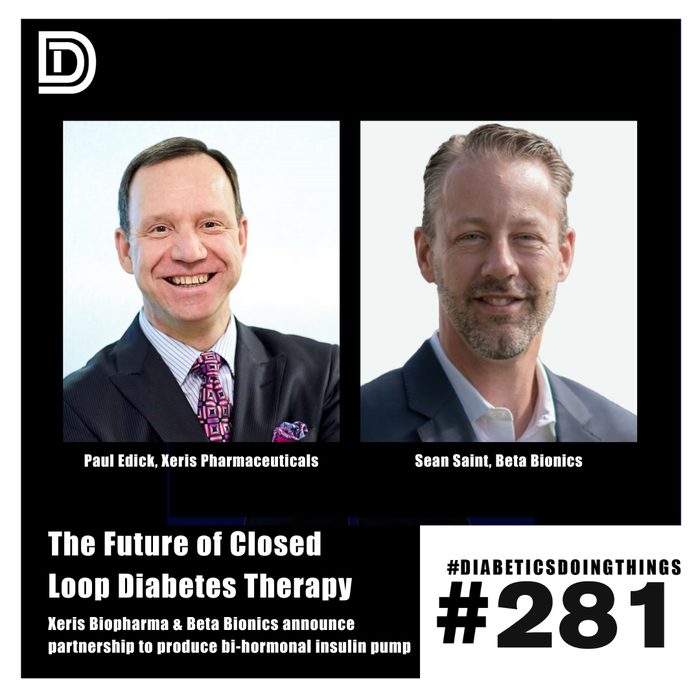
The Future of Closed Loop Diabetes Therapy - Xeris Biopharma and Beta Bionics announce partnership to produce bi-hormonal insulin pump with Paul Edick and Sean Saint

Episode summary
Paul Edick, CEO of Xeris Biopharma, and Sean Saint, CEO of Beta Bionics, joined Rob to announce a formal partnership built on a bi-hormonal insulin pump that delivers both insulin and glucagon in one closed loop system. Sean has lived with type 1 diabetes since 2011 and has worked in diabetes tech since 2003, including CGM and the iLet Bionic Pancreas. They explain how Xeris's glucagon formulation work pairs with Beta Bionics' device and algorithm, the plan for phase two and phase three trials, and why the deal is a close, years-long collaboration rather than a typical license. They also discuss the stigma around glucagon, low prescription and fill rates, and the goal of a largely hands-off diabetes therapy.
Key takeaways
- Xeris Biopharma and Beta Bionics formally partnered to build a bi-hormonal pump that pairs insulin with glucagon in one closed-loop device.
- Sean Saint says the bi-hormonal hardware is the same size as the current iLet pump, so size is no longer the barrier people assumed.
- Paul Edick says fewer than 1 million of the roughly 15 million people on insulin or sulfonylureas fill a glucagon prescription.
- Sean Saint says the goal is to remove the mental burden of lows the same way the iLet already removes the burden of insulin dosing.
- Paul Edick and Sean Saint describe this as a licensing deal closer than most, with Xeris staying involved through Beta Bionics' trials and regulatory process.
Show notes
In this episode of Diabetics doing things, Rob interviews Paul Edick from Xeris Biopharma and Sean Saint from Beta Bionics. They discuss the formal partnership announcement between Xeris Biopharma and Beta Bionics, focusing on the development of a bi-hormonal insulin pump for diabetes management. The conversation touches on the challenges and benefits of the partnership, the development process, and the potential impact on diabetes care.
Topics discussed:
Partnership between Xeris Biopharma and Beta Bionics
The unique challenges faced by a bihormonal pump compared to traditional insulin pumps.
The formulation process of the pump and collaboration between Xeris and Beta Bionics.
The upcoming phase 2 and phase 3 clinical trials.
The importance of glucagon in diabetes management and the need for increased awareness and availability of glucagon.
The potential for a fully automated diabetes therapy experience.
The role of technology in reducing the burden of diabetes management and enhancing quality of life.
The journey towards regulatory approval and commercialization.
The historical context of glucagon use and the evolving perceptions around its importance.
The positive impact of the partnership on advancing diabetes care and glycemic control.
Key takeaways:
The partnership between Xeris Biopharma and Beta Bionics aims to develop a bihormonal pump for diabetes management.
The collaboration involves overcoming unique challenges associated with incorporating both insulin and glucagon in the pump.
The development process includes formulation, clinical trials, and regulatory approval.
The partnership highlights the importance of increasing awareness and availability of glucagon for diabetes patients.
The ultimate goal is to provide a hands-off, automated diabetes therapy experience to improve quality of life for individuals with diabetes.
References:
00:00 Exploring Inspiring Stories of People with Diabetes and Industry Announcements
00:18 Exciting Partnership Announcement: Xeris Biopharma and Beta Bionics Join Forces for Innovative Diabetes Solution
03:58 Revolutionizing Diabetes Care with Biohormonal Pump and Xerasol Technology
08:52 Exploring the Future of Glucagon Use and Reducing Stigma in Diabetes Management
13:41 Revolutionizing Diabetes Therapy: The Future of Automated Insulin and Glucagon Pump Systems
23:41 Overcoming Fear and Stigma: The Journey with Glucagon and the Future of Insulin Pumps
25:17 Challenges and Partnerships in Developing a Bi-Hormonal Pump for Diabetes Management
30:47 Exciting Innovations in Diabetes Care: A Look into Bi Hormonal Pumps
Questions this episode answers
What is the bi-hormonal insulin pump from Xeris Biopharma and Beta Bionics?
It is a closed-loop pump in development that delivers both insulin and glucagon, so it can address both highs and lows automatically, according to Paul Edick and Sean Saint.
Is the bi-hormonal pump approved yet?
No. At the time of this announcement, Xeris and Beta Bionics were finishing the glucagon formulation and preparing for phase two trials, with phase three still ahead, per Paul Edick.
What is XeriSol technology?
XeriSol is Xeris Biopharma's formulation chemistry that keeps glucagon stable in liquid form at room temperature, rather than as a dry powder that needs reconstituting, Paul Edick explains.
How many people with diabetes actually carry glucagon?
Paul Edick says that of about 15 million people on insulin or sulfonylureas, fewer than 1 million fill a prescription for a glucagon product like Gvoke HypoPen or Baqsimi.
Full transcript Searchable, with timestamps
Rob Howe: Hello and welcome back to another episode of Diabetics Doing Things. We are telling the amazing stories of people with diabetes from all over the world and occasionally we get brought into big announcements from some of our partners in the industry and I'm very excited to bring this interview to you guys today. I have two CEOs here on the call with me from Xeris Biopharma I have Paul Edick and from Beta Bionics I have Sean Saint here on the call with me to review and a very exciting announcement this week and we're recording this on May 10th, 2021. 2024. Gents, welcome to the show. Thank you. Good to see you again, Rob. Thanks so much, Rob. Nice to be here. And Paul has been on the show a couple of times over the years. And Sean, this is your first time on the podcast. So I would love to talk about the announcement that has brought us here today and has brought you both here on the podcast, which is the formal partnership announcement between Xeris Biopharma and Beta Bionics. So I'd love to kind of start there and talk about these partnerships between a med device company and a biopharmaceutical company, from my experience, are pretty rare. And so I'd love for you guys to give us to talk about why we're here today and how this partnership came to be. Absolutely. If I may start, from my perspective, this partnership started actually well over a decade ago. and it was when even John Kinzel approached me at a Kelly Close event in 2011, I think it was. And so we've been aware of Xeris since way back then. And it's taken us till now for Beta to be at the right point and Xero's to be at the right point. But I think we've always looked forward to being able to do something like this for an innovative new product that really requires both device as well as drug development. I'm sure we'll talk more about that. Paul, your perspective?
Paul Edick: Yeah, I would say the same. I mean, ever since I've been with the company, we've been in some version of dialogue. And, you know, it's just the planets aligned all of a sudden where Beta was at a point where they needed a facilitating glucagon. And we were at a point where we believe we can formulate the appropriate product for them.
Rob Howe: and when we're talking about those products like what we're discussing is the bi-hormonal pump where we have a fully closed loop insulin pump which delivers not only insulin on the on the singular hormone hormone but also glucagon so you're looking at the fully closed loop solution for hyperglycemia and hypoglycemia and this is something i think we talked about a lot and i've heard a lot about as a patient over the years. And even, you know, when I was diagnosed in 2005, you know, my care team was talking about the future of diabetes care will be, you know, managing your diabetes with a device that can help treat highs as well as lows. So for you, Sean, you know, as a patient, as a person with T1D, like what does it feel like to have a chance to bring this first fully closed loop system to market? Well, it's just unbelievable, right? I mean, I, I haven't had diabetes, I suppose, as long as you have, I was diagnosed actually just a month before I met Xeris, really, 2011 for me. But I've been in the industry since 2003 and working on CGM at the time. And, you know, I've been so lucky in my career to be able to ring CGM and then, you know, some of the first versions of closed loop insulin pumps to a next generation pump with the iLet and now this. And the whole time we've been working toward making it easier to live with diabetes and ultimately easier to get better control or better outcomes. And I think this is just going to be the next step of that. It's extraordinarily satisfying, honestly. And I think the announcement as a patient reading that there's going, you know, this is something that's sort of been conceptual from a patient perspective, you know, where, you know, eventually we'll get to a bi-hormonal pump and a pump that not only carries insulin, but also glucagon. But now to see it is extremely exciting. So for Paul and Sean, maybe you can add this as well. Like, where do we go from here? Like what can patients expect to see in this roadmap now that we have this formal announcement? And, you know, what is the phase of development that we're currently in and where can we learn more?
Paul Edick: Well, I think that is more Sean for the answer. At the end of the day, you know, they're ready in my, you know, to start phase two and then go into phase three. And our glucagon will enable a more a rapid move forward. Sean, it's more your plan and your process than ours, right?
Sean Saint: Yeah, sure. Well, as Paul said, we're finishing up formulation now and getting ready for phase two type activities. And what will we see? I mean, I don't think you're going to see a whole heck of a lot of press from us on this subject because we prefer to sort of hold our cards a little close to the vest. but over time we obviously will be starting our our pivotal trial which our phase three trial which will be i think the largest trial ever run in the aid space by probably a long shot because it is also a drug trial as well and we have to have all the data to support the drug as well as the device but what you're going to see i think maybe more importantly from the device itself is a product that you can live with that will remove you know the daily burden right there's the care and feeding of the product is what we call it. But, you know, today, I think for you and I, we worry about the highs, and which means we worry about how much insulin to give and when. And then we worry about the lows, which means am I lower trending low? And do I have to rescue in some way, whether it be through, you know, I use the word rescue, but meaning, you know, treat with some carbs or true rescue, like a XeriSol technology, Gvoke product, something like that. And the idea of bi-hormonal is, well, iLet, is that we no longer have to think about insulin delivery. That's our insulin-only system. And now with bi-hormonal, that we no longer have to think about the lows either. So the burden reduction is just incredible. I do think it's important to note that I don't think any diabetes technology ever is going to completely eliminate lows and hypos. And we're always going to have to think about rescue. But that being said, the daily burden of it, I hope will be reduced. And you mentioned XeriSol technology, and I want to pivot this question to Paul for a second, because I think we're familiar with, and our podcast listeners have heard about Gvoke and Gvoke HypoPen over the years. But can you tell us a little bit more about XeriSol technology and
Paul Edick: how it's going to be used in the bi-hormonal pump? Well, XeriSol technology is our formulation chemistry. It's kind of the name we've given to it. What we're able to do is we're able to take products that are not stable in solution, such as glucagon. It was a dry powder that you had to reconstitute and make it stable in solution so that you can, at room temperature, so that you can put it in a device that you can carry around with you. So we built a version of that for the Gvoke for rescue that has a full milligram adult dose of glucagon in it, therefore the Gvoke HypoPen. And for the pump, it requires a different formulation and it requires a different amount that is going to be controlled by the algorithm, right, at the end of the day. So the daily management of your glucose as well as your insulin is what the pump, that closed system is designed to do. and Gvoke is your rescue option for when either if you're not on that pump or if you're not on a pump at all, when you have a severe low. And like Sean says, even these things, our hope is that it's great and that it is fabulous for patients, but there's still the human factor and stuff can go wrong. So it doesn't obviate the need for a Gvoke pen at the same time.
Rob Howe: And I think you're right. Like diabetes is the disease with too many inputs. There's always going to be some sort of factor, environmental or otherwise, that requires some sort of action on the place of the patient. I want to talk briefly because there's been discussion in the community over the years of this idea of glucagon, but not in the full dose. So I think colloquially, it'll discuss as like microdosing glucagon as a rescue. And I think it's not been FDA approved. And then especially for when we're talking about a Gvoke HypoPen or pre-filled syringe, the recommendation is to follow, you know, everything according to the important safety information and the instructions on the device. But this device will, at least in my mind, is like the theoretically being like administering the amount of glucagon that is required based on the sensor glucose of the iLet bionic pancreas pump. Am I understanding that correctly? Or, you know, what are some of the complexities around that? I think you're understanding it perfectly. The product's designed to just give you, you know, just enough glucagon to get you back to target, you know, so you don't go much higher. You don't have some of the other challenges with full doses of glucagon that we sometimes experience. But I think there's also an opportunity for doing that. And Paul, please speak to this for doing it in other formats.
Paul Edick: Yeah. Yeah. Yeah. And Rob, what you're talking about is the whole idea of mini dosing for, you know, we've talked about exercise induced hypoglycemia. We've talked about, you know, PBH and all kinds of stuff. The, the, the, I think that the unique difference here is when we were approaching a lot of those other potential indications, they're unique and standalone indications that the FDA considered prevention indications and, and very specific situations. And they'd never been studied before. You hadn't really had any history with the FDA on glucagon being used that way. In this system, it's glucagon being used for glycemic control along with insulin. I think the agency is going to look at that differently. At least my hope is that they look at it differently because it's a part of a system and it's a part of a, it's not a mini dose for a specific outcome. It's a dose as appropriate as opposed to insulin in a system to achieve optimal glycemic control. That's an excellent way of using glucagon, and it's an excellent way of using small doses. The outcome of that could very well be in the future some additional indications for mini-dosing of Gvoke. So we don't know, but I think that this is a little bit of a different approach to it, and it's different than Gvoke. Gvoke has its role and it has its place. And this version of liquid glucagon has a different role.
Rob Howe: That's really interesting to think about. Up until this point, glucagon really only has the rescue and option even only recently been approved for self-administration. So historically, the discussion around glucagon, and this is something that I've worked with Xeris on for now a number of years, is kind of eliminating the stigma of using glucagon. And, you know, that you can, you know, in emergency situations, self-administer if it's safe to do so. And so now to see these new applications and new research going into the uses of glucagon is really exciting.
Paul Edick: Well, we think so.
Sean Saint: For Sean, go ahead. I just wanted to add that it, I, wow, I don't have the words. You proposed that there's a stigma associated with the use of glucagon, and I suppose you're probably right. How depressing is that? Right? Right. I love the idea that if that really exists, and I suppose you guys are in a better position to know that than I am. How important is it that we remove that? I mean, the glucagon is just yet another drug that helps us control our blood sugar. Right. There's no. Well, I suppose there is some stigma with insulin. But now that I think about it, but but it certainly shouldn't be any greater than that. Shouldn't be that either. Wow. That just hit me kind of hard. Sorry, Rob. No, no, of course.
Paul Edick: And Rob, I think you would agree. A big part of the stigma is the way glucagon has been used historically. And a lot of the response to a patient having an episode where glucagon is necessary is you did something wrong. Whereas, you can do everything right and still need Gvoke. This is just a different way of using glucagon to better manage your condition.
Rob Howe: Well, I think it also just speaks to how much fear there is around hypoglycemia and severe hypoglycemia in particular, both from patients and caregivers. And I think, you know, Sean, you're right. You know, until you really start to think about it, you don't understand where that stigma comes from. And Paul, you're also correct. You know, historically, you know, the first, you know, up until very recently where, you know, products like Gvoke HypoPen have come to market that are more simple to use and have instructions that are relatively straightforward to follow. you know, the glucagon came in a red container and, and, you know, was very sort of just scary to look at and, and, you know, was, you know, emergency use only and around a very scary topic of severe hypoglycemia. So I think we're kind of working and there's been a lot of progress in that, but, you know, now I think as, as you mentioned, Sean, there's also a kind of stigma against insulin at times, but as we're integrating these hormones more into technology, I think that sort of presents an opportunity for us to say, Hey, you know, these are, these are working in tandem with your technology to keep you in range the same way that your pancreas would, or your, and your liver would, if you weren't living with, with a chronic condition like, like diabetes. So I kind of want to transition that into a question for you, Sean, about, you know, the iLet bionic pancreas system is, is advertised as the most hands-off pump system currently on the market. And this bi-hormonal pump is another step in that direction. So how are you and Beta Bionics thinking about the, like, leaning into the fully automated diabetes therapy experience? Yeah, that's a good one. First of all, I think you're exactly right. That is how we build the iLet. That is how we believe in the iLet. Look, with all the respect in the world for all the current hybrid closed-loop systems out there, AID systems, the others, in many ways, they do the same thing in the same way. You set them up in similar fashion. They control you largely to the same outcomes, utilizing the same inputs. And the iLet does represent the next generation from that. We've reduced the inputs. We've reduced the management. We've reduced the inputs or the required management of the user as well. And I think that at first, we're going to naturally be billed for the people who really aren't willing to put in that extra work. But before we see the bi-hormonal system, I think we're going to see a transition to the iLet itself to more of the people who don't want to put in that work, which newsflash is nobody. Nobody loves driving the diabetes car. And so we're getting the word out now on iLet. And, you know, I think the education around that system is so important because you do have to think about it differently. And my hormonal is no different than that. We're going to, it's going to be a next generation beyond that, that we're going to have to, you know, really evolve again into even a different level of involvement with a product. And I say different. It's not always less, right? There is slightly more management. You have to fill another cartridge, et cetera. Not fill. It'll be pre-filled, but load. But personally, I'll take that for the reduction in mental burden of, you know, I always use the example of, you know, walking through the supermarket with my kids and knowing I'm getting low and, you know, kids are running off to the other aisle and you're like, oh, geez, you know, what do I do now? How do I run after them or do I deal with my blood sugar or what do I do? And I don't really love that. So yeah, we'll be leaning into the elimination of or massive reduction and that sort of thing. Like crazy. That's what it's for. It's funny that you bring up the very tangible example of being in the grocery store because it seems like, you know, it should be studied how many hypoglycemic incidents happen while walking up and down the aisles of Target or your average grocery store. Surrounded by food. And, you know, having to sit down and answer questions about why you're, why you're in the candy aisle, you know, on the floor sweaty. Yeah. So Paul, I want to talk a little bit about product development and like where, where we go from here and how, you know, Zerus and Bay of Bionics are going to work together to, you know, get this product to market. You mentioned earlier, you know, Zerus has been a leader in innovating the shelf stability of glucagon and liquid glucagon. like where where do we go from here in terms of submitting this to you know the fda and the agency and the trials like how when when will we you know be able to you know when can we expect i guess for for our for our listeners who are like oh this is excellent i want to see this and be a part of it
Paul Edick: when when will those things start to come to market well so it's a process you've got a drug in a device so you've first things first we've got to finalize the formulation make sure it's everything that Sean needs for his program. And then we will support the beta bionics in designing a phase two and phase three clinical program that, you know, their expertise is device, our expertise is drug. So we're going to need to be kind of hand in hand in the process. You know, we will be scaling up that formulation to deliver clinical supplies and making sure that they've got everything they need for their phase two clinical study and phase three clinical study. That's not a short process. We will have the final formulation, you know, this year as fast as we can. Actually, I think the teams are already working on the go fast plan. I know we signed the deal a week ago, maybe. and they've already been in a couple of meetings between the two development teams. So I think it's off to a great start. And then we'll support them throughout their clinical development process. It's a years-long process. It's not months.
Sean Saint: Speaking to the speed at which we're having this conversation a week after the deal has been done, what has the response been like internally both at Xeris and at Beta Bionics now that this is public knowledge? Speaking for us, it's been fantastic. I mean, you know, our company was founded on the concept of biohormonal glucose control. Well, let's say that we started working on it back in the early 2000s. Company was founded in 2015 with that goal. And we ended up realizing we had a phenomenal product in the iLet along the way. And we decided we had to release that. And we are. And it's going fantastic. But that hasn't changed our focus. But I think the world thought it did. And I get the response all the time that people believe that we dropped the bihormonal in favor of the insulin only. And that's not true. We added insulin only to our product pipeline. But this has really reinvigorated the opinion on the bihormonal product, even internally at times. So I think people are just thrilled to see that.
Paul Edick: from from the xeris side there are people in the company that have been hoping that this would happen and wanting to see this happen for a long time so there's an element of pride and there's an element of opportunity and and really excitement about potentially and we believe you know very realistically changing the landscape of of how you know diabetes management glycemic control in a closed loop system and to be the facilitating glucagon in that process. That's, that's, you know, pretty exciting for our team. At the same time, as you, as you're seeing in this conversation, it, it brings Gvoke back into focus for, in a lot of ways that says, look, you know, they, they will coexist for all the right reasons. So it gives people additional time, an additional opportunity to talk about Gvoke for all of those times when, you know, you might
Rob Howe: need rescue. So it's been all around. Paul, you surprised me the other day, and I'm sorry, I don't remember the statistic. You shared the number of people that actually either have a glucagon prescription at all or carry glucagon, and it was far too low. So I'm going to echo that last comment and say that if this agreement and if the work we're doing together in any way increases the visibility to what glucagon is, the necessity for having glucagon around, then that is a wonderful thing in the short term. You know, I hope that's the case. Yeah, I mean, there's 15
Paul Edick: million people on insulin or sulfonylureas that the fact that they're taking insulin or, you know, sulfonylurea, they're at increased risk for a severe low, period. That is just a fact. Less than a million actually fill a prescription for a Gvoke HypoPen or a Baqsimi or whatever. So the more this process highlights the need for Gvoke is a good thing at the end of the day.
Rob Howe: That's a shocking statistic, Paul. It is. And even just in conversations around the table, my team and I were at a local JDRF event last month, and we're having conversations around the table about what's in our diabetes toolkit And when Gvoke and glucagon was brought up, most of the people at the table hadn't even, you know, ask their endo for a glucagon prescription or hadn't even filled that prescription and weren't even aware of what was going on. So even in this one-on-one conversations, you know, to me, when I see a headline that talks about, you know, a bi-hormonal pump, my brain goes to, well, maybe even people who aren't currently interested or aware of what's out there from a glucagon perspective, this could even influence them of how important it is to have that alongside. Paul came on the show, you know, going on four years ago now and said, you know, everybody on insulin should have glucagon available. And, you know, in case of a severe low blood sugar, severe hypoglycemia. So, you know, I think we've got a long way to go there, but it's exciting to take steps in that direction.
Paul Edick: And I think I think that mentality and if you think about it, it's kind of it may be counterintuitive. We're sitting here talking about a closed loop system for glycemic control that's got an insulin component and a glucagon component. The more we can build the momentum behind the need for ready-to-use rescue glucagon and Gvoke HypoPen in particular, the more receptivity I think there will be down the road to the closed-loop system that deploys both hormones. the mentality of the need for, is going to be important for both products, especially over the
Rob Howe: long haul. A quick compliment to Xeris here, you know, as a person who administered a rescue dose of glucagon back in 2011 with the lyophilized reconstituted glucagon, I'm real glad we have the new methods out there. That was difficult to do under pressure, you know, not, you know, being a little unsure yourself. And in my particular case, standing in front of roughly a thousand doctors as I did it, which was, I'm still not clear how that happened, how I had to be the guy to figure out to give glucagon, but okay. But yeah, easier would have been better. Sounds like we need another interview to talk about that story. I have a whole bunch of questions. I agree though. I want to give the Xeris team a ton of props for me personally, my journey with glucagon, I'd never used it. I was under the impression that unless I was unconscious, it wasn't to be used. And through the education of their team and the release of Gvoke HypoPen, I am now, I've used glucagon successfully and safely. And my wife has helped me a couple of times as well. And again, reduce that fear of administering glucagon. And I think that's something that we still have a long way to go in terms of the greater community. Paul, You mentioned only, you know, a million out of 15 million people with have the glucagon prescription. So, you know, we've got a lot, a large gap to cover, but I think, you know, the work that you guys have done at Xeris has really been instrumental for me personally in removing that, that fear or that, you know, even stigma of using glucagon, you know, at the right time.
Paul Edick: And my overriding point is I think the more work we do there, the more receptivity to the closed loop system by patients and users in the future.
Rob Howe: So I want to talk about just two things as we kind of, I want to be respectful of your time here. So Sean, for you, you mentioned that beta bionics was founded under the principle of the bi-hormonal, but within that, there are challenges that the other insulin pumps don't have to necessarily go through because they're only using the one hormone. So as, as this product is going through submission and trials, like what are some of those challenges with the bihormonal pump that even iLet is not necessarily, didn't necessarily have to go through? Yeah. So I think there are a few, and certainly having been involved in this since again, about 11 myself, I've lived them. The first is that, you know, we've never had the hardware and people have said, wow, you know, the bihormonal hardware is going to be huge. Nobody's going to want that. Well, the reality is the bihormonal hardware is the size of the iLet. It exists. The iLet contains the air that would be that other channel, if you will. And it's very acceptable size. So that's behind us. You know, we didn't have an algorithm that could control glucagon in an appropriate way. We have that now, right? We've done the formative testing. The feedback's amazing. The control's amazing. But, you know, we get phrases like, you know, I forgot I had diabetes, which is exactly what the product is designed to do. And then lastly, hey, you know, there's no drug. Well, I think that's what we're here to talk about today because there really is. Is it completely cleared yet? No, but it does exist, which really brings up an additional challenge. And I think, Rob, it goes back to the very first question of the interview today, which is that these things happen rarely. And I'll say a thank you to Zaris as they hold our hand as we, in some ways, become a drug company. We're lucky enough at Beta Bionics to have worked with both pharmacy reimbursement as well as pharmacy distribution through our time, both here as well as a companion medical in the past. So we're not intimidated by that process, but there's a huge amount that we're having to learn here. And it's been great to have a wonderful partner with Zerus to help us through that. But that's a challenge that in my opinion, most companies are just not willing to bite off and call us crazy. We'll do it. Well, I did have a question for you both on that, because obviously, you know, Sean, you mentioned companion medical, Paul, you and I have had discussions over the years about your career. You guys have been part of MNA activity and, and throughout your, your various journeys. When you think about this agreement and a licensing agreement, and it's, it's obviously different. And you mentioned, you know, Sean, it's, it's been 10 years in the making really between these two companies. Like how did this take shape or like, you know, where did you guys really find that alignment? Like what was the sort of catalyst where you're like, yeah, we're going to, this is the right partnership. This is the right, we have the right ambition. We have the right goals. We have the ability to take this on. Like, where did that momentum come from?
Paul Edick: You know, I'll take the first stab at that. We both had to realize that we would be tied together almost inextricably for the long term. And really, Sean and I got on the phone and talked through all of the issues associated with that. And what is the future of closed loop systems and pumps? And what's the future of glucagon? And for us in particular, does it have a detrimental impact on Gvoke HypoPen? And the answer that we got to is no, it actually could be a good thing. And participating in really the future of how glycemic control and really come to the realization that together we can do some pretty special things. And then it was a matter of, you know, the devil's in the details. And we worked that out over the course of a few months. And, you know, here we are. Sean?
Sean Saint: Yeah. Yeah, I'll add just like, I agree with everything Paul said. And, you know, since he brought up the context of M&A, I think the way Paul described that it was not dissimilar to the way a lot of great M&A comes about, you know, you realize that you're better together. And there you are, the differentiation I'll bring in this case, and Paul did mention it is that you're really dating your acquirer. But you know, you're married, you know, Paul and I are married at this point. we are we're together for the long run right which i think changes the way you do these license deals right i mean you've come out the other side of it you know and still be friends and i think we've done that and we're both really looking forward to a really fruitful partnership going forward where if we're being honest with mna you know there is some level of you know you know commonly they're gonna they're gonna walk people like paul and i out and say thanks for your help but you know there's the door that's not the case here so yeah we're not putting the companies
Paul Edick: together, but it's the kind of license deal. A lot of licensing deals, I mean, you give somebody a license and they take the drug and they just go and run with it. And you just collect royalties. You really don't do much. This is a little bit different. This is going to require that we're kind of in the process together. And some of what we had to work out was, okay, well, if Beta Bionic suddenly needs help with XYZ, how are we going to do that? And we've got that relatively figured out, but there's other stuff that stuff's going to happen and we'll have to figure it out down the road. So it's a licensing deal that creates more of an intimate relationship than a normal licensing deal. It's not real M&A. We're not putting the companies together, but it puts us kind of in bed together for the long haul.
Rob Howe: Absolutely. Well, thank you for guys for entertaining my kind of rabbit trail there. I think, you know, just from my, you know, just interest in how the two companies will work together. I want to, as we kind of reach closing, I'd love to see if you had any other closing remarks of anything that we haven't discussed yet. But before we do that, I just want to say how exciting it is when Dana sent me the press release earlier this week, because when I was diagnosed, you know, almost 20 years ago, my care team was very quick to tell me, you know, one day there's going to be technology available that allows you to manage your diabetes almost completely hands off. And, you know, bi-hormonal pumps were part of that discussion. And then it seemed like something that would, you know, was very way, way far down the road. And to be able to see that, you know, potentially come to life in my lifetime where I could potentially use it and benefit from it. And the millions of people with diabetes that'll have the opportunity to do that is extremely exciting. So thank you both for your time today. Thank you. We hope that happens. Yeah, I appreciate that, Rob. I want to just add one thing on that is that, you know, it's been done. So that's the thing that I want people to remember is that, you know, Paul and I are doing the hard work right now of getting it all the way through the regulatory process and making it a commercial product. But we've tested this clinically before. And biohormonal glucose control does work. And people love it. So, you know, it's not a pipe dream. It can happen and it will happen. We're on it. That's exciting. And thank you guys both for all that you do for innovating for people with diabetes and for your partnership with diabetics doing things over the years. I know, Sean, I've worked with members of your team, not necessarily directly with you, but Paul, I appreciate your partnership and your team's partnership as well over the years. So thanks for supporting the work that we do here. You're welcome. Thank you. Thanks a lot, Rob. Appreciate you having us today. Thank you.
About Paul
Paul Edick is CEO of Xeris Biopharma, maker of the Gvoke HypoPen glucagon rescue pen, and has appeared on the show multiple times. Sean Saint is CEO of Beta Bionics, maker of the iLet Bionic Pancreas, and has worked in diabetes technology, including CGM and closed-loop insulin pumps, since 2003.