

A Potential Future for Diabetes Care with Dr. Anath Shalev, Founder TIXiMED

Episode summary
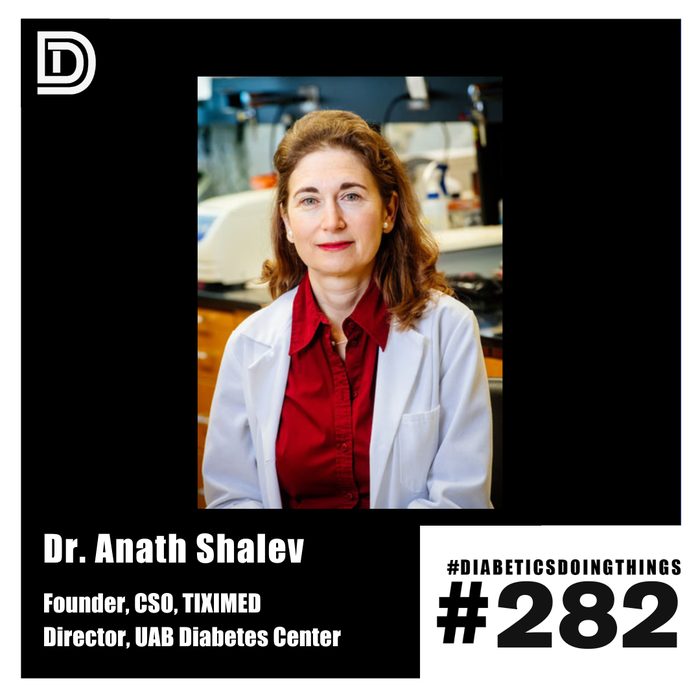
Dr. Anath Shalev is an endocrinologist and researcher who trained in Switzerland, at Harvard, and at the NIH, then led the UAB Comprehensive Diabetes Center for over 14 years. Her lab discovered TXNIP, a protein that rises in beta cells under high glucose and contributes to beta cell death in both type 1 and type 2 diabetes. She later founded TIXiMED to develop TIX100, an oral drug that targets TXNIP and also lowers glucagon only when glucose is high. Rob Howe talks with her about how TIX100 differs from SGLT2 inhibitors and GLP-1 drugs, why type 1 and type 2 diabetes share more biology than people assume, the earlier verapamil trials that led the way, and what combination therapies could mean for future patients.
Key takeaways
- Dr. Shalev says her lab found that TXNIP rises in beta cells under high glucose and drives beta cell death in both type 1 and type 2 diabetes.
- She says TIX100 is designed to work alongside insulin, not replace it, and may help preserve beta cell function if started early enough.
- Dr. Shalev explains TIX100 also lowers glucagon, but only when glucose is high, so it does not raise the risk of low blood sugar.
- She says earlier verapamil trials funded by JDRF showed adults with new-onset type 1 diabetes kept more beta cell function and needed less insulin for at least two years.
- Dr. Shalev notes that even decades after diagnosis, many people with type 1 diabetes still have some working beta cells left to protect.
Show notes
In this episode of the podcast Rob is solo as he interviews Dr. Anath Shalev, a diabetes researcher turned founder of startup TIXiMED. Dr. Shalev discusses the discovery of TixnIP, a protein involved in oxidative stress in beta cells, and its potential for treating diabetes. The conversation covers the development of TIX 100, an oral medication targeting TixnIP, its implications for type 1 and type 2 diabetes, and the differences from existing diabetes treatments like SGLT2 inhibitors and GLP-1 agonists.
Topics discussed:
Dr. Anas Shalev's background in diabetes research and founding of Tiximed
Discovery of TixnIP and its role in beta cell health
Potential of TIX 100 as a novel oral medication for diabetes treatment
Comparison of TIX 100 with existing diabetes treatments like SGLT2 inhibitors and GLP-1 agonists
Research process behind TixnIP inhibition and development of TIX 100
Future of diabetes care, combination therapies, and impact on patients' lives
Information about TIXiMED, clinical trials, and ways to support the research
00:18 Revolutionizing Diabetes Treatment: From Researcher to Founder
03:47 Revolutionizing Diabetes Treatment: Targeting Beta Cells and Glucagon Levels
13:47 Revolutionizing Diabetes Treatment: Targeting Beta Cells in Type 1 and Type 2 Diabetes
17:35 Revolutionizing Diabetes Treatment with Ticks 100: A Breakthrough in Addressing the Root Cause of the Disease
27:35 The Limitations and Advantages of Verapamil in Diabetes Care
29:47 Advancements in Diabetes Technology and Research: A Look into the Future
33:04 Exploring Diabetes Treatment Innovations with Dr. Shalev
Questions this episode answers
What is TXNIP and why does it matter for diabetes?
TXNIP (thioredoxin-interacting protein) is a protein Dr. Shalev's lab found rises in beta cells under high glucose and contributes to beta cell death in both type 1 and type 2 diabetes, which made it a target for a new kind of treatment.
How is TIX100 different from SGLT2 inhibitors and GLP-1 drugs?
Dr. Shalev says TIX100 targets an underlying cause of diabetes rather than just lowering blood sugar, and it reduces glucagon only when glucose is high, unlike SGLT2 inhibitors and GLP-1 agonists, which she describes as more symptomatic treatments.
Is verapamil a cure for type 1 diabetes?
No. Dr. Shalev explains verapamil is a blood pressure drug that happens to lower TXNIP and showed benefits in clinical trials, but it carries heart risks and must be used under a physician's supervision with an EKG first. It is not a specific TXNIP inhibitor like TIX100.
Can TIX100 help people who have had diabetes for many years?
Dr. Shalev says TIX100 is being developed to work alongside insulin, and people with longstanding type 1 diabetes may still benefit from its glucagon-lowering effect, though it would not replace insulin once most beta cells have died.
Full transcript Searchable, with timestamps
Rob Howe: Hello, and welcome back to another episode of Diabetics Doing Things. We are telling the amazing stories of people with diabetes from all over the world. And I'm really excited for today's interview because it really comes at an intersection of a lot of things that we're very passionate about and that we've covered a lot on this podcast. And the first is research. The second is starting companies for people with diabetes and also just a background of diabetes in general. and my guest today, Dr. Anath Shalev. Welcome to the show.
Anath Shalev: Well, thank you. Thank you for having me.
Rob Howe: It's very exciting to have you here today. You have spent your life in diabetes and primarily on the research side. And so as we kind of tee up today's conversation, I'd love to give you the opportunity to talk a little bit about your background as a researcher. And then let's shift into what drove the change for you to become a founder and to really be leading on the side of creating a company for people with diabetes? Sure. So I'm actually originally from Switzerland,
Anath Shalev: where I did my medical training. And then I did a research fellowship at Harvard and my endocrinology and diabetes fellowship at the NIH in DC. And I'll say that I was faculty at UW in Madison before being recruited to UAB in Birmingham to direct the UAB Comprehensive Diabetes Center over 14 years ago. And so that long I've been here. But for almost three years ago, and based on the discoveries that my lab has done over the last two decades, I founded the startup company called TIXiMED with the help of a local fund, the First Avenue Venture, directed by Mike Goodrich. And so now I'm the founder and the chief scientific officer of Tiximed. And our goal at Tiximed is to develop and commercialize Tixi-inhibiting medications as the first of its kind oral medication for type 1 diabetes and down the road, hopefully also for type 2 diabetes. I can't hear you.
Rob Howe: Can you hear me now? No? Still now?
Anath Shalev: Very faintly now.
Rob Howe: How about now? Is that better?
Anath Shalev: Perfect.
Rob Howe: Great. It wouldn't be a podcast without a little bit of technical difficulties, so I apologize. So you mentioned a few acronyms and names that I want our audience to get familiar with before we go through. And the first is TXNIP. So could you walk us through what TXNIP is, where you discovered it, and the impact that TXNIP can have not only on diabetes, but other diseases and complications?
Anath Shalev: Right. So TXNIP or thioredoxin-interacting protein is a detrimental protein involved in oxidative stress in the cell. And over 20 years ago, my lab identified TXNIP to be elevated in human beta cells in response to high glucose or high sugar and in diabetes, and both type 1, actually, and type 2 diabetes. And then we went on to show that it causes beta cell death and dysfunction. So beta cells are the cells that produce insulin in the pancreas. And on the other hand, downregulation of TXNIP in different models was protective. So with that, we kind of knew that we had found an attractive novel target for the treatment of diabetes.
Rob Howe: And for someone like me, a patient, you know, when you're talking about, you know, all these clinical terms, like in like the layman term, the most simple layman term is possible. What did that, what opportunity is there when you and your team discover TXNIP and its applications? What opportunity is there for, you know, this to come to market and for patients?
Anath Shalev: Well, it's a huge opportunity because so far, all the approaches in type 1 diabetes have focused on the immune system and very little has been done or even appreciated in terms of the beta cell and the beta cell contribution to the disease itself. And in fact, this has become very painfully apparent by the fact that so many approaches focusing just on immunosuppression and immunomodulation over the last several decades have largely failed. And right now, it's really become known and appreciated that none of these approaches will work if they're not paired with an approach that actually targets beta cell health. And so here suddenly we have a target that may actually promote beta cell health. And obviously, again, this has been kind of a gap in our knowledge because not only there were no treatments, we didn't even know what to treat and what to target. And so now suddenly we had an approach that we could pursue and trying to provide that additional kind of leg, I guess, of this whole treatment approach where we would promote the patient's own beta cell health and without insulin production.
Rob Howe: And so this really kind of flows into a question that I know we had in our list, which is, you know, this opens up the idea that type 1 diabetes is not exclusively an autoimmune disease.
Anath Shalev: That's right. And it really isn't. And so, I mean, it obviously is also an autoimmune disease. And that is just part of and one side of the coin. The other one is beta cell dysfunction and beta cell death. And actually, some experts even debate now which one comes first, and it comes a little bit the chicken and egg. So I don't think that is that important. But the important thing is that if we really want to have an impact, we have to address both problems, the autoimmunity as well as the beta cell dysfunction and the beta cell disease. And so obviously there would be no diabetes as long as the beta cell is not susceptible and protected against the cytokines and the inflammation that's going around. They can survive and there's no diabetes in the end. So we really have to go hand in hand with the immune system to protect those beta cells and to make them less susceptible to the disease processes.
Rob Howe: And this is something actually I learned a few years ago when I was fortunate enough to go tour the Barbara Davis Center in Colorado. And they were talking about a study that they did with their patient populations, which was an antibody screening for about 15,000 pediatric patients. And they were able to prevent diabetic ketoacidosis in like 12 out of the 13 patients that they identified for antibody markers, which they, you know, And I think there's also some preventative medications now on the market that focus on protecting those beta cells. So in this way, is this a similar sort of application to, like you mentioned, it's the chicken or the egg, the autoimmune, but also the beta cells to protect those beta cells can help with the onset of diabetes? Is that, am I understanding that correctly?
Anath Shalev: Absolutely. So, and I think you had another question where you were wondering whether, at which stage of the disease this would help. And so the way we design that, we'll get probably more into it while we continue our conversation. We design our drug, our Tix100 drug, is currently to work with insulin. So not, you know, without, not instead of insulin. However, we can imagine that if the medication is started early enough, at the time where the patient's beta cells are still largely alive, we could envision a scenario where it actually would prevent the use of insulin down the road and really prevent the disease. We don't believe that once the disease has fully developed and a lot of the beta cells have already died, that it would still be effective just on its own.
Rob Howe: So it requires for patients like myself who have had diabetes for a number of years, and our beta cells have largely either or completely died, it wouldn't be able to, Tix100 wouldn't be able to effectively treat on its own. There would still be insulin required.
Anath Shalev: Yeah, exactly. It still would be insulin, but it actually has another very interesting aspect. And this is one reason why we even got into this whole game, if you want so, and addressing that aspect of the disease. There's one striking finding that we had while we're still at NIH, and that is that people with type 1 diabetes, even sometimes 50 years after disease onset, still have a significant amount of functioning beta cells, just not enough to maintain normal blood sugar levels. And so we're not starting on ground zero. So it's not everything is lost and there's nothing to protect at that point. There is still something to protect. And we also know, based on large studies, that even a small amount of remaining beta cell function has a huge impact on outcome and prevention of complications. So that is one aspect. The other one is that for later stage diabetes, even for those people that have lost all the beta cell function, what TIX100 does is it has another effect. And namely, diabetes is kind of a bi-hormonal disease. So one thing is the lack of sufficient insulin, But the other one is excessive glucagon production. And glucagon is the counter-regulatory form into insulin. And what it does, it fools the liver to produce even more glucose, even when glucose levels are already high in the blood. And that is obviously a major problem. Now, TIX100 lowers glucagon levels. And it does so only when the glucose is high. So it does not cause any risk of hypoglycemia because when glucose drops, glucagon is still going to be increased. But with this, with the anti-hyperglucagonemia, it also is expected to be beneficial even in those that have lost all beta cell function. So it has an additional feature that we were surprised to find, and we're very excited to see that.
Rob Howe: Thank you for explaining that. I think I'm going to include in the show notes, there's a video on the TixiMed website, which has a really simple illustration of how Tix100, you know, works with the liver and glucagon and the visual for people who are more visual learners. For me, like really drove that point home. I want to ask a question you mentioned, and it was the first time I've heard this on my podcast is talking about diabetes as a bi-hormonal disease. And, you know, typically we're only treating it with one hormone or at least like across the board, we're only treating it with insulin as the hormone that we're, you know, exogenously consuming. So what impact or rather, you know, as from a research perspective, or as, you know, someone who is, you know, been studying diabetes for many years, like, it's the disease with so many inputs and so many factors of your life are impacted by, you know, by the disease. Why do you think we have only been able to treat it with just the single hormone?
Anath Shalev: or why has that been the approach thus far? Well, because unfortunately, glucagon is really a very critical hormone. So it's not, you cannot live without glucagon. So inhibiting it completely would be very, very dangerous. And several of the anti-glucagon approaches have had a lot of side effects, and so have not really gotten to the point because they were targeting more the glucagon effect downstream, where glucagon receptor antagonists, and they ultimately cause the opposite. They cause hyperglucagonemia and upregulation of alpha cells, so it kind of, it becomes a vicious cycle. And so we have not really been able to address it so far. In our case, again, it lowers glucagon secretion per se, and does only do so at high glucose levels. So we kind of avoid some of those detrimental effects that some of the previous approaches had. I mean, that is part of the reason. The other reason, of course, is that the more acute effects and the big challenge for diabetes is, of course, to control the glucose levels. And the major player is still insulin. I mean, there's no doubt. And so we were obviously able to control the disease reasonably well with insulin. But I think the other problem, and I think you alluded to that a little bit in your questions, is it's more of a symptomatic approach. It's really just treating the symptom, namely the high glucose, and that is best done with insulin. There's no doubt
Rob Howe: about that. Thank you for clarifying that. And again, I really want to put myself in the position of the audience who is just not as experienced with the biology and the science behind diabetes. So thank you for the explanation. And we've talked already, you know, about the, about how Tix100 would be beneficial for someone with type 1 diabetes, but talk to me a little bit about type 2 diabetes, and then even as well as early onset type 1, if we were able to identify the antibodies early, what impact would Tiximed have or Tix100 have for those patients?
Anath Shalev: Right. So again, I think another myth that as much as people were thinking that all beta cells are lost in onset of, once there's onset of type 1 diabetes, the other myth has been that type 2 diabetes is only based on kind of insulin resistance and has nothing to do with the beta cell. And we know that that is not true. Type 2 diabetes is, like type 1 diabetes, ultimately dependent on the loss of functioning beta cells. The only difference is that that loss of beta cell function is a lot slower. So that slope is a lot flatter. So in a way, actually, we have even greater opportunities to treat type 2 diabetes with approaches that target the beta cell because we have more time. So by the time someone is diagnosed with type 2 diabetes, they typically still have a significant amount of beta cell function left. So imagine if you target at that point, you can preserve the beta cell function. And in fact, if we do this right, we might be able to avoid having people to go on insulin in the context of type 2 diabetes. So there actually, it could be preventative in terms of not having to have to use insulin. Um, to your other question in terms of early, uh, type 1 diabetes, again, I think, um, the earlier we can start the treatment, obviously the better, because that's when more beta cells are still there and more beta cells are preserved. The earlier we start, the less insulin the patient would require down the road. And if we do it really early at a time where still beta cell functions are sufficient to sustain normal glucose levels, maybe insulin requirements could be avoided altogether. Later in the disease process, it probably just would be a reduction in insulin requirements.
Rob Howe: Fascinating. I think there's a lot of I want to unpack there, but I think something that is really interesting for me to translate for our listeners, because we've been talking a lot about diabetes stigma on this podcast this year, particularly within the diabetes community across from type 2 or type 1 to type 2 and explaining that to people in our various lives, right? And oftentimes, there can be sort of microaggressions or misinformation and stigma from the type 1 community to the type 2. But you said something really interesting that type 1 diabetes and type 2 diabetes are more similar than maybe we realize. And could you expand on that a little bit and think about in a way that our audience could learn a little bit about how the diseases are more similar than maybe we think?
Anath Shalev: Yeah, no, absolutely. This is a really good point. And this is something that I've been dealing with for the last 14 years at the center, because initially it was really kind of people were saying, oh, you're doing more type 1 or more type 2 diabetes. And we're really kind of trying to move away from that. obviously there are different additional aspects in terms of the pathogenesis of the disease the autoimmunity in type 1 and the insulin resistance in type 2 but that's pretty much the extent on how different they are a lot of the other processes again everything that's related to the beta cell is very much the same only the the speed of it and the the aggressiveness of the disease is different So the same factors that are causing beta cell death in type 1 diabetes, such as inflammation, ER stress, oxidative stress, all these other things, cause beta cell death also in type 2 diabetes. And so with this, when we have a target that affects and can kind of prevent some of those effects, we can treat both. And the joke I typically tell is that if we have something that works in type 1 diabetes in this setting, it will also work in type 2 diabetes. The reverse, unfortunately, is not true because in type 2 diabetes, you can treat the insulin resistance. You can treat a lot of other aspects of the disease that are not targeting the beta cell and still get symptomatic relief. Again, back to the issue, are we dealing with the cause or not? But you can get the relief, but that would not necessarily work in type 1 diabetes.
Rob Howe: So that kind of flows into my question about existing treatments that are on the market today for people with diabetes, like an SGLT2 inhibitor or a GLP-1. How is Tix100 different in how it addresses the disease from those medications?
Anath Shalev: So first of all, TIX100 is an oral drug that targets one of the underlying causes of the disease rather than a symptom, as I mentioned before. For example, SGLT2 inhibitors are just lowering blood sugar levels by promoting glucose secretions through the urine. So they don't have any beneficial effects on the beta cell per se or on insulin production. In fact, that is why what makes them so dangerous in a way in the context of type 1 diabetes in terms of diabetic ketoacidosis as they eliminate kind of the major marker for insulin deficiency, namely high glucose levels, fooling the patient into believing that they don't require more insulin when they in fact do. And then GLP-1 agonists have to be injected subcutaneously. They're not DPP-4 inhibitors. And they function primarily by pushing the remaining beta cells to secrete more insulin, delay gastric emptying, and in some cases cause significant weight loss. So again, it's more the symptomatic rather than the positive effect. And so again, just to be clear, I mean, both are great drugs for type 2 diabetes, but not so much for type 1.
Rob Howe: Yeah. Thank you for the clarification. And I think, you know, I'm learning a ton from this conversation and just like in layman's terms, how these medications work within the body, which is really fascinating. I think beneficial. You know, I want to talk about the research process, because it's pretty well documented in what I was looking in preparing for the interview about, you know, the discovery of the TXNIP inhibition. But for those of us who are not as familiar with how you and your team, you know, encountered this and the trials that led to the discovery, what can you tell us about that? And specifically, I'm talking about the verapamil.
Anath Shalev: Okay, so in terms of verapamil, again, it started off with TXNIP. Once we had identified TXNIP as a potential target, we were trying to prove that it was really TXNIP that was causing the beta cell death and that the reverse might be true as well, where we could protect against those detrimental effects by inhibiting TXNIP. So we initially went ahead and did genetic knockouts of TXNIP in different mouse models of diabetes, and we were able to see that they were all protected, whether it's type 1 or type 2, and so that was very exciting for us. But then we were looking for a pharmacological tool that we could use to inhibit TXNIP, and that's when we found verapamil, which is just a blood pressure medication known for years, and it so happens that it also down-regulates TXNIP. And so we were then able to use the same mouse models and use verapamil to treat them and found the same beneficial effects as we saw when we did the genetic deletion. But we took it one step further and we were able to start treating with verapamil only after the mice had developed overt diabetes. And to our excitement, we saw that not only it was protective, but we were able to rescue them from the diabetes, meaning that we could make diabetic mice non-diabetic. And that obviously is a lot more relevant for the clinic because people typically come to us when they already have diabetes. So with that, we were lucky enough to have JDRF ask us to do a clinical study with verapamil in new onset type 1 diabetes. And so we did this randomized controlled trial in adults with type 1 diabetes with verapamil, and were able to show that they had a much better outcome in terms of preserving beta cell function and being more in range in terms of the glucose levels, and then also requiring less insulin, and with that having fewer hypoglycemic episodes. And we had a follow-up study to that and were able to demonstrate that those beneficial effects remained for at least two years. And really, the insulin requirements went down to 50%. So, it was very exciting for us to see that this really worked so well and was translatable, really, from the bench to the bedside and with those mouse models that were predictive of what
Rob Howe: this would do in humans. And so with the verapamil study, and like you said, like the two years, like how did that lead us to like the studies with TXNIP and TIX100? Like how did those
Anath Shalev: flow into each other? Yeah, that's a great question. And they're really very important for the development. So a lot of people in the field, unfortunately, have experienced this far too often, where we have something that looks exciting in the lab, looks exciting in the mice, and then when you try to translate it to humans, it just doesn't work. One of the problems, again, has been that a lot of those approaches have focused on the immune system, and the immune system is very different between mice and humans. And so there's no much of a surprise that it's not always translatable. In contrast, actually, TXNIP is extremely well conserved across different species, and it's pretty much the same in mice and humans. So that's already kind of one plus. Also, we initially discovered TXNIP in humans, so that was helpful too for us to kind of be more confident that we're able to translate it. But the ultimate thing is really what you mentioned right now is with verapamil, because since even though TIX100 and verapamil, the only thing they have in common is that they lower TXNIP levels. Otherwise, TXNIP, TIX100 is not a calcium channel blocker, is not a blood pressure medication, unlike verapamil. So it has none of the potential side effects, but it lowers TXNIP. And so now we've been able to demonstrate with verapamil that lowering TXNIP in the setting of human type 1 diabetes is beneficial and has those protective effects. And so with that, we're confident that if nothing else is in its way, TIX100 would do the same thing and we would be able to translate its beneficial effects from the models to humans with type 1 diabetes. And assuming that we also were very careful when we did the studies with TIX100 that we used, again, the same experiments, the same models that had kind of guided us along the way to move verapamil through the pipeline and into patients with type 1 diabetes. And so we used exactly the same models for TIX100 to make sure that it worked in those models as well, and it has. And so now we're kind of at the stage where we really hopefully can do the final leap into humans and prove that it works in humans as well.
Rob Howe: I can imagine that when you were reviewing that data with your team, there was some buzz and some excitement. Talk about going from that discovery to where we are now with FixiMed and how shifting from the research side to turning this into a company and really going into the business
Anath Shalev: side. Yeah. So, I mean, again, I think this was a major factor for me to even decide to start the company. And we did this mainly because I felt that this was the best way to bring this as quickly as possible to patients and to have an impact. And with that, again, we started the company, did all the IND enabling studies to safety and go through rat studies and dog studies and all stuff and do the chemical development, produce stable and very clean, very pure compounds. So it will be ready to do the drug product development, the capsules. And so all that is done. And so we're hopefully getting ready right now to get FDA approval for the first-day man trial to see what we can offer with this.
Rob Howe: That's exciting. And what does that process look like for going from this first trial and getting approval to go into trials by the time you go through those various trials and then eventually, ideally, the drug is able to come to market? What does that process look like?
Anath Shalev: It's very lengthy. It's extremely costly. And it has a lot of ups and downs. And, you know, if we weren't as committed as we are to really see this through, there's a lot of ways to give up on it. But we have no intention to do that. But it's a very, very long process. I mean, typically the time that is quoted in general, and this has nothing to do with TIX100 in particular, you know, is 20 years to go from a discovery to market or even longer. and, you know, millions and millions, hundreds of millions of dollars to get this through. So that is the problem, of course. But if we don't start, we don't get there. And actually that, again, going back to why we pursued the Raphmil studies, it was twofold. It was one to set up the pipeline for this and to get the proof of principle in a way that targeting this pathway is translatable. And the other was really more, practically speaking, for people to have something quickly that we can offer. It's not ideal by no stretch. And I think we do have some questions about that as well. But at least we have something in the interim until we get something 6100 or something similar to people that would be kind of the ultimate goal. But at least we have kind of a suboptimal, but still usable approach that we can offer people.
Rob Howe: Well, and you noted that we kind of had a question about why verapamil in and of itself is not the ultimate answer, even though there are currently some patients who are using it. And my understanding of that is that it just has the two year life. So it's only has a short term that you're able to take it. What other what other reasons are or can you draw for the audience that verapamil isn't able to be the long term solution?
Anath Shalev: Yeah, actually, just to clarify, I mean, there's no, it doesn't have, I mean, it doesn't have only a two-year thing. I mean, we only tested it for two years. I mean, we would anticipate that as people continue to take it, it will continue to have the beneficial effect. So that is not the issue. But the issue is really that it is a calcium channel blocker and a heart and blood pressure medication. And it is really not specific for TXNIP inhibition. So it's not a specific TXNIP inhibitor. It wasn't developed as such. And as such, people who are susceptible to particular heart conditions or very low blood pressure, they can't take verapamil as it can cause very dangerous heart blocks and arrhythmias. So it's really dangerous from that aspect to take it without proper looking at it. The problem is also that some people don't know that they have these conditions. And so it is really critical that if verapamil is giving, it is given under the supervision of a physician, and that patient has an EKG prior to starting the drug to make sure that they are not susceptible to any of those arrhythmias. So really nobody should be using it on their own. And I know that's sometimes an issue. So that is really very important. And again, I think that the big difference and the big advantage of Tix100 is that it specifically targets TXNIP. It is not a calcium channel blockers. And with that, it has none of the potential heart side effects that Rathmil would have. And hopefully with that, so it opens up that people that would have these conditions that would prevent them from taking verapamil, they still could take TIX100. And I know so it's a lot more potent than verapamil in many aspects. Thank you for that clarification. To use a term
Rob Howe: from the tech world, I think it would be, it's a bug, not a feature of verapamil that it's able to inhibit TIXNP. I want to talk a little bit about the future. And let's think about the future of diabetes care, diabetes technology is advancing rapidly. You know, clinical trials are continuing to push things forward. I was reminded recently that I used to call this time that living in the diabetes renaissance because things are moving so quickly for patients that, you know, only a few years ago, and while even you were conducting your research, were sort of, you know, really dreams that we would have, you know, automated insulin delivery and ultra rapid acting insulins. When you think about the future of diabetes care and, you know, a patient who is on a TixiMed product on Tix100 and on insulin living with type 1 or type 2 diabetes, and they're able to, you know, lower their glucose levels and treat with less insulin and be less reliant on the exogenous insulin, so to speak, what does that look like for you? How does that power you and your team when you're innovating behind the scenes?
Anath Shalev: oh it's huge because i mean we know that this this makes a huge impact on on on people it's it you know provides obviously more freedoms more quality of life and and also less dangerous side effects such as as hypoglycemic episodes and and diabetic ketoacidosis and other things so so this is this is a huge motivator uh for us to to think about it and how this could could develop And, you know, again, I think one of the nice features is that since it targets a very different pathway that is not targeted by any other drugs, it lends itself to the combination with a lot of other approaches. And so, again, I think diabetes, what we've learned, it is a very complex disease. And so I don't think anyone believes that there's going to be one magic bullet and you can just take it, just do one thing and you'll be done with. So I think it's really the combination therapies that hopefully will bring better solutions and better treatments. And I think this lends itself to combination with a lot of the things that you mentioned and hopefully, you know, enhance each one of those.
Rob Howe: Yeah, thank you. It's interesting to me as we're continuing to learn about all of the research that's going on that, you know, as patients, we don't often hear about all the time. And I think, you know, that's one of the goals of this interview is to just help make patients more aware of the research that's going on behind the scenes that is, you know, has the potential to impact their lives in the near and long term. So where can, you know, if we're looking for more information or where can we learn more about, you know, TixiMed and, you know, Tix100 and all of the work that you guys are doing at TixiMed, you know, where should we direct, you know, people who are curious?
Anath Shalev: Well, exactly. You mentioned this before, TixiMed, we have a website, and that's at tiximed.com, very easy, so T-I-X-I-M-E-D.com, and you can find a lot of information and links there to read more on TixiMed and Tix100.
Rob Howe: And I just want to reiterate earlier, that video really did help me prepare for this interview, especially on the glucagon discussion. So, you know, props to you and your team for doing that. Is there anything else, you know, Dr. Shalev, that you would like to our audience to know about the work that you and your team are doing or, you know, ways that they can participate in clinical trials or ways that they can, you know, help spread the word of the work that you guys are doing?
Anath Shalev: No, I think you've covered it really well. I think, yeah, just spreading the word that, you know, we're working on, you know, really finding these other treatments and finding something that, that, um, has, uh, you know, targets one of the key causes of diabetes, um, that, that, that'd be great. I mean, we're, we're still always looking for supporters and, and, um, and this is not, this is not a one man and one woman show. So, um, we, we need every, every help we can get to work on this together.
Rob Howe: Well, this is certainly not a, uh, a one man or one woman show here either. It's the power of community. And I think our listeners are going to be extremely excited and grateful for the time that you spent with us today explaining this. And we're definitely going to be following TixiMed and the journey to market. And thank you so much for your time and for really detailing this and breaking down all the work that you guys have been doing. It's very thankful for your time.
Anath Shalev: Thank you, Rob. Thank you for all you do for the community.
Rob Howe: Thanks very much.
About Anath
Dr. Anath Shalev is an endocrinologist who directed the UAB Comprehensive Diabetes Center for over 14 years and founded TIXiMED, where she serves as chief scientific officer developing TIX100, an oral medication targeting TXNIP for type 1 and type 2 diabetes.