

Casey Terrell - T1D, Lawyer, Ultramarathoner
Episode summary
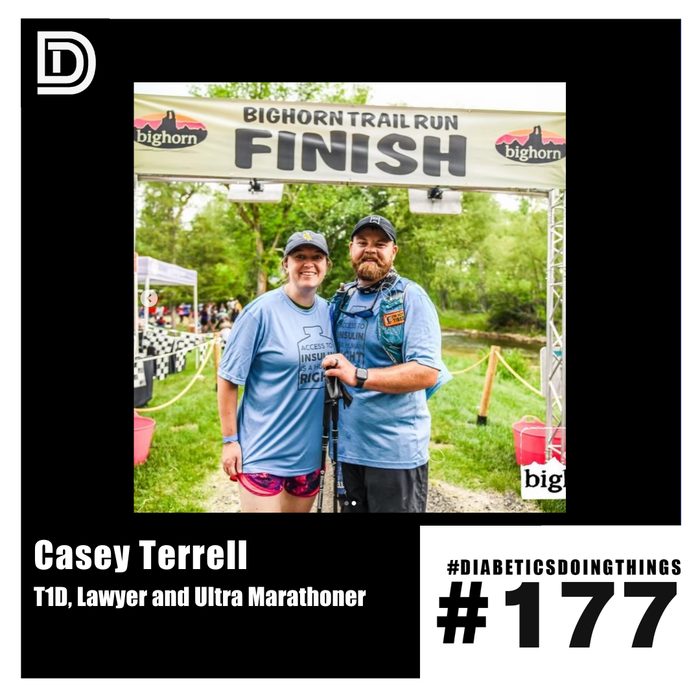
Casey Terrell is a lawyer and ultramarathoner who lives in Sheridan, Wyoming with his wife Callie. He was diagnosed with type 1 diabetes at 18, during his first year of community college, after a bout of diabetic ketoacidosis sent him to the ER. He describes years of trial and error, switching endocrinologists until he found one who listened, and says it took about eight and a half years before he felt in control of his diabetes. Casey talks about growing up far from specialist care, driving hours to see an endocrinologist, and the isolation of rural life with diabetes. He also describes his path from being overweight and inactive to running his first 5K, then working up to a 32-mile ultramarathon in the Bighorn Mountains.
Key takeaways
- Casey says it took him about eight and a half years after diagnosis to find a doctor and a routine that worked for him.
- He switched endocrinologists two or three times before finding one he connected with.
- Casey ran his first 5K after years of failed attempts to get in shape, then built up to an 18-mile and eventually a 32-mile trail race in the Bighorn Mountains.
- He keeps Mike and Ike's candy in his truck because the drive to his endocrinologist in Salt Lake City takes hours through remote country.
- Casey says comparison is the thief of joy and tells people not to measure their own day one against someone else's day one hundred.
Show notes
Rob and Eritrea are back with the intros, and in this intro we talk about
All the “things” that we’re doing on Diabetics Doing Things with takeovers, blogs and podcasts
How if you have a body you’re an athlete
Relating to people who are very different from you
Access and proximity to endocrine care in the United States
This week’s guest is Casey Terrell (@bowtiesandbolus on instagram)
Rob, Eritrea and Casey discuss, among other things:
Casey’s diagnosis story
What he remembers from life before Diabetes
Casey’s runners journey
Discussion about mental and physical benefits of long races
How long Casey has to travel to his endocrinologist
Chat about Casey’s upcoming relay race
Discussion about caregivers and community support
And much more!
SPONSORED! This episode is sponsored by Real Good Foods, who has been a supporter and friend of the pod for a number of years. Use code DiabeticsDoingThings on RealGoodFoods.com for $15 off a $15 or more purchase!
Questions this episode answers
How long does Casey Terrell have to travel to see his endocrinologist?
Casey lives in Sheridan, Wyoming, and says his endocrinologist is in Salt Lake City, about two and a half to three hours away.
When was Casey Terrell diagnosed with type 1 diabetes?
Casey was diagnosed in the fall of 2010 at age 18, after being hospitalized with diabetic ketoacidosis during his first year at Western Wyoming Community College.
What is the Bighorn Trail Run that Casey Terrell completed?
It's a trail race in the Bighorn Mountains outside Sheridan, Wyoming. Casey ran its 32-mile distance in 12 hours and 26 minutes.
What does Casey Terrell say helped him manage his diabetes long term?
He says finding an endocrinologist who listened to him made a big difference, and that it took him about eight and a half years after diagnosis to feel like he had found his rhythm.
Full transcript Searchable, with timestamps
Rob Howe: What up, what up?
Eritrea: Yo, yo, yo.
Rob Howe: We are back again. We're doing a lot of pods. We've got a lot of great guests.
Eritrea: We've been honestly killing it. I feel like everybody we've talked to these last couple of weeks is kind of, I mean, all people who move their body are athletes, but this last round of human beings has been like really setting the standard for getting out of your comfort zone, doing shit you never thought you were going to do, giving back to their community. communities, like real representation, real stories, real people. But I mean, that's what we do here. Diabetics doing things. We do. And I think, you know, if you have a body,
Rob Howe: you're an athlete, shout out to the Nike corporation for, for joining that. I don't know if you guys ever heard of them. Pretty big deal. Um, and I think Casey really embodies that this episode this week, he talks a lot about like, not looking like a runner, not, you know, and initially not feeling like one, but putting one foot in front of the other and taught, taught, talking about what running teaches you and what, you know, honestly, these ridiculous races that he's running, like ultra marathons. And, you know, when you see Casey's photo, the first thing that jumps out at you is probably not ultra marathoner, but we talked about that as well. And, you know, I think his takeover on diabetics doing things, Instagram was, was amazing. His blog that he wrote is equally good. I encourage everybody. I don't even know if everybody even knows all of the things that we do. Like we have blogs, we've got every, every guest writes a blog, every guest does a takeover. And that's just part of this before we get into these episodes. So if you're curious about the people who are on the show, definitely check us out at diabeticsdoingthings.com slash blog. And then on Instagram, check out the takeovers. They happen every Monday when we do
Eritrea: doing things day. Yeah, we're super lucky to have such amazing people come on and in my opinion, and bear so much of their soul with us because the stories that they're telling sometimes are painful sometimes come from like a part of their childhood or sometimes are even like transitions like in Casey's episode he tells us a lot about like how where he started and how he got to where he is now and even being so educationally like like he achieved so much in his education but how that was still like a person like his diabetes was still a personal struggle for me man it just so it was so resounding to me. It's such a good episode. It really hits home for especially those of us that have like achiever culture. And we try to kind of like hide our toxic negative habits with like how much we're achieving on one facet of our lives. So yeah, I don't know. He's an amazing human being. And I felt like I could really like resonate with him, even though we come from completely different places and completely different opposite sides of the planet. So I
Rob Howe: thought that was awesome. And you talked about coming from different places. It's a very different place in rural Wyoming where Casey lives. And we talk a lot about the difficulty of getting to his endo. I think over 300, over 300 miles to just go to his endocrinology appointment.
Eritrea: Was it 600? I don't know. It was like six hours, six hours drive or something. Like I wouldn't even drive six hours for Kanye. I want to drive nowhere for six hours. Like you going to get to
Rob Howe: the doctor girl. No. Okay. Yeah. And we talk about that too. Like, you know, how difficult that is and how it kind of reduces the cadence of that, you know, you want to go to the doctor, you know, you got to take off work. All of those things that are true for people who live in big cities like us, where it's, you know, 15 minutes to the end of, you know, he has, these are real problems and access comes in a lot of different ways, you know, it rears its head a lot of different ways.
Eritrea: So it's crazy that we have that problem in America. Like a few episodes back, we talked and Jorge tells us that in Yucatan, he had to like take an ER bus, like that took two hours to get him to his doctor. and it just it seems so crazy to me that the same issue that he was having of access in a whole other in a developing nation because mexico and other third world countries are still called developing countries we're still having in america so it's so intense to think about that like in a place which is the is it the inner mountains of the usa which is like yeah wyoming texas arizona all that people are having the same issues that we're having in developing nations and that's insane to me i don't
Rob Howe: get it. Well, and, you know, fortunately, I guess, fortunately, I don't know, fortunately, unfortunately, fortunately, we had some really great access discussions in the White House recently, where an advocate from Colorado was able to go speak with President Joe Biden on his on the White House's like Instagram and all that stuff. So a lot of visibility for the insulin affordability crisis that's going on here in the United States. And it is a crisis 100%. Um, and so, you know, unfortunately it doesn't mean that things are going to change, uh, but fortunately it's in the conversation, uh, at the highest level and, you know, the most visible foreign office or, you know, public office space. So progress, baby steps.
Eritrea: Absolutely. Like, like Casey says in this episode, one step after the other one foot in front of the other. Um, yeah, no, I watched that clip of the white house having the conversation about insulin. And I mean, it's heartbreaking to think about that a little girl was, cause I mean, it's, it's just really sad. Like, and we're all living the same situation. So, I mean, I don't know prayers up for everybody, I guess.
Rob Howe: Yeah. I mean, and at the same time, like continue to do that work, continue to tell those stories. And, um, you know, that's why, that's why it's so cool to, to be able to share people's stories on this pod, you know, and meet people from all different, all different areas. I would not have met Casey if not for this. So really cool to be connected to our guy, Casey Bowties and Bolus on Instagram. And after a word from our sponsors, we will get into it in the episode. This episode is sponsored by Real Good Foods. Real Good Foods has been a friend of the pod for a number of years now, and they're back sponsoring this episode. They have become one of the fastest growing frozen food companies in the US. Everything that they make is nutrient dense, high in protein, low in carbs, and made from real food ingredients. Instead of using processed flours, everything Real Good Foods makes is 100% grain-free and gluten-free, which is how they keep the carbs so low. And they make food for every occasion. Breakfast sandwiches, which are my favorite Real Good Foods product, poppers, enchiladas, entrees, pizza, and even ice cream. Everything they make is super convenient, which helps when you're trying to eat cleaner, but you're crunched for time. It's easy to prep and you can enjoy in a few minutes. And the best part is everything is super tasty and it's available at Costco, Walmart, Target, Kroger, and in almost every grocery store chain nationwide. Or you can order online and have them delivered straight to you the same day through Instacart, which if you haven't tried it yet, there's a 14-day free trial available. Best of all, we are going to have a code so that you can get $15 off a $15 purchase. So you can get that online at realgoodfoods.com if you use code DiabeticsDoingThings. So again, for $15 off a $15 purchase, use code DiabeticsDoingThings at checkout at realgoodfoods.com. Check them out at realgoodfoods.com or at Real Good Foods on all their social platforms. Thanks again to Real Good Foods for sponsoring this pod and being a cool friend of the pod for people with diabetes for a number of years. Okay, now back to the episode. What's up? What's up? Welcome back to another episode of Diabetics Doing Things. We're telling the amazing stories of people with diabetes from all over the world. Airtre is here and our very special guest today, Mr. Casey Terrell. Welcome to the show.
Casey Terrell: Thank you so much, Rob. Stoked to be here.
Rob Howe: Yeah, stoked to have you. And we were just chatting like off, you know, like we do off the recording. I'm super stoked for this interview because Airtre was mentioning that and something that we talk about a lot behind the scenes is that some of our most popular episodes are not always what you would assume they are. We just did an amazing interview with Super Bowl champion, NFL athlete, Kendall Simmons, which a lot of people downloaded. A lot of people had great things to say, and Kendall's an amazing guest. But most of us don't have that kind of NFL professional athlete lifestyle. Most of us just live day-to-day lives as regular people. And those everyday stories are super important because it normalizes what we're all going through. So Casey, man, I'm really excited to kind of dig into that with you today.
Casey Terrell: I'm excited as well. and correct. I have not won a Superbowl. That's okay. Me neither. Uh, you know,
Rob Howe: maybe one day just stretch goals, you know, just like, but one thing at a time, you know? Right. I'm not rolling it out. Sure. Uh, well, cool, man. Why don't you tell us like, like we do just introduce yourself and kind of start, uh, telling us by like how you joined
Casey Terrell: this type 1 diabetes family. Absolutely. Um, well, thanks again for having me on. So my name is Casey Terrell. I live in Sheridan, Wyoming, which is just south, about 20 miles south of the Montana border. It's in northern Wyoming. I haven't always lived here. I actually grew up in Pinedale, which is about 80 miles south of Jackson Hole. It's a super small town, so I always have to reference it by something that's near it. Growing up, I did not have diabetes. So that's an interesting experience of mine. I hear folks talk about summer camps and that sort of thing and getting plugged in early. And that was not my experience. I graduated high school, went to community college at Western Wyoming, which is about a hundred miles away, go Mustangs. And while I was there, started like dropping a ton of weight, was thirsty all the time, um just experiencing like a lot of things that in retrospect are now uh i know to be signs of ketoacidosis and yeah it finally sort of culminated one night i woke up in the middle of the night um was throwing up and uh i remember i called my dad and i was like dad and he's like oh no like are you arrested and i was like no i am not feeling good should i go to the doctor he was like just give it a minute and did didn't get better so my roommate at the time was awesome and literally like fireman packed me out to his truck and took me to the ER and I just showed up and had stomach pain and they were like didn't know what was going on and so kept giving me morphine and morphine and then I don't remember a whole lot but I'm told eventually somebody tested my blood sugar and it was super high and they're like oh he's probably DKA. So from there, I spent about a week in the hospital. And I remember like my academic advisor calling me and being like, so are you, are you still doing college or like, did you give up? What's, what's the deal here? I was like, no, I was really sick. So yeah, I got diagnosed, I guess that was back in the fall of 2010. So I'm coming up on my 12th anniversary. I was 18.
Rob Howe: man time flies when you're having fun right okay it's so funny that uh you know just knowing the very little that i know about sort of like wyoming and community college in like the western united states i had two friends that went to community college or junior college in uh in utah in like a very remote region and that call to your parents in the middle of the night like nine times out of ten it's probably hey i'm in jail you gotta you gotta bail me out but you had that one out of 10, like, no, no, I just, I'm in, I've had a ketoacidosis. Right. Like that was not
Casey Terrell: the most common that was, I don't even know how to describe it, but that was not the like most likely answer when that phone call occurred. And what do you remember? Like, you know, like you
Rob Howe: said, you were diagnosed at 18, you lived your entire like adolescent life without diabetes. I was kind of similar and I'm kind of at the point now, I guess I'm just getting older where I don't remember too much of the details. Like, you know, I basically remember now every meal I've given some sort of insulin dose or tested my blood sugar before, like what was the biggest change for you? Like going from like your pre-diabetes life, like to your life after, because like you're, that's such a like transformative part of your life anyway, you know, you're out of the house, you're not relying on your parents as much. You're like learning who you are and then throwing a diabetes diagnosis in the middle of it. That's just a huge
Casey Terrell: change. Yeah, I, in some ways, I think that was actually beneficial, because if I would have had to, I think it's weird, right? Because everywhere you live, you sort of have a role, whether you do it intentionally or not, you sort of start to be known for the different things about your personality and things you like to do and whatever. And if I would have had to take this new experience of being diabetic back to my hometown, where folks had known me my whole life, it probably would have been a little tougher to navigate compared to showing up at college, like you said, still being in a real sort of transitionary stage and then having this new thing thrown on. Um, that being said, like, I didn't always handle it the best. It was kind of a challenge. And, um, I didn't, I knew one other person with diabetes at that point, I guess, to my uncle growing up had diabetes, but he didn't live very close to us. And then I had another friend who actually like tested my blood sugar when I was in the middle of this DK episode. And he was like, Hey, this is really bad. You should go to a doctor. And I had been like really chubby my whole life. And I was losing a bunch of weight. And I was like, hold that thought. Do you see how skinny I am? Like, this is dope. I'm not going to the doctor. So at any rate, I didn't know a lot of folks. So I was, um, it was cool. Cause it was in a transitioning period where I can sort of embrace that identity at a time where I was already rolling through change. But it was also a little bit challenging because I was like, I was the only one out there really.
Rob Howe: Yeah. And that isolation, I think, plays a big part in like you're not only having to deal with the like care and personal care for yourself, but you're also having to educate everybody around you because you're the only one like advocating for yourself. And we talk about access and we talk about accessibility and advocacy and how it often takes like manifests itself differently for different people so for those who are listening who don't know a whole lot about western wyoming it's it's a fairly remote part of the united states and like fairly open you know especially if next time you fly to the pacific northwest and you're coming from like dallas or chicago or the east coast somewhere look out the window of that plane and you don't see a whole lot for you like making trips to the endocrinologist or like especially during the initial phases of your sort of diabetes onboarding, so to speak. And I was doing the quotation error quotation marks for those who are listening. What was that like? And like those journeys were like literally a long way and, and, you know, you had to gear up for them, I'm sure. Absolutely. So when I got diagnosed
Casey Terrell: at first, um, there was not an endocrinologist in town. And so they sent me to a GP, a general practitioner who was like, here, I'll write you some insulin pen prescriptions about it. And I was like, okay. And then they hooked me up with a dietician, which like, obviously diet's a huge part of all of this, but at the same time, it's much different. Like the approach is much different when you have type 1. So that, as you can imagine, didn't go so hot for a while. And then finally they're like, all right, let's hook you up with a specialist. So from there, um, I started seeing an endocrinologist in Salt Lake city, which was about like two and a half, three hours away. and I appreciated Rob's point. Like there's not a lot out there. Like if you are driving from one place to another and have a little blood sugar, it's not like you can just stop and hit up a cell like seven 11 on the corner for apple juice or something you got to play. Um, so, you know, you always have like, I always have my, my friends know I have Mike and Ike's in the center console in my truck and that sort of thing. Just because, um, if you're out there, you're out there. And even if you call for help, it's going to be a while to get there. So.
Rob Howe: Yeah. I've driven through like, you know, Western, Southern Utah quite a bit, uh, when I live in Colorado and yeah, there'll be like, it'll be like rest next rest area, 125 miles away. And it's like, yeah, you are out there, you're out in the middle. So, you know, and when you're making a road trip or you're making a journey, like, obviously like you can cover that in a couple hours, but when you start to think about, oh, well, my closest endocrinologist is in a different state start thinking about, you know, insurance is challenging too. But when you're in Western Wyoming, the closest big city is Salt Lake City, you know, and then it's like probably Denver or like Las Vegas that are probably the closest. And they're in all three in different states, all three a very, you know, big journey. It's not like you're just going to on a whim decide to go to any one of them. So that presents challenges, especially like when you're talking about having to go to the Enchronologist, take off work, you know, you know, make a significant journey. It's also costs associated with it. We've talked about, you know, more recently on the podcast about, you know, people with diabetes in Mexico and the closest clinic isn't, you know, for a couple hundred miles away. And we deal with that here in the United States as well.
Casey Terrell: Absolutely. It's, um, it's a weird sort of subset of challenges that not a lot of people face. And so there's not a lot of, um, I guess even exposure to it. It's not something you think about. Um, Um, affordability is huge with our community and both access, like as far as healthcare providers and insulin and supplies and that sort of thing. But also the idea of accessibility, like geographically, um, is huge and it's not just diabetes. It's all sorts of medical issues faced in rural communities. Like I'm from Sublet County, which is, I think, uh, one of the only counties in the continental United States that doesn't have a hospital. so that's huge for everybody but especially folks that like have a condition like type 1 where it
Eritrea: can escalate so quickly or even an emergency like i so we went to wyo so sidebar hi guys air tre is here um so last year we went to wyoming for my birthday we stayed in centennial which is like this tiny little town that literally population rob was 16 people 16 people live in this place so someone told us they were like yeah if you guys go for a hike or something like you need to have the number for the emergency here i was like is it not 9-1-1 they were like no because you'll probably need a care flight and i was like what i'm sorry somebody gets hurt y'all gotta send an aeroplane a helicopter because no no ambulance will not make it in time you will be so that's really scary to think about like girl what yeah and i mean even like 10 years ago like where phone
Rob Howe: technology wasn't like you couldn't just like turn the location on you know the mile marker you got to know you know where you are it's pretty remote and you know that's one of the beautiful things about wyoming it honestly is like is how remote it is and how kind of like raw the countryside is it's uh it's very beautiful as well but it can be really isolating especially if you're the only person or you know you wrote your blog for us casey like you know waking up at 1 30 in the morning to pound your mic and ike's in the kitchen you're the only you're all you're all you've got. And that can be kind of a very isolating and, uh, you know, a little bit of a scary situation from time to time. And, you know, like there's nothing wrong with living in a small town. Like diabetes is going to grab you regardless. Like the, the pot, the numbers, uh, of the population don't really discriminate where you are. Uh, and you know, part of that too, is just kind of adjusting and making diabetes work for you wherever it encounters you. And I also want to say like, you know, my college basketball career is as fun as it was, we got to spend a lot of time in small towns in the Western United States. Shout out the Rocky mountain athletic conference. I mean, going to small towns in Colorado, small towns in Utah, small towns in South Dakota, small towns in Wyoming and New Mexico. And, you know, it's just, that's part of, that's part of the attraction to some of those places for people is, uh, Hey, you can come here and school and sports can be your whole life. Cause there's nothing else to do out here. and you can kind of get away from that. And yeah, I don't know. I think that there's just positives and negatives sometimes to wherever you are and things that we take for granted here in the big city that people like you in remote places in the country just wish that they had access to an endocrinologist that was close by or just somebody maybe it's not as difficult to treat a little blood sugar. For me, I relied for years on my access to a convenience store or to food deliveries or whatever the case. And, you know, a few little things change and those aren't
Eritrea: options anymore. That was gonna be my question for Casey, actually, like at the beginning, like when you got the diabetes, right? So all you had was the internet when it's like 2010, like what kind of internet did we have then? Anyway, so all you had was like the internet for a resource, this one friend with the diabetes, an endocrinologist a million miles away. Like, how did you teach yourself to stay ready so that like you wouldn't be in an emergency situation? or did you have to learn that from an emergency? Like, how did it go?
Casey Terrell: For sure. I'm really lucky that I didn't have like a single emergency where like I had to go to a clinic or anything like that, which is great. But when I tell you guys that it was like 1000% trial and error, that was it. Like, and I was also making some personal choices at that point regarding like what I was eating and not exercising and stuff like that. So it was even more of a roulette wheel than it could have been. So it was just tons and tons of trial and error. And then I also have distinct memories of finally making it to my endocrinologist or whatever, and plugging my meter in. And first of all, they would always say that I wasn't testing enough because who is nobody. But second of all, they would be like, yeah, you're not doing so great or whatever, you know, they would be like, what's the deal here? And I'm like, I'm just trying to survive you know I'm just trying to make it um and so it like I'm also a very I guess driven sort of person so it was really hard for me to have a check-in once every like however many months it was um which turned into somebody telling me that I was doing a bad job and then it kind of felt like whose line it is it anyway where I would be like you're losing the game and then they would send me away and I would try and figure out the rules and try and do better and then I would come back and be like you did even worse and I'm like how how yeah the points don't matter, right? Yeah, exactly. Um, which it still feels like that, which I'm sure you guys can relate to a lot of days, but like literally zero help is what it felt like. Well, and I think
Rob Howe: that's such a challenging part of care teams. And, you know, I can't, I can't put all of the onus on the endocrinologists or the CDCES is because, you know, they're just doing the best that they can in that short amount of time that they see as many patients as they see. But, you know, like you said, why, what's the incentive for you to go back and have a frequency with something that doesn't help you and doesn't feel good. Uh, you know, and it, you know, what, it's very difficult to feel like you're making progress if the feedback that you're constantly getting is
Casey Terrell: negative or just sort of unhelpful. Totally. And I wrote about this a bit in my blog, but I probably went through, as I sit here and think about it, two to three endocrinologists, um, before I finally found somebody that I really vibed with. And literally when that happened, it was life-changing. And I think nowadays we throw around that term a lot, like I had a cheeseburger and it was life-changing. Maybe there is a life-changing cheeseburger out there. I don't know. But like this legitimately getting care from these folks has changed how I live my life every day. And I'm so grateful for that. And honestly, shout out to all those folks because they don't get recognized enough.
Rob Howe: What was the big thing for you? You said, you know, she changed endocrinology, she's changed care providers. Like what, when did you know that you were in the right spot that you had found a home, so to speak?
Casey Terrell: For sure. Um, I don't know if it was when I knew exactly, but the first time that I went to visit this endo, I can't remember what the appointment was set for as an initial warning. It was like an hour or something like that. I remember walking out two hours and 45 minutes later, like treating me like I was the only person there. I was the priority. And then I left feeling like, wow, I am really hurt. I felt like for maybe the first time since I've been diagnosed, I talked to somebody who like got it. They got it and I got them. And I felt, I guess, heard and seen. And so many of those things that are, we talk about being important as far as identities and disability and that sort of stuff. but that was the first really big sign for me. And then it's such a, I guess, ecosystem, right? Because if you feel good about it, it's easier to do well with it. When you're doing well with it, it's easier to feel good about it. So momentum is a real thing. Like life, it's so much about
Rob Howe: momentum. And how long was that? Like from the time you were diagnosed to the time that you felt that momentum, how many, how long was that? How many, how many years, months, give or take?
Casey Terrell: probably eight and a half years or so man yeah so that's like in the last couple years that you finally like have come into your own that's so crazy to think about man listen to that like and
Rob Howe: i want to go off on a tangent here like listeners eight and a half years in before you found your rhythm before you found that you were in the right spot before you started to get that confidence so if you are out there and you are listening to this and it's been a long time whether it's been eight months, eight weeks, eight years, it's okay. You, you may not have found the right mix yet. You might still be searching for that. And you know, your best
Casey Terrell: days could still be in front of you. So don't forget that. Yeah, absolutely. And I look back now and I would like to tell you guys that like the whole time I was just, you know, bird dogging it. Like I got to find better care, but I seriously was not, it would be like, it kind of felt like the motor would go out in my boat. And instead of like trying to row to shore, I would just be floating in the ocean. I'd be like, it is what it is. You know, I'm headed wherever I'm headed. And then luckily in my life, things happened where folks sort of inspired me to care about me. And then at that point I was like, okay, I gotta, I gotta start pursuing this. So one thing I would say is to also those folks out there that are experiencing challenge or whatever, it takes time. And also you're worth it, you know, getting the best care for you, getting something that makes your life better is worth your time. That's absolutely, you should
Rob Howe: make that a priority because you're absolutely worth it. I couldn't agree more. Couldn't agree.
Eritrea: I literally teared up. I can't even like follow up that comment. I literally teared up because I think that, so I was diagnosed as a child, everybody knows. And I like for 12 to 13 years didn't do any of my, my diabetes. Cause like, we're going to die anyway. So that's how I felt. Like I felt exactly how Casey did just like a boat in the middle of the ocean and like, who cares? Cause nobody's coming to save me, but like little did I know that I could save myself. So it's like, Casey's absolutely right. And like what Rob said, the best years could be ahead of you. And sometimes it's not as easy as making that decision. You have to make that decision every single day. Like you have to want to love yourself and care about yourself every day. And I think with diabetes, it's so easy to be like, just, you know, take me away diabetes. It's fine. Make this stop. But it's also just so powerful when you meet someone like Casey, who's like, I'm ready now, like I'm ready to step into my own self-worth. And that's, that's amazing, man. That's beautiful.
Casey Terrell: Thank you. I couldn't agree more with what you said.
Eritrea: So what was the, like, I know you said there was some inspiring people for me, that person was like my brother. Is it like your wife? I know she's an amazing human being. We definitely want to
Casey Terrell: shout her out on the podcast absolutely I have a beautiful wife uh Callie who I've been married to for it'll be um a couple years in September which time goes so fast but I started dating her and like um I remember when I was sort of in my bad diabetes phase if we can even call it that good and bad's a myth but when I was facing those challenges my friends would be like hey man you good. And I would always say back to him, like, yeah, I'm here for a good time, not a long time. And that was sort of my masking thing of like coping, right? Yeah. I'm not worried about it. Let's just have fun. And so I remember in particular, one time I said that to her and she's like, we were not very serious at this point, but she said something to me like, I don't think that's okay. You know, like I want you to be here for a long time. I think that's important and how somebody say that is super again life-changing you know I read something one time that was like truly being loved gives you courage and I think that's so on par so I kind of went from like I'm just here for the moment sort of attitude towards not only my diabetes but just everything I was doing to once I started seeing a future with her I was like, okay, I need to be more concerned about my longevity. And then it was again, a momentum process. Once I sort of started making that switch, I was like, not only that, but I was in terrible shape at the time. I was like, I want to be able to do the things I want to do throughout my life. I want to be somebody that other folks, um, look up to not because I'm looking for other people's, um, I guess. Yeah. It's like, uh, I want to be strong for them. You know, I want to be
Eritrea: good example for yourself you know what i mean so it's like not even somebody else yeah man i
Rob Howe: i've never heard truly being loved gives you courage before but wow what what a tangible thing and i also have to give a shout out like literally while you're giving that telling that story i texted my wife because i had like i was like 69 nice with two arrows down and i texted my wife i was like can you please bring me some coffee beers so shout out to all of the uh the
Eritrea: husbands and wives out there for the win i was about to say all three of us are so well loved like i i know i know rob is like we talk about erica on the podcast all the time she's an amazing human being and all three of us just have so lucky to have partners that like allow us the space to grow within because i think that diabetes requires a lot of like emotional growth maybe even like i don't want to say i don't want to say like even emotional intelligence but like maybe just a little of emotional maturity because like at some point it's okay to feel bad for yourself like I think I've said before it's okay to cry as long as you try but at some point you have to or it's it's imperative it's important that you're like okay yeah I'm crying but like now what like now what where's the resilience factor and it sounds like you found that within your wife because she gave you something to like look forward to like I want to be here for her and then later on you could be
Casey Terrell: here for you. Absolutely. And she, like, I think there's two types of relationships in this world that work. There's people that are very similar to one another and they sort of like, I guess, hype each other up like that. And then there's like salty and sweet, um, sort of those yin and yang personalities. And that's my wife and all, like probably the prospect of going on a podcast but just like I can imagine now she's like no thank you and walk away um but she's just like very um determined and like she's a scientist and so she's really like decision oriented and calculating and so I'm not that I'm like an emotional human being I'm very like charismatic outgoing so yeah it's having somebody that supports you in a way that you need to be supported is
Rob Howe: clutch. It is. And I think like, it doesn't look the same for everyone. And, you know, it doesn't look the same day in and day out. And we also grow and we like, you know, grow as people. And I think, you know, even for me, like asking for help has always been a challenge. Like I've been a pretty independent, like type a person my whole life. And so I was just even thinking about it in the context of this moment. Like I would have, my first instinct was to just turn off my camera for 30 seconds, sprint to my bedroom, grab some low snacks out of the drawer and come back here. And then I was like, wait, I have a partner. I have somebody who will help me and support me and who's not going to judge me to do that. So yeah, I don't know. Shout out change and growth. And speaking of, Casey, you have this incredible story of becoming a runner. And I think also in the context of, and I think you put this really well in the blog that you wrote for us, you don't maybe identify as like a, an ultra marathoner or like a, you know, a super runner, so to speak, a runner again in air quotes, but you have become a runner and it started, you know, with that, you know, not to be corny, but like with that first step. And I'd love to hear a little bit about how you helped to develop that journey for yourself. Uh, and you, you know, you know, develop that courage and develop that self-love and like develop that drive. Cause like you said, you're a driven kind of outgoing person, but showing up for yourself is different from showing up for other people. So how did you show up for yourself and, uh, and kind of, you know, build your journey to where, you know, now you identify as a runner.
Casey Terrell: Yeah. I'm trying to like, think back to if I could put a starting point on it. Um, one thing that I've struggled with my entire life is like my weight and my fitness. I did high school sports, um, but was definitely not an all-star and then, um, went to college and I can't even tell you guys how many times I was like, all right, getting in shape, starting the day. And I would get up at like five 31 day and hit the weights. And then two or three days later, I fall off. Um, and I, it was kind of weird because it wasn't like a lack of dedication. I would say that I was like very dedicated to different things in my life. It was just the idea of like physical activity sort of had so many other things loaded with it as far as like if you like want to take up fly fishing for example there's not a large contingent of folks out there in society that are going to judge you on your fly fishing ability but if you like go to the gym or something or you put on running shoes and hit the street like you think everybody's judging you and so it was um kind of that was something that i think was a big challenge for me when I first wanted to start doing any sort of working out. And then also like diabetes was just super, I don't even know how to explain it. It feels like a oversimplification and call it a challenge because it's just literally like a, a complicating factor on every single aspect of working out, like from the shoes that I wear to the stuff I need with me to like the timeline of my day and anyway so all of that and I like failed a ton of times and eventually I got to law school um and had pretty much given up I was just like you know what I'm not going to be somebody that's in shape and that's okay um I say that like I had accepted it but I was definitely not okay with it and sort of I just buried myself in all these other things um at school different clubs and scholarships and opportunities, which was great professionally. But as you guys can imagine, like my health wasn't awesome. My blood sugars were just a dumpster fire. And, you know, like if you, however you want to live your life, that's cool. But I was definitely, now I look back and see that I was sort of having this cognitive dissonance of like, I wanted to be somebody who did these things, but I was having trouble getting there. And so not doing the thing that I wanted to do was sort of this cycle of disappointment, which then made it harder to try and pick up the thing I wanted to do. So I guess that's sort of the background. And then I graduated law school and I was really heavy. I was like 308, 310 pounds or something like that, which again, if that's your body and you love it, that's awesome. But it was not where I wanted to be. and so I graduated and um I was gonna marry my wife in about like eight months or so and I didn't want to look back on that and be like because not only was I not happy with where I was it became the focus of how I viewed myself people would be like you know sort of the opposite of when I got diagnosed of how skinny I am people be like hey congrats on this award or congrats on this scholarship or something I'd be like yeah I'm just you know I would be very self-deprecating I don't even want to do it again because I'm that adverse to it now but don't don't I was like I want to I want to get in better shape so I moved for work which was kind of good it was like another reset you know instead of being stuck in this sort of identity that I'd made for myself I had an opportunity to change it a little bit and I happened to move to a town where um the sibling of somebody I was best friends with in law school lived and that sibling is now one of my really good friends too and he uh works out a ton and I was like yo man show me the ways and I remember he's since opened his gym and is super successful shout out to Graham but um one of the first times Graham and I went to work out we like went to the local YMCA he was like all right let's do legs and I was like, I'm about it. So we do this leg workout and he's like, you good? And I'm just like sweating. Like I look like I've been baptized. I'm like eating gummy bears in the gym because I'm low. People are giving me looks and I'm just trying to play it cool. And we're standing there talking to somebody who knows that the why. And he's like, you good? And I was like, yeah. And then all of a sudden my legs just collapsed from underneath me. And I was like, ah, and fell down. But yeah, so that's how I sort of started the ball rolling on this journey.
Eritrea: dang those first workouts man i feel that's so bad because i so i tried to get in i started getting in shape last year and shout out josh who is who recommend who rob recommended me to and i dead ass cried like i dead ass cried in my car just like you wimp because it's just like so tough but it's more it's more mentally tough than it is physically like the the weights are heavy but what you're really combating is, is that guy staring at me? Is he looking at me? Do they know it's my first day? Do they know I suck? Do they know that I'm not a good athlete? Do they know I've never done this before? Like it's all of these like nonsensical thoughts that have nothing to actually do with the workout that you're really like, that like, you couldn't even notice your legs were about to give out because your brain was so occupied. My college basketball coach,
Rob Howe: and I've talked about him a lot and he and I have a better relationship now. I think that the years have gone by, but it was really hard for me for a long time because he was just the toughest. He literally is the toughest person I've ever seen, ever heard of. Like the guy just had the mental ability to take on immense strain. And I mean, like, this is like an aside, but I'll kind of give him a pat on the back here, but like he was like making very little money as a division two basketball coach, but while his wife was in nursing school and they had four kids under the age of 12 and like actually five kids under the age of 12. And like the amount of strain that that guy was taking on was unbelievable. And of course he hated us little like college basketball pukes who were like worried about like what girls we were trying to pick up. And like, if we looked cool on the court or not, like this guy was like really grinding it out. Uh, but he said something that always stuck with me. And I think about it a lot. And it was very simple. The body is strong and the mind is weak. And he's like, you, you really don't even know what your body is capable of. And like you said, you know, you didn't want to be 310 pounds. And like that, if you are that, that's okay. And you can, and you can love yourself and be loved and deserve love at that weight. And it's not about the number, but you don't know what your body is capable of. Like your body woke up every day at that point and carried around and managed that yourself at that weight. And if you start to, you know, invest in your body and explore that and, you know, put that work in, it's amazing to see what it's capable of and like what amazing things that your body can do and what you can really celebrate. And I think I'm finding that as well as like, as I get older, my body doesn't do as exciting things as it used to do. You know, I used to be really like pretty impressed with some of the stuff that it could do. And I would try to push it that way. And now I'm more of like, Oh, well, like I can't maybe adapt as well as I used to, but like, wow, look at, look at what I can do without pain today. Or look what I can do, look what I can do today and still be in position to do something tomorrow. Uh, and look at that longevity. And I think, um, also like shout out friends, you know, Josh, uh, the trainer that, uh, Eritrea has mentioned is one of my oldest friends that I went to school with and was an incredible athlete in his own right. And I mean, she's talking about hard workouts. Like this man trains Ezekiel Elliott, like the Dallas Cowboys,
Eritrea: like starting running back. This is the only man I'll ever let me cry. Josh can make me cry.
Rob Howe: And like, you know, uh, but you got to show up. And I think, you know, shout out to your friend Graham. Like he said, he, you know, today he opened a gym or he runs a gym, but he was willing to be available for you. And I would say my, one of my favorite things that I've heard recently, like LeBron says it, and a couple of like trainers on Instagram that I follow say it like the best ability is availability. Uh, and if you can, if you can have a friend who's available for you and shows up for you, uh, when it's inconvenient for them sometimes, and they have nothing invested in it other than just being there for you and hold onto those people. Um, and, you know, shout out for you, obviously, like, you know, you had to coach yourself to not look to the left or to the right and show up for yourself. Uh, how did that manifest? Like, cause, cause I think that, you know, you ran a pretty significant race, if I'm not mistaken. I don't know if it was a marathon or half marathon or whatever, or a 5k or 10k or whatever, but you started from somewhere and you got there. How did, how did that manifest itself for you? Like emotionally and mentally?
Casey Terrell: Absolutely. Uh, so as far as like the mechanics of it, I started at that point. And then I remember in the spring after making some other friends that did, um, races and stuff, they, I like mouthed off about getting in shape and they're like, Oh, you should come check out this race. and I was like done so I showed up ran my first 5k in the rain and it was miserable and then like it's kind of this peer pressure thing right like you do one race and you see the folks there and then you go you're just around town they're like hey you're signing up for this thing like this weekend right you're like oh I got the thing and I'm like come on um but so I went from a 5k to a 10k and then I did a duathlon that summer which was like a 5k and a 17 mile bike ride and I remember being like this is it I'm capped out this has been fun you know like this was a goal I set for myself and I'm here and then that same year I had a friend run this thing called the Bighorn Trail Run which is in the Bighorn Mountains outside of Sheridan and he did the 32 two mile race. And he was just like a dude like me. And he did this and it mangled him. He was wrecked for like two or three days. And there's like, I talk about it with my wife and a friend of mine Austin sometimes, but like, I think there's people in this world and I don't know how to describe it, but some of us just have a little fire in our belly. And so I saw him do that. And the first thing I thought was like, you're miserable. And the second thing I thought was but could I do that though like is that possible um and I'm thinking about diabetes and whether or not I can manage that and where I'm at and so the next year we signed up to do the shortest length that the bighorn has which is an 18 mile trail run and that was the year of COVID and so the race got called off but a couple of us that live here locally were like you know what we're gonna do it um so we all showed up like distance that day and ran the dang thing and again I was like that's it I've capped out you know this is my hall of fame I'm done and then I remember telling people that and then like two weeks later I get a phone call from my buddy he's like hey we're doing the 32 next year and I remember I like I can't I think I'm pretty sure I just hung up the phone off I was like I don't need that nonsense in my life um but again that fire in my belly i was like but could i um and so signups for this run are on christmas the year that it's going to happen or i guess the year before so um christmas came around and i was like all right i'm all in so i signed up in december and then trained really really hard until june and then june 19th it took me like 12 hours and 26 minutes but i ran 32 miles man
Eritrea: okay i'm gonna i'm gonna trigger warning i say a bad word holy fucking shit like 32 miles yeah rob says i have to warn you guys now when i say bad words but anyway wow can you see like bro i'm over here tripping because i can run for like 12 minutes without stopping this mess i was out here for 12 hours wait so i gotta know do you run the entire time like even if it's like really really slow do you ever just like take a break and start walking oh for sure that's kind
Casey Terrell: of one thing that I like about trail running compared to like marathons is you're not expected to just go out there and sprint the whole time. Like the terrain is more challenging and it's sort of like a, I like that a little bit more because it requires grit, right? Like if you put a marathon person at the bottom of, I'm thinking of one particular hill on this course that everybody calls the wall and it's just like a quarter mile and it's damn trigger warning, damn near straight up. Um, and if you put even like a train marathon athlete at the bottom of that, they're going to be like, probably not, but you know, like you just put one foot in front of the other and that's what it takes. And that's what I like about it. But yeah, so definitely walk sometimes.
Rob Howe: Yeah. I want to like say even, even folks that run marathons are like thinking about running a marathon. Like I walked on my half marathon, like a couple, like, you know, probably a mile out of the total. And I was like, you know, I wasn't dragging, but I was trying to catch my
Eritrea: of breath trying to recover because you got a ex NBA man. Didn't you like hear about that marathon like one week before? And then you were like, don't do what I don't do what I did. Okay. Don't
Rob Howe: do what I did. But, um, you know, like go at your own pace, you know, I think like, uh, there there's people like David Goggins who are like these crazy, like, uh, endurance athletes who just have this ability to go to this level that most people can't tap into. And, you know, they run with broken shins and feet, you know, cause they've run, run a hundred miles, you know, but not everybody's like that. And I think, you know, uh, if you hit, if you come to the wall on your 32 mile race and you've got to go up a quarter mile and it's really steep, uh, you're in Sheridan, Wyoming, it's a, it's a very, uh, you know, remote and like, you know, mountainous region, high altitude, that air is crisp and it goes out of those lungs real quick. Give yourself a breather, you know, take that, take those obstacles one step at a time. But Casey said
Eritrea: something that makes me like, just like, it blows my mind. Like when you said one foot in front of the other, Casey, I think that's like the quote of your life, man. Like with the diabetes struggle, with the getting there struggle, like it's okay to take your time just one foot in front of the other. That should be the name of this episode, Rob. Like that, that, I don't know. It's really simple. I know it's something that people say all the time, but like when you said it just now, it blew my brain. Like it literally was just like, that's exactly what this is. Just one step at a
Casey Terrell: time. Wow. And I think that I love that for a lot of reasons, but the, the, the main one is, I think a lot of us nowadays, whether it's with diabetes or just anything in our lives, we sit around and we're like, dang, I wish that I could be an exposition. And you think about the steps that you could take to get there. And you think about the first one and you're like, that's not going to do much for me. Um, but when you're able, and I think that's why everybody should do an ultra marathon. And I don't mean actually do an ultra marathon, but something like that, like set your mind to do something, have folks hold you accountable, find resources and make it happen. Because when you can demonstrate to yourself that it's those small steps, whatever they may be, the results in this big change, then you apply that to every other aspect of your life, like hobbies, relationships, work, whatever it is, like you can figure it out
Rob Howe: one day at a time. I, uh, I learned from paying a lot of money to my therapist that the way that I talk to myself is I am capable. And, uh, that that's my internal monologue. And I think that a lot of that comes from my diabetes. Uh, a lot of that comes from my background as an athlete or as an entrepreneur. And that's just like manifested itself a lot of ways in my life. And understanding that has helped me get over a lot of like, you know, personal issues. But one thing that I, when I, especially when I was going around speaking a lot prior to COVID. Um, people would run into me and, and, you know, when you go to these diabetes events and you're like a featured speaker, it's kind of like a celebrity moment and sure it was great. And, and I, and I missed that and hopefully we'll be able to give back to that sometime when it's safe. But the first question people would always ask is like, well, how do I get what you have? Like, how do I get to where you are? And my, my answer in that, in my presentations is always change your metrics because your day one is not going to be the same as somebody's day 100. If you're showing up to your first ultra race and you see David Goggins, you're like, that's the guy I'm going to follow him. You're probably going to be in trouble and you're going to feel bad. And you're going to, because that comparison is the thief of joy. And so, you know, when people like, Oh, well, I would love to start a podcast or I would love to start a YouTube channel, or I'd love to start an Instagram or something. My, my words to them are always start because, you know, like another runner thing like this, put one foot in front of the other, but a journey of a thousand miles starts with a single step. And then the hardest part is step 100, 150, when nobody's cheering for you. There's no big finish line in sight. There's no sponsor deals. There's no million subscribers or any of those things that sound good or other people want. It's just you and the road or the trail. And you've got to reach in inside of you and show up for yourself. And I think that whether you're on your kitchen floor at 1 a.m. pounding Mike and Ike's or orange juice in your kitchen, or you're on mile 10 of a 30-mile race, or you're on day two of 100 days of some health journey or whatever it is that you're doing, or you're starting a new job, or you're meeting someone and dating someone new, showing up for yourself in those moments when nobody's cheering for you or where you find out what you're really made of.
Casey Terrell: 1,000%. And I think one thing that I'm guessing you would agree with me on is a mistake I used to make is not every step has to be forward, you know, especially when it comes to diabetes, like there are so many times, I can't tell you guys how many times I like went on a run or was at the gym and had to cut out, you know, cut off a workout early or cut off to the side and do something to figure it out. That happened during my 32 miles. I got to the top of the wall and I was like a little bit dehydrated. Um, my blood sugar was low and I, like my Dexcom wasn't telling me that yet, but I could just feel it like in my bones. And I remember sitting down, I'm literally in the middle of nowhere at the top of this Canyon. And I remember just doing a quick assessment of like, okay, if they're going to get me out of here, it's probably going to have to be by a helicopter. Cause it's going to take a lot of folks, a couple hours to pack me out. And at that point we're done. Um, but at any rate, I remember just like thinking like, okay, I'm not going to let this in my race. You know, it's a challenge, but I'm like, let's evaluate, let's adjust and move forward. And whether that's like on the span of a day, like you, you do a workout, you give it hell and then you have to quit early. Like getting up the next day is the, the critical thing. And another thing that Eritrea said earlier that I really appreciated, she's like, when you go to the gym, you're like, what are these people thinking of me? You know, are people judging me, whatever. One thing that I've struggled with throughout this whole journey is like identity, right? I was like, I remember thinking back in the day, you're out of shape, you're diabetic, you know, there's like all these really negative things. And I remember one of the hardest things about starting to work out was not the physical pain. It was looking back and like, sort of reconciling who am I? Like, is, am I the person that's going to stick with this? Am I the person that's going to put one foot in front of the other? Am I the person that finishes races or commits to racism and runs them? Or so it's just, yeah, it's about so much more than just working out. Like the identity piece is huge. And people don't talk about that. They're like, here's your workout plan here's a nutrition plan um or like even diabetes right here's a care plan um and don't talk about like all right you need to believe believe oh my god like ted lasso do you guys watch sorry oh i love ted lasso yeah he's like
Eritrea: oh my gosh it's just that's just makes so much sense it's just like you just or you know something that i've been doing and i got this from rob rob cover your ears i don't want you to think I admire you in any way. Pretend to be who you want to be. Like if you want to be somebody like how you do the small things is how you do everything is something that I've kind of learned from Robin this last year. And so like if you're not who you want to be, you can pretend to be that person. And like what would that person do on a Monday? That person would get up and test their blood sugar and eat healthy and go to the gym, right? So it's like if you're trying to accomplish something like you can just fake it till you make it like that's like some one of the oldest adages of all time, but it really like in these types of scenarios can save you can be the thing that pulls you out of that funk, just playing pretend in your brain a little bit so you can
Rob Howe: get past the obstacles of your mind. You know, and, and some, I'm glad you said that. And, um, you know, I won't let it get to my ego, but, uh, one thing though, I think I will correct you on is like, I don't think that you have to fake it. I think that if you show up for yourself and you're doing what you want to do, it's not faking it. And, you know, I, from the, I read this book called the master key system a few years ago, and it's basically like, say, do be, and, you know, if you say like, I want to be rich, then you just do what rich people do. And then you will be a rich person, you know? And it's like, or, you know, it's, it's, or you say you want to be fit, then you just do what fit people do. And then you will become a fit person. You know,
Eritrea: I was about to say, I pretend to be rich every day. I'm still bro.
Rob Howe: Well, you know, like, Hey, maybe we need to dig in it and understand what your definition of it is. But like, at the same time, like words have power, how you do what you do makes you who you are. And, uh, you know, I think another thing that I wanted to get on before, before we, before we wrap Casey is like, yeah, I do agree with you on that because I believe that all of life's great treasures come from compound interest. And what that means is a little bit every day, whether that's your relationship with yourself, your relationship with your significant other, your relationship with your diabetes, look at your A1C that's three months. That's not one day. You can have a big high or a big low, and it's not going to be like detrimental in the grand scheme. You can bounce back. I think diabetes makes me better at failure. I think it makes us, we learn how to bounce back from obstacles. We learn how to prepare. We learn how to think ahead and how we perceive those things that happen to us. Um, you know, it really isn't positive or negative. They just are things that happen. And I think that that's a great way of looking at, you know, at life or a journey. Uh, and you know, a race is a great metaphor for that because you're going to have moments in that race where you feel like a million bucks and that you're, you know, just cruising and your feet are barely touching the ground and you're crew and you're just running, you know, light as light as a feather. And then, you know, five minutes later, you may feel the worst you ever felt. You may have to, you know, puke or, you know, you've got a stomach ache or a cramp or your feet are hurting or somebody, some old lady passes you. Uh, I did the, the Manitou incline in Colorado Springs is one of the toughest, like physical, like public space things to do, uh, in the United States. And the first time I did it, I remember, uh, you know, it was just like, it wasn't like a race or for fitness. It was just to like, get comfortable with it. And these old ladies, like with ski poles, like past me and like, you know, they were in their seventies and they do it like every weekend. But I, and I was like, wow, I should definitely beat them. And I definitely did, but I felt like crap afterwards. Cause I wasn't prepared. And I had no experience and they did it all the time and they, and they paced themselves and they knew how it was working. So, uh, yeah, don't compare your day one to somebody else's day a hundred. Don't think it's going to always be, uh, you know, sunshine and rainbows because there's some, you know, I'm sure like there's, you're going to hit that wall. You're going to hit that quarter mile where you got to scramble up those stones. Uh, and you know, but once you get there, maybe it's all downhill. Who knows? You never know. For sure. And I guess one other thing I'd
Casey Terrell: say is like, beware of how you are perceiving things and how that relates to your journey. Like, I remember one thing that kept me out of running and exercise generally for a long time was being like, not only are all these people going to like, not only did I struggle in turning with it, but I was like, all these people are going to judge me. And then the people I know that do races, a lot of them do a heck of a lot longer than 32 miles. They do 150, whatever. and I show up as like this at the time I was like 280 pound dude I have a running vest on that's full of like fruit savers you know because I'm I'm out here doing this with the diabetes and they were all so supportive they were so cool and not in a placating way I think if you're in that hustle they respect it like if you're going to show up and put in work that is the universal language that's accepted by all folks. So, um, and I realized afterwards I had put a lot of my own impressions about those folks. I projected those on them and that wasn't true at all.
Eritrea: Man. I so agree with that. I've never felt more support than in a gym, to be honest, like other than like in a therapist office, like I go to the gym, I go to the gym, my parents, but like four other people go there. And those are the people that are always like, you're not messing it up. You're doing it right. Like, don't worry. Like those people have been where you were, you know what I mean? Like they had a day one, just like Rob said. So I don't know.
Rob Howe: The best ability is availability. You know, if you don't show up and be there, man, you're in,
Casey Terrell: you're in rare, rare territory. I can't wait for your takeover, Casey. It's going to be so,
Rob Howe: so good. We're so excited. Casey, man, thank you so much for coming on this podcast and for reaching out and connecting with us and for being a, you know, a friend of the pod. Uh, this was just the most uplifting conversation and I'm looking forward to, uh, to seeing what you do
Casey Terrell: with the takeover, man. It's going to be great. Thank you guys. I'm excited. I'm going to share a little bit about racing, a little bit about Wyoming, a little bit about rural. So I'm excited for it. And next time you guys find yourselves in Sheridan, Wyoming, hit me up.
About Casey
Casey Terrell is a lawyer and ultramarathon runner living in Sheridan, Wyoming. He was diagnosed with type 1 diabetes at 18 and has completed multiple trail races in the Bighorn Mountains, including a 32-mile ultramarathon.