

Diabetics Doing Stoicism Part 2 with Chris Ruden
Episode summary
Chris Ruden, a motivational speaker, entrepreneur, and type 1 diabetic missing part of his arm, returns for a second interview recorded live at the AADE conference in Houston. He and Rob talk about authenticity on social media, how people react to visible disability and medical devices, and why giving someone your full attention matters more than time itself. Chris describes applying for an $8-an-hour job last year when he was ready to quit, and reflects on mental health stigma for men. Chris turns the interview around and asks Rob tough questions, leading Rob to share publicly for the first time about his father's death and getting fired from the Washington Generals.
Key takeaways
- Chris Ruden says that last year, ready to quit everything, he applied for an $8-an-hour job at a vitamin shop and the manager refused to hire him, telling him he was overqualified.
- Chris says failing is an action, not an identity, and the only way to actually become a failure is to quit.
- Rob shares for the first time that his father died the previous year and that he has been seeing a therapist to work through the grief.
- Rob describes getting fired from the Washington Generals and finding out right before playing a game in Denver in front of 70 friends and family he'd invited.
- Chris says he wears his prosthetic arm about 40-50% of the time and treats it like an expensive accessory that helps him mentally, not a requirement.
Show notes
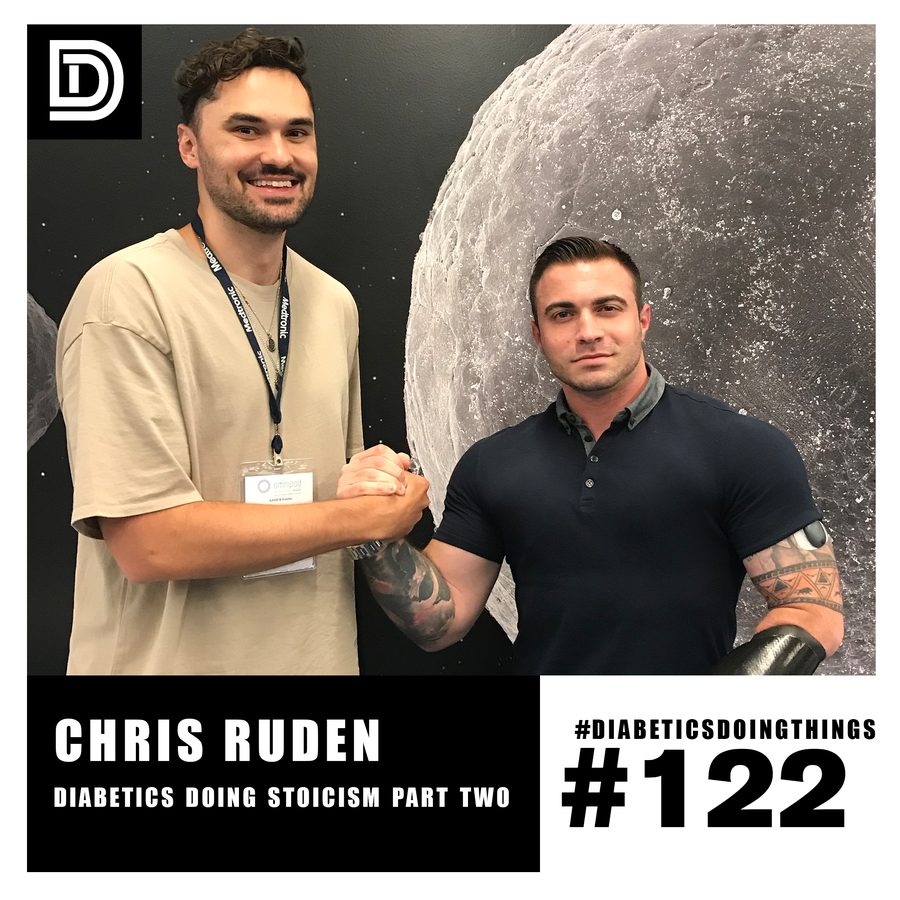
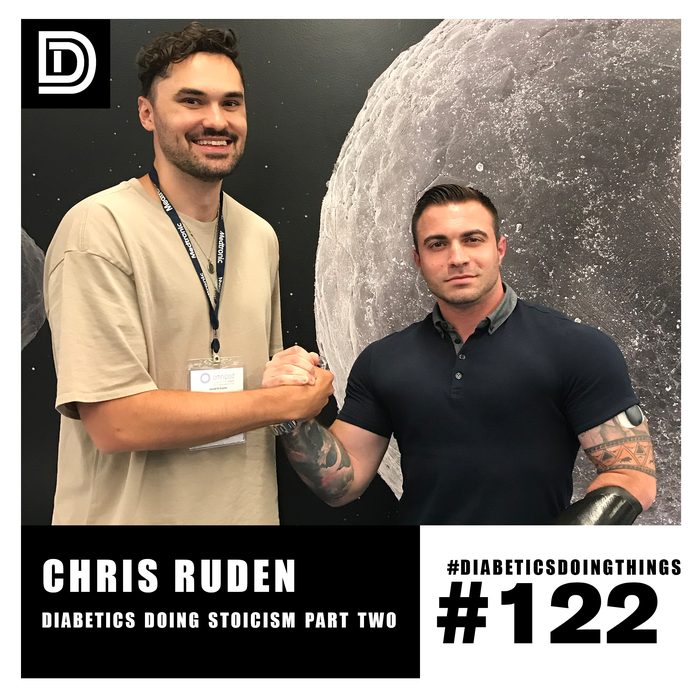
Chris Ruden (@chrisruden on Instagram) returns to the podcast for his second interview from the floor of the AADE Conference in Houston. Even though we planned on covering other topics, Chris and I are who we are so we dive back into Stoic Philosophy as it relates to social media and external perceptions of success.
If you haven’t heard Chris’ first interview on Diabetics Doing Things from March 2019, I highly recommend you check it out.
Chris flips the script on me a bit in this interview and puts me on the hot seat, asking me questions like “What’s your biggest struggle?” and “What’s the most painful thing you’ve ever experienced?” and I discuss 3 things I’ve never really discussed publicly. Chris and I then shift over to the topic of authenticity and vulnerability in the age of social media and Chris tells us a story he’s never told publicly before. You DO NOT want to miss this interview and if you somehow have not come across Chris Ruden to this point you are missing out. Chris is the truest example of “Don’t judge a book by its cover” that I’ve come across in my life, and I’m grateful for his time and contributions to Diabetics Doing Things.
Quick reminder, Chris also appeared on the JDRF Dallas Panel in 2019 which was our first live podcast, so while you’re looking for more Chris Ruden content to binge, check it out.
Questions this episode answers
Does Chris Ruden always wear his prosthetic arm?
No. Chris says he wears it roughly 40-50% of the time. He calls it almost like an expensive accessory that helps him mentally, but he's comfortable going without it too.
What happened when Chris Ruden applied for a job at a vitamin shop?
Chris says that last year, when he was ready to quit his career, he applied for an $8-an-hour job at a vitamin shop in Boynton Beach. The manager told him no and said he was overqualified, which Chris says pushed him to keep going.
How does Rob Howe say he dealt with his father's death?
Rob says his father died the year before this interview and that he has been seeing a therapist to work through grief, which changed how he thinks about his workaholic habits and priorities.
What is Chris Ruden's advice on failure?
Chris says failing is an action separate from being a failure, and that someone only truly fails if they quit. He compares it to planting many seeds, knowing not all of them will grow.
Full transcript Searchable, with timestamps
Rob Howe: Welcome to the Diabetics Doing Things podcast. We've been telling the amazing stories of type 1 diabetics all across the world since 2015, and we have over a thousand years of living with T1D on the podcast. The interviews range from incredible feats to everyday victories, and we celebrate them all just the same. Thanks for listening, and if you want to get involved even further, just send me an email at rob at diabeticsdoingthings.com. What's going on, guys? Rob Howe here. Extremely excited for this interview today. It is the second talk that I've had with the amazing Chris Ruden. This interview is actually the first of its kind. Not only are we live on the floor of the AADE conference in Houston, but Chris really takes the reins out of my hand. We've now had like almost two hours of recorded conversations for you guys to enjoy. Got a lot of feedback from the first episode that you guys really liked his perspective. And he puts the ball in my court and asks me some questions, puts me on the spot, and And he and I both discussed things that we've actually never discussed publicly. So around about the last 15 minutes of this episode, you're going to see us both dig really deep and get in some really personal, vulnerable stuff that really kind of reinforces what we believe about vulnerability and about honesty. And I'm really excited to hear you guys' feedback on it. So you guys know Chris Ruden. He is a motivational speaker. He is an entrepreneur. He is a fitness guru. And he is on Instagram as Chris Ruden. He was on the first season of the NBC Titan Games with The Rock, but that is only the beginning of the things that he is doing and will continue to do for people with diabetes as well as people with disabilities. So without further ado, part two of my conversation with Chris Ruden. Chris Ruden, dude, what's up? What's going on, man? Thank you for having me again. Of course. Glad to be here. We're here live at AADE 2019, Diabetics Doing Things podcast. We're back in action. this uh i gotta i gotta tell you not to pad the ego but people like even as recently as like last week where now we recorded in march uh our last podcast published like right after that and it's now august and people as recently as last week were like yo that episode was chris rudin was so dope so i got a lot of feedback from that but you know not to pad the ego but as we talked about last time ego is the enemy is the enemy absolutely dude i'm actually reading another uh ryan holiday book right now called Conspiracy. Yeah. Conspiracy. That was his early one. One of his early ones. Very cool. It's like, you know, he's a super smart guy. Absolutely. I just like his stuff. For sure. So what's up, man? You're here. We're here at AADE 2019. First year here. First year.
Chris Ruden: Things have blown up. Things have blown up since last time. And I'm just excited to be giving more value to the community, not just the camp side or the kid side or the family side, but now even the educator side. Right. And it's really cool to be able to give back and see the other perspective of not just people going through it, but the people helping the people going through it.
Rob Howe: Right. It's interesting. Austin and I were talking about it on, we did a podcast here as well. When you put faces to companies, right? And you actually see the people behind the scenes, it kind of changes things, or at least for me changed like, oh, this company really does know what people with IVDs need. And they really are focused on an individual level. They're like, yeah, I'm trying to solve this problem. Have you experienced some of that as well?
Chris Ruden: One of the biggest things I've noticed here is this is a meeting for caregivers, but the difference is caregivers that actually care. And that's not common. Surprisingly, it's not. You know, whether you're diabetic or you have any sort of issue, you've been to the doctor, most caregivers don't care. They don't. You know, they care that you're patient number 47 and you're paying the bills, but they don't care what you're going through and they don't treat you like Rob. They don't treat you like Chris. They treat you like your condition. So to be able to talk to people, companies and educators who respect that is different, you know.
Rob Howe: So it's really cool. Really cool to see that. Yeah. It's different, right? It is. Surprisingly, surprisingly. It's kind of interesting, you know, and I don't want to dive too deep into like the, you know, our health care system here in the U.S. But we will talk about a little bit later from a point of entrepreneurship, I think. Just hearing you tell somebody else's story today about living off of insurance for a while sparked that memory. But like, you know, those doctors and providers have like hundreds of people to see every day. And they're just going from one to another to another to another to another. And they're not able to develop those relationships that maybe in the past they were able to. So it's always interesting like to have people who take the time. Yeah. And I think here we have the space and the time to actually dig into those issues. And it's really cool to see some of the sessions that people are going to and really learning.
Chris Ruden: I think even with limited time, though, it takes two seconds to acknowledge someone. Like body language tells a lot. When you address someone, you face them, you give them time to respond. You treat them like you're present and not like you have a thousand other things to do. Because to be honest, most of us have a thousand other things to do. But give someone your time. That's the most valuable thing you can give as an educator or just a person is giving someone your time.
Rob Howe: So let's talk about your time. Like you said, things have blown up really since last time we talked and this year for you. Kind of following the Titan Games and as you've kind of come out of that. So maybe with a renewed sense of purpose and really driving yourself forward in something that I think you've known you wanted for a long time but now are finally realizing?
Chris Ruden: I think I've known I've wanted to help. And I started in the diabetes space, but I just wanted to give value back to people and understand the concept of struggle. And that's what makes it relatable. Whether you listen because you're diabetic or you listen because you're disabled or you listen just because you're a normal person, everyone understands the concept of struggle. So now I'm finally getting out into the world of diabetes as almost a covered disability and with the ADA. So clothing, you know, fashion, feeling better about yourself, confidence. Normalizing. Medical. Yeah, normalizing and normalizing individuality and accepting that different is awesome. So that's that's really what I'm focused on now. And now I'm working with, you know, clothing companies. I'm working with different corporations that get that language needs to change and relationships need to change because patients control the destiny of everything here. We're finally getting the power back to make the choices. And they're using people who are in the space for info. They're vetting us. They're using us as consultants to figure out how to reach their target audience. Whereas 10 years ago, they were just hiring companies for that. So we're in a very, very fun age to say the least. It's cool.
Rob Howe: And I think when I listen to podcasts and there's a guy I really like, Naval Ravikant, who was actually on Joe Rogan's podcast not too long ago. And he talks about his idea of what the future looks like is that everyone will work for themselves in some capacity or work for a smaller organization. That this idea of big companies and people wanting to work for a big company will start to dwindle. And I think we're sort of experiencing the initial parts of that, right? Definitely. Your platform is your business, is your lifestyle, livelihood. But also it's your avenue to help other people like you and also help companies to help other people.
Chris Ruden: And a lot of people ask me like, oh, how do you how do you get to do what we're doing?
Rob Howe: How do you get to do be what you're being? That's like the most common question. All the time. All the time. It's such an easy and unfair question to ask, right?
Chris Ruden: Yeah. And it unfortunately, it's an easy and open ended answer, you know, in that being authentic, being your true self and not trying to be what you're not. because anyone who is not authentic, you reek of a lack of authenticity. You can see it. You can feel it when you walk into a room, and everyone doesn't trust you. So to be authentic, to just be unapologetically you, is the hardest but most successful move you could ever make.
Rob Howe: Well, and I think it pays off. Soundbite. Right? That was major soundbite. I always had to let that sit for a second. Did you guys get that? Okay. Okay. And you talk about, it kind of comes back a little bit to reputation, right? Um, I want to, I'm going to spring this on you. Your reputation as Chris Ruden is that you are super genuine, kind, and just like unbelievably cool, uh, because you're you. And like, uh, and I, and I like totally agree with that. Like you can have a preconceived notion about what you might be like,
Chris Ruden: cause you have this kind of meathead. Of course. And I get that all the time. Like people are like, oh, I'm so surprised that you were cool. I just thought you were kind of, and I'm like, yeah, kind of what? Like douchey. I'm like, why? Oh, because I have muscles. I wear clothes that are too tight. I have tattoos, you know, and I get that, but that's where not judging a book by its cover is important. Now to close friends, I'm sarcastic, I'm fun, you know, like, you know, call me whatever. But at the end of the day, my goal is to help people. Sure. And I do that in the best way I know how, and that's just being me. Well, and I think that comes across super early
Rob Howe: when you interact with you. Um, which is great. I mean, like, like you said, authentic it's, it's, you could fake this if you wanted to, but you're clearly not. It would be exhausting. It would be
Chris Ruden: At this point, it would be, this would be the world's best, like I should just be hired to act
Rob Howe: because I would be the world's best actor. Just the method, most method actor of all time. Ridiculous. Talk about where we're at here. We're here today, where you are today, August, 2019. What would you, you know, this is a relatively new journey for you of acceptance with yourself, which I think is where really this whole journey started, you know, regarding talking about your disability, even, even outside of diabetes, what would, what would you tell your 21 year old self or what would your 21 year old self look at you and say? I think the difference is what I would
Chris Ruden: tell my 19 or 21 year old self doesn't matter because I wouldn't have listened at the time regardless. So, I mean, the, the best advice I could say to myself would be that you're going to get through it at your own pace. I wouldn't tell myself to speed up. Of course, I wish that I would have been more open. Hindsight is 20, 20. You look back like, man, if I would have stopped hiding, I could have been this, I could have been that. But that's a fake scenario that I created in my head to ruin my now for a past I can't control for a future that didn't happen. That's a waste of time and a waste of energy. And a lot of people waste energy on things that they can't control. Like we talked about last time, and I'll talk about that forever, because that's the most simple but profound concept is to put energy into things you can control um if that person was right in front of me now i'd be like why are you hiding you're hiding from yourself because no one had the cojones to tell me you can curse on this podcast if you want i mean i did it was in
Rob Howe: spanish but you're just not cultured it's fine no we're not i'm a cultural appropriation at its finest sorry guys well i need to take a step back i just hope that i said uh testicles yeah did i i think so cool we're good yeah solid it's good i think it's so tough you know you talk about being authentic and how it'd be exhausting to be the other way but i think today's society and not to make this like a huge treatise on what's wrong with the world but i think we're under pressure externally from people to appear a certain way or at least we interpret it that way maybe that's our relationship with that that uh you know external viewpoints so we're putting on we're in that sort of keeping up with the Joneses and social media plays into that.
Chris Ruden: It's really funny though, because we're, we're trying to appease a societal norm, but when you break apart societal norm into individuals, everyone struggles with the same problem they're trying to push on you. You know what I'm saying? So everyone is struggling with the same thing. Let's dig into that. Yeah. So you think about it like, oh man, everyone expects you to be perfect. You know, like you got to soften your face with that filter on Instagram. You got to, everyone's softened their face with filter. That means everyone has the same problem from the get go. You know, if you look at me weird, because I'm missing part of my arm, I look at you weird because your face is different than mine. Right? Like, you know, we're literally judging people based on individuality. And that's a requirement. It's it's a minimum requirement of being born. So it just blows my mind that we're upset. And I experienced this. So I can say this. I was upset that I wasn't the same. I was upset about a fact that is 100% true for everyone. And it's just, it's so weird to think about now. I'm like, that's, that's, it's weird to me.
Rob Howe: It's interesting. And like those microaggressions you take against yourself. Yeah. Um, and that
Chris Ruden: self-talk, um, the inner monologue you carry with yourself is the most detrimental or supportive conversation you could ever have, regardless of any other conversation with a CEO or someone who could move you up. And you know, people are like, it's not about what you know, it's about who you know. It's also about how you talk to yourself. Like that's one of the most important conversations. have you changed that inner monologue to reflect not just where you are but who you want to be
Rob Howe: well and i think also you have to believe first that that whatever you want for yourself is possible or is the right thing or else because it's really hard to get other people to believe it if you don't absolutely and you know kind of talking back to the conversations with yourself i was in montana this week at another american diabetes association um camp for kids and i was talking to one of the counselors because uh he was saying you know he asked how tall i am that's like a usual icebreaker for most people and also like uh clerks at grocery stores are always like look looking down they look up and they're like oh my god uh but i remember seeing and we had this conversation about uh like Dirk Nowitzki went on twitter and and said you know it's so weird like being seven feet tall you take yourself out of it sometimes he's like this i've had this great career and i have this thing that i do what i love but you know it's easy sometimes because people are commenting on your physical appearance to feel like left out or that you're weird or that you're like self-conscious absolutely and we were kind of talking about that he had a one of his friends was like a seven foot guy that didn't really play sports and like works at a desk and people every day the first thing they notice is how tall he is i'm sure they say things like
Chris Ruden: oh you should play basketball like exactly you should do something because of the way you were born and like not not because you want to but because of how i feel about how i see you and that That to me is so weird. Like you take my arm and people come up to me and literally grab it. And they're like, oh, this is so cool. And I'm like, I'm okay with that now. Now before I would have been petrified, like that would have destroyed me. But then let's flip the scenario. Let's say you are a person with, uh, let's say you have an extra 400 pounds on you. And I come up and I grab your stomach and I'm like, wow, you are so round. Like you are big.
Rob Howe: You are big, big, big, big. Which in some ways is almost the exact same interaction.
Chris Ruden: It's identical because this is how I was born. This is how you are. This is how we currently both are. And you are coming up to me based on something you don't know because your curiosity is so overwhelming that you disregard potential respect for someone you don't know. Right. I'm okay with it now, but you wouldn't do that to someone's wheelchair and like roll their wheels for them. But it's crazy how people act. Same thing with diabetes and having these supplies like, oh, is that a nicotine patch? Like people just throw out stuff. And that's just so weird to me. People are like, oh, are your ears disabled or are they just normally small? And like that's kind of like a low-key neg, you know? Absolutely. You're like hitting someone. And it's funny because I'm cool with it now, but I've done little like research experiments on my own where I go to Walmart. I'll have this arm on. Everyone talks to me. I'm the coolest person in the world, you know? Take this arm off. People avoid me like the plague. Very uncomfortable. They don't know where to look. They're like, hmm, not as cool. You know what I'm saying? So perspective is crazy of how people interact. And honestly, I'd rather people just ask and talk. Right. Because then we get to educate.
Rob Howe: And you're not using this arm, as an example, as a defense mechanism to hide.
Chris Ruden: No, not at all. And I do both. You know, like I wear this maybe 40% to 50% of the time. And for real, it's like a great, how do I say, like mental. It helps me mentally. It's almost like the world's most expensive accessory. It's great. Obviously, I use it. But to me, it makes me feel better. But at the same time, I walk around all the time without it, you know, and I'm fortunate to be in that case. Some people aren't. Some people won't show their Dexcom or their CGM or their pump or their insulin shot or anything like that. Some people will. I guess it's where you're at comfortably, but we do have to do better in respecting people's spaces.
Rob Howe: It's interesting because I think as a I don't know, as a species, we're very social, obviously. And like we want to try to connect and we don't always do it in the most tactful way. definitely for example right now you're wearing the Eversense CGM i'm wearing my medtronic sensor i go to the gym with the or play basketball and i play with it on so someone could bump it or ask about it and i just try to always put myself in the position where i was when i got diagnosed with diabetes which was i knew nothing about it um and i would have asked those questions too and i think for people maybe that are more in the public eye like you hear it more often it can become more abrasive potentially. And also how you do what you do makes you who you are. Like how you ask a question like that. Is everything. Yeah. And I mean, you know, you can, you can ask tough questions the right way. Oh dude. My, my favorite is when like people like, I just have
Chris Ruden: to ask. No, you don't stop. No, you don't. No, you don't. No, you don't. Don't. You want to ask. You want to. Yeah. Like just don't lie. Use the right language. Don't say you can't say you won't. You know, there's things like that. I'm big on language. So when someone says something like that I'm like I'm cool if you're just straight up like bro I'm so curious I just I really would like to know yeah how honest is that it's honesty like true raw honesty is is hard it's hard to do
Rob Howe: and it's like you're so I'm like I'm so curious and I think that honesty is it's such a nuanced
Chris Ruden: thing yeah right like we don't do it we're not our authentic selves anymore with with social media we we filter everything from the way we look to the way we talk to what we say we want versus what we actually want. It's not our goals and our actions don't align. Is that social media or is that just embarrassment? Is that fear? I don't think it's social media is the cause, but I think social media is definitely a vessel. So maybe it heightens that awareness. Oh, for sure. For sure. I think people just are afraid to be super authentic because it's vulnerable because it's raw. And then we kind of judge ourselves based like, damn, I really want to know about their disability like that's kind of messed up yeah but in reality it's not because they don't know they've never seen it you know can i blame them no but at the same time there's days where i don't want to be that person you know i don't want to be on 24 7 yeah i try to be but sometimes you know
Rob Howe: you just can't you and you know you got to take your time to to recharge and kind of disconnect as well i'm gonna ask you something i i guess i assume this about you but i don't really know for sure do you like kind of identify yourself as an entrepreneur or i know you're a keynote speaker
Chris Ruden: and a coach and yeah so I I mean I personally I'm a little weird about the word entrepreneur because most people who call themselves an entrepreneur aren't actually entrepreneurs you know they're wantrepreneurs sure uh everyone has amazing ideas a great pun by the way yeah oh it's amazing uh everyone has amazing ideas I have people pitch me all the time they're like oh man I got this million dollar idea I'm like no no no no such thing as a million dollar idea million
Rob Howe: dollar execution that's it there's that there's that uh famous like you know a million dollar idea with one cent execution is worth zero exactly you know a hundred dollar idea with a million dollar execution is worth you know yeah 10,000 bucks whatever there's so many so many good ones
Chris Ruden: and one that really resonated with me was uh you can't have a million dollar dreams with a minimum wage work ethic yeah so little stuff like that um you know people say memes don't work but uh you know sometimes they don't memes only work because the ideas existed before they put them on pictures there we go okay that's it now we're talking they're literally quotes on pictures that's it
Rob Howe: That's quotable. Yeah. In a meme.
Chris Ruden: We could literally meme a quote into a meme. Oh, man, I'm confused now.
Rob Howe: I think another interesting thing, though, while we're on the subject, we were talking about authenticity. We're talking about fear of not being perfect. You are in a position where you are constantly having to negotiate for yourself. Absolutely. And I am the same way. And we really all are in different scenarios.
Chris Ruden: to advocate for ourselves, whether you work for a boss or you work for different companies, you independent contract, like you have to advocate for yourself or you always be in purgatory of where you don't want to be in life. So let's, let's kind of go behind the scenes a
Rob Howe: little bit and just like take yourself into the mindset of, you know, when you're advocating for your own value or you're advocating for a job that you want, um, do you still experience those fears and that self-talk? How do you, how do you overcome those things? Yeah, I think that's,
Chris Ruden: that's a completely normal every I've done uh let's say 150 events over the last three years um every single talk even today I get worried you know I get that that anxiousness or that nervousness and I always have to coach myself through it I'm like oh I'm nervous I'm nervous I'm like I'm excited you know that's it's a similar feeling but I always get that doubt I think it's good to have a controlled pessimism of doubt to understand like every time you drive of your car, you can get that flat tire. Like we said before, uh, how can this go wrong? And don't let that thought spiral out of control. Use it as a reality check so you can prep almost like a
Rob Howe: healthy paranoia. Yeah. Yeah, for sure. That's a great way to put it. It's, I think it's a, a very
Chris Ruden: good thing to do if you can control it, but some people let that spiral out of control and then they go, what if, what if, what if, what if, and then they end up doing nothing, you know, paralyzed out of fear and analysis paralysis type of behavior. So I get that all the time, But at the end of the day, my concept is if I plant a million seeds, one might grow. Might. Not will. Might. And if it doesn't, plant more. Giving yourself a chance to. You have to. And you can't. I used to tie myself up with like one idea. So I really wanted this one gig with this one company. And I'm like, man, if I got this, then this if then philosophy. And I built this idea up into my head. So I was so excited for that. But by the opposite token, I was so distraught that it didn't happen. So instead of establishing the reality of if this if this works cool, but if it doesn't also do this, I was just one sided. So I'm very careful with that. And I appreciate every opportunity that comes. I'm not lucky, but I am fortunate to make it work.
Rob Howe: And, you know, not to even more quotes or quotable memes is like, do you know how hard I had to work to get this?
Chris Ruden: A hundred percent. You know, I see that a lot. It's really true. And people just see the topical success and they don't see what it took to get there and the amount of failure it took to get here, you know. So I'm just I'm lucky to be able to give value back to people in whatever space and be able to call this a job.
Rob Howe: Yeah. You know, it's pretty great. Yeah. You mentioned failure, so we got to talk about it. Let's go. Do you think, you know, failure as a I don't know, how did failure play a part in your life? I'll give you an example for me. when I was a really little kid, probably way too young to learn about like these ethereal like concepts. My dad got me this book. It's called, I can't accept not trying. It's like a little picture book by Michael Jordan. And so it's just like, I'm sure he made a ton of money on it and didn't write a single word, but it's based on the idea that because I try and fail, I'm successful. Uh, and you know, it's all the, the typical Michael Jordan stuff. Like I've shot the ball 99 times at the end of the game and I've only made it 12 times and I missed the other ones, but because I missed those, I'm able to make the next one. A hundred percent. Uh, and did that, uh, so how do you, you know, where did you get your comfortable, uh, where is your comfort with being able to put yourself out there and quote unquote fail and continue to pick up the pieces and come back again?
Chris Ruden: I don't know if we talked about this last time, but if I did, I'm going to say it again. Uh, understanding the difference between the word failure and failing. Right. I think we did. We talked about that a little bit, but I think it's still important. That's, that's so vital knowing that, you know, failing as an action is completely different than being a failure as giving up and, you know, succumbing to the loss. So failing holds equal weight. So winning, you know, winning and losing, you can't have winning without losing. You can't have success without failure. No one just made it. And you don't know how strong you are until you're tested. You know, strength doesn't come without struggle. So I feel like to avoid one would be a guarantee to avoid the other. Well, and let's talk a little bit about that and apply
Rob Howe: again to you since you're on the show you're the guest right now but did i talk about like all the failures i had last time i don't know if we got so deep into all of them but i think you know we we focused on this and i almost even said the same exact response just now that i did last time the
Chris Ruden: bad thing is it's what we believe it's what we live it's like my life we're gonna go listen to
Rob Howe: the old practice like whoa this is the same thing we just have video uh so but like if you hadn't had felt the way you felt about you, about yourself or made the mistakes, quote unquote, mistakes that you made earlier in your life, you couldn't have the same resonance that you have now.
Chris Ruden: I think I went through enough pain to make a change and most people don't. And looking back on it, it's great. Cause I'm like, Oh, thank God I went through that. You know, maybe I could have did different things, but you know, I, I got the mental fortitude of where I am today. But, uh, if I could go back, I would definitely not want to do that because it's not something I would wish on anyone. I do think that people have to struggle. They have to fail. They have to go through the dirt. They have to put their head down. We talked about this earlier. You know, most people ask like, Oh, how'd you get into speaking? I was like, I did 30 plus events for free. Yeah. They're like, well, how'd you get there? I'm like, I paid like, well, why? I was like, well, do you see where I am now? Right. Yeah. But I want to be there. I'm like, Oh, Oh, you want to hang out at the finish line without running the race. I see
Rob Howe: how that works. You want to, you're, they're comparing your day 1000 to day one. And that,
Chris Ruden: that's, that will never happen. And honestly, when people ask me, Oh, how do I get to somewhere like where you're at? I say fail, fail forward, fail often, you know, and you have to, you have to be able to be tough mentally and deal with the fact that life is not going to go your way. If you were able to say, I want life to go my way every single time. Think about this. When you go to apply for that job and 10 other qualified people just like you apply for that job and you get it because you wanted your way, you just destroyed 10 other people, right? Even though there were good options because of what you wanted. If your life went exactly how you wanted it to,
Rob Howe: so many other people would suffer. Because it's a balance, right? There is a balance. In order for
Chris Ruden: you to win, someone has to lose. Yeah. And that's, that's the truth, you know, and not saying you should lose or you should win on purpose, but I'm saying that you should come prepared for that win or for that loss and not take that loss to heart. Right. Because you, like you said, fail and fail
Rob Howe: often. Um, Oh man. Okay. So perfect example. Perfect example. Um, I got my degree in exercise
Chris Ruden: science and I never expected to, uh, get into speaking or anything. Like I thought about it, but never thought it was a job and parents did not think about it as a job either. Like, Oh, you're going to talk. We used to get in trouble for talking. I had a job, had a job that I got offered it's $25 an hour and at that time like as a freshman in college I'm like I haven't even graduated and you're gonna offer me this job for $25 an hour I'm like this is the I'm gonna be rich right I'm like Bentley is coming very soon I didn't show up to the second interview because of a girl and I lost the job and I was destroyed sure like I look back and I'm like well there's my whole career. Like that could have been the job for the rest of my life. Right. I really thought that like, Oh, that's, that's probably where we're going to end up for the rest of my life. Like, it's a great job. It's exactly what I wanted to do in the exercise science field. And I look back and I'm so thankful I didn't go to that interview at the time. Distraught, messed up. Now I'm so lucky that that didn't happen. Cause I don't know where I would have been. I think, I mean,
Rob Howe: that struck a chord with me. I, uh, I haven't talked about this a whole lot, but that was a new story. I was like, Oh, I just remembered that this is good. We're digging into new stuff. It's It's not going to be the same as the last episode. For now. So most people know I played for the Washington Generals against the Globetrotters. Most people don't know. I got fired. Like I was like. See, that's the kind of real stuff that people need to hear. And yeah, I mean, I was in the Pepsi Center. So even more nuance to it. I went, I lived for like six years in Colorado. I went to college there. And then afterwards I worked there, had a lot of friends. So we're in this part of our tour. the last leg of our first half of our tour in 2013 was in Colorado so I had like 70 people that came to the games to watch me that I was like giving tickets to and I get a call right before the second game in Denver in the Pepsi Center in the NBA in an NBA arena I get a call from my GM he's like hey man and we had had some like conversations the weeks leading up to it but I thought that we had kind of gotten over whatever the problems were he goes hey man like they are one of these guys doesn't like you on the tour he's like you're gonna be done after this but we're gonna let you play your games in Colorado because we know your friends and family there so I just got fired and I had to play three more shows and so like and like literally the game starts in an hour like people are texting me they're like hey we can't wait to watch you bro so I'm out there and I'm like god like I can't believe and I told you know one of my college teammates and his family were there and I like told him after the game I was like my trainer was out there like I was like I got fired I gotta find this thing and so like I moved home like after the tour was over and I was like kind of on fun employment for a little while like not you know just like a couple weeks and i was reaching out and i got a one of my buddies was living in new york at the time one of my best friends and he linked me up with this guy and we had this email conversation and he goes you know we're back and forth he's basically kind of offering me this job and i'm like you know kind of waffling on it i had another offer in dallas that actually ended up taking and i told him and i ended up i emailed him i was like hey man you know i appreciate the conversations and this has been really cool but you know i took this job in dallas because i'm here and you know it just seems right he sends me back this email he's like, Hey bro, just let me, let me know if you ever want to move to New York city and have the opportunity to make more money than you've ever seen in your life. At the time I just took it, I took it. I was like, damn, this dude's kind of crazy. But then later on he founded this company called stadium goods, which like sell sneaker, like aftermarket sneaker reseller was like a big deal. And, uh, you know, I would have gone and worked for this guy, but I didn't know that at the time. So, you know, I'm looking, I look back at it and the job that I took led me to starting my own company led me to have my own life to diabetics doing things to this entire this incredible opportunity and in that moment when i realized i was like yo i could have been at stadium goods yeah i had this quick hint like my mind went i could have had all this stuff yeah and i got disappointed with what i had but you can't and you can't do that and i realized in that moment i was like you know because this entire journey brought me to where i am i think the way people
Chris Ruden: think is like oh i live life this way and if i lived life that way it might have been you know different. Life can go so many different ways and you never know what would have happened in the past. You're literally creating scenarios that don't exist and you're stressing about things that don't exist. They're not real. They're literally not real. Literally not real. So I
Rob Howe: went, if I found that email, I went back and found it and I was like, wow, I got it. Okay. This really happened. And I was like, I'm so happy where I am. I'm like doing what I love to do. And even though, even in those moments, I doubt myself, you know, so I feel like I just want to destigmatized that like at whatever point we, you and I are at, that we still have those moments where, Oh, for sure. We can like question everything we've ever done.
Chris Ruden: I've had so many people talk to me and they're like, man, you're so lucky. You know, you're so lucky. You're, you're, you're so lucky to be doing what you're doing. Like, I wish I, I wish I did what you did. I wish, uh, I wish I had the time to do that. I wish I had the life you had. And I'm like, Oh, you wish you had the life I had. You wish I, you went through depression and suicide watch. You wish you went to the church to get food You wish you had a $500 car that broke down no AC in Florida, you know You wish you spent $50,000 on an app and lost it because the guy left You wish you moved to a different state for a business that failed and lost everything and had to come back You know, you wish you got on a tv show and then actually lost in front of the entire nation and entire world That big opportunity that you thought could have been bigger You wish you, you know got with a nike and they hired you and then ended up saying you're not their body type bro i messed up a lot like not even messed up but i like failed a lot technically sure technically but i'm here you know and it's not final how much are you willing to go through like what can be thrown at you and you're still unwavering if you find that why to keep you up after all the stuff
Rob Howe: like that you're on the right track so what's with that like what's your obviously you help people and you inspire people what's your why when you have those moments undoubtedly i vow to be the
Chris Ruden: person I never had growing up whether that's for a kid or an adult or a company a company that affects change in kids adults or anything I will be the
Rob Howe: person that I didn't have growing up man sound bite we did the clothes yeah that's good no thank you I think that's so important to hear for people you know because I got a question for you okay hit me with it what's the most painful thing you ever experienced? Uh, man. Um, first thing I, you know, my dad dying last year was like the, just shook me, shook me up and especially cause you're already in the influencer space,
Chris Ruden: but so to speak. And like, how did you deal with that? Like what kind of thing could you even go
Rob Howe: through? I can't even imagine it. Oh, you know, I'm seeing a therapist about it and we're working
Chris Ruden: through a lot of the grief stuff, which I think is really important. And we'll get to mental health.
Rob Howe: we can destigmatize that too like i yeah i see it there it's a necessity um and because she's a pro and you know you don't take your car to a bakery to get the exhaust worked on nope uh so i and i wouldn't don't know how to do a car exhaust myself so i go to a pro uh and we're working through some of the stuff like but it really shook the way you know the wheel of my life of the things that i think were important and the values that i had like priorities yeah priorities you know like i was a i'm a workaholic i love work um and he was like that and uh you know always looking for the next deal. Always pushing that. And, you know, sometimes sacrificing things in the present, trying to work for things in the future. And, uh, you know, I loved him for that. He, he gave that spirit to me. And at the same time we miss things. Uh, and I don't regret them. You know, we had time, but you know, now I'm like, okay, is this that important? You're just more aware. I'm aware of it. And it kind of cleared that up for me. And I think, um, you know, that's a different answer than I would have given a couple of years ago. Yeah. I'm sure. And I mean,
Chris Ruden: it depends on where you're at. Same thing. You talked about like my disability, like I'm all open for it. But before, if you would have did that, I would have took these headphones off. Sure. You know? Yeah. So, I mean, I resonate with the progress of growth and sometimes growth is healing. And I, I, like I said, I can't imagine going through that, but I can't imagine the pain of healing. And it's tough, especially when you're in a social light. It is. And I think honestly,
Rob Howe: you know not not being able to share that like my family is very private about the whole thing which i thought was a little bit um you know back to the control thing we're trying to control the narrative too much and you know we also were trying to be there for him like he was in his mind he was going to beat it so you know you wanted to fuel that sort of placebo you know we had those conversations um but yeah you know you you kind of feel a little bit more lonely and then you open up and like people you don't even know have been outpouring of health of this like
Chris Ruden: kindness and encouragement and like something that we need it's something we need not just in disaster not just in you know catastrophe but mental health is such a huge component and it's a big fuel of what i talk about you know i have my degree in exercise science but i i kind of hate talking about physiology because it's boring to me and it's there it's just logic and you've been there done that it's it's it's cool and all but with mental health is what we struggle with most guys are so stigmatized by mental health. We're not allowed to feel we're too masculine, masculine. We're, uh, you know, if I talk about depression, people like, well, you can't be depressed. I'm literally put on a pedestal of, I'm not allowed to be depressed. Right. I'm not allowed to have anxiety. Chris Ruden is depressed. Like, no way I have to be. That's insane. Like that, that blows my mind. And that puts a lot of pressure on me and other people too. And that's not fair. That's not something I struggle with depression and everything else, just like other people struggle with depression. And it's a daily battle. It's not like I read a nice meme quote picture and I'm like, wow, I am so motivated today. That's not how that works. There's some days that are just tough, but my why keeps me going through the bad days and through the good days. Everyone is motivated when things are going good. You get that new deal. When you get those hundreds of likes and everyone validates you, you are on top of the world. But talk to me on a bad day. How are you going to get through? What's your driving factor? Is your driving factor an external force that you can't control. Cause if it is, you're going to crash and burn.
Rob Howe: And I've crashed and burned plenty of times. And I think, you know, again, a lot of it is looking for external validation and you know, those not to keep going back to stoicism part two here, but you know, mastery of self is that's the journey, right? And you know, there's this book I really love called, uh, the war of art and it's like the, the artist version of the art of war and it's kind of a nice switch and kind of tongue-in-cheek and a lot of it talks about fighting resistance and how if you're an artist or an entrepreneur or a person who's trying for more every day you have to wake up and slay the dragon but there's no villagers that throw you a parade you just have to wake up the next day and kill the dragon again and I think that type of repetition that type of effort just to get to what you're trying to do is so tough and people miss out they think it's easy they look at you like oh man Chris Ruden has, he has millions of views. He's on TV. The rock gave him a hug. Yeah. They see the good
Chris Ruden: things and they don't see like the second that that show was over, like I'm done, you know, like I'm literally onto the next because I know I need to keep going. That's it's done. It's, it's not something that people talk about anymore. So I just always keep going with that. Something I do want to ask you, and I would love to kind of open this. What's something you struggle with now? Like sort of mentality wise, like for, I guess I'll start with, for me, it's understanding when to turn off, you know? We're, there's two kinds of people. There's people who are, who settle with less and not in a bad way. Like they're super happy with, they appreciate everything. They have gratitude. And then people who strive for more, you know? And I feel like we're definitely strive for more people. We constantly go after, we get the thrill of the chase in terms of entrepreneurship and business. Um, knowing when to actually be happy, when to choose to be content. Um, that's definitely something I have to actively be aware of is like appreciate where you're at versus always continue to be unhappy because you're not where you want to
Rob Howe: go. I think before I answered the question, I just speaking to that years ago, and it wasn't that long ago really um one of my good friends and i had this idea that contentment and happiness and complacency was bad it was like negative yeah that satisfaction is the death of desire exactly like we were soft at that point like we like our uh that was the moment we were dead yeah and
Chris Ruden: you know for years i lived my life that way um it's a great balls to the wall approach that will burn you out it is not sustainable it will burn you some people do it that's i think that's a crazy tool like definitely it was a tool to get me through some rough times where i'm just like Like, fuck it, keep going, go, go, go.
Rob Howe: I used to idolize guys like Kobe Bryant. Andy Frisella. Like, people like that who were just, like, hard. They were just hard. They're waking up at 2 in the morning and they're getting a workout in because they need that extra, you know, the Jocko Willinks of the world. They're up at 4.30 because they know when they meet the guy that's working against them, they're going to kill him. Plus, you see that image. You're like, damn, he's a badass because he does all the shit. He owns his life. He has ownership. He really is, like, in there. And I think, so, yeah, I looked to those guys, and I still do in some cases for motivation and things. Like, I have a tremendous amount of respect for them. But I also know myself now a little bit better.
Chris Ruden: I take part of it, you know. I extract the parts that motivate me. And that's important with everybody. You got to take it with a grain of salt. You can't be just like me or just like Rob. Like, that can't happen because you are doing yourself a disservice and the world is a disservice of you bringing your individuality and what you could offer.
Rob Howe: And you're probably, yeah, probably neglecting the parts that make, it will make you special, more special than us or different than us. And that's, I think, super important. So the thing that I'm struggling with right now is I have a lot of things. I'm a guy that likes a lot of irons in the fire. I don't like downtime.
Chris Ruden: So it's like the orange Lamborghini or the yellow one, right? Right. Yeah. Those are the problems I have. No. That's the next podcast.
Rob Howe: That's the next. I don't fit in a Lamborghini. That's the next one. That's why we want to talk about that. we can go do comedians in cars, drinking coffee, put Rob in a Lamborghini and that'd be right there. But, um, you know, I have my agency business recreation, which I love and is, uh, it just been an incredible ride to this point and is very successful to, to my estimation. And we want to grow it and continue to do great work. Uh, so I have that, I have diabetes doing things, which is really my own is my personal creative outlet. It's my connection to the diabetes community. It really is my passion. And also like what I think I was put on this earth, to do up probably at least at this point. And also I get a tremendous amount of emotional revenue from, uh, and just like this week, uh, I was in Montana. I talked to a kid came up to me and was like, Hey, like diabetes, he wasn't even really talking to me. He was like, diabetes camp is the only time I feel like a person. It's like the seven year old little moments you catch and you're like, Oh man, burner. I'm in the right place. You know, like I can have like, okay, this is worth it yeah there's a story you were at the young adult conference in Dallas earlier this year Laura Pavakovich and Ariel Lawrence were there and we have been talking with Nicole Johnson before and I donate some scholarships one to each of them to give away to one of their followers who wasn't able to afford to come to camp and JDRF Dallas sponsored the flights and I you know paid the conference fee one of the girls that came met had net had no type 1 friends only been type 1 for like six months met Brandon Arbiter from Tidepool, asked him for a job. He gave it to her. She moved out to the Bay Area. So now she works for Tidepool and had only done MDIs and never had a CGM. Now she's looping. That's insane. And I ran into her on the streets at ADA conference in San Francisco. That is insane. And so it's like, you know what? There are little things that I didn't even know about that are happening from that. So anyway, all I have to say is like, Dive Bay Area is super important and I love it and I hope it never goes anywhere. But, or it never goes away. But the thing that I struggle with is balancing opportunities. based on time. My time is finite. I'm getting married. You know, my fiance wants time with me and I love her. I want time with her, but you know, I'm also like excited about new things. Like it's hard to, I love saying yes. You know, and I think that the hardest thing for me is when to say no at times because, you know, and I think I've come up with systems where if it's a work gig and I need to get paid for it, uh, well, that's a simple thing. Am I getting paid for this? Yes or no, I can do it or not. Um, or is this a good opportunity for me to feel better about what I'm doing in the community or have an impact on people's lives? Yes or no. Um, or is this person just want me to volunteer and needs my help raising money or planning an event? It's like,
Chris Ruden: you know, is this my responsibility? Yeah. And that's, it's tough because you always want to add value. And that's just what we do is we, we try and give back, but we have to assess, is it going to take away from my ability to help more people? Right. Is it going to take away from my quality of life because if you damage the building's foundation, you know, it only survives so long. And if you're the building and you're giving all this value to people, you start doing those detrimental events or those detrimental scenarios where, you know, you shouldn't,
Rob Howe: it gets to you. Well, and I think too, it's a lot of it is trust, trusting that other people and also bringing other people up to do things and trusting them with being able to, uh, you know, one of my, one of my employees, she may listen to this podcast, but like she has challenged me because she's very talented and super smart. She doesn't really need me. And I have to trust her to be able to do the things that I used to do. And that's tough. And it's tough. But it's caused a lot of growth for me and realized that, like, if I can employ those things in other areas of my life, the things that are really important to me, I can continue to focus on and enjoy things that are just for me, my family. And the things that I'm good at and I've built can continue to grow with someone else in the mix.
Chris Ruden: See, that's why I wanted to bring that up because, like, I want people to know that everyone struggles, you know, like for me, what I struggle with for you, what you're struggling with right now. And there will be new things we struggle with. We talk again, you know, it's accepting that struggle is a part of life and accepting that you don't have to judge yourself by what you're going through.
Rob Howe: And we've talked a lot about struggle today. And I think like something that I always said and never had really reinforced itself with me until the last few years. I went to play basketball at the University of Colorado, Colorado Springs. I had a lot of other offers. I was not super highly recruited, but I was close. But I liked this school. And I didn't know why. I didn't really have a great chemistry with the coach on the phone as I look back. But I liked the location. I liked the guys. And my teammates that I had during that time were still some of my best friends. But every single day, my coach hated me. And I didn't play at all, really, until like halfway through my junior year. So I would go to work every day. My number one priority in my life and my number one love, which is basketball at the time. and they were telling me no and somebody was right there and he'd look me in the eye every day and be like no dude um i'm in control and i'm taking what you love away and so every day had to man it was hard how many times you know we joke about it my friends like how many times in our basement were you just sitting down there bitching and moaning about coach does this he won't play us and then every day we'd still wake up and with the hammer go back to work chipping away at it and then eventually it wasn't easy and like still had a lot of pitfalls but eventually i got i got to start i got to have my career high i got to have my big moments my game winning shot whatever and i remember after one of those moments just like walking after the post-game interview walking down the stairs like in the moment like in a stairwell by myself kind of like not collapsing but like sitting down and crying and being like fuck like this was yeah all that much all that yeah and but but at the same time everyone had given up on me except probably my family they're like you know what rob's a good college basketball practice player rob's a good teammate rob's a good guy. He's a good basketball player, but he's not going to make it. And that's just going to be that. And they were right to think that that was logical. But every day I had to just be crazy.
Chris Ruden: I mean, the doubt, the doubt you had to experience is real.
Rob Howe: It's real. And I have it still. I experience it all the time.
Chris Ruden: So I'm going to say something that I haven't said. I've told one person. Exclusive. This is, this is like, if you made it this far in the podcast, you're going to hear some stuff that you're like, no, you're lying. I have the paper proof. Last year, I was
Rob Howe: still pretty known right yeah you were known I knew you I would say so yeah would you believe
Chris Ruden: that I applied for a base level job at vitamin shop for eight dollars an hour I was ready to quit I lost so many opportunities I wasn't picking up any gigs money was tight I'm terrible at balancing money it was to the point where I was like screw this I'm done I went into this vitamin shop in Boynton Beach. I printed out a resume that I haven't printed out and the gaps, the gaps were insane. Um, and I, I brought this and I was like, this is me. He started talking to me. I started telling him about what I do and all that. He said, no, he said, I'm not going to let you do this. He said, I, I could hire you part time, but there's no point. He literally said no. And that was like the best thing ever because I had given up and I was physically ready to give up. I told one other person that and I was like that was last year man I still had the followers yeah still had the gigs still had all the all the fancy stuff every magazine all this stuff I was ready to quit I was done last year man so like when I hear stuff like that oh I know I'm walking by people maybe here and I'm like sure that person you said no to me two years ago everyone's talking about me now because I didn't give up and you thought it wasn't gonna happen right and I'm doing it because
Rob Howe: they come first you know so well shout out to that guy for not letting bro for real wow for real that
Chris Ruden: dude i mean maybe in his head he might be like i'm quitting i'm not onboarding anybody today i don't know but in my head i was like damn that's an angel like that's that was like one of those
Rob Howe: people that was just like nah you're not gonna you're way overqualified for this position and i just man you know how many examples like obviously i don't i don't ever get to hear those firsthand like you thanks for sharing that this is nuts but you know you've seen that like cartoon where the guy's like about to quit. He's like, I quit. The caption is I quit. And he's got a pickaxe and a tunnel. And there's like, yeah, right about to win, right. Right. Right. It's like the treasure.
Chris Ruden: Yeah. It's like, and you see him walking back like that. That's real life, dude. Like the only way to become a failure is to quit. And I tried to become a failure. I tried, you know, and I'm so lucky that there was something external, but immediately I was like, okay, back to the drawing board. What, what do I need to do with where I'm at right now to make this work? And sometimes that that's the most important question you can ever ask yourself. Like stop yourself in all your shit and be like, what can I do right now with where I'm at to make this suck less?
Rob Howe: What can I do next? That's it. What's the next step? There's Ariel walking by. Dude, it's, uh, it's not like, like, again, you're not going to hit it. You're not going to, no one throws a hundred yard touchdown pass, you know, nobody, because they, I didn't,
Chris Ruden: I didn't start deadlifting 600 pounds. You know, like I literally started and I physically couldn't even do it. So it takes years and years and every day you're going to doubt yourself. Every day I was like, there's no way I'm going to lift heavier than this. I lift heavier. I'm like, well, now there's no way I'm going to lift heavier. Right. And it's like constant, constant, constant. I don't mind if people complain or they doubt, just doubt to keep going.
Rob Howe: Don't doubt to stop incremental progress, man. It's like all of life's great treasures come from compound interest, whether that's physical, emotional, financial, financial. Yeah.
Chris Ruden: A hundred percent. And that's, that's like a massive point that it's uncomfortable because it's not, it's not something you can take a picture of. You can't make incremental progress and be like, look, I just incrementally progressed.
Rob Howe: And it's boring. And it's like, for me, I hate being bored. Like I'll do things for myself that I shouldn't even do, but I do them because they're interesting. And that gets me fired up to maybe get to the next thing. Temporary.
Chris Ruden: Yeah. And my therapist is telling me to stop doing those things. But yeah, technically it's not healthy, but I'm trying to control those things. You know, it's tough, man. But like I said, we all struggle and it's it's cool to show the transparency of struggle, regardless of where you are, without a doubt, regardless of where I end up. I'm going to continue to have these same struggles because it's part of who I am. You know, I'll fight it every single day, but I'm on a path to a better me.
Rob Howe: Yeah, man. Well, dude, solid talks as always. You show up and you're like Dion Waiters, which is Miami Heat.
Chris Ruden: Oh, man, I wish I knew sports. I don't even know, man. I'm like, I don't watch baseball, but it's all good.
Rob Howe: You play 10 minutes. You score 40 points with 12 boards. I've heard that's a lot. Yeah, that's good. That's good. Yeah, sports.
Chris Ruden: But it's cool that we can connect regardless of like, you know, I power lift, you play sports and do your thing. Like the concept of, you know, growth and struggle is universal.
Rob Howe: Well, and I think, you know, traditional society doesn't want us to be friends.
Chris Ruden: no they don't want us because we're on paper it doesn't make sense yeah but you know real life is you know we connected and we found out we have a lot more in common than we think topically people like wow a sport guy and a lifter like that's boring but people don't get it yeah people don't get it and it's nice to connect with people that do 100 agree good chris
Rob Howe: rudin oh yeah man this uh you know AADE 2019 it was good uh i know i'm gonna run into you again because you know what? I'm not quitting. Done. Chris Ruden, check him out. At Chris Ruden on Instagram. Yep. And obviously you guys know that. And keep watching his YouTube videos to make sure that he makes more. Yes, I need to make more.
Chris Ruden: Guys, push me for these YouTube videos. Help me.
Rob Howe: Comment on his most recent post. Help me. It's been an amazing journey thus far and I have a lot of really great stuff coming up in the future. So I'm going to do something that I haven't asked before. If you're listening to this podcast, A, I would love it if you would subscribe to the podcast just so you get the notifications whenever we publish new episodes because if you've been listening for a while, you know I don't always publish them consistently. Sometimes I'll publish five in a week. Sometimes it'll be only a couple in a month, and you need to know when these episodes drop, so be sure to subscribe. And if you like the podcast, be sure to go to your preferred platform like iTunes and leave a review. I would love to boost my reviews and I've never asked you guys to do that before. So I figured you don't ASK, you don't G-E-T. I would love a review from you. So I want to hear from you there. Also, we are now available on Spotify. Turns out I was just submitting it to Spotify incorrectly, but I corrected that. So now we're on Spotify. So if that's your preferred listening platform, be sure to subscribe on there. Also, just want to let you know that in 2019, we have an awesome new program coming called Tools of Type 1s. It's going to be on this podcast, so you don't have to subscribe anywhere new, but it's going to be an entirely new form of programming with some of your favorite type 1 personalities. So they're going to be two a week starting January 8th. Be sure to tune in and I'm going to blast all the messaging I can all around. So be sure to listen to Tools of Type Ones launching January 8th. And thank you for continuing to listen to this podcast.
About Chris
Chris Ruden is a motivational speaker, entrepreneur, and fitness coach who lives with type 1 diabetes and is missing part of his arm. He appeared on the first season of NBC's Titan Games with Dwayne Johnson and speaks on disability, authenticity, and mental health.