

JDRF North Texas Social Media Panel
Episode summary
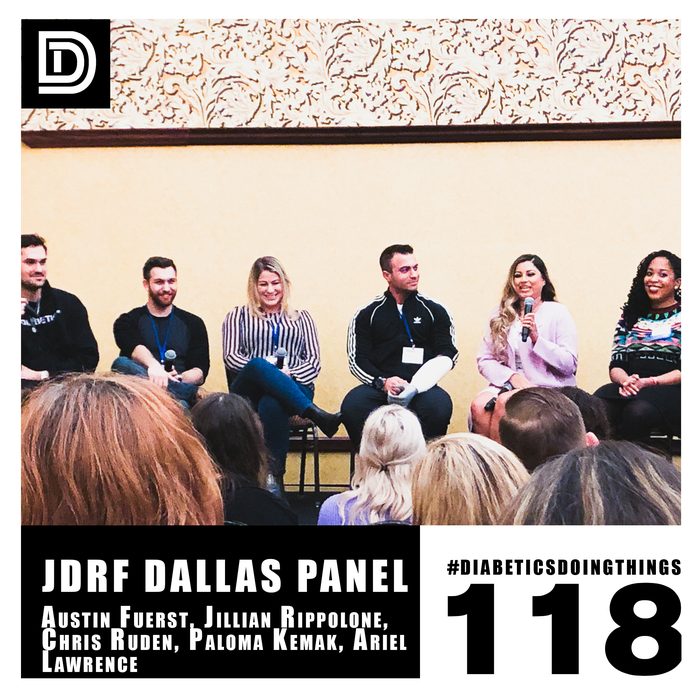
Recorded live at the JDRF North Texas type 1 Nation Summit on February 24, 2019, in front of about 650 attendees, this episode is a social media panel hosted by Rob Howe. Panelists Austin Fuerst, Jill Rippolone, Chris Ruden, Paloma Kemak, and Ariel Lawrence talk about building followings around life with type 1 diabetes. They cover hiding a diagnosis, repeated trips to DKA, dating with diabetes, and learning about CGMs and pumps through Instagram. Ariel Lawrence speaks on representation for people of color with diabetes, and Chris Ruden discusses hiding a physical disability. The panel closes with audience questions on caregiving and independence.
Key takeaways
- Jill Rippolone says she went to DKA three times with an A1C of 13 before the online community helped her bring it down to 5.6.
- Chris Ruden hid his physical disability for 17 years, including from his parents and girlfriend, before showing it publicly.
- Ariel Lawrence built her platform, Just a Little Sugar, to show representation for people of color living with diabetes.
- Paloma Kemak's first husband couldn't accept her diagnosis and they divorced within six months; she later remarried someone supportive.
- Austin Fuerst's parents taught him to give his own injections at age four and count carbs at five, to build independence early.
Show notes
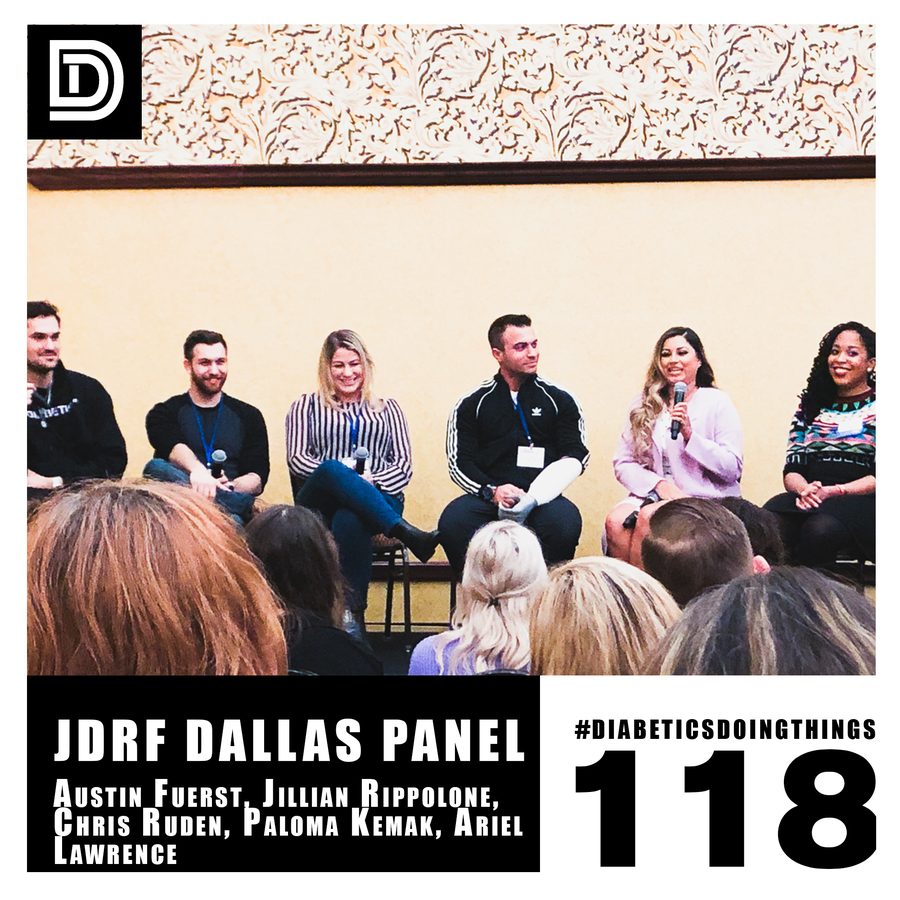
This episode was recorded live on February 24, 2019 at the JDRF North Texas Type One Nation Summit. Over 650 people attended the conference, either living with Type 1 Diabetes, a caregiver of someone with Type 1 Diabetes or a healthcare professional.
For the second year in a row, Rob Howe hosts the Social Media panel, where Type 1 Diabetes social media influencers discuss the Diabetes Online Community and leave attendees with inspiring messages.
Joining Rob on the panel are:
Austin Fuerst - @Everyday_T1D
Jill Rippolone - @T1dChick
Chris Ruden - @ChrisRuden
Paloma Kemak - @GlitterGlucose
Ariel Lawrence - @Justalittle_suga
The conversation spans about 1 hour, and has excellent sound bites from each of the panelists. We also take a few questions towards the end. This is the first of these panels that I recorded, but if you’d like Rob to come to your JDRF Chapter and do something similar, just shoot him an
Questions this episode answers
Who hosted the JDRF North Texas social media panel on Diabetics Doing Things?
Rob Howe, host of the Diabetics Doing Things podcast, moderated the panel live at the JDRF North Texas type 1 Nation Summit on February 24, 2019.
Who were the panelists on this episode?
Austin Fuerst (Everyday_T1D), Jill Rippolone (T1DChick), Chris Ruden, Paloma Kemak (GlitterGlucose), and Ariel Lawrence (Just a Little Sugar).
How did Jill Rippolone lower her A1C?
Jill says that after finding the diabetes community on Instagram and holding herself accountable alongside others, her A1C dropped from a high of 13 to 5.6.
What does Ariel Lawrence's platform Just a Little Sugar focus on?
Ariel describes it as a space for sharing her experience living with type 1 diabetes as a woman of color and highlighting other people of color managing diabetes.
Full transcript Searchable, with timestamps
Rob Howe: Welcome to the Diabetics Doing Things podcast. We've been telling the amazing stories of type 1 diabetics all across the world since 2015, and we have over a thousand years of living with T1D on the podcast. The interviews range from incredible feats to everyday victories, and we celebrate them all just the same. Thanks for listening, and if you want to get involved even further, just send me an email at rob at diabeticsdoingthings.com. Hello out there, ladies and gentlemen. This is Rob Howe. This is a very special episode of the Diabetics Doing Things podcast. It was one of the rare episodes that was recorded live and also another rare episode with multiple guests. So this was actually recorded live during the social media panel on February 24th, 2019 at the Dallas Type 1 Nation event. Actually, sorry, North Texas Type 1 Nation event that JDRF put on. It was the JDRF Dallas chapter and the JDRF Fort Worth chapters. We partner on our Type 1 Nation event every year because it gives people who are spread out throughout the Dallas-Fort Worth Metroplex a central location to go to, so it works out better for everyone. This year, we had an awesome panel on the social media panel. Some of my really close friends from the diabetes community, people that I have met in person, others that I had not. Austin Fuerst is there. He lives in Dallas with me, so we're both local guys. We had Jill Rippolone, T1D Chick on Instagram, who many people came to afterwards and said she was one of the first people they found in the community. So, it was really amazing to see. Chris Ruden, Chris Ruden on Instagram. Powerlifter, coach, diabetic, stoic, stoic-bedic, as we talked about and joked about. He was also on the Titan Games with Dwayne The Rock Johnson. You should check out that video on YouTube of him competing. Really, really inspiring stuff. we also had ariel lawrence from new york just a little sugar on instagram she advocates for people with diabetes of color and she had some amazing insights and was able to connect with people here in dallas as well and glitter glucose Paloma Kemak from arizona you guys know her it's funny i say i said everybody else's real name first and their instagram handle second but paloma is glitter glucose to me. She lives her life with glitter and sparkles, but also happens to live with diabetes. So this conversation spans about an hour. We also do some Q&A towards the end. It's really cool to come to these events and interact with lots of people. There are almost 650 people at this event with type 1 diabetes or caring for someone with type 1 diabetes of all ages. And just getting to interact with those people all day long at a particular event And then getting to share that with some of the people who, you know, advocate for people with diabetes on the Instagram community and getting to interact with them in person is just really special. So this episode is free flowing. There's a lot of jokes. We're all in a great mood. So enjoy the social media panel episode of Diabetics Doing Things. We'll be back with Tools of Type 1s next week. Talk to you soon. Welcome. Welcome to JDRF North Texas's Type 1 Nation for Dallas and Fort Worth. I'm Rob Howe. I am the host of the social media panel. I'm also the host of the Diabetics Doing Things podcast, which is how I know all these people who are in front of me today. Thankfully, JDRF Dallas has been a big supporter of getting people from the diabetes online community here in person to interact with you guys. and so it's great to see a lot of internet friends both here on stage and in the crowd. So welcome. Okay, so that's me. I've had type 1 diabetes for 14 years. I was diagnosed at Children's Medical Center of Dallas and I've stuck around. So here we are. I'll give everybody a chance to introduce themselves and we'll get the mic checked during that time and we'll be good to
Austin Fuerst: go. Hello. Oh, it works. My name is Austin Fuerst. Most people might know me as everyday T1D on Instagram. I'm a fan club. This is great. No, I made sure my mom didn't come to this. so I live in Dallas I'm moving to Denton this summer let's see I've I met Rob through diabetes yeah actually we met we met basically a year ago like last night happy anniversary to us let's see I've had diabetes for 21 years now I was diagnosed when I was two so I've had it a good portion of my life. I don't remember a day without having diabetes. And yeah, that's me.
Rob Howe: Nice intro.
Austin Fuerst: Is this the one that's working?
Rob Howe: No, use the mic that you have. Sorry. Okay, we're good.
Jill Rippolone: Hi, everyone. I'm Jillian Rippolone, and I am T1DChick on Instagram. More popular than Austin. I was diagnosed with type 1 22 years ago, and I was diagnosed a year after my younger brother was diagnosed with type 1. And I currently live in Detroit, Michigan. What's going on, guys? My name is Chris, and I'm a type 1 for nine years. Obviously, I was born differently. I was born permanently attractive. and I am a world record holding powerlifter. I have four state records and one world record and I was recently on a TV show with Dwayne the Rock Johnson, Titan Games and I'm a nutrition consultant for people with type 1 online and I travel the country speaking to people just like you.
Rob Howe: Just keep the mics on. I think we're okay. Is my mic working?
Unknown: Just turn it on. Yeah. It's on.
Paloma Kemak: Hi, I'm Paloma, and how did I get the short end of the stick to follow Chris, right? Online I'm better known as Glitter Glucose, where I share my very fabulous life. And I just happen to live with diabetes. I'm coming up on my sixth year anniversary, and I'm from Scottsdale, Arizona.
Ariel Lawrence: Hey everybody, I am Ariel Lawrence. I'm from New York. I've been living with type 1 diabetes for almost 13 years at this point. I have a platform called Just a Little Sugar where I talk about my experience living with type 1 as a woman of color. And I also highlight other folks of color living with different types of diabetes as well.
Rob Howe: Awesome. Well, welcome, everyone. This is going to be a pretty loose format. We're just going to ask questions and kind of get inspired. If you feel, and alarms are going to go off up here probably too. Paloma and I were both having a conversation about our numbers being like the same before we came up here So I want us to start but we're also gonna leave time for you guys to ask questions So if you feel like you have questions throughout Just hold those till the end and we'll be sure to give you enough time to to ask those towards the end Okay, so let's start diabetes and social media. That's why we're all here Jill, I want to start with you Okay I feel like you have a great sense of what it means to be a part of the diabetes community online. What made you start that journey, and how long have you been doing that now?
Jill Rippolone: So throughout my whole life and even in college, I kind of hid my diabetes from the world, and I was really ashamed about it, and I just didn't really want people to think I was different. I went to DKA probably about three times in like 22 years of being diagnosed with type 1 and I remember it was like my early 20s and I'm kind of like laying in a hospital bed feeling like death as some of you might know at DKA how it is. And I just, the doctor was like, you need to get a grip on your life, your A1C is 13. And then soon after that there was a JDRF walk that I attended and I saw like hundreds of hundreds of people just kind of doing the walk-in. I actually cried because I was like, oh my God, like I'm not alone. And there's like people my age. And then I was on Instagram one day. It was around 2016. And I came across a random Instagram page. And it was this girl and her whole Instagram was like diabetes. And I was like mind blown that people were kind of like, you know, like our age and posting that they're diabetic with like their pumps out and then I realized wow like this is what I really need and this is what we're kind of like lacking because you have like the whole like juvenile stage with diabetes and but I feel like there's really no transition between juvenile and then like being an adult so your parents are there to help you and guide you and then you kind of just grow up and you're just kind of almost like left in the dust and there was just no support whatsoever so I kind of created mine following this girl's lead and I felt like after kind of just navigating on social media more and more type ones were popping up and And fast forward to 2019, we have like the strongest community right now. And so many friendships have formed. And my whole thing is providing people with resources and to help people and people who can't get medical supplies. I started doing a big diabetic donation in Trade Post where thousands of diabetics all throughout the world will comment things that maybe they have extra of or unused items. and it's just kind of like it turned into like this amazing community.
Rob Howe: And I think it's cool to see even people here in the crowd where it is today compared to a few years ago. We were all diagnosed at different points in our lives. How important is it to find like your tribe and community, you know, where you are? And Ariel, maybe you can talk a little bit about not just diabetes representation, but finding people who look like you and talk like you from your background.
Ariel Lawrence: Yeah, so I guess I will start with diabetes representation and the importance of finding your tribe. So I think when it comes to diabetes, my experience is not just from a lens of living with it from type 1, but also thinking about it larger than that, right? So I'm thinking about how diabetes affects my community as a whole. And the reality is when we think about the incidence of type 2, et cetera, and diabetes outcomes, people of color tend to have more negative outcomes when we think of diabetes. And so for me personally, it was super important, especially following the death of my grandmother who lived with type 2 diabetes from complications, that I found someone that I could relate to that really understood the various nuances, that understood that for me personally, diabetes was beyond like type 1, but that there was more stuff at play. And I frankly found that there weren't many people who look like me on the or within the online space. And so it was super important for me to create that for myself. And so I began by sharing my own story with the belief that there was probably someone else out there who could be motivated and encouraged by my story and who looked like me and who thought that, hmm, man, this girl, black woman, is sharing her story. She's trying her hardest to live well with this disease. I can do that too. And I think that goes for anything when we talk about representation beyond diabetes right so when we think about Obama as the first black president or when we think about representation within the cinema sphere right it's empowering to see images that look like you and that you can relate to and especially when those images and depictions are positive ones it just does something it motivates you to say man I can do that too and when it comes to my work and what I'm trying to do within the community, I want to make available to other people like myself images of other folks of color that are trying their hardest to either stay fit, be intentional about what they're eating, be mindful about what their A1Cs are, provide those visible examples so that someone else who looks like them, when they see that, they say, I can aspire to be that as well.
Rob Howe: And I think, first of all, I love that sentiment. I love that purpose. And I think all of us have a purpose behind why we do what we do. And in our conversation, you know, now almost a year ago, I think I had for the first time the idea of being diagnosed twice. Once when the doctor tells you and then once when you decide that you really accept what happens to you or what's happened to you and want to put it out there for other people. and that sort of transformation doesn't happen overnight. There's no really timeframe for it. Like for myself, it was almost 10 years. I, Chris, I really love your story of transformation. You know, you obviously have transformations with your fitness clients, but also when you put yourself in that same category from, you know, where you were with your life overall, as well as your life with diabetes, what for you, when you think of transformations, like, did you ever imagine
Chris Ruden: you'd be doing what you're doing today? Absolutely not. You know, I got diabetes at 19. So I dealt with a different battle my entire life. You know, I grew up with a disability and I grew up physically different. So for 17 years, I hid my disability. I hid my hand from my parents, from my girlfriend, from everyone. And I did that up until a year ago. It wasn't until last year that I finally like took the glove off that I was hiding from. and I still built this business around that. So a lot of times there's that one elephant in the room that we stop trying to fix and we focus on everything else. Oh yeah, I'll get to that. Oh, it's not that big of a deal. But it is, and you know it is. So for me, transformation is not lifting all this weight or going on a TV show. It's being able to walk around with my Dexcom on my arm and my disability not hiding it at Walmart. It's that simple. that's the biggest transformation for me and the only thing that changed was my fear of what wasn't real and my decision to accept myself where I'm at so you have to be real with yourself you know your perspective is everything it's literally the only thing you can control is the way you think about you know what you're going through and if you think it's bad if you think it's negative you're right but also if you think it's not and if you think you can sit up here and empower people like we do on a day-to-day basis everyone has the same story we just decided to tell it.
Paloma Kemak: Yeah, that's really strong. And I think, yeah, give him a chance. You guys can clap. He's killing up here. Everyone's killing. We can like crap. Clap. We can clap. We can clap. We can clap. I've had like seven cups of coffee today. Thank you for that approval. Yeah. Yeah, when they make a good point, let's let them hear it. Paloma, let's talk a little bit about being authentic and like being true to yourself. You mentioned earlier that you just happen to let you share your life and you just happen to have diabetes on top of that What does that mean to you that type of authenticity? Well for me, I was also diagnosed as an adult So when I was suddenly hit with living with a chronic illness, I didn't I live my whole life being me being fabulous Loving fashion And that's what I thought was always going to be my purpose. I've always worked in the fashion industry It was my dream. I don't know if many people know that I'm actually a farm girl. I grew up on a farm in the middle of nowhere. But I always dreamt of being like a big city chick in the fashion world. So being diagnosed with diabetes, suddenly I felt like, what, who am I? What happened to me? Why me? And I lived for many years thinking, just this is how I'm going to feel forever. I'm just going to feel miserable. I'm the only one living like this. I'm going to be so alone. And it wasn't until I took that power back and I was like, no, even with this chronic illness, I can still be glittery, girly, fashionable. And I then took the step to show others that diabetes is a piece of you, but not all of you. And that's the biggest message that I can share to anybody. This is where you guys clap? We're killing. I know. I go to these summits all over. This is great. This is great stuff. Austin, you've had diabetes almost your entire life since you were very young, which I know there are a lot of parents in the room. There are a lot of people here today to get as much knowledge for people that take care of people with diabetes. As you look back at your life with diabetes, what words of encouragement would you give to parents and caregivers for kids
Austin Fuerst: with diabetes? So when you're taking care of someone with diabetes, especially like when I was when I was two, I obviously couldn't give myself insulin or count carbs and make sure everything was right. I didn't know how to give myself juice. I didn't know when I was low. I didn't know when high. I didn't have the ability to do that. And so my parents, they took on all of that for me. And they took care of me, made sure I was healthy, made sure I had all my insulin. And when I was two, we didn't really have fast acting insulin like we do today. It was still NPH. And so they would have to make me wait 30 minutes. And if you have a two year old, that's not an easy thing to do saying you have to wait 30 minutes to eat. And so they dealt with all of those things that you have to do, especially even when you're younger, like 6, 7, 8, that's still a lot of responsibility that you have to deal with. And so one thing I think my parents did really, really well is they always encouraged me to be independent with my diabetes. And so by the time I turned four, they taught me how to give myself my own injections. And so from then on out, they would draw up the insulin and I'd be like, hey, can I give it? And then I'd give myself my shots. And then when I turned five, they taught me how to count my carbohydrates in dose for what I was eating. And so from a very young age, they instilled the ability to be independent and make sure that I could know how to take care of myself so that when I turned 12 and I went on my first Boy Scout camp out by myself, even though my mom was still freaking out, she knew that I had the skill set and the ability to be there without any issues. And if anything arose, then I knew how to to take care of it. And so I think the biggest thing is to encourage and equip whoever you're caring for to be able to live in the real world rather than coddle them and be like, hey, what's your blood sugar? Oh, I'll check it for you. I don't let them learn how to be independent and be their own person. Because especially with diabetes, when you're going off to high school in college, that's huge. Not a lot of kids and I have to deal with that kind of responsibility. So if you do that for them, then when they get there, they're going to be like, oh, I don't know what to do. How do I do this? So encouraging them to be independent and equipping them is probably the biggest things that I would say to a caregiver slash parent. and I think yeah clap it up I'm just gonna that's my job I'm the hype man on this thing I just got to remind you guys to clap so in my conversations with people now like almost 150 of them over the years and we talked about a little bit today Chris talked about it in the keynote is is this is the best time to live with type 1 diabetes for a lot of reasons like the you know and I kind of call it the T1 living in the T1D renaissance where all of a sudden it's okay and cool even and to find a community where stuff goes where alarms go off in rooms right and we all know what's going we don't all know that that's okay and it's okay to be different because I think that's one of the hardest things especially when you're growing up is I mean you couldn't pay me any amount of money to go back to middle school and be tall and diabetic that That'd be the worst. So as we kind of live in that time, like how do you find that, you know, social media has added positive influences maybe to your life or to the lives of others just from being around and being able to tap into people? And this is for the whole group, whoever wants to step forward first and answer it. So I always say that everything I know about diabetes, I learned from you guys online. I felt like my doctor could only do so much. and then I was, you know, I see my doctor every few months, but I'm on Instagram and following other diabetics and it was the first time I ever saw an insulin pump was on Instagram. It's the first time I ever heard of a CGM. It's the first time I knew what a normal blood sugar was and just seeing how others manage their diabetes, it really inspired me to just take control of my own life and like I had said earlier, I felt so alone. I felt like nobody else in the world had diabetes. Like nobody knew who I was going through. So suddenly I found this whole community of people and I felt like this is where I belong. Like diabetes is obviously the worst thing that's ever happened to me, but I've been able to turn it into something positive. And the best thing about living with diabetes is being surrounded by people in the community.
Chris Ruden: you guys are getting it i like it so for me personally i think social media has helped me one embrace technology and then two do a better job of taking care of myself so first i have had like this very tense relationship with my continuous glucose monitor um i was first given one maybe like 10 11 years ago i don't know it was like an early version of the Medtronic and light, like the one before that one. And I remember doing the insertions and it was such a painful process for me. And from that point forward, I was just like, I don't need this. I'm fine. Like I can check my blood sugar five to six times a day. I'm great. And I would constantly go to the endo or the educator and they'd be like, Ariel, you're doing okay. But you know, if you had a CGM, you'd be doing so much better. And I'd always say, that's great, but that's not for me. And so it wasn't until I tapped into the Instagram community and started to see people wearing their Dexcom very visibly, that I realized that there was another alternative to the Medtronic sensor, and then two, that people were doing this as an everyday thing. It was normal to wear a CGM. And again, it was one of those things for me where I was like, okay, well, if this person is doing it, I can do it too. I don't have an excuse. And the same thing goes for my A1C. So I always call myself like a complacent person with diabetes. I'm like, I'm not that bad. gotta step in something. I'm terrible. I know. And so I had met so many people online who were like, oh, I've been able to get my A1C here within the six range. Some people within the five range, kudos to them. I don't know how they do it. But seeing people recount those stories over and over again, I was like, you know what? Maybe I can push myself a little bit harder. Maybe I am giving myself excuses. Maybe there's something more that I can do to actually achieve that goal. So I would say one definitely helping me embrace technology and then to taking more ownership over my care you guys I love you guys so I'm gonna play devil's advocate too because social media is the reason we're all here you know the connection the type 1 diabetes community we have today didn't exist what 10 15 years ago now it's one of the most tight-knit autoimmune disease these communities there is, but there's a huge downside too. There's this alarmism and fear that people put on social media that, you know, oh, you're going to get complications. If you don't have an A1C like this girl or that guy, then, you know, oh, I'm embarrassed to post my A1C because others are so good. They're putting it in our Instagram bio. So I must be terrible. You know, you start judging yourself based off the images we're putting on social media. And we have to remember that no one takes a picture like this. You do. You did yesterday. I do. I'm all about authenticity. But seriously, Instagram is a highlight reel. You know, you post the best of the best on Instagram and people don't like to post the bads, you know? So just like you wouldn't post a bad picture, an A1C or a bad A1C, if you want to attach the emotion to that number, is not a clear representation of your character, who you are. You know, a lot of people live their lives for their diabetes instead of with their diabetes and there's a huge difference and social media can perpetuate that cycle you know to me it's like diabetes is a bad roommate that you have to live with and you signed a lease for the rest of your life you know like that's that's my process dirty dishes in this yeah exactly exactly it so social media is amazing but it's also it has its dangerous points if it weren't for social media i wouldn't have met the people up here you know Jillian and I go way back, and she's one of my best friends in the diabetes community and one of the first people I reached out to. So it's amazing, but know your limitations and know the benefits with the drawbacks, and don't let someone else's life or picture of their life deter you from your best life. Free tweet.
Rob Howe: For me, I want to tag on a little bit, and then we'll move on to the next question. when I was at the ADA conference in Orlando this year and they have this giant like events room like 10 times the size of the one we were just in full of like research boards. It's like poster boards with like research projects from all over the country. It's really impressive stuff. And the only one that I could actually make sense of because science and me just, you know, don't really get along. But I found one that said A1C outcomes and diabetes blogs and social media. And I was like, oh, my own personal journey with that is I've always had relatively in control A1Cs. It's never been an issue for me. And I know that I say that like that checking my privilege, like for sure, that's not the case for everyone. That's been my experience. But since I've been involved with diabetics doing things and with my friends up here, maybe I'm more conscious of what I put in my body. And when I check my blood sugar and I have a CGM because someone recommended it to me and like I made an excuse and they're like, no, please call and get a CGM right now. It'll change your life. They were right. and so I've seen my A1Cs trend down over time so what I found on this research board was among like 25,000 people surveyed with type 1 diabetes those and there's only one question on the survey is like do you read diabetes blogs or social media and yes no really easy survey I was like I wish I would have thought of this 100% of the time from this survey people that read diabetes blogs and social media achieved better A1C outcomes over time. And so I knew that to be true for me, but I didn't realize how true it was for other people. So I think what the, you know, what are you waiting for? I think is the real question there. And I do agree with Chris. Like I recently had to take a three week break from Instagram just for my own mental health. And you know what? I came back because the, I guess the people up here, because I know something that was missing was the friendships and relationships that I had fostered over the last few years. So those types of things really do have a big impact.
Jill Rippolone: So kind of like piggybacking off like what Rob said, Instagram and our diabetes online community, also people call it doc, we're a safe, we're like a safe place. And our community, as much as Instagram could be very public, pretty much everyone that's in our little community, we all have similarities and we also manage our diabetes differently. And with that, I feel like Instagram is great because it keeps our community together, but it also keeps a lot of us accountable and we all learn from each other. But the thing about Instagram is that how what Chris was saying, everyone likes to post like the perfect 100 blood sugars and beautiful photos all the time but for me I will post my blood sugars when they're 300 I'll post them when they're 60 I'll post them at 100 and it's about being real to show not just our generation but the younger ones that are coming up and the teens that there is community and there are young people and we're we actually make diabetes cool it's kind of weird to think that we once hid everything And now it's actually, if we take a photo, our CGMs have to be out. Our Omnipods have to be out. And you just got to keep it real because you can't let other people think that you live this perfect life with diabetes because diabetes is not perfect. It's not perfect at all. And I went from, you know, being in DKA three times in a hospital bed ready to almost like die with an A1C of 13 at that time. And because of social media, I kept myself accountable with like everyone else. I would see their CGMs and then I got one. And then fast forward to today, I worked from, you know, a 13A1C to a 5.6. And when I finally saw my numbers, thank you. So when I saw my numbers start to go down, like the 13s and then the 10s and then the 8s, and then I finally hit a 6. And that was when I moved here two years ago, moved to Michigan two years ago. And I started crying because I didn't think it was possible. But that's because I think we really do keep each other in check a little bit. And we message each other. We have Facebook groups. and we even have Snapchat groups now, which is like a diabetic Snapchat. But yeah, it just kind of keeps everyone accountable, but you have to really honestly be real. Don't just post the good. Post everything.
Paloma Kemak: And I want to focus on that for a minute because I think Chris brought it up, and it's a great, I mean, we can do an in-depth case study six-hour conference on the harmful effects of social media on mental health, but we'll save that for another conference. I want to focus a little bit on a question that's very popular, I think, in the diabetes community, but also is something that just in general social media people typically don't share. And a little bit of, let's focus on, like, diabetes and dating. And I'd like Paloma, if you're comfortable, to kind of share a little bit of your story and then maybe kick off a discussion on how to, you know, we are different. We have differences. How do you bring that up? I think that's a tough thing for people, whether you're in school or whether you're meeting someone new, to say, hey, I am open with it. Like today, we're all showing our devices, but, you know, out alone, you can feel pretty isolated. So I'd love for you to just kind of kick off that discussion. So I feel like I've been through it all because when I was first diagnosed, I was married. I'm married now, but I was married to someone else. And I was diagnosed in April. So I had been feeling sick and terrible for a long time. And that put, you know, a strain on my marriage. and once I was diagnosed, my husband at the time was not supportive. He blamed me. He made me feel terrible and I was diagnosed in April and by October we were divorced and for me being with someone that I loved so much at the time and thinking the one person I loved can't even accept me for who I am, that was such a bruise to my ego, to my self-esteem. I even like feel emotional about it right now. But I thought if he can't love me, who will? But, you know, after having my pity party for however long, I decided to go out into the dating world. And I thought, okay, now I have, at the time I was like on injections and just manually pricking my finger and I just thought, I'm just going to go for it. Like, I already lost someone because of this. I'm going to be way more picky with whoever comes next. So I dated a lot, you guys. And just like me and Rob had talked about this, first dates usually happen at dinner. So I think it's important to remember that it's your condition and you kind of set the tone for how others see it. So if I went into the date like doom and gloom, like, oh, I have to check my blood sugar. I could possibly die on this date, you guys. I don't think that the tone would go so well. So I would just, so I just kept it light. I mean, I wasn't all doom and gloom, but I'm like, listen, I live with type 1 diabetes and it's different from what you think. I mean, it's not when you hear a joke about cupcakes, it's that's not what diabetes is. Just give a short little thing and be like, OK, when I eat, this is what I do. And obviously, that's new for most people that are not in this room. But if they didn't take to it well, good for me. They can go, you know. And so I went I met a lot of great people throughout my journey. And I never felt like someone, I don't know if she's in here, she said that she matched with someone on Tinder. And whenever she told them she had diabetes, they unmatched her right away. But I'm like, good thing he left. So if he's not going to be supportive and accept you for who you are. So fast forward to now, I'm married to the best man ever. And he helps me with whatever I need. He gives me gummy bears and I'm low. And, you know, he helps me as much as I want him to help me. I mean, I don't want him doing everything for me, but he knows his place in our relationship. And for every relationship, the partner's place is different.
Rob Howe: Great. Thank you. Anybody else? Yeah, I don't have anything else to add to that. But yeah, my joke is that like most days take place over meals. So it's like a great opportunity to talk about diabetes. Right. But no, thank you, Paloma, for sharing. Let's talk. I want to do one more just like discussion amongst ourselves and then we'll open it up and take questions. And I'll kind of walk around and make sure that everybody has a mic and can ask. but I think the biggest thing for me is that moment where you guys knew that this was something that you were supposed to do do you have any particular it doesn't have to be like an individual moment I think for myself I'll just give you an example I started diabetics doing things and I decided to change the way I looked at metrics I think it's easy in today's world to look at a million subscribers or a hundred thousand followers and be like, yeah, that's what I want. That's what I want to have. And I changed it because I was like, I could easily get trapped in that and that would deter me from my ultimate goal, which was to help people with diabetes. So I decided I was going to do 10 episodes of the podcast. And if one person reached out that I didn't know and said, this helped me, then I would keep doing it. And I had like 60 downloads of my first episode and they were all people I knew that didn't have diabetes. But get yourself some supportive friends. I got the best friends in the world. And from then on, I remember the first comment was like, hey, this is really good. Thank you for doing this. And I was like, counts. I'm going to keep doing this stuff. And so, yeah, I would just say when you know what you're supposed to do, change the way that you measure it. Don't compare yourself with other people. I think what Chris said about social media is very, very, it's a trap. Like comparison is the just enemy of happiness. So, yeah, I'll stop preaching stoic philosophy now and let you guys have.
Austin Fuerst: So for me, I guess the moment where I realized that this is something that I want to do. So it was a weird time in my life. So I was taking a year off of school when I was working. And I didn't really know what I wanted to do with my life. I started school studying marketing. And it was all right, but the job that I was doing was kind of mindless and boring. And I just sat there for eight hours a day waiting for my boss to tell me what to do. And so it was awful. and I had the only thing I would go to work, I'd go to the gym, then I had nothing. So I was like, there has to be something else that I can do. Like, what am I passionate about? And so I've always enjoyed educating people about diabetes every chance I get growing up, mostly because my parents, they did an awesome job raising me that way. And so I, during that time in my life, I was like, you know what, I think it's all Rob's page. and Jillian's page were the first two pages I ever saw. Wow, shout out. But I was like, yeah, I don't like these guys, so I can do my own. No, I'm just kidding. They're wonderful. And so I was like, I remember messaging Jillian. She encouraged me. She's like, hey, like we need more guys in the type 1 diabetic community. You should do something. I was like, oh yeah, maybe later. And then I think like a month later, I started my page and And my first logo was like literally stickers that I stole from like other like Google like sites. And I just kind of stacked them on top of each other. And it was awful. And I was just like, hey, so this is my life with diabetes. Follow along. Hopefully you learn something. And then I started posting and it grew more and more. and people were enjoying what I posted and kind of the way that I shared both the highs and the lows of my life. And so, like, once that happened, it kind of sparked something in my mind. And I was like, I could do this for real. Like, this could be a really cool thing. And so with the encouragement of Rob and all these guys and I was following Chris and Paloma, like, they were all my heroes. And now they're some of my best friends through this community. And it's just crazy how things change and how things can affect.
Rob Howe: Crazy how you look up to me and now I just make fun of you all. Pretty much. Chris, want to add something?
Chris Ruden: Yeah, so one specific moment pretty much decided why I'm here today. I was speaking at a camp. one of the first camps I ever spoke at, because I just want to share my story. And I wasn't super serious about speaking at the time, but people wanted me to come out and talk. This family pulled me aside right before I went on stage. And they're like, hey, we have a nine-year-old kid, and he tried to commit suicide because of his diabetes. And I was like, how are you going to hit me with that right before I go on stage? I'm like, all right. So in my talk, I have a thing that I do about HBA1C. You guys are familiar? No, you're not, because I made it up. So it's an acronym for habitual beliefs affects one's choices. So basically the way you think regularly will determine your outcome and the way you live your life. And I did a little push-up contest so I specifically called that kid up and he was a little shy and you know he hated everything about diabetes but I told him I was like if you can beat me in a push-up contest I'll give you $20. I was like but you can't look at me. So he faced away and I said go and he was just cranking out push-ups. I wasn't doing anything. He's just cranking out push-ups, cranking out push-ups. He stood up. I was like, you won. He's like, but you didn't do anything. I was like, that's the point. It's you versus you. And if you have the decision, like to make it for yourself, if you're willing to put in the work, you'll get there. So a year and a half later, he sent me a DM and he was doing push-ups and he's like, Chris, I'm taking care of my diabetes. I'm killing it. I'm going to be just as big as you. And I was like, yeah, that's it. I'm doing exactly what I need to do. And to think I'm literally no one special. I'm the only me, but I'm just using that and telling the story in a way that's helping other people. And every single person in this room can do that. Not at a capacity. You don't have to be in front of thousands of people. Literally the person to your right and your left, you can make the hugest impact just by saying that one thing, that one supportive thing and empowering a person. We've all talked about empowerment in different ways, and there's so many methods. Education, entertainment, it doesn't matter, but you have to do something. And, you know, sometimes you teach best what you need to learn most, and the best way to do that is to just help someone else.
Rob Howe: All right, I think that's the perfect transition to Q&A. So I'd like to echo that and ask you guys to do something and ask questions of these amazing people up here. So I'm going to walk around with the mic because it's wireless and I can still talk. All right. Right here on the second row, first question. And be thinking of your questions. We're going to try to get it as many as possible.
Audience member: Hello, everyone. I'm Scriven. So I got really emotional listening to a lot of the identity discussions that y'all are talking about. Everyone in this room who knows diabetes knows what it feels like for it to be part of your identity and for there to be times that you don't want that to be part of your, or like you don't want to be part of it anymore. I am a gay man, and I am not quiet about that. And I see so many parallels between those two worlds. And so there's just, like the fact that it's something that we can be closeted about and choose to come out about later. And I'm not making you all honorary gay people. That's not what this is. You don't get to do that. Sorry. It's a different journey. But I see that and I see the fact that it's like, and you have kids that because of it are hiding it and they're bullied because of it and they're, you know, trying to commit suicide and everything. It's a powerful thing. My point in the comparison is just that, like, it's something that I've lived through the power of and everyone in this room knows the power of that as well. When you get to those moments where you're like, I don't want to be part of this identity anymore, because there's plenty of days that I'm like, I don't want to be gay. I don't want to be gay today. and we all have the moments with diabetes like I don't want to be diabetic you all though have this extra identity as influencers of like you've got people looking up to you you've got people that are like depending on you to continue staying in their fight how do you balance the days that you're like I don't want to do this anymore with that yeah clap I think when it comes to those days where you're just like, I'm done, I posted every day this week, like this is exhausting. I don't have any photos. I don't want to take any more photos or whatever the situation may be. Because I'm very bad at taking pictures. It's awful. I think it's more of you're not doing this for yourself. You have to, in other words, die to yourself so you can help somebody else. And I think that's something that's really important. It's really easy to get caught up. Again, like Rob was saying, the likes, the number of people that are following you, it's really easy to get caught up and say, like, some post doesn't do as well as another. It's like, oh, wow, like, what did I do? Did I do something wrong? And that's not what it should be about. It should be about trying to help somebody, whether it's someone encourage someone to, hey, keep going. I have bad days, too. Or something like as serious as DKA. And I think it's important to realize that you're not doing this for you. You're doing this to encourage someone else. And I think that's something that helps me stay consistent. Yeah, I think when you become almost like this chosen one in the Instagram world, I think you look at everyone else who looks up to you and messages you about all different things, not just diabetes, like you have diabetes, but then there are other people that have it worse. They have other autoimmune, other immune diseases as well. and I also look at all the little babies on Instagram now. Everyone's posting their children and I think to myself, I'm like, wow, you know, yeah, I'm having a bad day of blood sugars and I feel like giving up and not posting today and then I'm like, but there's someone else out there that has it so much worse and I just have diabetes and just bouncing off each other, I feel like gives me purpose. And everyone has purpose, but you have to, but it could be a different purpose, but you, you know, we're all here for a reason and diabetes isn't the end. There's just, we live so much like just beyond with diabetes. And I think it's our community that kind of keeps us together and carries on. So I love the idea of thinking that this work is like beyond yourself and then reminding yourself of your purpose. For me, when I'm thinking about maintaining balance, I honor those moments where I'm tired and I feel burnt out, right? So there's already an aspect of diabetes burnout, right? Living with diabetes on a day-to-day basis can be very tiring. A lot of my work also talks about representation and the value of inclusion. So I talk about race a lot. And in this political social climate, sometimes that can feel very daunting and heavy. And I don't feel like doing it all the time. And so I need space for myself. And so I actually do take social media breaks. I do take a moment in which I'll disappear or I'm quiet for a couple of weeks. Because I am tending to my spirit. And I'm giving myself that quiet time to just regroup, rebuild, build my mindset again so that I can dive back into that work. So I'm glad you brought that up. The concept of dealing with adversity is pretty standard across all boards, whether it's, you know, you're gay or you have diabetes or you're disabled or anything like that. you're dealing with something that you know you live with and you have to ask yourself like if this is who you are you know why would you ever question it you know you're you have the right to be burnt out you have the right to be frustrated we all have the right to be frustrated but we also know like who we are to our true selves and what we have to do to get through that day a bad moment doesn't make a bad day or a bad life you know so we we get caught up in like the stubbing our toe you know you didn't break your leg you broke your leg you didn't die you know we make everything so much worse than it actually is and in reality you had a bad day and you're allowed to have a bad day you know you're still you tomorrow today later first I'd like to say thank you all very much for being here it's really so helpful but my question is you said it's important for the diabetic to be independent and J.D. is independent she is just amazing at 10. I mean she's been amazing through all of this but is it okay to give her a vacation you know when she comes to my house you know sometimes she's like oh you check my blood sugar or oh you give me my shot or you know or you count my cards is it okay for her to have a vacation for a day yeah um so
Austin Fuerst: what did she say doctor disclaimer uh so i i am not a doctor um hey just so you know is what we have five minutes left okay i'll be quick but in my experience um i think it is okay for them to take a vacation. So I grew up going to a diabetic camp called Camp Sweeney, which is in Gainesville, Texas, with a few of those guys back there. And in that camp, literally our job as counselors, or the counselors, I was also a counselor there, is to take the burden of diabetes off of the child. So they don't count carbs, they don't draw insulin, we do all of that, and the only thing that they have to do is have fun let us know if they feel low if we don't catch it before that and give themselves injections if they're old enough or if they're able to and so it's it's each session is three weeks long and that's three weeks where they don't have to worry about diabetes and i think that's that's one of the most beneficial things that you can do is to just be a kid so that's i I think that's super important. I would advise diabetes vacations.
Rob Howe: Awesome. We're going to do one last question back here, and then we'll all be around after the session, but we've got to keep the day moving.
Ariel Lawrence: So I'll keep this quick. Do you all think that there's a line between using social media to normalize diabetes and it turning into, like, an accessory or becoming one-dimensional, and that's all that you represent? And what are some ways that y'all kind of combat that? I'm very loud on my social media and in person. I'm from New York. And I think there are some people that have to go against the green. And for me and my platform, that's what I like to do. So if there's, you know, you mentioned the A1C, which is a whole other summit that we could probably do on just A1C. But it's, you know, things are portrayed a certain way, but it's up to us individually to bring out kind of like the truths. and I feel like now right like just in like on our panel we all have different things that we do and the way we handle our diabetes but yes because social media you know does like to just show all the good but you have us and you have yourselves to kind of bring out like the truth and more of like being just like realistic with diabetes.
Rob Howe: And to answer your question, that's why I always say I'm just living my life and I happen to have diabetes because I don't want to be pigeonholed that my whole life is diabetes. I'm going to get completely burnt out. This is my job. This is my fun. This is my, you know, life. And so I think it's important to show I'm living, I'm thriving, I can do anything, I'm having fun, even with diabetes. Yeah, and I think I'll tag one thing on before we close. Yeah, like my favorite thing to do in diabetes is when people tag me in their 69 blood sugars and say nice and then at me in that just because that's a really dumb joke that I love. And like, if you could, if you could build my perfect life around diabetes, it would just be really dumb jokes from people that like what I, I don't know, that like touches my heart in a way that it's hard to express. But I will say, you know, a big thing, and I'm going to echo, I'm going to try to echo what Chris said earlier about doing something. People often ask all of us, how did you get started? How did you, you know, grow your community? How do I speak on panels? And really the secret, like the obstacle is the way. To get started, you have to get started. Got to put one foot in front of the other. get involved in your local chapter. You have two great chapters here in North Texas in Dallas and Fort Worth that are really leading the way in terms of programming and fundraising and just have great examples of people both on the staff and volunteers that are here to help you and really care about people with diabetes. So I would encourage you guys to use your voice today and after we leave here stand up advocate for yourself because that's the best way to advocate for others and follow all these people on all of their platforms, support all the things that people with diabetes do because we're your family, whether you like it or not. And a lot of us are working really hard to add value to the lives of people with diabetes. And previously, that wasn't a thing. So I think that's probably my end point for living in this whatever T1D renaissance is that there are now companies and organizations who are solely focused on improving the lives of people with diabetes, and that is JDRF's mission as well. So thank you guys all for coming today. Enjoy the rest of the talks. How about a hand for our panel? Wow, and right on time, who's the best moderator in this building, guys? Come on, raise the roof. Rate us all fives on the sheet so that we can come back next year with more awesome, inspiring people. Thank you, guys. Thank you for listening to this podcast. It's been an amazing journey thus far, and I have a lot of really great stuff coming up in the future. So I'm going to do something that I haven't asked before. If you're listening to this podcast, A, I would love it if you would subscribe to the podcast just so you get the notifications whenever we publish new episodes because if you've been listening for a while, you know I don't always publish them consistently. recently sometimes I'll publish five in a week sometimes it'll be only a couple in a month and you need to know when these episodes drop so be sure to subscribe and if you like the podcast be sure to go to your preferred platform like iTunes and leave a review I would love to boost my reviews and I've never asked you guys to do that before so I figured you don't ASK you don't GET I would love a review from you so I want to hear from you there also we are now available on Spotify It turns out I was just submitting it to Spotify incorrectly, but I corrected that. So now we're on Spotify. So if that's your preferred listening platform, be sure to subscribe on there. Also, just want to let you know that in 2019, we have an awesome new program coming called Tools of Type 1s. It's going to be on this podcast, so you don't have to subscribe anywhere new, but it's going to be an entirely new form of programming with some of your favorite Type 1 personalities. So they're going to be two a week starting January 8th. be sure to tune in and I'm going to blast all the messaging I can all around. So be sure to listen to Tools of Type 1s launching January 8th. And thank you for continuing to listen to this podcast.
About Austin
Austin Fuerst, Jill Rippolone, Chris Ruden, Paloma Kemak, and Ariel Lawrence are type 1 diabetes advocates known on Instagram as Everyday_T1D, T1DChick, ChrisRuden, GlitterGlucose, and Just a Little Sugar. They joined Rob Howe for a live social media panel at the JDRF North Texas type 1 Nation Summit.