

Diabetics Doing Stoicism with Chris Ruden
Episode summary
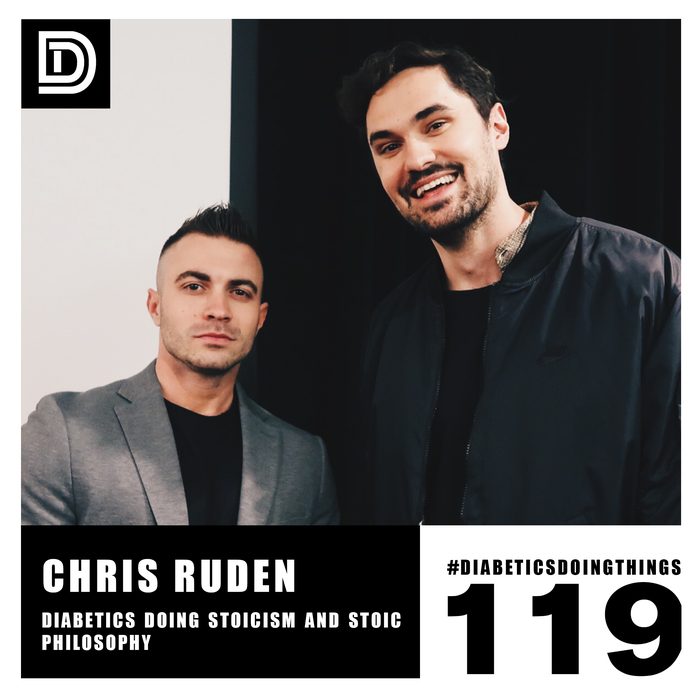
Chris Ruden, a public speaker and fitness coach, talks with Rob about stoic philosophy and how it reshaped his life. Chris holds state powerlifting records and an unofficial world record as the strongest disabled type 1 diabetic lifter against able-bodied competitors, and appeared on season one of The Titan Games. He describes growing up on welfare, hiding a physical disability under a glove for 17 years, struggling with addiction, and later chasing influencer status before realizing it left him empty. He and Rob discuss separating events from the stories people tell about them, controlling only what can be controlled, treating failure as a skill rather than an identity, and finding gratitude after a trip to Uganda.
Key takeaways
- Chris says he holds four state powerlifting records and an unofficial world record as the strongest disabled type 1 diabetic powerlifter against able-bodied competitors.
- He hid a physical disability on his left hand with a glove for 17 years, only showing it publicly less than a year before this conversation.
- Chris says stoicism means separating what actually happened from the story you tell yourself about it, and focusing only on what you can control.
- He draws a line between failing, which he calls a skill you build, and being a failure, which he calls a lasting choice to stop trying.
- Chris says chasing followers and influencer status left him empty, and that measuring success by the value he adds to other people's lives changed how he feels day to day.
Show notes
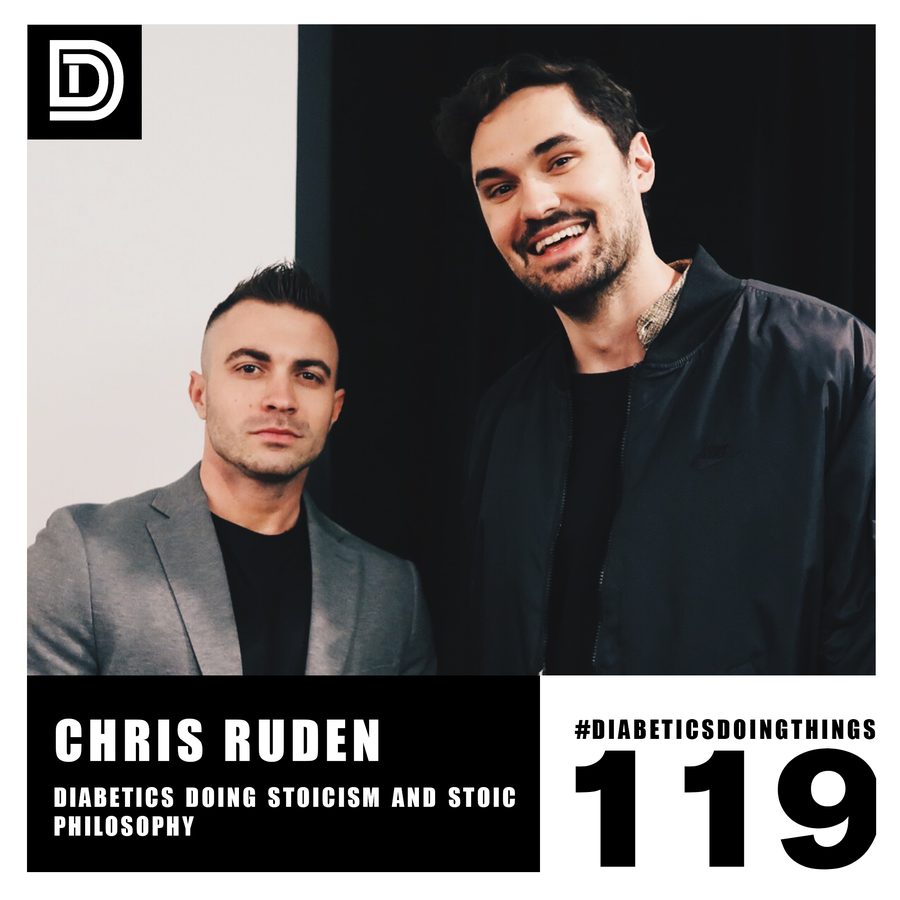
Chris Ruden (@ChrisRuden on Instagram) joins the podcast for his first solo interview, and he and Rob discuss their approaches to life, Diabetes, comparison, and social media as it relates to stoicism and stoic philosophy.
Chris Ruden is a public speaker, fitness coach, holds National and State Records for powerlifting, has lived with Diabetes for 9 years, and was born with a disability which up until recently, he hid from the world. He discusses how his life has changed over the years and how stoicism, vulnerability and mindset allowed him to make the changes that powered him to where he is today.
Chris was recently on season 1 of Dwayne The Rock Johnson’s TV series “The Titan Games,” and his video on The Rock’s Instagram has been viewed over 5.4 million times. He’s a super inspiring guy and I hope you enjoy my great conversation about stoicism and life with Chris Ruden.
Questions this episode answers
Who is Chris Ruden?
Chris Ruden is a public speaker, fitness coach, and powerlifter who has lived with type 1 diabetes for nine years and was born with a physical disability. He appeared on season one of Dwayne Johnson's show The Titan Games.
What disability did Chris Ruden hide, and for how long?
He hid a physical disability affecting his left hand by wearing a glove over it for 17 years, and only started going without it less than a year before this episode.
What powerlifting records does Chris Ruden hold?
He says he holds four state records and an unofficial world record as the strongest disabled type 1 diabetic powerlifter competing against able-bodied lifters.
What got Chris Ruden into stoic philosophy?
He says he found Ryan Holiday's book The Obstacle Is the Way during a hard period when he had quit his job to speak and run his own business and wasn't earning what he expected, and the principles in it changed how he coped with setbacks.
Full transcript Searchable, with timestamps
Rob Howe: Welcome to the Diabetics Doing Things podcast. We've been telling the amazing stories of type 1 diabetics all across the world since 2015, and we have over a thousand years of living with T1D on the podcast. The interviews range from incredible feats to everyday victories, and we celebrate them all just the same. Thanks for listening, and if you want to get involved even further, just send me an email at rob at diabeticsdoingthings.com. Hello, ladies and gentlemen, Rob Howe here from the Diabetics Doing Things podcast, taking a brief break from Tools of Type 1s. I do want to say thank you for all the support on Tools of Type 1s. We have exceeded our highest number of downloads each month since the podcast came out. So thank you so much for listening. I really do appreciate it. What's coming up next, I think you're really going to like. I've got Chris Ruden, Chris Ruden on Instagram, from the Titan Games. You've known him as a big figure in the online diabetes community for the last few years. really incredible interview. Chris and I were recently, we've run into each other a few times over the last six months. We came to Dallas for JDRF type 1 nation, the type 1 nation summit back in February. You can actually listen to that episode. It's episode one 18 or 19. It's the last Diabetics Doing Things podcast that was posted. In that day, we talked a little bit about stoic philosophy. We kind of made some jokes, realized that the two of us have a similar interest in Stoic philosophy. So that's where this podcast came from. It was just sort of an idea. We were texting back and forth. Hey, I'd love to do a Stoicism podcast. Sure. And this is what happened. So we also had been running into each other. We both serve as advisory council members for Xeris Pharmaceuticals. So I do have to disclose that both of us received compensation to be at the event in Chicago where we were at to provide them insights and analysis for for a product that they have coming out. So I do have to disclose that. But this took place in Chicago after a full day of meetings. And so I'm a little bit fried. I'm very wired on caffeine and stumble over some quotes, but it's some really fun conversation. And Chris is just incredible. He's one of the people that I think I've most enjoyed getting to know in the last six months from the diabetes online community. Like I said, I followed him for a while, but he really is so much more than what you see on Instagram. We talk a little bit about that as well. We dive into kind of how we got into stoic philosophy and stoicism, who our favorite kind of authors are, talk a lot about mindset, talk a lot about expectations and comparison. This is a really strong, powerful interview. So I don't want to take any more of your time, but please enjoy this really, really, really inspiring conversation with one of the most inspiring people I have ever met, Chris Ruden. chris thanks for uh taking the time today man absolutely dude appreciate you having me this is uh this is a very rare interview because we're we're in chicago in person in person i think we got the mobile podcast rig the same time away from everyone else yep everybody else is in there snapping photos very rare this is this is nice and i appreciate the time because i know you're busy dude for sure uh you're Chris Ruden you've been on the titan games you have i learned on our panel a couple weeks ago, not only state records with national weightlifting records.
Chris Ruden: Yeah. So I have four state records and one unofficial world record in powerlifting as the strongest disabled type 1 diabetic powerlifter against able-bodied competitors. That's pretty incredible. I mean, I do the best with what I got. You know, I was born with physical disability, you know, and I didn't get diabetes until 19. So I had to figure out how to deal with my disability and I dealt with it through being competitive. You know, like walking fast and doing everything I could to be as competitive as possible. I found weightlifting and, you know, fell in love with it. Found ways to make it work and always wanted to compete against people who didn't have the adversity I had just to prove to myself that I could do it, you know. And then it went from proving to myself to proving to the kids that I used to be like, you know, not thinking they were good enough or labeled disabled, you know. Some of the synonyms are disabled, weak, broken, useless, helpless. Some of these things are just terrible to be labeled as, and I just never wanted another kid to go through that, you know? So that's a big driver for me at this point.
Rob Howe: Well, and I think you, uh, you came and spoke on the panel and we actually put that on the podcast, uh, in Dallas a couple of weeks ago, JDRF type 1 nation. And you had a cool, uh, HBA1C acronym that really stood out to me. Um, obviously not the blood sugar measurement, but in your own words.
Chris Ruden: So my version of it was habitual beliefs affects one's choices. so I'm a big believer in the way you think controlling the only thing you can control which is the way you think which is really the reason why we're here today touching on a topic that changed my life a philosophy outlook that changed my life and when I found out that you were also interested in that I was like we have to do this yeah and I think I sort of just made a joke about it during the you said something related to it and I snapped my neck and I was like you yeah you know i was like i was like you too you're initiated as soon as that happened i was like okay he knows this thing i know this thing a lot of successful people know this thing and do this thing and i bet you want to know what this thing is right now so that's yeah we've
Rob Howe: referenced this thing quite a bit uh we're definitely going to talk about it we're talking about stoic philosophy stoicism stoicism so i think as you mentioned there's a lot of the successful people it's a very successful people of right now as well as as well as people who are in our sort of same, you know, public speaking, very outward, helping people, training, influencing in that sort of space. There are a lot of nods to Stoic philosophy and Stoicism and philosophers. So I guess let's, I guess, start with when and, you know, how you sort of stumbled into Stoic philosophy. For me, I'll give you an example just while you're thinking. In 2016, I was kind of going through a lot in my personal life in terms of I was on again, off again with my girlfriend. I was going all over the country just kind of, and I was so tired and I got recommended this book by a friend who I actually haven't really even spoken to that much since called Ego is the Enemy by Ryan Holiday. And that book, you know, you mentioned changing your life, really changed the way that I looked at myself and my own relationship with myself in terms of stoic philosophy. So how did you, and you know, what were the, I guess, circumstances and events that came across you discovering stoic philosophy? I feel like everyone had to discover this sort of
Chris Ruden: philosophy around the same circumstances, because I had probably the worst time of my life. It was about three years ago. So 2016, it's going to get even creepier because, you know, it was really bad situation. Um, work wise just sucked. You know, it was at the time where I decided I wanted to quit my full-time job and work as a speaker and do things online and kind of run my own business, but I wasn't getting valued like that. So I had to deal with the, I'm not making the money that I should be, but at the same time, I know this is what I'm supposed to do. Um, I was trying to do some self-reading. You know, the Tony Robbins thing didn't really do it for me. And I found a book by the same author, Ryan Holiday, called Obstacle is the Way. And I read that book cover to cover. And then I listened to it as an audio book. And the principles in that changed my life. And then it led me to the actual Stoic philosophy and looking more into what Stoicism means, what it is. And I'm just going to come out right before we go into what actual stoicism or stoic philosophy is. Um, I don't consider myself a stoic because I have my flaws. I haven't fully committed to the philosophy that we're going to talk about, but I do take principles of stoicism to help my everyday life. And it's helped me cope and deal with every sort of problem I've been thrown. And I don't think it's a rah, rah, rah, go me style. It's more of a reality. What is, you know, versus the story we tell ourselves. So I just want to make that distinction. I still have some of my worldly values that, uh, sure still fall victim to, but I fully believe that as a way of life, even if you take part of it, you benefit so maximally from it.
Rob Howe: And I agree. And I think, you know, the word stoic as just an adjective, uh, is not even close
Chris Ruden: really necessarily today's today's definition of stoic is cold and emotionless and removed and it has a negative connotation you know but the true meaning of stoicism to me is the control of emotion being able to control your own narrative you know being able to control your passion your pleasure and your pain because all of those things are emotional stories we tell ourselves so it's really the removal from things that don't require emotion and the enjoyment of things within reason, so to speak. That's how I would define it. How would you define your stoic?
Rob Howe: I think for me, it comes back to control a little bit. And I think there's that, uh, kind of like refrigerator magnet, like the serenity prayer, like, uh, you know, God grant me the serenity to accept the things I can't change and, uh, you know, change the things like Aaron, whatever, however it goes. Uh, I just butchered it. It's cool. It was very stoic, Like, uh, except the things I can't and, you know, uh, you know, the, and just like the patients to know the difference or whatever that is. And I think, uh, a big thing that my dad was influential on it before I even discovered stoicism, you know, his big thing for me, a lot of times was control what you can control. And a lot of times that's really just your responses and reactions to things that happen. And how am I going to respond to this situation? Or, uh, something that I think you talk about sometimes as well as like, was it, is it really a bad day or is it one bad or even marginally bad thing that you allowed to affect you for the rest
Chris Ruden: of the day and affect your mind and that's where that's where i want to really bring out that think about like a bad moment you had in reality let's say you your tire went flat you know you can say that's a bad happening but in reality your tire went flat it wasn't bad it wasn't good it had zero emotion your blood sugar high low it doesn't matter it's not bad it's not good it just is. The bad thing is we take what is, and then we tell ourselves a story. And the story always coincides with how we were previously feeling. And it coincides with how we want to continue feeling, which is that's where people get that pushback because they're like, well, I don't want to feel bad. Well, we continue to tell ourselves these stories with these negative connotations and negative overhang. And we're going to get really good at being negative and not saying you should be a positive poly, but I am saying acknowledge a situation for what is and what you can do to get out of that situation.
Rob Howe: And it's interesting because there's a fine line between being overly positive to the point where it's not genuine. It's fake. But also, you know, I see a lot of things, something that I feel like kind of an old man get off my lawn when I see this stuff, but people who wear shirts that say like lazy but talented or I look this bad because I was up late or, you know, I woke up like this and I look terrible or it's like negative on their t-shirt. Yeah. Like self deprecating, self deprecating humor to the point where it's just like, um, it's practiced, it's practiced, right. And it's reinforced and back to stories. So you, your thoughts become actions. Uh, and you know, you mentioned Tony Robbins, he's a big manifest, your thoughts manifest into action positively, but the same thing happens negatively. And for me, something that I had to realize in terms of the story was, uh, I'm 30 now. and as an athlete, you know, I feel old, I feel slow compared to how I was before, which is just reality. I mean, it happens to everybody. Absolutely. But that story I was telling myself sometimes was, ah, I'm old, I'm slow. I don't feel like I'm in shape. And even though I was still practicing those things and actually was not that different, the mentality started to manifest itself. Absolutely. And the awareness of that came from the stoicism and the stoic philosophy of like, what stories am I telling myself? Like, what if this were just good? And I go a little bit to my, I don't know how much you know about my improv comedy background, but there's two things in that is saying yes and to things and like the improv philosophy of, I often make my students say, I'm not going to try to do anything. I make them stand up in front of the class and recite this thing. I will not try to do anything. I will simply ask myself to do things, the results of which are neither bad nor good. They will simply be, I think there's that, there's that aspect, but then there's also treating every idea that you hear, like it's the best idea you've ever heard. And what if you took that opportunity with what happens in your real life? Like you said, that flat tire, Hey, what an opportunity. How can I turn this result into an opportunity and respond instead of react? Absolutely. So there there's a few topics that just brought up.
Chris Ruden: So one, I do want to cancel something out and this is in my opinion. So a lot of people won't agree. This is opinionated podcast, man. So, um, I'm going to throw out the concept of everything happens for a reason. And I'm going to explain to people why that's not a thing, why that's not real. So everything happens for a reason is a great way to complete something that's not complete. It's a great way to add absolutism to something that's not absolute. if everything does happen for a reason, please explain kids with cancer, please explain, you know, my buddy died in a fire recently, you know, like, please explain these things. If you're going to say that they died for your betterment, that is the epitome of selfish. And that is the epitome of like, you need validation for your life. So what happens if you bring in the other idea and remove the emotion from that? Everything happens. we just like to find reasons for them that makes us feel better you know it's a great pat on the back you know well i stubbed my toe because if not i might have fell into traffic and i could have died yeah you just built that story you are telling yourself a story which is what our life is and that's not a problem but understand at the root of it when we talk about like stoic principles the reality is what it is the rest is the story we tell ourselves right so um apply that to any part of your life. If you lose your job, if you get a promotion, you know, people, there, there's a funny proverb, a kid breaks his leg and the neighbor comes over and he's like, oh man, that sucks. That happened to your son. And the guy says, maybe, you know, then they go to do, uh, army draft and he can't go in. And the guy's like, damn, you're so lucky. Your son doesn't have to go to the draft. And he goes, maybe comes back, ends up getting a bad job, working his way, life away as a slave. He's like, oh man, that sucks so bad. He said, maybe, you know, the, the concept is we don't know. We, we really don't know. And we want to be certain of things so bad, but there is no certainty. So the only thing you can do is say, well, can I do with what I got, where I'm at right now? And that's my modern day version of stoicism is giving myself ability in the chain, in the specific scenario. If I can't change the scenario or the circumstance, I can change my perspective or my mindset around the happening.
Rob Howe: Right. And I think, you know, we talked about control. You're talking about certainty. Now something I want to introduce as like a bigger topic of conversation as well in the social media space and the fitness space is comparison. You know, because comparison is the, the enemy of joy. Comparison is the thief of joy.
Chris Ruden: And that's one of my favorite quotes and a hundred percent is. And we today I'm actually doing a post on this. so you guys are going to hear it first. Today, we're in a space of influencer culture. We want to be an influencer. We want to be that person so bad that we are willing to lower our value and our ideals so that companies see that we want it so bad. They take use of us. They will basically promote you like an influencer, and you will give away your value for free just to claim that name just for that social clout. You know, social media is a mask and you give a man
Rob Howe: a mask and you see who he really is. That's true. And I think it's, you know, you see so many different things written up. And right now the NBA is talking a lot about, uh, isolation via social media where these guys are on social media a lot. They're just like us, you know, they're on their phone for a significant portion of their day, but they're reading things about themselves. Uh, they're reading speculation, things that are really not based in fact, and they worry about it because they see it a lot. And that frequency starts to creep into their mind. And they're trying to figure out, you know, what do we do? What's our policy on this? Because it is a real thing that affects these people.
Chris Ruden: It does. I mean, there's going to be effect. And whether it's direct or indirect, you're going to have an effect of practicing negative self-talk or purposely looking for things that you know is going to detract from your end goal, which is going to affect your hormone response. It's going to affect your performance, your mindset. You're going to hesitate. there's so many problems that are going to come from that and you're going to validate your own concern you literally created your own problem right because you could have manifested your own you really did now the big issue that's going to be brought up with this when i say control the you know controllable is a statement i can't stand easier said than done easier said than done and why why does that it drives me insane it's the biggest cop out in the world so uh anyone listening I'll ask you, you know, do you work? Do you have a job? Yes, I have a job. Do you have to work? Yes. Unfortunately, no. You know, you could be homeless. You know, you could live under a bridge. You can give up everything you own. You could be homeless. It's my choice to work. It's your choice to. So it's funny that we answer necessity, even though it's a desire. So if we have the ability to convince ourself that a desire is a necessity with work, we have the ability to convince ourself that a desire to control our mind is a necessity. It's literally a choice.
Rob Howe: And even simpler than that, like the choice to control our mind to be positive or to respond versus react also a choice. It is a choice. Now it is a hard choice. I didn't say,
Chris Ruden: I didn't say it was easy, but I am saying it's simple. There's a difference. So, you know, when someone says, Oh, I get up and go to work every day, but I have to, I'm like, well, it's easier said than done, right? Yeah. But you still have to do it regardless of what, how easy it is or how hard it is. If it needs to be done, it needs to be done.
Rob Howe: I'll use an example from my own life and I want to tie it back to, uh, what you, when you talked about your journey of discovering stoicism and you were going off on your own and you had made the choice to run your own business, but it wasn't as successful as you quote unquote wanted it to be at the time. Uh, and you're putting a lot of work into that. I, uh, really, I mean, really almost as long ago as five years ago, I realized something about myself in my work life, in my working and volunteering for friends and doing some work with my passions, but weren't necessarily like work passions that I would bend over backwards for my clients, for my work, my friends. But the first chance I got to miss an appointment with myself or kick back a deadline for myself, I would take it. in some cases for good reason. Like I needed to rest. Uh, I'm sure as you know, uh, when you are working on your own stuff, a nap is sometimes your biggest obstacle because if it's available to you, you'll probably take it or why not watch an extra episode of Netflix? Exactly. Um, because
Chris Ruden: those are easy decisions to make. Cause you can blame yourself at the end goal. You know, it's no one else. So, you know, uh, maybe I can deal with a little less money. Maybe I can deal with a little less impact or work this month because I want to take that extra, you know, nap, that extra TV show. So it comes on you and it's easy to take when you're running your own thing.
Rob Howe: And I think as I then started two businesses, both of which I have significant equity in in terms of if I'm not putting the work in, it won't get done, especially early on. It was really just breaking that those habits and like really starting new ones because I realized and I think a lot of people realize this late that that job you're working for if you stepped off of the curb and a bus hit you, they could replace you in two weeks or less with somebody that they like just as much. That's the reality. And people are out there and I would be the same way. Oh, that's not me. That's not my boss. My company would never do that. It's like the world keeps spinning. And I think that's something that me as an athlete, and I'm sure I'd like to hear your perspective on this as an athlete yourself and where really you're competing against other people, I tried for many years and, you know, I'm still breaking myself of some of these habits to, I was chasing immortality. I wanted to hang banners. I wanted to build statues. And that to me was what I compared myself to, you know, these great, you know, men and women of our time, like that's who I wanted to be. And it took me a long time and really only recently to realize like none of that stuff matters. And it honestly took, I mean, this is, this is maybe just too heavy yet, but this is honest. Like it took my dad passing away for me to realize that even people who are super important in your life and a huge part of your life, the world keeps turning. The sun comes up the next day, the clients need their stuff. The rent is due. And, you know, if you don't enjoy those moments and live in those present moments and appreciate what those are and have gratitude for those, when they're gone, you'll have been like, what was I worried about? Is this the thing that I worried so much about? And I think like, uh, you know, back to stoicism, like Seneca, you know, imagine the worst case scenario and live like that for two weeks. And then think to yourself, like, is this what I feared all along? You know, being out of, whether it's being out of work, being out of shape, having fewer followers, uh, you know, not having the latest and greatest tech or, or fashion or whatever that is, or house or family. And you look at those things and say, well, is this, you know, what, what is, what do I have right now that someone else would kill for?
Chris Ruden: So it's funny that you say that gratitude is definitely a big component of stoicism. And for me, it was the hardest component to grasp. So it's along the same lines of what you're talking about. I wanted so much more than what I had, that I had no opportunity to have gratitude for what I had. I had no way to appreciate what I had because I was so fixated on what I didn't have or what I wanted. So let's, let's be specific a little bit. Okay. Specifics. So I wanted to be the best speaker, you know, I'm going to make it relatively recent, you know, within the last three years, I wanted to be the best speaker. I wanted to be being paid, you know, 50,000 plus dollars to talk. I wanted to have people chant my name. You know, I wanted that, you know, I wanted to have, be that guy. I wanted to be that guy, you know? And when I wasn't getting that, you know, when I wasn't earning that, it just put me in a spiral where I'm like, well, I must suck. Or people don't see my value. I started blaming people, started, you know, off-putting responsibility. When the real responsibility was my ability to accept where I was, where I'm trying to go, and the real mission, which was impact and value in other people's lives versus, you know, know, shiny letters and lights and names, you know, let's talk about that for a minute, because I think back to influencer culture, uh, I wanted that. I wanted to be an influencer. Yeah. You know, I never wanted to until a client of mine put me onto a Instagram and I started growing and I was like, this is what I want. I was like, people can do this. I want this, you know? Well, and there's that sort of dopamine response. Oh, it's amazing. It's instant. It's an instant response. You know, like you, you get this validation and it's an addiction, you know, we were, it's designed to keep us on the platform, but it's an addiction to get that validation. from people who don't matter. We value so much, and this is a loose quote from Seneca, who is one of the major three or four Stoic philosophers, but we value so much what people say, you know, about us. I don't understand, but we don't value what we think about our own selves. It really doesn't make sense to me how we value things that truly don't matter. Not just talking about physical things, but people we don't know, we want them to like us. We want them to, you know, comment. We want them to be engaged. You know, we want them to do all these things for us just so we can say we did it, you know? And for the people who do follow me, they might be like, well, it's easy for you to say, cause you know, you have a few thousand, you know, you have 50,000 followers and you have millions of views, YouTube. Okay. Let's talk about this. I didn't, I didn't always have that, you know? Um, that's today. Yeah. That's today. People see me today. Like, oh, you must've had it easy. So the backstory, and this is something I never really talked about on a podcast. Um, the backstory is, you know, I grew up on welfare. I grew up in a, when I say bad air, I can't explain what that means. Um, I grew up in an area where we had to go to church every week to get food. You know, my parents were constantly gone cause they had to work and that was cool, you know, but dealing with a disability growing up being made fun of and not telling your parents cause you're scared of what they're going to react to. You don't want to make them up. So you have to shoulder all that. And then going from suicide watch to suicide watch to, uh, abusing opiates and drugs and then to alcohol addiction, to getting diagnosed with diabetes, to wanting to be an entrepreneur, saving up money for years, spending $30,000 on an app that gets taken away from you and they leave with your money, you know, to moving to California, to messing up on a business and having to move back. Like I've failed more than most people have attempted to even, you know, try. And this didn't happen by accident. Now, at the same time, that gives me no right to anything you know and I thought it did at that point where I was like no I've I've done I put in the work I put in my time I put in my time I put in my sweat I deserve this that's where I messed up because I fully believe that I went through enough like it like it was some sort of equation you know like there was some sort of life equation like if I sweat enough
Rob Howe: I'll get the end result that's not how it works and I think there's a trap there too you know in today's culture of like grind culture grind oh hustle and grind culture is terrible you know we we value that it's insane and late late nights and early mornings and uh you know we value the
Chris Ruden: work ethic we value the instagram we value the influencer we value the end result you know we want to be at the finish line without running the race you know um and then we value oh no run race run the race then we really dig into the grind culture and it's like wait why did you do the race in the first place. Oh, to impact and value those people's lives, to actually have some sort of value to society. We forgot about the value and we got obsessed with everything else.
Rob Howe: I want to, I want to go back a little bit because I think, you know, you admitted that you hadn't shared it on another podcast or talked about it publicly. How do you think you, where you grew up, how you grew up sort of that independence, also growing up with a disability and then catching another disability at a very young age at 19, right? How do you think that impacted you today as the type of person you are, a guy who's willing to put himself out there and admit that he failed
Chris Ruden: and also still pick up the pieces and keep moving? I'm extremely fortunate because a lot of people have bad things happen to them and they make the choice that I made and they never come back from it. You know, um, there's power in moments where, you know, you have a definitive choice to make, you know, not to say you can save yourself later, but I made some bad choices and I made some choices that put me on the right path. But ultimately I found out that helping other people help myself, I would not do anything for myself. If it was just for me, I am a self-motivated person if If I'm helping other people.
Rob Howe: So, I mean, this is almost like too corny to even say at this point, but the obstacle was the way.
Chris Ruden: That is why that book made such a difference. And if you take that, the literal book title and the quote that he was kind of using for that, the obstacle in the way becomes the way. Everything that held me back has now pushed me forward. The reason I got on the TV show at the rock is how I overcame the disability diabetes and the weightlifting stuff. You know, the, the way I overcame drugs, like that was such a terrible time in my life. And now I'm able to talk to people about it and help them do the same, you know, like that obstacle was the, you know, basically turning that whole wall into door type thing.
Rob Howe: Well, and as, as I loosely prepared for this interview, thinking about you and what I know about you, I mean, your business is built on change. It is. And, you know, you, you post and like other fitness professionals changes from your clients, but what sticks out the most to me is the way that you talk about change in yourself
Chris Ruden: from really not that long ago. No, I mean, if we'll talk about disability wise, you know, I hid my hand for 17 years, my disability. I wore a glove over my left hand for 17 years and I didn't take it off until less than a year ago, you know, and that was a very recent change. I had already been speaking, you know, I speak around the country, I get hired to speak at all these events, um, outside of the diabetes community too. But even while I started that, I was still hiding. I was still, you know, transforming, so to speak. Um, I still have stuff I need to work on, you know, and I think everyone does if they're honest with themselves, but I want to be the person that's going to show people the good and the bad, the, what is, that's it. What is, you know, stoic philosophy has been that principle that has kept me grounded and it's kept me able to deal with the stuff that happens that I don't want to happen. You know, life is not by our design, you know? No man can control the design of life and we expect it to go our way and we're upset when it doesn't. When in reality, you know, you have so many people who are goal-oriented and goal-motivated. So everyone has the same goal. You take two sports teams. They both have the same goal to win, you know?
Rob Howe: so who's to say one deserves it more than the other and i always found it funny because i grew up in texas uh and we invented jesus yeah so uh we would always pray before a football game yeah like who's he gonna who's he gonna yeah whoever would find favor with god the most would win the game and i was like man i honestly don't know if isn't that funny like you're on the same field at
Chris Ruden: the same time praying to the same god hoping and he's like who am i gonna pick but that's here's one thing that we know about god he loves football yeah so i mean that's gonna happen but then he has to decide who his team is. So that's, that's a, it's a really funny concept to think about, like, you know, just because it's your goal doesn't mean you're entitled to it. And just because you didn't get it doesn't mean your life's over, you know? So we, we kind of go into these extremes of what happened, like in terms of severity, like, Oh, I, I missed out on that big business. I think about the worst thing I ever went through in my life. You do the same thing. Think about the worst thing you've ever gone through. You know, at the time it was probably a 10 out of 10. Yeah. But in
Rob Howe: reality it wasn't. I think about, I think, I think about that in terms of time. And this is obviously about stoicism. I don't want to change the podcast to my own theories on time, but when you're 13 years old, every day is a more significant portion of your life than the following day. So we've been on earth now for, I don't know, you're what, 28, 28 and I'm 30. So, you know, the time literally goes faster for us because we think back to what a year used to feel like when we were kids. And, uh, and now it goes quicker because it's a lower percentage of our life. So when kids make fun of you or, uh, a girl dumps you or you get, uh, you fail on the sports athletic field, you feel like that's the end of the world. Absolutely. And then when you're an adult, you realize, man, there's so much more life to live. We can tie that into stoicism all day too,
Chris Ruden: because, uh, stoicism talks about the art of being present, you know, and as a kid, we are so present that day is all that matters that's right that is a hundred percent like when you're going to recess you're like this is it if i lose this bout of four square basketball my life is over you know every moment counts and in today's world we scroll away our moments you know we we just are not here you know we go through the motions and it's so easy to do because everything is designed that way you know marketers ruin everything so sorry it's the truth you're not it's your job you know it's your job to to get people into habits it's your job to get people to
Rob Howe: deliver desired actions and i honestly i honestly go into meetings and i and i talk to clients about the war for attention yeah that's a hard only currency is holding someone's attention for a
Chris Ruden: split second that's it and you think about it you're you're battling people and they they don't know how to differentiate the real, the now, the present with like all of the stimulus that they're getting. So it's always going to come back to responsibility of the person, regardless of external circumstances and forces. It always comes down to you. How can you be more present? How can you value your current time, which is the only thing you can control? What can you do right
Rob Howe: now to better your life? And I think that's ultimately taking responsibility as well. And And, you know, not to go full Jocko Willink on everyone, but taking ownership for yourself.
Chris Ruden: It is, though. It's true. It's 100% true. We always want the ball to be in someone else's court because it gives away responsibility. And it's very comforting to know it's not your fault. Right. But it's also very false. It's not true.
Rob Howe: You mentioned early in your career you would look externally, you know, and kind of place the blame on others. Do you remember, you know, in that obstacle is the way type, and you may have already answered this, but how did you actively make choices to focus on yourself and improve yourself to, and the way that you responded to these certain, you know, whatever was happening to kind of help you A, with your mindset and B, also continue to power yourself forward?
Chris Ruden: It was a very, I'm good at being harsh with myself because I don't take it personally and I don't give it emotion. So I always said, it's my fault. I took everything as my fault. You know, if I lost a job opportunity, if you know, something happened, it was my fault. and I don't mean that in the way of, oh, you're self-deprecating. I'm like, okay. Meaning I can control what I can control. I can take a look at this opportunity and be like, okay, maybe I didn't because this, because this, because this. Now I also knew the reality is maybe they just didn't want me. Maybe they, you know, but there's external, it could be in any other hundreds of factors. So it brings up a good topic that I had already started practicing loosely before I found stoicism and this just solidified it. So I think his last name is Covey, Stephen Covey's seven habits of highly effective people um circle of concern versus circle of influence you know so um if you look at a titty i'm gonna say male titty because that's more appropriate because you can look at those without bras yep so a male titty okay you got a circle and then got a small little little circle okay okay i'm with you so far this is this checks out in the major pectoral major titty area you got all the concerns all the things you can't control the what ifs the oh my God, my life might suck. What happens if this happens? I'm so stressed. I'm so worried. Things you can't control. Circle of concern. In the small little circle, you have circle of influence. Things you can actually control. What can I do? How can I react? How can I think differently? What physical actions or behaviors can I do now to make this suck a little less? That concept, I was like, oh dude, this is amazing. This is literally a diagram for life. You draw that big circle and the small circle and you're like, where is this fall? I'm like, oh, it's outside of my circle of influence. So literally there's no reason to stress about it.
Rob Howe: Easier said than done. For me, uh, just that specific to the example, uh, I got in a knowledge trap where I felt like because I had access to all the information ever created, I should access it and know about it. And that I got caught up in this sort of Twitter of the moment, uh, in the culture, you know, moments, pop culture, things that were happening that I felt it was my responsibility to deliver those to the people, even just the people around me. It's debilitating. And it became, yeah, it became debilitating. And it became, and I didn't realize what a trap that is where we lived for hundreds of years with, uh, you know, no news and just word of mouth. And then about a hundred years on a newspaper where you would learn about the news in the morning, controlled, very controlled output. And somebody at the end of the day decided what was important, put it on a paper and delivered it to you. And you know, that you didn't need to know every minute of every day, what was going on. I remember, uh, you know, in the, in the peak of this or kind of where it started, uh, I was over at a friend's house. This is my like senior year of college. And, uh, Osama bin Laden, the news broke that he had been killed on Twitter. And I remember being the first person in the house who noticed that and told us to turn on the news. Uh, and then the president came out and he delivered his, the announcement. And I remember being so proud of knowing that first and getting caught in that. I have to know this first. And there was really no, honestly, there's no prize. No, everyone found out. It's social currency.
Chris Ruden: It really is. It's, it's such a good feeling of knowing that you did it, you know, like it was you, you're responsible, but in reality, there's no true meaning behind that, you know? And it's just your relationship with yourself. That's it. And there's a little bit of, you know, self-consciousness is going on there with, you know, you feel a little almost less than because if you're not that person, you feel less than about yourself. And then who am I? That's responsibility for you. That's, that's like you said, a relationship with yourself. And when you talk about stoicism, you're, you're okay with what is regardless of what you want. You're okay. You know, gratitude for where you are right now. Um, you talked about your gratitude thing and I went to Africa, you know, and to see, going back to diabetes, going back to diabetes was speaking to about 64 kids with type 1 in Uganda and to see how happy these kids were. And we're in this part of the country. And I was like, wow, this is really bad. They're like, this is the rich area. We went to the poor area where they're literally in huts. We had no AC, you know, I'm dying because I'm from here, you know? And you're from Florida. I'm from Florida. And I was still, I'm dying, You know, and these, these kids, one out of 64 had a refrigerator, you know, um, half of the kids came to camp because they were hungry. You know, they, the, the nurse was stealing their medication. Like it was just such a nightmare. And to see these kids so happy and so thankful. And so they would rejoice for each meal. They would rejoice to spend time with each other. They were so happy and so grateful for what we were doing there and so respectful. I came back with such a different perspective. You know,
Rob Howe: was that the first time you had traveled to that type?
Chris Ruden: I've never gone to like a third world type country before. So that was definitely a first for me. And that was a big eye opener. You, you hear about it all the time. You hear about it in the news, but you turn a blind eye just as a flat tire from someone you don't know doesn't affect you. It's the same thing. Right. But when it happens to you, it's different. And that's that, the selfish type culture that we live in.
Rob Howe: Well, and I think, you know, there's a million different wanderlust travel bloggers. you can follow for travel quotes, but you don't travel really to see new places, but to change the way that you see the world around you. And without comparison, even in first world countries overseas, I was very, very fortunate to, for my job playing basketball, get to see a lot of the world that not a lot of people get to see from where I'm from. And not realizing really at the time how much it affected me. And this is before, a little bit before some of the connectivity of social media where there was a trap of me being in my phone the whole time and missing it. I got to be very present and I'm very grateful for that. And sometimes that travel and getting out of that LTE cell phone range can just change the whole way you interact with everything. So, I mean, I definitely would encourage people to do that. I think, I think it's a necessity.
Chris Ruden: Honestly, at this point, we're so dialed in. Like I highly encourage anyone to get on a mission trip to something, you know, go to an area that really needs, aside from you helping them, you're going to help yourself, which is inevitably going to change your perspective and help more people in life.
Rob Howe: Well, and I want to focus on the help piece too, because that was part of changing my metrics for success when I started Diabetics Doing Things, which people who listen to the podcast have probably heard me say a dozen times, but I'll continue to say it because it's true. I knew I wasn't looking at downloads. I wasn't looking at followers. My key metric was if one person reaches out in the first 10 episodes and says, this help them, then we'll keep doing it because ultimately, ultimately it's the, the, the only insight that drove me to do it was you're always happier when you're helping people. A hundred percent. I mean, not only are you happier, but you're doing good in the world.
Chris Ruden: Like you, the, the value, when I say value, I don't just mean like there's a selfish component too, because that's life, but, um, you're valuing other people, but you're also giving your life value. You know, you're adding value to your life and to be able to create a success metric based on helping other people. Not only are you always going to be successful when you do it from a genuine perspective, but you're always going to feel good. You're going to have gratitude. You're going to be fulfilled. You're going to live life better versus always chasing a fleeting monetary
Rob Howe: or cultural, you know, landmark. Well, and I think we tell ourselves back to stories. we tell ourselves, well, when I have this job or when I make this amount of money or when I meet this person or when I live in this house, then I'll be X. I'm glad you brought that up. Those
Chris Ruden: if then statements get people in a lot of trouble only because they usually have it backwards. Yep. If I had this, then I would be happy. Well, if you were happy, you might be able to get it. Right. You know? So if you were happy, you might start making the right decisions to start putting on the right path to get to where you want to be. Like, well, if I was happy, I wouldn't get a plane. Well, if you stop wasting time trying to come at me and got happy and started putting energy into things that could earn you that plane, maybe you'd get it. Or maybe you could realize you don't need a plane to be fulfilled in life. Right. You know, it's nice to have things, but it's even nicer to have impact. And when I say impact, that's what's missing in today's culture. Everyone wants followers and likes, but even the most, the biggest influencers have no influence.
Rob Howe: Right. I think too, uh, you know, something that it's easy to get caught up in, especially if you look at something again, it's those if then statements. I know there are people that look at you and they say, well, when I, you know, I'll be successful when I'm doing what Chris Ruden is
Chris Ruden: doing. And that kills me. Yeah, that kills me. I hate hearing stuff like that. When people are like, I just want to be as successful as you like, no, man, no, no, no. Like, I've been fortunate enough to get to where I am. But my mission changed. And if I would have started this a long time ago, I would have been successful from the get go. I went through hell to get here. And not just to get here. I'm talking about mentally. I'm not talking about financial. I'm not talking about anything else to get where I am mentally. I went through hell. I always encourage people if they want to do something like what I'm doing or like what you're doing, strip it down of its basics, stoic it the hell up and take away the emotion and say, what are they doing? They're adding value to people's lives. They're taking time out of their day to make sure people have better lives and they're starting to get valued and they're paying their bills from it, which is awesome. And any extra is great. You know, it's, there's not a problem to want things. I don't think there's a problem to do that. Of course. But, uh, you were talking about from the, in the beginning of this podcast, I want to bring it full circle, the whole, uh, overly positive, overly negative thing. It's like, you're walking a tightrope with like a big pole, you know, those balancing act people. When you start to be overly positive, you got to balance it out with some negativity, you know, uh, controlled pessimism is the thing. And so it's preparing for what could go wrong. So you don't take it as harshly. Um, but also you get too negative. You got to throw some positivity in there. It's a balancing act. So between positive
Rob Howe: and negative is stoicism is the story without the emotion. It's the actual happening. So, and it's the balance and being present in that moment. I'm understanding the pull from both sides.
Chris Ruden: Well, think about worry is about either the past or the future, usually the future, you know, so depression is about the past anxiety about the future. The present is the only way and people screw up the present because they have this anxiety because they have these things that are, you know, taking away from their present. So if you want to be like me, or you like a, like a person you might idolize on some sort of TV show or something like that, take that away and say, what exactly do you want? Do you want the money and the fame and all that? Well, cause that stuff is easy. It's easy to say you want those things. It's easy to say you want that. Are you doing the work to get there? And honestly, that's such a superficial goal that will only end up in you being miserable. Jim Carrey has talked about that. Robin Williams is a perfect example of that. I think it was Jim Carrey that said he wishes everyone could be a millionaire for a day. I believe that was him, but don't quote me on that. He wanted everyone to be a millionaire. He's also big and kind of esoteric and he goes to red carpets and trolls people. He's super great. So if everyone could be a millionaire for a day and see that, not a day, but like to live that life and see that there's so much more, you know, people are like, I'd rather cry in a Ferrari. Yeah, that's nice, but I'd rather not be crying, you know? Right. You don't have to cry, that's a choice. You don't. don't. So, you know, don't, don't strive to be like someone. Don't strive to get to a certain status. Strive to add value. And I'm going to keep saying that. Strive to impact people. Strive to be a good person and strive to define your own level of success that you can attain right now in the next day and in the next week and in the next month and build on those and keep building on those. And if the people around you see that you're a good person, that's, that's a pretty
Rob Howe: standout characteristic in today's world. And I think integrity, um, is undervalued.
Chris Ruden: Integrity is, is rare in today's world. And that's the unfortunate part. Cause we're constantly
Rob Howe: wearing masks or gloves or whatever you're wearing, you know, being marketers, shifting,
Chris Ruden: you know, and we're not genuine and authentic, be authentic, define your goals, remove the emotion from the story you tell yourself about your life and see what you can do with where you're at. that's the epitome of living a good life and progressing forward.
Rob Howe: And that's really strong. And I want to, I want to kind of wrap it up and put a bow on this sort of interview. I want to bring it back to something a little bit related to diabetes, but something you were just talking about, you know, looking at someone and wanting the fame, wanting the fortune, asking if you're doing the work, but also I think, have you, are you willing to fail? Something that I have thought about myself and therefore maybe generally paralyze people with diabetes or people with disabilities is we have, uh, and specifically people with diabetes, we fail all the time with our day-to-day blood sugar management, no matter what, how, what way we treat, uh, we're always negotiating with whether it's what we want to eat, whether it's how we're feeling, whether it's, um, you know, whether we want to wake up when an alarm's going off and treat or go back to sleep or whatever the case may be, or go to the gym, or stay hydrated or whatever those negotiations are. And I have a theory that people with chronic illnesses and people with diabetes are better at failing because they're used to it and they're used to not letting it affect them. So how do you perceive failure and look at your past failures?
Chris Ruden: I feel like you're setting me up on this one because you knew like an alley-oop, like you just knew I was gonna come and dunk this.
Rob Howe: I'm like, you're Blake Griffin right now.
Chris Ruden: I'm just like laying this up. Oh, that's so exciting. Okay, so we're going to do a quick little English lesson for everyone listening, okay? Fail, to fail is a verb. Failure is a noun. There's a huge difference between failing and being a failure. So the act, or I should say art of failing, it's a skill. You know, you get good at it. You understand that, you know, without light, you don't know darkness. Without darkness, there is no light. Without pain, you can't appreciate pleasure. You cannot succeed without failing, unless you're a hedge fund, you know, baby, and that you didn't succeed, you just got it passed down. In order to know good blood sugar, you have to know bad. You have to know what differentiate and defines bad. You have to get intimate with it. You have to know it, you know. No successful person in any sport or business that they've rightfully earned it so ever went without failure. You know, we put a negative connotation on fail to fail because it's uncomfortable. It's definitely uncomfortable. It can almost cause ourselves to convince ourselves like, oh, you know, it's my fault. I'm a bad person getting that self-deprecating talk. That's us. That's a choice. failing is fine. Being a failure is not. One is a mistake you can learn from and grow from. One is an eternal choice. It's a long lasting or lifelong choice of giving up, not trying, not learning, and not growing. So many things come from pressure. You talk about diamonds, you talk about things like that. You can put all the metaphors all day, but in reality, like until you're pushed, you won't know how hard you can push back. I love it, man. That was a solid dunk. I was like dunked on the end of this 360. Like I'm going in on this one. I was like, the fact that you said the failing, like I have a clothing brand coming out called fail forward. And, uh, the book I'm actually writing my first ever, like legit self book, um, is about failure. So when you said that, I'm like, Oh, this is so good. Sometimes I'm like going through my head. I'm like, Oh, which one, which one do I say? Which one? But honestly, like I have a really good relationship with, you know, failing and, uh, I've been fortunate enough to build a little resilience. I think from the diabetes, from having a disability, you know, of dealing with that and understanding it's okay. The gym is a perfect example of like dealing with constant failures and knowing that like, Oh, I failed. It's okay. Um, but I think developing an okay relationship with your ability to succeed and fail you know it's a necessity to constantly move forward i love it well i'm glad i got to plug your book uh before i was like that's incredible i'm like i'm like i'm not gonna drop the name or anything but i'm gonna say like that is i appreciate that we did not plan that at all by the way so that was that's incredible this was absolutely we're sitting in like a dirty room that they didn't clean yet for this conference room i'm sure they're waiting to get in here and clean
Rob Howe: they probably passed by like four times like these two guys with mics are being super weird uh
Chris Ruden: Chris, I appreciate the time. Absolutely, dude. I had a great time. This is awesome.
Rob Howe: What you do for the community, I think both online and your crafted persona and what you do there, you managed to exceed that by 10x, I think, or more in person. And it's great to get to know you the last couple of weeks because I've followed you for some years now. And I think you can find yourself building opinions about people. It's easy to. Easy to, right? And I think just like getting to know you over the last couple of weeks has been awesome uh what you do for the community i'm super proud to know you and uh to be a part of your type 1 diabetes uh fam and then also you know be able to have you come on my podcast and
Chris Ruden: use a titty metaphor for sure absolutely i had to drop that but just know it was a guy's titty not a girl's girl's bosom that's i have respect i'll put some respect on my name okay if you somehow
Rob Howe: don't follow Chris Ruden already on instagram he's he's at Chris Ruden uh check out his youtube videos if you haven't been one of the 50 million or more people who have already watched it uh and
Chris Ruden: guys just know that like the stuff Rob's doing here is so valuable to people, you know, like he, he values so many people and gives us time to do this stuff. So I know he says, you know, if he helps one person, he helps a lot more than that. So, um, just give Rob credit. He deserves, you know, you're doing, you're doing really good in this community. And like, I love seeing people who have a genuine perspective. Like you said, you know, we follow each other. We know of a lot of people, but there's very few people you get to meet and you're like, wow, you're actually a real legit person you know like you you walk the walk you talk the talk and you live the life so live that like life semi-stoically and uh add value and just trust that we'll both be fighting
Rob Howe: our uh fighting our balance throughout the whole way for sure don't have it figured out for sure thank you again for having me of course thanks for coming thank you for listening to this podcast it's been an amazing journey thus far and i have a lot of really great stuff coming up in the future. So I'm going to do something that I haven't asked before. If you're listening to this podcast, A, I would love it if you would subscribe to the podcast just so you get the notifications whenever we publish new episodes, because if you've been listening for a while, you know I don't always publish them consistently. Sometimes I'll publish five in a week, sometimes it'll be only a couple in a month, and you need to know when these episodes drop, So be sure to subscribe. And if you like the podcast, be sure to go to your preferred platform like iTunes and leave a review. I would love to boost my reviews and I've never asked you guys to do that before. So I figured you don't ASK, you don't G-E-T. I would love a review from you. So I want to hear from you there. Also, we are now available on Spotify. Turns out I was just submitting it to Spotify incorrectly, but I corrected that. So now we're on Spotify. So if that's your preferred listening platform, be sure to subscribe on there. I also just want to let you know that in 2019, we have an awesome new program coming called Tools of Type 1s. It's going to be on this podcast, so you don't have to subscribe anywhere new, but it's going to be an entirely new form of programming with some of your favorite Type 1 personalities. So they're going to be two a week starting January 8th. Be sure to tune in and I'm going to blast all the messaging I can all around. So be sure to listen to Tools of Type 1s launching January 8th. And thank you for continuing to listen to this podcast.
About Chris
Chris Ruden is a public speaker and fitness coach who holds state powerlifting records and has lived with type 1 diabetes for nine years. He was born with a physical disability and appeared on season one of Dwayne Johnson's The Titan Games.