

Episode summary
Mitch Green was diagnosed with type 1 diabetes in February 2015 at age 24, after doctors first told him he was type 2. He describes going to diabetes education classes where he was told he could not live a normal life, crying before and after each one, and eventually quitting after an $800 bill. He turned to online research instead, found Beyond Type 1 and later the diabetes community on Instagram, and built relationships that helped him understand his condition. Green also talks about getting a CGM in his second year with diabetes, learning to communicate with family about his diagnosis, meeting his girlfriend one week before he was diagnosed, and advice for pursuing a career in finance while living with type 1.
Key takeaways
- Mitch Green was initially misdiagnosed as type 2 diabetes and only learned he was type 1 at his first endocrinologist appointment.
- He quit in-person diabetes education classes after being told he could not live a normal life, and turned to online research and Beyond Type 1 instead.
- Green says getting a CGM in his second year with diabetes was the simplest change that helped him manage his blood sugar.
- He met his girlfriend one week before his diagnosis and told her about it over text from the emergency room.
- Green advises networking and reaching out to people as the key to building a career, in finance or any field, while living with type 1.
Show notes
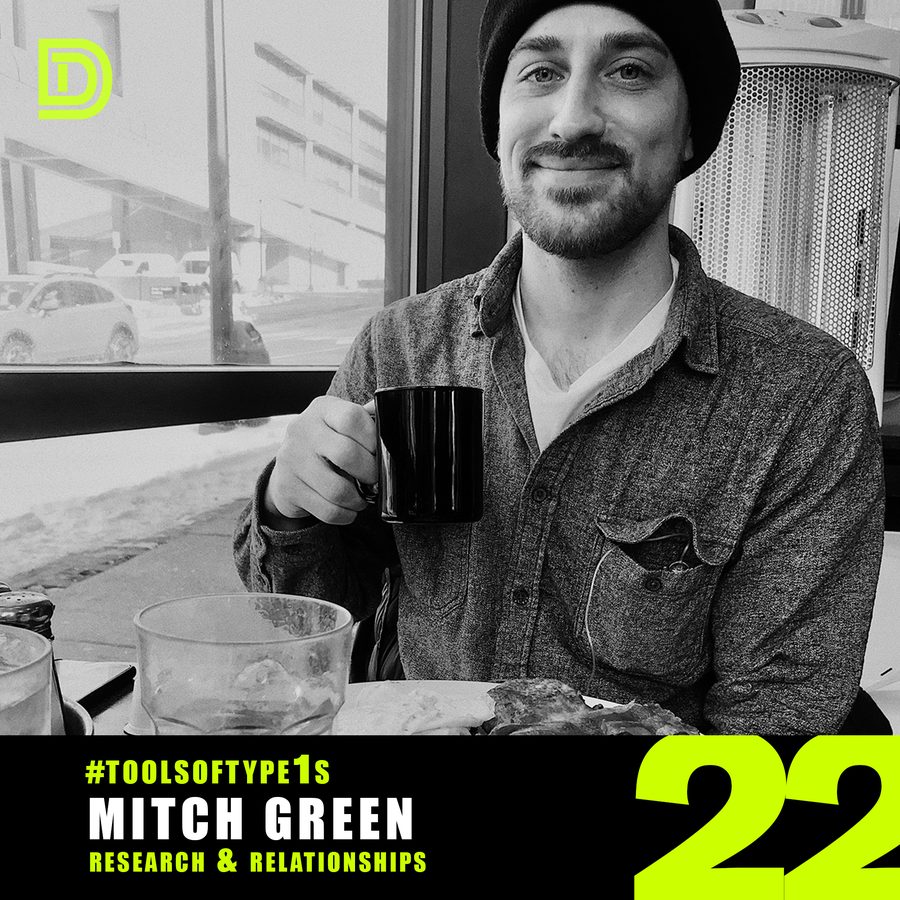
Name: Mitch Green
Hometown: Hillsdale, MI
Date of Diagnosis: 2.11.2015
Tool: Research & Relationships
Diabetes Devices/Treatment Methods: Medtronic 670g
Questions this episode answers
When was Mitch Green diagnosed with type 1 diabetes?
Mitch Green was diagnosed with type 1 diabetes in February 2015 at age 24, after first being told by a hospital that he was type 2.
What diabetes device does Mitch Green use?
According to the show notes, Green uses a Medtronic 670g insulin pump.
How did Mitch Green learn to manage his type 1 diabetes?
Green says he learned mostly through his own online research, finding the Beyond Type 1 app and connecting with other people with type 1 diabetes on Instagram.
What does Mitch Green say helped him most with diabetes management?
Green says getting a CGM in his second year with diabetes was the simplest and most impactful thing he did, since it let him see trends instead of just single blood sugar numbers.
Full transcript Searchable, with timestamps
Rob Howe: Tools of Type 1s Podcast. We took a little break, but we're back. We've got 20 episodes to go. Today's guest, Mitch Green. You may not know Mitch, but I do. He helps a lot, a lot, a lot with diabetics doing things. His skills are used in editing a lot of these episodes that you guys have heard. He's back on the editing trail for 2019, so we shouldn't have any more delays in getting any content out. So big thanks to Mitch. He's become a good friend. Looking forward to finally meeting him in person in Detroit here in May 2019. His tool, research and relationships. So without any further ado, I'll give my editing away as Mitch Green, The Floor. His tool, research and relationships, tools of type ones. These tools of type ones episodes are shorter than my normal podcast episodes, usually about 20 to 30 minutes. Sometimes in that sweet spot, 20 to 25, which is perfect because real good foods pizzas take about 20 to 25 minutes to prepare in the oven. so if you're trying to get your pizza on during this podcast and maybe you want to even add up the ambiance with some smells of some delicious pizzas pop a real good foods pizza in the oven and set that timer for 25 minutes and listen to this podcast they are a sponsor of the podcast and if you use code Rob Howe at your checkout online you can get 20 off and free shipping but most importantly you can get a delicious low carb pizza option for you to enjoy we had a pizza party with real good foods pizzas for the game of thrones premiere earlier this year and let me tell you what it was delicious and i didn't have to worry about my blood sugars afterwards because i counted my carbs for the chicken pizzas 16 carbs that's four carbs per serving delicious real good foods real good foods pizza real good foods.com use code Rob Howe at checkout and save
Mitch Green: 20% and get free shipping. My name is Mitchell Green. I grew up in the south central part of Michigan in a little town called Hillsdale. In 2010, I moved to Tuscaloosa, Alabama to study at the University of Alabama. Ended up staying there for a few years, hung out, got a couple degrees, moved to Birmingham, Alabama in 2017, where I worked a couple of odd jobs. And that's also the time that I reached out to Rob on Instagram, and that's how I started editing DDT episodes, which I've done on and then off over the past year. I currently live in Ann Arbor, Michigan as of this past December. I work in an investment office where I work with a financial advisor. I was diagnosed with type 1 in February of 2015 when I was 24 years old, so I might be a little later than most, but it's been a little over four years now. What is your tool of type 1s
Rob Howe: and what's the one thing that a person living with T1D could learn from you or your experience?
Mitch Green: my tool of type ones is research and relationships so my journey with diabetes started later in life and without any knowledge of it whatsoever I was misdiagnosed as a type 2 not that that title meant anything to me as I didn't know there was a difference between one and two or perhaps that there even was a one the hospital that I was diagnosed at told me that I needed to attend these classes or my insurance wouldn't cover what I needed, which ended up being a lie. But anyways, I went to these classes. I went to these education classes. I walk in. I'm the only skinny young guy in the room. Everyone stares at me. They're probably all 20 years older than I was. I ended up going to two of these classes before my first endo appointment. And at that endo appointment, I was immediately told that I was a type 1, uh, didn't know what that meant. And he was like, insulin. And I was like, okay. Uh, because I was taking metformin in this medication for my kidneys for about a week. And my blood sugar was just like in the 300 range or higher. Um, and I was like, man, is this really what diabetes is? Is this going to be my life forever? Cause I was feeling awful. Um, so basically he hooked me up. He, you know, helped me to get my blood sugar back in range. And so I had this internal struggle with whether or not to go back to these courses. And I did. I went back, I talked to the teachers and I was like, hey, I'm a type 1. I was like, are these classes going to help me? And they're like, yeah, close enough. And let me tell you, I hated these classes. They told me that I wasn't going to be able to live a normal life. I wasn't going to be able to eat certain foods. I wasn't going to be able to do certain things. After that first one, I just knew every time I was going in there, I would cry beforehand and I would cry afterwards. My friends are like, man, this is awful. I'm like, I know. Basically, I stopped going. I got this lovely $800 bill, which taught me that one, diabetes is ridiculous, and two, diabetes is expensive. What I'm getting at is that I ended up going online and doing my own research. and this is where I learned everything I know that I know now. I ended up finding Beyond Type 1, and this was like right before their app was released. And so when that was released, I was able to meet a few people and they were posting like things that I'd never considered talking to people and I didn't even know who to talk to with. I had, like I said, I had no knowledge about type 1 diabetes. And I learned so much from these people. And I formed these relationships. And from there, I continued those relationships, took them over to Instagram. And there, it was even better. People were sharing their stories about highs and lows and just being honest and talking about the blood and the relationships. And basically, there's no filter on there. Like, this is what it is. This is our life. I'm not going to hide anything. and I love that and I learn so much from that and I learn not to listen to everything that you're told and to connect with the real ones who are going to be honest and share those bloody details and even further that you can't judge diabetes by a day. Diabetes is not a sprint. It's a marathon and by doing that research and forming those relationships, relationships that's what really enabled me to get a better grip on it and have a better handle on where I was and where I wanted to go and that is my tool for type 1s. What is the simplest thing
Rob Howe: you've done that has helped you with the management of your type 1 diabetes? Where did you learn it or
Mitch Green: who showed it to you? The simplest thing I've done for my type 1 diabetes management has to be that I acquired a CGM. I didn't get a CGM, a sensor, until the second year of my life with diabetes. In that first year, I would check my blood sugar and I would see that number and I'd say, okay, that's what my blood sugar is. But I didn't know that if I was to look at that on a sensor, that could have had three arrows up or three arrows down. So now being able to see that and see that graph, see that chart, take a look at that, understand that, you know, doing certain activities or eating certain foods, they have a greater impact than other things. So just having that information has been a game changer. Where did I learn about that? I'm pretty sure I just saw a bunch of people on Instagram talking about it, the good, the bad, but it was a piece of technology that intrigued me enough to talk to my endo about it. So yeah, definitely I'd say acquiring a CGM has made the greatest impact and it's definitely been one of the simplest things
Rob Howe: I've done for my diabetes. What failures or apparent failures with T1D have made you better at living the rest of your life or made you more well-rounded as a person? Well, first,
Mitch Green: there are no failures. There are only opportunities. That's been something I've been trying to tell myself lately. So I'm going to speak it, speak it into existence. But if I had to answer an apparent failure that has kind of made me a better person in the end is probably just life with diabetes in general. It has made me a more understanding person. It has taught me patience. It has taught me that just because the time that you're in now may not be the best time, your blood sugar may be super high, your blood sugar may be super low. That's not a reflection of who you are. Obviously, make yourself feel better, correct, but don't dwell on that situation. Continue to move forward. Don't dwell on the past. I do think that diabetes has taught me that.
Rob Howe: What unusual or absurd opinion or approach regarding your diabetes do you have?
Mitch Green: I will keep this one simple. I'm going to live my life the way that I want to, regardless of diabetes. The only thing that I'm going to, the only factor of diabetes that I'm going to let affect me is how quickly I can eat my food. except I don't know it's kind of given me this weird sense of inspiration to do something great it's giving me this motivation to say hey I don't even know this is for me or for the kids but hey I have type 1 diabetes and I did that like to me that is one of the most amazing things that I can say. And especially if someone has no idea about that, they're like, wait, what? He did that? He has diabetes? Yeah, that's right. That's where my pump just went off. I'm still here. Here we are.
Rob Howe: It's going to be all right. What's your favorite thing? What gets you to smile or laugh almost
Mitch Green: every time? My girlfriend. And you know what? I met my girlfriend in a bookstore one week before I was diagnosed. So I have known her one week longer than I've known diabetes. And we had gone on one date. And the night of our second date, I had to cancel because I was in the emergency room. I sent her a picture with all these IVs in me. And I said, hey, I turns out I am a diabetic. I'm not really sure what this means, but I understand if you don't want to see me anymore. And here we are, four years later, still together, best friend, best girlfriend. I love her to death, but also breakfast, but preferably girlfriend and breakfast together.
Rob Howe: What challenges related to T1D did you encounter or have to overcome while you were doing your thing?
Mitch Green: I would definitely say learning how to communicate with people that I love and I know very well yet I don't see them on a daily basis such as my family when I was living in Alabama I would come home I'd want to enjoy my time and they would see me get my pump out or check my blood sugars and of course they had questions and they wanted to talk about it they wanted to understand but I I became very defensive with my answers. And it's something that I was conscious of. It was something that I didn't want to do, but it still happened. So learning how to communicate openly about my diabetes, taking that time, taking some time to just understand that they just want to understand themselves, that is definitely a challenge that I've had to work on. And I think my solution to that was to just take a step back and realize that they loved and cared. So, yeah, overcoming that challenge of communicating something that, you know, I didn't want to talk about all the time.
Rob Howe: What bad advice regarding diabetes do you see or hear that you'd like to address?
Mitch Green: Bad advice. letting anyone, whether it be a doctor, some dude on the TV, letting anyone tell you that you can't do something because of diabetes. And, you know, that's exactly why diabetics doing things exist. That's why there's so many people on Instagram sharing their experiences. I truly believe that. I truly believe that they're in it for the good, the better, to show you that, hey, I have this, and I do this. I truly believe that. I'm a firm believer in that. I believe we should all be sharing our experiences to help others with this. What priority are you focusing on in your own life currently? This can be diabetes related or not. I am focusing on balance right now. As I said, I just moved in this past December. Moving is extremely stressful. Starting a new job, that is also stressful. So just setting my schedule, having a time to exercise, eating healthier, going to bed, waking up around the same time every day. Those are all important things to me that I used to have and I've gotten thrown off track since moving here. So that is something I have been working on and really focused on currently.
Rob Howe: Who is someone that you look up to and what have they taught you? How do you apply that to your life?
Mitch Green: I look up to Anthony Bourdain. He was a chef that worked hard to get where he wanted to be in his career. He showed me that hard work does pay off, but also truly caring about your work is one of the more important factors. He taught me to be open, to be understanding, to listen, to empathize. He taught me to never stay static, and that is something I've really been working on over the last few years, and I think that makes for a great life.
Rob Howe: What are you most hopeful for? This can be diabetes-related or not.
Mitch Green: Well, to be all-encompassing, I'm hopeful for the future. The exponential increase and advancements in technology are inspiring, and I know that we've come a long way since the 80s, 90s, and even the early 2000s. I have faith for better care and possibly for a cure. And personally, I'm in a great relationship and am more motivated than ever to take the next step in my career. I'm hopeful to accomplish my goals and to give back to the community.
Rob Howe: What advice would you give someone who has T1D and is trying to pursue a career in your line of work?
Mitch Green: Well, I work in the finance industry. And whether you have type 1 diabetes or not, if you want to work in this industry or pretty much any industry, you need to network. You need to reach out to people, whether it be via email, in person, even on Instagram. Getting to know people, asking questions, that's how you're going to find a job. Personally, after graduation, it took me a while to find the right job, a job that I considered, hey, this is why I went to school. But now that I found that, maybe have a little bit better vision, 2020 vision, looking back. And I think that's the biggest factor on how I got to where I was, was reaching out to people and asking questions.
Rob Howe: What's the one facet or trait that you think makes you uniquely you? Explain why.
Mitch Green: I would say authenticity and empathy. I believe that it's super important to always be who you are and who you want to be. And that goes in the workplace and outside of the workplace. Empathy is always going to be important. And that's something I've really focused on in my life is taking the time to listen and understand what others are going through or just what they're trying to say. And that's something that I believe makes me, me. Plug yourself. Tell us where we can find you in the diabetes online community. Y'all can find me on Instagram at at Mitch Verde. You can find me on Facebook. My name is Mitchell Green. You can send me an email to mlgreen4@ua.edu or come up to Ann Arbor. We're going to have a little get together soon. That's been something I want to plan. So reach out. Let's connect. I'm looking forward to it. Thanks for
Rob Howe: having me. Thank you for listening to the Tools of Type 1's podcast on diabetics doing things. I'm Rob Howe. And every Tuesday and Thursday in 2019, we are posting the next Tools of Type 1 episode. So follow us on Instagram, hashtag tools of type 1's, or just on diabetics doing things. We will post these regularly every Tuesday, every Thursday. My favorite type ones are answering the questions I want to know the answers to. And hopefully you'll learn a few things as well. If you like this episode, be sure to review us on iTunes. And if you didn't like it, go ahead and let me know that too. I want to know. All the feedback is good to me. Thanks again for your time. I value that more than anything you could possibly give me. Thanks so much. Bye-bye.
About Mitch
Mitch Green grew up in Hillsdale, Michigan and was diagnosed with type 1 diabetes in February 2015 at age 24, after an initial misdiagnosis as type 2. He works in an investment office in Ann Arbor, Michigan, and has edited episodes for Diabetics Doing Things.