

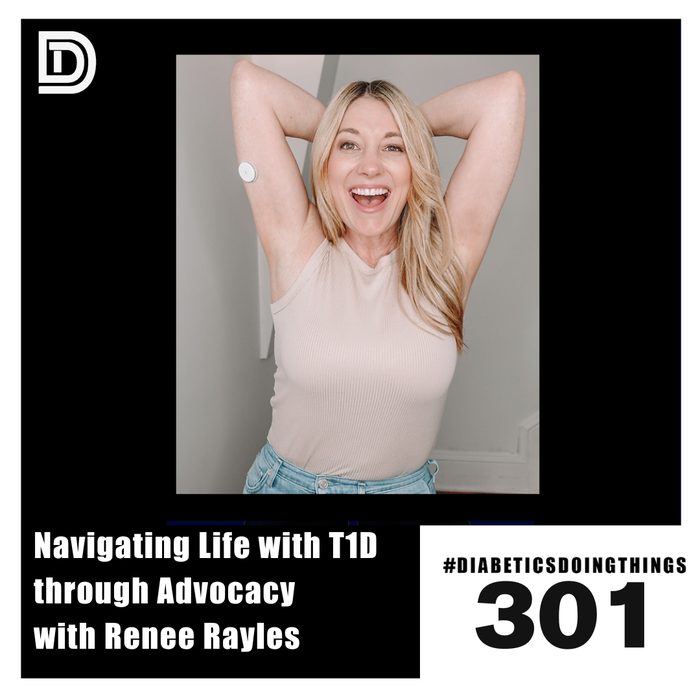
Navigating Life with T1D through Advocacy with Renee Rayles

Episode summary
Renee Rayles, creator of Hey T1D, was diagnosed with type 1 diabetes, specifically LADA, as an adult in 2021 during COVID lockdowns. She had spent seven years as a pharmaceutical rep for Abbott Diabetes Care before her own diagnosis, and that training helped her push for a C-peptide test when her doctor assumed type 2 because of her age. Renee talks about building a career as a TV reporter, host, and actor while managing diabetes on set, including hidden sugar in craft services food. She describes becoming an advocate for affordable insulin, speaking at a Georgia Senate runoff event, and attending Breakthrough T1D's Government Day in Washington, D.C. The conversation also covers stigma, bullying among young people with T1D, and the gap in post-diagnosis education for adults compared to children.
Key takeaways
- Renee says up to 40% of people diagnosed after age 30 are initially told they have type 2 diabetes when they actually have type 1.
- Her years of training as an Abbott Diabetes Care rep helped her recognize her own symptoms and request a C-peptide test, which she believes kept her out of DKA.
- Renee says adults diagnosed with type 1 often get little structured education, unlike children, who go through extended training with their families.
- She says advocacy does not have to be public speaking or going viral. It can be as small as helping one person find a juice box.
- Renee says young people with T1D have told her they've been bullied over their devices and their bodies, which she found shocking to learn.
Show notes
Embecta disclaims any control over, relationship with, or endorsement of, or the accuracy, truthfulness or completeness of the content or view expressed in this Podcast, which are solely those of the speaker and not necessarily those of embecta. embecta does not guarantee the accuracy or reliability of the information provided therein. Any and all comments and post are from members of the public community and do not necessarily reflect the views of embecta.
In this episode of Diabetics Doing Things, Rob speaks with Renee Rayles, the creator of Hey T1D, about her journey with Type 1 Diabetes. Renee shares how her diagnosis impacted her career in communications, acting, and broadcasting, underscoring the significance of preparation and informed decision-making.
The discussion highlights the challenges of misdiagnosis and the importance of being proactive in healthcare. Renee also shares her advocacy work for affordable insulin and raising diabetes awareness through public events and social media.
Emphasizing community support, the conversation covers overcoming stigma, misinformation, and the unique challenges faced by adults diagnosed with Type 1 Diabetes, particularly during the pandemic. Listeners are inspired by personal anecdotes and practical advice on managing diabetes, fostering community, and empowering both adults and children living with the condition.
00:00 Introduction and Sponsor Message
00:36 Meet Our Guest: Renee Rayles
00:55 Balancing a Career and Diabetes 0
2:59 Renee's Diagnosis Journey
03:55 Advocacy and Transparency
06:53 Misdiagnosis and Self-Advocacy
12:50 Jumping into Advocacy
18:06 The Early Days of Podcasting
18:23 The Power of Community Advocacy
18:59 Raising Diabetes Awareness
20:10 Personal Stories and Connections
25:15 Challenges and Misconceptions
27:52 Bullying and Body Image
30:36 Navigating Life with Diabetes
34:21 Resources and Support
35:18 Conclusion and Final Thoughts
Questions this episode answers
What is LADA?
Renee Rayles was diagnosed with LADA, latent autoimmune diabetes in adults, a form of type 1 diabetes that shows up later in life. She says it's often mistaken for type 2 because of the patient's age.
How often are adults with type 1 diabetes misdiagnosed as type 2?
Renee says up to 40% of people diagnosed after age 30 are told they have type 2 diabetes when they actually have type 1. Rob cites a separate figure of nearly 30%.
What is a C-peptide test and why did Renee ask for one?
It's a test Renee requested from her doctor to confirm she had type 1 rather than type 2 diabetes, since she didn't have the typical risk factors for type 2. She credits asking for it with helping her avoid DKA.
What is Hey T1D?
Hey T1D is Renee Rayles' show on Instagram, YouTube, and TikTok, where she asks medical professionals basic type 1 diabetes questions, like sick day protocols and how to store insulin.
Full transcript Searchable, with timestamps
Rob Howe: This episode is sponsored by Embecta. Formerly known as BD Diabetes Care, Embecta is now a standalone company solely focused on serving the diabetes community. They are partnering with diabetics doing things to help bring awareness to diabetes stigma by sharing stories from people living with diabetes like the one you're about to hear on this episode. Whether you're a person who has diabetes or you're helping someone else manage it, Embecta wants to empower people to live a life unlimited by diabetes through innovative products and educational resources. You can learn more at www.embecta.com. That's E-M-B-E-C-T-A.com. Welcome back, chat. We're back with another episode interviewing a person with diabetes, and today's guest is Renee Rayles. And Renee was diagnosed with type 1 diabetes later in her life We talk a lot about her journey with Lada today on the show. She also hosts a show on Instagram, YouTube called Hey T1D. So if you're not following her, be sure to check her out there. She's an actor and a host and shares a lot about diabetes. And as recently as last week was sharing some really valuable content about hurricanes and being insulin dependent and how to advocate for yourself and others during natural disasters. So definitely worth a follow and please enjoy this interview with Renee Rayles. Hello and welcome back to another episode of Diabetics Doing Things. We're telling the amazing stories of people with diabetes from all over the world. And I'm very excited to introduce our very special guest today, Renee Rayles, who you may know from the Hey T1D show and podcast and YouTube channel. So Renee, welcome to the show.
Renee Rayles: Thank you so much for having me. It's my pleasure.
Rob Howe: And we're going to talk today about a lot of things. But, you know, really the thing that I think most people, when they're asking the big question about diabetes and life with diabetes and is this possible with diabetes, the question that might bring in here from the jump is, can I still have a career in communications or broadcast journalism and have diabetes? So as we're getting into learning about you and your diagnosis story, I'd love to kind of answer that question for our listeners.
Renee Rayles: Well, let's get into it. Yes, you can. You can still do anything that you dream of. And I think one of the biggest things for me, being a creative, and a lot of times creatives, we are multi-hyphenates, which means, you know, I've been a TV reporter, I've been a TV host, and I'm an actor. I may not be able to make one income off of one of those, so I'm doing, juggling kind of all of those, if you will. And the biggest thing that I had to do was come prepared and not just come prepared, for example, with whatever that day means as an actor or a host or reporter. It also means coming prepared as a person with type 1 diabetes. And that was something that I had to learn pretty quickly. and some of those things are not just coming prepared, but also making the right decisions, and I say right decisions, better decisions for me on set. Craft services is a wonderful, wonderful place and they often have amazing things that perhaps you've never tried before. Or someone will say, yes, it's just grilled chicken. Little did you know until after you ate that an hour and a half later that there was honey on it as well. And I have a very hard time telling if something has sugar on it. So I know that was a very long-winded answer, but my answer is definitely yes.
Rob Howe: Well, I'd love to unpack a lot of that answer because a lot of it really mirrors some of my life in front of the camera as well. And getting to be on set at times and treat a low blood sugar at a craft services table, like you said, there's always something there that you could use to treat a hypo. I want to talk, though, a little bit about your diagnosis and immediately going into sharing your story, because even for someone like me, who I've now almost been podcasting for nine years in the diabetes space, but it took me 10 years to really be outgoing and seek out sharing my story to help others. and you launched your Hey T1D show really quickly. And in 2022, got nearly 22 million views across all your platforms. So quickly sharing your story and finding that community and getting that momentum. How did you come to that realization that you're going to use this diagnosis as an opportunity to educate and connect with other people?
Renee Rayles: Well, first of all, I want to say congratulations. Nine years. That's a long time in podcasting to stick it out. So not only stick it out, but be successful.
Rob Howe: Well, thank you. When I say it out loud, it sounds a lot longer than it seems like in real life. But yeah, it's been great, and I'm happy to still be here.
Renee Rayles: Well, that's wonderful. You know, I think for me, the biggest thing was being transparent about my diagnosis also helped me accept it more. And not being secretive about it, which I know so many people, especially in the industry that I'm in, had to be secretive about it or they wouldn't be hired. And, you know, I think a lot of that has changed with a lot of different medical devices that people are wearing. Even people wearing continuous glucose monitors that perhaps might not have diabetes. And I know that that's people like that, dislike that, whatever it may be. I think the one big thing from that is people are seeing that, oh, this is normalized. and also I really put together my past in the sense that I years ago was a pharmaceutical and medical device rep for many years and for seven of those years I worked for two different diabetes companies. One of those in particular was Abbott Diabetes Care. I never sought out to get into diabetes and the reason why I share this is because how this all kind of came together I felt like I was supposed to be transparent about it. So when I was at Abbott Diabetes Care, I was not diagnosed with type 1 diabetes. They trained us repeatedly so much that I was like, okay, we know enough, don't we, about diabetes. I mean, they sent us to Kansas to train the certified diabetes educators from the American Diabetes Association for four days. We had to read Think Like a Pancreas over a holiday break. I told Gary Scheiner when I met him this past weekend, who wrote Think Like a Pancreas, that was not the holiday reading I was intending to do. And that my son actually would ask me that week, Mom, are you thinking like a pancreas? Little did I know that I soon would be. And I'm so thankful for that training. And I know that it still took me a longer time than it should have to get the right diagnosis, even with my training, as well as the people that I know in the sense that the endocrinologist and the diabetes educators. And that's why I'm so transparent about it because it is because of my training that I not only got the correct diagnosis, potentially it could have saved my life. And as a previous TV reporter and host, to me, I just put my two worlds together and really thought after I'd seen all the stats, which, you know, the one stat is that up to 40% of people that are 30 years and older are being misdiagnosed as a type 2 when they are
Rob Howe: type 1. And this almost happened to me. Well, it's really interesting. First of all, shout out to Gary Scheiner, Mr. Think Like a Pancreas. I've seen him a couple times this summer. He came to our Breakthrough T1D Summit here in Dallas, and then I saw him actually last weekend or weekend before last at ADCES in New Orleans. And it's funny how you went from reading Think Like a Pancreas over a holiday weekend to full-time thinking like a pancreas as a person with diabetes. And as we shift to the diagnosis, and you're right, nearly 30% of people are misdiagnosed as adults with type 2 diabetes when in fact they have type 1. And it can be really challenging to advocate for yourself and request a C-peptide test to determine that your diagnosis is not correct. So walk us through that process, I know you got training from your time at Abbott. And, you know, did you immediately know that something was wrong? Or how did you go about that process with you and your family and your care team to get down to the real diagnosis and get to that correct diagnosis of LADA or T1D?
Renee Rayles: Well, I believe it was about seven years later, I was starting to not feel so well. I'd been to the doctor repeatedly. I went to two different allergists and had told them that I am gaining and losing weight overnight in about five to seven pounds. And one of the allergists laughed and said, that's not physically possible. Well, it is with undiagnosed type 1 diabetes or just diabetes in general. I went to the dentist and explained that every time I brush my teeth, I still can't get rid of this taste in my mouth. He said, that's generally from people not brushing their teeth. I will just told you. And you can see my medical record that I love to brush my teeth. And this kept happening. I went to my OBGYN. They did an autoimmune panel. But at no time did anyone take my blood glucose. And I believe that was also around the time where they changed for the age group that I was in that you didn't need to go every year for a physical where you would get a finger prick. So during COVID and Safer at Home, one of my doctor's appointments, I could see my charts before I got onto the appointment. And I noticed my blood sugar was high. And I knew that from my training in Abbott. And I thought, why is no one mentioning that to me? That's so strange. And I'm starting to put two and two together that I am not, I've repeatedly not felt well, but it is, this train is becoming bigger. I am noticing I'm drinking big gulps of unsweet tea and water throughout the day. Two and three huge ones. And so I scheduled a physical with my primary care doctor. I didn't tell him anything that was going on because I thought, sure, I don't have diabetes. And when those lab reports came back, my doctor called and said, hey, we got your lab reports back. Everything looks great except your glucose was elevated. And I said to him, I said, is there any chance I could have type 1 diabetes? And he chuckled and said, no, we'd be looking for type 2. We could retest in a year. And so I told him about my previous test. And he said, you know what? Come in and get your A1C draw. So I go in for my appointment. And the nurse coming back. And I said, hey, is there any chance I could talk to the doctor just briefly? And he comes in. And I said, listen, I know that I am not a doctor. But we just did a physical on me. And I don't have any of the comorbidities that go generally with type 2 diabetes. I don't have high lipids. I don't have high cholesterol. I don't have high blood pressure. And I'm not obese. Could we do a C-peptide test? and he stared and then said you know what that makes sense and thankfully that is all because it gives me chills of my training at abbott and i think that i definitely would have went into dka had it not been for that because my doctor wasn't going to retest me for another year because i don't look like someone that generally has type 2 diabetes so additionally for my age assumed I had type 2 diabetes if I was going to have it. Probably just thought she's pre-diabetes right now. And so I'm so thankful for that. Now, long story short with that is they actually, the lab lost my A1c and I had to go back in and retest. I could not get off the couch. I was so ill. And when they finally did call and say, we've got your A1c results back, it looks like you potentially have type 1 diabetes. They prescribed me insulin. I went to go pick it up. They did not prescribe insulin needles, so I wasn't able to get it. So I had to get needles. Long story short, I finally got the right diagnosis. And the reason why I'm so transparent about this story is knew that I needed to ask for a C-peptide test. I knew that just because of my age, it didn't mean I had type 2. And it still took me pushing this to get the right diagnosis?
Rob Howe: Well, there's a couple of things I can think of. One, I know maybe there's somebody out there listening now who's suffering through some sort of really boring corporate training for their job. You never know when that training may come back and save your life. So I think that's just a really good example of like where, you know, your journey leads, where it goes, and everything can have a purpose in, you know, the bigger than you even realize at the time when you're thinking about your training as a sales rep for Abbott now coming in later to potentially, well, obviously avoid DKA, so potentially keeping you out of the hospital and saving your life and making your life easier with diabetes from the jump?
Renee Rayles: 100%. Everything leads to everything. I have made sure I even reached out on LinkedIn to some of the people at Abbott to let them know. Thank you so much. Like I said, I saw Gary yesterday at the Breakthrough T1D Summit. I made sure I told him, you know, as well, because it's amazing how much we've always heard that education is everything.
Rob Howe: And it truly is. It really can be the difference between life and death.
Renee Rayles: It really can.
Rob Howe: Like no hyperbole there, right? It's, you know, being diagnosed with diabetes in those first few weeks and months are really critical. And now we know we even see that when you're able to avoid DKA at a diabetes diagnosis, that can help with some of the breakdown of the beta cells. So you're able to stay in sort of a honeymoon period longer potentially. So really impactful when you think about
Renee Rayles: the impact on your life with diabetes. I'm very thankful.
Rob Howe: This is 2021, coming up on three, four years ago. Immediately, you kind of jump right into, you know, like you said, living transparently and sharing your story with diabetes and even going to bigger links and advocating for affordable insulin and advocating for people with diabetes. You shared that you went to work in a re-election event for Senator Warnock in Georgia, and like how and advocating for people to make sure that the greater public realizes how important it is that we have access to affordable insulin. What for you made you jump into those causes right away? And what can you share about your work on the advocacy side?
Renee Rayles: What I was shocked about is how just basic information is not available to a lot of people with type 1 diabetes. You know, we know that type 2 is 90 to 95 percent of the diabetes in the United States. Type 1 is 3 to 5%, I believe they say. And there's a lot of information about type 2, and that's wonderful. People with type 1, I hear from people all the time that don't even know what ketones are. They don't know what a sick day protocol is. That scares me. And I meet so many adults that were diagnosed. And for example, in my state of Georgia, if a child is diagnosed with type 1 diabetes, they and their parents go through an extended training. Most adults, when we're diagnosed, we don't get that training. And I heard a diabetes educator say this once, this disease can be very scary because you can kill yourself pretty easily with insulin and we're not getting that training. And that was one of the reasons why I started just talking about it. Because, you know, even with, and I did a challenge on LinkedIn that I challenge these diabetes companies like Abbott, like Dexcom, like Omnipod. Because part of ensuring that people are being tested of all ages and not being assumed it's type 2 because they're adults is showing people of all ages and sizes in advertisements. You know, this starts with physicians and what they see as well. When that comes to advocacy, I had a tweet go viral during the election here in Georgia for the running for the senator. And they had reached out to me and said, hey, would you like to talk about the need for affordable insulin? And I said, sure. And it was a wonderful way to get the need for affordable insulin out. And not just for people with type 2 diabetes, but type 1 as well. We hear a lot again about type 2 and there's nothing wrong with that. We're type 1. we can't take anything else but insulin. And from there, that led to I got to speak at the Warnock runoff then when President Obama was there. And I spoke after America Ferrera, which was an amazing event. And then from there, I think it really just showed how much being true and transparent and not going about this in the sense of I'm trying to get attention, but I truly want to just help people, how sometimes that seed can flourish. And that ended up this year, me being invited by Breakthrough T1D to go to Washington, D.C. for Government Day, where we got to call on all of the congressional members of our state and ask for them to support not only affordable insulin, but the special diabetes program, which I did not know until a little bit before that, that that was part of how like the Omnipod 5 and some of these things that these medical devices that we wear get some of the funding for for this to be studied and when I came back from DC it really hit me you're like wow these are the people that make you know the decisions what else can I do because at that point you know you've gone to the lawmakers and when I left sorry it makes a little I kept thinking heard all these stories from people and all of the things that they went through. And you only have a couple minutes from these offices and you're trying to make it count. And did I see and express the right thing for all of my, you know, dying buddies out there? Because it is so important. You know, people die from not having insulin. There's a lot of people that still don't know the copay cards are around, which quite frankly are, you know, they could take that away tomorrow. But continuing advocating in any way that I can. And I just want to say this because yesterday I had some young people that came up to me and they were asking how they can advocate. And, you know, I think a lot of times with social media, you see people on TV or doing something big and advocating is just talking to one person. Even it does not have to be this big thing. It's just talking to one person and being able to be a friend to them to help them find a juice box when they need it. And I just wanted to make sure that I share that as well, because advocating doesn't have to always be at the highest level publicity-wise.
Rob Howe: Well, I want to mirror that back to you because that's totally in line with what we believe here at Diabetics Doing Things. And what really started me on this journey nine years ago, which was to, I committed to doing 10 podcast episodes. This was, you know, sort of before the big podcast boom in 2019 to 2021. And I just wanted one person to reach out to say this helped them. And if they did that, that I would keep doing it. And thankfully that happened. And now, you know, over 300 episodes later here, we're still doing this. And it really goes to show, and I think you're exactly right on the social media side, not everybody has to be viral for your advocacy to matter. You don't have to be the keynote speaker. You don't have to be going to these big events. You don't have to be featured as a guest or sponsored or whatever the case may be. Being active in your own community. I talk to people all the time who say, oh, I want to go to a meetup or I want to start a diabetes community. How can I do that? And my answer is always be the change. You know, you can, a meetup is just more than one person. So, you know, showing up at a coffee shop with more than one person and that is advocacy. And you talked about diabetes awareness, right? And the need for people to understand. And even on the type 2 side, like you're saying, there's a lot of awareness about type 2 diabetes. A lot of it is rooted in stigma. But for the most part, health equity starts with awareness. You have to know about the signs of diabetes. So Beyond Type 1 has a campaign right now called See the Science, where it talks about frequent urination and thirst and weight loss and the signs that we know as people with diabetes. But when you're thinking of them individually, they don't seem like it could be a chronic illness. But most people don't know that. And then you mentioned prediabetes earlier and people who are wearing continuous glucose monitors without a diabetes diagnosis. But the American Diabetes Association said that eight out of 10 people with prediabetes don't even know that they have it. And so like awareness, if you don't know where to go and you don't have someone in your life with diabetes or you've never heard of breakthrough T1D or American Diabetes Association or beyond type 1, where are you going for your information? And so that's why it's important, no matter what your story is, no matter what your platform looks like, that you share your story because you never know who it could touch or who you could reach at the right time. I'm sure in the three, four years that you've had diabetes, you've reached people that you never would have met otherwise. And you would not have met if you hadn't shared your story and you hadn't been forthcoming and transparent about your life with diabetes. And the reason that, you know, that comes back to you is because you're being vulnerable. It's a vulnerability exchange. So does anything come up for you when you think about people who you never would have met otherwise, who you've gotten to be in contact with from sharing your story?
Renee Rayles: I think the biggest thing is the type 1 diabetes community. It's the whole old adage of it's a community you never wanted to be necessarily part of. But they're such great people. And they're so kind. And being in D.C. surrounded by people that were not just affected by type 1 diabetes, whether it's a loved one that has type 1 or they do or someone, maybe they never even have, don't have someone in their family with it. committed to going out and advocating, giving up their own time, some of them coming on their own dime. And I think that that's one of those things that helps me continue to keep going with it, is to see that, like that spark and being around that kind of energy. You know, yesterday I met two young girls that they call themselves diabetes. They met at, I believe, a camp. And While they're waiting in the green room with me, they say, oh, my goodness, we've got a friend that's going low right now. We've got to go up there and rescue her. How cool is that? You know, that's awesome. And I think that one of the big things with adults is not finding another person with type 1 diabetes. You know, we know that JDRF changed her name to Breakthrough T1D, which I'm so happy about because we know that it's not just a juvenile disease. disease. But if you don't mind me sharing, I was at the endocrinologist last week. And when I walk in there, they now have a, there's a endocrinologist for children in there as well. And I notice a young girl and their parents and there's an Omnipod box. And I didn't know if it was the mom or the child or the dad that was on the Omnipod, but I just wanted to make sure I came over and introduced myself and said, hi there, I see somebody's getting the Omnipod. And I showed them mine and say, you know, I just got on the Omnipod myself. And they said, oh, our daughter is, she was four, I believe, and I was getting foot on it. And I, you know, I sat down and I said, by the way, I'd love to invite you guys to the Type 1 Summit this weekend. They're like, oh, we just came back from Camp Kudzu, which is a camp here in Georgia for kids with Type 1 diabetes. She's like, I just, you know, I don't know if we'll be able to do that too. Thank you so much. And I sat there, How cool is that? That's so awesome. For adults, we don't have that. And for adults, it can be just like for kids. It can be very much so a feeling of loneliness, feeling like someone doesn't understand you. Also, you know, you've perhaps had a life for however many years, you know, and then now you have this. And I'm not saying it's better or worse. I'm just saying, you know, it's different. And we need to create communities for adults too. And I know that they're doing that. And I met another lady who got diagnosed during Safer at Home, and she had never met another type 1, and she hadn't even met her doctor. It was all online. And I met her at a breakthrough T1D event, and she was like so overwhelmed to meet so many people with type 1 diabetes. And I was like, wow, what a great, I mean, breakthrough T1D and just the things they are doing, I feel like we're so lucky to have. And I feel like a lot of people don't know about it. And they have adult events as well as children's events. And I think one of the other things that when I was talking to a parent learned that, hey, Breakthrough T1D has great events for your kids, but also the parents, you can potentially find a babysitter or someone to help you out. You don't just want to leave your kids with someone that doesn't understand type 1. I got a little long winded there, but I always get passionate.
Rob Howe: I feel like it. I think you bring up a really great point because we've talked about this a lot on the podcast. and this was sort of a revolutionary thought for me early on because I was diagnosed at 16. So I was an older kid, but I was still a kid. So I got to go to Children's Hospital. I got Diabetes 101 from our local JDRF now breakthrough T1D chapter. And even though I didn't want to go to diabetes camp because I joked that I was too cool and I knew everything because I was a normal 16-year-old, I was told about diabetes camp and it was available to me to do that. And for adults, it's just not the same. And depending on who diagnoses you and what city you live in or, you know, where you live or what time in the case of, you know, during the pandemic where people were doing virtual appointments and getting diagnosed virtually like the woman that you met. You might just get, you know, one of our podcast guests just got a DVD in Spanish and she didn't even speak Spanish on what to do, a prescription and a DVD in a different language. You know, so like that's an extreme. Or your primary care physician just comes in and hands you a couple of different pens and sends you on your way because even they aren't necessarily trained in diabetes. And I think this kind of leads into our next question, but there's just also a lot of misinformation about what diabetes is. And I'd love to ask you as someone who was diagnosed as an adult who live their life all the way up until recent years, a certain way, even having a family and now adjusting to life with type 1 diabetes later in your life, late adult autoimmune diabetes, like what diabetes stigma have you experienced either with friends or family or just in the community and having to educate through that and advocate for yourself. Because I think that's also a really difficult and important part of the diabetes journey is that even people in your day-to-day life, co-workers, family, friends, don't know a lot about diabetes and everybody has to sort of be the change for them on their own.
Renee Rayles: You know, I'm going to start with the worst comment that I got. And that was I had talked to someone for a very long time. When I say very long time, probably six months for me, it's a long time not to talk to somebody. And we'd spoken on the phone and I let them know that I had type 1 diabetes. And it's all some of the stuff I was doing with insulin, I believe, like on Facebook. And they said, well, if you didn't get fat, you wouldn't need insulin. And I sat there and I said, pardon me, what'd you say? And then they just tried to change the subject. And I got off the phone and I was like, you know what? I'm not going to react in the way that I thought they acted towards me. and instead I'm going to take a moment, put my thoughts together because immediately I wanted to say something back and then I thought, no, we're not going to do that. So instead I wrote back the difference between type 1 and type 2 and then said, even if I did have type 2 diabetes, that's not okay to say. You know, that is not okay to say. And on the other end, I've had so many people because, you know, I worked in diabetes that I've been very fortunate. I see one of the best endocrinologists in the world I used to call on. You know, I have friends that are diabetes educators. And I'm very, very lucky in that sense. And I think one of the things that I've been shocked about, though, and this has happened to me on set more than once, someone will know that I have type 1 diabetes and want to tell me about a cure. It never fails. I have even been on an online class once, and someone DM'd me to tell me about their holistic doctor. And when I wrote back there is no cure for type 1 diabetes they wrote back well it sounds like you don't want to find out and i'm just shocked by this that this is a constant like thing and or someone's sending a granny video and and of some cure and you're like don't just think that i wouldn't know this by now or it would be in the journal of american medicine but i think or at least on headline news, you know. Yeah. I think so what that helped me understand better was talking with younger people that have type 1 diabetes, because while I'm getting some of that and I'm sure they get some of that, I've learned so much about many of them being bullied. And that has been shocking to me. And I think sometimes maybe their parents don't even know that. I had a type 1, a young lady that's super, super thin. I don't think we'll dose during the day because she's not going to eat any carbs and has been told that she's fat by a girl at school constantly. We had a girl at a Breakthrough T1D event that asked when we did some Q&A, what can you do about bullies? I've had people DM me saying, my daughter's experiencing this. Did you ever experience that? And, you know, I'm a grown woman, so if someone would try to bully me, good luck. But for a teen girl or a young girl, especially when we know that, you know, diabulimia and all of these things are so present when it comes to our young girls as well as, you know, young men. And I think that that's what's been the most shocking for me is to learn about that going on with a lot of kids. It is really difficult. And I think it's especially difficult for young women who struggle with body image anyway in the modern world. But we, you know, advice that I give to parents when they ask me, because I also was more of a grown up than a kid when I was diagnosed. So I was very fortunate that I had a lot of other things going for me that helped me navigate that bullying side. But we forget how difficult it is to be a teenager anyway. And then you throw a difference or something that's, you know, a little bit uncomfortable or a little bit gross, like diabetes at times, and is very visible. Even when we could be proud of our devices or we can be, you know, showing off our CGMs at our pumps, it's still really hard and it gives a target to bullies and to people who are just saying mean things and don't really know any better in many cases. It's hard to be a teenager. And being different when you're
Rob Howe: older is cool, but being different when you're younger is not a lot of times. That's right. You know, what are there any any things in particular that you did when it or did people ever mention or say things to you when you were younger that really, I don't know, hit you harder?
Renee Rayles: It wasn't necessarily so much the diabetes as I was really tall always. So that kind of presented challenges at times where I was just a little bit different and that put a target for me. And like I said, I was kind of mostly grown by the time that, you know, my diabetes has shown up. So that for me was, was a blessing in disguise. I think from my standpoint and the advice that I give, I also was very lucky. You know, you talked about how lucky you were to have people in your life that you could go to, diabetes educators, you know, people that you had met previously, your training at work. I was really lucky that I had a lot of things going for me outside of my diabetes that sort of made it okay that I had diabetes. And I think examining my role and what I even have called like toxic positivity within diabetes of like, I'm a great example that you can do anything that you want. That doesn't make it true for everybody. That still makes diabetes a very difficult thing to manage. I still do have to manage it. Fortunately, I've been given and I have not earned in a lot of cases tools to navigate that more easily. Diabetes really resonates with the way that I think. And I also have a physical body that's very able to handle a lot of the things that come my way. So I think I try to hold truths for both things. Diabetes is really hard. I still believe you can handle it. I'm here to help you if you feel like you can't or if someone has been mean or rude to you. I wanna advocate for you and come for you and just say, you know what? It's also just like you said, give it a little bit of time and it won't seem like it's such a big deal. And we learn for people who peak in high school and are bullies at that time, like just give it a little time and you'll be able to navigate all the way through that because there's also just a learning curve to all of this.
Rob Howe: And you were talking about the differences between type 1 and type 2. Like we're learning more about type 2 diabetes every day. And people who don't have a history of obesity or metabolic disease still end up with type 2 diabetes for reasons we're just learning more about. And so what I think I really want to get out into the type 1 community on the stigma front is that explaining the difference between type 1 and type 2 diabetes, you got to do that in a way that's inclusive because we are all a diabetes community together. And a step forward for all of us or a step forward for one of us at the expense of another group is not worth it. And I think, you know, again, we've all dealt with anyone who shared their story about a chronic illness online has dealt with the weird spam bots about the herbal cures and the weird, you know, shopmans or whatever out there about these cures. And, you know, what we've got to do collectively is just say, hey, you know, trust me, if there was really a cure for this, more people would know about it. And what I would say to people out there who are struggling with the people who are giving them those comments, you're going to win the long term. You're going to win in the long run. It's very hard to change people's minds in the Internet comments. But, you know, if you just make sure that you're doing what's right for you, creating a healthy boundary and not letting them get to you, there's a lot of really positive people in the diabetes community who can really empathize with what you're going through. I love that you shared a lot about your own personal journey. I think that that's why it's so important, especially for young people, to meet another person with type 1 diabetes, to see that it's not only you. There's not something just wrong with you, you know, and that it's somebody you can lean on, you know, as well. And I also want to share my mother was the principal of my high school. So while I might not have been bullied for type 1 diabetes, believe me, it was not great for my dating life by any means.
Renee Rayles: Oh, I'm sure that had to be really tough.
Rob Howe: Oh, it was. You know what I've learned about that time in my life is that it made me OK with me at an early age. Instead of trying to figure out myself later in life, I kind of figured out who I was earlier because I had to be OK with me. And now I'm thankful for that time. Well, it's always good to be able to look back and to be thankful for the journey. And I want to kind of use that as a transition to thank you for your time today for coming to share your story and share your platform with our listeners. Your show is HeyT1D on Instagram and on YouTube. Really easy to find. You know, as I was preparing to have you on the show, I was looking at all of the different channels. So I would encourage all of our listeners who are interested in hearing more to follow you at HeyT1D on Instagram. Any other links that you would like to plug or showcase here on the show?
Renee Rayles: So the Hey T1D show that is on YouTube is me asking questions to medical professionals about type 1 diabetes. And these are basics because we know that a lot of people are missing out on basics. Like what is sick day protocol? How do I store my insulin? If I don't take insulin or if I don't eat carbs, I'm sorry, will I still need to dose insulin as a keto diet? Okay. No, it's not. But we explain that in depth where the medical professionals explain some of these basic things around type 1 diabetes on the Hey T1D show on YouTube. So if you're looking for information like that, that is on YouTube and on my Instagram, TikTok and everything else. I'm just at Hey T1D.
Rob Howe: Awesome. And that's super important because I've said it over the years. I am not a doctor and I don't even play one on TV. So making sure that we have the medical professionals there to really dig into those topics. Sound like you guys see Nick DKA is something that you've been discussing with folks on YouTube. So really exciting. Be sure to check that out.
Renee Rayles: Definitely. Thank you so much for your time and having me today. I sincerely appreciate it.
Rob Howe: Of course, Renee. It was my pleasure. And thank you for your time.
About Renee
Renee Rayles is a TV reporter, host, and actor who was diagnosed with type 1 diabetes (LADA) as an adult. She previously worked seven years as a pharmaceutical and medical device rep for diabetes companies, including Abbott Diabetes Care, and now creates the Hey T1D show and advocates for affordable insulin.