

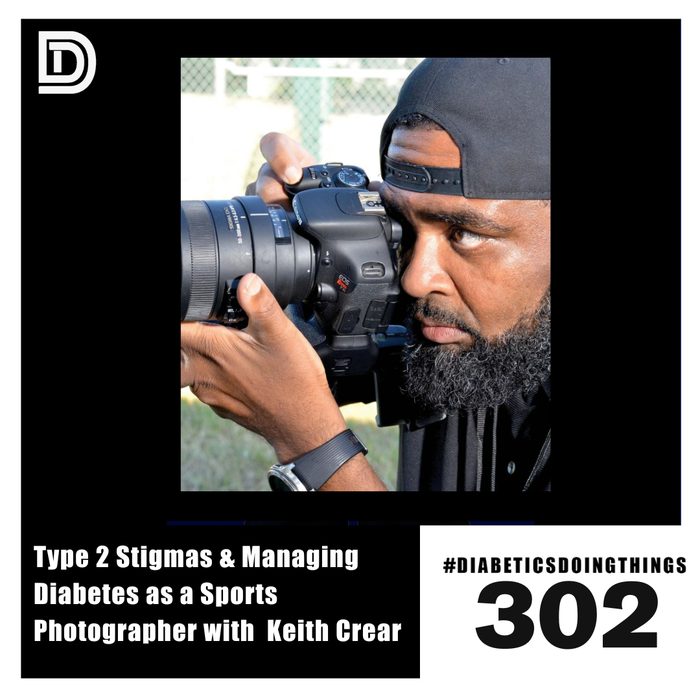
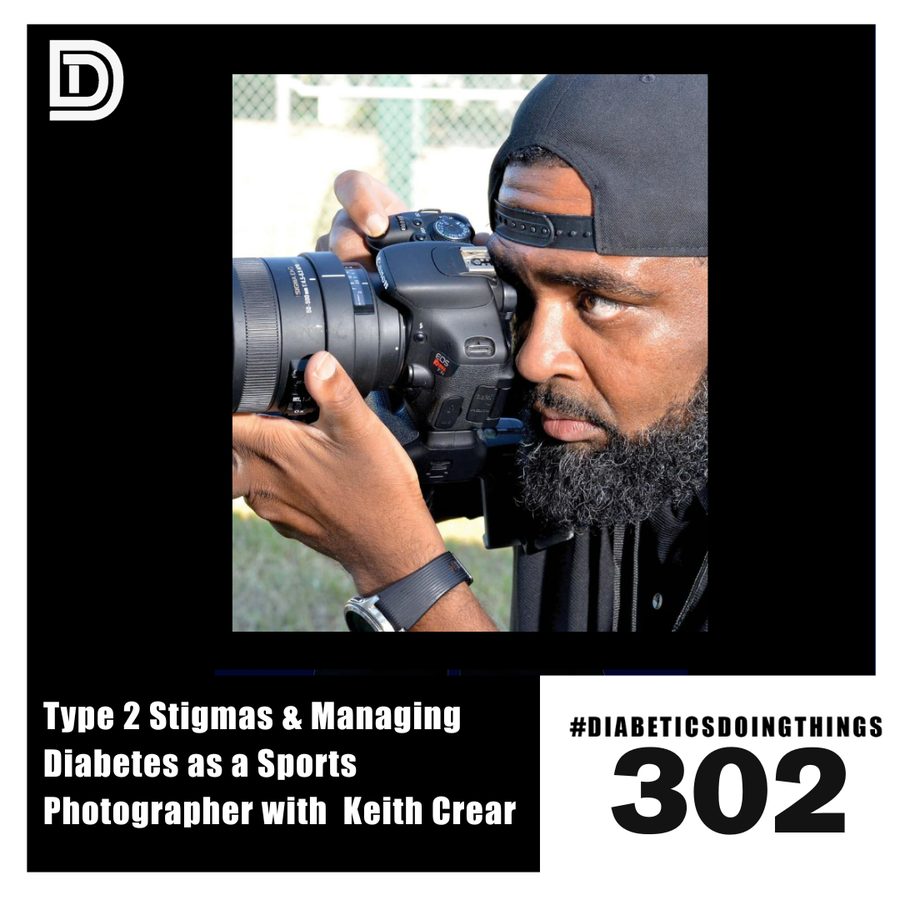
Type 2 Stigmas & Managing Diabetes as a Sports Photographer with Keith Crear


Episode summary
Keith Crear is a Houston-based sports photographer who shoots for the NFL and MLS under the name 56 Grizzly Media. He was diagnosed with type 2 diabetes in 2017 after he passed out from heat exhaustion on a job and learned the collapse was tied to undiagnosed diabetes. He describes getting generic, conflicting advice from a general nutritionist before a diabetes-focused counselor helped him build a diet and exercise plan instead of starting insulin. Crear talks about losing significant weight, managing his glucose while working NFL and MLS sidelines, and covering the USA men's and women's national soccer teams and Inter Miami. He also discusses stigma tied to his weight, people's reactions to him checking his blood sugar in public, and the differences between type 1 and type 2 diabetes.
Key takeaways
- Keith was diagnosed with type 2 diabetes in 2017 after passing out from heat exhaustion while photographing cars for an ad agency.
- Keith says a diabetes-specialized counselor, not the general nutritionist he saw first, helped him build a plan based on diet and exercise instead of insulin.
- Keith checks his glucose and carries snacks for lows while shooting NFL and MLS games from the sideline.
- Keith says type 2 diabetes is not caused by weight alone and can go into remission, while type 1 diabetes has no cure and is a different condition.
- Keith says people have mistaken him checking his blood sugar on the sideline for drug use.
Show notes
Embecta disclaims any control over, relationship with, or endorsement of, or the accuracy, truthfulness or completeness of the content or view expressed in this Podcast, which are solely those of the speaker and not necessarily those of embecta. embecta does not guarantee the accuracy or reliability of the information provided therein. Any and all comments and post are from members of the public community and do not necessarily reflect the views of embecta.
In this episode, Rob interviews Keith Crear, who shares personal narratives and professional insights about managing type 2 diabetes. The featured guest, a photographer contributing to NFL and MLS, recounts his diagnosis in 2017 following an incident of heat exhaustion and his journey from confusion to effective management through self-research and specialized counseling. Emphasizing personalized care and community support, he discusses the benefits of diet and exercise over insulin and reflects on balancing his creative career with diabetes management. The episode explores significant milestones in his profession, covering major soccer events and aspirations for the 2028 Olympics and highlighting how diabetes has shaped his perspective and growth. Additionally, the conversation tackles the stigma and misinformation surrounding diabetes, particularly in cultural contexts, and underscores the need for individualized care, the role of a supportive medical team, and the importance of sharing personal stories to inspire and educate others.
00:00 Introduction and Sponsor Message
00:36 Welcome and Guest Introduction
01:27 Diagnosis Story and Initial Reactions
03:05 Navigating Life with Diabetes
06:01 Finding the Right Support
09:34 Life as a Sports Photographer with Diabetes
11:41 Creating Diabetes Awareness in the Community
17:02 Living with Diabetes: The Struggle and Perspective
17:50 Transformative Journey: Weight Loss and Self-Discovery
18:59 The Importance of Mental Health and Community Support
20:22 Debunking Myths and Building a Strong Medical Team
20:51 Sharing Personal Stories: Impact and Misconceptions
22:11 Navigating Life with Diabetes: Challenges and Stigmas
26:33 Breaking Barriers: Food, Culture, and Stigma
29:44 Type 1 vs. Type 2: Understanding the Differences
33:49 Connecting with the Diabetes Community
33:58 Final Thoughts and Staying Connected
Questions this episode answers
How was Keith Crear diagnosed with type 2 diabetes?
Crear passed out from heat exhaustion in 2017 while shooting photos for an ad agency. At the ER he learned the collapse was linked to previously undiagnosed diabetes.
Does type 2 diabetes always require insulin?
Crear says his doctor looked at his blood sugar readings and told him his diabetes could be managed through diet and exercise rather than starting insulin right away.
Can type 2 diabetes go into remission?
Crear says type 2 diabetes can be put into remission through lifestyle changes, but is careful to say type 1 diabetes has no cure and is a separate condition.
What stigma does Keith Crear face as a sports photographer with diabetes?
Crear says people assume his weight caused his diabetes, question why he carries snacks on the sideline, and have mistaken him checking his blood sugar for drug use.
Full transcript Searchable, with timestamps
Rob Howe: Fans and friends of the pod, welcome back. We're at episode 302, continuing to power through, push forward. Today's guest is Keith Crear, who you may have heard on Stacey Sims' podcast earlier this year. He's a person living with type 2 diabetes, and we have not highlighted voices of people living with type 2 diabetes very much on this podcast. But I want you guys to pay attention to the stigma conversation that we have. because I think Keith does a great job of doing what many of our guests over the years have done, doing things. And while he's doing his thing as a sports photographer, he encounters some really serious diabetes stigma that I think many of us can relate to. So I want you to tune into that and use it as an opportunity to recognize that living with type 1 and type 2 diabetes from the outside perspective is really not that different. And I think there's a room for more inclusive conversation around people living with diabetes. So please enjoy this episode with Keith Crear, sports photographer, 56 Grizzly Media on Instagram. This episode is sponsored by Embecta, formerly known as BD Diabetes Care. Embecta is now a standalone company solely focused on serving the diabetes community. They are partnering with diabetics doing things to help bring awareness to diabetes stigma by sharing stories from people living with diabetes like the one you're about to hear on this episode. Whether you're a person who has diabetes or you're helping someone else manage it. Embecta wants to empower people to live a life unlimited by diabetes through innovative products and educational resources. You can learn more at www.embecta.com. That's E-M-B-E-C-T-A dot com. Hello and welcome back to another episode of Diabetics Doing Things. We're telling the amazing stories of people with diabetes from all over the world coming up on nine years of the podcast. So spanning lived experience with diabetes for over thousands of years of lived experience on the podcast to date. My very special guest, Keith Crear. Welcome to the show, my friend, from 5-6 Grizzly Media. We're doing the I-45 connection Houston to Dallas today. Welcome to the show, my friend.
Keith Crear: Thank you. Thank you. Glad to be here. Glad to be here, brother.
Rob Howe: We are talking about some things that I think have been uncomfortable in the community at times because you were coming on the show, living with type 2 diabetes. And when we started the show, it was primarily for type 1. And then we realized that it's more important to be inclusive. It's more important for us to have conversations together and share our stories because that's the only way that we can move forward. But we always start with diagnosis and your diagnosis story is particularly interesting. And so I'd love for you to kind of take us through that day in 2017.
Keith Crear: I was working in an ad agency, taking pictures, was two photography floor, inventory of the cars. And, you know, of course in Texas, there's suddenly heat, it's brutal, and working and passed out, you know what I'm saying? And got rushed to the ER, found out I was dehydrated and had heat exhaustion. But then that's when I also found out the third part of that was because of, hey, I was diabetic, right? Was always told I was pre-diabetic and, you know, thought I was doing something to kind of alleviate it, but never know the real seriousness behind it until I got fixed with that ER doctor. I said, hey, look, you're diabetic. How long have you been diabetic? And what are your next steps? And it was like, I'm not diabetic. He was like, oh, no, you are. That's the reason why he passed out. He said, your body shut down. And it was at that point I had to make some changes. So with that, it was kind of like a week of call. It was that shocker, like all this time kind of just live loosely when it came to my health and eating and now I have no choice but to face it so now it was at that point having to set up and meet with doctors and meet with nurses and meet with people and figure out what can I do to change the status you know is there something I can get rid of overnight again not knowing the severity of it it was like all these things are kind of rushing to your head you know what's next and that kind of changed the course of how I started to live my life with that port. So you mentioned that you'd had conversations with
Rob Howe: doctors previously about being pre-diabetic or at risk for type 2 diabetes. A stat that I read pretty regularly is kind of stuck in my head is that like eight out of 10 people with pre-diabetes don't even really know that they have it. And the ones that do don't really know what to do about it. So how did you feel like on that day of diagnosis, did you feel like you got the information you needed to kind of take the next step or did you have to go find that yourself? No, man, I have
Keith Crear: the goal hunt. It was like finding Nemo, finding Waldo. And you learn pretty quickly of how broad people talk about, especially in the medical field. That's weird, right? Like how broad they talk about it. And they put you all in the same box and they try to treat you the same way and give you the same medications. And you realize that, you know, when you do your own research that everybody's body is different in a way how it handles being diabetic. So it was learning how to figure out along like what new plans will work for me what exercise regimen will work for me me being a bigger guy when to eat what time to eat like all of that was bombarded with me at one time I was trying to trying to break all that stuff down and figure out like how is this going to make my plan to maintain this diabetes status and what what will I have to do and that was probably one of the hardest things and and even when you talk to nutritionists because I remember the very first nutritionist I talked to, it was very, very cookie cutter. It was eat this, eat that, eat this portion, this portion. And they gave me that little placemat that has the diagram, right? Wait on it, right? And I was like, okay. And then this question of fact of, all right, if my body is holding all this sugar, why am I putting more into it? Or are you telling me to eat more? So it was very, very confused at the time. And, but like I said, I had to do my own research and figure out, and it took me a while to actually figure out what worked for me. And I guess that's one of the things most new diabetics have to figure out is like what works for them. And that could be a challenge.
Rob Howe: It really can. And I think that's something that we talk about a lot in the type 1 community as well is like what works for one person may not work for somebody else because, you know, diabetes doesn't pick and choose what kind of people it affects. So we've all got different body composition, different activity levels, different likes and dislikes. And I think when you hear that kind of cookie cutter approach, that sort of one size fits all approach, we wouldn't use that approach in anything else in our lives. So why would it work? Why would we think that it would work on our health? So for you, as you're navigating that, obviously you have gotten, made a lot of progress with managing your diabetes? You went through and lost a lot of weight. You've gotten your lifestyle kind of dialed in. How did you go from getting that first kind of cookie cutter response, not really feeling confident about it to finding that momentum and finding that success?
Keith Crear: I think when I talked to a diabetic counselor, that's when things kind of really changed. She kind of helped me put the pieces together. And that's where I found out how, you know, when nutrition, The first person I saw was a nutritionist, but she really wasn't specialized in diabetes. And I'm, you know, not knowing the difference, right? And then when I talked to my counselor, she was like, well, I'm a nutritionist, but I specialize in diabetes. So what I tell you is going to be a lot different than what the first lady told you. So it was, okay. She was diabetic. It was more or less of an approach of you were at the time, I think it was like 38 or 39. She's like, you're 38, 39. This is not going to change overnight. right? The years it took for you to get here, it's probably going to take about the same amount to kind of keep it maintained on a regular basis. You know what I'm saying? So it was having that perspective and having that conversation where they kind of was like, all right, they put me at ease. So now I'm more receptive of finding that right meal plan, finding that right exercise plan. So that's really what it took for me was really having that diabetic counselor that understood it because she was type 2 and that made all the difference. I'm glad you brought that up
Rob Howe: because we talk about on the podcast quite a bit, the, and I kind of say like a friend with diabetes is a friend indeed, because it really allows you to skip all that sort of explanation and exposition. And, you know, even what your counselor told you about, Hey, what I'm going to tell you is going to be a little bit different than the general nutritionist because she is not focused on diabetes, right? She's just, you know, she's approaching it from a broader lens. and you know we see also in some of the research like the clinical outcomes of people who are friends or have you know community members with diabetes are able to more quickly get to the targets that they're looking for and they have you know have better a1c's or what have you so like once you had that conversation with the diabetes counselor did you feel like a little bit more at ease did you feel more confident going into the next steps of taking it day by day
Keith Crear: I did. I did because my original PCP had told me that I needed your insulin. And when I told her that, when I had the encounter with the first nutritionist of my PCP, she was like, well, I'm really not the type to recommend insulin off the gate because that's a whole different journey than taking metformin or whatnot. and when she was like well she took my blood sugar that day and she was like well we pulled a 139 this morning she's like did you eat and i'm like no ma'am and she was like well then i'm really not for you being on insulin she said yours can be managed by literally by diet and exercise she put that in the dashboard and the records for me and it sparked the debate of the booking of the rims per se but it was at that moment like all right cool i have a person that's in my quarter breaking the show. And it was that that really kind of pushed me forward to say, you know what, I need to make sure that I keep going on this path because now I found somebody that's in my corner. It's where we'll fight for them. So that made a big deal for us. And I also think like
Rob Howe: just being somebody looking at your data and saying, hey, based on what I'm seeing from you, not just like a general, you know, recommendation, here's what I think we should do. And here's what we think your treatment plan should be. And it's, you know, I think once you really get that personalized. It's just like any other relationship, right? Once you find that person that really is syncing with you, listening to you and seeing you as finding that plan, you know, things kind of can really take off from there. So kind of jumping from there, we're talking about when you were diagnosed, you were shooting photography for an ad agency. You're a photographer. You also, you know, are a like NFL digital content contributor, MLS photojournalist. I see you on Instagram always posting on the sideline. You know, I'd love to hear you live in a creative life like you know as an entrepreneur like on the go and i know that you know people ask us a lot on the podcast like traveling with diabetes and being active or you know having to be out in the field are things that people worry about and i see you on the big stage in these big moments capturing these incredible images what's your life like on the sideline as a
Keith Crear: photographer man you know actually it's exciting right it's it's entertaining it's one of those things that i never thought i would be able to do right you know probably like you could tell me if asked me like 20 years ago like hey Keith do you see yourself ever shooting a you know football game like that never happened to me and and now it's happening it's kind of like I look back I'm like how did I get here like I don't you know I never would have thought in a million years but you know it's those things that those driving forces that kind of keep you going but now I love it I get asked a lot about how I manage my diabetes on the sideline because a lot of our humidity here in Houston, it gets tough, but I manage, right? And it's like, you gotta adjust, but it's like, you gotta be mindful. You know what I'm saying? I can't forget that I'm a type 2 diabetic when I'm on the sideline. So, you know, my process may look different than the other photographer's process on the sideline. So, you know, I get questioned a lot. Hey, what is that? Like, although it's my reader, right? I got to check my glucose before I start a game, you know, make sure that I'm at a decent level because I don't want to pass out on the sideline because my numbness is shot up, right? and I see my bag full of snacks. And I'm like, well, if you're diabetic, why you got all the snacks? Well, it would tell you about this thing called lows because you never know what it is. And when it hits, it hits. So, and I had a couple episodes of that too. So, you know, like I said, it's fun. It's about me being prepared when I go to every game that I shoot. So I enjoy it, man. I enjoy it a lot. So like I said, it looks different from, you know, from a regular photographer, but like I said, I enjoy it a lot, man.
Rob Howe: I want to touch on two things as well because you're creating diabetes awareness, even just in your photographer community, right? By educating them about the checking your blood sugar and your glucometer. There was that viral video last year, Mark Andrews on the sideline and his teammates was asking about him checking his sugars. And then also having to explain like, okay, well, why do you have all these snacks in your bag? It's like, yeah, well, I got to tell you, sometimes my blood sugar gets low and the only thing that can help me is a little bit of sugar. So it's like medicinal gummy bears or whatever the case may be. We had a guest on the podcast recently who talked about, I guess the average human has between like 40 and 60,000 thoughts per day. So like, you know, you may not register them all, but you see, hey, that's a blue car or there's a bird on the fence or whatever the case may be. And a person with diabetes has almost double that. So, you know, anytime you're out there, because you got to think about, oh, I'm going out on the field. All right, well, do I have all my supplies? Do I have everything that's over the next couple hours is going to keep me safe and in range or be prepared if anything should happen. And your average person doesn't have to do that. So it's always, you know, inspiring to me because I think it's like, you know, you can do almost anything you want with diabetes, but you're going to have to take one or two extra steps to make sure that you're prepared.
Keith Crear: Correct. Correct. Correct.
Rob Howe: So when you think about some of your favorite moments on the field, you talked about if you had asked yourself 20 years ago, would you think you'd be doing this? And you say no. Are there any moments that stayed out to you as like, you know, kind of like pinch me moments where you're out there like, wow, I'm out here with some big moments really doing this?
Keith Crear: Yeah, man. The first moment, and it kind of progresses, right? So it was like the first time actually covering the Texans training camp, I was like, oh, this is amazing. And then there was like them covering a soccer game, covering the Dynamo. I was like, oh, this is amazing. But it was being able to cover the USA women's soccer team. Wow. I was like, yo, I'm actually on the sideline with the USA women's soccer team. And then a week later, covered the men's soccer team, the USA men's soccer team. And I was like, this is that moment. Like, this is that moment that you, what everybody talks about, like, we shit that thing that kind of like says, you've made it, right? And that was that moment that kind of like, all right, keep going. Keep going. So I was covering that CONCACAF tournament. And then now we just had the Leagues Cup here in Houston, I think about like three weeks ago. and was being able to cover Inter Miami, right, with Messi. Wow. Right? So it was like hard to see that. It was like, it gets no better. But then it's like, well, the Olympics is going. I want the Olympics next. So it was these points in the journey. For me, it was like the catapult to the next one. It was like that first training camp and then the coffee champs turning while covering the USA teams. and now it's like, all right, now I want to do the Olympics. How can I make that happen? Okay, the next one's in 2028, right? We're going to LA. That's the thing. We're going to LA. You know what I'm saying? So it's those moments that kind of like, like I said, it's kind of pushed me forward to keep going.
Rob Howe: I love it, man. I'm going to go back to this interview in 2028 when I see you on the sideline at the Olympics and we're going to say, hey, we brought it up right here. We manifested it. You've heard. I'm fascinated with environments where the best in the world come together and like how it kind of forces everybody to raise their game. Is there anything different that you notice to shooting from like a regular MLS game to when you're shooting like the men's and women's national team games? Or even just being around someone like Leo Messi where there's just that extra level of everybody's kind of on, not on edge, but like everybody raises their game to that next level. Is it something like that?
Keith Crear: Yeah, the intensity is always high through those tournament games, man. And not with just the players, the fans, right? Yes. Sometimes the fans can be more entertained than the players, especially with soccer. But no, yeah, it's just the intensity, you know, increases by probably like a thousand percent because everybody knows that stage is there and it's set. And the goal is to take home that trophy, not just outside of the regular season, but within that tournament. and you see it, you feel it, especially in the NRG. You know, you feel the stands rocking. You feel the intensity from the fans. I mean, they're going nuts, they're crazy. I mean, that kind of pushes you forward to the stages, you know, the extra push that ends up to keep going. So I do love that intensity that happens when those big gigs come around.
Rob Howe: It's not just the players. It's not just the coaches. It's also the fans, everybody, you know, all the auxiliary staff in the arena. it. Like everybody kind of raises their game collectively. It's fascinating. So I want to shift gears a little bit because I want to give you, first of all, some big props because you are one of the few people on the social media community that I get to interact with on a regular basis with type 2 diabetes who is going out of your way to share your story with the community. And I know that it's for good reason because type 2 diabetes is often, there's so much stigma around it. There's so much shame around it and so much misinformation about it. And it can be really challenging to share your life with a disease. And, you know, so you're a trailblazer and I'm a big fan and I appreciate you doing that. I want to ask, like, what do you think or what do you wish more people knew about living with diabetes?
Keith Crear: This may sound kind of strange, but it's a struggle. But it's something that has a bigger goal at the end of it, right? But one of the things I say all the time when I speak on panels and I talk to new diabetics is like, plus side of me being diabetic was that I got to see a smaller version of myself. Right. I was always the big guy. Right. And I was always four. I was 425 pounds. And when the urban community is kind of like, all right, cool. He's just a big guy. He's the teddy bear, you know, and you kind of play up on it. Right. And that's kind of how I got the grizzly part of my name. But, you know, but it's, it's, you use it to your benefit. But after being diabetic and going through the exercise regimen and changing my ED status and losing, you know, almost a whole person and seeing myself in the mirror with a smaller frame, that was one of the things that kind of like just jumped out at me. And I think that a lot of people don't see that. Like, it's all about your perspective. It's all about how you view it. Right. It could be, it could take its toll on you if you let it go, right? Because you are motivated to say, you know what, I'm going to be better. I'm going to do better so I can progress forward. Then that's how you're going to, that's how you're going to move. So I've just taken that mantra and applied it to everything that I do, especially with photography. So when I had the opportunity to speak about my status and even on Instagram, I talk about it a lot. Like you said, I talk about the good days, the bad days, you know, and I didn't know how many people were actually watching me. Right. And so that's even a motivational key for me as well. It's like, okay, so people are listening. People are viewing it. All right. Let me not stop talking about it. So, you know, another thing I tell people is like, talk about it. You know, that mental health piece is very, very crucial as well, because it will eat at you if you let it. Because again, now you have to find a new way to eat, a new way to move, you know, stay active. And if you're not used to it and you don't know how to, you know, process that, it will eat at you. And so one of the things I do speak about a lot is like, talk about it. Like I write about it all the time because, you know, I do a column on Health Union's Type2Diabetes.com every month. And I let it all out, you know what I'm saying? From the good, the bad, and the ugly. what are the things that people need to take from it? Is that just, it's not an overnight thing, right? It's gonna take some time, but you gotta be able to receive everything that's coming into you and have a different perspective about it. Despite all the negative stuff that gets thrown at you for being diabetic, oh, you're overweight, oh, because you do that. And it's like, I remember one of the things my diabetic counselor told me, she was like, it's not an overweight disease. because she's like, I have a few clients in here, a few, you know, patients in here that are 125 pounds, 150 pounds that are type 2 diabetic. Sometimes it's genetic, sometimes it's, you know, environmental. It just doesn't, but there's no one step of why you're type 2 diabetic. So it's just understanding that. And I will say, I know we talked about this before, everything's like, make sure you have a good medical team on your, in your behalf, you know, build it up from the ground up. like you're building a fantasy draft.
Rob Howe: Yeah, spend the money on that QB1.
Keith Crear: Yeah, there it is. You know what I'm saying? So, you know, build yourself a good medical team that's there for you and doesn't see you as a number of a patient that comes in to see them on a regular.
Rob Howe: I love that. I think a couple of things that stand out to me that I talk about a lot is, because I also, you know, going through the highs and lows and carrying that load of diabetes burden, And I wonder sometimes if sharing the story is continuing to work or if people are tired of it. But I think you really hit the nail on the head. You don't even realize how many people are seeing it and could be seeing it at just the right time that they needed to, you know, create big change in their life or just get some sort of reassurance. And, you know, I think over the past few months, I've had a few like small conversations with people who have just seen something or heard a podcast or heard a clip somewhere along the line and they came back and said, hey, that really made an impact on me. So I think one thing that I want to continue to reinforce for listeners and for people everywhere is like, no matter who you are, what your platform is, sharing that story, you know, could reach one person that you don't even really even know is out there at the right time. And so I really applaud you doing that. And, you know, I think too, you mentioned this in our email conversation, you were told pretty early on some misinformation about diabetes that you've been able to prove wrong in your family life. And, you know, I'd love to hear you talk about that as well. Once you got that right care team in place, the things that have been able to come into your life as a result.
Keith Crear: Yeah. So one of the things that a lot of people don't get is that how detrimental diabetes affects the body as a whole. Right. It affects everything. reason and you know one of the things i was told that i couldn't have kids and at the time he was like okay you know well no big deal you know i can do without kids right i'm young i'm straight but as you get older you're like okay i want kids i want a legacy you know i'm saying but then you get reminded can't have kids i accepted it but then the other the carry-on step piece was that that didn't tell me was once you start taking care of your body, changing how you eat and being more active, that kind of not so much resets it, but it kind of takes the load off the body to now where the body can actually function as it needs to. Four years ago, you know, welcoming the baby boy. And then, all right, I like this. And that tells me that everything, not saying I don't want to listen to my medical team, but sometimes there are some things that go into play when you start taking care of your body that again was something we talked about this before off air was sometimes that scope of what you're giving from the medical professional it's true not gonna knock it but there sometimes it's not always effective for your body right so it's learning how your body operates learning what triggers it, what motivates it, what keeps it going. And once you're learning those things and, you know, you kind of start learning yourself a little bit better to where like, okay, you know what? Yeah, they said, I can't have this, but I can have it because it doesn't affect them the same way they affect this person. So that's when I started getting more researching, more holistic diets, more, you know, holistic routines. And that's when you kind of start seeing some of the things that in the medical world, and I'm not a medical professional, but it's just like you kind of start seeing where some things don't kind of add up. And there's no, and there's no slighter in anybody, but sometimes it's just the math doesn't math up like a shit, right? And speaking from a type 2 diabetic standpoint, sometimes you have to take the risk. Like I took the risk and say, you know what? Let me see what happens if I go off my meds, but I add an extra 30 minutes or 45 minutes to my workout routine. Do I really need those two pills on that formula today? All right? If I start taking it every other day, what do I need to add to my routine and my regimen to say, okay, no, I don't need it. So it's taking those risks and documents because now you become like this little scientist, right? So you're constantly writing down everything, you know? Today I had, you know, a hamburger with lettuce, and my blood sugar was... So I was like, I started trying to recreate and be scientific about a lot of stuff. And I know it's kind of probably 10 times worth of type ones, but I know for the situation as a whole, you know, learning that what works for you and taking what the medical professional team is telling you, but not being afraid to research a little bit more. You just a little bit of pushback to see what else could work outside of being called medics and stuff, Ritchie, 24-7.
Rob Howe: Well, I think too, it goes back to what you said earlier about finding the right team and having a care team who's focused on you and what you want and not just the sort of one size fits all approach. Because, you know, I'm sure there are people who, you know, I know I see this in some of the stories that, you know, health coaches or other folks in the community say where these people's diabetes numbers are good, but their lives are miserable and they feel bad all the time. You're not just treating the disease, you're also treating the person and everybody's so different and everybody has different goals. You've got to have a care team that's aligned with you living the best life that's possible.
Keith Crear: But you know what I noticed is that it's, and again, it's right, it's all about the care team. And it's because of how, and I know we're talking about stigma, but it's how the media portrays it, you know, how even some care teams portray it. And then they feel like, it's a lot of mood patients feel like, okay, well, I can't live a life, right? I literally just did a campaign with type 2 diabetes, like, oh, beyond type 2, we were talking about just having a, just still living life by having diabetes, right? And I got an inbox on Instagram about it, you know, like, well, how do you do it? I'm like, I'm gonna tell you what my counselor told me. You can eat certain things. Just moderate it, right? Just, just eat it in moderation, right? Nobody said that you can't have that mashed potatoes or, because one of the things, I remember I made this video on Instagram about what Thanksgiving hit. And it was like, all right. I remember my first Thanksgiving being a diabetic. What in the world am I going to eat? Because it's nothing but starches, nothing but carbs that's on the table, right? Telling people like, it's just, you can still live life. You can still have fun. You can still enjoy selling those beautifuls, but you just can't go overboard with it, right? So, you know, if I say, you know what, I want the grilled chicken, But this time, instead of asparagus, I want the mashed potatoes. I know that when I make my log, hey, kids, you got to put in an extra 30 minutes at the gym. Like, you know, so you can't skip that day, right? So it's just a matter of trying to break those barriers and those stigmas of what people have been told about diabetes and what it really is in the sense of living a life and having a sustainable life at the same time. Right.
Rob Howe: Right. I mean, I think about the stigma around food and, you know, especially in cultural communities where, you know, you don't eat the standard American diet. You never have, you know, and then when you're handed a sheet from a nutritionist, it has all this food on there that you would never eat. And all the foods that are normally, you know, in there are normally in your diet or just nowhere to be found. so that Thanksgiving story really sticks out to me because, yeah, you're looking at that table and even that dessert table next to the table and it's like, man, there's nothing here that is on this sheet.
Keith Crear: That I was supposed to eat, right? Right.
Rob Howe: And so it's like, how do I navigate that? So we're talking a little bit about stigma as well and we've touched on it. What do you remember maybe early in your life or even stigma that you continue to experience? Because I think the challenge is that most of the public is uneducated about the real nuances of life with diabetes. And a lot of what they know about diabetes is based in and rooted in stigma. So, you know, what stigmas do you remember coming across and, you know, how do you, and how do you deal and navigate with that
Keith Crear: in your life? One of the main ones was because I was overweight, right? That's the reason why I'm diabetic. And not say that's not a part of the reason, but that's not sole reason. and it's just even me being 285 pounds and still talking it's still one of those stigmas like it oh well are you supposed to be eating that or you know you're not supposed to have that candy bar you're not supposed to be eating that fried chicken you know it's the stigmas of what the physical of you is supposed to look like or what is personal with diabetes or doesn't have diabetes is supposed to look like and then dealing with the stigma of what i'm supposed to eat what I'm not supposed to eat, right? And having people police your plate, basically. And then another one is, which is, I know it's kind of controversial, is that it could be cured, right? And I'm not going to say can't, but I feel like it could be in remission, right? It could be maintained to where you're not heavily dependent on medication, but that's only in the type 2 realm, right? And trying to explain to people that the difference between type 1, type 2, and I forgot to do one that's out now, but saying that, you know, hey, diabetes can be true. Like, no, I need you to be very, very specific about your word. I need you to say type 2 can be a remission. type 1 is a totally different ballgame than type 2. So I think that's one of the things that I have to battle. I get real upset about people generalizing the differences of type 1 and type 2 into one category and thinking that it's a one size fits all. and then just that in itself that you know or are you on the stigma of checking your blood sugar right because people if you check people at the wrong time when they see you look like you're injecting yourself or something like oh my god what is that what is he what is he juicing up or what is he don't i remember i never forget the first time i was on the sideline i had security come up to me because like before before game right i'm sitting there you know i'm checking my checking my needle right you know picking my finger and the blood comes out and i'm like and so i guess a fan i saw it and whatever and didn't know like oh my god i don't know what he's doing like he's he's injected himself this treaty guy comes up he was like hey what's going on i'm like nope nothing just checking my blood sugar he was like oh you're diabetic i was like yeah i said i'm just trying to make sure everything's straight before the game starts and he was like oh okay I said why he was like I said I think I know why he was like yeah I said somebody must follow me prick in my finger and I saw the blood or whatever they thought I was you know he was like yeah I said okay so that's dealing with that as well you know and that people not educating themselves and not knowing the process you know of that I have a really good friend who's type 1 and I'm like she gets real cautious about you know when she has to have an insulin injection and she does it and she doesn't have the pump so she still does it manually. So she gets real, she has, she's really, really self-conscious and agitated about it. Especially when she's out on public having to do it because she may be running, you know, she's running high. And, you know, people think the worst. Like, oh, that's just another, you know, drug addict.
Rob Howe: People love getting into other people's business.
Keith Crear: Yeah, right. So that's one of the things that I have to deal with and I hate the most is dealing with those little small microaggressive stigmas that kind of are out there in the world.
Rob Howe: Yeah, it's really uncomfortable to be, because it's such a personal thing that we're dealing with. And, you know, we're going out of our way sometimes to make other people comfortable. And there's still those uncomfortable questions and it's kind of encroaching on our territory. And like you said, diabetes is so complex and there's so many nuances and there's different types. And every day that goes on, we learn more about how they're all different and all these different variants. And so it's really hard to explain to a stranger in 30 seconds of conversation. It's really hard to give them all the information. So thank you for sharing that. I know that's a big focus for the diabetes community right now and us as well to really make sure that there's solidarity between the type 1 and type 2 community and that it doesn't do us any good. Because I think when I was first diagnosed, everyone was like, well, do you have the good kind or the bad kind? I'm like, well, which one is which? Because, you know, I didn't. Both bad energies. Yeah, they're both bad, right? And just because there's no cure for type 1 and some type 2 can be put into remission, I think that there's sometimes just insecurity between the two types because they feel like someone's encroaching on them or making them feel like they did something wrong. Right. And it's just not the case, and it doesn't really help either one when we do that. So I want to encourage anybody who's feeling alone out there to connect with somebody with diabetes, and you'll realize we know a whole lot more about each other than we think.
Keith Crear: For real, that is true, 100%.
Rob Howe: Well, Keith, you mentioned that you're writing an article, that you're participating in some stuff with Beyond Type 2. Where, if folks want to connect with you online, what's the best way to do that?
Keith Crear: Oh, man, Facebook, Instagram, all the same handle. The number five, the number six, Grizzly Media. That's where I'm at, man. Even on Twitter, same handle. I talk about, actually, I talk about everything. I'm not, I'm not open book. I'm not shy. I want you to know that kind of, cause I know social media is kind of that place where everybody kind of highlight all the positive stuff. Like, nah, I don't want you to see the bad side of me. When I get angry, I'm mad, man. How did it out on this now? You know? But yeah, that's what follow me. I talk about diabetes all the time. I incorporate it with what I do. Cause again, I just want to make sure that people understand, you know, the disease itself and have a better understanding of it.
Rob Howe: Absolutely. And thank you for doing that. Thank you for all that you do for people with diabetes. Looking forward to seeing you on the sideline this season.
Keith Crear: I got a DMR night actually, man. All right.
Rob Howe: Yeah, I appreciate you taking the time out of your schedule and really looking forward to sharing this with our community.
Keith Crear: Man, most definitely. Thank you so much.
About Keith
Keith Crear is a Houston-based sports photographer who shoots for the NFL and MLS, known online as 56 Grizzly Media. He was diagnosed with type 2 diabetes in 2017 and now shares his story and management journey on social media and through a column with Health Union's Type2Diabetes.com.