

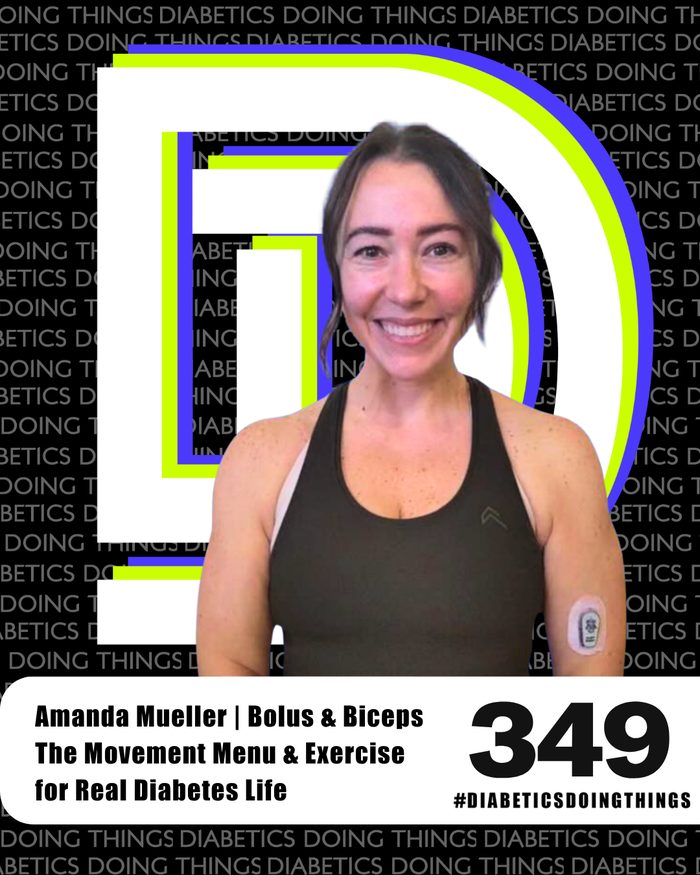
The Movement Menu & Exercise for Real Diabetes Life with Amanda Mueller (@bolusandbiceps)

Episode summary
Amanda Mueller was diagnosed with type 1 diabetes in her mid-20s in 2007, after mistaking early DKA weight loss for the results of a dance class. She describes years of being afraid to move her body before joining a gym at 30 and meeting her now-husband Cameron, a trainer who helped her rebuild confidence around exercise. Amanda, a certified personal trainer and corrective exercise specialist, explains her Movement Menu, a flexible list of activities chosen by energy, stress, and blood sugar on a given day, built so people keep coming back instead of treating a low or a missed set as failure. She and Rob discuss why exercise doesn't have to feel like punishment, how stress and blood sugar connect, and close with a playful draft of their favorite diabetes-friendly movements.
Key takeaways
- Amanda spent years afraid to exercise after her type 1 diagnosis because her healthcare team focused on her A1C, not on movement.
- Her Movement Menu is a rotating list of activities picked by energy, stress, time, and blood sugar that day, so there's always a backup option.
- Amanda says stopping to treat a low during a workout doesn't erase the muscle, glucose, or mood benefits already gained from it.
- Rob and Amanda agree exercise works best as a behavior you build and sustain, not a personality trait you either have or don't.
- Amanda's own movement menu picks are lifting weights, incline walking, and roller skating.
Show notes
Exercise is one of the most recommended tools for living well with diabetes and one of the most complicated to actually start. In this episode, Rob sits down with Amanda Mueller (aka @bicepsandbolus), a certified personal trainer, corrections exercise specialist, and CPA who was diagnosed with type 1 diabetes at 26. Amanda's honest about the years she spent afraid to move her body after diagnosis, the roundabout way she fell in love with strength training (spoiler: she married her trainer), and why she thinks the whole "exercise is good for your diabetes" conversation is being framed wrong.
The centerpiece of this conversation is Amanda's "Movement Menu", a practical framework for building a sustainable exercise life that actually accounts for bad blood sugar days, low energy, decision fatigue, and the reality that most of us are not elite athletes trying to optimize every workout. The goal isn't the perfect workout. It's the one you come back to.
They also go a little deeper and discuss why exercise shouldn't feel like punishment, how chronic stress and blood sugar are more connected than we talk about, and why going low in a Pilates class doesn't mean the class didn't count. If you've ever used a bad diabetes day as a reason to skip a workout and then felt guilty about it, this episode is for you.
They close things out with a live "Exercise with Diabetes Draft", each picking three movements they'd want on their personal movement menu, and why. It's fun, it's practical, and you might find your new favorite workout buried somewhere in it.
Chapters:
00:00 Introduction and Amanda's background
02:31 Adult diagnosis and the fear that followed
04:27 Losing weight in DKA and what came after
06:22 Meeting her trainer husband and rediscovering movement
08:08 Why the right people are force multipliers
09:45 Wanting to feel strong again: what that really means
13:36 Why exercise is a behavior, not a personality trait
16:04 The Movement Menu explained
18:09 The best workout is the one you actually do
20:13 Releasing judgment around imperfect workout days
24:40 The calorie math trap: why your class still counted
27:48 Exercise as a stress reset in 2026
29:32 You don't need more time, you need less friction
31:22 The Exercise with Diabetes Draft begins
40:27 Keeping it simple, sustainable, and fun
Resources:
Amanda Mueller on Instagram: @bicepsandbolus
Movement Menu Document: Comment "MENU" on the podcast post on Instagram (@diabeticsdoingthings) and Rob will send it to you.
Atomic Habits by James Clear: referenced in conversation around small, compounding habits: atomichabits.com
Questions this episode answers
What is Amanda Mueller's Movement Menu?
It's a list of different activities, grouped by intensity and type, that someone can choose from based on their energy, stress, time, and blood sugar on a given day, so there's always a sustainable option to fall back on.
Does a low blood sugar during a workout mean the workout didn't count?
Amanda says no. Stopping to treat a low doesn't erase the calorie burn, muscle building, or mental reset already gained from the exercise before that point.
Why was Amanda Mueller afraid to exercise after her type 1 diabetes diagnosis?
She was diagnosed in her mid-20s and says her healthcare team's focus was on lowering her A1C, not exercise, so she spent years working through the emotional side of diabetes alone before starting a gym routine at 30.
What exercises does Amanda Mueller recommend for people with diabetes?
In the episode's draft segment, she picks lifting weights, incline walking, and roller skating as her personal go-to movements, while Rob picks rucking, rock climbing, and hanging from a bar.
Full transcript Searchable, with timestamps
Rob Howe: Welcome back, podcast listeners. Boy, we have a good episode for you this week as we continue to explore living well with diabetes. Amanda Mueller is my guest. She's a personal trainer, a CPA, and has lived with Type 1 diabetes for 19 years. You may know Amanda as Biceps & Bolus from her Instagram account, where she digs deep into simple guides for improving your diabetes management, but also your relationship with diabetes. You may know her from her Whiteboard Wednesday content. That's some of my favorite. I'll say when she gets the whiteboard out, prepare to learn something new about the nuances of diabetes. diabetes. I invited her to the show to speak about exercise and its impact on the physical side of living well with diabetes, but specifically on getting started with exercise. I've been a competitive athlete my entire life, and I realized my story may not connect with someone who's just getting started on their exercise journey. And I think Amanda does an excellent job of providing tips and encouragement for people getting started with exercise. If you want to get Amanda's movement menu document, which we talk about in the episode, you can comment menu on the podcast post on Instagram and I'll send it to you. Enjoy the episode. Guys, who was MVP of the chat? Rob Howell! Rob Howell! What were you on? We need more of that. Hello, welcome back to another episode of Diabetics Doing Things. We're continuing the series of living well with diabetes and all of the physical, mental, social, and financial elements that go into that. And something that I had not really considered up until this year was that my experience as a person with diabetes, as an athlete, as a person who was very into exercise and sports prior to being diagnosed and kind of has always seen myself as a person who exercises, is that that may not resonate with some people and it may prevent them from getting started. And so I'm really excited to dig into this episode. I've got Amanda Mueller here. You might know her as bolus and biceps, the bolus first. And we're going to talk a little bit about starting an exercise practice today and why that might be paralyzing, getting analysis paralysis for some people. There's a lot to consider as well as how to choose an exercise. And then we're going to have a little bit of fun towards the end and do a diabetes and exercise draft for you guys, because I've been teasing out draft content and haven't really delivered on it. But today, I think, is the perfect opportunity. Amanda, welcome to the show.
Amanda Mueller: Hey, so glad to be here with you, Rob.
Rob Howe: So glad to have you. I know we were looking for opportunities and topics to bring you on the pod, and this one, I think, is perfect, right up your alley. So just to get started, why don't you introduce yourself to our guests who may not be as familiar with you?
Amanda Mueller: Yeah, sure. So I'm Amanda Mueller. I'm a Texas native from Dallas. Rob and I share that as well. I am 42, almost 43, and I was diagnosed with Type 1 diabetes in my mid-20s back in 2007. So there's, I feel like in our community, the more we get to know each other, the more people I'm realizing are having an adult or even later adult life diagnosis. But, you know, I know that getting to know you better, you have a completely different story with diagnosis as a child. So it's really unique how our journeys bring us together, but our stories are just so different. But I live in East Texas now with my husband and our two dogs. And I'm a certified personal trainer and certified corrective exercise specialist, which I love. And we can get into that a little bit more as part of my exercise journey. But I'm an accountant by trade. I own and operate a boutique accounting firm. and I love working with entrepreneurs and small businesses and helping them keep their businesses afloat. That's why I jam out to every day. I love it. And also, I feel like there's a
Rob Howe: lot of, maybe it's just on the measurement or on the tracking or just the types of math that you're doing. There's a lot of parallels between training and accounting, which maybe we'll cover on another podcast somewhere down the line. So let's talk about it. Your diagnosis in your mid 20s, like you said, diagnoses look different for everyone based on where they are in their lives. But the more we talk about them, the more we realize we're all kind of running into the same things. I imagine that you had at least some experience, whether it's playing sports in your school days or exercise practice. How did you, after your diagnosis, come to approach thinking about where you were then to where you are now? What were sort of the trial and error? What sort of curiosities did you have? Did you have any help? Like, how did that process go for you?
Amanda Mueller: So I want to briefly touch on a part of my diagnosis story in relation to this, because I was taking like this really fun gym, hip hop dance class at the gym in Uptown. And I was like losing a bunch of weight and I was like feeling myself right. And I was like, this is working.
Rob Howe: Meanwhile, I'm in DKA. Yeah. Right. Nobody knows about it. It's exactly what I needed.
Amanda Mueller: Yeah, who knew that like, you know, 30 pounds in a week was like the way to go with hip hop. That's a bit dramatic. But so obviously, that's not what was happening to me. I was in DKA. Obviously, hip hop was not doing quite what I thought it was. But I think that's an important component of my story because after diagnosis, I was really afraid to move my body. You know, here I was in my mid-20s. I was on paper, legally with the government, a full-fledged adult, right, and living on my own and had a full-time job. And now I'm responsible for, like, sticking a needle in myself every day and keeping myself alive. This is crazy. So exercise was the last possible thing on my mind. And honestly, it wasn't support or recommendation guidance I was getting from my health care team. And I'm not even saying that to like dig on them. It just wasn't the priority from them at my health care visits. It was really more about like, hey, you have an A1C of a 10. Like, how do we fix that? Right. Exactly. So I spent several years just trying to kind of navigate diabetes and being on my own and finding my own identity and kind of working through the emotional shame of it and what dating looked like. And so when I turned 30, I was like, you know what? I don't need anybody. I'm a strong, independent woman, right? Like, I got this. I'm, you know, several years into this diagnosis, and I am going to join the gym and figure this out. And that's when I met my husband, Cameron, because Cameron was my trainer. I love it.
Rob Howe: All of the trainer, client horror stories have been, we've got one in the other category here. We've got a winner.
Amanda Mueller: Yeah, there's like a trend going around on Instagram right now that's like, you know, there'll be a time when you are, you might be tempted to blank, you should do it. So like, hey, there may be a time in your life where you're tempted to go on a date with your trainer. Two thumbs up from me. All right. So that's really, I mean, I had the motivation to incorporate exercise into my life, but, you know, falling in love with my trainer was just kind of playing the long game really on incorporating and sustaining that in my life.
Rob Howe: The downstream effects of marrying your trainer. I mean, there's so many.
Amanda Mueller: Yeah. And now I'm a trainer. Kind of crazy. Having Cameron understand what type 1 diabetes was from a training standpoint and also from a partner standpoint was really beneficial to me. And he just was so encouraging to me to not feel afraid of exercise and to try different kinds of exercise, swimming, strength training, you know, cardiovascular activities, taking some cycling classes, just really mixing it up. And he made me feel really confident that like, hey, you can do all of these things. You know, you're young, you're strong, and you have this disease that sucks, but like, we'll figure it out. And at the end of the day, you know, doing the tracking and the analysis on what my blood sugar responses to these movements is and always has been my responsibility. But it helps to have a partner in that. And you don't have to make your health coach or your trainer your partner with a capital P. But you should be working with someone if you are working with someone that understands enough about your diabetes that can kind of help you be patient with you, help you kind of figure out what works best for you. I think that's so important.
Rob Howe: Well, I think we can all think about, no matter what our backgrounds are, having the right people in your life, whether it's a manager, whether it's a teacher at a school, whether it's a mentor or a parent or a coach, like all of those things I think are force multipliers in your life. I was trying to think of that phrase last week, force multipliers. I was like, it never, and then it popped right back into my brain. But it really is like a force multiplier for what you're doing. And you can take big strides and big advances ahead. So it sounds like Cameron was that for you in a lot of ways where kind of giving you the support you needed to give yourself permission to try new things to explore. Because I want to dig into what you said earlier, which was that you were afraid. And that's, I think, where a lot of people find themselves, especially early on or as they're navigating a new part of their life, like on their own, working on their own, legally an adult, but making their way in the world and don't necessarily have it all quite figured out yet. And this is where I think my experience with exercise and as an athlete doesn't necessarily connect with a lot of the community or a lot of the listeners, because that was really the first problem I had to solve. And I was so determined to do it that whatever the results were day to day, I was just committed to knowing that that was the necessary tax, so to speak, the cost for living the life that I wanted was to figure that out. And so that's why I wanted to have you on. So let's talk about the like overcoming those first, like what was it that maybe made you sign up with a trainer or maybe made you explore going back to a class after you had, like you said, worked with your care team to kind of get the basics under control?
Amanda Mueller: So I remembered a time in my life before diabetes in my early 20s where I felt active, felt, I don't want to use the word fit, but I just felt strong, felt strong. And that can mean that I can translate in many different ways to people. But I missed that. I craved that. And I wanted to feel strong again. I wanted to feel healthy again.
Rob Howe: and I want to pause on that because I think it's really good you said not fit but strong is that like a byproduct of confidence is that really what it is or like assuredness or comfortability in your own body like or in your own skin like what comes up for you there or is it more of like
Amanda Mueller: a physical you know kind of response yeah that's a great question I think it can be both you know at 30 I was living alone in my own apartment and so there's some physical strength there like I I want to be able to move the couch so I can vacuum under it by myself. You know, I want to be able to carry in all my groceries by myself. I wasn't actively dating. And I, like I said, I mean, I wanted to be this, embody this independent woman that I was at that part in my life. And being able to lift heavy things was important to me because I was living alone. But there was also definitely a component of self-confidence. There is an aesthetic piece there. I mean, we all look in the mirror and want to feel good about what we're looking at. Our standards and measurement of that standard varies individually. But I'm not going to lie and say, oh, I don't care what I look like. That's not true. And so it's a mixed bag of those things. But I don't think when I said fit earlier, it was to me that's more like muscular definition. It certainly has like the kind of thing. And that's not what I meant.
Rob Howe: Well, I think you think now, especially this is something I've been noticing both in the diabetes world and outside is like when you come across accounts on social media, sometimes there are distinguishing categorical modifiers. Fit is one of them. So it's like a person's fitness account or it's a T1D account or, you know, it'll say, you know, Rob T1D, for example. And so I think like that's maybe what comes up for me is like when you're talking about fit, you see that sort of aesthetic of someone who is, you know, building muscle or sharing a fitness journey of some kind. So, yeah, I think I was a good modifier. And I think, like you said, fitness and exercise look very different for a lot of people. I think even myself, like it has changed what my priorities are, how I like to feel, everything from what types of exercise you do to what supplements you take or what programs you're on. And all of those things are ever changing. And I think depending on who you're talking to and what time of day, like everybody's goals are different. So I think it's important to be able to find a healthy balance and healthy expectation as to whatever it is that you're trying to build towards.
Amanda Mueller: Absolutely. And I had definitely gained some good old LBs, you know, between diagnosis and where I was, like I said, turning 30 and ready to do something different. And I was just inactive. And that goes back to what I said at the beginning, which was I was afraid to move, you know. And I was in my 20s. I was having a good time. I wanted to be social. I wanted to go out to eat. I wanted to drink alcohol. And I'm not saying you can't do those things now and have good diabetes control and have good exercise implementation. You can do all of those things together and be healthy and feel good about yourself. But I wasn't at that point. And so I didn't feel good about physically feeling strong and also like emotionally feeling strong and having that confidence. So, you know, I had played sports since I was a little kid. I can remember playing sports. I did not play sports in college, but again, I was very active. I liked to run. And something I realized about myself, though, is that like exercise was not a personality trait for me. It was more of a behavior. I think maybe you're very different. Maybe you're the exception, not the rule, being an athlete, right? But I think globally, the majority of people, exercise is not a personality trait for them. I think you can fall in love with it. And I am in love with movement now. but it's still a behavior that I have to work on. And some days I have to psych myself up to do. And so I wanted to find a way to incorporate movement as a behavior in my sustainable routine because I did know that it would help me lose some weight. It would help me feel better about myself. It would help my diabetes. I didn't know to what level, right? This was like ground zeroes in the basement of this new chapter in my life. But I knew I had to do something. And so joining the gym was like step number one
Rob Howe: for me at that time. I love that. So let's touch on exactly what you just mentioned, which is that, and I just did an interview on the podcast with Claude. So when you ask or you Google or you're talking to people about like, what are the things that you can do in your life to help improve, to help yourself live well with diabetes? Exercise is often one of the top three things. And I think it, again, it encompasses this wide range of exercise. And like you said, I am recognizing that I am different. I think if I had nothing else to do, if we all woke up one day and didn't have to labor in whatever professions we would do, I would still exercise because that's what I love to do. It's part of my, it helps my brain, it helps my body, and it's just what I've done my whole life. And so recognizing that not everybody is like that, I think it can be a little bit intimidating to say, okay, exercise is good for diabetes. And then you look in like, okay, how do you start exercising? Or what do you start to do? And you start to see these things like, I think often in your late 20s, mid 20s and 30s, marathons comes up or Pilates or yoga or weightlifting or, you know, bodybuilding or something maybe even more dramatic. Triathlons, for example. These are kind of intimidating things. And certainly not while there are building blocks, you think of things like couch to five day or, you know, going to beginners classes. Having a beginner's mind in your late 20s, early 30s can be really challenging because you've got a lot of all of the other things in your life kind of figured out at that point. So I guess for you, when you decided to go back into the gym, where did you start? And what advice would you give to somebody who maybe this is their first time post-diagnosis or the first time since they were in a PE class in high school, and they're starting their exercise exploration to help improve their life with diabetes and
Amanda Mueller: whatever other physical goals that they may have. So I started strictly with cardio and I actually think that that was a mistake because for me, that was a time where I was really focused on, I just got to burn these calories. I want to lose this weight. I've got to drop my glucose. I didn't know anything about, you know, caloric intake, macros, you know, high protein, carbs fuel my body. I didn't know about any of that. And I kind of burnt myself to the ground a little bit on the flip side of it. So I'm just being honest. That's the transparent story of that chapter. Is that what I would tell clients now or even just a friend or somebody that sent me a random DM on Instagram? Absolutely not. I would talk to them about what I kind of call the movement menu, which the core framework behind that is just it's just a list of different activities or types of activities that you can choose from based on your energy that day, the time of day, your stress level, what your blood sugar has got going on, what's your motivation level. And that can be a mix up of strength training, you know, high stimulus like circuit training, sprinting. It could be a low intensity workout like taking a nice slow hike, going for a walk. It could be swimming. It could be playing basketball. It could be dancing it out. And a lot of times I'll tell folks like this is your time to explore what you want your movement, like your sustainable movement to look like. Meaning it doesn't have to be the same thing every time. I personally really love strength training. That's my jam. And I do that four days a week. I do mix in other things, but like that's what I fell in love with. But if you love dancing, then you should dance.
Rob Howe: Let's talk about this because you said the L word, which is something I guess a year ago I did. Sometimes I get asked to do interviews about exercise and diabetes. And even though I'm not, you know, an exercise scientist, I have enough experience where I can talk about it, at least from a lay people's terms in a way that doesn't get me in trouble. So that's great. Keep asking me to do that. Thank you guys for always doing that. On the other side, though, I think something that really clicked for me is the love word. The reason I play basketball and the reason you lift weights, it sounds like, is because you love to do them. Like, so whether that's you love the result, you love the process, maybe both. That's such a great place to start. And everyone is so different. We're always highlighting like, oh, everyone's diabetes is different. And yeah, that's true. But that's mostly because everybody is different. It almost has nothing to do with the diabetes. We are just all very different people physiologically, emotionally, mentally. And so we, of course, all like different exercises. And somewhere along the line, I think exercise gets positioned to some people as punishment or as some sort of suffering. And the reality is that it doesn't have to be. And that starts with liking whatever it is that you're doing. If you hate going to some exercise class, like stop going. There's plenty of other things that you can do. If you love throwing the frisbee around outside and that's the only exercise that you bring yourself to do on a regular basis, I got good news for you. It's exercise. So just do that.
Amanda Mueller: That's right. Yeah. The best type of workout or movement is the one that you do without having to constantly negotiate with yourself to do it. So this is your chance to explore and change your mind and change your mind and change your mind again. and that's again what I love about like this movement menu idea is make a list of like hey this month I want to try these five things and some of them can be things that you know you're good at and that you enjoy and some of them could be things you've never done before like underwater basket weaving I don't know and give it a try and maybe you'll love it and maybe you'll be like like you said Rob this sucks I don't want to do this anymore that's okay cross it off the list but given the fact that we have this crazy weird disease right that can like drastically impact how our day is going to operate, even if we feel really good, like we feel like, oh, we know what we're doing. We feel in control. Diabetes can creep up around the corner and surprise us. And so giving yourself the freedom to have options that still make you feel good about what you're doing based on, again, your stress, your time, your energy, your blood sugar, what your motivation level is, all that can be done with joy and accomplishment versus the idea of punishment. I have to do this. So I appreciate what you said about that because that's where my mind is now. And it wasn't initially. It's taken me a while to get there. But now you can hear me singing it from the rooftops because I don't want people that live with type 1 diabetes. And I don't want parents or caretakers of those with type 1 diabetes to feel like we've got to have exercise to bring blood sugar down. I think that creates such a negative connotation about it. And I want to help people turn that around.
Rob Howe: I love the menu idea also from a systems think perspective where it's like, OK, I have this system and on days that I feel good, maybe I'll do one movement or on days where I have more time. But what about a day that I don't feel like doing something or I have a bad attitude because like I'm guilty of those like or I didn't sleep good last night or my kids kept me up or my job, my boss was really on me or something didn't go my way. Like, what do you have that you can get to that allows you to move that forward? Because I think the best exercise is the one that you can return to when you have like nothing else in the tank and you're still able to to advance that forward. And that's maybe like I think maybe it's that type of thinking, I think, is pretty popular now for like the James Clear Atomic Habits type of crowd. And where, you know, if you just read one page in a book a day, you're probably going to read more than one page. So if you just go to your gym and you make sure that you're in your exercise clothes, you're probably going to find something to do once you're there. Or if you just commit to doing five, warming up and doing five squats, you'll probably do more once you're there to do that. So I think that's a thing that I really like about that movement menu because life is busy. Diabetes is unpredictable at times. And having something that's more of a backup plan to say, well, I planned on doing this kind of exercise or this kind of workout today. I'm not able to do that. Most of us are not elite athletes, myself included. and so we can kind of skip a day or we can scratch a workout and be curious about what happened but avoid the judgment side, which is I think where a lot of us start to beat ourselves up. Like we're going to have suffering in our life. We're not going to have every, every workout's not going to be perfect. I spoke with some parents of kids who are athletes as well as some athletes the other day. Scratching out of a Pilates class or like having to go eat a bunch of Starbursts in the gym, it's not a moral judgment. It's not a moral failing or a character flaw. It's just life with diabetes, which is really challenging. So, you know, I think if we can release ourselves of like something might go wrong today or, man, I was really prepared every other day this week. But today I wasn't or I had a bunch of insulin on board and I didn't account for it. And here I am sitting on the side of class because I think the perception is that everybody's looking at us and judging us with that. But really the only person that it is is ourselves. And so I want to give everybody who's had a tough experience or maybe beat themselves up a little bit too much on that permission to just let that go. And remember that it's not, you know, having a high blood sugar after a hit class is not a judgment on your character.
Amanda Mueller: Yeah, it's not. And I think a lot of times people also associate having to stop and treat or take a timeout, literally sit on the bench, exit a class early means that their workout didn't count. right and that blood glucose is just a data point and i don't want to diminish the weight or even the emotion you feel around that blood glucose at that moment that's super valid but what you do with that information i think is going to help motivate you and guide you on how you can re-enter that because let's say you tried pilates and you were like really into it and you were having a great time you like the music you like the vibe you like the instructor it's good community and then your blood sugar drops to 50 and you're like well crap now i gotta stop don't let that data a point ruin your ability to go back and experience all those positive things. Because exercise is about community. It's about calorie burn. It's about glucose utilization. It's about, you know, mental load or mental reset, I guess. And it's just so important for us, like physiologically, mentally, nervous system regulation, and not just because we're diabetics. And I know you said something earlier about how we hear a lot of talk, well, you know, if you're type 1 diabetic, You need to be in the gym. You need to be working out. Everybody needs to be moving their body, whether you have diabetes or not. So just because we have diabetes doesn't mean we should be moving. There are benefits that can help us with long-term glucose uptake and glucose stabilization related to exercise and building lean muscle. But everybody should be moving their body because of just general health benefits.
Rob Howe: I want to double click on that, too, because in that Pilates class example, right? No matter what happened with your glucose, that Pilates class was still good for you. It was still good for you to do. it's still a small, like that going low in that class, in that example, it's a small time frame, like you're going to correct it. And then also on the calorie side, like I think a lot of people get caught up in this sort of judgment as well, where like, oh, I only burned, you know, they're on their calorie tracker, which by the way, like grossly underestimate or overestimate how many calories we're actually burning. So like, that's a whole other podcast. But you look at that and you say, okay, well, I burned 500 calories, but I had to eat 300 calories worth of Skittles to get my blood sugar back up. This didn't count. I now have to do more. And I would say like, you know, it's not a one-to-one ever. And the most important thing is that you continue to exercise and that you stack those days. Because while, yeah, that's probably really frustrating as a person who is counting calories and trying to operate on a calorie deficit for one reason or another, that exercise was still good for you to do. Like you're going to see those caloric benefits, those strength benefits, those glucose uptake benefits long after that class is over. And so, you know, beating yourself up about that or acting like it didn't count simply just isn't true.
Amanda Mueller: That's so true. And I mean, muscle burns, burns fat, burns calories at rest. And it does. And I'm not again, you don't have to be in a gym lifting heavy things to build lean muscle. A Pilates class is a great way to get some lean muscle happening. But, you know, my accountant brain is thinking about quickly about how sometimes I have conversations with clients that are like, oh, I really want to reduce the amount of taxes I owe to the IRS. So I'm going to go out and spend $5,000 on a new computer and printer. And I'm like, well, hey, guess what? It's not a one-for-one. Just because you paid $5,000 doesn't mean you actually get to pay the government less $5,000. Don't think it's not always a one-to-one transaction. It's not always a one-to-one in and out. And I love that you just said that about the caloric burden you had versus the input of the calories maybe you had to take to bring yourself back up. It doesn't negate the hard work that you did. It doesn't negate the long term impact that that class had, not just on your muscles and on your glucose, but on your mind, body, soul. Right. Like, I'm not trying to sound, you know, geeky saying that, but it's so true.
Rob Howe: No, it's woo-woo. It's like it's the central nervous system. It's like your mind is part of your body. The chronic stress reset. All of that stuff is actually real.
Amanda Mueller: You remember that movie Legally Blonde? How could I forget? But when she is like talking about it was Allie Larder's character and she was like she didn't kill her husband and the attorneys don't believe her. Right. And she's like, because she's a fitness instructor and she's got endorphins running through her body. And that means she's happy and happy people don't kill their husbands. If you get out and move your body and find community. I mean, I like to go on solo walks and work out alone, but I like a good class, too, where there is community and I'm learning from people and they're learning from me. You walk away from that feeling good about yourself. And maybe you're having a great diabetes day and that was just, you know, the cherry on top of the sundae. But maybe you're really struggling and that helped your mind settle and your heart feel better. That's actually going to be great for your diabetes management, too.
Rob Howe: I totally agree. And I'm going to tack one last thing on that because we're currently on screens. We're currently on, we're seated, we're inside. And our brains and bodies are not wired for the abundance of today. We could have a thought during this podcast, jot a note down, and then immediately order that item, whether it's food or some sort of consumer item, and have it delivered to us probably today, probably in a few minutes. And imagine explaining that to like your great-grandparents and how crazy that would be. And so, you know, one thing that we can do, like we don't move our bodies as much as we used to. We're not all farmers. We're not walking a lot of places because we have the luxuries of modern technology. and we also have more chronic stress than any generation before us because we have that little screen that we carry around in our pockets and emails and texts and good news and bad news can find us anywhere that we are and we have the same response to those things the same fight or flight response as if we were walking on a trail and a snake walked by us and we would jump back and we would say oh my gosh that's dangerous i should get away we have that same response with social media comments with emails that come in and things like that. Rage baiting, everybody's probably familiar with that term. That's an actual physiological response that's happening in your body to something that feels dangerous or makes you angry. Exercise helps you clear that chronic stress because it's acute stress. A stress is not always a bad word. A heavy item that you're moving around or that movement menu with a big thing on it that you really have to exert yourself to tackle is good for you. Clears that out, gets you back balanced. And is, I think, you know, a literal weight that you can move to get those metaphorical weights off your shoulders, you know, living as a person in 2026.
Amanda Mueller: Yeah, it's so true. And it doesn't take a lot of time. This is something I have talked to, you know, with the women I've trained and just general conversation with people online is most people think they need more time. You know, they'll say, Amanda, I don't have an hour to spend in the gym. You don't need more time. You just need less friction, right? Like you just need that repeated stimulus and you don't have to be able to work out for an hour or two hours. Sometimes I'm at the gym for an hour because I spent 20 minutes of that talking to my gym friends. Like I'm not in there from start to finish for 60 minutes lifting weights the whole time. It's kind of become a social place for me and I like that. But if I really timed myself with no interruptions, most of my workouts are probably lower like 30 to 40 minutes. And it doesn't even have to be that long either. But to your point, what you just said, which is so beautiful, you don't need a lot of time to be able to kind of reset or flush that out of your system. Really, sometimes it's just that like I need to like snap, get out of it, get out of what I'm doing, get out of that stimulus and move into a stimulus that is better for my body. that's more regulatory, that's going to help bring down that itchy, that cranky, that feeling I've got going on that will help neutralize and stabilize blood sugar, neutralize our mood, but also helps improve our glucose by movement, by joy, right? Like those are the long-term things we want to spend our time doing, I feel like for me.
Rob Howe: I love it. Okay, I think this is a good time for us to transition, and I think it's a nice cap on the movement menu. So I think basically what we're going to be doing is developing our own movement menus for everybody here on the show. So we're going to do a draft. There's only two of us. So it's like it's basically you get it or I get it, depending on what it is. But I even like wrote some of mine down. So I've got some I got a draft strategy. If nothing else, I'm a general manager here. So this is what we're going to do. This is the exercise with diabetes draft. So each of us are going to take turns picking three exercises with diabetes that we want to have in our shelf, I guess, on our team. And then we'll publish these as a social media video. So you're going to have the first pick in the draft. And again, these are not ones, they don't have to be the best. These are just your personal picks. So whatever. And then with each one, we'll explain why we picked it and kind of go from there.
Amanda Mueller: So are we doing like the type of movement or like a specific movement?
Rob Howe: Yeah, it's a great question. It's more of the type of movement. So for example, yeah, you would say like running versus like a 5K.
Amanda Mueller: Okay, got it. Okay. So with the first pick. Well, lifting weights. Is that too broad?
Rob Howe: No, no. That was number one on my draft board. So like I was like, if you don't take it, because like walking could have been one that was like a top pick. You know, there's a lot of top prospects here, but lifting weights. So yeah, why was lifting weights your number one?
Amanda Mueller: Because I have found just over the years now with consistent, sustainable strength training, my reduction of insulin needs and just my time and range has increased so much because I have grown my insulin sensitivity significantly from lifting weights.
Rob Howe: I heard somebody say this last fall. Nobody ever regretted being stronger. It's just that just really connected with me. I love it. Okay. So off the board, off the big board, lifting weights, number one overall pick. I love it. Okay. I'm going to zag a little bit here. I'm going with my number two pick. I'm going rucking, which is a very popular thing. I do not do it very often. I'll caveat it with that. I might do like a farmer carry where I carry like a kettlebell. The reason I'm picking that is because one thing I love more than anything else is improving my insulin sensitivity. and sometimes walking takes a little bit longer. Like you said, sometimes you may have an hour on the calendar, but I may not be able to get an hour in today. So best bang for my buck in terms of getting my insulin sensitivity really cranking, grabbing a heavy thing and walking a little way. So rucking is my number one pick.
Amanda Mueller: Okay. So I don't think I'm stepping on your toes with this one because I'm going to say incline walking.
Rob Howe: Okay. I like it.
Amanda Mueller: And whether that's treadmill, cranking that bad boy up, or honestly walking in our neighborhood, the neighborhood my husband and I live in, the hills are like treacherous in here. And I think it's still a great way of like low intensity, steady state movement, which I love. There is so much research on how just walking, especially with some incline walking or rucking can be really good for fat reduction and great cardiovascular health. So that is something, especially on those days, it's a movement menu item for me, because if I don't have the time or my blood sugar is being really sticky or I didn't sleep well, and I know I want to move, incline walking is going to be my best friend that day. What's your treadmill setup for an incline walk? Like the numbers. It might depend, honestly, on like how much energy I have that day. And it could also depend on the actual machine that you're on, truly. But I mean, I'm probably pushing that up to like at least a four or five.
Rob Howe: On the incline?
Amanda Mueller: On the incline, yeah.
Rob Howe: And then how fast do you typically go? And every treadmill is going to be a little different.
Amanda Mueller: Maybe around three miles. Like set it at a three. I feel like that's good. But I mean, gosh, what is a steady walk for me? Like a fast walk or a mall walker? if you will, is going to be a different speed than my husband because our anatomy is so different. He's so much taller than me.
Rob Howe: Yeah, I think mostly I just want to give people some sort of frame of reference. It would be different for me as well. But I think what's interesting about incline walking or especially on a treadmill is how quickly it sneaks up on you. At first you're like, oh, this isn't that hard. And then two minutes later you're like, whoa, how long are we going to do this? Yeah, exactly. It's something that I would encourage people to look into if they've never done it.
Amanda Mueller: Yeah. Maybe match your threes and fours. So meaning speed and incline, threes or fours, see how that starts for you. And then you can gauge it based on your energy level, your time, your height, all those factors. I love it. All right. I'm going to continue my
Rob Howe: oddball selections here. I'm going rock climbing because that is something that I think is more popular, like bouldering or like rock climbing communities. I'm going to give it two reasons. Number one, you talked about this, like talking with your gym friends. I think that's a really good group activity, a social activity, if you're looking to meet new people and meet kind of people who like doing what you're doing. It's also non-traditional kind of meathead exercise. So I identify as a, my pronouns are dude bro, and I am prone to my meathead tendencies in the weight room. But when you're talking about like connectivity in terms of like being extremely strong, I'm sure that you guys have seen maybe social media videos where like a rock climber and a bodybuilder are like, you know, showing how strong they are. And a guy who has a ton of big muscle may not even be close to as strong as someone who's like kind of lean and sinewy from rock climbing because you're using your hands, your core, your legs, all those things. And I'm a big person. You know, I'm not shimmying over rocks very often, but whenever I do, you know, a lot of my focus is like getting low, staying strong on one leg, on one arm, really building up that strength and core capacity. And it's a great way, like crawling around on the floor is such a great way to get your insulin sensitivity up, as our parents with diabetes can surely attest.
Amanda Mueller: Yes, absolutely.
Rob Howe: Number three, rounding out your draft.
Amanda Mueller: Roller skating. Oh, I love this one. So man, back in my heyday in elementary school, grade school, we went to the roller rink Friday, Saturday, Sunday. I mean, that was my jam. And so now I put on my elbow pads and my knee pads and my shin guards. I know that the kids in our neighborhood are like, look at these two grandma and grandpa out here roller skating. I don't care. I bought myself a pair of lime green roller skates and we bust them out when the weather's right. As you know, Texas can get really hot and sometimes outdoor activity is just not helpful with blood sugar management. But right now it's the perfect time. So we started skating again. And, you know, my husband and I will do it together sometimes. But I like to put in my earbuds, listen to some music. It's a great lower body workout. It's a great sweat workout. And even though lifting weights is like, that's my number one jam, I'm actually an upper body day girl, lower day body, not my favorite thing. So this is a way for me to make sure I'm really like using my legs in a powerful way. That's a little bit different than my number one love, right? Like it kind of helps bring it back full circle for me. But I don't know, like, I feel really proud of myself that I'm like almost 43 years old. I'm out here roller skating.
Rob Howe: I love that. During COVID or pandemic times, my wife and I lived right next to a trail that was not a trail in the true sense of the word, but like a paved trail. And we got rollerblades and were like blading during the pandemic when there wasn't as much to do. I haven't done it a lot recently, but absolutely agree. It's also low impact. So you can go a long way. You can kind of go fast. And your body is not paying for it as much the next day, but you still get the great heart rate. So get the great, get a really good sweat going. and get the music pumping and have a really great time.
Amanda Mueller: Yeah, yeah. I've never been on a pair of rollerblades. I only know how to roller skate. I'm the exact opposite.
Rob Howe: So we're on the yin and yang of blades and skates. Anybody, if you're getting on wheels over the age of like 18, respect to you. That's how I'll end that one.
Amanda Mueller: Okay, what's your last one? I'm excited to hear.
Rob Howe: Okay, so I got a couple of things here on my list, but I'm going to pass on them. And I'm just going to go, like this one is not, it's not a weight. It's kind of in between weightlifting and rock climbing. I'm going to go just like hanging from the bar. So this is something I think, again, almost anybody can do. And it's something that you can work up towards. You can scale, like you can put a bench underneath and you can keep your feet on the bench and drop your knees and just hold. It's one of the, I think, you know, all the longevity experts talk about something that can really correlate towards all cause mortality, which is like your likelihood to die. and being able to hold yourself up, hold your body weight is like a 50% reduction in all-cause mortality or something like that. If you can do that for up to a minute or over a minute. So that's something that's really interesting. Again, like it's kind of boring and I like more stimulating exercise, but I like to just hang from the bar that like my back usually cracks. You know, I stand up straight, my hands, my whole body gets connected. And that's something that in a minute, like three, if you did three sets of one minute and took a minute break in between, in five minutes, you're going to be pretty tired and your upper body is going to be on fire. So I think in terms of bang for your buck, I love to find like a passive income kind of lazy way of getting into your exercise routines, especially on days where you're not feeling it. And what I find is I always feel better after I'm hanging from the bar for a little while than before.
Amanda Mueller: Yeah, stamina training, like it's really important. And especially as we're aging, we should be focusing on it. And there's such unique ways to do it. And what you're talking about is a really creative way to do it. Stamina training, endurance training, core training. You don't have to be doing crazy stuff. Hang from a bar for a few minutes in different, you know, a few reps of that. That's a great idea.
Rob Howe: Keep it simple. I think that's maybe a good way for us to kind of transition to the last part of the conversation for this episode. Although I think we're gonna have to have you back. We're going to talk about all the little rabbit trails we narrowly avoided. But, you know, I think keeping it simple, keep it fun, keep it, you know, able to come back to it, leave a little meat on the bone. I think there's a right. If anybody's ever taken like a writing workshop or like gotten into like writing recommendations, Hemingway had a great tip, which is like when you're really in a groove writing, just go ahead and stop and leave a little bit extra so that when you come back, you know where you can begin. And that's kind of how I feel about exercises. You're not going to make up for every exercise that you missed or however much time or levels that you want to cover in one workout. It's going to take compound interest, but it's one of those things, like you talked about muscle, you know, if you do a little bit for a hundred days, you'll look back and be a totally different person than at the beginning. And you'll have learned a lot of things about yourself and about what you like. And that's something that's really valuable, I think, not just in physical fitness and health, not just in diabetes, but in your life in general. And so I think I'd encourage you to find something you like, be curious about it and keep it sustainable. Get something that makes you want to come back tomorrow.
Amanda Mueller: Yeah, it's definitely about building a system, like you said, that works for you, that's going to make you want to keep coming back to it. And again, not to sound super corny, but like I believe this, the goal isn't to find a perfect workout because the perfect workout is the one that you enjoy and that you want to keep coming back to. So again, you just keep it simple. It doesn't have to be overcomplicated. You don't need a lot of time. And we talk a lot about, we hear a lot about decision fatigue. Routine fatigue is a real thing too. And so giving yourself the freedom to have those options, to be curious, to explore, to pick something different or replace, instead of eliminate, replace, will keep you coming back to that system that you've built with confidence instead of feeling like you're always like in debt with yourself. We shouldn't be thinking about movement that way.
Rob Howe: I totally agree. I really like that. And I think the movement menu you've talked about is a great practical example of how to do that. All right, Amanda, well, thank you so much for the time today. I think if I was out there and I was listening to you, I would want to follow you and get in touch with you about getting started with exercise as a T1D, whether it was for adults or for caregivers or for kids. And I think, again, I'm looking forward to connecting our listeners with your resources. And so thanks so much for the time today. Also, we didn't talk about this, but did you buy any coats? Like, what's your coat stack looking like? Because our cold days are like basically behind us. I think like two weeks ago, it was cold. I was like, let me wear all my coats today. How's your winter coat stack going?
Amanda Mueller: Yeah, I think I texted you and was like, I hope you're wearing all of the coats like every hour. Change it up. You know, I haven't put them away. I just won't put them away. and I often will wear a coat in the home sometimes because we like central HVAC happening in here. Took a look at the forecast next week, possibly some high 70s, maybe a light jacket. Some light outerwear? Yeah. Could be time. It could be a trench coat moment happening with some rain in the future.
Rob Howe: You know, if you stay ready, you don't have to get ready. That's right. That's how I like to think about both of our separate coat addictions.
Amanda Mueller: Yeah, if you need a coat, you can call Rob or myself at any time. You won't be coatless.
Rob Howe: And if you have coats that you want us to consider, it's summertime and that's the best time for me to think about what might I want to wear next winter one time for sure.
Amanda Mueller: On that one day in Texas. It was so great chatting with you. I love this so much.
Rob Howe: Of course. And we'll link all of your socials in the show notes as well. Thank you so much for your time, Amanda.
About Amanda
Amanda Mueller, known as @bicepsandbolus on Instagram, is a certified personal trainer, certified corrective exercise specialist, and CPA who was diagnosed with type 1 diabetes in her mid-20s. She lives in East Texas with her husband Cameron, who is also her trainer, and runs her own boutique accounting firm.