

Monique La Bomme - Sponsored by Medtronic
Episode summary
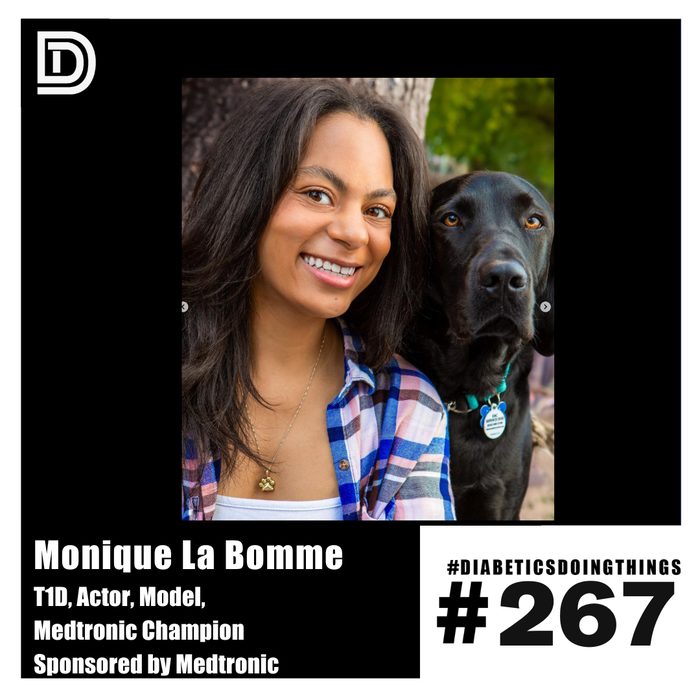
Monique La Bomme was diagnosed with type 1 diabetes at 14, in October 2006, after a week of flu-like symptoms and sudden weight loss that a recent lung specialist visit helped her pediatrician catch before she reached severe DKA. She describes a supportive diagnosis at a children's hospital, including an early peer community and group pump training. Recorded live at Medtronic's headquarters on World Diabetes Day, the conversation covers her two diabetic alert dogs, Waimea and Jolo, with specific stories of each catching a dangerous low or a borderline DKA episode. Monique, an actor and model, also discusses working with Jolo on set, becoming a Medtronic Global Advocate, and pushing for more representation of Black and brown people with type 1 diabetes and more diversity among service dog users.
Key takeaways
- Monique says her first alert dog, Waimea, physically blocked her from walking at Disneyland while her blood sugar dropped from 90 to 60 in about ten minutes, with no sensor on.
- Monique says her current dog, Jolo, alerted nonstop for a day before she tested and found she was borderline DKA, cutting her hospital stay to three days instead of a week.
- Monique was diagnosed at 14 in October 2006; a recent weight record from a lung specialist helped her doctor catch the pattern before she went into severe DKA.
- Monique says her alert dogs typically sense a glucose change 10 to 15 minutes before her CGM does.
- Monique became a Medtronic Global Advocate to push for more representation of Black and brown people with type 1 diabetes and more diversity among service dog users.
Show notes
In this episode of Diabetics Doing Things, sponsored by Medtronic, Rob is joined by Monique La Bomme, in an episode recorded live on World Diabetes Day at the Medtronic Diabetes headquarters in California. Monique shares her experience of living with type 1 diabetes and discusses her journey with diabetes alert dogs and diabetes management technology. The conversation also delves into the importance of representation and advocacy in the diabetes community.
Topics discussed:
1. Monique's diagnosis story and early days with diabetes
2. Diabetes management, technology, and the use of diabetes alert dogs
3. Representation and advocacy in the diabetes community
4. The impact of diabetic alert dogs on people's lives
5. Balancing diabetes management and social life as an actor and model
Here are key takeaways and lessons:
- Monique shares her diagnosis story, highlighting the importance of early detection and the role of a lung specialist in her diagnosis.
- Her positive experience with diabetes management at a children's hospital and the supportive diabetes community during her early days with diabetes.
- The significance of diabetes alert dogs in detecting glucose changes and preventing severe hypoglycemia incidents.
- The importance of representation and advocacy in the diabetes community, especially in showcasing diverse experiences and stories.
- The impact of diabetic alert dogs on raising awareness and inspiring others to consider using service dogs for diabetes management.
References:
- Instagram handle: Monique La Bomme - [@moniquenicolee] (https://www.instagram.com/moniquenicolee/)
- Medtronic - [Medtronic Diabetes](https://www.medtronicdiabetes.com/)
- World Diabetes Day - [International Diabetes Federation](https://www.idf.org/our-activities/world-diabetes-day.html)
00:00 Live from Medtronic HQ: A Type 1 Diabetes Journey on World Diabetes Day
05:09 Navigating Type 1 Diabetes: Community Support and Advanced Technology
09:40 How a Diabetic Alert Dog Changed My Life: Monique’s Story
19:33 Breaking Barriers: Advocating for Diversity and Inclusivity in the Diabetes Community
Questions this episode answers
How does a diabetic alert dog detect blood sugar changes?
Monique says her dog senses when glucose is moving quickly in either direction, even within a normal range, often 10 to 15 minutes before her CGM picks up the same change.
When was Monique La Bomme diagnosed with type 1 diabetes?
She was diagnosed in October 2006 at age 14, after about a week of flu-like symptoms and sudden weight loss.
What does Monique La Bomme do besides diabetes advocacy?
She works part-time and also works as an actor and model, bringing her alert dog Jolo to auditions and sets.
Has a diabetic alert dog ever caught a dangerous low or DKA for Monique?
Yes. She describes her first dog, Waimea, stopping her from walking during a low at Disneyland, and her current dog, Jolo, alerting her to a borderline DKA episode she caught early as a result.
Full transcript Searchable, with timestamps
Rob Howe: Hey guys, just a quick heads up that this episode is sponsored by Medtronic Diabetes. Medtronic is a sponsor of this episode, but the thoughts and opinions of guests and hosts are their own. Enjoy the episode. Welcome back to another episode of Diabetics Doing Things. We are telling the amazing stories of people with diabetes from all over the world. And occasionally, our partnerships and our adventures take us in person to have pretty cool experiences. And today we're recording live on World Diabetes Day. So you can see both my guest Monique and I have blue sweatshirts on, so a sweater and sweatshirt on to celebrate World Diabetes Day. And we are at Medtronic Diabetes Headquarters in Northridge, California. So Monique La Bomme is my guest. Welcome to the show.
Monique La Bomme: Thank you. Thank you. It's so great to meet you in person. So I'm excited.
Rob Howe: It's funny. I will say I remember being here five years ago and like crossing paths with you briefly and just being like, hi, like, hi, bye, like along the way. And so I am excited to have you finally on the show and meet in person and like actually get to talk to you.
Monique La Bomme: That's so crazy that you remember that I do not. I have.
Rob Howe: It's also all kind of like flooding, coming flooding back to me today, like being here at Medtronic, like on campus. It's been a long time, but I've been here quite a few times. So I don't know. I have a weird memory of like, I can't remember where I put my like glass of water. So I'll just grab another one and refill it. So there's glasses of water all around my house, but I can remember really weird, strange details from a long time ago.
Monique La Bomme: Wow. Yeah.
Rob Howe: So Monique, welcome to the show. You live with type 1 diabetes. And from our talk and our panel earlier today, I realized that you and I have had diabetes for about the same amount of time. So why don't you share your diagnosis story and what you remember about it?
Monique La Bomme: So I was about 14. I had just started high school, October of 2006. I think that's also when Nick Jonas was diagnosed. Okay. I've heard of him. Yeah. So I basically for a week, I was really sick. I think I missed like three or four days of school. And by Friday, my dad was like, we're taking you to the doctor. You're either faking or there's something's really wrong. So we went to the doctor and a year prior, I had been diagnosed with pneumonia and my lung collapsed. So I was constantly seeing a lung specialist in between all of this. So I went in, saw my normal pediatrician. We kind of went through the normal, these are flu symptoms, things like that. And then she checked my, and I was 70 pounds at the time, I think. So her and my dad went outside and they kind of had the anorexia talk and they were trying to figure out if that was the situation. So when they came in, both of them were kind of like like lecturing me, but I just so happened to have seen the lung doctor a week before and I was 80 pounds then. So I kind of mentioned that and I was like crying and I was like, I'm not doing this. Like I was fine last week. Um, and that's kind of what made my doctor decide to test, um, my blood sugar and ketones. And then she looked at my dad and she was like, yeah, take her to the hospital
Rob Howe: right now. So, wow. Yeah. So, I mean, really, if you hadn't been to the lung specialist, like you as a 14 year old might not have had the credibility like with your doctor and your dad at that time like obviously they were trying to care for you and figure out what's wrong but they didn't have
Monique La Bomme: all the information yeah exactly i think that would have been pretty dangerous i i know a lot of people have like those crazy blood sugar stories of when they were actually diagnosed like they were in the six or seven hundreds or even higher mine was only 300 at the time so I think even then I probably would not have known for a few more months or so if it wasn't for
Rob Howe: that drastic weight change in a week so yeah well and we we know and we talked a lot about on this podcast like avoiding going into diabetic ketoacidosis and all of the really drastic symptoms can really help you especially early on with your diabetes management and that's why you know, screening for type 1 antibodies. And we've talked about research on this podcast. So if you're able to catch the onset of type 1 diabetes before the diagnosis, before you get into DKA, oftentimes like you're able to be in honeymooning for, you know, period for a little bit longer, and it's not as bad. So sounds like, you know, that was that checkup came at like a really good
Monique La Bomme: time. Yeah. Yeah. And we've kind of noticed throughout the years that I'm actually really sensitive to things. So the two times that I have been in DKA, the first time my blood sugar was 150 and the second time I was only at 400 and I was very borderline. Jolo actually caught it and is why I went to the hospital. But yeah, I have crazy symptoms at numbers that most people don't. So I think it was, again, a blessing in disguise to kind of see that I was that sensitive that early so that we would pay attention more throughout this journey. So, yeah.
Rob Howe: Yeah, for sure. What do you remember about like the early days, like 2006? You know, I was diagnosed in 2005 and, you know, my singular diagnosis experience like made it seem like everybody's diagnosis experience was very the same and like was really good and positive. And I've learned over the years that that's not always the case. What do you remember about those early days, like learning to treat type 1 diabetes and like adjust your lifestyle? because like that's oftentimes 14, 15 years old. You know, when we look at the bell curve of A1Cs over someone's life, like those are the most difficult years.
Monique La Bomme: Yeah, I think I'm kind of the same. I had a really positive experience. The hospital I went to, their children's hospital actually, kind of has like a whole little section for diabetes. So I was hospitalized for a week. I had constant training and learning. My parents had to learn a lot. And even once we went home, there were at-home nurses that would come once a week for like two or three months and kind of check in. And I had my first like type 1 diabetes community at that time. They would have trips for us to go to Disneyland and just different meetups and stuff. So I think my experience was really positive and really great compared to some of the stories I hear where people are like completely alone or they get like a day of training and then they're sent home. So, yeah, I think I was really lucky.
Rob Howe: That is really cool too, to have like a community built in early on. Did you make a friend with diabetes pretty quickly?
Monique La Bomme: I did more so a year. So the hospital would make us do shots for a year and then they moved us on to, um, pumps and they kind of did it like a college dorm situation where they checked us into the hospital for three days and it was like four or five of us all getting a pump at the same time. so I made friends that way um and then found out one of the girls was actually um at school at my high school's rival so it was kind of cool to see that we were both cheerleaders at rival schools and we were both getting a pump at the same time so that was really cool oh that's really cool to
Rob Howe: meet somebody with similar interests and like you know even have like that in common like oh I know where you go to school yeah yeah that's really cool that's also an interesting component of like having a group of people doing it together and i think as i've learned the positive like clinical outcomes of diabetes community it's interesting to see like historically where they're doing that as well like even though it doesn't seem like a community activity you know getting everybody on a pump at the same time and learning together i think it's really normalizing too because you see other people like you or even in your same age group going through these things together is
Monique La Bomme: really cool yeah i think what was even better about it is we weren't all put on the same pump we had i think there was two or three of us on the same one and then the other two were getting something different so it was really cool to see the different technologies and options we had um
Rob Howe: so yeah that was cool too that is cool i think like also just seeing like how the pumps are different especially at that time like most most pumps were you know the same in terms of features but you know the way that they label things is different or you know it's just nice to see like everybody going through that as well as like we're here for a technology reason today you and i are both wearing the same pump the MiniMed 780G system how long have you been on 780 i think for about five or six months now yeah same for me summer 2023 you know doing the update did you do the
Monique La Bomme: the update yourself uh from 770 yeah i did exactly that so i think i got the email of you know you can kind of sign up early and i did that on the day that it opened up and yeah yeah never responded
Rob Howe: to an email so quickly yeah i think too it's it's just an interesting interesting to be on the first wave of software updates to pumps you know like historically it's just been like hardware and you had to get a new one to get new features and now just seeing pumps sort of be like phones where you can download a new update and new algorithms is exciting i feel like that's definitely what the future is going to be like for diabetes devices. Yeah, I hope so. I mean, it definitely
Monique La Bomme: lets you upgrade faster than your warranty. So yeah, for sure. Those four year warranties are
Rob Howe: always a thing. Yeah. So I definitely want to talk a little bit with you about choices in technology because you, in your diabetes toolkit, you mentioned him already. Jolo is your diabetes alert dog and your, your care partner. And you also wear a CGM and use an automated insulin delivery system. So how did you decide that a diabetes alert dog was right for you? And, you know, also like, you know, you, Jolo is not your first diabetes alert dog. You, that's been part of your, you know, diabetes toolkit for many years. So talk about that part of,
Monique La Bomme: of your diabetes treatment. So the decision to get a dog was kind of like a family thing. My dad's friend, his daughter had a diabetic alert dog. So I met her, I met the dog and we kind of just were like, yeah, that's something that I want. And then when I went off to college is when I really started having my extreme highs and lows. And I think I was woken up in my dorm by paramedics like two or three times my freshman year. My parents even like flew out to kind of come because it kept happening and they just wanted to keep an eye out. So it was really an easy decision to decide like, Hey, I need something that's going to kind of be there when my parents can't be there. And, you know, I wanted that independence of being able to be on my own without scaring everybody. So that was a big decision for sure. So, you know, you were, you were talking
Rob Howe: about, you know, getting the dog and like having, especially early on when there were no sensors. So did that, you mentioned, you know, losing consciousness a couple of times from hypoglycemia. How did that like give you confidence or give your family confidence that, you know, you, you now had a little bit better help, just a little bit more help on managing your diabetes?
Monique La Bomme: I think the biggest thing was the independence and my family not freaking out as much. So after those few hospital visits and 911 calls, my dad would actually, if I didn't respond within a certain amount of time, he would send another text like, hey, I'm going to call campus security and send them to your room if you don't respond. And I kind of got sick of that, especially being the girl on the eighth floor that was always having security at her door. So yeah, so once I got the diabetic alert dog, my first one, Waimea, it was actually after I graduated, but just not getting those text messages or constant phone calls. And my family's like, Jolo's got it or Waimea's got it. So yeah, that was a huge deal for me.
Rob Howe: That's awesome too. And Jolo, when I met him this morning, he immediately kind of like signaled he knew that I had insulin on me. Talk a little bit about how a diabetes alert dog works.
Monique La Bomme: so basically they can detect changes in your glucose whether it's high or low they don't really necessarily care which one they just know that it's moving and it's moving quickly even if you're in range if you drop from i don't know say maybe 150 to 130 which is in range for some people within 20 minutes that's a quick drop so even though it's still within range he's still gonna alert to let you know, Hey, you're dropping and you're dropping quickly. You might not necessarily need a treat for it or anything, but you're aware of it versus things like a sensor might not necessarily catch that because again, you're still within a certain range. So that's one of the,
Rob Howe: the big things. Well, it's interesting too, because a sensor, and this is, I think something when people are learning about the differences between blood glucose and sensor glucose, There is a little bit of a delay in the sensor glucose because it's testing a different fluid, the interstitial fluid versus the blood. Yeah. So from a timing perspective, the dog can sense the change a little bit quicker than some of the technology.
Monique La Bomme: Yeah. Yeah. He's usually maybe about 10, 15 minutes quicker, which is really great because usually by the time the sensor is going off, I'm already fixing it. But it's great to have both because Jolo's working in real time. But then with the sensor, I can kind of see, you know, different graphs and different things. I can take it to my doctor and say, hey, even though Jolo's been alerting nonstop, this is when it's mostly happening. And this is where we probably need to do some tweaks and fix things. So like you said, it's just another tool in my my arsenal to kind of stay alive and keep things going.
Rob Howe: So and he's a much more friendly tool than like in a beep or something.
Monique La Bomme: right? Yes, I definitely tune out alarms and sleep through them and you cannot sleep through a 60 pound dog jumping on your bed. So he's definitely helped to wake me up in the middle of the night because I kind of just ignore the alarm. So yeah, I think, you know, this,
Rob Howe: one of the big changes on 780g, the 780g system for me is that I get fewer alerts in the night for calibrations because I was pretty undisciplined with my calibration. So I would, you know, calibrate at 3 PM, not thinking that at 3 AM it's going to want another blood sugar. So I also would tune out some of those alarms. My wife would like hit me with a pillow or something to try to like get me to respond. Do you have a story where, you know, maybe you didn't have a sensor on or you were out working or, you know, just out and about and JOLO was able to, you know, alert you and prevent you from a low or, you know, other, any other stories, just kind of
Monique La Bomme: Jolo out in the wild? So I actually have two. So the first one that I love to tell about my first service dog, Waimea, we were at Disneyland and Disneyland is notorious for being very service dog friendly so they can get on most rides. But this was a ride that she could not get on. And she sat out with a family member. And as soon as I got off the ride, we walked over to them and she pawed me to alert me. So I checked and I think I was like 90 or so. So I kind of just mentioned, hey, we need to go get some food on our way to our next activity. It took us about maybe five, ten minutes to actually get up. And so I stood up. I wasn't wearing a sensor at the time. And we got ready to walk and she blocked me. And I was like, okay, maybe Maya needs another break or something. Like we'll have a sit down and give her some water or something like that. So we tried to walk again and she completely blocked me again and she's like you cannot move and she kept doing it would not let me move like more than a foot from the bench that we were at so I finally tested again and within those 10 minutes I went from 90 to 60. So she yeah no sensor she kind of basically saved my life in that moment because in the time it took to get to a place to get juice or whatever I probably would have been a whole lot lower. So yeah, so that's the big one with her that I love to tell. With Jolo, last year I was at my niece's birthday party. And all day, I think two days before I was sick, I think I had gotten food poisoning or something, I was okay the next couple days, so I didn't think too much of it. All day I baked the cake for her birthday party, went to the party, was jumping in the jumper, playing with the kids.
Rob Howe: Just a busy active day.
Monique La Bomme: Yeah, drinking alcohol with family, things like that. And he had been alerting all day long. And even though my blood sugar, it was a little high, but it wasn't like noticeably high. So I just was like, you know, giving him treats and stuff. And he would not let up all day long. And about 3 a.m. that night, he was like aggressively going at me. And so I got up, I went to the restroom. and when I came back I was completely red and my like I could see my veins through my skin and so I did a test I checked for ketones and it was like instantly purple stick so we went to the hospital and I was borderline DKA like I was right on the cusp so yeah he basically caught it really early so I didn't go unconscious I didn't have you know super severe DKA symptoms but we were able to fix it three days in the hospital versus a week. So yeah, that was really his big story.
Rob Howe: Yeah, for sure. And you know, you know, to have somebody who's sort of your partner in that too, you know, you just, you look at Jola too. It's like, you know, my, the inner dog lover in me wants to just give him a big hug, but he's like, you know, he's working, but you know, what he responds to and is like a partner in your diabetes care, I think also probably makes you not feel so alone in those moments at 3am when you're, you know, having to figure out how to get to the
Monique La Bomme: hospital and do all those things. Yeah. Yeah. I think if I had just gone to sleep that night, it probably would have been, you know, a 911 call versus just a drive to the hospital. And then even there, he would not take his eyes off me. The nurses were like doing their job and he's like staring them down. Like you do not hurt her. And then once we finally got to a room, he, they're not supposed to, but he jumped in the bed and he was like, I'm not leaving unless somebody makes me. So yeah, he's very protective in that way. Yeah. Well, you mentioned, you know, he's,
Rob Howe: he's with you all the time. Yeah. You are an actor and a model and sometimes Jolo also is,
Monique La Bomme: is a model and an actor. Yeah. My little Nepo baby. Yeah. You got to plug in there. You got to
Rob Howe: get him, you know, got to use some of those benefits, right? What, what does the day in the
Monique La Bomme: life for you, for both of you look like? Usually, so I do also work part-time. So usually it's waking up logging into work checking if there's any auditions or anything like that and or if there's actually a shoot or anything that day kind of navigating both of those yeah and kind of just you know if I have to go into the office he's coming with me if I have to go on to set it's really just making sure that my manager makes it known that he's going to be there making sure that he's protected and then that they're aware that you know he's got to be with me or close by and that someone's paying attention if I can't pay attention to the alerts and things like that so yeah just really just having a team with me at all times to make sure that he's taken care of
Rob Howe: and that I'm taken care of so very cool so we're here at Medtronic headquarters for World Diabetes Day. And we talked earlier on a panel and got to meet a lot of the Medtronic employees. This year, you joined as a Medtronic Global Advocate. And I'm wondering, you know, for you, like, when that opportunity came up, why it was important to you and you know, what you hope to accomplish as being part of a Medtronic Champion and Medtronic Global Advocates?
Monique La Bomme: I think when I was first diagnosed, I hid having diabetes for a little bit. And then I became, I joined the cheerleading team in high school and I realized very quickly that the more people who knew the safer I was. That's really well said. Yeah. So I quickly changed from hiding it to, you know, kind of wearing it proudly and making sure everyone who needed to know knew. And then once that happened, I realized that a lot of people did not know much about diabetes in general, but specifically type 1. A lot of people have, you know, that stigma or stereotype around type 2, which even that is wrong. So kind of correcting that and kind of making it a big deal and letting people know, you know, that this is what life really is and that a lot of people actually have this. And it's a lot more common than you think it is. So kind of just letting people know that you can do anything and kind of just being a face or like a helping to find community is what was really big for me. So when I did get the opportunity to be a global ambassador, I jumped at it because I was like, we need more. We need more representation of different people, even ethnicity wise within the type 1 diabetes community. There's not a lot of companies that showcase a lot of the different ethnicities or ethnic ambassadors or, you know, people who are big in the social media area. They kind of get the back seat. So kind of being asked to be a part of it. I was pretty excited to, you know, do it and then have that representation for a bunch of other people so that other companies can see it and maybe reach out and, you know, spread awareness. So, yeah.
Rob Howe: I think we're at a good, like, even in the time since I've been in the diabetes online community, which is going on 10 years now. It'll be, you know, 10 years pretty soon. But for the first 10 years of my diabetes, I also hit it. I was not, I was focused on living my life. And I didn't really want people to judge me or think that I was different. And I thought, I thought that was a disadvantage. So I really thought what you said was powerful about, you know, if you own that, it can actually create safety and create more awareness. But I think also what's interesting is we're in this time where we're shifting as well, because when I first joined the diabetes online community, it was white or white presenting people that were either represented or were representing diabetes from a marketing perspective. And I think now you and I were talking earlier, it's a bummer that we don't have Erica here so that you guys can meet face to face. But I think it's really important for, we even said it today, diabetes doesn't pick and choose. And, you know, as we look at populations of diabetes globally, there are more black and brown people with diabetes than there are white people. And I think it's really important that we continue to elevate those voices and those and find those diverse stories because people see themselves when people see themselves represented. I think it creates an opportunity for them to feel like their stories matter or, hey, I can raise my hand and feel welcome in this community. And that is a huge part of advocacy. So I'm glad that we're starting to really awaken the creativity of these communities because before it just seemed too exclusive. And I think now it's just so important to be more inclusive.
Monique La Bomme: Yeah, yeah. I think I've definitely seen the change and I love it. And then also even with having a service dog and not even just a diabetic alert dog, but just a service dog in general, there's not a lot of minorities that have service dogs. So even being out in public and people seeing JOLO and they're like, well, what's wrong with you? Why do you need it? Or they, you know, don't know one about diabetic alert dogs or service dogs outside of guide dogs. And then, you know, seeing someone of color with a service dog also is kind of like eye opening and people, you know, kind of see things. And I've even encouraged other people who didn't even know it was an option, but they're also minority. They're also type 1 diabetic to look into it because I think it's such a good tool to have if you're willing to deal with a three year old at all times. But I think it's really important to see someone with a service dog who is a person of color and know that this is an option not only for diabetics or for people who are blind, but also for epilepsy and PTSD. And there's even Jolo's company is training COVID dogs right now. So it's really cool to see what options and how far the dogs can be trained and then seeing, you know, a variety of people with them.
Rob Howe: So I resisting making a joke at my dog's expense, because I just want them to hear this podcast to know that they could have a better life for themselves if they just worked, you know, if they just got their act together. But I want to focus on an important thing, because you mentioned something. When I look at you, if I'm a stranger and I'm encountering you for the first time, you don't present as disabled. And that's true for many people with diabetes. So, you know, on the surface level, you can't see all the things that we're balancing in our head, or maybe our technology isn't visible. so do you encounter stigma uh with the alert dog and that you know i think you mentioned like well what's wrong with you why do you need this dog and like what what would you say to someone who's
Monique La Bomme: afraid of that stigma um just do it eventually people are going to figure it out um it does kind of get annoying to kind of have to always educate people um but i think as type 1 diabetics we kind of deal with that hurdle quite often, especially with like emergency room visits. And like I said, the stigma with type 2 and things like that. And people just don't get it. I even the DK story with Jolo, I had a nurse look me up and down, see my 400 blood sugar and say, you're probably not in DKA. And even the paramedic looked at her and was like, that's not how that works. So I think just mentally saying, screw it, doing it. And then it, you know, if it doesn't necessarily help you, it's going to help someone else. So kind of just keeping that in mind,
Rob Howe: I think is really important too. So it is a tough burden of diabetes to consistently have to fight stigma and balance your blood sugars and advocate for yourself, not only with your doctor, but sometimes in the emergency room and with strangers and with internet comments. But I think that is the power of community because when you meet somebody with diabetes, they have done those same things and they know what it's like to feel anxious about being the girl on the eighth floor who security always has to come through, you know? And at the same time, there is, when you live out loud and you kind of embrace yourself with all those, all your flaws and all the things you bring into the equation, there's power in that because there's awareness for people to care about you or advocate for your cause. And I think for me, I have long tried to figure out how to involve my friends who don't have diabetes in some of the work that we do at Diabetics Doing Things. And what I found is it's a little bit simpler than I maybe realized is they just don't know what they don't know. And they want to get involved. And I have to remember that I also didn't really care about diabetes before I was diagnosed. And people just need something to attach to. And it's great to have more important store or more, you know, stories and use the dog as an awareness tool as well. And shout out to Jolo. He, my blood sugar was dropping while we were shooting some content for Medtronic earlier and he was alerting you. And that was really fun to, you were like, Hey, who's what's everybody's blood sugar doing? We got to figure out whether he's alerting right correctly or not. And he had me right dialed in.
Monique La Bomme: Yeah. And as soon as he figured out that it was you, he kind of went to you. So that was fun to see. But I think kind of piggybacking off of all of that and seeing like how you can include the community. I didn't know how many people were affected by seeing me and seeing me with a service dog until my first service dog passed and I was posting about it. And so many people either in person or online reached out and they were like, I started doing research because of you and Waimea or I started to do an application for a diabetic alert dog or I started to look for a company in my area specifically because of you. and even my doctor my endocrinologist when I showed up for the first time without her one he cried and two he was like I have suggested a diabetic alert dog to almost half of my patients because of you and because of the bond and the way that I've seen her work so just kind of seeing that and seeing within those small five years that I had with her the big impact that we had on And so many people without knowing was kind of mind blowing. So that was why I was like, I definitely got to get another one.
Rob Howe: Well, it's powerful when you see it in action. And I have been very affected by Joel today. I have to resist every urge to just squish him because he's so sweet. But it's cool. And I think that part of the awareness and like representation, like you thought of it, people don't often talk about diabetic alert dog representation. but when you're exposed to it and you see the benefits and you get to experience it, it makes it more normal. It makes people more curious. And I think that's really powerful.
Monique La Bomme: Yeah. Yeah.
Rob Howe: Well, I know you mentioned, you know, you're active on social media. Where can our listeners who want to learn more about you and Jolo find you guys online?
Monique La Bomme: Right now, mostly it will be Instagram. So my handle is Monique Nicole and Nicole has two E's. Yeah.
Rob Howe: And we'll tag you in the show notes. So it'll be easy for people to find.
Monique La Bomme: I mean, we do have a TikTok as well, but it's not as active as my Instagram. So most of it you'll find on Instagram.
Rob Howe: Well, thank you so much for the time today. It was great to like actually kind of a conversation with you and meet face to face. We got to have, we got to try this like new setup. You guys didn't see this on, on the recording. I'll talk about it on the Rob and Erica Show. When I'm playing like producer and videographer and podcaster, it's a little bit chaotic, but we had a really great time. And thank you so much for being part of Diabetics 10.
Monique La Bomme: Of course. Thank you for having me. This was great. I'm glad to have met you in person. And now I can say I did a podcast. Yes, you can. We did it. We got proof. Yeah. Thanks guys.
About Monique
Monique La Bomme is an actor and model who has lived with type 1 diabetes since she was 14. She works with diabetic alert dogs, first Waimea and now Jolo, and is a Medtronic Global Advocate.