

#ToolsofType1s - 004 - Anita Nicole Brown
Episode summary
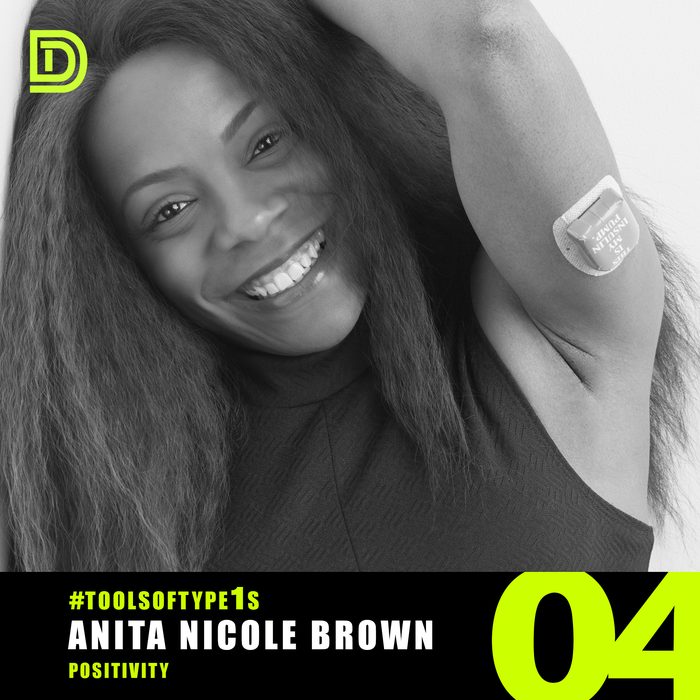
Anita Nicole Brown, an actress and ballroom dancer from Chicago, returns to the podcast as its first repeat guest. She was diagnosed with type 1 diabetes in November 1998, during her senior year of high school. Early in her diagnosis she developed diabetic nerve damage and lost the ability to walk for about a year before recovering. She switched to the Omnipod insulin pump in June 2013, which she says gave her tighter control over her blood sugar. Anita talks about building her life around positivity, pushing back on how movies depict type 1 diabetics as fragile, and co-hosting a show called T1D Lifestyles with Danielle, known as Color Me Glucose. She credits her late mother and her stepdad for her drive.
Key takeaways
- Anita was diagnosed with type 1 diabetes in November 1998, her senior year of high school.
- She lost the ability to walk for about a year from diabetic nerve damage early in her diagnosis, then recovered and took up dance.
- Anita says switching to the Omnipod insulin pump in June 2013 gave her much tighter blood sugar control.
- She works as an actress and ballroom dancer and pushes back on movies that portray type 1 diabetics as fragile.
- She co-hosts a show called T1D Lifestyles with Danielle, known online as Color Me Glucose.
Show notes
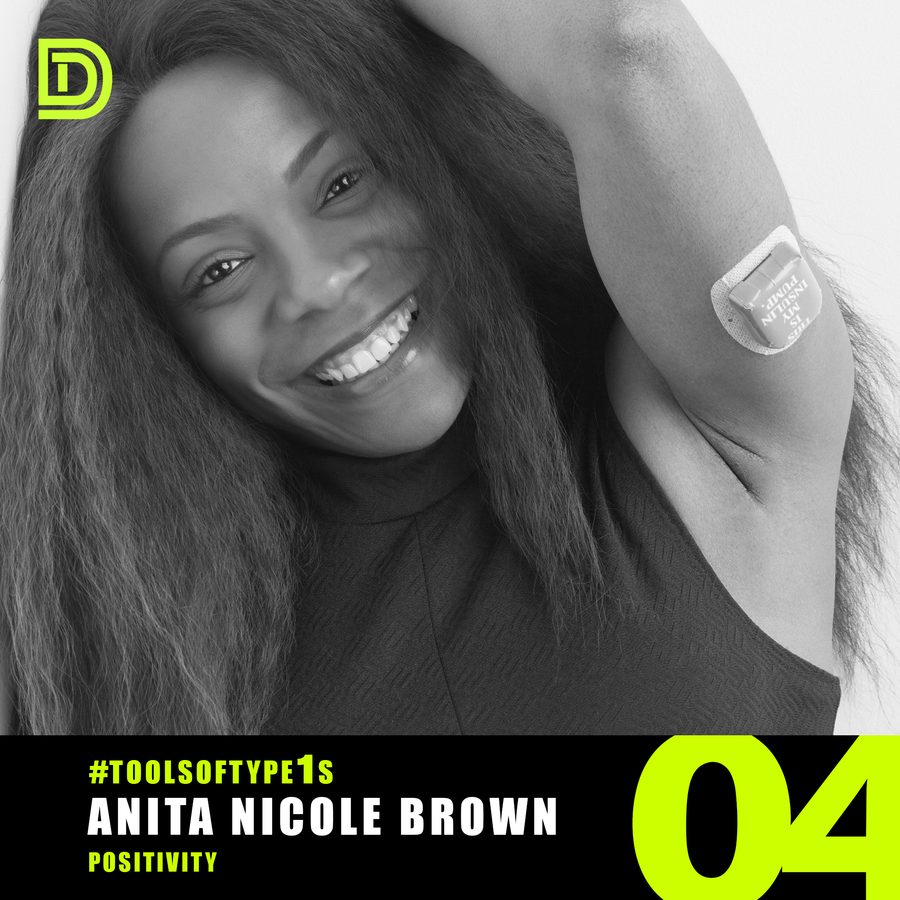
Name: Anita Nicole Brown
Hometown: Chicago, IL
Date of Diagnosis: 11.12.1998
Tool: Positivity
Diabetes Devices/Treatment Methods: Omnipod
Questions this episode answers
What insulin pump does Anita Nicole Brown use?
She has used the Omnipod insulin pump since June 2013. She says it gave her tighter control over her blood sugar than she had before.
Did Anita Nicole Brown recover from diabetic nerve damage?
Yes. Early in her diagnosis she lost the ability to walk for about a year due to diabetic nerve damage, and doctors told her the damage might be permanent. The nerve damage eventually went away and she recovered.
How does Anita Nicole Brown stay positive while living with type 1 diabetes?
She says she has kept a positive mindset since high school, inspired by a quote she had on her wall: a positive attitude equals a positive outcome. She tries to find a positive angle even during hospital visits for highs or lows.
What does Anita Nicole Brown do for work?
She is an actress and ballroom dancer. She also co-hosts a show called T1D Lifestyles with Danielle (Color Me Glucose) and is working on a film about a type 1 diabetic character.
Full transcript Searchable, with timestamps
Rob Howe: Tools of Type 1s, hashtag Tools of Type 1s on Instagram. We are continuing on. We're just getting started. Episode 4, Anita Nicole Brown. Anita Nicole Brown. She's been on the podcast before. She's the first repeat visitor. Her episode of Diabetics Doing Things, you can find by searching Anita Nicole Brown, Diabetics Doing Things. Her tool, no surprise here, her story is incredibly inspiring. Her tool is positivity. And this is not just a, you know, power of positive thinking type episode. Anita Nicole Brown embodies positivity in the way that she lives and her story with diabetes in multiple ways. I'm really excited for you to dive in and learn a little bit more of what makes Anita Nicole Brown type 1 diabetic tick. Follow us on Instagram, hashtag tools of type 1s or on Diabetics Doing Things. Here we go.
Anita Nicole Brown: hello so my name is anita nicole brown um i am born and raised and still live in chicago illinois and i have had type 1 diabetes for almost 20 years november 12th will be 20 years for me
Rob Howe: what is your tool of type 1s and what's the one thing that a person living with t1d could learn
Anita Nicole Brown: from you or your experience? Well, I came across Rob for Diabetics Doing Things, and I thought that was just an interesting spin on how the T1D community is just living and adjusting and just, I mean, being type ones, you know, just us living our lives. And I came across him through that. and I guess my connection to the T1D community is I am a type 1 so I mean that's the primary connection but it was more along I wanted to change the perception of what it means to be a type 1 diabetic so I think that's where everything really that's how I really became more in depth and involved with the um T1D community uh so let's see um what is the one thing that a person living with T1D can learn from me or my experience experience um I you know what I people tease me and stuff even to this day about it but I would just say you know putting a positive spin on it um it it's just me I I try to live life with the utmost positivity I I don't like being negative I don't like I mean I feel like if you keep a negative outlook, that's all you're bringing into your life. So even with this disease, I do everything possible to spin it and make it more positive, more optimistic,
Rob Howe: I guess you could say. What is the simplest thing you've done that has helped you with the management of your type 1 diabetes? Where did you learn it or who showed it to you?
Anita Nicole Brown: um I well it's actually what I just said um learning how to be positive with this disease uh I'm not sure who showed it to me but I do know that throughout high school I mean I was diagnosed my senior year of high school but before then there was a quote on my wall and it said a positive attitude equals a positive outcome. So I'd always try to keep that positivity in my life, at least somewhere in my life. Yes, sometimes darkness just rolls up in there, but I try my best to spin it and take it and just keep anything positive. I'm not sure where I got that quote from or anything, but that's literally how I've managed to, I guess, manage my T1D.
Rob Howe: What failures or apparent failures with T1D have made you better at living the rest of your life or made you more well-rounded as a person?
Anita Nicole Brown: I guess one of the, well, I can't even call it a failure. Well, no, I can't call anything a failure because every day that I wake up in the morning, it's not a failure. It's just a success. You know, I know there's a huge chance I may not wake up one morning, but every morning that I do wake up, I consider it successful. I guess one of the, not failures, but the complications I had to overcome was dealing with diabetic nerve damage and losing the ability to walk for about a year. So that hit me almost within the first year of my diagnosis And I remember the doctors telling me it was a huge possibility I may not walk again or I may live with the damage and everything in my legs and feet for the rest of my life And I'm just a very stubborn person and I just refuse to let that be the final say So I just kept doing me graduated high school, went to college, like was walk, learning how to walk again, took up dance class and everything. And one morning I just woke up and the nerve damage just disappeared. And I guess that's the complication that I guess I overcame. But I think that kind of helped me see that, you know, there's, there's a reason for everything that we go through. And if we learn how to see it in a more positive light, I think we get a better understanding of it and a better appreciation for it as well as a better appreciation for life.
Rob Howe: What unusual or absurd opinion or approach regarding your diabetes do you have?
Anita Nicole Brown: Again, positive. You're going to hear that a lot. I'm just, I'm really, really positive with this disease. Even in the negativity that we will face every day with type 1, I'm just positive. I find goofy, quirky, crazy ways to spin a positive outlook on this disease. And I do everything possible. Like even if I'm in the hospital or whatever, because of a hypo or hyper episode, you know, I'll be like, all right, so diabetes told me I needed to take a little vacation. So I'm taking a little vacation for the day. I'll see you guys later. You know, I just I try my best to keep it as positive, you know, because I think the more positive, the more uplifting, the more optimistic I am. It just gives me it gives me a better way to live life, you know. So I guess that's my unusual or absurd approach to living with type 1.
Rob Howe: What's your favorite thing? What gets you to smile or laugh almost every time?
Anita Nicole Brown: It's a little bit of everything. I do acting and ballroom dancing. And if I'm doing either of those, I'm smiling like I enjoy it. I also have my little fur babies. So they can just make you laugh or scream or whatever, but they're just really, really cute. I have three cats and I have a guinea pig and they are so adorable. So they usually do make me smile. I have nephews that I love. My little sister, I love her so much. My stepdad, my auntie, my husband, it's every body, everything in my life, it gives me a reason to smile. So I guess that, yeah, it makes me smile or laugh almost every time. You know, I guess, yeah, I guess just life,
Rob Howe: life in general. In the last five years, what new adjustment to your lifestyle has improved
Anita Nicole Brown: your life with diabetes the most? Was it 2015 or 2000? No, 2013. June 5th, 2013, June 5th was my birthday or is my birthday. But June 5th, 2013, I do believe I was put on the Omnipod insulin pump. And that has improved my life with diabetes so drastically. A lot of people or I'm sorry, my my endo thought it was the easy way out. But he said he's noticed that I've learned so much more tighter control, better control, better understanding of my insulin and carb ratios. and everything because of being on the Omnipod insulin pump. And he actually said because of that, he's no longer going to be as hesitant to present an insulin pump to his current T1D patients because he, like I said, he thought it was just an easy way out and he didn't realize it takes a lot more to control your T1D and everything with the insulin pump than it does without it. And I'd say that was, I guess that was the newest adjustment in my life. And, you know, and it's improved my life with T1D. So what challenges related to T1D did I encounter or have to overcome while I was doing my thing? Yeah, we already talked about that whole not walking thing, right? So that was one of the things, obviously, I had to over counter. I mean, especially if I enjoy doing ballroom dancing and stuff. I mean, being able to walk is kind of important. So outside of that, I guess it's something I'm still working to overcome. I don't want to say battling or anything like that, but it is something that I'm working on overcoming. And that is just a perception.
Rob Howe: What challenges related to T1D did you encounter or have to overcome while you were doing your thing?
Anita Nicole Brown: And that is just the perception of what it means to be a type 1 diabetic. I feel like the world's perception of T1D and I guess our own perception of T1D based on what everyone else views us as. I'm working on changing that perception, that understanding, that definition. So I guess, yeah, that's it.
Rob Howe: What bad advice regarding diabetes do you see or hear that you'd like to address?
Anita Nicole Brown: It's just the whole, we can't do this and that and this and that. I really, really hate that. Really, really hate that. because I don't think there's a limit to anything that we can or cannot do. And I just want us as T1Ds to understand that, that we determine and set our own limits and our own boundaries. And if we say we can't do it, then of course we're not going to be able to. But in my opinion, that's not true. We can do almost anything and everything we set our minds to. We just need to know that we can do it. And that, yeah, I guess that's like the bad advice I would like to address. We don't have to limit ourselves. We can do whatever we want and we need to understand that.
Rob Howe: What priority are you focusing on in your own life currently? This can be diabetes related or not.
Anita Nicole Brown: Yeah, there's that whole changing the perception of what it means to be a type 1 diabetic. um as an actor um I've seen lots of movies where T1Ds are painted as helpless fragile we're basically on our deathbed 24-7 like it's just it's a really annoying perception and I've never been comfortable with that depiction of us and I've been working with you know trying my best to show the world that we can do whatever we want. It's been a battle because I'm fighting against the entertainment industry and their perception of what things should and shouldn't look like. So it's something I'm still dealing with. I'm still fighting tooth and nail for this one. But yeah, that is what I'm going to keep doing and keep pursuing until the perception of people with T1D is just as amazing as I know we are. So that's, yeah, that's a priority
Rob Howe: I'm focusing on in my life. Who is someone that you look up to and what have they taught you?
Anita Nicole Brown: How do you apply that to your life? My mom is someone I looked up to. She passed away in 2011, but my mom just, I mean, she raised me, my twin brother and my older brother. She put us through school. She put me through college. And she's just been, or she, she was just amazing. She was always there. I never had to worry about my mom not being there because she made sure she, we all knew no matter what, she was going to find a way to be there and support us. The second person is my stepdad. My stepdad, Mark, has been an amazing, amazing father figure to me. Even after my mom passed, my stepdad has supported me in like almost every way possible for my career and venture into this entertainment world. And that's been, that's been a blessing. I don't think I could have, I don't think I would, I mean, I just wouldn't be here without the two of them. Like if they hadn't been there for me, I wouldn't be here right now doing what I'm doing. So they're who I look up to.
Rob Howe: What are you most hopeful for? This can be diabetes related or not.
Anita Nicole Brown: I know everyone wants to say like they want a cure for diabetes and things like that and all of that stuff. And that's great. Like, yeah, maybe one day. But in my for me, I want all diabetics to have access to everything that they need to live a healthy life with diabetes. So I want them to have access to the best medical coverage, the insulin, the insulin pumps, CGMs, anything that they need to keep their life moving forward until a cure comes about. That is what I am most hopeful for. That is what I would want for everyone across the world with this disease. Like I said, a cure would be nice, but right now most of us are passing away anything because we don't have the funding to purchase the necessities to be T1Ds. And that's what I am most hopeful for, that one day that's no longer a question.
Rob Howe: What advice would you give someone who has T1D and is trying to pursue a career in your line of work?
Anita Nicole Brown: Own it. if you allow someone else to depict how T1D is or whatever, it's going to limit you and what you can do. So I would just say own it, own it, accept it, embrace it and just go out there and live because you're the only one that can stop yourself from doing what you want to do. So as long as you be certain to have that confidence, that faith, that assurance in yourself, even with T1D, you're going to be successful. So my advice is just own it. Own who you are. Own this disease
Rob Howe: and just live life. What's the one facet or trait that you think makes you uniquely you?
Anita Nicole Brown: Explain why. I'm weird. I don't know. I guess, again, being uniquely me is just the fact that I do have this positive outlook, this positive mind frame. Even in the darkest of times, I find a way to still see that light. And I know as long as I can see that light, it's not going to stay dark for long. So I guess that's what makes me uniquely me or I don't know how, however you want to define it. That's, that's what makes me who I am. And I, I embrace that and I love that. And I think it makes living with diabetes for me so much easier. Where do you get plugged into the T1D community the most? Let's see. I am on Instagram at Anita underscore Nicole underscore Brown. I am on Twitter at Anita in Brown, and I am on Facebook at Anita Nicole Brown, the actress. so that's where I am um I I mean I do films I do movies on either one of those pages you're gonna find something about a film or movie or a project that I'm working on so you can just look up those um let's see how did I get involved um I got involved in the T1D community because um I want it to be a presence of positivity that people could relate to. So you don't always see the negativity. So most of the time on my Facebook, my Instagram, my Twitter pages, you're going to see that positivity. Let's see. I mean, if. Oh, and I also do a show as well. It's called T1D Lifestyles. I do it with Danielle. She's known as Color Me Glucose. Um, so we do those shows that just address type 1 from two different perspectives Um, some people would see it as it is addressed from the african-american perspective Um, but I just say it's just addressed from two different perspectives two different lifestyles, uh, two women Dealing with different things in their lives. So that's another thing that is also that is on my youtube channel Oh my god, I forgot I have youtube. Okay. Yeah, it's also on that station too um but yeah that's that's just a little insight about me where you can find me what I'm doing um I do have a t1d action film that I am working on uh so whenever that's ready and done uh hopefully I'll be blasting and sharing that and you guys can go and look at it and say yeah that's a badass diabetic right there so um that's I guess that's about it for me um I thank you guys um Let's see. Did I forget anything? Hashtags, anything? My hashtags or will always be T1D actress or hashtag T1D actress, hashtag diabadass, hashtag T1D life. Because I do pageants. T1D queen. Yeah, it's pretty much anything T1D. You'll probably find connected to me. But yeah, I think that's it. So thank you guys. Thank you, Rob, for letting me be a part of this. And I don't know, you guys got any questions, concern or anything, you can hit me up on any one of my avenues. And I look forward to hearing from you guys. Okay, bye.
Rob Howe: Thank you for listening to the Tools of Type 1's podcast on diabetics doing things. I'm Rob Howe. And every Tuesday and Thursday in 2019, we are posting the next Tools of Type 1 episode. So follow us on Instagram, hashtag tools of type ones, or just on diabetics doing things. We will post those regularly every Tuesday, every Thursday. My favorite type ones are answering the questions I want to know the answers to. And hopefully you'll learn a few things as well. If you like this episode, be sure to review us on iTunes. And if you didn't like it, go ahead and let me know that too. I want to know. All the feedback is good to me. Thanks again for your time. I value that more than anything you could possibly give me. Thanks so much. Bye-bye.
About Anita
Anita Nicole Brown is an actress and ballroom dancer from Chicago who has lived with type 1 diabetes since November 1998. She co-hosts T1D Lifestyles with Danielle (Color Me Glucose) and works to change how type 1 diabetics are portrayed in entertainment.