

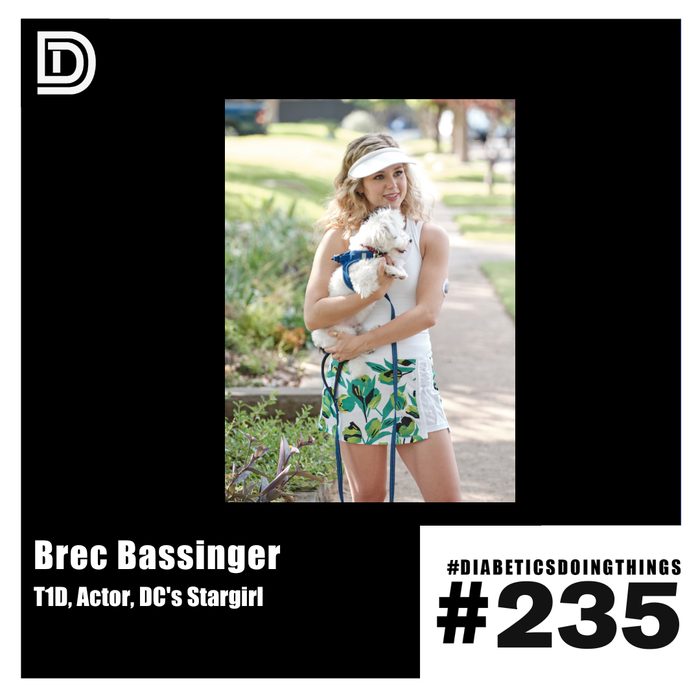
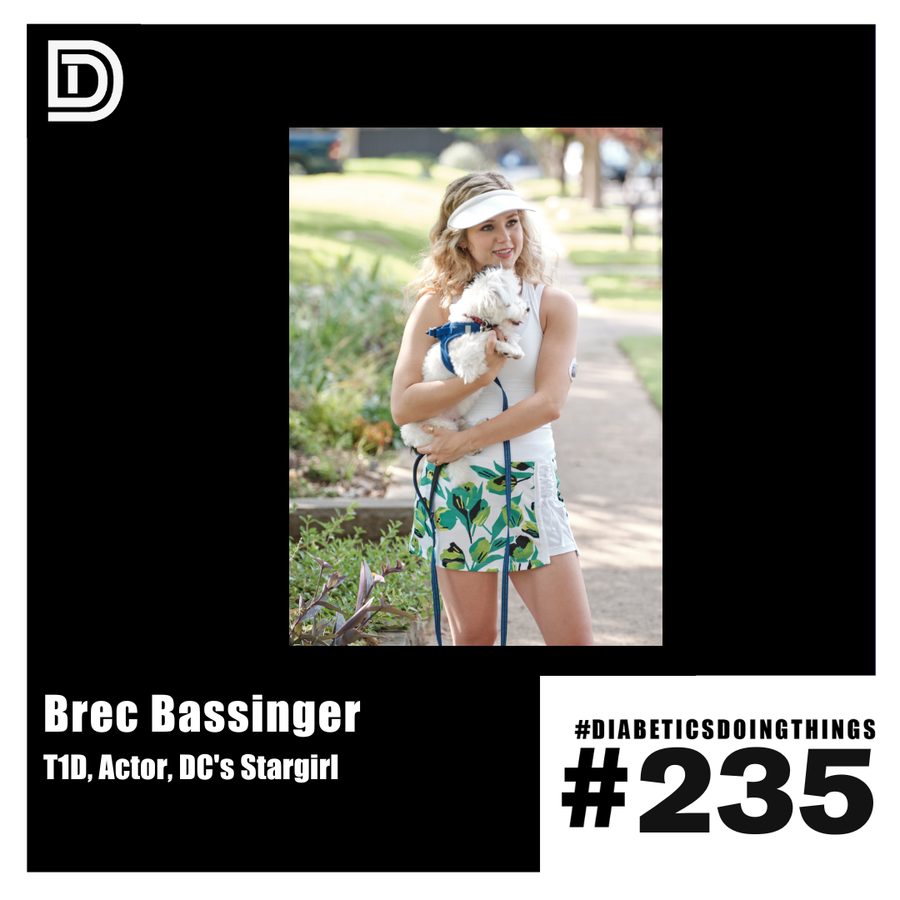
Brec Bassinger, T1D, Actor, DC's Stargirl


Episode summary
Brec Bassinger, who plays Stargirl on The CW, was diagnosed with type 1 diabetes at eight years old after a family trip revealed unusual thirst and weight loss. She was treated at Cook Children's in Fort Worth. She talks about managing long film days with diabetes, telling directors and assistant directors about her condition before shooting starts, and once needing a break mid-scene when a low blood sugar caused brain fog and made her forget her lines. She describes practicing self-empathy instead of self-criticism. She discusses using Afrezza as her mealtime insulin while training for the show, being inspired as a kid by Nick Jonas's diagnosis story, and producing a film about diabetes with fellow type 1 writer-director Kelsey Bascom. She closes with advice for newly diagnosed kids: it gets easier.
Key takeaways
- Brec Bassinger was diagnosed with type 1 diabetes at age eight, the same month Rob was diagnosed, both in DFW-area hospitals.
- She tells directors and first assistant directors about her diabetes before filming starts so juice is on standby if her blood sugar drops.
- She says a low blood sugar once gave her brain fog bad enough to forget her lines mid-scene, and she's working on treating herself with the same empathy she'd give a friend.
- She says she has used Afrezza as her mealtime insulin for over three years, after a friend with diabetes suggested she ask her doctor about it while training for Stargirl.
- Her advice to newly diagnosed kids: the daily burden doesn't go away, but it gets easier.
Show notes
This special #sponsored episode features Stargirl herself, Brec Bassinger! This episode is sponsored by Mannkind, and is part of Diabetics Doing Things ongoing partnership with Mannkind.
If you want to see Brec in Stargirl, it’s streaming in all places that stream the CW including HBOMax. Season 3 is out now. We also interviewed Brec in the DDT Zine format, which you can read here.
In this episode, Rob and Brec talk about:
How they both have January diagnoses in DFW area children’s hospitals
Balancing diabetes with a Superhero’s schedule
Life on set
The importance of friends with diabetes
Becoming an advocate and spokesperson
Favorite reality TV…hint: it’s Selling Sunset
Which celebrity they’d challenge to a pickleball match
And MORE
We want to hear from you. Send your questions, comments, queries, and general diabetes concerns to THE MAILBAG at mailbag@diabeticsdoingthings.com!
Questions this episode answers
Does Brec Bassinger have type 1 diabetes?
Yes. She says she was diagnosed at age eight, about 15 years before this episode, and was treated at Cook Children's in Fort Worth.
How does Brec Bassinger manage diabetes while filming Stargirl?
She says she tells the director and first assistant director about her type 1 diabetes before a project starts, asks for juice on standby, and steps away for about 15 minutes if her blood sugar drops before returning to film.
What insulin does Brec Bassinger use?
She says she has used Afrezza, an inhaled mealtime insulin, for over three years, after a friend with diabetes suggested she ask her doctor about it while she was training for Stargirl.
What helped Brec Bassinger after her diagnosis?
She says reading about Nick Jonas's type 1 diagnosis in a magazine while she was in the hospital at age eight made her believe she could still become an actor.
Full transcript Searchable, with timestamps
Rob Howe: This episode is sponsored by Afrezza and MannKind Corp. as part of our ongoing collaboration. MannKind has paid diabetics doing things for this placement, but the thoughts and opinions of hosts and guests are original and unfiltered. For more information about Afrezza, insulin, human, inhalation powder, and mankind, please visit afrezza.com. Please see additional important safety information, full prescribing information, including boxed warning, medication guide, and instructions for use on afrezza.com slash safety. That's A-F-R-E-Z-Z-A dot com slash safety. and HBO Max. If you don't know who it is, it's Stargirl herself just finished season three.
Brec Bassinger: Brec Bassinger, welcome to the show. Thank you. That was a great little segue
Rob Howe: introduction. I liked that. Not too bad, right? I'm getting the hang of it after all these years. Brec, you are a literal superhero on TV, but you are a diabetes superhero in real life, and you have lived with type 1 diabetes for most of your life. Why don't you share for our listeners who maybe don't know your diagnosis story. Like, tell us about your diabetes journey. Where did it all start?
Brec Bassinger: Wow, to say I've lived with diabetes for most of my life is so, such a, like, weird to hear, but it's true. Like, I was diagnosed when I was eight. January, it'll be 15 years. So it's, like, way past the majority, but it's interesting to hear that out loud. So yeah, when I was eight years old, I feel very lucky in that, like the way everything i feel lucky about my diabetes diagnosis but it's not everything kind of like lined up i was on a weekend trip with my mom and grandma and so we're staying in a hotel together so we were just spending every waking second together and i saw the obvious things i was really thirsty i was like and i hadn't i was eight and that wasn't something doing right losing weight i was actually there for a pageant and i got on my clothes tailored to my body and i've in a dress that I had worn like two years ago that did not fit me because children grow really fast and fit me. And my mom was like, I don't know how this dress fits you again, but somehow you are losing weight. What's going on? So immediately when we got home, my mom kind of like Googled the symptoms and she said that night she knew when she took them to the doctor that like the next morning, what it was going to be. She felt very confident that it was going to be diabetes. went in to care now got the diagnosis immediately was taken to Cook Children's spent five days there and even Cook Children's like i feel so blessed the experience that i had i actually cried on friday when i left because i loved everyone so much and i wanted to keep doing the daily hospital activities and like you're the only kid that cries and they have to leave the hospital But I'm like, it is.
Rob Howe: That's so funny that you were diagnosed in January as well. So because you and I are both from Dallas, Fort Worth. So shout out CareNow. I also went to a CareNow. My mom took me to a CareNow before. So it's kind of funny to see how like, and I know you're more on the west side. So you went to Cook's Children's and I went to Dallas Children's. But how fun is that? You know, both January diabetes diagnoses. January 1 for me. First day.
Brec Bassinger: Oh, wow. New Year's started off big.
Rob Howe: I know. I was like, New Year, new me. And I had no idea what that all meant. That's crazy. So you've been really awesome lately about sharing your diabetes life on TikTok and Instagram and kind of like what a day in your life looks like. And we've had actors with diabetes on the show before. But, you know, for you being like, especially in, you know, a superhero suit, like you're, you know, you're putting all your devices kind of underneath, underneath your superhero wear. Like, you know, how do you manage your diabetes while you're balancing a busy shooting schedule? And I know right now, you know, you're you and I, as we scheduled this interview, you have a really demanding shooting schedule. So for people who aren't as familiar with like working actors and like what's being asked of you on a daily basis, what does that look like for you and your diabetes?
Brec Bassinger: It's definitely challenging. Obviously, diabetes alone has its daily burdens. Working 16, 17 hour days has daily burdens. And those things together, there's definitely challenges. I always every time I start on a new project, I immediately go to the director and the first AD, the first assistant director and let them know. I don't like to make a big fuss about it, but I'm like, hey, guys, type 1 diabetic. If my blood sugar goes low, we're filming. We need juice on standby. I'll step off for 15 minutes and I'll come back and be able to be present. And that's happened a few times. Actually, it was this past week we were filming an emotional scene. And the way the camera works is it'll be on like, it'll be coverage on one person. And they'll flip the camera around and you'll do the same exact scene coverage on another person. So you'll do one scene, I think, 30 times. And the camera is always pointing at different people. We've been working on the scene for hours. And they turn the camera and it's my coverage. So this is when I have to show up and do my best acting. Feel my blood sugar going. And then I start trying to do my lines and I like cannot remember them because I get low blood sugar brain fog and find them like, guys, I actually, I have to, we're not going to get through this thing. So I'd literally be like, mine just could not get through it. So I really just try to have like open communication. I've really been working on like empathy with myself because sometimes this schedule is limiting or vice versa. And I've just had to like really be practice empathy towards myself because I'm not always the best.
Rob Howe: What does that look like for you when you're practicing empathy with yourself? Because I think that's something that I know I can do a whole lot better at because sometimes the way that I talk to myself about my diabetes can be a little too harsh. That's something I've been a little bit present with lately is give myself a little bit of grace to not be perfect. So what does that, you know, empathy and practice look like for you?
Brec Bassinger: I mean, exactly what you said. Like the story I just said about the scene, like it's still eating me alive. I went back to my, my chair in the green room and I was just like, gosh, I could always say diabetes isn't going to like prohibit me or affect my work. And it just did. Come on, bro. Do better, do better. And I was like, you're 14 hours into your day. So I really, I literally just talk myself off the cliff. And I think of my, one of like my life mottos is talk to yourself, how you talk to your best friend. And if it was my best friend next to me going, like, oh my gosh, my diabetes. I'd be like, stop. Absolutely not. You're doing it. You're doing this. So that's like my go-to. I'm my own best friend. Talk to myself like that.
Rob Howe: I love that. And I think too, it's really refreshing to hear someone like you, who portrays for millions of people, a superhero that you have your struggles with long days on set and things not going according to plan all the time. And I think that's one of the things with diabetes that can be the most frustrating is like, even when you do everything right, like there's still that wrench that could get thrown in and kind of mess everything up. Let's talk a little bit about diabetes characters like in like TV and film. There've been a few more recently that have kind of been like in the pop culture kind of sphere. Have you ever wanted to portray a character with diabetes on screen?
Brec Bassinger: Such an interesting question because like the majority of the projects I've been doing recently, I play a superhero in the two movies before that, in period pieces, 1973, 19, whatever. And I'm like, my Dexcom, I was like, I can't wear my Dexcom because they didn't have Dexcoms in the 70s. I would definitely open to the idea. I think it would be, I think I would be able to portray a diabetic way better than a non-diabetic because I know what it actually feels like. No hate on them, but you can only study it so closely. Recently, I have been attached to a project that the story is about a diabetic. It's this wonderful writer, Kelsey Bascom, who is writing, starring, directing in it. She is writing, she wrote it, she's starring it, and she's directing it. And she's a type 1 diabetic. And they reached out to me and they're like, we'd really love for you to come be a part of this and be a producer on it. And of course, like, as soon as I heard, it was like telling the real little things of diabetes. Like done. I don't even have to read the script I'm in. It was so cool because she's gotten so many diabetics to be involved. One of the scenes I was in was this wine party. And it was like 12 girls and her. And we were all diabetics. Even though only one of the Kelsey's the only one playing a diabetic in the movie. It was so cool. We were just sitting like in between takes, just like going off about our diabetes stories. So that was like such a lovely set experience. I'm really excited because I think it does go into what diet like you we were talking earlier and you said like the gross parts of diabetes the weird parts of diabetes kind of like the unspoken not that I I can't eat the cake not that I can't eat the cake the real stuff and I'm really excited for people to see it and I think it'll be I would have loved to have a movie like that when I was diagnosed to watch it just because I think it's very honest but like I think it's so
Rob Howe: cool to see even after a long life with diabetes, when you get in a room and there's a bunch of people around and you all can kind of skip the like exposition and the explaining about like what you're doing or feeling like shame or feeling embarrassed or feeling like you have, like you're calling more attention to yourself. Like when you were talking about, you know, you're having a little blood sugar on set and you have to take a break and the feelings that kind of come flooding in of like, you know, embarrassment or shame or like that you like, or even just like explaining things to people, that feels really uncomfortable. And I think for me, when I was an athlete, those were the times with diabetes that I felt like the most stressed out and the most like, you know, not myself because other people were having to wait or I was having to delay things because of my diabetes. And I just felt like, I don't know, anxious and sweaty and just like all of those things that kind of come along with that. So when you're in that situation, and I've fortunately been able to work on a couple of like small video sets with like five or six other people with diabetes and you just get to skip all that. And everybody's running by craft services and grabbing low snacks and like going to one scene to another. So many juices everywhere. It was
Brec Bassinger: awesome. The way you have like the juice and like the beef jerky, I'm like, this is definitely
Rob Howe: a super diabetic. It's great. And I think, you know, a friend with diabetes is a friend indeed. And I think the more you can surround yourself with people like that, if you're out there and you're listening to this and you haven't been in a room with a bunch of people with diabetes, I encourage you to do that either at an event or a walk or whatever you can do to make that happen for yourself. Staying on the diabetes train. Recently, I saw a video on your TikTok, and this episode is sponsored by MannKind, and you've been sharing that you use Afrezza to manage your diabetes. Just a reminder that this episode is sponsored by Afrezza and MannKind Corp as part of our ongoing collaboration. For more information about Afrezza and MannKind, please visit afrezza.com. That's A-F-R-E-Z-Z-A dot com. Afrezza is a rapid-acting inhaled insulin used to control high blood sugar in adults with diabetes mellitus. Afrezza may cause serious side effects, including sudden lung problems, low potassium, and heart failure. Afrezza is not for patients with chronic lung disease, such as asthma or COPD. Tell your doctor if you smoke, recently stopped smoking, have ever had kidney or liver problems, a history of lung cancer, or if you are pregnant or breastfeeding. Most common side effects are low blood sugar, cough, and sore throat. Severe low blood sugar can be fatal. Do not replace basal insulin with Afrezza. Afrezza is not for use to treat diabetic ketoacidosis. Do not take Afrezza if you are allergic to insulin. Talk to your doctor before changing your Afrezza dose. Blood sugar may need to be checked more frequently. How and when did you decide Afrezza was right for you?
Brec Bassinger: I was actually training twice a day to get in superhero shape for my show Stargirl. And when talking to my diabetic buddy, he suggested that I ask my doctor about Afrezza as a mealtime option. And at first I was just going to be on it for the months leading up to filming. But I noticed that adding Afrezza as my go-to mealtime insulin and, of course, remaining vigilant on my diet and exercise, I had a mindset to be able to focus on other things. And while there's still a risk, I just wasn't thinking about low blood sugars as frequently. And I have now been using Afrezza for over three years.
Rob Howe: Wow. So yeah, I think once you find something that works, once you find that mix and also gives you that headspace to be your best self, I mean, it seems like finding what works for you was really key for that. What do you think about in your role as a public figure and as a person with diabetes and your choice to live publicly and tell people and educate people and bring awareness to diabetes. What is it like for you to be in the spotlight and have your diabetes be a part of that spotlight?
Brec Bassinger: I was once asked if I felt like being in the spotlight and having diabetes, I felt a responsibility to speak up and to be an advocate. Honestly, I just really feel like it's an opportunity. I always go back to this story. But when I got diagnosed, I was in the hospital. My mom brought me a People Magazine article that they released that issue that month of Nick Jonas holding a Diet Coke, talking about he had type 1 diabetes. And at eight years old, even then, I still knew I wanted to be an actor. And I just remember being like, oh, you guys are all sad. And this is fine. Nick Jonas can do it. I can do it. And it really impacted me. And so I just feel like that I, the, the, the career blessings that I've had are just such an opportunity for maybe to be that Nick Jonas for even one individual would be worth
Rob Howe: it. So, well, I am grateful for it because I know that, you know, my own life and seeing people like Adam Morrison, people like Gary Forbes, who were doing what I wanted to do, playing basketball with diabetes and just normalizing that and saying, hey, yes, I'm doing this thing, but I also have diabetes. And if that's what you want to do, that's an option for you. That's a big reason why we started this podcast is so that whatever it is that you're interested in, you could find somebody
Brec Bassinger: with diabetes who's doing it. Right. And you don't, the thing is diabetes, it doesn't have, that doesn't have to be your thing. You don't have to talk about it, but your own relationship and whatever brings you peace with it, do it. How funny is that though, that, you know,
Rob Howe: you're in the hospital and that week is when you know nick jonas like you know you start to ask yourself like you know was that the right time right place you know i do not believe in coincidences
Brec Bassinger: at all that's another one of my life mottos and absolutely like i i i wouldn't even say like it was like his first big time speaking out about it and it was like a six page spread and people like i just looked and my mom like brought it to me like look what i saw at target and i'm like
Rob Howe: Okay, so let's get into some quick fire questions. So what you're going to do is I'm going to ask you and then you just as quickly as you can give me your response.
Brec Bassinger: Oh gosh, pressure. Got it.
Rob Howe: Yeah, pressure. This is the hot seat right now. Okay, so favorite go-to low blood sugar snack?
Brec Bassinger: Sour Patch Kids. Sour Patch Watermelon.
Rob Howe: Oh, love it. Favorite non-work activity?
Brec Bassinger: Binging reality TV.
Rob Howe: Oh my gosh, which reality TV franchise?
Brec Bassinger: I mean, all of them, but I'm currently watching Love is Blind.
Rob Howe: Oh, okay, cool. Love is Blind Hive. Comment below. What's your favorite thing about Alfie?
Brec Bassinger: The way he prances instead of walks.
Rob Howe: Favorite TV show to binge? You might have already got this.
Brec Bassinger: Oh, you know what? I'm going to say Selling Sunset is probably my favorite to binge.
Rob Howe: Ooh, love it. Celebrity you would challenge to pickleball?
Brec Bassinger: Dwayne The Rock Johnson. Because if I could say I beat The Rock at something, I could just...
Rob Howe: That would be the one. That would be it. That would put you on Mount Rushmore. I love it. Okay, so that's the end of the hot scene. Nicely done. Nicely done. All right. This one's the heartstrings question for me. This is the one that I want to dig in. Because you get to inspire, because you've chosen to be an advocate and because you've chosen to live your life in public with diabetes, what would you tell a young person living with diabetes today that you wish you had been told when you were diagnosed?
Brec Bassinger: that it will get easier. I meet so many diabetics who are still in like their first year of diagnosis and they're doing the very detailed log sheet. I actually just was talking to someone yesterday and was like, yeah, my daughter got diagnosed and we've been doing these log sheets. And I was like, oh my gosh, I haven't done log sheets in 10 years, but that was such a part of those first five years for me. Wow. And I wish I could just, it'll get easier. You'll start, you will know what a low blood sugar feels like. You'll know how to communicate to people when your blood sugar zone. Yes, it'll still be a daily burden. It'll still be difficult, but you will learn and it will
Rob Howe: get easier. Something I've been thinking about a lot lately is like skill acquisition, like how you get better at things over time. So I would encourage someone listening to this podcast and And I'm going, this is like totally made up. I didn't have this like approved on the question sheet, but this is what I would encourage you to do. Today, write down something with diabetes that you're struggling with and just fold it up and put it in your drawer and set a reminder to check on it in a year. Because I think what you'll find is those things that are really getting you today, in a year, you might surprise yourself how much further along you are. And those things that really hurt you or really were burdening you today, that you're managing them no problem a year from now. So that would be my challenge to somebody listening is to write it down and put it in a drawer and set a reminder on your phone for one year from now and check in with us.
Brec Bassinger: That's beautiful. I literally have chills. I'm like tearing up.
Rob Howe: Well, because you think about it, life is really overwhelming. And you were talking about that story earlier, being on set, you're set up for your shot, you've been working on the scene for hours, and then you have to take a break and you sort of feel this sort of avalanche of feelings and emotions from diabetes that coming over you. And as you guys know, listening, when your blood sugar is low, you are more sensitive to those emotions. Me too. I will full out avalanche downhill, like sad, like it's the end of the world with a low blood sugar. And I have to remind myself sometimes like that. It's just the low blood sugar talking. It's just the low blood sugar talking. Let's get it back up and think about it. But you know, if you really think about, you know, a long life with diabetes, which, you know, As of today, we don't have a cure in sight for us immediately. It's going to be some time. So making peace with who we are today and giving ourselves some grace for the future and recognizing that we're going to grow and that diabetes doesn't stop you from growing. It just makes every little thing in your life adds a whole extra step and a whole lot of extra math that you've got to do on top of it. So I would encourage you guys out there, if you are struggling, to write that little note down and let some time pass and revisit it and see how you also have grown and give yourself some props for that. Oh, I love it. Well, cool. Look what we discovered on our phone today.
Brec Bassinger: I'm thinking, I'm like, okay, when did I start? I think I might do it too. So we'll definitely
Rob Howe: have to have you back and we'll check on the things that we wrote to ourselves for this year. Brec, you are very online. If you were going to encourage people to follow you somewhere,
Brec Bassinger: where would you say? Oh, goodness. I am on Instagram at Brec Bassinger. I'm on Twitter, which I basically just use to like connect with people for Stargirl. Like I did live tweet for a new episode and that's Brec Bass. And then TikTok is at Brec Bass.
Rob Howe: Awesome. Well, we will include those links in the show notes. Brec, thanks so much for your time. And thanks so much for being such an awesome advocate for people with diabetes. You are a real life superhero with diabetes. And I'm just grateful for the time. And thank you for all that you do.
Brec Bassinger: Thank you, Rob.
About Brec
Brec Bassinger is an actor who plays Courtney Whitmore in DC's Stargirl, streaming on The CW and HBO Max. She has lived with type 1 diabetes since she was diagnosed at age eight.