

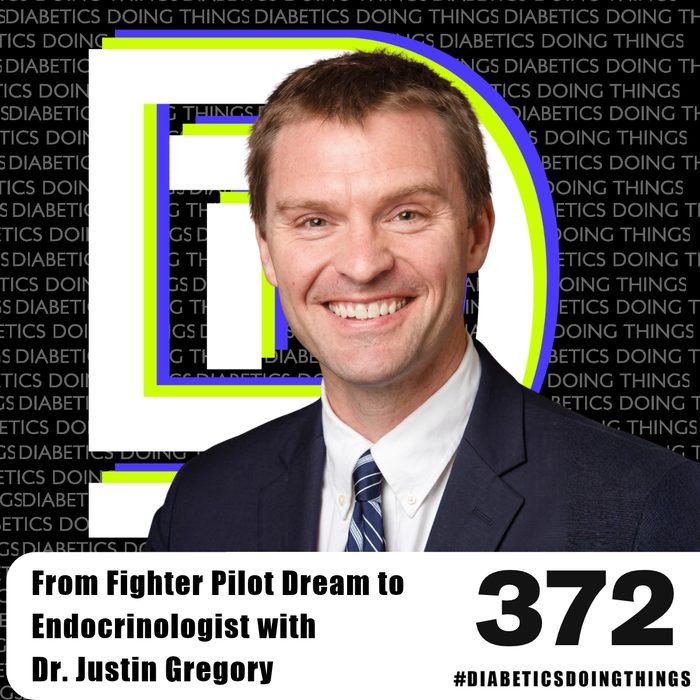
From Fighter Pilot Dream to Endocrinologist with Dr. Justin Gregory

Episode summary
Dr. Justin Gregory grew up in Kingsport, Tennessee, wanting to be a fighter pilot. At 19, halfway through the Air Force Academy, he was diagnosed with type 1 diabetes. In 2001, that ended his Air Force career. He tells Rob Howe about the depression that followed, the 12-year-old who told him it would get easier, and the endocrinologist who inspired him to go into medicine. He became a pediatric endocrinologist and physician scientist, and now works at Sanofi as a field medical director. Justin shares how he times exercise around his insulin and admits he still forgets to pre-bolus sometimes. He also explains why he wants people to get a "soft landing" into type 1 through autoantibody screening, and how families can bring up screening over the holidays.
Key takeaways
- Justin says losing his plan to fly at 19 was the one time in his life he went through real depression. The fighter pilot dream had been a big part of who he was since age five.
- A 12-year-old with type 1 told Justin it would feel overwhelming at first, then become routine. Justin found that to be true and passed the same message to his own patients.
- Justin plans exercise for times when he has less insulin in his body, like first thing in the morning or right before supper.
- Justin says autoantibody screening can give people a "soft landing" into type 1, instead of a first diagnosis in the ICU with DKA.
- Justin says more adults than kids are diagnosed with type 1 each year in the US, so screening is worth bringing up with adult relatives too.
Show notes
At 19, Justin Gregory was a cadet at the Air Force Academy. He was flying gliders, teaching other cadets to fly and training to become a fighter pilot. Then he was diagnosed with type 1 diabetes. In 2001, that meant his Air Force career was over.
Today Dr. Gregory is a board-certified pediatric endocrinologist and the field medical director for autoimmune type 1 diabetes at Sanofi. Before that, he spent about 15 years as a physician scientist at Vanderbilt University.
Rob and Justin talk about the depression that followed his diagnosis, the 12-year-old who told him it would get easier, and the endocrinologist who showed him what a good doctor can do. Justin shares how he times exercise around his insulin and admits he still forgets to pre-bolus sometimes.
They also talk about screening for type 1 autoantibodies. Justin explains why he wants patients to get a "soft landing" instead of a diagnosis in the ICU with DKA. He says more adults than kids are diagnosed with type 1 each year in the US, and he shares how families can bring up screening over the holidays.
In this episode:
- Losing a fighter pilot dream to a T1D diagnosis at the Air Force Academy
- The advice a 12-year-old with T1D sent him through his mom
- His first JDRF (now Breakthrough T1D) walk in Kingsport, Tennessee
- Timing exercise for when insulin levels are low
- Why adults should think about screening too
- How Justin says screening can lower the chance of a DKA diagnosis
- Starting the screening talk with family at Thanksgiving or Christmas
This episode is for information only and is not medical advice. Talk to your doctor about type 1 diabetes screening.
Questions this episode answers
Who is Dr. Justin Gregory?
Dr. Justin Gregory is a board-certified pediatric endocrinologist who lives with type 1 diabetes. He was diagnosed at 19 while at the Air Force Academy, spent about 15 years as a physician scientist at Vanderbilt University, and is now field medical director for autoimmune type 1 diabetes at Sanofi.
Can adults be diagnosed with type 1 diabetes?
Yes. In this episode, Justin says about 37,000 adults and about 27,000 children are diagnosed with type 1 each year in the US. He also says adults are often misdiagnosed with type 2 at first, which can delay insulin.
Does type 1 diabetes screening lower the risk of DKA at diagnosis?
Justin says roughly half of people in the US are diagnosed with type 1 while in DKA. He says that when type 1 is found early through screening, that drops to somewhere around 3 to 6 percent. Talk to your doctor about whether screening makes sense for you or your family.
How do I talk to my family about type 1 diabetes screening?
Justin suggests the holidays, when diabetes often comes up in conversation. He suggests reminding relatives that you share genes that raise their risk, and asking them to bring up type 1 screening at their next doctor visit.
Full transcript Searchable, with timestamps
Rob Howe: Hello listeners, welcome back to another episode of Diabetics Doing Things. We are telling the amazing stories of people with type 1 diabetes from all over the world, and I'm very excited for today's guest. His name is Dr. Justin Gregory. He is a board-certified pediatric endocrinologist and the field medical director for autoimmune type 1 diabetes at Sanofi, and he lives with type 1 himself. Before Sanofi, he spent about 15 years as a physician scientist at Vanderbilt University. His own diagnosis came at 19 when he was a cadet at the Air Force Academy chasing his dream to become a fighter pilot. And that diagnosis redirected him towards medicine and helping people who live with the same condition. Today we talk about why early type 1 screening and closing the gap between awareness and action, why asking about family history and all of the above matters, and why people without a family history shouldn't assume T1D can't affect them. And how earlier awareness can help patients and families feel more informed and prepared. Please enjoy this interview with Dr. Justin Gregory, and I hope you guys enjoy a really vulnerable chat with a healthcare provider who talks about some of the grief that comes along with a type 1 diabetes diagnosis. Enjoy.
Rob Howe: Dr. Justin Gregory, welcome to the show, my friend.
Dr. Justin Gregory: It's great to be here. Thank you for having me.
Rob Howe: I'm excited that you're here. It's National Diabetes Awareness Month, American Diabetes Month, depending on, you know, how you like to categorize November. And I'm really excited today because it's not very often that I also get to talk to HCPs like yourself who are also living as patients. And so we get to have that T1D perspective and lived experience along with the, you know, healthcare perspective. So thank you for being here today.
Dr. Justin Gregory: It's my pleasure. I feel really blessed. A lot of conditions you might live with in your life, for whatever reason, you can't work on it. If I have a condition that's going to drastically inhibit what I can do, I can't research it. I can't be a physician that helps other people with the same condition. I think one of the cool things about living with type 1 diabetes is it doesn't prohibit you from saying, hey, I want to become a scientist and study this condition, or I want to become a physician and help people in the clinic living with the same thing that I have. I've been both of those things. I've been a pediatric endocrinologist in a clinic helping people live with this condition. I've been a scientist working in the lab. Now I have the coolest job, man. I work for a company called Sanofi as what's called a field medical director. And part of the cool thing that I get to do now is raise awareness about this condition, about the importance of screening for type 1 diabetes. So I feel so blessed that you get to do so many things while still living with type 1 diabetes.
Rob Howe: Before we get into your diagnosis, because we have a little bit of a shared geography, so to speak, around your diagnosis story, you talked about recognizing the opportunity to be able to help others and also do research on the condition that we live with. When did that sort of come up for you? I know you were diagnosed at 19, but when did you first think, like, this actually might be something that I want to dedicate my career toward?
Dr. Justin Gregory: Yeah, so it was about that time. I think one thing for me and for many of us is you feel like if you're gonna be given a life to live, it's such a blessing and an opportunity. I was kind of this weird kid that from an early age, I said, whatever I do vocationally, I want it to help other people. For me that was, I wanted to be a fighter pilot. When I was five years old, I knew exactly what I wanted to do. The Air Force Thunderbirds flew over where I grew up in Kingsport, Tennessee. And I said, that's me. That's what I want to do. And as I, you know, went through childhood, that just became more and more cemented. I felt indebted to the people that came before me in the armed services to give me the freedoms that I have. And I felt like I wanna repay that by serving in our armed forces, and the way that I want to do it is as a fighter pilot in the Air Force. And so I went to, you were in Colorado Springs, I was in Colorado Springs, I was at the Air Force Academy because I wanted to be a fighter pilot. And long story short, I found out halfway through my time at the Air Force Academy that not only do I have type 1 diabetes myself, but my Air Force career is over. I cannot stay in the Air Force. I can't fly with this condition back in 2001. And so there was this real need to say, I've got to give this a greater purpose. It can't just be that I got type 1 diabetes so that I couldn't fly anymore and I did whatever I did. And so for me personally, that was, I want to use the way that my brain is strung up and apply it as best I can to this condition. So from 2001 to, you know, 2026, that's what I've done. I put my engineering mind to this as a metabolic physiologist. I feel like physiology is engineering of the body. And I put that sort of need to help people as a physician, as a pediatric endocrinologist. So that's given me so much purpose. It really heightens your enjoyment of life when you feel like you have a high calling, and I certainly feel that way.
Rob Howe: Yeah, I think, you know, having that purpose, something that's deeply personal as well, really helps to drive it. I know I've experienced that myself. Can we talk a little bit about a lifelong dream that you're living? You talked about seeing those fighter pilots when you were a kid, and, you know, getting into the Air Force Academy is not an easy task. Being in the Air Force Academy is even more difficult and rigorous, and then being told that you're not going to be able to chase that dream anymore, that that dream's got to change. We've had some amazing pilots with type 1 diabetes on the podcast over the years. And when you're connected and loving flight, that's a type of person who really cares and is really passionate about that, and the pilot and flight community. What was it like for you early on, being told that there actually are a few things that you're not able to do, at least at that time, with type 1 diabetes?
Dr. Justin Gregory: Yeah, I felt like the firm ground that I stood on was never going to be firm again. You know, when you're 19, when you're in the greatest shape of your life, when you're flying, in my case, gliders and teaching other people how to fly, you have sort of this sense of invincibility. And man, that went in a day when I had type 1. You know, just to find all of that out at once. To have a physician come to you and say, hey, you're gonna be taking shots for the rest of your life, and the only shots I'd had at that point were immunizations. And to find out you're gonna be doing this multiple times a day, every day, you're not gonna fly, you're not gonna be in the Air Force anymore. That was probably the one time in my life when I truly went through real deal depression. Because it's like my whole life, I was like, I am on this trajectory. What I want to do is virtuous. It's something that I have no doubt that this is what I'm gonna do one day. And there in a moment
Rob Howe: Big part of your identity.
Dr. Justin Gregory: It's gone. Very much, very much. People back home in Kingsport, that's what they knew. Justin's out of the Air Force Academy, he's gonna be a fighter pilot one day. And so in a moment for that to go away is a crisis, to say the least. And then it's like, what am I gonna do now? Am I gonna be an engineer? Because at least I was an engineering major, and I would have loved that. But that was never in the plan. It was never in the plan that I'd say, okay, gonna, you know, go work in a factory as a mechanical engineer. I would have liked that, but that was never what I envisioned.
Rob Howe: Well, we were joking a little bit before we started recording about being agile and being ready to pivot, and being ready to move on to, taking some difficult news and a path that you were really committed to and shifting that. So how quickly did you realize that you were gonna lean into that sort of purpose and, you know, dedicate the trajectory of your life and career towards type 1 diabetes?
Dr. Justin Gregory: It was a slow evolution. When I was diagnosed, I was a mechanical engineer. And at the time there was some talk that, hey, maybe one day we're gonna have these things called continuous glucose monitors. Because back in those days, when you would check your blood sugar, I mean, it was like sticking a harpoon in your finger. You'd have to milk massive amounts of blood out. And the thing, okay, these continuous glucose monitors, I'm going to be able to read glucose numbers every five minutes. And the engineering part of my brain said, well, okay, we can take that information and maybe do some mathematical adjustment, and that can tell us how quickly insulin should come into the body. And so that was the first time I thought, okay, maybe I can take what I'm doing as an engineering student and apply it to people living with the condition. And then as time goes by, I was very blessed to have an outstanding endocrinologist when I transferred out of the Air Force Academy and started going to college at the University of Tennessee. His name was Casey Page, and I saw just how good he was with his patients like me and what impact somebody could make inside of a clinic. And so, well, I want to do that too. And so maybe I can figure out how to do both of those two things, as an endocrinologist, and I became a pediatric endocrinologist, and also as a physician scientist. So that was my evolution.
Rob Howe: It's amazing the impact that a good endocrinologist can have on your life with diabetes. And I'd love to talk a little bit about your time in clinic as a pediatric endocrinologist, but, you know, you talked about giving shots, you talked about CGM. How do you manage your diabetes on a day to day, especially now, when your life is diabetes? We talk about this a lot on the podcast, about when your career is diabetes oriented and you live with diabetes 24/7, that can sometimes be kind of heavy to manage. So how do you manage your diabetes on a day to day?
Dr. Justin Gregory: Yeah, I think type 1 diabetes can be really easy. I think that you can have great glucose control that's almost like not living with type 1 diabetes at all. The only problem is that you have to be perfectly still the whole time and not eat anything. That's something I learned from my buddy Steve Edelman, is if you can just be perfectly still and not eat anything, an automated insulin delivery system is pretty great. But the problem is guys like you and me are committed to exercising. We want to have variety in our lives in terms of what we eat and how much of it we eat, when we eat. And so I guess in just general terms, I've learned a few things that I think are helpful for a lot of people living with the condition. One of the hardest things I think we do is exercise. It's such a simple thing to say, I'm going to go outside and run a 5K, if you don't have type 1. If you do have type 1, you have to learn things like, well, I've got to plan ahead. If I can exercise first thing in the morning, when the amount of insulin that's in my body is pretty low, because I haven't eaten anything yet, chances are pretty good I'm not gonna have a low blood sugar. And if I can't do it in the morning, maybe it's good for me to time my day out to where, like yesterday, my son and I went for a run in the neighborhood, and we did it right before supper because I knew that that's when my insulin levels would be low. And then we would eat supper and I could take my insulin then. So planning your day out for exercise is really helpful, as you know. And then there's things that sound easy in principle, but sometimes they're hard in practice. I think one of the best things you can do living with type 1 diabetes is to take your insulin injection, whether it's with a syringe or whether it's with your pump, several minutes in advance of beginning to eat. And the more carbs you eat, the more important that becomes. What I do a lot of times is if I'm out and about, you know, hopefully I'm washing my hands before I eat. I always try to bring my insulin injection into that because it's just something that I can connect. And if I'm at home, if I'm beginning to prepare supper for the family, that's when I go ahead and take my insulin.
Rob Howe: That's that engineering mind taking over that system.
Dr. Justin Gregory: So it's simple in concept, but the hard thing is that when life gets busy and it's hectic and you're 20 minutes into your meal and you're like, crud, I need to take my insulin bolus. A lot of times you're gonna be seeing a high blood sugar for the next hour or two. So those are just some practical things that I found living with type 1 that at least help me keep as much time in range as possible.
Rob Howe: Hey, I think it'd be refreshing for our listeners, caregivers of people with type 1 and people living with type 1, to know that even an endocrinologist struggles with a pre-bolus or, you know, remembering to bolus for their meal sometimes. It's just good to know that, you know, not all endos out there are perfect, you know? They're people too.
Dr. Justin Gregory: Absolutely. It's kinda like watching great basketball players, like you miss free throws every now and then. It's like, all right, yeah, I'm a sixty percent free throw shooter on a good day. Yeah, good to see Rob missing a free throw.
Rob Howe: Yeah, yeah. That's, you know, it's like in theory, it's so easy, but I get up there and, you know, every now and then two out of three feels pretty good.
Dr. Justin Gregory: Thanks for doing that.
Rob Howe: Yeah. I wanna talk a little bit about you as a type 1 at the forefront of research and progress. And, you know, what would you tell yourself, sitting in the Air Force Academy clinic in 2001? What would you be able to tell that 19-year-old about your career today and the stuff that you're working on?
Dr. Justin Gregory: I think the first thing I'll say, and this is true for a lot of people out there today, is if you don't live in the same family as someone with type 1 diabetes, if you're not closely connected to someone with type 1 diabetes, I have a word of encouragement and a word of advice to that person. The word of encouragement is that it's okay, on the one hand, to feel like this is overwhelming. This is something to be sad about. Your life has changed. But I remember I was 19, I didn't know anyone who had type 1 diabetes. My mom was a seventh grade social studies teacher, and she had a kid in her class that had the condition, and he told her to tell me something I've never forgotten. And this 12-year-old kid telling this 19-year-old kid, hey, tell your son Justin that at first, in the first few months, this is gonna seem really hard. It's gonna seem really overwhelming. It's gonna seem more than you can do because it rocks your world so much. But in time, this is gonna become much more routine. It will not seem so overwhelming. And I found that to be true. That's something that I told patients all the time. It's okay to feel sad. It's okay to feel overwhelmed. But I also wanna encourage people like that that it gets better. So that's, I guess, my word of advice and encouragement. Another word of encouragement I would have is that, man, if you haven't lived with type 1, if you haven't seen it, the very thought of shots, whether it's injections or whether it's putting in an insulin pump, what comes to mind is almost like this harpoon-like injection that you get when you might get an antibiotic shot or a vaccine. Insulin injections are not like that. I thought they were at the time. You're using a much finer needle. It doesn't hurt anywhere near as bad. So those are two things that I would have told that 19-year-old who didn't know anyone with type 1 diabetes, didn't know what he was getting in for: it's not as bad as you think. It's not gonna be easy, but with patience and persistence, your life can be very, very full. And this becomes part of your life, but it doesn't control it.
Rob Howe: I love that. And I think too, something we're really passionate about here is making a friend with diabetes, and the advice that that 12-year-old gave you. It's probably not much more advice that he could give you that you would accept at that moment, but that was such good advice and such sage wisdom from a kid who is seven years younger than you.
Dr. Justin Gregory: In those days, we were giving NPH and Regular, and you would inject once in the morning and once before supper. And there were no CGMs, not many people had pumps. And so there weren't all these things hanging off of people to where you say, that guy right there has type 1, I'll go up and introduce myself. And so one of the best days of my life with type 1 diabetes was the first day I went to, back then it was JDRF, now it's Breakthrough T1D, there was a walk there in my hometown of Kingsport. And all of a sudden you're surrounded with hundreds of people living with the same condition you do. I get emotional to this day thinking about how encouraging it was to see these people who had been there, done that, were happy, were not overwhelmed by the condition. And there's just something about seeing other people doing the same thing that you are that goes such a long way. One of my most precious groups of friends are people who are also endocrinologists who live with type 1. We make a point of getting together once a year at conferences and just spending time together. It's one of my favorite friend groups. It's just such an encouraging group to be around.
Rob Howe: Yeah, and you mentioned Dr. Edelman. There's so many others, people who live with type 1 and have dedicated their lives to helping. You talked about Regular and NPH back in 2001, which, if you think about it, you zoom out, that's really not that long ago. And, you know, the amount of treatment options and the technology and the insulins have dramatically changed since then, if you compare them. Things are moving fast, and we're talking about today, you know, advocating for screening for autoantibodies that people with type 1 diabetes have. What's something that you've changed your mind about in that time? As technology has advanced, as the treatment options have advanced, something that you've changed your mind about maybe from the time that you started practicing as an endocrinologist to now, or, you know, something that you've seen in the research that's given you maybe more hope or more optimism? What comes to mind?
Dr. Justin Gregory: Yeah, so a couple things. Two broad things. I think that we've moved in a direction where the practice of medicine, to include screening, has become more personalized, more precise. And the second is I think our field is moving in the direction of thinking more proactively, thinking about preventative medicine. So let's start with the second of those things. For years and years and years, medicine, practically speaking, was you come to me when you're sick, and I may put you in the hospital, I may see you in the clinic, but I'll give you medicine to not make you feel sick anymore. And I think what's going on is a movement towards, hey, let's think about preventing you from having an illness in the first place, or consequences from the illness, if we can't keep you from getting whatever that condition is. And so I think screening is a big part of that. I think that we want to move in the direction of saying, hey, when you are introduced to type 1 diabetes for the first time, we don't want that to be in the stress and duress of being in an ICU with diabetic ketoacidosis. That can be so emotionally traumatic to a patient or to that patient's family that it takes months and months and months to get to where you feel like, okay, I can sleep through the night because I'm not so terrified of this anymore. Or to sort of get you out of the mode of thinking that type 1 diabetes is a hospital condition. Type 1 diabetes does not need to be a hospital condition. But if your introduction is, I'm in the ICU, I have two IVs in my body, there's stuff beeping all the time, the traumatic experience of that is tough to get away from. I would much rather use antibody screenings, which did not exist, not in any way that could be done broadly speaking. It didn't exist in 2001. It does now. And I would much rather, I call it the soft landing. I would much rather identify someone early on in the natural history of living with type 1 diabetes, before they need insulin, before they're at risk of DKA, and gently and gradually bring that person into an understanding of what it's like to live with that condition and what's needed.
Rob Howe: I couldn't agree more. Even something as simple as, everybody listening knows what it's like to try to focus or try to do something while your blood sugar is out of range. It's hard. You're not feeling like yourself. And, you know, you add the hectic hustle and bustle and traumatic experience of being in the hospital. Man, it's hard to remember anything out of those types of situations.
Dr. Justin Gregory: Yep. You're doing good to remember ten percent of the things that you hear in that circumstance.
Rob Howe: That's right. Drinking from the fire hose, right? You're lucky if you remember what time of day, and mix up the two insulins that they give you. Right. And so, you know, being able to have that time and education can make such a huge difference.
Dr. Justin Gregory: So many times, Rob, I would have a family in the hospital and I felt like I had baby birds in a tree's nest, and I was kinda having to take my foot and shove them out of the nest to, you know, let them see if they could fly. I hated to do it, but I remember it was so hard because families were terrified of going home. I thought, you know, sooner or later we're gonna have to leave the hospital. I would much rather not have to do that. I would much rather, again, gently bring people into this new existence, this new routine that comes with living with the condition.
Rob Howe: Yeah, I think, you talk about the fear side of it. Your diagnosis experience can vary so much, and that can affect you for years down the road. I hear stories of people where one offhand comment from a nurse during their diagnosis prevented them from traveling or prevented them from applying to certain colleges or doing social interactions because, you know, in a quick moment they remember something from that trauma that took them years to overcome. And so the idea of being able to avoid that, the downstream effects are extremely positive.
Dr. Justin Gregory: For sure. And I think one thing that our field is gradually coming to appreciate and do a better job of is the need for early mental health help in this condition, psychologic help, whether that's from a social worker or a psychologist. We think that part of how we treat type 1 diabetes isn't just going and seeing the endocrinologist and having that person adjust your insulin dose. But asking people early on, even in the situation where you've gone through early detection, you've picked up someone who has antibodies but doesn't yet need to start insulin. I think there is an appreciation in many of those patients, we need to connect them with mental health specialists, because even just knowing that you have positive antibodies, that can be anxiety provoking. And so thinking through, okay, how do we help those people not feel quite so scared of this or anxious about it is something that we're doing a better job at year in and year out.
Rob Howe: Well, that was actually why I asked you about your diagnosis. You know, being 19 years old, being invincible, and that competitive mentality is part of being a fighter pilot. You know, we train our fighter pilots to be confident and, you know, pushing the envelope, and that passion for that career being taken away from you at that age, you suffer a real identity crisis. And, you know, moving forward can be difficult. And I know we've seen some comments recently of people who are really struggling with that grief as they're diagnosed a little bit older than some of your pediatric patients. Younger than five or six years old, you may not remember much about your life before diabetes. But people who are diagnosed in their twenties and older do remember that. And they remember the flexibility of not having to think about going to brunch and then going to a workout, or waking up and wanting to do a 5K, or staying out a little bit late and not worrying about what that's gonna do to their glucose in the morning. And I think that there really is a challenge to accept those things. And, you know, I think for me now, a little bit older, 22 years since I was diagnosed, I'm grateful that I learned not to be too attached to the way that my life is, because I know now that it can change. And also that even if you get some bad news, it's just information, and you can learn to adjust and adapt and, you know, put good people around you and advocate for yourself and others in a way that adds more to your life than it ends up taking away. But you need to be able to arm people with those resources. And so, you know, we're really passionate about the mental health aspect of it. Diabetes is so much more than just counting carbs and dosing that insulin. There's a whole life to be lived outside of that.
Dr. Justin Gregory: Absolutely. Couldn't agree more.
Rob Howe: So for you, if there's someone listening who has type 1 or cares for someone with type 1 diabetes, we're about to be around the holidays, where we're interacting with our family a lot. How should they approach screening for family members, either with their doctor or, you know, talking about those conversations around their family?
Dr. Justin Gregory: One of the things I'm surprised about is, a lot of our families living with type 1 diabetes, they know their family member's type 1 diabetes really well. And that's an accomplishment. They have an expertise. But there are a lot of misconceptions, even among patients and families of patients with type 1 diabetes, about risk. You'd be surprised. One misconception that's out there is that type 1 diabetes is predominantly diagnosed in children. It turns out more people, year in and year out in the United States, are diagnosed as new onset patients with type 1 diabetes in adulthood. About 37,000 adults are diagnosed with new onset type 1 every year, and about 27,000 children, you know, pediatric patients, are diagnosed every year. And so one of the things that I've tried to say to my patients and my friends living with type 1 is, it's not just going and telling, say, your nieces and nephews who are kids that they need to think about screening, or maybe that their parents need to think about screening those kids. It's also adults. There are a lot of people who are diagnosed in the adult years. And so for those people, everything I've already talked about with the benefit of early detection is true, with one additional mention, which is so often in the United States, adults who are diagnosed with diabetes are mistakenly diagnosed with type 2 diabetes, as opposed to type 1, which is what they really have. And there are some consequences of misdiagnosis. If you're misdiagnosed with type 2, insulin is delayed. I want to stop short of saying mistakes, but I'll put it this way: it takes longer to get the appropriate treatment for someone when they have type 1 and are misdiagnosed with type 2. And so a benefit of early detection with antibody screening is once you see those autoantibodies, it's harder to misdiagnose someone with type 2. And so, you know, at Christmas time, or whatever holiday your family celebrates, at Thanksgiving time, a lot of times it comes up in conversation. You know, how are things with your diabetes going? And that's a great time to say, well, it's going well. Here are the things that are going well. Here's the things that are not. And it's just a natural time to say, hey, you know, we share a lot of these same genes. That increases your risk of developing type 1. Have you ever thought about doing screening? A lot of times it's not even on people's radar. And again, if you're living with type 1 and you're not a doctor, it's okay, but it's a good time to say, hey, next time, you know, brother Jim, you go to see your doctor, bring it up and ask him or her about, hey, I've heard about this thing, type 1 diabetes screening, can we talk more about it?
Rob Howe: I hope that conversation is happening more often now. You talked about the mindset shift of medicine from a patient perspective. It's not always, hey, there's something wrong with me, let's go get treatment. It's more proactive, and we're working to be more proactive. Thinking of other disease states, for example, like colorectal screenings and the effectiveness of a colonoscopy and detection of future disease states, and the likelihood of treatment at those points is much better if we catch those during those screenings. And applying that same principle, I think, to type 1 diabetes is extremely important. And I wanted to add something that I learned. I'm very blessed and fortunate to have access to people like yourself and research that the general patient population doesn't always get exposed to, because I'm at these industry conferences and things. And one of the things that I learned recently is you're more likely to be diagnosed with type 1 diabetes the older you get. You start to see that distribution. Congrats, you're living longer, and you're more likely to get diagnosed with T1D later in your life. So why not try to do what you can do to know early enough? You may not ever get diagnosed. You never know. But having that extra knowledge in the back of your pocket, I think, is really helpful when you start to run into some of those symptoms, and avoiding those traumas like we talked about.
Dr. Justin Gregory: And one of the things, I think, too, for parents and for adults out there, a really compelling statistic for me, is that when someone is diagnosed with type 1 diabetes in the United States, roughly fifty percent of people are diagnosed in the context of being hospitalized for diabetic ketoacidosis, DKA, which is a life-threatening condition. Even if it's not something that's life threatening for everyone, it's not how you want to come into type 1 diabetes. The chances of someone being introduced to what we call stage 3 type 1 diabetes, that's when you need insulin, the chances of that happening in the setting of DKA, diabetic ketoacidosis, go from somewhere around 50 to 60% to somewhere around three to six percent because of the things that we're talking about, because we're thinking in a preventative way about type 1 diabetes. So that alone, I think, is a really compelling reason to screen for type 1 diabetes. It's just, you're not going to get introduced to needing to take insulin and needing to monitor your blood sugar in the setting of feeling really sick.
Rob Howe: And DKA is scary. We've talked about it on the podcast a lot to try to reduce that stigma of it. And, you know, it's something that you want to avoid if you can. And it's a great way. Like those numbers, like you said, the large percentage of reduction in DKA cases, I think that's good enough for me.
Dr. Justin Gregory: Me too.
Rob Howe: Justin, I thank you, man. Thank you for coming on the podcast today and being so open and vulnerable about your story, and for taking your shift and diagnosis and turning that into purpose for people like me and people with diabetes. I really appreciate it, and I appreciate your time today.
Dr. Justin Gregory: Hey Rob, I appreciate yours. I appreciate all that you're doing to raise awareness of this as we're coming into Diabetes Month, and thank you as well. I really appreciate you.
About Dr.
Dr. Justin Gregory is a board-certified pediatric endocrinologist and the field medical director for autoimmune type 1 diabetes at Sanofi. Diagnosed with type 1 at 19 while at the Air Force Academy, he spent about 15 years as a physician scientist at Vanderbilt University.