

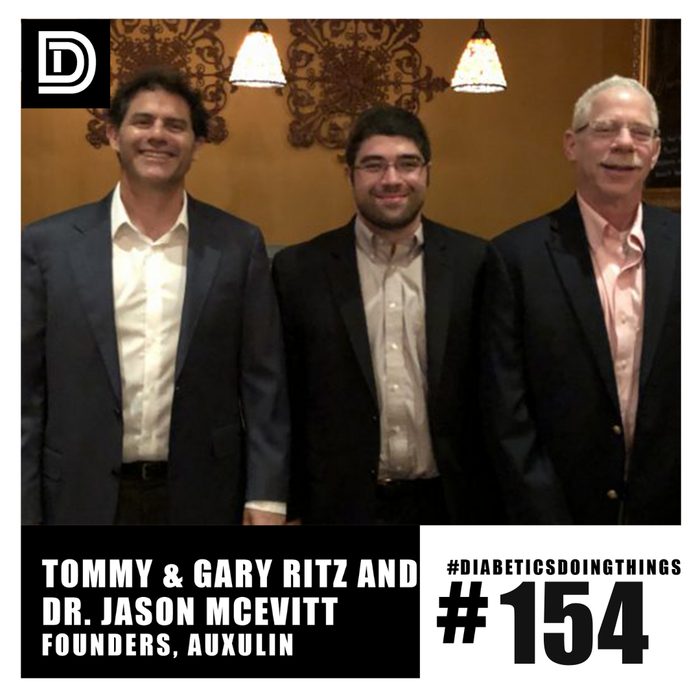
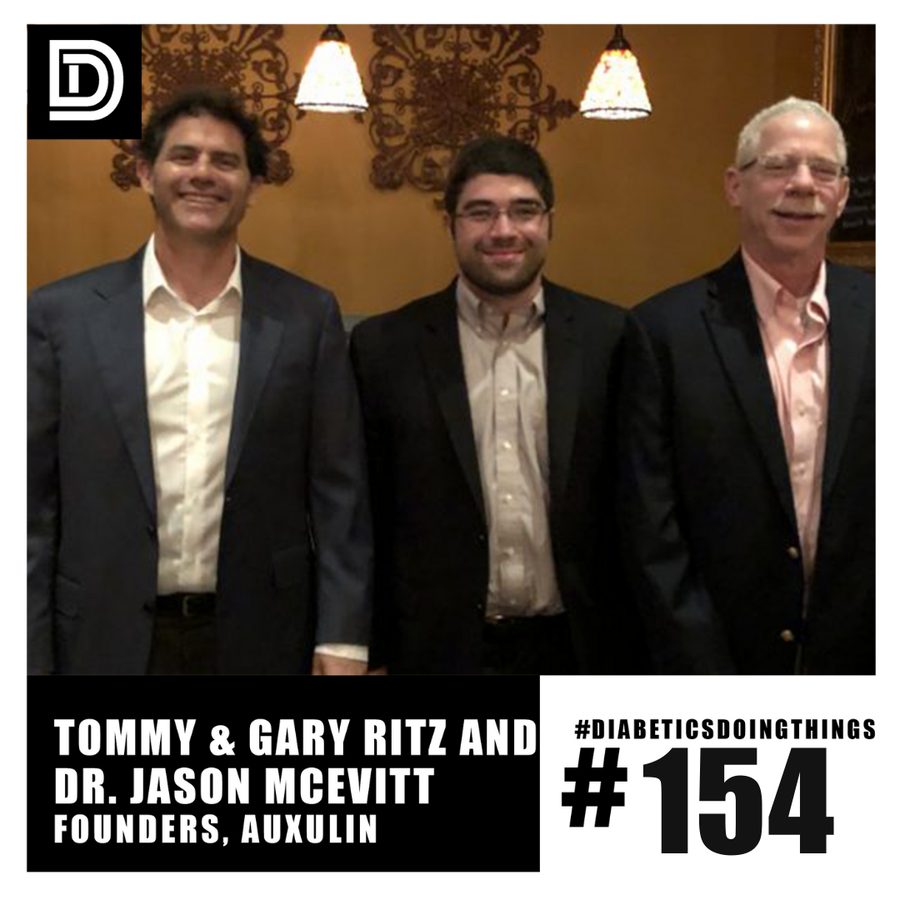
FOUNDERS Auxilin Co-Founders Dr. Gary and Tommy Ritz
Episode summary
Gary Ritz was diagnosed with type 1 diabetes at 26, during a podiatry internship in Seattle, after his blood sugar tested at 980. Years later his son Tommy was diagnosed at age six, after Gary noticed him chug a glass of water and checked his blood sugar at 250. The family includes a third brother with type 1 and a mother who works as an endocrine nurse. Gary and Tommy talk about growing up with multiple diabetics under one roof, the carb-counting rivalry at home, and the guilt Gary carries over passing on the condition. They also describe building Auxilin, a supplement meant to lower high blood sugar faster by reducing insulin resistance, which they tested on themselves and friends before seeking funding to manufacture it.
Key takeaways
- Gary Ritz was diagnosed with type 1 diabetes at 26 after his blood sugar tested at 980; his son Tommy was diagnosed at six after Gary saw him chug water and checked his blood sugar at 250.
- Gary says he still carries guilt over passing the condition to Tommy, since no one else in his family had diabetes.
- Tommy says he's the best carb counter in the family, ahead of his dad, his mom (an endocrine nurse), and his older brother, who also has type 1.
- Gary and Tommy co-founded Auxilin, a supplement they say lowered their blood sugar from an average of two and a half hours down to 45 minutes in self-testing with several other people with type 1.
- Tommy says Auxilin is meant to be used like a rescue treatment, taken with insulin during a high, rather than as a daily medication.
Show notes
Delayed publishing due to COVID-19
Welcome Dr. Gary and Tommy Ritz, the first father son diabetic duo interview on the pod!
Gary was diagnosed at 26 while working at an internship in Seattle in 1984, he had the usual symptoms, finally got tested and his BG was 980! Years later, Tommy, was diagnosed at 6 years old, and Gary was able to diagnose him after seeing him chug a big glass of water. His bg was 250 and the rest is history! Their Mom is also an endocrine nurse and they have another brother with T1D. Diabetes runs strong in the Ritz family.
We talk about what it was like growing up with another T1D in the house, and what advantages came along with it, and one of the fun facts that came up is Tommy is the best carb counter in the house.
Gary also talks about some of the parental guilt that came along with passing on the gene to Tommy, and how it sort of eats at him. That brought up something that I don’t often talk about, but my Dad had a really tough time accepting that there was nothing my family could’ve done to prevent me getting Diabetes. It can be really difficult for parents all around, even outside of day to day care.
What is Auxilin?
Like many people with Diabetes, Tommy has struggled with management of high glucose , and was frustrated at how there were a lot of ways to treat hypoglycemia, but not a lot of other treatments besides insulin for Hyperglycemia (and jumping jacks of course). So along with his father and Dr. Jason McEvitt - they set out to create Auxilin.
Auxilin stands for “Augmenting Insulin” to assist insulin in lowering blood sugar
Auxilin eliminates insulin resistance so your insulin works normally. As your blood sugar goes higher, you become more insulin resistant.
How does the science work?
Auxilin works on a hormone that everyone has in their body, which helps with insulin absorption.
Let me know what you think of this interview with a superstar Diabetic family!
Questions this episode answers
What is Auxilin?
Auxilin is a supplement co-founded by Gary and Tommy Ritz that's meant to be taken with insulin to lower high blood sugar faster by reducing insulin resistance.
How was Tommy Ritz diagnosed with type 1 diabetes?
Tommy was diagnosed at age six after his father Gary, who also has type 1 diabetes, noticed him chugging a large glass of water and checked his blood sugar, which read 250.
Does type 1 diabetes run in the Ritz family?
Yes. Gary and Tommy both have type 1 diabetes, as does Tommy's older brother Kevin, and their mother works as an endocrine nurse.
How is Auxilin meant to be taken?
Tommy says Auxilin is meant to be used like a rescue treatment, taken with water and insulin during a high blood sugar episode rather than daily, though usage varies by person.
Full transcript Searchable, with timestamps
Rob Howe: What's going on guys? New episode coming at you right now. This was recorded back in April during the quarantine. Again, I'm still getting caught up. I'm doing better. Thanks to Eritrea for continuing to remind me to publish episodes. I've got some. They're great interviews. People with diabetes doing all the things. Today, it's a Founders episode. It's also the first episode with a father and son who both live with Type 1, Type 1 Diabetes Duo, Dr. Gary Ritz and Tommy Ritz, who are the co-founders. and they have a another partner as well. They're the three headed monster behind I guess monster is a terrible word to describe it but they're the three headed founder group behind Auxilin. And we're going to talk a lot about Auxilin but primarily the really cool thing about this family is that they also have another brother with type 1 and their mother is an endocrine nurse endocrinology nurse. So diabetes is running thick in this family and it's really fun. I did learn in this interview that Tommy is the best carb counter. So if you're out there with a type 1 diabetes family and you got multiple people in your family with type 1, I want to know who's the best carb counter. So send me an email, let me know. We also talk about a really cool thing. Dr. Gary and I get into parental guilt around having another type 1 in the family or another series of type ones in the family. That's something that while I'm the only person in my family with diabetes, my father struggled for a long time knowing that hearing from the doctors that there was nothing he could have done to prevent it. He had a lot of guilt about that. And I think a lot of parents do, but also parents who are carriers of the recessive gene and pass it on to their children. So we talked a little bit about how he reconciled that and had to get over it and accepted it, which I think was really healthy to talk about that vulnerability and the struggles. So we're also going to talk about Auxilin, which essentially stands for Augmenting Insulin to Assist Insulin in Lowering Blood Sugar. So that's a product that they are currently working on as in development and testing. And I'm really excited to follow them along this journey as they get Auxilin to market. So without further ado, I'd like to introduce you to Dr. Gary and Tommy Ritz. Hey, guys. I'm going to use this ad portion to create a little bit of awareness on something that's very cool. and it's put on by the American Diabetes Association. It's called hashtag health equity now and you can search that on social media. It's the American Diabetes Association's new health equity bill of rights, which provides steps to building a future without unjust health disparities. So you can actually go and take action online. I did it. If you go to diabetes.org slash health equity now, you can go and they pre-populate in an email to your governor and they automatically do that. So no matter where you're from, You can go to diabetes.org slash health equity now, and you can send the health equity bill of rights to your governor. So I did that. It sent to governor Greg Abbott, and it just outlines all the health disparities that people with diabetes, especially communities of color face in the United States, and that we want to vote. And we are creating awareness with our representatives to make sure that they try to change the legislation, provide more opportunities. Number one on that list is the cost of insulin. So if you have diabetes, you should take a minute and contact your governor. Even if you're not in the United States, just put Texas because that's important to me. Diabetes.org slash health equity now and check it out. Welcome back to another episode of Diabetics Doing Things. We are telling the amazing stories of people with diabetes from all over the world. I have a very special group of guests today. For the first time on the podcast, we have a father-son duo of both living with type 1 diabetes. Dr. Gary Ritz and Tommy Ritz, welcome to the show.
Tommy Ritz: Great to be here. Thanks, Rob. Appreciate you having us.
Rob Howe: Yeah, appreciate you guys making the time. This is also a Founders episode, so we're going to be talking about the company that you guys have co-founded and are working on as we kind of get into the episode. But first, the way we do these episodes normally is to start a diagnosis. And since your diagnosis was first, Dr. Gary, I'd love to kind of hear about what you remember about being diagnosed with diabetes. And then we'll kind of transition into that to Tommy's story as well.
Gary Ritz: Okay. Well, I was 26 years old, never sick a day in my life and in podiatry school. And I had an opportunity to go to Seattle, Washington to do an internship. So I was there about a month, about three weeks into it. I'm starting to get really tired. And I figure, well, that's probably because they're working me to death. And I come home and all of a sudden I have a thirst that is just never ending. I cannot stop being thirsty. And I'm thinking, but I'm working out. I'm doing things. I'm exercising. Well, you know, maybe it's part of that. And all of a sudden I started having to urinate and I'm urinating every hour on the hour. Midnight, one in the morning, two in the morning, just could not stop doing that. and I went from 175 pounds to 155 pounds in about a week and at first I'm losing weight oh this is good but you know 20 pounds in a week this might be a problem and then the fourth thing that happened was I knew it was a stop sign by the shape of the sign but I couldn't read the word stop on it but I still delayed going to the doctor for about a week because I had when I got back I still had to take a bunch of tests you know at the school and then I go to the doctor and the lady comes in and she checks my blood sugar and she goes, ah, there's something wrong with the blood sugar machine here because the machine was reading high. And when they finally came out with the number, I was 980. And it was, you know, started my fun and starting insulin and just, you know, from that point on, it was a whole different lifestyle.
Rob Howe: And what year, you know, and don't quote me on this, I'm not trying to out you or trying to show your age here, but what year was this when you were diagnosed?
Gary Ritz: 1984 1984 so glucometers were there but when i started with the glucometer the first one i got it counted down from 60 when you got to 20 you had to wipe the blood off then put it in the machine and every time i would get distracted by the time i got to 20 i missed 20 and keep doing and it didn't take a little drop of blood it was it was a lot of blood on that that
Rob Howe: strip i can't imagine having to wait 60 seconds i i would be like you i'd be distracted not even know why I was doing what I was doing like on the two or three other things.
Gary Ritz: Or they would tell you to check the strips when you check your urine. All the colors look the same to me. I couldn't have picked what, you know, what the sugar was off that either. So, but, you know, thank God things have improved greatly since, you know, since back then with the pumps and glucometers and everything else.
Rob Howe: You know, it's really interesting. You look at where we are today, 30, you know, what, 36 years since 84. before and just the amount of incredible innovations in technology and treatment. Obviously, insulin by and large has remained the same, but just the technology, I think, is probably the biggest noticeable change in day-to-day management for folks. But seeing you today, you got a family, you're still practicing, you're still, you know, I got an entrepreneurial venture. You're living your life, man. It gives me a lot of hope because I feel like people who are diagnosed today or more recently, you know they we don't have to suffer through the 60 second wait time on a glucometer no you don't it is so you know you made it through all that and you're still living your best life so i i always it's always always warms my heart to hear people who have overcome a lot of those early day difficulties and are still uh kicking and just living the life the way they want to live it so
Gary Ritz: it also helped that my wife is a nurse and so she was also able to you know understand she worked on a floor that had diabetics on it. So she was really able to help me with, you know, when I first became diagnosed, we had just met. So she was really able to help with what to do and how
Rob Howe: to do things. That was a really nice perk. You met her at the right time. Yes, I did. Yes, I did. I hear her listening back there. That's good. I want to make sure I give you props. So I guess fast forward a few years, you guys brought Tommy into your lives. And, you know, At some point, you probably started noticing some of those same symptoms. I don't want to put words in your mouth. But Tommy, what do you remember about your diagnosis?
Tommy Ritz: So this is kind of unique because my dad is the one that helped to diagnose me. But I was about six years old and I was in kindergarten. And being so young, it's kind of like a fuzzy memory. Like in my mind, I can't remember not being a type 1 diabetic. But in this case, like I was using the restroom a lot, drinking a ton of water. And my parents were like, huh, that's weird. And they had actually seen like a genetic odds just before having kids to being like, hey, what are the odds that our kids are going to be type 1 diabetics? And the genetic odds just was like zero percent. I mean, my mom didn't have the recessive trade, it seemed like. So very low risk of their kids becoming type ones. So they're hoping, you know, it's a cold. It could be a million other things. So I come home one day with my dad's, I think, between patients coming home for lunch, coming home from kindergarten. and I'm like, hey, I'm thirsty. He gives me like a huge glass of water, chug it in like 10 seconds. He's like, you know what? I mean, I have a blood sugar machine laying around just to be safe. Let's check your blood sugar. And it was 250. So that's what started like the ball rolling on being a type 1 diabetic. And the interesting thing is I had a cold before that. I mean, as all type ones know, it's an autoimmune disease. That same cold got another little girl in my class in kindergarten to give her type 1 diabetes as well. So that's like a real odd coincidence that I've always thought about over the years about how that one cold like kickstarted two people's diabetic journeys.
Rob Howe: Yeah, that's always wild. I mean, you know, and as we learn more about what does and doesn't cause type ones, it's always interesting to look at those environmental factors like people living in the same town, you know, drinking the same water, you know, having a lot of the same environmental impact. You know, it's always, always interesting to see.
Tommy Ritz: Yeah. And that girl's mom was a type 1 diabetic also. Yeah.
Rob Howe: Wow. Oh, okay. Very interesting. So a lot of environmental factors kind of coming together at the right time in the right place. Interesting.
Gary Ritz: The other thing taught me to say was the first thing that my wife and I know is he's starting to pee to bed. Oh, yeah. And I say, Tommy, what's the matter with you? And I take him to the bathroom when he pee like, oh, thank God I took him. Never thinking, just like with me, never thinking it could be diabetes.
Rob Howe: And it's always so interesting, right? Like the symptoms on their own, especially for a young child, uh, or, you know, uh, a very tired, you know, busy person. I've heard, I've had people on the podcast that said, you know, I was starting my vacation and we were just hiking a lot every day. And I assumed my fatigue was coming from an increase in activity. Uh, or I assumed I was just, uh, training too hard and needed to drink more water. And that I was, you know, that that was a good part for me as an athlete. I was like giving myself a pat on the back. I was like, wow, I'm really drinking my water. I'm really hydrating. Coach is going to be excited. And then, you know, come to find out I lost 20 pounds. I'm like, okay, something's off here. But, you know, it's always interesting, you know, even when you live with diabetes, you don't always pick those things up right off the bat. What do you remember, Tommy and Gary, feel free to chime in as well about those early years with diabetes? Did you find that you guys were able to work together and it was sort of a, you know, symbiotic relationship early on and like kind of instruction and did it help having
Tommy Ritz: another type 1 in the house? Oh, I couldn't be more thankful that my mom was an endocrinologist nurse and my dad was not only a physician, but a type 1 diabetic. I mean, from what I remember, I was super resist, like, you know, I don't want to take shots. I don't want to poke my fingers and really struggle to adjust initially. But over time, my dad was a great role model of strict diet, strict exercise, checking his blood sugar constantly, and not going, you know, I'm a diabetic, but I'm a person with diabetes. So that's something I always took in stride growing up with it, especially, I mean, I got it in 99. And I think diabetes awareness has really grown since then. But back in those days, like I'd have teachers are like, all right, we're having pizza, Tommy's got to get out of the room. Just not understanding how diabetes worked, or going to like kids birthday parties and like, all right, we got cake and Tommy, we got you some celery, go in the corner. But just having my, seeing how my dad was able to get through life at an even more, for lack of a better word, ignorant stage of people's understanding of chronic illness really helped me get through it. Yeah. For me, the one thing I guess that changed when Tommy became diabetic is I used to always say, I don't want an insulin pump. I'll hold that for last shot in the barrel. nothing else is working then i'll get the pump but i thought well tommy might want to eventually get the pump so i'll do it first and then he'll it was the best thing i did but i didn't you know if he hadn't had diabetes i don't know if i would have bothered with a pump at that time you know
Rob Howe: too many many years later interesting how that perspective changes right yeah uh did you ever you know and this may be you know we're digging in but this is these that's why they pay me the big bucks guys. I got to ask the tough question. How, as a family, you know, getting, having another diagnosis and obviously Tommy being very young, um, you know, how did you guys respond to that as, as parents that it kind of, was it a kick in the, in the gut? Was it a gut, you know,
Gary Ritz: it really hurt. Yeah. It was devastating for me and my wife and I, she made me go in the garage cause I screamed, you know, when I found when, cause I was on a check to sugar and then I, I, you know, I had to leave, but you can't show them how distraught you are. And we actually called the endocrinologist and had him go that day, that afternoon. He actually went and ended up going. But it was, and I, you know, I, people say I shouldn't feel guilty. I feel guilty as hell because the only one with a rotten gene is me. It, it, I have no family history of diabetes, not a one or two in my family. So it had to come from me. so I mean I I will always feel guilty that I you know of all the things to pass on and put
Rob Howe: pass on my good looks I passed on yeah I uh thank you for for being honest about that I think one of the things that I don't typically talk too much about but uh something when when I talk to parents especially parents of teens because I was diagnosed as a teenager uh something that you know my dad really didn't open up to me for a long time was this immense feeling of guilt that he had just assuming he could never really rationalize doctors. And we had this great endocrine team and great diabetes education team, but he could never rationalize that there was nothing that they could have done or that it wasn't a response to something that they had done wrong or exposed me to. And, you know, I think that was just a tough thing, like chronic illnesses, autoimmune disorders, that there isn't a lot of information about what causes them. And there's no family history. I think there's a lot of sense to place a lot of personal blame and just kind of a lot of guilt that you carry with you. But thanks for opening up about that. I think it's a real thing that a lot of parents of people with diabetes feel, whether they have diabetes or not.
Tommy Ritz: Yeah. Again, I was very fortunate to sort of get that tribal knowledge from my dad. And then I have an older brother, Kevin, who unfortunately became a type 1 diabetic when he was a junior in college, which, again, devastating for our entire family. But, you know, he had me to pull from being three years younger than my dad. So it's just sort of sharing that tribal knowledge of, hey, this is how we handle these different nuances of type 1 diabetes. So, I mean, it's awful to have this issue so right for my family, but also almost a blessing to have so many people that can relate to you and understand it. And when they went down to Miami University to go get them, he asked for Tommy to go with them. So my wife and Tommy went down there, you know, Tommy to try to help them with what was going on.
Rob Howe: so talk about the relationship between the three of you guys uh obviously you know family is family uh sometimes you you know it's different for everybody but did you guys find that diabetes brought you closer with that like tribal knowledge you know knowledge share did it uh open up you know for you and your brother especially like you guys had a relationship before his diabetes is it different now that he has it do you guys have conversations together about you know frustrating blood sugar days or talking about treatment and what has that been like what's
Tommy Ritz: that dynamic like yeah it's a lot of understanding because i mean he's three years older he uh went right into work post uh post undergraduate i went into graduate school but it'd still be like man i have to go to i have to go sit through a three-hour class i'm not that interested in and my blood sugar was 400 the whole time it was impossible to pay attention he's in a six-hour conference call getting chewed out and his blood sugar is 400 just sitting there so there's a lot lot of those common threads. It was kind of an interesting dynamic where it went from me having an older brother that I would look up to and just sort of be like, hey, here's life's questions, what's your take, to him being like, hey, if I want to do this, how do I manage my diabetes at that moment? I mean, it's the same with my dad as well, where we'll have moments where he'll go, hey, how would you handle this? So it's sort of an equalizer, for lack of a better word, where it's we're all experiencing diabetes in our own way you know three different lives and being able to share that those those learnings and that tribal knowledge and tommy's the best carb counter in the house that's a pretty big title yeah hits it every time he's pretty good at that well i mean
Rob Howe: not just the three type ones but also you know your mom being an endocrinology nurse like that's a pretty that's a pretty highly competitive title to have in that family so uh what's your secret What's your carb count secret?
Tommy Ritz: Yeah. I mean, for me, it was just like reading the back of those packages and then just over time being like, all right, like this much bread equals this or this much rice is this. And then if I don't know, Googling it out and keeping that in mind. But she'll make my wife will make home a bunch of different things from scratch. Every time he knows. So I don't even try to guess anymore. I just ask him.
Rob Howe: Hey, you know, why not? Make it easy. Rely on him to do the heavy lifting and just. Everybody's got a forte. Yeah, that's right.
Tommy Ritz: And then I think the other interesting effect with our family. So we have I have a younger brother as well, who fortunately, knock on wood, is not a type 1 diabetic. But so he's pursuing his PhD right now at Dartmouth. And his big interest is diabetes research and helping diabetics. So though he's not a type 1, he's still very involved in the world and very focused on just helping out folks like, you know, his two older brothers and his dad.
Rob Howe: I mean, I think that's an awesome place to go. to find inspiration for a career though, right? I mean, what better way to find passion for something than something that's so close to you, like your family? And obviously, outside of the diabetics in the family, you guys have a history of serving people with diabetes from your mom as well. So man, you guys, I'm glad you're like the best kept secret in diabetes here. You got the whole crew. So kind of shifting gears a little bit, let's talk a little bit about the founder component of your family and you and your dad have co-founded Auxilin and, you know, the Auxilin Pharmaceuticals is, I believe, the name of the organization. Why don't you tell us a little bit about what you guys are working on and, you know, some of the discoveries that you guys have made along the way and, you know, what's going on with Auxilin? So I think the way that we started was
Tommy Ritz: pretty interesting because I, you know, like many other juvenile diabetics, really struggle with blood glucose management. And, you know, over time and learning to control my blood sugar, it became super apparent to both my dad and I that there was a plethora of products for low blood sugar, right? I mean, you can take glucose tablets, have a glass of orange juice, have a piece of bread, and it's going to get your blood sugar up. And you can take glucagon if you're really in a dire strait. And as I think you touched on a lot earlier in our call and talking about how the innovation innovations really transform diabetes really for high blood sugar. The only mode to lower it is insulin. So for the longest time, you know, when your blood sugar gets above 250, 300 and you have to take insulin, you think to yourself, man, why is this not working quicker? Can I get it down quicker? Can I feel normal in a more expedited fashion? So we'd always like complain to each other about that. Like, man, if only my blood sugar would drop quicker. But I think always in the back of our heads being like, you know, there's so many smart folks, these pharmaceutical companies, these supplement companies, somebody's going to come up with something to take with insulin to drop your blood sugar quicker. And then just one day we realized, you know, why don't we try this? So my dad, luckily being a pharmacist and a physician, was able to look through medical databases and look at different patent databases. And I was able to do some market research. We saw, hey, there's really nothing out there that you can take with insulin to lower your blood sugar quicker. And that's sort of how Auxilin got started. I mean, it's all in the name Auxilin's about augmenting insulin. I also found out that it's Latin for the word support. So boom, checking two boxes there. But so that's sort of how we got started. So we did a lot of self-testing with different compounds and formulations to see, hey, if we take this with insulin, how can we lower our blood sugar in a, will this lower our blood sugar for us? And we ended up finding a compound that worked. So with that compound, we kind of shopped it around with six or seven type 1 diabetic friends and family members that, well, just friends, no other type ones in the family, and had them try it as well. And we found that Auxilin, so the way it works is it's a compound that you orally ingest, take with water, and take your proper amount of insulin. And every single time that not only Gary or my dad and I have taken it, but that other folks took it in this sort of pseudo clinical trial, it worked 100% of the time for people where it lowered their blood sugars from like an average of two and a half hours down to 45 minutes. And on top of that, we both seen our A1Cs go from like my A1C was 7.6 before we started down this journey and uncovered Auxilin. It's now at a lifetime low of 6.7. Dan, what's your 7.2. The doc wants me a little over 7, so I follow the advice. So I have been in the 6s before, but he wanted it up a little bit. And to answer your question, where we're at now is we have a physical product that we are confident that works. Our next steps are going to be finding investors and partners to sort of start manufacturing this in a gummy form and a different solid form for folks to be taking with water and with their insulin. So we're at the point now where we're going to start looking to
Rob Howe: raise capital to go about this. It's very cool. And I think, you know, for a layman like myself, if you were going to explain it in layman terms, like how the science works, you know, how would you, how would you explain that to me? And I assume it focuses on insulin sensitivity, insulin absorption. How does it work?
Gary Ritz: So you're spot on there. It's as your blood sugar becomes higher, become more insulin resistant. It eliminates that insulin resistance. So your insulin works normally.
Rob Howe: And like you said, you know, taking that down from like a two and a half hour time period to about 45 minutes. You know, I think a lot of people, this will resonate with a lot of people who are listening because, you know, we kind of have that rage bolus, right? Where you're high, you want to come down, you're doing jumping jacks in the living room, you're chugging water. For me, I'm like doing lunges around the coffee table, trying to get myself to go down. And it just, it sort of augments, Auxilin, augmentation, augments that process and speeds
Tommy Ritz: it up. And that's exactly right. I mean, that's where the entire idea came from. I mean, my dad would be seeing patients with a 400 blood sugar. So you can imagine how fun that is. So I would start at eight in the morning and it wouldn't come down to lunchtime. And obviously you feel like crap. And I think that the best way, and you know it, but the best way if you're not diabetic, know it is, it's like you're a step behind. No matter what you're doing, you just cannot, cannot get there of what you're trying to do. And by using this and getting it back down within an hour, you know, was a game saver. Right. Because then, you know, you're, you're able to get back
Rob Howe: to being the way that you know, you can be quicker. And I think that's, that's a huge frustration for me. You know, when I was an athlete as well, like athletic performance, you know, you can do something. And for some reason you just can't. And that that's so frustrating because like physically someone looks out from the outside looking in like a coach or, you know, somebody, a spectator looks at you like, yeah, they look normal, but they, they're not performing to their normal capacity. And it's always frustrating. I think even on the work side, you know, having to sit through a conference call, having to go see clients, see patients, walk around and try to, you know, keep business as usual. It can be exhausting. And I feel like, you know, I always feel like I was in a car accident after I, or like I hiked all day or something after I've had a bad high blood sugar for a few hours because it just takes so much more effort to do even the
Tommy Ritz: simplest things. And the other thing you were saying about taking the insulin and then is you eventually you just tend to over bowl as you get so frustrated that it won't come down that then I'll take more insulin and eventually it'll work and then you crash. That's right. You don't crash because you're taking your proper amount of insulin to lower it or with taking our product it lowers it without the extra yeah there's no crashing yeah because the thought process is like gary said or my dad said like if you're going to be taking four units to lower your blood sugar it's not working you're gonna take another two another two etc you start stacking it up but it's just you know you take your normal amount of insulin to drop you to your normal range and it's going to drop you to that normal range and that's what we've seen with having uh six other individuals tried and then my dad and i his own journey with Auxilin yeah so this way you don't get the lows after, you know, after that and then the bounce and back up again. Yeah.
Rob Howe: Because you also, I mean, effectively, and let me just try to make sure I'm just trying to understand sort of the usage piece. Is this something that you would take all the time or like, you know, a daily, a once daily, or would you say, okay, my blood sugar is high. I'm going to give myself a correction bolus and I'm going to take Auxilin and that's going to help me get down into a safe range quickly without bottoming out.
Tommy Ritz: That's a great question. And it's something that we've had to sort of puzzle out as we developed Auxilin. So at one point, we were considering making this a 505B2 drug, like going down the pharmaceutical pathway, going through that whole $100 million song and dance. And we sort of identified this. And as a supplement, it's the same usage case as a rescue medication. So Rob, you as a type 1 go, OK, when I'm above 250, 300, et cetera, if I take insulin, and I know that I'm slow for the next couple hours. So that's when you would take it. It'd be something like if you were having an allergic reaction and you had to take the EpiPen. That's it, like an EpiPen. I could not think of that for the life of me. But that's how we're sort of positioning it, use as needed. So some type ones may be taking it daily. Like when I started my current daytime job, I was so stressed out, I was taking it once a day. And then other folks, like my older brother, might be taking it once every two weeks. So it really depends on the diabetic.
Rob Howe: Very cool. And I think, like you said, seeing it as a rescue treatment, I think brings it more into focus for me. The incident that I'm having is a hyperglycemic incident. My response is to take insulin and to use Auxilin to speed up that process and make myself more receptive to my insulin. I don't want you guys to have to reveal the entire, take us a look under the the hood from a science perspective what what is what what's behind Auxilin and what is the sort of what is that reaction at the cellular level look like
Gary Ritz: do you want to just you can describe some of that so we're not going to give away the secret sauce as of yet we we have a uh patent on this that we still that will be filed if not this month then next but uh so dad feel free to sort of describe in like a kind of a general way like how it works because it really has the insulin resistance part yeah well basically what it'll actually it'll get your sugars down by working on a hormone in your body and that hormone then will then it's a it's a hormone that everybody has and it will then causes just for your sugars to come down it prevents insulin resistance and it also controls the liver making too much sugar because there's two reasons our sugars go up you know one is your when your sugars are high your body's saying we need sugar so your liver is making sugar well it controls that and it also if you increase the insulin sensitivity you will bring your insulin down so you know and one of our other goals was to hopefully prevent ketoacidosis because if the sugars are keep rising up you know you're going to end up in the hospital with a ten thousand dollar bill so with what we're doing it because your sugars are coming down so so rapidly you should be in good shape and not hopefully not experience any ketoacidosis. Absolutely. And I think, I mean,
Rob Howe: I love this because I think it's another tool, like when it's ready and when it gets to, you know, the next phase. And I know you guys have a lot of work to do between now and the time that it actually is available for folks. But, you know, it's again, just another tool that we didn't used to have that allows us to live the life that we want to live a little bit easier with diabetes. For, you know, for people who are listening, is there a place where people can find more information or find a way to support you guys or to participate in some sort of
Tommy Ritz: studies? What do you guys have available currently? So, Rob, we are now at the point where, like I said, we're looking to pull a small amount of funding together. We could start, because it's a supplement, we could start manufacturing it in the next, let's say that we had the money in the bank today, we could start manufacturing it next week. So we're at the point where we're going to be able to go through our commercialization pathway pretty quickly. In regards to finding out more, so we have a website. I believe it's www.auxilin.com. And then if anybody's interested in finding out more, trying it out, or interested in partnering, et cetera, they can feel free to email myself or my dad.
Rob Howe: And we can all include links to the site and to you guys' emails in the show notes. I believe that people are going to be really interested to hear and be able to keep up with you guys. So I want to make sure that there's a place to direct them as well. Where did the idea come from? And how did you guys, kind of going into the formation story, going into business as a family? And what were those conversations like early on?
Tommy Ritz: So like I said, the idea really just came from us having to complain enough about our blood sugars being high and not having insulin drop it quick enough and recognizing a market opportunity. But working together as a father and son and as a family was very interesting. It's kind of like that tribal knowledge. It's a shift in dynamic. I mean, my background's in business and I ended up getting an MBA following that. So my dad would often have to turn to me like, hey, what if we did this? Does this make, in terms of a business, make sense from that way of thinking? My dad being a medical professional and a pharmacist would be like, hey, scientifically, would this work? Would this screw us up? So it really brought us closer together on kind of an equal playing field where it takes us out of the father-son dynamic and into the business partner dynamic of, hey, you have your swim lane. I have mine. Let's collaborate. And I did a lot of research and doing the research is I thought I might have discovered something. And that's when we gave it a shot. That's when we tried, you know, tried making products. And the first product we made tasted god awful. Oh, my God. Yeah. You know, but as you keep playing and playing it, eventually, I think we finally have gotten it now to the point where it's not god awful anymore. Yeah. Our COO, as far as it says, like, you guys must be Spartans. I don't know how you're like sampling some of this. Initially it was terrible.
Rob Howe: It's funny you mentioned that because it's like at the same time, you know, if you can get your blood sugar down, you know, you'll do whatever it takes to make that happen. Whether it takes bad, whether it's weird or it's like, you know, you're getting in the movie theater going up and down the aisle trying to get your blood sugar down or whatever the case is. uh so yeah i think that's a super relatable way to look at it and props to you guys for making it taste a little bit better uh but i always love to hear those stories of like you know it's easy to look at somebody's business when it's all polished and it's all successful but i like to hear those stories early like when you're trying things out for the first time and everybody's excited and then you know you mix it all up or you pop it and it's like oh god this tastes like gasoline or
Tommy Ritz: whatever that was basically the expression we had the first time we tried it so that that flavor masking has been quite the journey um but we're now at the point where we have a flavor profile that's that's fine like you can take it and it's like all right like this this isn't something i'd eat for fun but it's also not something that's going to make me go oh right it's something that's very tolerable and easy easy enough to get down and it works exactly that's the most important part of it it still works 100 of the time to to get better sugars down that's really cool man i i
Rob Howe: I, you know, when you, what's that feeling like when you, you know, you guys had this idea, you did the research, you've developed now, developed the product and you get to see and test it out on your, like you said, your own sort of pseudo clinical trial and you see the results. What does that feel like for you guys? Is that, I mean, obviously like tons of adrenaline as, as business owners and entrepreneurs, you know, feeling good about, you know, people with diabetes and also solving your own problem. I'm a big believer in entrepreneurs who are looking to solve a problem for themselves and just believe that there are other people out there with that problem. What's that like? What does that feel like?
Tommy Ritz: I mean, it was awesome. So when we, we, like, like I said, we did our own testing on ourselves with it. And then we had six other type ones try it. So our COO pulled it into a graph and his reaction was like, wow, like, have you guys seen just how impactful this is? Cause we, we had known that, that it worked well enough on us we've done some baseline testing but just seeing it laid out in an empirical way we're like we've really come across something so it was just a sheer feeling of joy and elation like wow three years of hard work looks like they've paid off that this is gonna change the world for so many people felt like i hit the game-winning shot like when i was in high school how's that nice yeah yeah no i love it you know i you know this we did it it's
Rob Howe: like Tom Sizemore in heat. Yeah. For me, the action is the juice, baby. The action is the juice. Well, guys, it's been so great to chat with you and to hear your story. I'm really interested in continuing to follow along in the Auxilin journey and to see you guys and wish you the best success going forward. I'd love to stay in touch and continue to update our community on how things are going for you guys. But before we go and kind of sign off, I'd love for you guys to, you know, as a father-son duo, maybe give, if there's one thing that you'd like to leave for someone with diabetes who's listening to the podcast, maybe from each of you, just like, what's one thing you'd like someone to take away, regardless of if it relates to Auxilint or not,
Gary Ritz: just, you know, a word of encouragement from you guys. I mean, we could both, I guess, give our own sort of take on this. But for me, it's don't let diabetes define your life. Rob, I'm sure you went through the same thing with people telling you, you're diabetic, you can't do this, you can't do that. I mean, obviously manage your illness, but I mean, the sky's the limit. You're a person with diabetes, not a diabetic. I always say, you know, and I would tell my patients that, you know, it's a fight every day. Sometimes you win, sometimes you don't. And if you expect your sugars always should be perfect like that, you'll be disappointed. But as long as you fight it every day, you got, then you can win. It's the people that don't fight it are the ones that always run into big trouble. And I just tell them to fight because that's all you can really do with it.
Rob Howe: Because you, you know, it's a battle. It is, you know, and I think sometimes it's easy to get discouraged. I'm glad that you guys have your, you know, small family community. I'm glad that we're able to, you know, have the diabetes community at large to connect us and to, you know, get us in touch with people who, uh, who can help us fight and help us, you know, add tools to our tool belt and just know what we're going through. So I just want to express some gratitude for you guys for reaching out and making this happen. And, uh, yeah, looking forward to staying in touch and seeing how this thing goes.
Tommy Ritz: Yeah. Once we, once we have our samples formulated, we'll be sending you a little package of them,
Rob Howe: man, if I got a package that lowered my high blood sugars and made those a little bit easy to deal with that might be a top five delivery of my life. So, uh, yeah, I'm looking forward to
Tommy Ritz: trying it out guys. All right. Yeah. Thanks for having us. Yeah. Thank you again, Robin, you know, continue to stay safe with COVID like, like every other diabetic, like definitely something
Rob Howe: to be concerned about and to keep avoiding. Yeah, for sure. We're a socially distant and, and, uh, sheltering at home for as long as it takes. Uh, but don't lose hope out there, everybody. I think, you know, if we can continue to try to flatten the curve by staying distant, that's going to be better for all people and especially for people with diabetes. So thank you guys. Hey guys, I'm going to use this ad portion to create a little bit of awareness on something that's very cool. And it's put on by the American Diabetes Association. It's called hashtag health equity now. And you can search that on social media. It's the American Diabetes Association's new health equity bill of rights, which provides steps to building a future without unjust health disparities. So you can actually go and take action online. I did it. It's if you go to diabetes.org slash health equity now, you can go and they pre-populate an email to your governor and they automatically do that. So no matter where you're from, you can go to diabetes.org slash health equity now, and you can send the health equity bill of rights to your governor. So I did that. It sent to governor Greg Abbott, and it just outlines all the health disparities that people with diabetes, especially communities of color, face in the United States and that we want to vote and we are creating awareness with our representatives to make sure that they try to change the legislation, provide more opportunities. Number one on that list is the cost of insulin. So if you have diabetes, you should take a minute and contact your governor. Even if you're not in the United States, just put Texas because that's important to me, diabetes.org slash health equity now and check it out.
About Tommy
Dr. Gary Ritz, a podiatrist diagnosed with type 1 diabetes in 1984, and his son Tommy Ritz, diagnosed at age six, are the father-son co-founders of Auxilin, a supplement meant to help insulin work faster during high blood sugar.