

Hydration, Sleep, and a Possible T1D Cure with Neil Greathouse

Episode summary
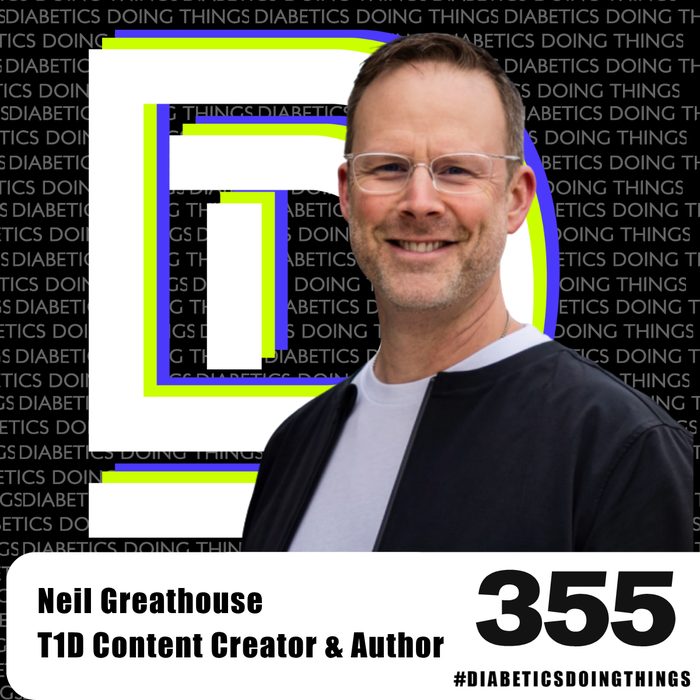
Neil Greathouse co-hosted episode 8 of this podcast and has returned several times; he runs the brand online as "The Betes" and created Your Best T1D Year. He and Rob Howe discuss what it takes to make diabetes content without having "mastered" the disease, and why vulnerability matters more than expertise. Neil describes telling people "I'm proud of you," testing his pump and CGM on friends during a work retreat, and moving from blogging to film to podcasting. He shares how hydration and sleep consistency changed his insulin sensitivity, and his emotional reaction to interviewing Katie Beth, a participant in the Eledon tegoprubart trial now insulin independent. They also compare notes on running a diabetes business and turning down paid partnerships.
Key takeaways
- Neil says one bad night of sleep under eight hours can drop insulin sensitivity by 21%, and sleep consistency matters more than sleep duration.
- Rob says Diet Coke and Coke Zero don't count as hydration, and switching to water fixed his stubborn post-meal blood sugars.
- Neil says all 10 participants in the Eledon tegoprubart trial are insulin independent six months after infusion, with A1Cs around 4.7.
- Neil turned down payment from Glow Glucose Gummies and asked the company to pass the full discount to customers instead.
- Both say telling someone with diabetes 'I'm proud of you' matters more than advice from someone who has already 'figured it out.'
Chapters
- Intro: Why this episode exists and who Neil is
- Friday at 5 PM and the Tim Ferriss random episode format
- Why there aren't enough guys doing diabetes content
- The mastery trap: waiting until you've figured it out
- The CDC educator who Good Will Hunting'd Neil on camera
- "I'm proud of you" — the most underrated thing to say
- Hydration, diet soda, and what Rob's mom figured out by 65
- Neil is running the NYC Marathon again (breaking news)
- Sleep consistency vs. sleep duration — the stat that'll surprise you
- James Clear, LeBron, and the cost of keeping options open
- 400+ episodes and what consistency actually looks like
- The Eladon trial, Katie Beth, and why Neil finally felt hope
- Steve Jobs, saying no, and the current era of tech
- Glow Glucose Gummies and how Neil thinks about brand deals
- The real economics of running a diabetes-focused business
Show notes
Rob and Neil have been doing this a long time, long enough to get bored with the safe version of things. This conversation started as a Friday-at-5 PM debrief between two guys who've spent years making diabetes content, and it ended up going somewhere worth sharing.
They talk about the trap of waiting until you've "figured it out" before helping anyone and why being in the middle of something is actually more useful than standing on the other side of it. Neil makes the case that saying "I'm proud of you" to someone still in the fight might be the most underrated thing a diabetes creator can do. Rob shares what hydration, sleep consistency, and the Steph Curry shooter's mentality have to do with managing blood sugars. Both of them are honest about the fact that none of this is ever really mastered.
There's also a surprisingly vulnerable cure conversation. Neil opens up about what happened when he recorded a podcast episode with Katie Beth, one of the 10 participants in the Eladon trial who are now insulin independent and why it wrecked him in a way he didn't expect. Neither Rob nor Neil is putting all their chips on a timeline, but something has shifted: for the first time in 34 years, Neil feels like the house needs to be in order.
They also get into the business side of being a diabetes creator, the AI spam in the inbox, the economics of running a mission-driven podcast, why both of them have turned down deals they could have taken, and why the audience is just too small to make the math work unless you actually care about the people in it. It's candid, it's funny, and it's the kind of conversation that only happens when two people have been in the same weird niche long enough to just say the thing.
Chapters:
00:00 Intro: Why this episode exists and who Neil is
02:04 Friday at 5 PM and the Tim Ferriss random episode format
03:42 Why there aren't enough guys doing diabetes content
05:21 The mastery trap: waiting until you've figured it out
07:02 The CDC educator who Good Will Hunting'd Neil on camera
09:24 "I'm proud of you" — the most underrated thing to say
13:50 Hydration, diet soda, and what Rob's mom figured out by 65
19:45 Neil is running the NYC Marathon again (breaking news)
20:13 Sleep consistency vs. sleep duration — the stat that'll surprise you
25:41 James Clear, LeBron, and the cost of keeping options open
28:43 400+ episodes and what consistency actually looks like
33:11 The Eladon trial, Katie Beth, and why Neil finally felt hope
38:20 Steve Jobs, saying no, and the current era of tech
44:36 Glow Glucose Gummies and how Neil thinks about brand deals
49:17 The real economics of running a diabetes-focused business
Resources:
Questions this episode answers
Does Neil Greathouse think a cure for type 1 diabetes is coming?
He says the Eledon trial's tegoprubart results, with all 10 participants insulin independent and A1Cs near 4.7 six months after infusion, gave him real hope for the first time in 34 years of living with type 1.
Does diet soda count as hydration for blood sugar management?
Rob and Neil say no. Both describe Diet Coke and Coke Zero as poor substitutes for water, and Rob says his blood sugar ran stubborn after drinking soda instead of water.
Is sleep duration or sleep consistency more important for insulin sensitivity?
Neil says research he found points to sleep consistency, going to bed at the same time every night, mattering more for insulin sensitivity than simply getting eight hours of sleep.
Does Neil Greathouse make money from brand partnerships?
He says he turns down most partnership requests and works only with companies he believes in, sometimes declining payment entirely, as he did with Glow Glucose Gummies.
Full transcript Searchable, with timestamps
Rob Howe: What's up, podcast listeners? I have a very special episode for you today. Some of you know that I have made really good friends with a lot of creators and peers, friends in the diabetes online community. And one of the first ones who ever came on this podcast, he was episode eight, Neil Greathouse. He's been back two or three times over the past few years. And he and I have also collaborated on his podcast. He is a diabetes creator in every way. He's one of the first men with diabetes who I found online. when I started sharing my journey back in 2015. And I've gotten the chance to meet him in person probably close to a dozen times. And every time is really special. And Neil is my good friend. So I sent him a note and I said, hey, Neil, what if we did a random episode? And we just talked, yes, about diabetes, but about specifically what we were thinking about and what our experience looks like as longtime diabetes creators and how that evolves. So this conversation covers a lot of different things. On one hand, we talk about things that we've changed our minds about in the last six months about diabetes. We have a really in-depth and kind of vulnerable cure conversation. We also talk about diabetes businesses and being diabetes creators who get pitched a lot by these AI outreach from weird businesses. And also how hard it is to run a business that's diabetes forward or diabetes focused. And, you know, how we have a heart for people who are trying to create something and meet a need for people with diabetes. because it is very difficult. So we have some of our perspectives there and even some of the economics of how I make this podcast work and those types of things. So in the midst of all of this, we have a really good time. We talk about running, we joke, we laugh a lot. This was Friday at 5 p.m. for both of us. And we're a little bit punchy from the week, but please enjoy this random episode with Neil Greathouse, better known as The Betes online. And I hope you enjoy it.
Neil Greathouse: Guys, who was MVP of the chat? All right, listeners, for you, it could be anytime, anytime, any day.
Rob Howe: But for us, it's Friday at 5, 12 p.m. as we're starting this recording. And for many years, my one of my favorite and most influential upon my podcast life podcasters is Tim Ferriss. And he has the random episodes with Tim and Kevin. And so I'm reaching out to my close friends and fellow podcasters and fellow people with diabetes and fellow creators. And one of my favorites and one of your favorites is Neil Greathouse. You might know him as the Betes. And I get to call him Neil and friend.
Neil Greathouse: And if I'm not one of your favorites, like I get it. There's a long list of people you have to choose from. I get it.
Rob Howe: Hold up there. Are there? Are there? Because like in the in the diabetes world, it's a short list of of guys who make content. Wow. Who are out there doing that. And I had that discussion and thought recently, like, yes, you and I actually, the last time
Neil Greathouse: we were on the podcast together, we talked about what there isn't out there for guys. And it's typically because they don't want to talk about this, which I completely understand. I tell Gina all the time. So I'm an internal processor. I don't know if you are either. I don't want to verbally process this until I figured it out internally. I'll eventually talk about it. But like most guys will bottle it up. But then also, I think, Rob, we might not have a lot of great examples out there of someone who can show vulnerability with this thing. And also, OK, it's time to pick yourself back up and let's get moving. You know that that balance of it. And you're right. There are not a lot of dudes out here doing this. And I have a ton of respect for the ones that are. And you're one of the best out there.
Rob Howe: Well, thank you. I was fishing for that compliment. So that was good. Well, it worked because I cook line sticker. I want to though position it as an invitation because I think you're right. There are a lot of like real, I don't know, sort of masculine obstacles that we create for ourselves where for me, it's like, I think my default is sort of to compartmentalize. It's like, I'll move this over here because I have this bigger problem or bigger rock. I need to move over here and I'll come back to it. And I think that's where, I don't know, I love the idea, like you're saying, of like being vulnerable. But I think there's, at least for me and maybe for some others, is like a tick of like, well, I'm not, who am I to give somebody else advice or to be a leader or to try to help somebody be vulnerable when I haven't reached a point where I feel like I'm worthy of giving that advice, right?
Neil Greathouse: Yeah, when are we going to get there? When would we know we have arrived at that place where you're like, you know what, I think I've reached the pinnacle and now I can share with everyone else what I've learned? I genuinely had this conversation two days ago with somebody. The way to help more people is to be as vulnerable and transparent about the things that you are still struggling through, as opposed to waiting until you figured them out, because that's not as approachable. But we feel the need to only communicate the things that we've got a handle on. Or, you know what, I used to wrestle with this, but I got it now. And so I'm fine. Now let me tell you how I did it. No, no, no, no, no. I don't learn that way. And I'm not inspired that way. way I'm inspired by somebody else who's still in the battle and I can watch them go through it. That tells me I can do it as opposed to I figured this out and you can too. Nah, I'm out, man. I, you're probably selling me, you know, creatine. I'm not really sure what you're selling me at that point, but you know what I mean? Definitely, definitely a course. Yes. Yeah. Stay on the call
Rob Howe: for a high ticket sales item. I think you nailed it. It's a trap that of mastery, I'll call it, where I'm only qualified to help someone if I've mastered this thing. And I think the challenge of a chronic illness is it's never really mastered. It only changes and it never goes away. Or does it? Stay tuned for the rest of this conversation. We'll talk more about that. How's that for a hook? After a word from our sponsors. We'll take a break and we'll be right back. But I do think there is something really, and I've noticed this a little bit in the diabetes community as well, some of the more new creators, this newer generation are sharing kind of on the fly what their life with diabetes is like. And whether those of us who are more long in the tooth or have had to like deal with compliance or like sponsored content or whatever, and are like, oh my God, I'd never be able to share that. It's interesting to approach it with a beginner's mind and say, you know, like this would have been real. I would have been really excited to share what I'm doing today, 10 years ago for the first time, but now I'm bored of it because I take it for granted. And yeah, I think that's something you never know, like whether it's a sensor change video or a site change video that seems like really, I use this word on, on your podcast, banal. Uh, so I'll use it again. You did. Yes. I look, I had to look it up later on for the show notes. Like am I very proud of that poll in Texas? We call it vinyl. No, but that's a joke for no one in particular. Uh, but I get it. All that to say is like those, those everyday moments are really relatable if you're willing to share them. So I want dudes out there to continue like overcome whatever obstacle is keeping you from participating and come on in. I had this moment years and years and years ago,
Neil Greathouse: there was a CDCES. I was, it was actually, I was filming, I was doing a short film. It was called type 1 Day One. And I was talking to the CDCES who's at my hospital in town. And she said something to me while I'm filming. And so you're looking through the, you know, I'm looking through the viewfinder i'm not really looking at her and she said you know like this whole thing with type 1 diabetes you know like it's not your fault and um i'm recording that and whatever and then she gets done she's like it was everything i said good i said yeah it was great she goes you do know and like i've got the cameras away from my eyes now and she's looking directly at me shorter woman she's in her she was in her 50 late 50s she goes you do know it wasn't your fault right and i'm goodwill hunting me on this? What are you talking about? And it literally, she, she said it to me several times. She goes, no, seriously, like you do know it's not your fault. And it made such a lasting impression on me. That moment has actually turned over into something. I, I do this, Rob. I don't, I don't know if anybody notices, you know, there's like so much work that goes into a podcast episode or a post or whatever behind the scenes that nobody ever sees. And you think people notice, but they don't. I have tried to get really good at frequently saying, I'm proud of you. I have noticed that to people with type 1, because first of all, I don't think in life we hear it often enough. You know, maybe there's some father, dad, you know, hurt, whatever that is. But at the end of the day, you could say, I'm proud of you to a guy, to a girl, to whoever is out there that's dealing with type 1. And that doesn't mean that they have to have it all together. You could be failing at all of it, but you're still in the hunt. You're still in the fight. You're still in the middle of it. And so to say, I'm proud of you is just like this galvanizing statement. That's something that I have tried to say, even if I'm complaining about this piece of diabetes tech or this didn't work, or I got really frustrated. I went on a run this morning, Rob, and my blood sugar went a little bit lower than I wanted to. It got down to 69. I didn't screenshot it and send it to you. I apologize, but it got down there, facepalm, I know. And I was like, like this is really really frustrating but i'm like hang on hang on like i'm i'm still in it right like that that's what we have and i genuinely think that that is approachable for everybody that's what i have tried to do more often for people in this space well i think it also there's
Rob Howe: a lot of compassion in i'm proud of you you know i think you mentioned like dad stuff like that's something i do miss like my dad passed away you know eight years ago and he was just like my biggest fan and my, you know, one of my best friends. And he would say all that all the time. And I'd be like, oh my God, dude, like get over it. Like, I don't need to hear that all the time. And now I'm just like, dude, I wish somebody would tell me that they love me and they were proud of me. And so I think it does have compassion because it's incomplete. Like our life is incomplete. And we feel like, and with diabetes in particular, distractions or those minor inconveniences, that's something that I've been noticing a lot more recently. It's like diabetes is a lot of things. A lot of it is minor inconveniences. Yeah. Oh, yeah. Whether it's like because our lives are so packed with like one thing after another, after another and so much responsibility, whether it's real or perceived responsibility, like coming at us through our phones or our apps and things like that. We like any inconvenience can throw us completely out of whack. And it's the unplanned stuff like, oh, I'm on a work trip and I have this limited amount of time where I I have to be doing this thing. And now it's interrupted by plain blood sugars or occluded sites or I forgot supplies. And now I'm not here. I'm at home where my diabetes supplies are. And so the compassion of like, hey, I'm proud of you for rebounding from that low blood sugar. I'm proud of you for bringing an extra site, like whatever that is, like small thing. And I think we're quick, at least at me, maybe as guys, maybe I'm generalizing as guys to be like, well, that's not a big deal. I didn't do anything for anyone to be proud of me. Like wait and delay that gratification. I think that's a trap. Absolutely.
Neil Greathouse: So I was just on a work retreat, like genuinely. We went in a cabin in like Southern Ohio and our whole team was there for two or three days. And my pump and my CGM both needed change at the same time. Team, we just cooked this massive dinner. Everybody's out on this porch, this wraparound porch and a cabin in the middle of the woods. It was just perfect weather. Like, well, some of this team knows. Most of this team has no idea. so let's just be super vulnerable and i'm just going to show them and see if anybody wants to change it you want to put the cgm on me you want to put the pump on me and i started it with i got two spoons from the kitchen cupboard and i put little drops i put a tiny drop you know which reference i'm looking for the tiny drop versus a little bit bigger and i said i just want you to know this is what somebody with type 1 is dealing with the balance between this will help me this could you know put me in the hospital or worse and then i walked through that whole thing and it caught me off guard, Rob. There were people that were super into it. There was, you know, 12 people around this table, crowded around, whatever, people taking pictures and whatever. One girl legitimately goes, she goes, it's okay, I can handle this. I've watched Grey's Anatomy. Yes, great, let's do it. And they're all at varying degrees. Some people were literally cringing at the thought of this thing inserting. Other people were super curious and they got their phones out and they're taking pictures. And I had this moment where I realized I don't think about what I have to do with that hardly at all, but it is incredibly inconvenient because I had plans to do something else. The inconvenience never goes away. You may get better at doing it, but the inconvenience of it. And the reality is if you don't, what, what, you can't just walk away. Right. So, you know, worse. And they were like, so how often do you have to do this? I said, you know, in three days, I'll be right back here. They're like, what? No way. It's that. that's where the I'm proud of you because you're still out there doing it even if you don't want to even if it is frustrating even if you didn't do a good job at it still out there doing it you
Rob Howe: have to yeah you do you have to have like I've been thinking a lot about and mentioning a lot in whatever talks about diabetes or other podcasts or things like that of like the Steph Curry shooters mentality idea where every season Steph Curry misses more shots than he makes but whenever he catches the ball the whole crowd's like right you know that he's gonna you know make the shot. And so, yeah, it might not be the best side change. It may not be, you know, you may have not just totally flubbed the bolus, you know, but you got to get up and do it again. And so doing that takes courage. It takes a lot of perseverance and it's worth being proud of, I think for sure. Something I noticed, so I've been noticing your notes of affirmation and positivity, just the little things on your posts. Something I'm also noticing, we're talking about living well with diabetes on the podcast this year. And, you know, when I think of myself, my best self is hydrated. Are you in the pockets of big water? I'm just curious, like, you know, because you've been talking a lot about how impactful hydration is to your life with diabetes. And I think people are like plants that need sunshine and water, sometimes dirt. And so tell me a little bit about like water. It's the essence of wetness. How did water become such a big talking point for you in
Neil Greathouse: the past few months. So if Gina were here and you've met her, she would hear, she would rip the microphone away from me right now and say, because he's been drinking Diet Pop for too long in his entire life. And I've been after him for years. Shout out to Scott Johnson, who drinks a 24 pack of Diet Coke every day. But he's doing a challenge right now where he drinks a gallon of water before he drinks the Diet Cokes. Wow. Not all heroes wear capes.
Rob Howe: I have a Sprite Zero here in the bathroom. I have a Sprite Zero here in the bathroom. Peer. Because he's going to, he's, you know, yeah.
Neil Greathouse: But he's like, do I feel great? No, this is really bothering me, but I'm absolutely not giving up the Diet Coke, but I'm forcing myself to drink the water. So where did all this come from? I did those one month challenges last year. You know, the best, your best T1D year still is going on, but I took longer this year to go through them. So there, there are only six challenges this year. There are not, 12 challenges because I realized last year it takes longer for one of those to stick. And also not everyone is waiting with bated breath for my next post, nor do they care. So it may take you three weeks to get to wherever we are. I don't care. Just jump in. We're still in it for two months. So it takes a little longer. The things that I noticed treating Lowe's with glucose tablets just revolutionized type 1 diabetes for me. My relationship with food, how I recovered from Lowe's, all of it. The next one was hydration for two months. And I just challenged people what I gave them the science behind it. I feel better than I have felt in the last 10 years, but it's not just the water. It's the challenge I'm doing this month and next month is getting more sleep. But it's, if our, if our doctors have 20 minutes for an existing patient, 40 minutes for a new patient three times a year, there's no, it's not their fault. They can't teach us this. And no one really ever taught me how important the little things are, the mundane, the incredibly boring, the non-flashy things like hydrating, hydration, and then electrolytes. Those two things combined, I didn't realize how much my body had been ravaged from the years of me living with type 1 and what it had drained and depleted me from, the energy levels came back. The ability to run further, faster came back. The ability to bounce back from soreness came back. All of those things came back and I'm going, okay, maybe there actually is something to this. And my wife's not just trying, you know, she's not out there plotting against me. You know, you need to drink more water for what?
Rob Howe: Well, I want to dig into it because for me, I know I'm a better person when I'm hydrated. It's like, yeah. Right. And you mentioned like really measurable things like bouncing back faster from exercise, running more miles. And you talked about sleep too. Let's just focus on the three things that, you know, I think are really crucial and critical for type 1 diabetes management. But also like they have honestly nothing to do with diabetes and they're good for everyone. Like they're just everyone. Right. We all could be better about this. The first one is hydration. Yes. You know, when I was growing up, half your body weight in ounces was like something that my mom and my dad would always say. My mom owned a Curves franchise for 15 years. I don't talk about that very often, but like she worked out through her 40s three times a day because she was trying to sell memberships and she was in the circuit. She was at the gym. And now she turns 65. Sorry, mom. In a couple of weeks. Sorry for outing you. She's in incredible shape. And so I'm helping her move and she's moving boxes and she's moving things around. And I was like, you know what, what a benefit this is for you to be able to do this because there are a lot of people your age who can't because they didn't didn't do what you did during your their 40s, you know. And so anyway, hydration, half your body weight in ounces. And I hate I hate that I'm going to be the one that says this because it hurt me, too, was that Coke Zero doesn't and Diet Coke doesn't count as hydration. Neil, when I realized like, oh, I'm having a stubborn blood sugars after a movie theater, but no, I can't be dehydrated. I just drank two Coke Zeros, two giant Coke Zeros. And then I would drink a glass of water and I would just feel all of the food in my stomach like immediate digest, like the gastric emptying because my cells needed water. And how does insulin get absorbed into the cell? Like they have to have hydration to do that. And so, you know, while I do love a good fridge Sig and Diet Coke and Coke Zero and Barks Root Beer Zero, which I had out of a Coke Freestyle machine the other day. Wow. Yeah. That's good.
Neil Greathouse: You can get the vanilla one.
Rob Howe: It's, man. We do a whole podcast on just that, I think, and the feeling that that brought me back to a kid, like drinking root beer and loving root beer. But it's not water. And it doesn't do what water does as it relates to insulin sensitivity. And something I've also been repeating a lot lately, like a healthy person wants a thousand things, a sick person wants one thing. And I think the one thing that most of us with diabetes want, besides to be rid of it, is that if our glucose is out of range, I want to get it back in as quickly as possible so I can feel like myself. And hydration helps me do that. Number two, exercise, which you talk about, you're running more. They have compounding effects on each other, which is incredible. And we've done episodes on exercise. I want to talk to you about your training because you ran the New York City Marathon two years ago. I did. I'm doing it again this year. You're doing it again this year. Okay, I'm just confirming that. Yep. You heard it here first, everybody. Breaking news, guys.
Neil Greathouse: This is breaking news. Everybody's been waiting for it.
Rob Howe: Neil is running the marathon again. and and you know running has been a consistent part of your life really since training for that marathon i think and probably sounds like because you're feeling better you're continuing to do that right and then the third one the third one is sleep too so let's let's go i'm i'm a world-class sleeper i always have been i didn't realize what a huge advantage that was from a diet my diabetes until a couple years ago like four hours with suboptimal or four days in a row with like suboptimal sleep, so four hours or around there, your insulin sensitivity can drop by 50%. That's like you're halfway to type 2 diabetes in four days. Right. One bad night of sleep. One bad
Neil Greathouse: night of sleep of less than eight hours will drop your insulin sensitivity by 21%. And you will pay for that for multiple days after. You start stacking up a couple. Look, man, it's rough out there right now because we're in the NBA finals and I don't want to go like there are some games on like I need to watch this so this is tricky so God those LeBron games West Coast games starting
Rob Howe: at 9 30 p.m. I'm just like it's a game seven or game four game seven I wish it was game seven game four of uh the second round series it's 11 35 and we're reviewing calls in the fourth quarter I'm like guys we got to speed stop reviewing this call we got to get on work in the morning right
Neil Greathouse: I did not realize what an impact that has. So there's, I'll tell you, spoiler on this, it's going to take two months of my podcast of telling people and slowly, you know, telling this story. So I'll just tell you really, really quickly because nobody loves to stretch something out like I do, Rob. It's what they actually found is it's not just amount of sleep. The thing that impacted type 1 diabetes more is the same one hour window that you go to bed. It doesn't matter If you get eight hours of sleep, but you go to bed at 1 a.m. and you sleep for eight hours, your body still interprets that as stress and out of rhythm. If you were to get six hours of sleep consistently at the same time every single day, that's better than trying to get eight hours sleep and fluctuating the start time by two or three hours, which is sleep consistency versus sleep duration.
Rob Howe: This was hard for me. Sleep consistency was higher. This was hard for me because I'm a guy that likes, I'm doing too much stuff. So late at night, I would work sometimes. Same. My wife would go to bed. I'd be up editing. It'd be embarrassing if I told you how long it took me to edit. It's just a sensor change video. You said the cuts were good though. So now I have to keep editing.
Neil Greathouse: I said they're buttery smooth is what I said.
Rob Howe: You did. It really hurt me to be like, oh no, my wife's right. She goes to bed at basically the same time within 30 minutes every night. I need to do that. And I also need to wake up about the same time that, you know, it's hard. That is for my personality is hard for me to do the same thing at the same time every day. But it makes a huge difference. I can go to bed like Rob.
Neil Greathouse: And I'm like, this is not a mild exaggeration. I could fall asleep anywhere, anytime, probably in less than 30 seconds. I used to tell people that was my superpower until Gina said, are you sure that's not just narcolepsy? Like, do you have a problem? I was like, well, actually, now that you say it like that, it might actually be that. it's uh it's uncanny how quickly i can fall asleep and probably my body's been depleted for so so long i started chronic fatigue i started setting an alarm for when i go to bed not just when i wake up why have i never done that before so for me it is i embarrassing to say this i start the process of going to bed at 10. No more phone after 10. So 10 to 10.30, that's a huge key. The whole blue light, all that kind of stuff, whatever. But not looking at a screen, I can fall asleep now in 10 seconds instead of 30 by 10.30, but I'm getting up at 4.30 or 5 to go run for two, two and a half hours. So I need to get up early. I would really ideally love to go to bed by 11, but the timing of it is a little bit different. That consistency has helped tremendously with my body's ability to recover from the type 1 stuff the day before. And we don't realize how much our body's doing
Rob Howe: behind the scenes. Yes. Sleep is huge. We don't. I think there's been good. You've been talking about it more recently to good awareness or good sharing on like how long your brain takes or could potentially take to recover from a hypoglycemia event or hyperglycemia. Sometimes like up to 45 minutes for the acute symptoms to stop and then the chronic symptoms can continue. Right. And, you know, that's certainly something in the past I've like kind of beat myself up about. Why can't I bounce back? I got to bounce back. I got to get this stuff done. Well, sometimes it's not up to you. Right. Yeah. I like to that. You are to me, it sounds like you're creating momentum through the consistency. And that feedback loop is is now you're running further. Now you're recovering faster. Now you're more hydrated. Now you're like you said, you are catching up on the years of maybe over revving or you're hydrating over diet coking yeah 100
Neil Greathouse: 100 i have started to fall in love with that process but it's um i i think i like obviously i want to be able to to run yes but um that has a price like to it you know it's like it's going to do a few things to my body. And so if I don't take care of myself, how much time does LeBron James spend and money does he spend on taking care of his body? He's got a sleep coach, like a coach who helps him sleep. I'm like, what am I dinking and dunking around here for? I'll work until 2am. I just won't stop. And I have done that for too many years. I think about this a lot. So
Rob Howe: James Clear's newsletter is called 321. I don't know if you subscribe, but on Thursday afternoon, that notification comes through and I'm like immediately opening it and reading it. And more often than not, it dunks on me in a way that I, it's like, it's got something that hits me right here and stops me. And I think it's been three or four weeks now. So two things came up for me. This came up and it was like, when you keep your options open, you think you have more choices and you think that that's good, but the options have a weight and you're carrying them. And so So the working at night thing was like, oh, I always have that available to me. I can kick the, you know, in the middle of the day, well, I'll just do this later. I'll just do this later. Oh, I can catch up for this at night or I can wake up before everybody else and do this thing. So by doing that, I'm not completing things. I'm leaving them open and I'm carrying them with me. And now I'm overwhelmed. So I love the idea of the cutoff and like, no, I sleep during this time. The second thing for me was you mentioned LeBron, but I'm going to, I'm going to bring up MJ. The jersey's not, not with me, right? It's okay.
Neil Greathouse: Sorry, I know where your loyalties are.
Rob Howe: The seventh episode of The Last Dance, at the end of that episode, he says winning has a price. And he goes on this great monologue about how he never asked anybody to do something he wasn't willing to do himself. But I think what you're talking about is to improve your running, especially later in your life. Like when you're younger, you can do things that you just don't know what you're capable of. But it takes focus and it takes sacrifice and it takes commitment and it takes a lot of time. time that you could be doing other things, but you're choosing to prioritize this over that. And so I think winning has a price in so many different ways. It's not always that you're the hardest worker, but maybe you're the hardest to, or the hardest optimizer. You're like, no, I cannot do that right now. I have to do this because this is important to me. This helps me be who I need to be. And that's something I, you know, I'm not, I'm working on a lot. I've like, Like, what actually do I want to do and what actually is going to make a big impact for me? It hurts to say no to those things, but as soon as I do, I'm free of them. I don't have to hold them.
Neil Greathouse: I'm sure you heard two statements. The first one was, know that Steve Jobs said the definition of innovation is saying no to a thousand little things. That is not what we think of innovation as of saying no to all those other things. They're just distractions from this other thing. But I know you know this one. Consistency beats intensity. every day of the week. It constantly will. And I tell people this all the time. I'm not the fastest runner. You will probably be faster than me, but you will not outlast me because I am still going to be back here tomorrow working on it, working on it, working on it. I'm not good at a lot of things, but I'm great at not giving up and not quitting. So I'll just keep after it. That to me is one of the reasons why I respect what you've done for how many episodes are you on right now? We've done over 400. I mean, that says the body of work, what you've done is so impressive. The same could be said for a lot of things with type 1 or taking care of your body or whatever that is. Consistency will outlast, will beat intensity. And I used to rely on intensity for
Rob Howe: years of my life. And I just, I'm like, you know what? I'm not going to do it. I want to mirror back to you because we've been doing this a long time, this diabetes content creation stuff in a lot of different. And I think for you, like I would look at the breadth of your work. I want to come back to Steve Jobs in a second, though, because I don't want to forget that. The breadth of your work. So let's talk about type 1 day one, which was like to me, who is a marketing, you know, I'm a huge fan of really great marketing, like the SEO behind that video at the time that it came out was like just incredible. So I love that type 1 day one. let's probably not linear here but bike beyond docu feature-length documentary awesome story we've had the the youtube channel we have the bds instagram we have the bds tiktok we did like the the year of tiktok videos every day and then you turn that into your best year with type 1 and like one day at a time which is became a book i'm looking over here at your other books that are on my on my shelf like so you publish two books in the last two years you're still doing your kind of type 1 day at a time content. You have a pod, you're doing your podcast now. So I think again, like your, your consistency, you're also living with diabetes. You're doing all of these other things. What have you learned? Because I think there's a couple of things and there's you and I'll put myself in this group and there's a few other people who have been around the whole time. And I do feel like tremendous empathy for diabetes creators in general, but also ones who like start and they feel guilt about stopping, like you can start and stop anytime. I think like that you have to give yourself the space to do that. You can walk away whenever you want to. Yeah. You can like, if you feel the heat around the corner, you put it down and go. How does it land for you? Like, how do you keep experimenting? Because those are different mediums. Those are like, it's still you and you're still producing it, but it's different. And the focus changes and there's challenges and there's, you're tinkering. Where does that find you today? Well, I'm actually wrapping up. Literally next week, we will be at Picture Lock
Neil Greathouse: on a short film for Blue Circle Health called Moving the Needle. Kelsey Bascom is our director and producing is a very different seat. I've produced a lot over the years, but it's a very, very different seat. And you get to see all these moving parts and all that kind of stuff. And I, I love the filmmaking process, the story of it, the whatever. And it kind of reminded me of if it's videos, it started off with blogging and then it turned into social media and then it turned into film and then it turned into books and then it turned into podcasts and then it's turning back into film. What I have learned over that body of work is people don't all consume and learn the same way as long as the same goals are out there and the medium continues to change. I don't know if TikTok will be here in five years. I don't really care. It doesn't scare me that it won't because I will figure out what the next thing is and branch out and do that. I'm looking over on my dry erase board because I don't want to get these wrong. This is what I aim for in everything that I do. I want to make sure that the audience feels educated, that they are entertained, that they feel connected, that they're emotionally moved and that they are acknowledged and validated. If I do those things in whatever the, If it's print, if it's moving pictures, if it's audio, I don't care. I didn't have any of this when I was diagnosed. I don't know if you did, Rob. I genuinely don't. I mean, it was difficult to find it if it was out there. It was probably in a diabetes magazine at the doctor's office that you're like, I'm not, that's not my people. I'm not picking that up. I don't have any choice. I can't stop, Rob. I hope is incredibly important to me right now at this stage of where we're at with possible potential cures, all this other stuff. And my mindset and my shift has gone around to, I want people to take such good care of themselves so that when that cure is around, they're ready for it. Not like, oh my gosh, I ravaged my body for the past 15 years. And now I'm like, I'm not even a great candidate for this. You know what I mean? Like don't get, don't hurt yourself along the way to getting to whatever that cure looks like.
Rob Howe: Put yourself in position to be able to receive the gift when it comes. Yes. Yeah. Something shifted in me, Rob. I don't know if this is okay, because I know you said you still want to talk about Steve Jobs. But no, I mean, Steve's been dead a while, so we can pour one out. Okay, so Katie Beth, you and I talked about it. Like, that moment recording a podcast with her was... So for those who might not know, Katie Beth, one of the 10 participants in the Eledon trial who have received maybe donor cadaver cells, beta cells, which have then, along with some new immunosuppressant with much work. tegoprubart, which I made a joke. I won't, I'll tell you after we stop recording. I made a joke with the Breakthrough T1D team about when they announced it. You'll like it. It's an audience of like four people that will laugh. That's great. I'm here for it. Tegoprubart, which has now all 10 participants are insulin independent six months now after the infusions.
Neil Greathouse: And he's got an A1C of like 4.8 or 4.9, something like that. Yeah, pretty good. Pretty good.
Rob Howe: And they were all people whose A1Cs were out of the, you know, standard of care range. Correct. Right. You know, eight and a half or above or something like that. So this study is a 10 out of 10 participants are insulin independent with A1Cs in the 4.7 range six months after the infusion. The most promising results of any trial to date with that percentage that we've seen. So this is the, and Katie Beth, so back, that's who Katie Beth is.
Neil Greathouse: That's who Katie Beth is. Yeah. Thank you for that. Yeah. Dr. Witkowski, they're trying to figure out what's next now, right? Like how do you take this to the next phase or the next stage of the whole clinical trial part of it? Katie Beth lives relatively close to me. You know, we could meet she and her husband and me and my wife have had dinner multiple times. She's 10 minutes down the road. I'm incredibly fortunate to have that connection. The more we talked and then did that podcast episode, I actually wasn't emotional when we did the episode. It wasn't emotional when I edited it. I was emotional when I hit post and people started responding. It just, it wrecks me, Rob. Gina, this has never happened as long as we've been married. Gina found me over in another room in our house. I'm in the dark sitting in a chair, just crying. Like it broke me. It really messed with me. And it wasn't just her story. I was like, oh my gosh, I didn't realize I haven't had any hope, haven't allowed myself to have hope because I'm like, listen, if it's not dependent on me to get the cure, then I'm going to do whatever I can to take care of the day-to-day side of it. And it shifted in me. All of a sudden I was like, oh my, this is what it feels like to have hope, but hope isn't a strategy, right? So we've got to get something that will actually help us long-term. And that's been the biggest shift in me is I'm going, okay, okay. All right, guys, like we need to get ready. I've, as long as I have lived with this thing, 34 years and 89 days today, I've never once felt like that, where I'm going, we got to get our house in order because this thing could be in the next 10 years. Okay. Then am I taking care of myself well enough? Did I do what I could do if it was up to me? That's, that's the shift in me. It's, it's been kind of wild. I've never had this.
Rob Howe: Thank you for sharing that. I think my journey is, I don't know how this lands for you, but like the more I learned about now the phases of type 1 and those clinical phases of it, it seemed like up until this trial, and there are others too, but this new set of trials, I'll say, that people like you and I who have been in phase three type 1 diabetes for a number of years, the ship was sailing. Like we, we were not going to get it. And I was okay with that because like it meant at least the new people will get it. And so we'll be among the last people with type 1 diabetes and you know, fine. So I had kind of put that out of my mind of like, okay, it's not for me and I'm not going to worry about it now. It's like, okay, well this is interesting. There's a lot. Again, I'm not getting so wrapped up in it because in the short term, because there, there isn't a large amount of time. They're real obstacles. But I think because of the momentum and we're back to momentum creation, like momentum is this like I have this quote written down in a notes app on my phone and it's like even buried in my to do list. But momentum is so much more important than ability or quality. And with regard to this is like the momentum is that type 1 diabetes is curable. So now I think that momentum will shift into say into regulators and people saying, all right, well, we can solve this huge problem that's a huge burden on all these people. Let's just do it. Let's pour whatever resources we can into making it happen. And that's what's exciting to me is, you know, we could go retire the sensor change videos and just make videos of something else.
Neil Greathouse: That would be, whew. Yeah.
Rob Howe: Yeah. What a day that would be. Like, Neil, what are you going to talk about? I don't know. The account formerly known as the Betes, you know? Oh, yeah. That would be wild. So you brought up Steve Jobs. The story that and, you know, how he was an expert at saying no. And he was this, you know, I think he had more taste than any CEO that we've seen since that mentioned in this. And, you know, we're in this era now. I'm kind of wrapping this around to like AI and to these sort of tech. He was the first, I would say, like technocrat where he was this kind of insanely rich guy leading the tech world. And we kind of created an archetype. And then the people who've been, you know, after him have been nowhere near the same kind of. kind of leader and kind of person, which has been really fascinating for me to think about as a fellow, like, fan of Steve Jobs and, you know, try to learn from this guy who seemingly is, like, one of one. And also, like, he, I thought of this when I made the joke about him being dead, which was, you know, anyway, he'll get over it. He also, like, made a choice to not get treatment. Right. Yeah, he did. You know, and kind of be and do this thing. And I thought, like, someone with so much taste, you know, for a while I judged that. And now I think I wonder, did he know something that we didn't know? That we didn't know? He's like, no, no, dude, it doesn't get better from here for a little while. I'm just going to go out on top here in 2011. There's stuff coming I don't want to see. And I thought that, you know, as a guy who wanted to put a den in the universe, and we talked a little bit about the phone. For me, it's kind of this interesting arc. You understand the hero's journey. You understand the storytelling. I'm going to round this into a question at some point. But, you know, this guy who set out to put a den in the universe, not here to see it, but this idea of this momentum and this taste, which is sort of like these ethereal qualities all kind of coming together at one time. And since we've all been grasping or there have been maybe charlatan Steve Jobs who've popped up, I don't know. How does that land for you? And I don't even know exactly what that is because I didn't really articulate that into very good of a question.
Neil Greathouse: I think I understand the question. He, you know, was definitely good at the no side of it. There were a lot of, how do I say this? We probably glorify him a little bit now. I think at the time he was rough and we don't remember or talk about that posthumously. right yeah yeah but i think it takes a little bit of that crazy dedication to be able to do that there are things that um i have to do i have to say no to a lot of things that like it was my birthday um at the beginning of the month that people are like oh my gosh where are you gonna you know are you gonna go out there and eat are you gonna do all this other stuff and i said i i can like i wanted to go put my face in a cake which i used to do every single diversity I don't know if you remember, that's kind of some of the first dumb videos I ever did, Rob. I was like, hey guys, this is my anniversary. It's 26 years and I'm going to literally put my face in a cake and blew bubbles for a while. I was like, okay, we'll see you again next year. Like that was, it was a joke. But I told these people, I said, no, I could go out there and really live it up. But I'm going to pay for it for like four days after all of that. It's not, I'm good. Like, no, I don't love some of the things that I have to say no to. right now, but having a little bit of discipline to do it, not only in managing type 1, but also in producing a lot of the content and all that other stuff. Rob, I'm sure you get it. Actually, I think you probably get it more than I do. The amount of requests or brand partnerships.
Rob Howe: I love this video you made. I love this video you made. I'm glad we're talking about this.
Neil Greathouse: I am not going to cheapen what I've been working on for the past 15, 18 years of consistency by getting out there and making, you know, a partnership video for somebody else. For what? That's what you're what I'm trying to build over time is trust, not trying to build a following. I'm not trying to build a level of influence. I'm trying to build trust. That's far more important to me. And I think it's far more important to the people that are out there on the other side of it. And I also, I am not so completely out of touch with reality that think that anyone is sitting around waiting for me to post another video. They're not. No one is asking for it. So if I'm going to do it, I need to make sure that it's on my terms. So I'm saying no twice today. Twice today. No, I'm sorry, guys. Thank you for thinking of me. I appreciate it. No, you know, if I could think of somebody else who could do it, I think it would be great. If something else comes up, please keep me in mind, but I'm not your guy.
Rob Howe: So you made this video a few months ago. you were talking about the amount of inbound emails or dms or partnership requests that you get just to respond to all of them is like a a job you know and like most of them are not very good i'll say this i get a lot of them too ai has destroyed it oh my gosh it's just and you know they rob we've listened to diabetics doing these podcasts we love that you tell the amazing stories of people with diabetes from all over the world and then it's like we've got this we've got this product blah blah blah and it's like all right well all right okay we think our insults our inserts inside of shoes are going to be a fantastic fit for your you're like what are you doing yeah and i got this one it was like uh like so the the meta ones are worse like the partnership requests that you can get like through instagram they have like a partnership tool so i got one and i opened the somehow miraculously saw the inbox so i saw it i looked in and it was interesting it was like a food um you know they had like diabetes friendly meal packages and i clicked it through and they looked kind of good and i was like you know what okay this they i've already i've now looked they piqued my interest the meals actually look good like hey cool this this might be beneficial right and then uh i i filled it out and i was like oh this isn't available in your area so they're like rob they had emailed me like rob we'd love to have you we'd love to do this oh we can't get them to you sorry and it's like okay well now you've wasted my and it's like in my profile says dallas texas like every post with a location dallas texas so it's like oh boy now i've now i feel stupid now i'm like okay well now i'm just not even gonna look at most i'm not
Neil Greathouse: gonna look at him anymore right yeah i i did something this hopefully this doesn't sound braggy cut this for time later on when this is when this bombs horribly or seems to if somebody
Rob Howe: makes it to this part of the podcast, I applaud them. Good for them. They made it through my Steve Jobs question. They'd be like, I'm out of here. He said, don't worry about Steve Jobs. He's dead. Keep talking. And they kept listening. He's not going to hear this. No, you're right.
Neil Greathouse: He will not. Yeah. Nope. I approached Naomi at Glow Glucose Gummies. She and I love gummies. We talked actually about a partnership for a while because I genuinely believe in what she's doing. I love that she has type 1 and she's trying to make a difference or whatever.
Rob Howe: And I'm going to be such a nice person as well.
Neil Greathouse: so kind. At first, we did start talking about money. I want to be really, really clear. And the more we talked about it, I felt gross. And I'm like, you know what? Why don't we do something? How about you just send a box with a couple things that I can open up and show people? And if you have a code that will give them a discount, you're about to find out what a terrible business person I am, Rob. Don't do this. She's like, yeah, I'll do it. I'll send it out. She She goes, and hey, we came up with this code. It's literally Neil 20. That immediately gave me the ick. I'm like, crap. Okay, Neil 20 is a code. And she said, what we'll do is what I do for everybody. I'm going to 10% of like half of that will go to you. Half of that comes to us. That's the way any affiliate link works, right? And I said, you know what? Actually, I don't want to do that. I said, can we give them the full 20? I don't want any money from this. I just want to help you as a company. can you still make that so that we can pass that savings on to people she's like are you sure yeah right before i'm ready to post the video she goes neil just want you to know not very smart of you but are you still wanting to do i was like yeah 100 and did it and posted about i don't even know how that comes across to people who don't know you who don't know whatever it probably looks like every other branded whatever i'm not making any money off of it but i believe in what people are doing in this space so much that if a single creator like her, a mother who has type 1, who quit a finance job to be able to manufacture something that is saving lives, I view it as medicine. Okay, I'm going to do that. That, I will open that request up all day long. The other ones,
Rob Howe: you know, I'm not opposed to it, but it's just, that's not why I got into this. I'm glad you, I'm whoever on this, because I wouldn't have come up with it. And I think people want us to talk openly about the experiences that we have and also like our experiences are not singular but like pretty limited so i'd like to hear your perspective on this you know i did the same thing for years with skin grip because i like skin grips yeah and they first of all their their ceo isaac has become my good buddy business wise i like him we have calls i like that his family started skin grip because they have a brother with type 1 and they saw a need and the brand is cool i liked his marketing and we've done a lot of deals over the years they they did pay me for like a podcast sponsorship way back in the day but after that i felt like did they get money out like out of this like was this good and so i just did everything else for free from them and like i was like whatever i and we've done some scholarship stuff like i was like well i'll post about this but like you give my fee to like the kid who's gonna get a scholarship like because it's a privilege to be able to do that because like both of us have other means of income Right. Right. And we also understand like as an I'm not an affiliate by choice, but also by like there just aren't enough people with diabetes to buy the things on a regular basis to like pay any bills for me. It's such a small audience, Rob. It's not a massive market. So like, even if you're the best at it, which there are people better than me for sure, but I know I'm like, okay, well, if you get paid a dollar out of these transactions, you're not doing 10,000 transactions. So like, and again, like I speak from this, like a privileged place, like I'm not going to make 10 grand off of this. Like I can't dedicate a ton of time and energy to it because it's like, that's not going to, that's not going to make a difference. Right. So, and it will make a difference to this company. Right. like to say to have your sign off and sometimes mine as well like i want to because like yeah we believe in these people and it's so hard to run a diabetes business oh my god it's stupid to run a diabetes business it actually is because it legitimately is your rate hours they fail
Neil Greathouse: right it's why there was a i'm trying to remember what the company was i went back and looked for it it'd been like two years since i had ordered something and i was like hey i'm gonna go back I can see if I can buy again. I couldn't find him. I'm like, what are you, what, man, they don't last that long because the population size of the people is so small. And also the number doesn't grow at a rate every single year. That is where people are just like, no, sorry, that's not it.
Rob Howe: Well, I think they're doing the same math we're doing. We're like, I'm working really hard at this company that now I can't grow because there's just a limited amount of people. And I think some of them I've met, like being in this kind of in-between position, I've met some of the smartest, savviest business people who do the diabetes business because they are connected to type 1 and they care about people with type 1 diabetes. But most of the really smart ones have like another business that just crushes it so they can pay bills. Yeah.
Neil Greathouse: Yeah, this is like a passion project or something they believe in off the side. Something else is, Rob, you obviously, you do other work. I do other work. Like people will ask me, I don't know if they ask you this question.
Rob Howe: This is why I want to talk about it because you know how creators make the videos? You guys have been asking me. You know what the most common question people have been asking me lately is like, Rob, how do you make enough money to fund this thing? And I'm like, first of all, like, who are you? I don't know you. So I'm just going to tell you? Yeah. I'm just going to like, yeah, transparently, this is how it all works. And I was like, yeah, this organization called Rob Howe funds this whole thing. Gosh, no, I don't make a dime off of this.
Neil Greathouse: People are like, wait, what? Like this isn't your main gig. Occasionally, if there is some sponsorship or something like that, yes. Do you know how infrequently that is? Partially, again, because I'm saying no to everyone like that. Also terrible business model. Like if I were in this for the money, I would be out here hawking some, you know, inserts and cinnamon, whatever for your souls. I don't think. Stay tuned for a message from Big Cinnamon. This is a message. Big Cinnamon doesn't want you to know this. The reality is I didn't get into this to make money. I'm not going to sit here and make a lot of money. And this is going to take a lot of time and a lot of energy. I'm doing this because I genuinely believe. But there are a lot of great business owners out there that are doing the exact same thing. This is not their main gig, but it's a passion project and they believe in what they're doing.
Rob Howe: Yeah. Yeah. So I have had multiple iterations of, I've been trying to make diabetics doing things work for 10 years now. It works, but it's changed. I've had people who work, you know, monthly, like as contractors. I've had, you know, at one time we had two people working as contractors on a regular basis. That's right. And we had a diabetes-owned video editor working for us. And so it was like, it was the team that got kind of big. Like we generate income. Do we make money? But we generate income. And so now we have the diabetes basketball clinics and we pay people who are coming to those events because I believe and I want to create opportunities for people with diabetes to give back where they're not having to fund it themselves. Right. You know, and no, those aren't huge checks. The benefit is the kids that come in in a safe environment, a cool environment, T-shirts and all those. I've made the relationships with the few brands, some of which you've worked with as well and know well, I'm sure, where I can pay for those things. But I think what I answered, a person who I do know and did ask about the money aspect of things, I said, I'm glad that diabetic's doing things that I don't depend on it for my sole source of income because it would change it for me. Right. Right. I would have to do the big cinnamon ads. You're you're in it for sponsorship deals. That's not enough. People are saying it. Yeah. At that point. Yeah. Right. Like you can't turn down. I would be doing every single one of those deals that came in in the inbox. I would be doing all of the wound gel and all of the you know, I think I think we all know or every meal plan and every diabetes AI app. like they would all be featured on this podcast because I would have to make my nut. Like I'd have to, I'd have to cover that. And I'm fortunate that I have another source of income that allows me the flexibility to, to do that. And also, you know, I'm kind of a business psycho. Like I'm a really good negotiator and that's good for you. And I try to be a good partner. And you know, it really sucks though, Neil, cause I'm also the talent. So I have to be, I'm going to go, I'm the jury and the executioner and the king. So like, I'm like, I have to go talk. I have to go see these people in person after I've told them that they've got to pay me more. Heavy is the crown. Right. Yeah.
Neil Greathouse: You know, the thing that's funny, Rob, you're saying all this. I'll listen occasionally. I'll go on a road trip. I'll listen to SmartLess and the podcast and they do all of their own ads. And so it's, you know, you're listening to SmartLess and they're like, and we'll be back in just a minute. And then Jason Bateman is like, have you ever had a hankering for Wonder Bread? And then he goes into this thing and I'm like, what are they thinking while they're in the recording booth doing a Wonder Bread ad or, you know what I mean? Like Colon Guard. Hey, when was the last time you got? And I go, I don't have to do that. Now, keep in mind, I'm not making $30 million off of whatever. People are negotiating all that stuff for them. I get all that. But at that, on the other side of it. Very rich guys, by the way. These are very rich guys doing ad reads. Right, right. Reese's. Yeah, GMC. I don't have any of their pipes. That's why Wonder Bread's not calling me. But I think it's also, there's a little bit of purity in it. Rob, I think what you've done with diabetics doing things, even if you did have employees and you don't know, that doesn't make any difference. You've maintained a core level of integrity through all of it. that's actually more important than blowing this thing up. So it is your number one income. I would think in the long run, you could look back at that. If somewhere to say five years ago, what would you say? I think that would be important. Thank you. I also kind of feel like the Tim
Rob Howe: Robinson driving crooner sketch where I'm like, I got to make money off this thing. It's simply too good. Got to figure out a way to monetize this thing. It's like, yeah, I'm glad I don't have to be that guy. It's like driving crooner, drivingcrooner.com. And then, yeah, I mean, I still have like, I have a contractor who works with me still. I'm still able to, to meet the demands of it. And the sponsorship sponsors that I have, and I've taken, I think we've, I have creative people on the other side too, who don't want to just do like, Oh yeah, let's just do this to a sponsored deal. Oh, let's just do a code. They want to tell stories that they bought into what we're, what we're doing here. And I'm lucky for that. Like, you know, this is a made up job. This is a, this is a joke that I get to do this sometimes for, to create opportunities to do things like that. Like, Oh, What are you doing this weekend? Well, I'm flying to Denver to do a basketball camp with Gary Forbes. Right. Oh, I'm flying to Friends for Life. I'm going to Orlando to Disney to have a basketball camp with Lauren Cox. She, her team just won the Australian League Championship. Ho-hum. Really terrible life that you're living there, Mr. Howell. Right. Yep. So, yeah, I have friends like you as well to get to share that with. I'm continually in awe of the breadth of work, but also continuing to come back to who you are as a storyteller. I think what you said about whether it's TikTok or it's a new platform or it's something down the road that we could never even concept, storytelling, and then the four list items that you read off of your board earlier, you're accomplishing those in a hundred different ways. And that's why I'm a longtime subscriber, longtime writer. And now I think at least tied with Ms. Lauren Bongiorno for most repeat guests on Diagnostic.
Neil Greathouse: I'm going to get you back on the podcast, Rob, because I think you need another shot at the fastest five minutes of your life. Did I not? Is that because I didn't do well? It's because other people have done better since then. At the time, you did the best that you could.
Rob Howe: Yeah. Hey, I want another crack at it. I do. I definitely do. Got it. Got it. So, yeah, I'm ready. Mind and range. That's what I'm going to be. We'll do it. I'm going to be putting that out on the that's what I'm going to be selling. That'll be my mind and range is coming soon. So if you made it this far, first of all, you might be Matty from San Diego. That might be the only person that's listening to the podcast at this point. Matty, I love you, dude. Matty from San Diego. Neil, thank you, man. Yeah, absolutely.
About Neil
Neil Greathouse has lived with type 1 diabetes for 34 years and creates diabetes content online as "The Betes." He runs Your Best T1D Year, has published two books, and has appeared on this podcast multiple times since episode 8.