

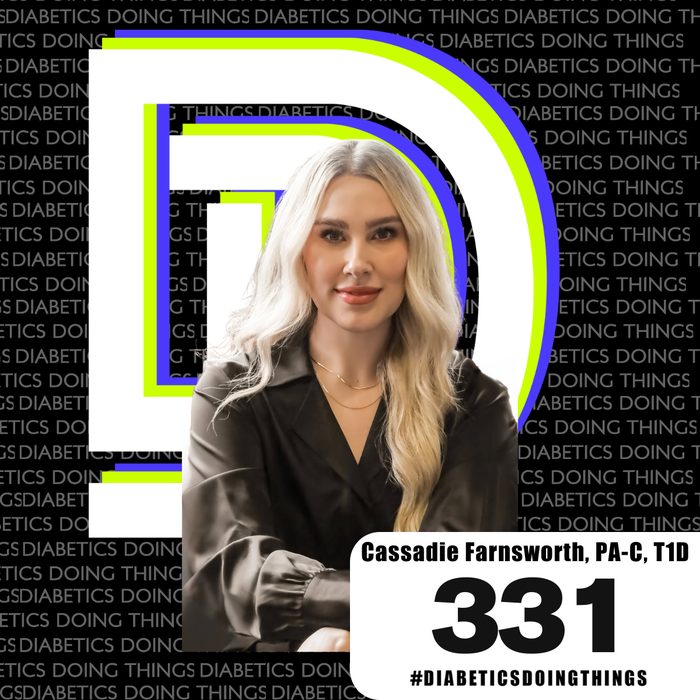
Why Mental Health Matters in Diabetes Care with Cassadie Farnsworth

Episode summary
Cassadie Farnsworth was diagnosed with type 1 diabetes at 24, after doctors misdiagnosed her as type 2 and treated her with metformin alone for several months. She ended up in the hospital in DKA before getting the right diagnosis. She had been working as a cancer researcher and had just gotten married; the diagnosis pushed her to go to PA school and then into psychiatry, where she focuses on the mental side of chronic illness. She and Rob talk about diabetes complications, self-love, harsh self-talk learned from athletics, and why she uses dark humor and an anonymous venting series on Instagram (@the_pa.tient) to build community. They also discuss how her husband Nick learned to help with her care, and how couples can talk openly about diabetes.
Key takeaways
- Cassadie was treated for type 2 diabetes for four to five months before a DKA hospitalization led to her correct type 1 diagnosis at age 24.
- Cassadie says she left cancer research for PA school and then psychiatry because she saw that patients' mental state determined whether diabetes advice actually stuck.
- Rob and Cassadie agree that developing diabetes complications isn't proof someone mismanaged their care, since genetics and access to care also play a role.
- Cassadie says it took her years to ask her husband Nick for help with daily diabetes tasks, and that sharing the load brought her more freedom, not less control.
- Cassadie uses dark humor and an anonymous venting series on her Instagram to help people with diabetes feel less alone and to take some of the power back from the disease.
Chapters
- Introduction to Cassadie Farnsworth
- Cassadie's Diagnosis Journey
- Transitioning from Research to Clinical Practice
- The Importance of Mental Health in Diabetes Management
- Complications and Self-Love
- Celebrating Small Wins in Diabetes Management
- Influence of Psychology on Diabetes Care
- Navigating Mental Health and Diabetes
- The Importance of Daily Work for Mental Health
- Finding Humor in Diabetes
- Building Community Through Shared Experiences
- The Role of Partners in Diabetes Management
- Asking for Help: A Personal Journey
- Creating a Supportive Environment
- Navigating Relationships with Diabetes
- Mental Health Strategies for Living with Diabetes
Show notes
In this episode, Rob interviews Cassadie Farnsworth, a creator and advocate for those living with diabetes. Cassadie shares her personal journey of being misdiagnosed with type 2 diabetes before receiving the correct type 1 diagnosis. The conversation delves into the importance of mental health in diabetes management, the role of humor in coping with challenges, and the significance of building a supportive community. Cassadie discusses her transition from a career in cancer research to pursuing a path in healthcare, emphasizing the need for self-love and grace in managing diabetes. The episode also highlights the importance of partners in diabetes care and creating safe spaces for open conversations about the condition.
Chapters
00:00 Introduction to Cassadie Farnsworth
00:44 Cassadie's Diagnosis Journey
03:43 Transitioning from Research to Clinical Practice
05:43 The Importance of Mental Health in Diabetes Management
10:30 Complications and Self-Love
16:26 Celebrating Small Wins in Diabetes Management
19:22 Influence of Psychology on Diabetes Care
21:10 Navigating Mental Health and Diabetes
21:47 The Importance of Daily Work for Mental Health
22:41 Finding Humor in Diabetes
23:40 Building Community Through Shared Experiences
26:28 The Role of Partners in Diabetes Management
27:17 Asking for Help: A Personal Journey
30:57 Creating a Supportive Environment
32:16 Navigating Relationships with Diabetes
37:30 Mental Health Strategies for Living with Diabetes
Resources:
Cassadie's Instagram (@the_pa.tient)
Questions this episode answers
Was Cassadie Farnsworth misdiagnosed before her type 1 diabetes diagnosis?
Yes. She was diagnosed as an adult at 24 and was initially treated as type 2 diabetic with metformin alone for four to five months, which made her sicker until she ended up in the hospital in DKA and received the correct type 1 diagnosis.
What does Cassadie Farnsworth do for work?
She is a physician assistant. She originally trained for endocrinology after her diagnosis but shifted into psychiatry because she found she connected more deeply with patients by focusing on their mental health.
How does Cassadie Farnsworth's husband Nick help with her diabetes?
She says Nick now handles tasks without being asked, like watching her Omnipod for pod changes, reordering insulin, packing her diabetes bag, and checking her Dexcom at night to bring her juice if she's trending low.
What is Cassadie Farnsworth's Instagram handle?
She posts as @the_pa.tient, where she shares diabetes content including anonymous venting sessions from her community.
Full transcript Searchable, with timestamps
Rob Howe: Hello and welcome back to another episode of Diabetics Doing Things. We're telling the amazing stories of people with diabetes from all over the world. When we readjusted the mission statement, we included creators with diabetes. And I'm very excited for today's interview because she is one of my favorite creators in the online community, especially from the last couple of years. Cassadie Farnsworth, welcome to the show.
Cassadie Farnsworth: Hi, thank you. And also thank you for that compliment.
Rob Howe: Well, I just really love the way you frame diabetes through like a dark sense of humor. It just makes me laugh.
Cassadie Farnsworth: I feel that very much.
Rob Howe: And yeah, it's just you've been an awesome follow and discovery for me over the past couple of years.
Cassadie Farnsworth: Thank you so much. I'm glad to be here. Yeah.
Rob Howe: So how'd you get here? Tell us the diagnosis story. What's the tea?
Cassadie Farnsworth: So it was a little chaotic, I would say. I was diagnosed at 24, so seven years ago. Being an adult, I think, led me to be misdiagnosed as type 2. So I was misdiagnosed as type 2 diabetic for four to five months, actually, and treated with metformin alone, which only made me sicker. So then I ended up in the hospital in DKA, literally fighting for my life. And that is when I received the type 1 diagnosis. You know, none of my family, not including myself, knew what type 1 diabetes was. so we had no idea what was even going on.
Rob Howe: So like no family history, like nothing like that. You just were-
Cassadie Farnsworth: Not at all.
Rob Howe: Yeah, I'm the same way. I didn't, I'm the only person with type 1. Like, you know, if we really dig into everybody's genetics and like what we carry, like maybe there was somebody way down, you know, that we don't know about back down the line, but there's no way to know. And it's confusing, you know, when you've never considered a disease, you don't know anything about it, especially when you're an adult, you've got most of your life figured out already. pretty comfortable with how things are going. And yeah, it just really derails you.
Cassadie Farnsworth: And then just turn very sick very quickly. Yeah. Scary for sure. And I know you understand and a lot of people understand, but yeah, it throws a loop for everybody, including your family.
Rob Howe: Well, and I think you learn so much so quickly about T1D and specifically, we used to think it was only kids who got diagnosed with it, right? And then we learn about LADA and it was called type 1.5 officially for a while. And like, so there's still so much misdiagnosis, especially for adults, because most of the diabetes encountered by endocrinologists or primary care
Cassadie Farnsworth: after age 18 is type 2 diabetes. Correct. That's correct. How old were you? I was 16. So kind of
Rob Howe: like right in the middle. So they knew it was still like type 1 because I was younger. But
Cassadie Farnsworth: I do feel like that would be hard, though, as a teenager, when you're already going through somewhat of an identity crisis, I would say, and then getting thrown type 1 on top of that.
Rob Howe: I'm very proud. I only have one moment where I was like, you don't know what I'm going through. And like, you know, really had this like, you'll never know. And like throwing my hands up in the air with my parents. My mom had like a quote, they did like a little basketball newspaper article about me. And she was like, yeah, like he's so independent and kind of very disciplined. So it kind of works all right. And that's very true. And I think a lot of my like, I was past a lot of my teenage angst kind of period when I got diagnosed. So it's really hard to be a kid and really hard to be a teenager, especially with something different. I learn now like the bell curve of A1Cs is like highest when you're a kid and a teenager because you don't know who you are and there's all these other real life hormones and trying to find your identity and then diabetes being a part of that is always really challenging.
Cassadie Farnsworth: Exactly.
Rob Howe: Shout out to all my teenage diagnoses, homies out there. So 24, you were probably all the way done with school.
Cassadie Farnsworth: I was.
Rob Howe: And living your life.
Cassadie Farnsworth: I was.
Rob Howe: What was your education like at that point?
Cassadie Farnsworth: Well, none, really. So I actually was not even a PA at the time or pursuing PA school. I had just gotten married to Nick about three months before I was diagnosed. I was working as a cancer researcher.
Rob Howe: And so we're going to talk about Nick and his Instagram name later as well. We will. For sure. Let's hype him up even more than he already is.
Cassadie Farnsworth: But yeah, no. And so I was never even thinking going clinical bedside at all. I was just going to do research. And that's what I wanted to do. Until I got diagnosed and saw everything that that entailed, I was like, no, you know what? I'm going to shift. And then that's what actually led me going to PA school. And I know we'll get into this a little bit more, but of course I was like, I'm going to go into endocrinology. You know, I mean, that's what I'm going to do. Yeah. And so whenever I did that for a little bit, it was great, but I saw myself more focusing in on the mental aspect of these patients and connecting with them on that type of deeper level, because I found that I could tell them all day long how to treat their diabetes, but if they weren't in the right mental state, really, whatever I said, it's not going to stick. And so I completely uprooted that and switched full psychiatry and have not looked back. And I think that that's a great fit for me.
Rob Howe: I would honestly say, and you know, again, I'm not a clinician, but the more I'm learning about the way that we defined diabetes in the past and the way that the more innovative and I think forward thinking, whether it's companies or people are thinking about it now, I would weigh mental health almost just as important as like pharmacology, like dosing insulin. Like it's, it's almost one-to-one because of the longevity of it and the decisions you have to make and the distress you have to deal with from talking to insurance companies or figuring out prior authorizations or just refilling your prescriptions or all the things you have to think about before you go on a trip out of town. It can be really hard for people. You know, it's just really hard
Cassadie Farnsworth: in general. That's exactly what I was going to say. Like the daily nuances of just keeping ourselves alive, like it shouldn't be discounted at all. And I feel like just given my personal experience, like whenever I was going through burnout, had a lot of depression and anxiety on top of diabetes distress. I went and saw someone for myself, therapy, another clinician. I got put on medications and I'm talking to somebody and it really did help a lot. just reframing my mental was able to then pick back up on diabetes and manage it better than I
Rob Howe: was before. So it does play a big part in it. Let's talk about it, right? You and I were having a really good discussion. One of my favorite things that you do is so creative is the anonymous venting sessions that you host. And someone had kind of put in there that they were worried about their partner and they were worried about the long-term complications of diabetes. And this is something that I've had to sort of learn more about and become more comfortable with. And I had it felt really, I don't know, there's some so much of like, social media and diabetes is like, sometimes I just feel like being in the right place at the right time and being able to offer thoughts about things. Because that person was like, I'm worried that my partner's not taking care of themselves today. And that's going to affect how I feel about them in the future, if they're having complications. That's about right what they were saying. I'm paraphrasing a
Cassadie Farnsworth: little bit. Yes, yes. More of like the implications and I guess their role in taking care of them in
Rob Howe: the future when complications or if complications do arise. Yeah, that's good. Yeah, and I think I call complications the C word because I think there's a lot of, for good reason, but there's some toxic conversations around complications that if you encounter them, it's because you didn't take care of yourself or maybe you didn't manage your diabetes very well. Like those things can be true. But what we know about diabetes is that it's never just one thing. Environmental factors or socioeconomic factors or mental health or, you know, just too much other things going on and not having the ability to prioritize your diabetes management or not having access to technology, even just not being told about different technology from your providers can dramatically affect your life with diabetes. And sometimes just your DNA makes you more susceptible to certain complications compared to other people who may have had worse A1Cs and worse management, but no complications just because they are different. That's very true. I've encountered several people just on social media alone who've had wonderful A1Cs years, and they're telling me they never even had one above like eight or nine percent with diabetic retinopathy, right? And we always think having higher A1Cs is what leads to that, but that's not always the case. And they have really tried to manage their diabetes. So you can have, and I know that's kind of scary, but just because you have complications doesn't mean you weren't trying to manage it or wasn't managing it. And that's kind of where we were having the discussion around that person's comment was complications are, while we all have some sort of responsibility for our diabetes management, you can't control them. And so for me, I started a couple of years ago because of your comment, right on diabetic macular edema or retinopathy. It's just your body's composition, your DNA makeup. You may just be more susceptible to those things than someone else and you can't control that. So what I've tried to do for myself and for others, especially as I've made friends with people and learned more about people and have real relationships with people who live with diabetes complications, what we have to do as patients is love ourselves even if we had complications and finding the capacity to do that. Like, can I love myself if I have a below the knee amputation? Can I love myself if I have diabetic retinopathy in my feet or my hands or my eyes? Those are things where if you can accept that, then no matter what happens, you can navigate it and make it through. You know, especially for caregivers, for parents, it's one of the worst fears that your kid's going to have some sort of terrible debilitation from diabetes. But life with diabetes is nuanced and terrifying and unfair. And so whether they have tight control or not, living today is like a miracle. So let's enjoy that. Let's find a way to give ourselves capacity
Cassadie Farnsworth: for what may come good or bad. I absolutely agree. And whenever I received that message from you, it literally, I told you, like it hit me in my feels. For real, it did. Because I think so many times, especially when I'm getting messages from people is I feel unlovable with my diabetes. And that makes me kind of flip the switch and think, well, then how do you feel about yourself? Like, do you love yourself? Let's start there first. So I really appreciate the fact that you sent that message because it was like, okay, wait, no, this is good because I could respond something like that to these people who are reaching out because you're so right. You've got to love yourself first before you can, I think, want to be loved by somebody else because you'll know your
Rob Howe: worth. I was looking forward to this discussion because I know you and your husband are athletes. You'll at least relate to me on this front. When you were a collegiate athlete and you are really striving and like optimizing your life for performance, I think in my case, I took on a lot of sort of toxic behaviors with the exchange of like, this is going to make me better. And one of those ways was the way that I spoke to myself. And so a thing that I had to change as an adult, as I've grown older, and like, and again, I did not come to this realization myself. I have two therapists. So if you think you're out there listening and you're too high maintenance, like, welcome to my life. I'm super high maintenance. But one of the things I learned, I used to set these alarms with like mean things for myself to wake up to the day and be like, you know, do this or else blah, blah, blah, like and telling myself this story that was very harsh and using language that was supposed to motivate me to do this thing, but it was like a very like scarce mentality mindset. It was very mean. And I would never speak that way to anyone else. I would like never say that. And, but I was doing it every day, just coming up with mean things to say about me if I didn't do something that I needed to get done. And it's because of the conversations with my therapist and with people like yourself who are making that mental health conversation more normalized that I had the awareness to be like, oh, maybe I should be a little nicer to myself and see what that does. But I just had all these like old behaviors that I had learned and thought
Cassadie Farnsworth: were serving me, but I didn't realize how much damage they were. Question though, but do you
Rob Howe: know why you were doing that? I don't. I mean, I think, go, I don't know, go ahead. No, I feel like,
Cassadie Farnsworth: because I did the same thing, but not, I feel like to your extent, but I used it as a motivator and to push me or I wouldn't amount to anything. Like, you know what I mean? And that's so toxic, but you're absolutely right. But I don't know where it came from.
Rob Howe: I think that's what's so interesting is like, I just adopted it somewhere or I felt that that was the right way to do it. Or maybe I got success from it at some point or told myself a story that I like to be coached hard or that, you know, it was sort of a zero sum, like either you do this or you're not worth, you know, something.
Cassadie Farnsworth: Yes, exactly.
Rob Howe: And that's what I would do, too. Yeah. And yeah, you know, I've talked about that with a couple of folks who were, you know, higher performer athletes. And there's just a lot of sort of alpha behavior that you take on that's not really right for any other form of existence than than that short term, like making the sacrifices, really giving a lot of yourself to to do it. And, you know, I think the other part, though, is the identity piece, like being able to have awareness to say, well, this I thought this was a part of me. It's not. I can separate. I can change it. I can adjust it and still be me on the other side. Like, where does this thing that I picked up along the way actually need to be set down? Or like, how much am I bringing on myself by holding it and literally writing it in my phone? And I think once I relieved myself of the pressure to have that be part of my routine, it sort of just opened up this entire space of like, oh, now I'm wondering what else am I bringing into my life that I thought is just here, but I'm the one that's kind of goading on, like, you know, carrying that burden.
Cassadie Farnsworth: That's correct. And then did it help with your diabetes management too? Did you recognize that maybe you were doing a little bit of that with diabetes?
Rob Howe: I'm sure, yeah. I think it flowed into everything. You know, the thing for me probably would be like if I forgot something or if I was at work and I knew I could have checked to see when my sensor was expiring. But now I'm 30 minutes away from home and it's expired. And now I'm beating myself up about making a simple mistake.
Cassadie Farnsworth: Even though you have to make 200 plus a day. You know what I'm saying?
Rob Howe: 200 plus. I don't know. What do they say?
Cassadie Farnsworth: What do they say? We make 180 more decisions a day than like someone without diabetes.
Rob Howe: I'm glad you brought this up. So it's 180 decisions a day. They say is the Stanford study. Is that what it is? Which was totally made up. Like the first person who it's, it's amazing how things like spread because the first person who said it like misquoted it. But then it just completely like has over the past five or six years, like continued to stay around. So it's something like that. It's not exactly that. But another person came on to the podcast and was saying that like the average person makes 200 decisions a day and people with diabetes make 600. So it's just the amount of like choices and decisions and thoughts that you have to have on a daily basis magnifies in an incredible amount. And that's, I think what resonates most with me is like, oh, you're just going out to eat. Well, I'm going to eat, but I'm making sure my blood sugar is in range. And do I need to pre-bolus? And how long, you know, what's my basal rate been? Have I gone, have I exercised today? Are we going to have drinks with dinner? Are we going to, you know, what's in this sauce? You know, all these things that nobody else is thinking about at the table. And hearing you say that out loud, I'm like,
Cassadie Farnsworth: wow, like that actually makes me proud of myself that I also do that every single day, multiple times a day. Unless like I hear it like that, it kind of just becomes second nature. You know, I just deal with it every day, but that's a lot. So we need to give ourselves grace. Like That's what I'm hearing from you right now.
Rob Howe: And I'm saying it because I need it. You know what I mean? Like you should be proud of yourself. I just want more people to go to therapy so they can learn these things because it really can help you just ease your way of living, giving yourself props like for I've told this story a lot, but one of my first ever speaking engagements with diabetes family was there and their son was 19. He didn't come with them because he didn't want to, which I get. Don't want to go with mom and dad to this diabetes event. He definitely doesn't want to hear from me. But they were basically like the fire department or EMS has had to come two times in the last week. Because our son is waking up, his blood sugar is super low and he's non-responsive. And, you know, that's terrible. It's never happened to me. I imagine like really traumatic for them and also for him. probably really embarrassing, probably really stressful. And all the other things in his life, they're like, you know, he used to play football. He doesn't, he got diagnosed a year ago. He doesn't really have the same desire to do those things anymore. And it's kind of like derailed his life. His friends have moved on. I was like, man, that sounds really hard. Yeah. And I was like, so did you guys celebrate the five out of the last seven days that the ambulance didn't come in the morning? And they were like, no, what, what, what do you mean? And so I think that's that, like giving yourself grace, celebrating those small wins. It's kind of like, I don't know, it's classic, like, you know, manifests positive thinking power stuff, but it's real. It really is real. Like you have to give yourself credit for the things that you're doing because no one else
Cassadie Farnsworth: is going to. And you got to recognize how hard you're working. Literally every single night before I go to bed, I get out my note section in my phone and I write the things that went well that day with diabetes work, everything like that. Because while I'm living it during the day, it's very hard to see the good. And I really just get frustrated with the bad and I hold on to it.
Rob Howe: So it's easy to overlook for sure while you're just going through the day. But the celebrate the wins, the very even small wins that don't seem like a win at the time, whenever you're going like at the end of the day and you're reflecting, you're like, oh, wait, I caught that low before Or it turned into something severe. Like, that's a win, right? I didn't over-treat my low. That's a win. Just little things like that, but they make a big difference. And you are doing a really good job. Like, it's a lot, but you're doing a good job. Yeah, like, you get to your job. You manage your diabetes. You eat lunch. Like, you go exercise. Like, congratulations. You just did, like, the hardest job there is.
Cassadie Farnsworth: So true. So true.
Rob Howe: Yeah, but again, easy to forget while you're just going through the day. Like it's very easy to forget. So do you think like how much does your work as a PA like on the psychology side of it? Like does it how does how much does that influence your perspective on your diabetes management or when you're interacting in the community and having conversations with folks online?
Cassadie Farnsworth: A lot. Like I feel like that is what helped me start this account and turn it more on to mental health. But I sit there and I tell my patients every day like life is hard no matter what your your situation is. I don't expect perfection. I expect effort, right? The same thing with my diabetes is I tell my patients, like, give yourself grace. If you're doing a good job, this is the stuff you're going through and you've made it this far. And then I reflect, I'm like, wow, Cassadie, like, same for you. So I feel like that helps me a lot as I'm giving advice and treatment plans all day, encouragement. And then I get to come home and I'm like, okay, well, you were hard on yourself for something that you might've told your patient not to be. So it really grounds me, I would say. It helps a lot. I think maybe I have an advantage in that regard over people who aren't in the psych world. So that's why also I like try to share that knowledge or support to people who don't work it every single day.
Rob Howe: Yeah, I think just having that lens really helps. And I think sometimes, too, looking back before I was really involved with therapy or meditation or mindfulness or any of the other sort of like buzzwordy topics around mental health, and even just like mental health as a broad term, I thought that there was some sort of like magic to it or there was some sort of, you know, So one day I would be meditating so hard, I would levitate off the ground and like all my problems would go away. But, you know, I think that's maybe like a pop culture kind of like perception of meditation or mental health or therapy. And what I've learned is that like the work is the work. You know, you going to therapy one time is like the same. You're getting the benefit out of that because you're investing that time in yourself. And or you sitting there and meditating and struggling because you have a lot of stuff going on in your mind. And like, that's the whole point. You just are recognizing and seeing it and sitting with it. And that was really frustrating for a super type A goal oriented type dude like me. But 10, 12 years later now, okay, I can sit down for two minutes and 10 minutes and just breathe and sit and feel the sun and like, you know, recognize that I'm sentient meat sitting on a spinning rock and it's going to be okay. nobody you know what i you know what i'm going through right now is not that important in the great in the grand scheme of things and that helps me you know get back to it and i like how you said
Cassadie Farnsworth: that the work is the work so yeah you can take the medication you can go to therapy but then it's what you do outside of those hours too on your own this is something with mental health and f1 diabetes this is indefinite i think that us putting in the work even just a little bit every single day for our mental health will make a big difference. And I just take time to acknowledge that and to acknowledge that you're more than just diabetes. I think that's a big thing too.
Rob Howe: Like it's a part of you, but it's not who you are. I couldn't agree more. Like before you had diabetes, you were a person, no matter how young you were, you know, and after you have diabetes, you're the same person. You just have diabetes, right? It's just more information. And in some ways it can lead you to a career. It can lead you to a community that connects you in a way that you never thought you would. And I think too, like you can find a unique perspective on it. I think one of my favorite things about your account is like how you're kind of makes your content super relatable for even the really challenging parts of diabetes. If we can laugh about them, maybe disconnect from them a little bit, it's not like hyper fixating. We can take away the power that it has over us.
Cassadie Farnsworth: That's exactly right. So I, 100%, I feel like humor gives us some breathing room to say that, yeah, it's hard. I'm still here. I'm overcoming it. I still have my humor. And so that I have power over, right? No matter how hard it is, I'm still funny. So it doesn't have all the control over me. And like, okay, I can laugh about it for 15 minutes, like while I'm making this video. And then when all these people see it and like see themselves in it, like again, just like making it, diabetes is going to take up space in your life. Like how much space it takes up is, it varies from day to day, but the more you can control it and say, hey, you know what? You're going to take up this space, but not this. You're not going to control me. Those little wins, I think, are also just really key for people. Exactly. And then also the connectivity of it. Like whenever I post a funny reel and then someone comments, OMG, same. OK, cool, because it's validation for both parties. We know that we're not struggling alone, even if we've never met across the country, whatever. But you're not going through it alone like it may feel sometimes. So I feel like that's a big part of it too. And also why I keep creating, even if it is dark humor, which I love. Yeah.
Rob Howe: Well, I think A, you got to do what's fun for you or else you'll never want to do it. I got to do what you love. Yeah. I think with the isolating thing, like because of the longevity of it and how, like you said earlier, life is really hard and it can be heavy and diabetes adds weight to that, adds challenges to that. It can feel like we're the only one going through it. And when you find someone else where you're like, oh, you know, you see something that you've definitely gone through, maybe you've never had, you know, the courage or you've never thought of a creative way to express it. But you're like, oh, that's me. Now you feel the power of normalizing those things. I think that's like.
Cassadie Farnsworth: I love that.
Rob Howe: Our diabetes camp, our basketball clinics, it's just basketball camp for two hours, you know, which is a small time frame. But in that time frame, five or six of the campers will go out and treat a low blood sugar and then they'll come back in. And so much of our lives with diabetes, we're like the only person on the team with diabetes. So nobody else is taking themselves out and putting themselves back in. So you think like in your heart or you're looking around and you're embarrassed, like, oh, I'm the only person. But then the next time another kid goes out, like all the parents look at themselves and like, oh, my gosh, it's not just my kid. Like they're not doing anything wrong. They're just they just have diabetes. So and then they go back in. That's the other part is at the end of the challenge, they go back in. and and they keep and turns out it wasn't a huge deal everybody knows what's going on and that's something i think you know that you can do as an adult in the online community and say you know what like yeah i had a little blood sugar in a meeting today at work and i was sweaty and just you know saying nonsense well somebody else has done that and we could talk about it here
Cassadie Farnsworth: exactly so i feel like that's one of the reasons i created my account is because one in real life, I don't know anybody else with type 1 diabetes or my daily life. And so anytime I have like a hiccup with diabetes, I just get right on. I post a story and then immediately someone's responding. Oh, yep. Happened to me. Maybe do this next time. Like, it's just so cool to have that support. I would encourage everybody to find your support system for sure,
Rob Howe: whatever that looks like. So speaking of support system, not to gatekeep celebrity here, but your husband has become a big part of your content and a big part of the journey you share online. It has a huge fan base within your followers. So how does he show up for you and how can other partners show
Cassadie Farnsworth: up for their loved ones with diabetes? Oh my God, he's so freaking sweet. So I want to emphasize the fact that diabetes is still scary for him. And so I've had it for seven years, remember, and I got it three months after being diagnosed. He has always wanted to help with it. He didn't know how. And it still scares him whenever anything that could, if he's messing with insulin or anything like that, like it scares him. He doesn't want to get it wrong, okay? I want to emphasize that. He didn't just jump in and start doing it. Over the years, I have asked him, like I've told him, this is very heavy for me. You show up in all ways and I'd like for you to start maybe helping with diabetes if you don't mind, right? Like instantly he was like, yes, like teach me what I need to do. So we spent some time doing that. How much courage did that take for you to say that? It seems like not an easy thing to bring up. It wasn't easy, especially for me who wants to have control over everything and not need help from anybody really. But I was drowning. And so I did. I got to a point where now looking back, I wish I would have done it a lot sooner. I'm talking maybe two to three years ago is whenever I finally told him, like, I need some help. So I spent four or five years, you know, trying to do it by myself or four years. Anyway, so now he will just do things without me asking. So he'll look at my Omnipod and see when it's going to expire. He will start filling me up a new pod, get that ready for me. He'll order my insulin whenever he sees it running low in the fridge. He'll pack my bag, like my diabetes bag, my supplies. He will check on me if I'm going low. So if he's staying up and I'm going to bed, he'll look at my Dexcom and see where I'm at. Come bring a juice on the side table, even though if I don't need it right now, but then I have it there if I am going low. Things like that. And it makes me emotional to talk about because it's so helpful. It's so helpful. And I'm definitely not doing this alone anymore. And I could have gotten this help a lot sooner had I just asked.
Rob Howe: You mentioned your desire for control. I think that's something that a lot of people resonate with, myself included. And, you know, I lived with diabetes for a lot longer before I even met my wife. So, you know, I think I had tried as best I could to be like, OK, I got to be able to manage this myself for now because like that's all that's all I've got for now. And so mine is kind of on the opposite end. It's like bringing her in a little bit over time. And she's more organized than I am. So, you know, when my low snacks are running low, she reorders them. And I think now I'm just more open to talking about things with her. She got scared a few years ago. I had like, I had an adverse reaction to some statins. I don't think I've ever really talked about this on the podcast. So this is interesting. So one of the side effects for some statin medications in like in rare instances, it can cause like dizziness or kind of disorientation. And I had a low blood sugar during one of those times. And so like I was like, I missed my alarm. It was really, really low and it scared her a lot. And I didn't really realize that like how scary it was mostly because I was totally out of it. But I remember like coming to and like I was like sipping on a juice box that she had got her orange juice that she had given me. And, you know, I think it took me a few years after that to realize like what effect that had on her because I was so good, like 99.9% of the time taking care of myself that even in that time frame, she wasn't really sure what to do. And so that was something where we had to have a conversation of like, luckily she did the right thing. And also like maybe I was controlling something too much and not sharing enough.
Cassadie Farnsworth: Exactly, because we do need help. Like we ultimately, we can't always be in control, especially when we're disoriented with a low blood sugar. And that's why I think it's important to one of the ways someone can support someone with type 1 diabetes, a partner, loved one, whatever it may be, is learn the basics. You know, you don't have to consume the role of the type 1 diabetic, but learn the basics. What is needed in a low, how to treat an emergency, maybe a little bit about the devices and things like that. Again, not for them to consume responsibility, but for them to be a backup if we do need. I think it's very important. And it's hard to like I totally understand that if you're listening to this, you're like, I don't want to do that. I know. But, you know, sometimes doing the hard thing is like on the other side of that is a little bit of freedom and a little bit less anxiety. I love that you just said that. Absolutely. I do feel like that. And giving up a little bit of the control does give you a little bit more freedom. I will say that from experience. But you do have to have the right partner. You do have to have someone who is willing to do it. And it is hard. Think about how scary that must be for someone who it's not their diabetes. and it's very critical that we get it right. You know what I mean? It's not something to play around with. And so that's scary for someone to, who doesn't have any medical knowledge, like Nick didn't go to any sort of medical school, like he didn't sign up for this per se, right? But he took on that role because he loves me and he's willing to help with whatever I need now. So I think that if you can find that support and just ask and don't expect people to just jump in, like people who don't have diabetes to just jump in and try to learn it all because it's scary.
Rob Howe: Like you have to tell them what you need. Something I've also noticed, and we can weave this back in a little bit to the vent sessions, is a lot of people talk about like early stages of relationships or they're in a relationship with someone with diabetes or they have diabetes and they're in a relationship with someone who doesn't have diabetes. Sometimes we forget like how challenging it is to ask anyone for anything at that point, like outside of, you know, and how the diabetes may be like causing anxiety for the other person because they don't want to say the wrong thing. They don't want to upset you. You know, they're liking where things are at. Things are going really well and they don't want to throw a wrench in it by getting too personal too quickly. Or for me, I would get defensive when people would ask me about my diabetes early on. And so, you know, maybe it's an uncomfortable thing that they also don't want to kind of rock the boat on.
Cassadie Farnsworth: I didn't even think about that, you know?
Rob Howe: See? And so that's a good perspective.
Cassadie Farnsworth: Yeah, no, because I was married before I got diabetes. So that's not even anything that I had to deal with.
Rob Howe: That's a great point, actually. Yeah. So then how would you recommend that they do that?
Cassadie Farnsworth: Yeah, I mean-
Rob Howe: Because you had to do it.
Cassadie Farnsworth: I don't know. I think it's really challenging. I think you have to know, and we can talk a little bit about this too, because I see a lot of like, diabetes shows up in romantic relationships for people very differently and very differently for men and women, which I think mostly speaks to like how just body image and like culture around women's bodies and like, and that's a totally different conversation, but it shows up a lot with diabetes and dating. It also shows up with dudes' inability to accept things that are like not like normal. Anyway, we can talk about that till we're blue in the face. I do think that if you are trying to help someone with diabetes and you're in a relationship with someone and you're trying to let them know that you're there to support them. I think you just have to create a space where it's safe to talk about it. So I would approach it this way. I would like definitely not ambush them with it, but I would ask them, it's like, hey, I would like to know more about your diabetes. Is it okay if I ask some questions on how I can help you? Like create the space because it may not be the right time when you bring it up. Like, so give them the power and be like, hey, can we create a conversation where I can ask dumb questions about diabetes and you're not going to feel like I'm attacking you? That would be probably where I would start. And I think you'd be surprised once you have the
Rob Howe: alignment that we're going to put diabetes on the table and talk about it. I think you'll be surprised at how far you can get in a really short time. One of the things that you, I can't remember exactly what you messaged me, but it's okay if your partner, we were talking about like is diabetes a deal breaker for a partner, right? Or should it not be all the time, right? You made a really good point. It's okay if they feel like they can't handle it right away. I can't remember exactly what you said, but do you remember what I'm talking about? I might have to pull it up. I'm just going to go get the receipts. It was so good. That was a really good discussion because I felt like that person who sent you that message felt like they were coming from a really good place. It was a really hard thing that they were talking about, but they were approaching it from a really good spot. So, okay. So let's see. She may not be able to accept him. Like this is the woman doesn't have diabetes and she's worried about her partner. She doesn't have the ability to accept him and his diabetes 100% yet. And that is going to be her decision to make. So then it's like, you know, we were like, okay, well, what could she say to create that? And I thought like Like she could tell him, I care about you so much. I'm worried about my capacity to love you in the future. And I want to be part of helping you. And I thought about how much that would hurt to say, like, because it's admitting this like very vulnerable thing that I'm worried about my ability to love you if you are hurt by diabetes. But like, and like how long, it wasn't clear like how long they had been together either. But like what I heard from that is that I'm thinking about me loving you in the future. and that that was a really sweet thing.
Cassadie Farnsworth: I thought the same thing. Remember, initially I was pretty upset. I'm thinking, well, how dare you say that you don't think that you could love him, right? But no, it was so much deeper than that. I love you so much that I'm scared that I'm going to be hurt in the future if something happens to you. I don't know, that was really, I like.
Rob Howe: I don't know that they had like knew that yet. I thought it was a really interesting like discussion
Cassadie Farnsworth: about where their relationship is.
Rob Howe: I didn't I don't know that. What if he knew that she loved him that much? I don't think he did. Yeah, right. That might change. That could change everything, you know, and I think one of the cool things about your venting session is that when people are anonymous, they're more honest and they're less afraid of being judged for something because it's a really hard thing to tell someone. And you might freak them out by saying, hey, I'm thinking about loving you in the future.
Cassadie Farnsworth: True.
Rob Howe: You know, they may be, you know, that might give them the ick. You know, it depends on where you are in the relationship, you know, but it also may be like, what a really loving, like powerful thing to say, hey, A, I love you enough right now to think about you in the future. And I want to help you and be there for you.
Cassadie Farnsworth: I still say that. Like, let me just be honest with you. I have my moments, even to Nick, who obviously is amazing, right? But I have my moments. That's not fair. And I I recognize that, but still, you know.
Rob Howe: Well, when you're having those moments or you recognize them, like what are your, what's on your like your mental health checklist? And I want to finish this interview by going back to your list that you have in your notes app because I have a fun idea there. But what's on your like, how would you help people with diabetes or what would you recommend to people with diabetes? Maybe not even as like a PA, but just as a person living with diabetes on like things to do to help their mental health.
Cassadie Farnsworth: Like as a whole?
Rob Howe: Yeah.
Cassadie Farnsworth: Okay. I do like the idea of the list, right? Write down all of your positives for the day. Connect with other people who have type 1 diabetes. Get into some sort of therapy. I don't think therapy should be a last effort. I think it, you know, it could be part of your just ongoing treatment. And then allow people to come in and help you, even though that that could be hard. When you are feeling some sort of way, like I say that I do sometimes, I get super anxious or overwhelmed and irritable. I try not to take that out on the people around me because it's very easy to do. So in those instances, I will literally stop, walk away, and that's what I do. And then I do my deep breathing or grounding techniques to kind of center, and then I'll go back out and one, either apologize for my behavior because, again, it's not warranted. Just because I feel a certain way doesn't mean I have to respond that way outward. And that's going to take work. We're all going to have hiccups. But I see too often where, going back for just a second to the event session, where partners of T1D are giving their T1D partners grace to act rudely towards them whenever their blood sugars are either low or high. And that's not fair to someone, to the partner without type 1 diabetes. I don't know. I don't think that that's fair because again, you can feel a certain way, but you don't have to respond that way. It kind of comes back to like hurt people, hurt people, you know, and diabetes hurts. And like you kind of come to a breaking point on a regular basis, which is super frustrating.
Rob Howe: Something I really love about your list, and I think this is something that maybe makes it the best, especially if you have it on your phone or something that's like really accessible to you, is that when you're in those low moments or you're having a really tough time, you have an entire folder on your phone of good things about yourself, about your diabetes, about your life. I think it's really important for people to do in their career as well. You know, I think your career changes when you realize it's nobody else's job to like be your champion. You kind of have to do it yourself. And I have to give my wife a shout out. She's an incredible like content creator too. She has like a very large community now of people that she sort of just discovered. And her first video basically went viral and she has done this amazing stuff. And I challenged her at the time. And I was like, write down all of these things that you're doing so that you can go back later and look and give yourself credit for all that you've done. And I think she she did that really well. And she did not want to. And she does not like when I give her advice, which is part of our relationship is really great. But she did it. And then, you know, she even said, like, hey, I'm so glad you made me do that because now I have like I didn't realize how much stuff I was doing that, you know, these little tasks that I was just forgetting about and doing that were really important. And actually, you know, if it was a job, I would have like listed as part of the work that I did. And I thought that was really interesting. Like as we're thinking about documenting and celebrating small wins is that you don't realize how much you're doing to manage your diabetes on a daily basis. And you're definitely not giving yourself enough credit for when you don't like nothing crazy happens. We're really fixed. You said this earlier, but like on Yelp, right? 90% of Yelp reviews are negative.
Cassadie Farnsworth: Negative. Yeah, because we like only go do seek that out when we have a bad experience, when we're like emotionally triggered or we just had a we have to be heard. And when we're like on the other side, like super positive, we almost never do that. So it's the same thing with your your diabetes management, your mental health. It's like we tend to hyper fixate on the really bad times without realizing that most of the time, like we're doing a pretty good job.
Rob Howe: I agree with you completely. All right. Well, we solved it. We did it.
Cassadie Farnsworth: Love that for us.
Rob Howe: What do we win? Yeah. Awesome. Cassadie, you are the P-A-tient. Is that how you say it? Patient with a period? How do you say it?
Cassadie Farnsworth: Okay. No, I actually want to hear from you. Is that how it reads? Okay. Because I will say this. Someone asked me for my handle and I'm like, how do I say that out loud? So yeah, if that's the P-A-tient.
Rob Howe: I don't know. I have to give myself, I have more healthcare knowledge than the average person. So I'm like, okay, yeah, she's a PA. She's a patient.
Cassadie Farnsworth: Love this.
Rob Howe: I get it.
Cassadie Farnsworth: Like the patient. I don't know. That's how I see it.
Rob Howe: Then I'm going to do that.
Cassadie Farnsworth: The patient.
Rob Howe: I love that.
Cassadie Farnsworth: Okay. I love it. Yeah.
Rob Howe: So you've probably already follow her, but we'll, we'll put her your handle in the show notes. And I just think again, like people with diabetes, creativity will never cease to amaze me. And I just, I think your community that you've built and the perspective you have is super creative and super unique. So thank you for doing it. And I hope you keep doing it. And also to Nick for being the goat, you know.
Cassadie Farnsworth: Of course, Nick.
Rob Howe: No, but for real. There are bros with diabetes who are fans of Nick too.
Cassadie Farnsworth: It's not just the ladies, I think. It's true. It's true.
Rob Howe: No, but thank you.
Cassadie Farnsworth: This was fun. Yeah, it was good.
Rob Howe: Nice little yap session on a Monday.
About Cassadie
Cassadie Farnsworth is a physician assistant working in psychiatry and a creator who posts as @the_pa.tient. She was diagnosed with type 1 diabetes at 24 after being misdiagnosed as type 2, and left a career in cancer research to pursue PA school.