

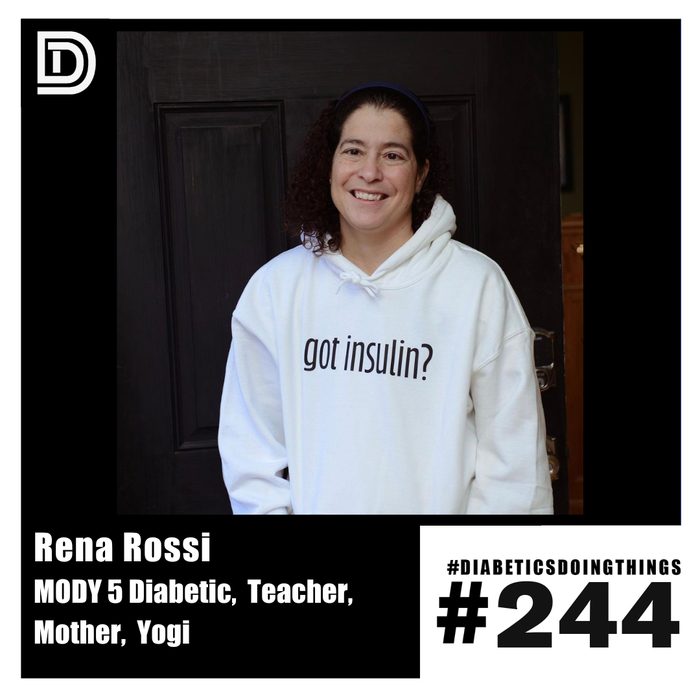
Rena Rossi, MODY 5 Diabetic, Teacher, Mother, Yogi

Episode summary
Rena Rossi, known online as Rena the Rock Hard Diabetic, was first diagnosed with gestational diabetes in 2007. Years later, at 35, after running a marathon and while grieving her mother, her blood sugar hit 590 even though her antibody test came back negative for type 1. Her doctor, who knew her personally, treated her as type 1 anyway, and her A1C fell from 10.1 to 6.5 within six weeks. Complications that didn't match a low A1C, including gastroparesis, neuropathy, and magnesium loss requiring IV infusions, pushed her to seek genetic testing, which led to a MODY 5 diagnosis. She talks about advocating for herself, teaching special education for 21 years, mindfulness through Diabetes Sangha, and evacuating a Maui wildfire while on vacation.
Key takeaways
- Rena's primary care doctor, a former Medtronic pump rep, treated her as type 1 from day one even though her antibody test was negative, skipping the type 2 treatment path entirely.
- Rena says she pushed her A1C from 10.1 to 6.5 within six weeks of diagnosis by demanding a pump and CGM right away instead of starting with shots.
- Despite an A1C consistently under 6, Rena developed gastroparesis, dumping syndrome, neuropathy, and magnesium loss requiring biweekly IV infusions, which led her to pursue a genetic diagnosis.
- Genetic testing found a deletion on Rena's chromosome 17, confirming MODY 5; her daughter carries the same deletion and has roughly a 90% chance of developing it, according to Rena.
- Rena and her travel companions evacuated their Maui hotel at 3:45am during the 2023 wildfires with only the diabetes supplies she had packed in advance.
Show notes
For the first time on the pod, we have a guest living with MODY 5 (Mature-Onset of the Young Type 5) diabetes: Rena Rossi aka @renatherockharddiabetic on Instagram. Rob and Eritrea talk to Rena about:
Initial diagnosis of gestational diabetes during her pregnancy in 2007
A diagnosis of a polycystic kidney disease while running marathons
Being in limbo between a Type 1 and Type 2 diagnosis
Having a primary care team that had a personal relationship with her and diabetes knowledge
Not noticing symptoms because they align with getting into shape
Having a personality to jump in and advocate for herself
Advocating for a MODY diagnosis when complications were occurring
Different types of MODY
Diabetes being a genetic ticking time bomb for some
Being a Special Ed teacher and Her Amazon Wishlist
and so MUCH MORE!
We want to hear from you. Send those questions, comments, queries, and general diabetes concerns to THE MAILBAG at mailbag@diabeticsdoingthings.com!
Questions this episode answers
What is MODY 5 diabetes?
MODY 5 (Maturity-Onset Diabetes of the Young, type 5) is a rare genetic form of diabetes caused by a deletion on chromosome 17, according to guest Rena Rossi. She says her form is multi-systemic, affecting her pancreas and kidneys and linked to polycystic kidney disease and an atrophic pancreas.
Can MODY be confirmed with genetic testing?
Yes. Rossi had genetic testing arranged through her kidney doctor and later traveled to Mayo Clinic in Jacksonville, which confirmed the same chromosome 17 deletion in both her and her daughter.
What symptoms led Rena Rossi to question a type 1 or type 2 diagnosis?
Rossi says she kept her A1C under 6 yet developed gastroparesis, dumping syndrome, neuropathy, and magnesium deficiency requiring IV infusions, complications she felt didn't fit a typical type 1 or type 2 picture.
Is MODY hereditary?
Rossi says her diagnosis is genetic and her daughter carries the same chromosome deletion, giving her roughly a 90% chance of developing MODY, most likely in her teens or 20s.
Full transcript Searchable, with timestamps
Rob Howe: Hello and welcome back to another episode of Diabetics Doing Things. We're telling the amazing stories of people with diabetes from all over the world. And today we have a first on the podcast. We have talked about a lot of different kinds of diabetes over the years and have learned a lot as a result. But there was one, and there's probably more, gaps in our types of diabetes that we've talked about. And that gap is MODY. So our very special guest today, who's going to be teaching us about MODY and talking about her story, Rena, you guys may know her as Rena, the rock hard diabetic, as one of the most supportive members of the diabetes online community that I have seen. So Rena, welcome to the show.
Rena Rossi: Thank you. I'm glad to be part of the show. And I'm late. This is my first podcast, so I'm excited.
Rob Howe: Well, I'm so excited that we get to be your first pod. So let's kind of start where we start. Tell us a little bit about yourself and what part of the world that you're calling in from. And then we'll start at your diagnosis, which I know is not as straightforward as many of the diagnoses that we see.
Rena Rossi: Yes, my diagnosis is definitely a little rocky. I am from Rhode Island. I've been an athlete all my life, soccer. recently. I mean, last couple of years, I got very heavily into yoga and meditation with the diabetes community. And that's pretty much it. I'm a special ed teacher in Rhode Island.
Rob Howe: Awesome. So let's start because I know I definitely want to talk and get into mindfulness and meditation. I know that you are friends with the and a member of the diabetes sangha community and very active in that community mindfulness breath work meditation. But let's start a diagnosis because I am curious and I know many of our listeners will also be curious to learn more
Rena Rossi: about Modi. So my diabetes journey started in like 2007 because I was diagnosed with gestational diabetes with my daughter, which my doctors thought was really rare because I was very healthy and I started off on insulin like straight away like and it was very hard to control even though I was very healthy runner beforehand so they thought that that was very like interesting and they were like and so but then that kind of went away so we thought and unbeknownst to us it was really Like probably MODY, not gestational, not type 1. So then fast forward to. I was like I was 35 and it was. I had just come off running a marathon. And my mom was. Had just passed away and a couple of months prior to that, I was diagnosed with polycystic kidney disease. so I would say I had gone I had gotten an athlete injury my back was a little tweaky went for an MRI and they saw cysts on my kidneys and they were like okay you have cysts on your kidneys so like all right I thought I had that diagnosis then a couple months later my mom had and sick and passive cancer and I went back to I was in summer school like I teach because I teach year-round and I was dealing with the other diagnosis and basically the other diagnosis was my kidneys were still 100% and they said that it was a slow progression slow progressive condition and that I had to take do high water intake that there was nothing at the time to do It was kind of like a wait and see. Just remain as healthy as possible. Keep doing what you continue to do. So I said, OK, like I just, you know, had to roll the punches. And that was like the diagnosis. Meanwhile, my mom got sicker and passed. So that's where I was at. Fast forward, I'm at summer school, just go for my yearly. I lost a little bit of weight, but I didn't think that was a big deal because I was coming off the back surgery and I was getting active again, getting my back in shape. I started running again, so I was feeling better, what I thought, but I felt a little tired. But I didn't think that that was a big deal, and I lost 15 pounds. But I was heavier than I normally was with the back surgery. So I was at my typical, normal running weight. Well, my PCP, who's also a close personal friend of mine, had left me a message. It was like, you need to come into the doctors. Your blood sugar is 590. but what was different was my antibodies were not like t1d positive like i didn't have the GAD antibodies but they were like she's like there's no way you're type type 2 so like you're kind of like in between we're not sure but we have to treat you like type 1 so she was like you need to be on insulin so she didn't go the the typical like ladder route where like or the typical like you think you're type 2 she's like you're coming off running a marathon like we know that you can't be type 2 so she didn't send me down the like we're gonna give you metformin route she so she was like we have to treat you like type 1 so i got on i got on insulin right away like so that was the positive of the diagnosis that we we didn't have to deal with like all of that let me
Rob Howe: let me pause you for just a quick second because i want to ask you made a really clear distinction like you had a personal relationship with your primary care physician and, and you guys had known each other for, for quite some time. So do you think that that helped? Because like you said, you weren't diagnosed as type 2.
Rena Rossi: It definitely, it definitely helped because she, she knew my background. She also, which she also has experience in diabetes. She was a nurse practitioner, so she was more personal and prior to her being an MP, she was an Medtronic pump rep. So she had experience in diabetes also. So she had a little bit more knowledge in the field than most people anyway. So she knew and she knew me. So she knew that I was not a typical type 2 and she had experience with people too.
Rob Howe: And something else that I also want to talk about is that your symptoms and your story is kind of similar to my diagnosis where you're exerting yourself. So you're getting into shape. So the weight loss, you don't really note. And the fatigue you kind of just assume is due to getting back into shape and starting back on your...
Rena Rossi: And like, because my mom was sick.
Rob Howe: Right. Yeah, all those things. So like, you know, when we talk about seeing the signs of diabetes, situation and context makes a big deal because you might be, you know, starting a new workout regimen. You might be dealing with personal life challenges and grief and stress. or, you know, one of our guests many years ago, Oren Lieberman was hiking in Nepal and like was just over a long period of time, just felt like he should be tired. He should be, you know, losing weight because he, his lifestyle had changed. So when you're thinking about those diabetes signs, now we can all look back and say, yes, well, obviously it's diabetes, but in those moments, those, you know, individually, they don't seem like they're that big of a deal.
Rena Rossi: yeah i i definitely i definitely agree it's just you have to it's it's it's like a string of things
Rob Howe: all together so you mentioned so that was the positive part of of the diagnosis and you're you mentioned that you didn't test positive for the antibodies that would indicate that you're type 1 or or lada and you you were starting on a treatment plan like you were type 1 but your doctor said you know hey there's something else here we're not really sure what what was the next
Rena Rossi: part of it went so then they said so i said okay like and then we went to i went to Joslin Diabetes Center which is like you know Joslin is like renowned like even though i'm in Rhode Island i said i'll go to boston like and i wanted to go in a pump right away like that was non-negotiable i was like get me on a pump like i want to start right away not doing shots like like i want cgm like they're like you have to wait i was like nope nope not happening so like by the time my appointment or the Joslin, I was already, they were like, you need to wait. And I was like, the pump is already going to be in the mail. Like I'm already going to be on the pump. They're like, oh, really? I was like, yeah, my doctor kind of fast forwarded that for me real quick. Like they're like, well, you have to like, even when I was in the diabetes educated, they were, they were like, first they were doing like the, you know, the 50, like the plan. I was like, no, no, we're not doing that. Like we're like getting carb counting like right now. like the i was like i'm learning this quick like we're i'm not like the first six weeks appointment my a1c went from the 10-1 to a 6-5 like i brought my a1c down like you really are rena the rock hard diabetic you're no you jump right in i go all in can you think that that had okay so for people
Rob Howe: like there's a lot who have technology barriers and i know for me like i couldn't get on a pump for a decade so do you think that that had to do with the relationship that you had with your primary care provider or do you think just my personality and i was about to say your personality like i'm not i am the person i was waiting for i don't care what is on your agenda rena has her own agenda so do you have any like advice for people who's like i think it was where
Rena Rossi: i was in that frame of mind like i needed i need but i also need the control like i'm i looped So like it's it's about who your personality is. And I need the control.
Rob Howe: OK, so you think I was going to say like giving people like advocating for yourself is a skill that I think is learned. And it depends on like I think people who have had diabetes for longer get more used to advocating for themselves, whether that's with their doctor, with their employer, with their insurance company.
Rena Rossi: You have to do that, too, with your employer. Definitely. I definitely do that, too.
Rob Howe: so I guess advice for you like did that come more naturally I mean I think I think for me it just did
Rena Rossi: I only and it was the frame of mind of where I was at that particular time I think because like I was a lot of like my mom was sick she like so it was just like at that time I could take control of that I had no control of other things other factors around me so I was like okay I could see how that affected her like how our cancer was and how we didn't have control about that so it's like i need to be the healthiest version of me because of my daughter my family running was something i like like i ran i can i can do this like i can just i'm taking this on head on so
Rob Howe: this is kind of a sidebar question but i love to ask people when they have like a very strong personality rena are you a fire sign by chance when's it when's your i have to ask sarah she's
Rena Rossi: good sarah she's a bug i'm a libra oh okay that's so interesting i don't know you just come off very
Rob Howe: like this is what we're doing and if you're not going to give it to me so exactly so maybe that's what i'm just trying to figure out how i can channel this and bottle it and maybe sell it because it sounds absolutely valuable because that's what i like that's even when later on
Rena Rossi: And when I when I did, then that's how I had to advocate for the whole Modi diagnosis, because then fast forward when things, my complications were adding up as to someone that shouldn't have all these complications. because my A1C was always under six. So I shouldn't be having gastroparesis. I shouldn't be having dumping syndrome. I shouldn't be having neuropathy. I shouldn't be having loss of magnesium where I have to have IV fluids twice a week.
Rob Howe: So talk to us about as you're managing your diabetes and taking control and using that very type A arena mentality.
Rena Rossi: yeah so my a1c below six like which which most people don't get my with MODY is a MODY can involve many different things because MODY is genetic MODY like where diabetes well type 1 is auto is autoimmune we know MODY there's more than one kind of MODY so like me and say Kylie she's MODY 3 I'm MODY 5 MODY 5 is considered multi-symptomatic so it has a little my modi has a has a lot of spice added to it because it has how the first step when we saw the kidneys i had cysts on my kidneys so my modi involves is multi-systematic it involves my kidneys it involves my pancreas but it involves my pancreas in multiple ways like how Maya has to take Creon, I also have to take Creon. Because when, right during COVID, when I had to go to, I was hospitalized once during, twice during COVID with the dehydration. They did a MRI and CT of me and they saw that my pancreas was atrophic. So I have damage to my pancreas. So I still have my pancreas, but it's, it's, it's, it looks like it's like disease. It's, it's malformed.
Rob Howe: so that wasn't problems with my digestion so let's talk about that like genetic diabetes like so MODY stands for maturity onset diabetes of the young but you also delineated that there's multiple kinds and you said that you you live with MODY 5 and others live with MODY 3 or potentially other numbers yeah there's other ones can you explain some of the differences between say modi 5 for you and maybe modi 3 or another number yeah it's just it's what form so it's
Rena Rossi: genetic, but it's the kind of deletion that you have on your gene and then how much of it is deleted. So in my case, which is the shirt that I have on, I have the whole, I have the whole, my whole chromosome is affected. So I have a deletion on my chromosome. And when we did the genetic testing in my whole family, it started with me and my daughter has the same deletion. so she will it's a 90 chance that at some point usually in her teens 20s she will develop MODY as well i didn't develop it until i was 35 so she could develop it later most probably because they said because i was so healthy as far as like exercise wise and whatnot that it was put off as long as it it was like goes at bay and then like like like anything else like sometimes stress situations can pop it up that was a stressful year yeah it sounds like it yeah that's so and
Rob Howe: so that's interesting too like that you're able to kind of know and have that awareness very similar to like an antibody test for for someone who's type 1 and has children or brothers and sisters uh yeah it's like really exact and you're able to see like really exact in terms of like the time frame wow wow i think wow okay so i've never thought of diabetes and this is going to sound like extreme but i've never thought of diabetes in the sense of like ticking time bomb disease like it just either happens or doesn't it didn't this sounds to me like something like Huntington's kind of where they like diagnose it before you ever even have it. So I guess does that have any kind of mental weight on you and your daughter? Like what kind of like your relationship with her?
Rena Rossi: She's like, I just wish I would get diabetes already. She's like, she's like, cause I, cause I, it's, it's going to come. She's like, but she's like, I don't find the diabetes, but like some of the other extra stuff you have, I could do without that. she's like the diet because the diabetes is by far i think for me is the easiest part to manage so let's talk about some of that other stuff yeah so we can get better understanding be like the diabetes is like you just manage your blood sugars which is one thing but because I have the atrophic pancreas, the digestion is a big thing. And for the last year and a half, going on two years, I've had to have IV mag supplements. And that's been every other week because my magnesium levels just drop. wow and because my body can't absorb orally i have to take it viv and up until last year i was having to go to the cancer center and take it and it's a four-hour treatment every
Rob Howe: other week so significant time investment and you're just obviously also it's not fun
Rena Rossi: When IV centers are cold, like IV centers are cold, you're tired. Like, does it hurt? Yeah, it's not. And you're hooked. And I was being hooked up to the IV, but now I have a pore.
Eritrea: It's another thing.
Rob Howe: I also want to talk, like, so how are you discovering, and I think this is really important for somebody who is maybe out there listening and is experiencing symptoms outside of the diabetes that they can't really explain. how how have you gone from understanding that it's not just type 1 that it is that it is the the genetic modi mutation and like and then what are all how did how did you discover like all of the
Rena Rossi: other and you and your care team all of the other for me like i went during it was like during covid and the things weren't lining up and i was like why isn't this all these things lining and i was like enough and I my my PCP was like I agree like it's it's something it's more than this Joslin missed it when I was they just said maybe we should go try you off insulin and another thing I was like I don't think that's working because my A1c is well when I'm not willing to go off insulin like and try metformin that's gonna mess my stomach up even more so that's not the answer So then I left them. I was like, I'm good without you. And then my kidney doctor said, let's do more genetic testing in Rhode Island. But meanwhile, I also made an appointment with Mayo in Jacksonville. and my dad and I traveled there. But meanwhile, the test did come back for the genetic mutation in, I think it was like January of that year. And then we traveled to Mayo in Florida and to run the rest of the tests because also I had hyperparathyroidism too, they discovered also. Because that's also connected to the gene mutation.
Rob Howe: so you've mentioned a couple of really big name like health systems like jocelyn diabetes is like the the diabetes you know name missed and they missed it so like right you know even if if the authority and diabetes missed it then like obviously this is a very like unique and special case then going down to the mayo clinic as well which is you know when you think of health care in general that's one of the few names that pops up and then also getting other tests from a kidney specialists like how how are you managing all of these different appointments all of these
Rena Rossi: different relationships like prior insurance like how island too so like even all boston it was like a day here a day here and then my kidney doctor isn't in rhode island either they're at they were at tufts so it was tufts for for kidneys mgh is where i was going for for the stomach and Joslin was diabetes and then i cut out Joslin for diabetes so i was like i'm done so now i just do tufts for diabetes and they're gonna manage the pth and and we're and i'm my i have my gis in rhode island because i'm
Rob Howe: i'm done i had to minimize well and and thinking through that too like traveling a lot like so in texas it's three hours to the closest city so we you know we stay you know that state like if there are different hospital systems we can damage yeah i mean Rhode Island's small like literally the smallest state in the commonwealth right so you're you know you're going to the across state lines does that cause any trouble with your coverage like also like asking for time off like you're a
Rena Rossi: teacher so i have i had filled out for like family medical leave and you can do yeah and you can do
Rob Howe: intermittent family medical leaves and that's the biggest hack ever then intermittent fmla for people who are in a school system that used to be in the school system is the biggest hack ever because they give you a bank of hours right and then you can just take them weekly like five or
Rena Rossi: my doctor for me every year which i have to do it again because it's only for a certain amount of time so i have that band that i have i can use it forever and plus i've been teaching for 20 this is year 21 so i have like 46 days even with me going out on shoulder surgery i had my rotator cuff surgery last year and i'm still i still have 40 days so i try but you still have
Rob Howe: teacher insurance so that was gonna be my next question is like i used to be the school system my mom the teacher i know that it's not necessarily the best plans and the names that you're mentioning like i can only imagine how expensive it is i have i have to say i have blue cross and okay
Rena Rossi: and they have they have good i have good coverage and you got it through your school system or did Yeah, I've always had them from all 21 years. Wow. Wow. They have good insurance.
Rob Howe: Also, I'm amazed that you've been teaching for 21 years because I thought you were like 35. Like the energy, the way you have like this lady.
Rena Rossi: I started when I was 21. So I started straight out of college. Wow. Wow. I did one year in Philly volunteering and then I went straight to Providence. Though, I don't know. People are dropping left and right these days.
Eritrea: So, yeah, it happened. Yeah.
Rob Howe: Yeah. I mean, you know, it's we're in sort of the hardest times like coming out of the pandemic, the hardest times to be a teacher. And, you know, a lot of there's a lot of articles, I think, of like teachers leaving who are, you know, many teachers who had only taught for many years like yourself, you know, and pursuing other professions and changes for a lot of different reasons. How do you talk to your students about your diabetes and about your MOTI?
Rena Rossi: Well, my kids are so little in special ed. They don't really notice, but I do get the kids in the, in the, in the school, like, you know, cause they always see like my pod or my Dexcom and they, they always like, I, I talk to them and, and they're, and they're good about it. Sometimes they'll see me eating like a Smartie or something and like, they'll say something and like, but, but they're, but they're good about it. And then this year, last year for the first time, we had a type 1 in the school and and it was pretty it was pretty cool she was a little first grader and I brought her some stickers and stuff and and a book and she was my little buddy and like sometimes she would come into my classroom when when when when she was having a low and stuff like that like to cheer her up like her teacher would send her down like if she was having a bad day because she just got diagnosed like the summer before so it was it was nice to have like she like she was nice having like a teacher in the school because that was the first kid in 21 years that i've experienced like in the school like i mean obviously i know type 1 kids but like in in my school wow we actually just
Rob Howe: had mary type 1 from you know tiktok and instagram oh yeah came on and talked about how she's never had a type 1 student but last year she had a student in her school who had type 1 and kind of came by her office sounds very similar like treating a low and just talking about her diabetes and you know sharing their devices with each other it's so impactful i think you know just to be
Rena Rossi: she was so cute i brought like the little stickers from luke's part-time pancreas and she was like she's all excited and she'd come in and show me the ones that she picked out and put on her on
Rob Howe: her little device it sounds like healing not just for the kid but also for you but anyway sorry rob go ahead no yeah i was gonna say like you know you mentioned lucas part-time part-time pancreas I would consider you one of like the best, like biggest, most avid supporters of all the different like diabetes creators and like diabetes projects like you are. You buy T-shirts, you rep, you rep the merch, you show up to the events, you participate in the different programs. Like you are just like a foundation of support for people with diabetes. When did you like find the diabetes community and like how did you like how do you find the time and energy to be so passionate and involved?
Rena Rossi: I started pretty quickly. Right when I got diagnosed, I found Diabetes Sisters through Sarah. And she was in Boston and I was in Rhode Island. And I went to a yoga class with her. And then I started doing Diabetes Sisters, Rhode Island. I stopped doing it for a little bit. I'm right after the pandemic, but we're going to start up meeting again now. and I'm the chapter leader for Rhode Island. And I was just talking to a friend of mine whose daughter and son just went to our Rhode Island diabetes camp and she was saying that there's a disconnect in Rhode Island for like little kids. So we're talking about she's an early childhood teacher and her daughter's diabetic, getting something going locally for the kiddos around here, like during the year, because there's like a gap. they go to camp one summer and then they're like, they miss each other. So we are trying to get a little something for the kids. Rob like asked the question, but I'm going to double down.
Rob Howe: Do you have burnout? You do so much. Like you have the motive.
Rena Rossi: Like that's what gives me like, like I'm getting burnout from real teaching right now. Like with everything that's going on, not my kids, but like just administration stuff. So when I do this, like I do like my creative stuff, like with like, making diabetes t-shirts my cricket and with my girlfriend like we like to do stuff like that like like i rather like that's the stuff that i enjoy so like this is like creative avenues that i like like it's like relaxing like if i get away from teaching it'll probably be something like in the diabetes space like in a few years like i don't know if i can teach forever so if i can't is going to be something like in diabetes for sure.
Rob Howe: Let me ask you this because this is something I've thought of for a long time. And early in my career, I gave this advice to younger people who worked with me because they were like, Rob, it seems like you do so much. How do you find a work-life balance? And to me, that work-life balance, sometimes if you put a lot into your work, which it sounds like you do with your teaching and with your kids, I think you have to put that same amount of energy into to not work into your creative passions or into your community passions or exercise or whatever that looks like for a person so that you're not just sitting at home kind of waiting and like being dormant, like, because then you'll feel the real imbalance, especially if you're putting a lot of impact. But that can also lead to like, you know, my sister says like the brightest candle burns out the fastest. So how do you, you know, how do you find that sort of balance for yourself,
Rena Rossi: like personally and professionally i think like right now is just it's just a little give and take like right now i know because of some of my health stuff i can't run right now and that for me it was like a big loss so i think putting my efforts now into creative stuff is what i'm doing to just keep myself busy because i like to work out i like to do all those things so like not being able to do that is is hard so it's like doing this right now is helping me not being able to run is hard not because that's that's the loss that modi has taken in the last like year with not being able to figure out the dehydration stuff that's like that's the hardest with the the dumping syndrome part of my condition that's the hardest part right now is just trying to manage that
Rob Howe: so i think the like the creative part is like is the balance well thank you for being so like open and vulnerable about that too like having something that you really love and really need and and are passionate about being taken away from you even you know maybe it's not forever but for right now like having to kind of grieve that and you know using creativity and using the community to to kind of fill that that void i want to i want to ask you because you mentioned it earlier you know about like diabetes sangha, like mindfulness and meditation, you know, you seem like, like me and Eritrea as well, like a very type A kind of like a tough person, like a person who, you know, gets up and gets after it. For me, I know it took some, you know, really deep, like inner work to kind of disconnect from that identity and really look inward and like focus on things like breath work and meditation. Like how have those things and, you know, being involved in diabetes sangha, Like how have those, you know, what have those given back to you and helped you grow?
Rena Rossi: For me, it's been a sense of calmness and even like routine. Like I enjoy like ending my night doing that. And even if I can't do it at that time, like I'll put on like one of the videos from YouTube from Peter or something like that. And even if I can't do it like in that way, like I'll put it on and I'll do a walk around the neighborhood and do a walking meditation just to get that, the sense of calm. It just brings my whole day down with the rush and bustle of school. It's just like, it's just my way of like totally disconnecting. Be like, all right, school's done now. Like, I'm not going to laminate. I'm not going to do anything else. I'm just going to breathe and disconnect. So like my ADHD going, going personality, it'll just like bring the whole thing, my whole mood down.
Rob Howe: It's fascinating how impactful it can be. And I think, you know, something I've been talking about a lot lately is that, unfortunately, all the things that they tell you to do, you have to do them in order to get the benefits and you have to slow down and you have to focus on your breath and you have to go for a walk and get the sunshine on you and really kind of disconnect from our sort of always on hyperconnected society. And, you know, I think that can be one of the challenges with social media is like, yes, there's all this positive community. And yes, there's all these amazing creative projects that we can be involved in. But also we have to make sure that we're not just mindlessly consuming things that are making us upset or things that are causing us more anxiety or kind of like you said, tapping into our ADHD brains a little bit. And, you know, it can be challenging to, you know, to consciously, intentionally say, no, you know, I'm going to go for a walk and I'm going to tap into one of Peter's YouTubes instead of just, you know, seeing what the algorithm delivers to me. Let me ask you this. Your journey diagnosed, you know, with diabetes and then going on into the different genetic pieces and going to different providers all over the country is challenging. It's not linear. and I'm sure has been with lots of moments that were really frustrating and really challenging. If you could like go back and, you know, to either tell yourself or somebody who is, you know, recently starting to undergo their journey with Modi and learning about, you know, genetic mutations and how that affects them. Like what advice would you give to somebody, you know, on day one?
Rena Rossi: I would just say just advocate for yourself. And if you need help, get it. Talk to someone because you're going to need someone to talk to because it's a lot. It's going to be a lot of information. And whether it's a therapist, whether it's a priest, whether it's someone, you're going to need someone because you're going to take in a lot of information. And you're going to need someone to bounce everything off of and get a notebook and write everything down.
Rob Howe: And it seems like you found a lot of someones. You found in the community, you've also been someone. I think, you know, even back, you know, when I first remember kind of interacting with you on the live show that we did during 2020, which is also where I really got to know Eritrea a little bit more like that was, you know, somebody who like, you know, like being being the change that you sort of wanted to see and, you know, being the friend that you needed to others and being the supporter that you needed. And I think that like returns back. So I just wanted to, you know, really give you, you know, your, your flowers of, of being just a great supporter and a great example of what it means in the community, because a lot of people talk about community and they, they talk about growth and they talk about followers or whatever the case may be. But community is like giving to and from each other and like how we can help each other, you know, continue to either just just to manage this disease or to make life a little bit easier or just be a sounding board or an ear to listen or a shoulder to cry on or a hand to hold. So I just wanted to really compliment you on being an amazing friend and community member.
Rena Rossi: Thank you. So it's definitely important to get support.
Eritrea: Support is from the beginning.
Rob Howe: so with that in mind like how many how many people with modi have you met online and like because of because of being like sharing your story and like raising your hand and saying hey i live with this uh genetic mutation of diabetes and i want to meet more people like myself we've we've had a
Rena Rossi: couple of meetups maybe 25 30 people like like they met and talked to kylie and i and jesse we've we've had a couple meetups with maybe 30 people total but probably about 100 people like reached out at different at different points like met different messages some people that had the full gene delete somebody from switzerland recently that had the a full that had a child with the full gene mutation that I have the same, the full 17Q deletion.
Rob Howe: What does that feel like to be able to meet somebody, you know, even all the way across the world in Switzerland where...
Rena Rossi: Yeah, it's pretty cool to have somebody like that, like you can, that is going through it that has like the same or similar needs that, that, that is not just type 1. And type 1 is one thing, but it's like it's interesting when somebody has some of the same unique challenges that you that you face every day.
Rob Howe: I just am so kind of blown away by how fortunate we are, like how the odds a like the odds of you look at if you look up MODY, you'll see like one of the first things that they talk about is how rare it is. and then you think about all of the things that had to go right and all the things that had to happen for that person to be able to find you and all the stories that each of you had to opt into and like technology that had to exist uh it's so like and it has such a huge impact just to be
Rena Rossi: i guess i was looking at my kind and mine is even rare mine is like five percent of the five of the of all the MODYs and mine is five percent like that's right so like that is like more you're
Rob Howe: like more likely to get hit by a bolt of lightning than to be able to meet another person like you. Right. So I just think that that's something that that continues to reinforce what we've talked about a lot on diabetics doing things, which is your story matters no matter what it is. And if you want to meet someone who knows at least a little bit or exactly what you're going through, the best way to do that is to share your story, to be a good community member, to be a good friend. And I hope that more people are able to connect with you guys in the MODY community. And we're going to do a better job of making sure that we speak to the Modi diabetics who are out there because it's not as simple, very similar like you talked about with Maya, with the type 3C community. It's important to make sure to address all the different variants of diabetes outside of just type 1 and type 2 and LADA. And the more we learn and the longer we continue to research diabetes, we learn about all the different variants and all the different things that go into this very complex life with a chronic illness. So, Rena, tell us where to find, I know you've got, you've got an Amazon wishlist for your, for your school list this year on your Instagram profile, Rena, the rock hard diabetic, which we'll include in the show notes as well as in the posts, anything that you're working on
Rena Rossi: that you'd like to plug? No, not right. Not right now. I'm just going to, hopefully we're going to get some stuff going with the little kids community. That's my next thing that I'm going to be working on. In a couple of weeks, once I get back to school, I'm going to work with my friend. Now I got another person to help me and then I'm going to be getting some meetups with the local Rhode Island community going
Rob Howe: too. So we shall see. More to come with the new school year approaching. Absolutely. Well, Hey from Texas In Rhode Island We're jealous of the Of the cool weather That you guys are having right now Cause it's Again Well it was
Rena Rossi: Very I did Just recently escape The Maui fires That was not Oh my god Really Yeah
Rob Howe: Wait wait wait This is a great This is a crazy sidebar So you were in Hawaii While this was happening Yes
Rena Rossi: Yes We were We were in Maui Like Right in Like right there Like our hotel Was We escaped at 345
Rob Howe: that was when did everything happen when did like i i've been on vacation on tuesday like on the
Rena Rossi: tuesday of the of this thing that the next we had lost power the day before and then at 3 45 in the morning that day we got evacuated that was a nice sidebar throwing all your diabetes stuff in the in your in your suitcase and trying to escape and grab all your stuff no access good thing i had like my snacks and everything with me because i had no access to food or anything other than what
Rob Howe: i had with me oh my goodness so they evacuated you guys out of i know like it's north maui
Rena Rossi: that was like yeah lahaina we were right there our our hotel was on the on the beach oh my gosh we were we had been in hawaii for a week and a half at that point because we had we had been at waikiki like at disney's private island before that and then we went to maui we had traveled to Somali on the Friday. And then this was Tuesday. And we were supposed to stay till the prior length right till Friday. We had evacuated and we didn't listen to them because they told us to stay in the side of the road and wait a couple of hours and then and then wait for police to tell us what to do. And we're like, no way. We drove straight to the airport. Like and then we were able to get a flight out later on that day. And we we ate non-diabetic friendly food, Krispy Kreme donuts. Even though I'm celiac, I didn't even care. I couldn't eat. There was no food. I was, like, starving. I was like, well, I'm going to eat some Kreon and hope for the best.
Rob Howe: Oh, my God.
Rena Rossi: Because we had no food. We were, like, abandoned on the side of the road. It's an insane sidebar to discuss, like, having diabetes and the complications of being in a natural disaster,
Rob Howe: especially when you're not expecting it. Like, you're not from Hawaii. This is not a place where you know where resources are.
Rena Rossi: And I had like brought food like I because I knew like there were times that I couldn't get snuff. I had like a few things like I didn't bring like enough food to sustain me like for 24 hours. Like I had like I had some meat sticks and like and like I had some low snacks like I had I had I brought fruit leathers. But like, is there anything from that experience? I ate two donuts and like bolus like 10 units and hoped for the best.
Rob Howe: is is there anything that you think that you learned from that experience like for other
Rena Rossi: possible disasters i mean the one good thing was i had everything like most of my stuff were already packed in my in my shook i like sugar medical llama bag that i had gotten from my friend for my 40th birthday that most of like my pods and everything was kept in but what i should have done which i didn't was i had my meds in like another bag and i should have just had all my stuff in that one bag so like i could have grabbed and goad like i could have i should have like but so they were packing in the pitch black there was no lights and there was three glow sticks wow and i should have had a backup my backup battery wasn't charged for my phone wow but we had jeeps so once we got out into the the car we were able to charge our phones on on the in like in that and my friend had a backup battery so she gave me the backup battery from my phone so that i
Rob Howe: had it that night and i'm assuming your pump was already charged and you're not a person like me
Rena Rossi: because i had gotten a new phone to like two days before the trip because my phone had broke i didn't set up my loop so i was i was using an old like the original the original Omnipod with like the old PDM. So I didn't need to charge anything. I just had that pump. Yeah. Wow. Well, I know we've
Rob Howe: been, you know, sharing like the resources and donating to the mutual aid in Maui. Yeah. And I know that there's in LA and San Diego over last week that they were, you know, coordinating like insulin and diabetes supplies. They were flying over to Maui on like a private jet. And, you know, I know that the community on the ground there has been, you know, talking about the needs and we We can link some of those in the show notes.
Rena Rossi: Oh, yeah, that's a good idea.
Rob Howe: But yeah, I didn't realize I saw your post, you know, with the with your Maui sticker on your Yeti, but I just assumed that you were on the East Coast.
Rena Rossi: No, I was right there.
Rob Howe: Yeah. Wow. Well, again, we're thinking of and actively, you know, donating myself included to, you know, support the people that are there on the ground. And I know that it has been.
Eritrea: I should send my brother back with some stuff.
Rob Howe: as as eritrea mentioned it's like a true natural disaster thousands of people displaced and hundreds of people that have lost their lives unfortunately and you know we're thinking of the people in maui and in hawaii especially the people living with diabetes i cannot imagine i cannot yeah i think though rena you gave us a good a good prompt for our next like robin eritrea show we got to talk about like a diabetes go bag like making sure that you know yeah i had a fire in my house earlier this year you know we didn't have to evacuate fortunately but like fires especially can turn from you know they can go really fast and they can turn into really dire dangerous situations and
Rena Rossi: yeah it made me even think about for my classroom this year i'm like i always have like a few things like in my bag but i'm like you know what i'm gonna make like i think the kids have their like the kid in our classroom has like a diabetes kit like i need to make like a kit for my class and like just have all my stuff like if there's a lockdown something like that like right i could be in the gym. I should make myself, I should be prepared too. And I'm a person who typically goes
Rob Howe: on vibes. Me too. And you need to make sure to be more prepared. That's something that I always talk about is diabetes really just adds one extra step. But sometimes you got to think about the extra steps that you don't want to think about. What if we lose power? What if we lose refrigeration? What if I left my supplies because we had to evacuate the building fast? All of those things, you know we need to try to be as prepared as we can for this is how i know we're getting older because it's like i asked myself questions like what if the plane crashes what if the building blows up like the stuff i never because i had to be cells eight and i've never worried about this before but now i'm just like oh my god natural disaster now i know the guy is like oh because i
Rena Rossi: i even put some of my insulin in my school fridge i'm like well if i lose all my power here i have some some on my backup insulin in my school fridge you're like well and we're we're in the
Rob Howe: season right now with i i know beyond type 1 a few years ago did like a natural disaster preparedness blog and like list of some things and like resources, but you know, it's hurricane season. There's a hurricane on the East coast and the West coast today, which, you know, I've seen a lot of our friends with diabetes posting about. So, you know, just when you think it couldn't happen to you, you know, there's a hurricane in Las Vegas. So it's like, you know, you never know where things are, you know, how things will change and, and, you know, you gotta be ready for, you know, in a lot of ways, the worst case scenario. So, well, anyway, Rena, I know that we, we were kind of wrapping up and then discover that, that, you know, natural disaster, you know, sidebar, but I'm glad we had that discussion, but thank you so much again for, for coming onto the pod and for, you know, really being the rock hard diabetic for all of us and showing that, you know, being a powerful advocate for yourself really can, you know, have dramatic effects. So thank you so much. No problem. Thank you. Hey, and this was your first podcast you've officially done at least one.
Rena Rossi: All right. Yeah. Awesome. Thanks guys.
About Rena
Rena Rossi, known on Instagram as Rena the Rock Hard Diabetic, is a special education teacher from Rhode Island who lives with MODY 5, a rare genetic form of diabetes. She is a chapter leader for DiabetesSisters Rhode Island and an active member of the diabetes online community.