

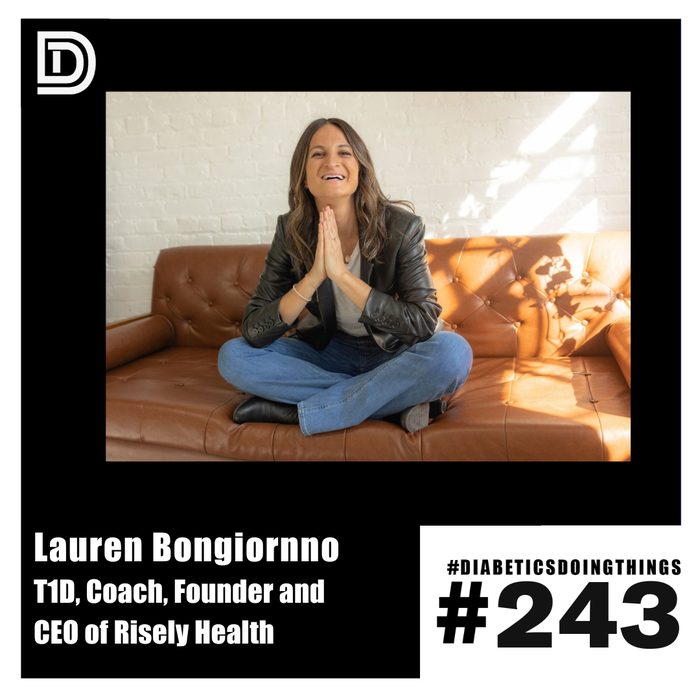
Lauren Bongiorno, T1D, Coach, Founder & CEO of Risely Health

Episode summary
Lauren Bongiorno returns to Diabetics Doing Things for a third time, on the eighth anniversary of the show's founding. She has lived with type 1 diabetes for 23 years and runs Risely Health, a coaching company she started in 2021. She and Rob discuss how language from doctors affects patients, using the story of a Risely client named Corey, who fired his endocrinologist after a harsh letter about his blood sugar and later lowered his A1C from 8.4 to 6.7 with coaching. Lauren talks about replacing judgment with curiosity, not outsourcing authority over her own care, leaving her twenties behind, playing in a soccer tournament, cold plunging, and building systems instead of chasing one-time goals. She also shares how she married her husband Chris and is now focused on growing Risely.
Key takeaways
- Lauren says a harsh letter from his endocrinologist led her client Corey to fire that doctor; after three months of Risely coaching his A1C dropped from 8.4 to 6.7 and his time in range rose to about 70%.
- Lauren says replacing self-judgment with curiosity, and asking 'why' repeatedly, helps people find the root of a habit instead of blaming willpower.
- Lauren says not to 'outsource your authority' to a care team; she says patients should trust their own intuition about their body.
- Rob says most people with diabetes who struggle aren't failing on purpose; he says they often lack employment, insurance coverage, or community support.
- Lauren says cold plunging once or twice a week gives her a bigger boost in focus, mood, and insulin sensitivity than anything else she has tried.
Show notes
We are very rooted in GRATITUDE THIS EPISODE! Recorded on the 8th year anniversary of the conception of Diabetics Doing Things, we have third-time guest and friend of the pod, Lauren Bongiorno!
Changes and updates to routine and diabetes management even after 23 years of managing!
Growing, changing but staying the same especially when it comes to relationships and marriage
Marrying her high school sweetheart Chris last fall
How diabetes can impact interactions with friends, family and peers; the impact of how a better relationship with diabetes can improve lives
The importance of language in treating people with diabetes and the difference the right support can make
Why outsourcing your authority isn’t helpful to you as active member of your diabetes care
Actionable and accessible management changes when not feeling motivated or have too many other things going on
Looking at yourself without judgment and where to start with that
Leaving firsts in her 20’s: happy firsts and devastating ones
Goals are for people who want to win once, systems are for people who want to grow repeatedly
How being an athlete can be a huge part of your identity and life after sports
About Lauren
"Lauren Bongiorno, diagnosed with Type 1 Diabetes at age 7, is the founder and CEO of Risely Health, a leading virtual Type 1 Diabetes Health Coaching company. Guided by a team of Nationally Board Certified coaches who live with T1D, Risely elevates beyond the traditional standard of diabetes care through innovative coaching programs and communities that empower T1D individuals and families to live with more freedom and confidence.As of 2023, Lauren and the Risely team have coached over 600 people and Georgetown medical school is publishing a study on the quantitative and qualitative results clients see in their programs.Lauren has been featured on the TODAY Show and has partnered with renowned brands such as Omnipod, Dexcom, Abott, Lululemon, and Nike. To connect with her more, you can find Lauren on various social media platforms, listen to the Reclaim Your Rise podcast, and dive deeper by visiting Riselyhealth.com."
We want to hear from you. Send those questions, comments, queries, and general diabetes concerns to THE MAILBAG at mailbag@diabeticsdoingthings.com!
Questions this episode answers
What does Lauren Bongiorno mean by 'outsourcing your authority'?
She means letting a doctor or care team make every decision about your diabetes without staying involved yourself. She says patients should trust their own intuition and stay in the driver's seat of their own care.
What happened with the Risely client named Corey?
After his endocrinologist sent a letter criticizing his blood sugar in harsh language, Corey fired the doctor and started coaching with Risely's Coach Meg. Within three months his A1C dropped from 8.4 to 6.7 and his time in range rose to about 70%, according to Lauren.
What is Risely Health?
Risely Health is a virtual type 1 diabetes health coaching company Lauren Bongiorno founded in 2021. Per the show notes, its coaches are board-certified and live with T1D themselves, and the company has coached over 600 people.
How does Lauren Bongiorno use cold plunging?
She says she cold plunges once or twice a week at a local gym and takes cold showers most other days, and that it gives her a more noticeable boost in focus, mood, and insulin sensitivity than almost anything else she has tried.
Full transcript Searchable, with timestamps
Rob Howe: Hey everyone, Rob here. First of all, I just want to thank you for listening and supporting Diabetics Doing Things. Your support means everything. We would not be here without you. Just wanted to call your attention to a few things that we're working on lately that are updates to Diabetics Doing Things. The first is, we are throwing events. And you can find more about our events at DiabeticsDoingThings.com slash events. We launched our first event in April of 2023. It was a coffeehouse roastery tour. and latte art class. And we have two very exciting events coming up in the fall of 2023, including our first ever, so our inaugural National Diabetes Awareness Month event. And those are going to be on diabeticsdoingthings.com slash events this month. So be sure to check those out. Also, if you have a question that you want Eritrea and I to answer on air, please email the mailbag at diabeticsdoingthings.com. So that's mailbag at diabeticsdoingthings.com. Your question will be answered on air during a special episode of the Rob and Eritrea show. So if you want to ask us a burning question and you want us to spend some time on it, please reach out to mailbag at diabeticsdoingthings.com. All right, let's get back to the episode. Hello and welcome back to another episode of Diabetics Doing Things. We are telling the amazing stories of people with diabetes from all over the world. What's special about this episode is that yesterday I got a Facebook notification that it's been eight years since I went to Columbia and came up with the idea for Diabetics Doing Things. So feeling very grateful and rooted in eight years of showing up consistently and growing. And one of the special things about today's guest. If you're in the diabetes community, you know her very well. She's been on this podcast twice before. Lauren Bongiorno, she's the founder of Risely Health. She is the host of the Reclaim Your Rise podcast from Risely Health, and she's our very special guest today and one of my favorite people from the diabetes community and truly a friend in and out of diabetes. So Lauren, welcome
Lauren Bongiorno: back to the show. Oh, thank you so much, Rob. And to Erica, I feel like we, you know, last time you were on it and this is going to be so much fun. I've got three of us to chat, but yeah, I can't believe it's three, three, this has been a third time and you've had so many incredible voices on the podcast and there are so many, you know, voices that haven't, you know, had space yet. So I really appreciate you inviting me back on and I'm looking forward to the convo.
Rob Howe: Well, now that you're a, you know, more seasoned, you got your own podcast and we, and I have been fortunate to be a guest on it. It's kind of cool to like have you back as like a seasoned podcaster. So, you know, from the early days of even my like year and recording, we were kind of like talking about gear before we started recording. So it's kind of funny to see that evolution on both sides. So let's just dive right in because I, you know, it's the middle of the workday and I want to like get right to it. You know me, I like to dive in with both feet. So for you, where we are today, 2023 in the summer, what are some of the changes that you have added to your life, your routine, your work, your practice this year that maybe are different from the last times that you have been on the podcast?
Lauren Bongiorno: Well, okay. Well, what's the same? Same as still have diabetes going on. Going on 23 years. So again, be consistent with that. But no, what has changed? I feel like a lot has changed. In a way, you know, I can't remember the last time that I was on Diabetics doing things, but I know the first time was like early 2017. And so in a way, I think all the times that I have been on with you, it's like an audio diary in a way because it really is these like drastic changes. I feel like, you know, I don't know if it's just me or people in general, but I think we underestimate how much change can happen in such a short amount of time. like I look at just the fact that we're in you know August and we're already halfway through more than halfway through the year and I think to where I was in January and I'm like whoa like didn't expect this growth in this area in this area and I looked you know six months prior to that and prior to that and a year ago two years ago and it's just like this fast track growth that um I'm feeling and I'm in right now there's a lot of momentum and last year I got married in September and to Chris and we, you know, I understand I've been together since high school. So it was a, you know, it was a long time coming, but for me, it was like, I realized and I recognized in that time that it was very hard adding such a big extra planning something, you know, a big life moment onto, you know, your, into your life. Like I had a very hard time juggling that and balancing both of those, you know, work and personal and relationships and then adding all the wedding planning on top of it. So on the other side of it, there was just so much room and so much space that I hadn't had in like a year and a half, you know, before last September. And now I'm just, you know, very focused on work, kind of have some, you know, maybe potential growing our family, you know, in the next few years or so. So really just looking at that and saying, okay, there is in a way this, you know, a little bit of pressure to get the things that I want to get done before a certain point. And that's kind of where I'm at right now. It's just like a lot of focus on driving big impact and growing our team and continuing to do the work that we're doing and scaling in the way that we have been since we launched Risely in 2021.
Rob Howe: I want to talk a little bit about impact, but I want to pause for a second because I do think it's so interesting. Erica and I got married in 2020. And so we got to, and we laugh about it often, but we got to sidestep a lot of the big wedding planning because it is such a huge thing. and especially in Texas, for those of our listeners in Texas know that like Dallas weddings in particular are just very extravagant and there's just like a lot of different moving parts. So for us, we feel like very grateful and also kind of laugh about, you know, how much work goes into it. It's honestly a full-time job at some points and it's very stressful and it's, there's a lot of family involved. And at the end of the day, like you finally make it to that point and you're looking at your person and you're like, Hey, we finally made it here. And then And on the other side of it, you're able to say, okay, well, let's zoom out a little bit. Let's think about our life together, which I think even before you get married, even if you've been with someone for a long time, like you and Chris have, you still are kind of working towards those big milestones. And once those milestones pass, you find yourself in them. And it's like, okay, well, what do I do now? And I think like, for me, I joke a lot about like, I still feel very similar to when I was like 18 years old, for the most part. And at the same time, I'm like, very, adult and running a business with multiple employees and all these different adult responsibilities. And it's like, life comes at you really fast, but also the opportunities of planning a life together and thinking about family and thinking about big picture things are just exciting. So I'm excited that you guys are on that journey. But let's go back to Impact because you started Risely in 2021. The other day, I think you're starting a new DCB bootcamp is starting a new class is coming here soon. And you were sharing some of the stories recently from the previous graduates and like from where they started to where they go. And I just felt really touched by one of the stories in particular. And I kind of like responded to the story that you had shared. And what is it like just being able to see even like on a small scale, because we're going to talk more about Risley later, but just on a small scale of being able to see people's lives impacted for the better in a very short period of time. And it's not just numbers, but like overall relationship with diabetes, but also the rest of their life. What's it like to be able to hear that on a regular basis? Because I walked away just reading your Instagram stories, very affected by these particular.
Lauren Bongiorno: Well, the ones that I shared was from a graduation call. So at the end of every group coaching program, we have a graduation call and we encourage every one of our members to invite on somebody from like their support squad, whether it's a sibling, a friend, a partner, a spouse, you know, whoever it is. And it is the most incredible call because we give space like in the last 20 minutes for, you know, people of the T1D support squad, right? Who they're really meeting everybody else and being in this Zoom, you know, experience for the first time, seeing all these other T1Ds and really understanding the, I think, significance of the program that that person just went through and that they went through for the past three months. And we give them space to kind of share. And we don't give much more direction than that. But oftentimes what comes up, it's very emotional because you have, you know, I just remember one specifically, it was, we had a member from Canada, her name was Alex and her husband started crying. And he was like, I haven't seen my wife like this happy and just laughing and like full of joy in life ever. I don't think it was ever he'd seen her like that. And I think it's stories like that to see that it doesn't just impact you as the T1D, but it impacts so much of your relationships that you have around you. And for us as the coaching team to see that ripple effect, that really is what drives us on a daily basis. It's not only the person who's making that change with their mindset, with their relationship to diabetes, with their numbers. And it's not even just, let's say, the people in their life that are impacted by that. But it's that person is showing up in the world differently. And you know that their daily interactions with whoever they come across is just a different experience. And so, you know, yes, we are the catalyst for their change, but they're the ones who decide how they're going to go back into the world and what
Rob Howe: that looks like. It's really cool. And I think it offered a perspective for me, you know, so much, I think of diabetes as my diabetes and like it only is affecting me and my body. But, you know, that just really kind of gave me that sort of mirror to say like, oh, I now I'm thinking about how my diabetes affects my interactions with my partner and my interactions with my employees or my interactions with my friends. And, you know, it really is when we talk a lot on this podcast about it being the disease of too many inputs. But some of those inputs are the interactions with our with our people, with our peers, with our friends and our family. And yeah, that those stories that you had shared from that graduation, you know, they really stuck with me. It was it was a really, really impactful thing. And that kind of brings me to, you know, another Risely, you know, story for you is earlier this year, I think you shared on Instagram, a reel about about the importance of language and the importance of how we talk about our diabetes with our practitioners in some cases. So this, I believe, was a report that one of your clients received from their endocrinologist. And they were reviewing some numbers. And then there was some language used in the way that the endo was responding to the data and to that patient's management that was overly negative. And I think that in particular, you used as a sort of a data the foundation to say, all right, well, here's how we can change the way that we talk about this type of diabetes outcome. And then you share recently the patient's outcomes after they've gone through the Risley program and the very stark difference between just changing that relationship and changing the way we think about what's going on in our body. So what can you share with us
Lauren Bongiorno: about sort of that patient's journey in particular? If I can do one thing this year, say one thing, I would want that to scale and that story and using Corey as a case study for so many endocrinologists, students in medical school, because it really is a quintessential example of how language and a specific type of support somebody needs matter. So a little bit of background for anybody who didn't see the post. And I can use Corey's name because he actually created his own Instagram account for this. You can look him up at insulin4rexfast, like with the numbers. He started recently and is sharing his story on there because he got so much support on this post that I had posted from the community. So all to say, he ended up getting a letter from his endocrinologist. He's had type 1 for 10 years. He's in his late 20s, 8.4 A1C, about 35 to 40% time and range, pretty consistently. And he gets this letter from his doctor and it says something along the lines of, we cannot move forward with you anymore until we understand why in like big capital letters, your average blood sugar is 300, like triple underlined every time you look. Are you serious about controlling your diabetes? Like contact me. And it was just so not what he needed in that moment or what I imagine anybody needs to hear or wants to hear from their doctor, because all it does is put a further divide between you and the person who is supposed to be supporting you and supposed to be your anchor in helping you overcome the challenges. And work plot from day one of diagnosis, okay, who's your main touch point? Your endocrinologist. And so you look to them for the advice. You look to them for feedback. A lot of us see too much validation from them and what they think about our numbers, right? And we have to find what that balance looks like. But All to say, Corey in that moment fired his endocrinologist and said, I'm not making any progress with this endocrinologist. He is just putting me down, making me feel incredibly just like less than and is really insinuating that like, I don't care about my diabetes. There's not one person that I know that like if they had a choice would like to be sitting at a high A1C with low time and reach. Like, of course, we would all choose to want to be, you know, at a in a better place. So all to say he ends up and I should say during that process of firing his endocrinologist, he had already reached out to Risley. So he already put in an application, talked to our team, signed up for coaching. He was just like in that interim of waiting to start and had already said, hey, I'm actively looking for more support. Here are my challenges. Here's what blocks I have, why I have been able to achieve what I want to achieve thus far and was doing all of that. And so he fired his endocrinologist, had three months of coaching with the coach on our team. Shout out Coach Meg. And within three months, his A1C is down to 6.7, 70% time and range. And his personality and his view of diabetes is like night and day. And he actually came on my podcast, Reclaim Your Rise, to share his story because it is just so many people related to that experience. And it's something that we have to talk about more. And, you know, I think one, first of all, I have to say, Rob, you inspired me to start a podcast. You're an incredible podcast host. You highlight so many people's stories and really get to like the root of people's why and how they're feeling and their journeys and all that. And when I started it, I had a similar intention, but I had no idea how personally fulfilling it would be to me and in my growth. when I started it, you know, a year and a half ago, I didn't have the voice or the confidence in my voice that I do now, where I was a little bit more cautious when walking that line of like talking about endocrinology and talking about the healthcare system because I was afraid. I was afraid of being, my voice being too loud or saying the wrong thing or, you know, hurting somebody or putting a profession down that somebody went to school for, you know, like the majority of their, adult life to get that degree. And it's like that very delicate line. And so being on the other side of it now, like clearly being able to talk about this so openly, it's because every time I have, there's been such a positive return and also has opened up a lot of conversations with endocrinologists that I know are impacting the patients that they have.
Rob Howe: Well, thank you for the compliment. I also, at the beginning, was kind of not confident in doing this. Somebody asked me yesterday, we had a group of master students at the Recreation Dallas offices and they asked like, well, what made you start a podcast? Or did you know anything about podcasting? And I was like, no, honestly, I knew nothing. There's way more resources now. I just knew that if I was going to try to write a blog, that would be a great way for me to write exactly zero blogs. And I think for me, I really do stand on the shoulders of giants like yourself who were so willing, especially early on to come on the podcast and share their stories. And even today, I had a hectic morning at the office, lots of stuff going on, high stress kind of situations on a few of the, of a few occasions. And I was like, got the calendar notification for us. I knew that we had this like anchor point. And I was like, you know where I feel really comfortable, but you know where I feel really good about like the connections that I make, not just with Erica, but also with my guests. And it's just an hour that I get to tap in with you guys and listen to stories. Think about making people's lives with diabetes better, which is what really gets me out of bed every day. And yeah, I just am so lucky and grateful to continue to do that, you know, eight years in, like we talked about at the top and see that journey and still to have multiple conversations with people because, you know, there's the only constant is change. And I think finding your voice is such an important part of being an advocate, not only for the community, but also for yourself, because you have to be in those situations where, like you said, you are challenging in some ways a person who is educated and went to medical school for their profession and has worked hard at it. And also like both of the things can be true, like you can be right and they can be right, you know, clinically. But also like, you know, there's there's just challenges in that conversation where, you know, as a patient, you have to be willing to do like Corey did and maybe fire your endocrinologist sometimes. And that feels wrong until you do it for the first time and you see those results and just say, you know, this was just not the right path for me. I needed something different.
Lauren Bongiorno: Yeah, no, exactly. And that it's tapping into, I think, what's innate in all of us, which is like we know where we have this voice within us, right? And I think over the years, it just gets buried because of, you know, people and maybe middle school, right, bullying you or you have then, you know, maybe later on in life, just, you know, somebody who you're in a work setting and they, you know, say, oh, I'm speaking first, then you'll speak next, right? Just like these little things that just squash it over time that I think, you know, reclaiming that is really important because to your point, like, yes, it's in, and we're talking directly here about diabetes, but it's in so many just areas of your life, being able to really just know who you are at your core and being able to express that.
Rob Howe: So as we're talking about this, I also want to leave our listeners with something actionable about, you know, things to be mindful of when you're getting feedback from your care team, or even when you're talking about your diabetes to yourself, because I think the voice that we with ourselves sometimes can be overly harsh. What are some of the things that you have seen work for your clients and even for yourself over the years and being mindful of how we're talking
Lauren Bongiorno: about our relationship with our diabetes? Yeah. So in terms of language, I think that what we've seen most is that we can have people in our programs who, yes, have had diabetes for three months, but we also have people who have had it for 50 years. We just had somebody in our last group, her name was Nadine. She's 75 years old, had diabetes the majority of her life, like sweetest woman ever. And regardless of the month time you've had it, everybody seems to remember what was said to them when they were first diagnosed. And that could be around food, around insulin causing weight. It could be around what you can't do in your life because of diabetes style, all of these little things that stick with you for a really long time. And so it's really important to understand, really be able to distinguish the voice in your head from what is like your truth and what's the truth and also what has been told to you and just a story that has, you know, been maybe not serving you for a while. So it's about this reclamation. I'm using this word a lot, but it's really about reclaiming ownership over your diabetes for your outcomes, knowing that it's called a healthcare team because they are there to support you. But like, you need to be in the driver's seat because like, I don't know about you, but like, I don't want to outsource my authority and my outcomes to anybody else. Like I want to be
Rob Howe: in the driver's seat. I'm so glad you said that phrase, outsource your authority, because I heard you on an AMA recently, I was preparing for this episode and you said that, and that stuck with me because I'm a person, like I delegate a lot as a, as a leader and I wanted to make sure I was like, man, are there instances where I've delegated or outsourced my authority and maybe taken an easy way out to not make a decision or not have to be courageous in a time where maybe I didn't have all the information, but I didn't lean into my intuition. And I was very grateful to hear that because I was like, wow, this is somebody who I look up to in a lot of ways for that advice. And I felt that really resonated with me on delegating your authority. And even if you're not a business leader or you're not, you know, don't identify as like a high performer, like you have authority and don't delegate that. Don't don't get that. Leave that away. Don't offload that. That's yours. And I think to something. Oh, go ahead.
Lauren Bongiorno: No, I was going to add to like and don't assume that somebody knows what's better for you than you do. Like trust in your intuition and trust in knowing like what you need, whether that's support, you know, insulin, like all of these different, right. Like areas, but that, yeah,
Rob Howe: exactly. Well, and I think too, and I know Erica's got a question, so I don't want to step on you, but something you said earlier, like we don't, this is a quote that I read earlier in this year. And it's really stuck with me is we don't see the world as it is. We see the world as we are. And some, some, and you know, you guys might be out there listening to like, wow, Rob, you're really woo-woo, you're really going in. And it's like, yes, you're right, I am. But all of our past and all of the ways that people have talked to us, and in this case, let's just think about diabetes, all of those things are internalized. And sometimes we're unconsciously internalizing the way that somebody else has spoken about our diabetes. And we think that that's the truth. And so as we encounter these different things, that sort of fossil record manifests itself in the way that we think about it. And it may not be true anymore. Yeah. And I think that's the other thing is you may be, you may have outgrown that old thinking. You may have, you know, outsourced your authority so much that you didn't recognize that now you are different and now you have
Lauren Bongiorno: changed the way that you think. But that's not woo woo. Like that's neuroscience, right? Like you have parts of your brain, you have your prefrontal cortex, which is your decision-making area, right? And you want to think that, oh, you know, the stories and things that you have in your head, like you can distinguish and make a decision, not based on that, but based on, you know, what you have in the logic in front of you. But that's not how our brains operate, right? You have the paratal or parietal, I always forget how to pronounce it. That's like your storage system, right? It's all where the files are kept from years and years and years ago. That works and operates a hundred times faster than your decision-making, you know, part of your brave. And so if you are not going into depths of that storage system, you're oftentimes, most people are operating every single day in the same habits, in the same thought processes. And when you're in the same habits and same thought processes, you are getting the same outcomes. So for anybody who is stuck in, I don't know why I know what I should be doing, but I can't, that's not a willpower thing. That's a, we have to get to the root of the mindset issue. So I think oftentimes you know a lot of people we think like oh it's it's woo woo it's it's energy but it's really not it really is is thought and mindset and and science behind it so okay I love
Erica Howe: the positivity I always feel like whenever Rob gets into these deep conversations with other people who are similar mindset of him and then when I ask the question it's like because not everyone lives on the sunshine side of the planet and it sounds like from the perspective of you guys it is a very active role that one has to take in your own diabetes management in order to be successful at it and people just don't have the energy every day so like what happens or how do you get back there right like what if that mindset set did change in a negative way how do you return like how do you do the backwards right because i feel like a lot of the people that you help like they maybe started off badly and have continued to be bad but some people maybe want to do better and just aren't doing better. So it's like, how do you do that?
Lauren Bongiorno: I guess if you're not as motivated as you guys are. Well, OK, there's there's first of all, great question. Multilayer. The first thing I'll say is I throughout my 20s, I. I went from my personal brand, my personal coaching one on one to creating a company with a team of coaches. And we have served over 600 people with tanker diabetes. When I first started out, I would say throughout my 20s, I have learned so much because of the growth in terms of the people that we're touching. So when I was working with people, I was working with maybe, you know, 40, 50 people a year, where now it's really ramped up in the numbers. So we have different backgrounds, different stories, different socioeconomic classes, like so many more people we're touching. And a very big moment for me was about three years ago, we had one of our scholarship clients that we were working with at the time. She said something where she said, you know, a lot of the language that you talk about and that you use is about taking ownership and not leaning on your endo. And she said, my experience is actually the total opposite because of the way I look and because of where I live. I can't even get an endocrinologist or a doctor to see me for five, you know, for 10 minutes and give and entertain the questions that I have, right? I'm pushed off, pushed off, pushed off, pushed away. I actually need, I want somebody to help me and help me. But what she was saying was, I need somebody to help me and handhold me so I can get to a place of ownership. But her perspective was a little bit different and it helped shift my mindset in really understanding how everybody perceives this type of support they need to be different because of other factors like that. So I wanted to mention that, but also to your direct question about like, if somebody's unmotivated, how do you get to a place of motivation? It really is different, obviously, for every person. But if you have somebody who is working three jobs, who is a single parent, who, you know, is just really just trying to put food on the table, right? Like their source of motivation, like their energy is going to be depleted. If you look at Maslow's hierarchy of needs, right? If you're focused on just like the shelter and the food, you're not looking at, you know, tier four or tier three, whatever tier it is, where it's like more self-actualization. Like that's just not in your area and your scope and in what you're focused on to survive. So if you do not have the motivation to really take care of yourself or you're not motivated, I think you have to really, really think about like, what's that next step you can grab for? Maybe if your A1C is a 10, you're not looking to go start doing ice baths and, you know, going to cook every single meal for yourself and eating organic and all of these things to improve your blood sugar and your health. Like you're looking at like, okay, like, hey, what are, what needs to happen now? Like maybe I can make time to call the doctor to make sure this time that the prescription is filled in or if he can advocate and I can advocate for myself for that, you know, different insulin type that I know work better next time. Right. Or maybe it's like, how can I create five minutes before food was on the table to give myself insulin and still instead of eating it afterwards. Right. Like there's little things that can be done, but I think it's less on motivation and more on creating support and creating systems in your life in whatever is accessible to you. I agree. And I want to answer also.
Rob Howe: So, and I can't speak for Lauren, but I want to answer like, I am not always positive. I certainly have days where whether it's work stress or life stress or diabetes stress or a combination of all of them or just having too many things on my plate. I'm a notoriously optimistic person and that gets me in trouble sometimes. I have to guard against blind optimism. That's like one of my like things that I'm journaling on very frequently right now. but can you look at yourself where you are without judgment and accept like, yes, I want to change, but I don't have it in me right now. And that's okay. Because at least then you're being mindful of it. And I think that's where you can start. Like Lauren said, like you're probably not jumping into cold plunging and different kinds of supplementation and different types of like exercise or like different kinds of meal planning. Like let's just do one good thing for yourself, 1% better. And something that you talked about earlier, Lauren, that I really want to reinforce And for me, it's a management principle when I think about managing people. But I think it really does apply to this conversation about diabetes is that most people, not all people, but most people don't do a bad job on purpose. Most people want to do well. And so when they don't do well, that's generally because they have no idea what to do. They're not set up for success or they got some bad advice or they have, you know, they lack some other structure like in those needs that Lauren was saying. And, you know, what we've learned, even with our work with North Texas Food Bank, is that across all types of people, demographics, psychographics, locations, what the number one thing that people with diabetes need is employment so they can afford the medication and the devices. They need coverage so they can have access to health care and they need community and they need to be able to tap in and learn from people. And so if you don't have any of those and you're working three jobs and you're being and you're highly stressed out and you're eating fast food on a regular basis, like you don't have the luxuries that other people have. And I think that's where you got to start where you are. And so and if you can do that without judgment, that's the first step. And just accept that here's where I am. No, today, not every day is going to be great. And then I remember, you know, for me, the perspective is always sports. So the best shooters only make four out of 10, you know, so that's six misses out of 10 for every time you shoot. And so just if you didn't get it right today, okay, we're going to pick ourselves up and we're going to try again tomorrow. And I think like that mindfulness without judgment, because if you're constantly thinking about the last miss, you're constantly thinking about the last miscalculated carbs or missed bolus or, you know, low blood sugar that has you feeling really bad. You're not going to be able to be a friend to yourself. So I know another long answer, but I think we could probably spend like another hour just on this topic alone. But I think wherever you are, if you can look at it without judgment and say, today I am Rob and I can start to do something better for myself than I did yesterday. And if you compound those, I think you'll be very surprised at the change that you can drive in your life.
Lauren Bongiorno: absolutely and and for people who are like all right well how do you where do you start with not judging yourself the opposite of judgment in my eyes is curiosity like just replacing judgment with curiosity and getting curious about oh like so interesting how every time you know my blood sugar is sitting for a couple hours when i'm high i'm not really addressing it why right ask yourself why it'd be like a little by i that's one thing that i've always had throughout my life and i I think is why I really was drawn to the coaching profession was because I love asking questions why, because if you ask why enough times, even to the same question, you get a different answer because you keep going levels deeper and you get to the root ultimately of like what needs to be addressed.
Rob Howe: Totally agree. I think curiosity is such a vital skill and it is a skill. You do have to practice it. But I think starting is, and just continuing to ask that, even if it's the same question, Like you said, asking why, man, that's deep stuff. And back to neuroplasticity, that's how you drive that change, by being curious and saying, okay, well, is this true? How do I feel about it? What can I do differently? All those things that I think are great answers. Okay, now, we can talk. Both of us are long-winded. We're both podcasters. I made the joke a couple weeks ago, like when I go on a podcast, I be talking. And I'm talking on my own podcast. But I have some great questions that I want to know from you. So I'm just going to call this the lightning round. I'm just going to, I'm going to talk less so that you can talk more. You recently turned 30 and I look up to you. So I feel like in a lot of ways, you're very ageless. Like you're just, you know, I, I admire you a ton. So what is one thing that you're leaving in your twenties as you move into your thirties?
Lauren Bongiorno: Thank you. First of all, I appreciate that. One thing I'm leaving, I will say I'm leaving behind a lot of first, like first, like first kinds of things. So whether it was like my first loved one that my grandpa passed away, right? The first time that, you know, somebody talked about me online and I couldn't control the narrative and couldn't say, hey, that's actually not the truth. The first time that I, you know, had to just have difficult conversations, whether it was a friend or something at work, the first time that something, you know, big and big, whether it was a partnership or something, you know, fell through and I thought it was the end of the world because everything was banking on that or whatever it was, a lot of firsts. And every single time those things happen, I crumbled, like literally crumbled. I was, I mean, I thought like I will never rise up from this. Like, that's it. Like I have to figure out something because it can't be what it was just, you know, before this thing happened. And so what I think I'm leaving behind is all of the first times of those things, knowing that like I did overcome them. And now in the next decade and beyond, it's almost like I saw a Petri dish of what the future is going to be like. And I experienced them. I know how it feels in my body. And I know also how to be a little bit more on the offense of certain things rather than the defense. And so I can kind of like prepare, I think, better emotionally and have a little bit more equanimity, right? A little bit more composure emotionally for what is to come in the future. So I would say like just feeling more grounded in my belief that like anything that comes my way because life is about uncertainty and you can plan as much as you want, but like things are going to come out of left field. Like you can handle it and like you'll learn from it and you'll become stronger from it. And that's all you can do.
Rob Howe: I love that. We finally have another cold plunger on the podcast. So, I mean, I did resist. I will tell you, I did resist making this entire episode about cold plunging. But I want to talk to you a little bit about plunging. And especially for our listeners who hear me talk about it all the time. They're like, Rob, I can't like I tried it. I can't do it. I can't even turn the shower to cold. Like, what would you tell someone who's heard me talk about it or even heard you talk about it, but hasn't taken the plunge yet?
Lauren Bongiorno: I'd simply say I'm going to live to 120. Like, that's it. I just know it. That is the level of confidence that cold plunging is taking. So I would say that, you know, you hear all these other little things on a health and wellness, you know, podcast writer blogs or whatever you're reading where it's like, make sure you're drinking this much water per day and make sure you're eating, you know, vegetables and fruits and maybe limit X, Y and Z foods and go out to sunshine the first 15 minutes of the day for vitamin D and, you know, sleep eight hours and keep your routine condition. like all these little kind of biohacking tips. There is nothing in the past decade of me being on this health and wellness journey for myself that I have felt like the immediate benefits of as much as I have with cold plunging. It is just so insane. The focus, the energy, the mood, the insulin sensitivity i mean it is really like medicine for the body and i am really grateful we chris and i we were going to this like just like a more corporate kind of like bigger scale gym and we found this like local gym that we love and like the owner is like a local guy from where we grew up and so we have a good relationship with him and he is in the you know he got the sauna and it was building out some of his things at the gym and i was like vinny can you please get the cold plunge and I convinced them to get it. And I'm so happy because I know you have one at your house and that's like the next step, maybe one day, but for now it's like enough and it feels really good. So I'm a big fan of it, but even on the days that I don't do it, because I only do it like once a week right now, twice a week, like cold showers at the end of the shower every day. I love it.
Rob Howe: It's 105, like every day here in Texas, just really oppressive heat this summer, but I go, I'm plunging in that cold plunge because that's just like, like you said, instant mood change, instant like elevation of everything. And to speak about like bring it back to neuroplasticity,
Lauren Bongiorno: like I never want to go on cold plunge. Like I, you'd probably want to go into it every day. Like I, I never want to go into it. And that's the funny thing. Like I can rave about it right now, but what I figured out is the key is when I ask myself the question, do you want to go work out and then, you know, bring a towel to go into the cold plunge? The answer is no. Right. So I asked myself that question without, you know, saying it out loud, just like in my head of like getting ready to go to the gym, the answer is no. But if I change the question to after the gym, is the type of day you're looking to have one with more energy, more insulin sensitivity, your day is going to be better, like you know you're going to have more focus, the answer is always yes. And that gets me there.
Rob Howe: It's a similar methodology for me. It's not quite as buttoned up, but I'm like, if I'm able to do the hard thing in the morning, like in the wintertime was really hard for me because I've got this cold plunge. I have the ability to have exactly like you said, the perfect morning routine. I can get my sunshine. I drink my water, my athletic greens. I get my sleep. And then I jump in the cold plunge. And right away, if I have the ability to do that, wouldn't I want to? And I do. So that's like, that's me kind of like, that's the atomic habit, I suppose, that I set for myself in order to do that. So I love it.
Erica Howe: Once you told me self-care is care we do not want to do. And that is basically a description of why I don't get the cold tub and maybe I should. Hey, if you get used to doing hard things,
Rob Howe: you build that momentum. And I think, yeah, you're right. I'm like you, Lauren. I don't want to get in it, but as soon as I'm in it, I never regret doing it. And so I think that's also just for me, how that works for my mind. We talked a lot about growth and kind of comfort zones. You started off with your personal brand. Then you had the Diabetic Health Journal. you've evolved now and founded Risely Health in 2021 or helping hundreds of people with diabetes every year what are some of the most like impactful practices or tactics that you attribute to that growth like both personally for you but also professionally yeah so you know I was thinking
Lauren Bongiorno: about this question and there was and I feel like maybe you remember better than than I did but there was a a instagram post that i reposted on my stories last week and you actually commented back to it but it was essentially talking about how like goals are for people who care about winning once and systems are for people who care about winning repeatedly and that right there is like i think the key for me i think it's a combination of first off like the growth has come from like one, the main thing, right, the growth has come from is like having a vision and then having the audacity to actually execute it and believe that I can with the right team and the right support behind me. I think a lot of people wait to have X, Y, and Z before they feel confident, whether that's like, I want to be, you know, this weight and then I'll feel confident or I want to be in this position or getting paid this much and then I'll feel like confident. And I operate the opposite of like, I have to have confidence in myself that I can execute that because that is the only way it is going to happen. So I think first it's like having the vision, getting crystal clear on it, having this like delusional confidence that I actually can do it and make it happen. And then part two is the logistics, the systems. What are, how am I systemizing a lot in my life? For example, like I feel like self-awareness and that curiosity is a lot of like what I have spent a lot of time on in my past decade to the point where I have this blueprint. I know how my body operates. I know that if I am, you know, waking up and I'm not like moving my body, the day is going to go one way. I know that if I am having the most important call of the day at 3 p.m., that is not going to be great because my energy starts to sink at 3 p.m., right? I know that I need a full, you know, I think in my head, oh, you know, doing X, Y, Z projects is going to take me an hour. No, it's not more. And be really honest with yourself and don't judge yourself. It takes you about three hours to do that, like block out the space for it. So it's, you know, just the calendar, I feel like, and your time. I value time so much because it's not something that we have an abundance of. And so I'm really protective of, and I don't want to say protective. A lot of people say, you know, I'm protective of my time and I put boundaries up. I don't think I'm like that. I think that what I do is I'm creative with my time or I figure out how to make space for all the things that are really important to me. So this is just a different way of saying it.
Rob Howe: I honestly got a little emotional while you were talking because especially early on in your answer, you talked about when I have this or when I get to this place, when I make this money or when I get to this age, I will have all this stuff figured out. And for me, that was a huge part of the way that I talked about myself, especially early in my 20s. and like optimizing towards those things is not like it's a recipe for unhappiness in my experience and it wasn't until I realized that my life is happening now and that talking about things that'll happen at a certain point is sort of invalidating the present where I'm living and saying well this time it's not as important as time down the road because I don't have these things yet and I realized that recently that that came from my dad and like the way that he thought And that came from his dad and the way that he thought. And, you know, when we talk about breaking generational trauma, like we talk about things like, you know, alcoholism or, you know, health or whatever the case may be. But for me, it was being present and and knowing that it's just the journey. And like that that's like, you know, I think that's the bumper sticker, right? It's like it's not about the destination. It's about the journey. And it took me a long time, more than I'm actually willing to even admit, like, because I seem like it's like the Rob, like this is what all these things that you've been reading, all these people that you have been studying have been telling you this, but it's not until you realize that like, I am an active participant in my life right now. And if I invalidate that by looking down the road, I miss out on all the amazing things that the journey brings. And so, I don't know, I was just like, oh, I just got a little bit teary eyed when you were talking about that, because I feel that so much. And I feel like in our culture, it's so easy to compare and you get off track and you say, well, hey, like what it's happening now isn't as important as what's happening down the road. And when I get there, I'll know better because I've, because I've gone through it and I've gotten it. And what I experienced is that when you do get it, if you don't enjoy the day to day that got you there, you'll be disappointed in the result, even if you do have what you said you were going to get.
Lauren Bongiorno: Absolutely. So, so well said, Rob. And I feel like I'm at that turning point. You seem like you're a little bit further ahead of me, but I just got to, and it's a funny thing because it's like, oh, you turned 30. Like, do you feel any different? And everyone's like, no, I mean, like, yeah i'm not really like i really feel different in that sense where it was like racing against the clock to do everything before i'm 30 and then i got here and i was like oh i'm still here it's just that other day and wow like so much life ahead and just like slow down and enjoy and enjoy it just be present enjoy and yeah that's like that's very much brian where i'm at right now
Rob Howe: in my life oh i love it still lots left to give i'm turning 35 this year i feel like i got a lot
Erica Howe: best days are still in front you know enjoy the journey enjoy the journey
Rob Howe: i do want to dig it because this is a selfish question for me just because i want to know i saw a couple weeks ago you played in a soccer tournament i know you don't play as much soccer these days as you once did i also don't play as much basketball as i once did but i still you know i'm still that same dog at the end of the day like i have a little bit of ego and machismo and all that so like when you went out and played i know you you had mentioned like you played in a tournament like all day and we're like really sore afterwards i definitely identify what was that like for you like reconnecting to that identity of like who you once were okay so let's
Lauren Bongiorno: just say the uh i'm going on a trip uh chris and i with our family we're going to europe uh tomorrow and i saw my sister the other day and she in a very jokingly lovingly way lovingly way looked down at my knees and she goes you're going to europe with scabs and bruises on your knees like as a joke kind of thing. And I was like, she's like, nothing changes, does it? I'm literally torn up. Like I literally am just like broken from two weeks ago from this game. And not even a game. I've hit him four 40 minute games. And in heat, it was like 90 degrees out. It was really hot. And I loved every second of it and it hurt, but I did my cold bath the next day and everything. But yeah, I would say, you know, my identity, it's a big question. I saw something the other day that I, And nothing I've ever seen resonated with me so deeply about being an athlete. And it was comparing being an athlete to a breakup, saying how like when you break up with somebody in a relationship, you lose somebody else. But when you end your career as a athlete in the sense of like playing in college or high school or whatever it looks like, you don't lose somebody else. Like you lose part of yourself. and that for me you know I really resonated with that because I identified so much of my life as an athlete and as a soccer player specifically and now years later like I'm able to now just enjoy kind of like pickup games and playing in this like league that I play in and it's it's fun and it's not about performance and performance and it's not about feeling imported and it's not about winning and it's not about, you know, being valued by the coach or, you know, the team. It's just like pure enjoyment and like competitive competitiveness, which like I'm a very competitive person. So I just like love that piece of it, but I'm still an athlete. Yeah. I I'm right there with
Rob Howe: you. I love the game. I just love, and I think that was something I thought was only going to be available to me when it was like my livelihood or my identity was built around that. And I have totally changed my perspective and POV on that as I get older. I still, you know, and I still kind of like, I was telling Eritrea on one of our recent episodes, like, I also think about diabetes when, especially when I'm like really in the zone and I'm really cooking because you know, who's not thinking about diabetes in those moments, the guys who I'm beating and like the guys that I'm, you know, playing well against, like they're not, they don't know what their blood sugar is. They don't have an insulin pump in their shorts. Like I do. And it's like, cool. What a, like, Like if I could just go like beam this information back to 16 year old Rob on his hospital bed and just like let you know, like, hey, dude, like it's going to be fine and you're going to enjoy this and it's not going to be just for a short time. You're going to be connected to this like forever. I just I don't know. I that would be something that I think I would send back if I had the chance because you are who you are. And like, you know, I think it's really awesome to to grow and to change, but also be able to connect with those things that allowed you to grow into the person that you are.
Lauren Bongiorno: yeah and and from a blood sugar perspective like it was hard i forgot how hard it was to and i think that's the thing like when i was younger i really wasn't managing my blood sugar like i was just playing and then when i went low i would come off really quick chug some juice have a gatorade stains all over my face go back on and then when i was high i just wait till the end of the game like that's how i operated it operated but now with my blood sugars in such a tighter control and I care more deeply for and can relate my performance to what my numbers are. It's like, damn, like this is this is difficult. I mean, four games in a row, 40 minutes with only a half an hour in between. And I was having adrenaline spikes. I pretty much stayed, I think, between like 70 and 220, maybe like 230 ish. Like we were we were bouncing. We were we were going up and down. And I was actively having to give insulin or eat little things in between. So it was it was a challenge.
Rob Howe: it is and i think it's so nice to hear that lauren bonjourno master of the universe like can still have you know it still goes into those like a soccer tournament and it's like hey we're gonna have to deal with diabetes today it's not gonna be the everyday it's not gonna be normal it's not gonna be perfect but we're gonna get through it and i love that you shared that after because i experienced it very similarly like i love basketball so my adrenaline gets high goes up when i go play because i love doing it and so i see that blood sugar go up a little bit i got my temp target on. And then like, you know, after the game, I know it's going to come back down. And it's just like, you know, hey, this is temporary. Let's be present and enjoy the moment. And yeah, I'm just, it was so cool. I felt, I was like cheering for you. Like I was like, yes, Lauren, go business icon, go play soccer with your friends this weekend and have a blast.
Lauren Bongiorno: I just, and we got, we got sent in place. I felt so proud of us, but it's something that I don't do so regularly. I'm going to play again in the fall season, but I haven't in a couple, in a couple seasons, but this was like a one-off tournament. So yeah, it was difficult. And for any parents too who are listening to this episode, like your kids being so active, like it's just, there's only so much you can do. There's a lot that you can do, but like looking for a hundred percent certainty that they're, that what is the answer to keep your rate a hundred percent of the time while they're doing, you know, they're on the trampoline, they're doing soccer, they're doing basketball, whatever it is, like, it's just not possible with diabetes. It's not, but that doesn't mean that it's like a really bad thing or anything. It just is what it is. And it's bad.
Rob Howe: Oh, I love that. Okay. We're coming up on time, but I want to ask one question because I know you mentioned that you guys are going on vacation with your family. So first of all, safe travels and I hope you guys have a blast, but how do you disconnect or unwind when you're off the clock? You are a person who works hard, you are dedicated, you have your routines, you have that dialed in. How do you find that rest? Like what's, and what's sort of that routine and how do you approach time
Lauren Bongiorno: off? Yeah, I think the biggest thing for me with time off is not touching my phone as much. I am where I'm at right now in the stage of Risely. I am on my phone a lot. And I also at the same time, don't have as much time and room for content creation as I used to, even though I still do. But what tends to happen is when I have this space where I'm quote unquote vacation, where I'm not really just like in the day-to-day of like my Slack and my team and managing emails and all of that. I have room and space that my head floods with like creativity is like, oh, I'd love to make this video or like this, this, this. So I'm still, some people will say like, oh, you're still kind of working. Like I posted a lot on my honeymoon and my team was like, what were you doing? And I was like, I don't know what, it didn't feel like work. It was just fun and connecting with the community over like what I was doing or eating or whatnot. So I think for me, the biggest thing is just like the in-between of the scrolling or the discipline to understand that like rest is essential for your brain and just being in nature with less technology alone like it's just the thing that tends to always you know just like give me that that that break that i need and
Rob Howe: re-energize and rejuvenate me i love that good advice and i think also you know it's just good to do the things that you enjoy. And I also, I'm in a stage where I love diabetes content creation. Do I get to do it all the time? No, but sometimes when I'm on vacation, I'm like, oh yeah, I know how to do this. I'm like back in my little diabetes travel blogger days. Big fun. Lauren, thank you so much for the time today. You are an awesome guest. I got to get you back on the podcast more often just so we can nerd out about all of the different things that we do. Erica was messaging me. She's like, are you guys twins? Like a secretly separate? Yeah, I do feel like that sometimes. And I feel just very grateful for the time. And I know people are going to get a lot out of this episode. So thank you very much.
Lauren Bongiorno: Thank you so much, Rob. I really appreciate you having me on. And everybody go support everything that Diabetics Doing Things is doing. And I know you guys are having some in-person events, right?
Rob Howe: We are. Big fun. Denver, Colorado. September 16th, we got Gary Forbes. When I was in college, I read an article about him playing for the Nuggets. and 15 years later, he's gonna be in an event that we're throwing in Denver for the diabetes community. So extremely excited and that's gonna be a very big like full circle moment for me. So if you're listening, you're in Colorado, can't wait to see you on September 16th.
Lauren Bongiorno: I love it. Have the best time.
About Erica & Lauren
Lauren Bongiorno was diagnosed with type 1 diabetes at age 7. She is the founder and CEO of Risely Health, a virtual type 1 diabetes health coaching company she launched in 2021, and she hosts the Reclaim Your Rise podcast.