

Playing College Basketball with T1D - Cooper Farrall the T1D Hooper
Episode summary
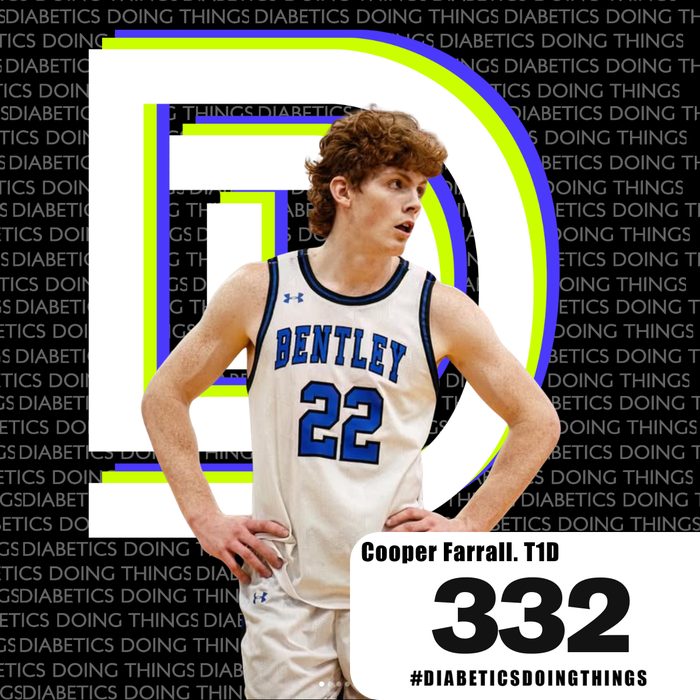
Cooper Farrall plays basketball at Bentley University and was diagnosed with type 1 diabetes at age 11 in a small Indiana town. His older sister also has T1D, but left for boarding school soon after his diagnosis, so he learned to manage it mostly on his own, driving hours to Chicago for endocrinologist visits. Two military academy programs ended their recruiting once he disclosed his diagnosis. He hid his diabetes from teammates for years until a trip to the emergency room on his first day of college practice forced the conversation. In March 2025 an interview with a fellow T1D writer led him to start the T1D Hooper Instagram account, later reposted by ESPN. He and Rob Howe discuss travel, conditioning, and the basketball camp Cooper is starting for kids with diabetes.
Key takeaways
- Cooper says two military academies ended their recruitment of him once they learned he has type 1 diabetes, since the condition disqualifies someone from military enlistment.
- He went to the emergency room on his first day of college basketball practice for a diabetes-related issue, then explained his condition to the whole team at once.
- A former teammate later told Cooper he had no idea what Cooper was managing during games, which showed him teammates were focused on their own play, not judging him.
- Cooper attended Diabetes Training Camp (DTC) as a teenager and says it taught him carb counting and how to plan the hours before a game.
- He is starting a basketball camp for third through eighth graders, including kids without diabetes, with proceeds going to Diabetes Training Camp and La Rabida Children's Hospital.
Chapters
- Introduction to the Journey of T1D Hoopers
- Cooper's Diagnosis and Early Challenges
- The Decision to Share His Story
- Growing Up with T1D in a Small Town
- Navigating the Recruiting Process with T1D
- Managing Blood Sugar During College Sports
- Overcoming Mental Battles in Sports
- Embracing Diabetes as Part of the Journey
- Giving Back Through Basketball Camps
Show notes
In this episode, Rob Howe interviews Cooper Farrall, a college basketball player living with Type 1 Diabetes (T1D). They discuss Cooper's journey from diagnosis at age 11, the challenges he faced growing up with diabetes in a small town, and his decision to share his story publicly to inspire others. The conversation delves into the complexities of managing diabetes while playing elite sports, the importance of community support, and Cooper's initiative to give back through a basketball camp for kids with diabetes.
Chapters
00:00 Introduction to the Journey of T1D Hoopers
01:41 Cooper's Diagnosis and Early Challenges
04:43 The Decision to Share His Story
09:18 Growing Up with T1D in a Small Town
12:24 Navigating the Recruiting Process with T1D
19:19 Managing Blood Sugar During College Sports
25:20 Overcoming Mental Battles in Sports
32:23 Embracing Diabetes as Part of the Journey
38:21 Giving Back Through Basketball Camps
Follow The T1D Hooper on Instagram
Questions this episode answers
Does Cooper Farrall have type 1 diabetes?
Yes. He was diagnosed at age 11 and plays college basketball at Bentley University while managing it.
Can you join the military with type 1 diabetes?
No. Cooper says two military academy basketball programs ended their recruitment of him once they learned about his diagnosis, since T1D disqualifies someone from enlistment.
What is the T1D Hooper Instagram account?
It's the account Cooper Farrall started in early 2025 documenting his life playing college basketball with type 1 diabetes. One of his videos was later reposted by ESPN.
What is Cooper Farrall's basketball camp for kids with diabetes?
A camp he is starting in his hometown for third through eighth graders, including kids without diabetes, with an educational component on fueling and carbs. Proceeds go to Diabetes Training Camp and La Rabida Children's Hospital.
Full transcript Searchable, with timestamps
Rob Howe: Welcome back podcast fans. Today I've got a very special interview. You guys know I love talking basketball with fellow T1Ds. And over the years I've gotten to do it with some of the best T1D Hoopers in the world. But none of them have the account T1D Hooper. That only belongs to Cooper Farrall, who started posting about his life playing college basketball with type 1 diabetes earlier in 2025 on the T1D Hooper account. Since then, he's even made it on to ESPN's account with one of the funny videos that he made as he documents his life playing college basketball for Bentley University where he's a rising junior living with type 1 diabetes. This was a really fun interview because it gave me a chance to think about where I was almost 15, 16 years ago playing college basketball living with type 1 diabetes and being able to offer my perspective from kind of an OG standpoint for Cooper. He's way ahead of me in both skill set and advocating outside of his own personal circle for people with diabetes. And it was really cool to be able to sit down with him. He will be a future diabetes legend. That is absolutely for sure. And I'd like for all of you to get introduced to one of my favorite people in the diabetes social media online community, Cooper Farrall. Okay, let's talk about our partners who help support this podcast. Today, I'm going to talk about Type Zero, which is typezerohealth.com. It is a business run and founded by a person with type 1 diabetes, John Jensen, who's been on this podcast a couple of times. I've been using this product since 2018. I started training for a half marathon, which I ran in Dallas in December 2018. I was looking for a workout supplement, a pre-workout that I could trust not to spike my blood sugar. And so that's what I've got here in my hand is the clean pre-workout. I use the stim-free version, which doesn't have caffeine. And I trust it, and I've used it now. So 2018, it'll be almost seven years for me using this pre-workout. It really works for me because I can drink it late in the day. And most of my basketball leagues that I'm playing in now are late at night. So I might have a game from 7 p.m., 8 p.m., 9 p.m. And I can make sure that I'm able to get up and play and also be able to fall asleep later that night so I can wake up in the morning, go to work and meet the demands of my life. Type Zero has gone a step further this year in our partnership. and they've launched the Rob Howe stack, which also includes a couple of my other favorite products, creatine monohydrate, which I've been taking the past two years. And if you wanna look up all of the good reasons you should be taking creatine, many scientists and performance coaches say if they could only take one supplement, creatine monohydrate would be the one that they chose. I agree, not only for the physical benefits, but also the mental focus and clarity. It's good for your brain. Do yourself a favor and add creatine monohydrate to your stack. Something I've also added is this clean hydration and electrolytes pack. I'll show you one of the little sticks. These are a lot smaller than some of the leading competitive brands because they just don't have as much salt in them. And there's no additives either. So you're not looking at any carbohydrates, nothing that you need a bolus for. And hydration is an essential part of anyone who has diabetes should be making sure that they're hydrated. And it's not just about drinking water. You need salt. You need magnesium. You need a little bit of the vitamin C and some vitamin B. There's a ton of zinc, selenium, chromium, all of the good electrolytes in this supplement. You mix the stick pack with, you know, 16 to 20 ounces of water. Helps you get hydrated. I've been doing mine in the beginning of the day to start my day and make sure that I'm hydrated. And it helps with your insulin sensitivity. It helps me have some clarity and make sure that, you know, I'm not a very disciplined hydrator when I'm sitting at my computer all day. It's good to be reminded to make sure that you're getting your hydration in. And it's a little bit more interesting to drink than just water. So you can get these as part of the Rob Howe pack, or you can get them on your own. You can get them on Amazon or directly from typezerohealth.com. And when you order from typezerohealth.com, if you use code ROBHOW, that'll save you 20%. So they've got some great sales going on really regularly. So if you can't save more with a promo that they're running, use code ROBHOW, and you'll always get that 20% off. And your support helps them support the podcast. So if you are a person with diabetes who's looking for a reliable supplements company that's not going to spike your blood sugar, that's going to get you into the mode to be the higher performer that you are. I recommend and I take type zero. I wouldn't recommend a product that I don't use myself. So please support typezerohealth.com, code ROBHOW, and search the ROBHOW stack to see which supplements I take and get a good deal on those as well. Okay, let's get to the episode. Hello, and welcome back to another episode of Diabetics Doing Things. We are telling the amazing stories of people with diabetes from all over the world. Very excited about today's episode because we're going to get a little bit of a blast from the past from me thinking about what my life was like playing college basketball with type 1 diabetes. And you're going to get to meet today one of my favorite members. I'll call him newer members of the diabetes community who's really burst on the scene in a huge way with amazing content and sharing his journey with diabetes playing basketball in college. Cooper Farrall, welcome to the show, man.
Cooper Farrall: Thank you, Rob. I really appreciate it. This has been a huge honor to be here with you right now talking with you. So definitely, I appreciate you having me on here.
Rob Howe: Man, well, if I could go back 10 years, tell myself that there'd be a guy who's living out with his diabetes while he's playing college basketball, like that would just make my day, dude. So it really is my pleasure to have you here. And, you know, thinking about all the all the conversations like this is one that we get to really nerd out because I know, obviously, some of you probably follow your T1D Hooper account. And if there's one group of people that I really love is hoopers with diabetes. So excited to dig in. I know you're a real hoop head and a real student of the game. Let's dig into it, man. Let's start like we always do, you know, talk about your diagnosis and like the journey too of going from, you know, being diagnosed as a kid to becoming the T1D hooper and that journey and learn how we got here.
Cooper Farrall: Yeah, of course. Well, first of all, just want to say thank you for bringing me on here. This is pretty big for me, obviously. As you speak, there's a pretty selective group of T1D hoopers out there. And so just talking with one that has experienced this before is definitely pretty surreal. So thank you very much. But to go into the diagnosis of more so the beginning of my story, I was diagnosed with T1D when I was 11. And as anybody else can tell you, it definitely changed my whole world, 100%. At first, it was overwhelming. and also my sister is type 1 diabetic and she's four years older than me. So she was super helpful through the process and everything. But as you know, as an ignorant kid, I definitely had no idea what she was going through. And when I was diagnosed, I had absolutely no idea what it was, even though I lived four years of my life with her telling me everything about T1D. So she was definitely a big help in my early stages. But as a, you know, as an 11 year old thinking you're completely invincible, you kind of just put it in the backseat and kind of don't pay attention to it. And unfortunately, my family and my parents had to deal with, you know, that 11 year old Cooper, which is fine. I trust me. I mean, I respect them. And I'm super grateful that they were able to help me through along through that journey, because it's so important to have that supportive group around you, especially in your honeymoon phase as you're going through these early stages as T1D, it's just tough. I mean, it's tough. You're finding yourself, you're finding out, you know, athletes, do I still want to continue to play this game? Do I have it in me? Would I rather take all the lows and the highs and everything while still trying to approach this game that I love? Or should I just, you know, give it up and try to manage it? When I went through the exact same philosophy and thought process. So that leads me more so into, you know, my high school and college career. Obviously, I definitely put T1D kind of behind me as like, I hit it 100%. I was diagnosed, so I'm 20 now. So I'd say about a decade I've been diagnosed. And for about, you know, eight and a half years, I completely disregarded.
Rob Howe: That's something that obviously, you know, you and I have talked before, and I've shared a lot the podcast. It was very similar for me, even the timeframe, different ages, right? But first 10 years, I was kind of focused on doing my own thing and putting diabetes on the back burner from a, at least from like talking about it. I didn't want it to be the main character in my life, right? What made you at that eight and a half year range? What were some of the reasons that you thought, okay, well, maybe I'm going to be a little bit more open about sharing this part of my life?
Cooper Farrall: Yeah, 100%. There was a time, actually this year, it just happened in March. There was an interviewer from the NE10. His name is Joel Goddard. He is a fellow T1D. And he reached out to me and said, hey, I'd love to tell your story. I saw at a game that you had a glucose monitor on. I have one myself. Just kind of wanted to sit down and talk with you about your journey. so I sat down with him great experience obviously because there's you you talk with the type 1 diabetic and you just kind of feel this deep breath because you can talk to him completely open and be vulnerable and have someone understand that you know they've gone through something that you've gone through so that was a really good interview and when it went out it probably I had so many people reach out to me and letting me know that it was it was a great interview it inspired their kids. It inspired athletes. I had moms, dads coming to me. And I'm a 20-year-old college student. To have these families reach out to me and say, hey, you're doing so much for these younger kids and these younger generations, it meant so much to me. To a point, it kind of made me realize as much as this is a burden, as much as these last eight years, I completely disregarded that I had type 1 diabetes. Maybe this is a great opportunity to actually take it by the hand and realize that this is my life. And rather than hiding it, I can kind of be a beacon to this younger generation. And as you said, just be there for yourself when you wish you had someone. Like if I'm able to talk to a kid that, you know, has gone through the same experience, it's like I'm talking to myself when I was in those early stages. And it's just to the point where you want to help that kid out so bad. And that's really where the identity came from to start this whole page. So Joe got it. Definitely a big shout out to him at the NE10. He really
Rob Howe: started this whole thing. Yeah, I love the idea too. And I've seen it so much and experienced it so much for myself. When you connect with somebody with diabetes, you don't have to explain all that stuff. And I think, and I'm speaking a little bit, I'm manifesting an interview this year that's going to be insane for me personally, but also for the pod. And I think a lot of the hesitation that the guest has is that he's been interviewed by people before about diabetes, but they didn't have it themselves. So you're talking about your guy from the NE10 who saw your device, reached out and said, hey, I want to connect. I think I can help tell you this story because I know what you're going through to an extent and how difficult it is. And it is difficult. I think, you know, I think there's a lot of times I wish I would have given myself more credit for what I was with diabetes. I don't know if you're like this, but I was talking with our guy, Gary Forbes, our diabetes legend, and the last guy with T1D to play in the NBA, the most recent guy. And we both have this like kind of chip on our shoulder where like when we were really cooking somebody, like in the back of our mind, like not only am I cooking you, but I also am like managing my blood sugar. I'm also like doing all this stuff that you have no idea about and kind of own that as like an internal point of pride. And I think that's maybe what he saw in you is like, yeah, you are this all-conference player, but also I know how difficult it is and how many more steps it is for you to get to the game and perform at your best than everybody else or most everybody else. Because there's also like, you know, if you don't know what to look for, you don't know the glucose monitor to look for, people might just assume that you're just like everybody else. And so I want to make sure that I'm sure there's other guys out there who are battling internal things that we don't know about. But I want to touch a little bit on your early days with T1D, I think it obviously is beneficial to have a sibling. You hit it on the head. Unless you actually live with it, even if you have somebody really close to you, you don't really understand the day-to-day, especially when you're a kid. You're not worried about that at all. So growing up in a rural area, I know you're from a small town, Larry Bird-sized town in Indiana, where basketball is religion. But being in a small town, a rural area, did that affect you in any way in your early days with T1D or make you feel either isolated or make it more difficult to explain? Or did you have to leave to go to the big city to go to your doctor's appointments?
Cooper Farrall: Like, what was that like? Yeah, all of that. And you just hit all of them on the head 100%. It was definitely, definitely tough. Access to care wasn't the easiest. You know, we had to drive a couple hours to Chicago just to see like an endocrinologist. Got out at La Rabida Children's Hospital and I'm super grateful that I was able to see them. They were super helpful to me as a kid, but it took about two, two and a half hours to get there.
Rob Howe: That's a full day. Like, you know, you're going to the endocrinologist, but that's an all day thing.
Cooper Farrall: Exactly. Well, and then, you know, waiting there another hour, waiting, leaving, and then, you know, 100%. It also at some times felt isolating. Like I was the only one going through it, especially in like a small town. In like in middle school, I don't think anybody else was type 1 diabetic. So there were, you know, times I would go down to the office if I had a low and, you know, the staff there would just be unsure of what to do because of, you know, they haven't really dealt with a type 1 diabetic beforehand. And to a point, I think that kind of helped with my mental toughness early on. As much as I want to say, you know, I would go down the office, I wouldn't really care. I'd eat some fruit snacks, I'd enjoy missing class, and that'd be on my way. I think figuring things out and staying disciplined and taking ownership of my health at a young age, really, even if I wasn't like 100% aware of it at the time, I feel like that helped in ways more so than like, you know, having the access or having the friends or the support around because you kind of learn how to deal with it on your own. So it was definitely, definitely isolating. But to the point where I am now, I'm kind of grateful that I was able to learn and deal with the experiences on my own, even though I had a sister with type 1 diabetes. She wasn't really ever in the picture. She went to a boarding school. So four years, right when I was diagnosed in fourth. So basically, if I was in fourth grade, she was in eighth grade, she'd leave into the boarding school, fifth, sixth, seventh, eighth grade, she's all the way, you know, at a boarding school and you just kind of have to figure things out on your own. Yeah. Yeah. I think it's really
Rob Howe: interesting. Diabetes makes you grow up really fast, but I want to hit what you said on your, like on the head because you nailed it. How you do anything is how you do everything. So if you're approaching your diabetes with discipline and trying to form good habits, trying to stay positive, all of those things, you know, flow into everything else. And it sounds like you're, you're that kind of basketball player as well. So I want to get into some of the questions that I'm sure you get asked a lot on social media, as do I. But I think it's also a benefit to me to be able to talk with someone who's gone through it, who understands it in a way that maybe even the people who are asking the questions don't. So let's start with the recruiting process. How upfront were you and your parents? Or did you guys have a discussion about how diabetes was
Cooper Farrall: going to be part of your recruiting process as you were going through that? Yeah, it was a good question. It was definitely something to be upfront about 100%. So I went to, funny you say that, I went to a military academy boarding school. And a lot of the groups that obviously come out of that go into West Point, Navy, just because they want to continue that, just that grit and that
Rob Howe: strive for greatness and good. Yeah. And they're like feeders programs, basically. Exactly.
Cooper Farrall: Exactly. Right. So being a somewhat decent basketball player, you get recruited by, you know, West Point Navy and everything. Those are really the first two that reached out to me, especially just because they knew I went to a military academy. And right away I told them, I was like, hey, you know, just to be up front with you, I am type 1 diabetic. And they were like, it wasn't more so like, oh, but it was like, OK, sorry, kid. We're going to have to stop our recruiting process with you because we can't enlist you like whatsoever. because of the chronic disease. And, you know, how was that for you? Like, cause I assume,
Rob Howe: you know, obviously like, so I went to college in Colorado Springs. So Air Force Academy is there. I had built a relationship like working at camps with their basketball program. And like, they were trying to get me to transfer into the prep school. And like, I was like, I would love to do that, but like, I don't have, I have diabetes, so I can't, you know, oh, they're like, oh, well maybe there's a way around it, but there isn't. Right. So it's one of the things that you legally can't do is be enlisted in the military with type 1 diabetes and other illnesses. So, I mean, for you, though, at that age, I assume, you know, also seeing some of your friends getting to go to these places, which are, you know, very prestigious schools, you know, military aside, and like good basketball programs in some cases. Like, what was that? What was that like for you? Did that kind of take a hit to the ego and like feel a little bit tough? What was it?
Cooper Farrall: It was definitely, it was tough, 100%. I wouldn't say it was a hit to the ego because they were so understanding about it. They were just like, hey, you know, we just can't make it happen. And it's to the point where it isn't that much of an ego hit because you know you have the capability to play at that level. It just so happens that you are blessed with the grace of God that you're type 1 diabetic. But that led to having other good conversations with other coaches and that kind of geared me and more so prepped me to have those conversations with other coaches and more so letting them know that like, hey, I'm probably going to have to sit out every other practice if I have a low blood sugar. And I just need to let you know, like at any time and point, like you're going to have to let me step outside of practice because this is life or death situation. Like I can't push through it. Trust me, I always get the like, you know, push through it. It's all mental and everything like it is for you. But if you know, you don't have that chance of dying with a low blood sugar, you know, it isn't mental. It's something that you have to deal with at hand. So talking with them, the more as I went through my recruiting process, like junior, senior year, they definitely got more understanding. I like being hesitant at first, but they were definitely more supportive as they learned about it.
Rob Howe: Well, because they're seeing the film, right? Like they know you can play. So, you know, I think that was always part of it with me too. Like my family and I made the decision, like, Like it's important that people who are stakeholders in your life are going to know about your diabetes. You're going to live somewhere for four years. Like let's talk about it. You know, like let's we don't want to get there and then be surprised or them not like have the resources or the framework to like help support you. And I'm really glad we did that because like you were saying, you know, it's like, hey, I'm going to do my best to be prepared and like be ready, be available. but like I'm probably gonna have to have it I had that you know have a Gatorade station like practice that nobody else could mess with uh and like you know all those things where I my coach took him a while but we had to like build this relationship where I didn't have to check in with him to go I could just go and he would trust that I was doing my best to do that but you know depending on your situation and depending on the program and like also how good you are relative to everybody else like that always is uh that's always part of it It can be a real challenge. And I think almost always, and we talk about this at our Diabetes Legends camps, when you're in high school, when you're on your college team or whatever, you're usually the only person with diabetes. So if you go out, it feels like you're doing something wrong. But in a diabetes camp scenario where everybody's got diabetes, we've got like 15 kids going in and out of the low station throughout the camp. So it makes it more normal. Like, oh yeah, it's just living and exercising and trying hard with diabetes. Like you're going to run into some obstacles. So I don't know. I think it's good, but like you said, it takes practice and it doesn't always go well, but you
Cooper Farrall: just have to kind of be ready for whatever it shows. Exactly. That's funny. That's crazy. I never would have thought, well, it's just because you can't really be in a situation all the time where everybody's diabetic, but that's hilarious because you're right. Everyone's going to have to
Rob Howe: stay out every once in a while. It never occurred to me either until I saw it. And the big light bulb moment is I was looking at the parents who stuck around and a couple of them were really like they were watching the the cgm like on the phone like and watching camp and like really making sure everything was okay and like the minute somebody else's kid came out and like sipped a juice box and then went back in like they just totally like relaxed and like breathe this high relief so i was like oh yeah like most of the time we're doing this on our own and we feel like this judgment of man everybody's looking at me everybody thinks i'm not prepared or whatever and that's it's just life with diabetes man it's just hard to hard to juggle like you can be as prepared as you want, but there's just a lot of different things that come into it. So I think that flows really well into our next discussion, right? Highs and lows, like playing elite sports. So you, you have shared, and I really like your videos on like how you prepare for game day or like how you go and like what you eat in a day and those types of things. Because I think a lot of people are really curious about, about that. And for me, you know, I didn't have anybody like when I was doing that, you know, Adam Morrison shared, like he kind of ate the same, he and his mom were like on ESPN saying that he ate the same meal before every game. And so I kind of adopted that, but it wasn't really clear what exactly it was or why. So let's talk a little bit about like that, like in your team environment, you're like, you know, you're going to be a junior this year. Is that right? Yes. Yeah. So you're going to be an upperclassman. So your entire career thus far in college has been underclassmen. So like your freshman year, the workouts are intense. You're going up a level, you know, it's, there's no, you can do all the prep you want, but when you get between the lines, like your first day of college, like it's totally different. What was that like, like trying to get your blood sugars to cooperate during that process?
Cooper Farrall: Tough, 100% tough. As you were saying, and as I always say, on a lot of my videos, it is inevitable. No matter what precautions you take every once in a while, you're gonna go low, or you're gonna, you know, not be able to get your blood sugar down. It's just how it is. It's just not as tough as that I would say if I didn't go to like a boarding school living on my own in high school. If I definitely took that big transition from living with my parents all four years of high school and then, you know, living on my own out in Boston, it would be a lot more tougher. So I'd say freshman year, it wasn't that bad, but it was still very difficult. I always share a funny story. Literally my first day of college workouts, I had to go to the emergency room due to diabetes related. That's just how it is. Of course, it was my first day. Oh, my gosh. I was red. I was blushing. I was literally about to start freaking out. And it was right at the time when they were practicing. So I'm in the urgent care. I'm sitting there. I'm like, what am I going to tell coach? When am I going to do this? Blah, blah, blah. I got to come up with an excuse. Anyway, so I get back to the locker room and coach is just in there. and we talked for 20 minutes just about like, you know, hey, this is how it's going to be. This is what it is. And then as the time we're talking about that, all of my teammates come in that I'm like super embarrassed about and everything. And it was just at that point in time where I just had to let them know that where I was, what happened. And that's just how my life is. And honestly, I'm kind of grateful that it happened that way because I didn't have to like graciously kind of introduce it to them. I just like told them all at once, but it's still so funny. Like, you know, what, what a coincidence first day of actual practice.
Rob Howe: And also like you're saying, like blushing is feeling so embarrassed. Like, you know, like not wanting to attract that kind of attention on day one, like your whole, you know, you probably have been hoping for weeks, like for that first day, like waiting to get after it. And that's always tough. It is an interesting perspective though. Like, Hey, this could happen. And like, I think, you know, now I I'm thinking about it. That's probably not for you at the time, but like then every day that that doesn't happen is a win. Right. And like show even your coach probably was like, oh, we got through a tough practice and like Cooper was good. Like, OK, great. Like that's not like I don't have to worry about it. So, yeah, it probably was good that that was day one. It was. It was in the grand scheme of things. Yeah. I think something I always struggled with was, you know, on a difficult conditioning day, for example, That was always when like my blood sugars would, would act up, like go high, or I would try to like counteract them with insulin. And then I go low, just chasing that roller coaster during a tough conditioning day and like not being able to really explain what was going on in my body to my coaches and teammates, like how obviously like that first day for sure helped, but how did you approach that? Or how do you kind of deal with, you know, either questions? I think we've all probably seen that, that Mark Andrews video where one of his teammates is on the sideline asking him about his glucometer and things like, Like, how have you talked about that with your teammates and coaches?
Cooper Farrall: Well, to be completely upfront with you, I'm still learning. Because as you said, it's tough to understand your body, especially as you're going through college conditioning. I'd say before every game, I get so anxious that my blood sugar, you know, skyrockets. Because it's just, you know, the adrenaline, the anxiety and everything. And then I can't ever get it down. But then on some normal conditioning days, I can't ever give my blood sugar up because I'm not thinking about it. And I'm just, you know, running into the ground. Whenever a teammate really asks about like the routine or more so like what goes on, I'd say early on, they're always questionable. Like, why are you chugging two Gatorades mid-drill? Like, are you okay? Like, you just, you know, or like, why are you sitting out? Like, why are you not doing this drill? And then just like having to explain to them, like I said, because they have no idea, you know, so it's your job to educate them because they're going to think, you know, you're sitting out just because. Yeah. Yeah.
Rob Howe: But it is tough, though, because like they don't, you know, I know sometimes like I felt like all their eyes were on me. So like for me, I was like I felt like I was letting them down because, you know, we my my group of guys, too, like we were pretty tough. Like, you know, Division Two players are different. You know, like you, it's a little bit of a more physical, kind of rough around the edges brand of basketball. Very athletic, but like a little bit more, everybody's a hack, everybody fouls. Like you just gotta be able to play through it. And like, we were some tough guys. And so I always felt like letting them down or like, I didn't want them to think they couldn't trust me like when things got tough. And that was a big like mental battle I had to overcome. And then like years later after we graduated and like moved on and like we're all talking about stuff like i started being more upfront about my diabetes started talking about it and one of my like basically my roommate and our leading scorer my senior year was like dude i had no idea you were doing any of that like so they don't like everybody's worried about themselves like they're worried about their field goal percentage they're worried about getting their shots like maybe they see you there but they're not thinking about it and i think that was years later that was a big relief because i just felt like you know whenever i wasn't around they were just talking about how i wasn't reliable or you know if it was a tough conditioning day, I was going to get pulled out because I had to go do my blood sugar. And they never thought that.
Cooper Farrall: I completely relate with you. 100%. It's hilarious because I don't think I've ever heard anybody else like say that. What you just said is in my mind of practice every single day. I always hate having to come out during the game or 100% during a practice because you're like, they're just thinking like, you know, he's not getting reps in. He's taking a break. He's cutting edges. and I just I hate that way of thinking and you're so right they don't care about you whatsoever they're thinking about their own shot they're thinking about how to not mess up and I think realizing that realizing that everyone is in their own head is definitely a big um yeah it's uh we're
Rob Howe: all worried about number one right like and that's not to say everybody's not a team player but like we're all trying to do the best we can so that we show well and we do well putting all that effort into it. So yeah, I don't know, man. I think, yeah, it obviously feels bad to not be able to control some things. I was like you, man, I was so, would get so stressed out and so adrenalized before games that like Mike could go from fasting blood sugar of 70 to like 400 in 30 minutes, you know? And like, I didn't really understand a lot then there, there was not a, you know, social media community at that time for me to be a part of and learn from. And my nurse practitioner was like 90 years old so it's really hard for her to relate to what was going on in my life but shout out to her i think she's passed away a long time ago but she was she was she was doing her best but yeah like having to totally reformat throughout my career getting prepped for games especially as you're long and more and more minutes like uh playing 30 minutes in a college basketball game is one of the hardest things you can do and you know i think learning how to manage it was i didn't celebrate it enough at the time like after i got through a game where like played I would always focus on like, well, did I play well? And we could probably go break down film and we'd see the games where my sugar was out of range versus the times that it wasn't. But it's a really tough balance. So props to you for doing it. Find that routine, work that plan. But sometimes you can't work the plan. And I was thinking of road trips or travel. Or one time I had to make the whole bus stop so I could get a battery for my pump at a gas station. And we had just lost, bro. It was like a conference game. And we had just like really tricked it off. And I had to like walk to the front of the bus and be like, coach, can I like stop at 7-Eleven real quick? I got to get a battery. It's like kind of an emergency. And he was so pissed. It's those, but I didn't like everybody was like watching me in the store. That was one time where they were watching. So, um, I don't know that the road trips, uh, we're always, we're always tough.
Cooper Farrall: Okay. First of all, I appreciate you telling me that because that makes me feel so much better. Like just of, of just having like the eye, all eyes on me. I feel so bad for you because I know exactly your whole thought process and having like your game plan of how you're going to tell them and everything. There's just no right way.
Rob Howe: It was like a small town. We were about to leave and like drive to the next game. I was like, damn, I don't think I have like, I definitely don't have six hours of battery. Like, like we, I got to move now or I'm a cook. So yeah, it happens, man.
Cooper Farrall: Exactly. And that's, I agree to your point of the whole routine, you know, travel, it definitely adds another layer of difficulty. As you said, not having like a backup battery and having to go to an unfamiliar environment is props, props to you 100%. Like new foods, weird schedules, long bus rides. I've forgotten supplies before, just as you. I mean, as much as I don't want to say, there's multiple times I've forgotten supplies. Had to dose differently, or just manage highs at 3 a.m. in a hotel room before the game. But you learn, obviously, try to stay organized and stick to your routine as much as possible. But like I said before, it's inevitable. No matter what, you're probably going to have something bad happen. You just try to take as many precautions as possible. So I'd say, agree to your point, trying to stick to my normal routine before a game or just more so my day-to-day routine as much as possible or as I can on a road trip So like trying to find, you know, substitutes for foods that are pretty similar or, you know, dosing the right amount of carbs, not eating a good amount of carbs, getting the right amount of sleep. You know, obviously music and meditation helps in a hotel room and everything. But but 100 percent out of routine kind of messes me up because I'm a big routine person, especially a lot of basketball players. you know, they're superstitious and everything. And, and having, you know, diabetes throw something at you before a game, it just pisses you off because you have to change, you know, everything.
Rob Howe: So I really, yeah, it just gets you, gets you out of your routine, gets you like doing things, maybe half a step fast, uh, you know, rushing through your normal game day routine. That I think was the most frustrating, uh, when diabetes like would mess up or like take time away from, uh, from a shoot around or like, well, I was too busy messing with my diabetes. So I didn't get to go through my regular walkthrough. Uh, now I got to go in and I didn't get my touches like that I wanted before the game. And so like, you know, I'm not, I'm out of the wrong head. I'm in the wrong headspace. Yeah. But you never know, man. Like sometimes I had, I had this weird, I know we ate at this weird restaurant one night. It was like kind of before one of my breakout games and I had like very little sleep the night before and had a good shoot around, like, and then just came out and just hooped, uh, after that. So you never know, man, like sometimes it just could be, uh, you know, just the vibe is different. You know, the earth's rotation is a little out of whack, but you come in there and really, and really hit it. I want to talk about like following this interview because you burst on the scene, man. And you know, you had like a viral post. It was, it was basketball related, but really funny. And you know, ESPN picked it up too, and reposted you posting up the Subaru. You'd given it that, that post work, but like embracing T1D as part of your story publicly, like what's that been like to talk with other athletes that are in the similar position as you inspiring the next generation, talking to parents, talking to kids? Like how has that, what has that brought to your life in the last six months or so?
Cooper Farrall: Yeah, I had, between me and you, I had no idea this page would take off nearly as fast as it did. I started the page back in, you know, really late March, early April after the interview with Joel Goddard. And you're right, that one video, obviously, that really took me to just a good next level. But, you know, I was definitely unprepared to have as much families, kids, athletes in my dms just asking for advice you know what i do before a game you know and it's the same thing to your point that's exactly where i want to be like i want to help these kids and i want to more so text me text me literally you know dm me i will answer any dm because as you said before and what you're doing that i just aspire to be more so you know rob how you take the time to answer those because you would want that answered for yourself when you were in that position. And that's really been my whole motivation to just keep this page going. I would have hated to see if I had my big social media page that I was following when I was younger and I loved him and I watched him play basketball and all of a sudden I asked him three questions, he hasn't gotten back to me at all, and then he stops posting and I'd be crushed. So definitely, I mean, those, the families, the kids, they keep me going. That's all the reason I'm doing this for. And that's really all I care about. Like that's, and I just put a post out recently, a mom and her son, we talked a couple months ago about routine and everything. Yeah. And her, she reached back out to me telling, you know, the progress of her son, Andre has been immense. They've won a bunch of games. He's been doing a lot better with his blood sugar. That just, oh my gosh.
Rob Howe: I got to say, I watched the film. Loki, Andre was killing.
Cooper Farrall: He was. He was. Dude, 100%, he'd put me up for running. I don't know. But it's just, and that's all that matters. So pages, following your page, following other pages, gaining education on how to support these kids. As much as I possibly can, this great following has been great and everything. And more so helping kids with that following. but it all boils down to at the end of the day, who do you want to be? And like, can you help these kids? So it's definitely a lot of fun.
Rob Howe: You know, sitting where I am now in the OG chair, I try to think about, you know, you have so much ahead of you in your career, in your life, like basketball or beyond that. And we talked a little bit a couple of weeks ago. I think you have talent to play as long as you want to play. And, you know, you're going to I think you and your team seems like you guys have a really good thing going and hopefully we'll be able to to have a great season upcoming and like lead to good things for all of you guys. I do think it's really important for athletes while they're playing, while they're experiencing like the peak of their career to talk about living with diabetes. I talked with Lauren Cox was part of our camps. She's part of our Diabetes Legends Foundation group. And, you know, she's at the top of her game. Like she was defensive player of the year in the Australian league last year. And, you know, that's the second best women's league in the world behind the WNBA. And, you know, Gary and I are behind our playing days, you know, like we're still nice, but, you know, nobody's paying us to play anymore. And it's a young man's game. And I think the, you know, it's so important for you to be open about. And I'm so glad that you're leading the way, sharing your journey, because like you said about Andre or whether it's some other some other kids out there or their parents, you know, Getting to bounce ideas off you or hear about how things are going, even the low moments like we've talked about, I feel really fortunate. I know this is my purpose in life is to connect with people with diabetes and to talk about my experience. But hearing you say like, oh, man, I know what that's like to have to ask for something that's inconvenient and maybe embarrassing, but I have to prioritize it because of my diabetes. So that maybe if you're in that situation, you can overcome it. And so I think it's, again, reciprocal for all of us to continue to share and give back, whether it was me riding on the bus feeling sorry for myself because I wasn't getting the minutes I thought I deserved, reading an article with Gary playing for the Nuggets, and then taking that on and continuing my career and doing well. or us having this conversation or you having your conversation with Andre or, you know, Adam Morrison and his mom sharing their journey on ESPN when I was a kid. Like all those things really add to the future of a life with diabetes for somebody that may not even be around yet, may not even be diagnosed yet. But being able to access people like you is really important. So I want to give you props, man. You're a young guy, but you got your head on, you know, on straight. I think you got a lot, you know, hit the boards. Boardman gets paid. Boardman gets paid. But I think you have a really bright career and future ahead of you. So let's talk a little bit about that. I know you got a camp that by the time we publish this is probably is going to be through, but you're already given back to basketball in your hometown for kids with
Cooper Farrall: diabetes. Tell us about your camp. Yeah. Thank you again. Just hearing you like speak is seriously, it just completely gives me a deep breath. So thank you again. But camp has been a great start. It definitely, obviously, hopefully it goes well. I mean, we'll see. I mean, we just started getting it up and running. I've started to reach out to a couple of companies for sponsorships and everything. But it really is, as I said before, it comes down to who do you want to be and what type of legacy do you want to leave behind? Because, I mean, I could be playing ball and everyone's like, wow, he's really good and everything, even if I'm not really good. But to the point where sharing with that younger experience and actually using what you're doing right now and, you know, just to help someone, as you said, give that extra step. All it takes is one extra step for maybe someone to decide they want to try something out new and then it takes them down a huge road. I mean, and that's really what this is all about. The camp will be for third graders through eighth graders. Funny enough, that's literally the prime of my, when I was type 1 diabetic, what I wanted to be doing. But it's a camp for not just type 1 diabetics. It's a camp for boys and girls. And I'm really going to be hoping to include an educational component, more so of fueling and carbs. That doesn't just help me as a type 1 diabetic. It helps just all kids and athletes. So I will probably do, hopefully, I'm excited to do it. It'll be like Coop's Carbs or something. and it'll be like my essential carbs that I do if I go low. So I'll have like, you know, Welch's fruit snacks, a Gatorade, you know, oranges, obviously healthy options for the kids. But just to show them that fueling and taking care of your body, what I have to go through is definitely super important and to also have fun. So I'm super excited for it. Trying to give back to the kids, trying to help their families, obviously, and also donate to Diabetes Training Camp in Lancaster, Pennsylvania. as well as La Rabida Children's Hospital. Definitely, I'm super excited to really get back to the community.
Rob Howe: Did you do DTC? Did you go to diabetes training camp?
Cooper Farrall: I did. DTC alum right here, man.
Rob Howe: All right, I love that. Two years. I've never been. I need to go.
Cooper Farrall: They were super helpful. I've been in contact with them, and they're actually having their camp in Colorado right now. They do two. They do one in Colorado and then one in Pennsylvania. It's diabetes teenager training camp. It helped me immensely. just more so of like the, what I know now of like the three to four hours beforehand. And then the one to two hours, you know, carb counting, having the right nutrition and energy for your body. Oh my gosh. It was super helpful. I would completely tell anybody, especially you to go the great group of people, great staff. I mean, and they would love you as well.
Rob Howe: Yeah. It's been a long time since I chatted with them early on in the diabetes community. They're like, oh, you got to get linked up with DTC because they're serious, man. They go hard. And anybody that goes hard with diabetes, bro, I'm all in. I'm all in. Okay. 25, 26 season preview. What can we, we're going to be following you close, man. We're going to probably pull you in for a mid season update or something when you're on your like three days of a Christmas break or something like that. But what can we expect this year? I expect a lot of lessons
Cooper Farrall: and a lot of selfishness, like a lot of good ball movement, a lot of fun plays, and a lot of effort. That's what you'll realize. We have a lot of returning players. We only had one guy graduate or more so leave, and I'm leaving. The transfer portal is mixing everything up. I am so grateful to have kind of more so that big, strong group as we had last year rather than a full new team. As much as I want to rip on the transfer portal, It's definitely doing a lot of good things for kids. It's just tough right now because in order to gain momentum going into your next year, especially for D2, you don't get a summer with the team. So, I mean, the transfer portal, you go rolling October, September. You basically have to, you know, get to know these guys, get to know how they play. And the next thing you know, you're playing games. So I'm super happy to have all the guys back.
Rob Howe: Yeah, it seems to me like that's a real advantage in the era of the transfer portal. Like, obviously, like you, it's so crazy how even like D2 guys averaging 10, 12 points a game are getting called up to the Division I level, like pretty regularly. They're looking for guys that they can plug in and play. But there's so much to team continuity and seniority and, you know, knowing your stuff and running your stuff and, you know, getting into conference play, like having an identity and not having to figure that out on the fly. You know, I'm sure there'll be some good players that have come in on the portal in the conference. Right. But having that core group, knowing who you are and like getting better together. You know, now I sound old because like that's just, you know, that's how it used to be, man.
Cooper Farrall: Yeah. No, I bet you're getting you're getting out of your seat right now the way you're talking about it. No, I'm joking. Yeah, dude, I'm psyched. I'm joking. It'll be it'll be fun. The way that I love the way that we play. We all know, you know, each other's styles, game plan. We have a great coach, great supporting staff, great training group. I really could not be more excited to get back going with the guys. So hopefully the time we do a next stop, you know, get me back on here, it'll be all positive.
Rob Howe: Man, I'm looking forward to it. And Cooper, man, I'm so glad we made time for this interview. This is definitely not the last time. But I know getting to know you and hearing a little bit more behind the scenes of Cooper, the T1D Hooper, the guy that took the Subaru seven games in the driveway, you know. I will never do that. I'm just excited for this platform that you built, man. It's a real strong foundation. I'm just glad that we get to link up. I think we're going to be friends for a long time, brother.
Cooper Farrall: Dude, I'm excited. This is just the beginning of our friendship, Rob. I'm super excited.
Rob Howe: 100%, man.
Cooper Farrall: All right. Thank you again.
About Cooper
Cooper Farrall is a rising junior basketball player at Bentley University who was diagnosed with type 1 diabetes at age 11. He runs the T1D Hooper Instagram account documenting his life playing college basketball with diabetes.