

Doing Well with Diabetes: Overcoming Stigma in Sports
Episode summary
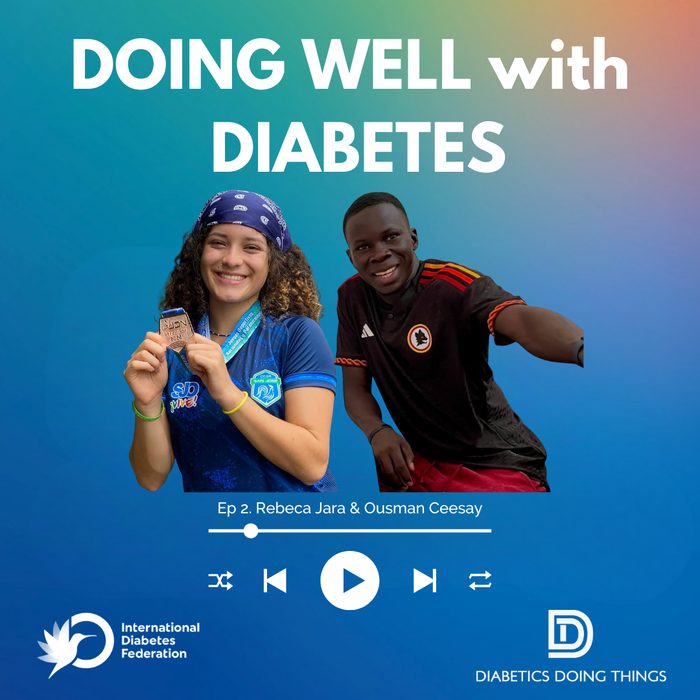
This episode pairs two athletes with type 1 diabetes talking with host Rob Howe for the Doing Well with Diabetes series. Rebeca Jara, a Costa Rican pole vaulter diagnosed at seven, describes competitions wrecked by high blood sugar and a broken insulin vial. A coach once tried to keep her off a Central American team because of her diabetes. She made the team anyway and won gold, which changed how she talks about her diagnosis. Ousman Ceesay, a footballer from Gambia, was cut from a team for the same reason. He helped start a new team for players with diabetes, became its captain, and scored the winning goal against the coach who rejected him. He now advocates for people with diabetes in Gambia through social media, TV, and radio.
Key takeaways
- Rebeca Jara says stress raised her blood sugar before competitions, the opposite of what she and her mother expected.
- A broken insulin vial and a blood sugar around 400 mg/dL cost Rebeca a Central American pole vault meet, but she competed anyway.
- A coach tried to exclude Rebeca from a team because of her diabetes; she made the team and won gold.
- Ousman Ceesay was cut from his football team for having diabetes, then helped form a new team, became captain, and scored the winning header against the coach who had rejected him.
- Ousman says his motto 'All Is Well Like Never Before' came from a night of severe low blood sugar followed by a high reading, and a hospital visit that made him grateful he could still walk and see.
Chapters
- Meet Rebeca: Costa Rican Track & Field Athlete with T1D
- Diagnosis, Early Years, and Finding Diabetes Camp
- First Track Competitions and Stress-High Blood Sugars
- Central American Championship: Broken Insulin Vial and DNS-Level Highs
- Overcoming Lows and Highs in Competition
- Coach Tries to Exclude Rebeca Because of Diabetes
- Winning Gold and Changing the Narrative
- Advice to Her Younger Self and Enjoying Sport
- Rebeca’s Online Presence: “Rebebetes”
- Meet Ousman: Gambian Footballer with T1D
- Being Cut for Having Diabetes and Forming a New Team
- First Game, Captain’s Armband, and the Winning Header
- Beating the Coach Who Discriminated Against Him
- Misconceptions About Diabetes in Gambia
- Building a Public Advocate: Social Media, TV, and Radio
- Mentoring Young People and Normalizing Visibility
- Origin Story of “All Is Well Like Never Before”
- Turning Hypo/Hyper Swings into Gratitude and a Clothing Brand
- Health, Perspective, and Redefining “Well”
- Closing Reflections and Future Vision
Show notes
Episode 2 of Doing Well with Diabetes Season 2 focuses on “Overcoming Stigma in Sports,” highlighting two elite athletes living with type 1 diabetes outside the traditional Western spotlight.
In part one, Rebeca Jara, a Costa Rican pole vaulter, shares her diagnosis at age seven, the transformational impact of attending diabetes camp as a teenager, and the long process of learning how stress, food, and insulin affect performance. She describes major competitions where high blood sugars, lack of fast-acting insulin, and broken vials wrecked her meets—and how she initially leaned on diabetes as an explanation for poor results. The turning point comes when a coach tries to keep her off a Central American team “because she has diabetes,” and she not only makes the squad but wins gold. That moment flips her internal narrative from “I can’t because of diabetes” to “I’m capable, and I won’t let others use diabetes as a reason to exclude me.”
In part two, Ousman Ceesay from Gambia recounts being discriminated against and effectively cut from a football team because of his diabetes. Instead of quitting, he helps form a new team of players with diabetes, is named captain, and scores a decisive header in their first official match—against the very coach who rejected him. From there he becomes a leading advocate in Gambia, attacking myths about diabetes (like “it’s only caused by sugar”) through social media, TV, and radio, while mentoring younger people with type 1 who are afraid to be seen. His motto, “All Is Well Like Never Before,” comes from a night of severe hypoglycemia, a morning spike, and the realization that despite diabetes, he can walk, see, and live independently—privileges many hospitalized people don’t have.
Together, Rebeca and Ousman show how stigma in sport can be confronted with preparation, persistence, and visibility, turning diabetes from a reason to be excluded into the engine for leadership and change.
Chapters
01:36 – Meet Rebeca: Costa Rican Track & Field Athlete with T1D
02:53 – Diagnosis, Early Years, and Finding Diabetes Camp
06:31 – First Track Competitions and Stress-High Blood Sugars
09:21 – Central American Championship: Broken Insulin Vial and DNS-Level Highs
15:05 – Overcoming Lows and Highs in Competition
18:28 – Coach Tries to Exclude Rebeca Because of Diabetes
20:01 – Winning Gold and Changing the Narrative
22:19 – Advice to Her Younger Self and Enjoying Sport
23:22 – Rebeca’s Online Presence: “Rebebetes”
24:12 – Meet Ousman: Gambian Footballer with T1D
24:49 – Being Cut for Having Diabetes and Forming a New Team
26:06 – First Game, Captain’s Armband, and the Winning Header
28:58 – Beating the Coach Who Discriminated Against Him
29:32 – Misconceptions About Diabetes in Gambia
31:56 – Building a Public Advocate: Social Media, TV, and Radio
33:54 – Mentoring Young People and Normalizing Visibility
36:58 – Origin Story of “All Is Well Like Never Before”
40:31 – Turning Hypo/Hyper Swings into Gratitude and a Clothing Brand
42:31 – Health, Perspective, and Redefining “Well”
43:24 – Closing Reflections and Future Vision
Resources:
Young Leaders in Diabetes Instagram
Questions this episode answers
Did Rebeca Jara face diabetes discrimination in sports?
Yes. A coach tried to keep her off a Central American track and field team because she had diabetes. She made the team anyway and won gold.
What happened when Ousman Ceesay was cut from his football team because of diabetes?
He helped form a new team made up of players with diabetes, was named captain, and scored the winning goal in their first match against the coach who had rejected him.
What misconceptions about diabetes does Ousman Ceesay fight in Gambia?
He says many people in Gambia believe diabetes is caused only by eating sugar, rice, or bread, and don't know the difference between type 1 and type 2. He corrects these myths through social media, TV, and radio.
Where does Ousman Ceesay's motto 'All Is Well Like Never Before' come from?
He says it came from a night in 2022 when he had severe low blood sugar followed by a high reading the next morning. A hospital visit afterward made him grateful that he could still walk, see, and live independently.
Full transcript Searchable, with timestamps
Rob Howe: Welcome to Season 2 of Doing Well with Diabetes, a collaboration between the International Diabetes Federation and the Diabetics Doing Things podcast. I'm your host, Rob Howe. Doing Well with Diabetes is a series interviewing people living with diabetes from around the globe to help inspire the next generation of people with diabetes globally and learn what it takes to live well with diabetes from their peers. This year's focus is on global health and well-being, so we are interviewing a series of guests from each of the following areas across the globe. South and Central America, Africa, India, and the United States. Doing Well with Diabetes is part of the Kids and Diabetes in Schools program from the International Diabetes Federation and is supported by Sanofi and ISPAD. To learn more about the Kids program, visit kids.idf.org. And to hear more from Diabetics Doing Things, visit diabeticsdoingthings.com slash subscribe. Now give it up for our next guest on Doing Well with Diabetes. Welcome to Episode 2 of Doing Well with Diabetes Season 2. Last year, on Season 1 of Doing Well with Diabetes, we focused on Olympic and professional athletes living with T1D. And this year, we felt that it was important to also highlight competitive athletes from other parts of the world who are elite athletes but also have encountered diabetes stigma in their athletic endeavors. This episode features Rebeca Jara, a track and field athlete from Costa Rica, and Ousman Ceesay, a footballer from Gambia. Both Rebeca and Ousman live with T1D and are both part of the Young Leaders in Diabetes program with the International Diabetes Federation. This episode is titled Overcoming Stigma in Sports, and I'm very excited to present this two-part interview with Rebeca Jara and Ousman Ceesay. I'm really excited for this interview. It's Rebeca Jara. Welcome to the show.
Rebeca Jara: Hi, Rob. Thank you so much for having me. Well, and hello to everyone that's watching the podcast right now.
Rob Howe: And Rebeca, this is a unique time for you because you are from Costa Rica and we're going to talk about your life in Costa Rica, but you're also currently living in Europe. So we're juggling the changes in time and as well as weather on your side.
Rebeca Jara: Yeah, well, it's been different. You know, the most struggling part, I think, is that in Costa Rica, there's too much humidity. And here it's super dry. So I've been having a hard time dealing with nosebleeds. And my eyes are dry and everything's super dry. Also, my blood sugars haven't been nice. I need to adjust.
Rob Howe: Well, I hope that goes smoothly for you. That's always tricky when you're changing routines or changing climate and lifestyle. So hopefully that gets easier for you. So I do want to talk about, as we start today, I'd love for you to introduce yourself to the audience and share about your diagnosis with type 1 diabetes. And then also share how you got involved because you are a member of the Young Leaders in Diabetes program with IDF. So share a little bit about your journey there as well.
Rebeca Jara: Well, I got diagnosed in 2010. This year, I'm turning 15 years with diabetes. When I was diagnosed, I was seven years old. So, well, of course, all of you know, it was hard. Mostly, I think, for the parents. My mom and dad were like crazy at that time. But well, we have overcome that. And we now see what great things have turned out to having type 1 diabetes. At first, I didn't have like many support. not I'm not talking about parents support as I didn't know like more people with type 1 diabetes or an association or something when I was about I think 13 years old yeah and someone talked to me about a diabetes camp that was taking place in Costa Rica yeah and someone told me about that and I was like super excited and nervous and so I went and they haven't stopped going it was amazing I mean, I knew so much people. I learned from everything, mostly nutritional things. But I felt like secure with more people who are living the same life as me with type 1 diabetes. And that's also how I started with YLD. My president of the association, she thought I would be a good fit for it. And then we started doing all the things and we went.
Rob Howe: I want to focus because our series this year is focused on health and well-being. And there's so much about well-being with diabetes outside of just clinical, like outside of giving injections or dosing your insulin or counting your carbs or getting your medication. And it's primarily for me like a basic need is like learning from people with diabetes and making a friend with diabetes is so critical. So what kind of things like or how did it change for you, especially like at a really critical time, like 13 years old is like a very difficult time for all kids, but also, you know, living with diabetes. So what comes up for you when you think of the impact that going to camp and making friends with diabetes had on your life early on?
Rebeca Jara: Well, I think I think it changed me a little bit. Yeah, of course. Mostly. I mean, I was I don't know. I was never like a rebel type 1. not like others I met I know I know it it's hard and we talked about that sometimes they were they talked to me about oh yeah I always have cravings and I never I always take them and I never inject and stuff like that so I I think we all learned more about as I told you nutrition and how to face it, how to treat it well. You know, like it's not OK if you want something sweet, but if you have to take action in order to.
Rob Howe: Yeah, I think I think that's something that we all like learn at a different pace. Right. Like, you know, I can have have a treat or I can have something that maybe my doctor told me not to have, but I have to take action. And whether that's with dosing or with exercise or something else. You are an awesome athlete and track and field is your primary sport. So I imagine that you started your career in track and field with diabetes, obviously, because you were diagnosed so young. So what do you remember about the first time you started to work in track and field or went to your first track and field competition with diabetes? What do you remember?
Rebeca Jara: I remember I didn't knew myself as much as I thought. Well, that's something I learned later on, that stress can have an impact in your glucose and can make your blood sugar go high. And I thought, well, I remember my mom was like stressed about it. She was like, eat everything because your sugar is going to get so low because you're going to do so much exercise and it's going to be a chaos. And I remember me being there just eating and eating. And at the end, it turned out like the other hand, the other side around. Yeah, my blood sugar was high. And well, that happened to me like the first times I competed. But I remember it was I had a good time. And that's like the most important part.
Rob Howe: Yeah, that is the most important part, I think. And obviously, like you continued to go back and continue to train and continue to work on your competition. And I think I asked the question about the first time because I think it's sometimes when we talk about athletics or sport with diabetes, we see like the photos of you crossing the finish line or the photos of you on the podium. And it's like, oh, like, look at Rebeca, like she's she's making it. She's not letting diabetes hold her back. And sometimes that skips over the challenging parts or even just the testing and learning. You didn't get it right on your first meet, but you still had fun and you learned and you were able to do something different the next time. And I think that's just a really important part of sport and just life with diabetes in general is that you have to have the ability to be willing to be wrong or be willing to like not do everything, willing to like let things not go smoothly and not quit. And that's something I think that sport with diabetes really teaches us.
Rebeca Jara: Yeah, of course.
Rob Howe: Well, that was your first competition. Do you remember a time where you were in a competition and you felt like diabetes impacted your performance like negatively, where your sugars are either out of range or, you know, you didn't get a good night's sleep the night before and like diabetes kind of got in the way of your performance?
Rebeca Jara: Yeah, of course. I've had too many of those, sadly. But as I said, I learned from it and that's the important part. But I remember the most important competition that I had, it was a Central American competition. It was in my country, this time, Costa Rica. I remember I was stressed, so my blood sugar was high. We were late, so I was stressed. As my blood sugar was high, I had to, well, inject myself. And I remember at that time, it's curious because I think I've overcome more than I thought. At that time, I remember, well, in Costa Rica, at that time, we didn't have sensors or anything. So it was like finger-pricking, you know. I also used, I guess it's called like that simple insulin, short-acting and NPH insulin. So it was not that fast. So if I was high, I would just not eat and drink water and that's it. And of course, that also affected me, you know, because sometimes I was hungry. And I remember that day I was super high, like 400, something like that. I couldn't do anything more than drink water. And I was, I mean, I hadn't had breakfast, so I was super hungry. Then I tried to inject myself in my, the bottle of the insulin. It fell and it was glass and it broke. So I had no insulin at all. I remember trying to pick it up like with something, I don't know, to pick it up and try to take just a little bit. But no, there was no, nothing I could do. I still competed. I knew I was, I was angry. I get angry fast when I'm high. I think everybody does.
Rob Howe: Me too, yeah.
Rebeca Jara: I think I was, I remember I was angry and I tried to jump, but I couldn't. And so starting the competition, I did three falls and that was it. It was like, yeah, that's the end of your competition. And yeah, that was a hard one.
Rob Howe: Well, and it's like so many things at once, right? Like, you know, your blood sugar is high, you're out of your routine because you were late, and then your insulin vial breaks and you haven't eaten, so you're just not prepared, but you did it anyway. And like you said, it wasn't your best performance. But I think, I don't know, there's something to not quitting, you know, and just even when you're not in, you know, obviously it'd be as safe as you can be. But like even when you're not in your primary performance area or when things are not going right, like still going up and participating and trying is really important, I think, because we're not always going to have like the best scenarios for life with diabetes. And you had like three of the worst ones, like all in one day.
Rebeca Jara: Yeah, you know, there's always like social pressure. It's hard not to think about it, but at some point you start to wonder, what are people thinking about me? I've had great performances and this is going super bad. And so social pressure is another factor that plays there.
Rob Howe: Yeah. How do you help yourself with the social pressure? I think that's something that a lot of people, whether they're athletes or not, like feel about diabetes is that everyone is looking at them or looking at us and saying, well, it must be their diabetes. They must not be able to do this or whatever the case may be. And I have my thoughts on this as well. But for you, like, how do you deal with that sort of internal voice of that social pressure?
Rebeca Jara: At that time, I wasn't really good at dealing with that, you know. And it's fun because I've heard scenes where I've heard people in Instagram and stuff, or people that I've met in real person say, oh yeah, I was super ashamed of my condition. I was always hiding my sensor and stuff. I think for me it was like the opposite. Not having, not knowing how to deal with it. I just needed like an excuse. Like, I just needed to feel like everybody was understanding me and that this happened for this reason. And I didn't dealt well with it. And I remember when some things got bad, like that competition, I used to go out and people will tell me, oh, Rebeca, what happened? And I'll be like, oh, it's because of my diabetes. And I also, I almost like made sure to tell everyone, yes, like, yes, my competition was bad because I have diabetes. and that's because I have diabetes and stuff like that. So maybe with time I learned to not do that, but I used to try to prick my finger in front of people so they will know that I have diabetes or inject myself, like to make an excuse. And I think that's something that I learned from in a hard way.
Rob Howe: Well, I think it's a really difficult thing, you know, and you want to be open. And like you said, people are really open about sharing now. And, you know, the reality too, And I think, you know, you mentioned this earlier, like you didn't realize like how many obstacles you were overcoming at the time. But now, like looking back, I think I've gotten better at it as I've gotten older, like in the longer, the more experience I have. And that's true with almost everything. One of my really close friends when I was in college and, you know, was he like was always at our house and like was my teammate. And we were practicing together like every day for multiple years. You know, five or six years later, we were talking about diabetes and he was like, man, I had no idea you were even doing any of that. I didn't think it was a big deal. Like it wasn't a big deal. Right. And I was like, well, I just wasn't sharing it. Like you didn't know what was going on in the back of my mind all that time. And so, yeah, I mean, I think it can be easy sometimes to blame diabetes. But if you think about it, a lot of it is diabetes. Like I also I didn't want to ever like give diabetes the power over my performance, I think was like I was stubborn and I wanted to believe that I could still perform really well in spite of the diabetes. But if I'm really honest with myself, I would be better if I didn't have diabetes at my at my sport because it's it takes up so much space and preparation. And I still was able to do what I'm doing, but it really is a hindrance. Yeah. But like on the other hand, like you can still have times where you overcame like a difficult diabetes moment. What comes up for you when you think about in competition, like not having an ideal diabetes situation and still performing really well?
Rebeca Jara: I remember that what I would do was like check myself. It happened to me like too many competitions before because I got experience, you know.
Rob Howe: Yeah.
Rebeca Jara: But when I started like knowing how to overcome stuff, it became easier, of course. So I would try to check myself like so much. And well, of course, it's not always the same. But I don't know, I've had like many competitions that I was like super low or super high that I overcame it no matter what. I don't know how. Maybe with low sugars was a little bit easier because I would just eat. But anyway, I got the job done. I remember, well, I did. I was a pole-balled athlete for like 12 years. And I remember I would have risked like the heights because they would go up 10 by 10 centimeters. And at one point, it would be like every 20 centimeters. And sometimes I remember one competition that I was jumping and I started like at a low height. And then I realized my blood sugar was low. And I talked to my mother. She was there and she was like, no, you know, maybe skip these heights. The next, I don't know, four ones or three ones. and start at a higher height. And I was like, oof, I don't know if I can do it. It's like putting pressure on myself, of course. But I had to. I was low. I couldn't do anything. So I took the risk. And it happened to me like so many times, you know. Sometimes it worked. Like, oh, okay, I feel better. I passed the high height and now I'm safe. But sometimes it wouldn't work. Like, no, well, okay, this was not the best competition, But anyway, took the risk.
Rob Howe: And it sounds like you and your mom, like working through like the strategy or the approach to the event. Like it's sort of just a learning, you know, it's a learning experience, right? Did you guys build a plan? And, you know, hey, if your sugars are in a good range, like we'll continue on. If they're not, we can skip a height or skip a few heights. And you kind of knew what your like what your threshold was for like how many you could miss potentially.
Rebeca Jara: Yeah, at some point we had a plan. And sometimes things will just come unexpected and we'll have to see through the path. And but yeah, mostly we have like a plan.
Rob Howe: And you and I had talked about this a little bit in our previous conversation about, you know, these conversations are about sports are often like achievements. But also for this one, we're talking and focusing specifically on overcoming stigma, which for most people shows up in a way of like when we're diagnosed with diabetes, almost immediately everything that we're told is something that we can't do. You know, you can't eat sugar, maybe can't fly a plane or can't go to space or whatever the case may be, depending on what your interests are. And I think we're doing better about it today compared to how we are in the past. But like stigma can be really harmful. And it was interesting. You initially thought that you hadn't experienced a stigma around your diabetes. But then as we were talking about it, we kind of heard that there was maybe some conversations with coaches that were difficult. So when we think about like extreme experiencing like discrimination or stigma about diabetes like
Rebeca Jara: what kind of comes up for you i i remember that at once i was going to get rejected by a coach to go to a central american competition and excuse was that i had diabetes and it's i think that was the turning point, you know, where I sat and I said, you know, maybe, of course, this is not my fault, but I said, maybe it was my fault to tell all these people, yeah, I couldn't perform my best because of diabetes. I sat and I said, yeah, maybe this is like what I've been talking about. And now people are using this excuse to get me excluded from a competition. And I said, no, I mean, I can do it. I can go. I can compete, you know. And well, at the end, we were two athletes. I was, at that time, I was like 10 centimeters or 15, I guess, better than her. And at a reunion, at a meeting of coaches, they were like, no, maybe, well, that coach, it was his athlete. That coach told everyone like, no, maybe we shouldn't bring Rebeca because she has diabetes and we don't know what to expect, you know. Well, at the end, they took me. And I remember I won that competition. I got first place in the Central American competition. And as I told you, that was a turning point because I was like, no, I'm going to stop telling people, you know, I can't or that my performance wasn't the best because of my diabetes.
Rob Howe: Yeah, I think it's interesting, like, because when, you know, at the highest levels, there's always going to be a reason that, you know, you don't get chosen for, you know, a highest level of competition and you want it to be because of your performance, not because of some sort of anxiety that they're having. It's interesting that a coach is always going to try to get his athlete onto the team, like whatever angle he can get. But what a great story that you were able to not only go on the trip, but also win. I think, too, like there are everything is in a balance, right? Like we want to share our stories with diabetes within our community where it's safe, like where we can all see it and get encouragement from each other. And sometimes we need to keep it close because we want to, you know, we're trying to do something outside of ourselves and we don't want it to get in the way. And it can be really challenging. So I think if anyone's listening out there and struggling with that, I think this has been a really good, you know, just normalizing that that situation is there. I, when I was going to college, I was very open about my diabetes with the recruiting process and with the trainers because I was going to spend four years somewhere. But then when I was trying to make professional teams, I didn't tell them about it at all because I didn't want them to have another reason to cut me. It's a very like different, depending on where you are and what your goal is and like what situation you're in, you may have to make different decisions.
Rebeca Jara: Yeah, yeah, yeah. I think that's super important. I mean, as I've told you, I've learned from it and it depends on where I am or where I want to be that I tell people that I have diabetes or not or later on, but not sometimes not right away because they might get they might get not a positive thought about it.
Rob Howe: Yeah. Yeah. It brings up fears for them, too. And that says more about them than I think it does about about you or others. But it's important to think about that. So as you think about your career in track and field with diabetes, you know, going back to that first competition, what would you tell yourself now after all these years to, you know, to that, to Rebeca at the first competition? What would you go back and tell them about your diabetes?
Rebeca Jara: What I will tell me in the first competition. Is that the question?
Rob Howe: Yeah, that's the question. Sorry. Yeah. What would you go back and tell your younger self?
Rebeca Jara: maybe keep going and i know there's gonna be downsides to it also great times and don't forget to enjoy because sometimes we get a lot of pressure for something and yeah maybe don't
Rob Howe: listen to people normally and just go with it great advice i you know i think the key like after you shared your story about like how difficult it was in your first meet but you still had fun and i think that's something that you know living with diabetes it's a heavy burden, it can be very difficult, but it can also still be fun. I think whatever your interests are or whatever you want for your life is possible. Like in finding that health and well-being and that attitude of just because my diabetes is here with me and it may be heavy to carry today, I can still have fun. I can still do what I want to do if I keep going. So a really great example. And thank you for sharing your story. Of course. Thank you for inviting me. Of course. Where can, if people want to connect with you, where can they find you or connect with you online?
Rebeca Jara: Well, I have an Instagram account. It's called Rebebetes. Rebe, because my name is Rebeca, but I repeat it because of diabetes, you know. And there I share like a lot of things related to, well, now I'm more like life-centered, not like a track outfit. But I mean, it's life. There's phases of your life where you're more focused on something. But I still share things about diabetes and well-being. And yeah.
Rob Howe: Awesome. Well, we will link to your profile in the show notes. And we're looking forward to continuing to stay connected in this next phase. Because like you said, life takes a lot of different phases and athletes, sometimes it's a big adjustment, but looking forward to continuing to stay connected with you. my very special guest, Ousman from Gambia. Ousman, getting to meet you this spring at the 2025 International Congress was a highlight of my trip. And I think anybody who has met you will know your energy is contagious, and I'm really excited to talk about your story. And we're going to talk about sports and stigma around diabetes and talk about your life as a footballer. You're also a competitor. You're a very competitive guy. You love to go and play, and obviously your love for the game. I'd love to talk about you joining the diabetes football team in 2018 and the game around that scoring the goal. I think
Ousman Ceesay: it was a turning point for me because I was discriminated in my former team, and it was just crazy. Then a friend of mine who told me that Osman, I don't think you can make it here because he's not listening. I think he he doesn't understand a lot about diabetes. And he said that you are not going to pay for his team. But he told me that, okay, I think we can look for another team and we see before the tournament starts, then I think that will help you. So by then there was no diabetes team. And that guy gave me an idea. He told me that, okay, I think we need to show people that, okay, diabetes, living with diabetes doesn't mean that your life is ending. I think we need to prove to them that we can do anything that they can do. Then he talked to people that he needed to speak to. And then the team was registered in the tournament without even forming the team. And everything was there very fast. And guess what? The coach told me that, okay, the coach, I was, he's a former player when I was very young. And he trained me a lot. And he told me, like, Ousman, I know how you are. I just love the leadership in you. I think you can be my captain for this tournament. And it was the first tournament that we joined. And in the first game, it was the first game of that team. I was on the bench, honestly. I was on the bench. And he said that I was not going to start you because of what? Whenever I am on the bench, I just read the game. I just analyze everything. And just because of what? I love playing football games. I love playing like manager games, like football manager, to be a manager, to play games on my mobile phone. I just love playing those things. I know a lot about managing a team and doing that. And he will call me if he needs something else. Okay, this and this is happening. How can you turn things around and stuff? Then because of that, he put me on the bench just for me to analyze again, to look for the problems in the game so that when I come in the second period, I can change a lot. And guess what? It was one of the toughest games because we just formed a team and we didn't know each other in the team. The football was just like crazy. Yeah, it was just crazy. People from different parts of the country, living with diabetes, coming together, forming a team without even training for one week. Then our first game. Then I came in the second period. The time they told him that Osman is coming, he ran from his position, come to me and give me the captain's armband. I told him, why are you doing this? He told me the coach, give me the order. Then I turned back and looked at coach. He smiled, then I smiled, then I went in. Guess what? just two, three minutes in the field. I scored a very powerful header. And the game ended 1-0. And I was at the top of the town. Yeah, I was at the top of the town. Everyone come up, you know, celebrate with me and stuff. And it was one of the best games in my life. Because I didn't celebrate that good. Because that was the code that discriminated me. Telling me that you have the ability. And after telling me that I'm not going to play for the team, we were in the same group. And in the first game, I scored against him. It was like one of the best games in my, even when I go to another football team, even when I travel to the Premier League, it will be the best game of my life because of what I played against a team that discriminated me. I played against a coach that told me that you cannot make it because you have diabetes. I scored and I didn't celebrate that goal because I just love the team. I show respect for the team. But for the coach, I was just teaching him a lesson that I have diabetes, but I can win you. I can do things that your players cannot do. And I did that. A very powerful header. A very, very powerful header. I even have the celebration in my phone. I make it on my screen wallpaper. I celebrated that goal without celebrating. I was on the green jersey and I was wearing the number 49. Yeah, just what... I just love that game, honestly. I think that game changed a lot in me. Honestly, it changed a lot of me.
Rob Howe: And I'm sure it changed a lot, not only for you, but for others as well. Like not only that coach that discriminated against your diabetes, but you're able to show him and educate him in a way that, you know, will help people in the future. Talk a little bit about like, you know, you, you're one of the, I imagine like first advocates for people with diabetes in, in Gambia and being very outspoken and leading. What kind of misconceptions do people with diabetes encounter in Gambia on a regular basis? What are some of the misconceptions and discriminations that they encounter?
Ousman Ceesay: In Gambia, well, I can say right now, I am the only advocate here in my country. I can say I know only myself because people always use those crazy words to describe diabetic patients. For example, it is so hard in this country, in Gambia, because they didn't know a lot about diabetes and like the misconceptions. Okay, diabetes is caused by sugar. I don't think diabetes is, a diabetic can eat rice. I don't think a diabetic can eat bread. Don't eat bread, you will have diabetes. Don't eat too much rice, you will have diabetes. So like, it's crazy. Those symptoms are just crazy. And what I did is like, okay, people are just unnecessarily toxic in my country. I think I have to do something. Then my brother called me because most of the time I do peer-to-peer support to go to homes of young diabetics to talk to them about their condition, to help them. He told me, Ousman, do you know that the social media is so powerful? I told him, yes, it's so powerful. He told me, why don't you have a Facebook, Instagram, and a TikTok account to talk about diabetes, to raise awareness about diabetes? By then, you can reach a lot of people, not only those that you meet at home, talking to them and stuff. Then I sat back and think about it. okay today maybe usman and and rob and some other people with diabetes i just using the social media and for me i am going from house to house maybe those people i meet from house it stops there but in the social media it can bring thousands of people millions of people and you don't know so things started and the first post i posted was like the time that i do research in 2018 2019 then I brought those knowledge in me, that courage in me, that strength in me as an outspoken person, as a person that talks with confidence. I know what I'm doing. I know how diabetes is affecting me. I know how I feel when I have high sugar level, how I feel when I have low sugar level and when I'm normal. But that doctor knows, tell a professional, just go to school and learn about it. But for me, I live with it. He who feels it knows it. That's what the English man said. He who feels it knows it. So I feel it and I know it. And I go back to school and I learn about it. I went for trainings. I went for conferences. And I think I have the knowledge already. I also have the experience living with it and feeling it every single day. I told my people that, okay, I'm going to do this. I'm going to the internet. I'm going to post anything about diabetes. And I have to inspire others. This is not just stopping from me. I want others to have the courage to stand here and talk about their conditions. And guess what? I am mentoring almost 10 young ones. And the missus, I'm 13 years old. Val is the youngest that I'm mentoring right now, 13 years old. And she's living with it for five years. And before, whenever I take a picture of her, I'm going to post it on my WhatsApp status. She will be crying. Don't do that. I don't want people to know that I have diabetes and stuff. Okay. Then I started to learn. okay, when you have diabetes, people will talk about you and people will discriminate you, people will talk shit about you. I told them that, okay, this is ending in my country. I don't want anyone to feel bad living with diabetes. Then I started to look for contacts, to look for TV presenters, to look for radio DJs and stuff, just to invite me to talk about that. And things started and people who are knowing me like bit by bit, bit by bit, bit by bit. Right now, even I can walk upstate and someone would say, Ousman, then I would just turn back. I recognize you in Facebook or in TikTok. You are doing a very great job. Then I would just come and give you a hug, give you a hand take and just have a communication with you. Just to tell them that I have diabetes. That tells me that I'm a hot person. I'm a very nice person. Yeah. So I think it's really helping. And in my country, misconceptions is really, really, really helping us. and they don't know anything about diabetes. That is why now a lot of people, I have my latest video that is talking about the difference between type 1 and type 2 because most of them, they don't know about the types of diabetes. They just have the name diabetes, then say, okay, diabetes. So I tell people, okay, I teach them that, okay, type 1, it is early onset and autoimmune disease that like we don't know where it comes from, but with type 2, it is family history or an inactive life or someone that is so obese and, you know, it is an insulin-resistant type and we have the gestational diabetes that is like people that are pregnant, they have it. So I think them knowing the difference is very important. Then, you know, let's say, oh, okay, I never knew about this. So that is why you are injecting yourself. So meaning you have that one, I would say yes. Okay, that one is not injecting because insulin is resistant. Maybe it's resistant, but not that too much. So I think those are the things that really help my people now and they are getting to know me and I'm getting better and so many radio talk shows, TV shows and also to talk about it is really inspiring a lot of people and it is motivating people that okay, I have another sickness and this guy is having diabetes independently inside of a single day and he's doing this. Why not me? they will start to do a lot of things. So I think those are the things like the behavior that I have, the courage that I have talking about it because I met a lot of people in TikTok in my country. They say, oh, I never saw a person so young like you having diabetes. I also have it, but I don't have the courage. I don't want anyone to know it. Then my question will be, why you don't want anyone to know it? I will tell them that don't be the same of yourself. Living with diabetes is just like, so I don't know the word to use. Living with diabetes is the best feeling someone can have in this world. Honestly, I'm just telling you this. Yeah, it's the best feeling, especially having the feeling of hypo. Hypogliazemia. Unconscious. And when you come back to normal, you just ask questions. What happened? What happened? I didn't understand myself. So, those are like, it will be like a movie, like an entertainment show. And I think it is great to have this experience in life.
Rob Howe: Well, Ousman, you are an incredible, powerful advocate for people with diabetes, not only in your home country of Gambia, but also around the world. I know meeting you when we were in Thailand at International Diabetes Federation Congress was very special. And I have no doubt that you are a real world changer. And I'm excited that you're mentoring not only the youth in Gambia, but also able to be an example for people who are older or who have been hiding their diabetes or who have been discriminated against or are living in fear. And your confidence in leadership is going to have real implications long term. Thank you for sharing your story as part of this series. And I think I can say, to do my best impression of you, all is well like never before.
Ousman Ceesay: So, can I talk about
Rob Howe: that? Yeah, I want you to. I'm teeing you up. That's how I'd love to close. Tell us about where all is well like never before comes from?
Ousman Ceesay: Okay. All is well like never before comes from 22, 2022. That is 2022. There was a day I woke up at night. I was having hypoglycemia series. So by 3 a.m. at night, people are sleeping. Then I woke up fighting for life and I couldn't get my glucose tablet. And I was struggling to get that glucose tablet. and later on that morning after using that vehicle and around 6 a.m. I woke up again to test my sugar level and it was so very high 16 point something then meaning like having 2 point something at night just within hours having like 16 point something and it was so very bad and I have to take inject my correction and in 3 hours later I was normal then I I was thinking wow this is so very fun just within 12 hours I was very low I was very high and I have to do something then something comes up I also think about okay every single day the first thing that I do is to prick myself prick my finger to just to sink blood every single day to sink blood first thing in the morning and today I can have normal tomorrow I can be high next day I can be low and I okay no matter what all is well all is well then for two three days I was just having this in my head for all this world. Everything is smooth, but in a very good manner. Then I said, okay, I have to be grateful to God. Because the next day I visited the hospital and I saw people that are so very sick. Some cannot drink and they have to fix these oxygen. Someone cannot work, they have to help you to work. Someone cannot eat, they have to fix machines for you. so you can go to the toilet or you can help to fix my sins for you then I ask myself why am I worrying why am I so not grateful because I am feeling that I have diabetes and every day I'm talking about my tongue clearly that okay I am sick I told myself that I have to learn a very big blessing I have to be very grateful to God because I have diabetes but I am working with my two feet I have my eyes seen I have got my hands and everything is normal to look at those people at the hospital. So I went, then on my way going back, I saw people begging outside the streets and everything. I'm like, okay, I have diabetes and I'm not begging on the streets. Then why am I not grateful? So I went back home and I was thinking about it in all Israel. Then I posted all Israel on my WhatsApp status. Then John 1 joined. Come on, do you want the movie? I was just surprised. What movie? All Is Well movie. I told her, okay, I didn't want the movie. YouTube, I have it. I sent it to you. Yeah. Then she sent me the link. Then I downloaded that movie. When I woke up in the movie, it is called The Three Idiots. It is a movie, the three idiots. Then I was so happy that, okay, something that I have in mind, it's exactly in that movie. Then I started to, I'm also a graphic designer. I designed that, that, like it was a design, like all this world design. Then I, I printed only one piece of, then I, then I put it on. Everyone was just saying, Ousman, I love your t-shirt. I love your t-shirt. The message, all is well. Someone was saying, Ousman, all is not well. I don't have money. And I would tell her, money is the last thing. But you are very healthy. You woke up in the morning. You just have to be grateful to God. Because there are some people out there. They are on the hospital bed. Some of them, they died because they couldn't wake up. They are now dying. They cannot do anything for themselves. Some people are there. They don't have anything to eat. Some people are there. They cannot even work. But you wake up, you are fine. You are just doing good, looking at you, looking fast, and then you have to be grateful to God. All is well with you. All is well with you. But it's not about money. Money is the last thing. And you tell me this man, that's right. You are just selling the picture. So what I did next was, okay, then I said, okay, I think I have to register this brand here in Gambia. I want to start a clothing brand. he just stared at me this man are you crazy just two days he said are you doing that I told him okay I have to do this because I think people are going to you know what I do
Rob Howe: tell me
Ousman Ceesay: so yeah I texted some of the people that I know that they have other sickness people that are also going through stress through depression going to the mental health and department some people with mental health disorders and stuff like they are mentally sick so I I spoke with them and I just give them the concept. They were so interested that they started to own other t-shirts. Without even, I only printed one. But people were demanding the t-shirt. Like, okay, the concept, I designed a flyer, something like a picture with the concept and everyone was just saying, this man, I need one, I need one, I need one, I need one. Then I was having financial constraint but I went to my bro, I told him that, okay, I need money. Just borrow me my business, I would pay back a letter. He told me how much I told her. I told him, okay, give me this amount. I went and buy all the t-shirts and the printing materials. I came back home. For two days, I had been printing. For guess what? Within one week, everything was gone.
Rob Howe: Yeah, I think you have a really great blueprint for, you know, for living with diabetes, right? Like whether anytime a doubt comes through, you start with gratitude. You take action. You believe. You have dedication and perseverance and you're rewarded with success and rewarded with, you know, taking to the next journey. And I think that's something that, you know, when we talk about health and well-being, you're a great example for people who are in small countries or who are the only diabetes advocates around, like that they can still make huge change for people. So I want to I want to applaud you for that. So for those of us, I'm going to link in our show notes for this interview, I'm going to link your social media profiles and your TikTok so that other people from the U.S. can get to know you a little bit better and continue to share the message that all is well like never before.
Ousman Ceesay: Yeah, yeah, definitely. Definitely. You can do that.
Rob Howe: Ousman, thank you for participating in this show. I know that it's going to make an impact. And I'm just grateful that I know you and that we were able to spend time today.
Ousman Ceesay: I think it was wonderful and it is great for me because these were the things that I was dreaming when I was so young. Okay, I said that, okay, one day I will want to stand in my global platform to talk about diabetes, not only a passing living, but with the knowledge that I have, with the confidence that I have, with the courage that I have, with the perseverance, with the resilience that I have. I think it was a dream and the dream is coming through a person who does. And I can say thank you so much for having me here. And I am so grateful for that. And thank you so much for everything.
Rob Howe: I'm grateful as well, Ousman. I'm proud to know you. And we'll talk again soon.
About Rebeca
Rebeca Jara is a pole vaulter from Costa Rica who has lived with type 1 diabetes since age seven and is part of the International Diabetes Federation's Young Leaders in Diabetes program. Ousman Ceesay is a footballer, team captain, and diabetes advocate from Gambia who mentors young people living with type 1 diabetes.