

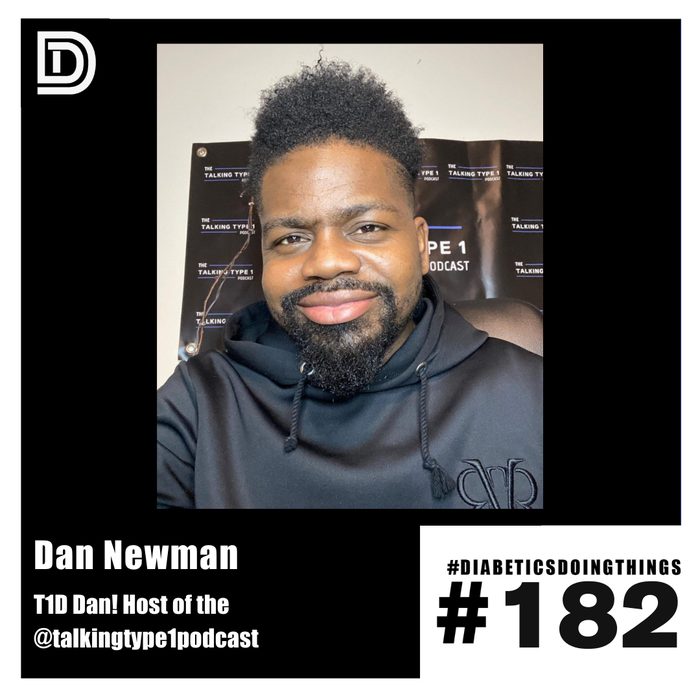
Dan Newman - aka T1D Dan, Diabetes Podcaster & Advocate
Episode summary
Daniel Newman, known as T1D Dan, hosts the award-winning Talking Type 1 podcast. He was diagnosed with type 1 diabetes at age 10 in the UK and describes years of denial and burnout as a teenager, including a period when he doubted he would live past 25. Newman developed chronic kidney disease and eventually needed a kidney transplant in 2018, receiving a kidney from a family member after avoiding dialysis. He also lives with diabetic retinopathy. The conversation covers his diagnosis, his podcast, his complications, and how playing futsal with the Diabetes Football Community reconnected him with the sport he loved as a kid. He and Rob also discuss a viral tweet of his that was copied by others in the diabetes community.
Key takeaways
- Dan says he didn't accept his diagnosis for years and went through diabetes burnout and denial as a teenager.
- Dan developed chronic kidney disease and received a kidney transplant from a family member in April 2018, about two weeks before he would have needed dialysis.
- Dan says seeing Chris Askew, the Grumpy Pumper, talk openly about complications inspired him to start sharing his own story about kidney disease and retinopathy.
- Playing futsal with the Diabetes Football Community let Dan treat a low blood sugar mid-game without anyone questioning it, which he says felt completely normal.
- Dan says he wasn't bothered when others copied his viral Olympics tweet, pointing to Gary Vaynerchuk's idea that being copied is a form of compliment.
Show notes
This week’s guest is Daniel Newman (@t1d_dan on Instagram)
Rob is on the intro solo to deliver a Content Warning: this episode contains discussion about mental health and depression. Listener discretion is advised.
After the intro, Rob, Eritrea and Dan discuss:
Diagnosis story
Dan’s podcast Talking Type 1
Dan’s story of sharing his life with Diabetes Complications
Receiving a Kidney Transplant
The Importance of Community when living with a Chronic Illness
BONUS: Rob asks Dan about plagiarism in the Diabetes community when his Olympics tweet was plagiarized
SPONSORED! This episode is sponsored by Type Zero Health, a T1D owned business who make exceptional clean exercise products that don’t spike your blood sugar. Type Zero is the official exercise partner of Diabetics Doing Things and you can save 20% on your order from TypeZeroHealth.com by using ROBHOWE at checkout.
Questions this episode answers
Who is T1D Dan?
T1D Dan is Daniel Newman, a UK-based podcaster who hosts the award-winning Talking Type 1 podcast and has lived with type 1 diabetes since he was diagnosed at age 10.
Did Dan have a kidney transplant?
Yes. Dan developed chronic kidney disease related to diabetes and received a kidney transplant from a family member in April 2018, narrowly avoiding dialysis.
What is the Diabetes Football Community?
It's a group founded by Chris Bright where people with type 1 diabetes play football and futsal together, treating highs and lows mid-game as a normal part of playing.
Why did Dan start talking publicly about his diabetes complications?
Dan says he felt alone after being diagnosed with chronic kidney disease and retinopathy, and watching Chris Askew (the Grumpy Pumper) speak openly about complications inspired him to share his own experience.
Full transcript Searchable, with timestamps
Rob Howe: What's going on everybody? Rob here. No intro episode for us today, just going to be me teeing up this amazing interview. We have Daniel Newman on the podcast, or T1D Dan as he's known on social media. He is the host of Talking Type 1 Podcast, which is a WEGO Health award-winning podcast. One of my favorite things to do on this pod is to interview other podcast hosts because they often flip the script. And I do the same thing when I go on other podcasts. It's just habits of a host, so to speak. So Dan really does flip the script on us this podcast. We have a great time talking about community, talking about diabetes complications, talking about sports, talking about how we all cope. And even we spill a little tea with some diabetes community gossip, which is always fun. One thing I do want to call out, though, I want to give you guys a content warning. We do talk about depression and mental health. So if it's not the right time for you to listen to those things, please go ahead and skip this episode. However, I would encourage you to try to listen to it. It's not scary, but I did want to call it out before you found it within the episode. So listen with discretion. Okay, with that out of the way, I'd love to introduce this episode 182 with Daniel Newman. What's up, guys? I got a very important announcement for you today. Not only is this episode sponsored by Type 0 Health, but type zero is now our official fitness partner of diabetics doing things. And that's exciting for me because if you can hear, I'm actually mixing up some type zero NO booster in my shaker cup right now because I'm about to go work out like I normally do late in the day. And what I want to tell you first about type zero is that for people with diabetes, you can get the boost and the pump you need to crush your workout without having to worry about spiking your blood sugar because type zeros and NO booster is clean. It's caffeine free. It uses natural ingredients No artificial flavors or colors And it doesn't spike your blood sugar, but it gets you the pump you need It also doesn't have caffeine so I can have it later in the day like I am right now It's about 5 30. I've just gotten through my work day and i'm about to go hit the gym I use it when I play basketball when I go on a run when I hit the weight room, which i've been doing a lot lately And i've been using it to help me shift into workout mode while i'm at home I get that shaker cup going mix it up. I'm using the cherry limeade flavor right now You got to check it out. TypeZeroHealth.com for more information. If you use TypeZeroHealth.com, use code ROBHOWE. That's my name, Rob Howe. No spaces at checkout and you can get 20% off. TypeZero is a T1D-owned business and you know how I love T1D-owned businesses. Check out episode 132 for my interview with the founder of TypeZero, John Jensen. You can hear his story there. Also, check out TypeZero's clean nitric oxide supplement. I've been taking it for a few weeks now and it has really powered my recovery. Again, no caffeine, just beetroot, pine bark, arginine, and citrulline, which are natural ingredients. It helps me recover, which is a big part of how I implement my training these days. I've got to be able to recover. I take on a lot of mental, non-physical strain. And then with my workout schedule, it's hard for me to recover and bounce back. And this has really helped me. I even left a review on Amazon with a photo of my whoop strap where it shows month over month how my recovery increased after I introduced the clean nitric oxide supplement. So check that out. Again, typezerohealth.com, the official fitness partner of Diabetics Doing Things, and use code ROBHOW for 20% off at checkout. All right, back to the episode. Welcome back to another episode of Diabetics Doing Things. We are telling the amazing stories of people with diabetes from all over the world. I am very excited to have a fellow podcast host on the show today because he's going to help me keep my questions in line. He's going to keep us on track and I'm sure he'll flip the script on us today. My very special guest from the Talking Type 1 podcast, Mr. Daniel Newman. Welcome to the show. Thank you. Thank you for having me. How are you guys doing? I'm doing great. I'm home today. I had to travel a little bit this week, so it's just good to be back in my home environment. How are you guys? How are you, Eritrea? Oh, I'm chilling.
Eritrea: I'm excited. What is it? It's 9 a.m. in Dallas. It's early as heck. And we're here interviewing Dan, Dan, the man. So I'm excited. I'm lit. Dan, I, you know, you you're in the UK. So like,
Rob Howe: you know, the, the all over the world part of our intro is, is very relevant today, but I will say that there are a few folks in the, that I will wake up like at seven o'clock in the morning to do a podcast interview, but for you and my UK people shout out to all my UK folks who have been on the podcast over the years, who have just gone above and beyond in the scheduling world. So you know thank you I'm very grateful that you're here with us today thank you thanks for having me
Daniel Newman: and um I like the reference to 9am in Dallas as well um Eritrea, she stole that from you
Eritrea: I just ripped it out of the I was ragging on them for loving Drake so much and I was like I'm just gonna steal it and get it out the way so we can move past this light-skinned man but anyway if
Daniel Newman: you're listening if you're listening and you don't know or you haven't heard the 9am in Dallas freestyle go and listen to that just type it in youtube or wherever go listen and then you'll get
Eritrea: the reference of what we're talking about this is a drake stand podcast and i cannot i can't we
Rob Howe: might have to kick eritrea out of the out of the zoom room just while we continue to talk about drake uh but today we're we're going to talk a little bit more about you know not just diabetes but life around diabetes and i think uh so much of of what you have led your conversations and your guests on your account over the years now has been around, not just like the diagnosis, but like what you do from there. And so I'd love to kind of start with your diagnosis. And then we're going to get into a conversation that we on this podcast have not covered too much and talk a little bit about complications of living with diabetes. So Dan, take it, take it away, my friend. Let's let's start with that diagnosis.
Daniel Newman: cool um so just before I get into my diagnosis story obviously I'm in the UK so I will probably use some UK terminology so when I say A&E it's the emergency room but we just call it accident and emergency so just throwing it out there in case you're lost by anything um so yeah I was diagnosed when I was 10 um in August 17th of August and basically it was the summer holidays it was really really warm I was drinking a lot my family didn't really think anything of it because it was warm um just drinking drinking drinking my aunt took um myself and my cousins to the cinema so to the movies watched the film I was unwell went came home still unwell um my mum then had to call the emergency uh GP so primary care doctor yep um and said you need to take him to A&E so emergency room now went there was there for what seemed like hours um just remember lots of needles lots of tests and then the doctor sat me down and said you have diabetes and obviously in your 10 you don't know what that means what that entails and then I was in hospital I think for about a week or two afterwards so yes it's I guess my diagnosis story is it's still it's obviously still a story but it's quite straightforward I've never been in a coma I've never lost consciousness I wasn't in severe kind of like DKA to that point of potentially losing consciousness I was conscious the whole time so um I guess I'm very fortunate in that sense I didn't know until I started I was more active in the community hearing and hearing different diagnosis people's different diagnosis stories how um not traumatic that's probably the one because it's traumatic but how many people did the experience kind of losing consciousness etc so um so yeah that's my kind of diagnosis story
Rob Howe: you bring up a great point about not knowing what other people went through and i think that's one of been one of the things i've learned the most from this podcast as well is it's it's so strange like i'm trying to wrap my head around this concept because everyone goes through relatively the same symptoms but at a different scale right and like you said like and i was very fortunate as well, like you to not have lost consciousness, to have, you know, not be in a, in a really bad way in terms of DKA. Um, but there are many people who vary and some who whose blood sugar is not even really that high by comparison, but their, uh, their GP, their primary care physician catches their blood sugar elevated and they go into the hospital and they get what they need. Uh, and then on the other end of that spectrum, you know, blood, uh, blood sugar is in over a thousand and you know in in severe decay and in loss of consciousness etc so uh i don't know it's been so interesting over the years to hear the similarities but also the differences between everyone's diagnosis story um what do you remember about that movie do you remember what movie you were seeing at the cinema no man i the only reason the only reason you always ask that you
Daniel Newman: always ask that well maybe if i googled what films came out in august 1996 i might be able to that
Rob Howe: would be that would be a trip down memory lane uh the only reason i ask is because the week before i was diagnosed i went to go see a movie with my friends and you know like like i did as a as a person not living with diabetes i got a big popcorn and a big soda and uh and so as i'm sitting here watching this movie, my body is responding to the amount of carbs that I'm eating. And I think I had to get up and down in that movie theater like 12 times during the movie. Like as soon as I sat down, I would have to get up to pee again. And so I just always remember that like weird feeling of being embarrassed. And like, I was like, what are the people behind me in the theater think about me getting up and down? Anyway, that was so I had to ask. I don't want to make us feel old, but
Eritrea: Matilda came out in August of 1996 so that was a long time ago it just feels like I don't know 96 feels like it was just you know yesterday but like but you really think like I googled what movies came out just to be funny and when it said Matilda I was like damn we old like oh my god that was so long ago that was literally 15 years ago my god so yeah yeah add another decade to that yeah what goodbye anyway yeah time flies time flies when you're having a good time right when you can't do math so anyway go ahead you're so you're celebrating i mean really 25
Rob Howe: years of living with type 1 um yeah yeah what do you a few weeks ago and i remember i saw you know celebrating your diversity on instagram from from 25 years ago in 1996 to to where we are today um how well did you do you think that you were set up for your life with diabetes from sort of from the jump from from your diagnosis what um and did you feel like when you were diagnosed that you got had the care team and the information and your you know your family were were up to speed on you know what your life was going to be like um honestly honestly looking back
Daniel Newman: I'd say no I think that if I if I look at my care team I think back then obviously there's been so the knowledge of type 1 back then compared to now is completely different I think that the care team that I had particularly when I was in pediatric care they did as well as they could and I think they were they were on hand to help but a lot of it was it was almost a bit of the unknown um and so in terms of the information and the data that's available now obviously was completely missing back then I do remember one point I've I've um I don't know if I might have spoken this about on my own um podcast but my um uh pediatrician said to me at one point when I wasn't testing my levels because I just didn't want to she she said to me oh do you know in the future you only you'll only need to test once a week and you'll be able to tell um tell what's going on so you know just focus on that and I look back and I think how wrong was that information information there um I think from my family's perspective um something that I've touched on before I think culturally so I come from a Caribbean background um never really spoke about health and the understanding of type 1 wasn't wasn't probably taken as seriously as it should have been knowing all that I know now compared to um compared to back then I think there's a lot that's a lot to do with culture and not talking about health and really understanding and going out to get the information to inform you and to make better decisions so I think from that aspect it could have been better and it I also think kind of throwing into my own growing up and being a teenager and living with type 1 and trying to be trying to fit in with everyone but then having this condition which isn't helping you and then your support network is there but it's not really there and you kind of I know I just got to the point now I can't be bothered anymore um if I take insulin I know I stay alive so that's all that matters I need insulin to stay alive so that's what I'm going to do um so yeah looking back I think it could have been better in some definitely in some areas um but it's the past as well so it's only you can't I can't change it but I think it could have been better and there could have been more help around around for me but at the same time I think that's an experience what they were doing their best at the time I yeah I think
Eritrea: it's an experience with a with a lot of kids of immigrants or like immigrant backgrounds where you don't talk about the bad stuff like I've noticed that like um I mean and I noticed like it's different culturally for like different hemispheres like with my mom we talk about bad stuff all the time that's Latin America with my dad who's more like African Arab it's like we don't we don't talk about my diabetes until my pump beeps and then he's like are you low but otherwise it's like no questions about diabetes so I wonder if it's almost like a culture of if you don't talk about it you don't have to think about it if you don't talk about it and think about it you don't have to worry about it so it's almost like it doesn't exist and we don't have to feel bad we don't have to process the emotions so I wonder if it's like a way of our parents coping mechanism and like they don't know they're hindering us they're doing the best they can also yeah I think that makes
Daniel Newman: sense and probably going off on a bit of a tangent and more down the psychological route I think if you look back at like our parents generation they were always told never to express how you feel and never to do this and not not to if you felt down or you felt low just get on with it so maybe that filters into it of um this is something I thought of now that you've said that maybe that that maybe that comes into it of my child is going through something but I can't feel these emotions I just have to get on with it. But in the long term, it does do it does more harm than than good.
Rob Howe: Yeah. Yeah. Good point. Something I think about a lot. Yeah. Yeah. Yeah. It's really interesting to see like and now we're like really deep in the psychological evaluation of our of our parents generations. Like, you know, they, they accomplished so much. I think like whether in the U S or as immigrants or, uh, in other, in, you know, in the UK and elsewhere, uh, you know, they, they built this modern world that we live in. And, uh, they did that by, you know, the sweat of their brow, they like push forward and they, uh, you know, they sort of, the, the, the phrase here is like grin and bear it, uh, and, and, you know, not, don't, don't focus on the burden and just continue to push forward. And, you know, I think a lot of that is traumatic, has been traumatic for many of them. And I think like internalizing that too, and then that gets passed along to us. And I think that's, you know, where we're at now today, where community is a little bit more focused. There's a little bit more of a, we're kind of shedding slowly the stigma of mental health and talking about mental health awareness. And, you know, I think ultimately you can kind of see how that pathway is like starting to become a little bit more normalized. it's more normal to talk about chronic conditions, whether diabetes or otherwise. And just, you know, raising that awareness kind of like as a whole, just because we're more comfortable talking about those things now. And I think we don't, maybe don't take them as personally. And I, and that's speaking from my, my own experience as well. I know that there are many people probably, so I'm even listening that still are working to, to reconcile like the comfort level of being open about their, their chronic illnesses and their struggles. So if you are listening and that is you, that's okay. It'll come when it's time.
Daniel Newman: Yeah, I think that's a key point. It will come when it's time. And I know we're going to talk about complications and me talking about it, but it takes time to get to that point of being able to talk. I know this is kind of a bit of a buzzword at the moment, but it's a process to get to a certain point where you might see people talking like me talking about stuff on Instagram it's not always been that it's not always been that way at all and I'll be and we can go into that but yes it's definitely a process and do it make sure you do it in your own time yeah I it was
Rob Howe: a process for me as well um 10 years really of keeping diabetes to myself um you know that that That was my journey. Other people get diagnosed on day one, and they are loud and proud and want to share it. And others, I think, it takes a little bit of time. Before we move on, though, to complications, I want to talk a little bit about teen years, because you brought up, you know, your mentality was, as long as I take my insulin, I'm going to be alive. So I'm just going to just do that. Teen years are so difficult for people with diabetes. And sometimes I often have to remind when I would go around and speak at events, parents of teens would come talk to me. And the first thing that always comes to mind is how difficult it is to be a teenager without diabetes. And like, there's so much change going on, like socially, physically, and throw diabetes on top of that. It just makes things so much more difficult. What do you remember, you know, looking back on those teen years, I know Eritrea has a lot of like stories from her teen days as well. um i don't know what do you remember about those days like the the emotional side of it like what what was what was going on in your life and like what what made what helped you during those years
Daniel Newman: that maybe somebody listening today would benefit from um i would say there was there was a lot going on particularly i would say majority diabetes wise and looking back i was i went through diabetes distress and diabetes burnout and I think a lot of even though I was diagnosed at 10 and had a number of years even with type 1 it was I didn't accept it so I think there was a lot of denial going through those teen years and those were the kind of main sort of emotions that I can remember is just not wanting to have have it feeling judged by um like my HbA1c results healthcare professionals um not wanting to test my levels because I was scared of what the numbers were going to show me knowing that I should be doing better but I couldn't I just couldn't be bothered to do better not wanting to talk about type 1 so it was a real just not accepting the condition and I think towards my yeah I got as I've mentioned I got to the point that's ah do you know what the easiest way to cope is just take insulin and then I put that to put everything else to the side and I I also got to a point in my mind where I was like this is just too much and I don't know you might want to add a bit of a trigger warning in here I just said oh look I'm not going to make it past 25 so if I live to 25 I've said that that's good that's good and that's it I was just I couldn't see anything further than past 25 or anything living longer than with this because it was just too much and then my later teen years was just more about going out partying drinking and I think again the drinking that I was doing obviously it's different in the UK because it can be 18 and that has to be well legal well you have to be 18 and I was going out just drinking like drinking partying clubbing clubbing but then not I wouldn't always inject or doing so I would come home be drunk not not inject not do anything wake up the next day with a crazy hangover and levels like in the 20s I know you can if you times it by 18 you can convert what that is um and that's kind of how the team is where it was just a complete denial phase of
Eritrea: type 1 I think that's what it's like I think that's what is it what it's like for a lot of when you're diagnosed so young so you're diagnosed at 10 i was diagnosed at eight i've said we've never put a trigger warning like for that in the podcast but i've said it before like i didn't think i was gonna live past 25 so it was like what was the point i remember ruining my credit because i was like i'm not gonna need to buy a house like i'm gonna be dead so like ain't nothing to worry about credit who not me y'all so i actually this is so ridiculous but like i kind of thought i was smarter than everybody because it was like i know the game like we're all gonna die anyway but i'm gonna die before all y'all so I'm gonna live fast and so I can kind of understand what Dan was on because I was on that same shit and it sounds really toxic and it sounds stupid but it's like you almost get off or for me it was almost getting off on being smarter than everybody else and like knowing that what I was doing was bad for me but like I'm not gonna have to deal with the repercussions of it so I'll just not deal with them because they're 20 years away from me and right now I can't cope with what's happening with me. So adult me, if she's here, she can deal with it, but little me ain't with the shit. And that's, so when you're talking, I'm like, yep, Dan, right here, friend, right here. Well, and yeah, go on, go on. I think, and I am going to add, I wrote it
Rob Howe: down. I'm going to add a content warning to talk about mental health and, and, you know, mortality, but you know, when you're, when you're young, you have no concept of death, uh, you know, you, And then for someone with diabetes or another chronic illness, you get introduced to this idea very quickly. Like if you don't take care, if you don't follow this protocol, you have run the risk of dying or having health complications. And that's a totally flipped around worldview for a young person. And, you know, what you're both describing, you know, looking for really just trying to find life somewhere, you know, and try to block out the, you know, incessant beeps and injections and tests and burden of diabetes, whether it's partying or drinking or social or traveling or just denial. you know we all I think have different coping mechanisms and you know some of us you know have different systems around us that allow us to thrive in those and others and have to find their own way and that can be very difficult and very in many cases like damaging to your body and your
Daniel Newman: physical and mental health and your well-being. Yeah I agree and I think as well where you you said about it being like flipped around kind of dynamic is if you think about it even if you just look at going to hospital appointments at a young age if you're 11 12 13 and every three four months you hear if you don't look after yourself this will happen if you don't look after yourself this will happen but perhaps if you're even if you're younger than that you might hear conversations of like your parents talking and I know people think children don't hear or understand children your children know everything they can understand what's going on and you take diabetes out of it how often does a 12 or 13 year old hear those sorts of conversations that knowing that their specific actions or what they need to do um will impact on what happens in their their future it doesn't happen and I think that's yeah it's it is it's it's it is flipped it's a crazy dynamic when you put um type 1 into the mix particularly a very young age and having to manage manage things
Rob Howe: And you brought up a great point. And I think I, you know, really clicked for me for the first time just now. I think sometimes it makes it difficult to assimilate socially as well, because your friends, you know, after you've been diagnosed, you have more, you have new information that your friends don't have, you have a new relationship with your own life. Uh, and, you know, for me, I think about when I was 16 or 21, uh, and like the way I lived, it was just like very short term, uh, and very, you know, just kind of one thing to another. And, uh, you know, I'm, I'm fortunate that I, you know, didn't get in any trouble and that I still have all my appendages, you know, I think, uh, but at the, at the same time though, trying to get back into your regular rhythm of things as a teenager, as a young person who's recently been diagnosed with any sort of chronic illness, it's very difficult because you have a new perspective that your friends don't necessarily share and they can do their best to try to hear it through you. But until it happens to you, it really doesn't
Daniel Newman: crystallize. Yeah, totally agree with that. Yeah.
Rob Howe: Man, we're digging into it. This is exciting.
Eritrea: It's deep. No, yeah, you're right. It's just like you said, it's not just new information. It's almost a new way of even viewing. Can you even still be friends with those people? you know like because now everything is at you're playing you're basically like a pro athlete you're playing something at a higher level and everybody else is still playing the same game and you're just like I'm not trying to play you know what I mean like so I'm telling you it's almost this like you are smarter than everyone else your age and it really shifts the playing field and makes it something really weird like but I have a whole theory about like how chronic illness kids are super manipulative and how we're like liars. Like I have a whole theory around it because we almost have to be that way to survive. Like your mind has to, in some way, protect you from this constant overflow of information because it's basically like you drinking from a fire hose. Like you're growing up as a person, you're figuring out who you are. You're starting to go through puberty. Dan was diagnosed at 10. I was diagnosed at eight. Like think about that. And like, you're supposed to figure out your hormones on top of this injectable hormone on top of immigrant parents who don't know what they're doing like it's it's too much it's literally a recipe for disaster and i am so proud of me and dan for making it here because like little us didn't think we'd be here and here we are looking at each other i see you friend like i see you too no but it's true
Daniel Newman: i never thought i i i surprised i made it past 25 that's that was just the mentality of yeah i'm not gonna make it past 25 so see well i'm glad hey i'm i will say i'm glad you're both
Rob Howe: here i'm glad you're both growth growth uh dan you have talked about openly your your kidney transplant and uh i'd love to like i don't want to touch on it too briefly because there's been a lot of episodes on your podcast and you and a lot of social media content where you explain it But for people who are out there not thinking about complications, tell, you know, what your story of complications, I think, is one that's extremely relatable.
Daniel Newman: Yeah. So, yeah, I had a kidney transplant in April 2018. I was diagnosed with chronic kidney disease in 2013. I'm not sure when but prior to that time I don't know I can't remember the exact years but I do know before then I was leaking my kidneys were leaking protein and I was given tablets and medication and it got to the point where chronic kidney disease developed and I think even at that point I still I had there was still an acceptance of type 1 but I definitely wasn't in the place where I'm in now when it came to management um and so yeah I was when you're diagnosed with chronic kidney disease it for me it felt like and maybe other people can relate to this other people it's it felt just like a ticking time bomb and in the sense of your kidney function is declining and there are things that you can do so whether you look at diet or um like or just like sorting taken there's certain things that you can do to prolong it um the function declining but at the same time you know in the back of your mind that it's it's declining um sorry there's a there's a car going past i'll be one second sorry i don't i can i don't know if you can you're gonna have to edit this sorry i'm adding but um yeah so you kind of know it's declining and you're just there and the advice that I was getting from my nephrologist was it was it was very just yeah cut down salt and that basically just cut down salt cut down your salt intake and do some exercise and so for five years or so maybe four years um my my function was declining um and then there was one big drop from I think I went from 60 to 40 in my terms of my kidney function and that was related to um a new medication that I was taking and my nephrologist didn't pick that up but I did and I don't know what happened but it's when that big drop happened it's almost I don't know if psychologically I just I felt defeated because for so long I've been around the 60% mark and when it dropped it was felt it felt like I was just fighting the losing battle and slowly the function the function declined and when it got to 20% I was sent to what they call a low clearance clinic so at that point it's preparing you for either a transplant or dialysis and at that point it felt real because it was a bit like you can can I swear on here yeah of course it's a bit like oh shit that I knew it was happening but it was like oh this shit's kind of real I'm gonna have to have dialysis or a transplant and I really didn't want dialysis because I had a family member who was on dialysis and I saw how how that was and I was just like I didn't want I wasn't mentally ready for dialysis so that was a kind of wake-up call for me in in that part of the process but I couldn't do anything because I knew the function was going down but one thing that I I don't know what it was but I just said to myself do you know what I'm not I'm not gonna have dialysis I'm this I'm I'm going to have a transplant I didn't know how but I was like I'm going to have and I said I'm going to keep working until the last this there's no way this is not gonna this isn't gonna stop me and up until my transplant I was very fortunate that a family member donated the kidney to me um and again that's a difficult conversation to have because you're not asking somebody to lend you um 10 pounds or 10 dollars or anything it's like hey can you have an operation give me one of your organs to help me stay alive but you're going to have to go through all of this pain and everything but you're helping me and that's such a difficult conversation to have because along with that comes guilt that you're you're in that position of wanting to ask somebody to go through that operation and yeah there's just so much there and and as I said part of it continued part of that I said you know what you're gonna you're not gonna you're not gonna have that I was just like there's no way I'm having dialysis and I was very very fortunate that I never had dialysis and I was about two weeks away from having it before I had my transplant no not everyone has a journey like that and I'm very very fortunate and I within me I have believed that it it was kind of going to happen because I set that out in in my mind and I was working up until two days before my transplant because I was like there's no way I'm not going to work this isn't going to stop me from working and I was getting up in the morning going to work and even that was a struggle but I wanted to do it because I knew if I didn't do it I would just feel just really deflated and just like whereas I was like no you're going to do it you're going to end and I think that yeah that that that helped me that got me got me through um whether you believe in um the universe or a higher power or whatever I I just I just think that that's something got me through that because the way it happened not needing dialysis being so sure that I wouldn't need it um so so yeah and I had the transplant very fortunate coming up to three and a half years now later everything's going okay i've not had any issues at all with the transplant um and again i mean this is just my journey so it's very very different to what maybe other people listening have experienced and i can only talk on what i've gone through but so yeah that's part of my my complication stuff and then there's also maybe we'll talk about a bit about the retinopathy or yeah there's
Rob Howe: well i i want to i want to i do want to touch on retinopathy uh and uh eritrea has has also you know very bravely shared uh very recently you know some of the challenges that she's had with diabetic retinopathy um it's part of the journey and like you said i i want to focus though you reached this point and your mindset changed even before before the transplant you like you were talking about when dialysis sort of became came into the focus as like the maybe the driver or the trigger of you pushing to a different mindset. After the transplant, that stayed with you, I imagine. And has that influenced your decision to be more involved in the community? And how has that fueled your... Because I think shortly after that was when I saw you started coming out on social media and got introduced to you and saw your podcast and everything. how much of that was was part of the I guess the neck the the follow-through on on the on the
Daniel Newman: transplant I think um it was probably a catalyst I would say definitely because for me I I think that I reached a point where I was like you're living 20 you've been living 20 plus years with the condition and you've gone through so much and there were certain points within going living with chronic kidney disease and also retinopathy where I just felt like I was on my own and living with complications when you're diagnosed with a complication I know many people and myself you just feel like you're on your own you feel like you failed to test and I just knew what it like for me and I thought well if that's for me there's probably others out there maybe I should talk more about my kind of experiences and life with type 1 but at the same time it did take a bit of time for me starting my profile to feel comfortable talking about complications and I think in it what I should flag up now is um I'm sure maybe some listeners do know something that but um have heard of the the grumpy pumper Chris yeah and so I I've known I've I've known of him I've known him for a while and he started talking about complications and the hashtag let's talk let's talk about complications and that's part of what inspired me to start to talk about it because I saw him talking about it and I felt well if Chris is doing it and the kind of the space has been opened up then why not share what I'm doing so he probably doesn't know it but that was quite an instrumental part of me being able to talk about complications now um or at least kind of feel more comfortable sharing my experiences there's still times when I share things um particularly related to retinopathy, where I felt quite vulnerable sharing it online. But then I've had people reach out to me afterwards and like a year or two down the line said, oh, I saw that you're having, you've had this surgery. I'm going through the same. What was your experiences like? And I think that's been really helpful. but yeah it was definitely the catalyst to start to to almost I don't know whoever you it felt a bit selfish that I had gone through these experiences and I felt alone so why would I then want other people to feel alone who are going through the same things as as what I've gone through um so yeah that kind of started it started it all and um yeah kind of
Rob Howe: here a few years later yeah and uh i'm so glad you you are and like we talked about process being like a you know sort of a buzzword but you know from there to today and you know you mentioned chris the grumpy pumper one of the like i i gotta say like on twitter there there's a uk diabetes like cohort uh and they are hilarious and and most of them have been around for for
Daniel Newman: many years and uh just i would just for me chris is like one of the ogs of the uh absolutely like like one of the names like the founding name that that like you know and you you come across and um yeah so yeah i was gonna just throw that in yeah absolutely i think there's like uh there's
Rob Howe: generations of of diabetes like uh of bloggers and and accounts and he's definitely in that sort sort of, you know, Mount Rushmore of, uh, diabetes, social media, for sure.
Eritrea: 27 years of diabetes. Sorry. You guys are like talking about this dude. And I'm like, who is this guy? And so like I did a quick Google and it's like, man's had men's had diabetes for 27 years. So he maybe need to be on the podcast next. I don't know.
Rob Howe: I think too, like just, uh, there is, uh, and I, and I want to shift this over into community. I promise I'm going to work my way into this question now because the UK diabetes, social media community, I think it's very close knit. Like it's a, it's, it's a little bit smaller. And obviously like in, in terms of like the country is obviously a smaller like proximity. So you guys all know each other. And I think of like Andrew, uh, who I met through bolus maximus as well, uh, you know, type 1 life, I believe on Instagram and, uh, and thinking through of all of the folks from the UK over the years. Uh, and I saw recently, uh, on the diabetes football community page, uh, that there's a team of you guys are playing futsal together. And there were like three or four faces that I recognized immediately from like the, the Instagram diabetes community. What's it like now? Like if you could, you know, going back to like, we talked about the struggles during your teen years and at the beginning of diagnosis, like when you think about that journey and think about that process and you see today, you know, with a group of eight to 10 people all living with diabetes, doing what they love and just having a fun time you know playing futsal together what is that like i don't know and i mean like obviously it's just like a community football game it's like it's not like a it's not the super bowl you know it's not the world cup but you go out there do you come out of the game or you leave those feeling like wow i i i never thought this would happen or or i i'm so glad that i have this
Daniel Newman: community now yeah so when i post that was the first game that i've ever played with um the diabetes football community and I'll shout out Chris Bright who is the founder of the diabetes football community really great guy and when when I've when I finished just driving home I felt like 10 year old me after I'd finished playing football just a little kick about or soccer but futsal soccer so just yeah it was it was it was there was just a real buzz about it and I think it's just the small things of obviously in the UK when it comes to kind of diabetes technology and access so everyone well not everybody you would look around I'd look around and I'd see like Libre like sensors or somebody would say oh my my Dex or whatever or there was a comment of my levels have gone up into um the 20s again multiplied that by but the levels were on a higher scale but it wasn't like panic it was oh this is a consequence of sport this is what happens and so that sort of stuff was just normalized and it wasn't weird if maybe you had to I don't know if somebody had to just take a break or just have have a have a juice have some sweet or people checking their levels at half time and I just left there feeling like like I was just a I'm seeing like a 10 year old again and I know that sounds probably sounds so like over but I was just buzzing I was absolutely buzzing when when I left because and I think 10 year old me would have been so happy to have known oh it's a long time to get there but there's actually this community of people who like football like you do but and they also have type 1 like like you and it's such a great thing and that community has brought a lot of people um together there's even like there's obviously got a whatsapp group and there's just different it's just a real community there and yes uh chris has definitely created a safe space for people living with type 1 who are interested in futsal or football that's so cool and big shout out to chris bright
Rob Howe: he and I have chatted a few times over the years. And I think, like you said, just normalizing, oh, I need to sit down and treat a hypo in the middle of a game and nobody questions it. That's just like the value of that. In Airtrade, I have talked a lot about diabetes camps and going to diabetes events so that you can experience something like that. But people enjoying the same activity that they've loved their whole life and getting to do that alongside with people with diabetes is just so impactful.
Eritrea: it's cool when diabetes isn't an interrupter but it's like an optimizer like it makes the experience better instead of making the experience worse because I've noticed it's like I like to think of diabetes almost like as of as salt sometimes because like sometimes it's terrible and too much and sometimes it's just right and it's perfect because like sometimes diabetes can be amazing like right now because all the things Dan said so much that I was just like bro right here right here you know what I mean so that's that's what I mean it's like with those experiences is diabetes is the thing that makes like the cherry on top or the salt that makes it perfect so that that's amazing i know rob can relate with his basketball games he'd be going he even when gets dunked on he'd be feeling real good after them games because the diabetes didn't interrupt
Rob Howe: so yeah i i get it i think we all do first of all i have no one has dunked on me i'm dead i just
Daniel Newman: want to go i saw i saw his face yeah i was like yeah just i just want i want to put that out there
Rob Howe: No one is knocking on me. However, I am not as young as I used to be. I will say that. I will say that. But it's okay. I'm aging gracefully. You guys were talking about it. I think what I try to do is to flip that. And because you can't change the past, I need to be more grateful in the moment. Because if I'm not, I will have skipped all this great stuff that I have today. And down the road, I don't want to look back and say, man, I really wish I had been aware of all the things that I had when I had them. Um, and so, you know, I, I think that, that kind of comes back to where I'm at with my, with my athletic career, so to speak is today. I'm grateful that I can, you know, go in my backyard and work on, work on some things and, uh, and, or go on a basketball court and be able to get up and down and have a fun time. Uh, and I'm going to acknowledge that today, uh, because, you know, in the future, maybe I won't be able to. Yeah. I was just going to jump in. I was,
Daniel Newman: I was going to say is and that's the thing about a kidney transplant so like insulin it's not a cure it's a treatment so there will be at some point in the future where I the the organ will probably the kidney will my body will reject you and I will even need another transplant or go on dialysis so it's could I spend this whole time worrying about what's going to happen and I did for about a year after my transplant coming up to 18 months it took a long time to get to a point of just kind of living in the moment and being like well I can do this now let's let let's just do this rather than thinking I'm gonna lose it in I might wake up and it might reject or I might be and again it's all mindset but again it takes time to get to to get to certain points yeah and you've you've
Rob Howe: been very careful to say that it takes time. And very, and I, and I appreciate that because I don't want people to look at, to be like, Oh, well, I, I am living in fear and I don't, I now judge themselves for it. And I think our greatest fears lie in anticipation. And I think that with, with diabetes and chronic illnesses, with complications at the same time, like you should be, you know, take care of yourself. But if you're not in a place where you're able to share your story today. That's okay. Don't pass judgment on yourself for that. I was there. It took 10 years for me. And I think if I don't live my life with regrets, but if I was going to go change something, I would have gone back and opted in sooner and raised my head and been a part of the community and been part of connecting with people like you. And man, I'm so grateful that you were able to come on the show today. You flipped the script back and forth. It was so great to have another host. Before we go, I do want to say I had this when we booked you for the interview. This is not necessarily so diabetes related, but you, I think ESPN or something tweeted at the beginning of the Olympics and you, it was like, what isn't an Olympic sport, but should be, and you put like managing diabetes and it kind of went viral. And people were sharing it all over and I was like, yeah, go get them, Dan. And then at the same time, I saw people try to like copy copy it and i was like come on come on y'all what are y'all doing
Eritrea: they the number one people complaining about being copied copying dan you know what i saw it
Daniel Newman: i saw it and i'm all you know what i i didn't post anything on my profile because i thought i don't want to but some people reached out to me and said look another one look another one all i saw it that's all i'm gonna say is i saw the dapper dan of diabetes hey props to you you
Rob Howe: took the high road i just wanted to say that i saw you too i saw you take the high road and i
Daniel Newman: and i saw you leading the way there's there's been times when there's so i'm gonna sound a bit salty but i'm gonna say i've say it there's been times where i've seen other things that i've done be repeated and I've not said anything but I I see it I see I see these things and I guess one I listen to um a lot of Gary V and um he says he talks about I think I can't remember but he says like when people copy you it's it's actually something like it's a compliment don't don't be too worried about people copying you and that's kind of what what I what I thought but I do see it and i see too yeah i don't mind it but just give you just give people some props for sure that's all i would say but yeah yeah i i wasn't sure how many other people saw it but yeah yeah
Rob Howe: i was you know i saw i saw the original tweet and then you know i saw everybody doing the screenshots and then there's like the evolution it was like there were the screenshots and the reposts and then there was like okay these are totally different now oh man well dad i uh i can't Thank you enough for coming on and starting our day on a huge high note. We will include all the links to your show in the pod, in the, in the show notes and tag you on social media, but man, thank you for giving your heart and for giving back to the community and for just being an all around super cool guy. It's 9am in Dallas now. So if you haven't listened to that freestyle yet, you better get on it.
Eritrea: Keep an eye out for Dan's takeover. It's coming this week as well as his blog post on our page. so Dan is officially a part of our takeover series we're so excited to see him show us a day in his life um and to just see what else is coming from Dan I know that I have fully loved this episode I've loved talking to you I feel like anytime I talk to you it's like a a new lesson in radical acceptance of myself and of everything around me and you seem to emulate that and I can't wait for us to meet so that's a for anybody listening Dan and I have a planned meetup in November. So if you're a UK diabetics doing things, I'm taking over. So if y'all want to meet up, keep an eye out for that. As Rob says, keep it locked. We'll let you know the dates and the place and the time and all that. So yeah, exciting stuff. Is this for me to?
About Daniel
Daniel Newman, known as T1D Dan, is a UK-based podcast host who has lived with type 1 diabetes since age 10. He hosts the WEGO Health award-winning Talking Type 1 podcast and received a kidney transplant in 2018 after developing diabetes-related kidney disease.