

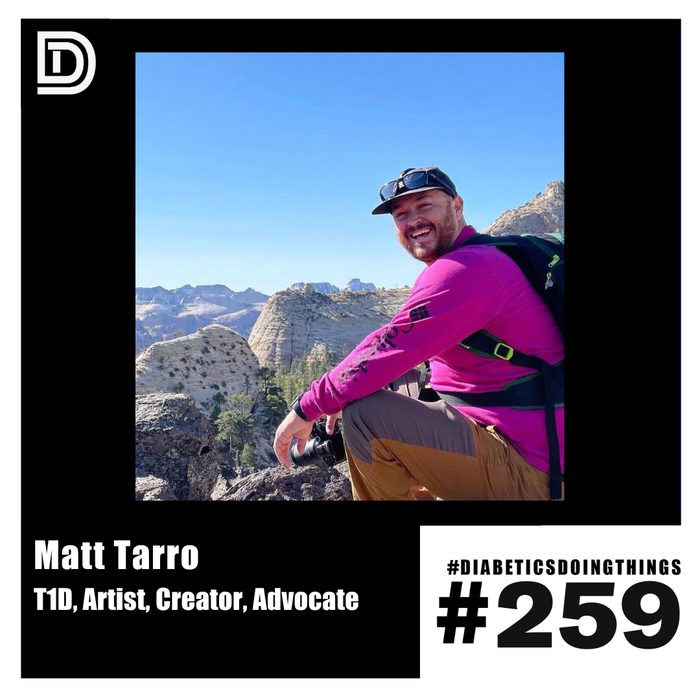
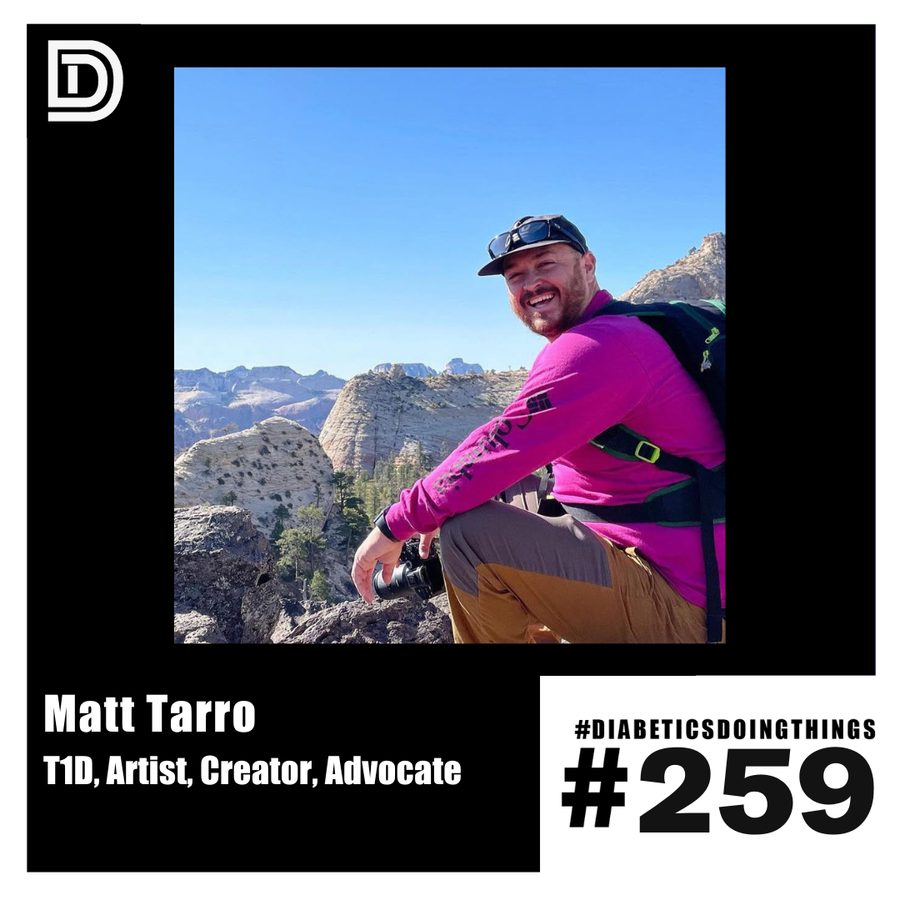
Matt Tarro, T1D, Artist, Creator, Advocate

Episode summary
Matt Tarro, a Denver-based artist and videographer, was diagnosed with type 1 diabetes at 16. He talks with Rob about growing up around cameras because of his father, moving from Rhode Island to Los Angeles to Denver, and working in digital advertising at companies like Snapchat, Oracle, and Havas Media. Much of the conversation covers Colorado's state insurance income cap, which pushed his insulin cost to over $300 a vial once a short contract pushed his income over the limit. Matt also describes taking FMLA medical leave twice for burnout, losing both parents, and using therapy and a grief recovery handbook to process his diagnosis as a loss. He now runs his own art, apparel, and overlanding business.
Key takeaways
- Matt Tarro says Colorado's state insurance caps income at about $1,616 a month, so a single week of contract work pushed him over the limit and his insulin cost jumped to over $2,500 for eight vials.
- He used FMLA-protected medical leave twice at corporate jobs, taking 10 to 12 weeks of paid time off to deal with burnout and diabetes stress.
- A therapist told Matt that being diagnosed with type 1 diabetes was a loss worth grieving, and recommended The Grief Recovery Handbook to work through it.
- He left jobs at Snapchat, MediaCom, and Oracle because the ad industry work felt disconnected from his values, eventually building his own art, apparel, and overlanding business in Denver.
- Matt and Rob discuss how diabetes creators often burn out because the work is tied to a personal need, not just a career goal.
Show notes
Bringing longtime friend, but first time guest, Matt Tarro on to the pod! There are so many amazing people living with diabetes and we finally got the Denver-based, incredible videographer, Matt Tarro, on the pod! Rob and Matt get into:
Content warning: there is some discussion of drug use
Matt’s incredible help at the Diabetes Legends Basketball Camp
Matt’s diagnosis story and his younger life as a person who has always been creative and artistic
How insurance has played a large role in what kind of work/jobs Matt has gone after
Matt’s journey as a creator and the hoops he’s had to jump thru to get his diabetes supplies at an affordable cost.
The strict guidelines around income limits that can make access to medications hard especially if you’re on State Insurance
Matt’s cost of insulin access going up to $300 at a time because of income creating an unviable option to insulin for him
The importance of signing up for a medical leave option or FMLA if you are working somewhere that its available
Diabetes creator burnout and the different inputs that go into taking care of your diabetes, OUTSIDE of just the basics
Matt’s cross country moves from his native Rhode Island to California and now Denver and how his own life experiences have pushed him out of his original home state
The grief that comes along with the loss of a parent and the management of mourning
Outgrowing and quitting things that no longer serve you
Follow Matt over on IG: @matt.tarro and check out @inkulin
Questions this episode answers
Why did Matt Tarro's insulin cost jump to over $300 a vial?
Because his income from a short-term contract job exceeded Colorado's state insurance income limit, he lost his coverage and had to pay full price, totaling about $2,560 for eight vials.
What income limit does Colorado's state insurance have for diabetes coverage?
Matt Tarro says he's only allowed to earn around $1,616 a month to stay qualified, far less than a single week of contract work at his going rate.
Can people with diabetes take medical leave from work for burnout?
Matt Tarro says yes. He used FMLA-protected leave twice at corporate jobs, taking 10 to 12 weeks of paid time off, which he says employers are required to allow.
How did Matt Tarro get into art and videography?
He started drawing and shooting video as a teenager because his father, a physician, brought cameras and tech into the house. He later painted murals in Los Angeles before building a full-time art and overlanding business in Denver.
Full transcript Searchable, with timestamps
Rob Howe: Welcome back to another episode of Diabetics Doing Things. We are telling the amazing stories of people with diabetes from all over the world. It's weird to me that you haven't been on the podcast yet, Matt, because you and I have been friends in the diabetes community now for many years. So when I discovered you hadn't been on the podcast, like it just, it just, in my brain, you already had. So welcome to the show, Matt Tarro. And I see Forrest back there in the background. around your diabetes alert dog. Welcome back to the show, man, or welcome to the show.
Matt Tarro: Yeah, thanks, Rob. I appreciate it. Excited to be here. Forrest shares that excitement on this Monday morning, so we're excited to get into it. There are so many amazing people living with diabetes who are doing things, Rob. You are doing such a wonderful job. You've got a lot of episodes, but like, dude, you have a long way to go. So there's a lot of amazing people still to get to. So a shout out to all the past guests, future guests here on Diabetics Doing Things. Decided to get into it. Fun topic today, huh?
Rob Howe: Big, big fun topic. So you were actually, well, before I want to touch on that thing, there are so many people doing amazing things with diabetes.
Matt Tarro: Yeah.
Rob Howe: We have unlimited IP that we could tap into on this show. And I think, you know, recently one of the challenges that we've had is like we have not enough time in the day to record all these great stories. So like, you know, getting more buttoned up and more disciplined on our team on how we make sure to make people feel seen and make people feel heard and like have enough space for, for everyone. So as you guys know, if you have reached out to try to be on the podcast and we haven't gotten to you yet, it's not personal. We're working through it and we want to give more opportunities to people to be on the pod.
Matt Tarro: So you can also text Rob if you haven't, his phone number is.
Rob Howe: Yeah, exactly. Exactly. And a lot of people do have my phone number. If you've emailed me, I realized that's in my signature now. So I got a call from someone the other day. I was like, oh, okay. Yeah, you have my phone number. So yeah, yeah, you I want to give you before we get into your story, huge props because you live in Denver now. Our paths have crossed over the years on multiple, you know, patient advocacy councils and with bolus maximus and working with beyond type 1 in the past. And you showed up for us big time. I just want to give you a huge shout out for the work you did for us on Diabetes Legends. You showed up with your whole video rig with your DJI or DJI Ronin. You're walking around. You got amazing shots of the camp that we now have forever. So what was a really amazing Saturday for people with diabetes, you captured for us. I just want to, I'm so grateful for that. And I appreciate you giving up your time for that. So during that trip, you and I were heading to the JDRF walk for the JDRF Mountain West chapter. And you had made some things and you are a creator and an artist. I want to get into your journey as well. But you were explaining to me something about being on state insurance and in the state of Colorado, there's a cap on how much money you can make to be eligible for the insurance coverage, which allows you to access your insulin and diabetes supplies accessibly. So we're going to talk about that. That was the impetus for today's episode. But before we get into that, I want to hear just a little bit more of your story for the guests. Like your journey and diagnosis with type 1 diabetes, you know, even moving from Rhode Island to California and now in Denver, like you're overlanding. There's a lot of really interesting diabetes-centric topics we can talk about. and even though we're only going to be here for an hour today, I think we can cover a lot of that ground pretty quickly.
Matt Tarro: Yeah, definitely. I appreciate it, Rob. Thanks for the shout out. It was super fun to do that with the Diabetes Legends events and young people coming to play some basketball and learn some particulars for their future. So I appreciate that you, you know, allowing me to be a part of it. But I also think it speaks to the larger conversation about creators and people who do have this talent, right? So I grew up as an artist. I was diagnosed with diabetes at 16. I've always had, I've always been, pun intended, drawn to art in colors, shapes, lighting. It's always been something that really fascinated me. but it also was something that my father bestowed on me as a as a father son and all of his children were around but not every one of them picked up a camera like I did so I had that with my father and he always took eight millimeter videos back in the day you know I grew up very privileged in the state of Rhode Island my father was a physician and my mother was the nurse so coming from a place of privilege I had an opportunity to get my hands on cameras when I was younger and where other people didn't have those things. My father used to bring his portable television to places that like, it's, it was like, it's the size of like a boom box and it had a tiny screen on it. Like he would, he brought places. We, I relate to that, especially like I also
Rob Howe: come from a place of privilege and my, you know, my dad loved emerging technology. I share that with him and we had a portable television with a vcr built in and it was like about the size of a cooler but we would like on road trips like put it in the car like on the on the little center console of my of my dad's like suburban and we could watch videos in the back seat it was like the peak of
Matt Tarro: luxury it was and it speaks to really what when my father as as we say it we kind of giggle but Knowing the work that we do now and who it is that we look to help serve now in the future, knowing how special it was to be in that space with my father and him doing those things, it was a personal thing. But looking back, I recognize how when somebody who works like that has an opportunity to relax, what does he want to do? That's all he wanted to do. and so uh video visuals that was always something we had tvs in my house we had audio equipment in my house and so for me it's always been about how how does that soak in into what my world and what i've done so when i was diagnosed with diabetes at 16 i wasn't this big full-blown artist and doing all this fun stuff but i would draw and i would be in this position where i wanted to create things and i wanted to have the ability to do that so as i grew up drawing everybody drew not everybody was taking photos so i got more into shooting with gopro like i'm using here today and shooting with cameras actually the first first camera i shot with the first gopro i have right here didn't even shoot 1080p the highest frame rate was 30 frames at 960 so we've come a long way baby and knowing that that progression takes time what i was able to do was i focused on uh the things i was able to get my hands on first and so that was cameras and the audio kind of came later where i'm at now with the podcasting with brandon stuff we've done in the past we plan to do more in the future coming back at it but really i i it's to my father and to all our fathers right who who had those things in their lives that ultimately now we see the visuals the elements that people really find there's a lot of money behind that stuff i didn't start doing it for the money right i did it because that's something that i felt comfortable doing and i really enjoy doing so that has really been that was my foothold in production and then from there right now it's it's really been in the last couple years about painting so personally i'd always been drawing but i really never had an opportunity to spray paint in los angeles uh first of all shout out to brandon a denson but he came to visit and while i was in los angeles i was like man let's let's go over these venice walls like let's paint real quick that was my first time doing that he was there josh was also there shout out josh we had an opportunity as a group to do something and i found that like we were all shooting cameras like nice big you know with our big sony and nikons and i'm like i gotta i gotta paint this wall i had never done that before so at that time i really needed some people around me to make me feel comfortable about what I was doing. And then all of a sudden, my public projection of my art became like a much bigger piece of who I was. I was like, you know, living in Los Angeles, 2014, 2015. I'm making videos. I'm putting them up online, feeling good. My confidence as a person was growing. My diabetes was like, all right. But my confidence as a creator started to grow. And then ultimately, you know, in the five years since, that world and the diabetes world has really merged to a place where like-minded individuals, ourselves, shout out to Eric Douds, who lives pretty much down the street from me now. we find ourselves merging those paths where the diabetes world and our creative worlds we're like hey i don't have this podcasting set up because i think i sound good i have it because brandon and i needed to reach thousands and thousands of people specifically men and young men who are living with diabetes so that we could open some dialogue and conversation about things that aren't being talked about. So ultimately, you know, I think that background has truly helped get me where I am today. And I'm very fortunate for it. It's not something I take for granted. I'm very thankful and I want to give back in that way as well.
Rob Howe: Well, I'm glad you said that because there's a couple of things I want to pick up on. A is like the importance of community with creators. You mentioned Brandon, you mentioned Eric, also friends of the pod, you know, friends of mine in real life. and also like the evolution of a creative is not always linear and i think you especially and this will feed into the transition of what we're going to talk about today with access and access for creators is that you have been on both sides of this like right now you are very much i would characterize you as an artist you're a full-time artist in that your work is at matte tarot art and design and photography and videography and overlanding and you check in and punch your timesheets there every day uh in the past though you have been like very much at like big tech companies or at large media companies and like very much like a more traditional quote unquote traditional career path to help with like you know your your income more consistent and and probably a higher rate because tech companies and big companies, it's like that career path, corporate America. You also get the insurance coverage aspect of it and the career growth. But I think something that I've observed, and I don't wanna speak for you, but it seems as though those types of environments, while in the short term provide you with the things that you need to live, they also take away some of that improvisational freedom that allows you to be the creative that you are.
Matt Tarro: Yeah, I think the way people use the pun, it takes the rug out from under you, right? It eliminates a little bit of your flow, your ability to do things and just kind of go with it. So because I've worked at those companies, I had my ability to do the stuff on the side. While I was working at big tech companies, I was making good money. and and you're right the money element is nice was nice has been nice isn't nice now because I'm unemployed but the reason I got those jobs was number one specifically insurance it was always I had a father who was a otolaryngologist and ear nose and throat doctor my mother was an a nurse a recovery room nurse an allergy room nurse for 25 and 40 years respectfully so So when I was, and they've both passed. So for me now, it was really like they told me the one most important thing they got across to me when I was leaving the nest was you need insurance. Any job you get has to give you insurance. If you don't get insurance, you're going to suffer. And it wasn't like, hey, this is going to X is going to happen. It's like things will happen. You need to know how to prepare for it. And so I took that and I just, that's always been my number one. Like I got to get insurance. I got to get insurance. So as an artist, while you're creating and you have this space to create, it's usually like a contract or a diem. Like we need you to shoot X tomorrow for $500. And that's it. All right. Well, in the state of Colorado, let's get right to the, to the crux of it, right? Currently in the state of Colorado, if I'm not working for a large company, my most recent job was with Havas media. It was a contract position. They did not offer me insurance. Prior to that, I was with Oracle, everything, 401k benefits, everything. I had everything. That was during COVID. I got let go from Oracle and immediately applied to get Colorado insurance. This is where I was living. So I get insurance through the state of Colorado. As I get my insurance, I'm learning. I had it in California as well. I'm learning that The government will allow anybody who is living with the needs of state insurance, like immediate state insurance, if you started making money again, anytime during the pandemic, they wouldn't kick you off your insurance. Where typically, it just happened to me, because you have to report what you're making to the government, government's like, ah, check it out, Al. You made X no longer qualifying for your medical insurance. So what's happened over the last couple of years is I've gone in and out of full-time positions, but I've also had the ability to stay on state insurance in the state I was living in. And if I wasn't working full-time, I was living off savings and starting to look for ways to get myself out of that world and into a world of, I want to create, but I need insurance to be able to do that. So it got to a point where I wasn't going to stay in California. I moved to Colorado. And then ultimately in the last several months and last year, I lose this insurance with Oracle. I get hired with Havas for Havas Media to do what I've done, getting paid $95 an hour. Like a good hourly rate. $95 an hour.
Rob Howe: Yeah.
Matt Tarro: If I worked one week with Havas, I would have tripled the amount of money I could make in a single month under the Colorado insurance.
Rob Howe: So let's say that again. So you work at that contract rate at, let's just say 40 hours, which would be probably your weekly max for a full-time employee, right? Is triple the amount of money that you're allowed to make in a month in order to stay on Colorado State Health Insurance as you're currently on?
Matt Tarro: Like two, two, two, almost like two and a half, but I just did the math, but yes, yes, exactly. Exactly. So just to put the numbers in perspective, what I'm saying is for a single week, and this is what I'm worth, right? What I do, where I've worked, my experience, I'm worth a hundred dollars an hour. And so I say that to companies now that's $200,000 a year for one week of work. That's $3,800, 40 hour week, right? $95 now is $4,800. that's $3,800. You're only allowed to make $1,616 a month to be qualified for the state insurance in Colorado. Dude, for the year, that's under 20 grand. I'm trying to take contracts worth that. That's what I'm supposed to make in the entirety of the year. Well, and then you start to,
Rob Howe: because not all chronic illnesses are created equal, right? You know, some people need, or, you know, their medication needs are such that if they get kicked off of that state program, that it wouldn't necessarily be a huge financial impact. Although I imagine it's big no matter what. But so you're now at the point where, like you said, you're trying to, you're going upstream for jobs and gigs and your art. But you're having to weigh that with, okay is this enough money for me to afford my insulin because you went to the pharmacy you shared the photo right after uh my visit to call and that was kind of the impetus for this conversation because your costs go dramatically increase like so you're you're you know with the on state insurance your insulin co-pays 15 30 right like it's just covered like normal but then as soon as you capped that number as soon as you hit that you know the weekly the weekly work for Havas or whatever project that comes in at your rate, your insulin cost immediately went to $300
Matt Tarro: a vial, four vials, 1200 bucks. Yep. Yep. And, and the overall price was $2,560 for eight vials of insulin. That's roughly 90 days worth of insulin for me. And so ultimately that is not, it's not viable, man. And it's just the, the number is, and I'll put it to you like this. I live in Denver. I live pretty much downtown and about five minutes outside of downtown, but in an industrial area, my rent is $2,500 a month. I have a whole house, a two bedroom house with a dog and a backyard. I have parking spaces. I live in a very busy area. That's a lot to pay. it's also i'm paying for my amenities but where i am you you're familiar here i am in the city is unique and what i have in in the space that i'm in is also unique so having the backyard and the time i needed that i needed it because i paint six foot canvases with spray paint that i can't do in my house i need space to do it and i kind of have the ability to do that i only moved here because I could show them a paycheck from Oracle, which was similar, you know, that's like $65, $75 an hour compared to what I was making at the next job. The state minimum, or what's the minimum wage right now, is like $13.50 or $15. I mean, there's no middle ground. There's no way for individuals to have the ability to live with a chronic illness comfortably and have to worry about extreme overstep and insight into your life from pretty much every agency, every facet of everything that's involved. Your job needs to know. You're going to have to choose insurance with them. And then I really, this is a big, this is a whole separate conversation, but realistically, I have taken medical leave from work, from those major corporations. If you're hearing me right now, your ears are ringing. If you're working for a major corporation, look into medical leave for your type 1 diabetes. There isn't anything that says, if you have type 1 diabetes, do this. What it's saying is if you need time away from the workspace, from your office, from your work to get paid, I've done it twice at two different companies. They will let you do it. Not only will
Rob Howe: they let you do it, they have to let you do it. I was going to say, it's not a let you situation. you are covered your diabetes is covered underneath those yeah i guess language is important always
Matt Tarro: i'm not a medical professional but i can advocate for people that know living with diabetes is stressful it takes so much time to really understand what when you need it how you need it you need that time like either alone or with your doctors or like first i took 10 weeks both times one time i took 12 weeks one time it took 10 weeks paid time off and was that under the short-term disability policy fmla fmla yeah yeah and it was all covered i could take however long i was i wanted to so essentially i took one I was at MediaCom and i i was distraught so 2016 2016. I'm like creating, but I'm not doing it in a way where like the media agency I'm working with and I'm sitting down with like a C-level, a mentor, a true mentor and pioneer in the space of ad measurement and digital advertising. He's not a nobody. Shout out Joe Barone. I sit down with Joe and Joe changed my life. I sat down, we sat across from the office. We sat at a bar. We had lunch we had a beer joe worked in new york city i went out to la to transition the nbc universal maybe you've heard of a business from one media agency to theirs that's why i was hired that's what i did i went to los angeles and then for like eight nine ten months i'm out here plugging away 50 60 i'm just going crazy i'm like man it's cool but like i need weeks away from an office this and he goes you should do it he goes just go he goes take leave and go and i was like whoa i could do that and he's like yeah we'll file we'll do this and this i hadn't maybe i'd heard about it before but like i didn't know when the managing director of my team it says gtfo pal and take your camera and go do it dude that was how i changed my instagram name became the drop because the trip i took was 4 000 miles three weeks it was in the shape of an upside down drop like all of that stuff like just changed how i i decided i was gonna move forward because i was like i want to do that i'm stuck here in the office but i want to do that and so yeah having the ability to do that. That's major privilege. That's an honor. That's time, space, the elements. I got in my car. I drove 4,000 miles. I went to six, seven states I had never been to. I camped more times in three weeks than I ever had in my whole life. That was the beginning of this journey. It's all these maps on the wall. I've been to 26 national parks. I've traveled 150,000 miles
Rob Howe: around this part of the country. That's what I want to get to too, because you've hit on a couple of points that I want to highlight. And one thing that I've realized over the past year or so at Diabetics Doing Things is that, A, this podcast only exists because I'm a diabetes creator. I wanted to do this and it has continued to fuel my curiosity and my ability to meet amazing people and find friends and community. You are also a diabetes creator. And I think, you know, in a way like multi-hyphenate and you know you talked about photography podcasting art painting drawing traveling camping storytelling and also you talked about something that i think has been really centric to me because i have seen so many people because of my time in the divise community over the past eight years i've seen so many different people come and go and they burn out for one reason or another, sometimes life gets in the way. When I was really big in the improv community here in Dallas, they would just become like a certain age where you'd lose like 80% of this population. They'd get the dream job or their careers would take off and they had to spend more time or they, you know, started a family and the family became the number one and most important thing. And so the creative side project kind of goes away. And so you lose and there's like a natural burnout and attrition. But one thing that I've noticed for people with diabetes who are creators is that they are creating to meet a need that would have helped them in the past. Like, so it's need based.
Matt Tarro: Yeah.
Rob Howe: And there's too much of a, I think this is just Western culture in general. And I'm sure you see it more on the art side as well, but like, there's too much of an impetus on monetizing your concept. And like, because if you're going to spend a lot of time, you've got to be able to make ends meet. We've all got rent. The rent's due every month. They don't care if you're an artist. They don't care if you're winning a Nobel prize. they want that rent. And so, especially in the West, like you've got to do that. You've also got the difficulties of insurance coverage, right? Like you're paying you and your parents talking about those things. That's what comes to mind for me. You know, I talk frequently about what my doctors told me when I was diagnosed is you can, any dream that you want for your life is still within reach as long as you take care of your diabetes. But what does taking care of your diabetes mean? It's not just carb counting and insulin dosing. It's also insurance coverage. It's also blood work. It's also pharmacology. It's also exercise. It's also sleep. It's all those things, all those inputs. Yeah. And burnout is like a huge component of it. And so, you know, for me, I think of there, there's a couple of creators in particular who I noticed and I missed because I was like, man, these people had amazing content. They had amazing vision. They had amazing momentum and people were receptive and still they burned out. and still they needed time. So because of all these things. So I think what I want to speak to at least a little bit is like your journey has not been particularly linear. You've been exploring, you've expressed curiosity, you've experienced burnout. So what I want to know is in those moments where you had to advocate for yourself in the burnout phases, each one of those led to the next thing that you're doing. So how have you navigated that throughout, especially the last
Matt Tarro: few years yeah i think that that's a great question and i the point in case right something as simple as my g6 sensors are out i have no more i tried to use the g7 today it failed within minutes i took it off now i'm stressed because i won't have my link between my devices sure i gotta prick my finger for 24 hours but like it's something as simple you know as that But anyways, pushing myself, right? So I take that trip and I go and do these things and I go, I want to do that more. I'm from Rhode Island. Shout out 401. But if you know anything about Rhode Island, it's tiny. There are no mountains. There's a lot of snow. We're adjacent to the ocean as being the ocean state. But your exploration really wasn't as fast as your imagination. could ultimately become. So I never got to a point where I felt comfortable exploring in my own backyard, which is an in and of its own thing. I'm like, yeah, it's all right. I go, have you been to Yosemite? Have you been to Yellowstone? Have you ever been to Montana? People are like, yeah, you should come home. I'm like, no, no, no, no, no. Home has so many deeply rooted trauma triggers. as much as I love being there to see my family when I'm alone there it's devastating I've lost my parents some of my best friends a lot of people in the state of Rhode Island a lot just recently too so outside of the stress of working a full-time job or having this and that there's just these life things that we have to deal with that are never comfortable any which way it gets shaped up for whoever it is no matter where you're from you need time you need space you're supposed to be grieving our grieving process if it was any any better 15 20 years ago because of the lack of screens we're we're at like basically no time now right and again a whole other conversation but people don't take time for themselves that's what i was doing i was getting in my vehicle and just driving and crying on the road i'd be like it's beautiful but i was so upset and those things started to come together and go i i can have a really good time of it i take care of the things i need to and then get out and do these things so i i want to i want to
Rob Howe: echo that because i will also give you a compliment you were your grief journey helped me on mine and you know just being able to have lunch in la a couple years ago short shortly after my dad had passed away and you know you talking about just openly talking about your trip from rhode island to la driving cross country as well as like the trip that you and your dad took, you know, and some of the, some of the ways that you remember him very similar to the ways that I do. It sounds like, you know, our dads are probably on some cosmic podcast right now laughing about us, but I think you mentioned something really interesting. And this is something for my grief process that was really eyeopening and it's difficult to experience until you experience it. it's difficult to get a handle on but there comes a time where people people can't grieve for you anymore and they have to move on like i remember i was getting requests for client deliverables at a certain point the rent was still due six short days after my my dad passed away and while people have grace for you there is an expiration date on it and i think you're right our sort of default in the west is to fill our time and fill our grief hole up with something else probably work or you know and we don't really give ourselves the time to really mourn and we're it's just sort of our culture right now like we're just not as practiced and it's not as healthy and like some of the habits that we've built up are, are whether they're screen related or otherwise, just, we just don't mourn very well. We're very uncomfortable with that part of, of, of ourselves. And like you said, you still got to manage your diabetes. You still got to go to work. You still have all these other responsibilities and like being a human is hard. And there's just, especially in today's, you know, very modern world, you know, on the screens connected to people, there's so many positives, but there's also a ton of negatives. And And, you know, I think like feel it's a what I'm hearing from you is. We don't see that necessarily in the paintings. We don't see that in the T-shirt designs. We don't see that in the cool overlanding videos, but that is part of your artistic journey.
Matt Tarro: Well, the painting ultimately, and this is how I would explain it to my family. I go, my family really hasn't been around me physically just to that point here in my space in Los Angeles and San Diego to watch me paint all of these things where they are an emotional. like this is just two days old right this thing right behind me with some butterflies i call it broken i call it broken even though there's a full butterfly because there's all these wings but ultimately i my interpretation of where i am in the world ultimately ends up on a lot of the canvas in my house however it's not very easily understood by people to be like Oh, yeah. Depression. Look, that's not how it works. So, yeah. Yeah. Yeah. Point. I do want to plug really quick two things. One is the thought of and it comes from my time with a therapist. She recommended that I get a handbook. It's called the Grief Recovery Handbook. The 20th anniversary edition came out more recently. You can look it up. It's by Russell Friedman and James John W. James. It seems it's the action program for moving beyond death, divorce, and other losses, including, how about this, health. My therapist told me that before I walked in that day and at any time prior to that, living with diabetes, I probably never looked at being diagnosed with diabetes as having grief from that. And I was like, what are you talking about? Yeah. Did you lose something? She's like, it's a loss, right? Grief is suffering a loss. Did you ever lose something? Yeah. Holy crap. 21 years ago, I lost the ability to be a normal person. I have her grief recovery handbook that outlines specific steps.
Rob Howe: well and i think i think too like for people who are diagnosed at 16 like us or you know two or three years old five or six years old 10 years old you're not really in a phase of your life to like grieve you know you're you're kind of just you know taking it as you go but i think that that is also more important to do it later because later that grief is is still there that loss is still there just because you haven't made peace with it or reconciled it that's inner child work ultimately but like diabetes is part of that yeah and it and it there's a core
Matt Tarro: to it from the diabetes element because it touches everything you do i can't do certain things and i never had looked at it in such a way then once i started to i realized ultimately though you know finding yourself in a position especially with your artistic freedom to create and do these things creating it is one thing showing it to the world is a totally and being in a place where you feel comfortable and confident to do both of those simultaneously that's big because a lot of people like me i have a lot of art at my house right now i'm trying to sell it you know but ultimately if i was just somebody who one of the paint maybe you have one canvas and i repainted every week that might be that might be something i'm the type of person who i'm like i want to do a show i want to make 50 of those and i want to sell them and then ultimately hard launch here on diabetics doing things but like my new business that i've set up in the last couple of months here in the state of colorado is something i want to live here i want to start a family here i want to be here in this state i started my business here for that reason but ultimately it's a diabetes focused endeavor because of of the ability to bridge those gaps so my traveling and my off-roading and overlanding sleeping in my truck with my dog being able to do that and then go from city to city and paint with different groups and get different projects murals up and off the ground that's that's that's the goal and that's the hope and we talked a little bit about being able to take you know some some elements of old diabetes t-shirts and hoodies and that sort of stuff that's right and that's definitely going to be the first project that i put together here in the beginning of 2020 for people that i want your old diabetes wear because newly diagnosed individuals should get something from the community we're gonna put some new design and and screen print something new on it and get it in the hands of people who are being diagnosed more on that to come but ultimately being able to get your creative turnout what you're doing back into the community i it was it was just something i was able to do because i could put a camera in my face with like snapchat instagram and then ultimately it's like we need sustainable goods we want to be we want to do things that mean more than just hey a brand paid me a grand to post something for them for the weekend well i i think that's what's really interesting kind
Rob Howe: of even about diabetics doing things is the evolution starts as a podcast get some traction I've gotten a lot of amazing individual opportunities some paid some not most not but the point being you start to evolve like you go from oh hey I got my first sponsored post how cool is that got our first podcast sponsor to oh now we're developing a diabetes education program for North Texas Food Bank it's like okay well those aren't exactly one A to B type destinations You know, like you have to learn so much in between. So I would encourage somebody if like, even if you don't know what your idea really is yet, keep going and keep hacking away at it. You know, for an artist, you know, your work is never done. There's no perfect painting, right? You're always a work in progress, always continuing working. As an athlete, it's the same way. You're always refining and you're always adjusting, taking in information and applying it. so what i would say is that there would be no diabetes community without diabetes creators and there is no one particular discipline that you have to be in right and and while your parents were right like insurance coverage like those basic maslow hierarchy of needs shelter food coverage we need those in order to self-actualize in order to realize our like truer purpose to be to find that output. And, you know, hard launching again, we talked about the creator collective that we're building here at Diabetics Doing Things. You know, that's what we're trying to look to do is to provide some more of those resources, provide some more opportunities, provide more of that coverage so that we reduce that burnout because I believe the next great diabetes innovation is going to come from somebody like a diabetes creator who just doesn't have the resources yet to pull their idea and bring it to life.
Matt Tarro: well i think asking the community to go back in to their own world and own life and ask the right questions and prompting them to do those sort of things through visuals through art through audio all of in person any way you can i second that i wholeheartedly agree you should be doing more the one thing too is like we talked a little bit about this you kind of get that burnout phase and then you're like i've done this for so long for like so many people for for what am i doing and and especially on a platform like instagram it doesn't it's snapchat i used to work at snapchat I would if you search the word diabetes on their platform you would just get tons of snaps with the word diabetes and photos of like milkshakes and treats and candy or someone inherent stigma donate 100 it's what drove me from that company maybe we had a parting of ways but But I left the media world. I left the media agency world because I was expected on a Sunday afternoon while I was trying to move. The Kardashians, oh, right, them, were doing a photo shoot. So my responsibility to get something to where it needed to be, how to be done by a certain time, never met that deadline. And especially when they chose to do that. So I'm trying to move. in Los Angeles from Marina Del Rey to Santa Monica by myself. I'm already, it's the first time I'm living by myself fully doing this whole thing. I got to stop in the middle of my day, put everything down and go back and do work because that's when they decided I was like, F this, I'm not doing this anymore. This is not conducive to my lifestyle. I need to be.
Rob Howe: Yeah. Because you lose some of that freedom. Yeah. It's a service industry, right?
Matt Tarro: After I left Los Angeles I went to San Diego started working at Tandem so I was like I need to work at a job that I'm doing something good I need to do good things like let me do good I can do good let me do it why was I doing what what now feels like just terribly deceiving construction of of ad campaigns that really got people nowhere like why did I want to do that forever I was a creator of what most people looked at as like, oh, I hate digital ads. I was an evil trafficker of evil. I've trafficked billions and billions of ad impressions across the internet. My guess is I, at one time, served most people I know a digital ad.
Rob Howe: Interesting perspective. How funny is that?
Matt Tarro: They didn't know. Yeah. Billions. especially i worked in digital ad operations for 10 straight years i worked on nbc universal they had specific pieces of creative that guarded hundreds of millions of impressions alone one day so there were days on snapchat no doubt between 2015 and 2016 when i was working there that people i knew would open up the app and use something every day that you made i didn't i didn't make it i helped put it there but because i didn't make it it started to get to me that like what am i really doing i'm just doing this is like whatever so that piece is ultimately what drove me i was like i need to make more for myself i'm a create i know what i'm doing i like colors i
Rob Howe: shapes i can but i think that and and i know we're running out of time here but that self-awareness you didn't just curate overnight no no right that that takes a lot of work a lot of inner work and i'm sure work with your therapist on who who am i what do i want and i think that's also part when i talk to my therapist about it is just like kind of aging in today's world is like you start to realize yeah there are new things that are for you and there are also some things that are not new that are no longer for you that you either outgrow or the time just ends on and i think those are uncomfortable and we kind of have a stigma against quitting or a stigma against leaving things behind that no longer serve us. But, you know, I would encourage anybody listening, like if there's something that really keeps bugging you in your life, you know, I'm not telling you to go in your boss's office and quit right now, but I mean, maybe entertain the idea because that could be, you know, life's too short. I think that's another thing that grief teaches you is that any minute you're spending wasting on this earth doing something you don't want to do, or that's really making you upset, you run the risk of that being your last moment.
Matt Tarro: Yeah. I think I can't echo that enough. I definitely believe in doing some self-reflection. I personally, I've used in California and Colorado something like cannabis. And now that I'm in Colorado, psilocybin mushrooms. I am not quick to the anger like I used to when I lived in New York City. I am not sure I get hotheaded. I get upset. I take walks. I spend more time in nature. I do more things for myself now than I ever had in any other place that I've ever lived. But I do them because I'm actively doing them for me. I want them for me. I want to do those things so that my future and my success is built on on exactly that so yeah i agree if if you're in a position now where you are creating you're not sure keep going do not stop don't stop can't stop won't stop but if if that truly is the piece that's holding you up what i would say is who are you doing these things for and is approval from the outside sources and the validation is that truly something that you feel like if you're looking for validation and trying to recreate something that other people are doing and putting it out there put it all down go for a walk put it down for weeks take take take a break come back to it with a fresh mind but but do it your way you're an individual like do it your own way. And that's always something I think that I've tried to do without maybe even taught it just from school and experiences, but I would, it's out there. And now there's an opportunity to ask somebody like Rob, who's creating that type of space for the creators, somebody like myself, who is a creator, we'll get on the calls with you. We'll talk about what it is that can And that can be done with what you have and where you need to go, but we can't draw the plan for you. You got to do it. We just want to help you get there.
Rob Howe: That's right. Well, Matt, man, I appreciate you in a myriad of ways. Your perspective. Awesome. I'm glad that we finally got you on the podcast. You and I seem like we've podcasted many times over the years, but man, there's so many parallels, so many things that you and I see eye to eye on. And again, I just want to express that gratitude for you coming out and capturing an amazing day for all of us at Diabetes Legends inaugural basketball clinic in Denver. Looking forward to seeing you again and big love to you, brother. Thanks for the time coming on the show.
Matt Tarro: Yeah, Rob, thanks to you and your team. And I appreciate time today to talk a little bit about it. And shout out to everyone living with diabetes, doing amazing things. Hopefully we're coming to a city near you soon.
Rob Howe: Thank you.
About Matt
Matt Tarro is a Denver-based artist, videographer, and type 1 diabetic diagnosed at 16. He has worked in digital advertising at companies including Snapchat, Oracle, and Havas Media, and now runs his own art, apparel, and overlanding business.