

Jeremy Robertson - T1D, AvMed Doctor & Aviation Addict
Episode summary
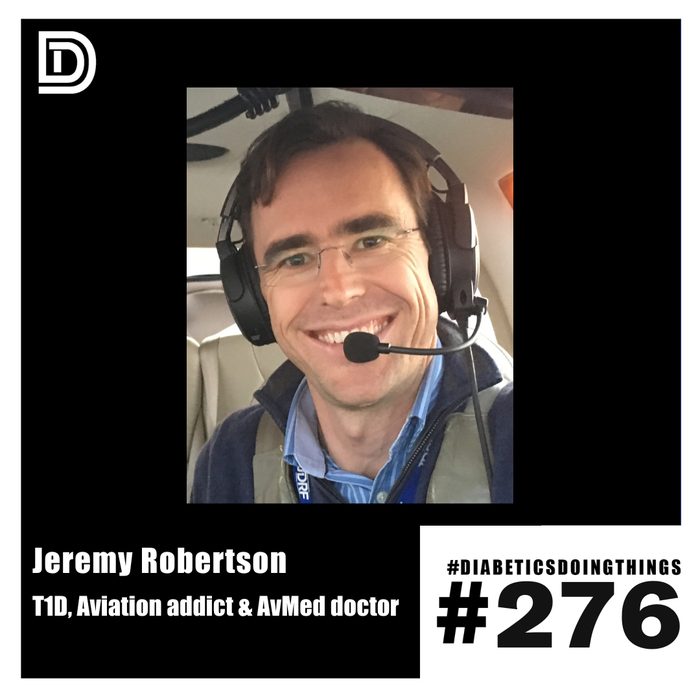
Jeremy Robertson is an Australian doctor and commercial pilot with type 1 diabetes, diagnosed in Los Angeles about 14 years before this conversation. The diagnosis initially ended his dream of flying, so he trained as a doctor and worked in family and aviation medicine. When Australia began issuing class one medicals to insulin-treated pilots in 2020, he was the first recipient there, but COVID then froze airline hiring for years. He eventually landed two airline job offers and is now training to fly 737s, including simulator work in Dallas. He and Rob cover the medical rules pilots with diabetes must meet, how he manages blood sugar before and during flights, being open about diabetes with colleagues, mentoring young pilots, and advances in diabetes technology.
Key takeaways
- Jeremy says Australia's class one medical requires pilots with diabetes to use a CGM, keep HbA1c under 8%, and stay in roughly a 100-300 mg/dL range more than 80% of the time.
- He says his CGM has to be running at least two hours before a flight, and his blood sugar has to fall in that range before the flight can start.
- He says if his blood sugar climbs to roughly 350-400 mg/dL or drops below 75 mg/dL during a flight, he has to hand controls to the other pilot and correct it.
- He was the first pilot in Australia issued a class one medical with type 1 diabetes, in April 2020, right before COVID froze airline hiring for years.
- He says being open about his diabetes with fellow doctors became his way of teaching other physicians what living with type 1 is actually like.
Show notes
In this episode of Diabetics Doing Things, Rob and Eritrea interview Jeremy Robertson, a pilot and doctor with type 1 diabetes. They discuss Jeremy's journey from losing his pilot license due to diabetes to regaining it and pursuing a career as a commercial pilot. They delve into the requirements and challenges of managing diabetes while flying and reflect on the advancements in diabetes management technology. The conversation highlights the resilience, determination, and inspiration found in Jeremy's story.
Topics discussed:
Jeremy Robertson's journey from losing his pilot license to regaining it
Requirements for managing diabetes while flying commercially
Reflections on advancements in diabetes management technology
The emotional journey of overcoming setbacks and pursuing dreams
The impact of Jeremy's story on inspiring others with diabetes to pursue their goals
The intersection of being a pilot and a doctor with diabetes
The importance of perseverance and long-term goals in managing diabetes
Key takeaways:
Long-term goals and perseverance are key in overcoming setbacks and achieving dreams.
Advancements in diabetes management technology have opened up new possibilities for individuals with diabetes to pursue diverse careers and activities.
The story of resilience and determination in Jeremy's journey serves as an inspiration for others facing challenges with diabetes management.
00:00 Exciting Interview on Diabetics Doing Things Podcast
00:03 Heartwarming Friendship and Global Connections: A Special Interview in Dallas
04:46 Emotional Journey of a Type 1 Diabetic Pilot: From Diagnosis to Returning to the Cockpit
08:31 A Rollercoaster Journey of Challenges and Triumphs: A Story of Persistence and Resilience
15:11 The Intersection of Medicine and Personal Experience with Diabetes: A Healthcare Provider's Journey
20:58 Shifting Conversations on Diabetes and Piloting, Inspiring Young Pilots with Diabetes, and a Random Condorman Story
25:16 Requirements and Guidelines for Pilots with Diabetes
30:09 Exploring the Intersection of Aviation and Medical Regulations
33:56 Journey to Becoming an Airline Pilot: Overcoming Challenges and Finding Inspiration
37:53 Inspiring Stories of Overcoming Obstacles in the Pilot Community
42:27 The T1D Renaissance: A Decade of Progress in Diabetes Technology
45:57 Exploring the T1D Renaissance and Friendship in a Podcast
Questions this episode answers
Can pilots with type 1 diabetes fly commercially?
Yes, in some countries. Jeremy Robertson says Australia and the US both began approving class one medicals for insulin-treated pilots around 2019-2020, allowing people with type 1 diabetes to qualify to fly commercially.
What blood sugar requirements do pilots with diabetes have to meet?
Jeremy says Australia requires an HbA1c under 8%, continuous glucose monitor use, and staying in roughly a 100-300 mg/dL range more than 80% of the time, plus standard checks like eye and kidney function.
What happens if a pilot's blood sugar goes out of range mid-flight?
Jeremy says the rules require him to treat it and hand control to the other pilot if his glucose rises to about 350-400 mg/dL or drops below 75 mg/dL.
Who was the first pilot with type 1 diabetes to get a class one medical in Australia?
Jeremy Robertson says he was, receiving it in April 2020, just as COVID halted airline hiring industry-wide.
Full transcript Searchable, with timestamps
Rob Howe: Welcome back to another episode of Diabetics Doing Things. I cannot tell you how excited I am for this interview today, guys. You guys have listened to the podcast for a long time, then you'll know that one of my favorite interviews and when people ask me what interview they should listen to or they should start with, I almost always say my interviews with my friend Jeremy Robertson, who is here with us in Dallas, Texas today. So I'm pulling up my questions that I have, like I am actually organized for this podcast, but I'm so psyched that you're here, man. Remember last time he was here? I wasn't here. Yeah, well. I've heard the story, though, because like you said, you were very excited for this episode. I was. So I was telling Ashley and Eritrea about the last time you were in Texas, which was in 2018. Yeah. And those of you who listen to the podcast and really know me love, like I love saying yes to things. So you were like, hey, I'm coming to Dallas. I'm doing this conference. You know, it's a thing I'm doing on the side. If I could stay with you guys, that'd be awesome. And we were like, oh, I was like, oh, yeah, no problem. and in between the time i said yes to that to and the time that you came to visit uh my dad got sick we got enzo as a puppy and i like totally was out of sight out of mind so when you came in we we had a we had enzo who was like we had only had for maybe four weeks he was a really excitable a very excitable puppy he's still very excitable still pretty puppy-ish uh and then on jeremy's first night so he like roll in like i don't know how many hours of travel from australia like so many difficult day coming in and the first night like michael j fox the cat like throws up in the bed and so like goes to the bathroom on the floor like our little apartment is in chaos my dad's in the hospital like i'm you know frazzled all over the place and jeremy just could not have been a more gracious and awesome guest and even in the middle of that you got to go to a conference and I think I've talked about this when we did our second interview where you got to meet one of the heads of the FAA and talk about the legislation, which eventually now has brought you back here.
Jeremy Robertson: Yeah, that's right. And look, as a testament to how good a host you were, I don't actually remember any of that happening with your animals. I think I was just so excited to meet you in person and stay with you guys.
Rob Howe: Well, we were like so happy to have you. And we are just anxious about our animals causing stress on people all the time, which I assume is how people are with their kids. No. Okay. And I don't have kids. No, but both of you guys are so cute because I would have left. I would have packed my shit, dog. And I'll catch you next time.
Jeremy Robertson: Really, the only thing I remember was Michael J. Fox, because I had occupied his bed. Yeah. Just waking up with him next to my face on the pillow most mornings.
Rob Howe: It just makes me laugh because it's like you guys connect already on the diabetes. So it's like, okay, we've done that. But on the human level, you also really seem kindred spirits. Well, yeah. Speaking of Enzo. I think that's something that I also haven't really shared. And that's all these dogs. Hey, Bowie, what are you doing? So we had a little bit of a dog interruption. Not Enzo, but another one of our office dogs at Recreation. Because we're recording this in person at Recreation Dallas headquarters. And those of you who are watching on YouTube can see us here. But there's a couple of things. So because you are based in Australia, the first time we did an interview was a weird day. And I remember it very specifically for a couple of reasons. And I was telling Ashley and Eritrea about this on our diabetes status call the other day, our diabetes status call. So I played golf with some friends that morning who I'd never really played golf with before. Kendrick Lamar had released an album that day. So we were listening to that on the course. And then I decided that I was going to make my way from the golf course where we were at to my parents' house without GPS because I was like, oh, this will just be an adventure. And I got so turned around and lost in like this very, you know, eclectic, strange part of Dallas. So anyway, I roll up to my parents' house. Barely like pass go, do not collect $200 like Monopoly thing and like run upstairs to their guest room, set up the podcast, which I had never recorded there to talk to you for the first time. And I remember that episode, like I had had some people from New Zealand and some people from international communities on the podcast at that point, but I never really realized how many people were listening to it or how they were. And you were telling me about a trip that you were taking to maybe your in-laws or a family trip and you had to join your family there later. so you really had a long road trip by yourself and you were listening to the podcast and that for me for the first time like helped me understand that the podcast was global like people really were listening to it everywhere and so i just i think about that and i hold it as very special time for me so that's a lot of our friendship as well as like and i just love your story and and you're you're my great friend so thank you for being here today absolute pleasure to be here again so you've come back to dallas and i think that's where we were going to get to is that all of this traveling and being a pilot and these other episodes that you've done have brought you back here, right? Yeah. So the good news is if you can go back and listen to our episode in 2019 about the FAA allowing type 1 diabetic pilots to get their class one medical. So you are now, do you have your class one medical or, and you're, you're going through the training to be a commercial pilot again? Yeah. So Australia, this was the
Jeremy Robertson: authorities in Australia were working through the same process in parallel to the FAA here in the US regarding insulin treated diabetics and commercial. And the approval came through here, I think in November 2019, Pietro got his class one medical and it went from there. And in Australia, it was April 2020. I was the first one issued in Australia. And of course, I think we all remember what happened in that kind of time frame. COVID went, the airline industry grew around to a halt. So any possible jobs for pilots, especially in Australia, just evaporated. And that was about almost 10 years. It was just after 10 years after I'd been diagnosed. So I thought, 10 years, I'm finally now in a position to get back to some potential flight. And that goal just disappeared again because there was no hope of employment until the aviation industry recovered. And at that point, yeah, we had no idea what course COVID was going to be. So yeah, I just continued working as a doctor, which was my profession at the time. And the industry recovered. Airlines started recruiting again. I've been fortunate to find myself employed by an airplane again and be flying their 737s or 737s, as Americans say. and we are so busy with training in Australia that we've run out of capacity to do all of the 737 training in Australia. So a lot of airlines are offshoring their training. So the company I work for is actually renting a simulator of Southwest Airlines here in Dallas. I'm here in Dallas from 737.
Rob Howe: Getting that hospitality training in Southwest, baby. You know, they say, you know, Dallas is the Australia of the South. No, they don't say that. But, well, it's so great to have you back. And I kind of want to talk a little bit about the emotional journey of getting your class one back, because there's been so many, there's been a lot of wins. Right. And I use your story when I talk to people about how people respond to a diagnosis and how everyone is different and how mere mortals like Eritrea and myself, like, you know, she was a child and I was a teenager. But, you know, we had this like, oh, no, kind of sense of, you know, the way that we were going to live, you know, has drastically changed and we felt a certain way about. And I know you've talked about you going through that as well, but becoming a doctor, going to med school, practicing as a physician, and then even getting to work as a physician with airlines to now be able to be back where you were nearly 14 years ago this week, if I'm not mistaken. Yeah. Yeah. where you're diagnosed in Los Angeles, you grew up wanting to be a pilot. You know, you talked about going to air shows with your dad and, you know, falling in love with the sky. I've learned a little bit since getting to know you. We've done some work on the professional side at recreation on pilot recruitment. And, you know, sometimes like being a pilot is born. Like you just, you know, a lot of those guys and, you know, Jerry Brzozowski, friend of the podcast you guys just love to fly and getting that taken away and then getting it back but then still having to go through a nearly five-year journey to get to where you're still you're still training to get back in the cockpit what's that been like oh well it's a series of
Jeremy Robertson: highs and lows i guess uh yeah i guess the journey from initial diagnosis through to receiving my medical was, I think, was just incremental. There were no major setbacks in terms of getting people back. There were no giant leaps forward, with the exception of when that medical was finally issued. That was a pretty slow and steady kind of journey. But yeah, the last four years have been a bit more of a rollercoaster. Because I've been working with the regulator in Australia, I kind of knew that my medical was probably coming. And when COVID kicked off, I didn't hear from them, didn't hear from them. I was just about to write them an email. I composed it in my head saying, we've probably got bigger fish to fry. Let's just put this project on hold. Yeah, that email was rattling around in my head. When I got the email with my medical being issued, that just kind of added it. element being unexpected. At the same time, knowing that I had this medical into wards, that had been a three-year process to get that medical approved, and there was now no way for me to actually practically use it. I remember I was working in family medicine at the time, and I had a gap between patients, just remember, at my desk, whether I should cry. It's just the irony of the situation. And then COVID, I think everyone has stories of what they did for work personally and professionally during COVID. I'm the same. I got an opportunity for a job that was very unexpected. It was just going to be for a month. And then there were some staffing changes while I was there and suddenly I was the only at this point for many months. Fantastic opportunity for my career. Lots of great experience. A ridiculous level of work never to repeat. And then suddenly ending up in a position where I applied to two major airlines, job offers from two major airlines. Beast. Yeah, just a ridiculous piece. Yeah, now I feel like at the point, actually employed by an airline and allocated an airplane, doing specific training for that airplane. There's about six or seven weeks left in that train. I'll be there. I'm really just trying to focus on my training.
Rob Howe: We were talking a little bit about that on the way over here. Visualizing that day where you're back in the cockpit and going through the pre-flight and you're there with your captain as a first officer. how many times have you visualized that over the last 14 years?
Jeremy Robertson: Yeah, it counts.
Rob Howe: And you're close. It's right there.
Jeremy Robertson: In the scheme of things, I'm this close.
Rob Howe: It's nice to hear a story where we already know that there's a happy ending. But as you were like, I don't know, in my head I see a Hercules-type journey, some Odysseus thing where you have to beat all these monsters, get through all these beasts. How do you get to the next challenge? I think this is something I struggle with every time we talk to our guests because you guys all seem so motivated and driven. It's like you didn't ever just sit in the room in the dark and cry. Like you didn't just want to give up.
Jeremy Robertson: Yeah, yeah. There were days where I wanted what I was doing. Yeah, medical training is hard. It's hard academically. It's hard emotionally. It's physically working hours. And there were days where I really questioned my life choices. But, and the last four years have been particularly draining. I think I'm just looking forward to having a job and just for 12 months just going to work, doing my job. I just want to cruise for a bit because literally the last 14 years it's been a constant, just about out of the bush. So I need a year of just cruising. And I'm sure there's things in the back of my mind that are incomplete, things I want to work on, things through the diabetes space other little first projects there's plenty for me to do just
Rob Howe: is it a personality thing do you think you guys are just because it kind of just reminds me of you do you just have push in you like there's just an unlimited amount of push like i think
Jeremy Robertson: for sure limited for me i can't yeah yeah well i guess till now i never found my limit
Rob Howe: recently found my limits okay so where did where did were there moments where you needed to find more push and you're like I just I need to get to this point or I need to get here what help do you
Jeremy Robertson: get to that for the next step well I guess and one of my neighbors said this the other day he said you know you seem to be the the master of the long game and that helps with diabetes but all these kind of personal and professional goals it has yeah I guess it hasn't fazed me that it's something happens and it's like oh that's going to be another year to get that to happen it's just you can always see that end goal and be with that as long as i'm working towards it so i think that yeah that mindset wow helps and that's it's not something i've ever consciously adopted
Rob Howe: it's just part of that's interesting you might have ran marathons in another life i don't know that's what it's giving it it is an interesting like allegory for diabetes because it is you You talked about ups and downs. We talked about the long game. You blink and 14 years goes by, and you're managing your sugars every day. How many injections? How many finger pricks? How many CGM changes? So many. And you don't notice them day by day, but as you zoom out, you start to say, oh, wow, I've checked my sugar 30,000 times. It's remarkable. I want to shift into my question, but it is a long game. I think life is, you know, unfortunately, we don't know how much time we have. Right. So it's both a short and long game. You have to live for the present and also, you know, pace yourself for the long journey. But you've mentioned something about, you know, being a good example for life with diabetes. But what I wanted to know and like I'm curious about from your journey as a health care provider. like looking back how has your journey practicing medicine made you see your own diabetes differently or or even change the way that you think about it yeah it's it's an interesting question because it
Jeremy Robertson: certainly gives you a slightly different perspective on your own personal condition i definitely remember the week at medical school where we were just focusing on diabetes for a week and just learning about all the horrible ways you can die from this disease. It's pretty sobering hearing doctors speak in doctor speak to other doctors about all the things that can go wrong whilst sitting there as a person with diabetes trying not to take it all personally. Yeah, that was pretty sobering.
Rob Howe: It's hard to do it. I find it very difficult sometimes to hear people talking in platitudes. Because, like you said, it's only a week. But for you, it's every minute of every day. forever so and we talk a lot about patient lived experience here on the podcast and how important it is because we it's not just one week for us even though you know it's formal medical training and doctor speak as you characterize but we know so much about what's going on and so then to be able to see it and talk about some of the things that are uncomfortable for us to think about
Jeremy Robertson: obviously really sobering yeah yeah and then out in clinical practice working in the hospitals that gives you a very skewed viewpoint of people with diabetes because you only see the people that have ended up in DKA or have not managed themselves for a long period of time and have developed complications. So seeing young people with significant levels of complication was really, really very sobering and upsetting because in Australia the public health care system makes all the medical side of things available for themselves. So that definitely gave me more motivation to focus on my own diabetes. But I guess what I tried to do, I was very open with diabetes. So all the doctors that I worked with all knew I had type 1 diabetes and would see me managing it all the time. So I guess I just became, that was my little mission. I would just talk to doctors about type 1 diabetes because it's a recurring theme that as a doctor, if you don't specialize in it or if you don't encounter it on a regular basis, it does, it becomes a week of med school that you probably don't cross paths with again. Doctors just aren't familiar with it. Yeah, that opportunity for doctors that I work with on a day-to-day basis to interact with it, that was my little attempt to educate the doctors.
Rob Howe: Yeah, like a little re-engagement. He took a pledge without even knowing. You took a pledge. No, there's this pledge to end stigma, right? And I think that we forget that stigma is perpetuated in everyday conversations and small societal opinion. So if you are talking to everyday physicians on a human level with like, hey, see me, Jeremy. See me as a patient instead of XYZ person who walks through the door. And that's going to humanize people with diabetes more to them. You are defeating stigma in a way or fighting it. It's like, let's get this man a superhero cape at this point.
Jeremy Robertson: like yeah well i mean it's a very personal choice because i know some people aren't comfortable with being open with their diabetes and i've worked with a doctor it's hard to just be vulnerable
Rob Howe: enough to do that yeah i mean not everyone has to right so when you make the choice to i don't think one even realizes the mission that they're setting on right because maybe you're like it's my secret mission i think we all well the people in this room i forget how often i talk
Eritrea: about diabetes because i'm just all constantly talking about it well that's it i was annoyed i
Jeremy Robertson: I've got half a dozen tacky type 1 diabetes T-shirts of various kinds. I didn't bring any with me, which is very unusual. So I'm normally wearing T-shirts. I mean, you're wearing the merch. You've got the hat. You've got the JDRF hat on.
Rob Howe: You've got more merch than anybody in this room. Yeah.
Jeremy Robertson: My CGM is usually visible with a bright colored sticker on it.
Rob Howe: Yeah, yours is cool. I saw it. It was like the solar system. Yeah, little space man. Yeah. Men is trending. Men is cool. Hey, I have a little peels thing on my pump now. Oh, cool. And I never thought I would be a sticker guy on my pump. I'm a donut T1 Tactical girlie. Shout out to our friends over at T1 Tactical.
Jeremy Robertson: I haven't got anything for my pump yet. We got to get you some. Yeah.
Rob Howe: Get some pump. Yeah, we got to hook you up with some stickers. Maybe we do like, maybe we just pitch some aviation stickers for you guys. Wouldn't that be cool?
Jeremy Robertson: Yeah, well, I've been thinking that I should make a CGM sticker because the G6 looks like the fuselage of a stubby airplane. Oh, yeah. You can make wings in an engine and something.
Rob Howe: I think we got ourselves a good idea. Listen. This is on the list. Yeah, there we go. in my brain. I love it. Right out the dome. Maybe we can help. Maybe we can help.
Jeremy Robertson: Yeah, someone out there in T1 land who's a graphic designer or something, please make me an airplane sticker for my seat. Say less. Hey, I was going to say
Rob Howe: careful what you wish for because we're going to make that work. Okay, I do want to talk about pilots in the T1D community because you guys are very close and, you know, there's Facebook groups and there's websites and obviously we talked about Jerry. Wait, there's a lot of them? There's like a bunch of you guys?
Jeremy Robertson: Well, on a global scale, if you put us all in one room, there's probably quite a lot But, you know, the Venn diagram of pilots and people with type 1 diabetes is pretty narrow. Oh, okay.
Rob Howe: Pretty small group, but they – I feel like you guys are very well networked. Okay. And I think the peer recommendation community where you find somebody who's interested in aviation or is a pilot and, you know, whether commercially or just for fun, hobbyist, you guys get connected pretty quickly, it seems. So in the last four years or so, what have those conversations been like as you guys are kind of seeing those people like you mentioned, like Pietro, like John, who are now in the captain's seat living with type 1? Yeah. And then, you know, you also have like the hobbyists like Jerry who are flying around and going to, you know, meeting other pilots with diabetes and kind of evangelizing it in that way. What have those conversations been like?
Jeremy Robertson: Yeah, the conversations have definitely shifted because in Australia, there were, you know, before the class one medicals became available, there was really me and a couple of other pilots kind of pushing it in Australia. So the majority of pilots in Australia with type 1 diabetes were private pilots flying recreation. And I would try and find them and chat to them. But the conversations, they were just, they were, it flew for fun. So there was not that drive to get a class one medical or change the rules or back. happy with what was there. And because the career wasn't available, there weren't those conversations with young people wanting to become commercial pilots. It was that unfortunate phrase, you know, well, there's only three things you can't do once you're diagnosed. But, yeah, in the last four years since the medical has become available, that conversation has just shifted, young people getting in touch with me or any of the other pilots that are flying. And just, I've always wanted to do this. I didn't know you could do it. How do I do it? Yep. a superhuman diabetic, just reassuring them, have a conversation about their levels and what they're using to maintain their diabetes, you will probably be fine. These are the rules. This is the process. Go off and do it. I can think off the top of my head of five or six young pilots in their late teens, early 20s who are at various stages of their training or getting their first job in Australia. and it's it's just been so rewarding to to see that happen last three or four years
Rob Howe: that's really cool man like you know even going on seven years since you were on this podcast for the first time those people were 12 13 years old you know and now able to in the last four years be able to say oh okay well this is an option for me and like you said it used to be the three things like right military scuba diving and flying an airline pilot like now it's just maybe two so you used to be having a baby too right like you weren't supposed to do i don't know i thought there was a bunch of stuff you couldn't do well there might have been like you know if we had been podcasting 40 years ago there's probably more than 10 things that they used to say you couldn't do that's so i there's probably a lot of things this is such a random aside do you know who condor man is who sorry condor man no okay do you know is that like a is that like a doug thing? No. Okay, so it's a random aside, but it's diabetes related. I just thought of it because you were like, you have to be like a superhero to fly around with diabetes and be a pilot. So at Camp Sweeney, for all our Sweeney listeners, there's a story at Camp Sweeney that they tell about this man named Condorman, who was a type 1 diabetic whose parents owned a bubblegum factory and made him chew all this very sugary bubblegum until he went blind and had retinopathy. This is the story they tell kids. Are you looking at my face, listeners? and he went blind and so he would go to sweeney and he would like go on the all camp hike but he's blind so he got lost one day during the all camp hike and this monster person dr zord meridian why do i know this story took him into his lair and was like do you want to have superpowers and the kid was like well i guess i'm here he's like okay so he puts him in this machine he turns him into half condor half man but doesn't cure his diabetes and he becomes condor man and he would fly over Camp Sweeney every Monday night and drop Trident gum for all the children. And I would stand outside with all the other little children and stick my hands up in the air for the gum. But I always thought people could fly with diabetes because I didn't know that it wasn't allowed. You guys haven't heard this story? No. No. I can't believe you think this is like a widely circulated story. I think we'd have to get the origins of Condor Man. Now I'm very curious about. We got to get more on the podcast. But there is someone with diabetes who's flying around in North Dallas dropping gum for kids. who has diabetes so we should find them and have them on next because i didn't know you didn't know them i i'm blown away by this story first i'm so sorry yeah i okay this is this you you did say random aside i was like i do anyways back to the real question okay so um you talked about the when people are curious about what it actually what the requirements of your blood sugar management diabetes control technology are. Are you able to share generally what those look like?
Jeremy Robertson: Yeah. I mean, very broadly, to meet the requirements of the medical, for a class one medical, you must be using a continuous glucose monitor in Australia. That's one of the rules in Australia. Your HbA1c has to be less than 8%, which is not a superhuman target. You don't have to be one of those militant low carbons that maintains a 5.5, less than 8. And they're now starting to look more at the CGM-derived data as well as indicators of stability, which is really good. So they're looking for various times in range. And broadly speaking, between 5 and 15 millimoles, which is what, 100 and 300 wacky units you guys use, about more than 80% of the time. So that's a pretty broad target. And they don't want less than 4 millimoles, less than 80, 75, more than 5% of it. So that's the kind of the control requirements. They're starting to look more at the coefficient of variation, things like that, the CGMs generate. But that's not in black and white yet. and then more broadly things that your endocrinologist or your family physician would want to look at your cholesterol levels are your kidney function they want you to have seen a optometrist or an ophthalmologist to check you don't have retinopathy they don't want you to have any long complications they want you to have seen a diabetes educator to verify that you've taken a course do you have to like repeat the course so that you make sure you didn't forget the course. No, no. At the moment, it's just a one-off entry requirement. Okay. So generally, if you fall in those kind of bounds with your diabetes control, then you would be eligible, apply, and you'd likely be successful. And then it gets more complicated then to maintain the medical because it starts to incorporate your level of control while you're flying. I have to to split out my cgm data for the time that i'm flying and provide that as well yeah that's what
Rob Howe: that was going to be my follow-up question was if you could take us through your diabetes component of your pre-flight checklist like what what does that look like and maybe it varies from time to time but you know for you as you're starting up and you know to the extent that you can share you know how do how does that factor into before you're you know taken up well the i guess it
Jeremy Robertson: It probably starts with me and my diabetes several hours to a day beforehand. I'm just going to be doing things or not doing things to maximize the stability of my diabetes. I'm not going to be having food that I'm not familiar with or not going to be going and doing an unscheduled significant amount of exercise or something like that.
Rob Howe: No, all you can eat pizza buffet.
Jeremy Robertson: No, no.
Rob Howe: Routine life for routine flight, right?
Jeremy Robertson: Yeah, exactly. whatever i can do to promote stability in my levels i'll be doing that and then in terms of the actual rules for flying i've got to have my cgm up and running at least two hours prior to the flight step that's pretty normal because it's just on all the time and then i've got to make sure i'm just above between five and 15 million miles between 100 and 300 for the flight to commence and that's really it. It's not that complicated. And to be honest, it's probably not too different to how you would run your day if you were going to be doing something that you knew was going to take a lot of your attention anyway where you didn't have as much attention to focus on your diabetes. If you had a big exam or you were going and doing something where you didn't have access. Yeah. So that's the kind of mindset. Just whatever I can do to promote stability and then in flight if if i do deviate outside that 5 to 15 that 100 300 range the rules just say do what you normally do to fix it so if i'm low it says check your blood sugar level and take corrective action it then has some hard limits so if you if i go all the way up to 20, almost 400, 350 to 400, then it says I have to hand over control to the other pilot and I have to take some corrective ins. Likewise, if my blood glucose drops below 4 millimoles, did I say that was 75? Yeah, 75. I have to eat rapid acting carbs, hand over to the other pilot. But again, coming back to the requirements of getting the medical, I've demonstrated that my risk of ending up in those positions is really, really small. So that's how it's important.
Rob Howe: It kind of sounds really logical, honestly. It's like insurance. You've never had the progressive thing that they make you put in your car so they can like, I don't know, I don't have progressive, but I've seen it on TV and they measure how fast you're driving to see how much your insurance is going to be every month because I guess they're measuring the risk. If you're slamming on your brakes. Yeah, are you texting while you're driving? Are you picking up your phone? So I guess it's a similar way of them analyzing the risk factor of your diabetes?
Jeremy Robertson: You've just summarized the whole of aviation medicine. Ah. It's risk, and specifically, it's incapacitation risk due to whatever medical condition you have. So if you can demonstrate that your incapacitation risk meets the threshold for certification, you should be able to hold a medic.
Rob Howe: Right, because what's stopping a regular pilot from having a, I don't know, I hope this never happens to anyone, but like an aneurysm, a seizure, a heart attack, stroke, like a regular shmegular dude can get on a plane. And I think, if I'm not mistaken, And some of that thinking, exactly what we're talking about, factored into at least the beginnings of allowing pilots with insulin-dependent diabetes to get their class 1 medical back. Yeah. Because you can track through the continuous glucose monitor.
Jeremy Robertson: That's exactly right. You can quantify your incapacitation risk because you can show the authorities exactly how much time out of your entire life you spend at a very low blood glucose level.
Rob Howe: and even like you know just reviewing your flight logs like you said you have to track it during the flight separately from the rest of your of your time so during flight like you could have 100 adherence to to the protocols over a long period of time and then again it's like okay well the risk
Jeremy Robertson: of this is fairly low and that that kind of data was exactly one of the things that supported the change in australia you know the uk had been allowing insulin dependent diabetics to fly for a number of years and they actually published their follow-up data so they they published for all that in-flight data how many times the pilots went high low etc basically validated the protocol so that was one of the bits of published medical evidence that supported the change in australia
Rob Howe: wow yeah so cgm's data big data it is and you know what i like to say we're now 40 minutes of the podcast before a Rob quote. So here we go. Oh my God, we made it. You know, what gets measured gets managed. You can track that. You can see it. And I think that's where, you know, when we talk about time and range as the, you know, new global measurement for diabetes adherence compared to A1C, which is still a good measure, but doesn't give you the full picture of, especially relative to incapacitation and blood sugar variants, you're able to see all that going on by once and day-to-day control like you said routines right so like you can you can also i guess man you're like the perfect person to do this you're a doctor and you have diabetes so you're like the guy i don't know but so you can look at things really and be like oh that's what i'll do on flight days because that's what works and then just mimic well as usual you're right on point but that was one of the reasons why you were able to have some of the discussions you were able to have
Jeremy Robertson: exactly right it can't remember when it happened but it was it was a little epiphany i'm like right I'm now a qualified doctor I have type 1 diabetes and I was also a qualified airline pilot how many of me are there out there in the world that could solve this problem I should probably do something so yeah
Rob Howe: what a moment, small 50 let me just change the world when you're an expert at two things there's a principle about that if you can be an expert at two three obviously but the principle is just with two I have a new white man role model hey yeah exactly as you as you should i'm not i'm just no it's just very it's just very interesting to be like this is you're uniquely standing at like this crossroads kind of that's exactly right
Jeremy Robertson: i stand at the intersection of two professional fields that don't really interact very much
Rob Howe: so well and they're also both really highly regulated and there's really specific criteria and in order for you to speak competently to one or the other like you have to really understand a lot of things that there isn't a lot of overlap with so yeah that's right a unique perspective
Jeremy Robertson: both professional fields have their own unique language if you ever sat listen to air traffic control or sat in a room with a bunch of pilots and listen to them talk about work don't understand any of that same with doctors when doctors get into doctor speak
Rob Howe: yeah so being able to translate yeah really use be an interpreter right and i think also like on the legislative side like not really understanding either of those and so like you know a pilot could go in front of that group and a doctor could go in front of that group and not be able to create the same resonance that an interpreter very cool is there anything that you like looking back in the journey where you're like i could have done that different maybe that i don't know is are there any like in retrospect you know hindsight 2020 you know what because i'm because i still
Jeremy Robertson: don't feel like i'm quite there okay i'm not qualified in the seat check to line as an airline pilot yet i actually haven't done that i haven't sat down and reflected on the journey yet it's still a work in progress still on the boat it's all good yeah yeah getting close to the finish
Rob Howe: line though like we have you know back to that like you know visualization of where we are yeah six seven weeks from now this podcast is going to come out and you know i'm going to share that social media post when you when when you make it and i kind of want to talk about that too you know when you're in that first officer chair obviously like you know i was asking do you have like a an announcement plan for the loudspeaker over the plane and you're like i don't know probably just going to be a regular flight for everybody else but you know visualizing yourself and even as you're in the simulator like working here over the past couple weeks it's it's a living visualization of what that's going to be like do you feel like that's going to have some sort of culmination for you of this like really exciting you know long-winded winding journey yeah i mean
Jeremy Robertson: i'm just like first take off i really just hope i don't burst into tears you know So hopefully I'll be able to remain a bit more controlled. But I think certainly at the end of that first flight, I think there will be a lot of emotion ready to be released.
Rob Howe: Cry? You should proudly cry. Cry.
Jeremy Robertson: Yeah, I'm hoping to have my wife on the flights. A couple of my friends have indicated that they would very much like to be on the flight as well.
Rob Howe: I want to go. I haven't been to Australia, so it's a little bit more of a commute, but I want to go. That could be our travel. I'm going to figure that out. I have to figure that out. Our off-site. Yeah. I have to allocate it some budget in different places than I had planned. But yeah, maybe we'll figure that out.
Jeremy Robertson: Yeah. I'm very much looking forward to it. Yeah.
Rob Howe: I'm just, I'm psyched, man. I really am. Because, you know, at the beginning of this podcast, and we've kind of been revisiting some of our favorite guests from the first 100 episodes, because A, Eritrea wasn't there to interview them. And B, I think we've come a long way, A, just a long time. And I, and a lot more conversations and I'm a lot more educated about diabetes, not just from my own perspective. And so remembering, and I think a lot of my early motivation was to talk to people who were also experiencing things that people with diabetes weren't supposed to do. I'm doing the air quotes for those who are listening. You're not supposed to be a pilot. You're not supposed to scuba dive. There's a few things that you're just flat out not allowed to do. And I think I, in my spirit, wanted to revolt against those, wanted to push back against this idea. Yeah, resist these limitations. whether they're real or not. And, you know, I just found your story so inspiring of how you could take a really big disappointment, turn it into a complete career change. And now 14 years later, like, you know, being able to go back and tell yourself in Los Angeles 14 years ago, Hey, like, don't there, this is going to be a wild journey, but like hang in there.
Jeremy Robertson: It's going to be all right. Yeah.
Rob Howe: I just feel really inspired by that. And I'm so glad that we were able to make this happen while you were here. And I just, I feel like your perspective as well. And like, We talked about the pilot community, but you're not the only story of a guy that lost his wings and is able to get them back. Or a kid that had a dream to be a pilot, and for a while that wasn't going to be the case. And now they can. Thinking of Pietro, who's a young guy and was diagnosed with diabetes, his path to being a commercial pilot seemingly gone. And then gets to be one of the first, if not the first person in the U.S. to get his class one medical with type 1 diabetes. and like there's still it's still early you know we still get to be we're still in the first generation of people with diabetes doing things for the first time yeah that's right and it's i
Jeremy Robertson: think it's only going to get easier from here you know the closed loop pumps are just going to get better and better and someone will make some advancement with islet cell implants someone will figure that out it is the that that incapacitation risk you know the worry from the flying point of view it's just going to get easier and easier to manage and it's going to be more and more accessible so yeah i think things only look better from here it's cool man you know
Rob Howe: knowing that and just thinking about telling kids and like telling people when i get to go out and meet them meet them that there are pilots flying commercial aircraft with type 1 diabetes and you
Jeremy Robertson: may not know it but you might be on one of their flights i mean i i love and when i used to fly i always used to love getting kids into the flight deck at the end of the flight and just letting them sit in the seat and pull levers and press buttons and stuff like that and i think when uh yeah when the first little kid that's got type 1 diabetes comes up to visit the flight deck after a flight that'll be a really special moment oh that's so sweet yeah i was definitely the kid
Rob Howe: that went in the cockpit and my dad would always take me up to the front of the plane international flights and i'd want to see all this like this stuff and they would let you touch the button so it'd be so cool to see a guy with a hey kid look at my meter look my cgm what a moment that is gonna be sweet maybe you'll cry then too yeah probably i would i know some parents are gonna be coming for sure for sure it's gonna be real real misty in there but also just very inspirational i don't think we think about enough what that does to little i know for me i was a little kid with diabetes seeing adults with diabetes doing cool things did spark something in my brain did make me think oh i see me a little bit but me you have to expand your mind to what's possible right you know for me with gary forbes like gary forbes in the NFL like he has diabetes like that's possible and you know jeremy in the cockpit of a of a commercial airliner flying you know that for somebody that could be the whole reason they go to flight school yeah you know eritrea going from sweeney condor man recipient to like leading global panels you know like those are those are real again i just keep coming back to 101 years ago yeah there was we died you know there was There was nothing around. And because of two guys on a summer project with their backs against the wall coming up with this awesome solution. And now over the next hundred years, all the people who have progressed. We were talking about some other members of the diabetes community, kind of Gen 1 diabetes online community and how that's grown. How our platform has evolved and grown. And we've been able to reach people like the next generation of people is going to do amazing, amazing things because of the groundwork that's been laid by the people who have been blazing these trails. So, again, I have to reiterate, I talk about you all the time. So just people ask, well, you know, what's the cool story you or, you know, what, you know, tell me, like, what do you what's your favorite interview of the podcast? Like, well, you know, there's this guy. He's a pilot, but he's also a doctor because, you know, when he got delivered this bad news, he found a way to make a change. And now he's going to be a pilot again. and that journey to me is just like if there was no other reason that we did this podcast like that to me was enough so um you know like i said i could i could brag about jeremy robson dr jeremy robson i want to say that i think these last couple episodes and especially this one maybe it's part of me growing up i feel like i'm growing up on this pod it's kind of weird but the takeaway seems to be like it doesn't happen overnight like it really really really doesn't happen overnight and we live in a culture in a society where it's all instant gratification on our phones and the computer and all this stuff and listening to someone go on a journey for 14 years like where it starts very like I don't know what's happening to now this is it is inspiring it is motivational I didn't know you before today so it is nice to meet you and then know that you're a real person you're not some like Instagram figure that just you know posts it's it's real it's life it's blood sweat and tears and that's crazy I think too we we talked a lot about it you never know i think a bit that i was doing what years ago when people would ask me and i still kind of do it but people ask me like well what's something you would tell your younger self i would joke that i probably was told all the right stuff i just it just wasn't the right time for me to hear it or i wasn't mature enough to to receive it and i think about that when you're talking about the the longevity aspect is i heard this first i think from tony robins years ago but it's like people overestimate what they could do in a in a day and underestimate what they could do or overestimate what they could do in a year and underestimate what they could do in a decade and you know it's been almost 10 years since you were on the podcast the first time and from just from there to here like all like and you still have three more years of that to go so it's like 14 years with diabetes all of the ups and downs certainly low moments certainly high moments but I remember you coming home from that event you're at that conference and there was the you know the big conference dinner and how excited you were about the conversations that you had at that conference yeah and then in the subsequent five years six years all of the advancements globally not just in Australia not just in the U.S. like all over the world opening things up for people with diabetes and I just you know I'm just glad I got to be on the sideline for that like that to me is like if i hadn't have started the podcast gotten and raised up and said hey i'm curious about this i want to get involved i never would have met you and we wouldn't be here having this conversation today and i wouldn't even know about all these amazing
Jeremy Robertson: people who were doing all this work behind the scenes yeah well it's my favorite quote of yours you know we live in the diabetes renaissance it's that's a rob howe oh man well if it isn't i'm I'm going to attribute it to him. I'll take it. Yeah. Put it on a t-shirt.
Rob Howe: I think I did. I did. That was one of my presentations, living in the T1D renaissance. Probably one of my first ones, honestly. Maybe you should revisit that one. Yeah. This is good. Yeah. It'll preach, right? A bar. As they say over here. Yeah. Yeah, we are. And I think, you know, last year that was really reinforced for me when we went to ADA, the ADA scientific sessions, because something that I think about a lot is when I was diagnosed, they talked about automated insulin delivery. They talked about hybrid closed loop systems that someday you're going to be able to look at your phone or your pump and see what your blood sugar was. Yeah. And now we're living in that. That's right.
Jeremy Robertson: I love looking at my watch. There it is.
Rob Howe: Oh, yeah. I don't even have to pull the pump out. I don't have to prick my finger. I can just do it really on the low. And now the next five years of stuff that's coming is unbelievable. There's a new pump just got approved this week that's super small. I love you. I'm so lit. And, yeah, I know you are. Where is it? Wait, pause. Wait, we'll see. And then even beyond that is like, okay, well, 14 years ago, there were no, CGMs were kind of around but very minimal, right? I remember- Not very accurate. Yeah. Difficult to wear and didn't integrate with the pump always. And now they're smaller and more connected and you can share them. Dude, it's non-invasive CGM is coming out. The Apple Watch is about to announce in the next six months that they can read your glucose from your Apple Watch. Exactly. That's crazy. So those types of really inconvenient things. So when someone's diagnosed today, they can get on an automated insulin delivery system relatively quickly. In the UK, that's NHS has passed out. I think in the same in Australia, right?
Jeremy Robertson: It's all publicly funded if you're under 18.
Rob Howe: So, you know, you're going to have access to those things, which makes your life with diabetes better. And the next wave of that is going to continue. So I just feel like we are in the T1D renaissance. This is, it is a, diabetes is terrible. We all would give it back if we could. But the good that's coming out of it and the opportunities that are coming out of it for people, I think, have never been more abundant.
Jeremy Robertson: Yeah, I would agree.
Rob Howe: Cool. All right. Well, you guys don't get to go to dinner with me and Jeremy, but just trust that we're going to have a good time. So, Jeremy, I want to thank you, man, for all your support over the years and just for being a true friend of the podcast and a friend of mine in real life. And, man, welcome back to Dallas.
Jeremy Robertson: Now, again, thank you very much for having me. It's just fantastic to be here in person.
Rob Howe: in Dallas with big text as your guide who could do it better I don't know and like you know you guys want to know what it's like to hang out with Rob Howell well Michael J Fox is going to throw up on your bed Enzo's going to go to the bathroom in your room and you still get to be friends after that so yeah you're cute all right see you guys next time
About Jeremy
Jeremy Robertson is an Australian doctor and commercial pilot with type 1 diabetes. He was the first pilot in Australia issued a class one medical with insulin-treated diabetes and is now training to fly 737s for an airline.