

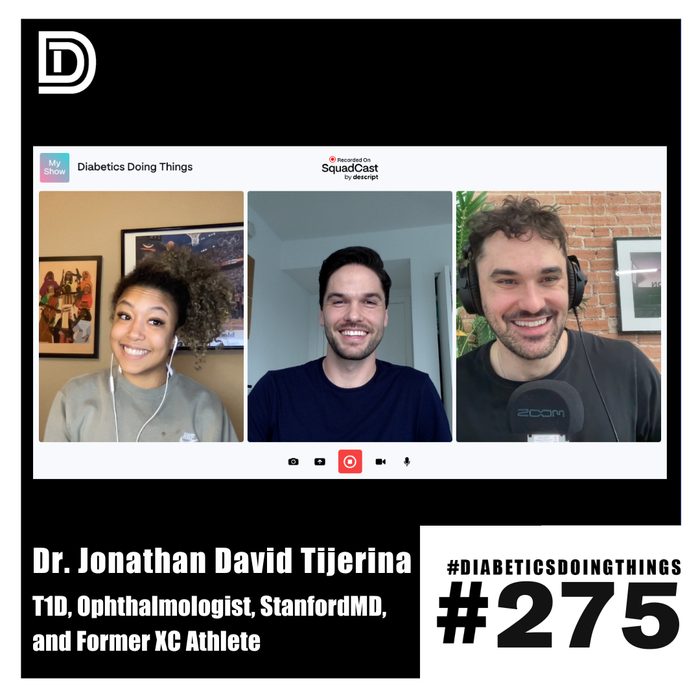
Dr. Jonathan David Tijerina - T1D, Ophthalmologist, StanfordMD, and Former XC Athlete

Episode summary
Dr. Jonathan David Tijerina, a former Baylor cross country and track athlete and Stanford-trained physician, returns to the podcast as a senior ophthalmology resident at Bascom Palmer Eye Institute in Miami, where he was recently named the program's first anterior segment chief resident. He has lived with type 1 diabetes for 18 years and uses a Loop system. He and Rob, joined by Eritrea, discuss diabetic retinopathy and diabetic macular edema: how high blood sugar damages small blood vessels in the retina, why annual eye exams matter even with good control, how injections and laser treatment preserve vision, and how imaging technology has improved detection. Eritrea shares her own diagnosis and treatment story. They close on patient communication without shame and balancing diabetes management with quality of life.
Key takeaways
- Dr. Tijerina says diabetic retinopathy and macular edema come from damage to small blood vessels in the retina, and the risk correlates with blood sugar control over time, though other conditions like sickle cell can increase risk independent of A1C.
- He recommends annual eye exams starting at diagnosis for type 1s, and within five years of diagnosis for type 2s, since eye damage can progress for years without symptoms.
- Eritrea says that if a floater or vision change appears, call the eye doctor immediately rather than waiting, since offices often have emergency slots for this.
- Dr. Tijerina says injections and laser treatment can preserve or restore vision in diabetic eye disease, and that modern imaging catches problems much earlier than exams done 20 years ago.
- He encourages patients to ask their ophthalmologist what their personal vision goals are, since treatment decisions can be tailored to what matters most to each patient.
Show notes
Disclaimer: The ideas expressed in this interview reflect the personal opinions of Jonathan Tijerina and do not necessarily reflect the views of the Bascom Palmer Eye Institute or the University of Miami Health. Medical decisions should be made with the collaboration of a licensed healthcare provider. Thank you!
In this episode of Diabetics Doing Things, Rob and Eritrea are joined by Dr. Jonathan David Tijerina, a former athlete turned medical resident, shares valuable insights on diabetic eye complications, focusing on retinopathy and macular edema. The conversation delves into the importance of lifestyle factors, regular eye check-ups, and advancements in treatment options for preserving vision in diabetic patients.
Topics discussed:
Dr. Jonathan David Tijerina's Journey and Expertise
Former athlete turned medical resident specializing in treating diabetic eye complications.
Career progression, including being appointed as the 1st interior segment chief resident at Baskin Palmer Eye Institute.
Understanding Diabetic Eye Complications
Fear of retinopathy among diabetics and its correlation with glucose control.
Impact of physiology and health conditions on susceptibility to complications.
Importance of addressing systemic issues along with localized eye problems.
Significance of lifestyle factors like diet and exercise in managing diabetic eye issues.
Prevention and Early Detection
Importance of regular eye exams for early detection and prevention of complications.
Guidelines recommending annual eye exams for type 2 diabetics within the first five years of diagnosis.
Managing blood sugar, exercise, sleep, high cholesterol, and blood pressure for preventing eye damage.
Treatment Options and Progression
Treatments including injections and laser therapy to preserve vision and prevent irreversible damage.
Early detection through routine screenings for better outcomes and prevention of serious complications like blindness.
Evolution of examination processes and data collection in ophthalmology.
Advancements in Imaging Technologies
Improved screening and imaging methods leading to more diagnoses and early detection.
Implications of advanced technologies like at-home retina photo-taking and cell phone attachments.
Correlation between risk factors for diabetic eye complications and overall diabetes control.
Challenges in Patient Education and Communication
Educating patients about diabetic eye disease without blame or shame.
Importance of clear communication, continuity clinics, and early screening.
Emotional burden faced by healthcare providers in delivering difficult news to patients.
Balancing Health and Quality of Life
Importance of regular screenings, following medical advice, and managing conditions like diabetes effectively.
Prioritizing eye health and establishing personalized vision goals with ophthalmologists.
Balancing quality of life with diabetes management, especially during personal and career changes.
Key takeaways:
Prioritize health, listen to medical professionals, and take proactive steps to manage diabetes effectively.
Seek immediate medical attention for eye issues and establish personalized care plans with ophthalmologists.
Educate patients without blame, communicate effectively, and emphasize the importance of early screening and treatment for diabetic eye complications.
00:00 Navigating Personal Opinions in Medical Podcasts
00:20 Uncovering the Success Story of Dr. Jonathan David Tijerina: From Athlete to Chief Resident in Miami
03:48 Understanding Diabetic Retinopathy and Its Relationship to Diabetes Control
10:18 Understanding the Importance of Regular Eye Exams for Diabetes Patients
18:50 Understanding the Progression and Treatment of Diabetic Eye Disease: A Personal Experience and Medical Insights
28:50 Unveiling the Evolution of Eye Health Examination and Data Collection in Diabetes Treatments
28:54 Evolution of Diabetic Eye Exams: From Old School to High-Tech
32:32 The Impact of Advanced Imaging on Early Detection of Diabetic Retinopathy
36:09 Understanding the Impact of Pregnancy on Diabetes Complications and Eye Health
39:18 Navigating Patient Education and Awareness in Diabetic Eye Disease
43:17 Understanding the Emotional and Practical Challenges of Diabetes Complications
46:42 Importance of Immediate Eye Care for Floaters and Establishing Vision Goals with Your Ophthalmologist
50:20 Balancing Diabetes Management with Life Changes: A Doctor's Perspective
54:14 Inspiring Stories of Overcoming Challenges in Ophthalmology and Aviation
Mentioned in this Episode: Eritrea’s Article, “Diabetic Macular Edema: How I Almost Went Blind”
Questions this episode answers
How often should someone with diabetes get an eye exam?
Dr. Tijerina says type 1 diabetics should get annual eye exams starting from diagnosis, and type 2 diabetics should start within the first five years of diagnosis, since eye damage can develop silently for years before symptoms appear.
Can diabetic retinopathy happen even with good blood sugar control?
Yes. Dr. Tijerina explains that while retinopathy risk generally correlates with A1C and glucose control over time, other factors like sickle cell disease, high cholesterol, high blood pressure, and pregnancy can make someone more prone to it even at a lower A1C.
What treatments exist for diabetic macular edema and retinopathy?
Dr. Tijerina describes injections into the eye to reduce leaking and inflammation, and laser treatment to stop abnormal blood vessel growth and prevent retinal detachment, with the choice depending on how much the condition threatens vision.
What should someone do if they suddenly notice a floater or blurry vision?
Eritrea recommends calling the eye doctor immediately and telling them it's an emergency rather than waiting for a routine appointment, since most offices hold emergency slots for sudden vision changes.
Full transcript Searchable, with timestamps
Rob Howe: Just a quick disclaimer for our guest and we'll get right to the episode. The ideas expressed in this interview reflect the personal opinions of Jonathan Tijerina and do not necessarily reflect the views of the Bascom Palmer Eye Institute or the University of Miami Health. Medical decisions should be made with the collaboration of a licensed healthcare provider. Thank you. Okay, let's get back to the episode. Hello and welcome back to another episode of Diabetics Doing Things. We're telling the amazing stories of people with diabetes from all over the world. I'm very excited because, as you guys know, on the podcast, we've been revisiting some of our favorite guests and interviews from all the years of the podcast and our first hundred episodes. And one of my favorite, we were talking a little bit before we started recording, one of my favorite T1D athletes of all time and just an all-around great dude, Dr. Jonathan David Tijerina. Welcome back to the podcast. You were on the podcast in 2017. We talked a lot about your career as a cross country and track athlete at Baylor. Ever heard of it? Going on to med school at Stanford. Ever heard of it? And now you are in your last year of residency in Miami and you're working and seeing patients. And I'm so psyched to have you back because even though we haven't spoken that much over the years, I just feel because of our social media communities, I'm like, man, this is the guy that we need to have on to talk about retinopathy, diabetes, diabetic macular edema and complications. So, man, welcome back to the show. Thank you so much for having me, right? I really appreciate it. Yeah, I've been following everything from afar. I still can't dunk, so I'm jealous of that. But I'm really excited to be here. It's been phenomenal the last couple of years here in Miami treating patients with diabetes amongst a bunch of
Eritrea Berta: other eye conditions. I'm happy to share. I also want to add that when I was Googling for this episode, because I am the infamous Google stalker, that a month ago you were added as the first Interior Segment Chief Resident at Bascom Palmer Eye Institute. And it's like super impressive because they've never had that position before. They created a job so that you could stay there because they think you're so incredible. So that's also like, we have a lot of winners on the pod, but I just want to start this one with like, you know, reminding everyone what kind of winner we
Rob Howe: have here. Thank you so much. I don't know if I would phrase it in exactly those terms, but I really appreciate the way that you phrased it. Yeah, I'm super excited. It's a new position and I'll be teaching residents next year how to do cataract surgery, staffing our, we have an emergency department only for eyes, completely separate building only for eye emergencies here, which is really cool. And I'll be staffing that also coming up. So I'm trying to prep. Well, it's been interesting too, like your transition, I, you know, I'm sure it's been kind of a whirlwind, you know, time flies when you're having fun, but, you know, coming out of Stanford, moving to Miami, starting to see patients and treat patients and, you know, working specifically around eyes. We're going to talk a lot about what we call at the pod, the C word, which is diabetes complications. And they are hot button issues and often, you know, get ignored for a host of different reasons. But we want to dig in with you, the expert, and kind of explore, you know, not just what some of these complications are, like talking about retinopathy, how common it is among patients with diabetes, but also how to build and have a relationship with your care team to, you know, manage that. And Eritrea is also going to like share from her personal experience. But, you know, for somebody like me who is every day is a new discovery about something with diabetes and I'm sort of just going off vibes, which I know a lot of our listeners do, you know, having having you to really rely on and kind of walk us through some of the ways that you and your patients work through some of these complications. I'm just really excited about. You do not super excited. I think having a patient who feels comfortable with you as their doctor and know that you're on their side is that is the biggest first step and something that I try to spend a lot of time in our first couple interactions with establishing with me. So let's dig into it. Whatever. Yeah.
Eritrea Berta: Robin, I was going to keep talking over to you this whole time. I think I was completely excited. But I mean, so for most people living with diabetes, I think it's routine for us to know, even at your PCP, you see an eye doctor once a year and that's the recommendation, right? But past that, retinopathy seems to be a really common fear. Is that the main reason, I think, for those yearly exams, right, so that your doctor can keep an eye on it. But the question becomes for me and for people living with diabetes, is retinopathy actually avoidable or can it just happen at any time, even for someone in good control? Yeah, that's a great question. So, you
Rob Howe: know, little background about where I am in Miami. There's a very large population of Latino and Cuban patients, as well as a lot of a large population of Asian Creole patients. And both of those people groups have a higher than average incidence of diabetes. So a lot of the patients that we see in our comprehensive clinics, which we run from the beginning to end of residency, same patients throughout the whole four years, you're adding patients as you go. So I've known a lot of these patients for a long time and seen the development of their eyes and in some cases, the development of their C word complications over time. And it tends to correlate with the control of the glucose and the control of your diabetes overall. But in some patients, we say some people are leakers and some people are are are bleeders and that i'll explain that a little bit more later but some people tend to be prone to those things happening at a lower a1c or what you would imagine would be like a better level of control and sometimes that has to do with other things that are going on in their body for example if they concurrently have sickle cell or something like that that also tends to damage blood vessels it's going to make you more prone to developing the same complications that are probably lower or better controlled a1c it kind of varies person in person. It varies also with, we say, time under the curve. So however long you've been controlled. One thing that I try to emphasize with patients a lot at the beginning is if they come in with something that needs to be treated, that you didn't catch on a screening exam or something like that, maybe they didn't even know they had diabetes the first time they're seeing an eye doctor, is that these problems didn't develop overnight and they tend to not go away overnight either. And that's something that is an expectation that needs to be kind of discussed at the beginning because otherwise your patients are going to come in and they feel like they've been misled or they feel like, why didn't you explain to me that this is not going to be done with one treatment and we're done. And I think that's something that's important to kind of establish. But overall, it does tend to correlate with your control of your A1C, control of your glucose. And sometimes it happens a little bit more aggressive. Can you speak a little bit to like the varying person to person we talk about? And we were talking about even before we hit record, like diabetes is not a monolith, looks different for everyone. And I think we typically make that like manifested to like how you respond to food or how you respond to exercise, like what lifestyle choices you make. But you're talking like specifically about physiology and, you know, adjacent conditions like sickle cell, like you mentioned, causing you to be more susceptible or more prone to complications than maybe someone without. And I think that's just a really important light bulb moment for me, you know, as you know, stepping into the role of the audience here is that there are things outside of your diabetes that impact what was happening within your body related to your diabetes. Is that fair to say? That's perfectly fair to say. I think that's something that people don't tend to take into account. And even when it comes down to eyes, people have sometimes a relatively small view of what's going on. And they feel like, oh, this is my eye problem. And usually I try to emphasize also that this is not an eye problem. The eye problem is really a local manifestation of the systemic issue. And if you don't treat the systemic issue, the eye problem will always come back, no matter how many treatments I do with injections, laser, anything like that, it will always come back. And sometimes it'll get worse, sometimes it'll get better. But the biggest way that we control this overall and make sure we protect your vision in the long term is to control the sugar. That's the biggest thing. I think that sometimes people have a very narrow view of their diabetes and outside of the context of their overall health, exercise, diets, other conditions like high cholesterol and and or dyslipidemias of other sorts, as well as high blood pressure are the most common combinations that we see that all tend to damage small blood vessels. And that's how they cause issues. But other things as well, in terms of keeping in mind that the eye problems are really a small manifestation of a big issue. We had Dr. Joshua Miller on the podcast a few years ago, and he was talking about, you know, damaging the microalbumin and like, you know, small, small blood vessels and like how that is typically like the first victim of diabetes complications and like how you're looking at sometimes that's gums, sometimes that's, you know, blood vessels in your eyes. My question for you, like when you're talking with patients about that, like often you're delivering kind of difficult news to hear, right? When, Hey, you know, your diabetes is causing a problem in your body and with your eyes, which is something I think we probably, I think holistically, I'll probably take our vision for granted more often than we realize. And then, you know, as you get a little older and you need glasses or, you know, you start to have some complications related to, you know, other, you know, chronic illnesses that you may have, you start to be, oh man, I really shouldn't have taken that for granted. So long way of asking, like, how does you also being a patient and you not, not just being a physician, but also living with diabetes and having these conversations with your own care team, like how does that help your patients, you know, when you're telling them these, these difficult, this difficult news or, and you're looking at, Hey, we need to address these lifestyle factors related to your diabetes in order to help with your eye health. Yeah. I think one, I appreciate the opportunity to do that. I think it's something I really value and it's not something that you, you know, one person has to share with their patient. I tend to, because I think that it helps establish that relationship and the patients are often much more accepting of advice that I give them and much more have a lot more confidence in the things I'm telling you about the overall plan and the overall prognosis of their issues or lack of issues and just kind of because they're like he gets it he's done it this is going on 18 years this year with diabetes it's been on you know it's been a track and kind of takes us back to what we were talking about earlier about screening screening recommendations I I think I tend to be not to get too philosophical, but I tend to be a person who's like, if you have the option to know what's on the other side of a closed door and you can do something about it, it's better to know. And if you are a person who has diabetes and is not getting your eyes checked, that problems from diabetes in the eyes are treatable and preventable in a lot of cases with advanced, you know, with advanced notice of what's going on, because it goes through a lot of stages that we can see inside the eye before you'll notice any sympathy. and that's something that patients don't really appreciate. Oh, I have something wrong with my eyes. My vision is 20-20 and it might be perfect. The vision might be perfect on the eye chart, but we can see that there are little spots of blood in there or little aggregates of protein in there from the damaged blood vessels that we were talking about. And even diabetic macular edema, to some extent, if it's not right in the middle of your retina, often doesn't cause symptoms. And so patients can go a long time developing these issues without knowing. So that's why the screening guidelines are kind of in place And the guidelines really are, you know, if you're a type 1, they recommend annual eye exams starting from your diagnosis. And then if you're a type 2 or not a type 1 or a person who's, I think a broader umbrella would be someone who's not instantaneously insulin dependent. If you're on oral medications for a while, they recommend starting annual eye exams within the first five years. And the guidelines for that really are based on whether or not it's probable that you could have been going years without being diagnosed. So a lot of type twos don't know they're diabetic and pretty high incidence of people who their first presentation of knowing that they have diabetes because they're not getting routine blood work, routine blood pressure checks or anything like that, is that they have something wrong with their vision. And then they come in and they say, oh, I have diabetes. I didn't know that. And that's something to keep in mind is that a lot of these people might not even know. And when you are the person who they come to, because they've, like you said, been accepting that their vision is great. They've just been going through life, doing what they got to do. They come into the eye doctor because their vision flurry and they're thinking, I just need glasses. Maybe even I just need cataracts or something like that. And then you have to tell them that they need a different kind of treatment that maybe not what they thought and that they have problems from diabetes, or maybe that they have diabetes. It's a big, it's a big responsibility to be that person for them. And on a broader scale, I think that's true. Many people will come into the emergency room here who have new eye emergencies or decreased vision that they trauma maybe, or something hit them in the eye or all kinds of things that could damage your vision. could be transiently, but to be the person who gets to help them do that is like really a biggest, one of the biggest things that's rewarding about what I'm doing.
Eritrea Berta: I'm glad that you mentioned that some of the treatment is like that noticing it early makes that treatment or like the condition preventable. I want to talk about retinopathy specifically, usually from what I've heard in the community, if you go to the eye doctor routinely every year, if they do see a retinopathy, what kind of treatments are available? For me personally, when someone's seen in my eye, my doctor was like, we're just going to keep an eye on it. We're just going to keep an eye on it. Is there anything you can actually do other than just
Rob Howe: improved blood sugar control? Yeah. So independent of blood sugar control, other metabolic markers tend to be consistent exercise with sleep. Basically, it all kind of comes back to the damage to those tiny blood vessels. Things that tend to increase blood flow or improve circulation like exercise and things that tend to decrease stress, inflammation, and your sugar, which are related to stress overall, like anxiety stress or lack of sleep, which increases cortisol, which is the stress hormone in your body, which can affect your blood sugar and your blood vessels, as well as managing any other conditions that you have or may not have in terms of high cholesterol and high blood pressure and things like that. Those things, if you catch them early, the best thing to do is modify those risk factors without having to do anything to the eye. And the reason is that kind of going back to the how it works, how damage to the eye from diabetes happens. There are a couple other things that you get a little quicker when you have diabetes, like cataracts, which aren't necessarily related to the altered or compromised blood flow. But in terms of retinopathy and diabetic macular edema, really the little blood vessels in the retina get damaged from the high sugar. And that can cause two things. One, it can cause the blood vessels to start to lack integrity and they start leaking, which is where you get inflammation and what we call edema, which basically just looks like little dots of liquid that shouldn't be there in the retina because typically the blood vessels are really tightly screwed on essentially and nothing leaks out unless we want it to, which would be like, you know, vitamins, oxygen, things like that. But when they start to get damaged, inflammation, liquid leaks out and that causes inflammation that can blur your vision. and if you have enough damage to the blood vessels that after the point that's damaged pretty bad you start to get lack of blood flow or what we call ischemia that's where you start to get things like retinopathy and earliest manifestations of that are bleeding in the retina protein aggregates in the retina which we call exudates and later manifestations of that would be things like bleeding into the eye called the vitreous hemorrhage and basically your eye tries to grow new blood vessels to replace the ones that are damaged which you would think would be a good thing but most of those blood vessels are not normal and they don't lack they lack integrity like we're saying with the other ones so they can pull on stuff and they can bleed into it and that's really where you get the differentiation between edema and retinopathy diabetic eye disease is kind of the umbrella term and you have those two things as the big entities within that and then there's a bunch of little stuff like cataract things like that that maybe related amd yeah exactly it's interesting to me hearing you describe like, you know, whether it's liquid leaking or blurry vision or blood in the eye or, you know, extra blood vessels or whatever the case may be like. And those are things that you may notice, like might be the first kind of hints or clues that you need to go see the eye doctor, especially if you're not even living with diabetes. You don't even know you have diabetes at the time. But earlier, you know, you were talking about even if your sugars are in control, like the recommendation is to go get the screening once a year. And, you know, I think I can kind of speak for most of us. I'm sure we've all gotten the eye dilation and we looked at the, you know, and had our doctor look at our eyes and those types of things. If not, definitely go do that. But it also seems like a thing where if you're getting good A1C numbers and your doctor or your endo are happy with your time and range, it's something that often gets pushed to the back burner. But what I'm hearing you say is that if you're good about the screenings, especially if you're already living with a chronic illness and you're diligent with the screenings, you can catch these problems prior to running into the issues of, you know, blurred vision or seeing the liquid in the retinas or these problems that become more acute and you're going to the eye doctor for if you're just going through your regular screening. Yeah. Yeah, exactly. And I think that really the question is, even if we do catch it, to your point, if we do catch these things in the early stages, the question really is, do we need to treat it? And for a long time, they thought that the answer was yes. And more recently, the recommendations are a bit more conservative because we have such good treatments now that often we can bring things back from pretty advanced disease and save a lot of vision in patients. But the question really is, is it visually significant? Is it affecting your vision enough that we feel like it's necessary to treat? And is the risk of not treating it posing some sort of permanent vision loss? Macular edema, specifically liquid in the macula, which is the center of the retina, which is responsible for most of your detailed vision. If the vision is worse than 2025 on our eye chart and there's swelling or macular edema around the center of the macular, which is an even smaller area called the fovea, then we tend to treat that with an injection into the eye of a medication that gets rid of the little distress signals that those blood vessels are making, which causes the leakiness and which causes bleeding. And if the vision is at a certain threshold, and then in the outside of the macula, outside of diabetic macular edema, we're looking at retinopathy. The question is, is it going to pose some sort of dangerous danger to your vision acutely, or is it going to cause some sort of permanent irreversible vision loss, which would be something like a retinal detachment from related to diabetes. And the way that we treat that can be either with an injection or with laser to the retina. But we don't tend to do that if there's just a couple little dots of blood, were just a couple little proteins or exudates. But if we start to see these big new blood vessels growing, we know the risk is now starting to kind of outweigh the benefit of watching. And that's when we recommend it. And you had mentioned this already, but it kind of like flows into one of our next questions, which is like the progression of diabetic eye disease, diabetic retinopathy. You know, sounds like detached retina was what you had mentioned on one of them. Like blindness, is that sort of the end game? Like what is that progression of the complications due to the retinopathy look like? Yeah, absolutely. So, you know, a feared complication of macular edema is scarring. The liquid we can get rid of fairly effectively as long as it's combined with glycemic control and those other risk factors that we talked about. But if it sits long enough, that liquid in the retina can cause destruction of the normal function of the retina. we call an exudate or scarring in the if it gets right under the center of the fovea then your vision often is very difficult to get good that even if we treat the fluid even if the fluid goes away because the scarring takes a long time to go away if it will sometimes it doesn't so if we see little drops of macular edema underneath the fovea right underneath the very center of your detailed part of your vision we tend to treat those even if the vision is not super effective because the risk is that it could cause a scar that we can't do. So injections are really the thing that treats macular edema. Previously, we used to do laser in the macula, which is not something we do super routinely now. It still is an effective treatment, but often it can cause what's called a scotoma or a flying spot in the center. Maybe not right in the middle of your vision, but it's something that people tend to notice because that's where they get most of their detailed vision. It's effective, but we don't do it that often anymore because injections are so effective. for retinopathy, if there's a few little blood spots out there, if there's a few little exudates out there, then almost definitely not going to be affecting your vision. And the treatment for those abnormal blood vessels that we were talking about that can cause bleeding or things like retinal attachments or even more rare forms of glaucoma, because those abnormal blood vessels can grow in the front of the eye, not just the retina and block the ability of the eye to drain liquid. The treatment for that is injection or laser to the retina. And the laser, if you do it early enough can often prevent tractional retinal attachment, the kind of breath, and very effectively prevent bleeding. The key is really kind of picking when it's benefit, the benefit outweighs the risk because every spot of laser you put, the reason we don't put it in the macula, right, is because it can cause a blind spot. Every spot of laser you put really, it acts as two things. It kills the retina that's there so that it stops making this distress signal that's calling for the new blood vessels to be made. And it acts like kind of a little spot well because the retina is a layer that's sitting on the back of the eye. You can weld it in place, then it's less likely to get yanked out, which is a retina. But, you know, potentially that can affect your peripheral vision because we're putting little spots of laser there. So we don't make them touch each other so that it's less likely that you'll notice. But we don't want to do that. We don't have to. And that's something we have to kind of weigh risk and benefit.
Eritrea Berta: It's so interesting to hear you describe it kind of from beginning to like treatment. I think so. We've talked about it a little bit on the podcast, but a couple of years ago, I've had type 1 diabetes for 22 years now. Hey, hey, me. That was yesterday. But a couple of years ago, I, yeah, thank you. A couple of years ago, I came home from a long trip. I've been like in Europe and Africa, like all these places. I came home and I was really frustrated. And suddenly out of nowhere, I was, I was in a bad mood, but out of nowhere, I started seeing like dark in my eyes. Just, it was completely out of nowhere. And I truly started freaking out. It was right. It was literally December 29th. So everything is now closed. I called my eye doctor who was opening up the next day for a couple hours in the morning. And I'd been seeing the same eye doctor since I was diagnosed when I was eight years old. So I know this guy, whatever. I go to the appointment. He's looked at my eye. He's like, well, we've known you had diabetic reptopathy for the last like five to seven years. We've been keeping an eye on it. It looks like it's progressed and now it might be something else. So I'm going to write you a referral to a friend of mine who's a retina specialist and I was just like okay when am I gonna be able to see this friend it's literally New Year's Eve I'm like freaking out I remember going to get an eye patch from Walgreens because having those dots in your eyes was making me have a headache and just like it was not fun and I quite literally was telling myself this is the beginning of me going blind like I would sit outside and like with one eye cover my and like look at the sky and be like take mental pictures because you never see you're never gonna see the guy again girl like this is it and when I finally got in to see the specialist I remember being really freaked out because everyone in the waiting room was like 60 years old or older and I was like what is happening to me like I'm not amongst my people and finally getting into the specialist they did all these like drops and they took they did like a weird IV that they were like we have to put dye in your eye and I was like what is this what is happening they did the dye in my eye and And then the doctor came in, Dr. Kazeeliak. He's great. I love him. And he was like, do you understand what is happening? And I was like, no, break it down because I am panicking. And he said, basically, if your eye was a house, the basement is flooded. The basement is completely flooded. And I was like, so what do we do? He's like, well, we got to drain the water out of there. And I was like, OK, what happens after we drain the water? Do we throw the basement away? Do I get new floorboards? Like, what is the step by step here? Don't give me an analogy, bro. Like, I need to understand. He said, first, we're going to drain the water out. We're going to completely drain the water out. And then we're going to bring you back in two weeks so we can see if there's still more water. And I was like, OK, what is what is draining the water out? I mean, he goes, we're going to use a laser today. And I was like, a laser in my eye? Yes. I was like, OK, it's going to hurt. He's like, no, we're just going to do some drops to numb your eye and we're going to do that. And I was like, OK. So we did it. It didn't hurt. I'll be really honest. I was expecting a lot of pain. I just sat there. They flashed a blight in my eyeball. And then I went home. Somebody had to Uber home because I couldn't drive. I Ubered home. I came back in two weeks. He looked at my eye again. They did all the same stuff again. The dye, everything. It takes forever. And he was like, okay, basement is drained. There's no more water in there. We need to rebuild the floorboards now. And I was like, what does that mean? What does that treatment look like? And he's like, well, we're going to do a shot. We're going to do a shot today. You shouldn't need more shots. But I want you to keep coming back every three weeks for the next two months so we can make sure. I was like, okay, cool. I'll do that. Came back and we did this out that day. Didn't hurt either. I was like, why does this hurt? You were putting needles in my eye. Like came back for six weeks. Everything looked great. He was like, you still look good. I think we're going to do treatment as needed. That's what I think we need to do with you. You're pretty young. You're only 29. Let's see you every three months now for eternity. And I was just like for eternity. And he was like, yeah, because I never know when you're going to need treatment again. so that's where I'm at now I think last September I was with Rob in Denver and I literally was like walking down the hall and he came up to me he's like what's wrong with you and I was like I have a floater in my eye because it was the first time I'd gotten one in two years so my question then becomes is that a normal product like diagnosis story does that is that just how it happened because for me it felt very out of nowhere and I truly thought I was gonna go blind and this is
Rob Howe: all my fault and now I'm totally fine. So yeah, I think, you know, it kind of depends on how much or how involved your discussions with your ophthalmologist were over the years when you're saying you are aware that you had some degree of diabetic retinopathy. We basically categorize it into two, categorize macular edema into kind of two categories there is you can basically think about it as something that's threatening your vision right in the middle We call subpovial or perifovial or extra fovial, which is less scary for us because even if it scars, it's not going to affect your central vision. And then you can separate it into kind of clinically significant where it's affecting your visual acuity on the chart or not visually significant. So not affecting your visual acuity. For retinopathy, we separate it into two categories broadly. Proliferative, meaning that there's new blood vessels. And you can diagnose that based on what the type of test that you had, which is called a fluorescein angiogram, where they put a dye. And basically, the pictures are really, really cool. Actually, if anyone ever wants to look them up, they'd use it for all kinds of different things outside of diabetes. But fluorescein angiography is basically highlight any blood vessels that are leaky, like we were talking about. And we'll also highlight any of those abnormal types of new blood vessels that are growing. And that's one way you can diagnose it. If it's hard to see into the eye, that's one that we usually go with. and if there's bleeding by definition you have a type of proliferative retinopathy as we know even if it's hard to see somewhere in the eye there's an abnormal blood vessel that's possible assuming that there's not a different cause of bleeding in your eye like trauma or something and then on the other side of that in the retinopathy there's proliferative and non-proliferative and then non-proliferative is based on is uh scale mild moderate severe which is based on some of the classic diabetes trials. Newer rec newer I guess classification schemes have been proposed because those old school trials which were you know props to the props to the OG ophthalmologist because they were doing all this based on exam only like not even good photos a lot of times they were literally counting the number of little bleeds that you have in your retina. They say okay this means mild this means moderate and severe and then there are certain characteristics of that you can separate into high risk or low risk. And that's for progression to having the bleeding. So if you knew that maybe you had severe non-proliferative retinopathy with high risk features, that would be less surprising than if you had, you know, say mild and you were getting annual eye exams and your A1C was 6.5. It'd be very surprising if you progressed from mild non-proliferative all the way to bleeding in your eye over the course of the year with good. That would be surprising. But if you knew that you had a higher level of retinopathy, maybe it would be less of retinopathy. You brought up something really interesting there, and you referenced it as the classics, the deep cuts, the OGs of understanding the eye health and you were talking about manually counting on examination, not even having good film. How has the examination process and the data that's collected, how has that progressed recently? Let's go back the last 20 years or So because this kind of fills into that theme that we've been talking about on the podcast, that it really is still early for a lot of diabetes treatments that, you know, 100, it's 100 years since insulin. And then all of the other things since then, we've sort of been, you know, learning about along the way. And so I'd love to know, like, you know, for somebody who is beginning an eye exam 20 years ago, what they were looking for, how they were looking for it compared to what you're seeing today. Absolutely. So, you know, we have good example photos of a lot of these things. diabetic macular edema used to be diagnosed based on essentially those protein aggregates or the little in on a photo I could show you photos on my phone which you want literally yellow dots in the retina and that's a sign that there was fluid there at some point so if your vision is blurry and there's signs that you've had fluid before the conclusion was drawn that you have fluid now and that's why your vision so they would treat it that way and for retinopathy they would they would look at the you know extra macular area and see if there was any evidence of new blood vessels growing, any evidence of new or old heme in the eye or blood in the eye, which tends to settle to the bottom. It's old and look kind of like whitish or khaki instead of bright red, like new blood. And go from there based on what they thought that you needed to treat. Of course, if you have, and then if you have any sort of manifestations of advanced disease, like what we call neovascular glaucoma, secondary to diabetes or retinal, that would be a sign that you have advanced disease. Nowadays, we have the more advanced imaging things like the fluorescing angiography will give you very easy to see diagram or readout, I guess. You have to interpret it yourself. No one does that for you, but the photos are much easier to see. And they're very easy to see compared to a normal exam if you have blood in a way, because they are very bright and kind of like light up as opposed to you having to try to peek through the blood when you do your exam, which is difficult. And for diabetic macular edema, we do what's called an OCT scan now, which is essentially a cut through the layers of the retina and it'll show you a little black dot which represents fluid or a leaky blood vessel instead of doing just looking like they used but those those original studies were really impressive i think on the note of original studies you know you might find if you look at the incidence of someone who is diabetic type 1 or type 2 the statistics are different but basically if you look at the incidence of some degree of macular edema or some degree of diabetic retinopathy at 20 years, the odds that you have it are pretty high, somewhere between a third and a quarter of people are going to have some degree of it. What I'll say is that I think that those are based on the older studies and that's before we had the treatments that we have now for diabetes in general. And nowadays we're catching a lot more macular edema because before it was based on looking at if you've had some sort of old swelling that never went away. And now we're able to catch tiny, tiny, tiny things that are probably not clinically significant. Anytime we have a new imaging modality in medicine, we have to make a decision on if we're going to care about it or not. And in terms of macular edema and retinopathy, it really kind of depends on affecting you and if we think it's going to affect your vision in the future. But we're catching a lot more stuff for sure. And that's interesting that you bring that up because, you know, it's like we're having more awareness, having better imaging, having better screening leads to more diagnoses of, you know, DME. So it, so it kind of like skews the data in that way, like, because we have the access to it, because we have the new testing, more cases are being reported, but that's just stopping like the rapid development or like, are the late stage cases, or maybe even some of like, you know, preventing some of the like later stage cases, because we're catching it earlier. Exactly. Exactly. I think that's me. I'm not a non-scientist, an idiot. No, that's actually, I think more, that's a good interpretation that I think a lot of scientists who get excited about the imaging and the pre pictures, which I do also, don't really take into account is that probably there's some degree of inflation, if you will, in terms of diagnoses, because we're catching things so much more readily. It's so much easier to screen people even at home now. There are, you know, we have imaging centers, people can just go to just for a photo of the retina, you can do it undilated, and you can see really well, pre or out to the edges of the retina to catch things that people who don't have time to come into a full visit for a dilated exam and, you know, be out of commission in some cases for, you know, four hours, six hours, the rest of the day, depending on how long your eyes stay dilated and what you do for work. Even cell phone cameras, there are attachments that they're developing now in beta testing to see if people can take their own retina photos on their cell phone with a special attachment to see about screening people at home. We're just going to catch a lot more. So with that as well, as like, as we're catching it, as we're diagnosing it at different times, is there a specific time frame that we need to be aware of it? Or as a patient and a listener with diabetes, is DME, can it pop up at any time? We've talked about it's not always related to your HbA1c or your time and range of control. Sometimes you had a big nod when Eritrea was talking about how long she's lived with diabetes. So is this something that can happen at any time? Is this something we need to have more awareness of as we live longer with diabetes? is just something that could pop up? I think definitely we're going to see probably more subclinical cases as we live longer. I'm hoping, you know, and I understand that I'm coming from a place of being very fortunate in terms of having had access to like the loop system and everything relatively early on with my mentors at Stanford getting me connected with that, which has been, and for a grown who doesn't know the loop system is a kind of jailbroke artificial pancreas system that has been saving my life for the last nine years, which has been incredible. recently fda approved yeah exactly i'm trying to get on that train as soon as they have it for iphone but uh but it's been i mean that that technology i think has the potential to really change the trajectory of people's of people's diabetic complication because the degree of effort you have to put in to maintain a relatively low a1c is so much lower and even you know once you stop inputting variables like if you're asleep for eight hours and your sugar is 120 overnight that's significantly going to decrease your risk of having any sort of complication by you doing almost nothing extra. And then, you know, not to mention putting in some work during the daytime as well. But those data, I think, are probably going to continue to be rising, potentially with some aspect of embracing from the better imaging that we have. But as we live longer, I think, yes, and the risk factors tend to correlate well with control for diabetic macular edema or retinopathy with the caveat that if you have some sort of other, you know, we would call it a vasculopathy or coagulopathy, where you're more likely to damage your blood vessels from some other reason like cholesterol or blood pressure or other diseases or other conditions, genetic conditions in some cases, you're more likely to have those things develop even with a better controlled A1c. And the one other condition that we see, not really a medical, I guess it's a medical winter is not a disease by any means, is pregnancy tends to accelerate these things. And pregnancy tends to third space fluid into different places, which basically just means that in different places, fluid goes where it doesn't usually go. For example, swollen ankles, fluid stays down there a lot of times in pregnant women. And a lot of times we see exacerbation of macular adenal pregnant. So that tends to kind of, that's an area that we keep a very close eye on,
Eritrea Berta: especially in our tech ones. It's so interesting that there's all these factors and things. And basically, can it happen because of uncontrolled stuff? Yes. But can it also happen because of longevity? Yes. But can it happen because you're pregnant? Yes. There's all these reasons. So I remember feeling really bad about myself when all this was happening, just very much like this is your fault. This is your fault. I know now that that's not necessarily the case. So for patients who are struggling around feeling guilt and shame around a diabetes complication like retinopathy or DME, what would you suggest for somebody like that?
Rob Howe: Yeah. Yeah. No, I mean, I think that to some extent it's on the doctor to help reemphasize that this is not a fault thing. This is a condition that we're going to manage together. And I really feel strongly that people who try to put the fear of God in their patients by essentially saying, you are really going to hurt yourself if you don't try harder and things like that, which I've had, you know, expressed to me before. I think that's really damaging to the relationship between physician and patient. I think that you have to be honest with them because sometimes on the flip end of the spectrum, there's people who have very serious disease who don't necessarily take it that seriously. And there are people who have very early disease who don't think that it could get serious. And even from the beginning, I think it's important to be honest with them about what could happen in terms of complication. And the incidence is high. You know, one out of three people with type 1 diabetes and a little bit lower, but similar statistics for people who are insulin dependent, type 2s, have some degree of macular edema. And that's not something to be shamed of. It's kind of similar to how when I talk to patients about their cataracts, this is a good point that Rob brought up that it is almost a badge of honor to have a cataract because you've lived long enough that your normal lens is now exhausting itself. And I can help you with that. It's one of my favorite things to do. And one of the most gratifying surgeries that I've ever done where patients come in with only being able to see potentially hand waving or, you know, light only can't read anything. And the next day they could be 2020, they could be 2030. And they're extremely happy. And that's one of the most gratifying surgeries in the world for me. But when I talk to them about cataracts, a lot of people who are between the ages of 40, 50, and sometimes in diabetics, particularly type 1 diabetics, those cataracts develop quicker. And I tell them they have some level of cataract, which may or may not matter in terms of their vision and probably doesn't need surgery. And they're all very surprised. And I'm like, it's actually a good thing. But that means that you've lived long enough to develop this. And that's hard. In a lot of places in the world, it's very hard to do, especially with diabetes. It's fascinating because it does present a unique challenge where you want to address it head on and you want to address that this is a problem, that there are consequences, but you want to walk that line very carefully to not, you know, get into the blame or the shame or the stigma conversation. So you're doing a lot of educating in a very short amount of time. So I guess for you, like how, how much of that are you sort of just reading the patient in the room of like their body language or like how they're, how they're responding or like their level of understanding when you present those options? Because like you said, you know, patients are coming to you and they're saying that they've had experiences in the past where they, it's like more of a scare tactic, which I think, you know, broadly speaking, I can't, I can't speak like on an individual level, but at least broadly we're shifting away from that. I think from like that, it's not as helpful as maybe we had thought 20, 30 years ago, but there's still a lot of people who received that message. We've talked to a lot of people on the podcast who, you know, had diabetes for 30 years and their doctor told them initially, like, if you don't take care of yourself, you won't live past age 30. And like now that's across the board, pretty much not, you know, no one's saying that at this point, or at least for the people that we're talking to. So for you, like, how do you gauge those interactions on that level? Like when you're in the room with the patient? Yeah, I think I ask patients a lot. What, what is your understanding of what's going on? If I've seen them before, and like I said, you know, one of the coolest things about Bascom Palmer, where I am, is that we have a continuity clinic since day one when we get here. So some of these patients I've been seeing every, you know, month for the last four years, and I've been doing their injections or lasers as needed that whole time. And we have a very good relationship and they are on board with what's going on. They understand the treatments. They understand when and when, when they need it and when they don't. Some patients come in and they know exactly what's going on every single time. I have new flutters. I have my vision's gotten blurry again. That is something that if I know them, it's easy for me to judge. If it's the first time I'm seeing them in the ER, for example, sometimes patients will come in with acutely decreased vision or new bleeding or something like that. And I asked them, what do you think is going on? And then we kind of go from there because they might, like I said, they might not even know that they have diabetes and we have to start from that level. Do you know what diabetes is? Sometimes it's, you know, I know I've had diabetes, but I'm not on medication. My doctor said it wasn't that serious. And then you have to say, okay, well, I think that we need to, when was the last time you saw your doctor? When was the last time you had blood work? And kind of go from there. And if they need treatment, then that conversation becomes a little bit more granular and condensed because you have to get to the point where you say, okay, these are the risk benefits and alternatives to doing what I think we should do, which may be injections or laser. But overall, a lot of the patients that we see have a pretty poor understanding of diabetes at large. And definitely diabetes, diabetic eye disease is not something that's super commonly talked about. And I'm glad that you're opening up that can of worms to the audience because I think it's super important. And with the technology and treatment that we have today for screening, with the screening technology and the treatments that we have available to us, we can prevent a lot of advanced disease and we can bring back a lot of vision in eyes that have had some damage from diabetes. But people have to know that. It's really interesting to me, like you talked about patients and seeing patients that you didn't, that they didn't know they had diabetes. And we see the stats. And I think in particular at Diabetics Doing Things, we've been, you know, because of our work with North Texas Food Bank, really examining sort of the fringes of diabetes awareness where, especially in senior populations who, like we talked about, you live long enough and your gear starts to wear out a little bit, for lack of a better word, lack of a better term. Diabetes is more prevalent in those populations. And yet, I saw some statistic, it's like up to 50% of people living with prediabetes don't even know that they have it. And to your point, maybe they talked to their doctor 10 years ago about, hey, you're living with diabetes, but there's no need for action now. and now 10 years from now it's like okay well there there maybe is for oil medication or maybe they need insulin dependence or whatever the case may be but you know for you I imagine that's like a tough emotional burden to carry where you're coming somebody came in for an eye issue and you're telling them oh well not only do you have this eye issue but it's as a result of your diabetes that is going untreated yeah absolutely I think for me as a diabetic I tend to try to take that as a a positive that i get to do it as someone who does understand what they're going through in a lot of ways and it's hard it is hard i think it's the hardest thing is when you get a referral for someone to come see you someone may have seen them before and didn't fully explain what was going on for example you know there's a comprehensive doctor or maybe even the primary care doctor or possibly someone who is within the same network as you and they just said we need a retina specialist i'm going to send you to ask him to see dr t arena but didn't really explain what was going on, sometimes it's hard to explain to the patients that maybe they don't have reversible vision loss. Maybe they're, you know, maybe it's scarier to do surgery than the benefit that we can offer them. Those are very advanced cases. And I think that if you catch things early, that tends to not happen. But there are cases like that. And that's really sad. It's really hard emotionally to be the person who has to say that to them, especially if you feel like I kind of got kicked down the line a little bit towards you. but as someone who lives with that worry that i'm someday potentially going to develop you know i've had a retinopathy or macular edema or something that will limit me not necessarily i guess because we're saying like we were saying earlier it doesn't always affect your ability to do things which is part of the beauty of screening things really but to live with the you know potential the the potential for complications in the future i think that that gives me at least a better window to see where they're coming from in terms of if they're anxious or if they're scared or if they're, you know, versant and they're not wanting to be around to even like get that talk. Sometimes people are just scared of it and they don't want it, which I get, which I do. Well, we kind of joke about it. Like the complications is a scary thing to talk about. But we're coming around to it, I think, on the podcast. I think it's something that we have uncovered in conversations, even within the community of the stigma of living with complications and how, you know, some of that rhetoric that we have been all sort of collectively unlearning about like, you can do anything that you want and diabetes doesn't have to stop you is like, that's true. But there's also like some real obstacles and real challenges that you're going to have to live with and face. And that doesn't make you less of a person or doesn't make you your accomplishments less, you know, impressive. It's not really even a reflection of you at all, as much as it is your physiology and maybe even genetic predisposition to different things. And so I don't know, I think it's just important for us to, and for me even just to, you know, you joked earlier about me like dunking and that's like a big part of my, my fun and my life. But like, you know, at some point there's going to be a diabetes complication that gets in the way of me doing something. But what I've learned today, at least and I think our listeners can take away from this is listen to your doctor and go to get your screenings, that's the best way to get ahead of it and minimize the longer term damage. Like you don't want to wake up one day with a floater or, you know, with a, you know, a spot that you can't see and say, you know, I really wish I could, or I really wish I would have listened to my doctor when they told me to make my appointment with my ophthalmologist or go and get the screening or the imaging done so that I have that awareness of where I am and where my eyes are. And maybe even what my genetic predisposition to, you know, things like diabetic macular edema is without
Eritrea Berta: knowing otherwise. And also past that, if you do wake up with a floater in your eye, call your doctor immediately. Do not wait. It's not going to go away. Like, I think a lot of times, and I don't know if it's just my brain or maybe just being scared or sometimes I just think it's immigrant culture, but a lot of times we're just like hoping it'll go away. And you're just like, if I just ignore it, it'll stop. But with stuff with your eyes, I've learned specifically, like, if you see a floater, go immediately. If they tell you they can't see you for two weeks, let them know that it's an emergency because I'm telling you they'll get you in faster that's been my personal experience honestly with that photo I saw in September I called and was like no I can't wait three weeks it needs to be this week and they were like they got me an emergency appointment they have slots for that for the doctors so I think it's so important to also just if it does happen to you it does not have to be the end of your vision it does not have to be the end of the line for you there's so many treatments available and so many different prognoses that it can go either way. So the sooner you can get in, the better.
Rob Howe: Exactly. Yeah, no, 100%. A plug for Bascom is ER. If anyone is around in the Florida area or can get to the ER here in Miami fast when they can get to wherever their doctors can see them, we're open 24-7, three or six, five days a year. There's four other emergency rooms in the country for eyes, but they're not common. But a lot of offices do have emergency appointments and ophthalmologists are well-versed in what the potential emergencies are that could be going They're going to squeeze you in if you tell them that you're having floaters and they're worried that you're having a floater event. That's something that is going to be prioritized for sure in the vast majority of days.
Eritrea Berta: Another take, something that you also mentioned earlier, and I know we're wrapping the episode, but it was like that relationship with your ophthalmologist and like cultivating a good one. And something I learned was that my doctor from the beginning, I think I just got really, really lucky. But he was like, what is your vision goal? Which who asks that, you know? But I think it's such an important question for all of us to answer for ourselves, especially if you're having some kind of floater or diabetic eye problem, to ask your doctor, whatever your goal is, how do I achieve that? Because for me, it was, I want to be able to see when I'm 70. Like that is my eye goal. I still want to be able to see whatever grandkids I get to have, dogs, whatever. I want to see them fools. How do we get there? So I think it's also important for you to talk to your doctor about what that goal is and if it's reachable so that you can get there.
Rob Howe: That's huge. And I think that that's something that we don't always emphasize enough or didn't take the time to discuss with our patients enough, not just about diabetes, but for example, cataract surgery, things like that. Not everyone cares about their distance vision being 20-20. Some people spend all day reading the Crawford puzzle, and that's awesome, but I want to help you do that. You know, I want to help you do what's going to make you happy. and if someone was just you know diagnosed with diabetes and started insulin at 80 years old their glucose to be great probably doesn't have to be as well controlled as someone who was diagnosed at eight years you know because they are not going to have to worry about it for that long like in terms of risk cumulative risk it's going to be lower the years that they have with diabetes than someone who is you know it's that simple and that's that's something that i think is kind of a relief to a lot of patients if you tell them that. And we know from the big clinical trials originally that if you try to control sugar too much, then hypos go up, which are also very dangerous, you know? So that's something to just a wake up call for us when we were originally figuring out diabetes control and the larger trials were showing, oh, hey, it's actually not always a product of just having diabetes as an entity that you're going to have complication. It's linked very closely with your A1C and your blood sugar control. Those trials, the subsequent trials, the ACCORD trials specifically showed that if you control the A1C too tight, people have adverse events like very severe hypoglycemia. And that's something that has to be balanced. That's the bottom line is that you have to hit your quality of life as well as your diabetes. The only way we can know that as doctors is if we take the time to talk to the patient about it. It's fascinating, right? Like the dichotomy of diabetes showing up almost all the time is like, yeah, you can be, you can be really tightly controlled, but you're going to have some adverse events that are, that could pop up. I remember reading, you know, early on in the podcast journey of like hypo, hypoglycemia is typically caused by hyperglycemia because we're overcorrecting and trying to get that down. So it's like, you know, some, every action, there's an equal opposite reaction and diabetes is going to continue to keep us on our toes kind of throughout, throughout that journey. And, you know, as, as we know, our insulin needs change, our lifestyles change, our, you know, we're having families and like, you know, changing careers. And I think as like in closing, I want to talk a little bit with you about this because, you know, you went from extremely demanding physical output as a, as a college student, as a college athlete to an extremely demanding mental and physical output as a med student at, you know, a top university. and now like kind of shifting into your practice. You know, how do you, how have you managed your diabetes changes throughout those like personal life and career changes? Like as you've, you know, since you've last been on the pod? Yeah, I think, you know, it's been hard. It's been hard. I think my first year here, this is another plug for, for screening and keeping on top of your, your screenings. It was right after COVID when I started my internal, I did my first, you know, one year of internal medicine training here. And then after that, we started in the emergency room at Bascom for our first year here, which is what we do primarily during our first year of ophthalmology at my program. And there were so many people coming in who hadn't seen a doctor in three years with way progressed pathology from what they had before because they were scared of COVID or because they lost insurance or because they lacked access and they lived remotely and they couldn't travel either. Those things really hit me hard. And I think kind of ground me in a lot of ways, especially being from where I'm from, which is rural, middle of nowhere, East Texas. And my family is very much kind of of the rural mindset that you don't really go to the doctor unless you feel like you're dying. And that's kind of how I was raised. And I interact with a lot of patients who are like that here. And I think that overall, it's been incredibly rewarding. and I've been nicer to myself. It's probably the biggest change where I've let the system do a lot more work and me a lot less mental work because I'm working a lot on making clinical decisions with patients. A normal clinic day here for a resident clinic is about 40 to 50 patients, which is a lot of patients you're seeing in one day. And you're making one to two decisions, if not more, every single patient interpreting imaging and things like that. So I tend to be in those scenarios and especially when I'm operating a little bit more lenient with my blood sugar and set my goal maybe like 160 to 180 instead of you know 110 to 120 or something like that so that I have a little bit more buffer and I'm okay with that and I tell myself okay don't don't be you know don't harder yourself at this moment because I think in the long run this is a better it's a better thing and my A1Cs have been fine but that's something I feel like would have bothered me a lot in medical school especially when I had more space to be managing those things like micromanaging them. So more lenient with that. I was going to, I don't know if I ever remembered to tell you this, but I recommended your podcast to this really kind family that I saw in the emergency room. And this patient was here not for diabetes, but his, he saw my tattoo. I have a, you know, a medical alert tattoo that I got back in the day when I was trying to be edgy and edgy diabetic. And I think that I still love the tattoo. My mom doesn't like it, but he saw said do you mind if i tell my son about you do you have a business card and i was like sure yeah of course why do you ask is he interested in entramology he said no i saw your tattoo he was recently diagnosed about a year and a half ago with type 1 and he was 15 i believe at the time but he just told me that his son had wanted to be a pilot and he was really scared and you know kind of felt like he may be depressed about his prospect moving forward because he wasn't sure if he would ever be able to do that. And that kind of hit me in the heart. And he said, you know, I'm impressed to see someone who is a type 1 diabetic out here treating eyes and doing surgery. And I just want to tell him that, you know, you can do that. And I was like, I have a podcast for you, a really good podcast that I think you're going to enjoy. You should send it to him. And that was just a really gratifying thing that came during my first year, which was one of the hardest years that I've had in training overall. And it really kind of uplifted me in terms of feeling like it was, you know, the grind is worth it. in the end. Sometimes you have to have that step back to just kind of see how far you've come. And the step back also, I think this is a product of aging also. But you just realize that a lot of things you thought mattered at one point are pretty small in the grand scheme. Yeah. I have that same thought quite a bit. It's like, all I'm doing is just aging in a very fast-moving, unprecedented time. And the results of those things. Trying to, trying to. I don't have quite the like the just touch of touch of gray yet but i'm looking forward to aging into that um i love that that story you shared about that kid who wanted to be a pilot because you didn't know this but yesterday air tre and i interviewed jeremy robertson who was the first pilot that i had on the podcast who is currently training and i i guess when our listeners hear this jeremy's episode will have aired the previous week but he's currently training and at the time of publishing He will be probably a week or two away from his first flight with a class one medical back in a commercial airliner with type 1 diabetes. So I, you know, I hope that that kid found this podcast because we got some great pilot content coming his way extremely soon.
Eritrea Berta: And there's two episodes already.
Rob Howe: I love it. I love it. I hope he sees it again and just sees the new episode. Yeah, that's incredible. I tell people about the podcast all the time. I think it's a phenomenal, phenomenal resource for inspiration and just sharing stories for people that even if there's not a way, a way can be made. You know, and I think that's if you have to be the person to do it, you're going to make it easier for the people that come. Well said. Ladies and gentlemen, Dr. Tijerina, JBT, as we call him on the interwebs in the niche communities online. And I thank you so much for coming back on the pod. I really do mean like reconnecting with the people who gave me like so much fuel and just like, you know, pats on the back or like belief in the podcast early on. We would not be here without that support and just like being willing to contribute and share your story and tell other people about it. I'm just grateful. And hopefully one day, now that I know that you guys have a 24 hour eye clinic, I might just pop in to say, hey, you know, I can't wait to meet you in person one of these days. And, you know, just again, thank you for, for sharing your story and for all that you're doing for people with diabetes. My, my absolute, absolute pleasure. Thank you so much for having me. I really appreciate the opportunity to kind of share perspectives on all these things. And, you know, if anyone out there is interested in ophthalmology, interested in medicine, interested in treating diabetic eyes, then I would be overwhelmingly happy to talk to you about it. So rub my email out to whoever asks, and I am just super grateful. This is a thing that I really appreciate it. I think it will help a lot of people. We've got an eye guy now. You got the eye guy. Dudes be like, I know a guy. So, but anyway, I guess we'll stop the recording here.
About Dr.
Dr. Jonathan David Tijerina is a former Baylor cross country and track athlete who went on to Stanford medical school and is now completing his ophthalmology residency at Bascom Palmer Eye Institute in Miami, where he was named the program's first anterior segment chief resident. He has lived with type 1 diabetes for 18 years.