

Diabetics Doing Things with Gary Scheiner


Episode summary
Gary Scheiner, a certified diabetes educator and founder of Integrated Diabetes Services, has lived with type 1 diabetes since being diagnosed at 18 in Sugar Land, Texas, in 1985. He talks with host Rob Howe about how insulin and glucose monitoring have changed since the 1980s, when NPH and regular insulin forced a rigid daily routine and finger-stick meters needed a large blood sample. Scheiner describes how his practice treats patients across the country and in dozens of other countries by phone and video, focused only on intensive insulin therapy. They discuss time in range versus A1C, glucose swings and athletic performance, how low blood sugar affects mood and judgment, and their shared love of basketball, including the annual AADE tournament and other professional players who live with type 1.
Key takeaways
- Gary Scheiner was diagnosed with type 1 diabetes at 18 in Sugar Land, Texas, in 1985, after recognizing his symptoms from an episode of MASH.
- Scheiner says about half of type 1 diagnoses now happen after age 18, not just in children.
- He says high blood sugar slows his reaction time and stamina on the basketball court, while being too mentally intense during exercise can spike glucose through adrenaline.
- Scheiner treats time in range as a better quality measure than A1C alone, since the same A1C can come from stable sugars or from big swings between highs and lows.
- He says most of his patients are too hard on themselves about their numbers, so he spends as much effort easing their mental burden as improving their blood sugar.
Show notes
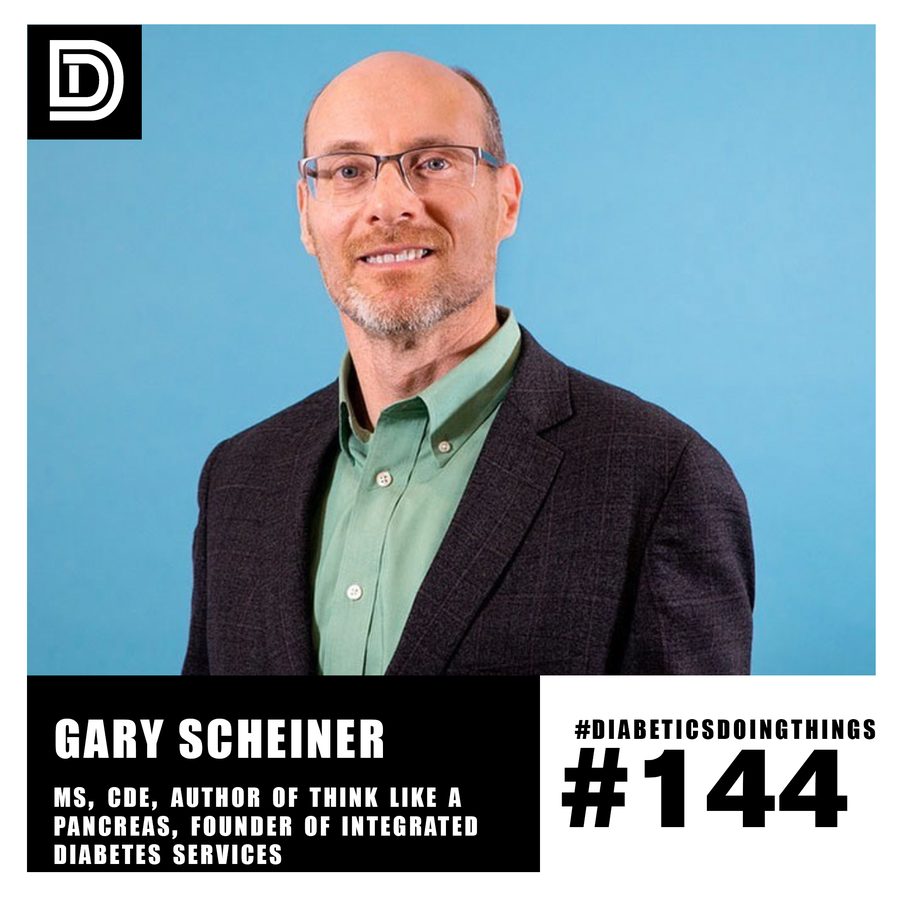
I’m fortunate to get to interview OGs in the Diabetes Community, and perhaps there’s no one better to hold that title than Gary Scheiner, award-winning CDE , author and founder of Integrated Diabetes Services (@integrated_diabetes_services on Instagram)
An award-winning Certified Diabetes Educator, Masters-level Exercise Physiologist and person with type-1 diabetes since 1985, Gary Scheiner has dedicated his professional life to improving the lives of people with insulin-dependent diabetes. He was named 2014 Diabetes Educator of the year by the American Association of Diabetes Educators.
Gary and I share a special bond outside of Diabetes through Basketball, so if you’re a fan of nerding out over hoops this will be a great episode for you. Last year at the AADE conference, I was the referee of the annual basketball tournament, of which Gary is a mainstay and force to be reckoned with on the court.
Gary is also the author of 6 books about diabetes, and perhaps his most famous title “Think Like A Pancreas” has recently been updated for 2020.
I’m a big fan of Gary the person as well as Gary the caregiver for people with Diabetes, and his insights are extremely inspiring for someone who is interested in the evolution of Diabetes care over the years. Hopefully once all this quarantine is over you’ll be able to run into Gary at any number of Diabetes events where he is a frequent speaker. But until then, I hope you enjoy this interview!
This episode is sponsored by Real Good Foods! Be sure to check out their new Breakfast Sandwiches, made with cauliflower cheesy buns with only 2g net carbs! They’re packed with protein (18g) and have no gluten or grains. Available in sausage egg & cheese and bacon egg & cheese flavors and they’re ready within seconds. Order them online or find a store near you today!
Questions this episode answers
When was Gary Scheiner diagnosed with type 1 diabetes?
He was diagnosed in 1985 at age 18 in Sugar Land, Texas, after losing weight quickly and recognizing his symptoms from an episode of the TV show MASH.
What is time in range and how is it different from A1C?
Scheiner explains that A1C is just an overall average, while time in range measures how much of the day blood sugar stays within a person's target zone, which he considers a better reflection of day-to-day quality of life.
Can type 1 diabetes be diagnosed in adults?
Yes. Scheiner says about half of type 1 diagnoses now happen after age 18, and he has patients who were diagnosed in their 50s, 60s, and 70s.
How does blood sugar affect athletic performance?
Scheiner and Howe both say high blood sugar slows reaction time, movement, and stamina during sports, while low blood sugar can cause a slowed, foggy feeling that a person doesn't always notice while playing.
Full transcript Searchable, with timestamps
Rob Howe: Every now and then on this podcast, I get introduced to an OG in the diabetes community. An original, outspoken leader in our space living for people with diabetes. I'm very excited to introduce you guys to someone that many of you may already know, Dr. Gary Scheiner. He only let me call him Doc one time. So just for all of you fact checkers out there, that is a fact. uh gary is a an award-winning certified diabetes educator master's level exercise physiologist and a person with type 1 diabetes since 1985 tell you a quick story before we jump into the pod the first time i met gary was on the basketball court at aade 2019 in august in houston at the second annual diabetes basketball tournament at aade which is put on about my sugar and run by Scott Johnson, and I got to ref that last year, and it was an amazing time. Shout out to Cherise Shockley as well, who was the honorary emcee. Anyway, I digress. I was warned prior to the tournament by a person who will not be named and will remain nameless on this pod that Dr. Gary is a little bit competitive, and turns out he's competitive in just the way that I want to be competitive. he plays to win he goes hard and he doesn't let diabetes hold him back so enough preamble Gary if you're listening to this ton of respect for you man and I appreciate all the work that you do for people with diabetes he's also the author of a number of books including think like a pancreas which I see circulating around social media from people taking photos of their favorite diabetes book so that is a tremendous endorsement if you want to know more about Gary you can visit online, integrateddiabetes.com. He sees patients from all over the US and probably all over the world. So again, integrateddiabetes.com and enjoy this interview with Gary Shiner. This episode is sponsored by Real Good Foods. Shout out Real Good Foods for supporting this podcast. I seriously love them and their products. They're awesome people as well. So big time, big time shout out, especially in the quarantine. I've been eating so many of these breakfast sandwiches. So thanks guys. Really. I appreciate it. Did you guys know real good foods also makes ice cream? Yeah, you heard me right. Ice cream. And this isn't just some poor excuse for ice cream or ice cream disguised as frozen dessert or light ice cream. This is real ice cream and it's real good because you know, real good foods. The ice cream is available right now in Kroger, Safeway and Meijer, but you can also order delivery from realgoodfoods.com and they're offering free shipping during the social distancing and quarantine to make it easier for you to get the super premium flavors. They're also available at Vitamin Shoppe. Only six grams of sugar per serving and this ice cream is sweetened with allulose to keep that premium ice cream flavor without all the added sugar. Real Good Foods currently has four super premium flavors available. Chocolate, Tanzanian Vanilla, Peanut Butter Chocolate Chip, my personal favorite, and Mint Chocolate Chip. Big shout out to Real Good Foods on their ice cream launch. Thanks for continuing to make awesome, delicious products that are easy on blood sugars. Check out realgoodfoods.com or realgoodfoods on social channels for more info. Hello, and welcome back to another episode of Diabetics Doing Things. We're telling the amazing stories of people with diabetes from all across the world. My very special guest today, Colin from the Philly area, Dr. Gary Shiner.
Gary Scheiner: What's going on, Doc? How are you? Hey, thanks, Rob. Thanks for having me. Don't call me Doc. I'll take that as an insult. Okay. Just call me Gary.
Rob Howe: All right. Well, then say no more. I'm not one for titles. I want to make sure to give you the proper respect that you do. Obviously, if you've been in the diabetes community, either online or at events for any amount of time, your name has surely come up in that timeline. But for the sake of this podcast, I'd love to talk not just about your background as an author, as a clinician, as a founder, and as a voice in the community, but also as your life with diabetes. So let's start. Let's go back to, I guess, 1985, if my research was correct. That's when this whole journey started for you.
Gary Scheiner: Yeah, one of the great ironies in history was being diagnosed in a little town just outside of Houston called Sugar Land. I figured, well, that's probably the place everyone goes to get diabetes. My family had moved there just a year before. I grew up in North Jersey near New York. I grew up a big Mets fan, Knicks fan, Jets, all the New York sports teams. We moved to Houston because my father was transferred. And a year later, during the summertime, I just started losing weight quickly. I was tired all the time. The usual symptoms, peeing my brains out, thirsty constantly. Finally, I went to a doctor after I saw an episode of the show MASH. And there was a character on the show who had diabetes and had a lot of the same symptoms I did. So I figured, yeah, I better get this checked out. So I went to the family doctor, and he did a blood sugar right then and there. It was off the charts. So I went to see an endocrinologist, and that's where everything led up to. So Sugar Land was the original site of my diagnosis back in 85. So that makes it, wow, I'm coming up on almost 35 years with this now. Time flies.
Rob Howe: Time flies when you're having fun, right? That's funny. I've, being from Texas, I certainly played my fair share of summer basketball and some high school basketball in the Houston area and Sugar Land and Kingwood as well around there. But that, I mean, sort of writes itself, right? A diagnosis with diabetes right in the heart of Sugar Land.
Gary Scheiner: Yeah, I have some photos from back then playing basketball outdoors. And granted, you know, it's hot as anything in Houston in the summertime. And so I have some photos of myself. I'm skinny as a rail. I lost a lot of weight, but I figured, you know, it's just hot. I'm exercising a lot. That's why I'm losing weight. I finally got it checked out. I wasn't ketotic. I'd never had to be admitted to the hospital. But I think if I had gone a little longer, that would have happened. I have a picture of a date that I had the night I was diagnosed with this girl I worked with at a restaurant. I was just working as a waiter in the evenings. And again, it looks like I look like a scarecrow. I just can't even keep my my clothes are hanging off of me like a coat hanger. And I was down to I think it was 118 pounds that day. And I normally weigh around 160. So I'd lost a lot of weight leading up to that.
Rob Howe: You know, it's funny. You'll you'll appreciate this from a basketball perspective. So, and you were diagnosed, you haven't said what age you were, you're 15, 16 around there? I was 18. 18, 18 years old. So I was 16 years old and a big basketball fan. So we had all the, my family had all the extra team channels. So I was watching the Miami Heat play somebody and the announcer guys were talking about Antoine Walker showed up for the season and training camp, like very out of shape. And so this was now towards the end of November, December, and he's losing the weight. So he's like, yeah, you know, he's running up and down. He's getting into the schedule. He's starting to round into shape. And so I was looking at myself at the time, a real skinny, 6'5", 175 pounds, soaking wet, 16-year-old. And I was like, oh, yeah, that's what's happening to me. I'm just getting into shape. I'm just losing some weight. And so I was like, yeah, you know, me and Antoine Walker just getting into shape. Uh, and that was kind of the first, uh, the first justification that I had along that journey. But yeah, I have very similar, uh, it was new year's Eve the night before I was diagnosed. So I took a lot of photos with, with friends and just looking at that guy and those pictures, I looked like a skeleton. Uh, and I think over time you don't really recognize it initially sometimes, but then, you know, looking back all these years now, uh, you know, pretty drastic weight change.
Gary Scheiner: Yeah. Yeah, and a lot of physicians also don't look for the symptoms, don't recognize them. So when people come in, they don't diagnose it right away. And I've learned since then that about half of all type 1 diabetes diagnoses come after age 18. Adults, type 1 is being diagnosed in adulthood just as much as it is in children. You know, the JDRF used to be just used to go by Juvenile Diabetes Foundation, and they took away the words and just go with JDRF now because they don't want to give the impression that it is just a childhood disease. It's often diagnosed. And I see patients now who are diagnosed in their 50s, 60s, 70s. So it can happen at any age.
Rob Howe: we see a lot of guests on the podcast who were misdiagnosed as type 2 because they were diagnosed in their 20s and maybe weren't you know had they had a lot of the same sort of base level symptoms of type 2 diabetes maybe a little bit out of overweight or you know exhibiting some of those same symptoms and then also in that honeymoon phase give them a little metformin and all of a sudden their numbers come down. So, you know, I think we've had maybe 15 or 16 guests on the podcast so far with some sort of misdiagnosis. And I think you mentioned too, the JDRF numbers, at least the most recent ones that I've seen report that in the US, 40,000 people a year get type 1, and it's half and half, 20,000 below the age of 18 and 20,000 above. So pretty, For people who are on the outside looking in, that's a pretty mind-blowing number for somebody. And in that time, since you've had diabetes, obviously, and are working in the community of certified diabetes educators, information in the information age of diabetes over the last decade has drastically increased. What do you see, things that you thought or things that were told to you when you were first diagnosed that, you know,
Gary Scheiner: you see like maybe a different response to? I guess the big thing back in the 80s, 90s is your insulin program sort of controlled your life. You had to structure your life around the insulin program that you were placed on. You had to take insulin to survive. But in order to keep your blood sugars reasonably well managed, you had to eat certain amounts of certain things at certain times. You had to be very cautious about your exercise and the consistency was critical. Your sleep times, not to mention your injection times for the insulin had to be fairly structured and regimented. So essentially you had to fit your life into your diabetes management program. And that's obviously changed radically. Now we fit your diabetes management into your life. Nutritionally, back then it was thought that complex carbohydrates were favorable because they were slow to digest. They wouldn't raise your blood sugar all at one time. And it was all the simple sugars that had to be avoided. And we know now a lot more about nutrition. We know that a lot of these starchy foods raise the blood sugar even faster than simple sugars do. We also know the impact protein and fat can have on glucose levels. So it's become a little more complex, but it's also become a lot more flexible as we learn how to match our insulin to what our needs are. From a sports standpoint, I was never discouraged from being active, but managing the diabetes with different forms of sports and exercise was always a challenge. And there was not a lot of good guidance, not a lot of support for that. Nowadays, we've got great strategies for managing glucose with any form of physical activity people choose. We also know the impact that glucose levels have on performance in any sport. I'm sure you can relate, but when the blood sugars are high, it's really hard to perform well. I know when I play basketball, if my sugars are up, I feel like I'm running in mud. Everything is moving kind of in slow motion, and I can't change directions as fast. My reaction times are slower. I can't defend it. Defense is all about quick reactions and thinking ahead of your opponent, and it's just really hard to think and move quickly when your glucose levels are up. Stamina is reduced. Strength is reduced, and so on. So it's important to manage glucose levels to be able to perform.
Rob Howe: You know, it's funny you bring that up. And I think you and I are going to talk a lot about basketball today, which gives me so much joy. I'm excited about it. We could go back and watch every game film from my college career. And I could tell you what my blood sugar was high or in range or maybe low, low less often by the game. for me I get that sort of brain lock as well if my sugars are high I feel very tense and stressed out and kind of my jaw locks up hold a lot of stress there but then I also with my hands like something like my hands are not shaky but just off they don't feel like they don't behave the way they normally do so I could have I'd have a ton of problems like scoring and even passing and dribbling just my hands would not be consistent so yeah we could go and look at some of these games. And when I played well, it was the correlation was my blood sugars were in range and I was able to, you know, move flexibly. It's a beautiful thing. And there's such a
Gary Scheiner: two way relationship. I find if I go into a sport or a workout and mentally I'm really intense about it, that'll often drive the blood sugars higher just because of the adrenaline production. So I've learned I've got to, I've got to chill. I've really got to relax with whatever activity it is or my sugar is going to go up and that's going to hurt my performance. And then when the sugars go up and I don't perform well, I get more upset and they go up even higher. So it kind of snowballs and gets worse instead of better. And of course, when glucoses are low, we can't really do much of anything well. I don't know about you. I don't experience symptoms anymore when my sugars drop. I really rely on my continuous monitor to alert me. but I've had times where I've been playing a sport and my sugar's low I didn't realize it and I'm like oh well maybe that's why I played so crappy I've got my blood sugar is 58 and you don't realize it sometimes it's sort of like people who who drive after having a few drinks they feel fine they think no problem but you test their reaction times and they're just not good you know their ability to judge distance is not as good as it normally is so you know subtle things like that. But getting back to your question about how things have changed in the mid-80s, and granted, I've had patients who've had type 1 for 50, 60 years, so I'm kind of a baby when it comes to that. But we were using insulins that were not nearly as effective as the insulins we have today. We didn't have a flat background insulin. We had this stuff called NPH, and that would peak inconsistently, sometimes four or six or eight hours after you took it. We use regular insulin at mealtimes, which took about two to three hours to peak. So blood sugars after meals would tend to spike up really, really high and then plummet for the next four or five hours. The glucose meters that we used were, we didn't have CGM, we just had point in time meters. They used a lot of blood. The meters back then required about 10 to 20 microliters of blood. By comparison, today's meters use less than half a microliter in most cases. So you had to get a drop of blood literally dripping off your finger to have enough to fill the testing area. The testing areas were often square on the strips. I don't know about you, but I've never been able to get a square drop to come out of my finger. Yeah, I miss that skill set as well. Most of my splatter. I must not have gone to the doctor when they taught that, but it took a lot of blood, a lot of time, and the readings were not that precise. The meters were enormous, but at least it gave you some idea of whether you were really high or really low, because it didn't seem like you had many readings in your target range back then. So obviously that's changed. The way we give insulin has changed also. So we had syringes back then. Now most people use pens or pumps. I'm lucky enough, I'm using one of the hybrid closed-loop systems now that's aided my management considerably. But it's essentially we've learned how to fit our diabetes into our lives. We can match the insulin to our needs so that we can do what we want when we want and still manage the diabetes reasonably well.
Rob Howe: Yeah, I think we're in this interesting time. And I guess I'll take credit for this term that I've tried to, you know, put into some presentation as well. We're in this sort of diabetes renaissance where people like you and I are able to be connected via the internet. And so there's this community aspect and knowledge share, which has been a huge, great discovery for me, not only from a just personal wellness and overall balance aspect, but also clinically, like since I've been more involved in diabetes community, my numbers are are better. And I know many, many other people share that those results. And there's even some studies that show the benefits of being involved in diabetes, social media and blogs. But then there's also the technology side, like you said. And you know, talking about the differences between not just the insulins, but the technology and the monitors, and the glucometers, which I feel like now, the new the newest thing is, you know, you don't need to finger stick and you don't need to calibrate, but the ones that we have are relatively easy to use and easy to access and don't require as much blood. So, you know, you measuring that against what it was like, even for you in the 80s, like you mentioned, you're relatively a baby compared to some people who are in the 60s, 70th year of type 1, where they were testing with urine sticks, and, you know, giving doses with glass needles that they had to boil every day to make sure that they were clean. So, you know, really in terms of life with diabetes, we're in this very emerging market of a very new world of lifestyle applications. And I think the first thing you said is like, when you were diagnosed, you had to fit your lifestyle to diabetes. And now it's more of the fitting diabetes into your
Gary Scheiner: lifestyle. Yeah. Renaissance, I think is a great word, Rob. I love that. And it truly is a, we are in a renaissance age. Although if you go back 10 years, we probably thought we were in a renaissance then, 10 years before that. And I bet if we look out five years from now, we're going to look back to 2020 and say, geez, that's archaic. What were you doing? So it's an ever-evolving renaissance that we're in. But I do see there's certainly a renaissance in technology. There's a renaissance in the social aspects of living with diabetes because of the connectivity that the internet has provided. I've got to be honest, though, where I do not see a renaissance is in the level of health care that's provided. And that's part of the reason I run the practice that I do. The vast majority of diabetes care providers are still offering very limited levels of care to their patients. They just don't have the time and a lot of cases don't have the expertise to help patients with type 1 diabetes manage it more successfully. They'll prescribe the insulin, they'll order the lab work, but that's about it. Beyond that, they leave it to the patients to still figure everything out on their own.
Rob Howe: And let's dig into that a little bit because obviously it's an area of expertise for you, and I have not had somebody with your knowledge of this on the podcast and this forum to have that discussion. So I'll ask two things. Number one, I think, why is that? what you just mentioned of like the time. And, you know, I think a lot of it in my mind is these doctors are under the way the healthcare system is set up. They need to see a certain number of patients every day in order to run a practice that makes money and can stay open. And then my second question is, you know, when we look at the numbers of people with just type 1 diabetes in the U S you know, somewhere between 1.2 and 1.5 million people. there are not that many people going to JDRF conferences or ADA camps or even involved in the social media space at large where are those people and why can't we reach them what is you know those are those are those are where I want to start and I think we can kind of spill out from
Gary Scheiner: there sure yeah I think you pointed out one of the challenges is you know the health care model as it exists, is not conducive to effective care of type 1 diabetes. Health care nowadays, its focus is on acute care. You have a condition, you treat it, you move on. Whereas with type 1 diabetes, this is ongoing, and there are countless decision points that the patients have to make on a day-to-day basis. And teaching them how to do that effectively and guiding them on how to do it optimally, It's a skill set that's just not something that most physicians have or most other members of the health care team as well. So part of it is time restriction. Part of it is access to all the new technologies. I know a lot of clinicians that work in hospital systems that can't even download a patient's meter, much less go online and access their data because of the way the firewalls are set up in the hospital. So, you know, the structure is just not right. I think the wrong people are getting paid nowadays to care for and treat diabetes. Treatment of type 1 in particular, I think, requires a certain skill set. You've got to be a good communicator and teacher. You have to be savvy with numbers. You've got to be able to crunch data effectively to be able to guide patients. and you have to I think have a certain empathy for the patient and I find people who live with type 1 tend to have that more often than not you know I do know some clinicians who don't have diabetes who do excellent work but they're so few and far between I try to hire people who are extremely passionate and clinicians who live with type 1 personally or have a child with type 1 I think they can lend that empathy to the patient care.
Rob Howe: And that's important because I think verbiage and rhetoric relating to patient care outside of just compliant versus noncompliant. With diabetes, there's so much in between and so much nuance there. How do you balance that? I think you're right. People with diabetes obviously have that firsthand experience and can really dig deeper into it. But in your experience, in your practice, how do you balance that?
Gary Scheiner: You mean balance my own diabetes care with providing the care for others?
Rob Howe: No, let me rephrase. I think balance is the wrong word. How do you find a balance between taking compliant versus noncompliant into a way that can really relate more with a patient with diabetes?
Gary Scheiner: Okay. Well, I try to see it from the patient's point of view. I mean, I have my own way. I like to do things. But I recognize that that's my own personal approach. And everyone is an individual. And what's going to work for one person isn't going to work for another. So customization, individualization is really essential. There are people who respond well to being told, you're doing a crappy job. You've got to do better. There are people who respond to that. more often than not though we've got to recognize that yeah this is a pain in the ass disease it's not an easy thing to manage it's frustrating there's inconsistencies there's there's no real benefit we're getting day in and day out i think it was bill polonsky who once said that all the work we put into diabetes management is basically so that nothing will happen you think about what kind of motivator is that we do all of this stuff to have just to avoid problems you know we try to avoid health complications and we try to avoid you know poor performance and severe lows and ketoacidosis it's all about doing all this work so that
Rob Howe: nothing will happen and it's sort of a sisyphean effort right we're just pushing the rock up the hill every day only for it to roll down again and just have to continue that effort. Um, and you know, usually when you put that amount of hard work into something, there's some sort of positive reward at the end, you know, you want to at least get some dopamine injection in there or something, but it's like, Oh yeah, I just got to eat dinner and didn't have any complications. Or I got to go to the gym and, uh, felt fine afterwards, you know, or I went to my, I took my kid to a birthday party and they had a good time. It's like, so yeah, you know, there's, it has no diabetes has
Gary Scheiner: no memory. And I love the original Terminator movie. There was a line from that where they were describing the Terminator, this monster. He said, you know, he has no remorse. He has no compassion and he will not ever stop until he gets you. And that's a lot of what diabetes is like. It doesn't care what you did yesterday or even this morning. If you screw up this afternoon, and your blood sugar is going to be terrible. So it takes a certain amount of perseverance and discipline, but it also takes acceptance. It takes acceptance that we're not always going to get it right, and that's okay. I probably deal more with patients who are overly critical of themselves than I deal with patients who are just underworking their diabetes. Most of the people I see are working too hard at it and they're too intense about it. And I'm looking for ways to ease their mental burden, at least as much as I'm looking for ways to improve their diabetes,
Rob Howe: their blood sugar management. Definitely. And I think that is the, you know, as we look for balance, right, that, you know, what, when relieving the, you know, the mental strain, I think I heard Dr. Fran Kaufman say one time, I think it was at AADE in 2018, she talked about the mountain of technology. And, you know, we're moving up and technology continues to increase for your diabetes care. But on the other side of that triangle is the relief of the mental burden. And so things like continuous glucose monitoring and hybrid closed-loop systems are working to not only improve quality of care but also relieve the mental strain and burden that diabetes can put on you. Because as you know and have written about, there is no cure right now. So there's no, hey, if you manage your diabetes great for 1,000 straight days, then you're good. No, you still have it.
Gary Scheiner: Yeah, I like the way you phrase that. It is a balance between the energy we put into it and the benefit we get out of it. The thing about all of these modern technologies is that up to this point, we're still not seeing a whole lot of improvement in glucose control. When we look at A1Cs and time in range and frequency of lows, it's about as bad as ever. So even though we have these technologies, they've made life easier for a lot of people. They've made things a bit more convenient. The glucose management's not gotten much better. And that comes back, I think a lot of that comes back to the kind of care patients are getting where they're not being guided properly. For example, people go on insulin pumps, but they never get their basal insulin doses set up properly. Or they never learn how to really carb count effectively, so they're not really matching their food to their insulin or their insulin to their food all that well. So it's the teaching and it's the details that go into use of these technologies that is so critical.
Rob Howe: Yeah, I find that when I talk to people with pumps, because I also wear a hybrid clothes loop, I wear the Medtronic 670G system, and people will message me on social media asking about certain features or what they should want to expect or whatever. And I realized a dramatic number of them were just getting the pump shipped to them with no pump trainer, or they hadn't been contacted by, you know, or worked with their endocrinologist or a CD, that they were sort of just setting it on their own. and they were having a lot of problems with it. And, you know, I was explaining to someone, it's kind of like trying to fix your car yourself, you know, like you in a sense know how an oil change works, but actually going in there and somebody who's done it a thousand times is going to be infinitely better than you, right? And having an expert in the room. And that's so essential.
Gary Scheiner: It's interesting to use the oil change analogy because any physician, anyone with a medical degree can prescribe an insulin pump. How much do they know about the pump and how to manage it and use it safely? Oftentimes, very little. An auto mechanic is certified on every product under the hood. Anything they're working on, they've received trainings and certifications on. They actually know more about devices in your car than your physician knows about devices they're prescribing. It's a sad state of affairs that that's the case. But again, that's the medical model that's set up now, where only a physician can prescribe these things, whether they know
Rob Howe: anything about them or not. So how did you, you know, knowing all this, and we've had, you know, discussions about the problems with the system, setting up your practice, how did you position yourself or, you know, what steps did you take to try to improve on, you know, that for, you know, for patient outcomes, right? I mean, obviously everything is with the patient in mind. How did
Gary Scheiner: you design your practice to address those issues? I tried to address the major barriers to providing effective care for patients. One of those barriers is simply access, having to go to an office, see somebody, park your car, et cetera. So we offer our service in person, but we also offer all of our services remotely. So we do video chats, we do phone, we do email with patients. So we offer the remote access. We have patients in all 50 states and about 30 foreign countries as well. We even hired a Spanish-speaking CDE, who's a nurse, type 1 herself, to work with Spanish-speaking patients. We've got a lot of clientele in Central and South America as a result of that. So that's one barrier is the access. Another one is the time. It does take considerable time to teach at an appropriate pace. It also takes a lot of time to analyze data and be able to help patients fine-tune things properly. So we schedule plenty of time for patients. You know, appointments are usually 45 to 90 minutes long. And we also spend time before appointments usually looking at downloaded data. And we offer patients the option of working with us between appointments. A lot of the nuts and bolts of diabetes care doesn't happen during an office visit or an appointment. It happens in between. So we offer them the opportunity to communicate with us or send us data any time they want. And we're available to review and offer input and help them troubleshoot and answer any questions that come up. Another barrier has to do with the skill set of the person providing the care. So we focus strictly on intensive insulin therapy. Not just diabetes, but intensive insulin therapy. Because you have type 2 specialists out there who don't know squat when it comes to insulin fine-tuning. This is all we do. It's just intensive insulin management, whether it's pumps or injections, that's our thing. So we work mostly with type 1, but also type 2s who are on insulin. And I have a staff of clinicians who all have that personal link to type 1. And we get a lot of continuing education. We really stay on top of things. And because we focus on this, we're able to provide a better level of care. So I feel that, you know, that combination of things. And I also try to hire people who have a good sense of humor, who are good communicators, and just relate well to people. The right person, the right personality makes all the difference in the world. So I feel that those are some of the things that I've built into my practice to be able to meet patients' needs a whole lot better.
Rob Howe: and you know now i'm going to ask the million dollar question because i you know all those things are music to my ears as a as a patient or even as like a business person like oh yeah like we're solving problems we're you know innovating what are some of the you know as you got started with this how did you know that you know this this method and this methodology and the way you're approaching it was really resonating with patients well the fact that patients are paying
Gary Scheiner: out of pocket for the service tells me that it resonates. We have a standard set of fees, but I'm not a businessman. I'm not a business major. I'll accept whatever people can afford. That's kind of part of my giving back to the diabetes world is I'm not going to ever exclude people who can't afford to access our services. That's part of the access problem as a whole anyway. Yeah, I think so. By avoiding the whole insurance fiasco, and it is a fiasco, we can focus our time on serving the patient. We're not dealing with bureaucratic paperwork and a lot of time, unproductive time involved in the insurance process. So patients just pay us, we offer the service. It's simple. It's easy. The fact that we have thousands of patients paying us out of pocket for something they may be able to get similar care from, you know, paid by their insurance. The fact that they come to us for this and they're willing to pay out of pocket, I think speaks volumes. And we've collected outcome data, not just A1Cs, but more importantly, time and range. The quality of management has improved dramatically with the patients we work with, cutting down on lows, cutting down on highs, spending more time in, I call it the happy zone or the performance zone where you like your blood sugars to be.
Rob Howe: Let's talk a little bit about time and range. Earlier when you were talking about regular and NPH, it reminded me that about two years ago in January 2018, I did 30 days on R and NPH. I went off of my pump and I wore a CGM during the time to try to document the data to show the difference between the quote-unquote Walmart insulins and rapid-acting insulins. Obviously, talking through the insulin crisis, and there's a lot of misinformation being spread by people who don't know what they're talking about. Why are people dying without insulin? Insulin is available at Walmart and what have you. What I wanted to show was that while, yes, you can survive on these treatments and therapies, that they're very outdated. And what I found myself doing with, you know, as a relatively compliant, I think at the time I went into it with an A1C of 6.1 and came out of that 30 days with it gone up two and a half points to almost 6.4. And I was just pinging back and forth between high and low. And I also was wearing a CGM. So the privilege of that was like even just able to see what that graph looked like at the end of the day and be able to, you know, mark what I was doing and what I was eating. there's so much more strain and like very little time in range and a very unbalanced approach to to care and so that's where we've come from but at the end of the day my a1c wasn't quote-unquote out of range but my lifestyle i was exhausted i wasn't getting like good sleep i wasn't able to exercise the same way i wanted to and i was you know you just looked at me and i looked worse off so all that to say you know coming from you know where we started this conversation on how therapy has improved to now where time and range is the I guess it's a1c is still the primary measurement but time and range being the focus now you know and having a more ability to collect that data on a more regular basis you know what are you seeing in the time and range versus a1c and how are patient outcomes improving by focusing on that? Well, first off, Rob, I have a newfound
Gary Scheiner: respect for you. Anybody who, for the purposes of science, would go back to those old school insulins to prove that point, you're all right in my book. I can appreciate your doing that, and thank you for doing that. Yeah, that's, I think there's a difference between a quality metric and a quantity metric. A quantity metric is something like an A1c. It's a number, it reflects an overall average, but it speaks nothing to the quality of life that a person is experiencing to get there. And you can have a nice A1c and 6.4. That's a great A1c. Even though it went up slightly, I still think that's fantastic. You can have an A1c like that with fairly stable glucose, where you're in your performance zone and feel good most of the time. Or you can get there by running a lot of peaks and valleys, highs and lows throughout the day and night. And not only your day-to-day quality of life is affected by that, but long-term complications are influenced by that. There's growing evidence about the effects of glucose variability. Swings in blood sugar rapidly up and down seems to cause what's called oxidative stress and contributes additionally to long-term diabetic complications. So it is a problem when we see a lot of variability like this. I do a ton of lecturing on just the simple idea of how do we keep our sugars from spiking right after we eat. People don't like the feeling of going up into the two or three hundreds right after eating, even if it does come down on its own once the insulin finally kicks in. So this idea of stabilizing blood sugar is an important one. And that's where the concept of time and range exists. To me, that's more of a quality measure. And it's individualized. I think it is different for different people. Like I had a patient in the office earlier today who has a history of a lot of severe lows, and we really need to run their sugar is a little higher than most people's. And she's very happy with blood sugars that are between 80 and 180. So that's our acceptable range. Other patients will come in, we're striving to keep them between, say, 70 and 150, or 70 and 160. We work with a lot of women through their pregnancies, and there we're looking at maybe 60 to 140 as an acceptable range. So with kids, the range is often a little higher and spread out a bit more. But, you know, once you've determined what your acceptable range is, then you can work on strategies for achieving as much time in that range as possible. It's different than saying, well, your A1C is eight, let's get it down to seven. You can do that and really screw things up because you can wind up hypoglycemic a heck of a lot of the time. But achieving more time in range is clearly beneficial. That's certainly going to improve a person's day-to-day quality of life. You perform better in athletics, exercise, energy level. Mentally, you perform better. Emotionally, you're more stable when you keep yourself within your target zone. That's why time in range is growing as a metric of the quality of a person's diabetes
Rob Howe: management. You know, it's interesting just kind of hearing you talk about setting a different range for an individual that everybody has a little bit. I think we know tertiarily, at least or anecdotally, that diabetes is different for everyone, that you and I will have different reactions and responses to different things and have our own way of treatment that works for us. But something that I was thinking as you were describing that was when you have or when I have sugars that are more in range or more in the range that I like them to be in, most of the other things in my life become more predictable as well. I'm more able to, you know, perform athletically. It's more predictable what my mood's going to be like, or what food I like to eat, or, you know, what activities I'm able to do. Versus, you know, before it's really like, oh, I have to make a decision based on what my diabetes is doing right now. And it wasn't necessarily as dependable. Yeah, that's a really good point.
Gary Scheiner: And some people think, well, if I'm, let's say I'm playing a sport or taking an exam, I just have to worry about my blood sugar during that time. But that's not true because your glucose levels for the past 12 to 24 hours are still influencing that because it influences your hydration level. It influences glycogen storage. It influences sleep quality. And these are the kind of things that affect our performance on a day-to-day basis. So if you don't want diabetes holding you back in any way, you have to think about your management around the clock. And that's not to say it needs to be perfect. In most cases, if you can get your glucose in range at least 70%, 75% of the time, you're doing a super job. That still means you can be out of range 20%, 25% of the time. That's okay. for somebody to be in range for a 24 hour period is an accomplishment. You know what we call those those days? They're called no hitters. Yeah. When you don't hit your high or your low threshold at all and you stay in the zone for 24 hours. And a lot of people like to post those on social media because it's a sense of pride. It is a point of pride to be able to do that. Absolutely. But I
Rob Howe: I think, too, I like the term no-hitter because a no-hitter doesn't happen all the time, even for the best ace pitchers, right? That's right. They're very few and far between.
Gary Scheiner: It's a special occasion.
Rob Howe: That's very cool. I think you mentioned earlier talking about acceptance and the diabetes. And I think right after that, you said diabetes is difficult and it's complex. When you go and speak to, you know, at JDRF conferences or at AAD or at ADA, do you find I guess my own personal experience I think a lot of what you were talking about on social media is people who are more publicly facing about their diabetes there is some sort of air at times from the audience that everything is easier or everything is happy-go-lucky and that there's more no-hitters than the days where you're you know everybody's getting on base but But I think to hear that diabetes is hard from someone like you, I think that sometimes turns a light on for people where, you know, because I think as humans, we're like tied to performance as like always being positive and like really progressing and growing. And with diabetes, it's sort of the opposite of that. Like you, no matter how good you get at it, you still don't, it doesn't really change for you.
Gary Scheiner: Share a quick story with you about that very subject, Rob. I was speaking at a children with diabetes conference last year, and there was a presenter before me who was a physician who has type 1 diabetes. He was from the Midwest showing how stable his glucose levels were with the approach that he was using. And he had just had, you look at his data, he had no hitter after no hitter. It was just continuously like that. And I'm looking at the audience. These are mostly parents of kids with type 1, some young adults with type 1. And I just saw everyone's shoulders sag, and I saw their mouths kind of go agape a little bit. And then I got up to present, and I did a quick scan that I stuck in my presentation of my blood sugars for the last 24 hours, where I peaked up above 300 twice in the last day, and I had one pretty bad low. I got a standing ovation. I think people appreciated that even the experts deal with this stuff day in and day out. And the fact that it happens to us also made them feel more comfortable and just a little more secure that you can do all the right things and it doesn't always turn out the best. It gives people a little bit more confidence to keep at it.
Rob Howe: And I think there's some sort of, and I'm sure you can speak to this more eloquently than I can, there's a psychological component to chronic illness about being sick. And that sickness carries a negative connotation. I think that many times can be very heavy for people. So similar to you, they didn't give me a standing ovation, but I got something to aspire to. at the beginning of I give a presentation occasionally people want me to talk about elite athletics in sport and my first slide is hey like just to let you know diabetes sucks and also most people are not in shape to play elite sports like most people who don't have diabetes don't make it to the gym the prescribed amount there's a you know obesity is a crisis in the United States is just a just a start but just seeing people like oh yeah like this is hard what you're doing is difficult. It's okay to not get it right every single time. Just kind of softening that a little bit really, like you said, eliminates that shoulder hunch or head down kind of weighty moment. And I think it's just important.
Gary Scheiner: The worse your glucose control, I think the more they like you. Yeah, which is also a double edged sword, right? Yeah, the more they feel they can at least relate to you. And we're dealing with the same challenges. That's why one of the first things we do with any new patient that we have is we start out talking about what their goals are. What do you really want to accomplish here? Sometimes we have to negotiate those goals with them a little bit. They might say, well, I want my blood sugar between 70 and 120. And I look them in the eye and I say, in what world are you living? Let's talk about reality, what's really achievable and what's desirable. And we'll also talk about other goals they may have that are not specifically blood sugar and number related. But I think having a realistic set of goals going in, that sets the stage for the kind of care they're going to receive and how we're going to manage.
Rob Howe: And that, I think, in a sense, is really making diabetes a part of your life, right? That psychological aspect and not the inverse, like we talked about when you were first diagnosed.
Gary Scheiner: I mean, my own challenge from my own standpoint is my diet. I eat a lot of healthy food. I also eat a lot of unhealthy food. You add it all up, I eat a lot of food. I'm not very disciplined when it comes to my food intake. I tend to eat too frequently, make a lot of poor choices. I get plenty of the nutrients I do need, but also a lot that I don't need. That's my kryptonite when it comes to my own diabetes care. And I've never really been willing to give in on that a whole lot. So my A1C, my time in range are decent, not great, but that's reality. On the other hand, I work out religiously. It's rare that I miss a day. I use all the technologies now to the fullest extent. My stress level is good. I manage all of the other cholesterol, blood pressure, etc. But, you know, I've got this weakness with my food intakes. Everyone, you know, just keeping it real. No one's perfect. And I don't expect our patients to be either. I think that's that really helps. And all of our clinicians are like that. We all know each other's kryptonites in our diabetes care. And we can laugh about it. It's okay to experience that. You know, low blood sugar is something that has always been a challenge for me, though, as well. And I haven't had to receive glucagon in over 20 years, but it was scary back in the day when I did. Low blood sugar is 10 times as dangerous as a high blood sugar. And some patients have to be convinced of that. They like to live in a low range. They're so anxious about elevated blood sugars that they'll let themselves run low way too often. And there's just so many dangers involved with lows. not to mention that we often rebound from them and wind up high anyway, or we overeat and start gaining weight from them. And that doesn't even get into the immediate hazards of driving a car impaired or falling down a flight of steps, getting hit in the head with a soccer ball, whatever. Personalities change dramatically also. And when my moods change, the first thing my wife says is go check your blood sugar she knows something's up now I can just look at my Dexcom I used to be able to get away with all kinds of things I would say oh I'm sorry my sugar was off then she could say let me see your CGM and she knows how you're you're doing fine I had one one family that I worked with it was an elderly couple with a husband Morty had type 1 for 50 years and his wife asked me one time, she was telling me that when Morty gets low blood sugar, he becomes very amorous with her. Normally, he's a really stoic, quiet guy, but when he gets low blood sugar, she said he starts to kiss me and whispers sweet nothings in my ear, is what she said. And her question for me was, how long can I let that go on before I get him something to eat? She liked it. So, yeah, your moods can change when you're low. Also, all kinds of behavior. How do you react to low? Is the your moods change at all?
Rob Howe: I get a little bit kind of like I've had too much to drink where I'm, you know, a little bit slow to think, a little bit slow to react, kind of drowsy. And it really just, you know, definitely I feel like more loose and very relaxed. so you know when I'm when I was playing basketball like in a practice or something in college and I would feel my sugar I'd have that kind of you know airy kind of uh off balance kind of feeling but I was playing and I was playing really well and I was in the flow I was like I wonder how long I can
Gary Scheiner: keep this up um yeah and I was you know I go secret to better performance yeah you know or so I thought
Rob Howe: you know very small sample size but yeah that's kind of my my low blood sugar I think where my moods really swing is when I, anytime I'm over 200, I, uh, I have a very quick temper. Um, and I occasionally have a, I was gifted a very sharp tongue from my father who, uh, and occasionally that gets me in very hot water with, uh, with my fiance and even my friends are like, Hey man, like, calm down. Why are you attacking my character right now? So your level of satire
Gary Scheiner: is a barometer for your blood sugar. In other words, definitely, definitely. Okay. But, uh,
Rob Howe: But yeah, it's just really interesting, you know, those how much of your life outside of just the number is affected by what the number is. You know, you talked about, you know, hydration and sleep, two things that I think are very, very in vogue right now in the fitness and like kind of fitness tracking world in the health and wellness space. And I just think like I value those so much into my diabetes. I can absolutely see the difference of when I get a good night's sleep versus not a good night's sleep, or I'm stressed on a deadline for work and I'm, you know, working through the night, I'm not drinking water. And then I wake up the next day and I'm like, man, I'm resistant today. Like something's going on. And it's like, oh yeah, it's what I did 48 hours ago that's impacting who I am right now.
Gary Scheiner: Yeah. I mean, diabetes management has such far reaching effects in our lives. You wouldn't think that just blood sugar can do so much. But when blood sugars are not, at least in a reasonable range, it affects so many things negatively. That's one of the motivators I try to use with the people I work with, the patients, is that I try to find out, well, what's important to you in your life? You know, for some of them, you know, it's looking good. Others, it's doing well in school or athletics. And that's more of the focal point. I don't really dwell much on long-term complications because, again, no one gets motivated doing all these things every day so nothing happens. That's not an effective motivator. But the day-to-day stuff is much more of a motivator, I find.
Rob Howe: It's interesting because complications, like a lot of those are fear-based tactics, which almost no motivator would ever use to try to get you to improve at something. And yet in healthcare, specifically diabetes, like much of the first, you know, experiences with diabetes is all centered around fear.
Gary Scheiner: Yeah, it's used all the time and inappropriately. It's actually more of a deterrent to engage in the right behaviors than a motivator.
Rob Howe: It's really interesting. Man, I feel like we could talk for hours on this. So I want to make sure that I'm being a good use of your time. And also I have just a couple more questions I want to ask you. So I'm going to hit you with a couple. Last year you played in the second annual AAD basketball tournament. Do you have a prediction for how the next year is going to go? Are you planning to participate? And I think I'm going to be, again, involved hopefully in some capacity. I've got to get Scott Johnson on the phone and figure that out. But what can we look forward to in the upcoming AAD basketball tournament?
Gary Scheiner: Well, I'll quote Mr. T from Rocky III when he said, what's your prediction for this fight? And he just stared in the camera and said one word, pain. I love it. It's a fun event. It's just nice being able to get on the court with other people from the diabetes world and play a fun game. No one takes it terribly seriously. We're all out there just having a good time. I'm hoping that they can expand the court a little bit because my strength is not my down low inside presence. I'm 5'9", 160. That's not happening. I'm more of a runner and streaker and all that. I need a bigger court to be able to perform well.
Rob Howe: Yeah. As a fan of the pace and space game, this year's court was not conducive to that.
Gary Scheiner: It was barely just a lane with a few feet outside of that. And that was it. Ben Simmons would love it because that's the only place he plays.
Rob Howe: Perfectly suited to Ben Simmons game. It was interesting, you know, being asked to be a part of that for the first time last year, just kind of having a good fun time being the ref and seeing everybody compete. And that was one thing that I really enjoyed. But also just kind of looking around the who's who of AAD were watching those games. It was a really well attended event. So I'm really looking forward to continuing to grow that with the rest of the crew there. Number two question I want to ask you is, you know, when you're talking to people at conferences or, you know, people are asking you about your book, I think Think Like a Pancreas comes up often as the maybe most, I don't have data on that, but like I see it more than a lot of other diabetes books. So for people who are looking for more information on you and your approach, where would you point them to go and what advice would you give them as they get started?
Gary Scheiner: Yeah, I mean, our website has a lot of good resources on it that people can access anytime. We've got a lot of good detail about pumps and comparing systems and comparing CGMs and hybrid closed loops. There's logging systems and there's a lot of good resources on our website. There's even a diabetes quiz that has a Simpsons theme to it. And we have a carb counting test that is a challenging one if you want to test your carb counting skills. And that's just integrateddiabetes.com is the website. Think like a pancreas is sort of like my opus. A lot of my experience and knowledge of diabetes goes into that book. And I have a third edition coming out in May. And it encapsulates a lot of the new technology and how to make better use of these CGM systems, how to look at data properly, how to benefit from hybrid closed-loop technologies. You use the Medtronic 670, but we now have the tandem control IQ. We have OpenAPS and the loop system. And being able to access those and utilize them effectively is the difference between having technology and benefiting from it. So there's a great deal about that in the new edition of the book. But, yeah, integrateddiabetes.com, good place to go. There's a bio on me and my fellow clinicians there. and think like a pancreas as my opus.
Rob Howe: Well, we'll absolutely include links to both of those in the show notes. So if you're listening to this and want to know more, just open up your podcast app, check out the show notes, and we'll go from there. Okay, my third question. Someone's listening to this podcast, they are struggling with their diabetes or they are recently diagnosed. What's one piece of advice or encouragement that you would give to somebody
Gary Scheiner: who's really just beginning to try to make sense of this whole diabetes world? I would say relax. We'll get it figured out. You'll get it figured out. Take small steps. Work with a clinician who knows what they're doing, really understands type 1 specifically. I think that makes a very big difference. And come up with a set of realistic goals and then work towards them. There are solutions to all of these issues, all these problems that we run into, but if you don't have a realistic set of goals in mind, it's hard to know where to start or,
Rob Howe: you know, how to proceed. Yeah, great advice. I think, you know, you mentioned it earlier, talking about the mental strain and this idea that there's a, you know, you can hit a no-hitter every day. You know, every day is going to be different, and it's just a very complex list of criteria that just gets you to be normal, like we said. But I appreciate you coming on the podcast and really giving your time. This is an awesome episode. Certainly not the last time you and I will run into each other. But thank you for all that you do for the diabetes community. And I'm really looking forward to continuing to run into you in upcoming events. Yeah, I'll share one more
Gary Scheiner: quick story with you. And another pro basketball player with type 1, you probably know Chris Dudley who played for Portland, New York, New Jersey when they were in New Jersey, 6'11 center, the worst foul shooter in the history of the NBA. He was just terrible. He made Shaq look like a great foul shooter. He was at one of the conferences I was at, and they had a basketball court set up, and it was a pickup game, and I got to guard him, even though he's 14 inches taller than me. And he backed me down, backed me down, and then slammed the ball through the hoop with such ferocity that he literally ripped the stanchion down. So left an impression on my head that I'll never forget. I'm no pro, but I still love to play. And that's the thing. You can enjoy your sport, enjoy what you do. You don't have to be a professional at it. I'll share a Chris Dudley
Rob Howe: story as well. I've, I've worked with his foundation at a distance. I haven't been to a camp. That's one of my, uh, items I want to do in the next couple of years is get up and be a coach or a counselor at one of those camps that they run up in Oregon. Um, but when I was diagnosed, there were two guys when I went to the, when I went to the old search engine, uh, I think it was either Yahoo could have been Google, but it was early days of Google. Uh, I searched for type 1 diabetic basketball players. And the one that I knew already was Adam Morrison, because it was 2005. And he was in, you know, a senior at Gonzaga and really, you know, co national player of the year that year. But then there was also Chris Dudley, who played, I think, like 10 or 11 years in the NBA had a really long career. Don't YouTube him because the first thing that pops up is when Shaq breaks a goal over over Chris Dudley, and then like shoves him out of bounds. It's like, it's a bad look for, for people who are looking for encouragement. There's plenty of other ones, But like, you know, all the work that they do with the foundation is incredible. And he's also run for state senator. And, you know, he's a very, very active and a very inspiring figure. So I'm thankful that he hasn't broken a goal on my head. But hopefully I'll be able to take the court with him here in the next couple of years.
Gary Scheiner: Look up Gary Forbes. He played for Toronto as type 1 as well.
Rob Howe: We actually had Gary on the podcast. Oh, did you? Yeah, three episodes ago. So he and I, three years ago, so I lived in Denver. I'll give you the short story. I lived in Denver or in Colorado when I was in college playing in college at University of Colorado, Colorado Springs. And while he was in Denver, so I remember reading, of course, like, hey, the Nuggets signed a new guy. He has diabetes. And I remember being 20 years old and saying, like, hey, here's a guy. He's not an NBA all-star, but he's a guy making it in the league with type 1. So when I got really going with the podcast back in 2017, we connected on Instagram and he had just had surgery and was really going through a tough time. And he talks about that on the podcast later because it was like a two and a half year journey to get him on the pod. But when we finally did, it was, you know, all the things he had experienced in the time since we had met with related to diabetes were super, super beneficial. So yeah, Gary, I think is only really beginning to understand his impact in the diabetes world. And as he kind of comes to the end of his playing career in the next few years, I'm really excited to see what he does.
Gary Scheiner: Great. Hey, Rob, thanks for having me on. This has been a lot of fun.
Rob Howe: Thanks so much for listening. Just a reminder that this episode is sponsored by Real Good Foods. Shout out Real Good Foods for supporting this podcast. I seriously love them and their products. They're awesome people as well. So big time, big time shout out, especially in the quarantine. I've been eating so many of these breakfast sandwiches. So thanks, guys. Really, I appreciate it. Did you guys know Real Good Foods also makes ice cream? Yeah, you heard me right, ice cream. And this isn't just some poor excuse for ice cream or ice cream disguised as frozen dessert or light ice cream. This is real ice cream, and it's real good because, you know, real good foods. The ice cream is available right now in Kroger, Safeway, and Meijer, but you can also order delivery from realgoodfoods.com. and they're offering free shipping during the social distancing and quarantine to make it easier for you to get the super premium flavors. They're also available at Vitamin Shoppe. Only six grams of sugar per serving, and this ice cream is sweetened with allulose to keep that premium ice cream flavor without all the added sugar. Real Good Foods currently has four super premium flavors available. Chocolate, Tanzanian vanilla, peanut butter chocolate chip, my personal favorite, and mint chocolate chip. Big shout out to Real Good Foods on their ice cream launch. Thanks for continuing to make awesome, delicious products that are easy on blood sugars. Check out realgoodfoods.com or Real Good Foods on social channels for more info.
About Gary
Gary Scheiner, MS, CDE, is an award-winning certified diabetes educator, exercise physiologist, and founder of Integrated Diabetes Services, who has lived with type 1 diabetes since 1985. He is the author of several diabetes books, including Think Like a Pancreas.