

Episode summary
Jordan Hoese was diagnosed with type 1 diabetes at 12 in 2005, shortly after her father left a marketing job at Medtronic's insulin pump division. She describes an unusually positive diagnosis and credits early exposure to diabetes science for her lifelong approach: learn the pathophysiology and use it. She talks about running seven marathons starting two years after diagnosis, joining Beyond Type Run, and leading the Type 1 Run Dallas group. Most of the conversation covers her path through medical school toward a family medicine residency, a rough patch in college when she avoided checking her blood sugar, getting a CGM and a Medtronic 670G, and how having diabetes shapes the way she treats patients.
Key takeaways
- Jordan says getting a CGM produced a sharp, visible drop in her A1C and changed how she managed her blood sugar day to day.
- Jordan says separating her feelings about a blood sugar number from the action she needs to take was the simplest, most useful shift she made.
- Jordan avoided checking her blood sugar during a stretch in college and ended up with skin infections and lost thumbnails before seeking care.
- Jordan leads the Type 1 Run Dallas group and ran the New York City Marathon with Beyond Type Run to raise money and awareness.
- Jordan says most type 1 and type 2 diabetics work with the same insulin and physiology; she argues the real differences come from habits and lifestyle, not the disease itself.
Show notes
Name: Jordan Hoese
Hometown: Dallas, TX
Date of Diagnosis: 08.26.2005
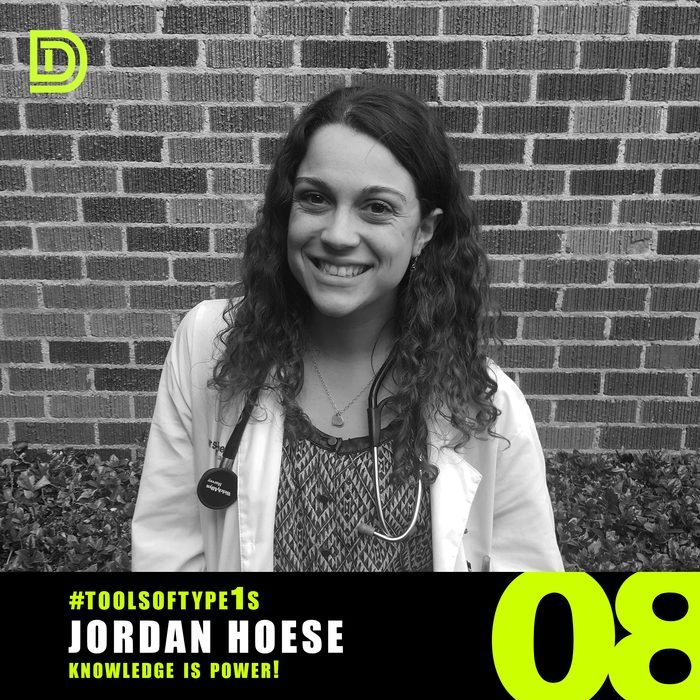
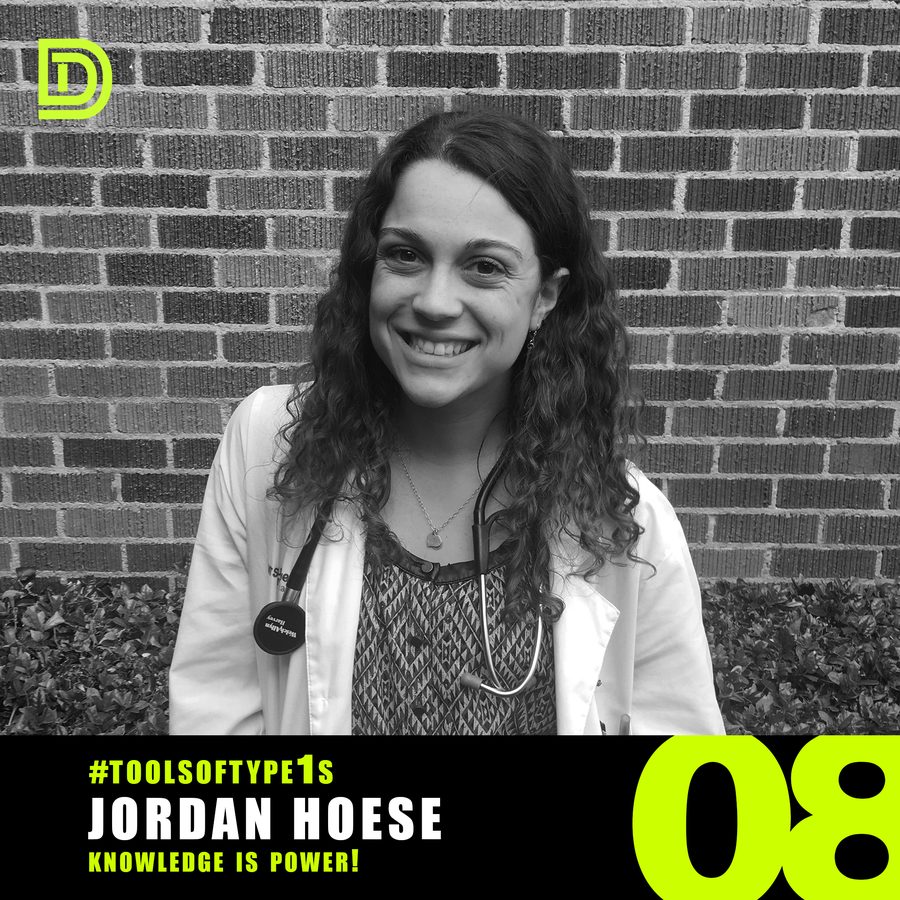
Tool: Knowledge is Power
Diabetes Devices/Treatment Methods: Medtronic 670g & Enlite Sensor, Humalog but currently experimenting with Fiasp.
Animal Personality: (OMG) the Octopus
Questions this episode answers
What is Jordan Hoese's tool of type 1s?
Jordan says her tool is knowledge is power: learning the science and physiology behind type 1 diabetes has consistently made her better at managing it, from her diagnosis at 12 through medical school.
What devices does Jordan Hoese use to manage her diabetes?
According to the show notes, she uses a Medtronic 670G pump with an Enlite sensor and was on Humalog while experimenting with Fiasp. In the episode she describes getting a CGM and auto mode as the biggest turning points in her management.
How did Jordan Hoese get involved in the type 1 diabetes community?
She connected with other type 1 diabetics on Instagram, became one of the original members of Beyond Type Run, and now leads the Type 1 Run Dallas running group, which is how she met podcast host Rob Howe.
What career is Jordan Hoese pursuing?
At the time of recording she was finishing medical school and applying to family medicine residencies, with plans to find out where she matched in March 2019.
Full transcript Searchable, with timestamps
Rob Howe: Tools of Type 1s Podcast Episode 8. We put out 8 episodes in January. It is January 31st, the last day of January 2019. Our guest today, Jordan Hoese, who I met in 2018 at a dinner with Eric Dowds, who was on the podcast earlier, at her house. Shout out her boyfriend, Matt, who was not asked to be on this podcast. Sad. So Jordan's tool, very similar to Christelle, the reason I paired them together, knowledge is power. And Jordan would know. She's just finishing medical school, going into the next round. I'll let her explain that in the episode. A great resource on all things type 1. Also, fun fact, my first ever type 1 run, or any kind of running group for that matter, was with Jordan and her type 1 run group here in Dallas. Go run with people. It was fun. I had a blast. I haven't gone back yet, but it doesn't mean I won't. It's just been cold and I've been out of town. So again, knowledge is power. This is hashtag tools of type ones on Instagram, diabetics doing things podcast, tools of type ones, episode eight, the last in January. Jordan, I'll let you take it from here.
Jordan Hoese: So hi, my name is Jordan. I'm 25 years old. I live in Dallas, Texas, but I am originally from Moorpark, California, the Ventura County area. I have had type 1 diabetes since I was 12 years old. Let's see. I've kind of always been connected to the type 1 diabetes community, actually, even before I had type 1 diabetes. So I had the kind of unique circumstance that my dad worked in the marketing division for the insulin pump division of Medtronic Diabetes for the seven years prior to my diagnosis. He was laid off in, you know, early 2005 and I was diagnosed just like three to four months later. So it's kind of a stroke of luck. I had a really positive diagnosis experience. Lots of type 1 diabetics in my family, so my parents knew the warning signs and symptoms. I was not in DKA. My blood sugar was like 200. I didn't even go to the hospital. I showed up at the endocrinologist's office, like as a direct referral from my pediatrician. He was like, just go to the endo, shut up the endo. The endo gave me a shot, said, go get a burger at In-N-Out, come back, and we'll do some diabetes education. And so I think that, you know, those early, really formative, positive experiences with type 1 diabetes have allowed me to kind of thrive with it. And they've also allowed me to be plugged into the diabetes community kind of from an early, early age. So I, you know, I volunteered at a day camp for children with type 1 diabetes all throughout high school and also throughout college and then a little bit after college. And through there, I was connected with other type 1 diabetics like, like Marie, nerds can fight. And a few years ago, I started seeing her post on Instagram, kind of calling out other type 1 diabetics. And so kind of through her, I became exposed to this larger community of type 1 diabetics online, which is how I found Rob, who also happens to live in Dallas. So that's kind of the very, very brief, condensed version of my involvement with the type 1 diabetic community. As far as two or three things that I do, and so a huge thing that I do is I run. I run seven marathons. I ran my first one when I was 14, just two years after diagnosis. I ran two in high school, three in college, and then currently I'm in medical school. I'm about to graduate with my medical doctorate, my MD, so that's another big thing that I do. So, but obviously I've, you know, running marathons with type 1 diabetes poses a unique set of challenges. And so I have gotten involved in the type 1 diabetes community through that. I was one of the original members of Beyond Type Run last year, and I ran the 2017 New York City Marathon on a team of other type 1 diabetics to raise money and awareness and do some advocacy and education on behalf of Beyond Type 1, an awesome, awesome charity. The second inaugural, not the second inaugural, that doesn't make sense. The second annual, the second annual team of Beyond Type Run is running the New York City Marathon in just like five short days. So I'm sure this podcast will be posted after they have already run it, but let it be known that I am sending them luck now. Okay, so yeah, so I run marathons. I'm currently in medical school. I'm applying for residencies kind of as we speak. I just had my first interview yesterday. I'm applying for family medicine residencies. My goals are to kind of be what you what I want to be the kind of doctor that you think of when you think of a doctor so the person who does anything and everything who will get up in the middle of the night to deliver babies who will fix your grandma's meds who will be your pediatrician who will you know prescribe your birth control who will take care of your aches and pains I just want to be the doctor the doctor who can do it all and your and take care of your diabetes I didn't even think about that Um, so yeah, um, those are two to three things that I do. So I think that my area of type 1 diabetes expertise, um, is the intersection between kind of the two big things in my life, which is running and then medicine. Um, I also have a master's degree in public health. And so I like to think about medicine from kind of these broader perspectives as well. Um, this segues into the next question. So next question. What is your tool of type 1s? And what's the one thing that a person living with T1D could learn from you or your experience? So I think that my, you know, summed up big tool that I have to tackle the beast that is type 1 diabetes is that knowledge is power. So when I was diagnosed, you know, at the ripe age of 12, I wanted to be a molecular biologist when I grew up. I was super into everything life science-y. And so when this opportunity to kind of learn more about like the intricate pathophysiology and the intricate homeostatic mechanisms of blood glucose control was kind of plopped into my lap, I ate it up. And so I was actually managing all my own blood sugars kind of within the first few months of my diagnosis because I thought it was so interesting. And I thought it was so interesting how the more I learned about the science and the physiology, the better I was able to apply that to live a, like, a happy and successful life, the better I was able to apply that to be successful at running long distances. So that has always kind of been my MO, is that the more I learn about the science and the medicine behind type 1 diabetes, the better off I will be. And I think that that still holds true. When I entered medical school three and a half years ago, it was a radical, like a radical, radical thing for my diabetes management. So I was already doing okay. Like I was never, I had never been hospitalized. I'd never been in DKA. I'd never had a severe low. By all, like almost all measures, I was doing fine as a type 1 diabetic. but when I entered medical school and I kind of took my knowledge of what it means not only not just to have diabetes but to have a disease in general and then specifically what it means to have diabetes and the pathophysiologic mechanisms of how elevated blood glucose levels take a toll on your body over the years not just oh it's bad for your nerves not just oh it's bad for your kidneys or bad for your eyes but down like to the level of the individual chemical reactions that end up ruining your nerves kind of drove it all the more home for me. And I felt more motivated than ever to really take control over my life. And I was lucky in that when I entered medical school, I also got hooked up with a really great endocrinologist who taught me not just the, like, the stone-cold bench science behind it, but taught me kind of the arts of, not the art, but yeah, the art of insulin management from like a pharmacologic perspective. And so he was also instrumental in convincing me to get a CGM, um, kind of some other lifestyle factors in medical school. I was running a lot more often because it was the only thing I could do besides studying and not feel guilty about it. Um, and, uh, you know, I was like at home a lot more. I had a lot more routine of a life. I was cooking my own meals and not just, you know, eating college junk. Um, And so all of those things, and then on top of that, the medical school knowledge about diabetes and even things like healthy lifestyles really has been my number one tool for not only motivating me to achieve better results, but giving me the knowledge and the ability to achieve those results. okay i feel like there's a little bit of a um of a disadvantage i feel like into doing a podcast in this format i feel like not having a conversation partner kind of gives me the freedom to ramble um so if any of this is rambling blame rob for not being on the other into the podcast. Just kidding. Blame me. What is the simplest thing you've done that has helped you with the management of your type 1 diabetes? Where did you learn it or who showed it to you? So I think one of the simplest things that I have, quote, done was really something simple that I realized. Kind of at the end of college, you know, I had had some bad experiences in college where I think I had not been as diligent or as on top of things as I would have liked. And part of that was because I was getting very emotionally caught up in what my blood sugars meant or in what my carbs, you know, my carb intake or my carb ratios meant. And I kind of had this moment of clarity in college where I realized that it doesn't matter what my feelings are about either my diabetes or my diabetes management, the numbers are still going to be the same. What does matter is not my feelings about them, but my actions. And so if I'm avoiding checking my blood sugar because I don't want to feel angry or embarrassed or ashamed when I see that it's high, that doesn't matter. What matters is that my blood sugar is high and I'm not taking the action to correct it. And so once I was able to kind of realize and acknowledge that my emotions were kind of irrelevant, I was able to set them aside and, you know, perform the actions that were ultimately going to be a lot more beneficial to my blood sugars, my well-being. So I think that was the simplest thing that I have done that has helped me with the management of my diabetes. That and then also the realization that, oh, I feel like these things are a burden and a hassle, but it takes like less than 10 seconds to chuck a blood sugar you know it takes like less than 10 seconds to enter it into your pump and bolus or to draw up a syringe or whatever um and so like again my emotions about these things are not reflective of the realities of these things and I think that is true you know for a lot of stuff and the more we can think rationally about it which is 100% easier than said than done because we're all humans but I think the more we can think rationally about these things, the better off we will be. So I think this kind of goes into what I was alluding to earlier with kind of my lifestyle shifts and my perspective shifts when I entered medical school. There was a summer in college where I was not, I was kind of like eating very high carb, but I was still eating pretty healthy. So, you know, in my mind, I thought I was doing okay. I wasn't really checking my blood sugars very often or dosing appropriately. I wasn't dosing appropriately because I think I didn't want to admit to myself like how much I was truly eating because, you know, being forced to monitor your food intake all day, every day can kind of screw with your psychology and your relationship with food. And so I was not bolusing appropriately. And then also, because of that, I didn't want to know what my blood sugar was, so I wasn't really checking. And all of that kind of culminated in what I suspect was probably my highest A1C, except I never went to the doctor, so I never got it checked, so I don't know what it was. But based on kind of a rough guesstimation of other patients that I have seen in similar situations as to the one that I was in, I would say that I was probably in the 8s or the 9s. And even that, I recognize that I am probably underestimating because I am embarrassed to admit it both to myself and to you podcast listeners. So who knows what my A1C was? But I had skin infections all over my body. And I got an infection in my thumb, like in the nail bed of my thumb that, of course, I picked at and it spread to the nail bed of my other thumb. And then both my thumbnails fell off and it was awful and it was painful. and it was terrible, and I had all these other festering skin infections, not just on my thumbs, but all over my body, and I went to the urgent care doctor, because I finally got fed up, and I was like, okay, I can't manage this at home anymore, I need to go get some antibiotics, and see somebody about this, and I walked in, and I will never forget the look of shock on this poor doctor's face, and honestly, thinking about it, like this doctor is probably not, like at the time, she was probably not too far away from where I am now in my medical training. Um, and, you know, I don't know if she'd ever seen anything like that before. Um, not, she probably had, I see, you know, there's so many diabetics and none of them are controlled and they all have horrible skin stuff. But, um, but the look of shock on her face was like, I felt bad to have shocked her, you know? Um, and then I felt embarrassed that I'd gotten myself into this situation. Um, I felt stressed because I was going to study abroad. I was taking a class in global health at Oxford, and my flight to England left in like six hours, and I was here waiting in the urgent care because I was freaking out before I left the country. So that was a real low point in my diabetes management. And honestly, I think that I didn't even have the insight at the time to realize that all of these things that I was experiencing was because of my poor diabetes management. And it's crazy how when we are so far in situations, like we can't really get that outside perspective and we can't like really see how things actually are. You know, if you had asked me at that time how to be successful at managing diabetes, I would have told you all the right things, but I was not doing them. And I had all of these really exquisite rationalizations for why I wasn't doing them so much so that like, I didn't realize that I wasn't doing them. So that taught me a lot about kind of getting outside my own head, like in retrospect, I have realized that that taught me a lot about getting outside my own head, taking my blood sugars at face value, taking what I eat at face value, again, and getting my emotions out of it, and really just tackling things head on. And I think that as a result in that process, I have become a person who values lifestyle and wellness so much more because I realized how important those things are in contributing to blood sugar management. what unusual or absurd opinion or approach regarding your diabetes do you have man okay so one um one aspect i feel like of being involved in the type 1 diabetes online community is that everybody has their own opinions um and you know the way that i manage my insulin and my activity and my food intake and honestly even the way that i count my carbs is probably going to be different than the next person over. No two diabetes management plans are alike, which means two things. A, people get really defensive and weird when you start trying to compare strategies because they're like, oh, well, that doesn't work for me. Therefore, it must be wrong. and B, what I have realized, especially the further I've gotten into medical school and medical training, the more I've interacted with not only type 1 diabetes community members, but also type 1 and type 2 diabetic patients in my work life, is that our diabetes is not as different as we think it is. And I think that this is a pretty controversial opinion. because at the end of the day, like, yeah, there are some differences in insulin sensitivity based on your body fat percentage, based on, like, how in shape your muscles physically are, and a little bit based on age, and a little teensy bit, like, a teensy bit based on diet, and I hesitate to even say that because people are going to take it and run with it. So there's, like, minor, minor, minor variations in insulin resistance and sensitivity, but other than that we are all working with the same the same situation like we are all working with the pancreas it doesn't work we are all working with no endogenous so like from your own body insulin production we all have to inject our own exogenous insulin and I think importantly the vast majority of us our insulin all works the same way like most of us are on basal bolus therapy. And yet here we are acting like everybody's diabetes is a unique snowflake when on paper it really shouldn't be. I think that where the distinction is, is everybody takes those same variables, everybody takes that same deck of cards, and the way that they manage it based on their own habits, their own psychology, their own lifestyle, their own schedule, their own diet, their own everything. That's where the differences come from. And I think also over time, the way that we end up adjusting our insulin regimens. So, you know, if your blood sugar goes high after a meal, you know, but it's like three hours after a meal, some people might adjust their mealtime ratio, other people might adjust their basal. And then that leads to kind of like a snowball effect of more adjustments down the road. And with every subsequent adjustment, there's more and more permutations until you get everybody who has these radically different insulin management strategies when really we're all working with the same materials. We're all working with the same insulin. We're all working with the same physiology in our own bodies. I don't know. So I think that is my controversial opinion and my unpopular opinion is that we are not as special as we think we are. And the difference, the differences between us are 100% within our control. And diabetes in general is a lot more in our control than we think it is. So often I see people, especially like within the type 1 diabetes community, and I see it reflected a lot in the language that we use, saying things like, oh, diabetes did this, like making diabetes the actor, like the agent in our sentences. And I don't think that that's true. I think that, you know, every action has a reaction. And so if those reactions are our blood sugars, if those reactions are what diabetes is doing, somewhere upstream there is an action or a variable or an event that caused it. I think if we did absolutely nothing but sat around our house all day and paid 100% strict attention, we would probably catch like 90% of these like causative events or causative actions. Um, and we would feel that our blood sugar was a lot more explained. Um, I say 90% rather than a hundred percent because, um, humans are actually like by nature of our psychology, we're really, really bad at, um, attributing causation. Um, if you guys have ever heard of the 25 cognitive biases, um, these are ways that our brain is hardwired to work and hardwired to interpret the events that go on around us. And they're really good if you need to make snap decisions. They're really bad if you need to think critically about stuff, like causation when it comes to type 1 diabetes management. So I think if we did nothing but pay attention to our diabetes and were as objective as possible, we would probably be able to attribute 90% of causation to, like, what caused our blood sugars to be like they are. So I'm not necessarily recommending that we all go do that, and I'm not necessarily, like, shaming anybody who doesn't go do that, because obviously we all have lives to live, and we all have priorities, and we all have to prioritize and strike a balance between having, you know, really, really good, really tight blood sugar control, really low A1Cs and standard deviations, versus, you know, doing what ultimately works within our life and doing what is ultimately sustainable to us from kind of a mental health perspective. Like, what can you do on a daily basis that is sustainable for the rest of your life? Because this is not going away. And I will say, kind of my other devil's advocate side to this is that I used to have this kind of like false belief, especially like when I was in college or even when I was in high school. I used to have this false belief that the more in control I was of my diabetes, the more it would impact my life. And so all the extra time that it would take to stay really on top of my blood sugars and, you know, basically that's all the things that go into staying really on top of your blood sugars. Um, that would create such a time burden on my life, um, or such a restriction on my life in other ways that it was not worth it to me. And as involved as I am right now is as involved as I can reasonably be expected to be. Um, as I have gotten, um, my, I don't, I'm not sure if you can hear the cat purring. Just jumped up right next to the phone. So I apologize. As I have gotten more and more in control, partially through things like getting a CGM and partially through things just like by prioritizing, checking my book sugars, I have realized that that could not be further from the truth. And so the idea that being more in control is going to be more of a burden on my life is just erroneous. Because when your blood sugars are in more control, like you feel better, you're not on a roller coaster, ultimately it frees you up a lot more to do the things that you want to do. And so this little tiny, tiny bit of extra effort actually has exponential payoffs because you're putting in this tiny bit of extra effort to get the rest of the day back. whereas if you are putting in minimal effort and you end up on this roller coaster that's going to impact your life a lot more than putting in you know the little bit of extra effort to you know check your blood sugars or really really carb count or really really dose your insulin would or even to like retroactively look at the patterns and see how can I adjust this and perfect this next time okay so basically my controversial opinions are that we blame diabetes a lot and I don't think we should. I think that's how I can best sum it up. With the big disclaimer that this is much easier said than done and even though the responsibility ultimately rests with us, I want to be very, very clear that I am not like in any way victim blaming. I am sharing my own experiences and I am gently reminding us all that the responsibility is ours and doing better is possible even if you don't think it is What's your favorite thing? What gets you to smile or laugh almost every time? Well the very, very immediate favorite thing is this giant cat that just jumped into my lap and you can probably hear purring there's a little excerpt for you um he acts like a dog and is just like the funniest goofiest animal that I have ever encountered and so usually he's doing some like stupid stuff um that will make me laugh um like usually when I come home he's just lying straight on his back um like flopped out across the floor looking like he died um and I get home and then he like hops up and comes and runs to me and it's just absurd behavior for a cat um let's see but what gives me a smile or laugh almost every time um my go-to answer that I was when I was thinking about how I was going to answer these questions so I was like wow like what gives me a smile or laugh um you know I think my boyfriend um one of the reasons I love him is because he has the same like weird like niche sense of humor that I do that's just like bordering on the absurd and so usually he says something um he can say something to get me to laugh you know anytime I need it um but what I was thinking about was those stupid buzzfeed lists um and I think you guys probably know the ones I'm talking about it's like 15 tumblr posts about harry potter or whatever and i'm like well this is dumb like buzzfeed is a dumb website listicles are dumb um tumblr is dumb i'm you know i'm not gonna laugh at these and i get like five in and again i think it's that like really absurd like humor niche and i just like lose it regardless of whether i'm in a room by myself or a room of other people. Um, so that's my like deep, dark secret. Um, you know, uh, my boyfriend knows that if he hears me laughing from another room, he always yells back, are you on Buzzfeed again? So, so that's my shame. Um, all right, moving on, please. In the last five years, what new adjustment to your lifestyle has improved your life with diabetes the most? So hands down, the new adjustment to my lifestyle that has improved my life with diabetes the most has been getting a CGM. So I saw my doctor, my new endocrinologist in medical school, I saw him for probably a little bit over a year. And that entire year, I mean, I've seen him for three and a half years, but the entire first year that I saw him, he was gently, gently trying to convinced me to get a CGM and I didn't want to hear any of it I didn't want to wear something else on my body but he just kind of like slowly planted the seed and slowly did some real like some really professional motivational interviewing to get me to think that getting a CGM was like my own idea or he just wore me down and you know it's like when you're trying to get a toddler to try food for the first time you have to like um or trying to get them to like a food you have to give it to them 20 times before they'll eat it. And so I think eventually I just got familiar with the idea and I just got worn down. And I was like, okay, I'll get a CGM. And oh my goodness, I just gave this talk to the first year medical students about what it's like to be a patient in medicine and also be on the other side of it, on the medical professional side as well. And as part of that, I showed them my graph because I was talking about my experiences with my endocrinologist and how effective he has been in getting me to change my own health behaviors. And I showed them a graph of my A1C prior to, um, prior to getting a CGM and then after getting a CGM. And like, again, prior to getting a CGM, I was doing fine. I wasn't doing great, but I was doing fine. Um, and especially by like medical, like from a medical perspective, um, you know, your doctor, all doctors are so used to seeing A1C is like greater than 10, you know, too high to read even, um, that anything under eight really looks good just because the doctor's perspective has been so skewed. And so all my doctors had always been telling me that I was like fine because my A1C was 7.5, um, or like, you know, 7.2 or whatever. And, um, that was kind of where I lived and then I got a CGM and there is this sharp like cliff like the month I got the CGM because again this kind of goes back to the whole knowledge is power thing and so if you know what your blood sugar is all the time you are more empowered to do something about that and not only are you more like do you feel more of an impetus to like take action but because you have the knowledge, you know which action to take. And you can get immediate real-time, like, graphical representation of the feedback about how that action went, and you can better adjust for next time. So getting a CGM was just, like, such a radical shift in my diabetes management, and I cannot believe that I ever, like, lived without one, basically. And, like, I was so resistance to it from the get-go. And it was an adjustment, but it's so worth it. So I encourage anybody who's in the same boat and who has, you know, the resources and the ability, because unfortunately they are still a privilege, to jump aboard the CGM train because it is a game changer. Also, you know, full disclosure, the Freestyle Libre is available without a prescription over the counter for a relatively reasonable price compared to other CGMs. So if you were somebody kind of without insurance or maybe without, you know, a physician that is going to be able to prescribe you, like, a waiver for, or in a prescription for a really, really expensive CGM, the Freestyle Libre is always an option. Oh, yeah, and so I got, you know, I've always been a Medtronic pump user in part because of my, like, family's ties to Medtronic, but I love Medtronic pumps and I feel like maybe that should have been my controversial opinion because people really love to hate on Medtronic. But my first sensor was the InLight sensor, which I've had great results with. I love it. With the 630G Medtronic half closed loop pump. And then kind of the natural progression, my endo talked me into getting the 670G, which is the closed loop automated basal delivery system that works with the same CGM. And so obviously, like auto mode has also been kind of one of the biggest adjustments of my diabetes life and has also made the biggest impact. Again, people really, really love to hate on auto mode. And I think it's, you know, it has to do with the reasons that I was talking about earlier. So it takes all of those human elements, all of those human adjustments, kind of totally out of the picture. And it gives you this basal that is 100%, not like as close as it can be to your physiologic needs. And over time, what all diabetics tend to do, myself included, is we tend to make so many adjustments to our insulin that we actually end up using more than our body needs, which can contribute to insulin resistance and weight gain. But it also means that we end up feeding our insulin. And so it means that we kind of subconsciously inadvertently end up eating carbs to cover the insulin that we're getting instead of the other way around, even if we aren't going low. And so what I was going to say is when you have a computerized system, when you have an automated system that kind of knocks you back down, um, to what your body's basal needs are, um, a lot of people end up going high all the time because they have been inadvertently covering for their mealtime insulin with their basal rates, um, which is a really common phenomena, um, across people who start in the 670G, um, and all diabetics. and that like those subsequent adjustments having to be 100% honest and accurate in your carb counting which is a burden and a battle in and of itself having to figure out your exact ratio having to figure out your new correction ratio because now your basal is different you know it's a huge paradigm shift and it is a huge mindset adjustment and it's you know it's really hard to accomplish. I've been on the 670G for a little over a year now, and I am still working on breaking the habits that I've created from over 12 years of manual insulin delivery, of manual basal rates, and manual carb ratios. But having knowledge of those things and having knowledge of the, um, the way that insulin works, like pharmacologically, um, the way that diabetes works pathophysiologically, and then also the way that my mind works to interpret all these things psychologically, um, has been a huge help in adjusting to the 670G on auto mode, as has my endocrinologist who has explained all of these things to me. Um, so if any of you guys are getting frustrated with the 670G, don't give up. I think that the reason that people like closed loop, like the DIY, like looping systems better than the 670G is because the looping system has a lot of freedom to make your own adjustments within the looping algorithm. And so you can still, you can bypass the computer's 100% rationality and do like continue to make your own adjustments that fit in with your own habits and lifestyle and psychology and biases a little bit more easily and by that I mean at all than you can do with the 670g on auto mode. Okay, the only other thing I'm going to say is I know a lot of these technologies that I've talked about are inaccessible to the vast vast vast majority of diabetics and I want to be very, very clear that while they are the gold standard and they make things a lot easier, a tool is only as good as the person using it. So it is really, really possible to have awful, awful results on like a CGM and a closed loop system. And it's really possible to have incredible results on MDI, multiple daily injections, and like just checking your blood sugar however many times a day on a glucometer. It really has to do with the person behind those tools. I do think that insulin pumps and CGMs make it easier, but if you're not willing to kind of meet the device and rise, not like kind of rise to the challenge, you know, like fulfill the tasks that the device is requiring you to do, then it's not going to be a good choice for you. And that's okay. But I think that's all I have to say about diabetes technology. What challenges related to T1D did you encounter or have to overcome while you were doing your thing? So to answer this question, I first have to decide what my thing is because I have a lot of things. My two big ones are running in med school, but I've got lots of hobbies. I think that, like myself and other people, have really, really covered the challenges posed by running with type 1 diabetes. Both, you know, in podcast form or online. Or, you know, I have posted a lot, a lot about it on my own personal Instagram, my own personal channels. So I won't really talk about that. If you have more questions, you can go listen to the Type 1 Run podcast. You can listen to my episode on the Type 1 Run podcast. Or you can go hook up with Type 1 Run on Instagram. You can hook up with me on Instagram. But I think I'll talk about challenges type 1 diabetes has posed in medical school. because I get a lot of messages from type 1 diabetic medical students or type 1 diabetes like nutrition students or type 1 diabetes health profession students who tell me that their type 1 diabetes management has kind of fallen to the wayside while in medical school or while in the clinic or whatever. And I also get a lot of messages from prospective students asking about how I've managed to be successful at managing type 1 diabetes as well. So being successful at becoming a physician and managing other people's blood sugars. And so I think that ultimately what it boils down to is you have to practice what you preach. And you have to take care of yourself first. And this is true across medicine and across health professions, regardless of whether or not you have type 1 diabetes. And so, you know, it is very, it has kind of risen in our cultural awareness. Maybe not, maybe in my cultural awareness, because all my, like, circles are healthcare circles. But it has kind of risen in the healthcare circles' cultural awareness that we really need to do a better job at protecting physicians from burnout and protecting physician mental health and protecting physician wellness. And this goes like across health professions. Because ultimately, like those things, without those things, medicine and healthcare are unsustainable. And I think that having type 1 diabetes has allowed me to be better at that than, you know, the person next to me. because I think that by prioritizing type 1 diabetes, I am automatically doing things like prioritizing wellness. I automatically have this insight and this realization that there are things that are more important than school and things that are more important than how I perform in the hospital. And so it kind of allows me to inherently have this balance to my professional life that I think is kind of hard to come by for a lot of people. And I think it's hard to come by for a lot of type 1 diabetics as well. Um, but you know, I mentioned earlier how when I entered medical school, um, I kind of changed my lifestyle in ways that were more amenable to, um, type 1 diabetes management. And so I, you know, was getting more consistent and better sleep. I was cooking at home. I was eating, you know, less processed foods and more whole foods. Um, I was getting regular exercise, things like that um I was also learning how to prioritize like time doing fun stuff over like studying because the thing about medicine is there is always more studying to be done you are never ever ever done you just have to like kind of figure out where your set point is that you call it and you say okay I'm gonna go do something else now I'll come back to studying later um because even like established physicians who have been in practice for like 45 years there's new medicine coming out like every day. Um, anyway, guy got sidetracked. Um, but I think that, um, having diabetes has made me in so many ways better at what I do. Um, but it has also presented challenges. Um, some of them logistic, um, you know, I have, um, kind of surreptitiously, well, I think I should preface this. I have never been open. Yeah, I've never been open. I've never been flamboyant about my diabetes in like my public or work life. You know, I still keep my hands in my purse when I check my blood sugar so that nobody sees what I'm doing and asks me about it and so that I don't distract from whatever the real task is at hand. And there have been times when my pump has, like, buzzed me to calibrate it, or I knew my pump was going to buzz me to calibrate it. So I, like, snuck my meter in my white coat pocket, and, like, while everybody else was busy, like, talking to the patient or whatever on rounds, I would just kind of, like, surreptitiously put my hand in my pocket and check my blood sugar and calibrate my pump. And nobody was the wiser. um you know that sounds like a little bit of a hassle but to me that is more worth it than the inevitable conversations that will follow if I um you know kind of disrupt the workflow and there is still very much the culture within medicine that you know and it's improving a lot and people will probably have no problem if I did if I was open about like chucking my blood sugar or whatever. But there is kind of still the culture that you, I guess you can't show weakness or that you can't, you have to be very professional at all times, especially when you are a medical student at the bottom of the totem pole and you can't like distract from like the task at hand. I think it's more of the pressure that I feel rather than the not show weakness pressure. and also the pressure to like not excuse yourself for any reason at any time. This is why for me personally getting the CGM and being on auto mode has been such a game changer. I got the CGM right before I started my clinical rotations in my second year and not having to like excuse myself to check my blood sugar, which is something that I wouldn't have done so I just wouldn't have checked my blood sugars and having my blood sugar on me at all times has been so, so, so, like, so beneficial. And then having auto mode so that I could go long periods of time, you know, without even looking at my CGM and my blood sugar would stay steady has been even more of a game changer for me. um you know before I had auto mode my I wouldn't I have never really been a person who carries food for lows um which you know I might have just ruined all my credibility because I know that some people feel very strongly about that but I um have always had really good like hypoglycemia awareness and I have always relied on signals for my body and I've always suspended my pump kind of preemptively to prevent a low even before I had auto mode even before I had a CGM um and so that has always kind of been my MO and I haven't found myself in too many situations where I've ever um really really needed to eat for a low and when I do they're typically at meal time and they're typically at dinner time and so not even when I am like in the hospital doing my thing. So I think type 1 diabetes has been a lot more of a benefit than a challenge when it comes to quote my thing which is medicine. I think that it allows me to prioritize wellness in ways that maybe my peers don't have that excuse or don't have that perspective and I think also it allows me to relate to patients on a totally different level. So the vast majority of people in medicine are young and healthy, especially, you know, at my stage in training, and really have no idea, like, what the experience of having a disease or being a patient or going to the pharmacy or trying to incorporate medications and remember to take them and remembering to do all these things that your doctor tells you, they have no idea what that's actually like when the patient leaves the exam room. And that is like an insight that I am quote lucky enough to have. And I think it allows me to communicate with patients better. I think it allows me to be a lot more empathetic. And I think it allows me ultimately to make my patients healthier because I'm able to meet them at their level. One of the annoying things, one of the reasons I don't talk about type 1 diabetes a ton at work is because I know that we get this like very skewed perspective especially if we're plugged into the online diabetes world but the online diabetes world is so self-selected it is the vast majority of people who are paying enough attention to their diabetes to want to be plugged into the diabetes world the people who are well resourced enough to have access to the online diabetes world. But that is a tiny, tiny, tiny sliver of our country's diabetic population. I mean, type 1s are a tiny sliver in and of itself, but even those on Instagram or whatever, or those on like beyond type 1s platforms, are a tiny, tiny sliver of the type 1 diabetes population. And the unfortunate and sad truth is that the vast, vast, vast majority of them are not doing well. They are under-resourced, under-supported, under-educated, and I say that referring to diabetes education, but also maybe sometimes more formal education, certainly in health literacy, which is a different kind of type of literacy. You know, most people have not been empowered or informed to take charge of their diabetes. And most people don't know how to have good results. And they have been taught this sort of learned helplessness with regards to their blood sugar at the hands of the medical profession, which is true for type 1 and type 2 diabetics. And so the stuff that we see online are the exceptions to that rule. the stuff that my colleagues see are the rule and so when I go up to somebody and I tell them that I'm type 1 diabetic instantly they have all these preconceptions about me and so then I have to spend a lot of time um being like well no like I'm not on dialysis or like well no like you know I don't need to sit down in the middle of surgery because my blood sugar is going to do whatever you think it's going to do. No, like I'm fine. Please treat me normally. I am not as sick as the vast majority of the patients that you see. I don't think of myself as sick at all because I have, you know, had the really lucky experience to be exposed to the knowledge and the tools and really incredible healthcare providers to help me take charge of this disease, which is not something that has been afforded to the vast majority of type 1 or type 2 diabetics in this country. Um, or in the world, really. Um, okay. Yeah. So, um, I think that that is probably the biggest challenge in medicine is dealing with other medical professionals. Um, but I always tell endocrinologists that I work with when I have diabetes because we always have really great discussions about it. Um, and I learned, I've learned so probably an equivalent amount from endocrinologists that I just kind of like encountered in like my daily work life. What are you most hopeful for? This can be diabetes related or not. So I think I'm most hopeful for the thing that I am focusing all of my efforts on right now, which is finding a residency program that meets all my training goals, that has a community of like-minded and supportive and collegiate people. that kind of my side goal is that it's in a beautiful location where I can do all my outdoor activities and hobbies and just be surrounded by nature. And I want it, also I want it to, you know, be in a place where, I don't know, just overall where I will be happy and fulfilled and successful in my pursuits and where my boyfriend will be happy and successful and fulfilled in his pursuits. Um, and I'm hopeful that as I go on this interview trail, I leave tomorrow for a big two week stint and then I have another like three weeks stint. Um, it will become, it will be obvious to me where that place is. That's what I'm really hoping for is that I will just like arrive somewhere and be like, okay, I'm home. Um, that's what I'm hopeful for. Easier said than done, or maybe not. We'll see. Check back with me. If you want to keep up with my interview travels, um, you can follow me on Instagram, um, and see where I end up on March 15th. What advice would you give someone who has T1D and is trying to pursue a career in your line of work? So I already talked about this a little bit when I was talking about, like, quote, challenges that I have encountered while doing my thing. And I think, you know, it boils down to practicing what you preach. and I think it also boils down to something else I mentioned earlier which is you know the more attention you pay to your diabetes the less it impacts your life you know contrary to kind of what our intuitive belief is which is the more attention I pay the more of a burden it is but the more attention you put into your blood sugars and the more attention you put into keeping them in range that pays off and you are able to focus on other things when ordinarily you would be focusing on the blood sugar roller coaster. And I think that that has what has allowed me to be successful in medical school is I have put a lot of effort into managing my blood sugar and that pays off so that I don't have to think about my blood sugar and it doesn't get in the way of medicine or, you know, when I'm working in the hospital as much as it would otherwise. And then I think my final piece of advice to anybody who has type 1 diabetes and is trying to to become a doctor or maybe another healthcare professional is that you can do it and that you are like uniquely suited to do it. I think that, you know, I see so many type 1 diabetics who enter the healthcare field. I feel like 50% of the endos I meet have type 1 diabetes. And that's for a reason. Like you have a unique perspective and experience that is really valuable in patient care. And so, you know, please don't get bogged down by the details of, you know, grades or all the hoops you have to jump through. I mean, I will, I, okay, I will say that, like, being a doctor is not for everyone. It's a super mega ultra hassle. You have to, like, really, truly love it to put up with all this crap. But, you know, if you really, honestly, truly love it, like, you will be successful at it, like kind of regardless of what your grades are and regardless of, you know, how poor you may feel your chances of getting into medical school are or, um, you know, anything like that. Um, it is possible. There are people out there who have done it. Um, I think that someone really inspirational to follow is, um, Mike Natter. You can follow him on Instagram. He is a, um, second year internal medicine resident who's going to be an endocrinologist. He has type really amazing things to share kind of about the humanistic side of medicine. Um, and a part of that is his, you know, his medical school journey and his medical school application story. Um, he was a non-traditional applicant and he did not necessarily think that he had all the traditional markers for success, but here he is being a super success with type 1 diabetes. Um, so I would definitely follow him for some, some inspiration and some awesome artwork. work um and then of course I am also always here if you guys need career or type 1 diabetes advice what bad advice regarding diabetes do you see or hear that you'd like to address um so I think this kind of goes back to what I was saying earlier um but I think a really really harmful concept and a really bad piece, a really harmful concept that a lot of bad advice is founded upon is that diabetes is, quote, different for everybody, when it is not the diabetes itself that is different for everybody. It is not the insulin itself that is different for everybody. It is how we use that insulin that is different for everybody. Our experiences are different, But diabetes itself is not. So we're all working, you know, with the same tools and the same set of rules. And I think that when people are giving advice, they don't realize this or forget this or are so caught up in their own world and their own flavor and their own strategies for diabetes management. that they think that that is the only way because it is the only way that they have found that works for them. And likewise, I think when people are receiving that advice, they're like, oh, well, I can't effectively put that into practice. Therefore, they must be wrong. And so I think that we could all stand to take our own advice with a grain of salt, and we could all stand to take other people's advice with a grain of salt and realize that just because something is not working for me or just because something works for me but doesn't work for somebody else, that doesn't mean it can't and that doesn't mean it's wrong. And so particularly with diabetes management, you know, there are a million ways to skin a cat. I don't think the actual expression is a million ways. I think it's like there's more than one way to skin a cat. But, you know, there's more than one way to achieve the same results with type 1 diabetes management um um importantly that is not because our diabetes is different that is not because our insulins are different it is because all the other stuff we do with our life and all the other like factors that go into which adjustments we make and which decisions we make are different between us um so i think we need to realize that when we are giving advice to each other, even if it doesn't seem like it's good advice to take, or even if it doesn't seem like it's possible advice to take, um, it is possible. We are just making the conscious decision to live our life in other ways, basically. Um, but I still think it's important to realize that we have a lot to learn from each other. Um, so much like the, the richest source of diabetes education is from other type 1 diabetics and taking what they know, um, or what they have experienced, um, that works for them and cherry picking what you like into a way that works for you. Of course, it's important to do this with, you know, as objective of a mindset as possible, which is really hard to do when you're so deep in the situation. And so the other part of this exchange of advice thing that I see is that there's kind of a lot of, not bad science out there that gets exchanged between type 1 diabetics, but kind of incomplete science, an incomplete understanding of science. And I know, I mean, there's like a whole, there's a whole industry out there that preys on people's incomplete understanding of scientific things. Mostly like the diet industry, because we have a really poor understanding of nutrition science. But I think that, I don't know, I don't want to, I'm not trying to discourage people from scientific inquiry, because I think, I mean, that is ultimately, like, the tool of type 1 diabetes that I'm, like, trying to promote here, is that knowledge is power, but I think that, you know, we have to be careful how we interpret findings, and there's a lot that goes in to science um that is more than just taking things at face value um it is okay but how does this fit in with the context of everything else i know and what does this actually mean rather than like sensationalist headlines or sensationalist claims um and so i i think that um sometimes when i see people um promoting like scientific pieces of advice um you guys couldn't see my air quotes there, but I put air quotes around the word scientific. I think it's really important that we look at that advice and then we go and we do our own research and we say like, okay, you know, yes, this person said this, but what are they missing? And what am I missing? And I think, you know, I see this a lot because I am in the position of somebody who like, you know, studied a lot of science in high school, went to college and got a degree in neuroscience, went to medical school, has spent my entire life studying basically like biology and life sciences and the scientific method. And I come to these scientific pieces of advice with a lot of background knowledge. And so I'm able to pretty quickly see, okay, yes, like you're saying this, but what about this other thing that's actually more important and has more of a, more of an impact that we actually need to be thinking about. And so I just encourage you to, when you see pieces of advice that look really, really solid because they seem to be rooted in science, to discuss that with somebody like your doctor or, you know, me maybe, who kind of has a broader scientific knowledge base or maybe yourself. I mean, I don't know, maybe you are much more educated than I am and know more about it. But there's a lot of incomplete science out there in type 1 diabetes advice. And so I encourage you to just take everything with a grain of salt and do your own research and talk to people who know what they're talking about. What priority are you focusing on in your own life currently? This can be diabetes related or not. I kind of have one priority now. Unfortunately, it is not diabetes related. Maybe it should be because I went to the doctor last week and my A1C crept up like a tenth of a point for like the third time in a row. And I was like, maybe I should like focus on getting this back down. It's still below 6.5. So for all the judgy duties out there, I'm doing okay. But anyway, Anyway, so my priority in my own life currently is applying to family medicine residencies and getting a job as a doctor. So for those of you unfamiliar with how medical training in the United States work, I'm sure this is what you all tuned into the podcast for today. You have to go to four years of undergraduate, so four years of university, get a degree, apply to and be accepted to a four-year medical school, get your medical doctorate degree, your MD. And then you have to, in your last year of medical school, you have to apply to a residency program, which is specialty training. The first year of residency is called intern year, for those of you who are like, but what about internship? So I'm currently applying to residency programs. Next year I will be an intern. I will be a first year resident. The residency program application process is very, very standardized. So we send the same application in to everywhere that we want to apply that we feel meets our training goals. And then they choose whether or not they want to interview us. And then we go on the interviews. And then once we've interviewed everywhere we want to interview or everywhere we were invited to interview, we rank them in a list. And then we submit that list in February. the programs also rank all the people they chose to interview um in order of how badly they want to employ them and work with them next year and they submit that list in february and then on the third it all goes into this like national centralized algorithm um that is based on an algorithm that won like a nobel prize in economics for like its efficiency so i guess we should trust it. Um, and then the third Friday in March at like, um, the same time across the country. So it's like 11 AM Eastern or whatever. Um, every single fourth year medical student and every single person who may have already graduated medical school, who was trying to get into a residency finds out at the exact same time, one place where they matched. And so I won't know where I'm going or moving next year until like March 15th or whatever it is. Um, I'm pretty sure it's March 15th. I feel like I should know this date. Um, it's like arguably one of the most important days of my life. Um, looking at the calendar, March 15th. Yeah. I knew, I knew I got that from somewhere. Um, so, you know, while I'm on this interview trail, which I am currently on, when I had my first interview on Monday of this week, I am not really allowed to discuss, like, where I'm going to be ranking these programs, and they are not allowed to discuss ranking with me, and it's all very formalized and standardized and very, very controlled. Like, they cannot commit any of these, like, there's a whole long list of match violations that are illegal, and then they can't hire anybody if they commit these match violations. So there is no under the table recruiting or anything like that. So right now, I just had my first interview. I have 15 more interviews in the next like two months, which is just an insane amount of travel. And I am focusing on finding a place that I want to live and train at and that will shape the type of doctor I become for the next three to four years. So I would say that that is 90% of what I'm focusing on currently. 95%, 98% of what I am focusing on currently in my life. And the other 2% to 5%, I think, is really increasing my Spanish language proficiencies. I went to Guatemala earlier this year and did some Spanish immersion I'm currently in a Spanish class I took it for a year and a half in college but I don't think you would know that but it's so important for patient care it's so important to be able to speak the same language as your patients and so I'm really I'm getting there I need to call the translator less and less but I really don't want to ever have to call the translator at all alright All right, next question. So who is someone that you look up to and what have they taught you? How do you apply that to your life? So I really struggled with this question because I have a lot of people that I look up to in so many different facets of my life. You know, the vast majority of them are family medicine physicians who have kind of mentored me and shaped my career path throughout medical school. And, you know, they've been people that I want to emulate later on in my life. And so that is why I'm currently where I am, applying to family medicine residences. So there's so many people, including my endocrinologist, who used to be a general practitioner before he went into endocrinology, um you know had some really awesome insights and things to share regarding like my career he doubles as my career counselor he's my endo slash career counselor um anyway but somebody who particularly stands out to me is um dr stephen brown so he is a family medicine physician who works um at a family medicine residency in arizona and i first heard about him on this podcast last year or earlier this year, I guess, um, in like January, um, called the undifferentiated medical student podcast. And he was there talking about the specialty of family medicine. Um, and it was at a time when I was really torn up about whether or not I was going to pursue family medicine versus pediatrics. Um, you know, I knew I really loved family medicine, but I also like, um, there, I really enjoy taking care of kids much more than I enjoy taking care of adults. Um, I enjoy taking care of adults and I feel morally obligated to take care of adults. Um, but as far as like things that I truly like really get a kick out of, I really get a kick out of like being a doctor for children. Um, so I was trying to decide like what would be the most satisfying career option for me. And on this podcast, Dr. Brown talked about how he went through that exact same dilemma in medical school at the same point in training that I was currently at, which I have, you know, since come to find out that, come to find out that the vast majority of family medicine physicians at one point considered being a pediatrician. I think that they are very much just like cut from the same cloth personality wise um but in hearing him talk about all the reasons that went into his final decision to become a family medicine doctor um not only did i 100 agree with all of his like really like eagle eye viewpoints on and perspectives on medicine and public health and why it is ultimately responsible to be a family medicine practitioner. Um, but he said something where he was like, you know, um, I don't know that he said this actually explicitly, but the, the overwhelming takeaway from his podcast episode, um, was that you don't have to listen to the haters about about what family medicine is or isn't, you have the power to create the path and create the life and create the career that you want to lead and that you love. And you don't really have to sacrifice anything. And so if you want to be a family medicine physician that sees a lot of kids, you can. If you want to be a family medicine physician who practices only in the hospital, you can. If you want to be a family medicine physician who does surgery, you can. and that was really really really inspirational and factored a lot into my decision to be a family medicine doctor is the fact that you know I have the power to create my own path yeah I don't know the other big thing that he said so he told a story actually I have a very similar story of my own that I will tell. His was very similar to this. So I had this patient. I rotated on the pediatric endocrinology service at Children's Hospital in Dallas earlier this year, kind of around the same time, actually, that I listened to this podcast, which is perhaps why it was so poignant for me. But we got a call. So the Children's Hospital is across the street from the county hospital. And this 15-year-old girl had showed up to the county hospital in florid DKA, new onset type 1 diabetes. But she was also in labor at 23 weeks of gestation. So very, very early, kind of borderline for viability is about 23 weeks, 22, 23 weeks. um so she shows up in labor 15 years old in dka with new onset type 1 diabetes and the county hospital did not know what to do with her because ob-gyn was like oh my goodness like she's 15 and she has this crazy medical problem um pediatrics was like yeah cool she's 15 but she's pregnant we don't do that um and also she has this crazy medical problem so this is best left to the OBGYNs who specialize in crazy medical problems. And then the medical team, like the internal medicine team who ordinarily takes patients in DKA, was like, yeah, great, like she's in DKA, but she's a kid and also she's pregnant. And we as internal medicine doctors don't deal with either of those populations. And so they called us, the Pediatric Endocrinology service. And we were like, yeah, like we can deal with her, but she's pregnant. So we can't deal with her. We'll just have her follow up as an outpatient clinic. And I was so, I never met this girl. Um, she was across the street at the other hospital and had basically been routinely denied care because all of her demographic features didn't fit nicely into the one box that had been chosen by the doctors. Um, and I, I, you know, this poor girl probably got no diabetes education in the hospital because she was on the OBGYN service. Um, probably got adult level diabetes education when she did rather than like the child level of support that she needs because it was not a children's hospital. Um, and you know, she delivered a stillborn baby at 23 weeks in DKA while being diagnosed with type 1 diabetes and probably got very very little psychosocial support um because her care was so fragmented um and I was there on the other side of the phone listening to them call in this consult to schedule the follow-up in clinic for two weeks and I was like hey this girl you know it's gonna have probably like six different follow-up appointments from all her different providers that she has encountered during this hospital stay. And I doubt that she's going to show up to anyone because she's going through this traumatic life experience and probably no one has explained to her the importance of coming to her diabetes follow-up. But B, if this hospital was only run by family medicine doctors, they are capable of dealing with pregnant patients. They are capable of dealing with pregnant patients with medical illnesses like diabetes. they are capable of dealing with acutely ill medical patients like those in DKA they are capable of dealing with children and they are capable of dealing with psychosocial components and psychology and psychiatry so if this girl had had a family medicine practitioner you know she would have had one doctor who was able to take care of all of her needs and she would have had one follow-up appointment and she probably would have come to it if it was one follow-up appointment. And her costs, like, you know, macro scale, her healthcare costs probably would have been a lot less, like, burdensome, because she would have been able to kind of streamline her services. And so I was really struck by the fact that, like, I never want to be the doctor who has to turn a patient away, because like, oh, you're pregnant, I don't deal with pregnant patients, or oh, you're a kid, I don't deal with kids. That's not fair to the patient. and studies have shown that a well-trained generalist can take care of upwards of 95% of a patient's medical needs without needing to refer out. And I think in situations like this, it is so much better for the patient to have a single person who they know and trust and who is competent to deal with all of their needs rather than having six different cooks in the kitchen. So Dr. Brown told a story a lot like that, and then I experienced, that story and I was like oh my goodness I gotta be a family doctor um so I don't know that I would have had I would have been primed to come to that conclusion if I hadn't just listened to Dr. Brown's podcast so um so thank you I had the opportunity to meet him actually at a conference um later this summer and now we follow each other on Twitter so um we're basically best friends it's fine what's the one facet or trait that you think makes you uniquely you explain why um so I think there's a couple things that um I don't know maybe they wouldn't be how other people define me but they're how I kind of define myself and they're kind of like this narrative that I've created for myself about how I perceive myself um so I think that one thing that makes me uniquely me is I try really really really hard to be open-minded and objective and rational in all things, particularly about my own beliefs, my own viewpoints, my own perspectives, my own behaviors, my own habits, my own role in the world. And I try really hard, you know, not to say stuff if I don't have the data to back it up. And I, you know, try when somebody presents an opposing viewpoint, I try really hard to, you know, consider it for all its, in all its merit, um, and incorporate that into my, my own perspectives. Um, you know, that's easier said than done, right? Because we're all like humans with our own biases and psychologies, but I think the more that we're aware of those biases, um, the better we can overcome them. Um, not 100%, but the better. Um, so yeah, that's how I try to, try to live. Um, and I think the other thing that makes me kind of me is I, um, I didn't know how to say this. Um, I don't really say no to a lot. Um, I'm kind of a yes man. Um, whenever somebody approaches me with like an idea or a project or an opportunity, I almost without fail have a track record of saying yes, like 100% of the time, which honestly has gotten me where I am today. Like there have been so many cool things specifically within my career in medicine that, you know, have had a huge impact on my life and have shaped who I am and have shaped where I'm ending up or where I will end up because they seemed cool and I said yes, even though I didn't fully understand what they were at the time. And so I think just like being open to opportunity and being open-minded in general are the two things that define me and make me uniquely me. And I think, you know, both of those things impact my diabetes management. Like we talked a lot, or I talked a lot, maybe too much, about, you know, like the importance of incorporating new viewpoints and being objective about your own viewpoints when it comes to taking other people's diabetes advice. And I think that, you know, that has allowed me to incorporate other people's diabetes advice in meaningful ways. And then also, like, being open to opportunity. I wrote about this in one of my residency applications. I think that having diabetes has taught me to be open to opportunity. You know, you can look at it any which way, but ultimately, there's so many things in my life that would not have been possible if I had not been diagnosed with type 1 diabetes when I was 12 years old. Whether that is, you know, I don't know that I would have gotten into running. I don't know that I ever would have run a marathon. I don't know that I would be as, like, healthy or well as I am currently if I didn't have diabetes, kind of reminding me that these things are important. I certainly would not have gotten involved in the type 1 diabetes community and met, you know, incredible people like I have been meeting for the past like 13 years. It's just all sorts of stuff, man. Diabetes has been one big opportunity and everything is really one big opportunity if you see it that way. I mean, my final disclaimer is that, particularly with the being, like, objective thing, is that these things are easier said than done, and they're hard to apply in real life. And so, like, I say that I really make an effort to be 100% objective in all my things, but, you know, I still make emotion-driven decisions, particularly with regards to diabetes management, on a daily basis, you know, sometimes multiple times a day. Like I still eat really high carb meals, even though I know objectively like that is just creating more room for air because I have decided in the moment that it is more important to me to like eat what everybody else is eating for social reasons. Or, you know, maybe I just really want this thing and it's, you know, going to make me feel better, which is not objectively a good reason to kind of have a high blood sugar later. but it is part of the balancing act and part of creating a sustainable plan for diabetes management and I think the key is being aware of when you make those decisions because ultimately, and what I am expecting to reach is a point where I am I'm like, okay, I've allowed myself to make these emotion-driven decisions for a really long time I'm going to cut this one out right now I'm going to stop eating a lot of carbs in this specific scenario. And I think that over time, being aware of these things is going to allow me to develop even more control over my blood sugars. But yeah, it's okay to have irrational behaviors. We all do. I think the key is to recognize when they're irrational behaviors. Plug yourself. Tell us where we can find you in the Diabetes Online community. so you guys can find me on instagram um my instagram handle is jord hose j-o-r-d-h-o-e-s um also my full name is Jordan Hoese i don't know if i have ever said that um my twitter handle is also jord hose like at jord hose um my twitter is like primarily like family medicine slash professional twitter but if you want me if you want to like plug in to like my medical stuff. Um, you can find me there on Instagram. I mostly post about, um, diabetes management. I post about running. I post about like the intersection of diabetes management and medicine. Um, and I also post a lot about travel. I travel a lot and will be traveling a lot in the upcoming months, um, on the residency interview trail. So including to some pretty cool places, if you want to see pretty pictures, um, come to my Instagram. Um, And then you can also find me, so I lead the Type 1 Run Dallas chapter. We have a Facebook group. It's called Type 1 Run Dallas slash the Diabetes Exercise Alliance, which is a pre-existing Type 1 diabetes exercise group in the Dallas-Fort Worth area. We've got a lot of people on that group. And obviously, the Dallas-Fort Worth Metroplex is a giant catchment area. um so even if you can't make it to one of my runs people are always hosting like bikes and swims and other athletic events um through the diabetes exercise alliance um and you can like sign up for our newsletter and things like that so get involved on facebook i am also i also started a training group um for people who are interested mostly medical students um but we have some type 1 diabetics from type 1 run who are um who have joined um it's a training group for people who want to run the Dallas, um, half marathon, the Dallas 10 K or the Dallas 5 K, um, in December of this year. And so if you were in the DFW area and you would like to train for those races, come find my training group. It's called the T O R, um, ACC training group. Just find me on like Instagram and I'll send you a link. Um, actually I think the link is in my Instagram bio. So nevermind, go to my Instagram file um and yeah I can help you train for your race um or if you want to like take my training plan and use it to train for another race I will not be offended um I think that is all the places that I am like easily accessible online um you know I I think I respond to everybody's messages um I really enjoy it when people ask me like science questions or ask me to explain something, I try to, you know, I don't post about explaining science stuff as often as I would like to because usually by the time I get home, I am so drained from talking about science stuff all day. But if you ask me a question about it, I will always, always respond. Alrighty. Where do you get plugged into the T1D community the most? so I think I get plugged in to the type 1 diabetes community the most probably on Instagram um that was my original introduction again I you know kind of was organically friends with some type 1 diabetics and I was like hey they seem to be posting about a lot of other type 1 diabetics let me delve into this world um and then when I um was chosen to be on beyond type 1 in 2017 I started posting a lot more about, you know, diabetes and then got really, really involved in the Type 1 Diabetes Instagram community, which is how I met Rob, who happens to live in Dallas. You know, I met people locally on the Type 1 Diabetes Instagram that I now hang out with in real life. And so the way I got involved with Type 1 Run was through Instagram. but now I host those runs for real um I actually partnered with the diabetes exercise alliance through like somebody that I randomly met while I was on a run and I was like oh hey you're wearing a Dexcom and then she found me on Instagram and hooked me up with everybody and then like we all got together with type 1 run and beyond type 1 um to create like a centralized running group in DFW. And so I think that actually, this is a really good metaphor. So I didn't know if any of you guys have read Aziz Ansari's book, Modern Romance. But in it, he talks a lot about dating apps. And he, you know, dating apps kind of have a really bad reputation. And meeting people online in general has a really bad reputation, which I think is changing. But Aziz Ansari makes a really good argument that you are not doing anything different when you meet people online than you would do if you're meeting them in a like in a bar or at some sort of event um you are just expediting the process you are creating like essentially what you have is a more efficient search engine for the people who are more likely to be interesting to you um and that's what the type 1 diabetes online community is but he says that the reason that people get fed up with um um like online dating apps is because they will have these interactions with people that never really lead to any sort of real life meaningful in-person interaction and I think the same is true of the type 1 diabetes Instagram like it is it should be used as a tool to facilitate real world interaction um if nobody lives where you live then it is a good substitute but if you have the opportunity um you should use it to facilitate these interactions people are always having meetups There are so many type 1 run groups now, even if you don't run, just like go walk with them, you know? Um, and then, yeah, if you want me to convince you to become a runner, reach out and I'll convince you to become a runner. Um, but you know, there's so many options, um, for meeting type 1 diabetics in real life through Instagram. Um, so that is what I recommend is using Instagram or whatever online platform you prefer, um, as a tool to make real life connections. Um, so yeah, also like, you know, the JDRF, um, JDRF chapters have local meetups and stuff like that. Um, there was one last night that I missed, sorry, Rob. Um, but I highly recommend it. If you can go, you should go. Okay. Um, I think that is it. So if you guys have made it to this far in the podcast or, um, you know, whatever medium this turns out to be. Thank you very much for listening to me just kind of talk into my phone in my living room with my coffee for, you know, however long this ends up being. I recorded it in pieces because I had been having issues with recording. And thank you for Rob for inviting me, you know, into to be a part of your platform and to kind of share my experiences and perspectives. um it is an honor to be asked um to be a part of anything that you were doing and um thank you so much for all that you do do for the type 1 diabetes community um and yeah that's it find me find me online so we can continue having some of these discussions about things um you know that maybe I talked about in the podcast or things that you want me to talk about or that you want to talk to me about sorry um or if you just want to see where I end up next year all right thanks guys bye
Rob Howe: Thank you for listening to the Tools of Type 1's podcast on diabetics doing things. I'm Rob Howe, and every Tuesday and Thursday in 2019, we are posting the next Tools of Type 1 episode. So follow us on Instagram, hashtag toolsoftype1s, or just on diabeticsdoingthings. We will post those regularly every Tuesday, every Thursday. My favorite type 1s are answering the questions I want to know the answers to. And hopefully you'll learn a few things as well. If you like this episode, be sure to review us on iTunes. And if you didn't like it, go ahead and let me know that too. I want to know. All the feedback is good to me. Thanks again for your time. I value that more than anything you could possibly give me. Thanks so much. Bye-bye.
About Jordan
Jordan Hoese has lived with type 1 diabetes since she was 12, growing up in Moorpark, California before moving to Dallas, Texas. She was finishing medical school and applying to family medicine residencies at the time of this episode, and leads the Type 1 Run Dallas running group.