

#ToolsofType1s - 007 - Christel Oerum
Episode summary
Christel Oerum was born in Denmark and has lived in Santa Monica, California since 2011. She was diagnosed with type 1 diabetes in 1997 at age 19. She runs DiabetesStrong.com with her husband Tobias, a health and fitness site written largely by people with diabetes, and works as a personal trainer specializing in diabetes and exercise. She talks about building the site from an online journal into a resource with recipes and exercise guidance, taking daily notes to spot blood sugar patterns, switching to a CGM, and getting denied insurance coverage for a specific long-acting insulin that worked for her. She pushes back on one-size-fits-all diabetes advice and talks about her hopes for a preventive cure.
Key takeaways
- Christel says her core tool is 'knowledge is power' -- she collects data on food, insulin, and blood sugar and looks for patterns.
- Christel takes notes by hand on overnight blood sugars and says three days of notes is usually enough to start seeing a pattern.
- Christel says switching to a CGM gave her far better insight into where her blood sugar had been and where it was trending, though she still takes it off occasionally for a data break.
- Christel was denied insurance coverage for the specific long-acting insulin that worked for her body and had to switch, which she says insurers treat as interchangeable when it isn't.
- Christel says there's no single right way to manage diabetes -- what works for her (resistance training, her diet) may not work for someone else.
Show notes
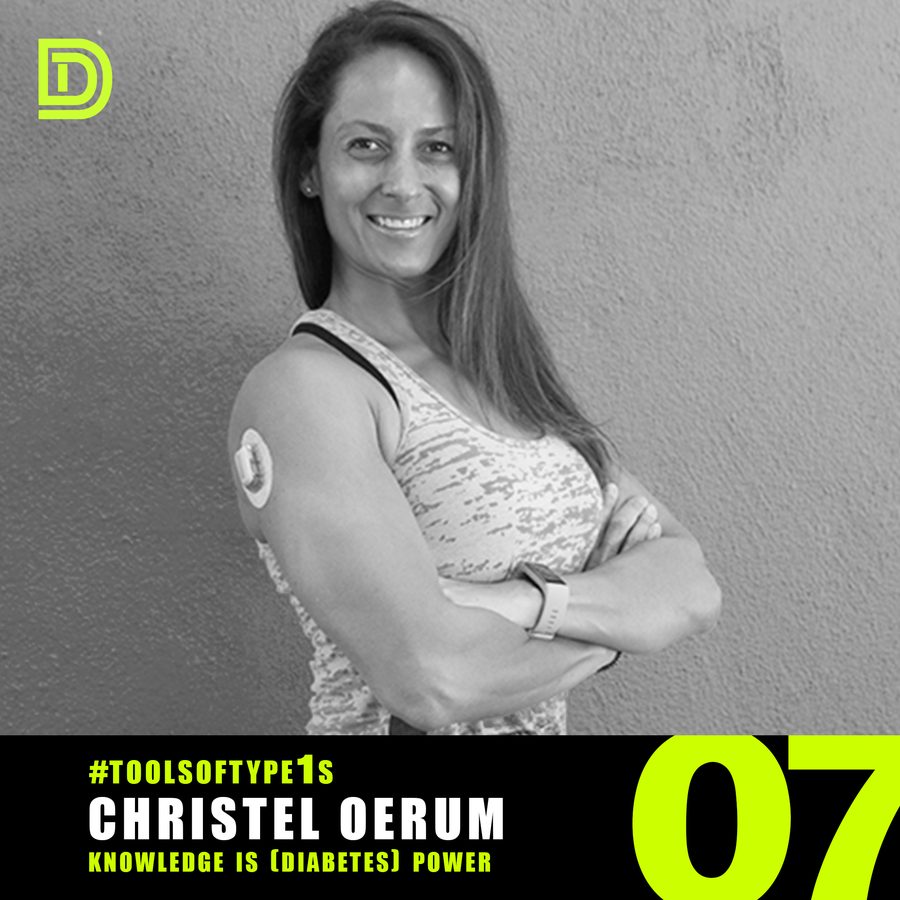
Name: Christel Oerum
Hometown: Santa Monica, CA via Denmark
Date of Diagnosis: 12.01.1997
Tool: Knowledge is (Diabetes) Power (learn more on DiabetesStrong.com
Diabetes Devices/Treatment Methods: MDI (Levemir & Humalog), Dexcom G6
Animal Personality: Black Kitty
Questions this episode answers
What is Christel Oerum's main piece of advice for managing type 1 diabetes?
She says knowledge is power: track your blood sugar, food, and insulin, write it down, and look for patterns. She still takes notes by hand and says three days is usually enough to start seeing trends.
Does Christel Oerum use a CGM?
Yes. She says she started using a CGM in the last five years and calls it a huge improvement over finger sticks because it shows where her blood sugar has been and where it's trending, not just a single number.
What is DiabetesStrong.com?
It's a health and fitness website for people with diabetes, run by Christel Oerum and her husband Tobias, covering exercise, recipes, and insulin sensitivity, written largely by people living with diabetes themselves.
What frustrates Christel Oerum about insurance and diabetes care in the US?
She was denied coverage for the long-acting insulin that worked for her body and had to switch, because her insurer treated different basal insulins as interchangeable. She also says there's a lack of research into type 1-specific exercise guidance.
Full transcript Searchable, with timestamps
Rob Howe: Tools of Type 1s Podcast, jumping into Episode 7. We're going strong, Diabetes Strong, with Christel Oerum. Christel's awesome. I met her in 2018 for the first time, both in person and on the internet. Just a super cool person. Very grateful I got to meet her and her husband, Tobias, who doesn't get enough credit in the diabetes community, but Tobias is dope. Shout out, Tobias. I know he doesn't listen to podcasts, but this is for you, man. Christel, her tool, knowledge is diabetes power. Her website is diabetesstrong.com, diabetesstrongIG on Instagram. Just very grateful to know her. Super positive voice in the community, expert on all things exercise and diabetes, including recipes. Diabetesstrong.com. This is the Tools of Type 1's podcast. I am Rob Howe. Did I say popcast? Podcast. I've done more of these than I prefer to admit on air. Episode seven, Tools of Type Ones podcast. Hashtag Tools of Type Ones on Instagram. Check out Christel's episode coming right at you.
Christel Oerum: Hey, Rob. This is Christel. Thank you for having me as part of Tools of Type Ones. I really appreciate that. As promised, I'll just go through all the questions and use whatever you like. My name is Christel Oerum. I was born in Denmark, so that's Scandinavia, and now I live in California, more specifically I'm in Santa Monica. I've been living in the US since 2009 and in Santa Monica since 2011, so this is home now. I was diagnosed with type 1 diabetes in 97 at 19 years old, so sort of as a young adult. And what I do, well, my primary gig here in life is to run the diabetes and health website called diabetesstrong.com. So diabetesstrong.com is fitness, exercise, health in general for anybody living with diabetes. And it's primarily written by people living with diabetes. So that's kind of what makes this a little bit different. um what else do I do well I am fairly active one would one would say I exercise a whole lot I'm very much into fitness my big love here in life is resistance training so that's what I spend a lot of my time on I think the way that you and I Rob connected first was actually through the diabetes community um somebody who knew both of us felt that we should be connected so that was kind of the introduction, I think. And that's the beauty of the DOC, right? It's a fairly small community, but I think, I'm sure we get better, but I think we're pretty good at connecting each other and always being there for each other. So I think that's pretty cool. So thank you for having
Rob Howe: me. What is your tool of type ones? And what's the one thing that a person living with T1D could
Christel Oerum: learn from you or your experience? Well, when you look at what my tool is, I guess it's knowledge is power. I think that's kind of it in a nutshell in the sense that what have made me successful in creating my website and sort of engaging with others is that I'm pretty good at collecting whatever knowledge I need to collect and structuring it such a way that we can learn from it. So in that sense, for example, when it comes to exercise, so figuring out exercise and diabetes, especially exercise and insulin dependent diabetes is super complicated, but that's something that I kind of decided to do. So I set up a structure for it and I started collecting data, data being, you know, what's my blood sugar? How much did I eat? How much insulin did I take? Yada, yada, all of those things. So I think what I have shown is pretty much that, you know, if you collect the right data, if you do the right analysis, if you do the work up front, there's pretty much nothing that we can't do with diabetes because knowledge is power, right? If we know what we're doing or at least have a good idea, it's easier to predict patterns when it comes to blood sugar management and our diabetes becomes easier. It's never going to be easy, but hopefully it becomes a little easier. What is the simplest thing you've done that has
Rob Howe: helped you with the management of your type 1 diabetes? Where did you learn it or who showed it
Christel Oerum: to you? So actually it comes back to, you know, knowledge is power. Again, I think, I think one of the simplest things I've done is taking notes. I know it's super simple and actually still do it on with pen and paper. But taking notes on what's going on in my life as it relates to whatever diabetes management tweak I want to do. And yes, I talk a lot about exercise, but it can also be sort of like, you know, managing blood sugars overnight. So that's something I tinker with a whole lot. I'm sure a lot of us do. But basically, I try to be structured. You know, I write lists and I analyze my results and I try to come up with tweaks. So again back to the overnight time glucose management, it comes down to well do I go low, do I go high, when do I go low, when do I go high, what did I do, what time did I have my last meal, did I have any insulin on board when I went to bed. So a lot of those things I just take notes. After three days I'm like three days then you you should start to see patterns. If you don't, take more notes. But, you know, take notes,
Rob Howe: learn as you go, and just tweak. What failures or apparent failures with T1D have made you better at living the rest of your life or made you more well-rounded as a person? That's a really cool
Christel Oerum: question. I think one of the main things was being very quiet about my diabetes and sort of being disconnected from the larger diabetes community. I was pretty much disconnected for the first 15 years of my diagnosis until kind of what I described as kind of came like jumping out of the diabetes closet when I started my website. But basically, it wasn't necessarily because I didn't want to talk. Well, yes, it was because I didn't want to talk about my diabetes. I'm actually very private, believe it or not. But I just, I don't think I felt like I could teach anybody anything and I didn't necessarily know that other could teach me something if that makes sense and that's a huge mistake because obviously we can all learn a tremendous amount from each other so I think now being more vocal about living with diabetes and being more engaged with other living with diabetes it's I've grown tremendously and all of a sudden I realized that my experience is, well, of course, somebody else can use those and grow as well. So that's been pretty fantastic.
Rob Howe: What unusual or absurd opinion or approach regarding your diabetes do you have?
Christel Oerum: So, of course, because I do this, I don't think it's super absurd, but I've been told before that I overdo it. I micromanage like crazy. So I micromanage my blood sugars. I micromanage my food. I micromanage everything. so that means that diabetes yes takes up a lot of my time and for some people that's not going to work because it's going to take over their mental state as well for me it just works okay I don't mind tweaking my my basal rate every night I don't mind or every day for that matter I don't mind tweaking my my blood sugars constantly throughout the day and checking in it's more like checking in on an annoying partner. But I do that. It works for me. I've had doctors who told me I test too often. I measure my blood sugars too often. I do this and that too often. I'm like, whatever. Don't leave me alone. This works for me. So yeah, I guess that's it.
Rob Howe: What's your favorite thing? What gets you to smile or laugh almost every time?
Christel Oerum: well what makes me smile every day is my little family i have my husband and my little pooch so she's three so i mean waking up looking at them that makes me smile it makes me happy i'm really happy in my life um other things is looking out my window i can see the santa monica mountains from where I live. I can see the ocean and I am grateful every day. I love living by the sea. I love living in a place that, you know, it's sunshine pretty much every day. It makes me happy. You can probably hear I'm smiling right now. So yeah, my family life and you know, just the everyday life that I managed to establish for myself and that's, I guess it includes diabetes as well in the sense that diabetes is my full-time job right now, not just for myself, but also with the website. But yeah, my life makes me happy right now.
Rob Howe: In the last five years, what new adjustment to your lifestyle has improved your life with diabetes
Christel Oerum: the most? That answer is actually a device answer. I've started using CGM within the last five years, and oh my gosh, what a difference that makes. All of a sudden, I have way better insights into what the heck is going on with my blood sugars. That makes a huge difference, knowing not only where you're going, but also where your blood sugar's been and you can see where it's trending. That's just so amazingly helpful. I always say, you know, diabetes is not random. We just don't have full information, but the more information we have, the easier it becomes. again back to it's never going to be easy but I think the more we know the easier it becomes so that's the technology part I I still take my CGM off once in a while if I need a data break because it is a lot of data but if I had to give up something it would definitely not be my CGM absolutely love it I'd rather have that over my finger stakes even though I think finger stay some more accurate. Another thing I think has made a big difference is I've sort of become an exercise slash diabetes expert in the sense that, you know, just establishing diabetesstrong.com, establishing all the resources we have on there. I've done a tremendous amount of research. I have experimented, so to say, on myself a whole lot, figuring out, okay, what goes on in the body, what goes on with blood sugars when you do one activity versus another one. If I go for a run, if I go for a hike, if I go do resistance training, if I go do a dance class, what happens? All those things have made a huge difference because right now I can go to the gym and I can be fairly confident in how my blood sugar is going to react. Dang, that's a difference from, you know, six years ago, whatever. And what all I had was a pamphlet that said, eat 15 grams of carbs, Not super helpful. So I think those two things, it's the technology, the CGM, and then it's just the exercise knowledge, exercise and diabetes knowledge.
Rob Howe: What challenges related to T1D did you encounter or have to overcome while you were doing your thing?
Christel Oerum: Well, there's been a few, I think. Not having access to information. I think because type 1 diabetes is basically such a small space relative to type 2, that's just a lot more research into type 2. And for example, just coming to exercise, I drew a blank back when I tried to figure out how to exercise safely and effectively with type 1 because there's just nothing out there. I hope my website has helped that, but you know, there's still not a ton of resources. Other one which still bumps me out living in the US is being denied coverage for the med that works for me, right? It's just, I mean, having this conversation with my endo she's like this is so so lame that you know i am i guess what they define as fairly well controlled and all of a sudden my insurance company is like yeah you have to switch insulin to whatever and i just know that this particular long-acting insulin that i'm taking works for my body you know and that's that's frustrating that kind of leads into one of those things is a lot of the insurance companies see basal insulin as all the same which is obviously not we know those that us who take them know that. But, you know, that's the other thing. If we also can apply that and look a little bit inward, I think, in the diabetes community, we tend to find something that works really well for us and then everybody else should be doing it. It's kind of like one fits all. I don't believe there is such a thing. You know, I always say I love resistance training. It works wonders for my diabetes management. But that doesn't mean that everybody should do it. If you absolutely hate it, then do something else. The same thing when it comes to diet. right so you'll never hear me prescribe like one type of diet i know what works for me and i can tell you that but if you come to me and tell me hey i you know should i be doing a b or c diet i'm like try it out see if it works does the shoe fit you know if it doesn't try something else i think just let's not all try and fit into a round mold
Rob Howe: what bad advice regarding diabetes do you see or hear that you'd like to address
Christel Oerum: Bad advice would be that we're all the same. We all should be doing things the same way. We should all be on an insulin pump. We should all have CGM. We should all use the same insulin. We should all eat the same diet. That is utterly bogus to me. I could not disagree more. I really think that we all need to find what works for us. I'm not saying insulin pumps are a bad idea, but for me, for example, it doesn't work. I tried it. It was not for me. But I know some people where it's just like it's a godsend, right? So worst advice is to just believe that we can all manage our diabetes
Rob Howe: in the same way. What priority are you focusing on in your own life currently? This can be diabetes
Christel Oerum: related or not? That's a good one. I am really focused on being happy. And that's not necessarily diabetes related, but it's one of those things where if you're not happy in your life, I kind of feel like you need to change something. So I'm very focused on making choices that I believe will you know make me happy overall and also work I'm working hard on reducing my stress levels um it's actually it's funny because reducing stress levels is both physically and mentally um in the sense that I tend to overdo things I tend to do too much also when I physically would be going to the gym a little bit too often for example so try and dial things back and sort look at the broader picture. And as for more of diabetes focus, well, I am trying to become an even, you know, I've always, well, I've been part of the DOC, the diabetes online community for a while, but my goal is really to try and be a larger part of it in many different ways. I became an American citizen in January of 2018. So I am trying to become more involved in the political scene. I think there need to be made some changes here in the U.S. in regards to access to medication. I am also trying to go out to more events, try and prioritize more meetups, etc., where I actually meet people one-on-one. Because right now I am very active in the online, but I like to meet people face-to-face as well.
Rob Howe: Who is someone that you look up to and what have they taught you? How do you apply that to your life?
Christel Oerum: yes very much indeed there is somebody I look up to so my husband is one of them um I think he's incredibly smart and good looking all that good stuff but basically um he and I run diabetesstrong.com together and it's amazing working so closely with your partner in the sense that he and I are very different people. And what makes me, we use the word look up to, is that he approaches life way differently than I do in a lot of aspects. I'm very risk adverse. He's a risk taker. He often has the approach to life going like, well, what's the worst thing that can happen? Let's just do, right? It's still calculated. It's not like with his head under his arm. But I really appreciate that. and I try to become better at that as well as sort of just taking some calculated risks once in a while. And I like the approach of, you know, what's the worst thing that can happen? Look at the worst thing and say, well, is it really that bad? And then move forward.
Rob Howe: What are you most hopeful for? This can be diabetes related or not.
Christel Oerum: I'm going to make this one a diabetes one. I am most hopeful for a cure, a preventive cure for type 1 diabetes because that's kind of based on the current research what I think is most feasible within my lifetime. I would think it would be absolutely amazing if no kids would ever be diagnosed or adults for that matter be diagnosed type 1 diabetes again. Imagine that. I mean, again, as I said, I don't necessarily think there'll be a cure for somebody like me in my lifetime. It might be for the down below. But just seeing that you could prevent it for developing, that would be absolutely amazing.
Rob Howe: What advice would you give someone who has T1D and is trying to pursue a career in your line of work?
Christel Oerum: So my line of work is a little interesting in the sense that it's, I don't really think there's anybody else quite doing what I'm doing. So I would say there's two components to it, right? So I am a personal trainer, specialized in diabetes. That's one thing. And then I run a website, diabetesstrong.com and the associated social media channels. So it's kind of like almost a twofold career, let's say like that. But if you have an interest in moving into exercise and diabetes, I would recommend, First of all, get the right education, you know, either get, well, not either, but get the right certifications, become a personal trainer, maybe a strength coach, take the right, you know, nutrition certification, et cetera. And then do your own research in the sense that when it comes to diabetes and exercise, there's not, there's not a lot of structured education on it. So you have to do some of your own research. it is out there but it does mean digging through you know some of the big research libraries and trying to find the right articles you can also look at the footnotes and a lot of my articles you can find them there but I'd say that's the first thing and also trying a lot of things out on yourself nobody is gonna look to you if you just tell them to go exercise and do a b and c if you've never done it yourself I think that one of the things that makes a lot of the recommendations I give powerful is that this is things that I've done you know if if people come tell me well I live with type 1 and I want to lose weight I hear that a lot but I can't because I'm type 1 I'm like first of all I've done it I can show you the footage um so just telling people that yes it can be done and this is how I've done it or this is what the latest research should say you should do. I think that's tremendously helpful. The other one is building a website. Well, I mean, first of all, know that that's no easy task and people are not going to just come to your website or your blog and, you know, read the content. You have to advertise it or you have to, what I've done a whole lot is I collaborate because there's other great websites out there within the field of diabetes or the area of diabetes that doesn't necessarily focus on the same thing that I do, but we all have something to offer each other. So I'm just like collaborate. Me helping somebody else does not hurt me. Right. So collaborate as much as you can and just hang in there. And also, you know, know why you have your website. Is it just because you want to journal, online journal? Well, then maybe it doesn't matter by getting your voice out. Right. But if you want to reach a lot of people,
Rob Howe: it does. What's the one facet or trait that you think makes you uniquely you? Explain why.
Christel Oerum: Unicorn. No, what makes me uniquely me is I am, um, I think I'm a powerful doer. So I'm a powerful structured doer. What I mean by that is that, you know, I am, I get structures gives a cell I'm structuring the way I approach things but I will also get things done so if I see a gap somewhere you know a personal life family life friendships whatever and something needs to get done and I don't feel like you know either let's say that nobody else is stepping up I will step up you know it's kind of like well it's kind of like, again, back to the website, Diabetes Strong, I started becoming very, very engaged, you know, in an exercise and wanted to take my fitness to the next level. And I just could not find the resource on how to do that with type 1 or with diabetes in general. So I created it. It didn't start out with me thinking, hey, I'm going to do a big website. It's going to be this and that. I'm going to have like half a million people read it every month. It started out by me just using it as an online journal. And then all of a sudden I started to see a lot of people reading it because there was that information was not out there. And that's kind of spiraled that way. But it's, it's all about, you know, if something needs to get done, just do it.
Rob Howe: Plug yourself. Tell us where we can find you in the diabetes online community.
Christel Oerum: okay so a little self-plugging here so pluck myself my name is Christel Oerum i run diabetes strong.com so diabetes strong.com is a health and fitness website for people living with diabetes it is all the content you're on that you'll find on there is it's everything from recipes it's exercise how to exercise with a type 1 diabetes how to improve your insulin sensitivity the works and it's all written by people living with diabetes. So when you go there, what you'll find is advice from people who gets it. It's not just me writing anymore. We also have other guest writers, other experts, and you can also ask questions, et cetera. And if you're looking for something a little more, let's say personal rather than just a website, of course, we also have the social media channels supporting the website. There's everything from Instagram where you can interact directly with me. Facebook, Twitter, Facebook, well we have the Diabetes Strong Facebook page as well as the Diabetes Strong support group. So it's called Diabetes Strong as well. And this is a group of people living with every type of diabetes and we have over 13,000 people in that group now. So that's where you can go find like direct peer support. Aside from the website and social media, I am also a personal trainer. I do in-person training, of course, here in Santa Monica, California. And I also do online coaching. And what I support people with is basically structure, figuring out, you know, how to think about adjusting their insulin, for example. I don't give that kind of advice, you know, dosing advice, because I'm not a medical professional. But we can set up structures so that people can start seeing improvements in A1C, in lifestyle, etc. Of course, there's also training programs, etc. I am also a speaker in the sense that I do get booked for public speaking events. I volunteer a whole lot, predominantly here in the Los Angeles area. But getting out and chatting with people who live with diabetes, who go through a lot of the same things that I do, is tremendously rewarding. And that's definitely something I want to do more of.
Rob Howe: where do you get plugged into the t1d community the most
Christel Oerum: the place that i feel the most connected with the doc is on instagram i am also on facebook but i think facebook and twitter for that matter can become a lot of noise and i feel like on instagram people can you know interact directly on your pictures but we can also send messages directly back and forth and i've seen i've received as well some really you know personal and well thought out questions there that i don't think people necessarily are comfortable just posting in a group forum on facebook or the twitter wars so i think that's that's the most personal right now But obviously it doesn't become more personal than meeting in person. That does require that, you know, it's in the Los Angeles area or if that, you know, if I'm traveling, if it's an event is on at the same time. But live events, you know, meet up groups is so much fun. so I like going to spend a few hours an afternoon here and there with a group of type 1s because it's just it's just another way of interacting and I think we can support each other in a whole different way thank you so much for having me Rob I really appreciate it I hope some of my tools can help others and yeah I guess that's it thank you
Rob Howe: Thank you for listening to the Tools of Type 1's podcast on diabetics doing things. I'm Rob Howe, and every Tuesday and Thursday in 2019, we are posting the next Tools of Type 1 episode. So follow us on Instagram, hashtag toolsoftype1s, or just on diabeticsdoingthings. We will post those regularly every Tuesday, every Thursday. My favorite type 1s are answering the questions I want to know the answers to. And hopefully you'll learn a few things as well. if you like this episode be sure to review us on itunes and if you didn't like it go ahead and let me know that too i want to know all the feedback is good to me thanks again for your time i value that more than anything you could possibly give me thanks so much bye
About Christel
Christel Oerum was born in Denmark and now lives in Santa Monica, California. She was diagnosed with type 1 diabetes in 1997 and runs DiabetesStrong.com, a diabetes health and fitness site, while working as a personal trainer and speaker focused on exercise and diabetes.