

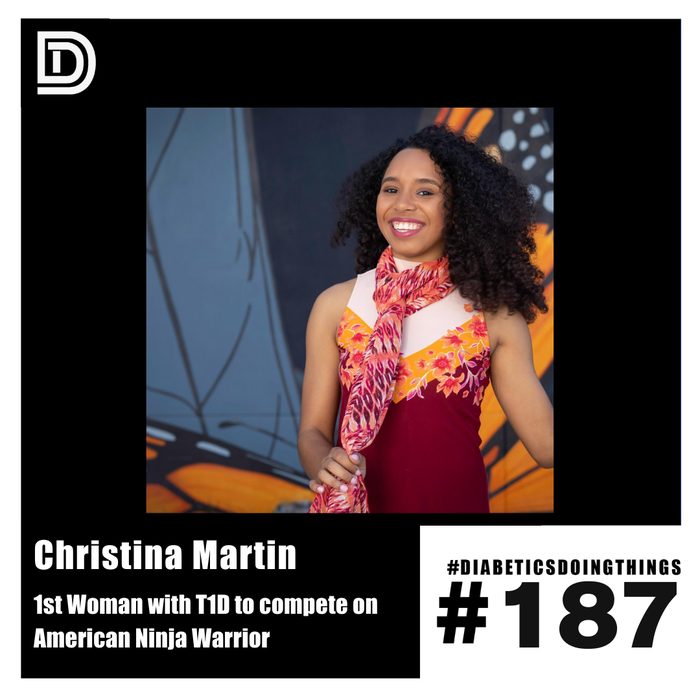
Christina Martin - First Woman with T1D on American Ninja Warrior
Episode summary
Christina Martin was diagnosed with type 1 diabetes at 13. She grew up as a dancer and started a high school club that became Type Zero Foundation, a nonprofit serving families in Central Florida. A job at a ninja gym led her to fall in love with the sport, and she became the first woman with type 1 diabetes to compete on American Ninja Warrior, training around a 3:30 a.m. run time and showing her insulin pump on camera during her run. She and Rob talk about the trauma of her diagnosis, building community from a single high school club, managing blood sugar during adrenaline-heavy competition, and letting go of embarrassment about diabetes. Christina, now a personal trainer, explains how finding her why and taking small steps built her confidence.
Key takeaways
- Christina Martin started a high school club for diabetes awareness that grew into the nonprofit Type Zero Foundation in Central Florida.
- She became the first woman with type 1 diabetes to compete on American Ninja Warrior and unclipped her insulin pump on camera during her run.
- Christina says her blood sugar rises during strength training and Ninja Warrior competition because of adrenaline, the opposite of what happens when she dances.
- She used to check her blood sugar in bathroom stalls to hide her diabetes and says being open about it changed how people responded to her.
- Christina says finding your why and taking one small step at a time is how she kept raising her ceiling for what she thought she could accomplish.
Show notes
We’re back with all new exclusive interviews, our guest this week is Christina Martin!
On this episode, Rob, Eritrea and Christina chat about:
Dreaming Big
Joining a Ninja Gym
Making the Audition Tape for ANW (watch it here: https://youtu.be/_QwEoLADr8)
Recording American Ninja Warrior
Showing her Insulin Pump
Christina taking us through how she used to feel embarrassed about Diabetes
The importance of finding your Why"
Questions this episode answers
Who is the first woman with type 1 diabetes to compete on American Ninja Warrior?
Christina Martin, founder of the Type Zero Foundation, became the first woman with type 1 diabetes to compete on American Ninja Warrior.
Did Christina Martin show her insulin pump during her American Ninja Warrior run?
Yes. Right before starting her run, she unclipped her insulin pump and showed it to the camera, and the crowd cheered.
What is the Type Zero Foundation?
It's a nonprofit Christina Martin started as a high school club in Central Florida to educate people about type 1 diabetes and build community for affected families.
Does exercise raise or lower blood sugar for people with type 1 diabetes?
Christina says it depends on the activity. Dancing lets her disconnect from her pump for a couple hours, but strength training and Ninja Warrior training raise her blood sugar because of adrenaline, so she has to correct more during those workouts.
Full transcript Searchable, with timestamps
Rob Howe: Hello everyone, welcome back to another episode of Diabetics Doing Things. We have an amazing guest today, Christina Martin. She is the first woman with type 1 diabetes to compete on American Ninja Warrior. We actually have a link to her American Ninja Warrior audition tape in the show notes. But this is so much more than just one event. And when we talk about people who achieve amazing things with diabetes, we often focus on the one singular achievement. But what's so cool about today's interview with Christina is that we talk about not only before, but also after and everything that she's doing with her foundation, Type Zero Foundation in Central Florida, impacting people who are living with diabetes. So be sure to check that out. But before we get into the episode, I do want to let you know that we have been working really hard behind the scenes of diabetics doing things for the past few months as we go into this new year. and we have some exciting, exciting things launching that we've never even done before on this podcast. So if you want to have exclusive access, make sure that you are subscribed to our email list, subscribe to our newsletter, The Drip. You can do that on diabeticsdoingthings.com. Just visit there and enter your email address and you will have exclusive access to all the things that we have going on at Diabetics Doing Things. So be sure to do that. And thank you as as always, for your support. Okay, coming at you is the exclusive interview with Christina Martin. Welcome back to another episode of Diabetics Doing Things. We are telling the amazing stories of people with diabetes from all over the world. I have a very special guest for you guys today, and this is something that we talked about a few weeks ago when we had Grace on the podcast. I was paired up with this person on a JDRF Ragnar race right at the beginning of 2020, And unfortunately, COVID caused that event to be canceled. But those of us who were put into the teams have stayed in touch and gotten to be friends in the online diabetes community since then. And I'd love to introduce you to Christina Martin, the type zero ninja on Instagram. Welcome to the show.
Christina Martin: Hi, thank you so much for having me on.
Rob Howe: It's so great to have you here. We've also got Eritrea. We're firmly in the middle, like directly in the middle of National Diabetes Awareness month, 2021, the day after World Diabetes Day. So diabetes is in the ecosphere where it's like, it's like all around. And I've got another diabetes event later tonight. So anyway, I'm super excited to dig into your story. So why don't you tell us a little bit about yourself?
Christina Martin: Okay, sure. Yeah. So I was diagnosed with type 1 diabetes when I was 13. And I've grown up as a dancer. And so once I received my diagnosis, it was definitely, as a lot of type ones can relate to, it was a story that was filled with trauma for sure. And me feeling like I would never be successful with diabetes. And I knew I wanted to change how that experience went for me and the fact that I didn't know anyone with it. So when I was in high school, I started a club that would eventually become the nonprofit organization we know as Type Zero Foundation. And this organization, we use to be able to unite families and create community for families who are impacted by diabetes. So that's my biggest thing. And then, of course, American Ninja Warrior is what I'm most known for now, having competed on that show. And so now I'm honored to be able to have the opportunity to be able to speak to our community and really empower them to do things they never thought they could do and really live their life to the fullest. I love that. And we are certainly
Rob Howe: going to talk a lot about your journey on American Ninja Warrior, because, you know, that's like you said, the headline, that's the big, the big draw, but I want to go back a little bit. You talked about trauma and obviously we talked a lot about trauma and diabetes on this podcast. Um, one thing that I find really interesting is that the trauma of diabetes that channels itself into really productive personal projects. This podcast is one of those. Diabetics Doing Things is one of those. And you mentioned your now foundation started as a group. So I think the thing for me that really sticks out is starting small, starting local, helping people around you, getting connected to other people with diabetes. So tell me about the early days of type zero foundation and what inspired you to like go out and, and, and gather around people with diabetes.
Christina Martin: Yeah. So I was a sophomore in high school and all I knew was that I wanted to teach people about diabetes. And I knew that I had, you know, I loved dance as well. And so my best friend and I, we, we wanted to see if we could create this thing. And at the time, and really this is just kind of the way it is with high school clubs is they're usually not started by the kid, by the student, but we wanted to see if we could do it. And so I remember it took us months and we were going around to all of the people, all the teachers and the people that, you know, the administration, and we were trying to figure out how to do this. And what was really cool was that we created this community within the school. So we had, it was mostly kids that actually didn't have diabetes, but they actually felt really impacted by our cause to be able to bring people together and teach them about diabetes. And one of my favorite things about like type zero is that our first board of directors was high school kids from the club. You know, they, they saw it, they said, yes, we want to do this. And that is what gave me the courage to be able to make this an official nonprofit organization, because we really wanted to be able to help families around Central Florida, not just the kids at the school. So that was like, yeah, it's I I'm so grateful to have had people who really believed in this. And I learned so much through that experience. So that's that's essentially how it grew.
Rob Howe: Yeah. It's so interesting to me, like this is national diabetes awareness month. And like so much of this for us, so much of the focus this month has been on the nine out of 10 people who don't live with diabetes, uh, in the United States and how to educate them and get them on our side. And I find like what you're talking about, where you have a community board of directors of people who are bought in, who are young, who are involved, and they're focused on educating people about diabetes, even, you know, just each one teach one sort of thing. And I think like too often we look at, and I think this is like a societal statement, not necessarily diabetes, but like too often we look at like, Oh, I want like a million views or I want a million hits or followers. And we don't forget that the impact of like real tangible change and impact happens one-on-one person to person in local communities. And it's usually a friend who introduces you to it. And you know, that's something that I think is so impactful. And I think when people, somebody emailed me today, they were like, Rob, I love what you're doing. I'm inspired. I want to, I want to help people with diabetes. And I was, that was my thing. I was like, look, man, it's easy to get excited about big stuff and like projects. And we'll talk about that later too. It's so easy to get excited about a person with diabetes on American Ninja Warrior. It's hard to get somebody excited about helping one person with diabetes, but it sounds like
Christina Martin: you've been able to do both? I think, I think what it is, is yeah, like going off of what you're saying here, we look at people who are really successful and we just say, I want that. But we're not always thinking about the road that it took to get there and the years of hard work that it also takes to get there. I would say for anyone who is, you know, dreaming big, which you, we should always be dreaming big. And you're thinking about accomplishing something great. You have to ask yourself once, you know, if you work really hard, but you do it really fast to try and get the million people who can follow you or, you know, who are fans of your work, are they really that invested? Like, are they really to the point where they absolutely love what you're doing? Because that takes time. I mean, think about like how long it takes to build a really strong and special friendship. You can't do that with a million people in like, you know, five days. It just doesn't work like that. Right. So I think that we all have an important story. And, you know, the thing is, when we tell our story, it's going to connect with other people if we are really raw with it. And over time, it will connect with more and more and more people and then you'll, you'll get to where you want to be. i 100 agree i go ahead sorry i was cutting in actually i want to kind of stay on the topic of national diabetes awareness just for a second but also tie it into what christina did as a high schooler because it's really interesting to me so this month at diabetics doing things we've been taking this kind of new approach where we're trying to educate people without diabetes like our graphics are made more to share with the common person who might not know that one in two people can't afford their insulin and it's just so it's kind of mind-blowing to me that sophomore in high school, Christina already kind of had that thought process. She was like, there's not a ton of diabetics here, but what I can do is educate those that don't have the disease. And I think that a pattern or something that we can notice over time is that change happens with empathetic people. It doesn't necessarily only happen within the groups of those that are marginally affected. It's really people from the outside saying, Hey, Hey, this is wrong. Something needs to be different. We need to be the change that we want to see. And I think that's amazing. And it's crazy to me that someone in high school, as young as you were, you were able to hone in on that. It's just, it kind of blows my mind because we just figured it out at Diabetic Studio. You know what I mean? And she already had it going on. So I just think that's really exciting and cool. Thank you. I think really what it is, is the fact that we have to, we have to step outside of what we're going through, especially when it's something really hard. And we have to see that as a part of our story that can help other people. So when we're going through something and it's really difficult, that's when it feels like it's impossible and we'll never get through it and all of these things. But if we can step outside and say, this experience, someone else is going through it. And by me telling my story, this can help them. This can empower them to do great. Then I think that we can accomplish great things. So, you know, diabetes sucks, but at the end of the day, I wouldn't want it any other day, any other way, because it's because I was diagnosed that I realized that this change
Rob Howe: needed to happen. Well, I think that's, that's really important too. And I wanted to focus kind of tying it all back, this neat little bow before we move on to the next phase of the interview is I saw this on Narcos season three, which by the way, I'm a big Narcos Mexico season three. Sorry right for those listening like that's what i've been watching on netflix i love don't spoil it i haven't watched the new season rob i swear i won't spoil it this is not a spoiler but in there they they talk about uh don't like if you pray to god to move a mountain don't be surprised when you wake up next to a shovel and i think that's where you know for me like we all as sometimes as a trauma response sometimes as a community response sometimes it's just like wanting to give back we all want these big things. Like we want to make change. We want to help people, but waking up, you got to wake up and dig that hole, you know, and you got to do it over and over and over and over. And can you sustain that or not? And are you setting yourself up for success and balancing yourself as you, as you do that? Because as we've talked about many times in this podcast, being involved with diabetes, having diabetes, working in diabetes can be really exhausting. Each one of those individual elements has its own levels of time, energy, and effort. And, you know, I think you just have to, something we say at my company at the agency all the time is there's no greater punishment than a good idea, because then you got to see it through. You got to, you got to make it happen. So speaking of seeing it through and making it happen, you were the first woman with type 1 diabetes to participate in American Ninja Warrior. And I know that there's been kind of a few people with diabetes who've done it before. Kyle Cochran, I know is probably the most celebrated, maybe Brandon Denson. I know also been tried out for one and he's, he's a friend of yours and mine. Yeah. Brandon, a big, a big Ninja Warrior.
Christina Martin: that is a good guy. I hate you. Brandon, I love Brandon. He, he was on the show and he actually helped me, uh, prepare for my audition. So yeah. All right. So let's talk about it. Like take us
Rob Howe: through from, from audition to like, wait, I want to start at the beginning. Like, were you just
Christina Martin: like watching TV and you're like, you see these people jumping up and down on this, these adult playground out that I want to do that. Like, I want to know how you came to that conclusion. Well, so I want to put, I want to put this disclaimer out for people that I think, you know, I didn't, I definitely did not just wake up and say, I'm going to do this and it's totally going to work out. My disclaimer is that, you know, when like we have a, we have a ceiling on what we think we can accomplish. Every time you push that ceiling a little bit, you feel like you can accomplish a little bit more. So I was already up here pretty much by this point. And so pretty much how I got to, you know, having that high ceiling in terms of what I thought I could accomplish came a few years before I even auditioned. I was trying, I was looking for a job, young college Christina looking for a job. And like I said, I grew up as a dancer. And so, and I had also taught dance as well. So I saw that there was a ninja gym that was hiring. And so I decided to apply and I was like, I have zero experience. I've never been on the show. You know, I don't, I haven't taught at a gym. I don't know anything about fitness, but I'm just going to, I'm going to do it anyway. And we'll see what's, what's going to happen. Where's that can happen is they say no. And I was so surprised when they reached back out and then, you know, hired me after they interviewed me. And what happened is they saw me as someone who was different than the people that normally applied to work at a gym. I was a female, which number one, that's already, that already makes it different. And I was in the dance space, not the fitness space. They actually saw my differences as strengths for them. And so this was my entrance into this world of ninja. So I got to try out all these obstacles and I fell in love with the sport. And so there was a day where I just, you know, I really thought about it and I was like, you know, I want to audition. Like, I don't know what's going to happen, but I think I can do this. And, you know, I had grown up, like as a kid, I sat on the couch with my family and we loved this show. We watched it and, you know, we watched the original that came out in Japan and just, we absolutely loved it. And so for the audition, the way it works is you have a really long application you have to fill out. Probably takes you at least an hour to fill out the application. But the harder part of the audition is you have to create a three minute video and they don't tell you anything else except that you have to submit a three minute video. And so I, you know, I had reached out to people who had been on the show, Brandon Denson being one of them and just asked for, you know, their advice on what they thought created a really good audition tape. And I went with none of what they said. I took what they said and I made it mine. Right. So my audition tape had, uh, and it's, it is on YouTube for anyone that wants to watch it, My audition tape has a lot about me with diabetes. It shows me as a dancer running type zero, and then it has a little bit of ninja, but the focus is not on ninja at all. And so I did find out once I, you know, so what happens is you get the call. So when you get the call a few months after you apply, that pretty much means that you made it onto the show. They call you. wait who calls who oh i need to know is it Ryan Seacrest like who called no no no no it's it's one of the producers from uh the show okay so there's some producer calls and is like hey girl we done
Rob Howe: got your tape and we liked it it's not howie mandel like deal or no deal i know right can you
Christina Martin: no so yeah they they call you uh and they pretty much they say hey you made it and it's like really exciting. Um, they, it's funny cause they actually told my mom ahead of time and she had to keep it a secret for like 24 hours because they wanted her to get a secret recording of the call. And yeah, so I didn't realize until after I saw my mom just over there, like she's like so excited, but yeah.
Rob Howe: So that was going to be my question. That was going to be my question. It's like, what, what, what did she capture? What, what happened on the call? Uh, what happened on the call is,
Christina Martin: you know, so also I'm like a really serious person too. So like I have excitement, but I don't think it's sometimes it's not seen the same, you know? Um, and so I was really excited, but a lot of it was me just like, like mouth open, like really excited. So, uh, but no, it's the video is hilarious. Um, it's cute. It's maybe only a minute long, but it's pretty much me just being really excited about the opportunity. Cause I, it just felt like a dream to have gotten it. I didn't really think that, that I was going to get it. I just figured I would apply. So, and also, um, the purpose behind me applying was that I wanted to see if I could bring awareness to diabetes on the ultimate platform as we know, television. Yeah. I mean, there really is no substitute,
Rob Howe: right? There, there's nothing that reaches as many people as, as like impactfully as TV. Yeah. So like, take us through the process, right? Like, so you get the phone call. yeah do they whisk you away to the ninja warrior village immediately is there like a timeline how does like you know walk us through and then also like getting up to competition day and you know preparing what was involved from a diabetes perspective but also just like a fitness and and you know overall preparation standpoint these questions are great by the way I've actually never been asked these questions that's good I tried I did look for some other interviews of you and I I was like, okay, cool. I've got like an open canvas. Cause that's the thing. That's my interview prep hack is go find other interviews and don't ask the same questions. That's awesome. If you
Christina Martin: want a tip for interview mastery, there it is. Ah, well, so basically once I got the call, I had about two months to prepare, which isn't a lot of time when you're doing any type of fitness training. Yeah. So I, at that point increased my training. I regularly, I train once a week for Ninja. And so I increased my training to three days eventually as we got close. And also this is something that I did. Not everyone does this, but it made it really easier for me. Yeah. I knew that the audition, this is what people don't know. Right. So like when you watch the show, you see that it's happening at night, but you think it's like around the time you're watching TV at like eight o'clock at night. No, it's not. It's in the middle of the night. The run is that like my run was at three 30 in the morning and I knew it was going to be late. I know, but I didn't know how late. So I actually, uh, two weeks before I switched my sleep schedule. So I was going to bed at 5 AM every night. Yes. So I, and I was training really late. I was doing like midnight trainings and stuff. Yeah. So like you had to be ready at that time of day for a competition. Yeah. You can't be tired. Yeah. So pretty much, um, the recording for me, happened in March and I was in Atlanta, Georgia. And, uh, it was a few, there was a few days. So I think I was there for about a week. And so what happened is I had one day where it was all camera stuff. So, uh, this was really fun. There was, uh, one section of the camera day where I was like standing on a rotating platform and they had me like do all these poses and stuff. And then I had another one where there was like a moving camera, like just a few different things like that. And then they did like a camera interview where, uh, it was me and the producer and we're in this like really dark room and it's just the two of us sitting there and you see the lights going off and everything. And that can be pretty scary. And, um, and that's pretty much like everything I did that day is what we see on TV when we see like the person being introduced and everything. Um, so then the next day was when I actually was on the show, you don't find out the course until you're there. They just love making this really scary for you. So, um, yeah, so I remember getting there and, uh, stretching and it was very cold, uh, and trying to figure out and like 50 degree weather, how I was going to stay warm in my outfit and everything. And then, uh, about an hour before my run, they took me and a group of people out and showed us the course. Yeah, we had like zero time to process it. It was just like, here's this obstacle. Here are the rules. Cool. And then they brought us back. And then eventually they called my name and I went out on a platform. And when people ask me like, you know, how the course went, literally my favorite part is not running the course. My favorite part was the moment right before, because I was there standing on the platform. And, you know, they had told me, they're like, we're just, we're going to count you down. So just, you know, stand, wave, whatever, and then we'll count you down and then you'll start on the course. So that moment of standing up there and seeing the course in front of me, the lights, the audience around me, everyone is cheering. That was really surreal. And eventually I realized this was going on for a while and I was like, okay, well, what else can I do? And so I decided to pull, to unclip my insulin pump and I showed it to the camera. And this was when the whole crowd just started roaring. And it was the coolest moment. It's one I'll never forget because it really brought me back to when I was diagnosed when I was 13 and you know, how I would, how I didn't think that something like this could happen for me. And I was no longer the kid that was sitting on the couch, but I was the kid, I was the one on the floor who the kid sitting on the couch was watching, you know? So, man, uh, you
Rob Howe: just all, all the emotions, right? Like it all sort of just, yeah, it's right before you do your race for you from a like diabetes management perspective. I think I'd be remiss if I didn't ask like, how did like competition prep like, cause it sounds like it's an exciting moment, but also we know like cortisol, you know, makes all of the balancing makes it kind of difficult.
Christina Martin: Yeah. So, um, my endocrinologist didn't like me for the longest time. I'm going to say that, uh, I was not good at managing my diabetes for the longest. And part of the problem was, uh, not feeling like I had control to like do better than what I was doing. So for diabetics who understand A1C or people who don't have diabetes, but understand A1C my A1C was chilling in the nines, which is not good. Um, and it was there for, for years. I mean, I could not, I could not get it down. Um, a few months before American Ninja Warrior though, before I ever knew that I was going to be on the show, uh, things just changed for me. Like there was a moment where mentally I just, I wanted to do something different. And there actually, there was a conference that I had attended, um, the students with diabetes conference that JDRF used to hold. And yeah, so I went to that and I decided to treat that conference as like my own retreat from the world. So I turned off my phone and I said, you know, let's see what I can do with my diabetes. And I also, I had just started the pump that I was on at the times and I, uh, hated it because it was brand new and I didn't understand the system. And it was my first time using a CGM and just was very stressful. So that two days was like a flip for me. Um, and I, it was the first time in a long time that I saw numbers that were good. And so I was reminded, okay, I can do this. And so, uh, through that process, something that I also started doing was experimenting on where my sugars needed to be when I was working out. And so, um, what I've learned at this point is that when I'm dancing, uh, if my sugar is in a certain range, I can actually disconnect from my pump and I can usually go a couple hours without the pump, which is a really nice break. Uh, but when I do American Ninja warrior training or any strength training, my blood sugar actually goes up because of the adrenaline and the hormones. So I usually have to try to make sure my blood sugar is like on the verge of going low and I have to keep my pump on because it will, my blood sugars will increase. So yeah, when I was on this show, I mean, my sugars were definitely creeping up and I had to continually make sure that, um, that I was keeping it down and I was correcting. So you, you mentioned a couple of things that I want to focus
Rob Howe: on really quick. Like, first of all, students with diabetes, uh, shout out Nicole Johnson, who used to put on that conference, uh, former former Miss USA. Uh, she's so great. Um, and And, you know, I think just like the connection with other people with diabetes and like you said, purposefully disconnecting from phones and things and being really present at an event can really change your life with diabetes. I went in 2018. That's the first time I met Brandon. And that was the last students with diabetes conference. And then JDRF turned into the young adult conference and then COVID. I don't know if you guys have heard of that. It caused those events to be delayed for some time. Um, but you know, for me as an athlete, I remember because so much of my other like training and preparation was all in my control. I felt really good. It was very frustrating for me when my diabetes was not, or that like the harder I worked or the harder I prepared or the harder I played, my blood sugars would go higher and higher just because that's, you know, what was happening inside my body because of, you know, cortisol and stress and those things. was it difficult for you to maintain that like sort of positive edge that you have, uh, during
Christina Martin: that prep? Definitely. Uh, you're saying like during American Ninja warrior specifically. Yeah. Um, yeah, I would say it was, but I was also at a point where I felt, I felt the most confident about my control. Um, I'd say now, you know, with it being a couple of years later, definitely I have these moments where, you know, still where I'm like preparing for something and And it's like, oh my gosh, like what's going on? And am I going to be able to do this? And that's, I guess that's just when, you know, I have to remind myself of what I already know I'm capable of. Right. And just, and just also realizing that, you know, we are acting as our pancreas and we're not always going to get it right. So.
Rob Howe: Oh yeah. Like even imperfect science is like an understatement, right? Yeah. We're doing the best that we can.
Christina Martin: Yeah. Or like what I like to say for people who don't have diabetes is a way to help them understand is like, well, when you take a deep breath, you're not, or when you just breathe in general, you're not telling yourself to take a deep breath in and deep breath out. Like it just happens naturally. Well, for diabetics, you know, it's like, we're having to tell ourselves when to inhale, when to exhale over and over and over. We're doing that with our pancreas, getting it to work, but yours just works like it should. Right. So it makes sense that mistakes are going to happen and that we're going to think we did everything right, but our body decided it was going to do something else. It is the disease
Rob Howe: with too many inputs, just, just, just, just wild always. So I want to focus on a couple of things because you, you mentioned when you did that interview, uh, you talked about like for the first time that your differences were seen as a strength that someone else externally gave you some validation of like, Oh, Hey, just because you're different, like that actually is an advantage for this that actually makes you more compelling to be, you know, a part of this program. How did you take any learnings from that? Like any confidence from that into your next, like after, you know, you were done with American Ninja Warrior, obviously your life goes on. And now, you know, the type zero foundation talk about how like that experience informed
Christina Martin: the next few years of your life. Yeah, I would say, uh, from American Ninja Warrior, when I came back, I really, I made a promise to myself that I was going to really own my differences. I was going to own the things that made me, me. And I was going to use that to be able to help other people. Um, and also, you know, especially let's go back to like high school really quick, the time of your life when what truly matters to you is validation and feeling like you blend in. Uh, I remember, you know, looking and saying, well, what makes me like those people, you know, but at the end of the day, that that's not what's gotten me to where I am. So yeah, I have used it and everything that I've done. I also found that from that point, actually pretty much from when, when I had gotten hired by that Ninja gym a few years ago before the show, ever since then, I've always told everyone that I interviewed for upfront that I was diabetic. And I said it proudly, You know, I think that, uh, I think it's all in how we present it, you know, because diabetes can be seen as this really horrible thing and someone feels stressed for you, uh, or they can see it as something that you've managed to live with and something that you're really strong with. And then they have no problem with it.
Rob Howe: Well, it's so interesting because confidence plays a big part of it. And I talk a lot about, you know, life is a confidence game and you've got to move confidently in those things, but it's a little bit counterintuitive because when we're afraid of things that we hold them inside and we like, we hide them from other people. Because like you said, when you're in high school, any little thing that's different about you is going to be pointed out by somebody who's just trying to deflect attention away from themselves because of their own insecurity, because we're all young and, you know, growing and hormones and all that kind of stuff for you though, like, and for people with diabetes, I'd love for you to just sort of be the the person who demystifies this for our listeners, which is when you share it, when you are leading with it, when you are open and you let other people in, in a confident way, and you're looking to educate or inspire or advocate or whatever the case may be, getting more people on your side is much easier. And it's like, you forget that, oh, I guarded this so closely for so long. And that was a heavy burden for me to bear. But when I opened myself up to things and I share it, we can all collectively carry it a little bit lighter. Do you feel like your life has reflected that
Christina Martin: kind of thinking? 100%. I did used to feel embarrassed about my diabetes. There was a point where I was the person that was going to the bathroom to check my blood sugar in the stall. I was not interested in doing that in front of people or answering questions about diabetes. And 100%, I think that, you know, that this is true. We also have to remember, you know, think about like the hardest thing you've been through, whether it's regarding your health, but maybe it's also regarding something related to your relationship or a family member, a friend, or maybe it's related to your job, whatever it is, think about the hardest thing you've been through and what could help you or what could have helped you to get through it. A lot of times what gives us the courage is coming from the outside. And it's seeing that someone else has done it or someone else sees us and really just sees us for who we are as human. And so when we can tell our story and we can be open and raw about what we're going through, we are doing that for other people.
Rob Howe: it's magical it is because i you know you're giving of yourself yeah collectively and i think that's that's such a huge part of community and you know i think for us one of the things that people ask questions all the time on instagram or in emails my first biggest greatest diabetes life hack is to make a friend with diabetes because immediately you have a mirror of somebody that you don't have to explain yourself to they just understand what you're going through and the great news is that there are a lot of people with diabetes available who want to be friends with other people with diabetes and you can find the ones that resonate with you. Yeah. And I would
Christina Martin: suggest, you know, I imagine that if you are someone that's found this podcast, you are trying to connect with other people who have diabetes. So what I would ask for people like that is to try and find people who are not doing that people who have diabetes, but haven't been able to do this just yet? Because it's mind blowing to me how often I run into someone who says, you are the first person that I've met who has diabetes and they've had this disease for years.
Rob Howe: Yeah. And I think we all have a story like that in some way, right? Where we were either intentionally compartmentalizing or we were too busy or we're focused on other things. But then there comes to that moment where you're like, oh, I could really use some help. I could use some community. I could use a connection and, you know, we kind of overcome that for me, it was 10 years, you know, 10 years in I, that was when I did it. Uh, and other people even longer, you know, you know, it's, uh, you know, since that time, it's like, wow, my life is literally night and day different from a diabetes perspective, not always just like the numbers or whatever, but it's just like opening yourself up to a whole world that you knew existed, but
Christina Martin: you just hadn't quite tapped into yet. For sure. Yeah. I think also, um, what I can say led to me being open as I am about diabetes was actually me following my passion, right? It was me deciding that I wanted to create something of my own and it was diabetes related. So there was, I remember this point in high school where I thought to myself, okay, if I do this, this means I have to be open about the fact that I have diabetes. And it was such a weird moment to like, think about that. And, uh, and so I think that sometimes like, you know, also just in general, when it comes to life, if we are doing something that we're passionate about and we're stepping outside of the box, we're going to push ourselves also to be more open with who we are and, and to share
Rob Howe: our story, you know, a hundred percent agree. And something you mentioned at the beginning of our conversation today is that you're a person who already was pushing her comfort zone and that you were a person who was living at the top of, you know, the, like, those are your words, right. Of like possibility. And we're willing to push that envelope. So how do you, how do you find that? Like, how do you find that next thing? Like, how do you keep your comfort zone evolving? How do you, for yourself, I guess, like complacent is not the right word, but how do you keep yourself stimulated to continue to push the envelope, to continue to try to do those new things?
Christina Martin: Yeah. So I think the first step is figuring out what your why is. What is it, you know, and it can, a way to figure that out too can be to determine what is important to you, what makes you really the most passionate or heated or whatever it is. What is a need that you would like to solve? And then from there, you figure out why it's important to you to, to want to solve that issue. You know, once you figure out your why, then everything else kinds of falls in place. and, um, and going back to something, Rob, that you had said in the beginning, you were talking about like people wanting a large amount of success. Right. And we were saying wanting that large amount of success, like really quickly. Well, I think the thing is that, uh, with, uh, I actually, I'm sorry. I like lost my train of thought for a second there, Rob.
Rob Howe: It happens all the time. It happens all the time in the pod.
Christina Martin: Can you, okay. Can you repeat what you said one more time and I'll just keep going?
Rob Howe: Yeah. I think for you finding ways to push your comfort zone, uh, finding ways to get outside of yourself, uh, even though you've already achieved these big things, uh, and you've already, uh, you've been on this global stage, uh, living out loud with your diabetes. How do you continue to challenge yourself?
Christina Martin: Right. Okay. So it's about taking one small step at a time. So this is what I was saying earlier. Yeah. So it's not about accomplishing a really big thing really fast, but we have to break that thing down into small steps. And I think that that is how we can continue to take bigger risks and continue to push that box and open up our box and say, what can I accomplish now? So for me at the time, it was apply for a job that I don't think I'm qualified for. Get that job. OK, apply for a show that I don't think I'm qualified for. OK, get that show. You know, that's that's the idea. So and it doesn't everyone's story is different. Your story is different and what you care about and your passions, they're all different. So it's just figure out your why, figure out why it's important to you, and then take one small step outside of your normal routine to make that happen. And each time you do that, your ceiling of what you think you can accomplish slowly increases.
Rob Howe: Print that. Print it. Yeah, it's super powerful. it's kind of like, how do you eat an elephant? One bite at a time. You know, there's, there's, you never heard that air trip, man. What in the white man did you just say? How do you eat an elephant? One bite at a time. Yeah. I don't know why you would eat an elephant, but I mean,
Christina Martin: I get the idea. You ever heard that one? Yeah. See, he made it up. Okay. Anyway, anyway,
Rob Howe: but no, really, I think, uh, it's those micro decisions. Like you said, it's that one extra one, that one little change repeated over and over and over. And then you look back and you start to see like, Oh, I have made some significant progress. Um, you know, uh, I think, you know, an old Tony Robbins quote is like more people, people underestimate what they could do in a decade and overestimate what they can do in a year or a week, you know, or a month. And we, I think put these short-term constraints on ourselves and expect that by 25 by 30, we're going to have all this figured out. We're going to have all this, you know, success. And I think that society puts a lot of that on us with like 30 under 30 lists and 25, you know, uh, this 26 year old is changing this industry or whatever the case may be. And we get fed that a lot. And we start to see ourselves as less than if we don't have those things. And what really matters is, can you change one thing today? That's going to make you more about like who you want to be down the road and continue to repeat that and build those habits because you didn't get to that Ninja warrior stage by accident, you got there through very intentional choices that led you up to an
Christina Martin: opportunity that you were ready for. Yes. 100%. Also. So I work as a personal trainer. And so something that I see all the time is I have clients that come in and they talk about how they've wanted to like, you know, gain or lose a certain amount of way or build a certain amount of strength. They've wanted that for years and they still haven't accomplished it, you know? And what I always tell them is I'm like, look at who you are now. Look at your age now. Every decision that you've made, every habit that you have, that came from years of work that you did to get to where you're at right now. So it would be unfair of me. It'd be unfair of you to ever expect yourself to make a large change overnight. It's just not a fair setup and we need to set ourselves up for success. So the best way to do that is the same way that we got to where we were now, baby steps, but this time making them more intentional, right?
Rob Howe: I 100% agree. You know, like the famous saying goes, how do you eat an elephant one bite at a time? Oh my gosh, I'm going to make this stick. I'm going to make this stick in this podcast. It's going to be the jumping off moment for the same. But no, I think often, you know, we're, we're kind of discussing like very high level topics that, that I think a lot of people, young people, especially people with diabetes deal with is like comparison culture, where, you know, when you look at, there are people online who only share good blood sugars, or, you know, you might see an overwhelming amount of good blood sugars one day, just by accident. It might start to look at yourself negatively. You might see people like you who are doing amazing things with diabetes. And I try to always balance everything that I say on this podcast with sometimes just getting to work or getting the kids to school or making it through the night, like, and getting rest is a huge victory. And we've got to celebrate those small wins. But, you know, sometimes if we get into bad habits of negative comparison or trying to hold ourself to an unfair standard, it could just lead to a lot of the things that accompany diabetes anyway, like anxiety, depression, and just all around feeling bad vibes, all around bad
Eritrea: feelings. Yeah. Something Christina said, because she was talking about every person, like everyone's comfort zone is different. Right. So just like tie it in, put a bow on it. As this man likes to say, comparison is the thief of joy so if you're consistently comparing yourself and your standard or what your limit is to someone else's you're never going to find that thing that's just you which comes back to the thing that christina was saying where it's like your why is very special and individualized to you specifically like it's subjective so figuring it out for yourself seems to be the important theme here so that that person or the the person listening to this podcast who needs to hear this message can go figure out what their why is so that they can get out of their own comfort zone. And they can find that joy that honestly, sharing your story can sometimes bring. I appreciate you sharing your story with us so much. Honestly, it's been really powerful. Podcasts, you're listening to speakers. You are essentially comparing yourself, right? Because you're listening to what they're saying and you're saying, how can I replicate that into my own life? So I guess it's just about making it your own. But I find this to be an interesting question. I just wanted to kind of leave that as like a fun food for thought.
Rob Howe: I mean, that is a, that is a can of worms for sure. Because I think it, it really is that, you know, it's those cycles that we have as people and all of us have different individual ones where what we are telling ourselves, you know, if I, I could do this, if I only had this, you know, if I, if I only had the time, then I could go on American Ninja Warrior. If I only had XYZ, if only my parents had been rich, if only I, you know, had the person of my dreams. And I think what we fail to realize sometimes, and that I have to remind myself is that our lives are happening right now. And if we believe that we have something that we can do, or that we want something, our actions just need to line up to that. And too often, like you said, we say, oh, well don't compare yourself to other people. And then what do we want to do immediately after is compare ourselves. And, and, you know, we have to continue to correct that behavior. But what we're, if what we're really saying is I can do this. And if you just take away that, if, and it's like, if I can go run a, what is the race that you, you and your, your team ran this weekend? Savage race, a savage race, which sounds so intense. It's like, if I believe I can do a savage race, well, the first thing I need to do is like, go find a savage race and sign up for it because there that's done. Now, how do I get ready for it? How do I take that one step? How do I break that big problem down into little bites? How do I break that big elephant down into bites and make that happen? Because I think that's where a lot of our sort of angst collectively comes from is that we see these opportunities. We know that they're out there. We know we could do that, but we never commit all the way to it and we don't stick with it. I don't know. That's another, I don't have a resolution. That's just another very heady
Christina Martin: concept that. It's something to think about, but I think what we can say at least is just when we feel the most overwhelmed, we just need to take it down. We need to tunnel vision it and say, okay, what's my why and how can I take one step towards it? That's it.
Rob Howe: That couldn't have said it better myself. That is a heck of a sign off for an awesome podcast episode. Christina, thank you so much for your time today.
About Christina
Christina Martin was diagnosed with type 1 diabetes at 13. She started the Type Zero Foundation as a high school club in Central Florida and later became the first woman with type 1 diabetes to compete on American Ninja Warrior. She works as a personal trainer.