

Diabetics Doing Things LIVE JDRF Dallas 2020 Panel
Episode summary
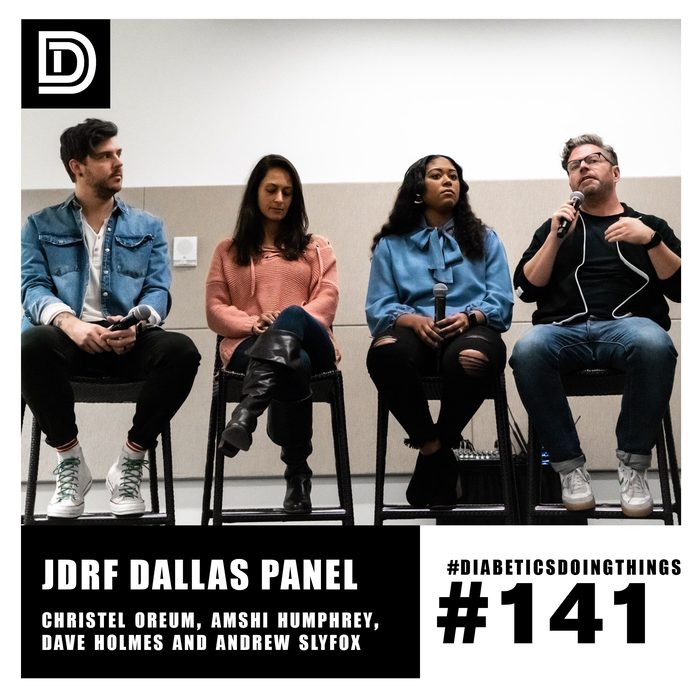
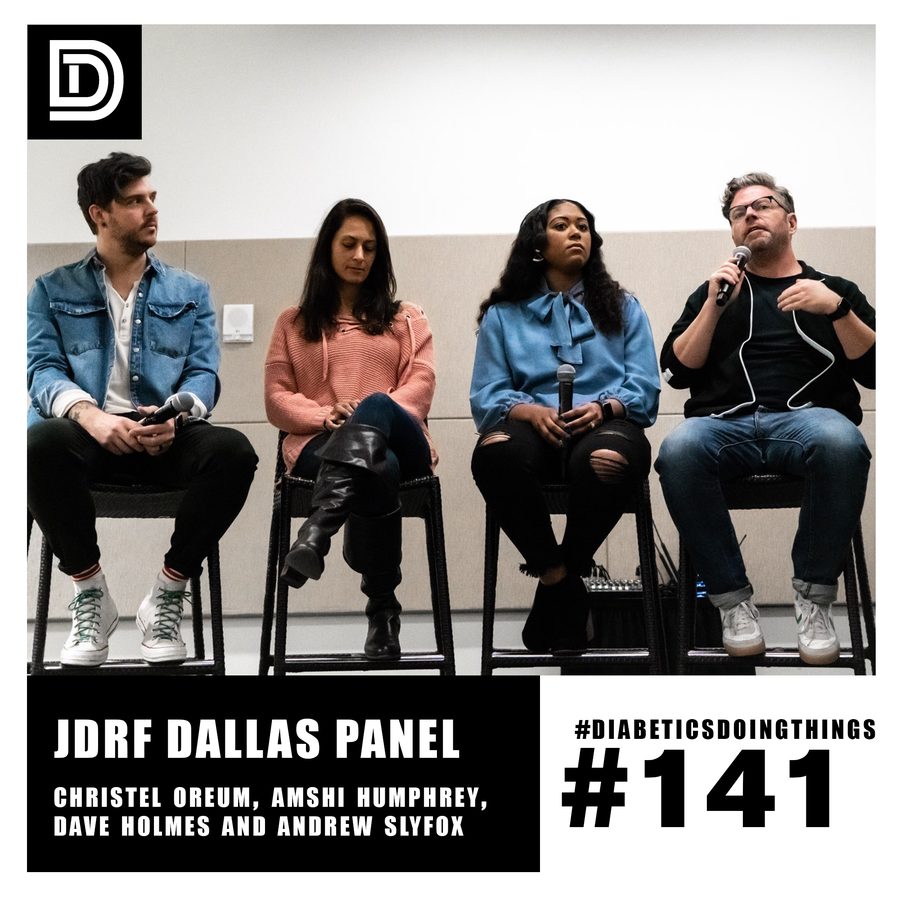
This episode captures the third annual JDRF Dallas social media panel, recorded live in February 2020 before COVID-19 shutdowns. Rob Howe moderates four voices from the diabetes online community: Dave Holmes, an Esquire editor first misdiagnosed with type 2 before learning he had type 1 in his thirties; Christel Oerum of Diabetes Strong, diagnosed in 1997; Amshi Humphrey of LivingDiabetter, diagnosed at 18 while playing college volleyball; and Andrew Slyfox of the Slyfox Family YouTube channel, living with type 1 for 22 years. They talk about how each one found the diabetes online community, why posting bad days matters as much as good ones, advice for people who want to start sharing their own story, and how friends and family still misunderstand daily life with the disease. Rob treats a low blood sugar live on stage during the talk.
Key takeaways
- Dave Holmes was first told he had type 2 diabetes after a high A1c, and wasn't properly diagnosed with type 1 until he got very sick about a year later.
- Christel Oerum started Diabetes Strong because she couldn't find real information on exercising with type 1, so she documented her own workouts instead.
- Amshi Humphrey hid her type 1 diagnosis for two years before she started sharing her story on Instagram and Twitter.
- Andrew Slyfox used to rig a Pebble watch to show his Dexcom readings before the Apple Watch could do it.
- Rob Howe says a small survey at an ADA conference found everyone who was active on diabetes blogs and social media reported a better A1c than those who weren't.
Show notes
Since COVID-19 has us all social distancing, I thought I’d drop this episode from JDRF Dallas’ 2020 TypeOneNation Summit.
Year 3 of the panel was fantastic. After last year’s panel with Jill Rippolone, Chris Ruden, Paloma Guerrero, Ariel Lawrence and Austin Fuerst, this year’s lineup was equally fantastic.
Join Christel Oerum (Diabetes Strong), Amshi Humphrey (LivingDiabetter blog), Dave Holmes (Esquire, Homophilia pod) and Andrew Slyfox (Slyfox Family) and I as we talk about real life with Diabetes and how social media has made life with Diabetes just a little more fun and helpful.
You’ll even get to hear me ask for a juicebox mid-podcast to treat a low. Unforgettable!
Questions this episode answers
Who is on this JDRF Dallas panel episode of Diabetics Doing Things?
Host Rob Howe moderates Dave Holmes (Esquire editor), Christel Oerum (Diabetes Strong), Amshi Humphrey (LivingDiabetter), and Andrew Slyfox (Slyfox Family YouTube channel).
Was Dave Holmes misdiagnosed before learning he had type 1 diabetes?
Yes. His doctor first diagnosed him with type 2 after a high A1c, and he wasn't properly diagnosed with type 1 until about a year later, after he got very sick and sought out an endocrinologist himself.
Does exercise affect blood sugar differently for people with type 1 diabetes?
Christel Oerum says exercise can raise or lower blood sugar depending on the activity, and that this isn't always explained to patients, which is part of why she started writing about it.
Why do close friends and family still ask basic questions about living with diabetes?
Panelists say even relatives who've known them for years, like siblings and parents, still don't understand daily management, such as whether they can eat cake, because that education doesn't reach people outside the diabetes community.
Full transcript Searchable, with timestamps
Rob Howe: Hello, hello, hello everyone. I hope you are all safe and safely quarantined and social distanced. Maybe grabbing some Netflix binging, working from home, working out. How do you wear sweats every day without completely giving up on yourself? I get it. I'm there. So I put these together for you guys during the social distancing quarantine times for you guys to just get a little community, get a little fun, get a little positivity while you're going about your day. So this episode is the second annual JDRF Dallas social media influencer panel, and it features some of my favorite, favorite, favorite people with diabetes. First of all, Christel Oerum from Diabetes Strong, who's been a regular on this podcast, a big fan of hers. Dave Holmes of the Homophilia Pod, writer for Esquire. Awesome dude. Legend. Absolute legend. Love him to death. We got Amshi Stevenson. I always call her Stevenson. I have to actually look up her real ass name now. I'm so sorry, Amshi. It's Humphrey Amshi Humphrey of the LivingDiabetter blog. And of course, my buddy, Andrew Slyfox from the Slyfops family. a Sly Fox, not Sly Pops, Sly Fox Family YouTube channel. They offer some amazing insights and they all came to Dallas back in February before all this crazy coronavirus started and we had an awesome panel. So what you're about to hear is about an hour of what a panel at a JDRF event sounds like with some of your favorite people with diabetes. I'm presenting this episode without a sponsor and I'll just caveat that with this episode is non-sponsored, but I'd like you guys to try to support a diabetic-owned business during this difficult time. Small businesses are getting hit really hard. There's still a need for supplies. There's a lot of companies that have been sponsors of this podcast, Type Zero Health with pre-workout, Skin Grip, many others. Support them where you can. This is a difficult time. There's a lot of uncertainty and community is the one thing, socially distant community, online community, connection can bring us all together. So I'd like to encourage you guys to do what you can to support a diabetic owned business during this difficult time. And with that, we'll get back to the episode. This is the social media influencer panel from type 1 nation, JDRF Dallas, 2020. Enjoy. Hi, everybody. Ooh, that's a little bit hot. The mic's hot. Just wanted to welcome you guys and say thank you for being here and supporting JDRF Dallas. My name is Rob. I'm going to be the moderator of this session. This is my social media influencers who are coming up here and sitting down are my friends from the Diabetes Online community. and this is the platform that JDRF Dallas has been so gracious to give me the last, this is now our third year of hosting a social media panel. And I just wanted to express my gratitude to JDRF Dallas for, you know, giving me this platform and believing in me over these last four years. What are we here for? I'm Rob Howe. I'm the host of the Diabetics Doing Things podcast and my own social media platforms regarding diabetes and associating with diabetes. And these are some of my friends from the diabetes online community. And I actually know them in real life as well, which is great. When you get to meet your internet friends in person, crazy things happen. People realize how much taller I am in real life than I am online. It's a very jarring experience. I think I can speak for most of you. So I did want to say just, again, thank you for JDRF Dallas. To you guys who are here, you represent like the 1% of the diabetes population in that you knew about this event. You attended it. You came to be here and spend time in the diabetes community to learn, meet people, and get involved. And that makes you very special. So thank you for coming. Welcome. Before we talk about anything, something I always do before my talks is to say the same thing that my doctors told me on day one with diabetes, which was whatever dreams you have for your life are still within reach. They are still valid as long as you take care of your diabetes. So if you leave with nothing else from this entire conference today. That's something that I want to make sure that you hear. It's possible. I've done it. These people are doing it. Come up and talk to us. We're also going to give you guys time to ask questions at the end of this sort of panel. So with that, I'd love to hand over the mic to my amazing guests. I stand on the shoulders of giants. These people are so much cooler than I am. So I'm going to let them take it away and introduce you guys to this awesome panel.
Dave Holmes: Hello, everyone. I am Dave Holmes. I can't possibly live up to that. I'm a writer, a performer, I'm an editor at Esquire Magazine, and I was diagnosed five years ago in my early 40s.
Amshi Humphrey: Hello. Oh, okay. My name is Amshi Humphrey, and I was diagnosed when I was 18 back in 2011, and at the time I was playing volleyball, so it was just a huge shock. So I took to social media about five years ago to share my story, but full-time I work as a social media manager at a public relations firm here in Dallas. Hey, everyone. My name is Christel Oerum.
Christel Oerum: It sounds weird because it's Danish. I've been living with diabetes since 97, so a few days. Yeah, it's been a while. Anyway, you can find me on diabetesstrong.com, which is my platform. It's both a website as well as social media because that's what we do. I am – the reason why I got involved is basically because I was super active. I couldn't find the information out there, so I created it. And that is me.
Andrew Slyfox: Awesome. What's up, guys? My name is Andrew Slyfox on the Internet. I'm a full-time YouTuber and Instagram person. I was going to say personality, but I don't know if that works. I think that's like a TV personality kind of thing. But that's what I do. And I'm also a type 1 diabetic. Go figure. This year will be 22 years. So I remember when I first met Rob, I was like, yeah, I'm officially an adult. You know, my diabetes can have a drink. And we were excited. But anyway, yeah, so 22 years. full-time travel with my family. My beautiful daughter, Jaden, is actually here with me today. Woo-woo! She's been an incredible supporter. Yes, she gives me shots sometimes, which is awesome, but that's what we do. Awesome. Well, for those of you who are here, today's session is about diabetes social media, so I want you guys to feel free to ask questions towards the end. I'll call on you guys from the audience, but let's talk a little bit about how you guys individually got involved with the diabetes online community. I think I often talk to people and say that we're diagnosed twice, once when the doctor tells us and once when we kind of take it on personally and really opt into our life with diabetes, and that was true for me. So I'd love to hear some stories about how you guys discovered this community online that ultimately ended you up here. Okay.
Dave Holmes: For me, it happened almost immediately because, as I said, I was diagnosed as an adult. I had the thing that is fairly common where in my mid-30s, I went for a regular checkup. I had a high-ish A1c and my doctor was like, this is type 2 diabetes. And it didn't really make sense for me because I was really active. And I mean, I had and have a few extra pounds. My diet, definitely there was room for improvement, but this was literally the week after I had done the New York City Marathon. And I was like, this doesn't make sense. But he put me on metformin. I did that for years until 2015 when I got real sick, lost a lot of weight, was in the bathroom constantly, like all the things that we know as type 1 diabetes. So I took myself to an endocrinologist, got the battery of tests. I was misdiagnosed. I went on insulin. Things got great right away. But my diabetes educator and my endocrinologist both said, first thing you do, find a community. Go on meetup.com. There's always like a happy hour or something. And I knew that I needed it, but I was also a grown man. And as grown men, we get messages throughout our lives that asking for help is, there's weakness to it or there's vulnerability to it or it's self-indulgent or something. So I resisted it at first. But I did start searching around Twitter and Instagram for other adult diabetics, just literally just to see like, is this person alive? Like, can this person run? Can this person, like, what do they do at dinnertime? Like all of the basic questions that I really had. And I found a bunch of great people. And I finally did get over myself and go to a meetup where I met a guy named Craig Steubing. All of these people who I mentioned you should follow. At Craig Steubing who started a thing called type 1 Run. At type 1 Run which is a runner's group for people who have type 1. They have chapters all over the world. and I found that in my own personal life on my Twitter feed, on my Instagram, in my writing I started to reference it a little bit because it became a part of my life and when I did that other people from other areas of my life kind of came out of the closet to me I had a lot of people that I knew who I didn't know were diabetic but who had had the exact same experience as I did and I told them the same thing that my endocrinologist told me which is go and find a community. And they, like me, said, yeah, I don't know about that. And so I found that it is even more important just to post about this stuff and to make it a part of your life. It doesn't need to be your entire Instagram presence. It can be. But just acknowledging these things, there's strength in that. And other people can look at it and see that you are alive and that you made it through dinner and that you made it through a long run. And it makes their lives better. So it's kind of just,
Amshi Humphrey: it's become a part of my kind of presence. Same, I was diagnosed when I was 18, so later in life, and I was one of the healthier kids in my family, and I was playing volleyball athletics, super, you know, involved with that, and all of a sudden, just bam, it just hit me, so I was misdiagnosed at first, and being on a college campus at the time, the doctor on campus was like, oh, you know, you have a urine problem, you know, it's not diabetes, but one of my former teammates had type 1 diabetes and so I kind of self diagnosed myself and I was like I'm peeing a lot I'm you know always thirsty I'm losing all this weight but being in two days I volleyball was like oh I'm just getting fit you know freshman 15 can't you know hold me back so it wasn't until Thanksgiving I went home for Thanksgiving with my family and I had an accident and so I immediately went to the gynecologist we did a urine sample and she was like oh my god you need to go to the emergency room. Your sugar's like at 402. And, you know, I was like, what does that mean? But I immediately knew it was, you know, type 1 diabetes. So I went to the hospital. Luckily, my mom works at a hospital. Hey, mom. Big shout out for moms. So I didn't have to wait. So it was just right on in the ER. And so that's when I got diagnosed. But it wasn't until I think two years after my diagnosis is when I fully accepted the fact that I had type 1. I was ashamed. I was like, how can this happen to me? I'm super active. And it wasn't until I found Instagram and Twitter until I started sharing my story. And I feel like that's when I owned up to the fact that I had type 1. And so I think being a woman of color, it was hard for me to find like a voice and find someone who I could relate to. So I was like, I guess I'll just take it upon myself to, you know, stop being so selfish and share my story. And that's when everyone started DMing me and say, oh my God, I love your story. Thanks for sharing. And so I feel like I'm the voice of the people who are still ashamed. And so, and I don't think I shared my handle, but at livingdiabetter, follow me on Instagram. But I feel like now I'm not ashamed of who I am. I have to accept the fact that I have type 1, but how do I cope with it? How do I go to work every day working the crazy social media hours? And so that's kind of my story. Cool, thank you.
Christel Oerum: Okay, so I guess mine is a little different. And so again, I was diagnosed back in 97, so I did not have a cell phone because that was kind of before the cell phone, you know, the flip phone comes out, came out. So that means there was not really any social media as such. There's probably some forums here or there where you could write some code and get in, but, you know, I didn't do that. So diagnosed in 97, I kind of just went on with my life. You know, I had diabetes and there you go. And I did that for about 15 years. and then about, well, I guess five, seven years ago, I started becoming very, very active in the sense I've always been an active girl, but I kind of started, you know, I moved to California where I live now. Yes, it was awesome. And I was down in Venice and Venice Beach and you have all these fit people running around. I'm looking, I'm going, oh my God, this is amazing. I want this for myself. I think due to diabetes, it was just like they're super fit and that was fun. So I started that. So I started exercising all these things and realized that's really hard with type 1 diabetes. You probably know that, most of you. There's the high and the lows that comes with that and I couldn't find the resources of, well, how do I manage this? All I got was a pamphlet saying eat 15 grams of carbs. Not helpful. Not helpful at all. It's not nuanced enough. So I started writing, just documenting my own journey, not because I necessarily thought Not a new one would be interested. Turns out people were because these resources were not out there. So that's kind of how I also started the social media accounts that came with all the writing I did. And that's actually what all I do right now. I run diabetesstrong.com and the social media. So long story to how I got to social media. But what I found is that I didn't think I had anything to offer in the sense I was like, well, I just somebody living with diabetes. But we all are, and we all have different experiences and different things that we bring to the table, right? So just me posting about, well, today I went to the gym, I love my weight, so this is what I did. Just me documenting that, and I'm not giving medical advice because I'm not a medical doctor, blah, blah, blah, all those things, right? But just me sharing means that other people can look at that and go like, oh, that might be different in the way that what they're doing, or it might just be, hey, I can actually exercise with type 1 diabetes. And I have some people reaching out to me going, no, we can't exercise because we have type 1. I'm like, that's really sad because that just means that you've not been exposed to enough people who actually show that they can do that or even have a medical professional who tell you that you can do that. And it's two ways, right? One thing is whatever I share, even if it's, hey, I vacuumed today, guess what happened? Probably all know that. Went low for the most part, right? Because that's the evil, like, cleaning fairies making sure that we all drop during cleaning. But people share other things, and I learn every day, which is just I learn that I'm not alone. I learn practical things about how to manage my diabetes and I just connect. And I say, you can choose to go through life with diabetes alone, but you don't have to.
Rob Howe: Awesome. That was really good. Yeah, so when I was diagnosed with diabetes, it was a, I think it was around 96, 97, so we're kind of like diabetes. Yeah, whatever we're doing. So social media things, I guess, right there is what we're doing. Yeah, so I was diagnosed with type 1, like I said, almost 22 years ago. And obviously the technology, like you mentioned, was completely different. No cell phones, none of that. And then eventually this thing called Instagram, I think in, oh, 2000, probably around 2006 is probably when I got on Instagram, like really, really early in there, like really early. So, of course, naturally, I decided to start looking for, like, hashtag diabetes, right? And when you do that, it's usually type 2 diabetes, I found out. And I was like, oh, this is different, nothing to relate to. You know, but my whole thing through almost 20 years of having type 1, I like that you just said that. I've never thought about it in that perspective of choosing to be alone. I didn't have the outlet of the Internet necessarily, and it was very difficult. You know, I see sometimes I would see like when we're traveling like some like a little sugar tester strips on the ground like randomly on the side of the road or something like, oh, my gosh, there was a type 1 right here. Like, this is crazy. Oh, I'm so connected right now. You know, somebody gets it. Somebody else gets it. You know, and so it's like it was kind of that moment of like, man, I definitely felt really alone. And I began to like just shell myself off in that aloneness where it's just like this is just my life. You know, it's really depressing and I'm really bummed out and it sucks. nobody really gets it that I'm around in my circles. Everybody's chowing down on pizza and I'm going, this is going to kill me. You know, there was no CGMs. There was none of that kind of stuff. So that was like the first whole part. And then, of course, like I think probably like maybe seven years ago now, I got this new doctor who was like, oh, my gosh, you got to check this out. They're talking about doing a continuous glucose monitor. I'm like, what is a CGM? I don't even get what that means. Whoa, no making fun of Texas. Dude, I'm in Texas. I had to do it, bro. I had to do it. I was like in my head. Don't let him bully you guys, okay? I'm sorry, guys. I'm sorry. I live in Southern California, but I'm from Michigan, so I'm kind of a country boy a little bit too. Kind of. Anyway. So, yeah. So, it was through this whole process of like, whoa, my diagnosis was intense, caught me off guard. I held on to those negative feelings for so long, felt completely alone. All of a sudden, like I said, Instagram comes out. And I start searching more. I start searching type 1 diabetic. And I find this thing called Nightscout, believe it or not. I used to hack together the Android phone, the Pebble watch, if anybody remembers back then doing all that, and I would have my Dexcom readings on my Pebble watch before the Apple watch was even out. That was kind of my first initial experience with, whoa, there's a whole other world out here that I had no idea even existed. Years continue on. My family and I, we started a clothing brand called Sly Fox Threads. We were like, hey, this is going really cool, and it's all over social media. It was kind of an Instagram brand that was growing. We were like, we should start a YouTube channel. We started a YouTube channel called Sly Fox Family. We've been on it for four years now, full time. We have 1.6 million subscribers. You guys can go check us out there. And we're doing that full time. And then people started saying to me, they started seeing my Dexcom on my arm in the comments. Like, oh my gosh, I'm a Type 1 also. And I'm like, whoa, what? Like we have, somehow you guys are finding us, which is amazing. And then I started getting like more like, oh my gosh, maybe my wife was encouraging me. some friends were like, you should start creating content that also is exclusively about your diabetes. So I started to do that and that community started to get a little bit bigger. Then of course I went back to Instagram. This is way years later. This is about two years ago. And I found a guy named David, which I reached out to. And of course, how could I miss Rob over here? So I found Rob. Rob was one of the first diabetics that I also met on the social media platform reached out to rob and we started connecting and talking uh i think even before i met rob i was like you're a pretty big guy what are you like six seven you remember that conversation i do i can't i can't ever forget like fellow tall internet people yeah yeah i was like oh dude i'm pretty tall too man but not as tall as rob so um that's kind of how my whole process was to get into that um but i do want to say this before i because i'm rambling on i'm kind of giving you a lot of years right here and 20 years in like two seconds but um one thing that I did learn is I knew nothing really about diabetes through almost 20 years from my diagnosis on other than how to hack together a cgm on my earth thing you know to read my on my watch but I learned that the diabetes community helped bring me through 20 years and like warp speed all of a sudden whoa whoa there's these little pouches called transcend foods that I can carry around with me everywhere that I have my pocket right now right like there's all these little adhesive patches and there's all these things that help to make the type 1 lifestyle better right so my diabetes fits my lifestyle versus me fitting that in a sense like I've always done um and then also there was a freedom in being able to say publicly like yeah I have type 1 man today sucked my sugars have been low low low low right but hey today is great because like I realized it was low but I overcame that and I had the tools to be able to do it and now I feel empowered right so that's kind of like what I do. I think you're mentioning that my whole social thing is not 100% diabetes, but it's such a huge part of my life, so it's intertwined through everything I do. Cool. Thank you guys for sharing the stories. I think there are a couple of things that I want to address with all of you guys, because I heard it more than once from this group, is this sort of feeling that your story doesn't matter. And I think that overcoming that fear, and like it's imposter syndrome and maybe generational, I don't know. But your story does matter. And that is often the first way to opt into this online community, whether it's Instagram or Twitter or Facebook groups or whatever the case is, your story matters and who you are and where you come from and how you got diabetes. There's, you know, I always see heads shaking up and down when it's like, yeah, I was peeing all the time or I was losing weight. It's like, you know, we all know, or I couldn't sleep or I went to bed and I was 20 years old. It's like those are very relatable things for people in this room. outside of that you might get some strange looks like even with this hoodie on I always forget I'm wearing it when I leave events like this and I'm going through the airport and people are like looking at me strange I'm like oh yeah I have diabetic across my chest that makes sense speaking of there there is like sometimes an association and we get questions at events like this of like being a public diabetes personality makes it seem like everything's super good all the time and she was just showing me her low blood sugar I'm currently having a little butchers if you have a juice box out there please toss it my way right now. I would appreciate it. I see you moving. She's moving quick. She's got something here. So yes, Capri Sun. Thank you. We will take a picture later. Thank you. This is great. Wow. Thank you. Awesome. Wow. Fruit punch too. Spoiled. So I'd love, before I mash this Capri Sun and take it to the face, I wanted to share something that personally from my experience of being in the diabetes community. And then something I learned at an ADA scientific sessions a few years ago, where at the ADA conference, it's mostly doctors. So there's not a whole lot of patients there. So I got this very cool privilege behind the scenes of like all of the inner workings of diabetes technology and all this cool news stuff. And they have a poster session, which is mostly science. And I am a notable idiot. So most of the information was like way over my head, way above my pay grade. But I did see something that said T1D blogs and social media. And I was like, I know that. Let me go there and talk and see what's going on. So they had surveyed a small number of people with diabetes, almost like 5,000, I think. And there was a simple survey. It was, are you involved with diabetes blogs and social media, yes or no? God, that feedback is like so intricate and killing me. Is it alarms? Could be both. Crank those alarm volumes up. I want to hear them in here. But then the other question was, what is your A1C? And rating the numbers. 100%. 100%, like unequivocal, 100% of the people who answered yes to the are you involved with diabetes blogs and social media had a better A1C outcome than people that answered no. Again, small study, there are inferences to be made. I'm not suggesting that this will absolutely help you. But for me personally, I had those experiences as well. So I would look at my numbers from the day I started diabetics doing things to the day that I was reading the study. It was like a two-year period. And my trends were my A1C had gone down. My time in range had gone up. I learned things from the diabetes community and from having People talk about diabetes and for to be able to absorb from other experts and as you guys know We're not doctors, but we live with this every day and so it can be pretty We get some trip tricks and tips that we all can share with each other and that helped me I'm very fortunate my a1c has always been relatively in range but it is unequivocally better today than when it was when I opted into the diabetes community. So that is my spiel. So my question to you guys, what's something that's surprising or interesting that you've learned since opting in and sharing your story in the diabetes community? And whoever feels compelled can start that off. I would say for me, one of the things I didn't expect was to find a community that I connected with online and then all of a sudden now I'm here at events and now I'm meeting these people that I talk to all the time but also the sense of family um you know what I mean it's like you you you meet each other once and all of a sudden we're like family you know what I mean it's like we just are like yeah I guess I never expected that I expected like oh cool I'm gonna reach out and say hey and we can talk about like diabetes a little bit but it's like it turns into like way more than that and then you want to be a part of it and you want to kind of give back like I feel like you start off when you're like let me get something like you mentioned it's like let me get something because I'm in need and then all of a sudden you start getting that you're like oh my gosh this is overflowing let me give back to you
Dave Holmes: you know you know a thing that I found it is you're right there good you know on especially on Instagram you tend to want to put your best self out there or what you perceive to be your best self out there you're never like oh I look like hot trash in this picture. Let me post it. Let me let the world see me first thing in the morning or whatever. You do want to put your best foot forward. I find on Instagram, the people that I follow, I get the most from them when they post their non-successes. I don't want to say failures. But when they are super high or when they did just survive a super low. It's great that if you just did a long run and you're at 100, that's fantastic. And I've definitely posted mine, because I'm proud of it. But it's also, I think, really important and really useful to post the times when you didn't do as well. Because for those of us who are kind of new with it, we need to see the people who stumbled and are still alive. We need to see the 400 that you got through and then you got up the next day and you got on about your business. It's, you know, this is one instance in which posting your failures is much more useful than posting your successes.
Amshi Humphrey: I would agree. I feel like not only do I make it a habit to post my good stuff, but my low stuff as well. And I'll talk about this example. So one time I was doing Zumba. I love my little dance classes as a workout. And I just went low. Like I had to leave the class. I went into my car and I just did an Instagram live. And that was the most engagement I've ever received. It was me being real. I was snot coming down my nose, sweat. And I was just crying, just reaching out for help for my diabetic community. And people reached out and they were like, oh, my God, I can relate. And thank you so much. But I feel like if you're real with yourself and not only showing what he just said, the good stuff, show the bad stuff for the new diabetics out there. They can relate. They can reach out if they have questions. But also, too, like sometimes I DM my friends and be like, hey, well, my diabetic friends. I'm like how many carbs is in a pizza because no one ever really knows and so you can read all the box all you want but just reaching out and feeling comfortable to to those and dming messaging commenting and stuff like that I feel like we are a family and I feel like we everyone knows each other online but like when you see them you get so excited like I just mentioned this with Austin I'm like I feel like I know you but um we met in person and like it's that connection that I really
Christel Oerum: love. I think that's probably one of the things that surprised me the most is how much of community that's actually out there. Kind of what I mentioned is I didn't really start my Instagram account because I thought okay now I'm gonna go out and look for community. It was kind of just became honestly came with the website and I was like okay I'm just gonna do this and then I found everyone. I'm like this is amazing and I think one of the things that I really realized which I focus a lot on providing information because that's what I do. And one of the things I was really surprised about was also the difference in what we all know. But just that we all know so many different things also means that we can support each other. And again, I keep always talking about exercise because that's my thing. But just like I was talking to someone just before the sessions that said that her mom had never been told for something that exercise can make blood sugars go up. Only that they can come down. And then learning stuff like that, you know, from your peers, it should be part of whatever education we get, but it's not. But you learn from your peers. And just having that knowledge means that you can go out and be more successful in your diabetes life as a professional type 1.
Andrew Slyfox: um yeah you want to start cool um so a question that i get quite a bit um is especially at events like this where we all like i think we can all agree we're here hearing inspiring messages or we're meeting friends like we're we've never been more gung-ho about our diabetes uh except for like days like today which are super important like these are those peak moments where it's like hey like oh I have diabetes too like this is so cool like I'm getting very motivated I'm going to start a blog I'm going to start a YouTube channel I'm going to start a podcast like it's all going to happen and then like tomorrow you're like wait I got to go back to work and like you know diabetes is here it's like my life is busy for people who are in here and they're like wow like this is really cool I'd love to share my story I'd love to get started what advice would you have for them like what is that what do you think a good way for them to do that would be or you know what would you tell a person like that or tell yourself like that if you went back in time whoever can whoever feels compelled What I always say, I speak sometimes at YouTube events, and the biggest thing that I always tell everybody, and this is what I tell myself too, is don't overthink it and just start. You know, if you have, like Rob mentioned, everybody's story matters, and you absolutely bring something to the table, and there's enough people on the internet where you can connect with whatever size niche you have. You know, so that's usually my biggest advice is always just start creating. Like people ask me all the time, like, how did you, like, what made you, like, how did you, like, grow this YouTube channel? I'm like, I started. I just started posting, you know, and that's really what it comes down to is, like, just start posting and you'll figure out your voice. You'll figure out your message and all those kinds of things. And maybe you get lucky and you already know that kind of stuff, but it's just a matter of just get started. and I love that you guys mentioned the same thing and I try to do the same thing where I don't always post on Instagram my great blood shakers, right? I make sure I post the serious stuff too.
Dave Holmes: Also, it doesn't have to be your entire presence, I think is kind of important. You don't need to, by posting once about it, it's not like, okay, well, this is all I am now. You can work it into the profile and the following that you already have and then you know if people respond to it then great but it doesn't have to you're not like locked into a diabetic online identity for the rest of your life it's there if you want it it can be a part of you as it is it's a really good point one of the things I always say to tell people is you can also just lurk I know that's not a good word but you don't have to post anything actually you can just have we all focus on I love Instagram Instagram is the most positive platform in my opinion. Twitter is a little more negative, I would say. Toxic and awful. Yes. Thank you. I actually deleted my Twitter app.
Rob Howe: The word dumpster fire comes to mind.
Dave Holmes: But for the most part, what I found on Instagram is that the diabetes community is really, really inclusive and really, I would say positive. You can post your bad days and still be positive, right? So I would say, even if you decide to lurk, just do that. Just go on there, search the hashtags, diabetes, type 1D, diabetes, whatever. And you can find some really cool accounts and just follow along. And then if you want to start dipping your toes more into it, start posting, right? And not everybody has to, well, not everybody has to be an Instagram personality or whatever we want to call it to you know use Instagram and really get a good
Amshi Humphrey: experience out of it yeah I agree with everyone I for me I built a separate account so I have a personal account and then a LivingDiabetter Instagram and I felt like I wanted to at first keep my life very separate like I wanted to post everything about diabetes workout nutrition on living diet better but I still wanted to post you know going out I mean you can still go out but I'm just saying if you want somewhere to start you can just create a separate account or for me having a mass communications background, I wanted to be a news reporter. So at first, everything I was posting on my LivingDiabetter account was very robotic and like, and three, two, one, and we're live, like news personalities. So looking back, I'm like, you don't have to like be robotic. You don't have to memorize a script. Just be you, be yourself. And so, and people can relate with that more. So just start somewhere, even if it's like what she was saying, just commenting or following. if you're joining JDRF, be the social media person for the day. Just start somewhere, get involved, and do you.
Dave Holmes: And know that whatever it is that you post, if you decide to post something, you are going to make a difference in somebody's life. You are going to inspire somebody for the simple fact that you are alive. Like somebody needs to see that. There's somebody in this world who's gonna search the Die Badass hashtag or whatever, if you're the person who comes up, you're a living person who proves that anything is possible. And as somebody who recently needed to see that, I would encourage you to do that.
Shannon: I totally agree. And I think I get really good feedback when I say this at events, like diabetes sucks. Like let's not tiptoe around it. It's terrible. Like if we didn't have it, like it would be awesome, right? So A, there's organizations like JDRF who are working to find a cure for T1D, which is awesome. And until we get there, just know that it's okay to hate diabetes sometimes. It's okay to feel burnt out and overwhelmed or unsupported. Those are super normal human emotions. And I feel those, and I know everybody up here feels them as well. So, yeah, get started. I'd say also don't compare your day one with somebody else's day 1,100. I talk about changing metrics. Like help one person is a whole lot easier than get 1.6 million subscribers. So start there. If you go listen to episode one of Diabetics Doing Things, I guarantee you it sounds like hot trash. I spoke through my old computer microphone and my friend from Ireland Skyped in. And I don't know how the technology worked, but it did. And nobody really complained. Maybe some people still have an opportunity to. But all I have to say is you can still get by without professional equipment or training or thinking everything doesn't have to be super curated. You can just get started. And who knows where you'd end up. Maybe you'll be speaking at one of these events or you'll make a difference in someone's life or just be a good friend or help yourself. So my goal was to help one person. Some days that person is me. Some days it's other people. And that's what keeps me going. So, okay, we have about 15 minutes left in this session, and I also love questions from you guys. They are always better than questions that I can come up with. So I'd like to open up the floor, and I will walk around with a microphone. Okay, Melissa is going to walk around with our microphone. She's our handy-dandy microphone. So we'll give you guys the mic. Please try to keep your questions as brief as possible so that we can try to cover everybody in the remaining time we have left and get good answers from our awesome panel members. So let's raise those hands high, and we'll get this thing rolling. My name's Shannon. Hi. Welcome. Thank you. I just wanted to reiterate what Andrew said. I was diagnosed at 92, and so for the first 20 years, I thought I had it under control, knew what I was doing, but I didn't know anybody that was diabetic. My mom introduced me to one guy who was her hair guy. He died from not taking care of himself. So I'm like, whoa, that's what's going to happen, you know? Then I got online, started searching, and just overwhelmed by how many people were out there. So I started blogging about eight and a half, almost nine years ago, and it was life-changing. Just to know that you're not the only person that has a crappy day, that wakes up low, even though you did what you were supposed to do the night before. it was just life changing so I was just going to reiterate what you guys said and thank y'all for what y'all are doing thank you
Dave Holmes: yesterday I flew here and I had a layover in Las Vegas and I went to the airport bar to have a beer and the bartender saw my Dexcom on my phone and he was like oh hey me too and he was somebody who had been diagnosed in childhood and And I'm saying this because this is somebody who has lived with type 1 for decades. And his doctor at the time was just like, have some insulin and then eat food. And try not to go low. And have a nice day. And that was kind of it. So we were just talking about stuff. Because at the time he was very high. And I was like, well, what's your correction ratio? And he was like, you're going to have to speak English. I don't know what that means. and just basic stuff that I was like, I went right into the data when I was diagnosed. He didn't. And there's a whole big world out there that he can like learn about and learn what a carb to insulin unit ratio is and it exists online. So he's got three full cocktail napkins full of people to follow and I hope that he does. But I say this because I think there is a world of people in middle age and beyond who just sort of got a pat on the back and then do insulin and try not to die from their doctor. And that was all the information they got. So we as people who are living with it can provide a lot more. Cool, next question.
Andrew Slyfox: So my wife is the type 1 in our family. And one of the things that always surprises me is how little people that were in her life from before she was a type 1 know about her type 1 diabetes. like they're like we'll be at a birthday party and she'll be eating cake and they'll be like can you eat cake and they're kind of these basic things that people that have been around in your life from before your diagnosis don't know and I just wanted to ask what y'all's experiences has been with sharing stuff from your diabetic life back into your what we call normal life or non-diabetic life? Yeah, so I have a sister and I've known her my whole life, believe it. So we've known each other a long time. And as I, over the last year or two that I started being more vocal about diabetes online, she starts asking me all these questions. I'm like, what? I'm like, I have been your brother your whole life. I'm like, you don't know these things about me? And I'm like, that's it. That's it. We're not talking anymore. But it's funny that you mention that because it'll be those types of situations, right? My son's birthday party. I've got friends. I've had friends for years. And I said, you know what? Funfetti cake. I like funfetti cake. I'm going for it, right? I'm going for it. So I take a thin slice, and that's just because a personal preference of carbs jack me up, and I don't like to feel messed up. It's not that we can't have it. It's just something I learned about myself. So I take a decent size. It was a decent size, right? and as I'm eating that I can feel all the judging eyes bro I'm like people are looking at me I see my mother-in-law looking like oh so much for that low carb and I'm like whatever you know but anyway it's it's funny that you mentioned that because like even like my sister who she was there when I was diagnosed um almost 22 years ago and she and she still doesn't know certain things right my mom she knows but my sister she doesn't know I agree I feel like my father-in-law and my dad My dad was there throughout all the classes. He knows what he's supposed to know, like, what to do in certain situations, but he still asked me random questions. He's like, did you inject when you were, you know, high and low? And, like, just stuff that does not make sense. And, like, at birthday parties or family events or holidays, he one time took the cake out of my hand and was like, you don't need that. You're going to go low. I'm like, you mean high? Like, it was just, like, he doesn't know the right terms, but you just have to, you know, shake it off. I've gotten to the point where education does not work for him, so you just, I'm okay, dad, just leave it alone, I'm fine.
Christel Oerum: But it's also very complex, right? We have to sometimes also when people come up and ask us like, ignorant questions on the street or whatever or at parties, et cetera, we have to also, I think we have to let some of it slide because we can't expect everyone to know Type 1. I will say, um, so my example is actually it was last summer. So my dad has been married to this lovely woman for about 10 years, but that means we've never lived in the same house and they came to visit. Um, and they were hanging out with my husband and I for, for a good week. And one point she turns to me and she's like, Oh my gosh, I did not realize how much work diabetes actually is. I thought it was just taking a shot, but you're like, because I was walking her through it, going like, so, you know, we're going for a hike later, we're eating this, we're out, okay, so I don't necessarily know the carb count because we're eating out, I'm going later, so I need to, reduction, all these things with walking her through it, and it's super complex, right? So I think, pick your battles, I would say, choose when it's worth to just say, hey, dad, fine, or, you know, say, hey, bonus mom, you know, this this is what it is. But again, can't probably not expect everyone to know.
Audience Member: So we have five minutes left. We're going to take one more question. So this is perfect. Thank you guys for sharing. Alrighty. So I have a question for people who have tubes. I have a tandem and I love it because it's just awesome. But I am a dancer, so I dance at school for about 45, an hour 45 minutes a day. and it's really, really difficult because tandems, they only go for 20 minutes without screaming because of their separation anxiety. And then my teacher screams because she's like, whose phone is that? Let me take it. And I'm like, okay, well, okay. So I was just wondering, how do you move around and stuff without your tandem falling out of your pocket or catching on to something? It's just so difficult. Spy belt. Spy belt?
Dave Holmes: That would be the short answer to that.
Rob Howe: So I know ladies with diabetes have a tough time with tubed pumps, I think. But at the same time, it is possible. Their spy belts are good for exercise. I wear, this is a shameless plug, I do work with this company and they do give me free stuff. But they make these leggings and workout compression that I put my pump in. And so I play basketball with it on. And I, you know, I'm still good with it. Like I can still play at a very high level. And that was something I never thought I'd be able to do. So I think there are, even Lululemon makes some really cool leggings now. Like they have pockets on the outside. The company that I work with is called Woloco. But, you know, there are some hacks. I think a big thing as an athlete or an artist and dancer is have the conversations up front to advocate for yourself about like things that you may need or things that'll happen like my pump may go off. I remember being in college and my college coach, like I took myself out of a practice and my college coach was, did not, A did not like me and B was very old school and C had this shrill high pitched voice when he would yell. So I took myself out to get some Gatorade and he was like, is that all we're going to get out of here, Rob? And that's exactly what he sounds like. And at the time I was like, I don't, yeah, I don't know. Like I just need like five minutes to like get my sugar back in order. Um, and I think like those moments were very difficult, especially when there's other people, other dancers or teammates who you love and care about, but also who don't really understand what you have to deal with and balance. So try to do your best to find a way to, to keep that pump close to you and on you. Uh, but also make sure that you're doing the work with your people who are in charge with your coach and with your other dancers who they know that you may have to step out or you may have to go reconnect. And like, that's just part of the unique perspective that you bring as a person with diabetes. And it's a cool gift. And I think like, I would encourage everybody if you're like, like trying to go to college, or you're playing sports, or you're, you know, talking about high school coaches, or you're really recently diagnosed, or teachers, the hard conversation of like, working up the cart, the courage to talk, tell them face to face that you're going to need a little bit of extra care and a little bit of special treatment will help you a lot in the long run. Whether you wear a tube pump or you have a, you know, a spy belt or you're on MDI or you, you know, or how, you know, working to, how do you work your Dexcom into your prom dress? I mean, these are all things that you've got to figure out. And I think being upfront will always serve you in the long run. So for those who are listening at home and can't hear like parents also with Dexcom share and alarms on the phones, like diabetes affects more than just us. It affects our partners who don't have it. My fiance this morning was waking me up because my pump needed a calibration, and it wakes, doesn't wake me up. I'm used to hearing it, but it wakes her up. So I wake up, and she's in a bad mood, and I'm really in the shit at that point. Pardon my French. So yes, there are, you know, alarms that Dexcom low alarm sounds like James Bond, like layers being broken into, and you're going to have to murder some people. We're getting the time. I'm getting the call back from here, but be sure to tell people, advocate for yourself one person at a time. Thank you guys again for being here today. Thank you to JDRF Dallas for giving us this platform. Everybody's going to be up here for a little bit as we make the connection to the next talks, but please follow all these people. They're friends of mine. My life is better because I know them, and I think yours would benefit from it as well. Thank you guys very much.
Dave Holmes: Thank you, Rob.
Rob Howe: Yes, if you are a teen in this room, please come up front down here. We will escort you to your next stop. Thank you so much for listening. I am doing these types of live pods when I go and speak at JDRF and ADA events throughout the country. So once we're through this COVID-19 coronavirus lockdown, I'm going to resume my speaking, and this will continue to be a part of what I do and what I offer. It was a lot of fun. We always get really cool questions, and it's just always really cool to sit on stage with awesome people telling their stories. So if you like this, tell your JDRF chapter and outreach manager to book me and introduce me via email, and we'll make this thing happen. Thanks, guys.
About Dave
The panel features Dave Holmes, an Esquire editor and Homophilia podcast host diagnosed with type 1 in his 40s; Christel Oerum, founder of Diabetes Strong; Amshi Humphrey, a Dallas social media manager diagnosed at 18 who runs the LivingDiabetter blog; and Andrew Slyfox, a full-time YouTuber behind the Slyfox Family channel who has lived with type 1 for 22 years.