

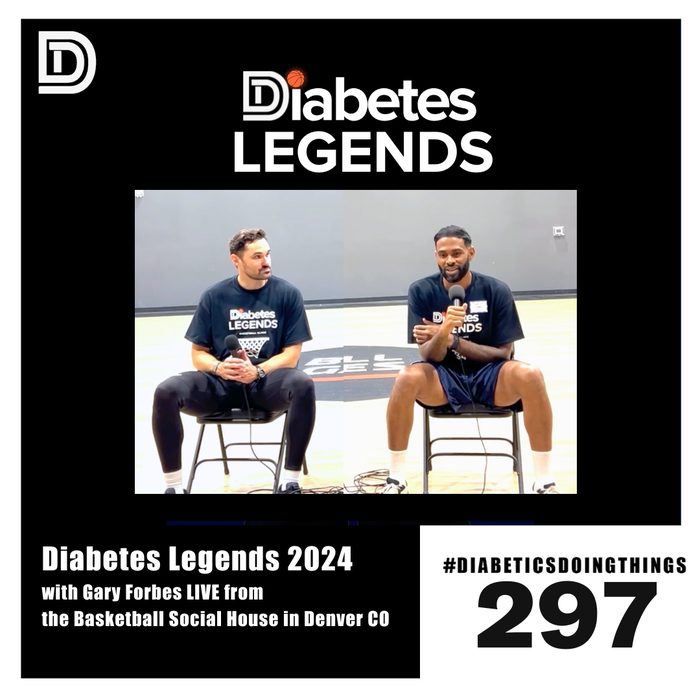
LIVE Diabetes Legends 2024 Q&A with Gary Forbes

Episode summary
Gary Forbes, one of three NBA players to have type 1 diabetes, joins Rob Howe for a live Q&A recorded at the third Diabetes Legends Basketball Clinic in Denver. Forbes was diagnosed at 19 after his freshman year of college and credits his father, also type 1, with teaching him diabetes was manageable, not a weakness. He talks about playing overseas without medical staff nearby, facing Kobe Bryant and the Lakers, and only switching from finger pricks to a CGM in the past year. Forbes also discusses The Sole Survivors, his graphic novel series about kids with chronic illnesses as superheroes, with volume three due November 1st. Campers and parents ask about injuries, insulin dosing, and nutrition.
Key takeaways
- Gary Forbes is one of three NBA players who had type 1 diabetes, alongside Adam Morrison and Chris Dudley.
- Forbes says his father, also type 1, taught him to see diabetes as manageable rather than a weakness.
- Forbes played against Kobe Bryant and the Lakers and called Kobe his idol.
- Forbes only switched from finger pricks to a CGM about eight or nine months before this recording, after Rob Howe and Eritrea pushed him to try it.
- His graphic novel series The Sole Survivors follows kids with chronic conditions as superheroes, with volume 3 releasing November 1st.
Show notes
LIVE from Diabetes Legends Denver: Gary Forbes on Diabetes, Basketball, and Inspiration
In this episode, recorded live at the third Diabetes Legends basketball clinic in Denver, Colorado, NBA player Gary Forbes shares his journey of managing type 1 diabetes while playing professional basketball. Forbes offers insights into his career, including playing against Kobe Bryant and adapting to life with diabetes.
The episode includes discussions on the challenges of living with diabetes, the importance of community support, and Forbes' graphic novel series, 'The Sole Survivors.' Emphasizing optimism and resilience, Forbes' story inspires listeners to see diabetes as a manageable and empowering challenge.
00:00 Introduction and Episode Overview
00:15 Special Guest: Gary Forbes
00:46 Gary's Journey with Diabetes
01:20 Exciting News and Announcements
02:00 Live Podcast and Q&A Session
03:28 Gary's Inspirational Story
06:13 Challenges of Managing Diabetes as an Athlete
10:37 Soul Survivors: Gary's Graphic Novel Series
12:01 Q&A with Campers and Parents
32:42 Final Thoughts and Acknowledgements
Links:
www.thesolesurvivors.com
Questions this episode answers
How many NBA players have had type 1 diabetes?
Three: Gary Forbes, Adam Morrison, and Chris Dudley.
Did Gary Forbes play against Kobe Bryant?
Yes. Forbes played against Kobe Bryant and the Lakers at Staples Center and says Kobe was his idol and the player he tried to model his game after.
What is Gary Forbes's book series The Sole Survivors?
It's a graphic novel series Forbes created about children with chronic health conditions portrayed as superheroes. Volume 3 releases November 1st, in National Diabetes Awareness Month.
When did Gary Forbes start using a CGM?
Forbes says he only started on a CGM about eight or nine months before this episode, after relying on finger pricks for most of his career, at the urging of Rob Howe and Eritrea.
Full transcript Searchable, with timestamps
Rob Howe: Good morning, podcast listeners and sports fans. We have an awesome episode for you today. This episode was recorded on September 14th at the 3rd Diabetes Legends Basketball Clinic. This one was in Denver, Colorado, back at the Basketball Social House and features Gary Forbes, one of three people with type 1 diabetes to play in the NBA all time. Of course, the other two, Adam Morrison and Chris Dudley. Gary joins us as a special guest and coach for the second time at Diabetes Legends. And we had an amazing camp. Our campers came out and really showed out. And we even had campers who were repeat campers coming. So two-time Diabetes Legends campers now for the first time. This episode features great conversations with Gary, whether it's sharing stories about adjusting to life with diabetes while playing professional basketball, stories about playing against the late, great Kobe Bryant and the Los Angeles Lakers, and how sharing your story can really reach someone at the right time. And in Gary's case, that person was me. And now for us to be able to put on these clinics together is an incredible privilege for me and really shows the power of speaking out and saying, hey, I live with diabetes and I want to share my story to help someone else. Gary has some exciting news for his series, The Soul Survivors. Volume 3 is dropping on November 1st in honor of National Diabetes Awareness Month. So keep an eye out for that announcement. But you can also pre-order the series today on thesolesurvivors.com. That's T-H-E-S-O-L-E survivors.com. And it's available on Amazon as well. So definitely check those out on Amazon or thesolesurvivors.com. We are going to continue to be doing these live podcasts and Q&As as part of our Diabetes Legends clinics. so you can check out last year's clinic on the podcast as well as the clinic earlier this year with lauren cox on the repost of her 2023 episode earlier this summer so enjoy this podcast q a from diabetes legends denver a live episode with carrie forbes one of the cool things that you guys have a level up on me today is that you guys have friends with diabetes already you guys uh can look to the left and the right and you can see somebody who knows what you're going through and that didn't happen for me. I know Coach Wolf was telling you guys some stories about me down there. That didn't happen for me until much later in my life with diabetes and now I have friends like Gary who was my hero. When he played for the Nuggets, I was playing at UCCS and the Denver Post did an article on Gary and his diabetes and I was 20 years old and I read that. It hit me at just the right time. So sharing your story and connecting with each other will help you not just today but on down the road. I know that there are friends and Eritrea is here, friends that people have had with diabetes for 20 plus years their entire lives. Matt, my good friend with diabetes, without diabetes, I wouldn't be here today with you guys. So I wanted to give you guys a chance to talk a little bit about life with diabetes and playing basketball at the highest level with Coach Gary. And then also have your parents have a chance to ask some questions as well, because I know it's a big day. Diabetes Legends Camp is big for mom and dad too, because they get to come here and they see that it's normal to come out of a drill and treat a low blood sugar every now and then. and we all get to be in this together. So, Gary, I'd love for you to kind of share your story with our first-time campers, and then we'll kind of dig into what life is like at the highest levels of basketball.
Gary Forbes: Sure, sure. Well, again, y'all know my name is Gary Forbes. So I was diagnosed at 19 years old after my freshman year at UMass, and kind of I was fortunate enough to have a father who lived with type 1 diabetes, and he never made it seem, you know, made it seem like a weakness, never made it seem like it was something that I had to be afraid of or worried about. He was a very strong individual. He was an Olympic lifter, a cyclist, a welder on the Panama Canal. So my father was my superhero. So I seen diabetes as something that kind of uplifted him and made him stronger. So when I was first diagnosed with type 1 after my freshman year, I think one of the things that the doctor said to me was like, oh, you may have to put basketball to the side and worry about your education. and luckily for me, I'm very hard-headed and, you know, it kind of went in one ear and went out the other and my dad always had a saying, you know, plan A is plan A, plan B is to make plan A work all the way to Z. So, I was always fortunate to have those kind of cliche sayings that, you know, help me and motivate me to be the best person that I, you know, could be living and managing type 1 diabetes. Although, I know that type 1 is, you know, very, very scary sometimes and you can have a lot of situations that aren't ideal, they are manageable. And if you take the right steps and if you're optimistic as I am, you can live out a very healthy life and be able to do anything you want to. And I was able to accomplish my dreams playing in the NBA. I am one of three players to ever play in the NBA with type 1 diabetes. And hopefully one of you guys will be the fourth and follow on right behind me.
Rob Howe: Yeah, I think time goes by quickly, right? There's only three people and only one person who's played in the WNBA. So four, you know, total at the highest levels of basketball. It's such a rare company. And so you guys got to have a coach today who's done what almost nobody else has ever done. And so that's part of being a diabetes legend like you guys are today. You're now honorary diabetes legends because you've done something that not that many other people with diabetes have gotten to do. So I hope you leave here today feeling really empowered by that because what's really cool is to be able to see Coach Gary. He's a real guy and he's here to have discussions with you guys about the highs and lows of diabetes, but he has done at the highest level what very, very few people have done. And that is possible for you too, not just in sports, but in life as well. And I think that's something that when I was young, when I was your age with diabetes would have given me a great level leg up to know that whatever I wanted to do was possible because of people who've gone before us like Gary. But it's not always easy. It's not always rainbows and butterflies getting to the highest level. So for you, you know, managing your diabetes early on too, because you were already a division one athlete when you were diagnosed, playing in the NBA, playing overseas, learning to manage your diabetes in different languages. talk about some of the challenges that kind that came with being a pro athlete with diabetes well
Gary Forbes: I mean obviously the challenge obviously is playing at the highest level playing division one basketball you got to be at practice two three times a day and I was always very I was a gym rat so I always wanted to make sure I was staying in the gym and working on my craft but I think one of the most challenging you know situations or experiences that I had was playing overseas I was fortunate enough to have the medical staff at the University of Massachusetts, who was great, always on top of me, making sure that, you know, my glucose numbers were right. I was always in range. But going overseas as a 22-year-old, you're by yourself. You know, you're in different countries, speaking different languages, different types of foods. So it was definitely a learning curve for me to, you know, figure out on my own what, you know, what's best for me. And that was very challenging some days. I had many lows in these different countries like Italy, China, Vietnam, all these different places. But I think, like I said, my father kind of kept that optimistic mindset of me for me. And we always have a cliche saying, if you think you can, you're right. If you think you can't, you're also right. So you decide. So I was always big on positive thinking, being optimists and manifesting the best out of every situation.
Rob Howe: I'm glad you got your quotes from your dad because I did as well. My dad was a big quotes guy as well. You have a quote that you talk about that I want to dig into a little bit today for everybody because you guys all worked really hard today, right? You guys feel like we had fun today, but we also got better. We worked hard. Gary says something that I really like, which is all work is easy work. So I want to know a little bit and have you tell our campers where that comes from. And even though something feels really challenging or feels really difficult, you can still do it.
Gary Forbes: Right. So I'm a big believer in perspective. And like I said, my dad is always looking at the glass half full. And being an athlete alone is very challenging. You have to be at practice. You have to learn all these different things. And it could be a lot sometimes. But I always look at work as easy work. Like Rob said, I have a saying, all work is easy work. I just look at it as this is something that is making me better. It's challenging, but I love to do it. And if you can have that perspective, if you can look at work, all work is easy work. You know, things, you know, start to become fun. And, you know, you're able to, you know, magnify that and grow and love that. So I love working out. I wake up at 5 a.m. every day, start with a cold plunge. And, you know, I still work out. And, you know, I look at it as something fun, something helpful to me. And it's making my body better. It's making my mind and everything around me.
Rob Howe: And I think this is something that I really buy into as well is that we're never really done. We've always got to keep working. We always got to keep refining. And I think diabetes has really centered that for me a lot because I wake up with diabetes every day. And just because my day before was great or it was bad, I've got to continue to move the rock forward, as they say. So for you, you talked about playing basketball in some pretty cool places all over the world. and I know that traveling with diabetes and kind of going off on your own or going off to college with diabetes can be scary and can be a challenge for people. So what would you say to somebody who's thinking about trying to go do something like that? Another quote, doubt your doubts before
Gary Forbes: you doubt your faith. So I think, like I said, I'm big on perspective and being able to put things in a positive light. I'm a big, big optimist. So I try, you know, it's definitely difficult sometimes because, you know, life is life and, you know, life happens. But if you can have the perspective of being optimistic and positive, I think that alone is a game changer. You're already, you know, halfway, you know, into a positive experience. So, you know, living and managing type 1 in these different places, I think has been difficult, but I think having a optimistic and positive mindset kind of overshadows those challenges and you're able to, you know, gravitate to that and it magnifies that positive impact. I totally agree. And you told, you talked earlier
Rob Howe: about your dad was your diabetes superhero, but you are not just an athlete. You're a well-rounded guy and you've written a series of graphic novels recently about some other superheroes with chronic illnesses. So why don't you tell everybody about The Sole Survivors? So The Sole Survivors. So at the,
Gary Forbes: towards the end of my basketball career, I wanted to figure out what's my why, what's my purpose, Why am I here? Why was, you know, I'm the one of three players to ever play in the NBA with type 1 diabetes. Why was I given this experience? So I thought I did have a story to tell. You know, the way I met Rob and I was an inspiration to him. So I kind of wanted to I kind of wanted to add on to that and be an inspiration and an idea for the entire world. I want people to look at me and be like, if Gary Forbes can do it, so can I. and created The Sole Survivors, which is a graphic comic novel about children with chronic health conditions, but they're superheroes. So it's kind of like a real life X-Men. And all these children in the comic graphic novel have different types of health challenges, whether it be autism, cerebral palsy, type 1 diabetes. And they're out there looking for a cure for each and every one of these health challenges. And they're superheroes. And these are my guys and gals.
Rob Howe: Yeah, and I see we got some copies of The Sole Survivors out there from some of the campers. So make sure to check those out. They're on Instagram and online at thesolesurvivors.com. Okay, before we turn it over to questions. So I know some parents were asking me questions earlier. So I'd love for you guys to start thinking about what you want to ask Coach Gary or even Coach Rob if you want to ask me something. But I got to thank our sponsors for making this happen today. How awesome is this venue at Basketball Social House? So give it up for Basketball Social House. and our friends from Medtronic Diabetes have allowed us to be here and to keep this camp low cost for everybody to be able to come. So big round of applause for Medtronic Diabetes for supporting diabetics doing things. Also, you guys all got packs of Skin Grips. I saw some of you guys wearing some of your grip tape already on some of your devices. So Skin Grip has provided tapes for everybody and Transcend Foods has also provided our glucose gels for our low blood sugar station. So if you guys want to take some of those as well on your way out, feel free to take as many of those as you feel like taking because those are courtesy of Transcend Food. So thank you to all of our sponsors for making this happen. And now I'd love to hear from you guys. What do you want to know? It's time for the Q&A and we can hopefully answer some of the questions you have about basketball, about life with diabetes, whatever you want to know. All right. And speak up because we might not be able to hear you from over there.
Gary Forbes: When I got hurt, how did it affect my level? So I've had, unfortunately, I've had six knee surgeries. So I've had those experiences where my blood sugar is, you know, all over the place, you know, skyrocketing, plunging. And, you know, those, you know, going to the hospital and having surgery and all those things do affect your glucose numbers. but like I said just having a positive mental attitude towards it knowing that everything is you know going to be okay I think is a you know a very good thing to have but but yeah it does affect it sometimes and you know it's unfortunate so uh that's a really good question does that's
Rob Howe: yeah because you're stressed out and your body is hurting and you know I think Gary mentioned it earlier highs and lows are just part of diabetes you know I think it can be it's funny it's great being in here today because we hear alarms and everybody looks for their stuff because we all know what that means. And most of the time, we're the only people in the room where those are going off or we're the only people on our team. I never got to play with a teammate with diabetes. So I was always the only one. And I felt guilty sometimes pulling myself out of a drill or pulling myself out of a game because I had to handle my sugars. But that's just life with diabetes. You're doing a lot of work behind the scenes that everybody who's has a normal pancreas does automatically. So I think having highs and lows when you're injured or when you're stressed out or when you really care about something, my sugars still spike up when I play basketball because I love basketball and I get hyped. I ran out of gas today on the knockout game, but I mean, you know, it has, it's still like my adrenaline shoots up because I love this game. And I think that's something that if you can just separate yourself sometimes from those highs and lows, you can zoom out a little bit because we can get really fixated on a number and it's important to stay healthy. It's important to stay active. It's important to try to strive to be in range, but highs and lows happen. They're just part of life. Let's go back here in the corner. Joshua, you made 10 in a row today, so give him a round of applause. So the question was, favorite team to play against?
Gary Forbes: I got the shorts right here, Denver Nuggets, of course. Yes, it was the first team that really gave me an opportunity to showcase and live out my dream. And playing in Denver with Hall of Famers and great players in a great city, I will always remember my time here in Denver. and just coming back here always feel like home and being able to play in Denver and just look at everything full circle, how they did a newspaper article on me and I was able to inspire, you know, someone like Rob, who's also inspired me, you know, to, you know, get on these CGMs and things like that. He's definitely changed my mindset and my perspective of living and managing type 1. So I think it all came full circle and I definitely appreciate him for that.
Rob Howe: yeah I think I'll come right back to you but you didn't know that I was going to see that story you know you didn't know that I was in Colorado Springs 30 miles south 40 miles south and you know I didn't know all of you guys until you know some of you guys are here for year two shout out to you guys but I didn't know you until we put ourselves out there and we started this event so you don't know how powerful you sharing your story with your class with your school with your friends could be for somebody way down the road you have no idea there are people that reach out to me that I've never, like, it's like six degrees of separation. I could have never met them in person. And they're able to connect because of people like Gary sharing their story and, you know, raising our hands and saying, hey, I live with diabetes and that's just part of who I am and I want to tell people about it. So it can be hard to be different, but it's a superpower, like Gary said. Let's go right here. Yeah, let me go first on this one. So the question is like, now we have, you know, I wear the MiniMed 780G. I'm on a closed loop system. You know, Gary's got a CGM, But when we were playing at the highest levels, we didn't have that. I wore a pump. I was like 50-50. My first two years of college, I was on injections. And my second two years, I was on a pump. Boy, we were going off vibes. And I used to check before the game, like an hour and a half before the game. And then right during the national anthem, I would go over by the water cooler and check because that was kind of like a good routine for me and the training staff. But, you know, my junior year, I started to play more. And the stakes of college basketball were really high. Like that was the most important thing in my life. And I would go from like an 80 milligrams per deciliter fasting blood sugar to like 400 before the game with no carbs at all. So I had to change the way that I prepared for games. I had to like hydrate a ton the day before and really work hard to try to figure out what was going on in my body. And now, you know, I play two or three times a week and I am able to keep my pump on and my my CGM on. and that's a tremendous advantage. It's not perfect, but man, if I could have only had that back in the day, that would have been a really big game changer for me. Yeah, definitely. For sure.
Gary Forbes: If I could have had been wearing a CGM, you know, playing in my, you know, in college in the NBA, I think it would have definitely been a game changer, you know, not having medical staff and coaches just every second, you know, you need to go check your blood sugar. You need to go check your blood sugar, you know, pulling me out of the practice or games and things like that. So I think, you know the technology is amazing it's it's a game changer it's it's saving lives it's helping people all over the world and I think thanks to Rob for being you know being on on top of me for
Rob Howe: that definitely was it was a helpful hand. It took me a while too I was somebody who actually lives in Denver and works in the diabetes space got me to try my first CGM so yeah you just got to be that for maybe you guys will be that for somebody else down the line. One quick thing I'm going to come right back to you over here a decision and my mom is here shout out my mom my parents and I made a decision when we were going through the college recruiting process to talk to the trainers about my diabetes and be really upfront about it. And we didn't really know how important that was at the time, but one of my trainers, he was a grad assistant when I was in school, now is a trainer at a school somewhere else. And he's had multiple type 1 athletes since my time. And you never know what your experience could be for the next person and helping the next athlete or helping the next person in your shoes learn about, because my trainer will send me a message every now and then every couple years like hey we had another kid with type 1 and we talked about you 10 years ago 12 years ago and now we're you know we're way ahead of the game I wish we would have had this stuff when we when you were around so you never know what change you can be for somebody else okay let's go down here okay this is a March Madness question uh did your team ever play in
Gary Forbes: March Madness yeah we did one year didn't didn't make out the first round but we played Tennessee
Rob Howe: Tennessee yeah my team did not make it uh to the to the NCAA tournament we made a conference tournament though and we we lost the metro state both times so they oh okay all right my favorite
Gary Forbes: team i played against in the nba the lakers playing against you know someone who i looked up to was kobe bryant and i still remember checking into the game i walked past jack nicholson and i'm just like yo i'm in the staples center and playing against you know my idol playing against someone who i tried to as best as i could model my game after i don't think i did a great job but you know i I got to share the court with him and share those experiences. And luckily for me, you know, when we were playing the Nuggets, we had a really good team. So we beat them a lot.
Rob Howe: Yeah, you were here during those heyday years, right? Okay, any other questions? Parents, mom, dads? Yeah, there we go. Great. So two questions. The first one was what age did we start taking over our primary responsibilities for our diabetes? And have we ever given ourselves too much insulin for something? So I kind of want to speak for both of us. You were 19, so you were already kind of on your own. I was 16, so my parents helped me a ton, but they also gave me a lot of independence, and I'm kind of an independent person. Anybody who knows me will tell you that. I think it's a very, everybody's so different, whether diabetes is a part of it or not. And so I think a really important thing for kids to become more independent is to come to events like this, and also Diabetes Camp. Camp Colorado, which is in Rocky Mountain National Park, I got to visit a few years ago. The ADA runs it. And they celebrate firsts at that camp. So the first time you gave yourself an injection, or the first time you tested your sugars, or the first time you changed your CGM. And the amount of people and the amount of kids at those camps who are celebrating their first milestone is really, really awesome. So, you know, everybody's a little bit different. And I think for parents, one of the things that I really love about this clinic, last year, I remember, you know, after the second kid checked out and went over to the low blood sugar station, everybody kind of relaxed a little bit because it's normal. It's normal to have to have a glucose gel. It's normal to get, have an alarm go off. Uh, and, uh, you know, it's, and, and back to the other question. Yeah. I've definitely given myself too much insulin before. How about you?
Gary Forbes: For sure. Definitely. Definitely. Uh, it's been some, there's some testing times, but, um, you know, lucky for me, I had, you know, great teammates, great staff, great people around me that was able to help me in those situations. Uh, when I had those, you know, low blood sugar episodes from you know mismanaging and it's you know it's every every every experience living with type 1 is different for everyone and every day is different i always say this everyone in here we all have the same health challenge but every single one of us in here woke up with a different number so it's that's still mind-boggling to me but um you know i think it keeps you on your toes every single day because you know you want to you know make sure that you're the healthiest that you possibly can every day. Every day is new.
Rob Howe: Yeah, and we were talking about some people on temp target earlier. Some people not on temp target. Some people wearing different therapies, different insulins. And a lot of that is, I don't know, if you make a mistake, that's okay. Something I think about the game of basketball taught me is even the best shooters only make 4 out of 10. So you look at somebody who has a 3-point percentage of 40%, they'd be considered one of the top shooters of all time. So when you zoom out and you're like, okay, well, if I'm getting it right more than half the time, I'm doing an awesome job. And I think the most important thing with diabetes is continuing or basketball as well, or whatever you're doing in life is like, whatever your result is, you commit to keeping on and coming back the next time and continuing to continue to try to get better. Nutrition as an athlete. How much time
Gary Forbes: do you guys have? I'm definitely big on health and wellness. And so I have another cliche, So if you were driving a Rolls Royce or a Porsche or any one of these fancy cars, what kind of gas would you put in it? Premium, right? So this, you know, I look at my body as this, you know, magnificent vehicle that I want to put the best possible foods and, you know, nutrition into it. And, you know, everyone is different. We all have different blood types that, you know, require different things. and I think doing I think diabetes has made me more you know just more into myself my body my health and wellness how I react to certain things and you only get one of these you can't take this back and get a new one you can't exchange this for for a new one so you know definitely hydration like colorful foods fruits and vegetables I know a lot of kids don't like vegetables but vegetables are very, very good for you. But you know, and exercise. Now we sound old. Yeah, I sound old right there. But yeah, fruits and vegetables, exercise and hydration. I think those are a very,
Rob Howe: that's a kind of like a starter kit for me. Yeah, I think all great tips, advice, nutrition, supplementation, exercise, rest, recovery. We're kind of in an interesting time where you can measure literally everything. And that can be overwhelming, both from a diabetes standpoint and from a personal fitness or what have you, I think there's like 142 factors that go into your blood sugar. That's a lot of things to control. And people with diabetes are like three times as likely to suffer from mental health challenges, five times as likely to suffer from chronic fatigue, just because of the amount of thinking we do. I guess the average person, somebody told me this recently, the average person thinks between 40,000 and 60,000 thoughts a day, just like, hey, this is a black t-shirt or hey, I'm walking on the floor. or you're kind of unconsciously thinking, people with diabetes think twice as many of those. So you're just processing double the amount of information as everybody else, and that's a challenge. So rest is really important. Sometimes it takes, they say on average, 15 to 45 minutes to recover from a hypoglycemia incident. So don't judge yourself if you can't get right back in. You're dealing with something really complicated. It's a disability. Some of you guys, I'm sure, know about 504 plans at school. You're covered by the Americans with Disabilities Act. that doesn't mean you can't do it but it does mean you should give yourself some grace if you don't
Gary Forbes: get it right every time and to piggyback piggyback off that i always having type 1 and being you know being pulled out of practice you know for you know a gatorade drink or something like that i can't it kind of made me have a chip on my shoulder because you know none of my other teammates had type 1 or anything like that so i always felt better than them because i'm managing this, you know, this chronic health condition and I'm doing, I'm running these sprints. I'm, you know, scoring the ball, I'm making shots and things like that. So kind of gave me a, a, a boost of confidence, you know, having type 1 and doing something that I love.
Rob Howe: Yeah. I do the same. When I, when I'm cooking somebody who doesn't have diabetes, I let them, I let them know. I for sure let them know. Okay. We got time for probably one more. Any other ones? Okay. Yeah, there we go. Great question. So advice for somebody who's just getting started with diabetes that I wish we would had at day one. I'll let you take it first. Advice for someone
Gary Forbes: who's just, I think, like I said, again, bringing to my father, it's, he showed me that it was manageable. He showed me that it was, you know, nothing for me to be afraid of. It showed me that I had control over even the, you know, the uncontrollable things. I still had the control on how I perceived it. And, you know, it's, it's, it's, it's definitely something that, that you can live out a healthy lifestyle and do the things that you love and want to do.
Rob Howe: I think the thing for me, and I probably was given this advice, but when you're 16, like, you know, you don't hear anything. So I'll zoom out a little bit. You guys have something really special here in Denver, Colorado, in the front range area. You guys have Children's Diabetes Foundation. You guys have the Barbara Davis Center. You guys have Breakthrough T1D, Rocky Mountain, Wyoming, whatever they name it now, JDRF. And you guys have this really great great close-knit diabetes community. So the thing that I would have told, if I could go back in time and tell myself, would be make a friend with diabetes. Because I had people that I knew that had diabetes, but they weren't really interested in the same things that I was. And so I had to look to people who were on TV. Adam Morrison was playing. The year I got diagnosed, he was player of the year in the NCAA. So I saw somebody doing something I wanted to do, but like even Google was kind of early then, so I couldn't find out how to do it. And so we had to learn a lot on our own. but when you make a friend with diabetes not only does it help you ask questions like Gary and I talking about getting CGMs but it clinically improves your your outcomes there's studies that show when you meet somebody or you're involved in diabetes community your A1c outcomes are better 100% of the time you can see over here there's where there's people with diabetes there's help and you know I think we all know what each other is going through so that's the thing I would tell myself I think from day one and that's why we're doing these types of events to create an opportunity to rule number three, make a friend with diabetes because you never know when you might need
Gary Forbes: somebody who knows what you're going through. Now that I think about it, besides my dad, I think you might've been my first friend with type 1. Wow. Yeah. You know, you, you sharing
Rob Howe: your story helped me at a time where if, if I hadn't seen that I, we may not be here today because I might've quit. I might've done something different. Wow. This guy's experience. He's asked, do we have bad days with diabetes? Yes, absolutely. I, boy, I was about to punch a hole in the wall the other day because I had a sight that failed and I had to change the sensor and it was two in the morning and my blood sugar was high. And, you know, in that moment, it felt like the biggest thing. It felt, I felt so upset, but took a deep breath, calmed it down, changed the sight, changed the sensor, got the insulin going. And, you know, four hours later, it was okay.
Gary Forbes: For me, just last night, my, I think definitely from traveling, you know, I live in West Palm Beach, Florida, coming up here to the altitude and, you know, you know, going on the plane, different types of foods. And, you know, my glucose was, you know, pretty high last night. And I was like, man, I'm just taking insulin still high and just kind of stressing out, man. I want to make sure that I'm in a good mood when I wake up. And, you know, luckily for me, I was, like I said, you know, Rob said, you know, calm down, took a step back, zoomed out and, you know, woke up this morning, you know, and everything was fine. Yeah. Yeah. Diabetes devices questions.
Rob Howe: if you're new or you're considering diabetes devices.
Gary Forbes: Right. I was thankful to Rob and Eritrea for just being just adamant about me making sure I get a CGM. I was still on the finger pricks last year. Maybe like eight, nine months ago, I just got on the CGM. But checking, you know, five, six times a day, it does kind of get, you know, I guess stressful and, you know, having to prick your finger. but I think you know doing those things can obviously help you manage you know what you're going through and and your blood sugars and keeping a daily log of what you're eating and what your glucose numbers are I think now you can study that and and be more you know
Rob Howe: locked in on yourself. I agree my back to quotes you we gotta we have too many quotes you and me I used to think of my diabetes if it ain't broke don't fix it and so I felt like I could manage my diabetes. I had a old pump. This was six, seven years ago. Now I had an old pump, no CGM. I didn't want anything else in my body. I was, I was good. My A1Cs were fine. My doctor was happy. And I was like, great. A friend who was on the podcast and I thought was going to be here today, but she and her husband were traveling. She was like, Rob, I hear what you're saying, but you're wrong. You need to, you need to try it. I encourage you to try it. Just give it a chance and you'll see what it's like. And she was totally right. So, you know, I went from being a very similar, very manual, kind of had it dialed in to being relying on breakthrough technology to help. We got one last question over here. Great question. So the question was that your friend's cousin was just diagnosed with diabetes and how can you help? You got advice? Go watch Diabetics Doing Things podcast. Yeah, thank you. Yeah, you can connect with us, Diabetics Doing Things. I think what I like to think about with that is find common ground outside of diabetes, like something she likes to do, and find somebody with diabetes that's doing it. Because that is, I think, what really inspires me. Like even things I'm not that interested in, if there's somebody with diabetes doing it, all of a sudden it's that much more important to me. And make a friend. She's got you. That's a big advantage because you're here and you're a diabetes legend. So part of being a diabetes legend is you got to go help each other. You got to go pay it forward. Got to bring people here next year. You got to go out in your community, set an example. You got Coach Preston in here who's playing at the highest level of Colorado high school basketball, go support each other. Be part of this community. Okay, a couple things. I want to, first of all, thank all of you guys for coming, and especially thank you for our year two guys and girls who came today. You guys rule. I want us to give one last round of applause for our buddy Sterling, who's in the hospital right now. He's going to be just fine, but I want us to clap it up for him. And I have a gift for all of you guys.
About Gary
Gary Forbes is one of three players with type 1 diabetes to play in the NBA, diagnosed at 19 after his freshman year of college. He later created the graphic novel series The Sole Survivors, about kids with chronic health conditions as superheroes.