


Episode summary
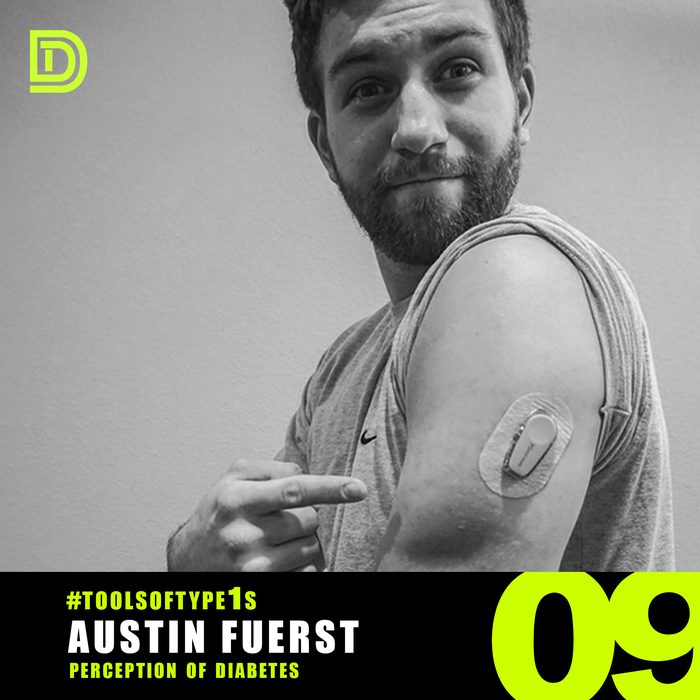
Austin Fuerst, known online as Everyday T1D, was diagnosed with type 1 diabetes at age two and grew up in Dallas, Texas. He talks about his tool, perception of diabetes, the idea that attitude determines whether someone struggles with the condition or lives well with it. Austin explains how he dialed in carb counting and insulin on board after years of trial and error, how exercise changes his insulin sensitivity, and his move from a pump to the InPen smart insulin pen paired with a Dexcom G6. He credits Camp Sweeney, his big brother there, his endocrinologist, and his mother for shaping how he handles diabetes, and describes his path toward becoming a registered dietitian and certified diabetes educator.
Key takeaways
- Austin says his attitude toward diabetes, not the disease itself, determines how hard his life feels.
- He avoids giving a full insulin dose for food when he already has insulin on board from a correction, because stacking doses can cause lows.
- Austin skips insulin for small snacks before exercise since exercise makes his body more sensitive to insulin and can send him low.
- He says comparing A1Cs or insulin ratios between two people doesn't tell you who manages diabetes better, since everybody's body responds differently.
- Austin isn't waiting on a cure and says he focuses on using the tools available right now.
Show notes
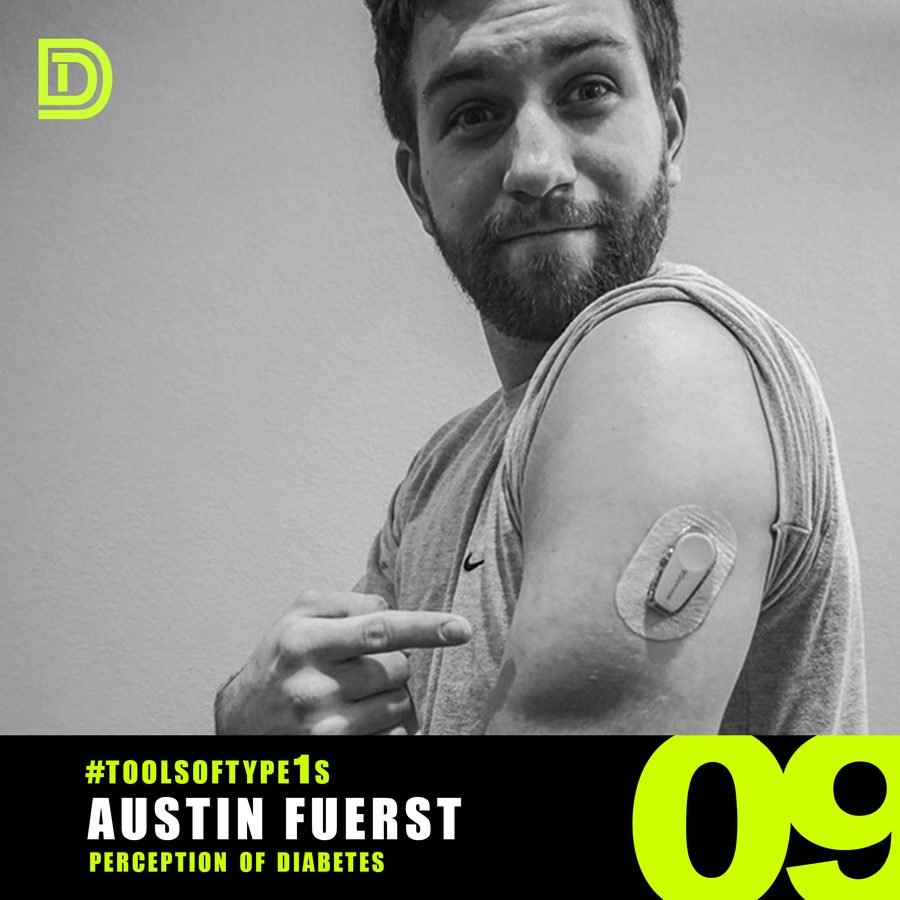
Name: Austin Fuerst
Hometown: Dallas, TX
Date of Diagnosis: 11.25.1997
Tool: Perception of Diabetes
Diabetes Devices/Treatment Methods: MDI, Smart Pen, Dexcom G6
Questions this episode answers
What is Austin Fuerst's tool for living with type 1 diabetes?
Austin says it's his perception of diabetes. He compares it to how you view a color: the same thing can be seen as good or bad, and that attitude shapes how hard or easy life with diabetes feels.
What is the InPen that Austin Fuerst uses?
It's a smart insulin pen made by Companion Medical that connects by Bluetooth to a phone app, tracking when and how much insulin he's taken and how much is still active in his body. He switched to it after coming off an insulin pump.
Why does Austin avoid giving insulin before a workout?
He says exercise makes his body more sensitive to insulin, so dosing for a small 15 to 25 carb snack before a workout can make his blood sugar drop too low.
Is comparing A1C numbers a good way to judge who manages diabetes better?
Austin says no. He points out that everybody's body reacts differently, so a lower A1C or a more insulin-sensitive ratio doesn't make one person a better diabetic than another.
Full transcript Searchable, with timestamps
Rob Howe: Tools of Type 1's podcast. We're into month two. It's February 2019. And I just want to thank you guys all for listening and sharing and communicating with me about the podcast. January 2019 was our highest ever month of downloads. So I hope that means I'm giving you guys what you want to hear. And you guys are finding value from our awesome, amazing guests who have been so giving of their time. going through each of these episodes this month has been a real treat. A lot of people that I'm very familiar with, also some that I've just been getting to know more recently. My first guest to kick off the month, Austin Fuerst, episode nine, his tool, Perception of Diabetes. I like Austin a lot. He's one of the few people in the diabetes community at large who's very active on Instagram that I get to interact with more often. He lives here in the Dallas-Fort Worth Metroplex, so he and I get together for coffee or dinner or lunch throughout the year, and he's become one of my good friends. He mentions it. I sort of big brother him a lot, but I'm very in awe of all he does for the community at such a young age, and I know he's going to grow into an awesome CDE later on in his career and just change what it means to be a type 1 diabetic to his future patients. So whether that's children, teens, adults, I know Austin's going to do an awesome job and awesome things in the future. Definitely follow him everydayt1d. There's an underscore in there somewhere. Also Austin is, I'm kind of hard on him and poke fun at his post because he's almost always shirtless. But I believe he wore a shirt for this interview. It could be wrong. Just something about the way that the audio sounds sounds like he does have a shirt on. So without further ado, thank you guys so much for listening. Tools of Type 1, Episode 9, Austin Fuerst, Perception of Diabetes. Big news on the Tools of Type 1 podcast. We have a sponsor. You've heard of them before. They've sponsored the podcast in the past. Real Good Foods. Real Good Foods at Real Good Foods on Instagram, realgoodfoods.com. You can actually order Real Good Foods products online and using code ROBHOW, that's me, Rob Howe, R-O-B-H-O-W-E, at checkout. You can save 10% and get free shipping. And I believe the shipping is the biggest piece there because it can be quite costly at times to ship frozen products, but you get free shipping when you use code ROBHOW. So don't forget that. one thing that's really important to me are companies like real good foods who are designing products that they don't know necessarily are perfect for people with type 1 diabetes but then they discover and they get really involved and they kind of dive in with both feet and real good foods has done that during national diabetes awareness month they donated a ton of money to beyond type 1 they design products that are great for our lifestyle and also taste great so pizza is obviously one of many guilty pleasures that I have. But also, I know a lot of people in the type 1 community have anxiety about eating pizza because it can be really tough. You know, high spikes, you know, the fat and the crust, difficult to count the carbs correctly and for the fat as well. Especially if you're eating it at night, it can be very difficult. So Real Good Foods pizza, 4 grams of carbs per serving. That's crazy. so i believe in one of their pizzas it's three servings in a single pizza guys that's 12 carbs and you know what counting those carbs injecting for that pizza it's right my levels stay flat and it's it's really cool to just have that sense of well-being and confidence when you're eating a product so highly recommend that you try it also very good when i was on vacation with my girlfriend over christmas we ran out of food in our airbnb we're like well we got to go to the store we got get some food. I'm craving pizza. Lucky enough in the frozen food aisle, Kroger, Walmart, your general grocery stores, check online if your local grocery store has them. But we're easily able to find the pizzas that we liked. And they also have these poppers that are made with chicken. They have jalapeno and they have pizza flavored, pepperoni pizza flavored. And they changed the recipe on those. I pop them in the air fryer. They're delicious. So if you want to try a low carb, low glycemic index, easy to manage with diabetes, delicious food. Check out Real Good Foods. They're in your frozen food section in your local store. And if you do try them, let me know. Give me a tag on Instagram. We'll chat about it. Okay, guys. I hope you guys are enjoying Tools
Austin Fuerst: of Type 1s. Let's get back to the episode. What's up, guys? My name is Austin Fuerst, or Everyday T1D, as most people might know me on Instagram and social media. I'm from Dallas, Texas. I've had type 1 diabetes for 21 years. My area of expertise would probably be health and fitness, management of diabetes, and problem solving with diabetes. I know Rob Howell from, I met him first at a JDRF type 1 summit in Dallas in I think it was 2017. I was going to be on the exercise and diabetes panel. And so they all had a kind of get together the night before. So that was the first time I met him. and we met and we became best friends. If he says we're not best friends, he's lying to you because we are. He's more of like a big brother to me, but same difference.
Rob Howe: What is your tool of type ones? And what's the one thing that a person living with T1D could learn from you or your experience?
Austin Fuerst: so I think something that someone can learn from me and my experience I've had a lot of experience with diabetes so it's hard to think of just one but I think one big thing that that I not necessarily use differently but I use that I guess differently than most people is the perception of diabetes. If you take color green, one perception is, oh, that's a cool color. The other perception is, oh, that color sucks. And depending on how you perceive and how your attitude is towards that thing, that color, in this case diabetes, diabetes, that's how you're going to go about living your life with it. So if you have a really negative attitude towards living with diabetes, then you're just going to hate every second of it. If you have a positive attitude towards it, then your life is going to be a lot happier, regardless of living with diabetes.
Rob Howe: The simplest thing you've done that has helped you with the management of your type 1 diabetes. Where did you learn it or who showed it to you?
Austin Fuerst: So the simplest thing that helps me manage my diabetes is probably carb counting and learning how to dose with insulin on board. So I used to be on a pump. I'm not on a pump anymore. But regardless, whatever you're going to eat, say something has 30 carbs, and you have no insulin on board, then you can go ahead and give yourself a full 30 carbs. So if you have a ratio of 1 to 10, that'll be 3 units of insulin. But if you already have 2.5 units on board from a correction, then you don't want to give that full 3 units. Because I know a lot of people, they don't really think about that. And they give themselves the full three units and then they end up going low and they're like, oh, what happened? Why did I do that? And so one thing that's super simple, but it makes a huge difference. and that goes to say with exercise as well as just living life. So if you're going to exercise and I have insulin on board or I want to eat a snack, I usually won't give myself any insulin for a 15 to 25 carbohydrate snack because if I do, then I'm going to end up going really low because when you exercise, your body becomes less insulin resistant. And so insulin has more of an effect. So if I get myself more insulin, then my blood sugar is going to plummet during my workout. Nobody wants that. So I think that's the simplest thing that I've learned. And I've learned it from experience. And I grew up going to a camp called Camp Sweeney, which is in Gainesville, Texas. and it's a camp specifically for children with type 1 diabetes. So if you're between the ages of 6 and 18, you can attend the camp and it's three weeks long and they teach you basically how to live life with diabetes. But at the same time, you don't have to do any work like diabetes wise. The counselors and medical staff, they take care of dosing, meals, everything. There are low stations, we call them med stations, all around the camp. So if you're low, you just go test your blood sugar. A counselor is going to be with you and log it. And if you're low, you get juice or tabs or whatever you want. No, whatever you want, but those two options. And I learned a lot from that camp.
Rob Howe: Yeah, they're awesome. What failures or apparent failures with T1D have made you better at living the rest of your life
Austin Fuerst: or made you more well-rounded as a person? Every day is different. I feel like every day is somewhat of a failure. Like today I woke up, my blood sugar was great. It was awesome. but then I for breakfast I enjoy cereal and I know cereal is super high carb and can be super annoying to do a sport and so I was kind of feeling lazy and rather than giving myself so with my the way I guess my body works I have to give myself half of the bolus up front then half of it about 30 minutes into it um and I gave myself the just the full 12 units because I didn't want to have to give myself another shot um half an hour later um and so like you'd think that oh I got 12 units like I got rather than six and then six later um I got 12 so my blood is gonna be fine but it's not the case because it makes a difference with timing and how how long it takes your insulin to act and how long those carbohydrates and how fast and how long they're gonna be in your body for an active for so that little failure to do two shots 30 minutes apart made my blood sugar skyrocket after about an hour. I was in like 350, 400. And so it's just those little things that remind you to be diligent in the way that you manage your diabetes.
Rob Howe: What unusual or absurd opinion or approach regarding your diabetes do you have?
Austin Fuerst: I don't know if this is what the question is asking, but like whenever I was in middle school, or I guess even now, and the nurse was like, hey, make sure you give yourself this much insulin, or make sure you check your blood sugar, blah, blah, blah, telling me how to take care of my diabetes, that just doesn't fly with me, I have the notion that I know my body better than they know my body, and I know how to take care of myself better than they can tell me how to take care of myself, and I still have that kind of notion when it comes to doctors, unless I trust them, and they know what they're doing, which luckily in my endo, he's awesome, and he is top of the line, especially with athletes and people around my age. But so I feel like I have better control and better judgment when it comes to diabetes and treating myself than anybody else can tell me because it's my body. It's my life that I live with it.
Rob Howe: What's your favorite thing? What gets you to smile or laugh almost every time?
Austin Fuerst: um there are a lot of things man um i love music i've played guitar for 14 years um and it's just a part of me and then whenever i hear i like acoustic music specifically um like whenever i study i study just acoustic guitar stuff it's i'm weird um but it's uh it's one of my favorite things that um and I love people I love being around people and meeting new people and talking to people um and every time every chance I get to travel to a new city um and maybe meet a few diabetics that's that's the jackpot for me I love it um it's it's it's a lot of fun
Rob Howe: in the last five years what new adjustment to your lifestyle has improved your life
Austin Fuerst: with diabetes the most? So for me, I'm always making adjustments, whether it's tweaking my insulin to carb ratio or introducing a little bit of insulin before I work out. Recently, I just got off the pump and I got on the InPen, which is made by Companion Medical, and it's really cool it's like um an insulin pin like just a normal pin but also has a bluetooth and it's connected to an app on your phone um it keeps track of when you gave yourself your insulin how much insulin is on board um and all of that stuff it's really really cool um and so i think the introduction to new technology um like the dexcom g6 um having a dexcom has made a huge difference in my life and be able to see how different foods affect my blood sugars and what I can do to counteract that like earlier when I said with the cereal example I learned that I have to spread out my insulin or extend it over a certain period of time in order for my sugars to not skyrocket so I think that probably the Dexcom is honestly the very first the best thing that's happened to my management of diabetes.
Rob Howe: What challenges related to T1D did you encounter or have to overcome while you were doing your thing?
Austin Fuerst: I think a lot of the challenges come when I'm just trying to live my daily life, whether it be going to class, going to work out, going to hang out with friends. a lot of times diabetes is has very inconvenient timing like if I'm getting ready to go out my blood sugar will decide to plummet or go really really high and I'll feel like crap one way or the other and I think that having to deal with that while still getting a workout in or hanging out with friends, whatever the deal is, is something that I've always had to deal with because I've had it for 21 years. So it's a constant thing, I feel like.
Rob Howe: What bad advice regarding diabetes do you see or hear that you'd like to address?
Austin Fuerst: I think one thing, it's not necessarily advice. but say you're comparing two people, like say you're comparing me to Rob Howe, and you look at our numbers and our different ratios and say, I don't know if any of this is true, but say my insulin carb ratio is 1 to 10, and his is 1 to 15, and so that means he's more insulin sensitive with that specific ratio, say it's lunchtime, than I am. And a lot of people are like, oh, why is he more insulin sensitive then? Is he a better diabetic than you? And that's not the case. I mean, everybody is different. Everybody's body reacts differently to different things. and so when two people compare numbers or ratios or whatever it may be with diabetes to each other you can't judge a person's control over those numbers and I see a lot of people doing that and it just kind of rubs me the wrong way because there there's no way to accurately do that. Even when it comes to A1Cs, it's like, oh, my A1C is a 7.1. His is a 6.8. Is he a better diabetic than you? No. It's just a different number. Your body reacts differently. As long as you're doing your job to be as healthy as you can, then you're doing the best that you can.
Rob Howe: What priority are you focusing on in your own life currently? This can be diabetes related or not.
Austin Fuerst: So right now, I'm in school, I'm in college. I'm studying nutrition with the hopes to become a certified diabetes educator, first registered dietitian, then certified diabetes educator. And so right now, that's really the big thing that I'm putting a lot of my energy into. If I'm not studying, I'm either with friends or at the gym. There's really no in-between. So that's kind of where my priorities rely, at least for now. I'm just trying to get as much schooling done as I can while I have time.
Rob Howe: Who is someone that you look up to, and what have they taught you? How do you apply that to your life?
Austin Fuerst: so there are a lot of people that i looked up to um both with type 1 diabetes and not again i grew up going to a camp called camp sweeney um and every again there are people from the age of six to the age of 18 there um and so like when you're younger you're paired up with a quote-unquote big brother, and they are just kind of there to hang out with you and encourage you and set an example for you, and so when I was younger, I first started going when I was, I think I was six, I don't know, I've been five, I was really little, but they made a huge impact on my life, all of those people I'm still really, really close to today. There's one or two guys specifically that made a really big impact. One of my big brothers was named Tim Hollis, and he was the epitome of cool. Like, I wanted to be him when I grew up. And when he went to college, he got a scholarship of some sort, and he wasn't going to be able to be there to accept it, so he asked if I could go accept it for him, and have that kind of relationship with someone that I looked up to, he taught me how to play guitar, he taught me how to play lacrosse, which are two things I grew up doing until I couldn't do it anymore, and he just made a huge impact on my life both socially and with my diabetes. Another man I really look up to is a endocrinologist. His name is Dr. Ernie Fernandez. He is the director of Camp Sweeney and he is the most kind, compassionate man that I've ever met. the way he loves on everybody encourages and he's who taught me how to look at something from a positive perspective and use that to drive you rather than let it keep you there and keep you anchored and so he he has made a huge impact on my life and I greatly give him credit for making me as passionate about diabetes as I am today. Those are just a few of the hundreds of people that have made my life what it is today. I also look up to my mom, my parents, because obviously when I was diagnosed at the age of two, I couldn't really do much to take care of it. And so they took the brunt of the work and the labor. And like when I was in elementary school and really little, my mom would come in the first week of school every year and read a book and kind of educate my classmates and my teachers about what diabetes is and how to spot the low symptoms and the high symptoms and what to do if something happens. And so she really, I guess, installed the education bug in me and kind of made me the way that I am and the reason I want to educate people and encourage people with diabetes. I think she really probably made the biggest impact on my life.
Rob Howe: What are you most hopeful for?
Austin Fuerst: this can be diabetes related or not so this might sound weird but i am not hopeful for a cure for diabetes um and that might may sound really like what why um but i i am not looking into the future and be like oh i hope this comes because ever since i was diagnosed they're like oh yeah a cure will come in five years cure come in five years no no big deal um oh i got usb notification um but five years passed nothing i was like okay there i go yeah it'll be another five years five years passed nothing um and so a lot of those times i put my hope in um someone's word and what they said that was going to happen. And I think that kind of defeated me in a manner. So I am hopeful. I mean, hopefully one day there will be a cure, but until then, I'm not going to wait for it. I'm going to deal with the here and now and use what I can to my advantage now, not the next pump system that's going to come out in a year. I'm not going to wait for that. I'm going to use the here and the now.
Rob Howe: What's the one facet or trait that you think makes you uniquely you? Explain why.
Austin Fuerst: I'm terrible at self-reflection. So this might end up being a ramble. But for me, I think the thing that makes me me is my energy and my, I think my energy and my drive is what makes me me. I'll give you an example. So when I was in fifth grade, I think it was right when the Nintendo Wii came out. It was the coolest thing ever. I wanted one so badly. But my parents were like, no, we can't afford that. we're not gonna get one for you um i was super bummed but um my lacrosse team was doing a raffle um they're selling raffle tickets um to raise money for the the league um and so the winner of whoever sold the most raffle tickets was nintendo wheat and when i found that out i ended up outselling the nearest second place person by 300 raffle tickets. And so when I had my eye on something and had a way to get it, I did not stop until I got it. And that has kind of stuck with me throughout my life. Whatever it is, I have the drive to get it. I think that's one of the things that makes me me because I think everybody has uniqueness in multifaceted ways.
Rob Howe: What advice would you give someone who has T1D and is trying to pursue a career in your line of work?
Austin Fuerst: So I am in the process of getting my nutrition degree. I'm at TWU, which is Texas Woman's University. I know men go there. It's great. It's fine. They have one of the best nutrition programs in the state. I'm also from Texas, just FYI, in case you didn't know. um and so i'm i've i'm in about i don't want to put a time frame on it but hopefully three years i'll have my rd and then after that i'll get a job and hopefully
Rob Howe: make my way to becoming a cd plug yourself tell us where we can find you in the diabetes online community.
Austin Fuerst: Y'all can find me on social media at everyday underscore T1D. That's me. That's my main platform. I'm also on Facebook if you still use Facebook. But that's where I live. I'm always on it. If you have questions, send them my way. I will be glad to answer them or just want to talk. I like making friends. but yeah y'all can find me I'm out also launching relaunching I guess my website everydayt1d.com and I'll be selling shirts it'll be kind of blogging thing it still works but I'll be selling shirts and all all that stuff to help bring awareness to type 1 diabetes
Rob Howe: Where do you get plugged into the T1D community the most?
Austin Fuerst: So I think the easiest way to get involved is through the social media community. So whether that's on Instagram or Facebook, there are tons of online groups geared specifically towards diabetes. I know there's one for Tandem. The Diabetic Journey has a really, really great one. And then you can just search hashtags on Instagram. Like I know T1D, hashtag T1D, and then hashtag type 1 diabetes, hashtag tag Dexcom. Basically anything that has to do with diabetes, just put a hashtag in front of it and you will find something. I know there's, Beyond Type 1 is a huge and awesome community. So you can find them on Instagram or on Facebook. just app beyond type 1. And then they also have an app, beyond type 1 app, which is really, really great for people that just have questions, concerns, or they just need some advice. Rather than posting it all like on publicly online, you can download this app and ask questions and find people and peers their own age, have experiences in the things that you're asking about. And I think it's a really underutilized resource that people need to use more because it's awesome. But yeah, that's it.
Rob Howe: Thank you for listening to the Tools of Type 1's podcast on diabetics doing things. I'm Rob Howe, And every Tuesday and Thursday in 2019, we are posting the next Tools of Type 1 episode. So follow us on Instagram, hashtag Tools of Type 1s, or just on Diabetics Doing Things. We will post those regularly every Tuesday, every Thursday. My favorite Type 1s are answering the questions I want to know the answers to. And hopefully you'll learn a few things as well. If you like this episode, be sure to review us on iTunes. And if you didn't like it, go ahead and let me know that too. I want to know. All the feedback is good to me. Thanks again for your time. I value that more than anything you could possibly give me. Thanks so much. Bye-bye. That's me, Rob Howe, R-O-B-H-A-W-E, at checkout. You can save 10% and get free shipping. And I believe the shipping is the biggest piece there because it can be quite costly at times to ship frozen products, but you get free shipping when you use code ROB HOWE. So don't forget that. One thing that's really important to me are companies like Real Good Foods, who are designing products that they don't know necessarily are perfect for people with type 1 diabetes, but then they discover and they get really involved and they kind of dive in with both feet. And Real Good Foods has done that. During National Diabetes Awareness Month, they donated a ton of money to Beyond Type 1. They designed products that are great for our lifestyle and also taste great. So pizza is obviously one of many guilty pleasures that I have. But also, I know a lot of people in the Type 1 community have anxiety about eating pizza because it can be really tough. You know, high spikes, you know, the fat and the crust. difficult to count the carbs correctly and for the fat as well, especially if you're eating it at night, it can be very difficult. So Real Good Foods pizza, four grams of carbs per serving. That's crazy. So I believe in one of their pizzas, it's three servings in a single pizza. Guys, that's 12 carbs. And you know what? Counting those carbs, injecting for that pizza, it's right my levels stay flat and it's it's really cool to just have that sense of well-being and confidence when you're eating a product so highly recommend that you try it also very good when i was on vacation with my girlfriend over christmas we ran out of food in our airbnb we're like well we got to go to the store we gotta get some food i'm craving pizza lucky enough in the frozen food aisle kroger walmart your general grocery stores check online if your local grocery store has them, but we were easily able to find the pizzas that we liked. And they also have these poppers that are made with chicken. They have jalapeno and they have pizza flavored, pepperoni pizza flavored. And they've changed the recipe on those. I pop them in the air fryer. They're delicious. So if you want to try a low carb, low glycemic index, easy to manage with diabetes, delicious food, check out Real Good Foods. They're in your frozen food section in your local store. And if you do try them, let me know. Give me a tag on Instagram. We'll chat about it. Thank you.
About Austin
Austin Fuerst, known online as Everyday T1D, was diagnosed with type 1 diabetes in 1997 in Dallas, Texas. He is studying nutrition at Texas Woman's University with plans to become a registered dietitian and then a certified diabetes educator.