

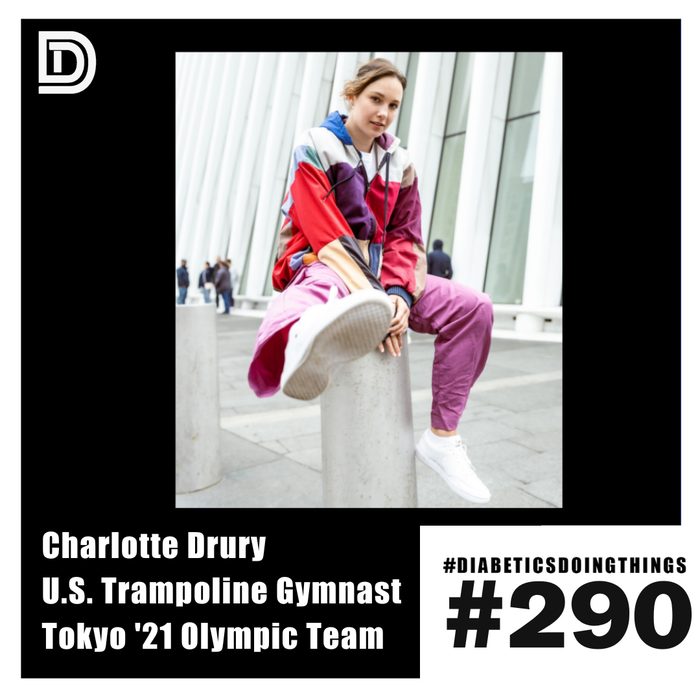
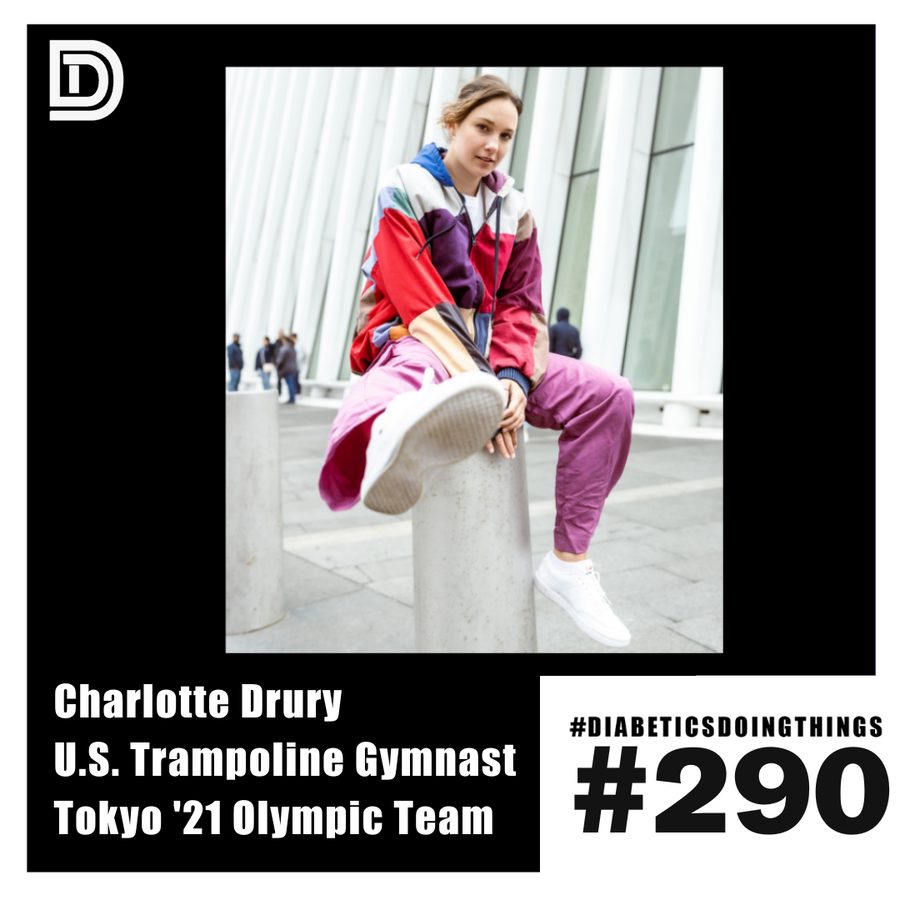
Charlotte Drury, U.S. Trampoline Gymnast, Tokyo '20 Olympic Team


Episode summary
Charlotte Drury is a U.S. trampoline gymnast who was diagnosed with type 1 diabetes about three months before Olympic trials for the delayed Tokyo Games. She describes months of declining health she blamed on pandemic stress, a diagnosis confirmed after a routine drug test flagged high glucose in her urine, and a fast turnaround learning to manage insulin while qualifying for and competing at the Olympics. She talks about wearing her Dexcom openly at competition, connecting with a teammate who also has type 1 diabetes, and leaning on her coach and partner. The conversation also covers her work as a photographer and writer, and includes co-host Larkin Clark, a DDT correspondent who also lives with type 1 diabetes.
Key takeaways
- Charlotte Drury was diagnosed with type 1 diabetes about three months before Olympic trials for the delayed Tokyo Games.
- She says that within about a week and a half of starting basal and bolus insulin, her training noticeably improved.
- Charlotte says connecting with a teammate who also has type 1 diabetes was the moment she realized she wasn't alone.
- She carries a running fanny pack for supplies and treats lows with jelly beans or Nerds gummy clusters.
- Charlotte says the perfectionism she learned in gymnastics didn't serve her diabetes management, and that "less than perfect is perfect."
Show notes
Rob and Eritrea are joined on the podcast by Charlotte Drury, U.S. Trampoline Gymnast alternate on the Tokyo ‘21 Olympic Team and person living with T1D. Larkin Clark also joined as a contributor to the DDT creator zine on this episode.
Read more about Charlotte in Charlotte Drury Bounces Back, the cover story for DDT Creator Zine Vol.1, Issue 1 written by Larkin Clark with images by Alfred Sarpeh.
In the episode, Rob, Charlotte Eritrea and Larkin discuss:
Charlotte’s diagnosis before the Olympics
Wanting to keep her privacy
Discovering the Diabetes community
Knowing there’s no wrong way to handle a diagnosis
Fitting Diabetes into your life
Waiting with open arms and advice
Living life
How awesome social media can be
Knowing it’ll get better
Questions this episode answers
When was Charlotte Drury diagnosed with type 1 diabetes?
About three months before Olympic trials for the delayed Tokyo 2020 Games, after months of symptoms she had blamed on pandemic stress.
Did diabetes affect Charlotte Drury's trampoline training?
She says her performance had been declining for about a year before diagnosis, and that within about a week and a half of starting insulin she felt like a different athlete.
What diabetes tech does Charlotte Drury use?
She wears a Dexcom CGM and links it to the Sugarmate app for trend data. At the time of this interview she had not started on an insulin pump.
What does Charlotte Drury do besides trampoline gymnastics?
She is a photographer and writer who shoots travel and lifestyle photography, and wrote a guest essay with her own photos for the New York Times.
Full transcript Searchable, with timestamps
Rob Howe: What's up, podcast fans? Hope you guys are having a great summer and you're gearing up for the Olympic Games in Paris. Day of Publishing is July 24th, 2024, which means we are three days out from the opening ceremonies. So we're highlighting athletes with type 1 diabetes who have been members of U.S. national teams. This is one of my favorite interviews as part of one of my favorite projects at Diabetics Doing Things. It's with U.S. Olympic team alternate in 2021 during the 2020 Games and world champion trampoline gymnast Charlotte Drury. Charlotte was in the news recently because she wrote a guest essay for The New York Times called Finding Freedom 30 Feet in the Air. And she also did the photography, which is amazing. And you can find that on NewYorkTimes.com. just search finding freedom 30 feet in the air and read an incredible story of the triumph joy and sacrifice that athletes make going to the olympic games and a little bit of what it's like to fly and flip in the air as a trampoline athlete i'm not going to do too much more on this because we have the amazing intro from the zine which you can still download at diabeticsdoingthings.com slash zine, and you can read the full Charlotte Drury interview there as well as in the upcoming episode. Enjoy and go team USA. What's up everybody. Welcome back to Diabetics Doing Things. Today, you are going to listen to an episode that is the first in a series that we are working on at Diabetics Doing Things as a part of our Diabetics Doing Things zine. This is the cover story from issue one featuring Charlotte Drury, US Olympic team member in the 2020 Olympic Games. In addition to being diagnosed with diabetes three months prior to the Olympic trials before the delayed 2020 Tokyo Olympics, Charlotte is a 2021 US trampoline silver medalist, 2019 bronze medalist. And in 2014, she became the first US trampoline athlete to win the World Cup at the Minsk World Cup in Belarus. There are 5 million people in the US who participate in gymnastics each year, and there's only 28 spots on the US national team. So that's a 0.00056 chance that if you participate in gymnastics that you can make the national team. So Charlotte is an exceptional athlete. We also are introducing for the first time correspondence for Diabetics Doing Things. And Larkin Clark, our first correspondent, who is here with us on the episode. She is a journalist, filmmaker, and photographer who's lived with type 1 diabetes for 28 years. And she and I and Eritrea take us through this interview with Charlotte. And we wanted to get a chance to get together and talk about that before we
Larkin Clark: dig into the episode. Thank you for the kind intro, Rob. It's so wonderful to be here with you all.
Rob Howe: This interview was super fun. And honestly, I think we all had high expectations and obviously are fans of Charlotte, but I'm not speaking for myself here. I hope when I say that she like totally exceeded that in her ability to be vulnerable and relatable and just such an awesome presence and such an awesome person in this interview.
Larkin Clark: A hundred percent. She said so many things during this interview that gave me chills, made me want to cry. We're so inspiring. And we all agree that she's just wise beyond her years. She's had diabetes for just about a year now. And I learned a lot from talking to her. It was such a pleasure. I think it was really special for all of us to just learn from each other and really have so many different people with different milestones within their diabetes, right? Like all of us are experiencing a different amount of time of having diagnosed. And with Charlotte only being here for a year and just already being such a leader within the community. I think she is inspiring and I, and I just feel so lucky to have been able to listen to this conversation
Rob Howe: and be here for it. It really was a privilege to be a part of. And I think one of the consistent themes throughout the interview that I found particularly relevant is how important it is to have friends with diabetes and how important it is to have a diet buddy. And I know that there are many of our personal diet buddies who listen to the podcast and who are friends of the pod or past guests. And I just want to express again, gratitude to the community for, you know, going on seven years of telling stories of people living with diabetes. And it really is kind of profound in this moment. Like in, if the stats are correct, there's 250,000 people who have been diagnosed with diabetes since we started doing this. And Charlotte is one of those people. And it's just so cool to see the impact that someone who's only lived with diabetes for a short time can have on 65 years combined of lived experience between the three of us on this episode. So I really hope you guys enjoy it. And it's the first of many and again, correspondent. So, you know, keep a listen and keep a lookout. We might have Larkin back in future episodes as well. Welcome back to another episode of Diabetics Doing Things. We are telling the amazing stories of people with diabetes from all over the world. And today it's very different because we have a little bit of a co-host situation. And this is the first issue of the Diabetics Doing Things zine, which launched this year in 2022. Our first guest is, I'm so excited. I'm literally jumping out of my skin here because we have the first ever US Olympic team member to join the podcast. Charlotte Drury, welcome to the show.
Charlotte Drury: Wow. What an intro. Thank you so much for having me. I'm very excited to be here.
Rob Howe: We are so excited to have you. And I also, I don't want to skip over an intro because we also have the first co-host of the podcast to come through outside of diabetics doing things.
Larkin Clark: Ms. Larkin Clark, welcome to the show. Thank you so much for having me. Very excited to be here with you and to interview you, Charlotte. Thanks so much for being here. So we've got a lot of
Rob Howe: people with diabetes. Eritrea is here with me as well. We've got people telling the stories of people with diabetes. We've got people with diabetes going above and beyond and living their lives amazingly. And we get to be all here today. If you had told me when I was 16 and I got diagnosed that this was going to happen. I would not have believed you. So let's just hit the ground running Charlotte. There are 5 million people every year that participate in gymnastics at some, in some form in the United States. And yet there's only 28 spots on the U S national team, which makes it, I'm reading here from the statistics, a 0.00056 chance that you can make the national team. So it's like way worse odds than making the NBA, which was my dream as a kid, we're, you know, like the cream of the crop elite of the elite. And then you throw type 1 diabetes on that. And you find Charlotte Drury there as a person who is living exceptionally and living well with diabetes. Talk to us a little bit about that. Like what, like, how did, how did you get into gymnastics? Like what was your introduction to trampoline? I want to know
Charlotte Drury: a little bit more about your story there. Tell us about you. Wow. I've, I've never framed the national team and like making a national team or a world team in that way. And that sounds like really, really cool. So yeah, thanks for that context. But yeah, so I was diagnosed rather recently, actually. So it's barely been a year. Actually, it'll be a year on April 1st. So we're coming up on my diaversary. But yeah, I've been a gymnast since I was three years old. I kept getting stuck in my neighbor's tree. And my mom was like, she's going to break her neck. So she needs a productive outlet and she needs safety. So she put me in a gymnastics class and the rest of this kind of history with that. I always had all this energy as a kid and I loved flipping around and I always loved climbing things and flying through the air. And that was really my favorite part of gymnastics too, was that feeling of flying and that feeling of like freedom and power and grace. When I was 13, I actually quit gymnastics and I kind of took a different path and started trampling instead. I had no plans of starting trampling. I literally, again, mom coming in clutch with, you need to do something. You have way too much energy. You can't just sit in the house all day. So she signed me up for a trampoline class when I quit artistic gymnastics. And I just remember my first day like bouncing and like, I kept smiling. Like I knew I looked so goofy, but like 13 year old me was so thrilled to like be there and like be jumping. And it just felt so fun and I hadn't had fun in sport in a long time so trampling was kind of that like safe haven for me there and then I got kind of good at it made the national team made the junior national team and kind of realized that oh shoot like maybe I can go to the Olympics for trampoline like maybe like quitting artistic gymnastics doesn't mean no more Olympic dream it just kind of means a little bit of a reroute in a new sport so that dream kind of kicked into full gear again and then made the senior national team world championships teams just kind of did the things that you do when you want to go to the olympics and then things like things like winning
Rob Howe: the world cup the winning gold like and being the first u.s trampoline athlete to do that
Charlotte Drury: you know just just little things like that yeah that that was cool but yeah so i just kind of like did that i had a really really rocky career as a whole like things absolutely never were not once have gone according to plan, but such is life. I was a really competitive contender for the 2016 team. And I actually ended up breaking my foot like right before Olympic trials there. So I didn't make that team. And I actually stepped away from sport for a couple of years and was like, I'm never doing this again. This is so brutal. This is so hard, you know, putting yourself on the line for their, you know, one shot at making a one person team, because trampoline is a one-person team is a little bit brutal so maybe I don't want to do this anymore and then in 2018 I kind of got that itch to try again and I kind of followed that passion and ended up bouncing again and ended up back on the national team and doing all this stuff and then Olympic trials starts and then everything's postponed pandemic hits you know now we have an extra year to just kind of sit tight maintain and like wait really and then in that year is kind of when I noticed the decline in my health kind of starting. So that's kind of the spiel up until diagnosis. Such an amazing story, Charlotte. So as you mentioned, you were diagnosed with type 1, just a couple of months before the trials for the delayed Tokyo 2020 Olympic games. Can you tell us what the months were like that led up to your diagnosis? Like what, what were some of the things that you were experiencing and what were your initial thoughts after diagnosis given at the point that you were at in your career? I honestly, my first thought was like, wait, what? That's not possible. Like I'm an athlete. I'm really healthy. I take care of myself like diabetes. I really had to learn a lot. I had no context of what type 1 diabetes was. And then my second reaction was really relief because I finally had an explanation for everything that I've had been feeling for the last months or the last year, really, because those were really, really, really tough. And I struggled a lot and I chalked it up to pandemic stress. I chalked it up to mental health problems. I chalked it up to training by myself now and not relying on my teammates and not being like externally as motivated because there's no competition, like pending and all of those ways that I explained away the horribleness that I was feeling actually were validated because now I had a physical explanation for what was going on. So when my doctor called me and she was like, yeah, no, you need to come in immediately. Like your numbers are out of control. Like we got to get you started on insulin right now. I was overwhelmed and shocked and terrified, but I was relieved. that's amazing that your doctor was able to call that out and you were able to start treatment right then were you at all familiar with type 1 diabetes or diabetes in general before your diagnosis like did you notice that any of the symptoms were maybe diabetes or is this completely out of left field for you so there's actually kind of a funny story with this one i so all elite athletes have to be in this international drug testing pool and when we get drug tested World Anti-Doping Association and then the u.s is usada so i'm part of usada and basically they come and drug test you like at random at any given time during the year they just like show up they knock on your door and if you're not expecting a visitor and you get that knock you're like oh my god they're here and you always have the same person so me and debbie me and debbie go way back. She's been my drug tester for like five years. And so Debbie shows up and this is like October of 2020. So I'd been feeling really bad. And actually the day before she had come, I was in bed all day long because I was like throwing up and I was so sick. And I think it like, I don't know if that was diabetes related, but it probably was. But so she shows up the next day and they take a urine sample and part of the like sample processes, they have to measure the specific gravity of your urine, which is basically how much particulate is in it to make sure there's enough for them to drug test on it. And my specific gravity, she like tested it and she was like, oh my God, this is so high. Like in 20 something years of being a drug tester, I have never seen a number this high. Like maybe, maybe you should go to the doctor, but because I was throwing up the whole day before I just kind of assumed that I was massively dehydrated and I brushed it off as, as we do. And I got drug tested again later, like right before national team camp in February. And it happened again, the numbers were super high. And she mentioned the word diabetes because it's common that when your body's not processing the sugar or you're not utilizing the sugar, you just pee it out. And so there was a ton of glucose in my pee. So that's what that was. So that was the only sort of like red flag hint that diabetes was the cause of what was going on. But again, I like, it just seemed so far fetched that I couldn't internalize it enough to like, think that it was true. And then the only other exposure that I had to type 1 diabetes is there was a, there is a teammate on the U S national team. His name's Brandon Chris Netsky and he has type 1. He's always had type 1. He was diagnosed as a kid and I just always saw him with his Dexcom and I really didn't know anything beyond surface level. Like, Oh, he has type 1. He travels with us. He does all the same things. Like he's an amazing athlete, but that was it. So there was really nothing pointing to me being like, Hey, I think I might have type 1 diabetes. Like not at all.
Rob Howe: I want to come, I want to come back to that though, because I think like what you were going to say as well, Larkin is like, how cool is it to have a peer like doing what you're doing? Like I hadn't have already like navigated a lot of those hurdles before we do that though. First of all, shout out USADA and WADA. Nobody here knows this, but I started my career working for USA boxing. And my job was to help the athletes coordinate their whereabouts with USADA and which can be very difficult when you're moving in and out of the national team. And like, you know, before you could text it, I'm sure there's an app now that you can submit it back in the day. It was like, you had to manually fill out a sheet and literally would, I would text them like on a Friday, be like, I'm going out of town for the weekend. Please take this update. I'm going to be at this address. Like, Oh God, it was such a nightmare before they got their technology put together. It's so funny. Like there's like so few people in the world who actually like know what difficulty that is, but it just brings me, it brings me joy. Shout out to all my athletes on the 2012 games with the USA boxing. They were, they, they did their best, but cause you can only miss, like if they come there, if they come to your address and you're not there, you can only miss like one of those or something like that. And before it's like a positive test, you can miss three whereabouts filing failures and then you're banned for four years. Yep. And that unfortunately happened to one of my good buddies. Yeah. It's my buddy, Cam F. Awesome. Did not get to make his Olympic run in 2012 because of that. So serious stuff, serious stuff. So anyway, fun little, that was a fun little fact. I want to go back to the more, you know, yeah, well, this is a little fun stuff. You mentioned feeling a little bit of relief when you were diagnosed with something and the something being type 1, I have spoken a lot about when I was in the hospital and I got my first insulin drip, like IV, how much better I immediately felt. And I was, I told the nurse, cause I'm so smart. I was like, Oh, whatever that was, just keep giving me that we're good. Because I just felt instantly so much better. And you know, you talked about the ups and downs in your training with injuries in the past, but like, after you got some insulin and you got yourself feeling better, like, how did that impact your training? Were you, were you just, did you feel just night and day difference right away? Or did give you confidence? Like how, how did, what did that manifest itself? Like,
Charlotte Drury: Oh my God. I felt like a new person, like a completely new person. I had been struggling so much in training and I was really, really kind of embarrassed by where my training was before finding out and getting treatment for type 1. I couldn't do things that I was doing since I was 15 years old that were a walk in the park since I was a teenager and as like an aging athlete as they say I was like well you just have passed your peak you know you know things get harder as you get older maybe you're not trying hard enough maybe you're not working out enough so I was really truly beating myself up for that and like there were comments coming in like just you know maybe maybe work out a little bit more maybe add a couple more workouts or like the national team started to get really concerned because we had to send in like videos to get ready for no because we hadn't seen anybody in a year so we hadn't they didn't know where I was at all I knew was that all I knew was that I was not where I needed to be and I was fully convinced in January when the national team required that I send in a video of my practices almost every single day that one that they were really worried because my performance was so bad. And two, I was like constantly thinking, I'm not going to make the team. Like, I'm not going to make it. If this is what I'm performing at, I'm not going to make the team. And like within, I want to say like a week and a half of being on insulin and being on like both the basal and bolus insulin, I literally felt like a new person. I was like, I was bouncing and I was like, Oh, this is me. This is the athlete that I know. This is the athlete that I love being. Like I was bouncing. I got back up on the trampoline and like, I was just exploding out of the bed and I was going so much higher than I had been going in literally a year. And things were easy that were supposed to be easy and things that were impossibly difficult before were now a manageable level of difficult. And like somebody, one of my teammates asked because we were both working on like speeding up this one skill it's called the it's a triple front flip with a half turn and I was barely making those around I was like it was scary I was scared to do that skill because I had no power and I was flipping so slow and bouncing so low and with starting insulin he was like I also didn't tell anybody at first that this had been going on. So all of a sudden my training just improved drastically for no reason in their eyes for no reason. And he's like, what are you doing? What's the technique? Like, how are you doing it? And I was like, bro, I have diabetes. That's the secret. Life hack. I got chills.
Rob Howe: Anybody else get chills while you were telling that story? That was unbelievable. Like when your body is working for you, like what you're capable of. And I can't imagine, especially with like the pandemic and like virtual coaching and like virtual high performance, like check-ins, like the mental burden of like, not being confident and feeling unfamiliar in your body that you've been like relied on for so long, like just the mental stress of that, I think, and, you know, having to balance that with performance and trying to make the team like
Charlotte Drury: that, I can't imagine like how difficult that was for you. Yeah, it was, it was tough. It was definitely really tough. The mental aspect is just as important as the physical aspect of training for the Olympics. And I think the mental aspect of dealing with the diagnosis is just as important as the physical aspect. And I wasn't, I mean, I got diagnosed and I had trials in three weeks. The Olympics were in three months. There wasn't enough time to sit and reflect and say, okay, what do I need? Where's my mental health? What's the check-in? It was truly like, go, go, go, go, go, figure it out, like figure it out faster than anybody else. Like you just have to do it. And I like, there was no time to relax and really take in the diagnosis. And I really only feel kind of that that has happened recently now. And it's with like life kind of calming down and slowing down a I am starting to process everything that's happened in the last year. And I'm starting to like fully appreciate the weight of everything that's happened. So that's been an interesting journey.
Rob Howe: And no kidding. I mean, like, I sort of like a time, time heals all things sort of right. Like at least giving yourself space and time to reflect. And I think that's something that I don't know, in the diabetes community, like we're sometimes so quick to move forward without addressing, you know, the difficult trauma and stress and change, drastic change that your body goes through, not just physically, but like you said, mentally. And, you know, there's a reason that people with diabetes are three times as likely to suffer from mental health because we're balancing a lot of stuff in our head.
Charlotte Drury: Oh, no way. I didn't know that fact. Yeah. Yeah. Well, yeah, we've got plenty of facts for you
Rob Howe: after the, after the call, we've got a lot of lived experience with diabetes on this call. So feel free. Any questions that you may have, we've, I'm sure got answers.
Charlotte Drury: Oh my God. I have so many questions all the time. I, so like I talk about it a lot now, like I, I diabetes has kind of been a big platform that I've kind of stepped into since making the team and having the diagnosis, but everybody I've talked to knows more than I do. So it's kind of tough. I'm still so new to it that I'm still learning. Like I'm pretty impressed with myself that I whipped out the words basal and bolus earlier without pausing.
Rob Howe: You're a pro already. And I mean, also, and you are, you're outwardly living out with your diabetes. Like it took me 10 years to do that. And I think like little conversations here and there with people I was okay with, but you know, that was one of the things that I think attracted me to this, to you in the story so much is that right there at the beginning, you know, you were thrust into the spotlight of, and, you know, people like us were cheering you on because of, you know, you were living, you raised your hand and said, Hey, I do have, I live with diabetes and I'm going through this. And I'm also a world-class gymnast, like at the highest level, competing at the highest level. And, you know, I, I don't know, I, what was that like for you? Like opening up online. And I know, I know this is a question was kind of later in the interview, but what do you remember about like the process of opening yourself up to sharing your story
Charlotte Drury: externally? I remember in the beginning, really wanting to hold my cards close and keep the diagnosis to myself and figure it out. And I think that's kind of my innate instinct when anything sort of upsetting or traumatic happens is I really like hunker down and I rely on my very close circle of friends and family to get through it. And then it kind of felt like, well, I don't really have a choice. Like I wear my Dexcom on my arm and I'm going to the first Olympic trial and it's, it's going to be right there for everybody to see. And it almost like the choice was kind of made for me, but I'm so happy that it was because I ended up connecting with Brandon, the teammate at that meet. And I hadn't posted about anything. Nobody knew that I had diabetes. We were like warming up and he comes up to me. He's like, what the hell is on your arm? what is that and I was like funny story I actually have type 1 and he's like no you don't no you don't and he like basically started crying and he was like oh my god like it's such it's such a hard thing I can't imagine what you're going through and like if you need anything I'm here if you have any questions I'm here like I'll be on the floor all day and then we like joked about where our numbers were at at that moment and that was kind of like a really like light bulb moment where I was like oh my god the community that's what I'm missing I'm missing the people that get it and connecting with him really felt good like I felt really seen and I felt really validated and I felt really supported and so like I made a little post on social media just where our Dexcoms were showing and so like just the people that had already followed me like knew it now and to some people that meant a lot and to most people that don't have type 1 or don't know anyone with type 1 it just was like oh okay like I don't know what that is but sure like double double thumbs up go you and then after the last trial I posted like the picture where I was like under the arch at trials and there was balloons and confetti and I'm like pointing to my Dexcom and I shared the story like the full like story of what it was like the last three months and getting diagnosed and having that decline and now having that rebound and like making it and having that like pure relief of it ending positively and people really responded well to that and I got so many messages from people people with themselves who have type 1 but the messages that like really really really hit home were the parents that were messaging me they were like my kid he's six years old he has type 1 he does gymnastics I saw his post and he can't wait to get back to the gym. Or my daughter was just diagnosed. She's 13 and seeing you proudly wear your Dexcom, like made her less embarrassed and less ashamed of it. And I was like, Oh man, like I'm done for sobbing going through my DMS. And so like that, like, it just really encouraged me to keep sharing about it. And I didn't realize that it was like a big deal, like what I had done or even that this community existed, like, dude, diabetes community online is next level. Like we go hard ride or dies. Yeah. I totally, I totally feel you on the support of the diabetes community online. I mean, I, this is how I got involved with everybody here is just through, through meeting people online. And thank you so much for being open about your experience because like Rob, I also, it took me about 10 years to, to become more open about it. And it really does help people. And thank you for using your platform and your story to help people feel less alone, because I think that that happens so often that we just feel so alone in our experience. And it just is so comforting to hear stories of other people, especially someone like you who has such like a, you know, an impressive career and you're doing something so inspiring with your, your body daily and to know that you can do it shows everybody that we can do it too. I love, I love that. Thank you. Now I'm getting emotional. I've got emotional hearing you talk
Rob Howe: about that. I'm just getting chills over here. Cause like you, it just goes and reinforces what we talk about on this podcast a lot. Like when you meet somebody with diabetes, like a friend with diabetes is such a huge life hack. Like, and like you get, you got to have that like on your team and to see the like ripple effects that that had, like you sharing, you guys both sharing your story, the DMS that you're getting, like the people that you touch, like there's a lot of things in this world that we all have to do because we have to do them. But when we get outside of ourselves and do a small thing, man, it can really, really, really have a profound effect on people. And I'm just so impressed that what took me 10 years took you like 15 minutes. So you're my hero.
Charlotte Drury: you really are oh thank you so much but i mean honestly if like there there is no right or wrong way to handle a diagnosis like this if it takes time for you to hunker down and keep keep your cards close then then that's what you need and that's what it takes and there there is no good or bad way like if you aren't comfortable sharing it that's okay you know it's totally okay but if If you do want to share it, there is a huge community out there waiting with open arms for you. A lot of advice. Yep, totally. I wanted to go back for a second to the fact that all of this at the trials and everything in your diagnosis was happening a year ago, which was kind of a strange time in the pandemic, right? The vaccine was just coming out. I'm sure you had a lot of different types of restrictions around you in training with your diagnosis and learning that you were with type 1 now in a high risk group. Did that impact at all your approach to training and your path going forward? Did you have to take extra precautions? What was that experience like? Yeah, it was definitely very frightening. I definitely was just kind of scared all the time. And I kind of felt that way before the diagnosis too. Like I, I, I took COVID very seriously because I was so scared one that I would get sick, but my biggest fear was that I would get sick and get somebody else sick and then somebody else sick. And I was already quite fearful of that. And me and my coach took all the precautions that we possibly could. Like when COVID first hit, I mean, the gym obviously shut down and the Olympics hadn't been postponed yet. So there was no choice. I still had to train. So we formed our own bubble. Like it was my family at home and Logan, and that was my entire bubble. And we kept it really safe. Like nobody else was allowed in the gym and we would usually have maybe one other person in the gym just for safety, but it was really just kind of like avoid others at all costs. And then things kind of loosened up and the vaccine came out and I felt a lot better about that. And then the diagnosis came and I didn't really fully recognize that that meant that I was in a little bit more of a high-risk group but I did know that I was I was a it was different now I was very hyper aware of my body and very hyper aware of my health where I just kind of always wore a mask where in casual settings like somebody might have taken it off or obsessively washed my hands always had hand sanitizer but other than that I think you know all the regulations in place kept travel as safe as possible and kept competitions as safe as possible. There was groups that were bubbled together and media didn't have like full access to everyone and things like that. So it was, it was definitely scary, but handleable. That's great to hear that it was something that you could handle easily. And what was the response from your, your team to your diagnosis? this well my my coach's first response because I called him on April 1st when I found out and I was like hey like so everything's fine well everything's sort of fine well everything's not fine but I'm fine sort of and he's like spit it out like come on and I was like I I have type 1 diabetes and I was like radio silence for a second he's like what oh shit like well that explains that like that that explains it because we had had so many conversations of like him asking me like what do you need what what can I do as your coach to help you keep pushing forward and to help you grow as an athlete to help get you back to your peak performance never once neither of us questioning that there was something actually physically wrong with me but it did explain a lot so I mean we chatted for a little bit hung up the phone, whatever. He said, take the time you need. Like I'm here. If you need anything, don't even bother. Like just do it, do whatever you need. You don't need to fill me in on every single step, but I'm here for you. And then he calls me back like a minute and a half later. And he's like, so wait, hang on. This wasn't an April Fool's joke, right? Like this isn't a joke.
Rob Howe: I was hoping he would say that. Cause like it's just a little too on the nose.
Charlotte Drury: Right. God, the universe, man. What are you going to do? But so he was so supportive. I mean, shock is everybody's first response. And the questions come in and I'm like, what does that mean? And I'm like, I don't know. Then it's just kind of, how can I support you? What do you need? That's really hard. My parents had just moved out of state. So now I was living, like I was the only one in my family living in California. Still, I live with my partner, thankfully. And that was just, you know, the support system that I absolutely needed at that time. And the way that that people showed up for me was awesome. Nobody judged. It wasn't a weird thing. It wasn't like, oh, can you still do this? It was really just like, okay, how can I help? That's incredible. And that's so important. I feel like, and such a community and family and partner who are there to support you. Something that I've experienced personally in my life is how diabetes sometimes can affect your romantic relationships in ways you might not expect. Even just like the initial onboarding can be complicated, the day-to-day highs and lows in mental health. Are you able to share anything from your experience on that front? I mean, yeah, definitely. It's like, you know, when you go through something, it's not just you going through it is you and all of your loved ones on this journey together because that is the definition of a loved one like you are in this boat together um and it can't go unnoticed like the toll that it takes especially on my immediate partner who I live with and do everything with and it's such a scary time and just the support that I received was like like I don't even have words I would not have been able to do it without that support I would have just crumbled absolutely no matter like no matter how hard I tried it was that support that I relied on and I just remember like I mean from the get-go I did we learned it together like we like so I got the call and she was like the doctor was saying that you need to come in immediately but it's you know six seven o'clock everything's closed so my office is going to call you you're going to come in first thing in the morning and so I'm like okay what does first thing in the morning mean like she didn't give me a time they're going to call me in the morning so I woke up at like five in the morning like and just waited with my phone like in bed and like then the phone rings and they're like can you come in like 20 minutes and I'm like I live 30 minutes away but yeah and and I was like getting up and like pulling my clothes on and my partner was like do you want me to come with you like I'll come with you and I was like it's really early and she was just like I don't care like if you want me there I'll come with you I'll just sit in the car I'll sit in the I'll sit in the lobby it's fine like you can decide later if you want me in there or not and obviously like once we got there I was so thankful that she was there and in the room with me and taking in all the information that I just simply could not take in in a moment of such shock and taking notes and asking questions that I didn't think about asking and just being my partner in it. Like I didn't have to do it alone and we learned together and everything was an experiment and some things went really well and some things just did not, but we were both there to pick up the pieces. So I didn't have to do it alone. And yeah, but it definitely takes a toll. Like the strap, like the stress, she must've been constantly terrified. Like we are both learning it together and it's, it's not an easy thing to manage. It's not an easy thing to learn. And as we're both learning it, like, that is not a time I want to
Rob Howe: go back to you, the way you described you talking to your coach and you were like, everything's fine, but also not, and I'm good, but I mean, we asked to do this differently. And it's like, if I've ever heard a more concise description of what diabetes does to your brain, like that is totally it. And, you know, being able to live that with someone and like have the support there, because it is a burden and like being able to reach across to somebody and share that whether they have diabetes or not is, is so important. And, you know, shout out to all the, the caregivers out there. I know I, mine and my own life. And like you said, parents of kids with T1D and others like partners, we see you guys and appreciate you to the max, whether it's bringing some snacks from the kitchen or just like bearing with us as we rage our way through a lower high, like that, you know, you guys are the real MVPs out there. 24 seven Dexcom alarms.
Larkin Clark: Oh my gosh. Oh no. Literally horrible. My poor husband. Same girl. Same.
Rob Howe: I gave my wife the way out. She doesn't have to follow me on my, on my care link share. So
Larkin Clark: in the beginning, it's like, especially cause I like, didn't even know how like a Dexcom worked and the calibration of a Dexcom and like a pressure low and this that and the other like like oh my god I can't sleep on my stomach anymore I can't sleep on my arm anymore like just this aggressive horrible ear splitting alarm going off in the middle of the night
Rob Howe: like come on so funny it's like on one hand it's like yeah it's super important but on the other it sounds like the Federal Reserve Bank's being robbed and it's just like genuinely dirt dirt so
Larkin Clark: wild and like I totally get it like you are on you're slowly like creeping down to dying so it's right pretty important that like you have going down to die yeah you're gonna quote me on anything that's what that sound is in case you're wondering right it's like that's my impending doom my time my my time ticking down yeah literally it's so ominous like you know the little like alert the top and it's in red. It's like you have 20 minutes until an urgent low and you're like, oh, that's terrifying. I will tell you one random life hack that I stumbled across recently because I have a tandem that then tandem pump that vibrates and it used to wake up my husband at night, but we recently got a new mattress. We got a purple mattress, which is one where you, when you move, it doesn't affect your partner as much. And that actually has helped a lot with the vibrations from my pump. Like he doesn't feel them anymore, which I guess is good and bad because if there's really a problem, like you might not wake up, but I think it starts to make a loud noise after a while. If that's the case, definitely helps. Yeah. This podcast isn't affiliated with purple mattress,
Rob Howe: but we're very welcome to it. It's an opportunity. Okay. So let's, let's shift back a little bit into like the tactics and like training, because especially like training up to the Olympic games, you you've just been working your whole life and competing against like the whole world to try to make it to this point. What, what is a typical like training, like leading up to a big event? And then like, what is, what is like a, what does an event look like as well? Because some of the feedback that we've gotten from athletes in the past on the podcast, specifically like swimmers and track and field athletes is that when you have multiple events in, in a day or multiple heats, so to speak, it can be very difficult to kind of keep yourself in range and be ready to compete. So we'd love to hear your kind of thoughts on like what's your typical training and event routines look like.
Charlotte Drury: Yeah. I mean, everything pretty much stayed the same. Like I've had my training plans and my competition plans in like on lock for the last like eight years. And we just kind of found the areas where we needed to slip in like diabetes friendly things. and those things were really just, you know, I mean, my coach was there on the whole journey, you know, again, we learned it together. So it was from step one to the Olympics that we just kind of laid some ground rules and it was like, okay, so if you need to stop, you stop. Like, I don't care. I'm not pushing you through that. So you, you tell me you need a break. We're taking a break done. No questions asked. And then, you know, you need to carry your juice on the floor while we're not supposed to have like food and drink, like take your juice, have the juice. But other than that, yeah, it's just like I would train in the mornings for a couple of hours and then I would usually do some sort of like strength and conditioning after that and then some recovery after that. And I guess the way that diabetes kind of shaped that was just, I had to bring some more snacks. That was pretty much it. Like once I got things down, as long as I had my like bag of supplies, I felt like I was just kind of the same athlete as I'd always been
Eritrea: with more interruptions. So is it any different when you're not training, I guess, when you're like keeping in your diabetes toolkit, what's the difference there when you're maybe in your
Charlotte Drury: off season? Oh, it's so much easier. I think I literally, so like getting diagnosed in the middle of like the most stressful, difficult time period of my life sucked. It was like, okay, you're going to learn on a hard mode and now retiring or taking a step back and taking a break from sport it's like kind of getting back to like medium mode so that was like a huge blessing but then now I've had to figure out like how to travel with it and that's changed things a lot and just like exists now like in the city like I moved to New York City and I had to manage diabetes through that whole move which was just another layer of things to think about and like switching pharmacies and finding a new endo and doing all of those things. So like that's been a nightmare. But yeah, I think just the main difference is like things just kind of got a lot easier, a lot less like unpredictability in my blood sugar throughout the day. Like if something's happening, I now know why it's happening versus back then I was just confused all the time. I never had an answer. I never had an explanation and things were just confusing as it always is in the first three months of being a diabetic. It's, you have no explanation for anything and blood sugar is so finicky and it responds to a walk that I took last night. And then at 11 o'clock the next morning, I have a low, I'm like, geez, sucks, Christ, like, come on. But like, now I know those things and I've learned them like intuitively over the months. And I feel a lot more prepared. I feel a lot more confident. I feel like I have a lot more trust in myself again. So I think training now would be a lot easier than it was eight months ago because it was very, very difficult. Just really, really new, right? As you are, like, as you're fitting diabetes into your life now, it's an everyday part of you. Are there any like skills or traits or habits that you think maybe you've acquired as a gymnast that have really come in handy for managing your diabetes? oh definitely I think just my attention to detail and like my general approach to things of I'm going to figure this out and I'm going to figure it out now and I'm going to figure out to the best of my abilities that is my like hyper competitive personality of like oh I have diabetes well I'm going to be the best diabetic you've ever seen like and like yeah that served me really well in the beginning but now I've taken a lot more like laissez-faire approach where I'm like okay I know the rules I know the guidelines I'm really just going to do my best to stay inside of those. I feel so seen. This is so good. Yeah. When she said it, I was like you and Rob two peas
Rob Howe: in a pod, in a, in a champion pot over, overachieved, overachieved mindset. Like,
Charlotte Drury: and then backing off a little bit. Diabetics club because that's a thing. Right. Yeah. Totally. But now we're there. Just in general is yeah. Gymnastics just in general is a really good or sport. I would, should say in general is a really good, like launching pad for the rest of your life. Like you learn discipline, perseverance, how to advocate for yourself, what your body's telling you, like just different things like that, that have definitely served me in all areas, including diabetes, but just in life as a whole, really. So do you notice any parallels between gymnastics and maybe your mentality around the diagnosis itself? I think, yeah, yes, honestly, towards the end of my career, like last year, kind of in the comeback of after 2016, coming back to sport, and I kept that 2016 mentality of push, push, push, push, push, like, you're tired, it doesn't matter, the strongest, like, champions are made on the hard days, you know, no pain, no gain, you got to go for it, like, you got to be willing to do things that everybody else isn't willing to do. That's how you become the best. Plot twist, like I'm just going to skip to the end and like let some truth in here. That's not true. The people that are the best and the people that rise to the top and are able to stay there, the people that know when to rest and the people that aren't aware of when they need to take a break. And I really took that into my life's approach after kind of 2018 didn't go so well. And I had to reevaluate in 2019 and just be like, what am I even doing here? Like, you know, we have one life, we have one body. I am going to take care of it. I'm going to care for it. And if that means having a rest day, that means having a rest day. And if that means calling my therapist, that means calling my therapist. Like, and that approach has helped me a lot because it kind of took the pressure off of being perfect in my diabetes management where I had that a lot in the beginning of the first month, two months, three months, even like even up to the games, because there was just, it was such high stakes where I really did need it to be perfect. But after the games and coming home and being like, okay, less than perfect is perfect. That is a great place to be. And that's felt really good because it used to be like a constant, constant thought in my head of like where my sugars were, Do I have my things? Like I was constantly thinking about it and now it's really taken like a backseat in my head. And I just have created the habits that I don't even need to think about anymore. And now I just live my life because I'm not thinking about managing my diabetes all the time. Totally. I'm so glad that you mentioned that about the perfectionism. I also dealt with that a lot early on growing up as a competitive dancer and a type A personality, just like push through, push through, be perfect. it's taken a long time. I'm glad we're all here for this support. Yeah. Yeah. It's taken a long time. We're going to make sure it's that, but to the point of realizing the importance of self-care and the realization that diabetes is never perfect. And you, there is no such thing as perfect. Even if you see that unicorn 100, it's okay. As long as you're taking care of yourself and putting time in and thinking about it sometimes and allowing yourself grace, sometimes that's what's Totally important. Yeah. In addition to the skills and traits that have come in handy, are there any specific resources or organizations that have been especially helpful in this first year with diabetes? Of course, beyond diabetics doing things, because obviously that I'm sure is number one resource. Shout out, appreciate that. Wow.
Eritrea: What a plug.
Charlotte Drury: Yeah. I mean, I think like the first website that everybody stumbles on is the beyond type 1 article of like, so you were just diagnosed and like you read that article and like you kind of have some information, but you just like, so are so starving for more information. I turned to YouTube a lot. Like I turned to people who were giving firsthand accounts of what it was like living with diabetes because they really took like the scientific jargon out of it. and I could comprehend what they were saying when, cause you know, like when you're in a doctor's office, you hear like 5% of what they're saying when you're stressed out, it's not making any sense. That's why you bring somebody with you because they're going to take it in. And I felt like it was the same thing for like months. Like I, I could not like take in this information that I was given in these like pamphlets and these packets and stuff. So hearing people that talk about it, that are just like normal, like a conversation like this, like I remember looking for podcasts and I remember looking for social media people and, and things like that. So those as a whole were really, really helpful. And then shout out Julie, who was there for like my first, from the first like day I was diagnosed and she was a skier and she had type 1 and I got connected to her through a really close friend of mine that I had texted. I was like, well, now we know why I've been struggling and training so much. Like I have diabetes. And she's like, no way like that first of all that's insane but second of all let me link you up with this person she is an expert on type 1 like that's literally she writes for type 1 content and she was like my saving grace in those first couple of weeks because my endo is not accessible at like a moment's notice i can't text my endo and be like hey something's happening what's happening i don't know what's going on the house is on fire and i don't know where the hose is like like the call she was that person literally literally and so she was that person for me and i'm like literally so grateful for her i could oh god i mean i could have figured it out without her because we have to but like she made it so much easier and so she was so helpful diabetes to the rescue diabetes time literally diabetes diabetes right here on this on this podcast. I'm so excited. I was just at a conference yesterday or two days ago for, for type 1. And I was like standing on stage. I was like, I have met two other type 1 diabetics in real life before knowingly. And now I'm in a room with like 500 of you. This is crazy. Like, and then as I said that, like somebody's like low alarm went off and I was like, I know that's. I know that's
Rob Howe: I'm so glad that events are coming back. Like that was my first experience to like being in a room, Eritrea. I went to diabetes camp and I don't know, I'll work and I'm not sure if you went to diabetes camp when you were younger, but that was something I missed out on because I was too type
Charlotte Drury: a and too cool and knew everything. Yeah. I totally missed out of them because of that when I was younger, which now I'm like, why, why did I put a huge mistake, huge mistake, because it's great.
Rob Howe: And you get to like norm, be normal and hear somebody else's alarm and it's not yours, but you know what they're going through. Like you can just shout them out or somebody will throw a juice box your direction. And like just having that kind of community, like diabetes, like we're really digging into that right now, but it was so overwhelming for me for the first time to be like, I, how many times have I felt so alone? And then I can be in this room with 500 other people who are dealing with the same stuff and they're dealing with it right now. And they can, you know, and they can, you know, each of us can learn from each other. And that is like truly the power of community. And it is kind of cool to just sit there and step back for a second and be like, man, all of these people know exactly what I'm talking about. And you know, there's so much power in that. So shout out to all the diabetes who are listening to this podcast as well. You
Charlotte Drury: guys roll. Dude. Yes, absolutely. And like social media is so awesome in that way of like connecting just anyone from everywhere. Like it's just, it's truly limitless of the amount of community that you can find. And I think the, at least for me, the initial urge when something like this happens is again to shut down and to isolate and to keep things like I just become a hyper control freak of all the things that I can control and my circle would then be one of those things and kind of relaxing and reaching out and branching out and removing that barrier of isolation is so so so important because when you feel like you're the only person in the world going through something that's some heavy shit and that's that's legit that's real and of course it feels like that. And while all of our experiences getting diagnosed are going to be different, at the end of the day, there's a, there's a really deep level of empathy and understanding between other people that have been there or even gotten another chronic illness diagnosis. You know, it's, it's, it's scary and it, and it's kind of a bond that you can't even describe. Yeah. It really does feel like you're meeting long lost family members. That's what it felt Yeah, truly. Yeah. With a diabetes community and met my first diet buddy randomly outside of a concert. No, we had, we had matching insulin pumps. That was it. That's how I met my first
Rob Howe: diet buddy too. He was outside of a Chipotle. I was, uh, it's like, I'm dating myself with this. It was like, you know, when Chipotle opened in your college town, they like would give away a free burrito. And so of course you go there as many times as you could. And my pump tubing was outside of my, it was hanging out in my shorts and this like snowboard bro kind of rolled up. He's like, he walked by me and then he doubled did double take and came back and was like, me too, dude. And like, that was the first time I had like randomly met a person with diabetes in public. And I don't know. I'll never forget. I will never forget it. It just was like the big, it was like such a small little thing, but I'll never forget it.
Charlotte Drury: So I can't, I was sorry. No, I couldn't tell you guys, I couldn't tell you the first diabetes, buddy but I want to tell you guys the last one so I was on a plane and I went to the bathroom and the girl who came out of the bathroom was wearing a tandem pump and she looked at me and I looked at her and I was like we did the spider-man meme and then she was like we should totally hang out or something and I never saw her again so if you hear this I think about you all the time misconnections let's put it on craigslist literally the the first person well so two experiences like happened really quick. And those were the only two. One, I was in the elevator of my apartment building and there was this guy standing there and he was wearing a tank top and he had Dexcom on his arm. And I did like a double take and I was like, no way. And I had a mouthful of food. It was, it was bad. It was not a pretty sight. And I had a mouthful of food. And so like, I pull my sleeve up and I was like, fuck, look, me too. And I was so new to it. So I like, like cornered him in the hallway and was like, so what about this? What about your, So how did you do this? And I was, oh my God, I was so excited. It's so embarrassing, but now we're Instagram friends. So like now we're friends. That's how it happens. That's how the magic happens. I literally saw a woman walking in my neighborhood the other day with a Dexcom on and I got so excited. And it was like, you know, like when dogs go for a walk and they see other dogs, but then I got nervous and I was like, no, she's going to think I'm crazy. She can't see my Dexcom because it's on my leg. Like, how do I start this conversation? but I still get really excited even 20 years then today I know I always like love having my Dexcom on invisible places because it's like let your free flag fly like let's put it out there tell me like I want to see I want to connect with people and like it's such like a like dead ringer like me I'm here I have diabetes look like talk to me it's such a if you know you know
Rob Howe: type thing where like you know you know you can just like lock eyes with someone even if they're in the middle of something and be like, yeah, I see you do like this. It's all good. Or like a quick fist bump or kids do like the pump bump. Well, the pre pre pandemic, they were like bump your pumps together or whatever on the tubing. Anyway, that was a thing I learned at diabetes camp and I was all about, I was a big, I was big on the pump bump. Bring it back.
Charlotte Drury: Hashtag bring back the pump. them. So Charlotte, we also know that you are in addition to being a gymnast, a photographer and creative. I would love to hear more about that part of your work and what's next there. Yeah. So my whole life, I have had photography as a hobby. I like just really gravitated towards it as a kid and like saved up and bought my first camera when I was like 15 and had always like just loved it and then always kind of thought it was too good of a thing to be a career like it almost sounded too good like you know when something's like that can't be real that's like that's not a possibility but it it totally is and it wasn't until recently where I was like oh no I can actually make a career out of this and I can use photography as the like vessel for all of the other important things in my life that I want to do, which is travel and meet people and tell stories and connect so many more people than you would have ever been able to without a camera. So that's kind of my approach to photography. I don't really have like a specialty niche. It's kind of just travel lifestyle, you know, creating things that I see on the way and using it as a way to have really cool experiences. What I've seen on your Instagram so far is beautiful. So I'm excited to see what else you shoot in the coming years. Thank you. That means so much. You are such a brilliant photographer. So that really means so much. Thank you so much. I love a compliment circle. Oh, that's so nice of you to say. That means a lot to me too. Do you have any favorite cameras to shoot on? Or I saw that you also shoot some film. Can you tell us a little bit about that? I do. Back in the day before I actually bought my like fancy digital, like my neighbor's son had like a bag of film cameras and gear and stuff that he like left at home and he went to college and my neighbor was like I know you like photography do you want to like play with these and then I just never gave him back so don't tell my neighbor I still have them but yeah no so I have a like a Minolta SRT201 film camera and then I have my like little point and shoot film camera. And then I grew up like stealing the family's rebel, like Canon rebel. And it turned from the family's rebel to Charlotte's rebel. And then bought another Canon. That was like my 16. I saved up. I've got my like big girl camera. And then now I actually shoot Sony. So I'm really big into Sony. I love Sony's Sony's line. Yeah. I also started as a cat Canon rebel girl. didn't we all i know yeah it's any aspiring photographers out there that's good solid one to start with your hands on a rebel can do a lot worse than a rebel yeah i mean honestly today like i think a phone is better than a rebel the bet what do they say like the best camera is the one
Rob Howe: in your hand right yeah truly but we are house i'm i'm a fuji shooter and my wife is a sony shooter so
Charlotte Drury: you know, file formats and all and lenses. My endo is a Fuji shooter, like diehard. We had
Rob Howe: this conversation at my last appointment. We love a multifaceted endo. We love that.
Charlotte Drury: We do. We truly do. Shout out Dr. Siegel. Nice. In terms of career, what's next for you? In addition to pursuing photography, has your diabetes diagnosis changed your career and personal goals at all? Or has it encouraged you even more to pursue certain elements of your career? Yeah, I think it's really kind of encouraged me to kind of have a more double faceted career. So there is the career that I have always been dreaming of, and that's the passionate, creative side of my life. And then there is the career now that takes me past sport and into this diabetes community. So as far as photography and traveling and journalism goes, it's, I've always wanted to do the craziest things. I've always wanted to use photography as a way to get me in places that I would never be otherwise. And diabetes definitely in the beginning, I was like, well, I can't do that, I guess. Like, I guess that's lost. I'm going to have to find something new. Like I can't, I just, it felt so overwhelming. And now taking little trips and then bigger trips and then a little bit bigger trip. And I'm like, no, I can do this. Like, this is totally possible. I just need to have all of the gear. I just need the tool. It's not going to hold me back from living that life. And then on the other side of things of, I really do want to stay involved in the diabetes community. And I've started doing some speaking engagements and speaking events where I've been able to connect with other diabetics on mass. And that has been so wonderful and so impactful. And it just truly fills me up as a human. so I really am going to continue doing that and connecting with people on that side of things through social media from conferences or like I'm speaking at a like a pharmacy club at a university like so just connecting with people on every scale at every level like selfishly I love meeting other diabetics and talking to other diabetics and then I just think it's a really good way to give back to the community that has literally propped me up through this entire year. that's amazing thank you so much yeah it's all very confusing though like i just moved to new york city and i'm like what am i going to do with my life i have this crisis like at least once a
Rob Howe: day that's good it's normal normalize normalize a daily crisis it's an ongoing crisis especially if you're creative like this is you're gonna you're gonna run into stuff that's like i don't know if this is me anymore oh wait no yes it is okay here we go no like exactly and coming from
Charlotte Drury: um sport which is so regimented and so like two weeks in three weeks in four in two months like there's literally like there's a schedule and then you have your like control freak to the max I would plan everything out to like the number of turns I was going to take in that day like and now I'm in this like creative lifestyle where I'll have like a week at a time where I like don't really have to do anything and I'm like I'm cheating. I'm cheating. There's stuff. I'm not doing something like, it's really kind of great, but it's also a little bit anxiety inducing.
Rob Howe: I feel you a hundred percent. I think like, you know, one of the, I don't know, I kind of believe life comes in phases, like learn, you know, in careers, especially is like learn, earn, return. If you like wanted to make it like nice and neat and marketing and rhyming, but like, I think of like the return aspect, even outside of diabetes, I think of athletes and exactly like you said, where you have months, years, you know, decades of your life where there are people in place to help you succeed. And there are frameworks and there are space and there's people whose literal job it is for you to perform or for you to go to class or for you to, you know, achieve your goals. And then at some point for everybody that ends and whether you're at the highest level of sport, like in the Olympic games or representing your country, or you just, you know, finish your senior year of high school or whatever the case may be, you, you kind of, that next step is open and there's not all of those kinds of guardrails of those people helping you. And, uh, I really have a heart for athletes in that phase. And, you know, I think that that's something that I'm hope to in the coming years, like really dig into helping those people and like, give them a little bit of structure and like help them with that empty time to fill it with things that are good for them and eliminate some of that anxiety and kind of wondering if they fit because sometimes the longer you play a sport outside of like a traditional path it can be very difficult for you to like go into the workforce people like well explain the gap in your resume and it's like oh well sorry i was just competing for my country in the olympics
Charlotte Drury: and i didn't have time yeah literally literally and there was always so much pressure and like knowing that that day was always going to come when i wasn't going to do sport anymore And to be honest, I didn't recognize that that day was going to come until after my first Olympic quad because I was so singularly focused on, you know, April 8th, 2016. Like my life was planned until that day. And then April 9th rolls around and I'm sitting there, not at the Olympics. Like what? Like the sun came up. This day is here. I remember being like fully sitting in shock and being like, this isn't real life. Like, but it is your real life. And I really like what you said before of like, there's a time for everything. And that's kind of been my mantra, like recently is there is a season for everything, you know, things will come and things will go in that this life. And that is such a good thing. And I think as humans, or at least for myself, I have this innate need to hold on to what I have right now and hold on for dear life because I'm so scared of change and change just so uncomfortable that kind of just reminding myself that, you know, spring will come, winter will come, and we are going to go through these fluctuations, which is immensely comforting when you are in the middle of winter, metaphorically, and actually in the middle of winter, knowing that spring will come because there is a season for everything and change is inevitable, which is a wonderful thing when you frame it like that and not quite so scary.
Rob Howe: I couldn't have said it better. I, those life is seasonal, right. And you're going to go through those high and low moments. And I think that's very similar in diabetes. Like you're going to have great days and you're going to have terrible, awful days. And just knowing that that's not a reflection on you as a person. It just sort of is the reality. I read this book called 4,000 weeks very recently, which is the average human lifespan is 4,000 weeks. And when you think about that, sometimes the most important thing you might do is just have a good conversation with somebody like we're doing today, something that can connect with someone somewhere who's experiencing burnout, who's in a winter of their life, who's wondering how in the world the sun came up this morning, because I thought it was all over yesterday, is the most important thing that you can do in that moment. And that comes from a very, very much in recovery overachiever. So like, I think we are reformed overachievers. I am. Yeah. I, every day I have to remind myself of that, but kind of in that, in that same vein, like you've been so giving of us with your time today and like just amazing insight. You're, you're well-wise beyond your years. And I'm a huge fan, but like for, for, do you have any advice yet for people who are either newly diagnosed or athletes who are living with diabetes or any advice that you'd give yourself looking back almost one year from, from today? Oh, I mean, okay. So when I was first diagnosed,
Charlotte Drury: I literally wanted to punch everyone in the face that told me this, but every person, it gets better. God, I wanted to punch them so bad. I was like, I, yeah, it's probably going to get better because it has to, but right now it fucking sucks. Like it sucks. And so if you are newly diagnosed and you are just so lost and so confused and so in shock and unable to even like I was taking any sort of information, if you're going to take in one thing, that's okay. Just one thing every day, one thing new, this is all an experiment. You are now doing a job that nobody is ever going to do better than you or worse than you, because it is your body and you're managing this. And we're always all just doing the best that we can. You're going to get there. You just have to wait it out. That's what I would say. And I would punch myself in the face for
Rob Howe: saying that a year ago. Yeah. I think we've all been on one hand. I thought that's so perfect. It's so poetic. And on the other hand, yeah, I've been there. I've been so angry. I was so mad.
Charlotte Drury: I was so mad. Oh, the worst. I also had the same experience. I think it's like any response to like trauma or grief is it will get better. When somebody tells you that and you are in the pits of it. Oh my God. The anger, like this, this burning desire for me to scream at you. Like, no, it won't because it doesn't feel like it ever will. Like, yeah, that's, that's, that's a real thing happened to me after 2016 too. The worst though, was when people were like, oh, this will make you stronger. God, if you want to know like one-on-one, what not to say to somebody going through something, this will make you stronger is probably the top of the list right next to like, it's not even that bad. Wow. That it's not even that bad as that's, that's bad. That's really bad. Yeah. I've also had the same feelings about people saying things to me like that over the years. And, you know, it, it is something where you go through cycles. Like you said, I loved that metaphor that you gave of the seasons where you really do go through those cycles of being like, this really fucking sucks so badly. And sometimes that cycle comes weekly for a while. And sometimes you'll go like a year or something. You're like, Oh, this is, it's not so bad, but I wish somebody had said those exact words that you just said to me when I was first diagnosed because you said it so eloquently. I think too, like, like what you
Rob Howe: said, Larkin, it's a cycle of grief. That's the reason they call that. Just because you make it through one low moment, there's going to be more coming. It's a cycle and it continues to happen. And just being aware of that and recognizing that it's not a reflection on you. And I think what you said, I totally agree. Larkin, it was Charlotte's so succinctly said like, no one else has ever lived in your body with diabetes. So there's nothing to compare yourself to. and you know your good days and bad days are yours alone and that can be celebrated and i think ultimately like this call even could not have happened if any of us were born at any other time in history we'd all be dead what a happy accident like what a happy happy here he goes like what a dumb what a dumb cosmic mistake that we're all get to be alive today like how cool is
Charlotte Drury: that pretty cool yeah it's so great that literally i've been so hung up on this whole like notion of change and how could probably because i'm in such a big transitional period of my life right now but you know our lord and savior mary oliver like there's this one line in one of her poems oh my god i literally love her to death like any any human in history that i want to have dinner with it's Mary freaking Oliver. Invite me, please. Yeah, Dawn. Dawn, it's a party. She says this one line and she combines like two words that are just, I've never heard in a sentence together. And the poem ends with all that and all that glorious temporary stuff. And like glorious and temporary, like wonderful and fleeting. You never hear that together in that context of when things are good, when things are great even like the fact that it's temporary is what makes it so awesome to have in that moment and even if it's a negative thing even if it's a bad thing like it's still gloriously temporary so it's like you can take that line and do whatever you want with it which is the beauty of poetry but yeah I'll have to find the name of the poem and I'll send
Rob Howe: it to you guys, but it's very good. It's a hero's journey, right? In order to know what the highs are like, you have to have the lows to compare it to and things end. And that doesn't have to be always sad, even though sometimes it is, but it makes it worth it. And choosing something or someone means foregoing everything else. And that also makes it special and powerful. Oh man, I'm just, I'm really, this has been great. Okay. I'm moving into the lightning round before we, cause we could just talk about this all day. I got a feeling this truly, I had to stop myself from like rambling. Yeah. I feel like we like, well, we've all just been very aligned today. I'm so grateful for this time. I feel like literally a hundred times better than when
Charlotte Drury: I got on this zoom. So I think this is a great group. You guys are, you guys are awesome. So are you. I agree. This is fantastic conversation. Thank you so much, but it's not over yet. Yeah, we have a lightning round. A lightning round. Okay, Charlotte, what is your favorite trampoline move and why? My favorite trampoline move is a double layout, which is a double flipping backflip in a laid out straight position. And it is my favorite because you only have to do work on the jump and then you launch yourself into the air and you fling and you fly for two flips and you don't have to do anything else. No big deal. No big deal. Okay. Next question. What is your proudest moment since being diagnosed? Proudest moment would be getting messages from kids as parents. Definitely is being able to connect with, with the parents going through this. Love that. Okay. Favorite pre-workout snack. apples lame I know boring but apples for apple that was my like that's what I figured out worked for me was just eating an apple and not dosing for it before a four-hour practice or four-hour
Rob Howe: workout we love an apple plus like just eating it like you know fiber burning the calories like
Charlotte Drury: just so nice a non-dose for a morally neutral thing too apples oh easy yeah I don't have hot takes about apples. Sorry. Apple a day thing, right? Like, there you go. Apple a day keeps the doctor away. So we have, we have this one. Okay. Hit me lightning round again. So we got
Rob Howe: this one. Favorite diabetes, friendly workout gear. I know you don't wear a pump yet, or if that's in your journey, but if you have one, like what do you have your favorite diabetes,
Charlotte Drury: friendly workout gear? Probably fanny pack, like a runner's fanny pack, because it carries my sugar and my phone and doesn't like bang against me when i run i'm a big fanny pack advocate so yeah an advocate of the fanny pack all right here so we're starting a club and instead of t-shirts we're gonna have fanny packs sounds great co-sign fully signed me in uh okay so in your fanny pack what's your favorite treatment for your lows nerds i love nerds i freaking love you want to know the best part about being diabetic is de-villainizing candy. Candy is now a medical necessity for me and for my entire life. Like I've struggled with disordered eating from sports and this, that, and the other from being a teenager growing up in today's world, like, God, going to the candy aisle and being like, Oh God, what am I going to get today? I recently got back into jelly beans and they're perfect because they're one gram of carb per bean. so oh no way easy calculation the one from trader joe's at least are that's my i'm gummy bears and
Rob Howe: the reason is because it's two carbs per bear so again just keeping the math real simple simple
Charlotte Drury: math that's the key i don't even do the math at this point i just like grab a handful and hope for the best they have nerd gummy clusters now those are the ones i'm talking about they're so good they're so they're amazing oh my god they're and it's 17 17 carbs for 19 pieces oh so perfect we have so much knowledge nice incredible i haven't tried those i'm adding them to my list thank you i'm weird you have to they're so good plus the nerds have like that specific type of sugar already that's like super fast uptake so they're perfect for like really bad lows totally or so i've been told i just really like nerds okay yeah you're okay oh there's it is there's the rope the rope okay charlotte so we've got your candy so what is the diabetes tech or app that you could never live without the dexcom app for all that it is and it literally just helps me so much and then i actually really like to link my dexcom app to Sugarmate which is another awesome app Sugarmate is awesome that that as a newly diagnosed i wish i had known about as that app in its existence because it helps it helped me so much with training because it was like the pre trend lines that you can set up like in advance and then like on your apple watch it doesn't just give you your number but it gives you your like last number and like how far off you were from that last number and like so at a glance that app is so so so helpful did you know you can pair it to your alexa at home so like if you have the screen it'll so the way we have it set up at our house is to do it every like three hours. And so randomly, and I hate it, but it is helpful. Randomly Alexa will be like, your blood sugar is blah, blah, blah. And yeah, so crazy, but it's the Sugarmate app that does that. Yeah. So it's cool. You can pair it. So yeah, that's really cool. I actually just got an Alexa. It should be here today.
Rob Howe: There you go. The more you know, diabetes. Okay. Last question. If you could eat anything with reckless abandon and not have to worry about counting carbs or dosing insulin or impact on
Charlotte Drury: blood sugars, what are you picking? Sushi. For some reason, sushi is my nemesis. And like, I truly believe everybody, everybody needs a nemesis in their life. It's healthy. It's good for you. But like, I love sushi and you would think it would be a really good thing, but it's the mirin in the rice. I just learned it's like literally sugar water. So I was like,
Rob Howe: obviously that's not a good thing it's tough there's sugar water yeah that makes it sticky
Charlotte Drury: like the sticky rice stickiness is sugar yeah i did it no now you know that's that's why like
Rob Howe: when you i don't know well what's your favorite kind of sushi though too what do you what do you
Charlotte Drury: like i literally like just like sushi like the little rice with like the fish hat same yeah i'm
Rob Howe: a big guy and my wife is my wife's favorite sushi ingredient i'm putting her on blast here is mayonnaise basically. So she loves like rolls and, you know, that's making fun of her a little bit, but she loves rolls and like avocado and you know, all that stuff, but I'm a big fish guy.
Charlotte Drury: My girlfriend's a California roll. Like I love a California item. It'd be a California roll. California girl. Love that California roll. Hey, that's classic too. That's like, you know, California roll. Excellent. But, but the good thing about the California roll is that it does have that extra fat in it. So it, it helps to elongate the, the, the impact of the carbs or rather like, you know, delay it a little bit. Yeah. Fats and fiber, baby. That's that helps
Rob Howe: those shugs shout out to fat, shout out fat, shout out fiber. Y'all thanks for, thanks for listening. Charlotte, I cannot tell you how enjoyable this has been for me. And I think for everybody else. You are an inspiration. You're an amazing person. And I'm so glad that we had time to connect with you today and that you've been a part of this and cannot wait for people to hear this interview and read this interview and see this interview in print. It's going to be fantastic. And I just wanted to thank you and really just express our gratitude from all of us that you were so giving of your time today. And you're our hero. We just, we're like big fans,
Charlotte Drury: all of us over here. Wow. Thank you so much. This has honestly been such a delight. Like this was so fun. Like I want to do this round table again, just like with drinks over Zoom.
Rob Howe: Let's make it happen.
Charlotte Drury: Anytime.
About Charlotte
Charlotte Drury is a U.S. trampoline gymnast who competed at the delayed Tokyo Olympics and became the first U.S. trampoline athlete to win the World Cup, at the 2014 Minsk World Cup in Belarus. She is also a photographer and writer.