

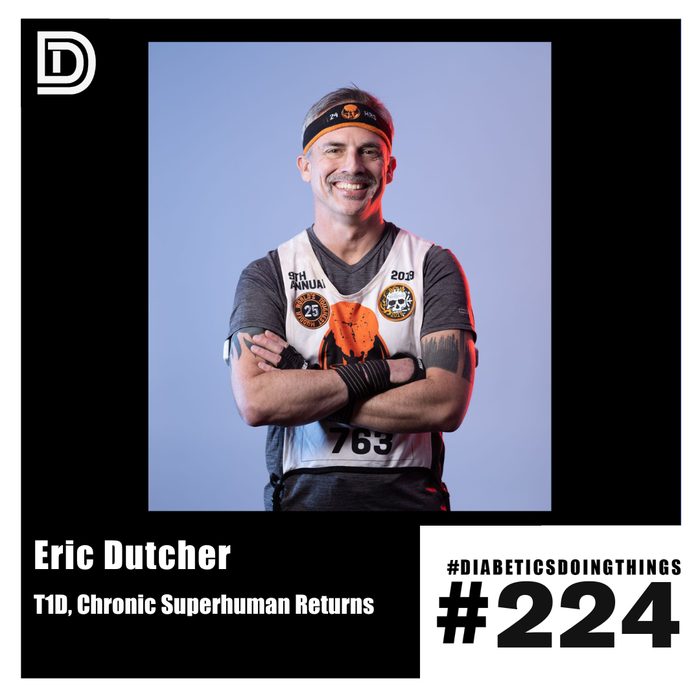
Eric Dutcher, T1D Chronic Superhuman Returns

Episode summary
Eric Dutcher, known online as Chronic Superhuman, returns to the show after his last appearance mid-run during a 47-mile ultramarathon. He was diagnosed with type 1 diabetes at 26 and calls it a body slam that left him afraid for about ten years, a period that overlapped with an abusive relationship. Counseling helped him recognize the abuse and rebuild his life. He now races Spartan obstacle courses and ultramarathons, including a 62-mile run that took 23 hours. He explains how he adjusts insulin and basal rates for different exercise zones, plans for failures like muscle cramps and low blood sugar, and finds meaning in long solo trail runs. He also describes failing to finish a 100-mile attempt weeks later and learning to sit with that setback without judgment.
Key takeaways
- Eric reduces his basal insulin by about 85% before long runs in zone two, and by 50% in zone four, to avoid having too much insulin on board.
- He uses pickle juice for muscle cramps and dissolves glucose tabs instead of eating solid food, since digestion slows during exercise.
- He packs backup pumps, extra clothes, and long-acting protein in drop bags in case his gear fails mid-race.
- Eric says a counselor's checklist for borderline personality disorder helped him recognize he had been in an abusive relationship.
- He didn't finish a 100-mile attempt four weeks after a 62-mile race and says he's still working on giving himself credit for the 20 miles he did run.
Show notes
The Chronic Superhuman himself, Eric Dutcher, is back on the pod! Last time he was here, he was in the middle of a 47-mile run. Rob and Eritrea chat with Eric about:
Ultramarathons and Spartan races
Seeing the beauty in long endurance events; the solitude in nature
Diagnosis at the age of 26
Toxic positivity and giving yourself permission to feel the darker feelings
Preparing for failure
and much more!
We want to hear from you. Send your questions, comments, queries, and general diabetes concerns to THE MAILBAG at mailbag@diabeticsdoingthings.com!
Questions this episode answers
How does Eric Dutcher manage insulin during ultramarathons?
He reduces his basal rate by about 85% when running in zone two and by 50% in zone four, and times his pre-run insulin and meal about two hours before the race starts.
What does Eric Dutcher use for muscle cramps during long races?
He uses pickle juice, which he says relieves cramping quickly, as an alternative to salt tablets or electrolyte mixes.
When was Eric Dutcher diagnosed with type 1 diabetes?
He was diagnosed at age 26, which he describes as a sudden and difficult shift that took him about ten years to work through.
What races has Eric Dutcher completed?
He has run Spartan obstacle course races, a 47-mile run, a 62-mile (100K) ultramarathon that took 23 hours, and attempted a 100-mile race four weeks later that he did not finish.
Full transcript Searchable, with timestamps
Rob Howe: Hello, and welcome back to another episode of Diabetics Doing Things. We are telling the amazing stories of people with diabetes from all over the world. The good news is we don't have to go far for this interview. It's one of our own Dallas-Fort Worth people with diabetes. You know him as Chronic Superhuman on Instagram. We know him as Eric Dutcher. Eric, welcome back to the show, man. It's been a little while since we've had you on, and this time, at least you're in a chair. You're not recovering from a 47-mile run. So, you know, we can be a little bit more relaxed on this interview than we did on the last time you were on the show.
Eric Dutcher: Yeah, totally. It's funny that you mentioned that because like my whole visual of being on diabetics doing things is like kind of leaning over a couch or a chair like in the middle of that 47 mile run. And, but it's still a great memory. And even, I think what was great about that was there was something I realized in that call that has stuck with me ever since. And you do a good job of bringing those things out in people.
Rob Howe: Well, thank you. And that's one of the reasons why we wanted to have you back on is because I think your insights, not just about your own diabetes, but about diabetes in general and the things that people have to overcome even in the day-to-day preparation to do the things that they want to do is particularly inspiring for us. And so the last few weeks, you've been extremely busy and you've put some really awesome accomplishments back on your resume. And so first of all, I think Eritrea, especially, we have this new sort of perspective this year where, A, we've realized that we love talking with athletes. And so we're psyched to dig into your preparation and how you manage your diabetes throughout that. But it also kind of presents us a new opportunity because I am like you, I love pushing myself and I love to figure out what this body can do and surprising myself sometimes. And, and Eritrea, I think is also on the, on the other end of that spectrum, is just learning about what all the different types of, you know, incredible feats that, you know, people, but also people with diabetes are, are accomplishing. So I want to talk a little bit about what it's like just in general to run 47 miles, 62 miles, even, you know, challenging yourself to run a hundred miles in an ultra marathon, because I don't know what that's like. And, you know, Eritrea, in our questions document, we were working on, she was like, just from an Eritrea perspective, like, how do you even run a Spartan race? How does an ultra marathon starts. So like, give us at least like, for those of us who are listening, who are, have heard maybe of ultra marathons or are familiar with Spartan races, you know, they can, you know, what they're up to and what they're like. Yeah, I actually, I kind of put the two
Eric Dutcher: into two different categories. So like I, and so I consider myself an ultra obstacle course racer, But what I've been kind of focusing in on lately is the trail running and why I think there are two different things is when you're going out and doing an obstacle course race, like it's incredibly rewarding the entire way that you're going. Because like you run for a quarter of a mile and then you go do some obstacle and maybe you fail, maybe you succeed, but you're like, wow, that was pretty tough. And oh, hey, I got through it. Or wow, that was really tough. It kicked my butt. But, you know, I'm going to try the next one. And so you've got this race that at the end of it, there's an accomplishment, but along the way, there's all these many accomplishments. And I think that model is such a great mirror for us as athletes and us as any sort of pursuit is anytime you can give yourself these micro wins along to a big win, you're going to have much more success than if you're going for one big win. on the trail running it's like there's a lot of solitude for me that goes into it and so you know there's a perspective on running out on trail runnings that or doing these long endurance events that it's got to be oh you got to embrace the suck and oh this is if you're not dying by the end of it then you're not somebody's got to carry the boats
Eritrea: you know yes yes like it's very ride or die and my question is always like why we gotta ride and
Eric Dutcher: why i gotta die where are we going like you and and that to me that's the beauty is really over the last year and and going and shifting into these really long endurance events the difference has been seeing the beauty in it. You know, when you're out on a trail for almost 24 hours or for over 24 hours, depending on what the race is, you are really out in nature for a really long period of time and you actually get to notice more things. And your mind starts to, sometimes you start to hallucinate. So some of the stuff you like seeing isn't actually real, but it's still art, right? But if you can find the art and the appreciation and what you're doing along the way and really enjoy the journey, which is kind of a metaphor for life, enjoy the journey, enjoy the journey of the run. I think there's, to me, it can be an incredibly rewarding time of solitude and communion with nature. Even to the extent of, I start to pick up on things of, like you can see rocks that have moved from the runners in front of you. And now that trail has been forever changed until somebody else comes along and forever changes it. But it gives us much more organic and interactive experience when you're out there for that one period of time.
Rob Howe: It's interesting to me and Eritrea kind of touched on it a little bit as well. It's like, it's not all ride or die. Some of it is just like deep meditation, like noticing things like rocks, shifting on a trail that are forever changed by the people going through. And, you know, for the runners that will come on not only that day, but in the future, they won't experience the trail the same way as everybody else. And so it's kind of a weird, um, yin and yang, so to speak of, and like a dichotomy of like, it is very intense and it is a very difficult athletic feat, but on the other side, it is also meditative, very, a very inward journey. a lot of time spent with yourself and very similar to, you know, many years ago, we had some through hikers with diabetes who were on the podcast and they basically were saying, you know, through hiking essentially is basically walking until you've thought all the thoughts. So, you know, you just basically are getting all the thoughts out as you're taking steps.
Eric Dutcher: And I imagine that it's very similar on a trail run. Yeah. Oh, absolutely. And, and it's not that it doesn't hurt because, oh yeah, it hurts. And, and it's not that it's not hard because, oh yeah, it's hard. But if you can put in your perspective, the different lens of what it is that you're doing and the beauty behind it, it's an amazing thing. Yeah. Well, I'd like to talk a
Rob Howe: little bit about that too, because you have not been an ultra runner your entire life. You also were diagnosed with diabetes. I wouldn't say later in life, but later than the normal time that people associate sort of in the general world with being diagnosed with type 1 diabetes when you were 26 years old. And, you know, we continually have to remind people all over the world is that every year there's a ton of people diagnosed with type 1 diabetes, and it's 50, 50 below the age of 18 and above the age of 18. And, and even with our, you know, our friends in the community who are diagnosed with LADA, sometimes you're not diagnosed with LADA until you're 70 or 80 years old. And so, you know, as we continue to learn about diabetes, like when you get it really runs the gamut, you know, of, of, you know, it's kind of a luck of the draw type of situation. So how did that change? I promise I'm going to get around to the actual question here is like, where did your desire to, to find ultra to, uh, to push yourself to these, you know, amazing feats of distance, where did that come from? And how did you, you know, have those conversations with yourself, you know, regarding your diabetes as you, as you worked to, to achieve those? Yeah. When I was 26, my diabetes diagnosis
Eric Dutcher: was a body slam. Like it just tossed me to the ground and that was it. Like, and I, I probably stayed on the ground for 10 years. And what kept me there was really this kind of fear. And having that fear hold me in that place for so long, sometimes you don't think you get beyond it. And so really, I didn't come out of that fear with this grand, it wasn't like I woke up one day or read a book or, you know, heard an inspirational speaker and then said, you know what, I'm going to, I'm going to go run 100 miles or I'm going to attempt 100 miles. there was just a there was an invitation and I think that's the key is like listening to the invitation that the world offers you and there was an invitation my wife saw it I saw it and Heather and I went out and ran a 5k survival race and like I mean the fire jump we probably could have rolled through the fire and not suffered any burns you know the mud was like you know, nothing, but every little micro win was, you know, intoxicating. And, um, after I started doing one of those, then I said, okay, well, what's the next thing I can do? And what's the next thing I can do? And, you know, that kind of attitude of, okay, well, here's an invitation I'm going to accept and then accepting more invitations of her life. I now look back and I'm like, are you kidding me? I actually ran 110 miles across West Texas, pacing somebody that I hadn't even met really before the run. Yeah. So it wasn't a planned progression. And I would still say, I'm still figuring out, like, I don't know what my destination is. I just know that I want to be open to what invitations come before me.
Rob Howe: I love that metaphor of the invite, where it's, you know, you don't have to do this, but here it's on the table for you. And here's how you get there. And I want to talk a little bit more about small wins as well, because I do think that's a great metaphor for life with diabetes. And we talk a lot about that, but we don't really get into how you recognize those wins and you actually celebrate them. But first I want to, I don't want to move too far beyond, you know, you being hit with your diagnosis and you talked about fear. What did that fear look like and feel like for you? And I, you know, I have only known you as, you know, chronic superhuman. And so, you know, you and I have talked, you know, a lot about that journey, but, you know, when you're in those moments, cause I imagine that, you know, there are people listening to this podcast who find themselves more resonating with that person than maybe somebody like, like you are today or, or Eritrea and our, and I are today. So what, what did that look like? What did that, what did that feel like on a day-to-day basis? So most days it felt very trapped in.
Eric Dutcher: and it was both on a literal and kind of mental basis. I was actually also in an abusive relationship at the time and part of the abuse actually was related to diabetes even. It was like, well, you don't want to pump because you don't want anything attached to your body. And I'm like, I guess I don't want anything attached to my body. Like there's, there is a way that my world was controlled and I was in this really, really dark place. And I think there were things that, that I didn't know how to figure out. I didn't want to pursue figuring it out just because I felt like there wasn't anything to figure out. like I had been told what my world would look like and so my world looked like that but I think it's really important to know that even though I was sitting in a very dark space most of the time I didn't realize that the space was dark and I think there was too many people that would come around and try to flip the lights on and tell me that I was okay or Pollyanna, that's probably an old term now, but like, you know, say that like, you know, everything's going to be okay and the over-optimism and the ableism, as we use the term today, that would kind of constantly try to flip the lights on and tell me that I wasn't in a dark space. and it really wasn't oh go ahead i i want to talk about that because i think
Rob Howe: you know we we can call it let's call it toxic positivity and and sometimes i think uh ableist rhetoric which is also you know is new sometimes and i think has caused me to look at some of the ways that i speak about things and things that are true for me i'm an able-bodied disabled person and so above all like i can still do some of these things that may not be true for people to the left or to the right of me in the diabetes community. And I think it's important to embrace that. But I think recognition and noticing, we might just be talking about that a lot today, is, you know, recognizing that you are in a darker space and not denying yourself the permission to say, you know, I'm not happy with where this is, but it is true for me. And I do feel that I'm in this space. And whether that's negative feelings or depression or just struggle with, you know, acceptance of diabetes or something else, or, you know, recognition of being in a toxic relationship. I don't think there are abusive relationship. You know, I, I don't think that, you know, you just as like men, we don't talk too much about what that looks like and how that manifests itself, or even know if we have the tools to recognize it. So when people, you know, despite what people trying to turn the lights on, as you've said, and, and, and paint a positive spin on things or Pollyanna, like you said, when, when did the lights come on for you from a recognition standpoint to say that, oh, wow, like I really am in a dark space and I'd like to find my
Eric Dutcher: way out. I think there were, I think there's kind of multiple points, but I could not even after I had come out of it, recognize or admit that I had been abused. It really took counseling. There were some things that encouraged, like the invitations were to step into, like you get an invitation to, you know, go do a run, but nobody says, oh, hey, like go, let's, let's invite you to find out whether you're being abused, right? It's, and sometimes when you're in that dark space, you just think that that's what the world is like. And, and it took counseling for sure. I went into, met a counselor. He said, here, I want you to pick up this book. I want you to not buy it. Just look in the, on the shelf. And it was about borderline personality disorder. And he said, like, just read through these, you know, list of eight things and find out if it, you know, applies to you. And like, he's like, if you've got more than three on there, then let's, let's talk about what it has meant for you to live with somebody that's got personal borderline personality disorder and and like I could check all eight and I mean there is a whole lot of tears and and there's a lot in my backstory that that digs into the darkness because I mean I lost my kids to borderline personality disorder for three of my children or you know I'm estranged from parent alienation, but that was all part of that dark. And I had moments where I thought I was looking on the lights and I thought I was gonna get them and things like that, but it never came through. And I don't think that people understand when they're sitting in a space that they know is truly dark or a space that just is less than and could be more, I think a lot of people sit in that space and go, yeah, but it's just me or the whole world's like this. And it's not until somebody taps you on the shoulder or you get exposed to a new experience or you step into counseling where you go, oh, wait a minute. Yeah, I probably shouldn't have to have been afraid to, you know, do X, Y, Z because of whatever the case may be.
Rob Howe: Thank you for digging deep on that, because I think it's such an important lens to look through the celebration of those small wins, even digging into that first 5K sort of mini Spartan race where you've got these obstacles. It's a relatively, like you said, looking back, straightforward obstacle. But the momentum that you build from one 5K obstacle course to saying yes to things, to turning on those lights in different parts of your life, to celebrating who you are and realizing that it's not just what's happening to you and you're not alone in that. And it's okay to admit when things aren't going as well as you would have planned or where you're dealing with something that is not typically for public consumption or it's not something that people are like, yeah, awesome, Eric. It sounds great that you're doing this work with a counselor and really working on these problems in your life. Those are such deeply personal decisions and often can be isolating. So to be able to flip that and to what we talked about at the beginning of the conversation, where you're often by yourself running in nature and finding a way to appreciate where you are on that journey and what things are different, whether it's nature or actually just internal things to appreciate about yourself and your journey there is a truly inspiring story and inspiring journey. because it's easy to look at you now and say, oh, wow, you know, Eric ran 47 miles on his 47th birthday and he's got diabetes and he won't let it stop him. And he's doing these amazing races. And, you know, there couldn't have been anything difficult in the beginning part of his story.
Eric Dutcher: It looks like he's always had it figured out. Yeah. Now I've, I've, I've been mired in debt. I had to restart my life, literally had to restart my life about 12 years ago. and and I at the cost of losing and having substantial loss in that but I can still find joy today and I can still have hope for the future um but what it means is I can also sit with somebody in the dark and just say it's dark and I'm here let's let the darkness consume us together and once that darkness has consumed you you can actually see the path out a whole lot better
Eritrea: I don't I don't really I don't know what to say but I I think a lot of our listeners in our last episode we talked a little bit about how I recently got divorced and I think that everything you're saying Eric just resonates so much with me even as a woman because you can think you're like in the best place ever where everyone else is in their relationships and it can just take a little bit of information from someone else to let you know that actually it's not normal and it's not okay for someone to treat you like that or to minimize your feelings and invalidate you. And from there, you can still get to be an ultra marathon, badass, chronic, superhuman. So thank you so much for sharing that with us, because I think that that's incredibly powerful to not just other men, but also anybody listening who is in a dark space right now. And Eric too, I want to
Rob Howe: just kind of mirror back what Eritrea is saying. And you and I, from that interview during the very beginning of the pandemic have been close, you know, through Instagram in that amount of time over the years. And I think I've been like exposed to different ways of thinking through the community, as well as like different ways to, because you and I, I think are both are, we're achievers. We like to do stuff. We like to do things. And I think, you know, recognizing that we can have permission to do that and that can be our story. And we can still have space for people who are in that darkness or who maybe have no intention of wanting to be inspired by somebody who's out there doing these things above and beyond and still have space for those people. I think it's just so important as a community to stand in solidarity with the people who are in the darkness and who don't feel like they are worthy of crossing the finish line with diabetes and achieving things or aren't ready to celebrate those big wins. And I just appreciate like being able to have somebody around who's going through that as well and recognizing and learning different things about the community at the same time. Um, and then, you know, still get back up on the horse and do the things that you want to do and like be yourself with diabetes. And that's, I think what's so, you know, because for me, I'm not particularly interested as, as an athlete in running more than 20 miles, but that's just like, Like that to me sounds tough and like, oh, like very difficult, but I see.
Eritrea: Also imagine Rob running, imagine tall six, six Rob running places.
Rob Howe: Hey, I did a half marathon in like two hours. So I mean, I can go, I can go, but. Like you, you joke, but like he, he runs up and down that court.
Eric Dutcher: And like, I tell you, those steps are going to be pretty darn close.
Rob Howe: So I appreciate the, I appreciate the affirmations guys, but, but really like, I see you doing that and I'm like, man, what I can see now and what I can celebrate now is Eric's ability to answer the calls from his life and say, oh, this is what I want to do. And now I can work because of the small wins, because I know what the darkness looks like. And because I've accepted that what I want to do is outside of the box that someone would typically put someone with diabetes in, I'm going to approach this challenge and celebrate every small win along the way. And so I can look at that and say, man, that feeling of, of the piece of running through nature and you're by yourself and you're noticing all the little things and you're, you've thought all the thoughts and you're just getting the steps and you're, and you've prepared and you've answered the call to me. That's, what's most inspiring about it is that someone somewhere is going to see that because they've been told that what, that they can't run a hundred K race with diabetes, but they've got your example right there that, that it can be done and that, you know, you can get back up and try to register for another race, like within a couple of days, right after that, that it doesn't have to be the end. And that's particularly inspiring for me. So I know we're going to dig into some like actual prep and like, you know, how, how you get ready for races and how you manage your diabetes along that. But I really do want to stress and thank you for being so open about your journey that you didn't wake up and be an ultra marathoner that it was part of a long road and you kept putting one foot in front of the other and learning along the way, different things about yourself and your diabetes. Yeah, for sure. So let's get tactical. How do you, how do you prepare for these insane feats? Like what's your, you know, going up into this, let's, let's use your recent 100 K race, uh, that I think is now like six weeks behind us. And I, and I was going back through your Instagram post. You had a ChatGPT, right? Your caption, which I thought was hilarious. I'm a big ChatGPT guy, but how did you prepare for that? Like that's, that is such a long race. You know, I think what 52 miles,
Eric Dutcher: is that right? So 52 miles, a long way. And that was the, that was the furthest you had run in a
Rob Howe: 62 miles, that was the furthest you had run in a race at that point. I know we can talk about Don. Don is a maniac and he ran across Texas and you joined up with him and did that stretch. But how did you prepare for that 100K?
Eric Dutcher: So I think it takes a lot of training and practice, as one might expect. But it really comes into framing, okay, I'm an adaptive athlete, right? And so, and we don't talk about that in the chronic condition space. We think of it more of in the, in the physical space, but like, technically we're adapted athletes. And so what is the one thing I can't do? Well, I can't regulate my blood sugars on my own. So everything that I kind of do, you know, comes from that changing that perception. Okay, now, and now I get into the practice of, okay, because I can't do this, I need to make sure that, okay, I've got a backup pump, I've got, you know, backup, you know, glucose tabs, I've got something that's long acting, you know, protein. I've got drop bags that are full of like, you should have seen, like I carrying in like five drop bags into a race that, you know, there's a pump in each one. There's pickle juice. There's like, you know, extra clothes that, you know, that I need. So there's a lot of just the, the preparation around if I know how I'm likely to fail and I plan for those failures, then I'm more likely to succeed. And so I do a lot of that. When you get into the actual tactics, I never do a ton of long runs beforehand because they can wear on your body. So I do a lot more of the shorter runs interval training, you know, fast, slow, and, and actually there's a lot of research in the, in the endurance community that is really supportive of that. There's a Camille Herron, I forget Camille Herron's last name, but man, she's like a, you know, massive ultra endurance person that's over, you know, around my age and, and just killing it, even crushing men's records and stuff like that. She's focusing in on these interval trainings. And so you do that. But the other thing is I've found kind of these tools along the way through talking through other experts about what insulin management should look like. And so, you know, typically you've got if you're exercising in zone four, then you typically need 50 percent less insulin. If you're exercising in zone two, you need 85% less insulin. And it all goes down to how your body's like, you know, releasing energy from stores in order to help propel yourself along. And so like when I get ready for the 100K race that morning of, I have to, I wake up two hours in advance of the race. And the first thing I do is I pre-bolus for a breakfast because normally I train without eating so that I don't have a lot of insulin on board. That's always key. Like if you have a lot of insulin on board, you're going to struggle exercising. It's just bottom line.
Rob Howe: so much pretty much no matter the sport you're just going to have some issues exactly and so
Eric Dutcher: and since i know my insulin duration peaks about two hours in advance i want to take my insulin you know two hours before my meal after i've taken that i immediately take my basal rate and reduce it down by the 85 percent 30 minutes in i'm eating a meal and then after I eat the meal well then that's about time to go get ready for the race site so you can kind of see that you really the bigger the event the more kind of spacing out of thinking ahead things that you have to do um but the rest of it is really just around okay where are my points of failure that are going to happen along the way and what is my action. And then like the practice that you do really is around, not just about training your body, but the practice is trying to create more failure like events so that you've recovered from
Rob Howe: those failures. What kind of failure type events, you know, would, you know, typically, or are you working to prepare for? And I mean, I could probably think of some, but I imagine like in your prep, like you said, you're not just running 75 miles up or, you know, 75 K up, you know, pre, you know, race day, you're doing your intervals, you're working on those failure events. Like what
Eric Dutcher: kind of events are you working on? Sure. So a big one is muscle cramps, long races, especially in, I don't know these stats, but I feel like since I've had diabetes, I cramp up more often. And it seems logical that they'd mess with that too. It messes with everything else, right?
Unknown: Yep.
Eric Dutcher: So, you know, working out cramps, you know, I found the reason why I referenced pickle juice is, you know, some people use salt tablets, some people use other like electrolytes and whatnot.
Rob Howe: In Texas, we use pickle juice, baby.
Eric Dutcher: Look, I'm telling you, like the minute it hits your mouth, like it releases the tension. And that's, that's the thing. So I know there's tons of people that are like probably crash their car, like, you know, listening to this and going, oh, that's disgusting. But I'm telling you, it works immediately. So there's the physical things like that. And actually in the, in the, was it the 100K? Yeah, about on the 100K run, I was at one spot where I thought I had done something to my Achilles tendon. and and it was I mean it was it was giving me some sass like that thing was talking to me and it was like you are getting off this course you will not do like and being able to work through is this a pain that is telling me to stop or is this a pain that is just alerting me to something that I need to change. And a lot of times people make two failures. One, they stop and they just said, look, my tendon was busted. So I had to quit. Or they try to push through, but they don't acknowledge the pain. And there's a great book called The Brave Athlete that talks about your chimp brain and how powerful your chimp brain is. And you got to acknowledge your chimp brain well i'm out there in the middle of nowhere thankfully there was a bench that happened to be along the trail right there i sat down like and thought through it and i was like you know what this isn't something that is a torn injury this is a i'm foot i'm hitting my footfalls wrong and i need to and i hear you chimp and i i said it i was like chimp I'm listening. I hear you. I'm going to change my foot. And I started doing that. And I was able to, like the thing actually went away. The pain actually went away. I was able to complete the race. And that was, you know, probably 13 miles in on the, you know, the big race. And so, but then there's other times like, I mean, just simple things like you may get a, a, a too low of a blood sugar. And, you know, I'm a big proponent of making sure that you're dissolving things in your mouth where possible. You know, digestion starts in your mouth. Digestion slows when you're exercising. So like when people are dumping a bunch of food into their stomach, hoping that they're going to raise a low, it's not going to happen while you're running. So I, I go old school. I'm like glucose tabs. If I need to rescue myself out on a run. Um, and that becomes important, you know, having a backup monitor in case you get too dehydrated for a CGM to read, or maybe you don't have a CGM. I mean, that's one of the things that I try to focus in on is I talk a lot about the technology, but a lot of what you can, a lot of what I do, you can do without the technology on MDI. You would just the night before you would reduce your long acting insulin by 85%, that sort of thing. So, well, and I think in a recent race,
Rob Howe: you towards the end had technology fail, like your either batteries went out or, or connectivity became an issue. So, you know, even in, you know, it's sort of like the man plans, God laughs kind of thing. I think man plans, diabetes laughs sometimes. Like you just never know what's going to happen. So when something like that happens to you, like did that kind of cause a, you know, a little bit of like your heart rate to elevate, so to speak, although, although you're probably like running so much, your heart rate's not going to do much, but like, you're thinking about, oh no, like where, am I calibrated in the, in the, am I in the right zone? Am I, am I able to maintain this for the rest of the race? What was going through your mind when that happened?
Eric Dutcher: Yeah, no, it happens, right? You, you immediately start to get a little concerned, but then if you can step back and look at the times that you've trained and something like this has happened before, it's pretty easy. Like I, I think it's fun. And I kind of mentioned this to clients sometimes, like do the, you know, do the guessing game of what your blood sugar is like and do it in activities where you may need to know because something's failed and it can be you know whether it's a kid at school or it can be you know in a meeting and whatnot like know what your clues are in different environments because my clue in a meeting is I'm going to get like shaky and and sweaty my clue while I'm running is I'm going to be like, Oh, man, why am I doing this? Like, there's no way that I can finish this race. Like, everything looks bad. I'm like, you know, the weather is turning bad. Like it could be a bright sunny day. And, you know, I'm thinking that I'm going to melt, you know, like my mood turns really, really south. And I actually start to notice that I'm moving subconsciously slower because my body's like, Hey, you know, I only don't have much blood sugar when I'm high. My joints start to feel sticky and I get the achy feeling. And I even had a point where on the, the a hundred K it took me 23 hours to complete. So I'm running through the night and I'm like, I'm, I kid you not, I'm running and I'm falling asleep as I'm running. I'm like waking up as I kick rocks and stuff. Yeah, it doesn't make sense, but that's what it was, right? And I'm sitting there going, oh my gosh, I still have like another aid station to go to. I like, I still got five miles to go and I'm not going to make it. And then it finally hit me. Hey, my blood sugar is high and that makes me tired. So give myself a little bit of insulin and off you go. And I was, I was awake again, didn't fight to sleep anymore.
Rob Howe: I love just like discussing the way that we feel when we're blood sugar is high or low. And I think everybody has their own unique perspective on it, but it's so interesting to me. I had a really bad, when I say really bad, it wasn't like an urgent low or severe low by number, but I had a severe low by response from my body. And it was, it was last fall and I was in a very stressed out period of my life. And I just started getting this sort of avalanche of negative feelings. And I was like, everything's bad. Everything sucks. Nobody's doing what they want to do. I'm worthless, blah, blah, blah, blah. How am I ever going to do this? And then I was like, skirt. And I looked at my pump and I, my blood sugar was like 53. And I was like, oh, like, am I really down and depressed and like down on my luck? Or is my blood sugar just low? And just that like awareness, that was the first time that it clicked for me. of like, oh yeah, you, the way you feel is related to what your blood sugar is. And as like, I know that, but until I had to experience it, you know, and any fool can learn from experience, but I experienced it and then noticed, noticed that, oh man, I was having an avalanche of bad feelings. And so, you know, we got the blood sugar back up and you know, all those problems seemingly, they didn't go away, but they were not as big of a deal and they weren't as critical to, and so So it was really interesting for me to, you know, you know, and I've, again, we've talked a lot about this, but you know, the toxic positivity movement of like diabetes doesn't have to stop you from doing what you want to do, or you can do anything despite your diabetes. It's like, those things are true, but you're also going to have a low blood sugar that tells you that you're not worth anything. So like, we got to acknowledge that that is, is part of the journey as well, whether you're in a race or you're it's Friday afternoon at your house, those feelings are true. and you can still do whatever you want to do alongside it. It's just kind of repositioning the thinking.
Eritrea: It has to be the perfect moment for me to tell Eric, I don't know if you're a Harry Potter fan or not, but I always say that diabetes is a horcrux. It's like when they're wearing the necklace and it makes them act all weird. It's like, why am I in a bad mood? Why do I not feel good? Oh, my blood sugar was high this morning and I'm just now leveling out. Sometimes you sort of ride that weirdo diabetes wave, Let it crash over you and move on girlfriend because it could take you out.
Rob Howe: So, oh, and I love the meme accounts whenever it's like, you know, when somebody asks you something, when your blood sugar is high or your blood sugar is low, you just like, you snap at them. I think we've all been there. So yeah, sorry to the people that I've definitely, why are you low while you're low girl?
Eritrea: I will hit you get away from me. Wrong question.
Rob Howe: But, but I think, you know, it's really cool to see your, you know, your response and your awareness of those in, in these races, because I think whether you're walking to class or walk into a meeting, you know, it's really important that, you know, your own signs and Eritrea and I've talked about this before, because she, after, you know, a long time with diabetes over 20 years suffers from hypo unawareness, which is very common. And, you know, again, you kind of have to recalibrate yourself because we can become so dependent on this amazing technology that everyone should have access to in the continuous glucose monitor space, but we can't totally rely on it because sometimes it just messes up because it's not perfect. It's just technology. And whether you're in the middle of the woods with five miles to go in a race or you're in the office and you're in a meeting or you're on an airplane or whatever the case may be, you need to know what you feel like when your blood sugar is out of range.
Eric Dutcher: For sure. Yeah.
Rob Howe: So crossing the finish line, go ahead.
Eric Dutcher: Go ahead. No, no.
Rob Howe: I was just going to say, so you're five miles out. It's the middle of the night. You're falling asleep. You give yourself some insulin. You make it to the finish line. You cross the finish line.
Eric Dutcher: 100k what did that feel like it was incredible it's it's funny like that particular race like the hardest part of the course was like the last it was a half mile from the end of the race don't you love how they do that oh it was a two loop race and like it just yeah so i mean going up there it it's really surreal I think when you get to the end of those and I think every race I get to the end of it I'm like yeah I'm done I don't I don't need to go further I don't need to perch myself farther I'm glad I got this but there is this sense of when you when you start looking at things that are completely absurd which running 100k is completely absurd and then you said it not on it you said it not me i did it's it's completely absurd and you do it it's amazing how you can actually apply that in other areas of your life and you go, wow, like everybody thought that was absurd and maybe it is, but maybe also too, like the dichotomy, it's also possible sometimes. And so, um, I don't know if, you know, it, it's, it's always different each race that you finish. And, and what we haven't talked about yet is I, I did try four weeks later to run a hundred miles and I didn't have it. And in a bad way, like it was, it was, it was awful. And I probably should have checked my blood sugar, although I knew it was okay. Cause like the world was down. Like I, I sat down, I even, I'm sitting there, like I finished the first loop of a five loop race, which meant I I had done 20 miles and I'm like really down on myself. I even met a guy there that his daughter had type 1 diabetes. And I'm like, you're like the reason, like this is my motivation to show your daughter that she can try something big if she wants to. And I still can't seem to get myself to feel good about what I've done. And I think that's, it's been like a lesson to me of like, we think we learn these lessons and it's learned and it's going to stay there. But I came to the realization that we need to remember the fact that we're going to forget. And there's lessons that we need to relearn because that was the same thing that I did after, like, we need to own every single success. If you got out and you walked around the block and that's all you got done today you walked around the block like own that success and enjoy the fact that you did that but here I was I had just run 20 miles after running 62 miles less than a month prior and I was feeling such a sense of failure and I still I still am battling it I'm still like I gave up too soon I should have gone harder I should have tried well I think it's
Rob Howe: really interesting, you know, thinking, you know, we always talk about celebrating wins. And, you know, I think we talked also a lot about like acknowledging when things are bad and, or when things didn't go the way that we planned. And, you know, I know you're, it's still just hearing you talk about it. I feel the pain and like angst in your voice about, you know, not completing it because you had set out to do that. And, you know, also going through and, and, and saying the things that you know you need to say about it to feel to to move past it and to and to bounce back and to acknowledge the effort and the intent i've had to do that myself too and i think the biggest part is like can i look at what happened good or bad without judgment and not get too high on the victories and not get too low on the defeats and kind of zoom out a little bit and you know i think where i'm trying to be and this is again like the most jock sports thing of all time, but I look at an organization like the San Antonio Spurs. They made the NBA playoffs 21 straight seasons. It was the longest in NBA history. They only had the best record one time in those 21 years. They only won five championships only, but they won five championships out of the 21. But over the course of that 21 years, they did more things right than wrong. And they certainly lost games. They lost games. They should have won. They made mistakes, but they had a framework and a culture of doing more things right than wrong. And when you zoom out over time, they were able to accomplish something that nobody else has been able to accomplish in that same timeframe. And so I have tried now as myself to, if I need to sleep for 12 hours, it's something I've learned about myself. Like sometimes if I'm like really down on energy and I haven't been able to bounce back or I've been pushing myself too hard without really recognizing it, I've just got to sleep for 12 or 14 hours. And that's like a teenager thing that you do. You know, it's not like, you know, you don't hear a lot of like podcasters talking about, you know, Oh, you know what I need to do today? Nothing but sleep. And I've had to release my judgment of myself on that to say, this is just what I need in this moment. And so I would encourage you as well. And anybody out there, like whatever the feat is. And like, sometimes, like you said, it makes it worse when you encounter people who you want to inspire and you're like, oh yes, I should be taking, you know, I could be taking this person who I've met whose daughter has type 1 and adding his fuel to my fire and continuing this race, but it's not a failure if you don't. And it's, it, it reminded me of a time I went to a big three, the BIG3 basketball league tryout two years ago. And right at like the last minute, I like tweaked an ankle, which had nothing to do with my diabetes. I just tweaked an ankle and I was to the point where I like, I'm not going to lace this up and keep going. I'm just going to pull myself out. Like I'm not going to, you know, it is what it is. And so I went over to the trainer and I got some ice and he noticed my sensor and he was like, Hey, what's up with this sensor over here? And I was like, Oh, that's my, you know, I can continue with glucose monitor. I have diabetes. And I showed him my pump. I had it on. He's like, Oh man, you should be proud to just be out here. And that kind of clicked for me in that moment. And I was like, Oh yeah, you're right. Like nobody else is out here with this. And so, uh, just giving yourself credit for showing up, doing the work and giving it a try. And, you know, I'm a big, also like, you know, very old school where I want to, I don't want to give you a participation trophy and things like that. I don't know. That's just kind of how we're built, I think, but allowing yourself the space to fail without judgment is an essential part of being an athlete, being a human, being a person with diabetes, who among us has not incorrectly counted carbs or has not counted stress or has, you know, mixed up some things or forgot that their sensor was expiring and didn't bring an extra one for a trip or things like that. So being able to release the judgment and still look at and celebrate the small wins, because you know who didn't run 20 miles on that day? Me. I did not run 20 miles on that day and you did. And Aretria too. So again, like, you know, failure aside, like failure is not final. It is not fatal. And I think, you know, that's John Wooden. That's not me. So, you know again as as somebody who uh you know is a friend of yours in the community and a peer i just want to give you a huge shout out for even having the gall and audacity to it to try 100 mile race four weeks after 100k race that's just unbelievable i want to say that's something
Eritrea: i think you and eric have in common is the delusion that you can do anything but you like
Eric Dutcher: actually do it so eric oh my god yeah well thanks and i mean rob i'm glad you said that because it does kind of come full circle in that you know you bringing up the fact about and you actually even said human in there you know people refer to me as chronic superhuman but i'm i'm really clear and that I'm the content creator at Chronic Superhuman. I am not the Chronic Superhuman. It's, you know, people living with chronic conditions are doing extra every day. And another word for extra is super. And so everyone that is dealing with a chronic condition that is listening to this call is a chronic superhuman. And we forget because we're living in it every day that we're, sometimes we forget, sometimes it's very apparent, but it's very easy to count out or count down something that we're doing as something small when you couple it with the chronic condition. It's really, really big. It's audacious. It is. It's insane.
Rob Howe: And I love that. You know, I think that's somebody came on this podcast years ago and they said, you know, definition of insanity is trying the same thing over and over and expecting a different result. And diabetes is just the opposite where you can do the same thing day in and day out and guaranteed a different result every time. And that is insanity. So, man, we really, we put a nice bow on this podcast. We crossed the finish line. All three of us feeling pretty good, I think.
Unknown: Yeah.
Rob Howe: Eric, man, you are an awesome inspiration to so many out there. And I'm happy to call you a friend and excited that you're here in DFW because we've got some cool DFW stuff coming up that we're very excited to announce here very shortly. So all the listeners who are in the DFW area, or maybe you want to just fly in for an event coming up soon. We've got some very exciting news for you guys that we're going to announce very shortly through all of our diabetes, Diabetics Doing Things channels. So keep it locked. be sure to give Eric Dutcher the content creator behind content chronic superhuman a follow and for all you chronic superhumans out there we've been Rob Eritrea and Eric this has been Diabetics Doing Things thanks so much for listening bye
About Eric
Eric Dutcher is an ultramarathon and Spartan obstacle course racer who posts as Chronic Superhuman on Instagram. He lives in the Dallas-Fort Worth area and was diagnosed with type 1 diabetes at 26.