

Diabetics Doing Things with Eric Dutcher the Chronic Superhuman

Episode summary
Eric Dutcher, diagnosed with type 1 diabetes at 26, called into the podcast partway through running 46 miles in laps around his neighborhood on his 46th birthday during COVID-19 lockdown, raising money for the Diabetes Sports Project. He explains how he decided on the run only a day earlier, how he fuels and manages blood sugar on ultra-distance runs, and how he reads emotional shifts as possible low blood sugar. He also describes the isolation and darkness he felt after diagnosis, an abusive marriage, and losing his father to cancer a year later, and how therapy, his wife Heather, and the diabetes community helped him move past old ideas that men shouldn't ask for help. He now coaches others through that same shift.
Key takeaways
- Eric Dutcher ran 46 miles around his block on his 46th birthday to raise money for the Diabetes Sports Project, deciding on the challenge just one day before.
- He fuels long runs with Uncrustables PB&J sandwiches, electrolytes, and water, and sets a temporary basal rate about 30 minutes before starting.
- Eric says crying or feeling mentally dark mid-run is often a sign of a low blood sugar for him, so he treats that emotional shift as a cue to check and refuel.
- He credits therapy, his wife Heather, and the diabetes community with pulling him out of years of isolation that followed an abusive marriage and his father's death from cancer.
- Eric now coaches people with diabetes and says asking for help is not weakness, pushing back on the old masculine habit of handling everything alone.
Show notes
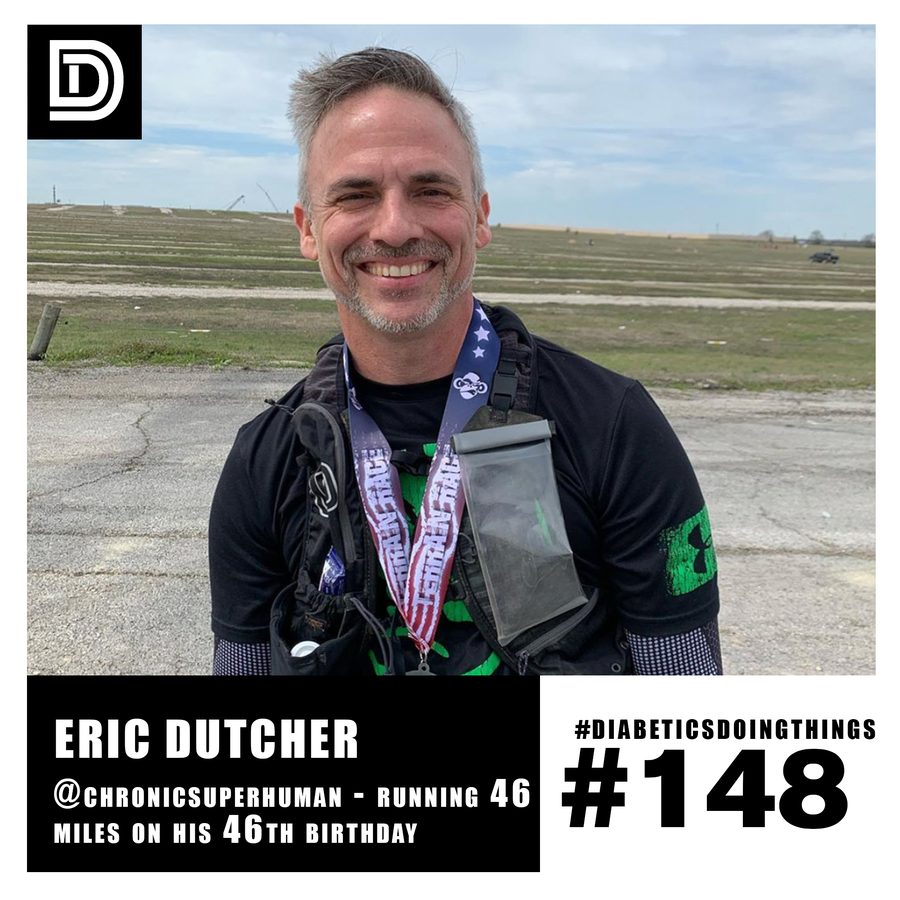
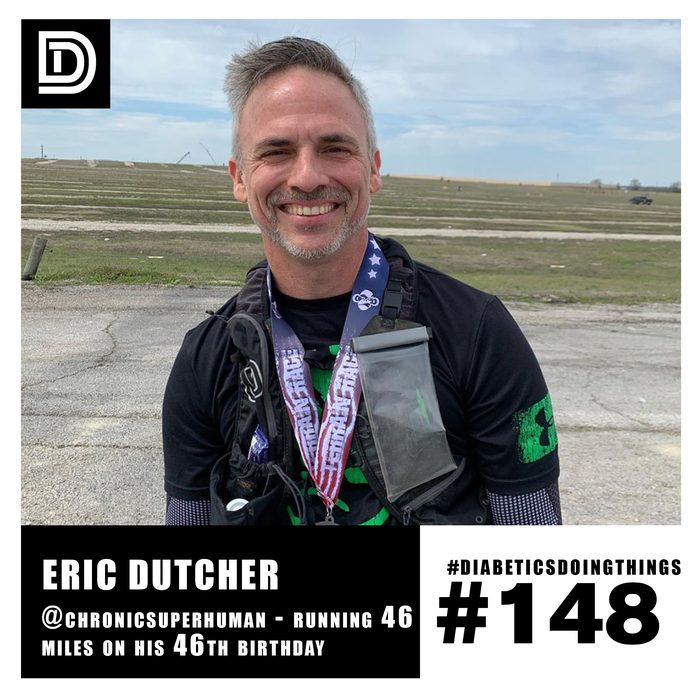
Eric Dutcher (@ChronicSuperhuman on Instagram) is running 46 miles on his 46th birthday (5/5/2020) to raise awareness about the possibilities of people with Diabetes as well as raising money for the Diabetes Sports Project.
Eric and I sat down for a quick phone call after mile 20 of his 46 mile day, and discussed where the idea of this race came from, how he’s preparing for it, and what his mindset has been like throughout.
We also discuss Eric’s emergence from the “darkness of Diabetes” and how traits that are traditionally thought of as “manly” do not serve a life with Diabetes, and how asking for help, going to therapy and being vulnerable in the community has helped him become who he is today.
I want to personally wish Eric a happy birthday and dedicate this “lightning episode” to him as the first episode that was published on the same day as it was recorded.
Finish strong my friend!
Questions this episode answers
How far did Eric Dutcher run on his 46th birthday?
He ran 46 miles in laps around his neighborhood block, reporting a high blood sugar of 143 and a low of 69 partway through the day.
What cause was Eric Dutcher's 46-mile run supporting?
He ran to raise awareness and money for the Diabetes Sports Project.
How does Eric Dutcher manage blood sugar during ultra-distance runs?
He sets a temporary basal rate about 30 minutes before starting, hydrates with water and electrolytes, and eats Uncrustables PB&J sandwiches for protein and carbs. He also treats feeling emotionally dark mid-run as a possible sign of a low.
How did Eric Dutcher work through the hardest parts of living with type 1 diabetes?
He says he spent years isolated after his diagnosis, partly due to an abusive marriage and old ideas about masculinity. He credits therapy, his wife Heather, and the diabetes community with helping him move through that, and he now coaches others with diabetes.
Full transcript Searchable, with timestamps
Rob Howe: Episode alert. What's going on, ladies and gentlemen? It is Cinco de Mayo 2020 and I am still locked down at home because I think that is the best place to be, not just for people with diabetes, but for people in general. Look at the science, trust your doctor, don't make this a political issue. I don't think facts should be political issues. The good news is today we have a lightning episode is what I'm calling it because Eric Dutcher is celebrating his 46th birthday today. by running 46 miles. Some of you may know Eric by his moniker, Chronic Superhuman on Instagram. So be sure to check him out and give him a shout out. He and I were talking about what made him decide to run 46 miles on his 46th birthday. We also talk about the darkness of diabetes and how being isolated, especially as a man and a male figure with some of those old school toxic masculinity traits of having to take everything on yourself and not ask for help, you know, hindered him in the beginning, but his opting into the community has opened up an entire new world for him. So I'm going to leave it at that. Please enjoy this awesome birthday conversation with Eric Dutcher, the chronic superhuman who is currently running all around his neighborhood, 46 miles on his 46th birthday. Enjoy. Welcome back to another episode of Diabetics Doing Things. We are telling the amazing stories of people with diabetes from all over the world. And, you know, normally I say all over the world and people are far away, but my friend Eric Dutcher joining us on the pod this morning, on his birthday, is actually just a couple miles up the street, out in a little bit north of where I'm calling from right now. So Eric, welcome to the show, my friend. Hey, thanks, Rob. It's great to be on. And today I had a, you know, yesterday when you announced your birthday plans to, and I'm I'm just going to go ahead and spoil it right now for everybody. Today you're running 46 miles on your 46th birthday. And, man, I was like, well, I've got to have the interview. We've got to just get this thing published. This is going to be the first lightning episode. We're getting it published immediately after we hang up so that people can hear your story and what you're doing today and hopefully follow along. This is a crazy thing, man. You're a wild man.
Eric Dutcher: Yeah, it's crazy. and probably my wife's response when I first told her what I was going to do she said you know two days ago you thought you might have COVID and now you're telling me you're going to run 46 miles so yeah I've had a little bit of a emotional swing as we've been on quarantine
Rob Howe: hey that is totally normal and I think you're definitely not alone in that I also have had a few emotional swings thankfully the last few weeks feeling like I'm crawling my way out of it I've got to credit The Last Dance as just snapping me out of my creative funk. But yeah, man, I think that's super, like, first of all, incredible feat. You, many people will know you on Instagram as Chronic Superhuman. This is a superhuman feat. You're, you know, true to your namesake, 46 miles in one day.
Eric Dutcher: Yeah, you know, it's funny. Um, it's, it's this concept of relentless pursuit that really has, uh, come to me ever since I got out of the darkness of diabetes, um, when I got first diagnosed and, um, you know, I, I know it's kind of, some people go, oh, well, yeah, you know, that's a great athletic feat, but, um, it's really more about going out and, um, going after something so big that you pursue it relentlessly and you almost forget you have diabetes in the process.
Rob Howe: Yeah, it's really, you know, you sort of are acutely aware of, you know, sort of the physical strain and, you know, the task or the road in front of you and really everything else other than preparation, obviously, with, you know, blood sugars sort of comes second after that.
Eric Dutcher: yeah it's exactly and um it's kind of you actually learn a little bit more about your body as you go along like when i'm running and i start turning dark and and feeling like okay there's no way i can do this or heck uh i'll say it i i cry on runs you know sure um and i when i start getting there then i go oh you know what uh i must have a low blood sugar and it's time to refuel um but you know, the great thing about all of these things is, you know, if we just take the approach that we're human first and we need to take care of our human things like socks that don't give you blisters and fuel that any human would need when you're running and water for hydration and a hat and sunglasses and sunscreen and things like that. If we just take that approach first, then the other diabetes stuff just kind of gets layered on. But I think so many of us, we start with, well, I'm diabetic. How do I do this? Well, how about you're human? How do I do it? And then just
Rob Howe: layer the diabetic stuff on top. A hundred percent agree. And I think sometimes it's easy to focus on the diabetes side because it's like very acute, very in your face. You know, we've got CGMs, you know, many of us have CGMs and those who don't, I believe should and should have access to it. We'll continue to fight for that. But it's easy to forget about the human things like hydration, sleep, rest, sunburn, blisters, you know, just general things that are hard for regular people. In terms of today's run, let me ask you a few questions. A, I want to know,
Eric Dutcher: is this the longest you've ever run in 24 hours? Yeah, it is. The longest I ran in a day before was 36 miles with Don Muchow when he ran across the state of Texas. And probably the best item off of that was his wife goes, yeah, you know, you did really well for the first 30 miles. And so, yeah, it's always a funny statement there. But yeah, this will be the longest I've ever done. But I'm feeling really good and really excited because I'm now down to less than a
Rob Howe: marathon to go. Wow. So you've already today, how many miles have you already run today? 20 and a half. 20 and a half. It's 11 a.m. So, okay. Now part two of that question is walk me through the approach, both as a human and as a person with diabetes, how did you approach this
Eric Dutcher: challenge? Well, I think the first thing is, is I, I had the advantage now with kind of stay at home orders and whatnot, um, that I knew I needed to be close to home, um, just because everything else is kind of closed. So, um, I said, all right, well, my route's going to be easy. I'm just going to do laps around my block. And, um, so I was able to set up a chair at the end of the driveway with water and hydration, you know, there, um, electrolytes, uh, you know, Uncrustables, which are these pre-made PBJ sandwiches, which are actually great running fuel because I've got a combination of protein and carbs. And, you know, and I think the rest has really just been around mental preparedness. I think it's amazing what our bodies can accomplish when we have the mental desire to do it. And, you know, yesterday I posted this on Instagram today, but, you know, yesterday I was going through things as as I literally made this decision yesterday. The mental preparedness behind it was when I got first diagnosed, the very first thing I did and I was diagnosed at 26. The very first thing I did was look up how long you live with type 1. And I've always felt really connected to my mortality. And on top of that, my father passed away from cancer just a year after my diagnosis at 53. And so there's always been this kind of, you know, something is going to happen or, you know, some fear associated with or connection with my mortality. And but the opposite has actually been happening because of the change of my mental response to diabetes. And that's, you know, just going out and pursuing stuff relentlessly. And I'm actually, you know, before COVID was in the best shape of my life at, you know, 45. And so 46, it just said, well, you know, all the birthdays are messed up this year. So why not do something crazy? So I honestly, the hardest part, Rob, has been making sure that I didn't chicken out when I woke up this morning.
Rob Howe: and and I imagine you know that was a pretty early wake-up call but before before we kind of talk about what your day has been like today um I want to talk a little bit about the idea of like that sort of mortality thing and that's something that I have not talked about a ton on the podcast but uh I also uh think about pretty you know regularly at least from from a healthy fear perspective I try not to worry about things that are not uh you know are not actually scary or not, you know, actually acute problems. But I remember about five years ago, there was, I was having a discussion with some friends on Twitter and we were talking about, you know, if you knew when you were going to die, like what would that be like? And so I like got on this, found this like random open source, like death calculator online. And I put in all my like date of birth and my, you know, they had a place for like chronic illnesses and some family history. And it gave me a number, like it's like a countdown. So you could like have the clock, like counting down to when you were going to die. And it just made me mad. I got the number back and it was like, I don't know, 73 years old. It like gave me the day and I was like, God, I'll show you death calculator. You won't get me at that point. Um, which was just a weird emotional response. And I ended up like, not, it ended up not serving me the way that I thought it would. Uh, so I just knocked it off my desktop. I was like, I'm not, I'm not going to, uh, to, to entertain this anymore. Uh, but yeah, it's something that I think about often as well, like even beyond diabetes, I feel like I've got diabetes pretty manageable, but there's comorbidities, heart, uh, you know, comorbidities is a new word that I've, uh, you inserted into my vocabulary since COVID, but, uh, you know, heart disease, cancer all run in my family, high blood pressure. So I'm trying to do the things now to take care of those. And, uh, you know, one thing I think that, that really embodies what you're doing today is that you didn't plan this out very long. And, and you even were very candid on Instagram yesterday of like, you said you had a run maybe earlier this week where you felt like you're a little bit maybe out of shape compared to where you were a few weeks months ago and and then your boldness to just be like well all right i'm gonna run as far as i've ever run in one day um pretty awesome man i just i i love the just the metaphor of you know seeing an opportunity to go above and beyond and really push your limits in a way that uh is just you know exploring you know what you're able to do with your body. And, uh, you know, you're, you know, I think Don Muchow is a great example of, you know, if you set your mind to it, it's pretty amazing what you can do, uh, you know,
Eric Dutcher: just by showing up and putting in the work. Yeah. And I think for me, it's, it's come from a healthy journey through counseling and other things that, you know, at the end of the day, there are some things I can do to extend my life, no doubt. But the length of my life is going to be the length of my life. And where I've come to a healthy place on it is that I want to live the width of it. And if that means, you know, deciding a day after, or actually it was yesterday that I I had a five mile run where I really felt like I was sucking wind and and really down on the fact that, you know, my training had gone down and how things were going. But, you know, I could walk through the door and say, you know what, I'm 46. I'm going to do 46 miles. And you know what, I'm I'm almost halfway there and I have no doubt I'll finish. And, you know, there's something in the back of my mind that goes, well, you know, I've never run two marathons in one day. And it's only six more miles. So who knows? Like, I'm crazy like that.
Rob Howe: I love it. I think, you know, when you it's amazing when you commit to something, you know, the opportunities that open themselves up to you. Right. Like four extra miles is 50 miles in a day. That's a cool. That's a nice round number, at least, you know. Yeah. So kind of back to the tactical of this morning, like it's your birthday. happy birthday. You woke up, the alarm went off at what time and what was your kind of routine to
Eric Dutcher: get started? Yeah. So I've, I've kind of gotten a good routine on that. So I woke up at five. Um, and the first thing I do is, is put on a temp basal. Um, for me, that's about 50%. Um, and then I have a, uh, cup of coffee and, um, you know, if I'm feeling like it, you know, faith is part of my journey. And so I'll read the Bible while I'm drinking that cup of coffee. And then I kind of see where my sugar is starting to trend up. I was already at about 130. And so the protein shake that I had ready to go, which I would have taken beforehand, if I was, you know, in the 90 to 100 range, I just took it outside with me and really didn't have that until lap through three, but it's really get up about 30 minutes before I start exercise and, um, set that temp basal.
Rob Howe: So, you know, and then, you know, today different than maybe some of the other days, uh, did you have any, you know, kind of nerves or do you notice any different sort of blood sugar responses from, you know, just getting the nerve to work up and hit the, hit the
Eric Dutcher: ground running as it were? No. Um, the, the big thing was, uh, I was, I was challenged mentally immediately because it was windy and rainy, uh, when I got out there at, at five 45 and started running and that, that combination is, is pretty tough, but I'd seen it before. I knew it was going to go away. And, um, I, I actually funneled my inner Eric Tozer and he had posted about running and having kids spray him with a water hose to keep them cool. And so I just, you know, tried to imagine the neighbor kids spraying me with a water hose instead of the rain falling on
Rob Howe: me. Uh, and, and Eric is a good mutual friend of both of ours. Uh, I got to go on a run with him last November and it was my first real run in maybe three or four months. And I had kind of I've just been, honestly, I'll look back on it, I'm sure, as like my, I was not in the best shape of my life. I guess we'll just leave it there. That guy is like adding gasoline to like a small fire, man. I ran like my longest run of the year in one of my best times and felt really good, you know, just from being around a, you know, super positive influence. So I'm going to have to take you up on that as well. I have to go for, we'll have to go for a run together. I don't know if I can commit to 46 miles at this point. But, you know, I definitely want, you know, there's power of community. So I'm glad you and I are getting able to chance to talk today while you're on kind of a break.
Eric Dutcher: Yeah, for sure.
Rob Howe: So you mentioned something earlier that really stood out to me, the darkness of diabetes. And, you know, you and I have obviously talked before about as you were diagnosed, like some of the challenges and some of the, you know, even mental hurdles that you had to overcome. You want to talk a little bit about how you were able to do that? I know that you're also working with other people in the same kind of capacity these days, but talk a little bit about what that was like for you when you were diagnosed.
Eric Dutcher: Yeah, it, you know, I, for all of us, uh, well, for most of us, you know, we end up starting in this kind of bright room when we get that diagnosis and, you know, somebody's telling us everything that's, um, new in our life, uh, and diabetes being the biggest portion of that. And the, you know, for me, the walls really collapsed in and made things pretty dark. And, you know, I was listening to Dave Holmes the other day and he mentioned something about, you know, as men, sometimes we take this attitude that it's all on me and there's not enough we. And I thought that was a really great example of what had me in that dark space was I felt like I had to do it all alone. I was early on in a career. I was very soon after diagnosis became, you know, sole income earner for my household. I was actually in an abusive marriage at the time and and I didn't know anyone with diabetes. And so it was a really, really dark place. And I felt like I had to struggle alone because I thought it would be weak, you know, to not. And I had faced a lot of bullies growing up, you know, I, you know, my emotions have always been deeper than other people, you know, you know, I've tried when a teacher's yelled at me, you know, in front of others, which is really isn't a good move in middle school. And I was very small in stature. And so weakness was something that I couldn't tolerate in my life. And so going beyond, I can do this, felt like death to me. And it really wasn't until later that I started realizing that I deserved more and that there were others out there that could help me. And I needed to, you know, get in touch with them and, you know, exited the abusive relationship and and moved on to therapy and then, you know, met my wife, Heather. and you know she saw that adventure side of me that i had buried long ago you know i used to be this adventurous guy like my mom called me tigger i was bouncing off the walls all the time but all of that was gone um but you know heather just kind of looked at me and every time i said i can't And she would say, you know, well, what if you did? And the power of going through therapy and the power of having that question, what if, is really what led me to the other side of diabetes. And, yeah, I have bad days. And, you know, I think it's very important to acknowledge that. And I think it's very important to allow people to sit in their bad days and feel that. Because unless we feel those days, we can't move through those emotions. And so, yeah, as you mentioned, I try to help people with that today through coaching.
Rob Howe: yeah and i think it's so important you know i know that there are a lot of men in the diabetes community specifically who who follow me follow you and but also are not as outspoken and maybe feel like they still even though they're kind of like dipping a toe in the water of the community feeling like sharing that vulnerability is too big of a jump to make um and i wouldn't i would I echo your thoughts as well. I think for 10 years, I handled diabetes on my own. Clinically, my outcomes were fine. But, you know, as a well-rounded person and emotionally or, you know, just from a balanced standpoint, I didn't realize what I was missing out on. And so, you know, it's not always the clinical outcomes that are most important, but the holistic outcomes of, you know, having someone to talk to from a therapy perspective. I'm a huge advocate for therapy as medicine. I would be in a very different place in this conversation with you right now without my therapists. and yes, I have two, I'm so high maintenance, I need two therapists that, you know, have gotten me through and helped me unblock a lot of things out of my, my own negative cycles that affect me. And, you know, without their help, I would be in a different place without a doubt, without the diabetes community, without having the option to have conversations like this, my life would be different. It may not look a ton different from the outside, but from, you know, balance and happiness and just overall holistic wellness and health. You know, I would not be the person I am today without taking that step and saying, hey, opting into the community, I have diabetes. It's hard for me, just like it's hard for you. And this is, you know, I just want to be a part of this community that we have out there. So, you know, props to you, man, for leading the way, not only physically in these crazy challenges that you're doing today, but also on the emotional side, because it's not like you said, and like Like Dave Holmes said, as men, we kind of have these old school habits that we may not even be aware of. And these internal monologues that really aren't true. But, you know, society has put those on or, you know, nature, nurture, whatever the case, a combination of the two has sort of put in our way and told us that we aren't worthy of, you know, getting help or, you know, aren't, you know, that it is soft or it is. you know, it seems weak to, you know, ask and say that you need help or rely on some other people to help build you up. And that's not the case. You know, nobody makes it, nobody makes it to the top without other people helping them. Nobody, you know, gets it through day to day on their own. I think that's just a, you know, people talk a lot about toxic masculinity. And I think that's a really internally toxic trait that a lot of men struggle with. And, you know, so if you're listening to this and you feel that, you feel, I think there's two guys on this line that are available to chat with you about whatever that looks like to you and maybe help you through it.
Eric Dutcher: Yeah, no, I like I really appreciate all that you do for the community. And the community is really part of what helps me unlock that fear and really build up that engagement. I mean, you look at some of the people out there and, you know, there's I go through these cycles of, man, I, you know, I wish I had the, the excitement and the joy of, of Marie Diaz and, and like, Marie's my spirit animal, you know, I'll, I'll do that. And then, and then I'll hear, you know, Chris Ruden speak and I'm like, wow, you know, I wish I could be a motivational, motivational speaker, you know, like him, or, or I listened to you and I'm like, man, Rob's such a powerful communicator. And the thing is, is each of these interactions help me realize that, you know, I am enough who I am. I don't need to be like these other people. But what I need to do is interact with them and be inspired from them and and help, you know, promote what they're doing, Because, you know, at the end, like you said, nobody gets to the top without help from others. And, you know, the people that really go far are the ones that learn from others, that help others, that really enter into life with others. And so, you know, that's where I go, OK, well, so, you know, if if I look at who I am as that person, you know, I hope that, you know, whenever the length of my life, you know, comes that people look back and they say, you know, Eric was one that pursued, you know, whether it pursued other people's hearts to help them or pursued athletic challenges. challenges or pursued knowledge or pursued, you know, family or, you know, pursued great grief and moments as well. That's what I hope. And all of that couldn't have happened if I didn't acknowledge that I was afraid to be afraid.
Rob Howe: hmm that's powerful man and i think it's something that i've been i've been thinking a lot about lately and i've even integrated into some of my talks and um mentioned on the show i think in week one on rob house a live show um achievement culture and especially achievement culture within diabetes i think we do a great job of celebrating the amazing things that people do with diabetes, even today, like you're running 46 miles and you have diabetes and you're not letting that stop you. Um, but if you look beyond that, if you look beyond just the achievement, um, and, you know, I think I'm, I'm guilty of playing into that as well. I, you know, is my story as valuable to some organizations if I don't have the professional basketball moniker on it? Um, you know, I think about what is the, what is the next 50 years of advocacy look like for me and the community. And, you know, the pro basketball story is only a tiny part of my life. And honestly, there really aren't that many interesting things about it beyond the first line. And so I think of, okay, well, what does that say about achievement culture for everybody else? Is our story valid if we, you know, aren't high achievers or if we aren't on the top of the mountain in our respective fields or if we aren't the, you know, the leaders as it were. And what I, what I'd say is that, yeah, like absolutely your story matters 100% unequivocally, whether you are, you know, a mom getting her kids to school on time and that's the, and that's your win for the day, that's your mountaintop, whether it's doing something outside of the box, like what you're doing today and really stretching your, yourself for no other reason than just to celebrate your life. And, you know, I think that those are things that we really need to continue to tell those stories are those achievements those personal achievements those small wins are just as important as the mountaintop uh you know professional athlete crazy you know Don Muchow running across the country uh you know incredible achievements that people uh you know take on uh and so i just wanted to applaud you and you know one of the reasons why i expedited this interview and blocked it off in in my day today was uh i thought it was so important to celebrate what you were doing on your special day, uh, where you're, you're spending your birthday doing something absolutely crazy, uh, and doing it to help people and help encourage them and empower them to, uh, find their own 46 mile, uh, journey, whatever that may be. And I just wanted to, you know, celebrate you, man, and give you a huge props and a pat on the back and let you know that I'm going to run, I'm going to get outside and run later today. Uh, and I'm going to celebrate, Hey, I'm only going to do a couple of miles, It's probably 4.6 if I'm going to look for synchronicity with you. But I'm going to get out there and celebrate you today, man, because this is the kinds of things that need to be told in the community. And I'm just glad that the community at large has made it possible for me to connect with people like you and you specifically. So I just wanted to give you mad props, man.
Eric Dutcher: Well, thank you. I appreciate it. And thank you for all you do to share everyone's story because everyone does matter.
Rob Howe: I stand on the shoulders of giants, my friend. There are, you know, incredible people that, you know, just from raising my hand and saying, Hey, I have diabetes and I want to be a part of this, uh, that I've gotten to meet. So, and you are definitely one of those. And, uh, I'm grateful to have you here in Dallas as well at all of our Dallas meetups. I'm looking forward to the next one, man, when we can safely get out in public and, uh, and gather. Cause I, uh, even though the stay at home orders are kind of in flux right now in Dallas. I'm really not sure of how safe that is at this point.
Eric Dutcher: Yeah, no, I'm, I'm looking forward to it too. And, and, and I'll leave you with this because most people always wonder what your sugars are when you run. I've had a very nice 20 miles of a high of a one 43 and a very Rob Howe low of 69.
Rob Howe: Whoa. Very nice. I love it. And you know, for, We're going to continue to follow you throughout the day. And I'm going to get this posted literally after we hang up this call. So I just want to wish you a smooth sailing on the remainder of your 20 miles. Enjoy those Uncrustables, which sound delicious. Might have to make myself a peanut butter and jelly sandwich for lunch just in solidarity with you. But, man, just wanted to just to celebrate you again. Happy birthday. Give yourself a plug, man. This is at the end. Where can people find you? I know we plugged your Instagram. But if they're trying to get connected with you online, where can they go?
Eric Dutcher: Definitely ChronicSuperhuman.com is the website and ThatsYourLife.com is where we have our coaching property. So come visit and thanks again.
Rob Howe: Well, thank you, my friend. And enjoy the road out there.
About Eric
Eric Dutcher, known online as Chronic Superhuman, is a type 1 diabetic ultra-distance runner and coach who was diagnosed at age 26. He now works with others in the diabetes community through his coaching site.