

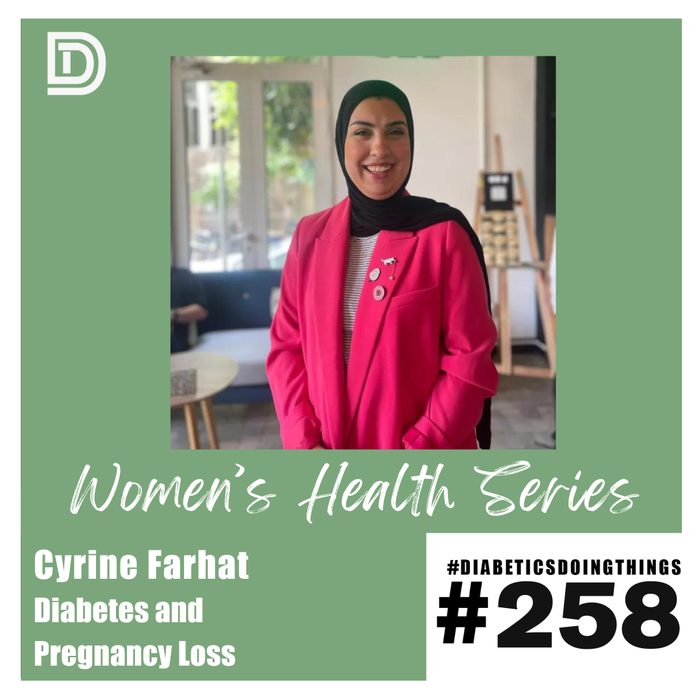
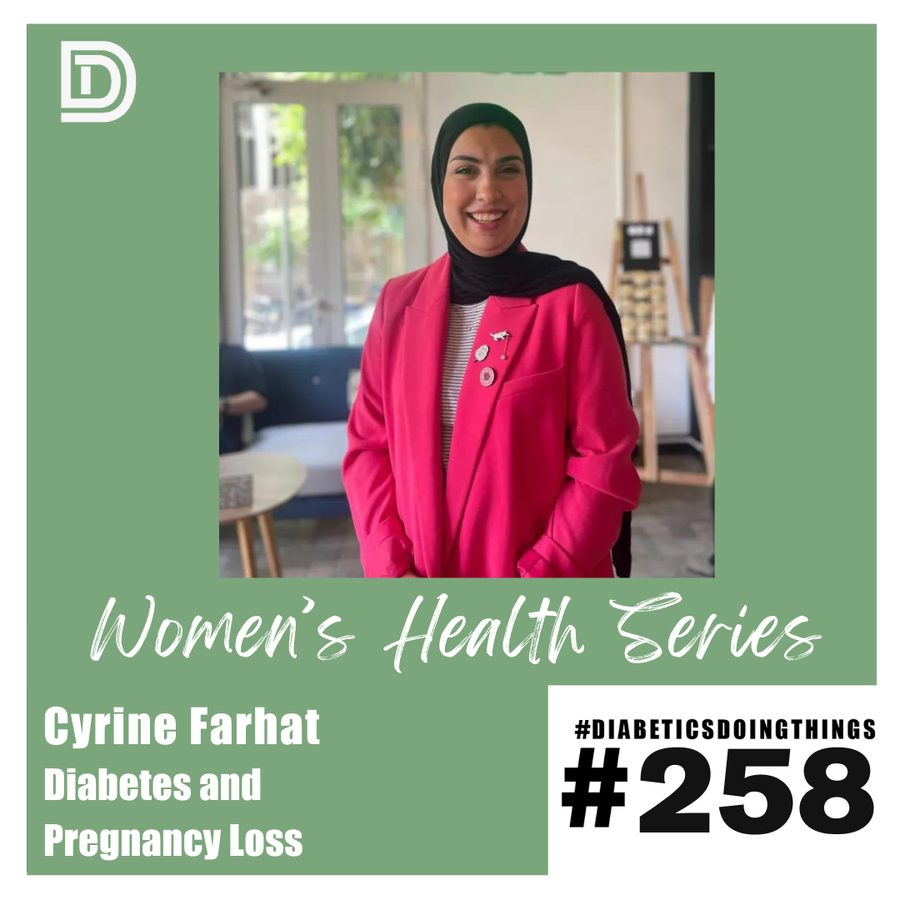
Cyrine Farhat, Women's Health Series: Diabetes and Pregnancy Loss

Episode summary
Cyrine Farhat, a type 1 diabetic from Lebanon and founder of the support group Positive on Glucose, returns for the final episode of the Women's Health Series. She describes her 2019 pregnancy with her daughter Joya, how her OBGYN dismissed her preeclampsia symptoms for months, and the New Year's Eve night she learned Joya had died. She talks about the grief, the blame placed on her diabetes, and how she turned the loss into advocacy. She also describes her second pregnancy with her son Fadel, where she changed doctors, managed DKA and preeclampsia, and had a healthy baby. Co-host Eritrea Musa shares her own 2019 pregnancy loss tied to severe morning sickness and diabetes complications.
Key takeaways
- Cyrine Farhat says her OBGYN dismissed her preeclampsia symptoms for months, and her daughter Joya was stillborn on New Year's Eve 2019.
- Cyrine Farhat says a doctor initially blamed her diabetes for the stillbirth, but a later test showed undiagnosed preeclampsia caused it.
- In her second pregnancy, Cyrine Farhat changed OBGYNs at six months and insisted her medical team follow her instructions; her son Fadel was born healthy after she also went through DKA and preeclampsia.
- Eritrea Musa says she lost her own pregnancy in April 2019 after hyperemesis gravidarum caused severe hypoglycemia and seizures, leading her to end the pregnancy.
- Cyrine Farhat advises partners to go to therapy together after a loss and to tell loved ones directly what kind of support they need.
Show notes
This is the final installment of our Women’s Health Series. We welcome back our returning guest and good friend the pod, Cyrine Farhat! On this episode, we peel back the layers on Eritrea and Cyrine’s personal experience with pregnancy loss. (Content warning: this episode will dive into the details of pregnancy loss).
We dive further into:
How Eritrea found friendship within Cyrine and the Positive on Glucose support group
Eritrea’s loss of her own baby in 2019 and how her pregnancy created diabetes complications
The shame and stigma that comes around pregnancy loss and how support and talking about experiences really can help
Cyrine’s story of pregnancy loss at 35 weeks with Baby Joya while living with T1D on New Years Eve 2019
The emotions that can come after pregnancy loss and the emotional labor of consoling others while processing your own feelings around the loss
How Cyrine turned her loss into a love for advocacy and helping other women with diabetes so they wouldn’t have to go through what she did
The importance of listening to your intuition and your body and how advocating for yourself can really make the difference.
The moment that made Cyrine open up about losing Baby Joya
How she attempted to prepare herself for the journey of being a mom even after loss
Cyrine’s Surprise Rainbow baby: Fadel!
What Health Care Professionals can do, and what Cyrine wished her doctor would’ve done differently
How differently she handled the second pregnancy differently after a hard learning experience
Advice for partners of a person with diabetes going thru pregnancy loss
Normalizing pregnancy loss and giving women their power back in making their own autonomous reproductive health decisions
Follow Cyrine for more over on Instagram @cyrinecando and if you’re looking for support, check out the link in her bio.
Questions this episode answers
What happened to Cyrine Farhat's first pregnancy?
Cyrine Farhat's daughter Joya was stillborn at the end of her pregnancy on New Year's Eve 2019, after her OBGYN repeatedly dismissed her symptoms of preeclampsia.
What is Positive on Glucose?
Positive on Glucose is the online support group Cyrine Farhat founded for women with diabetes in the Middle East, which later helped co-host Eritrea Musa after her own pregnancy loss.
Did Cyrine Farhat have another child after losing Joya?
Yes. Cyrine Farhat had a son, Fadel, in a second pregnancy where she changed doctors and pushed for closer monitoring, despite complications including DKA and preeclampsia.
What is euglycemic DKA?
Cyrine Farhat describes euglycemic DKA as diabetic ketoacidosis that can happen even when blood sugar levels look normal, which she experienced during her second pregnancy.
Full transcript Searchable, with timestamps
Rob Howe: I just want to issue a content warning for this episode. This episode discusses in-depth and detail loss and pregnancy loss and miscarriage. So if those topics are uncomfortable for you, please consider skipping this episode. But we felt they were extremely important to cover as part of our Women's Health Series. Enjoy the episode. So, all right, welcome back to another episode of Diabetics Doing Things. This is the final installment of our Women's Health Series for National Diabetes Awareness Month 2023. And I think one of the best parts of this is that we get to check in with our friends from the diabetes online community and share a little bit more of a patient perspective. So with that, I'm going to turn it over to Eritrea to introduce our returning guest from Lebanon, Cyrine.
Eritrea Musa: Welcome back to the show. Hello. I'm so excited to have you. Cyrine is not only a dear friend of mine, but also just a repeat guest. Like Rob said, a true friend of the pod. She was on the show in 2021, actually during the Beirut blast, like right after, and was the first takeover person for me for Diabetics Doing Things, one of my first big projects and initiatives. And we wanted to bring her back for a Women's Tell series as a special final episode. Today's episode is a little bit different, not just because she's been on the show before, but because a lot of what we're going to talk about has to do with not just her story, but also part of mine. So, Cyrine,
Cyrine Farhat: welcome. I'm so happy to have you. I'm so happy to be here, and I hope my story helps other people go through their stories because it's a very common story, unfortunately.
Eritrea Musa: I think that's a really good way to open this up. Usually on these episodes, we start with interviewing our guests. And today, I think that it's just necessary to provide some context for our listeners so that they can understand where my friendship with Cyrine really began. Because honestly, how does a girl in Dallas, Texas meet a girl from Beirut, Lebanon and become not just best friends, but almost like sisters? I want to cry. Too many times in society, like Cyrine said, it feels like we only acknowledge successful pregnancies. And in the background, women are losing babies every single day. While successful pregnancies with diabetes are absolutely possible and such a big part of the world now, it's so important to remember that diabetes can pose a huge increased risk. So for me personally, in 2021, I found Cyrine's account while I was looking for people to take over diabetics doing things. And after starting kind of a quick friendship, just a small DM relationship, I saw a story where Cyrine spoke about how she lost her baby, Joya. I, Eritrea, ended up joining Positive on Glucose, which is Cyrine's support online group, and started attending weekly meetings and chats with other people in the Middle East who were going through similar experiences, not just with pregnancy loss, but just all of the stigma that comes with being a person living with diabetes while still living in an Islamic and Arabic culture. At the time, and this is not something we've talked about on the pod before, but that I'm finally brave enough to open up about, I'd experienced my own loss in April of 2019. I was pregnant for about four months, and I had hyperemesis gravidarium through the entire four months. What that means is that I've had all day morning sickness. So that is being sick, throwing up, and that can create complications when you're a person with diabetes because you are taking insulin for your food. So with those episodes of vomiting came intense hypoglycemia that was followed by seizures and accompanied more symptoms that were just complicated and more and more complicated. Ultimately, in my story, I ended up losing about 28 to 30 pounds and deciding to move forward with terminating my pregnancy, which I spoke with my family about and thankfully religious leaders who said that in Islam, this is allowed because the health of the woman comes first. So I felt spiritually okay, but still just lost and alone because I had no one to talk to. So there was so much shame and guilt around what happened and the decision that I'd had to make, that when I stumbled on positive on glucose, because that's what happened, a whole community of women who were experienced and living similar experiences jumped out to save me, to pull me from drowning. Cyrine and Noor and Yasmin and Julie and Taj and Dr. Kadira and Iman, whose mom is an OBGYN in Egypt. A whole group of women who are culturally and sometimes religiously similar to me. For me, talking about what happened felt like it was finally like breathing, like taking a breath of fresh air and getting to tell a story. There's a quote, Maya Angelou says that there is no greater pain than a story that goes untold. and for me, Cyrine's group gave me a space to do that. There's an importance to loss that demands discussion, exploration and that's the space that Cyrine and Positive on Glucose gave me and it's the space that I want to create today for any woman who might be listening to this episode. So now that I've told my story, Cyrine, I want to give you the stage to maybe tell us about your experience in being pregnant and that loss that did lead to the loss of Joya.
Cyrine Farhat: I feel so emotional like so this is a story of like I like to call it loss and love because like for me it was losing something but finding love in a sense so in 2019 I had an unplanned pregnancy I just had gotten like married. I was six months into my marriage. I was doing my master's. I had a full time job. Life was like chaotic. And I found out I was pregnant and I was not ready to be pregnant, like emotionally, mentally, like, you know, pregnancy is a big deal. And in the Middle East, a woman living with diabetes is a big deal because like we live all our lives being conditioned that we're not fit to be moms. Our bodies cannot carry babies. We're shamed. People doubt our ability to, you know, to be moms, which is so natural to a woman. And I have to say, like, throughout my entire pregnancy, basically, I had an unplanned pregnancy. And I just had gotten married, like, six months into marriage, a full-time job, doing my master's. Life was chaotic. And, like, pregnancy was the last thing, like, that I needed, honestly, in my life. and I was not prepared mentally emotionally my HbA1c was 8.5 so like I wasn't doing my best even diabetes wise and it just like it shook me so I remember like I tried everything I can to lower my HbA1c I tried to eat as healthy as I can you know to be on top of things all the time but like needless to say like where I come from in the Middle East in Lebanon on we we lack a lot on education so basically a woman with diabetes is someone who is unfit to carry a baby like we live with this programming or conditioning that we are unfit to be mothers that our bodies failed us in a sense and so like this always was in the back of my mind like i have to do this i have to do a good job and especially back then like i had just started positive on glucose um i think the same month i got pregnant and like there was this internet community that supported me and that was waiting for me to have this baby and like i have this community in lebanon and i just wanted to prove like to give them hope like yes i can do it like my our bodies can do that so i remember the gender reveal and like knowing it was a girl and I was like so happy because like I felt back then that I would be a girl mom now I'm totally a boy mom by the way so we called her Joya we wanted like a name that is different and we wanted something on the basis of joy so like Joya so that that is where the name came from and I loved her so much like it's so weird but I felt very connected to her I would know like what time it is depending on when she moved like I would definitely know like now it's 10 a.m now it's 2 a.m 2 p.m whatever and I just I felt very connected to her we went on adventures we celebrated her while she was just in my tummy and I think I started having weird symptoms when I was around six months pregnant. I just, I started swelling. I would Google, you know, like my symptoms and like the number one complication with diabetes, type 1 diabetes always was preeclampsia. And I asked like my, my gynecologist back then, who was married to my endocrinologist? Like I did not pick them one team. I picked them one home, literally, because like I wanted them to take good care of me. And like my endocrinologist, I'd worked for them for four years. I trusted them. I loved the guy. He was so amazing. And like, of course, his wife would take perfect care of me. And like, they're at the same clinic. They're married. They literally sit around the kitchen table every day. So like, they're a good team. And she said like, nah, you're fine. Like it happens to any pregnant lady. Like she never tested me out. And I kept having persisting symptoms and like, they just kept getting worse and worse. Every time I would Google them, it would say preeclampsia. And I always go back to preeclampsia and I remember one time I was like eight months something pregnant I was like hey like might I have preeclampsia she was like no like stop googling things stop reading you're so obsessed that she told my husband like stop listening to her she told my mom like stop listening to her she's so obsessed she needs to stop googling things she's fine like this happens to all pregnant ladies and she never tested me like deep down in my heart I knew like something was off and always like i don't know if i've ever told you this earth yeah i always had these dreams when i was pregnant that i would give birth and i would ask them like is the baby okay does does the baby have 10 toes and 10 fingers and they would say yes and i would ask them in my dream like why isn't the baby crying i always had like this recurring dream in my like during my pregnancy which was weird and then I understood why until New Year's Eve 2019 meaning like the next day would be 1-1-2020 I woke up and the baby was not moving and like my baby had a schedule like she would move at a schedule and she was not moving and I googled they told me like eat chocolate turn to your i think either right or left side i don't remember anymore like the baby's supposed to move and she was not moving three hours passed by she was not moving and deep and deep deep down inside of me i knew like i knew so i called my husband he's like no you're overreacting the baby's okay call your OBGYN. She's fine. I called my OBGYN. She's like, no, you're overreacting. I was like, no, no, no. Something is off. I can feel it. I'm a mom. I'm connected to this child and I feel something's off. So she said, no, no, no. I'm sure everything's fine. Like just rest a bit. I'm sure she's going to move. I wait half an hour. She doesn't move. And like, inside of my heart, I know that she's not there so i call my objian again i'm like my baby's not there i'm certain like i need to go do something she's like well yeah you're overreacting but if you want just go to the er tell them like to do i forgot what what you call them like the ultrasound yeah no not on the ultrasound like it's kind of monitoring where they see the heartbeat of the baby oh that
Eritrea Musa: The belt thing that they put on you. Yes, the belt thing. Yes.
Cyrine Farhat: I forgot what it's called. So, like, I call my husband. He's like, yeah, like, just go take the cargo. I'm like, no, no, no. You're taking me. He's like, I'm sure you're fine. I'm like, no, you're taking me. So I remember I went around my house. I tidied up my house. I wore a black dress. I got my carry-on. And I just knew that I was going to the hospital. I'm staying there. Like, my baby's not there anymore. and like I remember all the way to the hospital I literally ripped off all my nail polish because I was so anxious and I went into the elevator in the hospital and this guy looks at me and like I'm a whale I'm so pregnant he's like oh you're gonna have a baby on your sleeve that's so cute and leave inside I'm like no no that's not gonna happen so I go inside the delivery ward where where they do this monitoring i walk inside and i lay on this uh bed and um they're like yeah now we're gonna see the heartbeat of the baby and it's one nurse then it's two nurses then it's three then it's four then telling me like undress take your jewelry off they tell my husband like go go down to like to admissions admit your wife and and like my husband my poor husband thought i was having a baby. And deep down inside, I knew like, nope. So like I tell them what's going on. Is there a heartbeat? They don't answer. I asked them again, is there a heartbeat? They don't answer. So like they started leaving one after the other. And then like, there's just this one nurse. I'm like, did my baby die? And she's like, the OBGYN will now come and let you know what happened. And that moment, I literally had an out of body experience. Like I could see myself from the corner of the room crying my eyeballs out like I can never forget the feeling it felt like the entire space on earth did not fit the emotions that I had like no space on the planet could fit what I what I felt it's such a weird feeling and like my husband comes in and he saw he sees me and he realizes like we didn't have to talk like he realizes and I remember he brought me back he said you're still here you're still here you're alive you're still here she's gone but you're still here and like he repeated like six seven times and he grounds me and I come back I come back into my physical body like I feel like I'm still here and then I had to do like a very tough decision which is who to call because like it's New Year's Eve like everyone's I remember like I was doing some pizza like my parents and my husband's parents are like getting ready to celebrate everyone's coming from like all towns like all his brothers all the family is coming together like what the hell am I gonna do so we decide that we don't want to tell his parents because we didn't want to spoil New Year's Eve for them it was such a weird like I don't know how we were so like zen it was so weird but I call my parents I tell them like I call my mom like listen I lost my baby. I'm at the hospital. Can you please come? She's like, what? I'm like, I lost my baby. Can you come to the hospital? And she just couldn't like. So the gynecologist comes. She's like, I'm sorry for your loss. If you want, you can go celebrate New Year's Eve and come back in two days and we deliver you. I'm like, what the hell? Like, no, get this baby out of me right now. So she tries to convince my husband that I should have a normal birth, like not a C-section. and like my entire thoughts were like, get this dead baby out of my body. Like I can't like even accept the idea that there's a dead baby. It's like, get her out, just get her out. And she convinces him and he convinces me that this is the best thing, the best course of action, whatever. And all of this happened and they still did not even tell me I have preeclampsia. You know what the first thing she told me was? Oh, you're diabetic. This is the complication. most diabetics have. You had stillbirth. This happens to most of people with type 1. And I felt like I was slapped in the face. Like, don't you dare blame my diabetes. Like, I worked so hard to be at home for this baby. Don't you dare blame my diabetes. Like, I knew that was not what happened. So I stay over. The next morning, they induce me. I start throwing up nonstop, hypertension at 17 and then they decide that I should have an emergency c-section. I never see my baby. I never saw her. I never held her. I never got to say goodbye to her. And to this moment, like, I'm still in therapy because of that, you know, like, I didn't have closure. I didn't get to see her. I don't know how she looks like. And she's part of me you know like she's part of my soul and I never got to see how she look looks like and like the following four days at the hospital I was just so numb like people would come and say I'm so sorry for your loss and they cry I'm like oh it's okay it's okay I'm okay and I don't know where that calmness came from but like one thing I remember the most was the love like I felt and I feel it up to this moment like she filled me with so much love like she taught me how to I don't know love without her like and that was why she chose me to be her mom even if it was like just for nine months or eight and a half months like she taught me how to love and ever since then I felt like I have this fire to give back, to love, you know, to give love. A week after it happened, I decided to see another OBGYN to try to figure out what happened. I gave him my tests and he looked at my tests. He's like, oh, you have three plus protein in your ear and you have preeclampsia. And I was so angry. Like all of this could have been avoided. Like I was so angry. But at the same time, I felt like if God chose me to go through this like he knew that i was up for it and i was and i used this story to empower and help and to kind of become an advocate and to speak up more about diabetes and to speak up more about women empowerment and speak to speak up more about mental health and i was blessed this year with Fadel weirdly enough i i got pregnant with Fadel who was also on plant the same time I was with Joya and his due date was also in the same week Joya's due date was it felt like I was giving me another chance like literally he got me go to go through the exact same dates with hope and I had my baby boy I still had complications but this time I was like I was prepared like I knew I would have preeclampsia so like I did all the tests and i was prepared and even when i went into the icu eight months pregnant i went through dka by the way even though like i did not have high blood blood glucose but like i had dka and then i had preeclampsia so like i was so was that like i'm sorry sorry to interrupt was that
Eritrea Musa: you guys euglycemic DKA yeah yeah when your blood sugars are normal but you're still going to dka
Cyrine Farhat: yeah yeah yeah and i spent like six days in the icu when i had when i gave birth i was separated from my baby for the first 48 hours i didn't see him he spent 10 days in the eq but still i was prepared i had a medical team that believed me and i told them like this is my story and you you do my way like you you do things my way because like i know and this is where advocacy is so important because i know i live with diabetes it's my diabetes my diabetes is different than yours robin different than yours erythria and like no one can judge diabetes other than the person who's living with it and so like i forced them to believe me and to listen to me and i've advocated for yourself and i have a healthy baby right now so that's the story of loss and love i i want to thank you for being so vulnerable and sharing that story because i i think obviously there's so much pain behind it and you know and so much grief and loss but we do feel that love coming through i also think you know even for eritrea if you hadn't gone through that and started you know you said you started positive on glucose work right at the same time and then as that's you know as this is happening to you you're able to share that and create a space for people to find you and connect with you in the future and i know that eritrea is not the only or the last person to to do that and so you know it's interesting that we were talking about you know God doesn't give you challenges that you can't overcome or that you can't handle. And it doesn't negate how difficult they can be. But I think when, and Eritrea and I've been talking about this, that diabetes sometimes forces you to have a growth mindset. And, you know, you can take this horrible, tragic, negative thing and turn it into positivity, positive on glucose and meet other people and become, you know, internet sisters in in many ways and you know diabetes sisters in many ways and so you know you know i think that to me is the sort of crown jewel of of what internet and self-advocacy can lead to is connecting to other people and helping them learn from you like you said everybody's diabetes is so different and also all of the different other chronic illnesses that spiral from diabetes that we all deal with in different ways, you know, may not be the same from one person to the other, but when you have your experience and you're able to advocate for yourself, you know, sometimes on the other side of that courage is something that you want. And so, you know, it's so encouraging to, to hear you today as, as a boy, mom and, and with, with Fidel, you know, I, I think that's a really amazing story to come back to and to say that, you know, because I was, because I learned and advocate for myself and connected with other people and helped other people. Now I, I, my, on the other side of that terrible pain is this, is this beautiful joy. So I know Eritrea has a couple of questions like, you know, revolving around, you know, when you were going through your second pregnancy, like what were some of the things that you really made sure to advocate for? And, you know, hearing from your, you know, all of the different people, I think one of the things that's really common in this podcast, especially for women with diabetes who are intuitively feeling that something is wrong with them, whether that's, you know, in, in, uh, Felicia DeRose's case, who was on our podcast a few months ago, talking about wanting to be tested for antibodies for type 1, even though her doctors thought she was type 2. And the many people who said that, no, she was overreacting that, no, that wasn't correct. Or the many people who, in your life who were saying, no, no, everything's going to be fine. you're just overreacting, but your intuition and you know, yourself and your body was telling you that there was something wrong. And so I think, you know, there are people out there who are, who mean well and, and still will not know everything that you will know about your body. And so, you know, back to the advocacy piece, it can be really hard to advocate for yourself, especially when experts and people who care about you are telling you that you're overreacting, but you have to listen to your gut. You got to really follow in and only knew you know yourself that well. So anyway, I'll turn it back to Eritrea because I know we have some important questions.
Eritrea Musa: Well, before we get to them, I guess something I'm working on is leaning into the jazz as my mentor Rob has been teaching me. And I think you're a really good storyteller. And I also think you've had to tell this story many times because you are such an advocate for what's happened. And first of all, I'm always just so proud of you because you tell it so eloquently in a way that is graceful and still just beautiful. But I always wonder, like, this is the first time that I'm ever telling my story publicly ever in a place. Rob does, I want the listeners to know, Rob does not know this story. This is not a story Rob has heard before and we're close friends. What was the moment that you were like, this is a story I need to tell? Like, was there a light bulb that turned on? What moved you to do that?
Cyrine Farhat: So, when it first happened, I wanted the earth to just open up and swallow me, especially in front of the diabetes community, because everyone was waiting for me to talk about my pregnancy and my baby. And back then, I had so many internet friends from Positive on Glucose. You'd connect over Instagram. You're one of them. Mohammed's one of them. I had so many, so many, so many friends back then on Instagram. And this was even before the WhatsApp group and the support group over Zoom. So we were talking four or five months before that even started. And I was so silent up until February. And then I was like, I need to talk about this. I literally need to talk about what happened because so many people are waiting to hear from me. People will text me asking me, like, how are you doing? When's the baby due? And I will just not answer them for weeks. And I remember I set up the tripod in the baby's room. And I put the camera and I put a chair. And I was like, okay, how am I going to tell this story? And I would try to tell this story and I would cry. And then I would wipe my tears, turn on the camera again. And the video was still there even though I was not a hijabi back then. I left it. God understands because it would help people go through their stories. so that was the first time I ever opened up about it and ever since then I just I think the first year after it happened the story was my fire like it was my fuel it was like the pain I don't know it was pain and love at the same time I don't know how to explain it like I wasn't grieving in a sense that I just wanted to be left alone no I was out I was fierce I wanted to talk about it to people I started a baby loss group in Lebanon I met with other moms that went through baby loss we started doing support groups i'm a life coach so we started doing support groups for other moms and i just worked so hard at supporting baby loss for the first year and a half and then i realized that what i was really doing was like i was being overactive to just stop myself from feeling and so in 2022 i decided to feel i started to let myself like go like i wanted to go into my grief go into my pain try to look at it try to feel it try to immerse in it and And that's when I kind of stopped telling my story for a while until I got pregnant again.
Eritrea Musa: That was going to be my next question, actually, before you just give all the spoilers away for our audience. But for me personally, I don't know if I'll ever be willing to do it again. I don't know if I'll ever be able to open myself and my heart open to an experience where I tried to bring a life onto the earth. Because I think it's a brave thing to do. I think it's literal carnage, as I said before on this podcast, and I'm scared. So I always ask myself, like, Cyrine, you're the bravest woman I know, like, to just be like, you know what? I'm back on the trampoline. Here I go on this horse. Like, how did you come to that decision? Or was it just something that happened, you know, by the will of, you know, of the universe? So how did you get there to be like, okay, I can try one more time? Or where are you there? Yeah.
Cyrine Farhat: so I think now I'm there. But when it happened, I was not there. I tried for the longest time to be prepared for the idea to be pregnant again. And I went through therapy. I changed so many therapists. I did so many mindfulness stuff, like access consciousness and Reiki and all the things and the spiritual things and the super Islamic things. I did literally everything off the spectrum. and at one point I was doing great and then I slipped again into my depression and like my A1C was 10 point something and I had a tumor actually it was a so it was a benign tumor but I had a really really big tumor in my abdominal muscles and I had to have like this big surgery and so I go in I do the surgery weirdly enough before I did the surgery they wanted to do an x-ray and they were like are you pregnant ma'am I'm like no but like if I'm pregnant like what should we do they're like oh you have to wear this protective thing let's work I had no idea I was pregnant I was pregnant spoiler alert I do this surgery general anesthesia like this really big surgery hurts as hell and i come out into the recovery room and i was i had like i was still like you know in and out and like this nurse tells me like oh we have to do like an x-ray to the guy next to you are you pregnant i'm like no but like how how can you protect me like he's like how we do this thing i'm like okay yo i swear to god i'm like i get out of the hospital on a i did the surgery on a thursday i come out of the hospital on a saturday i can barely walk and i miss my period on a Tuesday. I'm someone who's very regular, sorry for the information. And like, I call my diabetes educator. I'm like, oh, like my glucose, like it's so high all the time. It's like 400, it's not getting down. I miss my period. What's happening? It's like, might you be pregnant? I'm like, no, no, of course not. Like I've been using, I'm on, like, we're trying to keep it safe. She's like, why don't you just get a test? And I text my husband, I'm like, can you please get me a pregnancy test he's like why like you just had general surgery like you're not pregnant like get a test and I remember I put the test it was like seven in the morning my husband my husband was in the bathroom and god knows what husbands do in the bathroom for an hour each morning and like and the test is positive and I'm like I'm really able to walk and like I opened the bathroom door I'm like oh man I'm pregnant and I start crying because like I was terrified like I had two x-rays internal anesthesia my A1c's 10 like what the hell am I doing to myself how am I pregnant like how is this ever even happening and I cried for like an hour and then I was like wait I'm pregnant And it happened. I'm so happy. And I just, I felt this calmness inside of me. And I knew my baby had a guardian angel, who's his sister. And I just knew everything was going to be okay. My A1C was down to six in a month. I had an overall okay pregnancy. It wasn't that hard. minus the complications that happened before I gave birth. But now when I think of it, it was the best thing that ever happened to me. And I would do it again in the blink of an eye. Like now, literally an hour ago, I was telling my husband, I was putting away the baby stuff and there are so many baby clothes that are in very good condition. If he has a sister, they fit both genders. I would do it in the blink of an eye because Eritrea, society tells us that we fail as women because we have diabetes but once you see that baby who's like this big and you look at it and like you say i created that like that literally sat inside of me and i did that and then it's like the best achievement you've ever done in all of your life so to all the women like who are terrified of having babies don't don't like your body can make miracles it's here like it's all it's all here it's what we're conditioned to believe and it's what you decide that you want to change inside your head you can do miracles and like i have proof he's like asleep inside he's proof that my body can make miracles and that my body my body did not fail me at any point
Eritrea Musa: i think the way you explain it is so well there's there's an a belief there's a belief in islam and i and i don't want to be too religious on this episode because for our listeners not everything here is that way but there's a belief in islam that what what's happening to you is already written for you that your story is your story it was created before you know obviously at free will but your story was already written for you so when i hear your story and i hear about Joya which in spanish means jewel and i hear about Fadel because i habibi Fadel i love him I just think about how powerful the story that you have is and how it's one that is now trailblazed a space for more women who exist like me in this weird limbo space of, do I go this way or do I go that way? And I feel like you are living proof that whichever way I decide to go, there's going to be beauty there. Because through pain, you can find beauty. And I feel very lucky to have you in my life and to be able to share your experience with more people here today. There are, we do have a few more questions. I just want to kind of highlight the loss of, of Joya, like you said, it was avoidable. And I think that that you are a much bigger person than I am, because I am an angry person. And I don't know how I would have handled that. And I'm sure you did have anger because we talked about it. But was there anything there in that experience that you really wish that your doctor would have done other than dismiss you because it sounds like she was very just dismissive in general and not just dismissive of you but telling other people to dismiss you like i want to hop on a flight to lebanon and fight her but anyways how did you like handle that and what else do you wish that she would have done differently
Cyrine Farhat: you know like one question i'm always asked when i tell my story is like how did you not beat the hell out of her yeah literally why didn't you sue her so like i didn't beat the hell out of her because i'm not that kind of person i i'm like my husband and i were not that kind of people no i believe that god will take or like will revenge me like or karma will do whatever it wants why I didn't sue her because I live in Lebanon which is a very effed up country with a lot of failed systems including the health care and the judiciary system so even if I had sued her I would have paid a lot of money and she would know would have known someone at some political party that would have gotten gotten her out of it the proof is she another lady lost her baby because of her and she's still in practice so yeah so like for me like i know god will take revengeance over what she did to me i really believe in that and i've always seen people who like cross me like i see them with my own eyes i see what karma does to them so like i really really really believe in that i'm waiting the
Eritrea Musa: universe balances the scales basically yes yes and i wouldn't have changed anything because
Cyrine Farhat: because i'm a coach i have learned that you have no power over others you only have power over yourself so i would have acted differently and that is what i did in my second pregnancy i don't believe in the what ifs honestly like what happened happened nothing i can ever do would change what happens what i can do is i can talk about my feelings i can process them and i could learn from them to prevent them from happening to other people or to myself again so with my second baby Fadel i did everything i can to not repeat my mistakes my mistakes and actually i changed uh gynecologists with Fadel i i changed gynecologists when i was six months pregnant because I felt like the first one wasn't taking my preeclampsia from the first pregnancy serious and I did that so we we don't have power over others we only have power over ourselves how we feel how we behave and I think this is very important to realize
Eritrea Musa: that's powerful self-advocacy is a I feel like a very common thread here diabetics doing things it's like closed mouths don't get fed on this boulevard you gotta open up and speak up
Rob Howe: I think the reason that it keeps coming up though, is because it's not something that's ever completed. As a matter of what level of diabetes or what, you know, what tasks you've completed previously, you're going to still have to advocate for yourself just like it was the first time. And it takes courage to do what you said, like at six months in your pregnancy to change your endocrinologist. That is probably not recommended in many cases. So you have to go against what is practical and when you're advocating for what you need.
Eritrea Musa: Yeah. Lots to say here. I'm not a man, but Rob is. I just wonder that if from a partner, and Ahmed's great, by the way, big fans of Ahmed. Shout out to my homie, because that's my homie. He follows me and everything. Be like in the post. That's my homie. But as a partner for two women, like, is there something that you would say to men who are experiencing their wives, either their wives with diabetes or themselves with diabetes, going through pregnancy loss or going through loss of a child? Like, as partners, because I know for me, my partner at the time, unfortunately, it was just very emotionally unavailable. And that was very, very difficult. So I wonder, what's the advice or what's something that you would want them to know, to better support their partner who might have lost you know the physical child itself
Cyrine Farhat: yeah um so i'll tell you things that i've learned from my experience um and something also that came up in a recent conversation with julie you know her i love her yeah so basically i think first thing if you if your wife goes through loss push her to go into therapy because I resisted therapy for the first year and a half. And I will also advise the couple to go into a couple of couple therapy sessions because whether you realize it or not, it has a toll on your relationship and there is blame and there is guilt. Whether you are vocal about it, you acknowledge that you feel it or not, it is there. And Ahmed and I, like we pushed it away for so long until it blew up in our faces and we had to go to like process it individually and together and i i'm lucky enough to have a supportive husband in the middle east who is pro-therapy because like a lot of people here don't really believe in the concept of therapy or mental health or like ah you're not crazy why would you want to go why would you want to go to a therapist you know like like the arab yeah andy in dimajnuna yeah like is she crazy why would she want to go to someone and blah blah blah about her life just go go pray Habibin no no no no it doesn't work like that honey no no prayer doesn't solve mental health issues like you have to go to a therapist so yeah that's that's the first aspect of it the second aspect of it is something I learned from Julie who was with me on a podcast and we were talking about women and diabetes and all of that and she told me like one tip I would give to women is to educate their partners on what kind of help they want to receive they do not know tell them not just your partners your parents your friends tell them how you how you'd like them to take care of you because sometimes they really don't they want to take care of you the best way they can but they don't they don't know what's your love language how you like to be taken care of so just be vocal about your needs don't expect people to know and like for me i just like i expected people to know that and they didn't say what I needed. I was angry. Like, why aren't you giving me what I need? And the truth is they were trying. They just didn't give me what I wanted. So that is like, these are the two things I think that I can come out of my experience with. I think those are great pieces of advice for partners, even if you're not planning on having a family anytime soon. And I think, you know, creating that space for that communication, telling your partner how you want to be loved, how you want to be supported are things that everybody could, could do well to, to understand and to understand each other a little bit better. I also want to, you're right. I'm a man. I don't understand these. I'm not a father yet. I hope to be someday. But something, you know, the discussion of miscarriage was introduced to me pretty early on because my, my mom and dad before I was born had a miscarriage and my mom's been really, you know, shout out Anita. She's evolved with, with the times because that used to not be something that people shared very openly. And I think there was a lot of shame and stigma around. I think there still is. But it all makes sense because it's grief and loss and it's uncomfortable and it hurts. But there is really something to sharing your story and to normalizing that, you know, even in the United States, 10 to 20% of pregnancies end in miscarriage. And so while that, you know, doesn't necessarily make ease the pain in the short term, I think in the long term, as we seek out those connections, like you two have found in positive on glucose and many others have found like sharing and being open and and normalizing that conversation and taking away that stigma i think is where you know the the power to to grow and to you know i think of like a forest fire right like it's so tragic when we see the flames burn down but the richness of the soil you know can allow new things to grow and i think that to me is something that you know when, when the fires of life come to you and they really hurt you and they cause you pain, sharing that with someone can really help, you know, grow and enrich your soil. So I think, you know, surrounding yourself with support and with friends and with people who really care about you and want to support you and love you in the way that you are, that you say that you want to be supported and loved are really valuable. And so I think, you know, as we kind of close the episode, I think that's something that I'm grateful for that this podcast has done, which is bring more people into this and these situations where we can have open discussions and connect with each other over really tragic situations that we're able to look back on fondly and say, you know, because this happened to me, I can be a voice for other people and, and share my story with, in hopes that somebody out there who is struggling, advocating for themselves in these types of situations will, you know, maybe hear something today that allows them to, to have the courage
Eritrea Musa: to make difficult or challenging decisions. And while this episode was difficult to record, I would like for the audience to take away a feeling that this isn't a bummer. Like, it's not like sad, sad, cry, cry. It's more like, like Rob said, it's the fires of life that, that kind of shape you and shape us as people. And I think it's important for us to walk away from this today saying like, yes, this was a hard experience that Cyrine and Eritrea went through, but that's how you learn. That's how you grow. And that's what shapes you. And I also think it's just important for us to normalize the loss of pregnancies and that it's okay if you try to have a baby and you didn't get to. And if you don't want to have one, that's also okay. I think it's important to normalize women everywhere in whatever decision that they decide to make with their own reproductive health. Too many times there is judgment and stigma and shame and even unnecessary conversation that quite frankly is not anyone's business. Stop asking women when they're going to have a baby. Like, please stop doing that. Stop asking people when they're going to try again. You know, like small things that I think we forget because having a healthy baby seems so normal and so easy. We forget that it is actually a miracle
Cyrine Farhat: of the universe. It really is. And besides that, it's major surgery and a major physical commitment. And I think, you know, in the US, we have a lot of decisions that are being made about women's rights that are being made by men who don't understand and who aren't interested in really understanding. And so I think that's something that also, you know, making sure that women have autonomy in these decisions as well is extremely important. And I also would say, Like, you know, from this women's health series, I have learned a lot, especially, you know, even outside of diabetes, because diabetes, as Cyrine said earlier, it looks very different for everyone, but it's extremely different between men and women. There's just way fewer things that the men with diabetes have to have to balance in our heads. So Cyrine, thank you for your time and for sharing your story. You know, it really has touched us and I know our listeners are going to get a lot out of it. And thank you for your work with Positive on Glucose. You know, we don't have to look any further than Eritrea today to show the impact that it's had globally. So thank you for all that you do. And so happy to have you back on the podcast. Same here, same here. I'm so happy to be back. And I just want to like tell people one final message. Pregnancy is hard, but like taking care of a baby is even harder. It's like, it's a decision that you should not take lightly, especially if you have diabetes, like you're running around the little monster who's like half drunk during your apartment and like you have to manage your highs and lows so like just be very ready for it and i just i hope it helped so many people heal if they needed to heal from something and i want to remind them again that they are a home you are a home no matter what ncd you live with so always remember that I love that. This episode was produced by Eritrea Musa. It was edited and published by Ashley Bright. And our amazing video clips come from Excel Creative from DJ and Corey. Thank you. And I'll see you next time.
About Cyrine
Cyrine Farhat is a type 1 diabetic from Lebanon, a life coach, and the founder of Positive on Glucose, an online support community for women with diabetes. She returned to Diabetics Doing Things to share her experience of pregnancy loss and advocacy.