

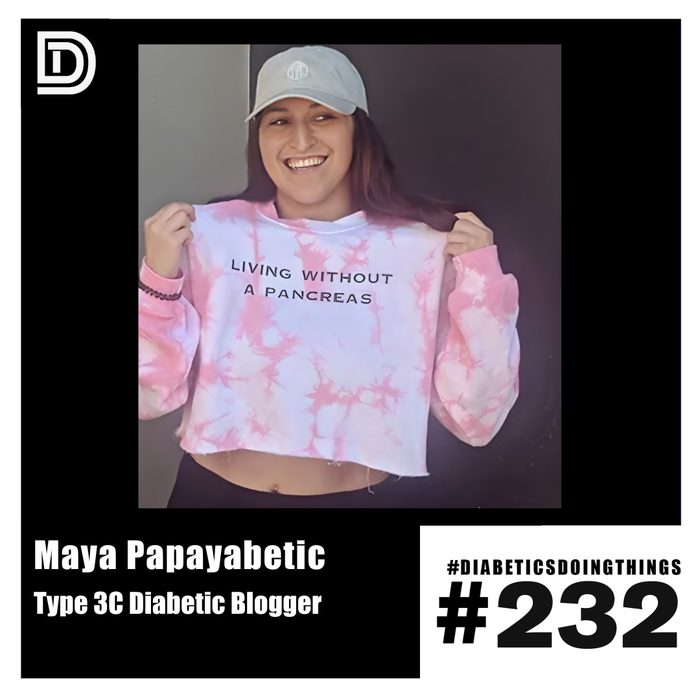
Maya Papayabetic, Type 3C Diabetic Blogger

Episode summary
Maya Ramirez, known online as Papayabetic, lives with type 3C diabetes after a full pancreatectomy as an infant. She was diagnosed with congenital hyperinsulinism within hours of birth, causing dangerously low blood sugars doctors could not control. After three surgeries, her pancreas was fully removed by eight months old. She has used a Medtronic insulin pump for 20 years and started on a CGM about three years ago. Maya talks about losing her mother and brother, and how she built the Papayabetic Instagram account and NorCal Diabetes meetups afterward to connect with others living with rare forms of diabetes. She also covers insurance hurdles, taking Creon for digestion, and pushing back on calling a pancreas dead.
Key takeaways
- Maya says she hit her 30-year diaversary and her 20th year on a Medtronic pump within the same week.
- Maya was diagnosed with congenital hyperinsulinism within two hours of birth and had her pancreas fully removed by eight months old after three surgeries.
- Maya says living without a pancreas means also taking the enzyme medication Creon, and her digestion causes more trouble than her blood sugar control does.
- Maya started the Papayabetic Instagram account after losing her mom and brother within months of each other, to find community and process grief.
- Maya says she pushes back on calling a pancreas dead, since it still affects digestion even after insulin production stops.
Show notes
This week on the pod, Rob and Eritrea welcome Maya Ramirez (aka Papayabetic) to the show! Maya lives with type 3C diabetes and underwent a full pancreatectomyas an infant at 8 months old. In this episode the team dives into:
30 years of living with diabetes and without a pancreas
Maya’s Diagnosis with congenital hyper-overproduction of insulin in her pancreas at 2 weeks old (hyper insulinism)
Props to parents of children with diabetes, a whole different ballgame of providing care!
23 years of using an insulin pump (even if it is technically off-label usage)
Why considering your pancreas dead is not only incorrect, but stigmatizing language
The other health implications of living without a pancreas
Using grief as motivation to bond with people in her community
If you’re in the North California area and you’re looking for a community of people with diabetes: check out Maya’s IG @papayabetic to stay updated on future meetups!
We want to hear from you. Send your questions, comments, queries, and general diabetes concerns to THE MAILBAG at mailbag@diabeticsdoingthings.com!
Questions this episode answers
What is type 3C diabetes?
Type 3C diabetes develops when the pancreas is damaged or removed, stopping insulin production for a reason other than type 1 or type 2 diabetes. Maya has type 3C because her pancreas was fully removed as an infant.
What is congenital hyperinsulinism?
Congenital hyperinsulinism is a rare genetic condition where the pancreas overproduces insulin, causing severe, uncontrollable low blood sugar. Maya was diagnosed with it within two hours of birth.
Why did Maya have her pancreas removed?
Doctors tried three rounds of surgery to control her hyperinsulinism by removing part of her pancreas at a time, but her blood sugars stayed uncontrollable, so her full pancreas was removed by eight months old.
What medication does Maya take besides insulin?
Maya takes the enzyme medication Creon with meals because she no longer produces digestive enzymes on her own, and she says it costs far more out of pocket than insulin.
Full transcript Searchable, with timestamps
Rob Howe: Hello and welcome back to another episode of Diabetics Doing Things. We're telling the amazing stories of people with diabetes from all over the world. And I'm very excited about this episode. To me, in a way, it's long overdue because there's some awesome members of our community in the diabetes online community who live with a different type of diabetes than Type 1 or Type 2 and that most of us and most of our guests over the years live with. And our guest today is Maya, and you might know her online as Papayabetic. So Maya, welcome to the show.
Maya Ramirez: So happy to be here. Thank you so much for having me.
Rob Howe: Well, we are so glad to have you. We really love your account and interacting with you over the years. But also we wanted to talk a little bit about type 3C diabetes, which we know that you live with and you get to be the first guest. You don't have to shoulder all of the education, but you get to be the first introduction for our guests on this podcast, at least for what it's like to live with type 3c so first of all like let's talk about you and you know just a little bit about you and your diagnosis story and then you know introduce our guests our listeners rather
Maya Ramirez: to type 3c diabetes yeah so i actually just hit my 30 year diadversary like two days ago oh 30 30 year diadversary yeah yeah and then it's also been 20 years that i've been on the medtronic pump. So that's kind of like two huge like accomplishments. I didn't think I would get here, honestly. You know, like thinking back, I'm like, well, I'm finally there. So that was just a huge milestone for me. But yeah, I know. I'm just excited to talk more about, you know, my journey with diabetes and what exactly type 3C is. Well, before we get into that, 20 years on a
Rob Howe: medtronic pump. So which what was your first medtronic pump? Oh, you know, I'm terrible with the numbers yeah they're they're hard to remember there's a lot yeah i got on on my 10th birthday
Maya Ramirez: actually just happened to be that case so that was 2003 obviously so i know it was a blue pump a blue or black pump i don't remember the number though but it's been great being on the Medtronic pump i had been able to see the evolution of what it offers throughout the two decades um and now Now with the new 780G coming out, which I need to pre-order, it's been on my calendar.
Rob Howe: It's funny. I like went to the endocrinologist yesterday just so I made sure that all my stuff was in order so that when I was ready, I could make the upgrade.
Maya Ramirez: And that's so funny you say that because I actually have an endo appointment like a couple days before the 15th. So I'm going to make sure all that's lined up, but it's just so awesome. And I actually just went on a CGM not too long ago, like maybe three years ago. So that's been a huge transition in itself as well. So it's really exciting to see all the technology changes.
Rob Howe: It's funny, like when you think about it, there's like all these kind of, I don't know, like it's such a change to get on CGM. And I think some people like myself were really resistant to it because you don't want another thing on your body, but then you experience it and you get to see like how convenient it is to look at your blood sugar. And something I was doing last month was just trying to like be conscious of when I checked my CGM on my pump or my phone and how, you know, six or seven years ago for me, that would have meant I would have had to prick my finger and like check my blood sugar on my glucometer. So, you know, just in those moments, like remembering how like, you know, I'm very grateful and we're, and we're very fortunate. You know, some of us in this country are fortunate enough to be able to get access to CGM. And when we think about like the big opportunities across the world, I know what you're Eritrea does a lot of this in her, a lot of this work in her day job, but like it's, you know, getting people access to CGM is so important because you really do get to unlock like what your body does throughout the day. You don't have to guess about it anymore. And it's just really
Maya Ramirez: impactful. Absolutely. Yeah. And I can totally relate to that because I, since I graduated college in 2016, I was really struggling trying to find a job that would provide good health insurance. And so I've always worked multiple jobs just in order to survive. And I finally was able to get on with the state. And that has been absolutely amazing. And that's a hard process in itself, but they do provide really good medical coverage. So I have been very fortunate and beyond thankful to work for an employer that does provide access to these medications and devices.
Rob Howe: Well, good. I'm so glad to hear that for you. And, you know, it's just an important, always thing important to note for people living with chronic illnesses, like side hustles sometimes are not like optional. You've got to do, you know, go the extra mile And I think there's a lot of trauma living behind. People may not even recognize it always, but you never know when you might need a big out-of-pocket expense that you can't negotiate around that you have to do. And I think that's always kind of hanging over people's heads sometimes. So props to you and your employer for offering that great coverage. And I know that's something that we're passionate about at my companies as well. All right, transitioning. You mentioned you just turned 30 and you had your 30th anniversary. So you were right from the jump, right from day one, thrust in you and your parents, thrust into this world of being a full-time pancreas. And for you, that meant even having your pancreas removed. So let's talk about your story as well as just sort of some general awareness about type 3C diabetes.
Maya Ramirez: babies? Yeah. So I've always considered my diversity, obviously my birthday, because within the first two hours of life, they diagnosed me with congenital hyperinsulinism, which is a rare genetic medical condition that pretty much the pancreas overproduces insulin. So it creates uncontrollable hypoglycemia. And at the time they obviously, where I was born, And they had no other patients that they've ever experienced this with. So that was a challenge in itself for my parents. And I ended up having my pancreas, my pancreatectomy done at UCSF. But it did take about three rounds of surgery because they were trying to not do all of it all at once because they were saying like, well, if you take that part of it, maybe it'll help. And obviously it didn't. So I had the final surgery when I was eight months old. So, you know, back in the early 90s, there was like really no technology. So my mom, my dad had to be like on top of everything, checking my blood sugar every two hours. And with hyperinsulinism, you know, especially when you're fasting, like your blood sugars are tanking. So it's like trying to figure out how much to give the child in order to sustain the blood sugars. So the way the doctors put it to my parents, diabetes was kind of like the better option because at least you were able to control it more. Whereas with HI, it's very uncontrollable. But now with technology and certain medical advancements, you know, it is a little better, but it's still a huge challenge in itself, you know.
Rob Howe: Yeah, no kidding. And I just, you know, thinking without a continuous glucose monitor, trying to figure out where you are, you know, from a hyperinsulinism standpoint like that at that time would just be so difficult, especially with not only like pediatric patient, but like a newborn.
Maya Ramirez: Yeah. And the challenges with HI is that you are susceptible because you're having these extreme low blood sugar. I'm talking extreme. I'm talking like under 30, you know. So my parents would tell me stories like, oh, yeah, you were in the teens, you know, like just. crazy low blood sugars and so you obviously are susceptible to like seizures and other neurological issues that occur from low blood sugars so children now that are born with it there is options to get on a cgm um but that's still a huge challenge in order to get insurance to kind of cover that because they don't have that diabetes diagnosis you know right and within hi there are several different like genetic strands. The one that I particularly had, that's why I had to have the pancreatectomy. Most kids with HI can take a medication to help control the blood sugars or they kind of like outgrow it. So it just really depends. And there's a lot of genetic testing that goes into it, obviously. But at that time, everything was so minimal, you know?
Rob Howe: Sure. And I think like, that's a really interesting way of looking at it. Even like Like diabetes is obviously not a rare disease, but, you know, just thinking of like how different the diagnosis experience is for someone today, for the most part, compared to somebody 20 years ago, 30 years ago is, you know, obviously like you see how far we've come and that is also extended over into more rare diseases like HI, right? So, you know, that's great that there's those options out there, but for you, like having to have your pancreas removed, three different surgeries before you're eight months old, like that's a lot of work being done on such a young person.
Maya Ramirez: Yeah. And I don't even know how my parents did it. Like, unfortunately, my mom passed away five years ago, but before she passed, she would tell me all the time, like, you know, it was just so hard that she somehow did it. You know, I don't know what it was. And I just, I give so much props to parents, but especially parents that have a child at that age, like, I don't know how they do it. Like an infant can't communicate with you, you know, and that's just a whole different ballgame. It's so scary to think about, you know, so shout out to all those parents.
Rob Howe: Man, I think about it all the time. Like they're like having a child is like such a big disruption anyway. And then, you know, you think about having to be a full time pancreas and then not just for a newborn, but then trying to explain like the nuances of it to a toddler or, you know, a kid who's five or six years old, you know, and just really can't understand the complexities. Yeah. Shout out to, you know, all the parents out there who are caregivers and, you know, being full time pancreas. for for their kids also what an impossible choice like i'm just thinking of your parents like i assume they were maybe younger their babies come like their baby comes out they're so excited and like they're being told that they now have to make a decision to like remove parts of that baby's organs and it's just like that it's so hard for me to reconcile in my mind so i really wonder like and it's so sad to hear that you've lost your mom because i wonder like how she had to make that decision. And it's like, I am choosing to remove an organ that yes, is going to make things better. But now my child is going to have a chronic lifelong illness. Like what a decision. It's like between a rock and a hard place. Like I can't imagine. So definitely props to them. I just feel like we can't gloss over that because it's like, I think maybe because it happened to you, it's, it's like you're used to, you live with that trauma, but like hearing it right now myself, I'm just like, oh my God, that is absolutely terrifying. Yeah. And I've actually been able
Maya Ramirez: to connect with the Congenital Hyperinsulinism International, which I'm so happy to have connected with them. But I've been just hearing all these stories of these young, like you said, young parents having their first child being diagnosed with this. And it's like, that is just so scary. And like, I couldn't, I could never, like, I don't know how, I don't know how to handle it as a parent, even though I have it, you know, like, that is just a huge decision to make.
Rob Howe: well and let's let's stay on the topic of community as well because there are a few type three other type three c's that i know in the in the diabetes online community um and like Jen and Brandon come to mind as to that i am aware of and you know i know that there are others as well but like how important is that for you now like as a creator with your papayabetic account like connecting with other people who have like a similar story because it is it's not just diabetes like obviously like we know how important it is like to connect with people with with diabetes and like the impact that it's made for both air tray and i individually both early on in eric air tray's case going to camp and like having friends with diabetes and in my case like you know making friends on the internet and you know feeling that sort of like welcome spirit when you're like oh i don't have to explain this to this person so talk about what that was like you know for you as you're kind of like in the online community and encountering other people who are living with type
Maya Ramirez: 3C? Yeah, definitely. So, I mean, I'm just kind of thinking back. I didn't meet another child like me with diabetes until I was 10 years old. And that's like when I went to camp. So fast forward as an adult, I didn't meet anyone else until I met Jen on the diabetes community. And what's so interesting about type 3C is that like my diagnosis is way different, but every person that I meet with type 3C has a very different diagnosis as well. So I learned so much from them, you know, but it wasn't until I met someone who actually had HI that I was like, wow, this is like a whole other ballgame. Like it is so cool to meet other diabetic and then others that are type 3C, but then someone that actually knows what HI is. I was like, that never happens. Like even my doctors are kind of like, I always joke saying that, oh, the doctors gave me like the deer in the headlight look because they've never had a patient like me or they've never heard of the hi medical condition medical condition so like to have someone actually know what it's like was just it's just i can't even describe that feeling you know and a couple months ago i actually met a family here in sacramento who had two children that were born with hi that now have their pancreas removed and i was able to chat with them for a couple hours and it was just i can't describe the feeling but it was just i felt so happy and understood you know
Rob Howe: yeah it's like from this like very difficult thing there there can you can find some thread to pull through and like you know i think where when we have those sort of low moments where we're wondering well why did this happen to me and i don't like this and like there's no there's no end it's like you know life is difficult enough and i have this to deal with there's those rare moments where you you can really connect with someone and i think like that that's really special. I have only, you know, with, with diabetes, obviously it's not as rare. So I get to meet parents and people and friends and peers and some who have become my closest friends with diabetes. But I think I was thinking back to one of my, you know, really close friends, nephew was diagnosed with type 1 and like just getting to go like sit down across the table with him and his mom and his grandma, just be like, Hey, like, it's going to be okay. We can connect on that and ask questions and like see the lights come on for them. I know that that meant so much to that family. So that's such a cool thing. Yeah. And community is amazing. I think we all need it, you know, because diabetes is so hard and already, you know, but to have someone there that understands it is like so crucial. It's a huge, huge level up. And, you know, it takes though, it takes like courage to create the space for yourself and to like raise your hand. So you got your account papayabetic and we were talking in our staff meeting we were just we were calling you maya papaya so i assume that is is you're just your nickname is that and that's
Maya Ramirez: where that came from yeah yeah so maya papaya is my nickname and when i was creating this account i asked my boyfriend like what should i call it he's like why not papayabetic like papaya diabetic and i'm like oh i like that thank you and then i kind of just went from there
Rob Howe: and you know what kind of what what caused you to take that step was that something that you just encountered or you know i many people have told their stories of like clicking through hashtags and feeling like you know wanting to contribute and be a part of the community what
Maya Ramirez: was that like for you so i actually just started my instagram page because at that time in my life like i had just lost my mom and my brother and i was just going through a lot like mentally dealing with two losses at such a close time frame because I lost them my mom or my brother in May my mom in October the same year so it was just a lot and so I was trying to somehow just find an outlet where I can meet others like me you know and just have something fun to focus on because it was just too much in real life you know and so that's where my papaya bed it came from I was like well I'm gonna I want to meet others that have diabetes like I just want to started talking about it, started creating content. And then I connected with Jen and I met others like me, like other type three C's. So I kind of just took off from there, honestly. And it's been fun. Like I've been doing this now, I think for three years. So it's been cool.
Rob Howe: It is cool. And I, and I just, I love your approach and, and, and also we can talk about like North Cal diabetes, but I don't want to gloss over like, you know, sorry to hear for your losses. And I think, you know, we've talked a lot about grief on this podcast and like how adjacent it is to diabetes and like how much grief there really is involved in diabetes as well so I'm sorry to hear about the loss of your family and just you know sending you guys love for that thank you thank you yeah and what a beautiful tribute to both of them you know like your mom was there from day one with your diabetes and I know my siblings talk about how that it's impacted their lives so I can't imagine how it impacted your brother so what a way to completely like I don't know it's so it's really meaningful to me a person who can take grief and turn it into love because what someone said is like what is grief but it's from a tv show but it's like what is grief but love like enduring yeah and like that is just i'm gonna cry i gotta stop yeah and that
Maya Ramirez: and i've kind of like when i like when i've been able to do these like fun big moments within my platform i'm like i just want to tell my mom so bad because she was so involved in the diabetes community and i can't but i obviously tell her in my head or you know and my brother was like they were all such advocates for me. So it's something I can do to keep their memory alive,
Rob Howe: honestly, for me too, you know, so that's the origin. Well, that's, that's very sweet. And I know they're proud of you, I, you know, and what you're doing for others as well. So speaking of others, and you know, you mentioned that you're in Northern California, like Sacramento. So Northern NorCal diabetes meetups, like, and I've, I see your account, on NorCal Diabetes all the time, you know, posting and tagging and being involved in the community. And you guys did a meetup recently. And what's that like to be able to connect with people in your area and be able to see, you know, starting this thing and like tangibly be able to interact? We recently had a local event in Dallas. And for us, it's just really cool to, you know, people we don't even see, or we wouldn't even expect to be there. We don't really even know we get to meet them. And like, you know, everybody loves that community connection, but it's always such a surprise to see people where like, wow, we really are reaching these people. And there really is an opportunity to get people, you know, offline and in person.
Maya Ramirez: So what's that like for you guys? Oh, I think it's really fun. I'm still in the stages of kind of creating NorCal Diabetes more like official, like learning what it takes to be a nonprofit. So in the meantime, I've just been doing meetups, but I want to do so much more, obviously, with that group. But it's been fun. Like I've been able to connect with some really cool people in SAC. I've also met other people living with diabetes that have the other types like MODY, you know, type 3C, LADA. It's just been really cool. And with NorCal Diabetes, I then was able to get my second job, which is with DYF, Diabetes Youth Families. And we put on camps in the Northern California area. So recently I took my NorCal group and I also with DYF and we put on a meetup for children at a, it's called like Rebounderz. It's like a big indoor trampoline place. And that was really fun because I was finally able to connect with parents and just kind of speak with them about camp and just like their overall experiences with diabetes. And just, it kind of brought me back to like when I was a kid, like seeing these kids meet others for the first time, like them, they were just so happy, you know? And it's just a very rewarding experience to be able to bring others together so they can talk about their experiences and make friends too, you know? So I've been able to make some really awesome friends past two years since I've been doing this. But also creating meetups, like it's challenging in itself too, you know? Like there have been times, and I'm not afraid to admit it, where I put on meetups and no one shows, you know? So it's like, okay, like what can I do differently? Like what do people want to do, you know? So it's like, it's fun, but it's very
Rob Howe: challenging at the same time. It is. And it feels risky too. Like we, excuse me, we're even doing, um, wow. I have like a, I have like the Godfrey voice. Oh my God. I love that. My voice is gone. Batman, your city needs you. Okay. I'm back. But we even talked about on this podcast of like, you know, it's easy for, you know, to look at like social media numbers or like, you know, endorsements or whatever. And like, say, Oh, like, you know, Rob and I begs doing, he's like doing all these things but we were talking about also like we're just hoping that we could get six people at a meetup and we got we had 20 and i felt like i could have been king of the world at that point i was like oh yes we have 20 people here and like we're having a great time and we're just like having coffee together but it is risky like because you never know like people are busy they have tons of stuff going on and it's hard to commit to doing something extra and doing something outside yourself so yeah uh that i think we couldn't even get the guy to commit and this is like completely like this is insider tea so this you're gonna get my but like we were there for the meetup and there was this random guy getting coffee who just was wearing an Omnipod so i was like hey are you here for the meetup and he was like no you crazy weird lady get away from me like very like totally had diabetes completely uninterested so i said it's funny we couldn't even get a guy who was just randomly there to commit but 20 other people came so it's totally fine but I will say that fear of like putting something on and nobody's gonna come like it's like my fifth grade birthday party all over again like I sent out the invites will anyone ever show up because I'm not cool enough but you know it's different when you work with a celebrity I guess I don't know why
Maya Ramirez: yeah well it's like I mean you're really putting yourself out there I mean you put yourself out there when you're on social media and in person like I've had friends that have said comments It's like, well, I could never do that. Like, what happens if no one comes? Like, how embarrassing. I'm like, well, at least I tried, you know, like. And I mean, like, like you said, like people have their own lives going on. So it's like, I understand, you know, so. But it's still just a fun experience, even if someone doesn't show, you know.
Rob Howe: But I love that, though, because I. I can work like to me, the worst crime is not trying and talking yourself out of it. and I've talked about this before but like my I have this book sitting in my office and it's my dad got it for me when I was like six years old and it's like this Michael Jordan book and it's like a hundred words long it's like it's calling it a book it's just like it's a lot of pictures in it or whatever but it's like I can't accept not trying and that's like such a big like inside my heart like that exists as like my some of my ethos and I so when I hear people say things like that which I do all the time because people talk themselves out of doing amazing things because of fear and sometimes like really good reasons. But I think on the other side of that is just so you never know where it's going to lead you, like having conversations with parents, you know, doing collaborative meetups with with kids and camps, like going and jumping around a trampoline park. Like those are things those are experiences that if you don't raise your hand and like give your give of yourself that vulnerability, you don't get that return. So I think that there really is like so much good stuff on the other side of that. if, you know, people can commit and overcome that fear. So props to you for doing that. It's a big thing. Thank you. Thank you. Way to commit. Also, like, it just makes me feel like, I don't know if Maya, if Maya, you're a super Rob fan or something, because it's very like on theme to something he said a few weeks ago to me, which was, are you clocking in at the desk of XYZ and doing the work? And it really seems like Maya shows up a pyabetic every day and puts in the time. And I think that's beautiful because if people are looking like there's a community right there yeah yeah thanks yeah yeah yeah so let's talk just a little bit about like what would you say to someone who is is having those thoughts like oh i want to i want to get i want to have this community or i want to be part of a meetup or i want to like start what you know do something in my community like what maya is doing but they haven't worked up the courage yet like what would you say to
Maya Ramirez: somebody like that. And it's funny you mentioned that because I have had people ask me that like on TikTok, especially. And I just say like, just go for it. Like, you know, like I know that's, I wish there was a better answer, but it's like, if you have an idea that you want to bring people together, really just start talking about on social media, especially the first one, give it like a couple of weeks, you know, like just really market yourself and what you want to do and hope for the best, you know, like hopefully that people will come. But the tricky part is too, is finding venues that don't charge you a lot of money. And I get it. They're a business. They have to do what they have to do. But I think, especially in the beginning, I was like, I don't know if I can fork out like a hundred and something dollars just to reserve a table, you know, like I don't even know if anyone's coming, you know? So I always tell people that are interested in that, just like find somewhere where you can reserve a table for free for just a couple people, really talk about it on social media and just go for it, you know, because you'll never know who will come. And everyone's nervous. Like the first one I did, the awesome ladies that came, they're like, we were so nervous to come, but I'm so glad that we did. And we talked there for like three hours, you know? And it was just a good time. And so, yeah, just go for it.
Rob Howe: if you're interested in doing a meetup. Yeah, I love it. I, when I used to go to events and speak more often and some of those are coming back, but I used to tell people like the word meetup, sometimes it's just like people meeting at a restaurant or it's meeting at a coffee shop or meeting at a bar or, you know, a, you know, a bowling alley or something where, you know, a couple of people would just meet or friends would go anyway. So just be the meetup you want to see in the world and just, you know, put that out there. And sometimes, you know, again, the word meetup, you'll see photos. Everybody looks like they're having a great time. And I think that can be intimidating for some people. But really, it's just like five or six people most of the time just sitting around talking, having a good time and just overcoming their fear, getting outside themselves and being willing to show up for each other, which I think also has a ton of power. So here I am, big meetup guy, big advocate for meetups. Yes. And I think also
Maya Ramirez: depends on location. Like obviously, you're in your area. There's a lot more people. Sacramento know is like even though we're the capital of california it's it's not an easy place for everyone to meet everyone's kind of spread out you know so that's like a tricky part too like if i was in san francisco or la i think it would be a lot easier but that's just me personally thinking
Rob Howe: that you know you might just have to light the beam you know just tell people where to go so i want to ask you a question you know regarding a little bit of you talked about your Medtronic pump and you've been on a pump for 20 years. And something that I learned in the last year about type 3C diabetes is that because it's not diabetes mellitus technically, like even though the symptoms are the same. And I think where I learned this was I was talking, I was on a speaker committee trying to approve speakers for a conference. And there was a person who had submitted their request and they they lived with type 3 seed and unfortunately like there was this big discussion about how they couldn't technically approve them as a speaker because they didn't have diabetes mellitus and to me i thought that the story was the more important thing and like this like they weren't giving any you know treatment options or anything like that it was more of just inspirational yeah but there are challenges and i want to know like for you maybe with insurance approvals or endocrinologists or even working with brands, have you run into any issues like because you live with type 3C and technically that's not, even though your treatment is the same as, you know, mostly the same as a person with type 1, technically on paper,
Maya Ramirez: there is a difference. Yeah. So I have noticed that too. And I feel like, yeah, it's a tricky one because we put type 1 on insurance because that's the only way things are getting paid, honestly, you know, but like my doctors are there like, no, like you're pancregenic, your diabetes is secondary. Like, you know, it's a surgical induced diabetes. Like, so it is tricky because, you know, like when I introduce myself to people, I'm like, oh yeah, I have diabetes. I just say diabetes. I don't even say, I, you know, they'll ask me, oh, you type 1 I'm like not really like I handle it like I'm insulin dependent I say that but I have my pancreas removed and they're like what like never heard of that you know um so it does get tricky you know and so that's why especially with like devices or in just insurance we have to put like type 1 even though I don't have type 1 you know so it is a very tricky thing but I think including all the different types of diabetes especially in conferences like speaking engagements you know like I think that's important because I think we can all learn from one another you know and diabetes is at the end of the day we all go through the same thing we like you know we may just have different diagnosis but we're all dealing with the same types of stresses and issues you know especially with medical stuff oh absolutely and I couldn't agree more I think like
Rob Howe: the knowledge that I gained from learning from other people with different types of diabetes, you mentioned earlier, like MODY and LADA. We haven't had anyone with MODY on the podcast before, and that's a miss. We've got it on the list to do later this spring, but yeah, just learning about LADA and learning about people who were misdiagnosed type 2, really have LADA and go through that journey. How many times have we heard that in the community? And if you're not plugged in, you may have never heard of that before. exactly and like you said like on some forms there's probably not type 3c you know it's just diabetes you know and i i think too like i often you know just to try to be more respectful and inclusive of people with type 2 also introduce myself as just having diabetes if they want to get into the the nitty-gritty we can but most people just are like oh okay cool yeah i take and and then the next one is usually whoa what do you take it's like yeah well i take insulin so So yeah, it's really interesting. I think to me, like inclusion is such a huge, it's kind of a buzzword right now. And I think a lot of like companies, like whether it's, you know, race and gender or cultural background, but diabetes is inclusive of that. And I think in the diabetes community, it's really easy to like, we're really good about saying diabetes is not a monolith, but it's when you put it into practice and you see like there are real hurdles to just getting the care that you need. Even if you check all the other boxes, like, you know, insurance and coverage and access to, you know, the right people to get you the devices that you need, you can still encounter these problems. And, you know, switching healthcare providers, like you said, like different distinctions, like surgically induced diabetes. It's like, at the end of the day, you're still required to take insulin. You're still required, you know, to treat and count every carb. Well, that's the loophole, right? That's why your providers have been able to do it is because you are insulin dependent, right? So that's why we're like, oh, we'll just list you as type 1. That's pretty smart. It's kind of genius, you know, on there. And like, how do we still get her what she needs? Yeah.
Maya Ramirez: And then because I have my pancreas in real, then I obviously have to take the digestive enzymes. So that's like, it's tricky and it's up to you because my endo can prescribe them, but I really should be seeing a gastroenterologist for it. but a lot of the gastros have never seen a patient like me as they claim also so it's just that issue with that medication is a whole other discussion you know I was wondering what those
Rob Howe: implications were because I know that the full removal of the pancreas is insulin and digestive enzymes so I was just like so what does that diagnosis look like yeah so I mean I have to
Maya Ramirez: take well the name brand that I use is Creon there is another brand and I'm kind of going through some difficulty with that medication as we speak because my endo noticed, well, my absorption, my absorption is horrible in general because I don't, you know, create those enzymes naturally. I have to, you know, take them orally. And so obviously it causes all these issues in my blood sugars where I experienced really bad rollercoaster effects. Like sometimes I'll be like close to 300 and drop down to like 40, you know, like just insulin is, I'm so sensitive to insulin. I've never really experienced that insulin resistance and certain foods will obviously we already know the certain foods cause issues with our blood sugars you know but because even though I'm taking the creon sometimes I feel like it's like I never took it because my body's done starts to freak out because it can't absorb and it can't digest but creon if you need to have good coverage for it because that medication is more expensive than insulin you know like a lot more like very very very expensive and there are some programs that help with the cost um but it's just ridiculous like how much that medication really is out of pocket you know and we obviously need both you know because i need to eat you know and so right now i'm trying to figure out if i need i'm earning in the highest dosage of Creon, but I need to see if like a gastro that can help me figure out why I'm having so many digestive issues, you know, and I've done all the tests. There's no celiac, no nothing, you know, but it's really impacting my blood sugars at this point last like year or two, you know.
Rob Howe: It's also so interesting to see how your body changes over time, you know, and your dosages change or your body assimilates and adapts to the medication. You either have to take more or take something different. yeah well you know i hate i hate knowing how frustrating roller coaster blood sugars are man i i absolutely feel tons of just sympathy for for you having to go through that and also then having to figure out the brand name or the generic and like all of that like and i you know that's another thing that we didn't even really talk about is outside of being insulin dependent and having to basically live with the you know the treatment of type 1 diabetes you not only you have other challenges as well. So what is your typical kind of like medication and treatment plan look
Maya Ramirez: like? Well, I obviously take the insulin and the Creon anytime I eat or eat snacks, but I feel like, and this is going to sound so weird to say, but I feel like the blood, handling the blood sugars is not my biggest difficulty. It's just the digestion, like, and just eating. Cause there's a lot of foods that I feel like I can't eat because they give me like horrible symptoms, you know and it's just like the constant like fatigue of like feeling sick from my stomach you know and recently I went to the children with diabetes conference the regional in Seattle and I was talking to the director there and he was familiar with my diabetes was like oh this is so cool you know and he recommended some things that I should look into so I'm like oh I'll definitely check that out with my endo next time you know because he's seen others that have like me obviously that have complained about the same things. So I think I need to like see like a sub-specialist, you know. And I've also spoken to other people within the HI community that have experienced the same thing. So I'm kind of just seeing what my options are, but it's going to be a little, it's going to be kind of tricky, honestly.
Rob Howe: Well, and it's kind of like, just when you get a good piece of information, it means, oh, I've got to go make another appointment with another specialist and like go through those hurdles, you know, just to get through that,
Maya Ramirez: which is such a challenge. Yeah, definitely. But yeah, I mean, it's kind of just crazy. I don't think a lot of times people realize how much the pancreas actually does for us, you know? Like obviously insulin is a big thing, but like I know that a lot there's, and I mean, there's a lot of people and a lot of people that don't, but some people use the term dead pancreas, you know, in the community. And I kind of chuckle when I hear that word because I'm like, your pancreas really isn't dead just because you stop making insulin you have no idea how much that organ's actually helping with your digestive system you know and like when you don't have that like oh my god like it's just it just kind of sucks you know like the digestion and dealing with the blood sugars and insulin you know um so that's why i just try to stay away from using that term or using other words like lazy pancreas or whatever you know just because that organ is
Rob Howe: so important. I love that you're talking about this. I was waiting. This is tea. That's what we were just saying, because I feel like there's a whole group called Dead Pancreas Gang. I think there's like a t-shirt. Maybe I'm sorry. If there's a podcast and that's y'all in my bed. But that is a lame name. Like people who are actually impacted by that, like full on, like you had no pancreas. Right. And it's like you are just pretending that other people are just pretending this organ is dead in their body when like it actually does all this stuff for them. like how privileged of us you know and i don't think we're even thinking about that it's it's that i love this stuff because it's the othering of others right like Eritrea and I talk about this a lot but it's like we play oppression olympics in disabled communities and like yeah gosh i just i until i found your account it never even crossed my mind that we were othering people with type 3c like how so so i that you you hit the nail on the head because it didn't cross your mind because you didn't know so i you know i've seen the dead pancreas gang sweatshirts i've seen the the you know, the sweatshirt, other sweatshirts that and T-shirts that people have had challenges with. And I do feel a little I want to be gentle to my creatives because I know people are like they mean well. They mean well and they're trying something new and they're doing something in a space that like nobody does cool stuff for. So keep doing cool shit. But also just remember that, like, we're all learning so much about diabetes on, you know, and it really is a spectrum. Like your first 10 years, you learn, you know, enough. And then you start to start to weasel your way into other communities and meet other people. And hopefully you're sharing your story. And that allows you to meet other people that change your perspective and makes you realize like, oh, like my pancreas really does do some things for me that if I didn't have it or if I had pancreatitis, like I would have tons more problems. And so I think like, you know, while we're while we do sometimes are guilty of playing oppression Olympics and especially on social media where we're trying to be seen and we're trying to be heard and we're trying to be validated, we, you know, can, can do better to remember, like to be gentle with each other on both sides where it's like, Hey, like, you know, that's an opportunity to educate. Uh, there's so much stigma in the world of diabetes, like 50 years of Wilford Brimley's type 2 diabetes commercials, rest in peace Wilford Brimley, my guy. But, um, you know, like there's just a lot of, a lot of work that we've got to undo and it takes one person at a time. So because we have papayabetic, because we have Jen has diabetes, because we have the other folks who are out sharing their stories, we now know that there's, you know, your pancreas, my pancreas is not dead. It's lazy and worth a shit, but it, you know, it's not dead. It's still there helping me out. I think it would be worth to people like Maya. So I guess this is my question, right? Like other than the digestive enzymes and the insulin, what else do people with diabetes need to know that the pancreas does for them that maybe does not happen in a type 3c body at all you know i
Maya Ramirez: know there's other things but i can't like name them off the top of my head right now honestly you know but um those are just the two that really come to mind obviously the digestion and the insulin producing and kind of like to go back to like the whole statement that that pancreas thing the way i mean and there's no hate to anyone you know at all it's just like to me it's just, I take it as a time to educate because like how most people with diabetes don't like it when we say, oh, diabetes is caused by eating too much sugar. I don't really like when people say dead pancreas because it's like your pancreas really isn't dead, you know, like, so it's just, it's just a time to educate, you know, like, and I think we can all learn from one another, one another because diabetes is just so complex, you know? Gosh, the more I learn about it, the more that
Rob Howe: rings true. It's so true. There's so many different things. It's been now five plus years since I had a researcher come on the podcast and talk about in the research community, diabetes is known as the disease with too many inputs because there's so many different things that affect it. And 80% of them, you don't even have control over. So are you having a bad blood sugar day because of diabetes or because of the 90 other things that could potentially be going wrong. Yeah. Because somebody said something mean to you or because, you know, a doorknob snatched off your site or, you know, one of the infinite other challenges that could be going through it. And then you add another complexity like losing your pancreas as part of that. Then there's other things to overcome. And, you know, all of those things play into each other. And it is complex. And, you know, anybody who's dealing with it or anybody who's taking care of someone who's, who's, who's encountering, whether it's type 1, type 2, type three, MODY, Lada, or others. And we, we don't even know like the, the other distinctions underneath those yet. Like there, there could be 40 types of diabetes and we just don't even know yet because we're encountering so much new research every single day.
Maya Ramirez: exactly and then like when I think of when I was recently talking to a doctor from I was at a conference also for HI and I asked them like okay obviously like at some point I'll probably will be thinking about having kids you know like how does this affect me and he said well you're gonna have to get genetically tested to see if you carry the gene because it's a 50 50 chance you know so you either have it and you have to figure out like if you do have children like are you going to pass on that gene you have to get your partner to get tested too it's like a whole thing so it it just brings on a whole other can of worms honestly i feel like you know well and like what a
Rob Howe: normal thing to ask you know and and you know i think again back to the you know the unintended consequences of trying to be positive like you know the the you you can do anything with diabetes line, while true in some cases, like it's not true for everybody. And, you know, that doesn't mean that there aren't going to be extra complications or extra challenges or questions that you have to ask that are really difficult. You know, when you're doing things like starting a family, which somebody who's more able-bodied might just take for granted. Yeah, exactly. I think about that a lot. And maybe this is a little bit off course, but it's just like, maybe Maya, I don't know if you have these frustrations, but gosh, sometimes I dislike healthy people so much. And I can't imagine thinking of like planning a future family and being like now I have to consider if I'm going to pass this gene on so what a implication as a woman right and so I guess I guess I wonder if there's other implications also as a woman with type 3c like if there's anything else that you have to deal with maybe on a monthly basis or whatever yeah I can't think of anything
Maya Ramirez: right now honestly I just it's just yeah but it it's scary to think about like I have to make such a big decision if I do want to start kids you know like I have to get tested I have to get you know my husband does like all that it's just but yeah I agree like I I think I get jealous more so like when people can actually just eat food and enjoy it and not have issues eating it you know like yeah like they don't have to give insulin but they don't have to think is this food going to actually hurt them and they're have a terrible stomach ache for the next couple hours or days you know like I get jealous of people that can eat food normally okay I relate absolutely like
Rob Howe: I love being. You guys know what I do to healthy people? What? I hook them on the basketball court on a weekly basis. That's my therapy. I'm just like, you don't know this, but I have this insulin pump in the CGM in my arm. And when I go home later, my blood sugar is going to fall low when I sit on the couch. But I'm going to get you now. That's my personal. It's very much like I am disabled, and yet I am better than you, healthy person. Jeez Louise, Rob. It's bad. Will the superior complex ever die? But that's a conversation for a different pod. How much time do we have for this pod? Maya, this has been awesome. I messaged Eritrea on the side. I just said, good pod. This is an excellent, excellent, excellent podcast. This is very fun. Thank you. Thank you for being so willing to share and educate us as well as our listeners on what life is like for someone whose pancreas has been removed and lives with type 3C diabetes. I've learned a lot and, and I just am so inspired by you being willing not only to get up every day and, you know, do the work to make yourself like live and, and eat and, and all of the math and all of the challenges that come with that, but then also to give up yourself and to connect with others and be part of the community and talk to, to, to family members. I know, uh, you know, not to, I don't know, this, this is, I'm feeling emotional, even just bringing it up, but I know that your family, just knowing that you can pay it forward to someone else. I know that if they could have met a papayabetic when you were born, that that would have really, really helped them. And so props to you for paying that forward. And I know you're making a huge impact in people's lives. Oh, thank you. That's sweet. Oh, cool. So we've talked about papayabetic. We've talked about NorCal diabetes. If you're listening to this and you're in NorCal, you've got to follow that account. You got to get linked up. And yeah, we would love to do some more stuff with you as well. So we'll keep an eye on it. So please link us up if you need us to promote any meetups or things like that, or send something out in the newsletter. We would love to help support.
Maya Ramirez: Well, thank you so much. Thank you. Thank you. Awesome. Well, have a good day, guys.
About Maya
Maya Ramirez, known online as Papayabetic, lives with type 3C diabetes after a full pancreatectomy as an infant for congenital hyperinsulinism. She runs NorCal Diabetes meetups in the Sacramento area and works with Diabetes Youth Families camps.