

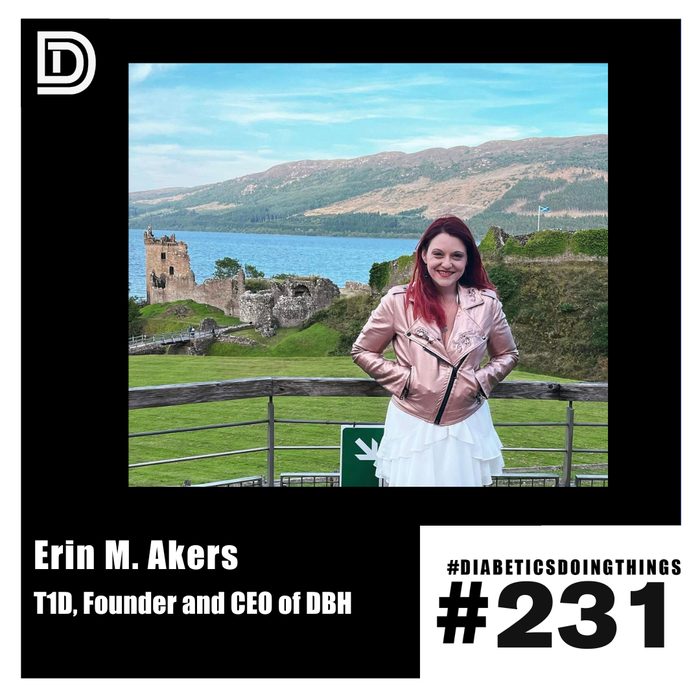
Erin Akers, T1D, Founder and CEO of DBH


Episode summary
Erin Akers returns to the podcast to discuss how the Diabulimia Helpline she founded has become DBH, expanding from eating disorders into broader diabetes and mental health work, including depression, anxiety, and burnout. She explains the link between diabetes burnout, serotonin depletion from sustained high blood sugar, and the slide into disordered eating. She describes DBH's 24-hour hotline, therapist database, and Facebook support group. She talks about her own diabulimia as a teenager, missing her prom because of DKA, and finding community online. She previews DBH's conference in London, its focus on underrepresented voices including men, and her talk on toxic positivity. Co-host Eritrea shares her own diagnosis story and hopes to attend.
Key takeaways
- Erin says diabetes burnout isn't an endpoint; blood sugar held above 250 for long stretches lowers serotonin and can create a physical depression that reinforces the burnout cycle.
- Diabulimia Helpline became DBH to cover depression, anxiety, and burnout as well as eating disorders, since Erin says the two are closely linked, often starting with burnout.
- Erin cites studies showing roughly one in four women and one in seven men with diabetes have omitted insulin to lose weight, a pattern seen in the US, Sweden, Norway, and China.
- DBH runs a 24-hour hotline, a therapist database for chronic illness, and a Facebook support group of about 5,000 people worldwide.
- Erin's advice for teens with diabetes: make the accommodations you need, then go live your life instead of hiding the condition or letting it take over.
Show notes
Erin Akers is back on the pod! Erin is the founder of the Diabulimia Helpline, now DBH.
In this episode Rob, Eritrea, and Erin talk about:
Diabulimia Helpline’s transition to DBH
Erin’s mother and one of the GOATs, Mama Dawn
The 3rd International Conference on Diabetes & Eating Disorders In November
Presenting at ADCES in Houston this year
Broader world of Mental Health and Diabetes including burnout, anxiety, and depression
The importance of group support
Representation matters especially in conversations about disordered eating
The warning signs of diabulimia
The destructive nature of toxic positivity
Want to volunteer for the helpline? Send an email to info@dbh.org
We want to hear from you. Send your questions, comments, queries, and general diabetes concerns to THE MAILBAG at mailbag@diabeticsdoingthings.com!
Questions this episode answers
What is diabulimia?
Diabulimia is restricting or skipping insulin to lose weight. Erin Akers notes it isn't a formal DSM diagnosis, which is part of why her organization moved from Diabulimia Helpline to the broader name DBH.
How does diabetes burnout affect mental health?
Erin Akers says prolonged high blood sugar lowers serotonin production, which can create a physical depression that reinforces burnout and raises the risk of disordered eating.
How common is insulin omission for weight loss among people with diabetes?
Erin Akers cites research showing about one in four women and one in seven men with diabetes have omitted insulin to lose weight, with similar findings replicated in Sweden, Norway, and China.
How can someone volunteer with DBH (formerly Diabulimia Helpline)?
Email info@dbh.org or message DBH on Instagram. Volunteers can help staff the 24-hour hotline, work on finances, or assist with planning the annual conference.
Full transcript Searchable, with timestamps
Rob Howe: Hello and welcome back to another episode of Diabetics Doing Things. We are telling the amazing stories of people with diabetes all over the world. And we got a pretty exciting agenda today because one of our first 60 episode guests is back here to do round two, not only to update us on what she and all the folks behind the Diabulimia helpline are up to. But I wanted to preface this with, we've been talking about mental health. We've been talking about disordered eating. We've been talking about some of the obstacles and challenges that people with diabetes deal with outside of just blood sugar management, outside of just carb counting and exercise and all of those sort of the basics of diabetes. And we're extending into these adjacent spaces and challenges that people with diabetes know all too well, but often go overlooked in the mainstream media side of diabetes coverage. So I'd like to welcome back the founder of the Diabulimia Helpline and chairman of the board, Erin Akers. Welcome back to the show.
Erin Akers: Hi, guys. It's so good to see you both. I know you both outside of the podcast. I have spent time with you both. And so it's just so nice to be here. And Rob, I've known you for, oh my gosh, so long. And so it's so nice to be here.
Rob Howe: It's so funny. I was reflecting on just exactly what you said. The first thing being like, you were one of the first people that I had on the podcast and then subsequently met at like multiple events afterwards. I think the first time we met was ADA 2018. So shortly after we had recorded that first episode. and then I can't tell you how many times we've run into each other both overseas and also running into your mom and at different conferences all over the country so yeah always feel very close and I know I'm in the right place whenever I run into you so yeah oh my god let's talk about your
Eritrea: mom yeah we have to say it Erin's mom came with her to a conference when I met Erin and she's so sweet your mom is a gem love her shout out to Erin's mom momadon momadon is known
Erin Akers: throughout the diabetes world, now internationally as well. And yeah, I will say she came back from a conference because she is now the executive director of Diabulimia Helpline, and she is getting her master's in mental health counseling to work specifically with people with chronic illnesses and mental health disorders. And so she is now attending conferences, formerly as an advocate and now as a mental health professional. and she came back from a conference and she said, you will not believe who I ran into. And I said, who? And she said, tallest man you ever knew. And I said, oh, Rob, you ran into Rob. And she said, yeah, he gave me a big old and he ran right to me and he said, Aaron's mom. And so she is beloved and she was in the diabetes sphere so long that she said, you know what? I'm just going to switch jobs so I can do this for a living. And so now she is working now just as the executive director of Diabulimia Helpline, but she is in school right now to get her master's so she can help those of us who are suffering from mental health disorders alongside our diabetes.
Rob Howe: Well, I can't think of a better path for someone who's such a true advocate from going to just advocating in their spare time and giving of themselves to then turning that into their professional career to better people long term. And yeah, that's exactly what I did. I hopped out of my booth. There was like a line of people in front. And I was like, no, I'm going to go talk to Mama Dawn and give her a big hug for all that she does. So it's always nice to see a friendly face, especially at those big conferences where there's a lot of people around. So looking forward to running into both of you again down the road.
Erin Akers: Yep, she will. She will be at, we will both be at, in Houston at ADCES. We have a poster presentation that we are actually presenting on the risk of suicidality in people with type 1 diabetes because the Diabulimia Helpline, which is now DBH, because we have moved beyond just diabetes and eating disorders. And now we do diabetes and all mental health kind of as part of our expansion. and one of the things that we have really been looking into in the last couple of years with one of our board members who's specializing in it is the risk of suicidal ideation and suicidal risk in people with type 1 diabetes and how that is very unlooked at and unstudied and the more that it is studied the more risk we see and just like everything else in type 1 diabetes, kind of, the more we look at it in mental health, the more we see it. And so we're doing a presentation at ADCES on it. And I'm really excited to see that. We actually have a presentation at the International Conference, not us, but a different speaker, where when is lack of self-care actually self-harm, right? When do we stop taking care of ourself actually an act of self-harm. And I think that's an important line that we draw and that we look at. And so I was so excited when we got that proposal in. And that was one of the ones that the committee was checkmarked. Yes, absolutely. We were very excited to be able to have that one at the conference.
Rob Howe: I love that sort of progression. And we talked about your mom's progression from advocacy to professional and pursuing her master's now as well. I want to talk about the progression, not only of you personally, but also now from Diabulimia Helpline to DBH to be a more all-encompassing resource for diabetes and mental health. I think that connection to, as you mentioned, suicidality and not caring for yourself in diabetes and where that turns into actual self-harm. How has that journey been? Obviously, you guys were the first, I think, public resource that I encountered about diabulimia. And I've learned so much about diabetes and disordered eating just from interfacing with you guys in the community over the last few years and all the amazing advocates that have told their stories. But how did that progress? And where did you identify that there were other adjacent mental health, you know, challenges and disorders that you guys felt you could, you know, be in a position
Erin Akers: to get people help? Yeah, it was, it was a really, it was, it was both long and yet a seamless transition. When we started out, there was, there were no resources for diabetes and eating disorders. There were amazing, there was an amazing resource that's still a dip called BDI, Behavioral Diabetes Institute in San Diego for diabetes and mental health. And I just want to give them a huge shout out. You know, Susan Guzman and Bill Polonsky run it and they were doing amazing work. But they really focused on mental health and there weren't really a lot of things out there for eating disorders, especially for patients. And so we really focused on that and we were the first 501c3 national nonprofit to really focus on that. And then we progressed to having a sister organization in London and then one in New Zealand called DITA to kind of just expand, both run by former clients of ours, actually, that had the same kind of thought that was, there are no organizations in our country that are doing this and there need to be. And eventually, in around 2018, BDI had lost their funding and they stopped being able to put on conferences. And it was, I think, a really tragic loss to the diabetes community. And what we also were saying was that so many of our personal clients who had come to us with diabetes, they had other mental health disorders as well. They had depression, they had anxiety, they had burnout and diabulimia are so closely linked. My diabulimia started with burnout and so many other people's. It's the most common starting factor in disordered eating. Well, in diabulimia specifically is burnout and a sense of diabetes distress. And so to be able to tease those apart, you really need to be able to have some professional resources for the depression and the anxiety and the diabetes burnout and the diabetes distress. And so it became obvious that in order to fully help these people, we had to have the resources for things beyond eating disorders, for things like depression and anxiety. And with the numbers being, you know, 33% of people having depression and, you know, 2.5 times more likely to have anxiety, it just became such an obvious need for people to have those resources and such a lacking in the diabetes space for it. And so when we started the conference, so many of what we got as far as proposals for topics were not just for eating disorders, but they were for things like shame and stigma and things that were general mental health. And you can't really tackle eating disorders without tackling some of the broader mental health topics. And so that's when we moved as a board voted to move into general mental health. And the idea to go to DBH as a term was also because diabulimia is a media point term. It's not in the DSM. It's not a doctor, you know, originated term. It's not something that you can be diagnosed with by a physician. It's not something you can be treated by. And it also is something that can be alienating if what I have is diabetes and anorexia. I don't have diabulimia. If what I have is binge eating disorder and diabetes, I don't have diabulimia. And so we really want to be as inclusive as possible. And we had also moved into, have moved into working with adolescents and working with adolescents with mental health disorders. And if I'm 13 and I hear about diabulimia outline, and I've never heard that term, and I go home and I type it in, I have learned something new. And we don't want to be the reason a 13-year-old learn something that can be not great for them. And so DBH is just a safe way that we can teach a 13-year-old about anxiety and depression and mental health and disordered eating without necessarily giving them the how-tos on an eating disorder.
Rob Howe: That's such an important distinction to make for pediatric patients. And like you said, They've never heard the term and there is that sort of downside sometimes to education at the wrong time or without supervision. And so that's a really interesting sort of caveat on changing the name and evolving that to be more inclusive, but also as sort of a safety standard. I do want to go back a little bit, though, because something you told me has really got my brain spinning, got my wheels spinning. So you were talking about the link between diabetes burnout and diabetes distress and diabetes eating disorders and specifically diabulimia. I think oftentimes I see language in the community where we look at burnout as this sort of destination, the sort of end point of like, you know, it could be anxiety, could be depression, could just be numbers and distress. And that leads you to this or new medication or challenges with insurance. And there's obviously so many inputs that go towards that, but it leads us towards burnout as this destination. And the way that you positioned it is that it's not just the destination, it's an inflection point that can lead to other really harmful adjacent disorders and diseases and both mental and physical. So talk about some of those connections, if you don't mind, about like, you know, when some of the consistent themes that you see with some of the patients that you guys treat and some of the people that you treat through the Diabillemia Helpline and the DBH conference. Like, what are some of those things to watch out for in that diabetes distress and diabetes burnout that could potentially turn into, you know, something more damaging?
Erin Akers: Yeah, I think it's really important that we as a community and we as physicians both acknowledge that diabetes burnout is not an end point, but really just a middle point for so many people's journey. Because diabetes burnout can last for years. It's not people act like it's something that I hit and then that's rock bottom and then I rebound. and and diabetes burnout can last for for years it can be a place where I just sit and I think that this is as good as it's going to get and this is where my diabetes lives and this is where I I exist and this is where my life is and the physical complications of that are the ones that we all know right those are the the diabetes complications that don't you know need to be repeated. But the mental complications of that are the fact that there are no serotonin in your body. The longer you live at high blood sugar levels, the less serotonin your body starts to create. And so you are now causing a physical depression in your body, a clinical depression, because you have a blood sugar of higher than 250. So the longer your blood sugar is above 250, the less serotonin your body makes and the longer you are creating a physical depression in your body. And so we act like you, you know, you get to burn out and then that's that's the end. But you get to burn out and you start to create a loop because you start to create a physical depression, which then keeps you in burnout because you're depressed about your diabetes and you're depressed about where your diabetes is. And because you don't like where your diabetes is, you are in a physical depression. And because you're in a physical depression, you can't do anything about your diabetes. And so it becomes a loop that is reinforcing itself. And so once you hit that point, there are so many different mental places that people spiral down. There's anxiety about the complications that people have. Like we all know that you don't get there. And then you're like, well, oh, well, you think about the complications, about what's going to happen in 10 years. You think about, oh, my eyes, my feet, my kidneys. Nobody is a diabetic that's just like, well, Well, I'm sure everything's going to be fine. You think about what's going to happen and that causes major anxiety. And a lot of people have anxiety about the fact that they're not doing anything, but they're in a depressive cycle or a burnout spiral and they can't do anything. There's the depression itself and all of the complications that that can cause. A lack of serotonin causes a lack of dopamine and it can actually cause your body to create less and less of the hormones that you need. And that can cause a lasting long-term effects that can actually take medication to restart in your brain. And then there's, of course, the eating disorders, which is that if you see a weight drop and you have a lack of dopamine and a lack of serotonin in your body and people around you are saying, well, you look great. And you feel like, but people are saying, well, you look great. You're thinking, at least that's something. That's something I can hold on to. I don't feel good and I hate myself right now, but gosh darn it, I look so good in these genes and everyone is saying so. And so and I know it's coming from something. And so that's where the eating disorder starts. And so that's when you start restricting food or restricting insulin or doing unhealthy coping behaviors because you don't feel good, but you think at least I look good or at least there is a numbing behavior in which I can make the bad feeling stop in some way.
Rob Howe: Well, and I think you mentioned it as well. If you're starved for dopamine as well because of your anxiety, depression, and disordered eating, that compliment may give you the dopamine that your brain is craving just to keep, you know, powering yourself up. And that, you know, creates another pattern. I think, you know, for people who are not as experienced going through like talk therapy, and we've talked a lot about it really in the last six months on this podcast is a really important part of what we recommend for people with diabetes. And there's obviously so many barriers to diabetes in general, but also just practical mental health. And it varies very much state to state, country to country. but one of the things that has come up repeatedly for me in my work with my therapist over the years is the recognition of patterns and you just talked about that pattern and the sort of doom loop of you know a little bit of anxiety leading to some depression leading to restricting insulin or you know not you know checking your blood sugar or you know whatever whatever however that manifests itself in your diabetes therapy and then kind of getting stuck in that loop that ends up leading to more destructive loops and behaviors, what advice would you give or do you guys give at DBH for people who maybe aren't recognizing some of the patterns and cycles that they're setting themselves on? And where would you ask them to start if they were curious about, hey, maybe some of this behavior is linked and maybe I am starting down one of these paths or in a negative pattern that could be leading me somewhere dangerous?
Erin Akers: well we obviously always start with saying therapy you know we also obviously always start with a good therapist is is key and we have a database of therapists who are trained in working with people with chronic illnesses diabetes but also just chronic illnesses in general because the grief that you experience from a chronic illness is so unique and so specific that having somebody that you don't have to explain that to and also having somebody that you don't have to explain it to when you have the the fear of going low and the fear of going high and and and the fear of what the long-term complications mean so we always start with therapy and because as a therapist will be able to tell you if what you need is, you know, CBT or EMDR, you know, very different kinds of modalities for very different kinds of trauma. But beyond that, there are different kinds, you know, just because no one else can heal or do your inner work for you doesn't mean you can, should, or need to do it alone. For so many people, seeing a therapist or going to, you know, treatment every week might not be a reality. And as someone who goes to therapy every single week, therapy is expensive as hell. You know, I'm not going to pretend like therapy is a luxury and a privilege, and I will acknowledge my privilege full-heartedly. I love my therapist. You know, shout out to Quinn. You know, I'm sure she's listening to this. I'm sure she's a big Diabex doing things fan. And but she's a luxury. She is something that I can afford because I have the money. And I think that if you can't afford therapy, the work that you need to do is still something that you should be doing with other people. And that does not mean that your friends are somebody that should be doing it for you. You know, if your friends are looking at you like like you need to be paying me right now, that means it's time to stop complaining to your friends. Right. And there are communities out there, though, and those communities are out there for a reason. And Diabulimia Helpline started as a Facebook support group, and we still have a Facebook support group that is, you know, 5,000 people strong now from all over the world. You know, we have people from almost every continent. You know, I think Antarctica is missing. So, you know, shout out to, oh, I can't remember her name, but your last guest. Get her to- Rage Soil. Rage Soil, yeah. made me feel like I need to get my shit together, like making sure her low juice isn't frozen. And I'm like, I can barely remember to bring mine half the time. But, you know, get her to join. She can represent the continent. But, you know, we've got 5,000 people there. So no matter where you're from or what you're struggling with, there's someone there that's going to be able to help you. And or, you know, come to the conference. It costs what one week of therapy costs for me. And that was important for us. And we've got discounts too. And to make sure that it, and we have scholarships because we want to make sure that cost is not a barrier because it's a good way to get a start on the journey. You know, I'm not saying come to the conference and you're cured, but I'm saying it can be a good jumpstart and that there are communities out there that can help you. on that journey. If there's also, you know, if you're in diabetes distress, there's diabetes distress at all, take the questionnaire and go through it and, you know, find out if, you know, how far down are you? The seven points on it, I think are really good and really important to find out where you are and where you need work. It can be, if you're in therapy, it can be a good place to bring into your therapist. And if you're not in therapy, it can be a good thing to bring to, again, a community-based group to be like, yo, this is what I'm struggling with. Anyone else struggling? There are diabetes and mental health groups on Facebook. And that's specifically for that. You don't even need to take it to a general diabetes group. You can take it to a diabetes and mental health group where everyone else is struggling with something else, where everyone else is saying, I'm in burnout, I'm in distress, I'm on the brink too. And I think being on the brink was kind of what this conference was built upon, was that idea that there are so many of us out there that are there, that are on the brink.
Rob Howe: Well, I want to dig into the conference a little bit because I know this is the third conference, conference but it's the first one that's in person because of because of covid it's been difficult
Erin Akers: obviously getting everybody together they've all been in person okay this is just the first one that's in london so this is our first international one the first one was in new orleans the second one was in san diego and this one's in london so this is our first international conference the the the The in-person one is really important to us because every experience we have, people kind of add to the tapestry of who we are, right? And the big emotional experience has a chance to truly change us. And the more intense the emotional experience, the more likely it is to cause a lasting change. And we've seen in the past five years of the conference that the attendees who go to this conference, who are waffling in their recovery, find that, you know, that lasting path they were missing. And those that were missing, you know, kind of a recovery path altogether find that beginning of the road that leads to, you know, a life of peace that we're all looking for. But it really starts with, you know, a lunch together, a processing group where we talk about our feelings or an interactive session led by a doctor who also happens to be a type 1 diabetic herself. But it needs to be in person where you're looking someone in the eye, where you're holding somebody's hand, where you can say to somebody. I see you. I feel you. You know, it's the hug. It's it's the running up to somebody at a conference. it's the it's it's the thing that makes almost all diabetics instant friends it's that i see you you see me we are we are kin and and so it's it's what we have had the the support group online for 14 years now and we have seen such important relationships grow from that we've seen bridesmaids and best friends and and and godmothers come from that group and so we We know that the relationships are what matter. And so we knew that getting people together in person was going to be a really important aspect of this conference.
Rob Howe: I totally agree. And I think there's something to just a galvanizing experience. You think of, for me, when I was a kid, going to summer camps and just being away from your normal day-to-day, committed to something with a group of people, whether it's learning, whether it's searching, whether it's community focused. Obviously, there's tons of research about just the impact of being able to, like you said, sit down with a professional or just appear and say, I see you, I accept you as you are. And we're both here today looking for something for each other and here to not only look for something for themselves, but also extend and help others. And as I look at the speakers at the conference, lots of friends of the podcast, Mary Mosier, Sarah Moback, and obviously yourself. So just an amazing array of people from all over the world, you know, there for a, you know, a singular purpose to connect with others who are like them. And like you said, like being international now, like, and being able to address these issues from all over the world, like, obviously, in every country, there are different, you know, access challenges, there are different socioeconomic challenges, there are different stigmas. But being able to hear from different sides, I imagine, is just an incredible experience for, you know, for everybody who attends.
Erin Akers: Yeah, it was it was really important to us when we started the conference. You know, it was called the International Conference at the beginning because we knew we wanted to hear from from all over. And we wanted to hear new voices, not the same 20 people that have been kind of saturating the diabetes sphere for the last 20 years. We wanted to hear new research. We wanted to hear cutting-edge research. We give awards every year called the Flame Awards. And one is the committee hands out is called Innovator of the Year, and it's to a clinician doing groundbreaking research. And one is Advocate of the Year to a patient who's really pushing the field forward for patients in diabetes eating disorders. And it goes back to our theory that the only way to solve the kind of the crisis facing our community is with this holistic approach by both clinicians and patients working together. And that also means that we have to do it internationally, that it can't be this Eurocentric idea that Americans can solve it. I mean, one out of four Americans or one out of four women, excuse me, and one out of four men with diabetes are omitting insulin in order to lose weight. And that has been a study that has been replicated in Sweden, in Norway, in China and all over the world. And so we need to hear from these countries where they're seeing the exact same results and figure out not only why is this happening everywhere, but what are they doing differently? We have an entire session that's just the French telling us what they're doing because they have an entire conference called the Congress about Diabetes and Eating Disorders. So what are they doing over there that is different than what we're doing over here? so many of our speakers are from the UK, where they don't call it diabulimia anymore. They call it T1DE, type 1 disordered eating. And they've got it in Parliament. They've got laws about it in Parliament because one of their leaders in Parliament lost his daughter to the complications of diabulimia. And she was actually a volunteer of our organization in London. And so it hit really close to home. And so they've worked really hard to kind of push that through parliament. And so we want to hear, you know, first of all, what are they doing over there? Second of all, how did they do it? You know, it's a much smaller country, but we would love to see some of that advocacy represented over here. And so we really, and we've got speakers from Eritrea, and I was happy, she's from South Africa, and she's talking to us about what it means to have mental health issues in South Africa with diabetes. You know, we talk about what it means to have the issues over here, but, you know, when you have issues having, or you have issues getting diabetes supplies in South Africa, what does it mean to face mental health access as well? And so we really want to hear about what it means all over the world to face diabetes and mental health access challenges and what can we be doing better. We're partnering with a lot of really amazing organizations. When we were in the United States, we offered 14 CEUs, so that professionals could come and learn and get credit for their jobs. And now that we're international, we'll be offering CPD credits, which is kind of the international version of CEUs, and partnering up with JDRF UK and some of the international organizations now that we're going to be in London. And it's just it's it's really important to us to show that. This is not a Eurocentric problem, and so we cannot have a Eurocentric approach. We need to hear from all over the world and from all different all different countries. As well as what Americans think, because we always hear what Americans think.
Rob Howe: We do. We're all pretty we're all pretty loud.
Eritrea: All you Americans have microphones. It's the whole thing. everybody everybody's got a podcast right no I love that I think it's great that you want to I mean obviously yeah how can you get a full view of something unless you get everybody's point of view right and I think that when we're talking about eating disorders so much of it is focused on women and I feel that like we're constantly talking about women and eating disorders and how like our mental is around it and men are just so underrepresented so I guess my I'm wondering like what the resources for men really are when it comes to disordered eating? Because, I mean, I think the stat you gave was one in four men with diabetes. Which is insane. Yeah, it's insane.
Erin Akers: Yeah. So it's one out of four for women, one out of seven for men, which, yeah, it's insane. We have a marginalized panel, which will include people of the BIPOC community and then males. Because in the eating disorder community, males are a marginalized population. And so in the past and at this conference as well, it's really important to us to hear what it means to be a male with an eating disorder because they are a marginalized population. Like you said, you see a pamphlet come out from NEDA and it's for women. It used to be for skinny white women, but it's gotten a little better, a little better. But it is still usually it's for women. And so we need to be acknowledgement that especially in the diabetes world, we have a higher than normal rate than we do in the general population of eating disorders in men. This is because men are given the same training, same age education that women are given around diabetes, around the importance of food, around the importance of numbers, the same kind of socio training that we are given that make us higher than normal to have an eating disorder, men get that too. And so although we have a biological imperative to have an eating disorder, those also are something that male have. The fact that we don't get satiety signals, that's something that men have. there are a lot of things that make men more likely to get it for if they're if they have diabetes and so that's something we we will be talking about in that marginalized panel because in in in the eating disorder world men are a marginalized community which feels so strange to say in our in our world right to be like men need a voice too but but they do in the eating disorder community you have to acknowledge that men need a voice so we'll have a panel that will be three people of, well, two people of color, one person from the LGBTQ community, and then two men. Because we want to make sure that we're hearing from everybody to hear, what did it mean to have your care affected by being a male? Was it hard to get access to get from eating disorders as a male? And then there are two male-focused eating disorder organizations that we work with that And I'm not going to remember. Beat Ed is the name of one of them that is in the UK that is male focused for eating disorders. And another one that I will send a link to so that you guys can put it up that's in the US. But that both work exclusively with male. So they are male focused eating disorder resources. Unfortunately, they're not for diabetes male focused eating disorder. That's kind of one you're going to have to tease out between the diabetes-focused eating disorders and the male-focused eating disorders. But there are some good male eating disorder resources out there.
Rob Howe: Well, that was actually one of the reasons why earlier this year we did a little episode with Ben Tzeel to offer his CDCES perspective, but also having two men discuss disordered eating on a podcast. I think I just had not seen in the diabetes community. And, and, you know, obviously, although, you know, the, the premise of that was mostly like, if you have diabetes, like you live with disordered eating, even if you're, you don't have an eating disorder, like a diagnosed eating disorder, just because of how much information you're balancing on a regular basis. And like you said, men and women often have the same like socio introduction to diabetes and training. And And so there is, you know, some challenges there, obviously. So, you know, I think that was an interesting, you know, opportunity to just like bring that into the open. And you're right. It is weird to say, oh, like men are underrepresented. And it's like, are they really? And it's like, yes, they are in this case. And I think like it's just important to normalize that conversation rather than to just make it so, you know, exclusive to one gender or another. And, you know, I think I think it's awesome to have more representation on those panels just to hear a different perspective. And often, like you said, the perspectives from around the world, diabetes is not a monolith. And we often talk about access and mental health and information, but those are not a monolith either. And if your number one priority is you're unable to get test strips and you live in a remote South Africa, well, that's a very different mental health challenge than somebody living in the U.S. or a more developed country or with more resources. And so, you know, just I think it's so enlightening to just be able to hear person to person, peer to peer perspectives that just open your eyes about what it's like to live with diabetes in other places, because it truly is so different for everyone.
Erin Akers: Yeah, we're really excited. And I have to say, I heard that interview with Ben and I loved it. It was so well done. And I thought that you guys really covered a lot of what makes it so easy for people to fall into the trap of, do I have disorder eating or do I have eating disorders? And I love Ben. He just posted something on Instagram the other day that just said, diabulimia, let's talk about it. And I thought it was just so important to just bring it out right into the open. And I think it's so important that somebody with such a huge following about food and and and weight and body image just says hey like how much of what what i do and and and my body image and my food is is disordered eating and is is eating disordered and to have a male perspective on it was i think so important and i thought that was so well done and sorry i just wanted to give you your flowers and i i i had to i would say that was so important i i i
Rob Howe: I missed the question altogether. No, no, it's fine. I think it's a good transition because I think we've talked about some of the warning signs. We've talked about the intersection of burnout and eating disorders and diabulimia specifically. We talked about DBH being more inclusive of the other diabetes and related eating disorders, not just diabulimia. And also like the difficulties of, you know, education while also wanting to make sure that it's education in the right way so that the, you know, vulnerable people at the wrong time don't discover it. I want to kind of rewind back to a little bit of our first interview about your story, but I want to focus on the time in our lives with diabetes that HCPs, and I think often in previous and maybe still, you know, at large, but like in the diabetes community, we're doing better to unpack this language, but that we typically call as non-compliant. And, you know, the teenage years and those years where there's so many hormones, there's so many life changes, you're really learning who you are, you're growing, you're changing, going through puberty. And it's often labeled sort of under teenage rebelliousness. So I'd love to address like, you know, for you and your story and for the community members that you serve through DBH and the helpline for caregivers and or people who are living in that time of their life with diabetes right now. Just some, I don't know, words of advice or normalization about, you know, difficulties during that time. Because I, you know, when parents talk to me, I tell them that was the most difficult time with my life with diabetes. It was also at the very beginning for me. So for people who've lived with diabetes for a long time, sometimes it can be a little bit shocking, but I would love to just talk about like that, that timeframe specifically and its role in mental health and, you know, in, in disorder eating.
Erin Akers: Yeah, that, that was not, that, that was not good times for me. Teenage years was, was not a fun time. I, that's when my eating disorder was at, was, was with a raging beast. It was, it's kind of acknowledged in my house that most of what what was done in in my house was kind of you know we were kind of like oh well that that wasn't Aaron that was the eating disorder and and and and it's it's like my blood sugar was rarely below 500 for for a good portion of of my high school life and and i missed my my prom because i was in the hospital because i was so intent on being thin enough for my prom that i ended up in dka um and so for for for kids and teenagers I would say focus on on living your life focus on on on on on doing whatever you need to do to be a person and and you know that means having a healthy blood sugar you know I couldn't do anything because my blood sugar was 500 I ended up taking half of my classes online because I was so sick. I couldn't have a full schedule. I was so intent on not letting my diabetes control me that my diabetes was absolutely controlling every aspect of what I did. And so I think it's important to just acknowledge that, okay, you have diabetes. That sucks. It would be better to not have diabetes. No one's going to tell you that it wouldn't. So make the accommodations you need to make and then go about your life. You need to add in half an hour for a test so you can have a low. All right, do that and then go about your life. Don't try to hide it. Don't try to pretend like it's not there. Do what you got to do. And, and, you know, be, be, be whatever kind of diabetic you need to be to live your life. And if that means you need to be a person with diabetes, be a person with diabetes. If that means you need to be a diabetic, be a diabetic, you know, just don't let it be the thing that controls you. And I think by hiding from it and running from it like with all emotions the more you run from it the more it controls you and so I think just just just be it just let it let it be a part of who you are and and not all of who you are and also not none of who you are just let it be part of of you are the the happiest I think I ever was was when I finally just acknowledged, I was like, yeah, no, I'm diabetic. That's a part of me. And find your community. I refused to go to diabetes camps as a kid. I refused to go to JDRF events. I would not reach out. And when my mom tried to reach out, she would go to the family picnics and I'd be like, well, you have fun. I'm going to stay at home. Mama Dawn, always trying to look out.
Rob Howe: Shout out Mama Dawn forever.
Erin Akers: Shout out Mama Dawn. And, but like if that moment I found my community, I was obviously online first, but that changed it, that changed it all. And the closer I got to the people that I felt like were my community, the closer I got to finding true and lasting acceptance to who I was. And I mean, the diabetes conferences I attended at the beginning of my advocacy career were absolutely life changing. But I always left feeling a little like the odd man out still. I knew these people were searching for like 5.0 A1Cs. And I was sitting there with like a 12 being like, how do I get into the single digits? And I wondered if there was a place for me. and people who were just trying to survive, people holding on by a thread. And it was after learning just how many people were feeling the same that we created the DBH conference, DBHCon. Because it was also clear that the healthcare professional should be seeing that side of diabetes too. And that's how the TwoTrack conference was born because it's important for healthcare professionals to learn about treatment and it's important for patients to learn about recovery. But some of those inspirational moments have been when a provider and a patient sit down at a lunch together and finally understand each other's experience as a human and see this is someone who's going through some shit and they just need some understanding. And that goes both ways. That's also a diabetic who's like, my endo is not the scariest person alive. there's someone who had a bad day. And I think sitting down at a lunch together really changes that. And that goes back to the idea that we really wanted it in person and we wanted it to be a two-track event. We did not want to isolate it. We did not want it to be healthcare only. We did not want it to be patient only. We wanted it to be both people. We wanted it to be able to sit down, look across from someone and say, this is not somebody who's non-compliant, you know, like we talked about earlier. This is somebody with depression. This is somebody who lost their mother. This is somebody who has an issue that you need to take a second to learn about because this is a human just like you and I.
Rob Howe: Well, and I think, too, there's room for growth and there's room for connection on both sides of the examination room. And I think like just being able to have a space for that, both for providers and patients, is just a huge advantage. So very excited to, and I think you hit some notes in that as well, that I really want to hear your topic, your speech at DBHCon23, the destructive nature of toxic positivity. Because I just heard like how much, how damaging that can really be and, you know, how powerful it can be when you just say, hey, I do have diabetes and that is part of me. And I've talked about that on this podcast a lot of, you know, we're kind of diagnosed two separate times, like once when the doctor tells us and once when we accept that and make it part of us and embrace it rather than resist. And so, you know, thank you so much for for bringing a voice to that. I know Aretra has one more question kind of before we start to close, but I want to make sure.
Eritrea: Oh, it wasn't a question. It was more or less like something Aaron said that I was just like, wow, that really reminded me of something from when I was Aaron. So it's kind of going backwards, right? But I'll just mention it now. So Erin and I were diagnosed around some more times. I was also diagnosed when I was nine. And she's right. There is this like theme of teenage rebelliousness that kind of happens somewhere. And it can be, you know, further extreme than for people. But I just remember something an ACP told me once because I would like manipulate my book triggers here and there, not every day or, you know, to that extent, but just, you know, here and there. And he was like, well, you have to manage your diabetes anyway. way so why don't you just do it the right way now this is something like when aaron was talking about how like it can just be so skewed the way people see it it reminded me of that conversation so it's so crazy that now 15 years later you know the the way you hdps talk to people with diabetes is so important because it is a seed that can live in your mind forever right and so the importance of that just really got drilled home and i you know i'm hoping to be at dbh con this year so I will be there and I can't wait to hear everything else because it's just, you're so passionate about what you're sharing that it's, it's, you know, it's palpable. So, yeah.
Rob Howe: And also you're just a great podcast interview. So I got to just keep remembering that just to have you back on because you really nail your points. You're great.
Erin Akers: Thank you. And I have to say, Eritrea, you were, I mean, it is, it's those, it's those one liners, right? It's those one thing that a healthcare provider says. And, you know, we have, we have the 24 hour hotline where people can call if they're in any sort of mental health distress and the amount of time somebody because I work it from time to time and the amount of times that someone has called and has shared something that a health care provider has said. And it's always, you know, one line, you know, my doctor has told me that if I don't lose 40 pounds, I'll be dead before I'm 20. And we did have, you know, a teenager call and say that. And how could you say that to a teenager? And how could you not think that a teenager is going to develop an eating disorder after saying that. And it's those one-liners that a healthcare professional will throw out without thinking about the fact that you're talking to a teenager who is digesting everything you're saying and looking at you like an authority figure. And especially the language we use around adolescents especially, but these people that are trying to learn how to take care of themselves and every single second of every single day and you're spending 10 minutes with them. You can't watch, you know, the nine sentences you tell me. Like it is baffling. And so it really is, it is really inspirational to see. And like I said, I do like it to go both ways because I have had a lot of bitterness towards some healthcare professionals in my day, both from my own experience and especially from working with my clients and just being like, you know, how could you talk? And then to see healthcare would be like, I did not understand. I did not understand the side of it. I did not understand. And then to see them be able to change their perspective and to know they were just somebody who did not get it to. And we're all just human. We're all just like, you know, like exactly like you said, Rob, we're all just trying to learn. And to be able to see that the healthcare professionals taking advantage of this conference, trying to learn, trying to better themselves also makes me you know, they're not willfully ignorant. They're not taught this stuff in med school. There's not a class on diabetes and eating disorders. And so when you see healthcare professionals take this step, trying to learn, trying to better themselves, you're like, okay, we're all moving forward at the same, you know, we're all trying to do our best. We're all, mental health and diabetes is not, it's still a new field. And so we're all trying to better ourselves together. And that can be really hopeful to leave with is knowing that like, we're all, we're all in this together.
Rob Howe: We are. And I thank you for that reminder that this is all new. You know, I think we, I consider myself very fortunate to be as informed as I am in the diabetes community and to have my content curated in a way that I make sure I don't miss things and that I'm up on the latest and greatest. And I just remember that that's not true for everyone and everybody's on their own path. And there's so much work that just, just the basics of diabetes at the general public, like decades and decades of work and stigma that needs to be, you know, undone. But we are making progress and that's excellent. And I think like one thing I'd like to leave us on is you mentioned this just now and I think it's a great final, it's a great finish is that if you do want to help and you do want to, you know, potentially connect with someone and be a volunteer, like how could someone who wants to volunteer for the helpline, you know, where do they go? Where should we, where should we
Erin Akers: send them? Yes, please. So we have a 24-hour hotline and we always need volunteers to staff it. All you need to do is be somebody with diabetes who wants to learn about mental health and go through a couple of training. Send us an email, info@dbh.org. Pretty simple. You can also find us on Instagram at Diabulimia Helpline and shoot us an email and we will find something for you to do. You like numbers, we will let you play with our finances. You will want to help people, we will put you on the phone line. You like event planning, we will let you help plan the conference. So, you know, we love volunteers and we love to connect people with things they are passionate about. So if you have diabetes and mental health issues in your past, and one of the best ways that you can stay on a track for recovery is to help somebody else. It was the way that I was able to find recovery. It can be a great way for you to find recovery is to help somebody who is also
Rob Howe: struggling. Well, we will absolutely include that in the show notes. And for those who are listening, and I always shout out the show notes, we did figure out a way to fix the show notes issues we've been having on Spotify. So be sure to check those out. Aaron, thank you so much for giving your time today in the middle of your workday to talk to us so deeply about the work that you're doing at DBH. Again, the conference is the third international conference on diabetes and eating disorders. It is November 10th through 12th of 2023 in London. And if you're looking for a hashtag to follow on social media, it's DBHCon23 and more information at dbh.org. All right. Erin, thank you so much again. Thank you so much for coming. Again, I can't wait to run into you at our next event and or, you know, see your mom from across the conference and weird everybody out by waving and jumping and running over to her and saying, hey, you guys are, you know, really, truly for me, like friends with diabetes. And I just appreciate that. And for always being so supportive of diabetics doing things. I appreciate you guys's partnership and looking forward to seeing what great things come from this year's conference.
Erin Akers: yeah we're so excited to see you and Eritrea hope to see you there yeah I'm really I'm trying
Eritrea: really hard to get it approved so that I can get the flights paid for because it's expensive but yeah I might just talk to you offline about other places who offer sponsored like to sponsor people
Erin Akers: so yeah all right well it's so great to talk to you both and thank you so much for having me it was so great to be here again Rob and maybe I'll see you in another seven years to see what you're up to. Oh, and congratulations on the move, by the way. I can see the new plates in the background.
Rob Howe: It looks great. You're actually the first podcast recorded in the new office. So you'll have that
Erin Akers: distinction forever. Oh, I feel so honored. Thanks so much, guys. I'll talk to you later. Bye.
About Erin
Erin Akers is the founder of the Diabulimia Helpline, now DBH, and lives with type 1 diabetes. She has her own history with diabulimia as a teenager and now leads DBH's expanded work on diabetes and mental health, including its annual international conference.