

Doing Well with Diabetes: Jyotsana Rangeen
Episode summary
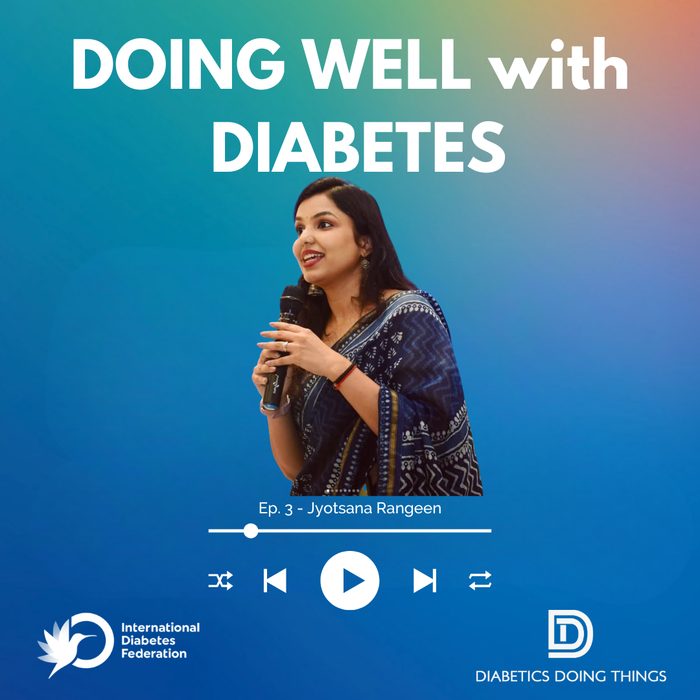
Jyotsana Rangeen was diagnosed with type 1 diabetes in 2015 at age 21, after finishing college in Delhi, India. Her family was told to hide the diagnosis and call it a stomach bug, and relatives asked how an active dancer and basketball player could have diabetes. The stigma left her afraid she would lose dance, her passion since age three. Six months later her father was diagnosed with cancer, and watching him fight it pushed her to relearn her body and get back to dancing. She began posting videos wearing her insulin pump and CGM in public, which connected her to thousands of people online and led her into advocacy with the International Diabetes Federation's Young Leaders in Diabetes program and Blue Circle Voices.
Key takeaways
- Jyotsana Rangeen was told by relatives to hide her type 1 diabetes diagnosis and call it a stomach bug.
- She says her confidence returned after she started posting dance videos while openly wearing her insulin pump and CGM.
- Her father's cancer diagnosis six months after her own motivated her to relearn her body and get back to dancing and basketball.
- Jyotsana says her in-laws initially opposed her marriage because of her diabetes, and she had to convince them she was independent and capable.
- She credits the International Diabetes Federation's Young Leaders in Diabetes program and Blue Circle Voices for connecting her to a global advocacy community.
Chapters
- Introduction to the Diabetes Journey
- Facing Diagnosis and Stigma
- The Power of Language in Diabetes
- Finding Motivation and Confidence
- Embracing Public Advocacy
- Cultural Perspectives on Diabetes
- Transformative Advocacy Journey
- The Importance of Community and Support
- Reflections on Growth and Purpose
Show notes
On episode 3 of Doing Well with Diabetes Season 2, Rob and Jyotsana Rangeen discuss the journey of living with type 1 diabetes, focusing on the challenges of stigma, the importance of community support, and the transformative power of advocacy. Jyotsana shares her personal experiences from diagnosis to becoming a prominent advocate, emphasizing the need for positive language and self-acceptance in managing diabetes. The discussion highlights cultural perspectives on diabetes, the role of community in empowerment, and the significance of turning personal challenges into a purpose-driven life.
Chapters
00:00 Introduction to the Diabetes Journey
01:07 Facing Diagnosis and Stigma
04:59 The Power of Language in Diabetes
08:52 Finding Motivation and Confidence
12:06 Embracing Public Advocacy
16:59 Cultural Perspectives on Diabetes
21:28 Transformative Advocacy Journey
25:19 The Importance of Community and Support
28:20 Reflections on Growth and Purpose
Resources:
https://www.instagram.com/diabetes_india_youth_in_action/
Questions this episode answers
Who is Jyotsana Rangeen?
She is a type 1 diabetes advocate and dancer from Delhi, India, diagnosed in 2015. She works as a change management professional and serves as a Blue Circle Voice and Young Leaders in Diabetes mentor with the International Diabetes Federation.
What stigma did Jyotsana Rangeen face after her diagnosis?
She says she was told to hide her diagnosis and tell visitors it was a stomach bug, and relatives questioned how an active dancer and basketball player could have diabetes.
How did Jyotsana Rangeen get back into dancing after being diagnosed?
She says she spent time learning how her body reacted to different workouts, using injections and a glucometer before she had a pump or CGM, then joined dance workshops and eventually posted videos of herself dancing while visibly wearing her devices.
What is the Young Leaders in Diabetes program mentioned in this episode?
It's an International Diabetes Federation program that Jyotsana says gave her advocacy training and connected her with other young diabetes advocates worldwide; she also serves as an IDF Blue Circle Voice.
Full transcript Searchable, with timestamps
Rob Howe: Jyotsana? Jyotsana Rangeen. Welcome to Season 2 of Doing Well with Diabetes, a collaboration between the International Diabetes Federation and the Diabetics Doing Things podcast. I'm your host, Rob Howe. Doing Well with Diabetes is a series interviewing people living with diabetes from around the globe to help inspire the next generation of people with diabetes globally and learn what it takes to live well with diabetes from their peers. This year's focus is on global health and well-being. So we are interviewing a series of guests from each of the following areas across the globe. South and Central America, Africa, India, and the United States. Doing Well with Diabetes is part of the Kids and Diabetes in Schools program from the International Diabetes Federation and is supported by Sanofi and ISPAD. To learn more about the Kids program, visit kids. And to hear more from Diabetics Doing Things, visit diabeticsdoingthings.com slash subscribe. Now give it up for our next guest on Doing Well with Diabetes. Welcome to episode three of Doing Well with Diabetes season two as part of our global health and well-being series. My guest for this episode is Jyotsana Rangeen, a diabetes advocate from India. Jyotsna and I talk a lot about turning life with T1D into your superpower and how the entire course of your life can change when you embrace your life with diabetes and share it with the world. We also talk about overcoming diabetes stigma as a woman in India and how Jyotsana's advocacy has connected her with thousands of other women online. Please enjoy this very special episode with T1D advocate and my friend, Jyotsana Rangeen. I'm very excited for my guest here today because she and I have been friends on the diabetes online community for many years, and we got to meet this year in person at IDF International Congress. Jyotsana Rangeen, welcome to the show.
Jyotsana Rangeen: Thank you so much, Rob. It's such an honor to be part of Diabetes Doing Well. And it's such, I mean, you have been such a great friend for so many years. And I'm really excited to have this amazing conversation with you today.
Rob Howe: Yes, I think this is another thing that's been so cool about being in the diabetes community online is meeting people from all over the world with shared interests. And you and I also share a passion for basketball. So today we're not going to talk so much about that, but it's always great to find those things in common with each other, no matter where we're from. So, Jo, let's talk a little bit about your diagnosis and a little bit more about who you are and how you joined the type 1 diabetes family.
Jyotsana Rangeen: So hi, everyone. I'm Jyotsana. I live in Delhi, India. I was diagnosed with type 1 diabetes in 2015, so will be completing 10 years now. And I'm a change management professional working with an MNC. I'm a dancer. I'm a type 1 diabetes advocate. And I have been part of the Young Leaders in Diabetes Program of International Diabetes Federation. I'm currently acting as a mentor. And I'm also a blue circle voice of International Diabetes Federation. And really excited and happy to be here with you.
Rob Howe: Jyotsana, thank you for pronouncing your name correctly because I had no idea and I've been mispronouncing your name for so long. So I apologize for that. I'll have to go back and rerecord the intro for us. But something I think that's been really cool about getting to know you over the years is you have been such an advocate for overcoming diabetes stigma. and so much of what people know, the general public knows about diabetes is rooted in misconceptions and misinformation. And I'd love to talk a little bit about your diagnosis and like what you were told you wouldn't be able to do and then kind of how you responded to that.
Jyotsana Rangeen: Absolutely. I think the memory is still so fresh in my mind. When I was diagnosed, I was 21 years old, just after college, and my whole life changed overnight. And at that time, just like so many of us, I had no clue about type 1 diabetes. None in my family knew what type 1 diabetes is. So it came as a very big new kind of a virus in our lives that I had to struggle to understand what it is and how we need to navigate through it, just like COVID happened. But when I was diagnosed, the worst thing that happened was that it was not just the lack of awareness and education that I got in the hospital care. What also came along with that was the stigma, the judgments, the self-doubt that crept in. Because the first thing I was told to hide was that don't share it with anyone. You know, so many people were coming to visiting me in the hospital and I was told, just say it's a stomach bug or something else. Don't tell them it is diabetes. Because it was considered as such a big word. People thought that it's a lifestyle condition. And, you know, so many relatives and friends and family who came there. The first question is, how can she get diabetes? She's such an active kid and she's been dancing, playing basketball. She's doing everything like that. She's not obese. These were the kind of questions that they had. And it was a tough thing for my family to kind of to answer those questions and to really understand what has happened with their daughters. I feel that whenever someone is diagnosed, the one thing that can really change how they live with this condition is how they were treated when they're newly diagnosed. What kind of positive things that are said to them? Because I think if usually the opposite of that happens, which happened with me, those negative judgments, that stigma, that thing that I had to hide it from everyone left me gave me so much self-doubt and it shake, shake in my confidence. After that, I felt like, OK, will I be able to do that? I used to dance a lot. I used to play basketball and all of those questions started coming into my mind. Will I be able to do it or not? And obviously at that time, I was not in my best of health. I was weak. I was tired. I was just not able to understand what was happening in my body. So even though I tried to dance, I tried to play basketball, I was not my best. And that really, you know, that and everything that people were saying, it was actually matching up with what was happening in reality. And I thought, OK, I think this is it. I might not be able to give my best in basketball or dancing any longer. And that was the moment where I felt like my confidence was at zero. My self-esteem was at zero. I thought I will not be able to do it. And that diagnosis, I think this moment was the most painful moment for me because I love dancing. You know, I started dancing when I was just three years old. And I'm the biggest fan of Madhuri Dixit, if you know. She's like one of the leading Bollywood actors. And I started watching her on TV and I started dancing. And it has always been like my bestest thing, like my freedom, my language, something that helps me to communicate and express myself beautifully. and gives me the maximum happiness. And when I was told that, and when I felt that, you know, I won't be able to do it any longer, it was a tough moment for me.
Rob Howe: I want to talk a little bit more about that because you brought us something that's really important. And I've talked about a lot on the podcast over the years, but I think it bears repeating and reinforcing is the language that's used around diagnosis is so important, critical importance. You can take someone who's in the same situation and one person is told what they can do and one person is told what they can't do, and they go on completely different pathways. Because like you said, diabetes is very difficult, and it's a traumatic experience when you're diagnosed, no matter what age you're diagnosed. You have to build that self-esteem and that confidence up basically from zero. So yes, it's harder to do those activities that we love to do, but it's possible. So if you know it's possible, you can work your way to it. But if you think on the other side, like you mentioned, where in the back of your mind are these words that people told you about that you can't do these things. So you start to self-fulfill prophecy a little bit when you encounter those difficulties. And that kind of has a compounding effect and it's very difficult because ultimately we all have to reach in within ourselves to do those things that we want and that we love to do. Like you said, you know, you're able to express yourself and you feel like you're your best self when you're able to dance and diabetes can take that away from you. And I think that causes a lot of anger and resentment and sadness at times when people encounter those things early on in their life with diabetes.
Jyotsana Rangeen: I think you expressed it so beautifully, exactly what I wanted to convey. And I feel like, you know, what we hear when we're newly diagnosed, that stays with us for very long. Because we're at a very vulnerable stage, whatever is happening around us while we're navigating with type 1 diabetes, everything that is being said to us, it's very difficult to erase that memory at that point of time. So I feel like how the language, how we are dealt with, the kind of emotions and language that people use with us is very, very important at that moment of time to really help us to learn the art of living well with this condition. And not get bombed down by diabetes and not feel like it's going to limit us. It's not going to let us do whatever we want to do. And I feel that at that point of time, I realized that, okay, probably I might not be able to do it. But then it also gave me a kind of, you know, a feeling that, you know, I want to challenge people, not just people. I thought that I have to challenge people and tell them, OK, I can do this and show them, no, no, I can do this. I want to do it for myself. I wanted to show it to myself that, yes, Jyotsana, now you can dance. Yes, Jyotsana, now you can play basketball or do whatever I want to do, whatever I feel like doing or I love doing.
Rob Howe: Where do you think that that attitude or that developing that can do, that I can do this mindset and that self-talk and reinforcement? Like, where did where did that come from? And how does it how do you think about it today? Like as someone, you know, you're enjoying dancing and being active and going hiking and traveling. Like these are things that that you're able to do and thinking of yourself back then. Like, how does that land for you now, knowing that you've done all these things and these things are still part of your life? Thinking about, you know, 21 year old Jyotsana, where you're like, I don't I don't know what I what's possible or what I can do.
Jyotsana Rangeen: I think one of the biggest motivation factor was my dad, as I always say, because after my diagnosis, after six months, he got diagnosed with cancer. And when I saw his journey for two years of healing with cancer and how he fought it beautifully like a warrior, that gave me so much motivation, confidence and inspiration that if he can do it, I can also do. And that's when I decided that I am going to do whatever I want to do. joined these dance workshops and I started dancing I started learning my diabetes well because that was a very important step before I actually started doing anything so I took a lot of effort to understand my body understand how my body reacts to different kind of workout routines and just kind of play with it play with type 1 diabetes play with just have fun you know I was not too adamant of okay I have to do everything perfectly I was just I just wanted to have fun enjoy doing what I do. So I started going a lot of dance workshops. And then unfortunately, you had the opportunity to be part of a dance company where we started creating these dance videos. And I still remember seven years, eight years ago, our first video released, and I was very scared. It was not an easy journey. It was very tough navigating that, you know, I was doing a full time jobs, finding time for rehearsals, then understanding my body at that time I was not on pump. I didn't even have a CGM. So everything I did was an insulin injections and glucometers. So I used to test my blood sugars. And of course, I had highs and lows and it was a whole journey of learning and understanding because sometimes it used to be a very high intensity dance routine, sometimes used to be a normal routine. So everything had a different effect of my blood sugar levels. But once I started learning that, I started enjoying the whole process. I still remember that first video eight years ago where I was shy, scared, had a lot of self-doubt in me that whether, you know, I will be able to do, whether I'm doing the right thing or not. That video had the highest views till today. And it was such a, you know, it gave me so much confidence. Beyond that, you know, it was, I joined because of passion, because I love dance, but it turned more than that. It turned into when I started connecting with people, you They started spotting me in dance videos and I started using pump. And then I made the decision that I will wear my pump and dance. And I have such amazing dance peers that they supported me, cared for me so much. And I started posting these videos with insulin pump on, with my CGM on. And people started identifying me on YouTube videos, started connecting with me. It was such a beautiful feeling that so many messaged me that, you know, It's so happy to see you loudly and proudly wearing your devices and showing it in public because we are scared to even tell it to a neighbor who's just right behind staying with us. So I feel like when I started sharing these things, it really changed a lot of thoughts that people had. They felt more seen. They felt more heard. They felt that there are things that are changing now. They don't have to hide behind diabetes anymore.
Rob Howe: Well, it's such a drastic change, too, from what you were told at the beginning of your diagnosis, right, where you need to keep this a secret or you need to not tell everybody about what's going on with you. And the shift and the change that comes from like when you started to share your story and you started to become open about your life with diabetes and creating your YouTube channel. Like you said, your first video is the video that the most people have seen. And like to me, because it's very similar to my own story, my own journey of like my life changed when I actively said I have diabetes and I and I want to contribute to the community. I want to tell people about it. You know, before that, I felt very isolated and like diabetes was just my thing to manage. And I have learned so much from other people. And, you know, like you said, I think just getting the confidence to express yourself openly, to live out loud with diabetes has led to even you changing your therapy and like becoming a blue circle voice and a YLD mentor and all of these different opportunities and opened you up to this global community. If you hadn't made that video, you and I wouldn't be talking here today. So it's amazing what, you know, one decision, the ripple effects that that can have on your life.
Jyotsana Rangeen: Absolutely. You said it very beautifully because when I started doing these dance videos, it gave me so much confidence. It brought back that self-esteem that I might have lost because of so many comments and judgments around me. And I felt that, OK, you know, I can do this. And if I can do this, I need to help so many others who might be feeling the same way how I felt in those two initial years of my diagnosis. And I need to help people. And that was the moment where I started openly sharing about my journey with type 1 diabetes, my dance stories and everything on social media. and it instantly got so much attention and I got connected with so many beautiful community people who really needed that help, who really needed to see that video or that small message that gave them so much confidence and that helped them to really come out of their shells, come out of the prison that they were living in and feel liberated with diabetes. And I always say that I don't dance in spite of having type 1 diabetes, I dance with type 1 diabetes. It is a part of me, you know. it's not something that limits me in any way and I say it very openly of course we have our bad days of course there was a very long journey of understanding type 1 diabetes and dancing I don't say it's an easy thing and not just dancing any sports activity you do really need to understand and then only kind of take it very seriously don't just do it like that and not take care of your type 1 diabetes so I feel like once you start doing it it really changes your life It changed mine. I got connected to community. I started advocacy, which I didn't even know at that point of time what advocacy was. But that's how I connected with so many people online. And I started my journey.
Rob Howe: Well, I want to talk about two things related to that because your advocacy journey, and I think we all are learning in real time how to be advocates and what it means to be an advocate. And it looks different for many people. But something that you said earlier about you weren't trying to be perfect with your diabetes and dancing at the beginning. You were just trying to have fun. And you were, you late experiment and learn from how your body responds. And, you know, in that way, you're not there's no judgment. You know, you're able to be free. And if you have a hypo or you have a hyper like during that, like, that's OK. We're just learning about ourselves and we're doing something that we want and pursuing it. And you realize like when you try something new with diabetes and you put yourself out there, you're going to get different results at different times. That's just life with diabetes. But because you're doing that, it opens you up to new experiences, new opportunities. And, you know, at this point now, you're living publicly with diabetes online. You're making content, you're making videos where people can see you as a woman in India living with type 1 diabetes. And, you know, we know that there's 1.3 billion people in India. It's the largest country in population in the world. And so, like, there are also cultural misconceptions and perspectives that you mentioned at the beginning of the podcast as well about diabetes. Like, what was that like for you to be public and like start to see perspectives of people changing around you? And what has that meant for you of like connecting with other young women with diabetes in India?
Jyotsana Rangeen: So Rob, I would say thank you for asking that question. So I would say the perspectives of so many people have still not changed. There are still people who are still putting labels of women living with type 1 diabetes, specifically that, you know, if they have type 1 diabetes, they won't be able to get married. They won't be able to have their healthy children or won't be fit in a society to do anything that they want to do. They should get married off. And if we hear about so many stories in the rural community where, you know, the parents, their only buddy once their child has got diagnosed with type of diabetes, you just get them married off because they don't want to take the responsibility of that child. And I feel that all of these things, while in this 10 years journey have changed. I started that movement because I felt that prison. I was told my hide my condition. I was told that I won't be able to get married. I was told that the boyfriend that I had at that time, he would leave me and he would not stay with me. I was told that, you know, I should just drop everything, leave my job and just sit at home. And all of these things really impacted my life at that point of time. It took a lot of strength. It took a lot of, I would say, self-confidence to come out of that hole, black hole, I would say, the prison that I was in. It was just a one small moment of that. I am going to do it. I'm going to start publicly sharing about my journey on social media. And I just did that. I never thought about who is going to say what. Of course, there were people who did say that, you know, why is your daughter sharing about these things on online? You know, what will people think? What will relative things? How will she get married? And, and I think over the time, while my dad saw my journey and how it shaped my life, how it shaped into what what I am today, even he started supporting me even he started saying that just do what you want to do you know and earlier he was a heap of that thought that you should hide your condition don't tell it to anyone and I feel that it not just changed me it also changed the people around me which was beautiful to see it changed so many lives you know because people started seeing me and they started messaging me that can you help us I'm I'm also going through the same thing they get so much confidence they got so much love and care from the community because they also got that confidence that i can also share about my journey they also they got to understand okay they cannot relate with someone who's also going through those highs and lows and who is sharing their journey openly and publicly so i feel you should never hide behind your diabetes you should always feel that you know it's something that you need to share with others you should own your story and
Rob Howe: never be afraid of it. I think that last line, never be afraid. You know, you talk about your dad's mind changing. And like when you're a parent and you're in your child is experiencing danger, like I think you want to be protective, right? But so much of that diabetes misinformation and stigma is based in fear and a scarcity and like, you know, not living with abundance or with confidence. And so I think especially early on, you know, living in that fear of like just trying to be safe and just trying to maybe not upset the balance can be like an easy trap to fall into. But I think for you and using your story and like owning your story and starting to put it out there publicly and be vulnerable. And I've talked about this before, like a vulnerability exchange where because I'm vulnerable, then others can be vulnerable and we can share this experience together. And that turns into like a launch pad. So, you know, using that diagnosis and changing that mindset and moving away from fear and moving into this growth area where you're saying, okay, I can find a positive purpose. I can impact other, you know, conceptions and perspectives about diabetes in my community, as well as the global community and meet others who are going through these similar things, even though we've never met and we're from different places or maybe have different, you know, cultural experiences, speak different languages. We know what we're going through and we can have a positive impact so like your passion for dancing and for telling that story has opened you opened you up to global impact beyond what you could have
Jyotsana Rangeen: ever thought absolutely um i never thought that i would be here i never thought that i would be the person i am today i thought myself to be a very ordinary person who was just doing whatever going through her life but now i have a purpose how many people in in life have a purpose and so i feel diabetes have given me so much more that I would have never imagined. I turned my passion into purpose. I'm now living a life where I'm able to help others and make a difference in the lives of others. And that is my biggest purpose in life. That if I'm able to help even one person to not go through what I went through in my life, even one woman who can come up to and say to me that, I openly shared about my condition with everyone. I'm not scared of it. I'm not gonna hide behind it uh when i got married it was like a project because my in-laws were totally against my marriage because i had type 1 diabetes so i had to do a lot of convincing to make them understand that you know i'm an independent girl i'm not dependent on anyone and you know i do everything that i want to do and it doesn't limit me in any way and when i started sharing those pictures online you won't believe i got thousand messages from so many people who got like they got so inspired that how are you wearing your diabetes devices in your in your marriage functions and I told them that because this is what this is this is who I am and I'm not gonna change for anyone I'm not gonna hide because I want to please anyone because I feel ashamed of my condition I own it this is what I live with this has made me into the person I am today and I'm very proud of that and I would never hide behind it and I would share it with anyone and everyone and even if I have to explain myself hundred times or thousand times, I would do it because this is what is required for me to live a very authentic life. And that is the message that I give to every girl, every person who messaged me and says that, you know, that that boy rejected me or that family rejected me. And I tell them that we have all the right to be loved and respected. If you feel that you're being rejected, you don't have to take that negative negativity and rejection as something as your identity. You know, there are people who understand and who really kind of appreciate you for who you are. And that's what my journey has been. And even with dancing, you know, I never stopped dancing. I did professionally. I did a lot of wedding choreographies. I did a lot of personal coachings. And I feel that it just gives me so much happiness. And nobody, not even type 1 diabetes, can take that away from me.
Rob Howe: I couldn't have said it better. I think you, you know, you're such a powerful advocate for women with diabetes. I think, you know, whether dancing for you, it's not the dancing itself, right? It's the expression that comes through it, the passion, the love. It's the same way I feel about playing basketball today. It's an expression of gratitude for, you know, the body that carries me, diabetes included. And it's just such a radical shift from, you know, the person I was when I was 15, 16 years old and, you know, the woman you were when you were 21. And, you know, something I'd love to, you know, this is our second year on the podcast working alongside IDF for this series, Doing Well with Diabetes. We're here talking about health and well-being for people like you and I who are regular people who want to just live and thrive living with diabetes. Getting involved as a Blue Circle voice and getting involved with YLD, you know, Young Leaders in Diabetes. What would you say to someone who either has that opportunity or is considering that on like what that has given you? And, you know, how would you how would you encourage someone who is thinking about getting involved?
Jyotsana Rangeen: So I would say a lot of credit to my eight years of advocacy journey was International Diabetes Federation and Young Leaders in Diabetes. When I joined that program, I had no idea what it entails and what I'm getting into. Of course, I was excited about meeting the global advocates. But once I joined and once I realized the importance of it, it was a truly transformative journey for me. I learned so much. And when I met the global advocates around the world, when I met the advocacy team, they gave me so much confidence and learnings that I thought that, you know, while we're living in different countries, we speak different languages, we would have different challenges. But I realized that we all have similar challenges. There are stigma in other countries as well, not just in India. And that gave us so much perspective to think beyond of what more we can do on a global platform. And YLD and Blue Circle Voice as a platform gave us those wings to do what we want to do. You know, they gave us the learnings, the education to really understand how we can become better advocates, what advocacy actually is and how it's not just about raising awareness about diabetes. It's about questioning the systems. It's about building a community. It's about coming together. And I felt that energy whenever I go and meet all the young leaders in diabetes, the community that is there. It's just amazing how all of us are united for the global cause, how all of us come together whenever there's a new idea, new project. We connect with each other and just feel free to talk about anything that you want to do in the diabetes space. And we get so much freedom, so much love, care from the advocacy team of IDF that it's amazing that the proper involvement of people living with diabetes and these YLD programs and Blue Circle Voice programs are setting the benchmarks that how we can meaningfully engage people living with diabetes and think about the diabetes access, cure and inclusion. So I feel that for me, it has been a transformative journey. I give a lot of credit to them for my advocacy journey and who I am today and what I'm doing today. And thankful for so many opportunities, just like this one, and the opportunity to meet so many amazing global advocates along the world and have lifelong friendships with them.
Rob Howe: I want to ask you something today. After saying that and like all of the experiences you've had as a diabetes advocate, thinking back to where you were, like when you first, you know, were dealing with the traumatic experience of being diagnosed. What do you think? What do you think you would think about your journey today? Like, you know, you see seeing yourself, if you could go back to there sitting in that hospital bed and see yourself today and all the things that you've done, just a beautiful highlight tape of everything that's gone gone through. How does that sound to you? What comes up for you?
Jyotsana Rangeen: It's a tough question. I feel that I feel truly blessed. I feel that when I was diagnosed with type 1 diabetes, I was scared. I had lots of fear. There was uncertainty. I knew nothing about type 1 diabetes. I thought that, you know, I don't know what I'm getting into. When the doctors told me that you have to take insulin injections for the rest of your life, it was a devastating moment that I still get goosebumps when I think about that because it was something that came suddenly and I thought that my life has ended, you know. And only when I decided that I can change into what-ifs, into what I can and I will, that's when the whole perspective changed around diabetes. That's when I truly learned the art of living well with this condition. When I decided to not get bogged down about the judgments, the comments, the self-doubt that creeps in every now and then because of the people around me, because of what I used to hear and learn about type 1 diabetes on Google. I used to be like a crazy person used to Google every day. And I used to only read negative things about type 1 diabetes on Google. And I was just tired.
Rob Howe: You got to be careful when you Google. You got to be careful when you Google.
Jyotsana Rangeen: I thought I'm going to die. But then only when I met the community, when I met people who truly understood me, I could relate with whom I could freely share my highs and lows. And without the fear of being perfect with type 1 diabetes and having the perfect numbers all the time. That's when I truly felt liberated. I felt like, okay, this community is everything. This community has given me so much and helped me to come out of that cocoon to do things that can help others. In that moment, it also helped me to learn more about type 1 diabetes, more about myself, what I like doing, what I don't like doing. And I think today, my journey, I feel truly blessed, really grateful for all the opportunities that I've got, all the things I've done. And I still feel that I've not done a lot. I still need to do a lot. But I still feel that the person I am today, the confidence that I have today, I wouldn't have had it if type 1 diabetes hasn't been there, if the community hasn't been there, if the opportunities and the platforms and the people who I connected with, it wouldn't have been there. The stigma is still there. It's still persistent, especially in India. We're still fighting every day. But I think it's our job to, you know, fight against it, to smash the stigma, to own our stories and never be afraid of diabetes.
Rob Howe: You're such a great advocate for people with diabetes. I don't care where you're from, but especially in India, but all around the world. I'm very grateful. I think for me, everything comes back to gratitude. When I think about the good things about diabetes that has brought to my life, and it's meeting people who are such powerful advocates like yourself. So thank you for being a resource for people with diabetes through your Instagram, T1DJoe on Instagram. I will link you in the show notes for anybody who doesn't know you. But I want to express my gratitude for your friendship and also, you know, speak into existence. Future collaborations are going to happen that we've been working on kind of behind the scenes for a long time that include your dad as well. So I'm looking forward to one day, you know, smashing the stigma on a very large scale and following our passions, our mutual passions and love for dance and basketball to change some things for people in India. So very excited.
Jyotsana Rangeen: Yes, same here Rob. Thank you so much for this opportunity. It was lovely speaking to you.
About Jyotsana
Jyotsana Rangeen is a type 1 diabetes advocate and dancer from Delhi, India, diagnosed in 2015. She works as a change management professional, mentors with the International Diabetes Federation's Young Leaders in Diabetes program, and serves as an IDF Blue Circle Voice.