

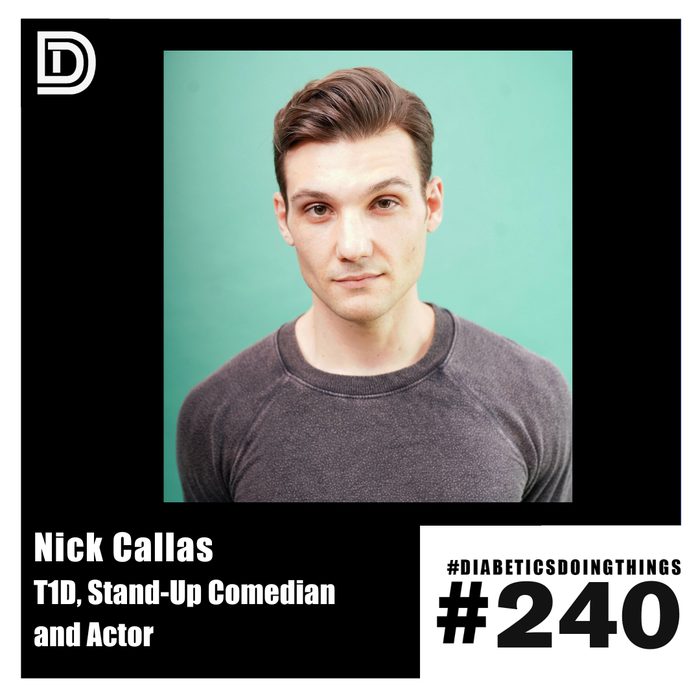
Nick Callas, T1D, Stand-Up Comedian and Actor

Episode summary
Nick Callas is a stand-up comedian and actor who was diagnosed with type 1 diabetes at age six, growing up in Bergen County, New Jersey. He talks about how the diagnosis deepened an already present separation anxiety and insecurity, and how he decided early on to hide how much it bothered him. He connects the self-awareness comedy requires to the self-awareness diabetes requires, and discusses humility, blood sugar swings before shows, and guilt tied to low blood sugar. He describes using nutrition and strength training, built around his diabetes management, to get into better shape than his non-diabetic brothers. He also covers touring on multiple daily injections, insurance fights over his CGM and test strips, and his upcoming one-hour special in Austin.
Key takeaways
- Nick says he decided as a kid never to let people see how much diabetes bothered him, modeling himself on his 'tough guy' brother and father.
- Nick says comedy and diabetes both demand constant self-awareness and humility, because both punish him for losing track of himself.
- Nick keeps his blood sugar close to range before every show because he says he can't perform well, physically or emotionally, outside that window.
- Nick credits counting carbs and macros for teaching him nutrition, which he says left him more fit than his non-diabetic brothers.
- Nick says touring as a self-employed comedian means an insurance change to his CGM or test strip coverage can derail him right before a trip.
Show notes
Nick Callas is on the pod! He’s a multi-hyphenate entertainer, stand-up comedian, actor, writer, director, etc. etc.! He chatted with Rob and Eritrea about:
His at age 6 and how that compounded his separation anxiety at a young age
Understanding that diabetes (and comedy) can really humble you and force you to be self aware more often that you’d like
Setting himself up for success with foods so he can perform at his best
Placing the thing he really wants to do behind all of the things he needs to do
Touring when you’re dealing with a frustrating healthcare system
Follow him on Instagram @mrnickcallas
See him live on tour especially while he tapes his special in Austin in September!
We want to hear from you. Send those questions, comments, queries, and general diabetes concerns to THE MAILBAG at mailbag@diabeticsdoingthings.com!
Questions this episode answers
When was Nick Callas diagnosed with type 1 diabetes?
Nick Callas was diagnosed at age six after weeks of excessive thirst and urination, growing up in Bergen County, New Jersey.
Does Nick Callas use an insulin pump?
As of this episode he is on multiple daily injections with a Dexcom G6, though he says he's considering a pump after years of resisting having a device attached to his body.
How does Nick Callas manage his blood sugar before stand-up shows?
He says he aims to be near 140 by five o'clock before an evening show, relying on simple, repeatable meals like peanut butter, apples, hard-boiled eggs, and cold cuts.
Where can people see Nick Callas perform live?
He's touring through the end of September and taping his first one-hour special at The Creek and the Cave in Austin, with shows on September 29th and 30th.
Full transcript Searchable, with timestamps
Nick Callas: Hey everyone, Rob here. First of all, I just want to thank you for listening and supporting Diabetics Doing Things. We are going on eight years of recording this podcast and approaching 350 episodes on this feed extremely quickly. So your support means everything. We would not be here without you. Just wanted to call your attention to a few things that we're working on lately that are updates to Diabetics Doing Things. The first is we are throwing events and you can find more about our events at diabeticsdoingthings.com slash events. We launched our first event in April of 2023. It was a coffee house roastery tour and latte art class. And we have two very exciting events coming up in the fall of 2023, including our first ever. So our inaugural National Diabetes Awareness Month event. And those are going to be on diabeticsdoingthings.com slash events this month. So be sure to check those out. Also, if you have a question that you want Eritrea and I to answer on air, please email the mailbag at diabeticsdoingthings.com. So that's mailbag at diabeticsdoingthings.com. Your question will be answered on air during a special episode of the Rob and Eritrea show. So if you want to ask us a burning question and you want us to spend some time on it, please reach out to mailbag at diabeticsdoingthings.com. All right, let's get to the episode. Hello, and welcome back to another episode of Diabetics Doing Things. We are telling the amazing stories of people living with diabetes all over the world. And today we're going to the big city. To me, our very special guest, Mr. Nick Callas on Instagram. It's Nick Callas himself. welcome to the show what's up well i love it man thank you for taking the time today and we were kind of just chatting off here man a love love seeing your comedy love seeing your bits online it's just it's just fun to meet people with diabetes doing creative outputs and making people laugh and very excited to kind of dig into your story and i kind of talk about your life with diabetes. So why don't you introduce yourself to the audience and we'll kind of start where we start normally, which is like, when did you join this type 1 diabetes sort of multi conglomerate, the family? Yeah. Well, first of all, thank you for such a lovely intro. My name is Nick Callas. I am a standup comedian. I'm now I'm 30 years old and I was diagnosed with diabetes when I was six years old, growing up in Bergen County, New Jersey. you know shout out big shout out bergen county so what do you remember i mean like six years old you probably don't remember life as much before diabetes like what do you remember about like adjusting to that like diagnosis and you know anything with family or you know what what stands out to you from like the early days yeah i have a few pretty core memories about pre and post diagnosis generally and i think and not to get too deep off top but i think like generally as a kid i was extremely quiet scared actually and and very insecure and a lit and i would say i i just didn't have a good sense of anything and felt uneasy busy. You know, I just didn't, I didn't know the rules to games and stuff. I think like most kids don't sports and stuff like it. So I was very intimidated by a lot of things. And I also had tremendous separation anxiety from my mom. And I think at the, around that time, my parents had gotten divorced too. So I had all these different factors that made me feel like quite isolated. And then here comes diabetes, which actually exacerbated just about all of those things. Because now I had a medical reason that I needed to be by my mom's side because it was, of course, a number of years before I could really handle myself as a diabetic. And so, yeah, so there was this diagnosis that I remember going to the doctor's office and for what must have been a few weeks prior, I was just chugging water before I go to bed. And then peeing in the same, you know, in the same 10 seconds, I just drink water and pee and drink water and pee and couldn't go to bed. And I remember this distinct moment where my older brother is five years older. We're sitting in my parents bedroom and he goes, you're going to have to keep peeing if you keep drinking water. And I was like, I know, but it's if I feel like I need to. I said that to him, I was like, I feel like I need to. and you know i just had some outrageously high blood sugar at the time and you know my mom was like all right something's up with this kid and at this point we had no diabetes in the family we've actually been a few people since who have you know developed it and i think we learned through me that a number of people in my family especially on my dad's side had had an antibody like predisposition for it but so go to the doctor what seems like a normal chick up uh leads to me like a number of hours later waking up in the hospital i guess i'd fallen asleep at some point and then all of a sudden they're just all these dragon ball z toys surrounding me and balloons and stuff and i was like oh my god it's the best day ever but why am I went in the hospital. And so my mom and a doctor came and sat down with me and like explain what was going on. And I had no idea. I don't think I'd ever even heard of diabetes before. And my family was there and they kind of explained to me that this, this was going to be like this big journey. And this was, this was a big deal, but it didn't connect with me. It didn't connect with me at all. I just was like excited that people were around and paying attention to me. And also, you know, I couldn't conceptualize like the change that was going to happen in my life. And once I started to over the next couple of days, I started to realize, oh, I have to take insulin shots and I have to check my blood sugar. And I think as a kid, too, there's a big. There's a big obsession about needles, like needles in 19. This must have been 1998. Like needles are going to be such a big part of your life now as a six year old. and I remember making a choice to like never let him see a sweat because as a kid I was so I felt so ostracized and so bizarre already that having like a real reason now to be in need of help or attention for anything other than like you know being cool and felt terrible so i remember making a choice that like no matter how much this sucks don't let them know you feel that way especially because my older brother and my father were such tough guys and one of the first things anybody had said to me sitting in the hospital was you're a trooper i remember somebody saying you're a trooper and i and it felt good to hear that and so i just never let go and most certainly i did lapse at times and probably like complain about having to you know take an insulin an injection or not get to eat cake at something. But for the most part, that was like kind of my mantra. It was just like, deal with this. And I think that that was a huge part of like developing a sense of maturity and a sense of self and, and growth and like being able to cope with things. Cause like, God knows there've been much more challenging things in my life since then than to have diabetes. but it did give give me a sort of like bedrock foundation to to like process everything through after that it's such an interesting perspective because to be six years old and like really digging into oh i want to be a trooper i want to be a tough guy i want to be able to handle this and and not let people see me sweat or not be sort of othered we were talking about that before we started recording too that when you're young it's you just don't want to anyone to see something different about you because they'll point it out and you're not comfortable with who you are yet and you're because you're young and you're still growing i kind of felt the same way i was just like i i i've come to accept it more as i get older and like the passage of time like certainly opens us up as we get older and like more mature and really you know recognize why we do some of the things that we do but to me like some of it is survival too because you're early on you're just trying to you know get through it and say hey like i can do i can do this i can i can still be myself even with this diabetes and i think for me too like i was older and like 16 but even the pressure to fit in at those ages especially early on is so great that you're afraid to acknowledge these little details or the these things that make you not fit in did you feel that like ever like as you kind of yeah constantly and i think i'm very lucky actually in that some of the things that have been like challenges for me are things that elicit a level of self-awareness and discipline that i think most people just won't counter and by that i mean i i do stand-up comedy the most important element for me about comedy developing it off stage and then also deal performing and dealing with it in the moment is self-awareness you need to be extremely aware of yourself and aware of your surroundings obviously in a show in order to to do the job and to perform and to make people laugh and then also diabetes is a very physical quite literal version of self-awareness and then also humility with both of those things like you have to be humble and you have to know that okay you know in a literal sense of diabetes i can't eat this right now or if i want to eat this later i have to do this that and the third and we stand up with this the same thing is true is that you have to be aware of yourself and your obligation has to be to other people's good time. And so you have to be very aware of how you're behaving and how you're coming across. And so I have all these things in my life that are sort of like metrics of my sense about myself. And so it's like a blessing and a curse, right? Because it sucks to have to think about what you're doing and how you're coming across all the time, but also it keeps you in line And it forces you to be more aligned with like your, your authentic identity, right? Like you're who you're trying to be in the world. So, so there's that, but that, you know, that took a long time to develop in the early stages of like being a diabetic kid. It's mostly just insecurity and feeling vulnerable. And even to this day, I, I've noticed, I'm sure you guys have had this experience where like you're watching TV or something and a commercial for diabetes will come on and And maybe no one looks at you, but there's this feeling that people are looking at you now or that you're being talked about. Or if diabetes ever came up in health class, like all of a sudden you feel looked at. Maybe you are like it because it's weird. And there's like me. There's always maybe a couple diabetic kids in school. So it is this like lantern that's hanging on you. and even to this day it's this bizarre trigger where if i hear the word diabetes out on the street or tv i'm passing or something my ear will involuntarily just perk up it actually happens to me and it's it's again it's like i'm sure other people have them for other reasons maybe if you're not very tall or you're very tall you hear somebody talk about height or something and then you know just kind of grabs your attention there's all these like weird little things so it's kind of like when you're when you're in a crowd of people and you hear someone say your name like you just hear it so much more clearly and for me and diabetes too i don't know if you've ever worn an insulin pump in your life with diabetes we can talk about devices and stuff later but the the og medtronic pump had this like beep cadence that was really specific and now whenever i'm in a room if i hear it i can hear it across the airport it's just like because it's just so dialed into like my brain to hear it, even though my palm doesn't make that same noise anymore. So it's so weird, like those different, like kind of ingrained in your brain, like I'm part of you to listen and take note of those like various, you know, whether it's diabetes or it's your name or, you know, a device beep. Yeah, it's all it's different reasons to make you aware of yourself in a way that makes you feel insecure. And like we said, growing up as a kid, you have a million of those already and you know if you're embarrassed about something as a kid you can hide it or lie that's a lot of being a kid I didn't do that or I didn't say that or I don't have a crush on her but diabetes everybody knows you have it and it is this thing where it makes you feel I don't want to project anybody else's experience but as a kid I felt broken in some ways I was like I can't physically i'm not the same as these other kids on a biological level right and so i felt weakened by that and especially playing sports if i had to sit out at gym class or something like that i did feel i my my experience was that i felt handicapped and then when that combines with like your social identity can be can be awful i mean also kids are vicious and they don't know and they don't know and they don't know how they're how they're i mean to this day i'm a comedian i go on stage and sometimes i say something that later on i'm like i might have been not funny in the way that i thought it was going to be or it was hurtful it happens to me all the time but kids are even worse with that and there was a kid came up to me one day and she'd said she'd said hey don't you have aids and shout out to the aids community there's nothing wrong with having aids either doesn't change who you are but as a kid there's plenty of stigma around that and we're in fourth grade mind you so it was just like i i because here's the thing here's the brilliance of this comment is that i didn't have aids and so i had to correct her with my real disease so it's also embarrassing in that way because i couldn't be like i don't know what you're talking about
Eritrea: but i did as a kid it's embarrassing but as an adult we call that a read anyway no i love i so first of all i don't think you're projecting when you say you felt broken in our last episode we literally did an episode that came out today of the Rob and Eritrea show where i was talking to my dad and I was like, I feel broken. Like, I feel like you guys don't want me anymore because I'm not that perfect kid. So I think a lot of us do go through that sentiment of just like, what's wrong with me? And then just to like double down on these elementary school trauma stories, I remember going to lunch because like I'd have to leave early to go test for lunch. And the first time I had to do it, this one kid raised his hand and he was like, miss, what's wrong with her? Like, what is she? Is there something? You know what I mean? So it's just like kids are mean that's just how it runs and if you're a kid and you're listening to this first of all I'm sorry but also it's going to get better but that does prompt the question that I wanted to ask you so I want to go further back when you first got diagnosed you said that you had like already a form of separation anxiety from your mom and a lot of the people who listen to our podcast are parents of kids with diabetes did your diagnosis impact that relationship further with your mom like did it make it hard for her or was it just hard for you yeah i'll admit it's so
Nick Callas: hard for her because you know my mom was pretty young when she got married and pretty young when she started having kids she's not she's not a nurse but she'll be the first person to tell you now that she's had a crash course and everything and now is a nurse and a and a doctor and pilot and an astronaut and all these things that's like that's what being a mom is right you just suddenly they got to be all these things. But yeah, I mean, my mom, my mom could be an endo. And that's the thing. And I've said this to people before is that the thing about having diabetes that is unlike a lot of other things that you could have is that you have to be an endo. If you're a diet, if you're a diabetic and you manage your diabetes, well, you're just baseline healthy. It means you're capable of all the things that an endo is capable of. And you know, all those things because that's how much you have to be on top of it it isn't like it isn't you know i don't want to make uh comparisons and put myself out of school here but like in general a lot of a lot of ailments that might even be life-threatening are things that only a doctor can do for you be it with medication or devices or just you know frequent checkups but diabetes you walk around with it all all day uh every time you you eat every time you're active you have to be able to like treat yourself and so you have to know what you're doing it's not like something that you can be diagnosed with that you'll just go okay i'll deal with it today and then i have an appointment in six months like you're really with you all the time so again that's the kind of thing that I hated as a child because it was one, mortifying and two, preoccupying in a physical health sense. I had an aide that would sit in the back of the class for at least a few years when I was in middle school. She was like a ghost or a shadow that just sat in the back of the class, a lovely woman, but it didn't make a difference. She sat in the back of the class and she would just check my blood sugar every couple of hours and before length. And by the way, it's not like I could only see her. You know what I mean? The whole class has this lady there. They had to have her. What is she doing here? Nick Handler. It's Nick Handler. It was like an awful version of being like a rich kid or something. I just had this like Alfred behind me.
Eritrea: in retrospect though would you kill i would kill to have a lady in the back of my life just walking
Nick Callas: around asking me about my blood sugars oh my god now i'm just trying to make it in common to the point where i can hire somebody to do that but at the time yeah yeah it's like you didn't know you didn't know how good you had it at the time it's like and it was embarrassing now i'd kill for a lady to follow me around and oh my god yeah she doesn't even have to do anything for my diabetes if a lady would follow me around on my left it'd be a very good thing yeah just have her around good to bounce ideas off of. I'm going to make sure I'm not doing it. I'm living right. Hey, can we get a calibration here on decision making? Great stuff.
Eritrea: You've got one of those, Rob. But anyways.
Rob Howe: I mean, I have a wife. She's not my employee. I don't claim her as a dependent. You know, I think it is interesting though. And I want to kind of talk about, because you've mentioned kind of Alfred, you mentioned like discipline and like the burden of kind of like living with diabetes, like chronically where, and it just reminded me like, Any day, it could be today, for example, Eritrea and I, before you came on, we were just talking about like last night she had an urgent low and I forgot to, I got out of the shower and I forgot to turn my basal insulin back on on my pump. So I woke up at 3 a.m. with my blood sugar in the 300. So like just in average everyday life, like day to day, you have like the life-threatening experience and you're sometimes like near death and you just like eat some candy and stand up and we're like, okay, well, we're good now. time to just get back to what we were doing before yeah I'm gonna plug my charger in while I answer this question just because I don't want it to die honestly yeah
Eritrea: and the running to get the charger like you're man I'm the queen of my the queen of my pump and my phone not being charged with me where is my crown
Nick Callas: I mean it's it's a constant it's a constant thing for me and again i'm like blessed and cursed with with a vocation and a career that forces me to have to be more on top of it than frankly i care to be because i can't none of us want to fucking can we curse sorry no none of us want yeah yeah do anything i can't even think when my blood sugar is 300. Bury me at the beach. I don't even want to be around. It's the worst. I can't. And when you're low, the only thing you can even think to do is to just fill yourself with food. And so part of that is like making that as convenient for yourself as possible, trying to like live within the bounds of like when you might be high or low. But because I perform at night every night, I have to at least be golden from five o'clock till whenever I go to sleep. Because if my blood sugar is high or low at all near when I'm going to perform, I just can't do it. Maybe some comedians could, but the nature of my standup is extremely emotional. It's very physical it's too taxing to not be at a 140 blood sugar i can't do it otherwise and and then there's a huge emotional toll i don't know if you guys experience this but i'll often guilt if my blood sugar is not good i feel really crappy about myself or not taking dude i i i have to remind myself regularly during low blood sugars that it's just the low blood sugar talking like that emotional swing is like part of the clinical response you know it's like your body is just hey like we're not good and by the way if you didn't feel bad enough like here's some really
Eritrea: bad feelings to just tide you over here are all these thoughts about how it's your fault like yeah yeah and it's like what is it rob you said love yourself through the low isn't that something you
Nick Callas: got you do but you just also have to remember that like it's it's just a low blood sugar it's like am i worthy of life and it's like oh yes absolutely like it's just a low blood sugar telling me that I'm a piece of shit. Like, so, or that, you know, Hey, I got, and I talk to people a lot about exercise and, you know, people without diabetes have a lot of excuses to not exercise. And like, it's really easy to give yourself, you get to the gym, you, you've got your outfit on, you're like, you're good doing your sets. And all of a sudden your blood sugar tank, it's really easy to beat yourself up for that. Uh, but you just gotta like, Hey, remember like, all right, this is just the diabetes. Like I live with diabetes and negative feelings and like emotional swings are part of high and low blood sugars that's why we feel better when our blood sugars are in range that's why you don't feel comfortable you know performing when your blood sugar is out of range it's why i can look at every basketball game i've ever played and i could tell you whether my blood sugar was in range or not based on the games that i played good i was great but the ones not i was out of range and i'm sure all of us have too much pride to ever maybe with the exception of like a brother or sister or parent or something if i had a bad set if i didn't like a performance of mine um batman himself could not get out of me that well my blood sugar wasn't good i would never i could never cop to that i would internally i would go dude you got to take care of yourself because of this down the third but i would never share that with someone because it's and this goes back to the childhood diagnosis thing is like i don't want to be anybody else's obligation anybody else's problem i don't want to be seen that way and while there is like a sort of middle ground where you have to be real with yourself for your own health and safety and people should be aware of what's going on with you it is actually a character fortification to to take all that on the chin and go like this is my burden and this is my problem because it it really does make you better and one of the things i kind of want to like transition this conversation into as like bit of unsolicited advice because some of the things that diabetes has really helped me with is confidence and physical health because all the things that we're talking about now have forced me to be more aware of what I eat and how I eat and how I feel. And by that, I mean that, you know, we all can read a nutrition label just secondhand and we can all eyeball things and have a pretty accurate guess of the carbs and whether or not it's a solid protein source and what type of carbs is that going to hold me over? Is that going to spike me and then I'll crash? What is that going to do to me? That helped me really learn how to count calories and macronutrients really quickly like it was a second language to me and then that combined with like weight training and stuff that i started doing has like put me in the best shape of my life and i'm much healthier dare i say than my two non-diabetic brothers because i have this i have this like other language that i speak that is you know nutrition i think that's something that's really interesting because you're not the first person who has said that on the podcast in fact there's a guy who like literally wrote the book on diabetic bodybuilding and building muscle with diabetes he came on the podcast you know five or six years ago and was like you know before i got diabetes that you know i think he was 17 or 18 when he was diagnosed like he he said i didn't have good nutrition habits i didn't i didn't care about athletics or lifting weights. And because of diabetes, I was given this kind of insight into what's happening inside my body. And I think for you, like when you're talking about like being physically fit and like seeing the results of that in your diabetes, like it just feeds that sort of like dopamine in your brain. It's like doing something good for yourself. And it's like, and now not only do I know like, Hey, I look and feel good, but I also can look at my diabetes and like directly connect that to like good choices that I'm making. I think that compounds, like it really is like, and you know, I think everybody has their own like time when they're able to like connect those things. And it is difficult, but like life with diabetes is difficult and it is long. And I'm a huge believer in just like incremental progress. You talked a lot about discipline and other, you know, other interviews that I was reading preparing for this interview. And, you know, I could tell it was like, Hey, I can tell what kind of person with diabetes you are. You very much be like Eritrea, where you say, all right, if I can just eliminate some variables and put myself in a position to succeed, what I want for myself is on the other side of that. And so I would love to know, too, you do stand up every day. That is, I think, many people who don't know about what it takes to be successful in comedy don't realize that literally every day you're getting up on stage somewhere at an open mic or on a performance. you're going on a tour you're not being you know privately you're not flying private you don't have a woman following you around with all your stuff behind like you know it's a group of people who are like really hustling going from place to place and you know with travel with stress with like staying up late not sleeping well like sometimes like not in situations where you can always eat very well like how do you find like the choices to make or how do you set yourself up for success when you're in that kind of schedule yeah that's a great question Right. And thank you. So for me, it's a confluence of a couple of factors that makes it easy and replicable because that's like the number one thing, right? This has to be a thing that is easy for me to do that I can do all the time. And the only way those things will happen is if I enjoy doing them. So like, what are what are the foods that I like to eat that are easy to eat and good for me? It's got to fulfill that criteria. And for me, I love peanut butter. I'm obsessed with peanut butter. I literally eat it every single day. And it's very dense in calories. It's very macronutrient dense. It's a great source of fat. It's a good source of protein. And it's a moderate source of carbs, right? So I travel with peanut butter. I travel with apples and bananas usually. And then less often recently just because my control is tighter i'll travel with apple juice or orange juice something that's it's kind of it's kind of my like parachute it's kind of my emergency food and then i'll have like maybe a protein bar or something in my bag you know just in case something that's like a little bit more dense but eating eating healthy eating sort of near keto not not completely keto, it's kind of impossible for diabetics, in my opinion, to last very long in a keto diet. I also don't think it's a great way to feel energetic, but I digress. If I'm really in tight control and I'm focused on eating meals with a great protein source, then I can travel around to different states to perform and know that my meals can be assembled pretty quickly just at a 7-Eleven if I need. I'll go grab some hard-boiled eggs. I'll grab some cold cuts, maybe some cheese, maybe a loaf of bread and peanut butter. And because I'm eating these pretty standard lunch table meals that I can construct myself very quickly, it behooves my my like exercise diet and also my diabetes and those things have become very linked for me well and i think like the oh first of all i think that your framework is really accessible like you know things that you enjoy things that are good for you and like things that are good for your diabetes like i think and my things that you can repeat like we are what we repeatedly do like you got to set yourself up for success and kind of eliminate those decisions and then like for you like when you we've dialed that in you mentioned that your control now is like tighter like how did you kind of like did you self-motivate yourself to do that did you have this sort of like moment where you're like if i want to have you know if i want to be successful in in you know comedy or theater or just creative outputs that you're pursuing and be successful with your diabetes like this is what I need to do like how did that how did that happen for you yeah completely I'm a big proponent of placing the thing that you want most right behind all the things you don't want to do that you should do for me I don't want to take care of my diabetes I want to eat Cheetos puffs and drink Dr. Pepper till I die that's what I want to do. But more than I want to do that, I want to be the best stand-up comic that I can be. And if I go to perform every night, if I have a less than ideal blood sugar at seven o'clock, when I'm on stage at eight o'clock, I can't do the job. And so, you know, everything else falls in line beneath that. Okay. I know that I can't really eat before this soon before the show. And so I have to eat around this time. And for me to be in a sort of stasis place before the show, I've got to eat this way and I've got to make sure I take insulin this long before the meal. And everything just kind of falls in place because there's this other thing that I want more than any negative consequence of like not taking care of myself. And then again, like because I do stand up every day, everything compounds over time. And then a lifestyle is built out of this one choice that I don't have to make now forever, just have to make it every single day. And if there's a motivator that's big enough to get me to kind of automatically make that decision every day, then the whole year, my whole life is spoken for because there's just this eye on the prize. I love that. I think a question I ask myself, whether it's in creative projects or whether it's fitness or whether it's personal life, is what am I optimizing for? And it's like, for you, you're optimizing to be the best stand-up that you can be. And everything else kind of falls into place as long as you keep a nap front and center. I think this is a good time to transition to talk a little bit about your stand-up and like your career you're I would just say like multi-talented you're an actor you are a stand-up you're a rapper all of these things like are wrapped in this kind of like very vulnerable very you know accessible and friendly package which we're experiencing and like kind of deep uh in a way like in this interview but like you're a funny guy and I think as you know somebody sends me your Instagram it's like okay cool let's watch these clips your set is energetic your you know big energy lots of lots of physical comedy like where where does that where's your inspiration come from like what are you like how would you hit yourself like somebody wants to know what your act is about sure thanks so much so let's see i have always my whole life as a kid have always really responded to big bombastic performances music animation and i think it's because i feel a lot i think we all do I think we all feel a lot of stuff. And I think for me, big visuals, big music, big emotions, big performances are a way to reflect that that's going on inside in a way that makes it okay to be feeling things like that, whether it's excitement or anger. I was always so drawn to Jim Carrey as a kid because I would see him behave and it it just felt appropriate to me it felt like what I was experiencing and here was this way that he he was you know creating these caricatures of moments be it like excitement or anger sadness that was just such a pure distillation of like things I was experiencing and so I've always been drawn to that. I like extremes in my art. I like fast rap and I like very physical comedy. And part of that is because I like to know that there's work being done. I like to know that there is an intrinsic challenge or difficulty inherent to the thing that I'm watching. One-liner stand-up is great. It's not my cup of tea because I think a lot of the work takes place off stage. And when I'm an audience member to something, I want to see it being done at a really difficult level. So that's the type of stuff that I try to keep in mind when I'm creating my own things. I want to make people feel like what they're paying to see is worth every dollar so i i always try to put as much of the work into the experience yeah i love that i think too like you talked about self-awareness earlier like things that you're experiencing outside like bringing those into the stage like feeling the room out and like you can see that like in in your performance it's it's it's fun to watch it's like it's like you really do like want to know like what it's like to be in the room. Cause like, that really is like a moment you're not going to experience again. Right. I'd love to talk about, because I think people will have questions about this and they'll, nobody ever like angrily messaged me for missing, for missing questions, but they want to, I'm sure they want to know like how your career as a comedian, like works with your diabetes. And like, we, we talk a lot about access on this podcast. we've talked to a lot of different creatives who don't sort of fit the typical nine to five you know corporate america benefits package type career and of course with diabetes like it's always a challenge like okay well how i gotta make sure i can afford my medication and my supplies so like what kind of diabetes tech do you wear and if any and you know how how does that how does your diabetes kind of manifest itself in your creative career so i'm i'm on the dexcom this is a g6 i'm 179 right now guys so we're okay but i took a couple of units and so should we all do let's do it okay so yeah i'm 185 right now i was 179 you're 185 yeah we're right right dialed in
Eritrea: i'm 219 i don't want to talk about this my head's we're like all within like 30 like 35 units of
Rob Howe: Yeah, we're all... Honestly, that's 5 o'clock-ish. We've all probably eaten once. There's a lot of insulin left in the tank.
Eritrea: Yeah, I have two units on board. That makes sense.
Rob Howe: Yeah, 1.2 on board over here. Yeah, we're doing it. We're going through it, guys. We're having the 5 o'clock rundown. So just the G6?
Eritrea: Yeah, like, so your devices are G6. Are you multiple daily injections?
Nick Callas: Yes, I am. Multiple daily injections. I'm strongly considering jumping on a pump. I think I needed it to catch up to where I was at because I hate having stuff on my body. I don't even... And again, I think this is also part of... When you're a kid, you got to carry a bag with your meter and with snacks in it and stuff. And I just hated feeling like a little pack mule as a kid. And then playing sports, and then I started performing by the time I was 16 or 17. I hated having a thing on me, having to explain it, and even just the physical thing on me. I always hated. But this stuff has gotten so much smaller and so much easier now that I was actually just talking to someone in Philadelphia that I bumped into with a pump on it. It was so small and just kind of easy that I was like, all right, I think it's time. I've spoken to my endo about it, so I'll probably get on a pump.
Eritrea: Don't feel too bad. it's also a big apple thing a lot of you big applers do not enjoy the idea yeah so i have a few friends actually bambi too she's mdi but most of them don't wear pumps because it's like i'm walking all the time i'm always doing all this stuff and it's like like my friend best was like what if something bumps me and rips it off and i was like oh it's not gonna happen but like at the same time it seems like a very big new yorker thing also to not have stuff on you yeah join us I feel like I'm part of a cult. Join us. Join us. Join us.
Nick Callas: Man, 15, I guess, yeah, 16 years ago when I was like trying to get on a pump or my dog, my endo was trying to get me on one. I was like very against having things attached to me. I just didn't know at the time. I thought it was going to be more invasive. I also just had weird misinformation. I think I've shared this on the podcast before, but I had a friend, like one of the only people I knew with diabetes growing up had like a port surgically like implanted in them for their insulin pod. and I thought that they were all like that so I was like well I don't want that and my touch was like no no where did you hear that so I do not want your situation yeah I was like I do not want that but you know now even with like so I have a seven day wear infusion set now so it's like I only change my site once a week and you know now I am a CGM I'm much more comfortable with them so I think it just depends on where you are everybody's different that's interesting your hypothesis about Big Apple like New Yorker is being more I have a thought
Eritrea: I have many a friend in New Yorker like no thanks I don't want to pump but okay so MDI G6 I think we were leading into questioning of like is this stuff accessible to you as a person who is a comedian and essentially an entrepreneur is self-employed
Nick Callas: yeah a lot of my stuff is covered by my insurance which is great my endo visits are out of pocket and they're very expensive so there's that but that is the situation that works best for me at least right now and so yeah so for me personally it's all it's all pretty accessible though the big frustrations are when for instance you know a company doesn't want or my insurance doesn't want to cover like Dexcom anymore or you know because I'm also I'll do if I'm not on the Dexcom for one reason or another and I'm you know testing my blood sugar with strips like freestyle or whatever it is and then my insurance decides they don't want to cover a certain type of test strips anymore and so they go ahead and they change it for me as if they're doctors i mean it's unnerving it's crazy it's insane that i that that can even happen so that's like one of the biggest frustrations in my life i think is not being able to get a prescription that i have been getting for my whole life and so i think that that to me is one of the most frustrating things about the health care system i I mean, there's, we could pick, we could just blindfold ourselves and throw a dart at the wall and pick anything that are infuriating about it. But just like changing the formulary, like, because for some people, you know, even though like, so for example, like Novolog, Humalog are basically the same thing, but some people like Novolog just won't work for them just because of the way their DNA is made up or whatever. And so when your insurance like makes you do that, then you got to go get a prior authorization and go through all this paperwork just to get, just to get the medicine you've been taking your entire life right and and you know your your prior also or your your doctor they're not easy to reach they have other they have other i almost said clients patients but clients is fucking the right word too because that's what it starts to feel like it's impossible and then you know here's the thing it's not like if you if you order a pair of Nikes and they come on Thursday instead of Monday, that's fine. You'll figure out something else to wear. You probably have another pair of shoes. You'll be all right. But when it's your medication, that's not OK. It's it's it's it's insane. It's insane. It just seems like ridiculous
Eritrea: barriers. And like when I think about your situation, like, OK, you have access to all this other stuff. But the thing that's most expensive is the endo visit. But every year, all of us all three of us have to go to the endo at the beginning of the year to recertify that we have diabetes just to reprove signs on the girl that it hasn't been cured make it make sense i will fight any of these people in the street i just but yeah that's so frustrating i can't believe that you have to go through that and we all do but yeah sorry that it's a barrier like that because
Nick Callas: that really really sucks you know what happens to me and also i should have the freedom to be lazy sometimes it's my autonomy but it always happens that like right before i'm about to leave to go on tour or i'm about to be like in another city for some number of days i like can't i have to scramble to get all my prescriptions and stuff like that it's like it's the worst it's the worst make
Eritrea: friends with your pharmacy like find a pharmacy where you make friends with them because they'll
Nick Callas: help you so that's me well because i think too like that's not that has nothing to do with like diabetes care and yet that's like so so like immensely part of diabetes life and like it has nothing like and no one else can help you like if you have no you have no representation the pharmacist doesn't know who you are like the medical device company doesn't know who you are the endo is unreachable because they have 19 other patients who they've got to see and check their diabetes off it's tough man i think it's you know that that to me is like one of the more frustrating things about diabetes it's not always just counting carbs and blood sugars it's just all the other their hurdles that you got to jump through just to be able to do your job right it's
Eritrea: it's so many other things and that's my new stuff like i was just telling you about when we were complaining out earlier like i was telling you about how i had that low or whatever but like when you're low and then you have to like refill your cards it's just like diabetes just adds up it's just like this big big big big big pile and it just lives in your life and you just have to look at it and be like i'm cool with you being here even though you'd like to commit homicide
Nick Callas: so it is what it is well nick i know i kind of we're kind of coming to times and i wish we i could stay on for the whole rest of the afternoon but man it's been so such a pleasure and like breath of fresh air in the middle of the day just chat with you and hang out with you for a bit um where should we send people to find you you're you're very online but yeah where do we want to send people from today's pod yeah well first let me just say like this was a blast it was a great conversation. I've never, I not never, but I, it's rare that I get to talk about these things with people. So on or off the podcast, I'd love to do it again. I feel like barely reached the surface here at things we could have talked about, but yeah, so you can find me at Mr. Nick Callas on Instagram, no punctuation, just M R N I C K C A L L A S. And you have your diabetic message me and say that you heard me here and ask me about my diabetes and we'll talk about yours. And then come to a show. I'm touring a lot between now and the end of September. I'm shooting my first one-hour special in Texas. So definitely some diabetics. Oh, we're in Texas.
Eritrea: We're in Dallas.
Nick Callas: Not in Dallas, in Austin.
Eritrea: That doesn't fall over.
Nick Callas: Classic, classic. No, yeah. Are you in Dallas? Both of us are. You're both in Dallas.
Eritrea: oh no way we are diabesties i don't think rob likes that phrase but we are diabesties i would
Nick Callas: wear a diabesties shirt or bracelet so it's going to be at The Creek and the Cave in austin and it's shooting there's a seven o'clock show september 29th and a nine o'clock show and there's a seven o'clock and a nine o'clock show on the 30th so yeah bring them out that's interesting i'm gonna to just put this out there and because it's going to be recorded people will hear it and then have to hold me accountable to it so i'm doing an event with JDRF Austin in august and i'm going to tell them about that and we're going to bring a group of people to one or both of those shows so that's that's what i that's what i'm telling you from this that's amazing i was i'm hoping to do it but cool well i agree nick we have we barely scratched the surface uh you are officially friend of the pod. I would love to continue to stay in touch. So this will not be the last time that we talk to you or do some things with you. So thank you for being a guest on the show. And thanks for being open and vulnerable about your life with diabetes. For other people with diabetes, it's awesome and essential to what we do. Truly my pleasure. And I'll drop my cell
Eritrea: address so you guys have it. Thank you so much. For those of you...
About Nick
Nick Callas is a stand-up comedian, actor, writer and director diagnosed with type 1 diabetes at age six. He's touring ahead of taping his first one-hour comedy special in Austin.