

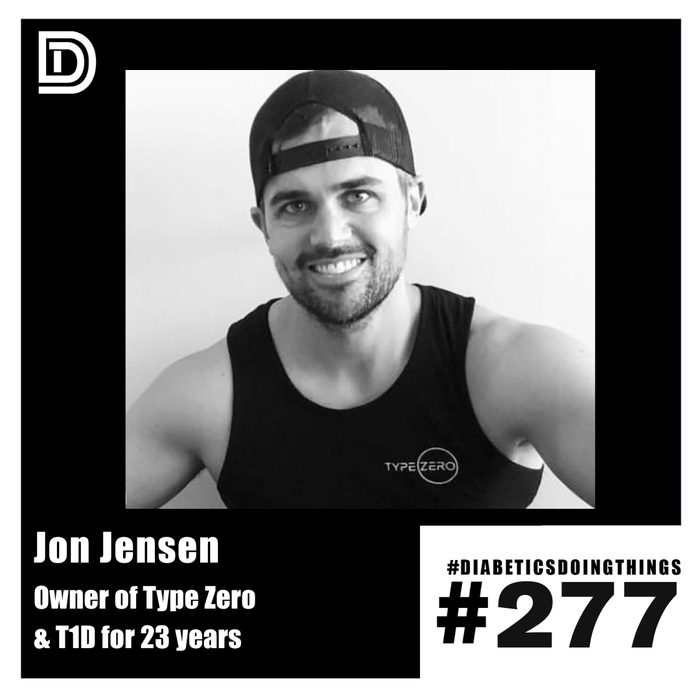
Jon Jensen - Owner of Type Zero Health & T1D for 23 Years
Episode summary
Jon Jensen, founder of Type Zero Health and a type 1 diabetic for 23 years, returns to the show to talk about running a supplement business while managing diabetes. He and Rob discuss how stress from entrepreneurship shows up in blood sugar, the double edge of CGM data and alert fatigue, and how visualization and mindset shaped Jon's confidence as a founder. Jon describes scaling Type Zero from one product to around 40 SKUs, the strain of manufacturing delays and third-party testing, and his decision to sell a rental property to free up mental energy for the business. They talk about clean, stevia-sweetened supplements, supporting diabetes-owned brands like Catalina Crunch, and why short walks and hydration reliably help blood sugar and mood.
Key takeaways
- Jon says a stressful year running Type Zero raised his A1C even though his blood sugars are usually good.
- Jon finds that constant CGM alerts sometimes make him overcorrect with insulin and crash his blood sugar.
- Rob says he lost some hypo and hyper awareness from relying on CGM alerts, and regained it during a six-month pump break.
- Jon credits visualization and living lean financially with helping him grow Type Zero from one product to about 40 SKUs.
- Both say a short walk and getting hydrated are reliable ways to bring down a high blood sugar and improve mood.
Show notes
In this episode of Diabetics Doing Things, Rob welcomes Jon Jensen back to the podcast. They discuss the challenges of running a business, dealing with stress, and how being active impacts blood sugar levels. They emphasize the importance of movement, hydration, and clean supplements for overall health.
Topics discussed:
Challenges of running a business as a person with diabetes
Impact of stress on blood sugar levels and business decisions
Importance of movement for physical and mental well-being
Clean supplements and their role in maintaining health
Positive effects of simple activities like walking and hydration
Support for diabetes-owned businesses
Personal experiences with fitness, mindset, and health
Key takeaways:
Stress and lifestyle factors can significantly impact blood sugar levels and overall health.
Movement, hydration, and clean supplements play a crucial role in managing diabetes and promoting well-being.
Small actions like going for a walk or staying hydrated can have a significant positive impact on mood and health.
Supporting diabetes-owned businesses and sharing feedback can create a positive loop of motivation and satisfaction.
References:
00:00 Exploring Inspiring Stories of People with Diabetes Worldwide
00:03 Exploring the Intersection of Diabetes, Entrepreneurship, & Stress with Type Zero Health Founder
03:27 Managing Chronic Stress and Diabetes in Today's Information Overload World.
06:37 The Impact of Information Overload on Blood Sugar Management.
09:49 The Power of Visualization and Confidence in Performance
12:59 From Visualization to Growth: A Founder's Journey with Type Zero Products
22:29 Revolutionizing Fitness with Type 0: From Mindset to New Products
25:05 Struggles of Creating Clean and Effective Supplements in the Health Industry
30:23 Empowering and Supporting Diabetes-Owned Businesses and Athletes in the Community
33:48 Revolutionizing Health with Type 0: A Passion for Movement and Clean Supplements
39:10 The Power of Walking: Simple Yet Impactful Health Benefits and Overcoming Gym Anxiety
42:32 The Power of Small Habits for Mental Health and Well-being.
46:35 The Impact of Entrepreneurship and Paying It Forward: A Conversation with Rob Howe
Questions this episode answers
Does stress affect blood sugar?
Jon Jensen says a stressful year running his business raised his A1C even though his blood sugars are usually well controlled, and Rob Howe agrees that chronic stress is a major factor in glucose swings.
Can too much CGM data hurt blood sugar management?
Rob and Jon talk about alert fatigue, where constant CGM readings can cause people to overcorrect with insulin or lose touch with their own hypo and hyper awareness.
What is Type Zero Health?
Type Zero Health is a supplement company founded by Jon Jensen, who has type 1 diabetes, making stevia or monk fruit sweetened products like pre-workout, creatine, magnesium, and hydration stick packs.
Does walking help lower blood sugar?
Jon says going for a walk around the block after a high reading usually brings his blood sugar back down, and Rob adds that short walks and hydration also help his mood and glucose control.
Full transcript Searchable, with timestamps
Rob Howe: Welcome back to another episode of Diabetics Doing Things. We're telling the amazing stories of people with diabetes from all over the world. And occasionally we get to have repeat guests. This has been a theme this year, bringing back some of my favorite interviews and people from the diabetes community. And coming back from our Founders with Diabetes series way back in like early 2020, like pre-pandemic, Jon Jensen from Type Zero Health rejoining the podcast. and you guys know when you follow me on social, every workout that I've done over the past five years or so, I've used the Type Zero pre-workout product. Every day I'm taking the Type Zero creatine. I am as big of a fan of Type Zero's products as I am of John and the company. So welcome back to the show, man.
Jon Jensen: Hey, thanks for having me back, Rob. It's tough to be here with you today.
Rob Howe: Yeah, man. Going to be exciting because we're going to dig in not only to Type Zero, but just you know, some of the challenges of running a business and running a business as a person with diabetes. And, you know, we know in the diabetes community, you kind of can't count on one day being the same as the previous day. And it's amazing how sometimes the bad experience kind
Jon Jensen: of flows into business as well. Yeah. Yeah. It's funny to even say that. I was just thinking like this morning with my blood sugars, they are so different every day in entrepreneurship, we were running a business every single day. Like I got an email 20 minutes ago before this call and it said that we sell a ton of products on Amazon and it just said this new fee with Amazon is going to cost like, I don't know, 50 cents more per bottle. So, you know, 50 cents isn't a big thing, but if you sell a lot of product, then yeah, it ends up being quite a bit of money in a period of time. So, yeah.
Rob Howe: And you know, yeah, I was just going to say, you never know when you're running a business, like when you're just going to get an email or a client, a client is going to change something, or, you know, there's some new compliance piece that you didn't know about. And, you know, there's just all the, always a surprise. And yeah, you're going to say the same thing about
Jon Jensen: blood sugar, I'm sure. Yeah. Yeah. It's like every day, my blood sugar, like I wake up with always good blood sugars for the most part, but like running a business. So, so 2023 for Type Zero, I mean, it's like a stressful year. We grew a lot. I took on a lot of projects and just, I guess stress in general. So I never really noticed that stress really causes a huge difference in your blood sugar. I guess I've never really been stressed, but this last year, man, I mean, even my A1C went up when my A1C is usually always really good. So it's a good learning lesson
Rob Howe: that I just need to de-stress. Man, it's such an interesting thing. I think there's like, you know, I, I'm probably going to butcher this statistic. This is what I rely on here at Ray before. It's like the 48 factors that influence your blood sugar at a given time. And stress is a big one. And like, you know, stress gets, it's kind of like a four letter word in some cases, like, you know, you don't want to be stressed. And then, and yet, you know, a lot of what we'll talk about as well, because, you know, you and I are both like athletes and like fitness is a big part of our life. And it's obviously a big part of Type Zero, but like there's good stress and there's bad stress. And like, you know, it's, it's interesting to me. And this is me kind of like zooming way out. So for the listeners, you guys know, I kind of get this way. Sometimes it's like, man, humans were not wired, not built to live in the abundance of today's society. Right. We can basically like think about something, go to Amazon, order it and have it delivered in two or three hours. Like, I just can't imagine explain, explaining that to like my great grandparents, like at the turn of the 19th or the, you know, the 20th century and being like, Like, yeah, we can fly from, you know, I just flew from Dallas to Florence in one day, you know, and just like how crazy it is for humans to live in today's, you know, environment. And with that comes the chronic stress of taking on too many projects or getting an email with bad news in it or getting a news alert about something going on in the world that's like, you know, something terrible that you didn't know about. But now you know about it. Now you're stressed about. and it really is an interesting flow because it does impact your blood sugars and one of the reasons why i love like cold plunging so much is they it kind of clears your chronic stress threshold because you're like acute stress you know you're freezing cold you were like one of
Jon Jensen: the ogs of cold plunging back before it was cool you know i i thank you for saying that not enough
Rob Howe: people are giving me credit for being the for an old og plunger yeah i gotta give my parents credit though, when my brother and sister and I and my, and my brother were like, we were just being bad in the wintertime. My mom would just like get mad at us. And she'd be like, you know what, go jump in the pool. I'm going to make you guys jump in the cold water and change your attitudes. You guys needed attitude adjustment. And she framed it as like, oh yeah, this isn't bad. This isn't bad at all. It was just, you know, and, and now look what she created. She created a bunch of cold plunging kids. So yeah, even whenever my, my brother and sister visit me, Now we all hit the plunge just to remember the good times. But yeah, wiping that chronic stress slate is such an important part of, you know, just life with diabetes because it does affect your blood sugars. And it's like a little bit at first, but then it, you know, grows over a long period of time.
Jon Jensen: I wanted to ask you this. So speaking of like overload of information in today's world. So I'm pretty old school with diabetes. I just use insulin pens. I don't really love the pump. I had a Dexcom years and years ago. I didn't work too well. So I just recently got on a Dexcom this last year. So it's so crazy. Sometimes I'll look at my phone or my iWatch and I'll see what my blood sugar is and I'll feel fine. And it'll say like 180. So I know that's not a good blood sugar or I'll see like 200 or something. And before I see that number, I mentally feel okay sometimes, but then I'll see it. And all of a sudden I just feel like crap. so it's it's totally like a psychological thing sometimes so i'm i don't know if i really love the dexcon to be honest with you i i do like it for certain things but so much information from it it almost causes my blood sugar sometimes to like i'll see that high number and so i'll do a few doses or a few units of insulin yeah units yeah and then it'll i'll see that it might take too long to drop and so I'll do even more and then all of a sudden it'll just crash and so I'm it's like that over information for me it's like and I'll get off I'll do a break of the Dexcom and my blood sugar like I'll you know still test it like if I don't about if I'm not wearing a dex oh I'm testing like six eight times a day and it's usually really good numbers but sometimes if I see that spike on my soul and it just creates this I don't know it creates almost
Rob Howe: yeah you're definitely not alone when I was at ATTD last week when we were talking about that before we started recording a lot of the data shows that there really is a lot of alert fatigue that people see and so you know when they're going from having no CGM to being on a CGM or being on an automated insulin delivery system or a hybrid closed loop like I'm on with my Medtronic MiniMed 780G, it can cause a negative feedback loop of information because sometimes information overload is confirmation bias in some ways. I'll give you an example, not diabetes related. I wear a whoop. It gives me a red, yellow, or green recovery every day. Sometimes if I see a red recovery, I kind of like take my foot off the gas I'm like oh well I'm not going to be my best today I I don't need to do that I have a red recovery and conversely when I have a green recovery and I don't feel great I'm like well I got to power through this like I can't waste a green recovery I really got to get after it so it's really interesting sometimes like too much data kind of interferes with your own intuition a little bit and it's interesting you know talking about going on and off CGM. When I took, I took a break from my pump at the end of 2022, I took about six months off to let my pump sites heal. And it was really interesting to me, like kind of getting back to basics because I really had to re-examine or sort of reignite my diabetes intuition because I can, you can become really reliant on, and there's data to support this. You can become reliant on your CGM for alerts. So you're less tuned in to your low blood sugar awareness, your hypo awareness, or your hyper awareness. So you don't really, aren't really noting or noticing how you feel. You're just looking at the number and making a decision. And so, yeah, I've had that same thing happen where it's like, oh, I feel pretty good. I look down and I'm 212 and it's like, oh, now I feel
Jon Jensen: real bad. Yeah. And that just brings like another example I was thinking of, like how powerful our mind is with blood sugars so like this was probably three four years ago my wife I'd go out to work and I'd come on the way home my wife would have me pick up this these udon noodles from this little Japanese food truck and when she ordered them she told me that the udon the noodles they were made out of tofu so I was like oh sweet if it's tofu then that's really like basically no carbohydrates. I don't really need really any insulin. So we ate there like three times. And you know, after I ate on blood sugars, just, just good. And then she was busy one day and she's like, we call the food trucks called Japanese number seven. It's in Haleiwa, Hawaii. I live on the North shore of Hawaii, but here we go. It's a good spot. And I called them and I said, Hey, can I get the tofu noodle udon? And they're, they were like so confused. They're like, we don't, we don't like noodles are not made out of tofu. It's not a thing. Right. And I was like, oh, like they're made out of whole wheat. And I'm like, oh, that's not good. Cause I don't really do well with gluten either. And it's not good for, you know, there's probably a bunch of carbs in there. So that day, boom, my blood sugar was just skyrocketed after that meal. And then if you, the next couple, I know I don't, I don't even get them anymore to be honest with you just such a so what was that first what was that first dish that you got it's just uh it was a big bowl of udon soup and i thought the noodles were made out of got it got it tofu and tofu i don't know i don't know if tofu is really healthy for you but tofu doesn't really generally have carbohydrates in them to spike your blood sugar so once i learned you know it's just basically made out of pasta breaking the heels my blood sugar spiked it's just such a crazy once i learned that i was just blown away about how my body reacted yeah that's
Rob Howe: so interesting of just like you know it really does kind of reinforce what i think a lot about like confidence like life is like momentum that you create and like having confidence in something even if it's a little bit irrational sometimes it's good yeah i think about like i had this I've shared a little bit about this like years ago, but when I was in college playing basketball, I had this, I lost my confidence. My freshman year, my, like I just hadn't been in a situation where like the feedback I was getting was like super old school, like very like harsh. And I hadn't been in a situation like that yet in my life where, you know, something I was really working hard at and really cared a lot about, about, and was good at, like, I just couldn't do it. I could not make a shot. I could not make the right play. I was so in my head. And I really had to like get down to like visualizing. And I learned a lot about like visualization research. And there's this book called The Inner Game of Tennis. And it basically like, it shared this study of these kids. Like they had like 50 kids and they divided them into like two groups. And they were teaching them like tennis techniques. And one group, I just got a high blood sugar alert. So that's no fun. but I did have a really nice treat earlier. I had a meeting and I had a nice little croissant with some tiramisu in it. And yeah, I think I'm paying the price now a little bit. Anyway, back to the story. So half the group, they gave tennis skill lessons to. And so they were teaching them the forehand or whatever. And then the other group, they just had them do mental visualizations of them hitting good. And at the end of the week of the study, the kids who were visualizing ended up performing better than the ones who were actually like working through the technique. And so it was really interesting to think about like confidence in terms of, you know, like just believing you can do something or believing that something's going to work out better for you. Having that mindset can sometimes actually influence your performance.
Jon Jensen: Oh, yeah, I totally agree. That's played like a big factor in my life. Because visualization, I feel like it's kind of getting to be more popular. and when I was younger, I really didn't hear about it, but it's like Type Zero. You know, we've been in business for probably five, maybe six years. Our first year we had like one product and you know, it was that clean, stim-free pre-workout. The next year I had one more product. This year, let's see, we have like 40 different SKUs. I think I told you that before. So that's, you know, variation of the flavors and we're launched like six to eight more products. But a big part of that, just because you bring up visualization visualization is yeah just visualizing the right the right products to launch or like that we can make it through because we've been through some hard stuff last year where i wanted to give up like every every day during certain times and just but a big part of that like i have a new partner now like end of 22 when i'm in 23 it was just it wasn't bad with he wasn't a partner but he he He helped basically run the business and he's great, but just doing well and envisioned. And so the partner we have now, they're amazing. It's really good support, product launching. It's my manufacturer who I partnered with and they're huge. And they, you know, all the testing is rigorously done. Like we have one product right now, like this is never even been a problem for us. So every products that we launch some of the time, like you have to keep making, let's say you order like 5,000 units and then if you sell all those super quick, then you're out of stock. So you always put in purchase orders and lead times on that could be anywhere from four weeks since COVID happened. It's kind of delayed now. So sometimes it's like three, four months, but just kind of depends. So we have one product and it's been in third testing. So we're really strict on the quality of ingredients. So we have to send all of our batches of new, every time we order something to third-party testing of the company we don't own or anything like that. And they've been super backed up and this product has just been sitting in the third-party testing. So it's technically done and we can sell it, but me and our legal team won't let it go yet. So we're like hurt it's really hurting like our amazon listing it's hurting cells you know income all that since we don't since we can't control like any testing we're just missing out and i've never had to deal with that because they've always done it like on time all of our ingredients have always passed this one's just been sitting there and they're like that for like three four weeks and it's driving me insane so so like every day like you know as much as you try to like yeah
Rob Howe: You can't work your way around it. You're always coming back to like, I have this product. I got to get it out there. I can even sell it, but like you can't fulfill it. So if you could sell it, I could order it, but it wouldn't be able to be shipped to me.
Jon Jensen: Yeah. Yeah. And it's every day learning something new. Like, I mean, you know, I came from a world where I did door-to-door sales for so long. And then this last year, so that's part of why 23's been kind of tough is because I just dealt so much my time into Type Zero rather than it's like i don't run any like door-to-door sales teams anymore i still sell some solar because i do live in hawaii and hawaii is a very expensive place and then just startup you know a startup of Type Zero we do we do a lot but if you're constantly launching new products all the time that money doesn't well i was gonna say like
Rob Howe: putting in those purchase orders that comes that comes with a check you gotta write there as well So talk to me though, because like, I know, especially when you were first on like Type Zero was definitely like a, a side, not a side business. I don't like, I don't like saying side businesses. Like it was a, it was a secondary business, right? For sure. And, and you've been growing and like going from one skew. I want to think about like, just like the decisions that go from one skew to over 50 skews once these new ones launch. and like you know your team has not grown by 50x you know like you're you guys are you know still very small and like so what has that been like how has that changed your day-to-day as a founder
Jon Jensen: going from one to 50 i mean i'm i'm working on the business every day and i think i guess if there's like other founders or other people wanting to launch a business i think one big mistake i made is I didn't go big sooner. And I chose, well, I mean, I live, I just live in an expensive place and, you know, we have a, we have a nice home and all that stuff, but it was just, so what like what I'm doing right now. So I don't know. I don't know. I was born in Utah. So we have a rental house there that I've had since college. So that's, I'm selling that right now. And it's gonna make me a bunch of money so the reason i'm doing that i wanted to keep the house forever but i'm like i need more of my mental capacity on Type Zero so the only reason i'm selling that is so that mentally clear the head space yeah just to have money so that because if you don't have money dude i mean you're stressed out and that just it's gonna affect your business it's customers have better or sorry customers have worse customer experience so the reason i'm selling that house is so that there's like a little bit of a cushion so that my mind is mentally just i have better energy towards Type Zero because if i come in every day just stressed out about things or you know launching stuff then Type Zero is not going to grow the way that i
Rob Howe: would like it to so i want to i want to talk about what you had mentioned though at the beginning because i know as an entrepreneur there are always a lot of good reasons not to go big and the the biggest one is probably like money and risk right you don't want to you want to bet the farm on
Jon Jensen: something that you're not sure about yeah i've learned that it's like from your energy i guess if you're putting out like positive energy usually things are going to work out the right way like i have the best business partner in the world. And it's because I feel like I tried to do the right things for the business. And my advice, like just previously is if you want to start a business, you need to live really, really lean. So that's the one mistake that I made is I was making a ton of money with my other, well, not a ton of money, just good income for my other job. And just to, you know, go full into a startup, it kind of kills momentum of like income and whatnot. So So if you're wanting to start, you live lean. Like me and my wife right now, this is the leanest we've lived since we've been married. And that's part of why I like selling the house. And the only reason is because I want TypeZero to be a great company. So we can have better products for customers. We have better customer experience. That's all it's for. And it's just to free up that energy in my brain for people have better experience.
Rob Howe: I want to double down on that because I try not to always be a mindset guy because I know there are other factors, you know, like there certainly are. But for me, I had like really at the end of 2023, 2023 was a very difficult year for me. 2022 was also tough, just like business wise, like economy, working on my relationship with my business partner, same kind of thing. and I realized like so much of the stress, like the stress and the challenges were real. They were definitely real, but I couldn't control those things. Like they were outside of my control and I was, I was trying to control things I couldn't control. And that was what was making me miserable. And that was, what was ruining my mindset. So I was operating from a place of scarcity almost all the time. And I sort of had this realization right before the holidays in 2023, which was like, oh, I'm doing all this to myself. Like this, this attitude that I have, this is all coming from me. And I can just stop. Like the one thing I do have control over is like how I feel about and how I'm reacting to these situations. And so the minute I stopped doing that everything has changed. And so I guess like just to like to people out there, like, you know, I think this is a nice, like vulnerable episode of us, like, you know, talking about business and like talking about the struggle. And like, if you're feeling down and like, you're feeling burnt, like I've been there. And, you know, sometimes like, you just got to sit down and ask yourself, like, who's actually doing this? Like, is this real or imagined pain? And like, what can what what does it matter that i'm upset or that i'm like you know you know really stressed out about it could i could i just not be that and see how that works because it really worked for me
Jon Jensen: yeah it's like the i can't even think of the quote but like basically like what you were saying what's the downside of thinking positive right the worst case scenario is you're already living in it
Rob Howe: so why not try to think a little bit different well and the best possible outcome is still on the table. Like it's still, you know, it's not done. You know, you're not, don't stick a fork in them. You're done. You know, it's like, there's still an opportunity for things to go right. Like why not just believe like those kids who are visualizing the tennis shots, they're not imagining themselves hitting bad shots. They're imagining themselves hitting good shots. And so like, you know, that, that shift can make a huge difference. Yeah. A hundred percent. That's good.
Jon Jensen: I love that. So that was just last Christmas you were doing that. Just, so just like,
Rob Howe: this, the last three months have been such a night and day difference from the previous three, just for that reason. And like, that's, that's the only change I can really, you know, attach to it is like, it's just the way I'm responding. I love that. Yeah, man. So, so let's dig into, so like now, you know, we've, we've talked a lot about mindset, we've talked about, we've talked about business, like talk about what's, what's new from Type Zero for, for folks who haven't tapped in in a while. You know, I, you know, I'm using the pre-workout Every morning I'm using the creatine. I mix that into my greens product, my AG1. And then you and I caught up a couple of weeks ago and I tried the hydration product. So I've now got that rolling. We love the nitrous oxide, the NO2 supplement. What else is coming? I know you guys have seen recently, you guys are working on some sleep products. What's new from Type Zero?
Jon Jensen: So we, I mean, sorry, I don't know if you can hear those chickens, but.
Rob Howe: Hey, chickens are welcome on this podcast, man. It's all good.
Jon Jensen: We got so many chickens in my house. We have so many products. You're right. Like the pre-workout, that was like Type Zero staple. You know, that's what, that's what was my passion. That's what I loved. But there's so many other good products that just help you and your blood sugars. And so we, my, my favorite product, it's just our hydration stick packs that we just launched. so like hydration is you know it's kind of bigger than it's ever been i know everybody's probably had a hydration stick pack from costco or from wherever by now and those are great but we just wanted something just with no sugar that was you know a little bit more simple because hydration is so important for your blood sugar i'm sure i know you notice that if you're not your sugars are just off. I think the hardest part about Type Zero and like new products. So we have a ton of like single ingredient products, like our top sellers, magnesium glycinate, which is awesome. The best time to take magnesium is before you go to bed. It'll help you sleep better, help you go to the bath. You're more regular. It helps your body recover from, you know, working out, being sore and like L-citrulline, that's another big seller for us, L-glutamine. So these are just single ingredient supplements or amino. The hardest part about Type Zero though, is we want products to be clean. So, cause like you can grab any drink or snack from the store. And a lot of that stuff is either has a bunch of sugar in it or fake like sucralose. So we make products that are generally sweetened with like stevia you know we do some monk fruit monk fruit's pretty expensive though so we will delve more into that in the future but just to get tough stuff to taste really well and kind of the reason we're i mean kind of the reason we're like against like sucralose or artificial sweeteners is honestly i'm not a scientist or anything same but like you're gonna i don't think they're gonna be like terrible on your blood sugar but if you're just consistently taking sucralose and artificial sweeteners over time it's obviously worse for your body your body's not gonna you're basically your body's not gonna be as it's gonna be more insulin resistant and so that's why i want things to be cleaner so i just wanted a product you can grab you know you can still you know have your snacks and whatever but if you're gonna work out and if you're gonna move your body why not take something clean because if you wake up in the morning you work out, I guarantee if you eat breakfast after that, you're not going to have something unhealthy, like pizza or pancakes or something. You're going to probably eat something cleaner just because you, you move your body, you feel better mentally. Right. And it's like the habit stacking, right?
Rob Howe: Like that's a really popular thing right now too, is like, you know, you do the one thing and then that leads you to a better decision. And like, you just continue to compound those good decisions.
Jon Jensen: Yeah. So it's just hard. Like, I mean, we have such a unique business because a lot of people don't like to like if you're on amazon and you're buying a pre-workout or something you can buy one and you're like man this tastes just like starburst this is amazing but then you look at like the other ingredients you see like the artificial sweat so if we sweetened our stuff with stevia or things like that it's like half the people love it and the other half are just like man my taste buds don't even know how to handle this natural sweetener. So it's like, it's such a, it's such a battle because like our stick packs, I think they taste amazing. My family thinks they taste amazing. My neighbors, my son, it's so great. My son, he's two and he'll ask for his energy drink every day. Basically he'll go over to our little supplement cupboard. He'll pull out a little stick pack and we'll put like a little bit in, you know, a little bottle thing that he drinks and he'll just sip on that. And he is so stoked on it. He loves it. And a lot of people love him, but then you'll run into a person that just tries it. And like this, this tastes like gasoline and it's because it's not sweetened with something that's artificial. So it's, that's probably one
Rob Howe: of our biggest struggles we go through. It's it, I think uphill battle is the right way to, to frame it, like you said, because it's so interesting. And I, I joke about this all the time with my wife because she, she's not doing this anymore, but for a while she was training to be, to do like a bodybuilding competition. And so she had all of those like really good tasting protein shakes, really good tasting pre-workouts or whatever, you know, some of the name brands that, you know, people will know. Yeah. And I grew up and I think you're a couple years older than me, but like going back to when I was training to be a competitive athlete and like the disgusting options of protein and pre-workout at that time, like there just were, there was no like cotton candy flavored anything. It was all just like the nastiest, like maybe you got vanilla and it tasted maybe sort of like vanilla. It just was like the, the, the idea that there was going to be a good tasting protein was, you know, years and years down the road. And so for me, like, I think maybe that's, that's why I really vibe with the products because, because I also don't, I don't want to, like you said earlier, when you work out, you don't want to just immediately go eat a slice of pizza afterwards. You want to make a good decision for your body. So like, I don't want to take, I don't want to even drink an ice cream flavored protein shake because I know that in that flavoring is something that I don't want or like and something sort of unnatural, something that's going to not allow me to maximize my performance. So that's like, you know, even outside of the diabetes side of things, that's one of the reasons I really like you guys' products is because I trust that they, if I am sacrificing a little bit of flavor or a little bit of variety, I'm gaining that in cleanliness of the product and confidence that I'm going to, you know, benefit more from this cleaner product.
Jon Jensen: Yeah. No, thank you. You've always been such a support to Type Zero and that's been like, one of our biggest advocates. I've always appreciated you on that.
Rob Howe: I'm like, yeah, man. I, I, you know, I like to, a, I love small businesses and I love, you know, supporting people, diabetes owned businesses as well, which I recently been learning. I don't know if you have any perspective on this. So like diabetes is a disability under the Americans with disabilities act. And there is like a classification of a disabled owned business. So I actually haven't looked into like what that would, would take, but like, you know, I've talked about supporting, You first came on the podcast in the Founders Series. Like, man, why wouldn't I want to support a business that makes a product that I like and I benefit from, but also is somebody with diabetes, like in our community that I want to support? You know, I think that's just an important, I don't know. That's a personal thing, but like that's my, that's, you know, why wouldn't I want to support a business like that?
Jon Jensen: Yeah, I appreciate it. Like there's a Catalina Crunch, they make cereal. I think I told you this. If you look on the back of their label, that guy, he's type 1 diabetic. he created cereal basically to be better for his blood sugars too so i i buy catalina crunch all the time just because he's diabetic and yeah i try to do the same thing if i know anyway yeah
Rob Howe: jalen brunson they're doing a campaign with uh jalen brunson from the knicks right now i get i get his ads all the time yeah i'm all about catalina crunch there's some pretty awesome
Jon Jensen: t1ds these days i listened to one of your podcasts recently the guy uh i can't remember his name but he played basketball he was so good at like march madness he had an ugly mustache oh adam morrison yeah he that was like the first person i ever saw when i was growing up that had type 1 diabetes and he was like winning at life i was like whoa this is so cool this guy's i mean march madness stuff to me growing up was like the coolest thing now i live in hawaiian i barely even watch sports because i don't know what's going on tough time zone for uh prime time sports it is so but now it's like you know people everywhere are just winning and it's that's what i love about the type 1 communities people are finally starting to realize that because although you have a disease you can still live normally you just have to watch what you eat take your medication, move your body, and you should be fine. What's really interesting to me as well
Rob Howe: is like, we know this because we all live with diabetes and we are in the community and we're talking about our blood sugars and we're conscious of what we're putting in our bodies. And we know that movement is important. And like all of those things are just core tenants for humanity in general. And like, I've always kind of seen it as a gift for me, you know, back to mindset is like, you know, it really was a huge gift for me so early to be, to know and learn how all of these different things and activities affect my body and affect my ability to do what I want to do. Because, you know, you see the data and you read the headlines. It's like, you know, people are sleeping worse. They're, they're not eating well, like type 2 diabetes and prediabetes affect like 80 million Americans. Yeah. It's crazy. And, you know, and it's, and then that has like kind of ripple effects like cardiovascular disease is like the number one killer of Americans, obesity, Alzheimer's and dementia, all these things are like linked to, you know, metabolic disease. And, you know, people like us, we get to measure and see on a minute by minute basis, like what's going on in our bodies. And while certainly like none of us wanted it or asked for it, you know, it is a really interesting perspective to say, well, because of this diabetes, I now can be more aware of these other things going on in my body.
Jon Jensen: Yeah. And hopefully be more aware to even be healthier. Like I feel like I'm pretty dang healthy for the most part. Like I grew up, I was a chubby kid, you know, I was bullied and stuff, but now like I love fitness. I'm in good shape. I own a supplement company.
Rob Howe: It just like totally changed my life. How much pre-workout do you, do you take on like a weekly
Jon Jensen: basis all day every day yeah i love it no i mean i work out five six times a week and i think for me yes i take i do take the stim-free pre-workout we have a pre-workout with caffeine i take that sometimes but yeah i take products pretty much every day i take the magnesium every night that's for me the magnesium has been such a game changer in my recovery and my sleep and all that and then just kind of go back to your question you asked a little bit ago what's new for Type Zero so we're so Type Zero is like a business that i launched my passion is diabetics that's like my people that's who i think that needs the most help for health wise for me that i can relate to but then you were just saying there's like 80 million people affected you know that could be type 2 and so i just see like this big kind of somewhat of an epidemic of people just like having poor blood sugar and so we're we're kind of changed because if you own an amazon business obviously you can't see their information like oh like this person is from pennsylvania and yeah they're type 1 diabetic like you can't see that right like you can see that through like websites and stuff a little bit you know or just through talking to them but amazon just owns a lot of information anyways so our business it's mainly passions diabetics because that's who i am that's my people just like i said it's for people who looking for clean all natural ingredients which include like keto diabetic but our main goal now is to have clean supplements that helps everybody move so that's going to kind of one let's you'll see that's going to be one of our new slogans is because if you can move your body other than let's see so other than like if you're diabetic so other than you taking your insulin or medication you eating healthy the next best thing to do is to move your body like if you like for me if my blood sugar is high and i go on a walk around the block i'm usually pretty good after that kind of like a good reset i think that's just like a big problem we have now that people just aren't moving very much like you could just sit on zoom calls all day and not move around and you would notice your blood sugar having issues, right?
Rob Howe: Well, and man, like not just my blood sugar, just my mental state. You know, for me, like, and you know, there's a lot of research and all that stuff, but like just getting outside, like breathing fresh air, like you said, going for a walk, even like, you know, a workout, for example, like I woke up this morning and I wanted to work out today. I didn't have a ton of time before I had to get my day started, but I was like, all right, cool. I'm just going to do 20 minutes. I have time for 20 minutes and I did not, I had 15. Yeah. So like, I don't know about, I, I didn't set any 20 minute workout record. I wasn't hitting PRs this morning, but I felt better all day because of the work that I did this morning of just that like little dose of, of movement, just, just break a sweat, get through my movements. Like, cause I'm going to be sitting all day and or in meetings or kind of, you know, the only exercise that I'm going to be doing is walking from meeting to meeting. And, you know, that's not a recipe for great health. And so, yeah, I mean, I'm getting people moving. I'm all about that. I think, and like the hydration is an important part too. Like if I'm having a bad blood sugar day, if I get hydrated and move for 10 minutes, that almost completely sends it around in a 180. Yeah. Like there's a bunch of diabetics that
Jon Jensen: they're like big giant bodybuilders that are just, you know, ripped. We're not really like a supplement brand. It's just like geared towards big meatheads. Although we do, you know, sell the proteins, the pre-workouts and stuff. But if I can get like a 50 year old mom who might be a little bit overweight or might have type 2 diabetes, if I can, if Type Zero can help her get off her couch for 20 minutes and go on a walk around her block. Like I am so stoked on that because that'll just create momentum to maybe go on a walk every day that week or, you know, and that's going to change her blood sugars, that's going to change her mood. That's going to help her marriage or help her be a better mom because she's moving. So that's really like just our passion is helping people move.
Rob Howe: Let me ask you this, cause I also am not a scientist. we can talk about not being scientists all day long, but I, I find this really interesting that all of the scientists who are scientists basically say like 10 minutes of walking is basically all you need. And that'll like help diminish your risk for all of the diseases that we talked about earlier. It'll improve your mental health. It'll, you know, help you, you know, regulate your circadian, your circadian rhythm and get better sleep. And I, I don't know, I'd love your perspective on this because sometimes I think it's just, it sounds and seems too simple and people are like, well, like, even though they could walk for 10 minutes and go, you know, walk around the block or, you know, you know, pop out and, you know, get a little sunshine. They don't know, they don't think that that'll make a difference. So they sort of opt out of it. I don't know. I'd love your perspective on that because I think you're right. Not everybody, you know, I think people see the, the big jacked people or even the, like the really active and really fit people. And they think, oh, well, I can't go to the gym. I can't do this because those people are there. I'm going to get in the way or I'm going to be embarrassed. And, you know, I think that psychological hurdle, you don't need to go crush a PR in the gym. You just need to have the space or confidence to go for a walk and like start there. That is a really
Jon Jensen: meaningful step. Oh yeah, I agree. There was like this viral video going around yesterday. You might of saw there was like this she i guess she's kind of like a bigger lady and she was going to the gym and it was on instagram she's she was like crying and she was basically so happy because she's been going to the gym for a few months and this dude that's there which is supposedly she's i mean he was this big jacked up guy and he came over to her and said hey i'm so proud of you for being consistent coming in here and that like changed her whole day or you know this was just i just saw this the other day but i think a lot of us too it's kind of going that if you're having troubles going to the gym most people in there aren't worried about you they're worried about themselves like my mom she is my mom is the coolest mom ever she's like 65 and she doesn't really want to go to the gym because she's like scared of other people but when i go to the gym If I see an old lady in there, I'm like, that is amazing. I want to be moving and working out when I'm close to 70. So I think just some people just kind of get caught in their head that they're not, I guess, I don't know if worthy is the right word, but to be in a gym. But you're right. Just if they can go on a walk around the block. Walks around the block can just change your life, as corny as that sounds.
Rob Howe: It does sound corny. but you know, there's a lot of evidence. Like I Einstein was like a walker. Like that was his, that was like where he like cooked up all his best stuff, like came over the theory of relativity because he would just go on walks and think all the thoughts. And you know, it, when you start going, when you start digging in, you get in the rabbit hole of like people, you know, amazing, impactful people over the years who basically walking is their secret weapon. It really makes you think it's, it's something. So, you know, that, that is exciting that like, I hope that somebody listening to this will, you know, be, you know what, get a little Type Zero in there, get a little walk around the block and yeah, just, you know, check out, we got in, we got Type Zero products listed in my little Amazon storefront support diabetes owned businesses. And you know what, when I'm going to think about this conversation, when I'm scooping my pre-workout or my creatine every morning is like, you know, this little thing back to those habits, like is setting me up for longer term success. Yeah. Yeah. Type zero is here to help you move your
Jon Jensen: body. And just like the one last thing on that. So my wife, she's super fit. She's a, she just became a personal trainer, super healthy, but she's been on anxiety medication for just so long. And you know, that medication can, I've seen her get off of it. I've seen her get on it so i i know all the benefits and all the the downsides too but she's she eventually wants to be fully off but she feels like that's the best thing for her her body to do and so she's i guess i don't really know the she basically does down to the milligram count she quit cold turkey a while ago that was bad so she's just feeling terrible yesterday and we have this home gym over here and it's awesome but sometimes working out at home isn't super motivating right so she was kind of in like kind of doom and gloomy a little bit and the sun came out she just walked around the block and she was awesome the rest of the day i'm not saying that's going to make your whole day great but just for what she's going through at this time where her like chemicals in her body are basically changing, right? That sunshine and walk around the block made a big difference for, for her, but it made, you know, her be happier for me, which made me more stoked. And yeah, it just helps a lot. So it, it, it really does, man. Like
Rob Howe: back to kind of what we were talking about, you know, our brains are not really wired for the abundance of today and like not, we weren't, we haven't evolved to like really love being on screens all the time. You know, we are creatures ultimately, and we need water and sunshine, just like plants. You know, we got to go outside and like, it's amazing what like a little sunshine on your face and in your eyes, on your skin, a little bit of water, like some of those things that like you were really wrapped up about can just kind of go away. And it really is, I don't know, I don't want to oversimplify it, but it like next time you're having a bad day listeners, like, or you're feeling like the way I look at it is like, you're, the walls are closing in, you're kind of like just tunneling and just notice it, stand up, grab some water, go outside, take a walk. And, you know, let us know if you, if that, if you don't feel better, I would be surprised. Just like what, I'm not going to say you're going to, you know, be, be ready to take on the world after that. But if you don't feel some marked improvement, I would be surprised.
Jon Jensen: Yeah. Yeah, me too. So it's definitely helps me a lot. And that's why kind of why we're wanting everybody to, yeah, we'll be talking about it a lot throughout our messaging and stuff. But it's been such a fun company to own. You know, I think I talked more about like the hard parts, but it's so cool if somebody takes a minute out of their day and just sends me an email. If they just say something simple, like, I love this. Like, I just see that. And I'm like, oh, okay. Yeah, today doesn't suck. My business isn't super hard right now. I can kind of forget about that. So like those people that do that, it goes a long way. And so it's made a point for me, if I have like a good experience with a business or something, I'll make it a point to like tell them because those little simple messages for me, like just change my whole mood and energy towards my business.
Rob Howe: So yeah, same here. I just, I don't know. You start to, I think being an entrepreneur changes you. I'm glad you talked about the hard parts because I feel, I feel like so often a lot of like podcasts you listen to are just like highlight reels for like really successful people. And I'm glad that you were vulnerable and shared that. But I think like being an entrepreneur changes you in that way of like, man, I, whenever somebody like I can tell they're like working hard, going out of their way to like make my experience really good or help solve a problem for me. I just try to make sure to give them an attaboy because I know myself and my employees, if somebody went out of their way to do that, they would feel better and that would make their day. So just trying to do the same, trying to pay that forward.
Jon Jensen: Yeah, it goes a long way.
Rob Howe: It does. And with that, I'm Rob Howe. I love Type Zero and I've been taking it for years. And if you want to learn a little bit more about it, typezerohealth.com or check it out on Amazon. Jon has not paid me for this endorsement today. And I'm just a huge fan of what you guys do. And I'm going to be continuing to use it and continuing to tell people about it because it works for me and I love it. So, you know, thanks for continuing to innovate. I'm excited to see these new products. Can't wait to hear about like what this product that's like, just ready to get approved. And just like, as soon as it gets thumbs up, ready to see what that's all about. But definitely keep an eye out for new products coming from Type Zero. and we'll definitely have you back on the pod. Jon, excited to see the growth here in the next coming years. You're awesome, Rob.
Jon Jensen: Thanks for having me. Always good to talk to you.
Rob Howe: You as well, man.
About Jon
Jon Jensen is the founder of Type Zero Health, a supplement company, and has lived with type 1 diabetes for 23 years. He lives in Hawaii with his wife and young son.