

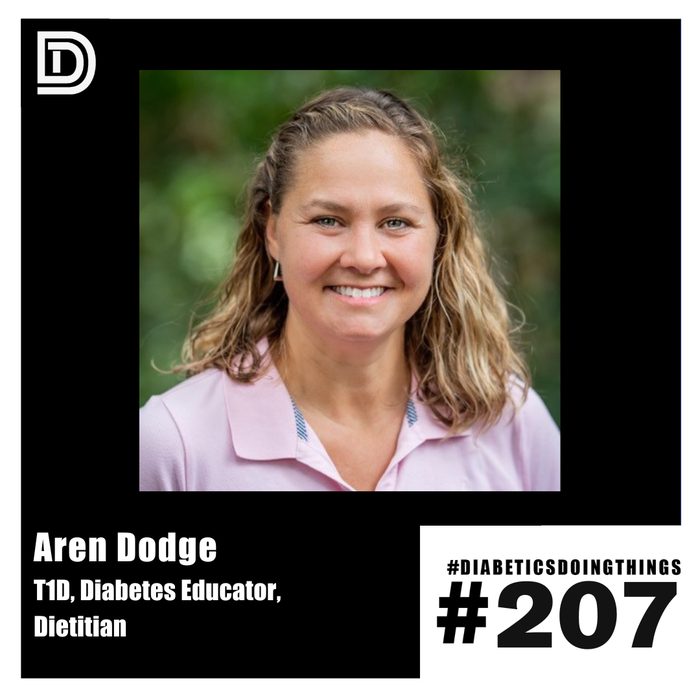
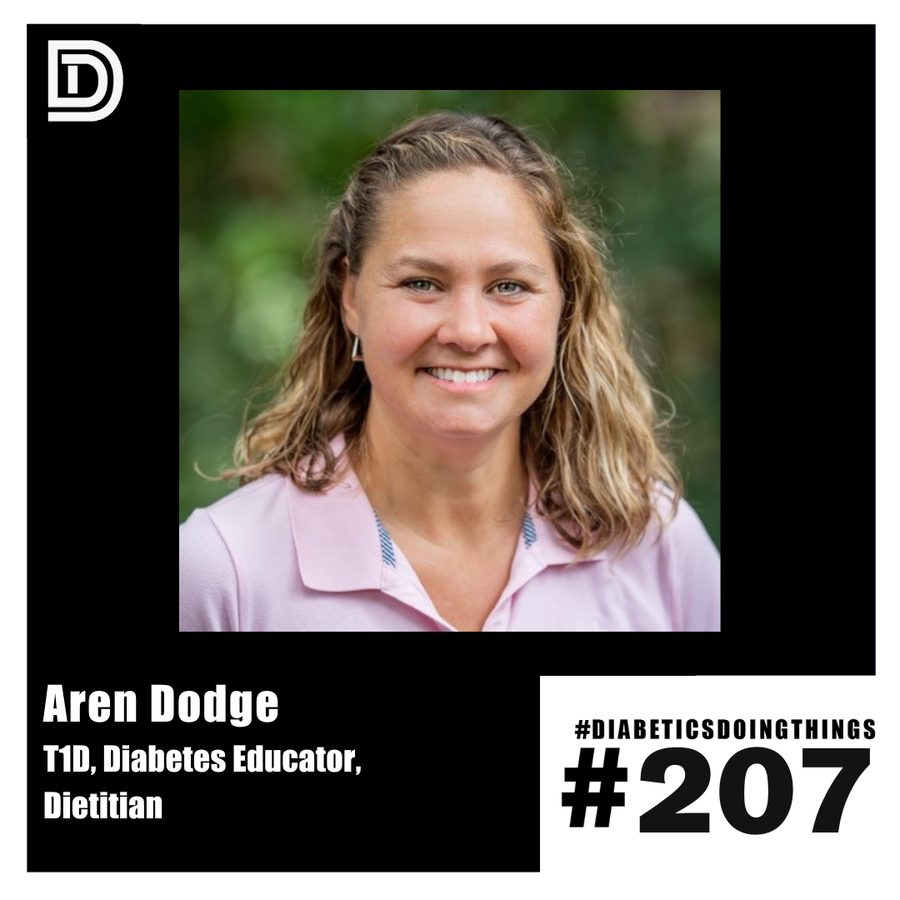
Aren Dodge, T1D Diabetes Educator, Dietitian

Episode summary
Aren Dodge is a registered dietitian and certified diabetes care and education specialist who has lived with type 1 diabetes for 30 years. She was diagnosed at 13 during a blizzard in West Virginia after being misdiagnosed with strep throat; her blood sugar reached 1851 and she spent two days in a coma before recovering. Her pediatric endocrinologist also had type 1, which pushed her toward diabetes education, and she now runs Dodge Diabetes LLC. She and Rob discuss her diagnosis story, hypo unawareness and dead-in-bed syndrome, why a personalized blood sugar target matters more than chasing the lowest A1C, how severe lows can affect brain function, stress responses that raise blood sugar, and the risks alcohol poses for people on insulin.
Key takeaways
- Aren Dodge's blood sugar hit 1851 at diagnosis, and she spent two days in a coma before waking up.
- Dodge says she developed hypo unawareness after about 20 years with diabetes and now has seizures when she goes low without warning.
- Dodge says six to ten percent of people with type 1 die in their sleep from dead-in-bed syndrome, and she recommends keeping time below range under 4 percent.
- Dodge says raising your target range and avoiding lows for about two weeks can reset hypo unawareness so the body starts signaling lows again.
- Dodge warns that alcohol can stop glucagon from working because the liver is busy processing the alcohol instead of releasing stored sugar.
Show notes
This episode is dedicated features Aren Dodge. Rob and Eritrea talk to Aren about:
<Content Warning > This episode discusses some heavy topics including near death experiences and Dead in the Bed syndrome
30-year diaversary
Misdiagnosis and astronomical highs
Diabetes Dinosaurs - no CGMs, just vibes
Finding your life’s purpose - educating others about diabetes
Stress responses and sugar spikes
Troubleshooting for patients based on firsthand experience
Hypo-Unaware
Lows: “the speed at which you fall can make you feel even worse”
Goldilocks effect of finding your personalized sugar targets
Brain neuroplasticity and glucose
Alcohol and dangerous lows
Check out Dodge Diabetes LLC
Questions this episode answers
What is dead-in-bed syndrome?
Dodge says six to ten percent of people with type 1 diabetes die in their sleep from a low blood sugar event called dead-in-bed syndrome, where the heart can't compensate for the drop.
What is hypo unawareness?
Dodge describes hypo unawareness as losing the ability to feel symptoms of low blood sugar. It developed for her after about 20 years with diabetes and now causes seizures when she goes low.
How can someone reset hypo unawareness?
Dodge recommends raising your target blood sugar range and avoiding lows for about two weeks, which she says can retrain the body to feel symptoms again.
Why is alcohol risky for people with type 1 diabetes?
Dodge explains that alcohol keeps the liver busy processing it instead of releasing stored sugar, which can stop glucagon from working and raise the risk of a severe low.
Full transcript Searchable, with timestamps
Rob Howe: Hello, and welcome to another episode of Diabetics Doing Things. We are telling the amazing stories of people with diabetes from all over the world. And before we get started with this episode, I do want to issue a quick content warning. We are going to be talking about near-death experiences and diabetes on this podcast. And while we know that sometimes even taking a walk out your front door can be a near-death experience with diabetes on a daily basis, if that makes you uncomfortable, please proceed with caution or skip the episode if you have to. All right. Welcome to the show, Aren Dodge, RD, LD, CDCES, and person with diabetes. Welcome to the show.
Aren Dodge: Yes. Thank you, Rob.
Rob Howe: We are so excited to have you. And let's just give a little bit of context to this interview because we are posting some content. And I think I was putting it in an email that for me this year, I've really come to this realization that people with diabetes, people like ourselves, are living on borrowed time. If we were born at basically any other time in history, we wouldn't be able to live. And for me, that is hopeful now today for the future, but for many, obviously, there are still major obstacles to overcome. And so you reached out and you said, hey, I want to talk about my story and experiencing a true near-death experience with diabetes from diagnosis. So here we are. I'm glad we made it happen.
Aren Dodge: Yeah, it's just amazing how the universe works sometimes. And here I am doing diabetes education. And when you hear my story, you'll realize how crazy the stars align and things happen for a reason. But I was in seventh grade, and this was back in 93. So this is actually my 30 year anniversary this year. Oh, wow. And yeah, I know. Right. So I was playing church basketball and we, you know, I started to feel symptoms and normal, like, you know, everybody on the podcast seems to mention the thirsty, the tired. And then something happened that like smacked me in the face that made me realize like, oh, man, this isn't just hungry and tired and thirsty. I actually peed my pants and when you're 13 years old and you pee your pants it's a big red flag that something's not right so we were on our way home from basketball practice and I went before we left and of course drinking a bunch of water and then couldn't make it to the bathroom and my mom and I both were like whoa so we kind of started looking at the symptoms and things and the next thing you knew, we ended up hitting there. So there was a big blizzard that came through. I grew up in West Virginia. And so this was the blizzard of 93. And we got hit with two feet of snow. And when you live in the country, you want to make best friends with someone who has a tractor and, you know, can plow your driveway. So we lived up on a big hill and we had luckily friends and family and they came in and shoveled us out so I could go to the doctor. And we just did the walk-in appointment. And my mom came with a list of all my symptoms, which was like I'd lost 10 or 15 pounds already. I had the thirsty, tired, all the symptoms. Like if you'd read it in a book and check all the things, it would be everything. And then I also had thrush, which is like where you get a buildup of yeast in your mouth from all the glucose, all the sugar that was circulating through my body. and I mean she was throwing him softballs like you know I didn't think anybody but babies would get died or would get um thrush and he's like oh no everything's fine oh your throat's sore let me take a look and it was of course red from the irritation and he diagnosed me with um misdiagnosed me with strep and gave me antibiotics and I went on home and of course the recommendation was to drink Gatorade and ginger ale and popsicles and jello. And I just got worse and worse. And that was on a Friday. So Saturday, I wasn't feeling better, but my mom was waiting for those antibiotics to kick in. And then, you know, being sick on the weekend is never a good plan. Especially during the snowstorm, like you want to be out playing in the snow. Right. So she finally took me to the emergency room. And I was kind of in and out of consciousness at that point wasn't making any sense because my like the pH in my body had gone kind of bonkers from the ketoacidosis and made it to she had to like carry me into the ER. And luckily, there was a lady there that had was like one of the grandmas of the team where I'd played softball basketball with. She didn't even recognize me. I'd lost 20 pounds at that point was down to like 65 pounds and had like that gaunt like, you know, on the verge of death face. And my mom told me just the first time this detail that I asked her two things on the way to the hospital. I asked her if she could call our children's pastor to see if he could pray for me. And then I asked her if I was going to die. And it like killed her to hear those words. So we made it there. I laid on the grandma's lap while mom checked me in. And she kept trying to keep me from going, you know, into the coma. And I don't remember anything after that. So fast forward, my sugar was 1851. And the number is not like, I mean, it's, it's huge. I've never met anyone else that's lived with a higher blood sugar than that. And it's interesting, because I'm in the diabetes world so much. But I woke up two days later on a Tuesday and it was just I was just so lucky. And it's it's just a crazy story just to even tell now about how close I was. And everybody was I was too fragile to transport because there was a big children's hospital up the road. And with the snow and everything, they couldn't really get me there and had to like conference and kind of come up with a game plan for like giving me insulin. and bringing my sugar down slowly because the electrolytes and everything, that's a really tricky sort of balance to get you back into the normal range. So it was amazing that I survived.
Rob Howe: 1851. That is super high. I think that the highest maybe I had heard prior to that was 1300. And that was a friend of mine, like sort of like a loose tie from my childhood who I played ice hockey with back in the day. And he had a very similar kind of like went to the doctor, they misdiagnosed him as something else. And, you know, 1300 was the result. But man, you know, what did you feel like when you woke up? Did you, you know, obviously, like, I'm sure your sugars are back at least low, much lower than they were before. Like, did you and with no recollection, like, what do you remember about your early days, like training you to live with diabetes?
Aren Dodge: Oh, it was. So just as a like for you youngsters out there, this diabetes dinosaur from 30 years ago, it was just right when the food label came out and it was when they used to do exchange lists. So I got like you get a serving of protein and, you know, a meat and then a starch and then a fruit and a vegetable. And it was very regimented in kind of that balanced plan. And my mom, I mean, we had class. I stayed in the hospital mainly because I was so fragile, but to learn all that stuff for a week and made best friends with the educator there. And I just loved her job. And luckily, my my pediatric endocrinologist also had type 1. And it was just it made me want to teach people. And that's kind of how I got into doing like Dodge Diabetes is what I'm doing now with trainings and everything.
Rob Howe: Well, and, and, you know, you're like, you're a registered dietitian, a CDC, yes, like, you know, dedicating your life to helping people with diabetes and dedicating your career for that. Yeah. I mean, how often do you get to share your story? Like, you know, with people quite a bit of being like, Hey, you know, it's pretty bad, but it could have been worse. Could have been 1850 during the worst. So storm in a century.
Aren Dodge: right right and um you know i still keep in touch with my endo pediatric endo and um he's up in morgantown right now still still working 30 years later he was just right out of fellowship so he got trial by fire you know with my diagnosis but um i'm just i'm so excited and proud that you know to have diabetes as you know my my um life's purpose and and you know it's kind of one of those things when you wake up, you kind of get a lot more clarity. And I was one of those people that got to tell, like I told everybody when I was back in school, seventh grade, I was letting my friends give me injections and, you know, telling everybody what had happened. I love that you were
Rob Howe: that way. Like how much of that is just you? It's just your personality is like nature versus nurture, right? Yeah. Because, you know, we've met a lot of people with diabetes over the years and continue to. And everybody has their, and I think it ebbs and flows, like depending on the season and, you know, kind of where you are mentally and physically, like how much you want to share. But yeah, I mean, it really is like a personality thing is like, there's people who bring people in and there are people that kind of keep people at bay. And I'd say like, there's no right way to do it. It's just whatever feels most comfortable for you. But, you know, now I'm sure that that helps you, you know, really cover a lot of ground really quickly with some of your patients.
Aren Dodge: Well, you just gain a lot of trust and you have a lot of empathy about how hard this disease really is. And I think that's the big key is it's every day, 24 seven, no vacations. And, you know, to have someone that really gets that is, is, is really special. And, you know, I'm just, I'm just, you know, love how the universe works. It's kind of funny, you know, I mean, looking back now, 30 years later, like, whoa. So, but.
Rob Howe: Well, it is kind of, it's really interesting, like the passage of time, right? You mentioned exchanges and, and, and Eritrea, both, both of us kind of had like this, you know, flashback memory of like, oh man, yeah. I remember exchanges like, oh yeah, this is one carb. And like one carb is 15 grams. And like, that's how you do this. And, um, you know, just like the ways that the diabetes technology and treatment has evolved. And something that we talk about a lot on this podcast is that when someone's diagnosed today in 2022 at the time of recording, hopefully, like there's a chance that they have a dramatically better diagnosis story than for me, almost 18 years ago, Eritrea 20 years ago, and for you 30 years ago. And like those things that they told us to keep an eye out for back then are now a reality. Right. So, you know, for you, like when you have those conversations with recently diagnosed children, families, adults, like, how do you, do you use that sort of past context? And, you know, I'm sure that really helped you to have a pediatric endo living with diabetes. And like, what, what kind of advantage does that give you even compared to your colleagues who don't have diabetes, like just that extra lens to communicate or, you know, how do you, how do you see that manifested in your work? Um, I would say just being
Aren Dodge: 100% delved in with my finger on the pulse every day, watching my own CGM, doing trial and error with different foods, going out to like a crazy sushi restaurant. Like there's so many opportunities to teach myself with my own diabetes, but then that transitions and translates to help other people with scenarios. You know, even little things like stress, like I've had two different moms where their sugars will spike when they get home when their kids get home from school so it's like that whole stress response so we sometimes will like tweak their basal rates or whatever to accommodate for that stress or teach them how to like be more mindful and kind of calm their bodies down in that stress response situation so there's a lot of random weird scenarios that I've lived that I can kind of share and troubleshoot with um so it's it's great experience. And I joke around that, you know, God's made me the best dietitian and the best diabetes educator just from 30 years of living diabetes. I was going to say there's kind
Rob Howe: of no better patient than, than yourself. Right. And, you know, you mentioned weird scenarios and, you know, as you were talking about, you know, moms whose sugars rise when their kids get home, I would kind of laugh. I was like, man, moms with diabetes need a break and a nap. They are doing so much work um but weird scenarios that we were talking about kind of in our email thread is a little bit about hypo unawareness and i know eritrea has or lives with a little bit of that on her side so we'd love to just have you guys talk about like you know hypo unawareness after
Aren Dodge: a long life with diabetes i mean where do i really start um i used to be super hypo where like if i had low blood sugar i would feel it if i wake up no problem i think it's mostly in the last like 10 years that if I have a low unless it's a really really bad one I do not feel it um I have seizures really not fun um I'm really thankful for my glucagon and I always have emergency but yeah kind of hypo unawareness really really sucks I burned my face one year like from like a year to here from the seizure so it's been tough um and I don't really know how to so I'd love any advice that you have yeah I mean I those lows and I honestly personally hate to be low like when I'm looking at my time in range and if there's anything more than two percent like the goal is less than four percent in time in range so if you guys want to go download your um it's called the AGP report whether you're using CareLink or the LibreView or um um Dexcom. So you'll be able to see and if you're less than if you're more than four percent in that low range and very low range then you really need to work on bringing that back up because it's really you can have those scary events where I mean and I almost I feel like it's almost like a post-traumatic stress thing where you kind of get anxious anytime you start to go low and when you feel out of it it's you just feel so vulnerable and it's really scary especially when you don't have anyone around that can help you or that knows your diabetes I think it's so crazy that you say that because I'm one of those people that if my blood sugar is like 180 and like slanting down I will treat my low because I'd rather be high than have to deal with being low for a long period of time especially because I don't know if it is part of hyper an awareness or not but like once i'm already low it's not an easy 15 carb treat it's like hours of being low because i've been low for so long and i just didn't notice or whatever so um something that did help was changing my target blood sugar it's like 160 instead of being like 110 which is like on the higher side so i can catch those lows but i definitely do have that anxiety if i see the arrow planting down even a little bit i'm like got a treat kind of for a like right and the speed which you fall makes it feel even worse um in the nighttime hypos I think
Rob Howe: yeah yeah if I'm falling fast like if I'm two or three arrows down even if my like actual blood sugar is not what we would call like severely low just that motion and for me I always feel like I don't I don't know you I don't know if you guys have seen like Dr. Strange when like they hit the people and they're like soul comes out behind them. That's how I feel with a low. I'm just like,
Aren Dodge: I'm like trailing behind my physical body. Yeah. A lot of people, um, refer to like inception, that little, um, scene where he's kind of like having that out of body, like experience, it kind of feels like where you get the wall wall, like you don't really like hear a thing. You feel like you're in a tunnel and there's a lot of hormones that are kicking in when that happens. So when you have hypo unaware, it doesn't signal those hormones that can help increase your blood sugars naturally. So when they looked at the study, I know we kind of talked about like that. So there's this thing called dead in the bed syndrome. And it's a scary statistic that shows that six to 10% of people with type 1 will die in their sleep from a low blood sugar. Now, I mean, that's a super significant percentage. Now, hopefully with like the automated insulin delivery systems out there, it's going to be better. And then like having access to CGMs more now. But if you don't have that response, like with the hypo unawareness, your body doesn't have that ability to send that stress signal to your body. And what tends to happen and whether you have a seizure or not with the dead in the bed syndrome is that your heart can't accommodate and you end up having the heart attack basically and that's what ends up being the cause of death from that low blood sugar um so it is can be really scary and it's really serious um well i think too like a lot more sorry i think it's a lot more common than people know i um Grew up going to Camp Sweeney. So I know a lot of kids who have diabetes and now we're adults. And I can't tell you how many of them from my graduating class just haven't made it from dead in bed syndrome. Like at least 10 out of 30 of them. So it's really bad. And I don't think people talk about dead in bed enough. And I don't think most people know about heart attack by heart. I think they just think it's a really bad love.
Rob Howe: Well, I think, too, even the name is sort of it's so scary to say, you know. And so I think it is really, you know, especially when people latch onto it. I remember one of my classmates in college who is a friend of my college girlfriend. I was like helping her move something. When you're an athlete in college, you get asked to move stuff a lot. And her sister had diabetes, had type 1. And I had just gotten onto a pump and I was like telling her about it. And her mom was like very anti-pump in terms of because of the dead in the bed syndrome. Cause like the pump didn't know there was no way at that time for it to be connected to a CGM. So it will continue to give you insulin, even if you didn't necessarily need it. And she was really afraid of that type of interaction. And, you know, so she kind of like told me about it and I was like, I don't want to talk about this. Like, I'm like, I'm going to be, but, but yeah, I mean, dead in the bed syndrome is, you know, that's why it's so important. like you said, access to CGM, access to glucagon, and to have those things covered by insurance, you know, especially like, you know, government insurance or Medicare, Medicaid, like for people who, you know, are on assistance, like they need that stuff in an emergency because it doesn't matter what your A1C is. If you're the best controlled person with diabetes of all time, like one mix up of, of an insulin dosage, one accidental or miscalculation of carbs, like and you could be in real dire shape. And I think, you know, that's something that we don't like to think about a lot. I think it's like a hard place to operate from, but it certainly is like a very hefty mental burden that we have to overcome on a regular basis. Right. As if like the
Aren Dodge: 24 seven diabetes management wasn't enough, you have that kind of doom and gloom looming in the background of your management. And it's tough because it's like Goldilocks. You don't want your sugar to be too high, but you don't want it to be too low. And trying to find your personalized target is the most important. And it's really hard with social media and seeing everybody's unicorns and all these beautiful graphs to not feel like I want to get my sugars in better control. But the best A1C for you is one where you're not having those lows. So if that's 7%, if that's 7.5%, 8%, or it's 6%, you just have to be careful because the lower you run, the more at risk you are for having those severe, severe hypos and the dead in the bed thing.
Rob Howe: Aren, talk to me about this. Cause this is, you know, we don't have a ton of clinicians on the podcast, so I'm really glad that we're able to talk to this about you, but you know, they're the target a one C for a person without diabetes is, you know, 5.5 to six, you know, is like, is what the chart always says generally. Uh, and then, you know, you have your, you're elevated to normal people, which is like a good time, a good A1C level for somebody with diabetes, like well controlled, well managed. So you got like the 6.0 to 7.0 and then like slightly elevated 7.8, all that stuff. I've seen a lot of people online talking about the graph, you know, with their A1C in the low five or like high fours in some cases living with type 1. And, you know, so that's like an average blood sugar of like 80, 80 to 75 in some cases on the low end. I mean, though there are people who are trying to do that, like at that target, even though like I've, I've seen the studies, there's no evidence yet to support that that has any sort of impact in your long-term health. What are the risks of the sort of the downsides of
Aren Dodge: being so, I guess, type a about that control? Well, remember everybody's diabetes is different. And I think we're at the cusp of finding out so many more different types of diabetes genetically. That'll be super interesting because I've always struggled with keeping my sugars in range. And I have some other like I have celiac and some other allergies and things that have where I have a lot of inflammation. But your diabetes is your diabetes. So it's not you against other people with with with diabetes. It's you and doing your best and finding your target that makes you feel safe and that keeps you from being at so much risk for these complications. And, you know, with that said, I somehow made it through college without a CGM. And I played intramural basketball and went to the bar afterwards. I mean, it was like there were some scary like scenarios and situations where I mean, it's just a miracle.
Rob Howe: Yeah. You're reading from my bio, basically. Like, yeah, no CGM, just vibes going to party to party. Oh, Hey, you got a, some punch that you guys made. Oh, there's probably 400 carbs in this. Like, Oh, well let's bottoms up. Let's keep partying.
Aren Dodge: Right. And I mean, not like I'm not endorsing like the party scene, but like, I feel like we have so much better technology right now that I think it's a, it's a, you have to have a careful balance. Um, so they do know that if you have a lot of low sugars and hypo, so if you've ever had those scary lows, um, like H was talking about, you feel brain dead, man. It's almost like you couldn't count change out in your hand or do mental math or even make a sentence. Sometimes I had a really bad low where I couldn't even talk coherently and that's your brain crying out for glucose. So when you've had a low like that, especially an extended severe low in a long over a long period of time, that can really damage your brain cell. And what they're finding is that a lot of those lows can cause dementia and like that Alzheimer's sort of pathway because of your your body chemistry and all that damage over time.
Rob Howe: um so your brain operates on glucose you know just like just like the rest of your you know and the brain is so interesting like neuroplasticity and i'm really big into metabolic health right now and i'm trying to kind of translate some of the research that i'm reading for people with diabetes because you know i think a lot of times it's people without diabetes or without other chronic illnesses who are kind of leading the way on these studies and at the same time like they're using tools that we have to use to survive and so i think we kind of have an advantage there to like get ahead of the game on some of this stuff. But you know, your brain needs glucose. I was just, as you were telling me, you know, telling us about this, that low that you had where you couldn't really think or count change. I've had two lows where it kind of was what you're talking about earlier about like extended low blood sugars. Cause my actual sugars were really not that low, probably in the like high sixties, low seventies, but I just couldn't translate what was happening in my brain out of my mouth, which is unusual for me. I'm a talker as you guys know 250 episodes on this podcast you guys have heard me vomit from the mouth a ton so for me to not be able to communicate i was i had to just be quiet and like just tell my co-workers around me like don't worry about me i'm totally inside my head and i cannot communicate
Aren Dodge: externally like let me just eat some gummy bears i have a default setting so my parents and my brothers say that when my blood sugar is low i get really quiet and i just start saying i don't feel good i don't feel good and i just like i don't go like i don't feel good until my mature comes up it's really weird but i've been doing it as a little kid so maybe it's like my body's way of like or my brain's way of being like this is what we do when our blood sugar is low and we don't
Rob Howe: know what else to do you know it's tough it's tough living with a chronic illness that's like so stigmatized and you know type 1 obviously not nearly the stigma of type 2 but when you start talking about things like dementia and you hear, you know, a lot of these talking head podcasts talking about the blood brain barrier and, and, you know, dementia and Alzheimer's being like type three diabetes and understanding like the role of glucose control with like overall brain health. Um, you know, it really is, it's challenging. And like really kind of like puts in perspective to a person who doesn't live with diabetes, like managing your glucose and managing your sugars and your diet and exercise holistically, you know can lead it really has big impacts like and spill over ripple effects later in your life so how do you you know when you've been managing patients i'm sure of all ages and all you know types of diabetes for some time like how do you help manage that sort of marathon of diabetes where it really is not a sprint it's a thing that we have to manage day in and day out full-time job with no vacation how do you manage that like later later in life and like set people up for success
Aren Dodge: It is 100% like that marathon. And you have to balance, you were talking about those type A's that have the 4%, like 5%, even less than 6%. Like that's a lot of work to maintain. So you have to have that life balance with your diabetes and your sanity and how much it's worth. And I think that when since so I've been on the like the automated insulin systems for a couple of years now, and that's probably been the biggest thing where I can almost for a brief second, almost forget I have diabetes and it'll steer for me and I feel confident. But, you know, I just want to reiterate that. Again, the A1C is just kind of a guide, but I'm telling you, if you can look at your time in range and you can if you identify that you're more than 4 percent below target. again, you are at really, really high risk of having a severe, severe low. And none of that effort that you're doing to prevent long-term complications is going to make any difference if you don't make it, or if you drive your car into a tree or, you know, I mean, it's a really brutal truth, but it's something that we, you know, kind of have to bring to the light. Well,
Rob Howe: Well, I'd like to talk about that because, you know, four, four to 5%, I hope that when people are listening to this podcast, they go and plug their CGM into the clarity report or into their in pen app or, you know, generate a report from their, you know, pump through their care link. If they see like, you know, say somebody's got higher than four or 5% of, uh, of low blood sugars or, you know, extreme or severe low blood sugars, you know, in that two to 3% range, like higher, the higher percentage than you would recommend, what are some of the steps that they need to take? And obviously like, you know, consult your doctor, consult your care team, but you as a, as a CDCS and a, and a registered dietitian, what, what steps would you recommend
Aren Dodge: taking just broad strokes? Yeah. So it's actually pretty specific and it's actually nice because it's sort of laid out for you. So think about your diabetes as a thermostat. So if you're used to hanging out at the 300 number, even going to 100 is going to feel low to you. You're going to have symptoms. And so with hypo unaware, what happens is your body just kind of gets used to being low and that's not a good thing. So your thermostat is set below your target range and nothing's going to be alerting your body that, oh, it needs to like activate and release that cortisol and all those hormones that help naturally bring your blood sugar back up or tell your heart that it needs to compensate and work harder so that you don't have that heart attack with the hypo unaware. And so what they found is that thermostat has a time estimate for two weeks. So if you think back to when you were diagnosed, it took about two weeks for you to kind of feel better and feel normal in that target range of blood sugar and not feel hypoglycemic when you got to 100. So two weeks is the sweet spot. So that might mean like I did where you upped your target range, you were very aggressive about not going below 90, even setting your Dexcom or your Libre or CGM alerts to let you know when you hit 100 so that you can catch and bump and nudge that blood sugar back up into that target range and not ever really see those low, low numbers so that it readjusts your diabetes thermostat. And in two weeks, you should feel symptoms again once you go below 60 or 70 or in those scary low sugar ranges. And if you can maintain that, it's almost like a reset button. So that's what I would definitely recommend for people. And again, two weeks, even if your sugar, your blood sugar average goes up to 150, 200, 250 even, it's the safety factor that two weeks is not going to matter in the scope of your projected complications from diabetes, but it will save you from not feeling your lows and having those scary emergencies with hypos my doctor always says this thing um she's like i'd rather us deal with like high blood sugars and figure them out and have the time to figure them out then you die from a low and it's not being able to figure it out so and i feel like that's a really good way for me to be like i'd rather be high for a week figuring it out than being low and not getting
Rob Howe: the chance to figure it out yeah i um i was on a panel that's actually how i met my endo which this is the most robbed thing of all time is i met my endo on a panel um and he it was a off the college panel and so we were kind of talking about what we were talking about earlier about you know you're gonna want to go out you're and i was telling parents i was like your kids are going to drink alcohol. Like, I don't care who they are. Like, that's going to happen. Like, just get comfortable with it. And my doctor was, you know, now my endo was on the panel and he said, yeah, like the worst thing that happens if you go drink a bunch of mixed drinks out and you, you know, come home and go to sleep, you wake up a little bit high. He's like, but one thing that I don't want you to do is to, you know, go out and have, you know, really be overzealous about bolusing for alcoholic drinks when you don't really know what, you know, how much sugar is in it and all those things. He's like, we can live a couple hours being high. That's not gonna, you know, but what I don't want is for you to get too much insulin, be impaired by alcohol. So glucagon doesn't work and get into a situation where, you know, you, you could potentially die. So, yeah, I mean, I think that's right. Like, you know, a little high blood sugar here and there, like don't beat yourself up. You can adjust and move on from that. And, you know, on the other end. However, it's very dangerous and very severe with severe hypoglycemia.
Aren Dodge: Right. And that little caveat with the alcohol, if you think about the symptoms of being intoxicated and the symptoms of low sugar, they kind of like mesh and meld together to where it's hard to tell the difference. Have I had too much to drink or is it my sugar's going low? And then if you drink excessively to the point where you're not really feeling it, you're not with it, you're kind of like, you know, passing out those symptoms, your body tries to tell you when you do hit that low threshold to kind of wake up, get something to eat. It doesn't work. It doesn't trigger and you just sleep right through it because you're passed out from too much alcohol. And those are honestly probably the scariest scenarios. And that's when you do see a lot of dead in the bed and admissions to the hospital and people not doing well because
Rob Howe: of the combination of those two. For sure. And, you know, there's a lot of research coming out now, even at the time of recording this week on the Huberman Lab podcast, which you guys who really know me know that I love Huberman Lab. Even one drink a day, like, you know, one drink three times a week makes your neocortex smooth. Like it's super bad for your brain. Like, and we're talking a lot about your brain health. Like the brain is part of your body, but your mind lives in your brain. And even though I have, it is on record. I have, I have drank alcohol. I've had fun. I have been Mr. Party guy. And you know, I'm also entering that part of my life where I just become more boring because I'm aging, but you know, alcohol is bad for you. I don't care if you have diabetes or not. And while it is fun and it is a huge part of our culture, and it's sort of the only drug that if you tell people you don't do it, they look at you funny. It's bad for you. And I think at face value, we just got to remember that, that when you're living with diabetes and you're participating in things that are totally normal from an able-bodied and a cultural standpoint, you still have diabetes and you're still going to need to be as hypo-aware as possible. And you need to be able to have glucagon work if you're in a, you know, a tight spot or a bad situation. And, you know, right, right off the bat, those are two things, you know, the alcohol affects directly at any time. So anyway, that's my PSA. I'm getting off my soapbox.
Aren Dodge: Right. And physiology wise, the reason that doesn't happen for anybody listening is, so he's saying that the glucagon won't work when you inject it. And that's because the liver is so busy processing the alcohol that it doesn't release that glucose that your basal insulin is taking care of. So it's like a double whammy where you won't have the glucagon, the glycogen in your liver to help bring your sugar up if you need it. But then also your risk of going low is drastically increased the number of drinks that you're consuming because it's going to keep your liver from squirting out sugar into your blood. And that's what your basal is handling. So your risk of hypo is, is through the roof.
Rob Howe: Well, man, we have covered a lot of really good stuff on this podcast. Um, Aren, you run a great account on Instagram, dodge underscore diabetes. So if you are looking to, to connect with Aaron or you have questions for her after this podcast, um, I'd encourage you to reach out there. And, you know, the other thing is like, and Eritrea mentioned this to me, like we came into this podcast thinking we talk a lot about really dark and heavy stuff, which we have, but at the same time, like people with diabetes do, like we're approaching it in a way that's accessible. It doesn't have to be scary. Like we can plan for the worst case and not get caught up in a negative headspace and like really still say, okay, well, I am going to be prepared. I do need to understand. And, you know, for what, you know, Eritrea and I often talk about in our staff meetings is this could be the first time that somebody hears about, you know, drinking and diabetes or dead in the bed syndrome or, you know, near death experiences and diabetes or hypo and awareness. And these topics are really important to cover. So Aren, thanks so much for, for reaching out and connecting with us to, to come on this episode.
Aren Dodge: Yeah. Thank you so much. Yeah. And you can find me on Facebook as well at Dodge Diabetes LLC. And I have a community on there and post a lot of helpful educational stuff and do education for one-on-ones. And I have a group, a virtual group course that it's called Be Your Best Pancreas. It's all intricate diabetes for insulin users. So I'd love to see you guys there. And I'm just so blessed and excited to be able to share all the 30 years of experience with diabetes to help others.
Rob Howe: Well, and I think, you know, you brought this up earlier, like it was instrumental for you to have a pediatric endo who lived with type 1. And you never know what you're missing out on by not having more people with type 1, especially experts in your life. And we talk about that a lot. A friend with type 1 is a friend indeed. That's a great life hack to get ahead. And we will include all the links to the Dodge Diabetes pages and website in the show notes. So if you're listening to this now, go ahead and click there and check them out.
Aren Dodge: Great. Thank you so much, Rob. Thank you, Aitra.
Rob Howe: Yeah, thanks. Thank you so much, Aren. And we'll see you next time.
About Aren
Aren Dodge is a registered dietitian, certified diabetes care and education specialist, and person with type 1 diabetes who runs Dodge Diabetes LLC, offering one-on-one education and a group course called Be Your Best Pancreas.