

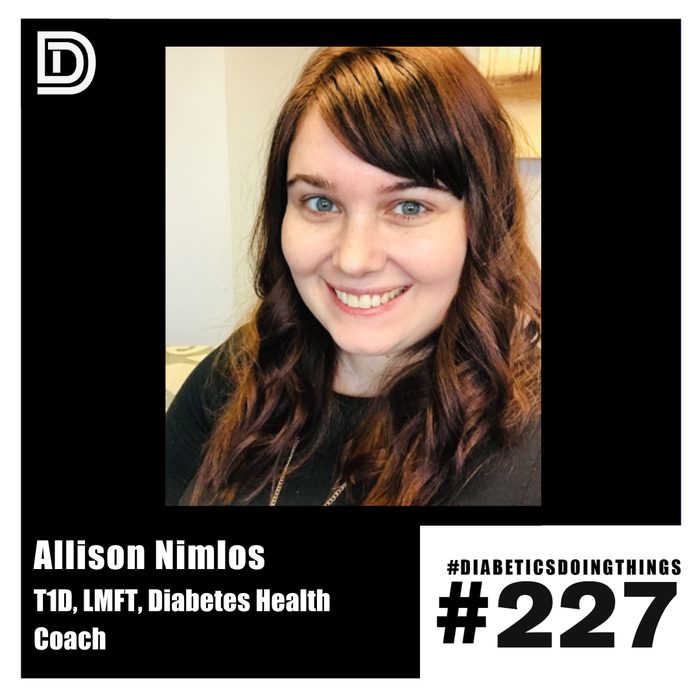
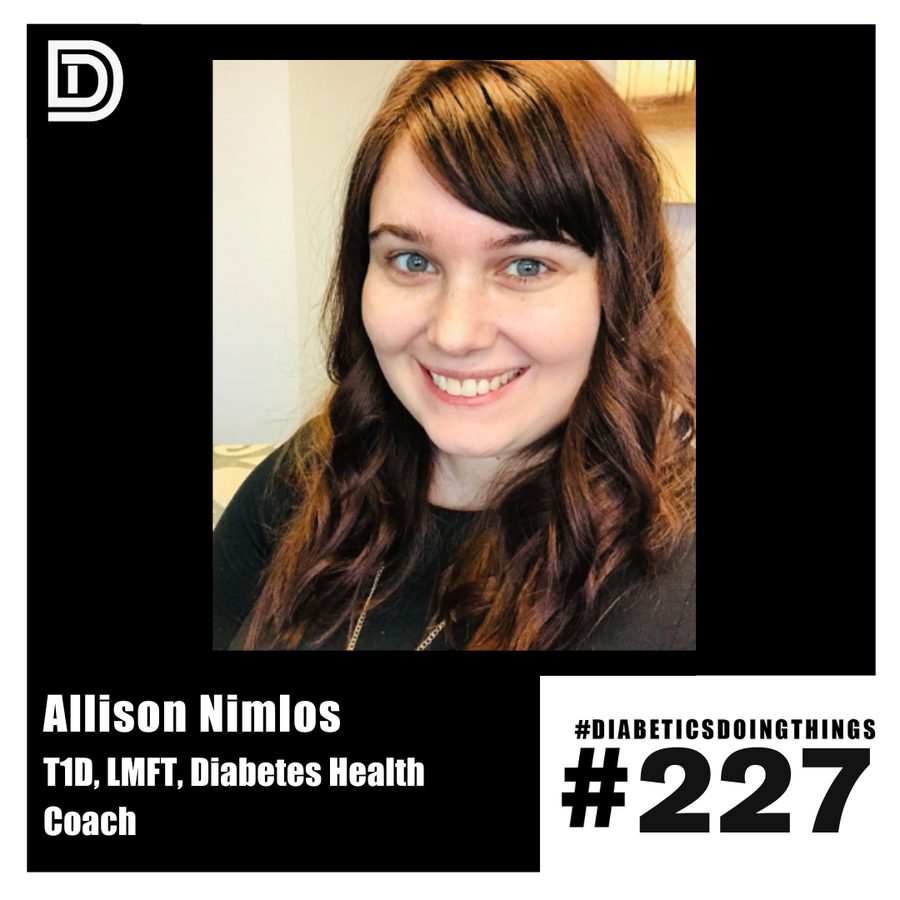
Allison Nimlos, T1D, LMFT, Diabetes Health Coach

Episode summary
Allison Nimlos has lived with type 1 diabetes for 29 years and has been part of the diabetes online community since high school, first as a blogger. She is now a Licensed Marriage and Family Therapist known as "the diabetic therapist." Rob and Eritrea talk with her about diabetes distress, which she says affects 40 to 50 percent of people with diabetes at any given time and often goes unrecognized by doctors and therapists. The conversation covers harsh self-talk versus self-compassion, setting personal boundaries around questions and food choices, and the fear and trauma some people develop around low blood sugar. Allison also previews the Diabetes and Mental Health Conference she co-organizes, happening May 5 and 6, 2023.
Key takeaways
- Allison says 40 to 50 percent of people with diabetes experience moderate to severe diabetes distress at any given time, and it often goes unnoticed because it isn't a formal diagnosis.
- A free self-assessment at diabetesdistress.org scores seven areas of distress and can help pinpoint where it's coming from.
- Harsh self-talk and shame don't motivate better diabetes management, Allison says; research shows they trigger avoidance and burnout instead.
- Setting boundaries, including saying no without explaining, protects relationships and lowers distress, according to Allison.
- Fear of lows and trauma from scary low blood sugars often need professional support such as EMDR, not just self-talk, Allison says.
Show notes
Allison Nimlos, longtime diabetes advocate, Licensed Marriage & Family Therapist, podcaster, and so much more, is on this episode! Rob and Eritrea talk to Allison about Diabetes & Mental Health:
The Diabetes and Mental Health Conference coming up on May 5th & 6th
The early days of the diabetes online community
The prevalence of Diabetes Distress
You can do a self-assessment survey at diabetesdistress.org
Importance of self-talk and language around your own diabetes
Self-compassion, self-advocacy, and setting boundaries
“You can’t be comfortable at doing something you never do”
Hypo anxiety and trauma from scary lows
Be sure to check out the virtual Diabetes and Mental Health Conference coming up on May 5th & 6th
We want to hear from you. Send your questions, comments, queries, and general diabetes concerns to THE MAILBAG at mailbag@diabeticsdoingthings.com!
Questions this episode answers
What is diabetes distress and how common is it?
Diabetes distress is the emotional burden of managing diabetes day to day. Allison Nimlos says 40 to 50 percent of people with diabetes experience moderate to severe diabetes distress at any given time, and it is distinct from a clinical anxiety or depression diagnosis.
Where can someone check their own level of diabetes distress?
Allison recommends the free self-assessment at diabetesdistress.org, which covers seven subscales tied to different sources of distress.
When is the Diabetes and Mental Health Conference and who is it for?
The virtual conference runs May 5 and 6, 2023. It has a patient track and a provider track with CEUs available, and sessions are recorded and available to registrants for a month afterward.
How does fear of low blood sugar affect people with diabetes?
Allison says many people develop hypoanxiety or trauma from past severe lows, which can lead them to over-treat lows or avoid dosing insulin. She notes this kind of trauma often needs therapies like EMDR rather than self-talk alone.
Full transcript Searchable, with timestamps
Rob Howe: Hello and welcome back to another episode of Diabetics Doing Things. We're telling the amazing stories of people with diabetes from all over the world. We've been talking a lot about mental health on this podcast, really going back to last National Diabetes Awareness Month. So I'm very excited for our guest today. She's a podcaster. She's a longtime diabetes advocate, diabetes blogger, diabetes community member, and she's a therapist. In fact, she's the diabetic therapist, Allison Nimlos. Welcome to the show.
Allison Nimlos: Thank you so much for having me. I'm so excited to be here.
Rob Howe: I'm excited to have you as well. I think we first connected when I was in Minnesota four years ago now, I think. I was speaking for a little JDRF event there. Shout out to our JDRF Minnesota chapter. They have been a long time supporters of the podcast and what we do here. and we got to meet and talk at length on that trip. And I guess, you know, just since then, there's been a few things that have happened, but in both of our lives and also obviously in the global pandemic, obviously was a part of that. And now kind of coming out of it, really excited that you also are promoting the latest version of the Diabetes and Mental Health Conference, which we're going to talk at length about later. But that conference is May 5th and 6th of 2023. So at time of recording, about a month out from where we are today. So Allison, like we normally do, let's talk a little bit about your life with diabetes. And even I'd love to talk about early days in the diabetes online community as well, because I think it's so important to know where we came from.
Allison Nimlos: Yeah, absolutely. Well, I have had type 1 diabetes for 29 years. And I got started in the diabetes community in high school. So as we were talking about before we started recording, sometimes I kind of feel like the grandma in the diabetes community because it's like, that's over 20 years that I have been involved in the diabetes online community. And it has changed so much. I was just thinking about this the other day that when we first started blogging, We could keep up with the number of people who had blogs. And I don't think you could try to record the number of people who have blogs and Instagrams and TikToks and websites now. I mean, there's just so many people, so many voices, which is so exciting, so exciting. But yeah, it was super tiny and kind of nascent back in, you know, the, I guess, mid to late aughts. Is that what they call it? And yeah, things have changed a lot, but it has been really cool to see that evolution and to see so many more people feeling comfortable talking about diabetes and putting like, so many of it was, so much of it was like anonymous back then. And not that things aren't still anonymous, but I think people are feeling more and more comfortable putting themselves out there and talking about diabetes.
Rob Howe: I totally agree. And I think, you know, we're 200 episodes on the feed when this goes live and we're not even close to interviewing even a large percentage of the number of active voices in the diabetes community. And even in the, you know, now seven, eight years since we've started doing this podcast, the amount of people who are sharing their stories is way up. And I think the community is better as a result. And I think I can confidently say now, like no matter who you are, no matter where you are living with diabetes, there's somebody who is sharing their story that you can connect with. And going back to the aughts back when I was first diagnosed and almost 20 years ago now, that's a different story. And so in a lot of ways, obviously a diagnosis with diabetes is never good, but at least now there's more voices to follow. There's more amazing people to be inspired by no matter what you're into. And I think that's something to celebrate for sure.
Allison Nimlos: Yeah, absolutely. I mean, I remember when I first started my blog, like one of the things that inspired me was I felt like I didn't, there was no one in college with diabetes on the internet. And it was like, now there's, you know, the Diabetes Link, you know, formerly, you know, CDN. And there are so many more people who are able to kind of contribute those stories and the accessibility to a community is just, it's so much more accessible than it was when I was first
Rob Howe: diagnosed and growing up. It's exciting. And I think one of the big wins of social networking and the internet is just connecting all of us folks with chronic illnesses to each other. So with that in mind, we've talked at length and not just here, everywhere in the diabetes community at different times about the impact of diabetes and mental health. And so, you know, for you living with diabetes and also practicing as a licensed marriage and family therapist, let's talk about, you know, let's get past the just that people with diabetes are three times as likely to suffer from anxiety and depression, which I think is a is a very impactful line, especially when you read it for the first time, because you can see it's like, oh, okay, well, maybe this anxiety and some of this depression that I'm experiencing is normalized. And I think that's really important to use in that language. And so for you, you know, when you're thinking about the impact of diabetes and mental health, after all this time in the online space and all this time practicing with patients, you know, what are, you know, some of the things that people with diabetes should be conscious of and try to notice in their life that may manifest themselves as anxiety and depression? Yeah. Well, I think, I mean, I think knowing the
Allison Nimlos: stat is really important, but I think one of the other stats that I like to share when I give presentations about diabetes and mental health is actually the prevalence of diabetes distress. The diabetes distress is even more prevalent, like 40 to 50 percent of people with diabetes at any given time are experiencing moderate to severe diabetes distress. And because diabetes distress isn't a diagnosis, it's not in our DSM, it can often go overlooked because there are not, you know, it's not something that psychotherapists are going to get trained on. And there's not really kind of, I mean, the diabetes distress scale is a great way to assess that. But it doesn't come up as much in like discussions with like endocrinologists or even like your own therapist, if you have one. So I think that can often get overlooked. So what I think first, very first thing I would want, if anyone here is listening and wants to know like, what is something I might be able to take away and do with this podcast I'm listening to is to do a self-assessment of diabetes distress. And you can do that at diabetesdistress.org. And no, they're not paying me to say this. I get no commission. But I just think it's a really great resource and insight into the areas. There are seven areas, subscales, we call them, in diabetes distress that this asks you lots of questions about that. And when you know the source of the feelings, that's when we can problem solve and that's when we can take action and do something. A lot of times, you know, patients, clients that come to me, they know things don't feel great. They know that something feels off. They just don't really, they don't feel empowered. They don't feel confident. They don't feel, you know, joy or anything like that. And when you have kind of a sense that something is off, but not really knowing the direction it's coming from, it can feel even more disempowering and hopeless because you don't know what can you do. And so that's one thing that I would recommend that people can get started doing it on their own, you know, today to kind of raise their own self-awareness about what their lived experience is.
Rob Howe: Well, I also want to focus on like awareness in general. It's like not just self-awareness, but you know, I didn't know the diabetes distress.org existed. So, and I'm pretty informed and I'm, you know, so I think there's opportunity obviously to find that awareness of what distress diabetes is bringing to your life. And I think we all can look back at our diagnosis dates for the most part, those of us who were old enough to remember how radically our life changed. But we don't associate that change with why we're feeling the way we're feeling necessarily. Like, you know, we don't always make that connection. I think a lot of it comes back to language and how we talk to ourselves about it. You had a post recently on Instagram that kind of walked through like the importance of language and self-talk and the way that we talk about our diabetes. And I think, you know, I'd love to talk a little bit about that with you in terms of like how thoughts and beliefs can become reality. I'll share a little bit something of my own. I, in 2021, probably I started writing myself notes on my alarms. So like when you on an Apple iPhone, you have your alarm and it has a label and you can write something there. So I would write something either just a little snippet or a quote or, you know, a to do list for like the first things in the morning. So the first thing I see is, you know, how I start my day. And there was a period where that language was really harsh. And I was like speaking to myself as kind of like a drill sergeant. I was just very, you know, overly. I don't know, mean. Toxic is the word you're looking for. Toxic, mean. I mean, you know, very directive, like not sensitive and kind of like, you know, we talk about softening edges with mental health. It was a very hard, direct language. So it's kind of like a slap in the face, like early in the morning. And I changed that, you know, in 2022, I just became aware, conscious of like, oh, the way I'm talking to myself, I really wouldn't talk to anybody else that way. So maybe this is a factor in like why I'm feeling the way I'm feeling. And I think that changing that, softening those edges and being a little bit more open to myself has given me a little less distress in terms of all of those kind of daily, you know, starting my day on the good foot. So I would love to talk to you about, you know, the words that we use for ourselves and how we can treat ourselves more like a friend than an enemy.
Allison Nimlos: Yeah. This is one of my favorite things to work with my clients on because I think the idea of being compassionate with someone else, with a friend or family member who's struggling, is very well taught, role modeled, example that we really elevate that as we should. But the idea of doing that to ourselves, to speak to ourselves as we would a friend, has a lot of misconceptions and myths around that. That, you know, people can feel that being self-compassionate is indulgent or it'll make you lazy or it means you don't care. And that being that judge, being that critic, being the, you know, almost a bully is motivating. This will motivate me if I'm really kind of, you know, give myself the stern talking to, I'll shape up. I'll lower my A1C. I'll pre-bolts earlier if I kind of shame myself into it. And what research shows is that absolutely is not true. It doesn't work. It is in all of the research that they have done on this, and there's quite a body of work now. Yeah, shaming and judgment does not motivate somebody into action. And the worst thing is it actually it's harmful. You know, it brings up in us that fight or flight reaction, right? When we have somebody who is harming us, we want to kind of run away. And it's sort of a catch 22 because in self-judgment, And we're both sort of, we're the victim and the perpetrator at the same time. And so, yeah, creating some awareness around the language that you use in response to the things that have been like a high blood sugar or forgetting to bolus or forgetting to bolus early enough or whatever it is that you think you did wrong and that you want to respond with harsh criticism is really noticing that pathway, that sort of cause and effect. Because I think what a lot of people would probably notice is that when this event happens, whatever it is, this event happens and then they have beliefs about the event. So this is something I talk a lot about with clients is the connection between beliefs and thoughts. Thoughts are more like things that happen in the moment, but beliefs are like the foundation, like how you are grounded. The beliefs that you have about the event feed the thought that you have in that moment. And then that thought will then impact what kind of response that you're going to have. And the more difficult the thought and the more difficult the response, eventually you're going to go into avoidance mode. That's just normal. You know, there's only so much there's only so long before you can fight that's usually what people go into like right away and not everybody but that's often like you know when you get that harsh criticism from your endo and you'll go i'll show them and it lasts for a certain period of time but eventually coming from you and for you know days on end it it has the opposite effect of of what you're intending, which is to motivate, but it actually goes, I can't do this. I'm not good at this. This isn't something that I can do. And it's so emotionally difficult. I'm having such a hard time coping that I'm going to avoid. I'm going to not engage as much. And that's where we see the distress and some of the burnout happening. So that's kind of the pathway that that can take.
Rob Howe: that really resonates with me i think you know from the beliefs and thoughts because i think often we talk about how thoughts become reality but we don't understand maybe the the precursor to that which is the beliefs that turn into the thoughts that turn into the reality and how that is rooted so deeply within us and i think like you mentioned we often don't see ourselves as a as a as an entity we you know we don't and the way that we talk and think we don't think of that as an interpersonal relationship. And so for me, hearing like, well, you should speak to yourself like you speak to a close friend, that sort of makes it really tangible, or at least for me, made it really tangible. I'm like, oh, well, yeah, that makes sense. Like I would never, I'm like overly nice is probably one of my like flaws. Honestly, I'm just too nice. But it's like, okay, well, can I apply that to myself? But then on the other side is like, when you're in your body, like your body and your brain are part of the same thing, but your mind is separate. And like that, even that is kind of how your physical body and your, and your mental body interact. Diabetes is such a personal thing. Like you talked about that resistance. And when we hear something bad or we hear something personal, because diabetes is part of us, at least early on in my diagnosis, whenever anyone would ask me a question, even if it was innocuous, like I would get uncomfortable because it felt like a, it's something different being pointed out about me. And I think there's like shame and there's, you know, you sort of go reactive. And that first reaction is to be defensive and to put up the walls and to maybe react in anger for me, at least, you know, when I was, when I was much younger, but you know, it can be, it's such a personal thing. Hey, your A1C is too high. If your endo is saying that to you or whatever the case may be, that feels like a personal attack because it's something that you are managing and going through, even though you're doing the best you can do, you know, ideally, it still feels like a personal failure and then you have no one to blame but yourself and you start that negative pattern of just you know getting back on that roller coaster of blaming yourself you know not making the changes or reacting and then you're back to the back to the cycle it could be smaller than that right like i you something you said just really like caught my attention when you were like something personal that you're managing i don't know if it's just me but i used to get really triggered when somebody asked me why my pump was beeping because I just feel like I am handling it. Like, shut up. Just let me handle it, you know? And I sometimes would come off as rude, but it just felt like not an attack, but just like you're questioning me and my methods and my management. So it can be as small as, oh, are you okay? Why is your pump beeping? Or like, hey, do you use some sugar? Is your blood sugar low? You're acting kind of weird. Like I personally get triggered by those types of questions. I don't like them.
Allison Nimlos: Yeah. I mean, the first thing I was thinking is the, you know, belief of the pump beeping or the story, that's another, you know, kind of phrase I'll use, like the story you tell yourself about the thing. So if a pump beeping is the story I tell myself about my pump beeping is that something bad is happening, something wrong is going on, and then somebody notices, then we might have this thought of, they're judging me for not managing my diabetes because I have a belief that my pump beeping is a bad thing and it's being pointed out and now I feel
Eritrea: shame. For me, it's like I have a belief that I don't want to be different from everybody else. And I know Rob and I don't want anybody to like look at me and be like, oh, that's the girl with diabetes. So it's like if my pump beeps and someone's like, why are you beeping now? Everyone's like, oh, yeah, that's the girl with diabetes. Yeah. So that's more the story in my head.
Allison Nimlos: Yeah. Being different is bad. Right. Yeah. If we have a story that we're telling ourselves that having diabetes is shameful, is bad, then whenever we're in a situation where our diabetes might be noticeable, we are going to carry those, we're going to have those thoughts of they're going to think something. What are they thinking? What are they going to do? What's going to happen? And it feels really in the moment, but it comes from a much deeper story. And so that's some of the work that I do and that therapists do in counseling is to kind of look at what are the stories that you're walking around with? How are they manifesting? And then how can we make some shifts so that we have, you know, shifts in those stories so that we have better outcomes?
Rob Howe: This is actually a really great transition to my next questions that I want to talk about around self-advocacy. Because, you know, what you're describing, Eritrea, when your pump beeps and somebody asks you a question, now you're in a situation where you have to be your own advocate on a very micro level. It's not the same as when you're at the endocrinologist's office or you're on the phone with your insurance company and you're trying to get a prior authorization for the medicine that they have, that you have a prescription for, that you need, but they don't want to cover. That's a different type of advocacy. I think a bigger, and you might be more galvanized to do that because when you pick up the phone, you know what you're going to have to do. You have a little bit of an expectation of what you're going to have to go through. But when someone sort of surprises you with a, because as we all know, those of us that wear pumps that beep, they beep at weird times, and you can't always decide when they're going to beep. And somebody asking you, that becomes a micro moment of self-advocacy. And we, as people with chronic illnesses, have to advocate for ourselves in many different situations. And I think back to that mindset, it can be difficult to, you know, if you're low on energy, or you've had a difficult diabetes day, or you're in a high state of diabetes stress, to advocate for yourself even on a micro level. And as Eritrea, like maybe a brisk remark or a rude comment that you give back, that person has no idea what you've gone through that brought you to that point. They think that they've caused it, and it's almost never the case. So Allison, I'd love to know some of the ways that you galvanize yourself to remember to be your own advocate and some of the ways that you discuss
Allison Nimlos: that with your patients as well. Yeah. Well, I think the word that comes to mind hearing this is boundaries. And we actually have a whole session on boundaries at our conference. but one of the you know things that a lot of people struggle with in diabetes and with any client I've ever worked with is on personal boundaries and it kind of goes back to this kind of what we're talking about with compassion like we're sort of trained to be like really nice to people and the idea of having boundaries can feel kind of mean like I can't say no or they're just we kind of make you know we try to explain it a way of like why allowing people to say or do things or ask us things but having to sort of capitulate or participate you know even though it doesn't feel good we feel obligated and so so this question kind of makes me think a lot about how we identify and communicate boundaries of what we are okay talking about, what we are okay being asked, what we are okay participating in. And that can be really challenging for people who, you know, don't have a lot of conversation or a lot of opportunities to really think about what their boundaries are and to learn how to communicate that in, I think, respectful and effective ways. Because I think most people just think of boundaries as being kind of those like sort of mean little retorts that don't even really feel that good once you're done doing it. Like, you know, you may have set a boundary, but you know, you don't feel that great either. And I always tell, you know, my clients like setting boundaries protects the relationship. It helps to guide the relationship so that the people in your world know how to relate to you know how to support you know how to help you and that you know you are are guiding them and and vice versa that they will guide you on on their boundaries and what they need so that's that's something that i would encourage people
Rob Howe: to to be thinking about i want to talk a little bit about boundaries because i think sometimes it can be really uncomfortable when you make new boundaries or you decide what your boundaries are and you sort of verbalize those because you're prioritizing yourself. That's not a selfish, selfish, the negative connotation selfish. It is a selfish act because you're trying to help yourself. You're trying to create a space for yourself. And I think sometimes it feels like a four-letter word. It feels like a bad word when you're like, hey, I don't do that anymore. Or hey, It can make people uncomfortable. And I think part of that is just because so few people these days have established those boundaries for themselves or are aware of what things are good for them or not. And we can kind of talk about this on a broader scale. We talked about diabetes distress, but there are a lot of similarities that people with diabetes deal with on a regular basis regarding their mental health. And I think a lot of them stem from boundaries, either ones that we haven't established or ones that are encroached upon by external factors or ones that we maybe aren't as honest with ourselves about or aren't able to commit to. So, you know, what are some of the similarities that you see with, you know, patients, whether, you know, differing levels of diabetes distress or just dealing with diabetes burnout or, you know, diabetes affecting their mental health?
Allison Nimlos: Yeah, well, one thing that comes to mind is the idea that of being a burden to other people. And so we may not not advocate for ourselves with our family or with friends saying, I need some help. I need some support. I need to I need to do something differently or I need you to help me to do something differently because we don't want to be we don't want to be a burden. And so, yeah, that's something that I see come up a lot around the idea of, you know, being able to kind of speak up for ourselves and how that contributes to diabetes distress. And then, of course, you have things where you're being, you know, you're you feel like you're being asked to do something, you know, we want to we want we want to do something. And maybe it feels like not the right decision for you. But, you know, you don't want to say you don't you don't want to refuse something that, you know, you know, grandma cooked and say, no, I don't really want that right now.
Rob Howe: Grandma boundaries are tough.
Allison Nimlos: I'm not I'm not going to have seconds or whatever it is. and that can just feel like, well, I can't say no, and because we are sort of afraid of what people are going to do or say or be offensive. And so that across the board leads to a lot of distress for anybody. If that's the story we're telling ourselves, it's saying no is offensive and it should be avoided.
Rob Howe: And I think no also has, no is a boundary. Oh, it is a boundary, yeah. You had a post about this recently and friend of the pod, she was on one of our first 15 episodes. Melissa Urban, formerly Hartwig, wrote a book on boundaries and talks about no is a complete sentence. And, you know, sometimes just saying no and not having to explain and not burdening yourself with having to explain is a strong boundary, a strong foundation. It takes practice, though, because it really does feel uncomfortable because I think from a societal perspective, people don't we don't talk about saying no as an option very often. You know, say no to drugs for sure. Like, obviously, is like, you know, has a big campaign behind it. But that took a long time, too. And like saying no to peer pressure and saying no to things where you try to fit in. And I also think for young people who are trying socially to fit in, it can be very challenging to say no in a high-pressure situation, whether socially or just fun or not wanting to explain. I've talked about it on the podcast before, but a few years ago on 7-Eleven Day, I didn't get a Slurpee. My whole team went to a 7-Eleven. I didn't get a Slurpee. I got a Coke Zero because I had like 12 units left in my pump. It was in the afternoon. I didn't want to deal with the, you know, the roller coaster of bolusing for a sugary beverage. Sorry, Slurpee. But the and somebody comes people commented like, just get the Slurpee, just drink the Slurpee. And I was like, well, you know, that's my choice. I don't have to do what you want me to do. And it was a really weird interaction. So, you know, I think I blocked that person. If they're out there, I will beat you. This is bottom line. So I will beat you. But like at the same time, I think like it did feel weird. I was like, OK, well, it's such a strange thing for people to be upset about. But again, I had to worry about myself and what was right for me in that moment. And I think, you know, on a day to day basis, that can be that can be challenging. And especially when you're dealing with it, the boundaries and relationships that you really care about. Yeah. It takes an extra step of recognition.
Allison Nimlos: Yeah. And sometimes it's not even saying no. It's saying it's not about even saying no to, you know, the food. Sometimes it's that you have said yes to something and people want to know why. why can you eat that and why you know i thought you had diabetes and all this stuff and so so sometimes it it isn't because you've said no it's because you're you're saying no to a type of interaction that doesn't feel healthy that doesn't feel safe and that we are able to kind of slow down and talk to somebody and say you know even that i understand maybe why you're asking this And maybe, you know, if you want to, you can say, like, I appreciate your curiosity. Thanks for your interest or your care. But and then you set your boundary of, you know, talking about my food choices isn't something I do.
Rob Howe: And I think that is such a succinct way of doing it. I think a really strong way of operating. And I think that I've had a lot of practice. Well, right. Which is why you're here. And I think, you know, for somebody who maybe has only done that one or two times or has thought about it, but not committed to it, it is an option. It does feel uncomfortable. But I think sometimes, and this is like an improv thing that I haven't thought about in a while, but you kind of have to follow the fear sometimes. If you're afraid to set that boundary and you feel it in the butterflies in your stomach or, you know, just that really kind of uncomfortable feeling, that's your brain warming up to do something new. And I think kind of following that fear sometimes will lead you to a place that you don't know. And we talk about a lot. I think online advocates do this extremely well. Every opportunity that you encounter a stigma or a predisposition is an opportunity to educate. Now, you may not have energy to educate at that particular moment. And that, I think, is where some of the conflict and the difficulty arises. But by learning to say how you feel and be aware of why you feel that way, even to a total stranger, you know you can be successful in those in those situations yeah well that line reminds me of
Allison Nimlos: something I I often say you know you you cannot be comfortable at something you don't do if you you're avoiding something a lot of a lot of clients a lot of people that I work with they're like well I'm just you know I'm not comfortable with that yet I'm not comfortable and so I'll ask I'm like, have you ever been comfortable and totally confident in something that you've never done? And then they go, no. And it's like, that's the idea. You know, we are not going to feel really, like, confident and, like, knowing the outcome to something, like, the first time you are doing something or even the first handful of times that you're building, you're building that skill. but we don't build the skill by avoidance my therapist and shout out to shout out to her i
Rob Howe: won't name her i guess but i could i don't think you're supposed to you can you can you can you can't she's she's not a secret spy yeah there's no there's no yes there's no like oh my
Allison Nimlos: I'm Rob Howe's therapist. What a flex.
Rob Howe: Oh my gosh. Well, you know, she was talking to me about, we've been working together for three and a half years now. And she said, you know, if you had done anything almost every week for three years, anything else other than what we're working on, you would not be surprised that your skills are better at that than someone who has never done it. But when we look at ourselves, we look at things like mental health and therapy and practice and mindfulness, we don't associate those the same way we would with like skill acquisition of like nailing a hammer or building a birdhouse or something, you know, like you're, and I think that's a really interesting way. I'm not sure exactly why. I think it's just probably human nature of like, we just don't, we're not as good at affirming ourselves, the work that we're doing internally, because it's not tangible always. And like you said, but if you don't practice it, if you, if you don't put it in practice, you'll never be good at it because the first time you do something, anything, it's always worse than the hundredth time you do it. I was, I was, I don't know, maybe, maybe that's too like generic, but I think also the reason this is so is connecting for me so much is because there's so much of my life is spent in social media content, not just for myself, but for my clients as well. And I can't think of any other like type of, of output where we assume on day one, the first thing that we put out there is going to go be the best post of all time. And we're disappointed that every post didn't go viral, even though it had no business doing that. And we're just getting started. And awesome creator, Mr. Beast, has a really clickbaity kind of talk where he says, oh, you want to be famous on YouTube? Make 100 videos. No one's going to watch them. But on that 101st video, something magical will happen. And it'll be so much better than video one that you'll have found something, you'll learn some skill and you'll be in a different place than you were prior. And I think like, so that's so much of what we're saying is like going to therapy once or going attending one conference is not going to change immediately all of the way that we deal with our diabetes or our diabetes distress, but it does put us on a path where we can practice and return to that practice to improve that skillset and that commitment to ourselves.
Allison Nimlos: so I don't know that was kind of a windy road answer but absolutely I definitely and I you know I think in the diabetes world one place where I see the sort of the mental and the physical go hand in hand is with hypoglycemia and so many people I work with have you know fear of hypoglycemia or hypoanxiety. And so they, you know, they go, well, I felt anxiety. So I did, I did something, right? So there's this link between thoughts, emotions, and behavior. And when they tried to, you know, not get, you know, not maybe eat as much, or maybe it's the, you know, the reverse, it's trying to pre-bull us a little bit earlier, but they were really anxious. And they go, I was so anxious so I didn't do it again and I was like that's that's that's missing the point the first time you are going to have anxiety but the more you do it the anxiety will it's not a it's not a light switch it's not just going to go on and then off it's more analog than which is you know pretty old school you know the dials right it's it's a dot you're going to kind of dial down the anxiety that you feel in situations, but it's something that is gradual and over time through exposure to this new way of thinking and behaving. And the outcome of seeing that you were okay is the thing that starts to override the old story. So overriding the old story is really hard to do. We actually have to do some just some actions in order to start to have some evidence to rewrite because that old story is so. So sticky and because it has been the story, we have a lot of evidence for it. We have a lot of evidence to support that.
Rob Howe: And we're familiar with it.
Allison Nimlos: And we're familiar with it and feel safe. There's a lot of things that feel like pretty normal and natural, even though you probably cognitively could see there's some issues with it. But a lot of people want to just work on the story first. They're like, I'm just going to change it. And they find so much resistance to that. And it's because to really change some of the story is to go, I need to, I actually You just need to try, try the pre-bolacing to see that it's going to work. I can't tell myself ahead of time that the pre-bolacing is going to work because you're, you know, I mean, that's face, I guess. You could just try to do that, but to really feel confident in something and to really start to override some of those, those grooves. I often describe it as, and maybe that's because I'm a Minnesotan and I drive in snow all It's fine. We still have snow outside, by the way. I think of it as like grooves in the road, right? You get grooves. You think something over and over and over again. You start to get grooves in the road. And to make new grooves to shift takes time to do that. But we actually have something called, it's called neuroplasticity. Yes. Talk that talk. We actually have the ability to create new pathways of thinking. The old pathways don't necessarily go away. You may actually always sort of notice that like little urge to like eat a little bit more or maybe like not pre-bowl is quite as much, but eventually you get more and more comfortable and it becomes more automatic. It becomes more habitual. And so that's really where I see like the, you know, the mental and the physical and the distress that sort of links the two. that's really where I see it show up so much for the people I work with.
Rob Howe: You touched on so many important things there.
Allison Nimlos: I do. That was so long.
Rob Howe: I think we could unpack that for a series of episodes and it would be an absolute pleasure to do that. So let's revisit that on another day because we have some really deep things that we need to cover here. But I do want to focus on the analog really quick because you talked about we as humans are analog creatures. Today, at 2023, we are living in a mostly digital world. Most of us sit most of the day. We don't go outside. We're on phones. We're on screens. And we're learning slowly that some of that is bad. And that volume at which we are addicted to, those things are bad. And, you know, I kind of want to get into that return to the analog that I think we're seeing and that so much of what we do and what's good for us from a diabetes, but also just holistic human health perspective is in the analog. It's sleeping, it's breathing, it's drinking water, it's getting sunshine on our skin and our eyes, going outside and moving a little bit. And again, I kind of as an athlete benefited from unknowingly having to do that and building those pathways and building those tracks in the snow early in my life so that they're serving me well now and they're just part of who I am. And that is a huge advantage that I just lucked into. And on the other hand, I do see, especially for our younger community members who were born into this age where from a young age, they were downloading things on phones and iPads and TVs and their relationship with technology is much different. and so they're experiencing the world differently than we did. And it wasn't even really that long ago that we were in the same space as them. And so those levels of distress and those patterns and those stories are so different than ours. Some of these things that are real basic to us because there weren't cell phones when we were children to play games on that we went outside and played with our friends and played make-believe in a grass field, some of us, And that was like the highlight of our week. And so like those types of things, like in returning to that analog, that's obviously an extreme example of, you know, returning to childhood. But some of the things like during the pandemic, you know, there was a real rise in awareness of how good walking is for you and just going outside because that was really all we could all do for a while. That was, you know, a safe, socially distant way for us to get outside. And, you know, I saw in my own neighborhoods, just more people walking and just going outside than I'd seen in a long time. And there's no magic to walking. It's an analog thing that our body moves, we get some sun, we get some air, we drink some water, we get out in nature. And that is a positive benefit. And a return to analog and kind of that rewiring. So I know I'm rambling and this is the part of the podcast where I typically do that. But I do want to focus on our Eritrea has another question for you before we move on to promoting the conference. But I really find this discussion of neuroplasticity and relearning and changing our story to be so valuable. So my question is about the same thing. Like my question is about the same thing. So I have. OK, so I have a tendency and I did a poll on my Instagram a few months ago where a lot of people agreed with me where I do not trust my technology enough. So like when I my pump starts saying like your blood sugar is 90 and dropping, I will suspend my insulin, even though I'm an A. hybrid closed loop system so for those of you that are in something similar it's like a tandem Dexcom the Tidepool Loop or like the RileyLink or a Medtronic one or a Medtronic one there you go plug but the point is that like I have a really hard time trusting my technology to do what it's supposed to do and that gets me in trouble all of the time because I'll suspend my insulin then I'll treat the low then I'll resume my insulin once my blood sugar is rising but now I'm chasing a high so it's like how do I rewire because that's my question I have a therapist sitting right in front
Allison Nimlos: of me give me that free therapy how do i rewire my brain to stop doing that because i'm missing as i tell lots of people i am a therapist i am not your therapist so
Rob Howe: so you're not confused podcast for therapy by the way
Allison Nimlos: no yeah but i think that's a great question and it's it's certainly something that i think a lot of people experience, right? Really intense hypoanxiety that just doesn't just go away with a little bit of practice, right? And I have worked with clients who are like that. And another topic that we're going to have at our conference is trauma, trauma and diabetes. And so as I'm not going to diagnose you with trauma, but what you described may resonate with people who have experienced atraumatic low blood sugar or really, and trauma is a word that gets used a lot in a lot of different contexts, but basically what it does is it's sort of, it's an event that can kind of instantaneously rewire your brain. So rather than something happening kind of slowly over years can, you know, well, I mean, there is that kind of trauma, but the trauma that a lot of people with low, who have low blood sugars will have is an, you know, an episode where we, we suddenly do become very distressful of that, you know, the, the, the treatment is going to work because the low lasted for an hour or that we dosed and we dropped so fast and we weren't expecting it. And, you know, again, we can have sort of like long-term trauma that can do this too in different settings of life. But I think the idea of being traumatized in diabetes is something that doesn't get a lot of recognition. And it can be really difficult when endocrinologists and diabetes educators are sort of promoting, well, you just need to take your insulin or you just need pre-bouleds, you just need to do all of these things. And they're not seeing that there may be an event that has happened or a series of events, a series of memories that are being coded a certain way that are now influencing our beliefs, our thoughts, and our actions because of an event that has already happened. I often describe it as sort of the past living in the present, that something that has already been is making, is really influencing what is happening now. And again, this is not sort of a diabetes, exclusively the diabetes. I think anybody who's experienced trauma probably knows a little bit of what I'm talking about. and and there are trauma therapies things like emdr eye movement reprocessing i'm not trained in emdr so i always forget what the last letter is is but emdr art which is accelerated resolution therapy those are a couple of their somatic experiencing so those are brain spotting is another one. Those are some trauma modalities.
Rob Howe: EMDR is the eye movement desensitization and reprocessing. There you go. Sorry.
Allison Nimlos: EMDR. Yeah. I reprocess. It's reprocessing. Yeah. Desensitization. EMDR. I was thinking EMRD. I don't know. My brain doesn't
Eritrea: think it. Acronyms are tough.
Allison Nimlos: Thinking it. If I wrote it out, I'm sure it would have worked, but I was thinking it in my head. And then, and both of those, EMDR and accelerated resolution therapy are both kind of eye movement reprocessing modalities that help people to sort of, it's not like, I'm going to say, it's not like eternal sunshine of the spotless mind where you're like forgetting the memory. The memory's gone. That's not what they do. But they basically take a memory and they sort of adjust our emotional reaction to it so that things that happen in the present aren't so triggering, that things can feel a little bit safer, a little bit more okay. And so I would definitely, you know, recommend, you know, checking, you know, getting a consultation and checking that out to see if somebody listening is experiencing this or you are experiencing this. Can learn to see if that might, you know, ask your doctor if EMDR is right for you. So, you know, because it's hard for me to say, obviously, on a podcast, but there are modalities that target, that support these experiences that people have. And I think that is one of the things that's been unfortunate about the conversation of mental health within the diabetes healthcare space is the fact that a lot of healthcare providers just want to work on the physical and the biological. They just want to work on insulin adjustments and like, let's add a medication or something. And they aren't really looking at what mentally is happening. Because some of it is not going to be just something that you can self-talk your way out of. Trauma usually needs a lot more professional support than I think people recognize.
Rob Howe: well i think too new things are uncomfortable i also think we're learning dramatically more about the human body and mind and brain on a daily weekly basis it's like that and you know i'm sure there's a there's a principle for it or there's a chart that shows like how accelerated it has become but we're learning we just know so little about our physical and mental spiritual bodies and how they all work together. And we're learning more every day, but we're just scratching the surface of what's there. I do want to kind of shift a little bit because we have an event to promote. We have an opportunity for our listeners to benefit from a lot of the principles that we've discussed today in a two-day conference next month at the time of recording. So May 5th and 6th, 2023, the Diabetes and Mental Health Conference. For those listening who want more information, we have it listed on our Diabetes Mental Health page. So diabeticsdoingthings.com slash mental health. So you can check out the links there as well. But Allison, while we have you here, who's the conference for? Who should attend and what can attendees expect? We've talked a little bit about some of the paths and some of the sessions that are going to be at the conference, but give us the pitch. Who should go to this
Allison Nimlos: conference? Everybody. And I don't say that sarcastically. We're very intentional about wanting this conference to have something for everybody because there isn't a conference that does this anywhere else. This conference has two tracks. It has a track that is geared towards patients and a track that is geared towards providers. And that track, the one for providers does offer CEUs. So if you are a healthcare provider who is listening to this, an RD or an RN or a CDCES, you can get some CEUs. And then even within the patient track, you know, we have a session, several sessions, I think are one in particular is for parents. Most of them can be watched by parents because I think the more you understand about the experience your children will grow into, the better a parent you will be. So I encourage parents to watch, you know, to watch all of the tracks or all of the sessions in that track. And then same with the providers. I think the more you understand the lived experience of your patient, the better you will be able to support them. Going to a session where they are going to learn about boundaries can be really helpful in you kind of guiding some of the conversation. um so the conference is really it's really for everybody we have such an amazing lineup which is at our website which i know is in your show notes so i won't list out everybody but our keynote speaker is Dr. Mark Hyman and we also have our our welcome keynote is mila clark and our closing keynote is adam brown so just you know two you know phenomenal people in our in our community Adam has actually become a therapist since working at diaTribe. Not a lot of people know that, but he has actually transitioned out of diaTribe and into our world, which I'm really excited about. And a big thing that we do every year is our panel every year. This is only our second year, but it's a big thing that we do. We do a panel. This year, It's going to be on the first night. And this year we are going to be talking about shame and stigma. So very good continuation of a lot of what we talked about earlier today. We have Susan Guzman from Behavioral Diabetes Institute, Jane K. Dickinson from Columbia, and then T'ara Smith and Phyllisa Deroze and Renza Scibilia, who are just been phenomenal advocates in the kind of world of stigma and shame with diabetes. So those are some of what I'm looking forward to. We just, I mean, and then of course we've got a session on trauma and we've got a session on boundaries. We've got a session on everything. And I think a lot of that comes down to the fact that because this is dedicated just to mental health, we're really able to break things out a lot more into the subtopics of diabetes and mental health. A lot of times in previous years before COVID when I still traveled to speak, a lot of the conferences had one session.
Eritrea: Right.
Allison Nimlos: Diabetes distress or mental health or something related to psychosocial issues. It was one out of, you know, the six or eight that were at an event.
Rob Howe: And you might be up against like a really exciting session. Right, and sometimes it was, yeah,
Allison Nimlos: sometimes you had concurrent sessions happening. So not, you know, you didn't even have everybody there. sometimes you were the only session but it was still like one 45 minutes or 55 50 minutes to talk to talk about everything mental health like that was you could barely scratch the surface and I think that was really the inspiration for me to kind of partner with Sarah Adams to put this event together because I didn't like that I only got 45 minutes like I was like there's That's not enough time. But now we have a day and a half to talk about it, to talk about, you know, to really kind of dive into some of the nitty gritty. And it was, we got a great reception last year and we're, we are already getting a lot of good feedback. Just people seeing who's on the schedule and like the different sessions that we're going to have. So I'm really excited to see how it, how it all comes together.
Rob Howe: Well, we are as well. and like you said, it is on our website, diabeticsdoingthings.com slash mental health and you can find the link there. We'll also include it in the show notes and promote it with the Instagram post as well and this is going to be going out at a time of recording next week. And I totally agree with you in terms of like, we often refer to diabetes as a disease with too many inputs and so many of those inputs are centered around the mental health side of things. So to be able to have options for multiple tracks and multiple sessions within one place, I think is a tremendous resource and, you know, meets a really big need here in the online community and the greater community as well. So tell a friend with diabetes to tell a friend with diabetes about the Diabetes and Mental Health Conference, May 5th and 6th, 2023.
Allison Nimlos: And it is recorded. So I wanted to throw that out there in case you already have plans. It is recorded. The sessions are available for a whole month after the event is over. So you have lots of time to go back and watch the keynotes and the panel and the sessions. So no, no need to worry about like having to, to be, to necessarily be there.
Rob Howe: Awesome. Well, Alison, thank you so much for coming on the show. I, it's been long overdue and, you know, thank you also for, for being a trailblazer in the diabetes online community and one of the OG bloggers that we, you know, many of whom we've talked to over the years and become friends with. So thanks for all that you do for people with diabetes and through the diabetic therapist on Instagram and we'll tag you there as well. So be sure to give her a follow. And thank you so much for spending the time with us today.
Allison Nimlos: Thank you so much for having me. This was so much fun.
About Allison
Allison Nimlos has lived with type 1 diabetes for 29 years and is a Licensed Marriage and Family Therapist known as "the diabetic therapist." She is a longtime diabetes blogger, podcaster, and co-organizer of the Diabetes and Mental Health Conference.